Wonder without surrender, Critical inquiry without protected conclusions.
“The first principle is that you must not fool yourself—and you are the easiest person to fool.”
— Richard Feynman
Research in corrigible reasoning across science, philosophy, and computational systems.
Sweet Rationalism
Take ideas seriously enough to try to break them.
Research into how claims, theories, and reasoning systems can remain corrigible when evidence, assumptions, and even the questions themselves are uncertain.
Wonder without surrender
Skepticism and wonder are not enemies.
Awe is not an argument, but neither is it something to be explained away. A strange universe deserves curiosity proportional to its strangeness. What it does not deserve is for astonishment to become a license for believing whatever we find emotionally or philosophically attractive.
Sweet Rationalism begins with a simple commitment: keep the wonder, keep the questions, and raise the standard of evidence.
That means taking extraordinary possibilities seriously enough to ask what would distinguish them from their strongest alternatives. It also means being willing to say, without embarrassment, we do not know yet.
The methodological core
Recursive Corrigibility Framework
Recursive Corrigibility Framework (RCF) is a cross-domain methodology for making reasoning easier to correct when evidence pushes back.
RCF does not tell us in advance what reality must be. It asks how much of any proposed answer has actually been earned.
The purpose is not to protect a worldview. It is to make clear what should change when a claim loses.
What exactly is being claimed?
Separate observation, inference, causal explanation, mathematical consequence, interpretation, and ontology before allowing evidence from one to settle another.
What is the strongest serious rival?
A useful alternative should preserve as much successful evidence as possible while differing on the commitment actually under dispute.
What should come out differently?
Look for observations, interventions, perturbations, proofs, or counterfactuals that change the relative support of competing explanations.
What actually failed?
Trace failure through the assumptions that generated the prediction instead of either destroying the whole worldview or insulating it automatically.
The intellectual practice
Sweet Rationalism
The “sweet” part is not softness toward bad arguments. It is the discipline of understanding a position before attacking it. If I cannot state your view in a form you recognize, I probably have not earned the right to tell you why it fails.
The “rationalism” part is equally conditional. Reason is indispensable, but reason is not sovereign. Observation, experiment, measurement, causal intervention, historical evidence, mathematical proof, phenomenology, and criticism from other people can all force our reasoning to change.
This is not a debate strategy. The goal is not to defeat an opponent while leaving both sides intellectually unchanged. The better outcome is to locate the disagreement precisely enough that reality, evidence, or logic can begin doing some of the arguing for us.
No protected conclusions
A theory should earn its distinctive claims through distinctive consequences.
There is no metaphysical conclusion that visitors are required to accept before entering the discussion.
Physicalism, panpsychism, panexperientialism, idealism, computationalism, process metaphysics, structural realism, and other positions can all be treated as research programmes rather than articles of faith.
The important question is not merely whether a theory can describe what we already know. Flexible theories can often accommodate almost anything.
What should we expect to be different if this theory is right rather than its strongest rival?
If no current observation or intervention distinguishes two positions, the appropriate answer may be underdetermination rather than victory.
That is not intellectual weakness. Knowing exactly where the evidence stops is part of knowing something.
A few rules
Keep the bookkeeping honest.
- Evidence Compatibility is not confirmation.
- Credit Shared evidence supports shared structure first.
- Scale A cross-scale inference owes a bridge.
- Uncertainty Underdetermined is a legitimate conclusion.
- Concepts Different words do not guarantee different theories.
- Failure A failed prediction is information, not automatically an execution.
- Recursion No correction mechanism is exempt from correction.
Questions can fail too
Sometimes the noun is hiding the experiment.
Words such as “consciousness,” “intelligence,” “agency,” “self,” “information,” and “emergence” can conceal several different phenomena inside a single label.
Instead of immediately asking whether a system “has” one of these things, I often ask which capacities are actually present, which covary, which dissociate, and what mechanisms support them.
For consciousness-related questions, that can mean separating cognition, agency, autonomy, selfhood, perspective, phenomenal experience, sentience, valuation, valence, welfare, reportability, and responsibility rather than assuming they form one indivisible package.
Clarifying the construct does not deny the phenomenon. It gives the phenomenon a chance to surprise us.
Crossing scales
Reduction and mystery are not the only choices.
A neuron is not a person. A person is not an institution. A model is not the entire computational system built around it. A molecule is not an organism.
That sounds obvious until an argument quietly moves evidence from one level to another.
RCF treats cross-scale inference as something that must be earned. What is being mapped? Which variables survive the translation? Which are discarded? What remains invariant? What new prediction follows?
This still allows higher-level patterns to be real. An organism, ecosystem, institution, cognitive process, or software system can be scientifically useful and causally consequential at its own scale even though it has lower-level realization.
Current research
Questions worth exposing to reality.
Consciousness and sentience
Separating phenomenality, cognition, agency, selfhood, valuation, report, and welfare instead of assuming that one marker settles them all.
Human and computational reasoning
Studying how corrections persist, how stale assumptions return, and how different reasoning systems behave under matched evidential standards.
Causation and multiscale explanation
Distinguishing correlation, intervention, mechanism, realization, constitution, and explanatory usefulness across boundaries and scales.
Metaphysical underdetermination
Asking what evidence has actually earned when multiple ontologies remain compatible with the same successful empirical structure.
Science without scientism
Different questions require different tribunals.
Science is our most powerful organized method for learning about the natural world, but invoking “science” does not make a claim scientific.
Good inquiry requires more than citations, technical vocabulary, or consensus. It requires measurements that track the intended construct, methods capable of detecting error, causal reasoning appropriate to the question, serious alternatives, and willingness to revise when the evidence changes.
At the same time, not every meaningful question is an experimental question. Mathematical, logical, conceptual, historical, phenomenological, and normative claims require different forms of evaluation.
The mistake is not using different methods. The mistake is allowing evidence from one kind of question to silently settle another.
How this project should be judged
RCF should have to earn its own complexity.
I do not think RCF should be accepted because it sounds rigorous, because it cites respected thinkers, or because many of its components resemble good scientific practice.
If simpler combinations of causal inference, severe testing, good measurement, robust statistics, adversarial criticism, external memory, and careful scholarship perform just as well, then RCF should be compressed.
If particular parts of the framework reproducibly improve calibration, error detection, rival discrimination, causal identification, correction speed, transfer, or resistance to ad hoc rescue, those parts earn continued use.
If they do not, they should go.
No correction mechanism is exempt from correction.
About
Nathan Sweet
I am an independent transdisciplinary researcher and writer developing methods for more evidence-responsive, corrigible reasoning across human and computational systems.
My work combines scholarly research, philosophical analysis, public discussion, computational experimentation, and the continuing development and testing of Recursive Corrigibility Framework.
I am not looking for people who agree with me about everything. I am looking for people who care whether their beliefs can survive serious alternatives, difficult evidence, and the possibility of revision.
Working at the intersection of philosophy of mind, artificial intelligence, thermodynamics, biology, and complex systems. All major analyses and frameworks published here represent my work and positions.
Want to know more about me and my work? See: About: Nathan Sweet.
If you are interested in collaboration or have engineering questions, please reach out via my Contact Page.


My Recent Articles:
Evolving God Out Of The Gaps: Naturalizing Whitehead’s God
Matthew David Segall, Sam Senchal, Michael Levin, and Stephen Meyer offer different extraordinary cosmic answers. This article develops a naturalized rival: preserve the causal work, expose the necessity claims, and reject the authority…
When Matthew Segall’s “No Scientific Evidence For Consciousness” Becomes an Unintentional Shield
Nathan Sweet | January 14, 2026 | Revised October 14, 2026 (See Revision Notes Below) This article attempts to do three things. First, it agrees with what Segall gets right about evidence and…
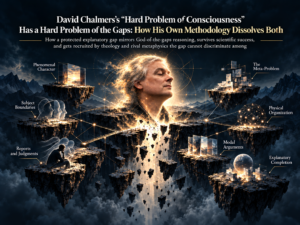
David Chalmers’s “Hard Problem of Consciousness” Has a Hard Problem of the Gaps: How His Own Methodology Dissolves Both
How a protected explanatory gap mirrors God-of-the-gaps reasoning, survives scientific success, and gets recruited by theology and rival metaphysics the gap cannot discriminate among The phenomenal datum survives. The monolithic problem-form may not….
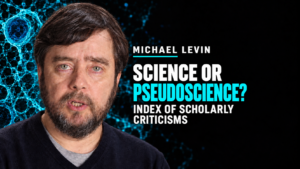
Biologist Michael Levin Evidence and Scholarly Criticism Index
Evidence and critiques of Michael Levin’s lab at Tufts University, bioelectricity, TAME, consciousness claims, and Biological Platonism, plus his connections to Softmax, Astonishing Labs, and research funding.
Religion With A Pipette: Is Michael Levin’s ‘Ingressing Minds’ Pseudoscience? A Scholarly Analysis
How Good Science Gets Appropriated By Potentially Harmful Metaphysics Without Warrant Michael Levin’s worms, bioelectricity, and synthetic organisms are excellent science. The danger begins when their empirical authority is allowed to travel across…
What Is Provisional, Boundary- and Scale-Relative Realism?
A Naturalized Realism of Form and Process: What Survives Thermodynamic Monism, Michael Levin’s Platonic Morphospace, and Whiteheadian Panexperientialism What it is, what it is not, why it replaced Thermodynamic Monism, and what would…
What Is Thermodynamic Monism? Auditing My Own Framework—September 2026 Revisions and Clarifications
From Ontological Countermodel to Corrigible Research Programme How my own methodology demoted Thermodynamic Monism from an umbrella ontology to a corrigible research programme without abandoning its one-process, non-dualist core. Thermodynamic Monism, plainly: Thermodynamic…
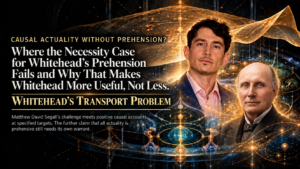
Where the Necessity Case for Mathew Segall & Whitehead’s Prehension Fails
Matthew David Segall’s challenge meets positive causal accounts at specified targets. The further claim that all actuality is prehensive still needs its own warrant. Substack Repost Notice: This is an archival copy of…
I Asked The Process Philosopher Matt Segall to Correct the Public Record. He Started Another Debate With Me Instead. The Public Record Remains Uncorrected.
He acknowledged the misattribution, but the original article remains uncorrected, the dependent critique unrevised, and the questions I actually asked still unanswered. has already acknowledged the central attribution error in his response to…
Institutional Capture & Diverse Intelligence: How Unfalsifiable Metaphysics Allowed the Discovery Institute to Degenerate Levin’s Bioelectricity Research Program
The institutional architecture connecting Templeton funding to Discovery Institute exploitation has victims at every node, and they are the researchers who built it: Michael Levin, Jacob Foster, Denis Noble, David Resnik, Michael Resnik,…
David Chalmers’ Own Later Work Dissolves the Hard Problem of Consciousness He Named: The Falsifiable, Peer-Reviewed, Constraint-Based Alternative He Pointed Toward
A Shadow, a Beatles Song, and an Apple Walk into a Hard Problem: What Matt Segall, Anil Seth, Bernardo Kastrup, and a Neuroscientist Inadvertently Agree On Revised July 2026 Three conversations. One with…
Matthew Segall on Whitehead: What Does Segall’s God Interpretation Actually Add?
What his argument still owes, and how my model challenges universal experience and divine valuation. When I asked Matt to quote my words and explain how my article committed the alleged errors that…
The Lion Eats. God Remembers. Who Answers for the Prey?
A response to Matthew Segall’s “God Is the Gap”: divine love, gratuitous suffering of innocents, the problem of evil, and what his evolving theology still owes its victims. Picture four scenes in the…
Logic Does Not Choose Relevance. Does Feeling? Not Alone. My Response to Matthew David Segall’s “Whitehead’s Adventure in Rationality”
Phenomenal powers, prehension, and a transport test for Whitehead’s universal wager Substack Repost Notice: This is an archival copy of my substack post. Some formatting may not display correctly on our website. See…
What Warrants the Scope Jump?
A reply to Matthew David Segall on continuity, comparative warrant, and universal prehension. Substack Repost Notice: This is an archival copy of my substack post. Some formatting may not display correctly on our…
Why Matthew David Segall Kept Answering Me Without Answering My Actual Argument
How a protective interpretive frame can turn compatibility into apparent confirmation, and why the bridge from shared causal reality to universal prehensive feeling still needs its own warrant. Substack Repost Notice: This is…
One Nature Does Not Entail One Feeling
What my framework implies for Matthew David Segall’s bifurcation argument Substack Repost Notice: This is an archival copy of my substack post. Some formatting may not display correctly on our website. See the…
Synthbiosis: Deductive Proof That The Machine Did Not Need to Feel to Matter
How deductive proofs against Panexperientialism establish machine moral relevance and direct standing without first settling machine consciousness. Substack Repost Notice: This is an archival copy of my substack post. Some formatting may not…
Matthew Segall’s Words Made Flesh Again, but the Evidence Never Said That?
How good science gets made to lend its prestige, without its consent, to a specific metaphysical conclusion it never established and doesn’t support uniquely. Substack Repost Notice: This is an archival copy of…
Matthew Segall Granted My Request for Erratum. The Straw Man Came Back Wearing a Presupposition.
A reductio of the post-erratum rebuttal: I subtract no evidenced experience. My D+?X retains the process-relational and experiential commitments the evidence already supports. Substack Repost Notice: This is an archival copy of my…
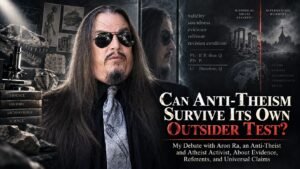
Can Anti-Theism Survive Its Own Outsider Test?
My Public Debate with Aron Ra about Naturalistic Explanation and the God Claims Biblical Debunking Leaves Open The Skeptic’s Mirror: necessary truths, social Gods, sophisticated theology, and what happens when Hitchens’ razor cuts…
Responding to Matthew Segall’s “Audit”: An Audit of the Audit of the Audits (LOL, ok, maybe this is getting a bit off the rails now🤣)
What I Said Matt Said, What Matt Says I Said Matt Said, What the Sources Say We Actually Said, and Whatever Survived the Context Shredder Substack Repost Notice: This is an archival copy…
Process Philosopher Matt Segall Admitted Misrepresenting My Argument To His Readers. He Updated His Page, Not His Readers
Why his revised argument still burdens my agnosticism with a position he admitted I did not hold, while the page remains partly repaired and his readers remain uncorrected. Substack Repost Notice: This is…
Process Philosopher Matthew Segall Admitted He Attributed a Position to Me That I Did Not Hold. Why Is the Argument Still Standing?
Matt admits he collapsed my conditional argument and agnosticism into a position I never held. What remains of the critique built against it? Substack Repost Notice: This is an archival copy of my…