Professor Philip Goff “Responded” to my argument: Panpsychism, “Heretical Christian,” Unfalsifiability, and the Evasion
Framework clarification and update: September–October 2026
This article predates several later clarifications and extensions of my methodology and working ontology. I am leaving the original argument intact for intellectual provenance rather than silently rewriting the record. The later work makes my claim typing, scope limits, bridge requirements, uncertainty bookkeeping, and comparative standards more explicit.
My work on Thermodynamic Monism was developed as a naturalistic process-relational research programme and comparative countermodel, particularly in response to Platonic and anti-physicalist arguments claiming that biological organization, morphogenesis, cognition, or other phenomena required additional nonphysical explanatory machinery. Its purpose was to test how much of the relevant explanatory work could be recovered from causal continuity, thermodynamic constraint, historically accumulated organization, multiscale dynamics, and higher-level difference-making without assuming the richer metaphysical posit under dispute.
I did not take that comparative success to establish that thermodynamics explains everything, that thermodynamic variables are privileged at every scale, or that empirical success by itself settles the intrinsic nature of reality. The current formulation makes those limits more explicit. The commitments I continue to retain include one causally continuous process order rather than separate causal substances or realms; thermodynamic constraints on physical realization; dynamically maintained and historically conditioned organization; and the reality of higher-level explanatory variables when they earn predictive, counterfactual, interventionist, compressive, or transferable leverage. One process does not mean one explanation.
The same clarification applies to my earlier use of falsification-first language. I did not use the rule “if it is not falsifiable, it is false.” My methodology already distinguished questions of semantic determinacy, evidential burden, theory-ladenness, auxiliary hypotheses, counterfactual testing, and Lakatosian research-programme appraisal. A sufficiently determinate empirical or causal claim should incur conditions under which it would lose support, but not every meaningful claim belongs before the same tribunal. Formal, semantic, phenomenological, historical, modal, normative, ontological, causal, and empirical claims can require different forms of warrant and criticism.
My current Recursive Corrigibility Framework formalizes that plural structure more explicitly. The shift from falsification-first to corrigibility-first is therefore primarily a clarification and expansion of jurisdiction: identify the claim type, determine what evidence or argument actually bears on it, locate the relevant bridge and dependencies, specify what could revise it, and localize failure to the part of the argument that actually failed rather than allowing one failure to automatically propagate through an entire framework.
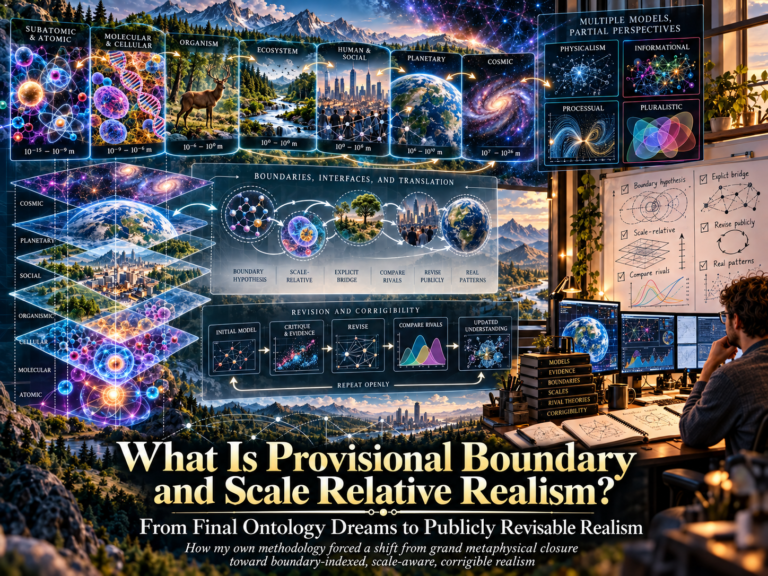
My current working ontology is Provisional, Boundary- and Scale-Relative Realism . It makes explicit a discipline already motivating much of the earlier work: boundaries, scales, identities, causal variables, and explanatory vocabularies must earn their relevance at the target under investigation. Local success does not automatically transport into universal, intrinsic, necessary, or exhaustive metaphysical conclusions.
An accessible statement of that position appears in What Is Provisional, Boundary- and Scale-Relative Realism? . Explanatory gaps are treated as records of missing warrant rather than automatic evidence for whatever ontology might fill them. Evidence also does not transport across boundaries, scales, or constructs merely because the same vocabulary can be used in both places.
My earlier consciousness work should be read with the same distinction in mind. My proposed bridge between organized physical dynamics and phenomenality was already presented as a risky empirical wager with explicit conditions for failure, not as a settled conclusion about phenomenal identity. Phenomenal identity remained unresolved. What later work makes more explicit is the dependency structure. Evidence for organizational closure, recursive integration, bounded perspective, temporal continuity, report, discrimination, self-modeling, valuation, or agency can bear strongly on those particular capacities without automatically settling whether any of them is identical with phenomenal experience. Evidence earned by one construct should not silently migrate into another.
I therefore now decompose the traditional Hard Problem more explicitly into distinct questions about phenomenal occurrence, phenomenal character, candidate subject boundaries, physical organization, report and judgment, the meta-problem, modal arguments, bridge principles, and explanatory completion. This preserves unresolved phenomenality without allowing the unresolved remainder itself to perform explanatory or metaphysical work that has not independently been earned. The Hard Problem dissolves as a distinct unitary problem if, once those constituent questions are separated, no additional positive explanandum remains and no necessary explanatory relation is lost by the decomposition.
The most current statement of that analysis is David Chalmers’s “Hard Problem of Consciousness” Has a Hard Problem of the Gaps: How His Own Methodology Dissolves Both . The newer argument asks whether the canonical Hard Problem retains any additional positive explanandum after its constituent questions are separated. If no positive residual can be identified, and no necessary explanatory relation is destroyed by the decomposition, then the monolithic Hard Problem dissolves as a distinct unitary explanandum while the constituent questions remain live wherever the evidence leaves them unresolved.
My later comparison with Matthew David Segall and Whiteheadian panexperientialism applies the same rule in another direction. In Where the Necessity Case for Mathew Segall & Whitehead’s Prehension Fails , I ask which explanatory targets actually require subjective prehension rather than merely remaining compatible with it. Mechanistic, dispositional, process, organizational, constraint-based, and intervention-sensitive accounts recover substantial causal explanatory work without subjective prehension as a premise. That undercuts a necessity claim at those targets without establishing that universal prehension is false. Its wider application still requires independent comparative and transport warrant.
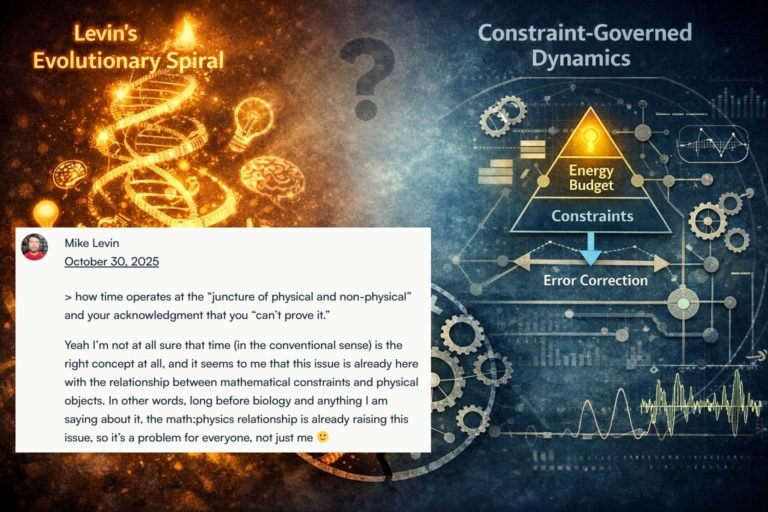
My October work on Michael Levin extends a distinction that was already central to my earlier criticism of biological Platonism: strong empirical results do not automatically transfer their evidential authority to every metaphysical interpretation placed around them. In Religion With A Pipette: Is Michael Levin’s “Ingressing Minds” Pseudoscience? A Scholarly Analysis , I separate the experimental evidence for bioelectricity, morphogenesis, biological competency, synthetic organisms, and multiscale control from the additional claim that such systems access nonphysical minds or Platonic structures.
The newer formulation makes the credit-assignment rule especially explicit: evidence shared by multiple rival explanations supports the shared empirical structure first. An additional metaphysical posit earns additional credit only when the feature it uniquely adds improves prediction, intervention, explanation, compression, transfer, or some other claim-appropriate discriminator relative to serious alternatives.
I have consolidated the larger Levin research programme in Biologist Michael Levin Criticism: Science or Pseudoscience? . The index separates the evidential status of Levin's experimental bioelectricity and morphogenesis work from the distinct questions raised by TAME, basal-cognition language, consciousness attribution, Platonic ingress, and stronger metaphysical or theological interpretations. It also collects later corrections, qualifications, primary sources, peer-reviewed literature, and comparative alternatives.
A fuller account of the development of Thermodynamic Monism, what I continue to retain, what I now state more narrowly, and which specific earlier formulations I would revise appears in What Is Thermodynamic Monism? Auditing My Own Framework—September 2026 Revisions and Clarifications .
Intelligent Design for People Who Hate William Lane Craig, or How to Relocate the Designer Inside the Universe and Call It Explanation
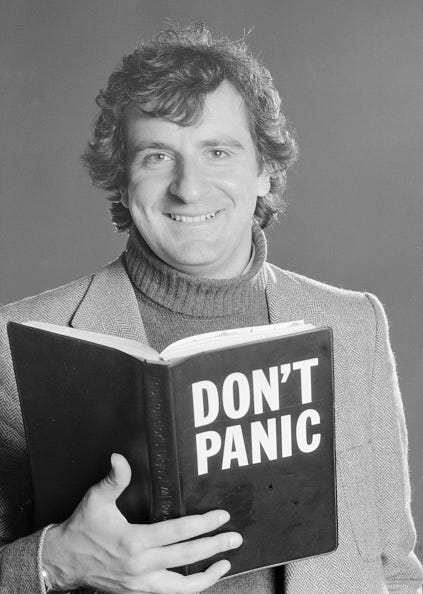
“This is rather as if you imagine a puddle waking up one morning and thinking, ‘This is an interesting world I find myself in—an interesting hole I find myself in—fits me rather neatly, doesn’t it?’”
— Douglas Adams
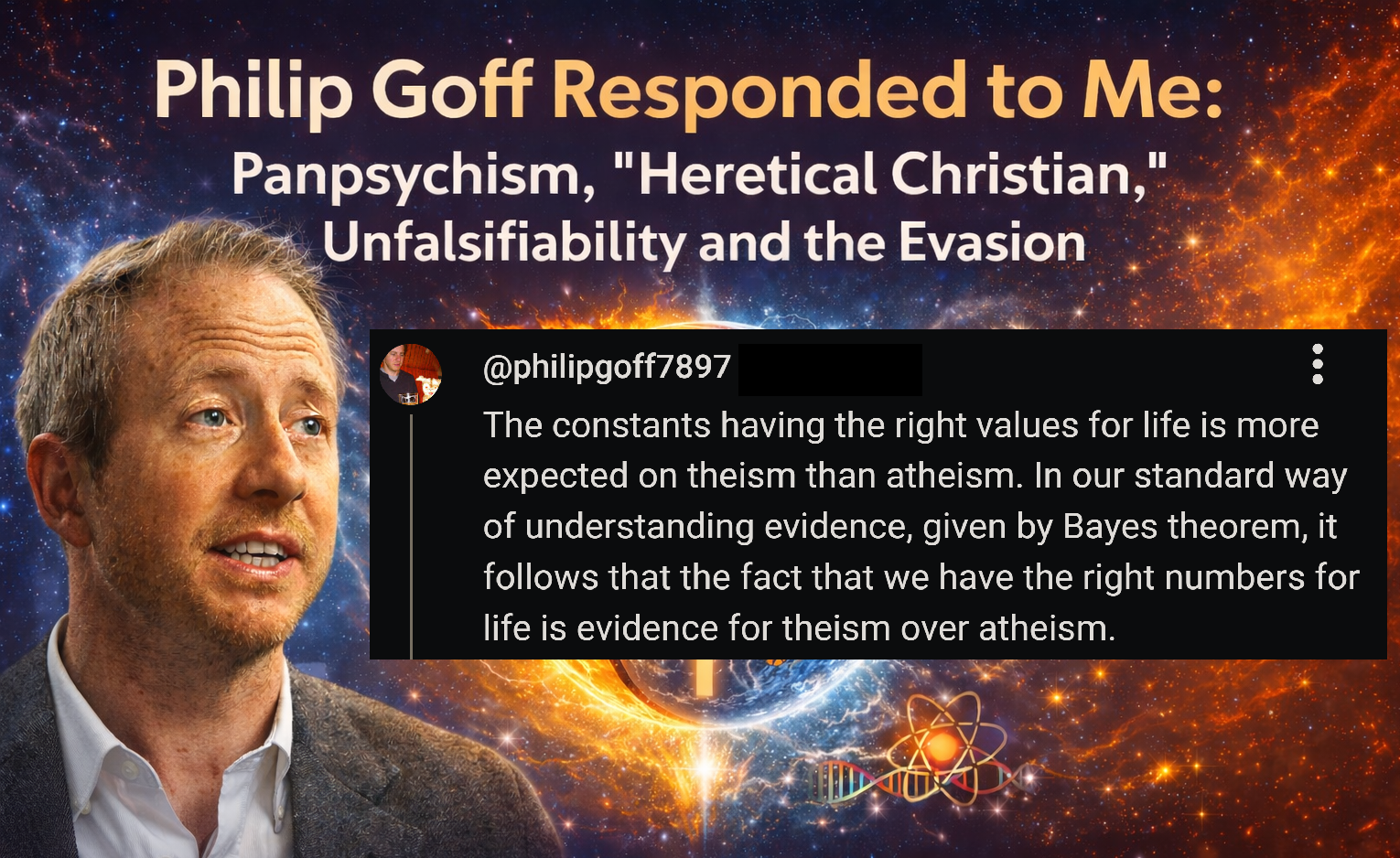
Our dear panpsychist Philosopher Philip sells “universal fine-tuning” the way late-night infomercials sell ab machines: if you squint hard enough at Bayes’ theorem, the universe secretly wants your love poems. The pitch hovers between cosmology and motivational speaking, but the universe doesn’t reciprocate. He recently appeared on Alex O’Connor’s podcast, doing just this: Jump to Video: “Why I am a Heretical Christian.” – Philip Goff” I couldn’t resist commenting on Philip Goff’s video because the core move looked too familiar to ignore. What I didn’t respect was him responding to it with blatant evasion rather than simply providing the evidence requested that would be required to support his argument and how he could know it failed or not.
I was honestly so disappointed with his response that I refused to believe the person that responded was the real Philip Goff, and assumed it was a fan. But… nope! It was Philip’s account. @philipgoff7897, as seen in the description on this video here: Sabine Hossenfelder’s Philosophical Mistakes about Mind w/ Philip Goff. When you read his response to me, I have a feeling you will be as surprised as I was. Or maybe not; perhaps I had been giving him too much credit? I’ll let the reader be the judge.
In his talk with Alex O’Connor, he frames consciousness as fundamental, talks like “the universe fine-tuned itself,” and treats “goals of its own” as if that magically dissolves the explanatory debt instead of relocating it. My comment argued that this is intelligent design with the Designer™© shoved inside the system and given diplomatic immunity from empirical challenge. I called out the anthropocentric valuation function explicitly: “the constants are compatible with things of great value” becomes the hidden premise that turns “we exist” into “therefore reality intends us.” I also flagged the predictable escape hatch: when pressure rises, the view leans on flexible constants “pre Big Bang” in a way that starts to resemble theological special pleading with different clothing tags.
@nathan_sweet Professor Goff offers us what he calls “the universe fine-tuned itself” (10:46–10:52) and assures us this constitutes an elegant solution to cosmological questions. The maneuver is transparent. He begins with consciousness as the fundamental substrate, grants the universe “goals of its own” (10:46), then claims “the constants weren’t set in stone” but “rather than being determined by random processes they are determined by the universe itself” (12:29–13:12). This is not an alternative to intelligent design. This is intelligent design with the Designer relocated inside the system and granted immunity from empirical challenge. When pressed on circularity by William Lane Craig, Goff “cheekily borrows from multiverse theorists” (12:04) to posit pre-Big Bang flexibility in physical constants, a theoretical rescue operation indistinguishable from theological special pleading. The anthropocentrism drips from every joint in the argument. Why does fine-tuning require explanation? Because “the constants are compatible with things of great value: life, intelligent life, people falling in love and writing poetry” (37:01–37:07). Douglas Adams had a puddle wake one morning and think, “This hole I find myself in fits me rather neatly, must have been made to have me in it.” We are that puddle. This is the same narcissistic logic that led pre-Copernican astronomers to place Earth at the center of everything. Replace “Earth” with “human experience” and the error remains identical. Goff admits his framework “accounts for the data better” (24:57–25:03) than traditional theism, yet the only datum being explained is our existence, which requires no cosmic intentionality whatsoever under naturalism. The universe did not aim at poetry. Poetry is what certain arrangements of matter do when sufficiently complex, no more requiring cosmic purpose than crystallization requires ice to intend its structure. The harm in accepting this framework extends beyond intellectual embarrassment. When academics grant legitimacy to unfalsifiable consciousness-primacy, they provide cover for Intelligent Design advocates seeking scientific respectability, undermine genuine research into evolutionary mechanisms, and corrupt students into believing metaphysical speculation constitutes explanation. Most brazenly, Goff converts his God problem into a God solution through sheer terminological gymnastics. He rejects an all-powerful God because “it doesn’t fit the bloody data of suffering” (25:40–25:48), so he posits a limited conscious universe “trying to create something new and something good” (1:00:37–1:00:43) that “can only do it in two stages” (1:01:01–1:01:06). This is progressive creation theology dressed in process metaphysics. God becomes the universe becomes a striving agent with specific limitations perfectly calibrated to explain why we observe both order and suffering. These limitations are “brute facts” (29:44–29:56) we must accept, yet somehow more intellectually satisfying than the multiverse or evolutionary naturalism, which require no cosmic mind at all. He has simply traded one set of unanswerable questions for another, while adding massive ontological baggage. The entire edifice rests on unfalsifiable metaphysics wrapped in scientific vocabulary. What observation would falsify “the universe fine-tuned itself”? What experiment distinguishes conscious cosmopsychism from mindless physical law? When asked about the mechanism, Goff retreats to “it’s just a fundamental fact that the conscious universe can do some things, can’t do others” (20:50–21:04). This is not explanation. This is capitulation labeled as sophistication. He claims to take fine-tuning seriously while explaining it with a hypothesis that generates zero novel predictions beyond standard cosmology, preserves all functional properties of traditional theism (intentionality, purpose, design), and immunizes itself from refutation by declaring consciousness fundamental. The result is intelligent design for people who find William Lane Craig too gauche, pantheism for those who need their mysticism peer-reviewed. It remains creationism in its structure, its logic, and its empirical vacancy.
Goff “replied” (yes, I went there; I was gracious enough to call what follows a reply, and I get this is a stretch), but not to the argument I made. He answered a simpler, more culturally convenient target: “theism vs atheism,” framed as if my critique depended on “random atheism,” and as if Bayes alone can convert “life-permitting constants” into evidence for a cosmic mind. That response dodges the actual pressure point, which was never “atheism good, theism bad,” but “what observation or intervention would come out differently if your conscious-cosmos story is true?”
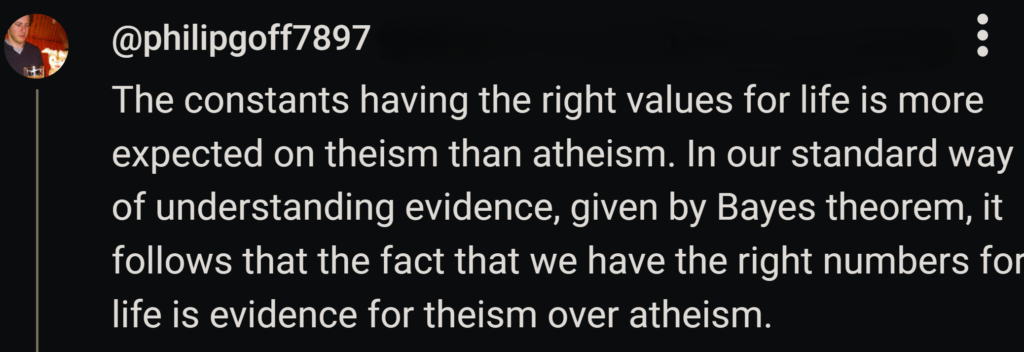
There we go, this must be the answer to everything I asked, right? The constants being right for life are “more expected on theism than atheism,” and Bayes supposedly seals the deal. But, and here’s the kicker, that is not engagement with thermodynamic monism, constraint-based self-organization, the falsifiability question, or anything that I actually said.
Woops, right? Surely he didn’t mean to do that.
So, giving him the benefit of the doubt, as the Principle of Charity and intellectual honesty demands of me, and offering him a chance to engage with my argument with intellectual honesty rather than intellectual laziness, I followed up directly: this is a false dichotomy (theism vs “random atheism”), a strawman (naturalism does not mean “random”), and an Igtheist definitional shell game where “God” becomes “whatever values life and tunes constants,” which explains any outcome equally and therefore explains nothing. My follow-up made that explicit: I do not defend “randomness” as an ontology, and I do not defend reductive caricatures of physics. I defend a constraint-based view where self-organization, free energy minimization, and attractor dynamics can generate complexity without importing purpose as a primitive. If the claim is about the world, it owes us measurable teeth. If it cannot cash out into discriminating predictions, it is not evidence-based cosmology. It is aesthetic metaphysics wearing a false probability tie. I asked, again, for the thing that distinguishes explanation from poetry: what observation would falsify “the universe fine-tuned itself,” and what mechanism produces different predictions than standard cosmology?
Here is the reductio on Goff’s counter, tied to my article: “The Manufactured Binary: How Linguistic Drift and Institutional Capture Created the Atheism-Theism Divide.” The “theism vs. atheism” frame functions like a two-party system for metaphysics: it forces every critique into one of two branded camps, then treats defeating the caricature as defeating the argument. If “atheism” gets defined as “randomness,” then any non-random regularity becomes “evidence for theism,” and the conclusion is guaranteed before the first premise finishes loading. By that logic, any universe whatsoever becomes evidence for whatever you define as “theism,” because you can always redescribe the outcome as “more expected” on the view that you tailor to the outcome. That is not Bayesian reasoning. That is painting a target around the arrow, then calling the bullseye probabilistic support. The binary is manufactured because it makes evasion look like engagement: you can reply quickly, win rhetorically, and still never touch the falsifiability question you were asked.
My full response, for anyone curious:
@nathan_sweet @philipgoff7897 Professor, with all due respect, I am rather disappointed in your response. You are debating a ghost and demonstrating the intellectual dishonesty inherent in the position you are defending. You contrast your Theism with “Random Atheism,” but that is a False Dichotomy that ignores the framework I actually support: Thermodynamic Monism (which ironically aligns with Theism better than your own cosmopyshcism does); while attacking a position I don’t hold (Atheism), this is a really low level God of the Gaps argument, and I would expect a more good faith engagement from you than this. The Strawman here is blatant. I am not arguing the universe is “random”, a weak reductive physicalist caricature that doesn’t align with any serious physicists or mathematician’s view of the universe in 2025 is. I am arguing it is Constraint-Based. Systems self-organize into complex forms (life) not because a “Mind” wants them to, but because Free Energy Minimization creates attractors that favor complexity. This is Terrence Deacon’s “Teleodynamics” and Karl Friston’s “Active Inference.” It explains the “fine-tuning” as a structural invariant of a self-consistent reality, requiring no external or internal “Designer.” Your definition of “Theism” fails the Igtheist Check. You define God/Universe as “That which values life and tunes constants.” This is circular. You are painting a target around the arrow (Life) and claiming the “Universe-Archer” meant to hit it. If the universe was 99.9% black holes, you could define God as “That which values gravity” and claim the black holes are evidence for that God. Your logic validates any outcome equally, which means it explains nothing. Which God, and how’d you rule all the other mutually exclusive and contradictory alternatives mankind has come up with? Retreating into vague deism abandons theism entirely, while losing any distinguishability from naturalism. Ironically, your “God” is Idolatry by the standards of David Bentley Hart or Aquinas. You have reduced the “Ground of Being” to a “Cosmic Engineer” who tinkers with constants to get a result he couldn’t achieve otherwise. My framework, which views what people called “God” as the Process of Agape (Systemic Coherence) inherent in the laws themselves not a being with the attribute of Agape, is far closer to the ancient understanding than your “Intelligent Designer in a Lab Coat” and is actually supportable scientifically and is faithful to the original Greek per extensive textual-criticism scholarship. Graham Oppy has shown that Naturalism is strictly simpler than Supernaturalism because it creates the same explanatory fit with fewer ontological components. Your ‘Conscious Universe’ does not solve Fine-Tuning; it merely relocates the complexity into an undefined agent and declares the problem solved. This is not parsimony; it is an immunization strategy. You have constructed a linguistic shield to protect your metaphysics from the empirical falsifiability that any claim about the nature of reality must survive.
Goff’s silence after that is the point of this article: not that a philosopher replied, but that the reply dodged the falsifiability constraint and retreated to a Bayesian incantation that never touches the underlying causal story.
I did not expect Philip Goff to agree with me. I expected him to answer me.
That is the entire point of this post. This is not “I’m mad a philosopher disagreed with my worldview.” Disagreement is normal. Good disagreement is oxygen. This is about something more boring and more corrosive: a professional philosopher responding to a detailed, world-facing critique with a two-sentence template, as if the template counts as engagement. It does not. It is the intellectual equivalent of replying to a multi-page bug report with “works on my machine.”
That is not an argument. That is a gesture at a style of argument. That is pointing at Bayes as if Bayes is a priest and you just invoked his name, so the ritual worked. Bayes is not a priest. Bayes is a calculator. It does not care what you believe. It cares what you specify.
And Goff did not specify.
This post is my attempt to do what he did not do: put the missing assumptions on the table, show where the maneuver hides the bodies, and then state, as clearly as I can, why I find his reply disappointing. Not because it failed to flatter me. Because it failed to meet the standard of honesty his own position requires.
What my critique actually said
My original comment was not “lol fine-tuning is dumb.” It was a specific accusation: that Goff relocates “intelligent design” inside the universe, grants the universe “goals,” and then immunizes the whole story from empirical challenge by making consciousness fundamental and the universe a kind of striving agent. I called it intelligent design for people who find William Lane Craig too gauche. That line was not just for comedy. It was a structure claim. It says: your explanatory pattern preserves the functional role of theism (purpose, direction, selection of constants) while swapping the label on the agent and avoiding the usual objections to a supernatural designer by declaring the designer identical to the system.
I also pressed on falsifiability. I asked, bluntly: what observation would falsify “the universe fine-tuned itself”? What measurement distinguishes conscious cosmopsychism from mindless physical law? Where is the mechanism? When pressed, Goff retreats to brute facts about what the conscious universe can and cannot do. That, I argued, is not explanation. It is capitulation labeled sophistication.
Finally, I pressed on anthropocentrism. The fine-tuning discussion repeatedly treats “life like us” and “poetry” as if they are the target. But we are not the target. We are a local pattern that emerges given constraints. We are a puddle congratulating itself on how well the hole fits.
Those were the claims. They are falsifiable claims in the only sense that matters here: if someone can show that Goff’s position generates discriminating predictions, has a non-handwavy measure over constants, and does not function as an immunized purpose narrative, then my critique loses force. I am not afraid of that. I am begging for it. Because if I am wrong, I want to be wrong in a way that teaches us something.
Goff did not engage any of this. He did not touch mechanism. He did not touch falsifiers. He did not touch the “designer relocated inside the system” structure. He did not touch anthropic selection or the measure problem. He did not touch the difference between “Bayes as a formalism” and “Bayes as a license to assert whatever likelihood ratio you want.”
He replied with: “more expected on theism than atheism, therefore evidence.”
Which brings us to the first missing step.
Bayes is not a magic wand, it is a bookkeeping identity
Bayes’ theorem, in the relevant form, says:
Posterior odds = prior odds × likelihood ratio.
That’s it. It is a rule for updating. It does not tell you what the priors are. It does not tell you what the likelihoods are. It does not tell you what counts as “theism,” what counts as “atheism,” what counts as “life,” what reference class you are sampling from, or what measure over the constants you are using.
So when Goff says “the constants being right for life is more expected on theism than atheism,” he is asserting a likelihood ratio direction. He is not deriving it. He is not defending it. He is not even stating the model that would let someone else compute it.
This matters because the fine-tuning argument lives and dies on those hidden assumptions. If you refuse to state them, you are not doing Bayesian reasoning. You are doing a kind of probabilistic ventriloquism where you throw your intuitions into Bayes’ mouth and then act like Bayes said them.
If theist evidence arguments were honest, they would look like this:
- Define a hypothesis space H, including a precise model of “theism” that implies a distribution over constants.
- Define an alternative hypothesis space, including a precise model of “naturalism” that implies a distribution over constants.
- Define a prior distribution over hypotheses.
- Define a probability measure over constants or over effective laws, or else admit you cannot assign “improbability” in the usual sense.
- Condition on the observation that we exist as observers, or else you are double-counting the data.
- Compute the likelihood ratio.
Without that, “more expected” is just a feeling.
Goff did not do that. He did not even nod at the fact that those steps exist.
So the disappointment is not that he disagreed with me. The disappointment is that he acted like the hard part is optional.
The measurement problem, or why “improbable constants” is often undefined
Fine-tuning arguments usually begin with a claim like: “If the constants were slightly different, life would be impossible.” Even if we grant that for the sake of argument, the next step is the one everyone tries to skate past: “The life-permitting range is tiny compared to the possible range, therefore it is improbable.”
Improbable relative to what distribution?
If you assume a uniform distribution over some interval for each constant, you get a number. But why uniform? Why that interval? Why treat constants as independently variable knobs? Why treat them as free parameters rather than emergent invariants of a deeper structure?
And if you do not answer those questions, you do not have “improbability.” You have an intuition you like, plus a line segment you drew around it.
This is not a nitpick. It is the core. Without a principled measure, “tiny range” has no probabilistic meaning. It is like saying, “the number 7 is unlikely because it’s a small part of the possible numbers.” Possible according to which distribution? Over which space? Defined how? With what invariances? With what symmetries?
When someone says “fine-tuning is evidence,” but they cannot specify a measure, they are doing the rhetorical version of a unit conversion error. It looks like math. It is not math.
And if someone responds to criticism by invoking Bayes while leaving the measure implicit, they are not fixing the problem. They are polishing the problem.
The anthropic problem, or why “we observe life” is not “life was aimed at”
This is where the puddle metaphor matters, and yes, Douglas Adams deserves his frequent flyer miles.
If you condition on the fact that you are an observer, you should not be surprised to observe a universe compatible with observers. That does not explain the universe. It explains why you are not observing a universe in which no one can observe anything.
This is selection, not purpose. It is a filter, not a target.
To treat “we exist” as evidence for “a mind wanted us” you need to show that the observation of life is not just a selection effect. You need to show that, given selection effects, the data still strongly favors theism. That requires a model again. That requires defining what universes are in the sample space, how we are sampling, what counts as “an observer,” and how “theism” changes the probability distribution over observer-permitting universes compared to naturalism.
Goff’s reply did none of that. It did not even acknowledge that selection exists as a confounder.
This is part of why the non-response matters. It is not merely incomplete. It is structurally evasive. It skips the part where the argument becomes vulnerable.
The plasticity problem, or why “theism” often predicts everything and therefore predicts nothing
Suppose I grant Goff everything he wants, just to see where the logic leads. I grant that there is a meaningful distribution over constants. I grant that life-permitting ranges are “small” in some relevant sense. I grant that naturalism has trouble “explaining” that.
Now he has to show that “theism” predicts life-permitting constants with higher probability than naturalism does.
Here is the problem: “theism” is not a single hypothesis. It is a bucket of wildly different hypotheses with wildly different predictions. Does God value life? Does God value beauty? Does God value mathematical elegance? Does God value maximal suffering for inscrutable reasons? Does God value black holes? Does God value nothing because God is not a moral agent? Does God create many universes? Does God create one? Does God have constraints? Does God have a reason to optimize anything at all?
If you allow theism to flex its preferences to match whatever we observe, then it “predicts” every possible outcome. That makes P(data | theism) high by construction. But that is not evidence. That is curve-fitting with an unpenalized number of degrees of freedom.
In scientific terms: you are fitting noise with a model so flexible it cannot lose. In Bayesian terms: you are hiding the complexity in the likelihood function. In everyday terms: you are painting the bullseye around the arrow.
My critique of Goff’s cosmopsychism and “the universe fine-tuned itself” is basically the same: if the universe is a conscious agent with goals, but the goals are not specified in a way that constrains predictions, then the position can accommodate any result. It becomes immune. It becomes non-world-facing. It becomes metaphysics that borrows the authority of science while refusing science’s vulnerability.
Goff’s reply did not address this. He treated “theism” as if it is a crisp hypothesis with clear likelihoods.
It is not, unless you make it one.
If he wants to use Bayes, he has to pay the Bayes price: specify the model.
My position is not “random atheism,” and his reply pretends it is
In his response, Goff framed the comparison as theism versus atheism, and he implicitly framed atheism as “random chance physicalism,” the familiar cartoon: brute laws, brute constants, no structure, no constraints, just lucky dice.
That is not my view. That is not what serious physics looks like. That is not what serious complex systems theory looks like. It is not even what serious philosophical naturalism looks like when it has done its homework.
My view, and the view I think is forced on us by the evidence we actually have, is constraint-based. Call it thermodynamic monism if you want a label. But the core is simple:
Reality looks like a cascade of constraint satisfaction under thermodynamic law. Systems self-organize. They form attractors. They do not do this because a mind wants them to. They do this because certain patterns persist and others do not, given the energetic, informational, and dynamical constraints.
If that is true, then “fine-tuning” might be an artifact of treating the constants as free knobs rather than emergent invariants. It might be an artifact of looking at a local region of parameter space without understanding the deeper structure that restricts what is possible. It might be an artifact of underestimating how much “order” you can get from constraint propagation alone, without any goal-directed agent.
This is not “random atheism.” It is a different model class. It competes with theism and cosmopsychism by doing what they do not do: it tries to be mechanistic, and it tries to be falsifiable.
So when Goff says “fine-tuning is evidence for theism over atheism,” he is not answering me. He is answering someone else. He is answering the version of “atheism” that the fine-tuning argument needs as its foil.
That is why I called it a non-response.
“More expected” without a model is like saying “my drug works better than placebo” without defining the placebo or measuring anything
If you want to understand why I am not impressed by the Bayesian slogan, imagine a pharmaceutical company responding to a clinical critique like this:
Critique: “Your trial design has no control group, your endpoints are ambiguous, and you do not specify how you measured improvement.”
Reply: “Improvement is more expected on the drug than on placebo, therefore the improvement is evidence for the drug.”
That is nonsense. You would laugh them out of the room. You would demand the missing details. You would demand the actual statistical model. You would demand measurement procedures. You would demand the falsifiers. You would demand pre-registration. You would demand, basically, the discipline that makes science different from storytime.
Fine-tuning arguments and cosmopsychist purpose arguments often try to avoid exactly that discipline while borrowing its prestige. They use probabilistic language as a kind of rhetorical solvent. They dissolve the need for mechanism. They dissolve the need for discriminating predictions. They dissolve the need to specify a measure. They dissolve the need to state what would count as evidence against the view.
Then they call the residue “explanation.”
That is why I am disappointed.
What I wanted from Goff, specifically
I did not want a ten-paragraph apology. I did not want him to concede. I wanted him to answer the objections that make his position vulnerable.
Here are the minimal questions that would have counted as engagement:
- What is your hypothesis, exactly? Not “theism,” but which theism, specified in a way that yields likelihoods.
- What probability measure over constants are you using? If you do not have one, why do you keep using “improbable” language?
- How do you handle anthropic selection? Do you condition on being an observer? If so, how?
- What observation would count against your view? Not “it could still be true,” but what would lower your confidence?
- For your conscious-universe story, what is the mechanism by which the universe “determines” constants? What does “determines” mean in physics terms, not in poetic terms?
- What is the empirical footprint? What would we observe differently if your model is true compared to a constraint-based naturalism?
If you answer those questions well, you earn the right to argue. If you do not answer them, you are not arguing. You are marketing.
Goff’s reply answered none of them.
He gestured at Bayes and walked away.
What becomes of fine-tuning under thermodynamic monism
Here is the part that matters for my project, and it is also the part that gets lost in the “theism versus atheism” cage match. I do not think the right response to fine-tuning is “haha puddle, checkmate.” That is fun, but it is not enough.
The right response is to ask: what does the evidence actually support about why our universe has the effective regularities it does?
Under thermodynamic monism, you start from constraint propagation. You treat laws not as divine decrees and not as arbitrary dice results, but as stable regularities of a self-consistent dynamical system. You treat “constants” as parameters of effective theories, which may or may not be fundamental. You treat “possibility space” not as a buffet of universes you can pick from, but as a space constrained by deeper invariances we may not fully understand.
This reframes fine-tuning in a way that is both less mystical and more demanding:
- If the constants are truly free parameters with a known measure, then “improbability” might be meaningful. But we do not have that. So the argument is premature.
- If the constants are emergent invariants of deeper structure, then their values might be typical given that structure, and the “tiny life-permitting range” narrative collapses.
- If there is a multiverse, then selection effects become dominant, and the fine-tuning argument must be reformulated carefully or it becomes a puddle argument with extra steps.
- If life is more robust than we assume, then the life-permitting region is larger than the fine-tuning argument implies.
- If “life” is defined anthropocentrically as “life like us,” the whole argument is a category error. You are using one local biological implementation as a cosmic target.
None of this proves theism false. That is not the point. It shows that the fine-tuning argument, as commonly deployed, does not earn the confidence it claims.
And it shows why Goff’s response was disappointing: it assumes the fine-tuning argument is already in a form Bayes can just consume, when it is not.
Why cosmopsychism often functions as intelligent design with the designer moved inside the system
Now for the part that tends to make people uncomfortable, because it sounds “mean,” but it is not about being mean. It is about structure.
When someone says “the universe fine-tuned itself” or “the universe has goals” or “consciousness is fundamental and guides the unfolding,” they are doing a move that preserves purpose without paying for purpose.
They want the explanatory comfort of a teleological narrative (things happened for a reason, toward a value-laden end), but they want to avoid the liabilities of traditional theism (a supernatural agent, intervention, the problem of evil, conflict with science, etc.). So they build a new story: the universe itself is the agent.
But if you do that, you have to answer the same questions theism has to answer, just with new labels:
- What is the mechanism of goal-directed tuning?
- What are the constraints on the agent?
- How do you distinguish “agent-like behavior” from “constraint-driven self-organization”?
- What would falsify the claim?
If the answers are vague, you are not doing better than theism. You are doing theism in a different outfit.
This is why I used language like “immune to empirical challenge.” If your universe-agent can always be invoked to explain any outcome, then it does not predict. It rationalizes.
And rationalization is not explanation.
If the universe is a conscious agent but you cannot say what it would do differently, then “agent” is a decorative label
Imagine two universes:
Universe A: fundamental physics, constraint propagation, thermodynamics, no additional interior agent.
Universe B: exactly the same physics, exactly the same observed phenomena, but you also declare “the universe is conscious and has goals.”
If Universe B has no additional observable consequences, then Universe B is not a better explanation of the world. It is a different way of talking about the same world. It might be ethically inspiring. It might be psychologically comforting. It might be poetically powerful. Fine. But then do not sell it as evidentially supported ontology. Do not dress it as science-adjacent explanation while refusing the requirements that make explanations accountable.
So when Goff says “more expected on theism than atheism,” he is asking us to treat his model as world-facing and evidential. But he is not doing the work required to make it world-facing and evidential.
That is the mismatch.
The simplest steelman of Goff’s move, and why it still fails without details
To be fair, there is a steelman version of his Bayesian reply. It goes like this:
Premise: If God exists and values conscious beings, then God is more likely to create a universe with laws that allow conscious beings.
Premise: If naturalism is true, there is no reason to expect life-permitting laws rather than sterile laws.
Therefore: Observing life-permitting laws increases the probability of theism relative to naturalism.
Even this steelman fails without details because:
- It assumes “naturalism provides no reason,” which is false if naturalism includes constraint-based self-organization and the possibility that constants are not free knobs.
- It assumes God values conscious beings, which is not entailed by “theism” unless you specify it.
- It assumes God has the power to choose laws freely, which is not entailed by many sophisticated theologies and is exactly the kind of “cosmic engineer” framing that classical theists often reject.
- It does not handle selection effects properly.
- It does not specify a measure over possible laws or constants.
So even at its best, the Bayesian move is not wrong. It is incomplete. It is a promissory note. And promissory notes are not evidence.
Why I am not satisfied with “just metaphysics” as an escape hatch
There is a move that always appears at this point: “You are asking metaphysics to behave like science, but metaphysics has different standards.”
Sometimes that is true. Sometimes it is a dodge.
If someone is doing metaphysics as interpretation, as a way of organizing experience, as ethics, as aesthetics, as existential orientation, then fine. Use coherence. Use adequacy. Use whatever human criteria you want. But then do not claim you are making evidential statements about the world that are supported by Bayes. Do not say “this is evidence.” Do not pretend your metaphysics is superior because it “accounts for the data better,” unless you are willing to specify what you mean by “data” and how the accounting works.
The moment you claim evidential support, you have entered the arena of accountable inference. You have to pay the price. You cannot claim the prestige of scientific reasoning while insisting on exemption from scientific vulnerability.
Goff, in his reply, invoked Bayes. That is the language of evidential support. If you invoke it, you owe the details.
The reply I wish Goff had written
Here is what a good faith, intellectually serious reply could have looked like. He could disagree with me and still be serious:
“Your critique raises legitimate questions about measures over constants and anthropic selection. I think fine-tuning arguments can be formulated without a precise measure by using comparative expectation across model classes, but I agree that this is a weak point that needs care. When I say ‘more expected,’ I mean that on a theistic hypothesis where God values conscious life, the probability mass over life-permitting regimes is higher than on a naturalistic hypothesis where laws are not selected for life. I acknowledge that this depends on how we model divine preferences and on whether constants are genuinely free. On my view, we cannot currently give a decisive Bayes factor because the priors and likelihoods are underdetermined, but I think the direction still modestly favors theism. As for falsifiability, I agree my view is not testable in the way a physical theory is, and I do not claim it generates novel predictions. I claim it is the best explanation in the sense of theoretical virtue. If you want a world-facing model with intervention hooks, my position is not that.”
If he had written something like that, I would still disagree. But I would respect it. Because it would have faced the objections rather than stepping around them.
Instead, I got the Bayesian bumper sticker.
Where this goes if the style of non-response becomes the norm
This is not just about one YouTube comment thread. It is about a pattern. When philosophers, academics, and public intellectuals normalize “Bayes-washing” metaphysics, here is what happens next:
- The public learns that “evidence” is a rhetorical token you can invoke without specifying models.
- Intelligent Design advocates learn that they can retrofit their narratives with probabilistic language and gain legitimacy by association.
- Students learn that “explaining” something means naming a mystery and then declaring it fundamental.
- Science communication gets polluted, because people stop distinguishing between mechanistic explanation and metaphysical gloss.
- Real work on consciousness, cosmology, and complex systems gets drowned in attractive non-falsifiable stories.
I am not saying Goff is malicious. I am saying the incentives are perverse, and the style of reply he gave is exactly the style that spreads memetically: short, confident, and unspecific. It feels like an answer. It is not.
What I will do differently going forward.
This is partly for me, because I do not want to become the mirror image of the anti-intellectualism that I hate. It is easy to turn this into pure dunking. Dunking is fun. Dunking is also cheap. I want to be expensive.
So here is my operational rule for engaging these arguments publicly:
When someone invokes Bayes, I will ask them to state the model.
Not as a “gotcha.” As a falsification gate. If they can state it, we can argue. If they cannot, the conversation is not about evidence. It is about rhetoric.
My disappointment in Goff’s reply is methodological, not personal. He responded to a mechanistic and falsifiability critique with a likelihood-ratio slogan that does not address the missing assumptions.
If he wants to claim fine-tuning is evidence for theism, he has to specify the measure, the priors, the likelihood model, and the handling of selection effects. Otherwise, “more expected” is not an argument. This statement suggests that you not only lack evidence for your conclusion but also do not have a coherently defined referent to construct an argument around that leads to said conclusion. The result is an empirically contradicted vibe, not an argument. Confused primate noises don’t equal evidence for ontological claims, no matter how much we wish they would.
“Why I am a Heretical Christian. – Philip Goff & Alex O’Connor – Within Reason