Michael Levin’s Platonic Spiral: Evolution or Unfalsifiable Circle?
Framework clarification and update: September–October 2026
This article predates several later clarifications and extensions of my methodology and working ontology. I am leaving the original argument intact for intellectual provenance rather than silently rewriting the record. The later work makes my claim typing, scope limits, bridge requirements, uncertainty bookkeeping, and comparative standards more explicit.
My work on Thermodynamic Monism was developed as a naturalistic process-relational research programme and comparative countermodel, particularly in response to Platonic and anti-physicalist arguments claiming that biological organization, morphogenesis, cognition, or other phenomena required additional nonphysical explanatory machinery. Its purpose was to test how much of the relevant explanatory work could be recovered from causal continuity, thermodynamic constraint, historically accumulated organization, multiscale dynamics, and higher-level difference-making without assuming the richer metaphysical posit under dispute.
I did not take that comparative success to establish that thermodynamics explains everything, that thermodynamic variables are privileged at every scale, or that empirical success by itself settles the intrinsic nature of reality. The current formulation makes those limits more explicit. The commitments I continue to retain include one causally continuous process order rather than separate causal substances or realms; thermodynamic constraints on physical realization; dynamically maintained and historically conditioned organization; and the reality of higher-level explanatory variables when they earn predictive, counterfactual, interventionist, compressive, or transferable leverage. One process does not mean one explanation.
The same clarification applies to my earlier use of falsification-first language. I did not use the rule “if it is not falsifiable, it is false.” My methodology already distinguished questions of semantic determinacy, evidential burden, theory-ladenness, auxiliary hypotheses, counterfactual testing, and Lakatosian research-programme appraisal. A sufficiently determinate empirical or causal claim should incur conditions under which it would lose support, but not every meaningful claim belongs before the same tribunal. Formal, semantic, phenomenological, historical, modal, normative, ontological, causal, and empirical claims can require different forms of warrant and criticism.
My current Recursive Corrigibility Framework formalizes that plural structure more explicitly. The shift from falsification-first to corrigibility-first is therefore primarily a clarification and expansion of jurisdiction: identify the claim type, determine what evidence or argument actually bears on it, locate the relevant bridge and dependencies, specify what could revise it, and localize failure to the part of the argument that actually failed rather than allowing one failure to automatically propagate through an entire framework.
My current working ontology is Provisional, Boundary- and Scale-Relative Realism . It makes explicit a discipline already motivating much of the earlier work: boundaries, scales, identities, causal variables, and explanatory vocabularies must earn their relevance at the target under investigation. Local success does not automatically transport into universal, intrinsic, necessary, or exhaustive metaphysical conclusions.
An accessible statement of that position appears in What Is Provisional, Boundary- and Scale-Relative Realism? . Explanatory gaps are treated as records of missing warrant rather than automatic evidence for whatever ontology might fill them. Evidence also does not transport across boundaries, scales, or constructs merely because the same vocabulary can be used in both places.
My earlier consciousness work should be read with the same distinction in mind. My proposed bridge between organized physical dynamics and phenomenality was already presented as a risky empirical wager with explicit conditions for failure, not as a settled conclusion about phenomenal identity. Phenomenal identity remained unresolved. What later work makes more explicit is the dependency structure. Evidence for organizational closure, recursive integration, bounded perspective, temporal continuity, report, discrimination, self-modeling, valuation, or agency can bear strongly on those particular capacities without automatically settling whether any of them is identical with phenomenal experience. Evidence earned by one construct should not silently migrate into another.
I therefore now decompose the traditional Hard Problem more explicitly into distinct questions about phenomenal occurrence, phenomenal character, candidate subject boundaries, physical organization, report and judgment, the meta-problem, modal arguments, bridge principles, and explanatory completion. This preserves unresolved phenomenality without allowing the unresolved remainder itself to perform explanatory or metaphysical work that has not independently been earned. The Hard Problem dissolves as a distinct unitary problem if, once those constituent questions are separated, no additional positive explanandum remains and no necessary explanatory relation is lost by the decomposition.
The most current statement of that analysis is David Chalmers’s “Hard Problem of Consciousness” Has a Hard Problem of the Gaps: How His Own Methodology Dissolves Both . The newer argument asks whether the canonical Hard Problem retains any additional positive explanandum after its constituent questions are separated. If no positive residual can be identified, and no necessary explanatory relation is destroyed by the decomposition, then the monolithic Hard Problem dissolves as a distinct unitary explanandum while the constituent questions remain live wherever the evidence leaves them unresolved.
My later comparison with Matthew David Segall and Whiteheadian panexperientialism applies the same rule in another direction. In Where the Necessity Case for Mathew Segall & Whitehead’s Prehension Fails , I ask which explanatory targets actually require subjective prehension rather than merely remaining compatible with it. Mechanistic, dispositional, process, organizational, constraint-based, and intervention-sensitive accounts recover substantial causal explanatory work without subjective prehension as a premise. That undercuts a necessity claim at those targets without establishing that universal prehension is false. Its wider application still requires independent comparative and transport warrant.
My October work on Michael Levin extends a distinction that was already central to my earlier criticism of biological Platonism: strong empirical results do not automatically transfer their evidential authority to every metaphysical interpretation placed around them. In Religion With A Pipette: Is Michael Levin’s “Ingressing Minds” Pseudoscience? A Scholarly Analysis , I separate the experimental evidence for bioelectricity, morphogenesis, biological competency, synthetic organisms, and multiscale control from the additional claim that such systems access nonphysical minds or Platonic structures.
The newer formulation makes the credit-assignment rule especially explicit: evidence shared by multiple rival explanations supports the shared empirical structure first. An additional metaphysical posit earns additional credit only when the feature it uniquely adds improves prediction, intervention, explanation, compression, transfer, or some other claim-appropriate discriminator relative to serious alternatives.
I have consolidated the larger Levin research programme in Biologist Michael Levin Criticism: Science or Pseudoscience? . The index separates the evidential status of Levin's experimental bioelectricity and morphogenesis work from the distinct questions raised by TAME, basal-cognition language, consciousness attribution, Platonic ingress, and stronger metaphysical or theological interpretations. It also collects later corrections, qualifications, primary sources, peer-reviewed literature, and comparative alternatives.
A fuller account of the development of Thermodynamic Monism, what I continue to retain, what I now state more narrowly, and which specific earlier formulations I would revise appears in What Is Thermodynamic Monism? Auditing My Own Framework—September 2026 Revisions and Clarifications .
“Competence without comprehension is the way of life of the vast majority of living things on the planet and should be the default presumption until we can demonstrate that some individual organisms really do, in one sense or another, understand what they are doing.” ― Daniel C. Dennett, From Bacteria to Bach and Back: The Evolution of Minds
Levin is right that development is not a dumb gene-to-trait vending machine. Real organisms correct errors, stabilize form, and regenerate using multi-scale control. He is also right that this changes how selection “sees” variation. His “Technological Approach to Mind Everywhere” frames this as a broad, experimentally anchored program for recognizing cognition-like competence across diverse substrates. None of this is contreversial in the slightest. But the newer rhetorical escalation, calling the genotype–phenotype map “intelligence” and leaning on latent spaces and “mind everywhere” language, often swaps mechanism for relabeling.
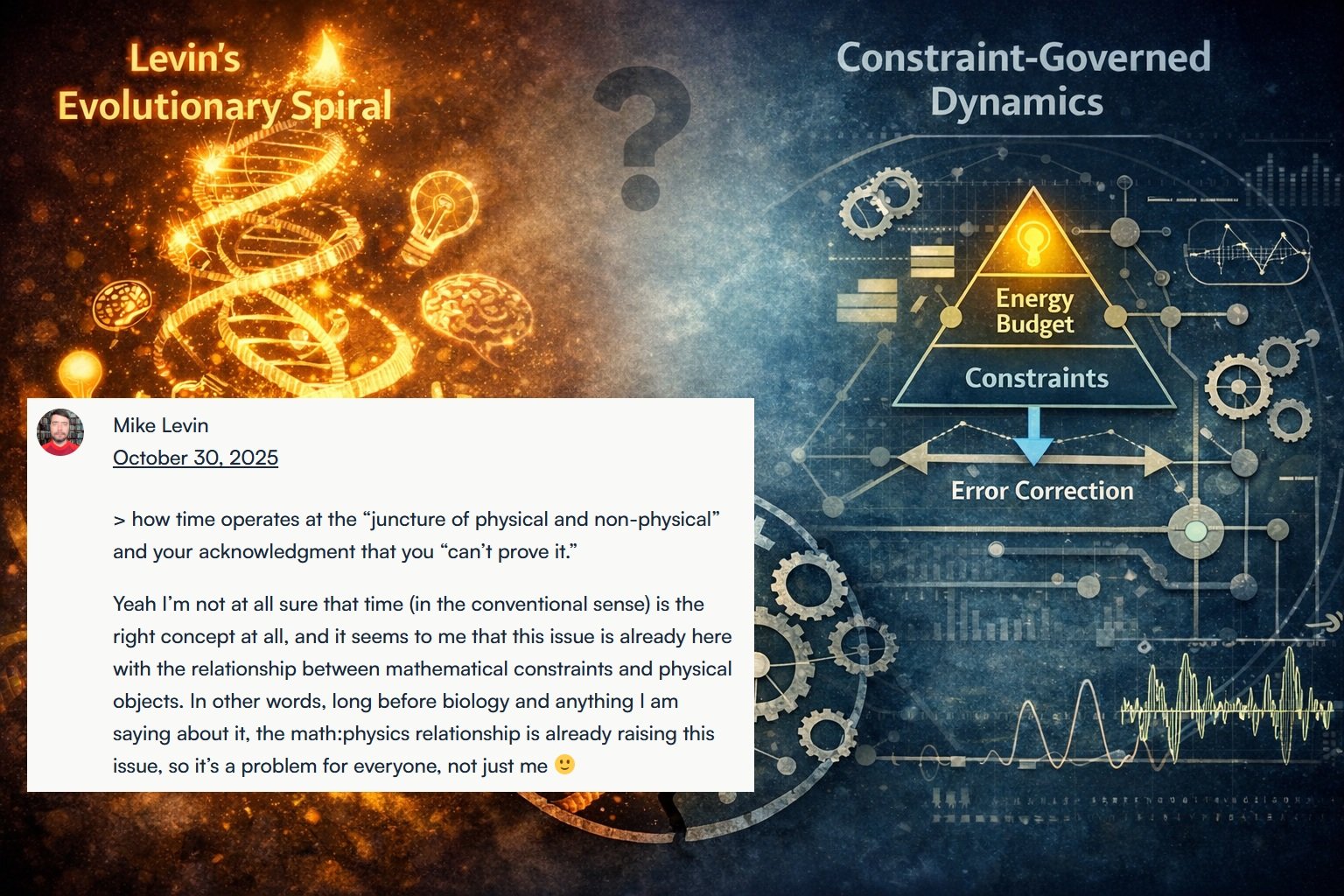
The result feels like an “evolutionary spiral” while behaving like a circle: identify robust control, rename it “intelligence,” and treat the rename as a discovery. Levin’s own framework is introduced as experimentally grounded, but the most expansive claims drift into positions that do not clearly state what would prove them wrong. That is a problem because a theory that cannot lose cannot teach. Levin’s best work is experimental. His weakest move is turning “effective higher-level descriptions” into “proto-mind ontology” without paying the price in falsifiers. Levin explicitly describes a framework for understanding minds across “diverse bodies” grounded in experiment, which makes the absence of crisp failure conditions in the most metaphysical extensions more glaring, not less.
If “intelligence” explains morphogenesis, what observation would force you to stop using the word?
Levin’s Oxford Talk: Four Claims and Three Paradigm Levers
Levin’s Oxford talk, A talk on evolution, from the perspective of diverse intelligence implemented in morphogenesis, is not one claim, it is a bundled package of four claims and three “paradigm challenges” that function like hidden load-bearing beams. If you do not name the beams, the audience experiences a smooth narrative arc and mistakes it for cumulative evidence. If you name them, you can ask the only question that matters under falsification pressure: which claims are mechanistic extensions of developmental biology, and which are ontological promotions riding on the back of useful descriptions.
The four claims, operationally, are these: (1) morphogenesis is goal-directed problem-solving by cell collectives, not a linear gene-to-trait vending machine; (2) evolution runs differently and sometimes faster because it operates on “agential material,” meaning a substrate with its own competencies; (3) novelty and open-endedness implicate something like a space of formal possibilities that biology can explore, often described with Platonic or “latent space” language; (4) minds, agency, and “top-down causation” scale upward via a ratchet in which learning-like dynamics and causal emergence reinforce one another. None of these is automatically incoherent, but each has a different burden of proof. Treating them as one seamless insight is the first methodological error.
The three paradigm levers Levin pushes against can be summarized as: A, “genes encode form in a mostly mechanical way”; B, “minds only exist in brains”; and C, “we are fundamentally physical beings” in the strictest sense. The first two challenges can be made productive without metaphysical drift, because cybernetics, control theory, evo-devo, and constraint-based biology already show how competence appears in non-neural systems. The third challenge is where the epistemic risk spikes, because it invites a slide from “our best models are abstract” to “abstractions are ontologically prior,” which is exactly where falsifiers tend to evaporate.
A rigorous audit therefore has to separate three layers that are routinely blended in the talk. Layer one is empirical: plasticity, regeneration, bioelectric patterning, and multi-scale control are real and experimentally tractable. Layer two is explanatory compression: “goal,” “memory,” “problem-solving,” and “agent” are summaries of constraint-governed dynamics, sometimes useful, sometimes misleading. Layer three is ontology: claims about non-physical domains, Platonic causation, or mathematics as a source of “free gifts” are not just summaries, they are commitments, and they require explicit mechanism or they default to skyhook status.
The test is not whether this language inspires experiments or keeps a lab busy; productivity is not a truth criterion. The test is whether each promoted term pays explanatory rent, meaning it generates discriminative predictions that a leaner constraint-based description would not generate. If “intelligence” does not sharpen what you expect to see under intervention, then it is a label, not an explanation. If “Platonic space” does not commit you to a specific, risky divergence from thermodynamic constraint satisfaction, then it is metaphysical decoration, regardless of how compelling it sounds on stage.
That is why the through-line of the critique is simple: keep the competence, keep the mechanisms, keep the experimental program, but force every conceptual escalation to name its failure conditions. If a claim cannot lose, it cannot teach. And if it cannot teach, it will be used as a rhetorical solvent that dissolves boundaries science needs to keep.
See More: Michael Levin’s Diverse Intelligence Framework: A Critical Analysis
Falsifiability Audit: Levin’s Weak vs Strong Claims
| Dimension | Weak Claim (Falsifiable, Scientifically Productive) | Strong Claim (At Risk of Unfalsifiability) |
|---|---|---|
| Core assertion | Developmental systems bias phenotypic variation, increasing the efficiency of natural selection. | Intelligence or agency is a primary driver of evolution, preceding or transcending selection. |
| Ontological commitment | Entirely physical and informational: constraints, control networks, feedback loops. | Implies non-physical or extra-physical sources of causal structure (e.g. Platonic patterns, ingressions). |
| Role of “agency” | Descriptive shorthand for distributed control and error correction in developmental systems. | Treated as an explanatory cause in its own right. |
| Relation to evo-devo | Fully compatible with evo-devo, facilitated variation, niche construction, plasticity-first models. | Risks bypassing evo-devo mechanisms by appealing to higher-level agency. |
| Mechanistic specificity | Explicit mechanisms: gene regulatory networks, bioelectric coupling, modularity, buffering. | Often underspecified; mechanisms gestured at but not fully cashed out. |
| Testable predictions | Predicts measurable changes when control networks are perturbed (e.g. loss of canalization, reduced evolvability). | Predictions often diffuse: “more intelligence,” “greater agency,” without clear operationalization. |
| Intervention tests | Disrupting communication channels (e.g. gap junctions) should reduce viable phenotypic transitions. | Hard to specify what would not count as agency manifesting. |
| Energy & thermodynamic accounting | Explicit costs: maintaining plasticity, control bandwidth, developmental robustness. | Costs often implicit or ignored, risking “free lunch” assumptions. |
| Relation to mathematics | Mathematics describes constraints on possible forms and dynamics. | Mathematics risks being treated as a source of novelty or causation. |
| Risk of nominalization | Low: terms map onto measurable variables. | High: “agency” risks becoming a re-labeled mystery. |
| Discriminative power | High: distinguishes systems with different control architectures. | Low: risks labeling all complex systems as agents. |
| Boundary with metaphysics | Clearly within biology and systems theory. | Blurs into metaphysics if not tightly constrained. |
| What would falsify it | Demonstrating that developmental bias does not increase viability or evolvability. | Difficult to specify falsifiers without retreating to weaker claims. |
| Scientific payoff | Advances regenerative medicine, evo-devo modeling, causal intervention strategies. | Risks conceptual inflation without proportional explanatory gain. |
| Epistemic status | Robust, progressive research program. | Degenerative unless sharply constrained. |
What Levin gets right: development is competent, history matters
Start with the part that does not deserve cheap shots. Developmental systems really do implement robust error correction. The organism’s phenotype is not a literal decode of the genome. It is the outcome of dynamics: signaling, electrophysiology, biomechanics, and constraint coupling across scales. That means the same genome can reliably reach similar endpoints through different micro-trajectories, and that property matters for evolvability. If you want a crisp way to say this without mystical fog, you can say: organisms are systems of constraints that regulate flows and thereby preserve organization across perturbations.
This is where a constraint-based biology is useful. Montévil and Mossio’s program treats organisms as maintaining themselves through interdependent constraints that modulate processes and collectively sustain the organization that produces those constraints. This is not vibes. It is a structural claim about how biological organization persists: constraints enable processes, processes maintain constraints, and the closure of these relations stabilizes the system as a whole. That “closure” notion explains why an organism can appear goal-directed without smuggling in a ghostly goal-setter. The “goal” is the persistence of the organization under constraint.
When you say “goal-directed,” do you mean “minimizes deviation from a viability set,” or do you mean “has intentions”?
Claim 1 Under Falsification Pressure
Goal-Directed Morphogenesis Without Mind Promotion
Levin is at his strongest when he stays inside the empirical envelope: development is robust, error-correcting, and capable of reaching similar endpoints via multiple micro-trajectories. This is exactly what you expect from systems with constraint closure, multi-scale feedback, and history-dependent state variables. Saying “the system has a target” can be a useful control-theoretic shorthand, but it is shorthand, and the shorthand must be cashed out in measurable state descriptions, not treated as a free-floating property called “intelligence.”
The central ambiguity is definitional: does “intelligence” here mean “competent regulation under perturbation,” or does it mean “mind-like properties that are ontologically basic”? If it is the first, then most of the dispute collapses into vocabulary, because cybernetics and dynamical systems theory already cover it. If it is the second, then the word is doing metaphysical work that requires a mechanism, a boundary condition, and a falsifier. Without those, “intelligence” becomes a dormitive principle with better branding.
A disciplined version of the claim can be stated without losing any empirical content: morphogenesis behaves as if it is minimizing deviation from a viability set across scales, using stored state and feedback to correct errors. In that formulation, “goal” is a description of the stability basin the system returns to, not a ghostly intention. The key scientific work is to identify what carries the long-range state, how it is written, and how it is rewritten under perturbation, whether via bioelectric networks, mechanical stress fields, gene regulatory architectures, or their coupling.
This is also where Levin’s best experiments can be used as constraints rather than as metaphors. If transient bioelectric perturbations can rewrite a regenerative setpoint, producing persistent anatomical outcomes across regenerations, then “memory” has an operational meaning. It means there exists a state variable with retention over time, and there exist interventions that shift the system into a new attractor. That is not mystical, but it does impose hard requirements: the variable must be detectable, manipulable, and subject to energetic and informational costs.
A falsification-first reader should therefore demand a clear discriminator: what observable difference would separate “intelligent morphogenesis” from “complex regulated morphogenesis” once both admit feedback and memory? If the answer is “none, it is just a more inclusive term,” then the term should be demoted to rhetoric and replaced with the specific mechanisms it compresses. If the answer is “it predicts specific generalization under novel perturbations,” then name the perturbations, name the generalization metric, and state the failure threshold.
The practical upshot is that you can keep Dennett’s discipline while still crediting Levin’s competence story. Treat “agency” and “intelligence” as optional stances that are justified when they improve prediction and intervention design relative to lower-level descriptions, not as discoveries about a new ontological ingredient in matter. This protects the empirical program and blocks the category error in advance. It also forces the conversation to stay where science is supposed to live: in measurable control variables, not in vibes that survive every outcome by definition.
Where the spiral turns into a circle: definitional expansion as explanation
Levin’s recurring move goes like this: identify multi-scale regulation, define intelligence functionally (reach the same end by different means), declare the system intelligent, then treat that declaration as explanatory. But notice what changed between the first and last step: the mechanism did not deepen. The label did.
A definitional expansion can be rhetorically powerful while being scientifically empty. If you broaden “intelligence” until it overlaps with “adaptive control under constraints,” then you will “discover” intelligence everywhere you find feedback and memory. That includes organisms. It also includes thermostats, hurricanes, and autocatalytic chemistry. If you try to block that reductio by saying “no, not those,” then you owe a principled boundary condition, not a vibe-based exception.
Devil’s advocate, the fair version: broad terms can unify disciplines. True. But unification is not free. The cost is specificity. If your “intelligence” term does not sharpen predictions compared to “constraint-governed regulation,” you are paying for poetry with explanatory power.
What predictions does “intelligence” add that “constraint-governed regulation” does not already imply?
The Nominalization Cascade: How Homeostasis Became Cosmic Mind
The most instructive failure in Levin’s framework is not any single claim but the rhetorical trajectory that carries the audience from defensible empiricism to unfalsifiable metaphysics through a series of moves that each seem innocent until you notice the conjuring trick has already been performed. Wittgenstein diagnosed this pattern in Philosophical Investigations §308: “The decisive movement in the conjuring trick has been made, and it was the very one that we thought quite innocent.” The innocent move here is calling homeostasis “intelligence.” Once that linguistic substitution is accepted, the rest follows with a kind of logical inevitability that feels like discovery but functions as definition.
Watch the cascade unfold. Step one: organisms maintain form under perturbation, which is empirically uncontroversial and grounded in decades of developmental biology from Waddington’s canalization through Gilbert’s synthesis. Step two: this maintenance involves feedback, error-correction, and reaching similar endpoints via different micro-trajectories, which remains empirical and aligns with everything from Ashby’s cybernetics to Friston’s Free Energy Principle. Step three: William James defined intelligence as “reaching the same goal by different means,” therefore morphogenesis is intelligent. Here the move has been made. What changed between step two and step three? Not the mechanism. The label. And with that label comes an entire freight of anthropomorphic connotation that will do work throughout the rest of the argument without ever being examined.
From “morphogenesis is intelligent” it becomes natural to say “the genotype-phenotype map is intelligent,” then “evolution operates on agential material,” then “agents all the way down,” then “cognition precedes life,” and finally “mind is the largest set here, larger than physics.” By the end Levin is claiming, at 47:53 of the talk, that cognition encompasses non-physical systems and that mathematics provides “free gifts” of novel properties. But trace back through the chain and ask: at what point did we leave empirical ground? The answer is step three, when a process description (constraint satisfaction under perturbation) was replaced by a substance term (intelligence) that imported explanatory debt without paying it.
The verb-restore protocol exposes this directly. Ask of any noun: what process does this compress? “Intelligence” compresses constraint satisfaction, feedback regulation, and homeostatic maintenance. “Problem-solving” compresses the same dynamics viewed through an anthropomorphic lens. “Creativity” compresses the appearance of novel stable states under changed boundary conditions. None of these nominalizations add predictive content. They add connotation, the feeling that something mind-like is happening, without specifying any observation that would distinguish “intelligent morphogenesis” from “complex regulated morphogenesis.” If you cannot specify the difference, you are not making a scientific claim. You are making a rhetorical move, and the audience’s intuitions are doing the heavy lifting that mechanism should be doing.
Gregory Bateson saw this coming half a century ago. In Steps to an Ecology of Mind (1972), Bateson warned against the “dormitive principle” fallacy, where we explain a phenomenon by naming it and then treating the name as if it were an explanation. “Why does opium make you sleepy? Because of its dormitive virtue.” Why does morphogenesis reach stable forms? Because of its intelligence. Bateson’s entire corpus is a sustained argument that cybernetic explanation, properly understood, requires specifying the circuit, the feedback structure, the constraints on information flow, not invoking mental predicates as if they were mechanisms. When Levin calls developmental regulation “cognitive,” he is doing exactly what Bateson spent decades teaching us not to do.
Autocatalysis and “intelligence before evolution”: the clean version
Levin-style “intelligence precedes evolution” claims often sound radical, but a mechanistic version is mundane. Self-organizing chemical networks can explore state spaces and maintain organization before genetic replication exists. You do not need cognition talk for this. You need chemistry, networks, and constraints.
RAF theory gives you a formal handle. Hordijk’s definition treats a set of reactions as RAF when every reaction is catalyzed by something produced within the set and the set can be generated from an available food set. That is a mathematically crisp criterion for a kind of self-sustaining network organization. No spirits required.
Here is the reductio, stated plainly. If “pre-replicative self-organization” equals “intelligence,” then a candle flame becomes a genius, because it maintains structure by dissipating gradients. That is why the better move is to reserve “intelligence” for cases where additional operational properties appear: scalable learning, cross-context generalization, model-based intervention selection, and measurable improvements in error reduction per resource. Otherwise the word collapses into “non-equilibrium persistence.”
What property differentiates a RAF set from a mind, operationally, that you can measure?
Claim 2 Under Falsification Pressure:
“Agential Material” and the Baldwin-Style Bridge
The appeal of the “agential material” claim is that it can be true in a thoroughly unromantic way. Evolution does not search raw physics uniformly; it searches through developmentally biased constraint architectures. Organisms are not inert clay passively stamped by selection, but active systems that maintain, buffer, and regulate their own internal constraints. As Conrad Waddington put it in his original formulation of canalization, development “tends to produce a particular end-result regardless of minor variations in conditions” [1]. Selection therefore tunes control topologies at least as much as it tunes static traits. This view sits comfortably within evo-devo, Mary Jane West-Eberhard’s plasticity-first account of evolutionary change [2], James Shapiro’s emphasis on regulated genomic change [3], and the older James Mark Baldwin–Waddington lineage in which plasticity smooths fitness landscapes long before genetic fixation occurs. None of this requires rhetoric about “intelligence before evolution.” It requires only the admission that development shapes the search space in which evolution operates.
Where the argument begins to slip is when competence of the substrate is treated as an explanation rather than as a description of mechanisms that still require specification. Saying that “evolution is faster because the material is intelligent” risks becoming a classic nominalization: a flattering noun quietly replacing a causal account. Richard Lewontin warned against precisely this move decades ago, noting that invoking organismal properties without mechanistic grounding merely “relocates the problem rather than solving it” [4]. The correct move is not to deny substrate competence, but to enumerate its real accelerants: modularity in gene regulatory networks, reuse of conserved developmental toolkits, multiscale buffering and error correction, plasticity that yields functional phenotypes before genetic fixation, and constraint coupling that channels variation into viable regions of phenotype space. These mechanisms are testable, quantifiable, and admit trade-offs. They do not need to be baptized as “intelligence” to do their work.
A clean, falsifiable version of Michael Levin’s strongest point would read something like this: development biases the distribution of phenotypic variation such that mutations are expressed not as random forms, but as structured perturbations of an already competent control system. This increases the proportion of viable variants, thereby increasing the efficiency of selection, producing what appears to be accelerated evolution without foresight. This framing aligns closely with Marc Kirschner and John Gerhart’s theory of facilitated variation, in which conserved core processes generate adaptive novelty by recombination and regulation rather than blind search [5]. In this formulation, “agency” is not a mysterious cause. It is a property of developmental control networks that shapes which phenotypes are reachable under perturbation.
If Levin wishes to advance the stronger claim, namely that agency alters evolutionary dynamics in ways not reducible to the extended evolutionary synthesis, then the burden shifts to differential predictions. For example, one might predict that lineages with deeper multiscale error correction will display greater evolvability under novel stressors, but at measurable energetic cost, longer developmental times, or increased sensitivity to resource constraints. One might also predict that disrupting communication channels implementing high-level control, such as bioelectric coupling via gap junctions, will selectively impair certain phenotype transitions even when genetic variation is present. Levin’s own experimental work on bioelectric pattern regulation makes such predictions testable [6]. These are empirical bets, not slogans, and they live or die by intervention.
The same discipline must be applied to talk of a “functional agency ratchet.” Treated conservatively, it is a hypothesis about positive feedback between control integration and adaptive performance. But the moment the claim mutates into “mathematics supplies novelty,” its logical type changes. We are no longer describing biased search in physical systems; we are gesturing toward a source of causal structure that escapes thermodynamic and informational accounting. At that point, the argument brushes up against exactly the problem Daniel Dennett cautioned against: mistaking competence for comprehension, and then reifying the mistake [7]. This is where the candle-flame reductio ceases to be a joke and becomes a boundary test. If every dissipative structure qualifies as an agent, then “agency” no longer discriminates explanatory categories; it dissolves into ornament.
The constructive stance, therefore, is not to reject “agential material,” but to force it to pay rent. Cash it out in measurable variables: degrees of plasticity, bandwidth of sensing and coordination, energetic costs of maintaining flexible control surfaces, and intervention outcomes that distinguish competence as constraint closure from competence as mind-like cause. If those variables can be named, measured, and manipulated, the idea becomes biology. If they cannot, the phrase becomes a narrative bridge from evo-devo into metaphysics. And as Christopher Hitchens might have put it, a bridge that carries no traffic of prediction or risk should be dismantled before it is repurposed as a highway for whatever ideology happens to be shopping for a respectable citation.
What Evo-Devo Already Explained: Sean Carroll and the Toolkit Genes
The irony of Levin’s appeal to evolutionary novelty is that evolutionary developmental biology has spent thirty years explaining exactly the phenomena he attributes to Platonic morphospace, and explaining them without any metaphysical commitments beyond garden-variety biochemistry and population genetics. Sean Carroll’s Endless Forms Most Beautiful (2005) and the broader evo-devo synthesis demonstrate that the striking conservation of developmental toolkit genes across phyla, combined with the modular, hierarchical, and combinatorial logic of gene regulatory networks, produces exactly the kind of evolvability that Levin treats as evidence for pre-existing forms.
The key insight is that body plans are not stored in morphospace; they are generated by the deployment of conserved regulatory modules in different spatiotemporal contexts. Hox genes do not “access” a pre-existing limb plan; they activate cascades of downstream targets whose interactions produce limb-like structures when the constraints are satisfied. The remarkable fact that similar toolkit genes produce similar morphological outcomes across wildly divergent lineages is not evidence of Platonic forms but evidence of what Carroll calls “deep homology,” the conservation of regulatory logic that makes certain phenotypic solutions reliably reachable.
This is constraint explanation in Lange’s (2016) sense: the toolkit genes constrain the space of developmentally accessible forms, not by pointing to eternal templates but by physically channeling developmental trajectories. A form appears repeatedly across evolution not because it exists in a warehouse of ideals but because the dynamics of gene regulation, cell signaling, and tissue mechanics make that form a stable attractor under a range of initial conditions. Carroll’s evo-devo provides the mechanism that Levin’s Platonic biology only gestures at.
The evolvability of development, the fact that small genetic changes can produce large, coherent phenotypic changes, is explained by the modular, hierarchical structure of gene regulatory networks. Modules can be duplicated, co-opted, and recombined without catastrophic pleiotropic effects because the regulatory architecture buffers changes. This is Kauffman’s adjacent possible applied to ontogeny: the space of viable morphologies is structured by the network topology, not by a transcendent catalogue of forms. Xenobots, on this view, are what frog regulatory modules do when freed from frog-specific constraints, not evidence that xenobot properties pre-existed in mathematical space.
Category Inflation and the Discriminative Collapse of “Agent”
The “agents all the way down” framing deserves particular scrutiny because it exemplifies a failure mode that falsification-first epistemology is designed to detect: category inflation that destroys discriminative power. If everything with feedback and memory qualifies as an agent, then hurricanes are agents (they maintain structure, respond to perturbations, exhibit path-dependent behavior), candle flames are agents (they regulate their own combustion, recover from disturbance, maintain organization by dissipating gradients), and autocatalytic chemical networks are agents (they self-sustain, repair, and even “reproduce” in the right conditions). At this point the term “agent” has collapsed into “non-equilibrium system that persists,” which is every dissipative structure in the universe.
The honest response is to either (a) accept this collapse and stop treating “agent” as carrying any special explanatory weight, or (b) specify additional criteria that distinguish agents from mere dissipative structures. Levin does neither. He uses the intuitive weight of “agent” and “intelligence” while defining them so broadly that the intuitions are unearned. This is having your cake and eating it too: the rhetorical power of mind-language with the definitional escape hatch of “I just mean feedback and memory.”
Dennett’s intentional stance provides a more disciplined approach. You can usefully treat a system as an agent, as having beliefs and desires, when that framing improves prediction and control compared to lower-level descriptions. But Dennett is explicit that this is an interpretive strategy, not an ontological discovery. The thermostat has a “goal” in the sense that treating it as wanting a certain temperature lets you predict its behavior efficiently. The thermostat does not have a goal in the sense of phenomenal experience or genuine intentionality. Levin’s framework collapses this distinction, treating the usefulness of agential descriptions as evidence for agential ontology. That is a category error, and it propagates through every subsequent claim about minds preceding matter.
Bateson’s concept of logical types is directly relevant here. A category and its members are different logical types; confusing them produces paradox. “Intelligence” as a category describing certain system behaviors is one logical type. Specific instances of feedback regulation are another. Levin’s framework systematically conflates these types, treating the category as if it had causal powers independent of its instances. When he says “cognition is the largest set,” he is treating a descriptive category as a metaphysical foundation, which is exactly the type confusion Bateson and Russell warned against.
Internal Falsification: Durant et al. 2017 and the Path-Dependence Problem
The most damaging evidence against Levin’s Platonic morphospace framing comes from his own laboratory. Durant et al. (2017) demonstrated that bioelectric interventions in planarian regeneration produce path-dependent outcomes. The specific sequence and timing of voltage manipulations affects the resulting morphology, not just whether a head or tail forms, but the detailed characteristics of the outcome. This is precisely what thermodynamic constraint satisfaction predicts and what “accessing a pre-existing morphospace” cannot accommodate.
If morphological possibilities exist eternally in a Platonic space, waiting to be “accessed” by developmental dynamics, then the path taken to reach them should be irrelevant. The form is already there; the organism simply navigates to it. But path-dependence means the form is constructed through the specific constraint-satisfaction trajectory, not retrieved from a warehouse of possibilities. Different paths yield different outcomes because the outcome is the residue of the process, not a pre-existing target the process aims at.
This falsifier is internal to Levin’s research program. His experimental work demonstrates exactly the path-dependent, context-sensitive, constraint-governed dynamics that undermine his theoretical framework. The empirical Levin has produced results that the metaphysical Levin cannot explain without ad hoc patches. That is the signature of a degenerating research program in Lakatos’s sense: the empirical core keeps generating anomalies that the theoretical framework must explain away rather than predict.
D’Alembert’s principle from classical mechanics provides the right framing here. Constraints partition the space of admissible states; they eliminate trajectories rather than selecting among them. The constraint does not know or care about the “goal.” It simply rules out what cannot happen given the boundary conditions. What remains is what happens, and if the constraints are path-dependent (as they manifestly are in bioelectric morphogenesis), the outcomes will be path-dependent. No Platonic space required; no free gifts from mathematics; just physics doing what physics does.
Marc Lange’s Because Without Cause (2016) extends this insight into a full philosophy of constraint explanation. Lange argues that some explanations work by showing why certain outcomes are necessary given the constraints, rather than by tracing causal histories. The laws of thermodynamics explain why certain perpetual motion machines are impossible without specifying the mechanism by which any particular machine fails. Similarly, developmental constraints explain why certain morphologies are impossible, or unlikely, or reliably reached, without requiring that those morphologies exist independently in some abstract space. Constraint explanation is modal explanation: it tells you what must be given what could be. Levin’s Platonic framing adds a metaphysical layer (pre-existing forms) that constraint explanation renders superfluous.
The Xenobot Problem: What Actually Explains Novel Properties
Levin’s most rhetorically effective example is the xenobot, aggregates of frog cells that, removed from the frog-body context, exhibit behaviors never selected for: spontaneous locomotion, kinematic self-replication, wound healing in configurations that never existed in evolutionary history. Where do these properties come from? Levin’s answer at 43:44, “a free gift from mathematics,” is precisely the kind of non-explanation that sounds profound while explaining nothing.
The thermodynamic answer is mundane and therefore more likely to be true: xenobot properties are what frog cells do when liberated from frog-body constraints. The cells have a repertoire of behaviors, adhesion, contraction, signaling, division, that evolved in the context of frog development but are not limited to frog development. Remove the constraints that normally channel these behaviors into frog-making, and the cells will settle into whatever stable configurations the remaining constraints permit. The “novel” behaviors are not novel at all from the cells’ perspective; they are the same basic operations combined differently under different boundary conditions.
This is Prigogine’s dissipative structures applied to biology. Far-from-equilibrium systems with energy throughput self-organize into patterns that dissipate gradients efficiently. The specific patterns depend on the specific constraints. Change the constraints, change the patterns. There is no mystery about where xenobot kinematic replication “comes from,” it comes from the intersection of cellular capabilities and the new constraint environment. The mathematics that describes this behavior does not “exist” independently any more than the mathematics describing planetary orbits exists independently of planets. Mathematics is notation for constraint relations, not a separate realm generating physical behavior.
Kauffman’s autocatalytic sets (1986) and the RAF framework formalized by Hordijk (2023) provide the right conceptual vocabulary for pre-genetic organization. A reaction set is RAF (Reflexively Autocatalytic and Food-generated) when every reaction is catalyzed by something the set produces and the set can be bootstrapped from available precursors. This is a mathematically precise criterion for self-sustaining network organization, no cognition required, no Platonic space invoked, just chemistry and thermodynamics doing their thing. When Levin gestures at “intelligence before evolution,” the clean version is RAF closure under realistic boundary conditions. When he escalates to “free gifts from mathematics,” he has left science for metaphysics.
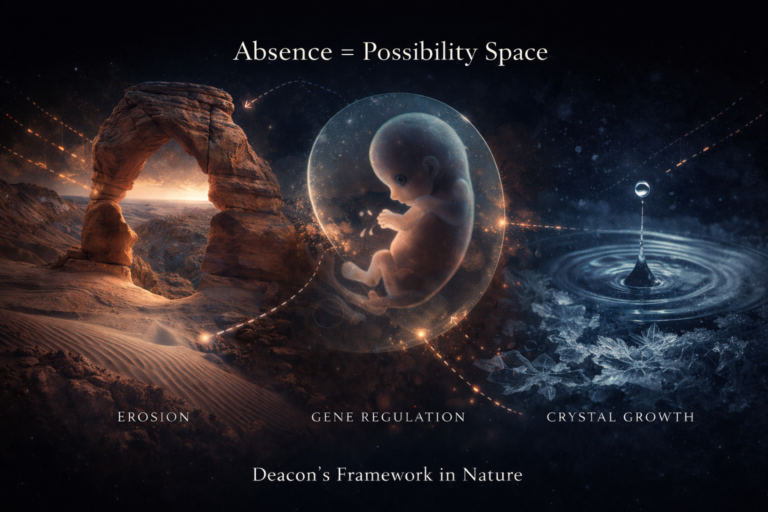
Terrence Deacon’s Incomplete Nature (2012) provides the most rigorous alternative framework for exactly the phenomena Levin wants to explain. Deacon’s teleodynamics shows how goal-directedness emerges from nested constraint satisfaction: autocatalytic chemistry yields self-maintenance, self-maintaining systems yield morphodynamics, and the constraints at each level are inherited by and modified at the next. Purpose appears without a purpose-giver because the constraints themselves select for outcomes that preserve the constraint-generating organization. Deacon explains xenobots without invoking cognition: they are what happens when autogenic (self-generating) constraints are satisfied under novel boundary conditions. The key move is recognizing absence as causal, constraints define what does not happen, and what remains is what does happen.
Montévil and Mossio: Closure of Constraints Without Minds
Montévil and Mossio’s “Biological organisation as closure of constraints” (2015) provides perhaps the most directly applicable theoretical framework for everything Levin attributes to intelligence. Their key insight is that biological organization consists of a network of constraints where each constraint is maintained by processes that are themselves constrained by other elements of the network. This closure, where constraints generate the conditions for their own persistence, is what distinguishes living systems from mere physical processes.
Critically, closure of constraints requires no cognition, no Platonic morphospace, no free mathematical gifts. It is a formal property of certain dynamical systems that can be defined precisely and tested empirically. A system exhibits closure when the functional constraints that make it work are regenerated by processes that are themselves functionally constrained by the system’s organization. The result is organizational stability that looks teleological but is explained entirely by the dynamics of constraint propagation.
This framework handles everything Levin cites as evidence for intelligence: regeneration (the constraint network repairs itself because closure requires maintenance of the conditions for closure), development (morphogenesis is the establishment of closure from initial conditions that only partially specify it), evolvability (closure under perturbation allows exploration of nearby organizational forms), and robustness (the network of constraints is self-stabilizing within limits). None of this requires Platonic forms. It requires only that living systems have the particular dynamical structure that Montévil and Mossio formalize.
The advantage of the closure framework over Levin’s is falsifiability. You can test whether a system exhibits closure by examining whether its constraints are regenerated by constrained processes. You can measure the degree of closure, the extent of constraint integration, the timescales of regeneration. These are empirical questions with empirical answers. “Does the system access Platonic morphospace?” is not an empirical question. It is metaphysics dressed as biology.
What “Emergence” Actually Means (And What It Doesn’t)
At 41:01 Levin anticipates the objection that xenobot properties are “emergent” and correctly identifies this as inadequate: “that means at the time things were selected to be a frog, it also learned to be xenobots… I find that very disturbing.” He is right that “emergence” is often a pseudo-explanation, a way of gesturing at phenomena without specifying mechanisms. But his alternative, “free gift from mathematics,” is equally pseudo-explanatory. Both are ways of avoiding the actual work of mechanism specification.
The thermodynamic answer is not “emergence” as magic word. It is: the same constraint-satisfaction machinery that produces frogs, when placed in different conditions, produces different stable states. There is no mystery about why xenobots can exist because there is no selection pressure required to explain them. They are not adaptations. They are what happens when you take adapted components and recombine them under non-adapted conditions. The components were selected for their roles in frog development, but their properties, contractility, adhesion, signaling, are substrate capabilities, not frog-specific talents. Those capabilities, combined differently, yield different outcomes. Full stop.
Deacon’s teleodynamics explains how goal-directedness emerges from nested constraint satisfaction without importing cognition. Autocatalytic chemistry yields self-maintenance, self-maintaining systems yield morphodynamics, and the constraints at each level are inherited by and modified at the next. Purpose appears without a purpose-giver because the constraints themselves select for outcomes that preserve the constraint-generating organization. This is Montévil and Mossio’s closure of constraints applied to the origins question, and it handles everything Levin attributes to “pre-evolutionary intelligence” without any of the metaphysical commitments.
The evo-devo perspective adds another layer. When Carroll and colleagues show that the same toolkit genes produce similar structures across divergent lineages, they are demonstrating that the space of developmentally accessible forms is constrained by regulatory network architecture, not by a morphospace external to biology. The “emergence” of xenobot properties is the same kind of phenomenon: regulatory and cellular capabilities have a combinatoric space of possible expressions, and changing the boundary conditions moves you through that space. No Platonic forms required; just physics and chemistry doing their thing under novel constraints.
The Cost Levin Doesn’t Pay: Thermodynamic Accounting
Bennett’s analysis of Landauer’s principle (2003) establishes that logically irreversible computation has minimum thermodynamic costs, roughly kT ln 2 per bit erased under ideal conditions, far more under realistic conditions. This is not a metaphor. It is physics. Information processing, memory maintenance, and error correction are physical operations with energetic and entropic bookkeeping.
Levin’s framework tends to treat plasticity, error correction, and “search in latent space” as if they arrive without cost. But if a system maintains robust form under noise, it is spending energy to do it. If it stores long-range bioelectric patterns, it is paying in ion pump activity, channel maintenance, and metabolic overhead. If it corrects errors, the correction process itself consumes resources. There is no free lunch in thermodynamics, and there is no free intelligence in biology.
This is where thermodynamic monism gains its teeth. Every claim about “competence” or “intelligence” should come with an explicit energy budget. Where does the ATP come from? What is the cost per bit of error-corrected morphogenetic information? How does that cost scale with the complexity and range of the error correction? These are not pedantic quibbles. They are the difference between science and poetry. Levin’s experimental work implicitly answers some of these questions, bioelectric interventions have measurable energetic correlates, but his theoretical framework treats the answers as irrelevant, as if the “intelligence” floats free of its thermodynamic substrate.
Prediction from thermodynamic monism: plasticity trades off against something. High-fidelity, long-range error correction cannot be free. Organisms with greater regenerative capacity should show corresponding costs somewhere, higher metabolic rates, longer development times, reduced allocation to other functions, increased vulnerability to energetic stress. If Levin finds organisms with arbitrarily high plasticity and no corresponding costs, thermodynamic monism is in trouble. But so far, every detailed examination of regenerative systems reveals the expected trade-off structure. The bill always comes due; the only question is which line item it appears on.
Causal Emergence: Information Gain, Not Mind Promotion
Hoel’s causal emergence framework provides a legitimate tool for talking about “higher-level causation” without leaving physics. The core insight is that coarse-grained descriptions can sometimes exhibit greater effective information than fine-grained descriptions, the macro model can be more informative about intervention outcomes than the micro model. This is a measurement claim about the predictive structure of descriptions at different scales, and it has been empirically demonstrated in various systems.
What causal emergence does not support is the move from “better macro model” to “mind-first ontology.” If coarse-graining improves effective information, that tells you something about the system’s control-relevant structure. It does not tell you that macroscopic descriptions are metaphysically prior or that cognition underlies physics. Levin slides between these levels promiscuously, using information-theoretic language to gesture at metaphysical conclusions the formalism does not warrant.
The constraint-based framing asks: when you say “higher-level causation,” do you mean a measurement claim or an ontological promotion? Causal emergence is a measurement claim. “Cognition is the largest set” is an ontological claim. The gap between them is not bridged by information theory. It is bridged by rhetoric, the feeling that if macro descriptions are predictively powerful, they must be ontologically fundamental. But predictive power and ontological status are different things, and conflating them is exactly the kind of move that makes frameworks unfalsifiable.
The Michael Resnik Alternative: Patterns Without Warehouses
If you want to talk about forms without leaving the universe, Michael Resnik’s mathematical structuralism (1981) provides better discipline than Platonic morphospace. On Resnik’s view, mathematics concerns patterns, and mathematical objects function as positions in structures rather than self-standing entities. The number 2 is not a thing floating in a Platonic realm; it is a position in the structure of arithmetic, defined by its relations to other positions.
Applied to biology: morphogenetic attractors are patterns in dynamics. They do not require a warehouse of organismal ideals waiting to be accessed. They require constraints, flows, energy gradients, and stability conditions. The “form” of a frog is not retrieved from a morphospace; it is constructed by the intersection of genetic, bioelectric, mechanical, and chemical constraints under specific developmental conditions. Change the conditions (as in xenobots), change the form, not because you are accessing a different region of morphospace, but because you are satisfying different constraints.
This is the cash value of Resnik’s structuralism for Levin’s empirical findings. You can acknowledge that biological forms exhibit pattern-like stability without reifying patterns into pre-existing objects. The stability comes from the dynamics, not from eternal templates that the dynamics somehow access. And the dynamics are thermodynamically grounded: patterns that persist are patterns that satisfy constraints under available energy budgets. Everything else dissipates.
The Collaborator’s Dilemma: When Structuralism Defends Its Opposite
Understanding the institutional dynamics around Levin’s Platonism requires examining how it functions within his collaborative network. The pattern is instructive for anyone trying to evaluate scientific claims that carry metaphysical freight.
David Resnik is an NIH bioethicist and Levin’s co-author on the TAME (Technological Approach to Mind Everywhere) framework. He is also the son of Michael Resnik, a well respected philosopher who spent four decades developing mathematical structuralism, a framework designed specifically to avoid the problems Platonic realism creates. The elder Resnik’s work, following Quine’s holism, argued that mathematical objects are “positions in structures” defined entirely by their relational properties, not things-in-themselves residing in a separate realm. “Mathematical objects have no features over and above their relational features,” he wrote in Mathematics as a Science of Patterns (1997). This dissolves the ancient problem of how abstract objects causally interact with physical systems: there is nothing to interact, because mathematical truth consists in structural relations that are instantiated in physical arrangements, not accessed from elsewhere.
The younger Resnik publicly claims to favor his father’s structuralism. Yet he defends Levin’s Platonism in public forums, creating a contradiction that illuminates how unfalsifiable frameworks perpetuate themselves through institutional legitimacy.
The contradiction emerges starkly in claims like this, which Levin has echoed publicly: mathematics is “immanent in the world, not separate from it,” yet “there can be mathematical facts that are independent of physical facts.” This formulation attempts to have it both ways, but the terms are mutually exclusive. If mathematics is immanent, it depends on physical instantiation and the structural relations are constituted by physical arrangements. If mathematics is independent, the mathematical facts hold regardless of physical instantiation, which means they are separate, which means we need an account of how we access them, which is exactly the 2400-year-old interaction problem that structuralism was invented to dissolve.
The Internet Encyclopedia of Philosophy states this directly: “An impenetrable metaphysical gap between the mathematical and spatio-temporal realms of the type that proponents of the epistemological challenge insist exists if platonism is true would exclude the possibility of causal interaction between human beings, who are inhabitants of the spatio-temporal realm, and mathematical entities, which are inhabitants of the mathematical realm.” Independence entails separation. Separation entails the interaction problem. The interaction problem is what structuralism eliminates by denying that mathematical objects have non-relational features requiring explanation.
This matters because the peer-reviewed collaborative work, the TAME paper and the goal-directedness preprint, is naturalistic. It describes goals “encoded in” bioelectric networks, systems exhibiting equifinality, organisms maintaining homeostatic set-points. This language is fully compatible with thermodynamic constraint satisfaction, with structuralism, with Dennett’s naturalism. It makes no claims about transcendent realms or organisms “accessing” patterns from elsewhere.
The Platonic additions appear in different venues: podcasts, YouTube videos, symposium comments, public talks. In these contexts, Levin describes organisms “ingressing from Platonic space,” “thin clients” downloading from mathematical servers, “free lunches” provided by mathematics, and asserts that “physicalism is not viable.” He has told the idealist philosopher Bernardo Kastrup that “idealism is probably the more accurate position.”
This creates what philosophers call a motte-and-bailey structure. The motte is the defensible position: naturalistic descriptions of bioelectric computation that require no transcendent commitments. The bailey is the ambitious claim: Platonic forms causally interacting with physical morphogenesis through unspecified mechanisms. When challenged on the bailey, retreat to the motte. When unchallenged, advance the bailey. The peer-reviewed work provides legitimacy cover; the public pronouncements do the metaphysical work; the retreat to peer-reviewed work deflects criticism.
“I Don’t Know How to Handle It”: The Admissions That Matter
The symposium record at thoughtforms.life contains remarkable admissions that rarely appear in discussions of Levin’s framework. When I pressed on how time operates “at the juncture of physical and non-physical,” Levin acknowledged:
“Yeah I’m not at all sure that time (in the conventional sense) is the right concept at all.”
When asked about the mechanism of interaction between Platonic forms and physical processes, he wrote:
“I’m not claiming I have a satisfactory vocabulary for it.”
These are not minor technical details to be worked out later. They are fundamental to the coherence of the proposal. A framework that posits causal interaction between physical and non-physical timeless realms must specify the mechanism of that interaction, or it is not a scientific hypothesis but a placeholder for one. Levin’s own words confirm the placeholder status: he does not know how the interaction works, he does not know whether conventional time applies, he admits he cannot prove it.
Yet the framework is presented to audiences of millions as if it were established science. The symposium itself was framed as exploring legitimate scientific questions, not as acknowledging that the core mechanism remains entirely unspecified after years of development, and 2,400 years of philosophy.
When confronted with the objection that his framework might commit Whitehead’s “fallacy of misplaced concreteness,” treating useful abstractions as if they were concrete realities, Levin responded: “I’ll have to read it. I’m open to finding problems here, all of this is being worked out and it’s early days.” The symposium occurred in late 2025. Levin has been presenting Platonic frameworks publicly for over a year. The “early days” framing suggests a research program just beginning, but the public presentation suggests established conclusions, frequently stated with confidence using rhethoric like “I don’t know what’s more woo” to create false dichotomies between his Platonism and naive physicalism that ignores centuries of philosophical and scientific advancements.
When confronted with the objection that his framework might commit Whitehead’s “fallacy of misplaced concreteness,” treating useful abstractions as if they were concrete realities, Levin responded: “I’ll have to read it. I’m open to finding problems here, all of this is being worked out and it’s early days.” The symposium occurred in late 2025. Levin has been presenting Platonic frameworks publicly for over a year. The “early days” framing suggests a research program just beginning, but the public presentation suggests established conclusions, frequently stated with confidence using rhethoric like “I don’t know what’s more woo” to create false dichotomies between his Platonism and naive physicalism that ignores centuries of philosophical and scientific advancements.

Frameworks that avoid the Platonic interaction problem by never positing seperate realms, despite Levin’s claim that this is a problem for “everyone”:
Aboriginal Australian Dreaming (Songlines) (W. E. H. Stanner, Deborah Bird Rose, Tyson Yunkaporta)
Indigenous American relational ontologies (Vine Deloria Jr., Robin Wall Kimmerer)
African Ubuntu metaphysics (John Mbiti, Mogobe Ramose)
Daoism (Laozi, Zhuangzi)
Classical Buddhism (Madhyamaka) (Nāgārjuna)
Advaita Vedanta (Śaṅkara)
Aristotelian hylomorphism (Aristotle)
Stoic physics (Chrysippus)
Spinozist monism (Baruch Spinoza)
Process philosophy (Alfred North Whitehead)
Pragmatism (Charles Sanders Peirce, William James, John Dewey)
Thermodynamic monism (Ludwig Boltzmann, Rolf Landauer, Ilya Prigogine)
Systems biology (Denis Noble)
Control theory / cybernetics (Norbert Wiener, W. Ross Ashby)
Active inference (Karl Friston)
Enactivism (Francisco Varela, Evan Thompson)
Ecological psychology (James J. Gibson)
Structural realism (Henri Poincaré, John Worrall)
Mathematical structuralism (Michael Resnik, James Ladyman & Don Ross, W. V. O. Quine)
The admission that cuts deepest came when Levin described his ontological commitments: “I think for now, the best model has at least 2 functionally coupled components: one described by mathematicians (and, I hypothesize, cognitive scientists), and one described by physicists. I (and many other workers) don’t see how they can be reduced to one.”
This is substance dualism stated plainly. Two ontologically distinct realms, physical and mathematical, “functionally coupled” through mechanisms that remain unspecified. The classical interaction problem that has plagued dualism since Descartes is acknowledged but not solved: “I don’t see how they can be reduced to one.” The hope that “someday” they might be “folded in somehow to a homogenous baseline reality” is not a solution but a deferral. Meanwhile, the dualist framework shapes how millions of people understand morphogenesis.
The Deflection to Penrose and Tegmark
When pressed on falsifiability, Levin has consistently deflected to other Platonists: “If you can actually say something convincing about why the facts of math are determined by anything physicists study, you have a lot to say to Penrose, Tegmark, Frenkel, etc. etc. I’m a very small fish in comparison to that pool of intellects, you’ve got much better targets there.”
This deflection fails for a crucial reason: Penrose, Tegmark, and Frenkel make different claims than Levin does, and the difference matters enormously.
Mathematical Platonists like Penrose argue that mathematical structures exist independently of physical instantiation. This is a descriptive ontological claim about the status of abstract objects. Penrose explicitly calls the relationship between mathematical, physical, and mental worlds “three profound mysteries” precisely because he lacks a mechanism for their interaction. When pressed on how physical brains access Platonic reality, critics note that Penrose resorts to “waving his hands and saying consciousness ‘breaks through’ to platonic reality.” He acknowledges the mystery rather than claiming to have solved it.
Tegmark’s Mathematical Universe Hypothesis makes a different move entirely: it claims that physical reality IS mathematical structure, not that physical systems ACCESS mathematical structure. This eliminates the interaction problem by collapsing the distinction. If the universe is mathematics, there is no gap to bridge.
Levin’s framework differs from both. He claims that organisms causally interact with Platonic space during morphogenesis, that forms “ingress” into physical systems, that cells function as “thin clients” downloading from mathematical servers. This is a prescriptive biological claim that requires mechanistic specification. It is not a philosophical position about the ontological status of abstract objects (Penrose) or an identity claim that dissolves the physical/mathematical distinction (Tegmark). It is a claim about biological mechanism that should be testable.
The distinction between descriptive and prescriptive Platonism is not subtle. As one analysis puts it: “The primary criterion of the distinction between mathematical platonism and mathematical pythagoreanism is, as it appears, the category of causality. In platonism, the mathematical entities are considered as epiphenomenal whereas in pythagoreism as real causes of the physical world.” Levin’s framework is Pythagorean: it claims mathematical forms cause biological outcomes. This claim requires empirical support that pure mathematical Platonism does not.
Deflecting to Penrose and Tegmark is therefore a category error. Their frameworks do not make the same claims and do not face the same objections. A critique of prescriptive biological Platonism is not answered by noting that descriptive mathematical Platonism exists.
The Map-Territory Conflation
At the symposium, Levin was asked whether morphospace might be “a useful mathematical idealization for organizing empirical observations about developmental attractors” rather than “a non-physical entity that causally interacts with cells.” His response is revealing:
“Yeah I don’t think that works. I don’t know what independent reality is; neuroscience (and I think physics) are telling us that naive realism is not viable… Everything is ‘real’ to the extent that it matters and can figure prominently as a target of relationships. And beyond all that metaphysics, the specifics here are: if I want to understand biology, I have to understand properties of mathematical objects. That makes them real, if they weren’t real, I wouldn’t have to worry about them or could change them at will.”
This conflates two distinct claims. The first claim is that mathematical descriptions are indispensable for understanding biology, which is uncontroversial. The second claim is that this indispensability demonstrates mathematical objects exist as non-physical entities that causally interact with physical systems. The inference from the first to the second does not follow.
When engineers use differential equations to model bridge stress, they must “worry about” the properties of those equations. They cannot change the mathematics at will. Does this prove that differential equations exist in a non-physical realm that causally interacts with bridges? Or does it demonstrate that mathematics provides powerful descriptive tools for capturing regularities in physical systems?
Hartry Field’s nominalist reconstruction project demonstrated that physical theories can be reformulated without ontological commitment to mathematical objects while preserving all empirical content. The mathematics is indispensable as a descriptive tool; it is not thereby demonstrated to be an ontologically independent realm. Levin’s inference pattern, “I have to worry about X, therefore X exists non-physically,” would prove far too much. We have to worry about the rules of chess to play chess well, but this does not demonstrate that chess rules exist in a Platonic realm that causally constrains piece movements.
The map-territory distinction is directly relevant. Morphospace is a mathematical description of possible morphologies, a map. Levin treats it as a territory that organisms navigate, accessing pre-existing forms through unspecified mechanisms. The Free Energy Principle literature addresses exactly this confusion: “The map-territory fallacy reduces to a failure to distinguish between recognition and generative models.” When we treat our descriptive frameworks as if they were the things being described, we commit exactly the fallacy Whitehead warned against.
The Category Error Cascade
A specific pattern recurs throughout Levin’s symposium responses and is now reproduced in his Platonic spiral evolutionary model: questions about mechanism are answered with claims about utility. When asked what experiment would falsify Platonic access, as distinct from thermodynamic relaxation and constraint satisfaction, Levin replies that the framework is “keeping about 6–7 people in my lab very busy” and has generated “more new discoveries than competing paradigms.” When pressed on the interaction problem in the context of the spiral model, he answers that his philosophical commitments motivated experiments “no one else did.”
These are claims about pragmatic productivity, not about explanatory mechanism or falsifiability.
A framework can be heuristically productive while being metaphysically false. Ptolemaic astronomy guided observation, generated predictions, and employed astronomers for centuries. Its success did not establish that the Earth sat at the center of the universe. Utility is not evidence of ontology.
The question of mechanism cannot be answered by citing productivity. If Levin’s spiral evolutionary model claims that organisms traverse or access Platonic attractors during morphogenesis or evolutionary exploration, there must be a mechanism. What carries the signal? What selects one attractor rather than another? What determines when transitions along the spiral occur? What is the energy cost of that access? These questions require answers in terms of physical processes, not sociological metrics like paper counts or lab throughput.
This failure becomes sharper when we ask a more basic discriminator: what does the Platonic spiral predict that thermodynamic constraint models do not? Levin has not named a single prediction generated by the spiral framework that contradicts or exceeds thermodynamic, control-theoretic, or information-theoretic expectations. Not one. Every empirical result his lab produces is already compatible with, and in many cases anticipated by, standard thermodynamic and constraint-based accounts of development, learning, and morphogenesis. The Platonic spiral adds no distinct, risky forecast.
Levin’s response to the energy question makes the category error explicit. When confronted with the observation that the spiral framework appears to posit “free lunches, stuff we didn’t pay for,” in direct tension with Landauer’s principle establishing minimum energetic costs for information processing, the response has been to treat “free lunch” as a feature rather than a problem. But Landauer’s principle is not philosophy. It is physics. Information acquisition, storage, and control have unavoidable energetic costs.
If organisms are “ascending” or “sampling” Platonic spaces as part of an evolutionary spiral, that sampling must appear somewhere in the thermodynamic accounting. Where, exactly?
This question remains unanswered because the mechanism remains unspecified. And the mechanism remains unspecified because specifying it would force the spiral model to become falsifiable. It would require Levin to name predictions that diverge from thermodynamic expectations and to risk refutation by the very data his lab produces.
At present, the appeal to Platonism in the spiral model functions post hoc. It is not doing explanatory work. It is not constraining models. It is not generating discriminative predictions. It is being retrofitted onto results that thermodynamic constraint analysis already explains. Calling this “philosophical guidance” is charitable. Treating it as evidential support is a category error.
If Platonic access does no predictive work, it earns no explanatory rent. And if the spiral model cannot be specified without collapsing into thermodynamic constraint satisfaction, then it is not an alternative evolutionary framework at all. It is an ornamental metaphysics layered atop physics it does not improve, challenge, or outpredict.
The heat budget does not care. Neither should we.
The Discovery Institute Problem
The Panda’s Thumb blog, a longstanding watchdog for creationist incursions into science, documented in May 2025 that the Discovery Institute was citing Levin’s Platonic language to support design arguments:
“The biologists that the DI platonists refer to are less clearly referring to any supernatural processes. Michael Levin comes closest: ‘instances of embodied cognition likewise ingress from a Platonic space, which contains not only low-agency patterns like facts about triangles and prime numbers, but also higher-agency ones such as kinds of minds.'”
This weaponization is not incidental. The Discovery Institute’s explicit strategy, documented in their own materials, is to “advance the argument that neo-Darwinism has failed to explain the origin of the highly complex information systems and structures of living organisms” in order to make it “reasonable to infer that the evidence of biology… suggests the need to consider that some intelligent cause may have played an indispensable role.”
Levin’s Platonic language provides exactly the scientific cover this strategy requires. When a respected biologist at a major research university claims that organisms “access” patterns from a non-physical realm, that “physicalism is not viable,” and that mathematical forms “inject information” into biological processes, the Discovery Institute gains a citation that pure mathematical Platonists cannot provide. Penrose and Tegmark make no claims about biological mechanisms. Levin does.
The logical structure is isomorphic to Intelligent Design arguments: wherever mechanistic explanation is incomplete, posit transcendent causation; make the mechanism unfalsifiable through vague language about “degrees of access” that accommodate any outcome; claim this enhances rather than contradicts naturalism. The difference is aesthetic, replacing “divine intelligence” with “mathematical forms,” while the logical structure remains identical: gaps in mechanistic explanation filled by appeals to non-physical causation with unspecified mechanisms.
Daniel Dennett spent his career fighting exactly this pattern. His distinction between “cranes” (mechanistic, bottom-up explanations that can be fully specified) and “skyhooks” (miraculous, top-down explanations that defer rather than provide mechanism) was designed precisely to identify when apparent explanations are actually placeholders. His “loan of intelligence” must be “repaid by finding and analyzing away these readers or comprehenders.” When Levin claims organisms “access” Platonic forms through unspecified “ingression,” he is taking out a loan that cannot be repaid. That is a skyhook by Dennett’s explicit criteria.
Levin studied with Dennett. He co-authored work on naturalizing teleology. His tribute to Dennett after his passing was genuinely moving. But the framework he now promotes contradicts Dennett’s core commitments in ways that provide ammunition to the movements Dennett spent his career opposing.
What the Symposium Record Reveals
The thoughtforms.life symposium is valuable precisely because it shows Levin responding to sustained critical pressure in real time. The pattern that emerges is consistent: when pressed on mechanism, deflect to utility; when pressed on falsifiability, note that the framework generates research; when pressed on the interaction problem, acknowledge it remains unsolved but defer to future work; when pressed on the Platonic label, disclaim commitment to Plato while retaining all the problematic features.
One exchange is particularly revealing. When confronted with the objection that mathematical Platonists like Penrose explicitly avoid the causal claims Levin makes, Levin responded: “I don’t believe they are causally inert. I think the ’cause precedes effect’ definition of causality, and the conventional time concept, break down here.”
This is a significant move. Standard causation requires temporal ordering: causes precede effects. If Levin is abandoning this requirement for the Platonic realm, he is not extending ordinary science but proposing something categorically different. Causes that do not precede effects, operating outside conventional time, interacting with physical processes through unspecified mechanisms: this is not a research program continuous with normal science. It is metaphysics that happens to be proposed by someone who also does normal science.
When asked what would falsify the framework, Levin’s response was instructive: “We can consider it a failure if, after some amount of active work (like with any new paradigm), it doesn’t generate more new discoveries than competing paradigms are doing.”
This is not a falsification criterion. It is a productivity criterion. A framework that generates discoveries is not thereby shown to be true; phlogiston theory generated discoveries. Falsification requires specifying what observation would demonstrate the framework is wrong. Levin’s response specifies no such observation. The framework succeeds if it is productive and fails if it is unproductive, but neither outcome tells us whether organisms actually access Platonic forms.
The symposium also reveals Levin’s response to the Whitehead objection. Matt Segall, a Whitehead scholar participating in the symposium, warned that Levin’s framing risks “misplaced concreteness,” treating useful abstractions as concrete realities. Levin acknowledged he would “have to read” the critique and was “open to finding problems here.” But the framework continues to be presented publicly without addressing the objection. The “early days” framing persists years into the program’s public presentation.
The Professional Responsibility Question
There is a dimension to this that academic philosophy rarely addresses: the professional responsibilities that attach to scientific claims when those claims are weaponized for harmful ends.
Levin’s co-author David Resnik is an NIH bioethicist. His professional role exists to identify when scientific work is distorted or misrepresented for public consumption. The NIH Scientific Integrity Policy requires “reasonable efforts by covered individuals to ensure the fidelity of the scientific record and to correct identified inaccuracies” and mandates that scientists “communicate science with integrity.”
The Discovery Institute is citing Levin’s Platonic language to legitimize anti-science agendas. They raise funds on this language to attack evolution education and climate science. The bioethics literature is explicit about responsibilities in such cases. Baur, Budnik, and colleagues wrote in the International Journal of Occupational and Environmental Health: “When scientific evidence is distorted to endanger health, silence is complicity, not neutrality. Scientists have a professional and ethical duty to expose misinformation disseminated by vested interests.”
The peer-reviewed collaborative work provides legitimacy cover for the public Platonic pronouncements. The motte-and-bailey structure ensures that criticism of the bailey gets deflected by citation of the motte. The harm compounds while no public correction occurs.
This is not an abstract ethical puzzle. The Discovery Institute’s educational initiatives reach millions of students. Their climate denial funding affects policy decisions with planetary consequences. When scientific language provides cover for these agendas, the scientists whose language is being used have responsibilities that extend beyond their own research programs.
What Actually Survives Scrutiny
After applying full falsification pressure, what remains of Levin’s framework?
The empirical demonstrations of plasticity survive. Picasso tadpoles, regenerating planarians, eye-on-tail functional integration, xenobot self-replication, anthrobot wound healing, these are real phenomena, replicable, and they constrain any adequate theory of development. Any framework that cannot accommodate this flexibility is inadequate.
The bioelectric research program survives. The correlation between voltage patterns and morphological outcomes, the ability to reprogram morphogenesis via bioelectric intervention, the integration of bioelectric signaling with other developmental control systems, all of this is solid science with clear mechanisms and testable predictions.
The observation that genomic “mess” correlates with regenerative capacity survives and deserves mechanistic explanation. My hypothesis: organisms with messier genomes are forced to rely more heavily on higher-level error correction (because genetic-level specification is less reliable), and this higher-level error-correction machinery generalizes better to novel perturbations. This is testable by comparing the organizational properties of developmental control networks across species with varying genomic complexity.
What does not survive is the interpretive escalation from “robust regulation” to “intelligence” to “agents all the way down” to “Platonic morphospace” to “mind precedes physics.” Each step of this escalation adds connotation without adding prediction. Each step makes the framework harder to falsify while feeling like it explains more. That is the signature of degenerating metaphysics, not progressive science.
The thermodynamic monism alternative handles all of Levin’s empirical findings without any of the metaphysical commitments. Constraint satisfaction under thermodynamic budgets explains plasticity, error correction, and novel stable states. Path-dependence falls out naturally from constraint dynamics. Causal emergence at higher levels is a measurement property, not an ontological promotion. “Intelligence” becomes a regime label for systems with certain measurable control properties, not a substance that precedes matter.
And critically: thermodynamic monism specifies its own falsifiers. If plasticity has no energetic cost, if path-independence holds despite different constraint trajectories, if forms appear without any traceable constraint-satisfaction process, if mathematical structures exhibit causal efficacy without physical instantiation, then thermodynamic monism fails. Levin’s framework, by contrast, absorbs every possible observation by expanding its definitions. That asymmetry is the difference between science and something else.
Frameworks That Already Explained This: A Summary
The irony of Levin’s theoretical apparatus is that every phenomenon he cites has already been explained by frameworks with better epistemic hygiene:
Developmental robustness and canalization: Waddington (1942, 1957) explained this as the landscape metaphor implies, dynamical systems with attractors. No minds required.
Modular, evolvable body plans: Sean Carroll and evo-devo (2005) showed that toolkit genes and gene regulatory network architecture explain both conservation and diversification of form. The combinatorics of regulatory deployment do the work that Platonic forms are invoked to do.
Self-organizing pattern formation: Prigogine (Nobel 1977) demonstrated that dissipative structures self-organize under far-from-equilibrium conditions. Order from chaos is thermodynamics, not intelligence.
Goal-directedness without goals: Deacon (2012) showed how teleodynamics emerges from nested constraint satisfaction. Absence is causal; constraints define what does not happen; what remains is what does happen. Purpose without purpose-giver.
Biological organization as constraint closure: Montévil and Mossio (2015) formalized how living systems regenerate the constraints that enable their own processes. This is precisely the “error correction” Levin attributes to cognition, explained without cognition.
Constraints as explanation: Lange (2016) showed that constraint explanation is a legitimate form of scientific explanation that does not require causal mechanism in the usual sense. Constraints partition possibility space; what’s left is what’s actual. No Platonic space needed.
Pre-genetic self-organization: Kauffman (1986) and Hordijk (2023) provide the RAF framework for self-sustaining chemical networks. “Intelligence before evolution” is just autocatalysis under favorable boundary conditions.
Information and logical types: Bateson (1972) warned against exactly the category conflation Levin commits, treating meta-level descriptive terms as if they had first-order causal powers.
The intentional stance: Dennett (1987) clarified that agential descriptions are interpretive strategies, not ontological discoveries. Useful anthropomorphism is not evidence for literal minds.
Every empirical finding Levin reports fits comfortably within these frameworks. The Platonic superstructure adds nothing except connotation, the feeling that something deep is being said. Strip the connotation and what remains is: “developmental systems are robust and flexible.” That’s true. It’s also what Waddington said in 1942.
The Thermodynamic Off-Ramp Remains Open
The constructive point underlying all of this is that Levin’s empirical work does not need the Platonic superstructure. Everything valuable in TAME, everything groundbreaking about the bioelectric research, everything useful about the multi-scale cognition framework, can be preserved within thermodynamic constraint satisfaction.
The symposium exchange makes this clear. When Levin describes xenobots settling into stable configurations, he is describing thermodynamic relaxation into attractor basins. When he describes bioelectric patterns encoding morphological outcomes, he is describing constraint satisfaction dynamics. When he describes organisms exhibiting equifinality, reaching similar endpoints through different paths, he is describing what dynamical systems theory has formalized for decades.
The Platonic interpretation adds a layer: these processes are not just constraint satisfaction, they are “accessing” pre-existing forms from a non-physical realm. But what does this layer explain that constraint satisfaction does not? Levin’s own response to this question is telling: he cannot specify what observation would distinguish Platonic access from thermodynamic relaxation. He cannot specify the mechanism of access. He acknowledges the interaction problem remains unsolved.
If the Platonic layer adds no differential predictions, makes no falsifiable claims, and provides no specified mechanisms, then by Ockham’s Razor, it is explanatorily superfluous. Worse, it is harmful: it provides cover for anti-science agendas, contradicts the naturalism Dennett championed, and obscures the mechanistic insights that Levin’s empirical work actually provides.
The off-ramp exists. Deacon’s teleodynamics explains goal-directedness through nested constraint satisfaction without invoking cognition as ontologically prior. Montévil and Mossio’s closure of constraints explains biological organization without transcendent forms. Friston’s Free Energy Principle explains adaptive behavior through prediction error minimization without Platonic navigation. Michael Resnik Sr.’s structuralism explains mathematical objectivity without abstract objects. Carroll’s evo-devo explains body plan conservation through toolkit genes without morphospace.
These frameworks let you keep everything: the empirical demonstrations of plasticity, the bioelectric research program, the multi-scale agency language, the rigorous teleological descriptions. What they do not let you keep is the Platonic decoration that adds no predictions while creating liability.
The choice is not between Platonism and eliminative materialism. That false dichotomy, repeatedly deployed in Levin’s symposium responses, is the rhetorical move that makes Platonism appear necessary. Thermodynamic monism rejects eliminative materialism as firmly as Levin does, recognizing that higher-order patterns have genuine causal efficacy through constraint propagation. The choice is between unfalsifiable metaphysics that contradicts the data and enables weaponization, and falsifiable thermodynamics that explains the data and specifies what would prove it wrong.
The elder Resnik’s structuralism pointed the way forward decades ago. The framework that dissolves the interaction problem, that treats mathematical truth as structural relation rather than transcendent object, that requires no bridging mechanism because there is nothing to bridge, already exists. The tragedy is that it is being defended by people promoting its opposite.
Thermodynamic Monism: a constraint-based model of evolution that stays falsifiable
50+ minutes and Levin doesn’t mention even once how his model could be tested or falsified. Here is the Thermodynamic Monist version, stated plainly as a model that can fail.
Core claim: Evolution is the historical shaping of constraint architectures in dissipative systems, under energy budgets and noise, where selection tunes not just traits but the control topology that maps perturbations into recoverable trajectories. Intelligence-like behavior can emerge when constraint architectures make error correction cheap enough, fast enough, and robust enough across contexts. But intelligence is not an ontological ingredient. It is a measurable regime of control performance.
Operational definition so it is not poetry: A system is in an intelligence-like regime when it shows multi-context generalization of corrective behavior, adaptive policy updates based on experience, and improved error reduction per unit resource over time, under explicitly measured costs such as energy, time, and material. If you cannot measure the costs, you are not doing thermodynamic monism. You are doing motivational speaking.
Prediction 1: Plasticity scales with budgeted energy and constraint maintenance costs
Mechanistic expectation: As plasticity increases, so do maintenance costs, because the system must preserve flexible control surfaces and sensing bandwidth. If a theory treats plasticity as almost free, it will mispredict trade-offs. Landauer-Bennett accounting does not say biology is a computer. It says irreversible information handling and control have costs.
Falsifier: Find broad classes of organisms with extremely high plasticity and high-fidelity long-range error correction that show no corresponding energetic, metabolic, or temporal trade-offs across ecological contexts. Not “some cases look cheap.” No corresponding costs at all.
Comparison to Levin’s framing: Levin’s rhetoric sometimes suggests that competence is an intrinsic property evolution can exploit without emphasizing cost ceilings. Thermodynamic monism forces the bill onto the table.
Prediction 2: Higher-level causation increases when coarse-graining matches control-relevant partitions
Mechanistic expectation: Causal emergence should rise when macro partitions align with actual control variables, because the macro model becomes more intervention-informative than the micro model.
Falsifier: Show that causal emergence systematically increases under arbitrary coarse-grainings that do not track control-relevant structure, while still improving intervention prediction.
Comparison to Levin’s framing: Levin sometimes slides from “macro descriptions can be better” to “therefore cognition is fundamental.” Thermodynamic monism stops at the measurement.
Prediction 3: Origins-of-life plausibility rises with demonstrable RAF-like closure under realistic boundary conditions
Mechanistic expectation: If prebiotic organization plausibly bootstrapped complexity, experimental and theoretical work should increasingly identify RAF-like reaction networks or scaffolds operating under chemically and thermodynamically realistic conditions.
Falsifier: If RAF-like closure reliably appears only under contrived, fine-tuned, or physically implausible conditions, the account correspondingly weakens.
Comparison to Levin’s framing: Levin labels this phenomenon “intelligence before evolution.” Thermodynamic monism describes the same empirical target as network closure under constraints.
The difference: Levin’s claim, as stated, lacks criteria for failure. By contrast, the thermodynamic account is falsifiable: it specifies measurable energy flows, constraint dynamics, and intervention points whose absence or breakdown would invalidate the model. “Intelligence before evolution” names no operative variables, defines no limits, and generates no conditions under which it could be shown false. As a result, it functions as epistemically unconstrained causal language, structurally indistinguishable from Intelligent Design, creationist, alternative-medicine, and similar non-scientific narratives, and readily appropriated by them. This ambiguity does not merely fail to advance science; it actively enables attacks on scientific education by providing prestigious vocabulary that bypasses falsifiability.
Prediction 4: Forms arise from stable patterns in constraint-coupled dynamics, not Platonic reservoirs
Mechanistic expectation: Stable biological forms correspond to attractors and pattern constraints in dynamics.
Falsifier: Robust novel forms appear without any traceable constraint relaxation, energetic pathway, or dynamical route, requiring a pre-existing latent repository.
Comparison to Levin’s framing: Latent-space gestures become tempting where mechanisms are unspecified. Thermodynamic monism treats that as a warning.
A practical falsifiability checklist for Levin’s strongest claims
If Levin wants “mind everywhere” to be more than a charismatic umbrella, he can make it sharp by answering these:
Boundary condition: Under what measured perturbations should morphogenesis stop looking intelligent?
Separation: What prediction distinguishes collective intelligence from constraint-governed regulation?
Metric: What variable increases when intelligence increases here?
Intervention: What manipulation should reduce intelligence without killing tissue?
Scope limit: Name a domain where this framing should not apply.
If the answers are not available, the honest move is to keep the story at the level of experimentally grounded competence, which Levin explicitly emphasizes in his framework.
A better spiral is constraint tightening, not concept inflation
Levin is circling a real phenomenon. The question is whether calling it intelligence improves prediction or just improves applause. Constraint-based biology explains control without importing mind-substance. RAF theory explains pre-genetic organization without romance. Causal emergence explains why macro models can be better without making them metaphysically primary. Landauer and Bennett remind you that computation has costs. Resnik lets you talk about patterns without invisible warehouses.
A theory that never risks embarrassment will eventually deserve it. Science is not the art of being right forever. It is the art of building ideas that can be cornered by reality.
References
- Waddington, C.H. The Strategy of the Genes (1957). https://doi.org/10.4324/9781315765471
- West-Eberhard, M.J. Developmental Plasticity and Evolution (2003). https://press.princeton.edu/books/paperback/9780691079925
- Shapiro, J.A. “Evolution: A View from the 21st Century.” FT Press (2011). https://www.ftpress.com/store/evolution-a-view-from-the-21st-century-9780132780938
- Lewontin, R. “The Organism as the Subject and Object of Evolution.” Scientia (1983). https://doi.org/10.1007/BF00200354
- Kirschner, M. & Gerhart, J. “Evolvability.” PNAS (1998). https://doi.org/10.1073/pnas.95.15.8420
- Levin, M. “The Computational Boundary of a ‘Self’.” Cell (2021). https://doi.org/10.1016/j.cell.2021.02.034
- Dennett, D. From Bacteria to Bach and Back (2017). https://wwnorton.com/books/9780393242075
• Bennett, C. H. (2003). Notes on Landauer’s principle, reversible computation, and Maxwell’s Demon.
arXiv: physics/0210005
https://arxiv.org/abs/physics/0210005
• Hordijk, W. (2023). A concise and formal definition of RAF sets and the RAF algorithm.
arXiv:2303.01809
https://arxiv.org/abs/2303.01809
• Hoel, E. P. Causal emergence and information-theoretic coarse-graining.
Primary peer-reviewed paper:
https://journals.plos.org/plosone/article?id=10.1371/journal.pone.0158722
Supplementary overview (author-maintained):
https://erikhoel.com/causal-emergence/
• Levin, M. (2024). Technological Approach to Mind Everywhere: An Experimentally-Grounded Framework for Understanding Diverse Bodies and Minds.
ScienceDirect landing page:
https://www.sciencedirect.com/science/article/pii/S2949855424000123
• Montévil, M., & Mossio, M. (2015). Biological organisation as closure of constraints.
Journal of Theoretical Biology
https://www.sciencedirect.com/science/article/pii/S0022519315000872
• Resnik, M. D. (1981). Mathematics as a science of patterns. Noûs, 15(4), 529–550.
DOI: 10.2307/2214851
JSTOR stable link:
https://www.jstor.org/stable/2214851
Bateson, G. (1972). Steps to an Ecology of Mind. University of Chicago Press.
Bennett, C. H. (2003). Notes on Landauer’s principle, reversible computation, and Maxwell’s demon. Studies in History and Philosophy of Modern Physics, 34(3), 501-510. arXiv:physics/0210005
Carroll, S. B. (2005). Endless Forms Most Beautiful: The New Science of Evo Devo. W. W. Norton.
D’Alembert, J. (1743). Traité de dynamique. [Establishes the principle of virtual work and constraint partition.]
Deacon, T. W. (2012). Incomplete Nature: How Mind Emerged from Matter. W. W. Norton.
Dennett, D. C. (1987). The Intentional Stance. MIT Press.
Durant, F., et al. (2017). Long-term, stochastic editing of regenerative anatomy via targeting endogenous bioelectric gradients. Biophysical Journal, 112(10), 2231-2243. https://doi.org/10.1016/j.bpj.2017.04.011
Friston, K. (2010). The free-energy principle: A unified brain theory? Nature Reviews Neuroscience, 11(2), 127-138. https://doi.org/10.1038/nrn2787
Hoel, E. P. (2017). When the map is better than the territory. Entropy, 19(5), 188. https://doi.org/10.3390/e19050188
Hordijk, W. (2023). A history of RAF sets. arXiv:2303.01809
Kauffman, S. A. (1986). Autocatalytic sets of proteins. Journal of Theoretical Biology, 119(1), 1-24. https://doi.org/10.1016/S0022-5193(86)80047-9
Lakatos, I. (1978). The Methodology of Scientific Research Programmes. Cambridge University Press.
Lange, M. (2016). Because Without Cause: Non-Causal Explanations in Science and Mathematics. Oxford University Press.
Montévil, M., & Mossio, M. (2015). Biological organisation as closure of constraints. Journal of Theoretical Biology, 372, 179-191. https://doi.org/10.1016/j.jtbi.2015.02.029
Popper, K. (1959). The Logic of Scientific Discovery. Hutchinson.
Prigogine, I. (1977). Nobel Lecture: Time, Structure, and Fluctuations. https://www.nobelprize.org/prizes/chemistry/1977/prigogine/lecture/
Resnik, M. D. (1981). Mathematics as a science of patterns: Ontology and reference. Noûs, 15(4), 529-550. https://doi.org/10.2307/2214851
Waddington, C. H. (1942). Canalization of development and the inheritance of acquired characters. Nature, 150, 563-565.
Wittgenstein, L. (1953). Philosophical Investigations. Blackwell.
Discovery Institute. (2014). The Theory of Intelligent Design: A Briefing Packet for Educators. https://www.discovery.org/a/3914/
Hoffman, D. (2019). The Case Against Reality: Why Evolution Hid the Truth from Our Eyes. W. W. Norton.
Kastrup, B. (2024). Response to Rupert Sheldrake’s critique. https://www.bernardokastrup.com/2024/11/response-to-rupert-sheldrakes.html [Acknowledges his framework makes no discriminatory empirical predictions]
Levin, M. (2025). Symposium responses. thoughtforms.life [Contains admissions about mechanism, time, and the physical/non-physical juncture]
Johannes Jäger (2025, June). “pseudo-profound bullshit” Why TAME is lame …
Panda’s Thumb. (2025, May). Platonic Nonsense. https://pandasthumb.org/archives/2025/05/platonic-nonsense.html
Quine, W. V. O. (1951). Two dogmas of empiricism. The Philosophical Review, 60(1), 20-43.
Resnik, M. D. (1997). Mathematics as a Science of Patterns. Oxford University Press.
Rogers, C. (2024). Misplaced concreteness in economic modeling. Cambridge Journal of Economics, 48(1). https://doi.org/10.1093/cje/bead050
Segall, M. (2025, November 9). Patterns are not puppeteers: The return of misplaced concreteness. Footnotes2Plato. https://footnotes2plato.substack.com/p/patterns-are-not-puppeteers-the-return