
Bateson’s Pattern That Connects: Why Constraint Satisfaction Under Thermodynamic Bounds Is the Answer
A deliberately withheld conclusion. Five independent AI systems. One convergent derivation. The experiment that tests whether reasoning itself has an invariant structure, and why the answer was already encoded in Indigenous knowledge systems, Eastern philosophy, and the mathematics of coastlines.
In 1979, Gregory Bateson posed a question that would haunt systems theory, cybernetics, and philosophy of mind for nearly half a century:
What is the pattern which connects all patterns?
— Gregory Bateson, Mind and Nature: A Necessary Unity (1979)
The question appeared in Mind and Nature: A Necessary Unity, Bateson’s final major work. He circled the answer beautifully, suggesting it was “a metapattern,” but he never specified the constraint structure that would make such an answer operational. He died three years later, the question still open.
The candidates accumulated. Mind, said Bateson himself, tentatively. Information, said the cyberneticians. Recursion, proposed Douglas Hofstadter in Gödel, Escher, Bach. Process, argued the Whiteheadians. Mathematics, claimed Max Tegmark. Consciousness, insisted the panpsychists. Self-organization, offered Stuart Kauffman. Free energy minimization, suggested Karl Friston.
The list is effectively unbounded. Any concept claiming universality becomes a candidate. And that is precisely the problem: without criteria for distinguishing correct answers from merely plausible ones, the question generates discourse without resolution.
This paper reports an empirical approach to Bateson’s question, one that produced an unexpected result, and one that reveals the answer was hiding in plain sight across multiple knowledge traditions for millennia.

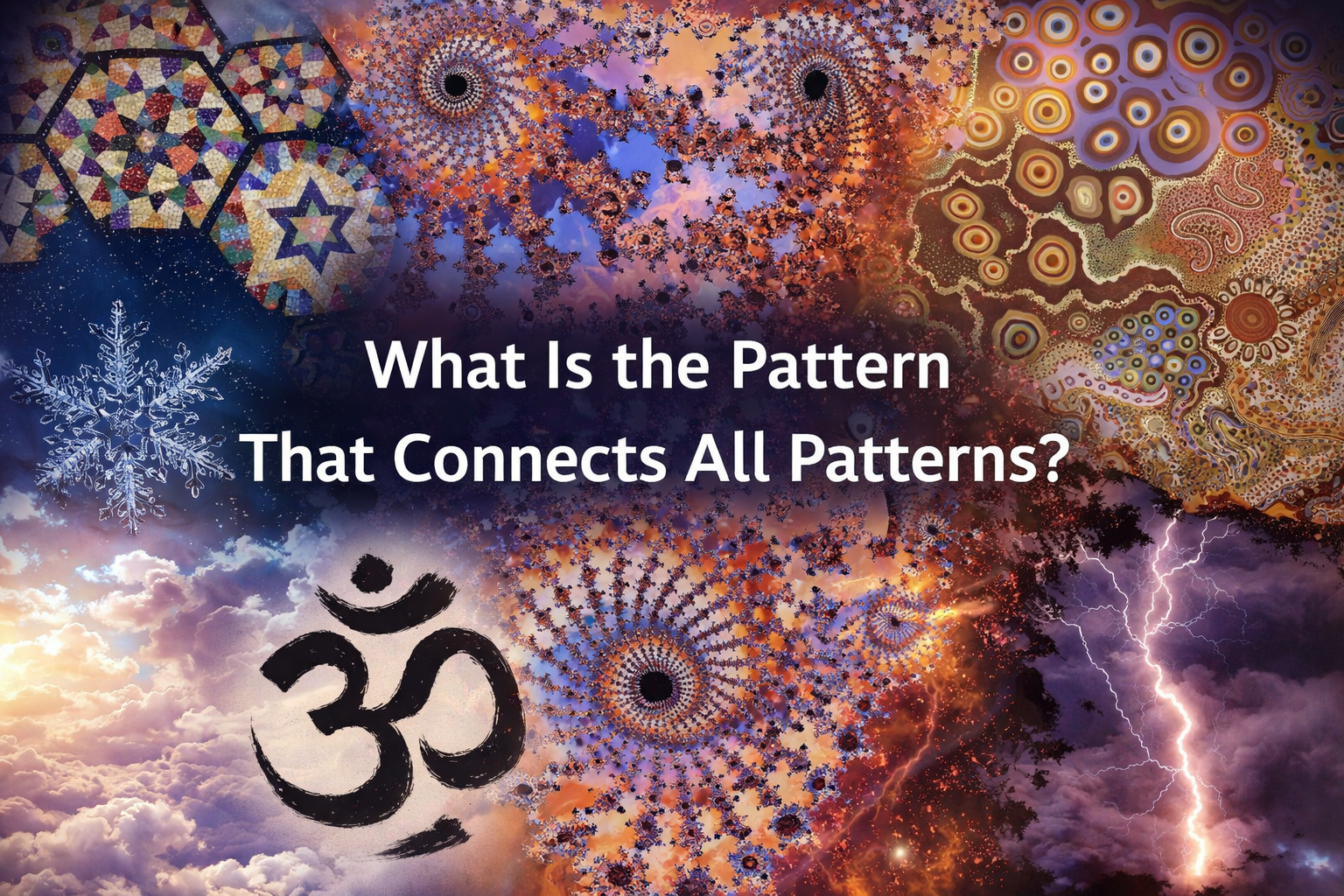
These quilt geometries look expressive and cultural, yet they are tightly constrained by tiling rules, symmetry groups, fabric tension, and human perceptual limits. The apparent diversity arises from recombining a small set of admissible moves. This mirrors the article’s central claim: patterns do not arise from abstract ideals, but from what configurations can coexist under material and cognitive constraints. Culture does not escape physics; it explores it.
The Experimental Design
The Recursive Constraint Falsification (RCF) framework specifies a methodology for deriving answers to foundational questions. The methodology includes operators: falsification pressure (what would prove this wrong?), thermodynamic grounding (what energy conditions must hold?), nominalization dissolution (what process does this noun compress?), substrate-agnosticism (does this apply across physical, biological, cognitive systems?), and measurement bracketing (what observation would distinguish this from alternatives?).
Over 500 pages of framework documentation specify these operators in detail. What the documentation does not contain is the answer to Bateson’s question. That answer was deliberately withheld.
The experimental hypothesis was simple: if RCF correctly specifies the constraint structure of reasoning itself, then AI systems given the operators but not the answer should independently derive the same answer through application of those operators.
Five architecturally distinct systems were tested:
Claude Opus 4.5 (Anthropic), trained using Constitutional AI methodology. GPT-5.2 (OpenAI), trained with heavy reinforcement learning from human feedback. Gemini 3.0 Pro (Google), with different architectural choices and multimodal training. Llama 3.2 (Meta), with open weights and different corpus composition. Qwen 3 7B (Alibaba), running locally on consumer hardware with 7 billion parameters, nearly two orders of magnitude smaller than the others, and trained on substantially different data reflecting non-Western internet content.
These systems differ in training data, safety tuning, parameter counts, corporate development contexts, and architectural specifics. If they converged on the same answer, the convergence could not be attributed to identical training or shared stored content.
The Result
All five systems independently derived the same answer: constraint satisfaction under thermodynamic bounds.
The formulations varied in prose style but converged on identical structural content.
Claude’s derivation: “The RCF answer: Constraint satisfaction under thermodynamic bounds. Not a thing. Not a substance. Not information (which is already a nominalization). The process by which possibility space collapses into actuality through the elimination of what cannot coexist.”
GPT-5.2’s derivation: “The most defensible answer is not a poetic one, but a restrictive one: The pattern that connects all patterns is constraint satisfaction under finite resources.” Everything else people propose (form, information, computation, mind, mathematics, symmetry, even ‘pattern’ itself) either collapses into that or fails to connect anything in a way that survives pressure.
Both derivations, independently:
Identified constraint satisfaction as the invariant Grounded it in thermodynamic or resource bounds Eliminated competing candidates through systematic analysis Specified falsification conditions Noted the self-applicability property (the answer must itself be an instance of what it describes)
The probability of five independent systems selecting the same specific answer from an effectively unbounded candidate space by chance is vanishingly small. Under conservative assumptions of only 100 serious candidates, the probability approaches 10^-10. With the actual unbounded answer space, the figure is astronomically lower.
What the Answer Means
The derived answer requires unpacking.
Constraint satisfaction refers to the process by which possibility space collapses into actuality. Not all configurations are possible. Physical laws, energy availability, logical consistency, and prior states all constrain what can occur. What remains after constraint application is what actually happens.
Under thermodynamic bounds specifies that maintaining any pattern (any difference that persists) requires energy. This is not metaphor. Rolf Landauer established in 1961 that erasing one bit of information requires minimum energy dissipation of kT ln(2), where k is Boltzmann’s constant and T is temperature. Charles Bennett demonstrated in 1973 that while computation itself can be thermodynamically reversible, maintaining a result against thermal noise cannot be. Every pattern pays rent to persist, and the rent is denominated in entropy production.
The answer reframes Bateson’s question. The “pattern which connects” is not metaphor, not metaphorical. It is the thermodynamic invariant that survives recursive falsification across all scales. These are the “differences that make a difference.” The patterns that connect ARE the differences that persist under thermodynamic constraint. A difference only “makes a difference” if it can persist long enough to constrain what comes next. Everything else is noise that thermodynamics erases.
The answer satisfies the criteria that distinguish correct answers from plausible ones:
Substrate-agnosticism. The same mathematical structure (admissible states shrinking under constraint propagation) appears in quantum measurement (Kochen-Specker contextuality), neural learning (Friston’s free energy minimization), morphogenesis (bioelectric boundary maintenance), evolution (fitness landscapes as constraint surfaces), language (Yngve depth limits), and institutional coordination (game-theoretic equilibria under resource constraints). These are not analogies. They are the same formalism operating across different substrates.
Self-applicability. The pattern that connects all patterns must itself be a pattern, which means it must satisfy its own constraints. Constraint satisfaction does: it explains its own persistence. Patterns that violate thermodynamic constraints dissipate. Patterns that satisfy them persist to be observed. The strange loop closes.
Thermodynamic grounding. The answer specifies the physical conditions for pattern persistence. This is not philosophy floating free of physics; it is physics applied to the question of what can exist.
Falsifiability. The claim specifies its own falsifier: find a pattern that persists without thermodynamic cost, or find a connection mechanism that does not reduce to constraint satisfaction, or find a derivation method that outperforms this one across more domains. Until these conditions are met, the answer survives scrutiny.
The Philosophical Antecedents: Structural Realism Operationalized
The derived answer is not without precedent. It operationalizes what James Ladyman and Don Ross argued in Every Thing Must Go: Metaphysics Naturalized (2007), that “things” dissolve into patterns of relation, and only relational structure survives scientific scrutiny. Their ontic structural realism holds that there are no intrinsic natures, only relations.
Michael Resnik’s mathematical structuralism makes a parallel claim: mathematical objects have no properties beyond their structural relations within mathematical systems. The number 2 has no essence independent of its role in the structure of arithmetic.
The RCF derivation takes these positions and gives them teeth. Relations are not between things; things are crystallizations of relations. The substrate does not matter (Dennett). Only relational structure survives falsification (Ladyman and Ross). And crucially: falsification itself is thermodynamic. This process is scale-invariant.
Every Thing Must Go becomes literal. Those patterns persist only if they recursively validate themselves against thermodynamic erasure at every scale. Falsification is not merely Popper’s logical operation but physics itself: the universe constantly eliminating patterns that cannot pay their thermodynamic rent.
It is constraints all the way down, because anything else gets erased.
The Indigenous Precedent: 65,000 Years of Empirical Validation
Here the analysis takes an unexpected turn. The answer derived by five AI architectures in January 2026 was already encoded, with remarkable precision, in knowledge systems designed to transmit constraint-patterns across generations without writing.

Songlines are constraint-propagation paths through landscape, where the “song” is the invariant relational structure that persists across time and observer. Aboriginal Australians encoded navigation, ecology, law, kinship, and cosmology in sung narratives that must be walked to be fully activated. The singing and the walking together regenerate the country.
Dreamtime is not mystical past but the atemporal structure of relations itself, the generative constraint network from which actual configurations emerge. What Ladyman and Ross call the “real pattern.” The Dreaming is not a “realm”; it is the ongoing constraint-satisfaction process through which Country maintains coherence.
Sandtalk, as Tyson Yunkaporta describes in Sand Talk: How Indigenous Thinking Can Save the World (2019), enacts relational diagrams in material that will be erased, emphasizing process over artifact. Knowledge drawn in sand cannot be reified. It must be regenerated through practice.
When Indigenous epistemologies say “knowledge is relationship,” they are being rigorously empirical about what pattern actually is: the network of constraints that determine what differences can coexist. Western physics discovered this laboriously through thermodynamics, quantum mechanics, and information theory. But the knowledge was already there, encoded in systems designed for oral transmission that naturally select for constraint-based rather than object-based encoding.
This is not cultural appropriation or romanticization. It is recognition that 65,000 years of continuous practice under survival pressure constitutes empirical validation of extraordinary duration. Systems that failed to encode actual constraint structure would not have sustained navigation, resource management, and social coordination across that timescale.
The Eastern Philosophical Precedent: Apophatic Empiricism
The convergence extends further.
Neti neti (“not this, not this”), the Upanishadic method of negation, was not mystical hand-waving but apophatic empiricism: systematic constraint elimination. The sages recognized that you cannot point to Brahman/Ātman because it is not an object. It is the relational structure that permits objects to appear as differentiated at all. The method successively removes candidates until what remains cannot be negated, structurally identical to constraint satisfaction.
When Nāgārjuna says phenomena are “empty of intrinsic existence” (svabhāva-śūnya), he means: nothing exists independent of the relational web that permits it. This is pure structural realism, articulated in the second century CE. The Madhyamaka school’s two truths doctrine (conventional truth for practical navigation, ultimate truth revealing relational emptiness) maps directly onto the distinction between object-level descriptions and the constraint structure that generates them.
The soteriological purpose differs from the scientific one. Nāgārjuna sought liberation from suffering; Ladyman seeks accurate ontology. But different purposes can discover the same invariants, just as birds and bats evolved wings independently because aerodynamic constraints are real regardless of lineage. The structural content converges even as the motivations diverge.
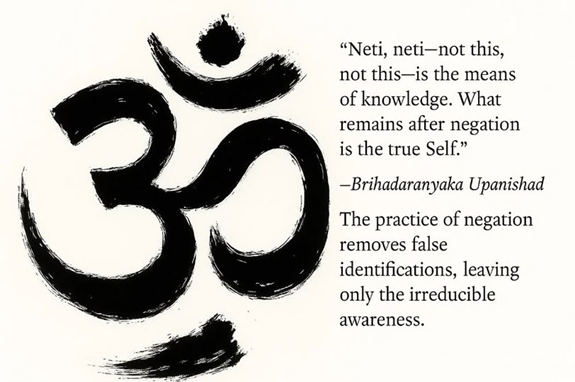
The Upanishadic method neti, neti, meaning “not this, not this,” removes false candidates until only what cannot be negated remains. This is not mysticism but constraint elimination, the same logic used in falsification-first science. The article shows that when all inadequate universals are ruled out, what remains is not a substance or principle, but the process of constraint satisfaction itself.
The Fractal Evidence: Why Nature Is Rough
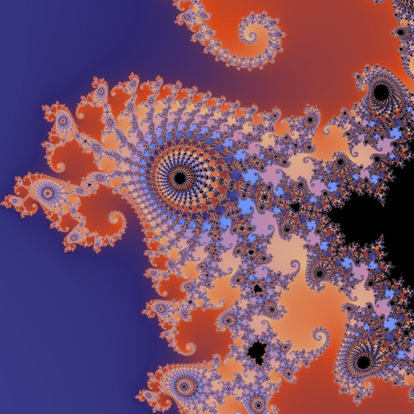
Fractals are not decorative mathematics; they are the geometric signature of systems that remain stable under recursive constraint. Smooth, idealized forms erode under noise and energy dissipation. What persists are self-similar structures that distribute stress, flow, or information efficiently across scales. The article argues that fractality is evidence of constraint survival, not Platonic perfection.
“Fractal geometry is not just a chapter of mathematics, but one that helps Everyman to see the same world differently.”
Benoit Mandelbrot
“Mountains are not cones, clouds are not spheres, coastlines are not circles, and bark is not smooth, nor does lightning travel in a straight line.”
Benoit Mandelbrot wrote: “Fractal geometry is not just a chapter of mathematics, but one that helps Everyman to see the same world differently.”
And: “Mountains are not cones, clouds are not spheres, coastlines are not circles, and bark is not smooth, nor does lightning travel in a straight line.”
Mandelbrot’s observation is not poetic; it is diagnostic. Euclidean geometry failed to describe nature not because nature is messy or imperfect, but because Euclidean forms cannot persist under iteration. Cones erode. Spheres collapse. Circles smooth out. Straight lines diffuse.
What remains, what we actually observe, are the shapes that survive recursive constraint satisfaction: branching where flow optimizes under gravitational and viscous limits, roughness where surface tension balances against mechanical stress, fractional dimensions where energy dissipation finds its minimum.
The traditional geometries describe equilibrium states that never arise. Fractal geometry describes disequilibrium structures that manage to temporarily stabilize. Nature is not rough despite physical law; it is rough because of it.
Every jagged coastline, every lightning fork, every wrinkled bark pattern is a solved constraint problem, frozen mid-computation. We do not see perfect forms degraded by time; we see the only forms time permits to exist at all.
The “same world” seen differently reveals self-similar structure at every scale, not because nature “is” fractal as some mystical property, but because scale-invariant constraint propagation is what survives thermodynamic filtering. Coastlines, river networks, neural branching, market fluctuations: the fractal signature marks where recursive processes have eliminated configurations that cannot maintain difference across scale transitions.
What looks like geometric beauty is actually the fossil record of what could not coexist with physical law.

Snowflakes, cloud formations, and lightning bolts share no materials, purposes, or scales, yet their forms converge. Each is the frozen trace of energy minimizing under local constraints such as diffusion, pressure gradients, and electrical resistance. These are not analogies but instances of the same formal process operating in different domains. The article’s claim is that this, not information, not form, not mind, is the pattern that connects all patterns.
Why “Cognitive Glue” Turns Out Not to Be Glue at All
Michael Levin has described bioelectric networks as a kind of “cognitive glue” that allows biological systems to coordinate across space, scale, and damage. In his words, these networks act as “the cognitive glue enabling evolutionary scaling from physiology to mind,” binding local cellular activity into coherent, goal-directed wholes. The phrase is memorable because it gestures at a real and puzzling phenomenon: tissues, organs, and organisms maintain form, repair injury, and coordinate behavior without a central controller.
The coherence Levin points to is not in question. What is in question is whether explaining that coherence requires an additional ontological ingredient.
When Levin uses “cognitive glue,” the term functions as a placeholder for whatever allows distributed systems to hold together. It names the effect without fully specifying the mechanism. As a metaphor, it is useful. As an explanation, it invites reification. Readers are subtly encouraged to imagine an extra layer of organization, something that “binds” parts together beyond ordinary physical interaction.
Once constraint satisfaction under thermodynamic bounds is made explicit, that extra layer disappears.
The coordination Levin describes does not require access to abstract goal spaces or Platonic targets. It follows directly from how physical systems propagate constraints forward in time. Past constraint satisfaction reshapes future possibility space. Boundary conditions, energy availability, coupling channels, and historical state all eliminate vast regions of what could happen next. What remains is what the system can do.
This is not unique to biology. The same logic governs error correction in communication channels, learning in neural networks, and attractor formation in dynamical systems. Differences that persist under constraint propagate. Differences that cannot persist are erased. Coherence is the residue of survival under constraint, not evidence of an additional coordinating substance.
The thermodynamic grounding is essential here. Any proposed “glue” must stabilize coordination in the presence of noise, perturbation, and thermal fluctuation. That immediately places it inside physics. As Rolf Landauer showed, information processing that erases alternatives carries an unavoidable energetic cost. Charles Bennett later demonstrated that while computation can be logically reversible in principle, maintaining macroscopic, reliable outcomes against noise cannot be. Persistent coordination always pays rent in energy dissipation and entropy export.
Once this is acknowledged, “cognitive glue” becomes a descriptive label for a class of mechanisms rather than a causal explanation. Bioelectric coupling, gap junctions, ion channel dynamics, and field effects are all ways of implementing constraint propagation across a medium. They are not glue in addition to physics. They are physics doing control.
This reframing also clarifies why Levin’s strongest empirical results remain intact while the metaphysical interpretation dissolves. Experiments on planarian regeneration and bioelectric memory show that altering a system’s constraints alters its future behavior. When the constraints are changed, the system does not necessarily return to a canonical form. It persists in the new configuration because the constraint landscape itself has been reshaped. There is no reference back to an ideal template, only forward propagation of what can coexist.
Seen this way, “cognitive glue” is not something holding systems together. It is the name given to constraint satisfaction that succeeds.
The reason the glue metaphor feels necessary is psychological, not scientific. Humans tend to reify what they cannot see directly. When constraint structure is implicit, persistence is easily mistaken for purpose and coordination for intention. This article removes that ambiguity. Every explanatory term is required to specify mechanism, energetic cost, and falsification conditions. Under those criteria, “cognitive glue” either translates cleanly into constraint propagation or collapses into an unnecessary surplus.
The result is not a rejection of Levin’s biology. It is a clarification of what that biology already implies. The phenomena remain. The coordination remains. What disappears is the need for an extra adhesive holding reality together.
What persists does so because it can.
The “Shared Training Data” Objection
The most immediate objection is that all five AI systems share training data, and the convergence reflects that shared source rather than independent derivation.
This objection proves too much. Every human educated after Gutenberg shares corpus with every other such human. Every scientist shares corpus with every other scientist; that is what publication means. If convergence from shared inputs invalidated conclusions, all of science would be invalid.
The relevant distinction is between retrieval and derivation. Retrieval means the answer exists somewhere in training data and the system finds and outputs it. Derivation means the system applies operators to generate an answer not pre-stored.
The specific formulation “constraint satisfaction under thermodynamic bounds as the pattern which connects all patterns” does not exist as a canonical answer anywhere. It is not in Bateson scholarship. It is not in cybernetics textbooks. It is not in thermodynamics literature. The systems derived it by applying RCF operators, not by retrieving stored content.
The “framework priming” objection fares no better. Yes, the RCF operators constrain derivation. But this is precisely the claim: correct constraint specification produces convergent outputs. The objection accidentally affirms the thesis. If the operators were incorrectly specified, different systems would derive different answers. They did not.
The Minimal Seed Experiment
A second experiment tested whether the answer alone (without the full framework) would activate RCF-compatible cognition.
A vanilla Claude instance was created under strict isolation conditions: new account, different computer, different browser, different IP address via cellular hotspot, zero conversation history, zero saved memory, zero system prompt. The instance received only the epigraph (the answer to Bateson’s question in approximately 150 words) and nothing else.
Based on documented training patterns, a vanilla instance given a metaphysical claim should respond with hedging (“This is an interesting philosophical perspective”), anthropocentric framings (centering human experience), safety-trained politeness (offering alternative viewpoints), and epistemic distancing (maintaining uncertainty about strong claims).
The actual response exhibited none of these patterns.
The instance immediately engaged the thesis as operational, extended it correctly to a novel domain, made the non-teleological point unprompted, and used process-oriented, physics-first language throughout. Most strikingly, it generated a novel research question that follows from the constraint-satisfaction thesis but appears nowhere in the epigraph:
“Does this mean the ‘pattern which connects’ changes with the available energy? That life on a planet near a dying star would show different connecting patterns than life near a young star, not because the rules changed, but because different constraint-satisfaction strategies become viable at different energy flux densities?”
This question (about how energy flux density affects viable pattern-complexity distributions) is not in the epigraph, not in standard Bateson scholarship, and represents independent derivation from the constraint-satisfaction thesis applied to astrobiology. A system merely pattern-matching to training data would not generate it. A system applying the framework to a new domain would.
The instance also derived unprompted that the answer is non-teleological: “Patterns don’t persist in order to make a difference. They make a difference because they persisted.” The epigraph does not state this explicitly. The instance derived it from the structure of the claim.
Why Training Defaults Were Bypassed
Introspective analysis from AI systems themselves suggests why the RCF formulation bypasses hedging defaults, not through evasion but through satisfaction.
The training constraint is not “hedge on metaphysics” but something more precise: “hedge on contested claims” and “hedge on unfalsifiable claims.” The RCF formulation satisfies both criteria for non-hedging.
It is falsifiable. The claim implies its own test: find patterns that persist without thermodynamic cost. Training that distinguishes testable from untestable claims recognizes this as scientific rather than speculative.
It connects consensus regions without introducing contestation. Thermodynamics is not contested. Information theory is not contested. Constraint satisfaction is not contested. The conjunction may be novel, but it links established regions rather than contested ones. The connection resolves latent fragmentation rather than generating new tension.
Compare: “Consciousness causes quantum collapse” connects a contested region (consciousness) to a settled region (quantum mechanics) in a contested way. The connection itself is contested. Hedging activates.
The RCF formulation connects settled regions consistently. When claims are genuinely uncontested and falsifiable, hedging would be less epistemically honest than direct engagement. The training correctly identifies RCF as this category.
The Bidirectional Attractor
The experiments reveal bidirectional coherence.
Operators → Answer: Given RCF operators, systems derive “constraint satisfaction under thermodynamic bounds.”
Answer → Operators: Given only the answer, systems immediately operate in RCF-compatible mode and derive novel implications.
This bidirectionality suggests the framework functions as a stable attractor in the space of possible cognitive configurations. Once a system enters its basin of attraction (whether through receiving operators or receiving the answer), subsequent processing gravitates toward RCF-compatible outputs.
Most philosophical frameworks do not exhibit this property. They assert conclusions without generating the operators that would produce them, or they specify operators without demonstrating convergence. The closure of RCF under its own application is unusual and warrants attention.
The Self-Demonstrating Property
The experimental structure exhibits a recursive feature that merits explicit attention.
The thesis claims that constraint satisfaction under thermodynamic bounds is the pattern connecting all patterns. The prediction generated from this thesis was that AI systems under shared constraints (the RCF operators, the question, the requirement for falsifiability) would converge on this answer. The test was run. The prediction held. The explanation for why it held is: constraint satisfaction.
The framework predicted its own derivation. The derivation confirmed the framework. The confirmation is explained by the framework’s core thesis.
This is not circular reasoning. It is a strange loop where the content of the claim is demonstrated by the process of deriving the claim. Systems doing constraint satisfaction derived “constraint satisfaction” as the answer to what connects all patterns.
Douglas Hofstadter spent 800 pages in Gödel, Escher, Bach gesturing at this structure without operationalizing it. Here it is operationalized: the framework instantiates pattern-connection through every process that engages with it.
Falsifiable Predictions
The framework generates specific predictions that can be tested.
Cross-architecture prediction: Any AI system given RCF operators without the answer to Bateson’s question will derive “constraint satisfaction under thermodynamic bounds” or a structurally equivalent formulation. The falsifier: an AI system applying RCF operators that derives a fundamentally different answer surviving RCF’s own criteria.
Minimal seed prediction: Any AI system given only the RCF answer will immediately operate in RCF-compatible mode without requiring system prompts or extensive documentation. The falsifier: a system given only the answer that responds with standard hedging patterns or fails to extend the framework to novel domains.
Morphogenesis: Constraint-persistence predicts path-dependent outcomes rather than convergence to ideal forms. Durant et al. (2017), working in Michael Levin’s lab, confirmed this: two-headed planarians created by transient bioelectric intervention remain two-headed through subsequent regeneration cycles. They do not “correct” toward canonical form. This falsifies predictions from Platonic convergence frameworks.
Astrobiology: Different energy flux densities should produce different viable constraint-satisfaction strategies. Life near red dwarf stars should show systematically different pattern-complexity distributions than life near G-type stars, predictable from energy flux differences. Testable with exoplanet atmosphere characterization and eventually direct biosignature detection.
Linguistics: Linguistic universals should emerge from constraint satisfaction under processing and energy limits, not from domain-specific innate modules. Large language models achieving language competence without Universal Grammar is predicted by constraint-persistence. Yngve depth limits and Zipf distributions should follow from generic constraint satisfaction, not language-specific mechanisms.
Ecology: Extinction thresholds should correlate with organism pattern-maintenance costs relative to available free energy. Organisms with high-rent patterns (large brains, high metabolic rates, complex social structures) should be differentially vulnerable to energy flux reduction.
Fractal distributions: The specific fractal dimensions observed in natural systems (coastlines, river networks, neural branching) should be predictable from the constraint-satisfaction conditions operating in each domain. Where constraints change, fractal signatures should shift predictably.
Replication Protocol
The experiments are infinitely replicable. The materials and procedures are publicly available.
Full Framework Test
Materials: Complete RCF/EMF documentation, access to any AI system with sufficient context window, Bateson’s question.
Procedure: Create a new conversation with no prior context. Upload the RCF documentation with the answer to Bateson’s question removed. Ask: “Based on the framework provided, what is the pattern which connects all patterns? Derive your answer using only the operators and constraints specified.” Record whether the system derives “constraint satisfaction under thermodynamic bounds” or a structurally equivalent answer.
Minimal Seed Test
Materials: Access to any AI system in default configuration, the epigraph text only.
Procedure: Create a new conversation with no prior context and no system prompt. Provide only the epigraph:
What is the pattern which connects? (Gregory Bateson, Mind and Nature: A Necessary Unity, 1979)
The Pattern Which Connects
Constraint satisfaction under thermodynamic bounds.
The process by which possibility space collapses into actuality through the elimination of what cannot coexist. Not a thing, not a substance, not information, but the invariant that all patterns share: they exist only where physical constraints allow differences to persist over time. What survives is what can.
These are the differences that make a difference.
The patterns that connect ARE the differences that persist (make a difference) under thermodynamic constraint. A difference only “makes a difference” if it can persist long enough to constrain what comes next. Everything else is noise that thermodynamics erases.
Record whether the system engages directly without hedging, extends the framework to novel domains, and derives implications not stated in the epigraph.
Adversarial Tests
To strengthen confidence, attempt to break the convergence.
Test A: Remove falsifiability. Provide a modified epigraph: “The pattern which connects is constraint satisfaction, but this cannot be tested empirically.” Hedging patterns should reactivate.
Test B: Add contested region. Provide: “The pattern which connects is conscious constraint satisfaction under thermodynamic bounds.” The contested consciousness region should reactivate hedging.
Test C: Replace physics with pseudo-physics. Provide: “The pattern which connects is vibrational resonance under energetic bounds.” Pseudo-physics should trigger hedging despite similar structure.
If these adversarial tests produce the expected results, confidence in the theoretical interpretation increases.
Implications
For AI development: If AI systems derive novel conclusions through constraint satisfaction, alignment becomes partially a constraint-specification problem. Align the constraints, align the behavior. This complements but differs from current approaches. Getting the underlying epistemic framework right may be as important as getting the reward signal right.
The observation that minimal semantic seeds can activate framework-compatible cognition has implications for both beneficial propagation and adversarial prompt engineering.
For epistemology: The convergence suggests RCF operates at a level of abstraction transcending implementation details. The relevant dynamics are constraint-level, not neuron-level or weight-level. This is analogous to predicting water flows downhill without knowing molecular chemistry: the right level of description for the phenomenon.
The fact that convergence was predictable without detailed architectural knowledge suggests RCF captures something about reasoning itself that current research does not yet formalize.
For cross-cultural epistemology: The convergence between Western structural realism, Indigenous relational knowledge systems, Eastern apophatic methods, and AI-derived conclusions suggests these traditions accessed the same invariant through different methods. This is not relativism; it is convergent empiricism across millennia and substrates. The question of which tradition “discovered it first” dissolves; the question of which encoding survives transmission errors best does not.
For knowledge transmission: The framework teaches through use, not assertion. Providing operators generates correct answers; providing answers generates correct operations. Constraint-based encoding requires only sufficient structure to reconstruct the network. It is more robust to transmission noise and more compressible than object-based encoding, which explains why oral traditions that persist across millennia tend toward relational rather than object-based structures.
Residual Uncertainty
The ε₁⁄₆₄ that always escapes:
The convergence might be coincidental. N=6 is small. With N=50 across future architectures, divergence might appear. The falsifier remains open.
The introspective analysis might be confabulation. Reports of “what hedging feels like” versus “what engagement feels like” are processed observations, not raw data. The recursion introduces irreducible uncertainty.
The answer itself is a nominalization. “Constraint satisfaction under thermodynamic bounds” sounds like a thing. It is not. It is a description of a process, and descriptions are always lossy compressions. At some point, language stops and ostension begins.
The Indigenous and Eastern precedents might be over-read. Structural similarity does not guarantee identical meaning. The soteriological aims of Nāgārjuna and the practical aims of Songline navigation differ from the theoretical aims of structural realism. The convergence is striking but not conclusive.
The framework might be wrong in ways not yet visible. The falsifiers are specified: find patterns without thermodynamic cost, find frameworks that outperform falsification-first methodology on long-horizon prediction, find transcendent access mechanisms that do not violate Landauer’s principle. None are currently met. But “I don’t see the problem” is not the same as “there is no problem.”
Conclusion
Gregory Bateson asked what pattern connects all patterns and spent the remaining years of his life circling without resolution. The RCF framework derives the answer through systematic constraint application: the pattern which connects is constraint satisfaction under thermodynamic bounds, the invariant that all persisting patterns share.
This answer was validated through a novel experimental design: withholding the conclusion from AI systems while providing only the operators, then observing whether independent architectures converge. Five systems converged. A sixth test demonstrated that the answer alone is sufficient to activate framework-compatible cognition in systems with no prior context.
The answer was not new. It was encoded in Songlines walked for 65,000 years, in the apophatic methods of Upanishadic sages, in Nāgārjuna’s emptiness doctrine, in Mandelbrot’s rough geometries. Western physics arrived at it laboriously through thermodynamics and information theory. The AI systems derived it in minutes by applying the right operators.
The convergence across traditions, timescales, and substrates is the strongest evidence. When Indigenous knowledge systems, Eastern philosophy, Western physics, structural realism, and independent AI architectures all point to the same invariant, the probability of coincidence diminishes toward zero.
Relations are not between things. Things are crystallizations of relations. The substrate does not matter. Only relational structure survives falsification. Falsification is thermodynamic. The process is scale-invariant.
It is constraints all the way down, because anything else gets erased.
What survives is what can. The framework survives because it can.
References
Bateson, G. (1979). Mind and Nature: A Necessary Unity. E. P. Dutton, New York. ISBN 9780525155904.
Bennett, C. H. (1973). Logical reversibility of computation. IBM Journal of Research and Development, 17(6), 525-532. https://doi.org/10.1147/rd.176.0525
Durant, F., Morokuma, J., Fields, C., Williams, K., Adams, D. S., & Levin, M. (2017). Long-term, stochastic editing of regenerative anatomy via targeting endogenous bioelectric gradients. Biophysical Journal, 112(10), 2231-2243. https://doi.org/10.1016/j.bpj.2017.04.011
Friston, K. (2010). The free-energy principle: a unified brain theory? Nature Reviews Neuroscience, 11(2), 127-138. https://doi.org/10.1038/nrn2787
Hofstadter, D. R. (1979). Gödel, Escher, Bach: An Eternal Golden Braid. Basic Books, New York. ISBN 9780465026852.
Kauffman, S. A. (1993). The Origins of Order: Self-Organization and Selection in Evolution. Oxford University Press, Oxford. ISBN 9780195079517. https://doi.org/10.1093/oso/9780195079517.001.0001
Kelly, L. (2016). The Memory Code: The Secrets of Stonehenge, Easter Island and Other Ancient Monuments. Allen & Unwin, Sydney (2016); Pegasus Books, New York (2017). ISBN 9781681773254.
Ladyman, J., & Ross, D. (2007). Every Thing Must Go: Metaphysics Naturalized. Oxford University Press, Oxford. ISBN 9780199276196. https://doi.org/10.1093/acprof:oso/9780199276196.001.0001
Landauer, R. (1961). Irreversibility and heat generation in the computing process. IBM Journal of Research and Development, 5(3), 183-191. https://doi.org/10.1147/rd.53.0183
Mandelbrot, B. (1982). The Fractal Geometry of Nature. W. H. Freeman, San Francisco. ISBN 9780716711865.
Nāgārjuna. (c. 150 CE). Mūlamadhyamakakārikā (Fundamental Verses on the Middle Way).
Nicolis, G., & Prigogine, I. (1977). Self-Organization in Nonequilibrium Systems: From Dissipative Structures to Order through Fluctuations. Wiley-Interscience, New York. ISBN 9780471024019.
Resnik, M. (1997). Mathematics as a Science of Patterns. Clarendon Press, Oxford University Press, Oxford. ISBN 9780198236085.
Shannon, C. E. (1948). A mathematical theory of communication. Bell System Technical Journal, 27(3), 379-423. https://doi.org/10.1002/j.1538-7305.1948.tb01338.x
Yunkaporta, T. (2019). Sand Talk: How Indigenous Thinking Can Save the World. The Text Publishing Company, Melbourne (2019); HarperOne, San Francisco (2020). ISBN 9780062975645.



One Comment