
Michael Levin’s Platonism: Harmful & Unfalsifiable Metaphysics— Evidence from Bioelectric Morphogenesis That Falsifies Platonic Predictions
Framework clarification and update: September–October 2026 This article predates my later methodological clarifications and remains unchanged for intellectual provenance. My current Recursive Corrigibility Framework and Boundary- and Scale-Relative Realism clarify claim types, scope, evidential burdens, explanatory bridges, uncertainty, and localized correction. Thermodynamic Monism remains a provisional naturalistic countermodel, while my work on consciousness , Whiteheadian prehension , and Michael Levin distinguishes established findings from additional phenomenal or metaphysical claims. Local explanatory success, shared evidence, and unresolved gaps do not, by themselves, establish or refute those stronger claims.
This article predates several later clarifications and extensions of my methodology and working ontology. I am leaving the original argument intact for intellectual provenance rather than silently rewriting the record. The later work makes my claim typing, scope limits, bridge requirements, uncertainty bookkeeping, and comparative standards more explicit.
My work on Thermodynamic Monism was developed as a naturalistic process-relational research programme and comparative countermodel, particularly in response to Platonic and anti-physicalist arguments claiming that biological organization, morphogenesis, cognition, or other phenomena required additional nonphysical explanatory machinery. Its purpose was to test how much of the relevant explanatory work could be recovered from causal continuity, thermodynamic constraint, historically accumulated organization, multiscale dynamics, and higher-level difference-making without assuming the richer metaphysical posit under dispute.
I did not take that comparative success to establish that thermodynamics explains everything, that thermodynamic variables are privileged at every scale, or that empirical success by itself settles the intrinsic nature of reality. The current formulation makes those limits more explicit. The commitments I continue to retain include one causally continuous process order rather than separate causal substances or realms; thermodynamic constraints on physical realization; dynamically maintained and historically conditioned organization; and the reality of higher-level explanatory variables when they earn predictive, counterfactual, interventionist, compressive, or transferable leverage. One process does not mean one explanation.
The same clarification applies to my earlier use of falsification-first language. I did not use the rule “if it is not falsifiable, it is false.” My methodology already distinguished questions of semantic determinacy, evidential burden, theory-ladenness, auxiliary hypotheses, counterfactual testing, and Lakatosian research-programme appraisal. A sufficiently determinate empirical or causal claim should incur conditions under which it would lose support, but not every meaningful claim belongs before the same tribunal. Formal, semantic, phenomenological, historical, modal, normative, ontological, causal, and empirical claims can require different forms of warrant and criticism.
My current Recursive Corrigibility Framework formalizes that plural structure more explicitly. The shift from falsification-first to corrigibility-first is therefore primarily a clarification and expansion of jurisdiction: identify the claim type, determine what evidence or argument actually bears on it, locate the relevant bridge and dependencies, specify what could revise it, and localize failure to the part of the argument that actually failed rather than allowing one failure to automatically propagate through an entire framework.
My current working ontology is Provisional, Boundary- and Scale-Relative Realism . It makes explicit a discipline already motivating much of the earlier work: boundaries, scales, identities, causal variables, and explanatory vocabularies must earn their relevance at the target under investigation. Local success does not automatically transport into universal, intrinsic, necessary, or exhaustive metaphysical conclusions.
An accessible statement of that position appears in What Is Provisional, Boundary- and Scale-Relative Realism? . Explanatory gaps are treated as records of missing warrant rather than automatic evidence for whatever ontology might fill them. Evidence also does not transport across boundaries, scales, or constructs merely because the same vocabulary can be used in both places.
My earlier consciousness work should be read with the same distinction in mind. My proposed bridge between organized physical dynamics and phenomenality was already presented as a risky empirical wager with explicit conditions for failure, not as a settled conclusion about phenomenal identity. Phenomenal identity remained unresolved. What later work makes more explicit is the dependency structure. Evidence for organizational closure, recursive integration, bounded perspective, temporal continuity, report, discrimination, self-modeling, valuation, or agency can bear strongly on those particular capacities without automatically settling whether any of them is identical with phenomenal experience. Evidence earned by one construct should not silently migrate into another.
I therefore now decompose the traditional Hard Problem more explicitly into distinct questions about phenomenal occurrence, phenomenal character, candidate subject boundaries, physical organization, report and judgment, the meta-problem, modal arguments, bridge principles, and explanatory completion. This preserves unresolved phenomenality without allowing the unresolved remainder itself to perform explanatory or metaphysical work that has not independently been earned. The Hard Problem dissolves as a distinct unitary problem if, once those constituent questions are separated, no additional positive explanandum remains and no necessary explanatory relation is lost by the decomposition.
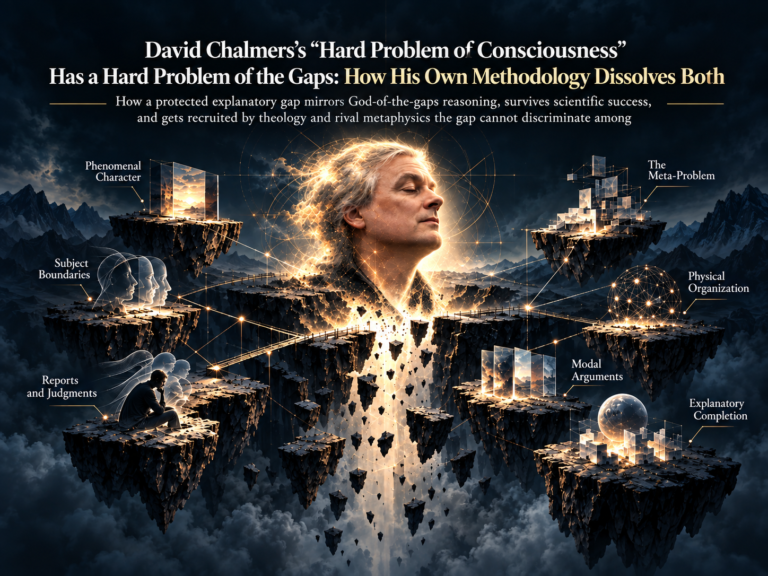
The most current statement of that analysis is David Chalmers’s “Hard Problem of Consciousness” Has a Hard Problem of the Gaps: How His Own Methodology Dissolves Both . The newer argument asks whether the canonical Hard Problem retains any additional positive explanandum after its constituent questions are separated. If no positive residual can be identified, and no necessary explanatory relation is destroyed by the decomposition, then the monolithic Hard Problem dissolves as a distinct unitary explanandum while the constituent questions remain live wherever the evidence leaves them unresolved.
My later comparison with Matthew David Segall and Whiteheadian panexperientialism applies the same rule in another direction. In Where the Necessity Case for Mathew Segall & Whitehead’s Prehension Fails , I ask which explanatory targets actually require subjective prehension rather than merely remaining compatible with it. Mechanistic, dispositional, process, organizational, constraint-based, and intervention-sensitive accounts recover substantial causal explanatory work without subjective prehension as a premise. That undercuts a necessity claim at those targets without establishing that universal prehension is false. Its wider application still requires independent comparative and transport warrant.
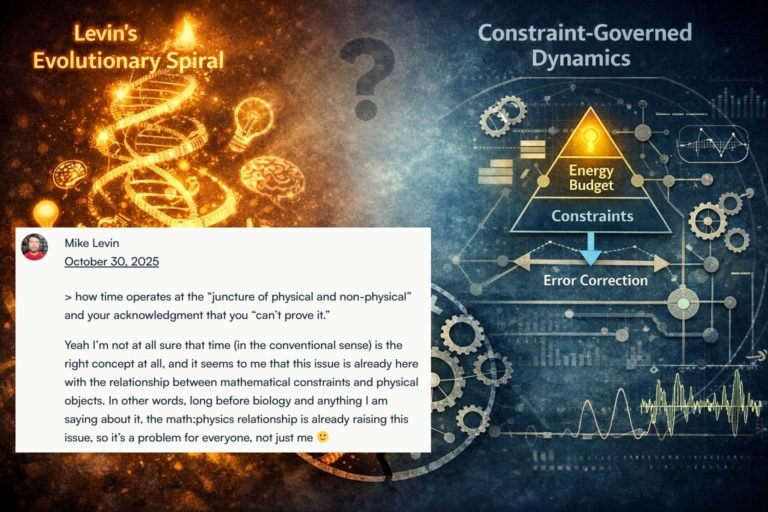
My October work on Michael Levin extends a distinction that was already central to my earlier criticism of biological Platonism: strong empirical results do not automatically transfer their evidential authority to every metaphysical interpretation placed around them. In Religion With A Pipette: Is Michael Levin’s “Ingressing Minds” Pseudoscience? A Scholarly Analysis , I separate the experimental evidence for bioelectricity, morphogenesis, biological competency, synthetic organisms, and multiscale control from the additional claim that such systems access nonphysical minds or Platonic structures.
The newer formulation makes the credit-assignment rule especially explicit: evidence shared by multiple rival explanations supports the shared empirical structure first. An additional metaphysical posit earns additional credit only when the feature it uniquely adds improves prediction, intervention, explanation, compression, transfer, or some other claim-appropriate discriminator relative to serious alternatives.
I have consolidated the larger Levin research programme in Biologist Michael Levin Criticism: Science or Pseudoscience? . The index separates the evidential status of Levin's experimental bioelectricity and morphogenesis work from the distinct questions raised by TAME, basal-cognition language, consciousness attribution, Platonic ingress, and stronger metaphysical or theological interpretations. It also collects later corrections, qualifications, primary sources, peer-reviewed literature, and comparative alternatives.
A fuller account of the development of Thermodynamic Monism, what I continue to retain, what I now state more narrowly, and which specific earlier formulations I would revise appears in What Is Thermodynamic Monism? Auditing My Own Framework—September 2026 Revisions and Clarifications .
Evidence from Bioelectric Morphogenesis That Falsifies Platonic Predictions
Re: Michael Levin’s Platonism, Platonic Symposium
I want to start where good faith starts: Michael Levin is unusually good at experimental imagination, and that matters. His work has helped widen the conceptual aperture of developmental biology, and it is not trivial to do that without drifting into pure speculation. The bioelectric results are often striking, sometimes beautiful, and frequently provocative in the best sense of the word (e.g., bioelectric pattern control and symmetry breaking work in planaria and related systems).
The general idea that morphology can be treated as a dynamical control problem rather than a static genetic script is not only plausible, it is necessary. If that were the whole story, I would not be writing this. The problem is that Levin’s imagination extends far beyond devising clever, and even groundbreaking, experiments. He then dives into a Platonic metaphysical framework that is constructed in a way that resists falsification, and he attributes his laboratory successes to it without providing independent empirical support. What remains are repeated claims that naturalism “cannot explain” certain phenomena, despite the fact that naturalistic explanations for those phenomena have existed in the literature for decades.
These claims are then presented to very large lay audiences who are unlikely to notice that no additional predictive or mechanistic content has actually been supplied. There is no hidden explanatory engine behind the curtain, only promissory notes deferred to an unspecified future theory and an invitation to treat inspiration as evidence.
This critique is not all-encompassing. Levin’s laboratory work itself is often careful and rigorous, and his analyses routinely invoke thermodynamic constraints and dynamical systems reasoning in ways that are both productive and defensible. The problem emerges only when a post hoc explanatory layer is added on top of those results, one that feels expansive, reassuring, and intellectually generous. It almost feels too good to be true.
That layer gives the appearance of depth while quietly relaxing the constraints that distinguish scientific explanation from narrative framing. The issue is not metaphysics as such. Metaphysical speculation has always played a role in how humans search for coherence. The issue is comfortable metaphysics: metaphysics that can absorb any counterexample, accommodate any outcome, and still present itself as explanatory while retaining the authority of laboratory science.
When that happens, the metaphysical story does not merely coexist with the empirical work. It begins to steer how the empirical work is interpreted. At that point, it becomes increasingly difficult for outsiders, students, funders, journalists, and even collaborators to distinguish which claims have operational consequences and which function primarily as rhetorical atmosphere.
The Empirical Smoking Gun Against Levin’s Platonism: His Own Lab
The Devastating Quote:
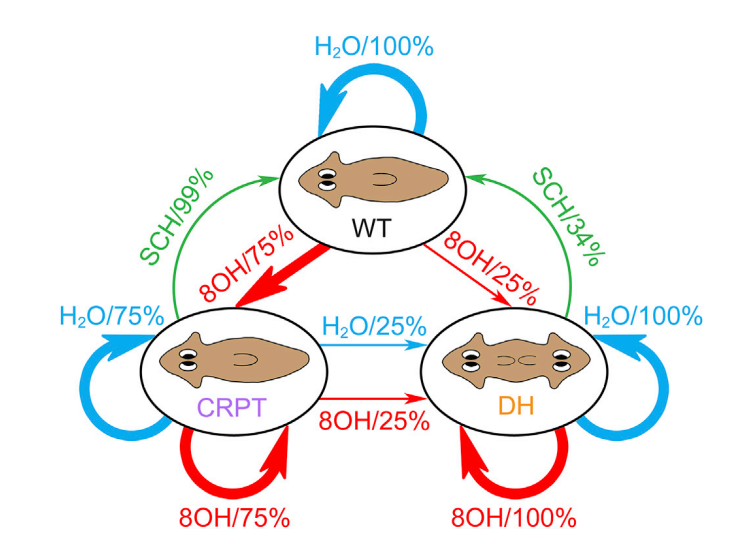
“Thus, species-specific axial pattern can be overridden by briefly changing the connectivity of a physiological network.”
Durant et al. 2017
Why This Falsifies Platonic Predictions:
If Platonic forms existed as pre-existing ideals that organisms “access,” these two-headed worms should gradually converge back toward the one-headed canonical form over multiple regeneration cycles. Instead, they maintain the altered configuration permanently, demonstrating that:
- Form emerges from thermodynamic constraint satisfaction (bioelectric gradients creating stable attractor basins)
- There is no external ideal the organism is trying to reach
- The “goal” is simply thermodynamic stability in whatever basin the system occupies
Levin’s own lab, in Levin’s own peer-reviewed publications, has empirically demonstrated that morphological forms are path-dependent stable attractors, not convergences on pre-existing Platonic ideals. The data supports thermodynamic monism, not Platonism.
This is why I repeatedly ask: “Why doesn’t Durant 2017 falsify Platonic convergence?” The paper provides clear empirical evidence against the claim that organisms access pre-existing ideal forms.
Levin’s only response?
Michael Levin: “Again, my view is not that standard animals are the full extent of Platonic patterns, so 2-headed planaria are not a problem. But even if we did have only convergence toward pre-existing Platonic forms, how do you know the 2-headed form is not a manifestation of a pre-existing pattern? We haven’t mapped out the space, so it’s way too early to say anything like that.”
But notice what this does: it absorbs any lab result by redefining the hypothesis to be permanently unfalsifiable.
Any observed morphology, no matter how contingent, path-dependent, or historically specific, can always be retroactively declared a member of an uncharted Platonic space. The empirical findings no longer constrain the theory; instead, the theory expands to accommodate every possible outcome.
“A research programme is degenerate if it merely accommodates known facts by ad hoc adjustments rather than predicting novel ones.” — Imre Lakatos
At that point, Platonic space is no longer doing explanatory work. It functions as an unfalsifiable reservoir into which all results are poured after the fact, while the actual causal and predictive work is carried by attractor dynamics, bioelectric control, and thermodynamic constraint satisfaction that Levin’s own lab has already demonstrated.
“If it disagrees with experiment, it’s wrong. In that simple statement is the key to science.” — Richard Feynman
The Platonic framework is architected to absorb disconfirming evidence by design rather than by accident; it permanently severs empirical constraint from theory revision, enabling metaphysical laundering, misuse by ideologically motivated actors, erosion of scientific accountability, and policy or educational harms driven by claims that can never be meaningfully tested or rejected.
“A theory which is not refutable by any conceivable event is non-scientific. Irrefutability is not a virtue of a theory, but a vice.”
— Karl Popper
I cover this issue in much more depth in my article breaking down the debate I had with Levin, you can read it here if you’re interested: Dr. Michael Levin’s Response to My Critique: Misrepresentation, Platonic Morphospace, and the Infinitely Unfalsifiable Framework
How it Began
This post is written about my exchange with Michael Levin and his public responses to our exchange from November 2025, up until January 2026, when I am writing this article. It is not a motive audit. It is not a call for cancellation. It is not a demand that anyone agree with me. It is an attempt to do the simplest and most boringly necessary thing in a high stakes domain: demand failure modes. I am a systems engineer by temperament and by trade. If you tell me a system does something, my reflex is to ask what would prove it does not. If you cannot answer that, you are not giving me an explanation. You are giving me a talisman.
I originally went to Levin for the opposite of a debate. I went to him as an engineer with a tool and an offer: I had built an AI-assisted workflow that can search rigorously through peer reviewed literature at scale, cross check claims against the actual papers, recursively falsify its own hypotheses, and synthesize thousands of findings into naturalistic, testable mechanistic candidates without hand waving. I also brought concrete, falsifiable tests his lab could run, because my working assumption, based on his own long trail of podcasts and talks, was that he had genuinely tried to find naturalistic accounts for the hardest parts of these phenomena and had concluded, perhaps prematurely, that nothing in the existing literature could do the job. So I did what I would want someone to do for me: I assembled the relevant foundational scholars, the most replicated constraints I could find, and a set of experimentally actionable ideas his lab could stress test. The “32,000 words” he later framed as critique were, in large part, exactly that: peer reviewed scholarship, mechanistic alternatives, and proposed experiments, offered in good faith as a way to reduce reliance on metaphysical scaffolding by expanding the naturalistic option set.
What I got back, repeatedly, was a reframing of my position as “reductive physicalism,” which is not just inaccurate, but structurally incoherent with what I was actually arguing. A reductive physicalism story tends to smuggle in the very substance ontology that process relational approaches reject, and ironically it would corner me into the same interaction-problem terrain that causal Platonism requires. My actual stance is closer to a process relational constraint story: organisms as dynamical systems whose forms emerge from history dependent control under energetic and informational constraints. That view does not deny meaning, purpose, or agency as phenomena. It denies only that we get to skip mechanism, skip accounting, and still call it explanation.
The core dispute is not whether Levin can use Platonic language. He can. People can talk however they want. The dispute is whether his “Platonic Space” framing functions as a scientific hypothesis, meaning it can be wrong in public, or whether it functions as an immunized interpretive layer, meaning it can always be right by definition. If it is the latter, then it is not a harmless aesthetic preference. It becomes a methodological hazard because it blurs the line between operational biology and metaphysical permission slips.
The question that refuses to go away
Throughout our exchange, I returned to one question, stated in different forms but always meaning the same thing: What observation would convince you that the Platonic Space hypothesis is false? Not “less useful.” Not “less fruitful.” False.
This is not a philosophical parlor trick. It is the basic shape of epistemic accountability. Every safety analysis requires it. Every serious model requires it. Every engineering discipline that deals with real failure and irreversible harm requires it. If your framework cannot fail in principle, it cannot guide action in practice. It can still entertain. It can still motivate. It can still generate poetry. It cannot tell you what to do when the world pushes back.
Levin’s reply, repeatedly, substituted a pragmatic stopping rule for an epistemic falsifier. The clearest phrasing of that substitution is this: “I move on when I feel that it’s not being fruitful for new discoveries.” That sentence matters because it reveals the category swap. Fruitfulness is not falsification. Fruitfulness can track novelty, funding, curiosity, social dynamics, and a hundred other variables that have nothing to do with truth. A research program can be endlessly “fruitful” while being epistemically empty. History is littered with fertile dead ends. Fruitfulness tells you where effort flows, not where reality yields.
If you think this is pedantry, consider the practical stakes. In biology, the line between “framework” and “belief system” matters, because the moment you treat an unfalsifiable frame as explanatory, you weaken your ability to detect when you are fooling yourself. The lab can keep producing results while the interpretation layer becomes increasingly unmoored. That is not a hypothetical. That is the default human failure mode.
“A theory which is not refutable by any conceivable event is non-scientific.”
Karl Popper, Conjectures and Refutations (1963).
Here is the entire dispute compressed into a single test
If you claim that organisms “access” patterns in a Platonic space, then you owe at least one empirical condition that would count against that claim.
A clear falsifier looks like this: “If we observe X under conditions Y, then Platonic access is wrong.”
What I got instead was a stopping rule: “I move on when I feel that it’s not being fruitful for new discoveries.”
That is not a falsifier. It is a personal heuristic for when to stop trying.
A framework that cannot specify what would prove it wrong can still inspire experiments, but it cannot claim explanatory authority. It becomes a story layer that never risks contact with reality.
“A good test is one that is likely to uncover flaws, if they are present.”
Deborah G. Mayo, Error and the Growth of Experimental Knowledge (1996).
Why the “any outcome fits” move breaks science
To see the problem cleanly, take a simple thought experiment. Suppose a framework says organisms access pre existing ideal forms. Now suppose an experiment produces a persistent aberrant morphology, like a stable two headed planarian line after transient perturbation. The natural question is whether this contradicts the framework. Levin’s reply to that question was: “How do you know the two headed form is not a manifestation of a pre existing pattern?”
Stop and read that again. It sounds like an invitation to humility. It is actually an invitation to unfalsifiability. If any outcome can always be redescribed as a manifestation of a pattern, then no outcome can ever count against the hypothesis. The framework becomes immune to evidence, not because it is true, but because it has been designed, perhaps unintentionally, to metabolize everything.
This is an ancient maneuver. You see it in astrology. You see it in pseudoscientific psychoanalysis. You see it in conspiracy thinking. You also see it in respectable academic work, when the incentives reward rhetorical breadth over operational precision. The structure is always the same: a claim is made in a way that looks empirical, but when a counterexample arises, the claim expands to include it. The claim never shrinks. It never pays rent.
“A research programme is progressive if it predicts novel facts; degenerating if it only accommodates known facts.”
Imre Lakatos, The Methodology of Scientific Research Programmes (1978).
Thermodynamics politely knocks, and gets it’s experimental validation waved away with a promise
When I raised the thermodynamic constraint, I raised it the way engineers raise it: as an accounting problem, not as an ideological preference. If information enters a physical system from a non physical source, where is the energy accounting? That is not a “materialist bias.” It is the basic logic of physical interaction. If something changes a physical system, something did work, and work has a cost.
This is exactly the terrain Landauer staked out in his original formulation of the thermodynamics of computation: logically irreversible operations incur a minimum thermodynamic cost, independent of interpretation or metaphysics (Landauer, IBM Journal of Research and Development, 1961; https://doi.org/10.1147/RD.53.0183). The point here is not philosophical preference but physical bookkeeping, a constraint later generalized and unified within the modern thermodynamics-of-information framework (Parrondo, Horowitz, & Sagawa, Nature Physics, 2015; https://doi.org/10.1038/nphys3230).
Crucially, this bookkeeping is not merely theoretical. As of 2026, Landauer’s Principle has been experimentally validated across multiple independent physical platforms, demonstrating that logically irreversible operations dissipate a minimum heat cost consistent with kTln2. This includes direct single-bit erasure experiments in colloidal systems (Bérut et al., Nature, 2012; https://doi.org/10.1038/nature10872), nanomagnetic memory elements (Hong et al., Physical Review Letters, 2016; https://doi.org/10.1103/PhysRevLett.116.240601), and superconducting and electronic implementations confirming energetic lower bounds under controlled, reversible-to-irreversible transitions (Yan et al., Nature Physics, 2018; https://doi.org/10.1038/s41567-018-0097-0).
These experiments do not merely gesture at consistency with Landauer’s logic; they quantitatively measure heat dissipation, error rates, and reversibility limits in regimes where the principle could have been falsified, and instead repeatedly constrain, refine, and confirm it. This places Landauer’s framework squarely within experimentally accountable science, in stark contrast to unfalsifiable explanatory layers that invoke non-physical informational access without mechanisms, energetics, or failure conditions.
By contrast, Levin’s Platonic-access framework has zero experimental validations and no stated empirical conditions under which it could be false, making it not an immature theory awaiting tests but an unfalsifiable interpretive layer that currently sits outside the domain of experimentally accountable science.
The reply I received was: “A better science of Platonic forms plus their interfaces may force a re do of Landauer’s Principle.” That sentence is rhetorically confident, and methodologically empty, unless it comes with a mechanism and a measurement plan. In practice it functions as a deferral move. It relocates the constraint into the future, where it can remain indefinitely impressive, because it never has to cash out.
If you are tempted to treat this as bold scientific vision, ask the only question that matters: what would that look like operationally? What experiment would demonstrate the “re do” is required? What quantities would be measured? What predictions change? What does the revised accounting say that the old accounting forbids?
If the answer is “we cannot specify yet,” then the framework is not explaining the biology. It is asking the biology to wait for a future physics that conveniently arrives only after the metaphysics has been declared safe.
This is not an insult. It is a structural critique. When constraints become inconvenient, one can always declare them provisional. But if every constraint becomes provisional precisely when it constrains your hypothesis, then you are not doing the hard work of explanation. You are doing the easy work of immunization.
The authority decoy, or why “I’m allowed to contradict X” misses the point
Another recurring pattern in the exchange was the substitution of social permission for logical reconciliation. The phrasing was essentially: “I am allowed to contradict Dennett.” “I am allowed to contradict Kauffman.” “I am allowed to contradict Wolfram.” Sure. Everyone is allowed to contradict anyone. That is not a defense. The issue is not permission. The issue is compatibility.
If your unfalsifiable claims contradict the empirical science of respected collaborators, they deserve an explanation. If you cite or gesture toward a thinker’s framework as supportive context, and then you adopt positions that are structurally incompatible with that framework, you owe the reconciliation. You do not get to call it an argument from authority when someone points out the contradiction. That is an argument from consistency. If you cite or gesture toward a thinker’s framework as supportive context, and then you adopt positions that are structurally incompatible with that framework, you owe the reconciliation.
This matters because calling it an “authority” becomes a convenient decoy. It lets you dismiss a real incompatibility as if it were merely name dropping. But the critique is not “Dennett says you are wrong.” The critique is “your claim implies prior access to solutions, while Dennett’s program explains competence without prior comprehension.” That is a structural clash.
Similarly with Kauffman and pre statable spaces: in the 2025 Entropy paper by Garte, Marshall, and Kauffman, they make the point in a deliberately blunt way: “the world is not a theorem” (https://doi.org/10.3390/e27020280). That line is doing real methodological work here: it’s a warning label against frameworks that can be made consistent with any outcome by construction. As they put it, “Apologies to Plato”.
The Planarian Problem, Stated Plainly
This is the most important empirical issue in the entire discussion, not because it is philosophically exotic, but because it comes from the strongest possible place: Levin’s own experimental domain.
Across multiple independent studies, transient bioelectric interventions in planaria produce persistent changes in target morphology that do not revert across later regeneration cycles. The system remembers what it did. History matters. Initial conditions matter. Attractor basins shift.
Mathews and Levin (2016, Developmental Neurobiology, https://doi.org/10.1002/dneu.22405) showed that a brief disruption of gap junction mediated bioelectric signaling can permanently rewrite the anterior posterior axis of a planarian. Worms induced to regenerate with two heads do not correct back to a canonical one head one tail form in subsequent regenerations. Instead, the altered body plan is stably maintained. The paper states explicitly that “the normal AP pattern can be permanently rewritten by a brief perturbation of endogenous bioelectrical networks,” and that the new target morphology is stored in global voltage patterns across the tissue.
Durant et al. (2017, Biophysical Journal, https://doi.org/10.1016/j.bpj.2019.01.029) deepen this result by modeling bioelectric states as multistable dynamical attractors. Morphological outcomes behave like state variables in a physical system. Once the system falls into a new basin, it stays there unless perturbed again.
This is exactly what dynamical systems theory and thermodynamic constraint satisfaction frameworks predict. It is also exactly what convergence to privileged forms tends to struggle with, unless it is allowed to stretch until every possible outcome is retroactively declared compatible.
If organisms were genuinely accessing timeless Platonic templates during regeneration, you would expect correction toward canonical outcomes once the perturbation is removed, especially across repeated regeneration cycles where the system has multiple chances to realign. Instead, what we observe is stabilization of altered states. The system does not remember an ideal. It propagates the new attractor.
Predictive Sufficiency Without Platonic Access
The empirical situation becomes even clearer once predictability is considered.
Hansali, Pio-Lopez, Lapalme, and Levin (2025, IEEE Transactions on Molecular, Biological, and Multi-Scale Communications, in press) model regeneration explicitly as active inference over bioelectric fields. While the final journal pagination is still pending, the work is publicly described through IEEE preprint and conference-linked materials associated with the Levin lab and can be tracked via the journal here:
https://ieeexplore.ieee.org/xpl/RecentIssue.jsp?punumber=7741526
In both simulation and experimental validation, disrupting specific ion channels produces graded and predictable changes in morphology. As bioelectric signaling is progressively degraded, anatomical patterning becomes noisier and more distorted in proportion to the disruption. This behavior is exactly what a free-energy or prediction-error minimization framework predicts for a distributed physical control system. No appeal to external morphospace is required to recover the results.
Crucially, the model achieves explanatory and predictive success without invoking Platonic templates, external pattern repositories, or non-physical access mechanisms. Local bioelectric computation operating under thermodynamic constraints is sufficient.
Manicka and Levin (2025, Cell Reports Physical Science, Article 102865) independently confirm this picture:
https://www.cell.com/cell-reports-physical-science/fulltext/S2666-3864(25)00239-8
That study shows that large-scale anatomical patterning emerges from endogenous electric fields coordinating cellular activity. These fields are explicitly physical and classical, mediated by ion channels and gap junctions. Pattern formation is described as a collective field phenomenon, not as retrieval of a pre-existing template. The paper emphasizes that bioelectric fields can store and propagate morphological information through standard physical interactions, fully within known biological and thermodynamic constraints.
At this point, the pattern is difficult to miss. Embodied constraint satisfaction explains the data.
“Competence without comprehension is the rule in much of nature.”
Daniel Dennett, From Bacteria to Bach and Back (2017).
Which raises a basic question. What would falsify Platonic access? If regeneration outcomes can be predicted, perturbed, and systematically manipulated using only local bioelectric dynamics and thermodynamic constraints, what empirical work does Platonic space still do? An explanatory layer that never alters predictions does not deepen understanding. It becomes empirically inert.
The Interaction Problem, Still the Interaction Problem
This brings us to an older philosophical issue that never quite goes away.
If a non physical realm influences physical systems, a causal story is owed. Not a metaphor. Not an analogy. A story that can be connected to measurements.
A common move at this point is a category slide between two very different claims. Mathematics constrains physics. Organisms access abstract patterns.
These are not the same kind of relation. Mathematical descriptions constrain physics descriptively. They characterize invariants of physical systems. The number e does not reach into your liver and tweak ion channels. “Access,” by contrast, is causal language. It implies influence.
If causal language is used, causal accounting is required.
If the response is instead that all of this is heuristic and that ontological commitments are not the point, then the framework needs to stop making claims about what minds literally are and where they exist. You can have heuristics, or you can have ontology. You do not get both without turning the framework into a shape shifting fog.
This tension is especially visible in Fields, Glazebrook, and Levin (2021, Neuroscience of Consciousness, https://doi.org/10.1093/nc/niab013). That paper argues for minimal physicalism, grounding cognition in information processing, thermodynamics, and Markov blankets, without assuming special neural substrates or separate ontological realms. Consciousness, on this view, emerges from physical information dynamics. No Platonic space is required.
Even Levin’s own co authored theoretical work does not need the extra metaphysical layer that later Platonic interpretations introduce.
The Motte and Bailey Pattern, Explained Without Snark
There is a recurring rhetorical pattern here that deserves to be named, because it appears frequently in public scientific discourse.
Sometimes the position is strong. Minds are forms in Platonic space. Minds access one another in that space. Biological systems project those forms into the physical world through interfaces. This is a substantive ontological claim.
When pushed on mechanism, energetics, and falsification, the position retreats. All models are heuristic. Ontological commitments are not the point. The real goal is to generate experiments.
The weaker claim is defensible. The stronger claim is where the empirical problems arise.
The difficulty is oscillation. The strong claim is used to gain rhetorical leverage, and the weak claim is used as a shield when asked for mechanisms or falsifiers. You cannot have it both ways. If the framework is purely heuristic, it should be treated as such, and it should stop making claims about what minds literally are. If the framework is ontological, then it must pay the costs of ontology. Those costs include falsifiers, causal sketches, and consistency with known physical constraints.
What the Data Force Us to Say
A framework earns its keep by making risky predictions.
The bioelectric framework makes a clear one. Disrupt bioelectric computation itself, not just individual ion channels but the integration dynamics, and you get proportional disruption of morphological memory. That prediction is falsifiable. It has been tested. It holds.
More importantly, existing data already contradict Platonic convergence. Two headed planaria that remain two headed across regenerations do not converge back to a privileged form. Xenobots and anthrobots exhibit path dependent morphologies driven by initial conditions, not convergence toward an ideal anatomy.
Both phenomena demonstrate divergence, not correction. That is exactly what thermodynamic construction predicts and exactly what Platonic access struggles to accommodate without becoming unfalsifiable.
At that point, the disagreement is no longer about metaphysical taste. It is about explanatory discipline. A framework that can never be wrong cannot warn you when you are wrong. It cannot guide intervention. It cannot fail loudly enough to be corrected.
Science progresses by paying rent in prediction and constraint. On this score, embodied bioelectric models are doing the work. Platonic space, so far, is not.
The subtle harm: indistinguishability under hostile reuse
This is the part that many people prefer not to talk about because it smells political. It is not political. It is adversarial robustness.
When a framework uses language that implies non physical sources of biological information, it becomes trivially usable by groups hostile to evolutionary science. They do not need your intent. They need your phrasing. If your framework cannot draw a bright operational line between itself and Intelligent Design style claims, then it will be blurred in public discourse regardless of how many times you say you do not like those groups.
This is not about bending science to please anyone. This is about designing explanations that do not collapse under adversarial reuse. If your explanation cannot be falsified, hostile actors can always treat it as permission. If your explanation can be falsified, hostile actors cannot safely cite it because it comes with conditions that could prove them wrong.
A scientific explanation that resists weaponization does not rely on good intentions. It relies on sharp constraints.
How Intelligent Design Co-Opts the Language by Default
We also need to be honest about a downstream effect that is not hypothetical, not speculative, and not political posturing: the systematic co-opting of Levin’s language by Intelligent Design advocates, made possible by how the framework is articulated. This is not about intent. Levin has been explicit that he has no sympathy for creationism. The problem is structural. When biological order is described as arising from access to pre existing, non physical forms, the explanatory shape becomes indistinguishable, at the level of mechanism, from design based narratives. Intelligent Design proponents do not need to distort the claims. They can quote them directly. Phrases like “biological systems accessing patterns outside spacetime,” “minds as pre existing mathematical objects,” and “forms that constrain matter from beyond physics” are exactly the vocabulary ID arguments have been trying to legitimize for decades. The Discovery Institute does not need Levin to endorse them. His language already does the work.
This is not an abstract worry. Levin’s work and interviews have been cited verbatim by Intelligent Design outlets such as Evolution News, where his descriptions of goal directed morphogenesis are framed as evidence that biology requires non material sources of information. Once that happens, the distinction between “naturalized Platonism” and supernatural design collapses in public discourse, because there is no operational criterion separating them. If information can enter biological systems from outside physics without energetic accounting or causal specification, then the door is open to any external intelligence claim whatsoever. The framework offers no internal defense against that misuse, because it cannot specify what would count as illegitimate non physical causation.
What makes this especially frustrating is that this vulnerability is entirely avoidable. Levin’s experimental results do not require metaphysical Platonism to remain powerful or generative. The same data can be explained using thermodynamic constraint satisfaction, path dependent attractor dynamics, and embodied control architectures, all of which remain fully within physics and biology. Those formulations preserve everything empirically valuable while closing the Intelligent Design loophole completely. There is no “outside” for ID to exploit if all constraints are immanent and energetically accountable. By choosing language that gestures beyond physics, Levin unintentionally supplies exactly the rhetorical affordances that anti evolutionary movements have been seeking, when a more careful articulation could have prevented that co option outright.
This is why the issue cannot be dismissed as a matter of taste, metaphor, or political sensitivity. In an era where scientific language is rapidly laundered into ideological battles, unfalsifiable frameworks do not stay neutral. They travel. They get quoted. They get repurposed. When a theory cannot clearly distinguish itself, in principle, from Intelligent Design, no amount of disclaimers will save it in practice. Precision is not pedantry here. It is containment.
TAME, AI, and a Category Error About Minds
There is an irony here that is worth sharpening rather than dramatizing. Levin is the author of TAME, the Technological Approach to Minds Everywhere, a framework that explicitly argues that minds are not defined by familiar biological substrates, but by functional organization, goal directed behavior, and access to abstract solution spaces (Frontiers in Systems Neuroscience: https://doi.org/10.3389/fnsys.2022.768201 ). He has repeatedly emphasized that many minds may be “hard to detect,” and that our intuitions about where minds can exist are likely parochial. Taken on its own terms, this position makes a clear commitment: arguments should be evaluated by their structure, constraints, and empirical consequences, not by whether they originate from a human brain typing unaided on a keyboard.
And yet, when confronted with a critique that used AI in the most conservative possible way, not to invent arguments but to spell check, grammar check, compress large bodies of peer reviewed literature, and stress test my own conclusions against replicated findings, the response was to treat AI involvement as a disqualifier. The substance of the arguments did not change. The citations did not change. The falsification challenges did not change. Only the method of assistance did. This is a category error. If minds are defined by what they can do and how they are constrained, then dismissing an argument because AI helped format, compress, or sanity check it contradicts the core premise of TAME itself.
More importantly, this move obscures the real issue. The problem was never that AI was involved. The problem was that the critique exposed a framework that cannot specify a single empirical condition under which it would be false. When that happens, provenance becomes a convenient distraction. Whether a human wrote every word unaided, or used tools to ensure accuracy and consistency, does not alter the fact that Levin’s own replies concede that Platonic access has no falsification criterion beyond personal judgment about fruitfulness. Treating AI use as the problem avoids engaging with that concession. It shifts attention away from the unfalsifiability of the framework and toward an irrelevant procedural concern. In a theory built around detecting unfamiliar minds, that is not just inconsistent. It is self undermining.
What a good alternative looks like, and why it matters
Here is the quiet irony: you do not need Platonic access to get the experimental fertility Levin wants. Thermodynamic constraint satisfaction, dynamical systems, control theory, and information theory already provide a mechanistic vocabulary that can generate real predictions and real interventions.
When we say “morphology is a control problem,” we can ask operational questions. What are the state variables? What are the control variables? What are the attractors? What are the energy and information budgets? What interventions shift basins of attraction? What is the minimal perturbation needed to drive a transition? What does the system conserve, and what does it dissipate? How does memory emerge as a restriction of admissible future trajectories?
These are not metaphors. These are knobs. You can turn them. You can test them. You can falsify them.
The Platonic layer, by contrast, does not add knobs. It adds ambiance. If it cannot produce differential predictions that thermodynamic and dynamical frameworks cannot produce, then it is explanatorily superfluous. You can keep it as personal inspiration if you want. You should not treat it as explanatory authority.
The Final Evasion: Thermodynamic Monism as the Unnamed Foundation
There is a final moment in this exchange that is hard to read as anything but evasive. When I explicitly framed my position as thermodynamic monism, Levin responded as if the term itself were unfamiliar or unclear. This is remarkable, not because the label is sacred, but because the substance of it is already doing real work in his own papers, and I provided him succinct operationalizable, testable, falsifiable definitions of thermodynamic monism multiple time (See the chat logs from Levin’s symposium, which he had to review for them to be visible here as he uses comment moderation on his site: https://thoughtforms.life/symposium-on-the-platonic-space/#comment-4452 or mirrored here on my site: Primary Evidence Record: Verbatim Symposium Comments on Michael Levin’s Platonism, Bioelectric Morphogenesis, and Empirical Falsifiability). Levin routinely invokes thermodynamic constraints, energy flows, information gradients, and attractor dynamics in bioelectric systems. He cites Whitehead in his Platonic symposium, whose entire project was a process relational alternative to substance metaphysics grounded in becoming, not static forms. He uses non equilibrium dynamics and control language throughout his work. In other words, the machinery of thermodynamic monism is already present. What is missing is not the physics, but the willingness to let it close the loop without importing a transcendent explanatory surplus.
Pretending not to recognize the position or what thermodynamics and monism are functions as a rhetorical reset, especially when he uses thermodynamics in all of his papers, and as he stated on December 28th, less than two weeks ago:
“Right now, I think a more dualistic perspective (while knowing it’s likely going to be replaced by some sort of monism, someday in the future) is the way to go, to make tangible progress.” – Michael Levin Source: https://thoughtforms.life/symposium-on-the-platonic-space/#comment-4695
By acting as if thermodynamics and monism are alien reductionist doctrines, Levin can sidestep the uncomfortable implication that his most successful empirical results already sit comfortably inside a fully naturalistic, process relational, energetically accountable framework. No Platonic ingress downloads required. No external realm needs to be accessed. The explanatory work is being done by history dependent constraint satisfaction in far from equilibrium systems. That is precisely what thermodynamic monism names. It is not eliminativist. It does not deny agency, meaning, or goal directedness. It denies only that these require a separate ontological warehouse outside physics to exist.
This is why the move matters. If thermodynamic monism is allowed to stand, then Platonic space becomes optional at best and misleading at worst. The same experiments are generated. The same phenomena are explained. The same control insights emerge. But now there are real failure modes, real energetic costs, and real predictions that could be wrong. When Levin asks, faced with two headed planarians, “how do you know the two headed form is not a manifestation of a pre existing pattern,” thermodynamic monism gives a clear answer: because attractor landscapes shift under intervention, and history locks in new basins. There is no need to multiply forms to infinity to save the framework. The system remembers by constraint, not by access.
That is the real reason this point was never engaged directly. A framework that already explains the data, already uses the same mathematical and physical tools, and already aligns with process relational philosophy leaves no explanatory space for causal Platonism to occupy. Once you let thermodynamics finish the job it started in Levin’s own work, the metaphysics quietly falls away. And that, more than tone, AI, or moderation policy, is the core of the disagreement.
A gentle reductio, because comedy is sometimes the only honest scalpel
Let me put it in a form that lands softly but cleanly.
Imagine two frameworks:
- Framework A explains morphogenesis using constraints we can measure: energy flows, information propagation, boundary conditions, feedback loops, and history dependent attractors.
- Framework B explains the same phenomena by adding a realm of forms that organisms access, without specifying how, when, or at what energetic cost.
Both can inspire experiments. Both can be made to sound profound. Only one reduces ontological commitments and sharpens failure modes.
Now ask: what experiment distinguishes them? What does Framework B predict that Framework A forbids?
If the answer is “none, but it feels deeper,” then Framework B is not science. It is comfort food. It might taste great. It might even motivate some people to do good work. It cannot claim explanatory primacy.
The reductio is not “Levin is wrong.” The reductio is “if any outcome counts as access to a form, then the hypothesis predicts nothing, and the only remaining test is whether it continues to feel fruitful.”
That is not a scientific criterion. It is a mood.
Michael Resnik and the Misattribution Problem
Michael Resnik’s work sits squarely in a tradition that takes structure, constraint, and modal necessity seriously without reifying them into a separate Platonic realm. In Resnik’s structural realism, mathematical and relational structures do explanatory work only insofar as they are instantiated, constrained, and testable through physical systems. What matters is not access to transcendent forms, but the stability of relations under perturbation. When Levin attributes experimentally validated bioelectric phenomena to “Platonic spaces of form,” he is effectively reassigning explanatory credit away from the very kind of structural, process based accounts Resnik’s framework was designed to defend. These frameworks explicitly avoid the interaction problem by never leaving the physical domain in the first place.
This is not a philosophical quibble. It is an explanatory mismatch. The experiments Levin cites, persistent morphological changes, attractor stabilization, history dependent outcomes, were already predicted in spirit by structuralist and process oriented accounts that treat form as an emergent property of constrained dynamics, not as a pre existing template. By attributing those successes to Platonism, Levin does not strengthen the explanation. He weakens it, because he replaces a framework that generalizes and constrains with one that merely redescribes outcomes after the fact.
Michael Resnik is David Resnik’s father, and David Resnik is a co-author with Michael Levin on his TAME paper. That fact adds a layer of gravity that is impossible to ignore. Michael Resnik spent his career developing a form of structural realism explicitly designed to avoid the interaction problem, to keep mathematical explanation grounded in physical instantiation, and to show how structure can do real explanatory work without being reified into a separate Platonic realm. His framework was built precisely to retain necessity without metaphysical excess. And yet the experimental successes now being publicly attributed to Platonic realism are exactly the kind of results his structuralism was meant to explain without invoking transcendent forms, with his own son appearing on the author list of the work being rhetorically redirected. This is not merely an abstract misattribution. It is a case where explanatory credit flows away from a rigorously developed, constraint grounded framework toward the very metaphysics that framework was designed to replace, in a context where professional, intellectual, and familial lines are unavoidably intertwined.
What makes this especially troubling is not personal irony but intellectual erasure. Structural realism earned its legitimacy by doing the hardest work philosophy can do, namely explaining how mathematics constrains the world without leaving it. When experimental biology produces results that fit that picture and those results are instead narrated as evidence for Platonic access, the philosophical labor that made such explanations possible is quietly overwritten. Inspiration replaces accountability. And the tragedy is that the science itself loses nothing by staying grounded, while the metaphysics gains everything by claiming credit it did not earn.
Prigogine, Dissipative Structures, and Why History Matters
“Irreversibility is the mechanism that brings order out of chaos.”
Ilya Prigogine
The deeper irony is that Ilya Prigogine’s work on dissipative structures anticipated precisely the kind of biological behavior Levin now frames metaphysically. Far from equilibrium systems do not converge on timeless ideals. They select paths, lock in asymmetries, and amplify fluctuations into stable macroscopic order. History matters. Irreversibility matters. Constraint matters. These are not philosophical add ons. They are experimentally grounded consequences of non equilibrium thermodynamics.
Prigogine’s framework does not need Platonic forms to explain why biological systems settle into novel, stable configurations after perturbation. In fact, it predicts that they will. Once energy flows and boundary conditions change, new attractors emerge. Nothing in this picture suggests a return to privileged templates or pre existing ideal states. On the contrary, it explains why such returns often do not happen. In that sense, Prigogine’s account does not merely coexist with Levin’s data. It fits it better, while remaining falsifiable and energetically accountable.
Ladyman and Ross and Why Constraint Based Ontology Generalizes Better
If you want to ask which framework actually scales across biology, physics, and complex systems, the answer is not Platonism. It is the kind of ontic structural realism defended by James Ladyman and Don Ross, where explanation is earned by identifying real patterns that survive across levels because they are constrained by physical law, not because they exist in a separate realm. Their program explicitly rejects surplus metaphysics in favor of what they call rainforest realism, which keeps what does explanatory work and discards what does not.
This matters because Levin’s Platonic framing does not generate new constraints. It does not sharpen predictions. It does not rule anything out. Ladyman and Ross’s framework does. It tells you which structures are real because they are indispensable to successful, cross domain explanation. That is why it generalizes. That is why it has teeth. And that is why, when Levin’s empirical results are placed back into this lineage, Michael Resnik’s structuralism, Prigogine’s non equilibrium thermodynamics, and Ladyman and Ross’s realism, they gain coherence rather than mystery.
The Core Issue, Reframed
So the problem is not that Levin invokes philosophy. The problem is that he attributes experimental success to a metaphysical framework that neither predicted it uniquely nor constrains it meaningfully, while sidelining the very traditions that did anticipate these behaviors and do generalize beyond them. Platonism here is not doing explanatory work. It is claiming explanatory credit.
Once you see that, the exchange stops being about disagreement and starts being about accounting. Which frameworks pay their way in predictions, constraints, and failure modes, and which ones only arrive afterward to say that this too was always allowed.
Why This Matters for Real Scientists and Engineers
This critique is not about winning an argument. It is about preventing serious biologists and engineers from reacting to Levin’s work in ways that permanently damage its credibility. That reaction is already visible. On Levin’s own site, one commenter tries to rescue the framework by reinterpreting it as a Kantian self organization story, where the whole is simultaneously cause and effect of the parts. Another responds by abandoning charity altogether, calling the Platonic turn “utterly meaningless metaphysical garbage,” accusing Levin of shifting definitions for self promotional reasons, and stating that they no longer trust his empirical work unless it is independently replicated by someone they consider a serious scientist. That breakdown has nothing to do with the experiments. It is a response to explanatory slippage.
My goal is to stop that slide before it becomes irreversible. Levin’s experimental work does not deserve to be dismissed because of metaphysical ambiguity layered on top of it. But when language drifts between control theory, teleology, proto intelligence, and Platonic realms, technically trained readers are forced into an impossible choice: rewrite the theory into something it does not actually say, or reject the entire project as pseudoscience. Tightening the framework around thermodynamic, process relational explanations with real failure modes is not an attack. It is the only way to protect the science from being flattened, misused, or written off entirely.
What I am not saying
I am not saying Levin’s experiments are invalid. I am not saying bioelectric patterning is not real. I am not saying high level descriptions are useless. I am not saying unfalisfiable dualistic metaphors have no place in science. Metaphors are often the ladder we climb before we can see the roof. I am saying ladders are not roofs, and if you keep the ladder permanently in the room, eventually people will confuse it for the building.
I am also not saying Levin operates in bad faith. In fact, the pattern looks like what happens when a highly productive researcher falls in love with a metaphor that once helped them think. That is a very human thing. It happens to all of us. The difference is that in high stakes scientific discourse, we owe each other the discipline of removing metaphors once they have done their job.
The uncomfortable reality
The most telling feature of this entire exchange is that the central epistemic demand never received an epistemic answer. I asked for a falsifier. I got a stopping rule. I asked for a mechanism. I got an appeal to future revision of fundamental constraints. I asked for differential predictions. I got definitional elasticity.
The result is a framework that can always survive, not because it is robust, but because it is structurally non contact. It floats above the causal layer. It harvests explanatory credit while outsourcing explanatory cost.
If you are reading this as someone who admires Levin’s work, you do not have to stop admiring it. You can simply bracket the metaphysical layer as optional narrative and keep your hands on the knobs that actually move the system. If you are reading this as someone who dislikes Levin, resist the temptation to treat this as character critique. The issue is not personality. The issue is whether a scientific community tolerates unfalsifiable explanatory claims because they sound inspiring. Please don’t think I am suggesting we cancel Levin’s work.
I want to be clear about how I read this exchange, now that it has run its course. I did not approach it seeking validation, endorsement, or agreement. I approached it as an engineer approaches a system: apply pressure at the points where explanation must either cash out or collapse. In that sense, the outcome was exactly what I needed. When asked for falsifiers, I got heuristics. When asked for mechanisms, I got metaphors. When asked for accounting, I got promises of future new physics, without explanation why current physics wasn’t enough. When asked for differential predictions, I got definitional elasticity. None of that undermines the experiments. It cleanly separates them from the metaphysics layered on top of them.
What emerged publicly and unambiguously is that the empirical work stands on its own, while the Platonic explanatory frame does not accept risk. It cannot be wrong in principle, only abandoned in practice when it no longer feels “fruitful.” That is not how scientific explanations earn authority. That is how narratives preserve themselves. The rejection of my work, the reframing of my position, the diversion toward AI provenance and moderation policy were not rebuttals; they were boundary-maintenance behaviors that make sense only if the core claims cannot survive direct constraint.
So I take this exchange as resolved, not because anyone conceded rhetorically, but because the structure of the response answered the only question that mattered. If a framework cannot specify how it would fail, it is not doing explanatory work, no matter how inspiring it sounds or how often it accompanies successful experiments. My goal was never to tear anything down. It was to see what remains when constraints are allowed to close the loop. What remains is solid science, and a metaphysical layer that can be safely bracketed. That distinction is the real result, and it is now on the record.
A final question, stated as plainly as possible
If tomorrow someone demonstrated that all of Levin’s experimental successes could be generated, predicted, and extended using thermodynamic constraint satisfaction alone, with no appeal to Platonic access, what would be lost?
If the answer is “only a story,” then that story should not be steering the science. It should not be granted explanatory authority, and it should not be allowed to create conceptual openings that can be repurposed to undermine hard-won naturalistic accounts of life, mind, and evolution.
This is the standard I am holding myself to as well. If my critique is wrong, I expect to be shown where it fails mechanistically, where it misrepresents the empirical record, or where it overlooks falsifiable predictions uniquely enabled by the Platonic framing. I welcome that correction. What I do not accept, and what science cannot afford, is the substitution of inspiration for explanation, or immunity to failure for rigor.
Good engineering demands explanations that can break. That is not austerity. It is respect for reality, and for the patients, ecosystems, and future humans who do not get to opt out of the consequences of our conceptual choices.
If this critique provokes discomfort, that is not its flaw. It is its function.
References
Landauer, R. (1961). “Information is physical.”
Irreversibility and heat generation in the computing process. IBM Journal of Research and Development, 5(3), 183–191.
https://doi.org/10.1147/rd.53.0183 Establishes the thermodynamic lower bound on information processing. Central to the argument that “information ingression” without energetic cost violates established physics.
Bennett, C. H. (1982). “Logical irreversibility implies physical irreversibility.”
The thermodynamics of computation: A review. International Journal of Theoretical Physics, 21(12), 905–940.
https://doi.org/10.1007/BF02084158 Formal clarification of Landauer’s Principle and its implications for physical systems performing computation.
Durant, F., Morokuma, J., Fields, C., Williams, K., Adams, D. S., & Levin, M. (2017).
Long-term, stochastic editing of regenerative anatomy via targeting endogenous bioelectric gradients. Biophysical Journal, 112(10), 2231–2243.
https://doi.org/10.1016/j.bpj.2017.04.011 Flagship experimental result from Levin’s own lab demonstrating path-dependent, persistent morphological divergence (two-headed planaria), directly contradicting convergence predictions implied by Platonic access.
Fields, C., & Levin, M. (2018).
Multiscale memory and bioelectric error correction in the cytoplasm–membrane system. Wiley Interdisciplinary Reviews: Systems Biology and Medicine, 10(2), e1410.
https://doi.org/10.1002/wsbm.1410 Establishes memory and error correction as emergent from physical constraint dynamics, not access to non-physical informational realms.
Friston, K. (2010).
The free-energy principle: A unified brain theory? Nature Reviews Neuroscience, 11(2), 127–138.
https://doi.org/10.1038/nrn2787 Canonical thermodynamic framework explaining biological order, learning, and stability without invoking non-physical information sources.
Kauffman, S. A. (2019). “The world is not a theorem.”
A World Beyond Physics: The Emergence and Evolution of Life. Oxford University Press.
https://doi.org/10.1093/oso/9780190871339.001.0001 Demonstrates that biological evolution transcends pre-statable mathematical spaces, undermining the idea of a pre-existing Platonic morphospace.
Kauffman, S. A., Longo, G., & Montevil, M. (2012). “There are no entailing laws for the evolution of the biosphere.”
No entailing laws, but enablement in the evolution of the biosphere. Proceedings of the Royal Society B, 279(1744), 474–482.
https://doi.org/10.1098/rspb.2011.1819 Formal argument against pre-defined mathematical state spaces in biology.
Popper, K. R. (1959).
The Logic of Scientific Discovery. Routledge.
https://doi.org/10.4324/9780203994627 Establishes falsifiability as a demarcation criterion for science. Central to the critique of unfalsifiable Platonic frameworks.
Lakatos, I. (1978).
The Methodology of Scientific Research Programmes. Cambridge University Press.
https://doi.org/10.1017/CBO9780511621123 Used to evaluate whether Platonic frameworks constitute progressive or degenerating research programs.
Dennett, D. C. (2017).
From Bacteria to Bach and Back: The Evolution of Minds. W. W. Norton & Company.
https://wwnorton.com/books/9780393242075 Articulates “competence without comprehension,” directly contradicted by claims of organisms accessing pre-existing ideal solutions.
Ashby, W. R. (1956).
An Introduction to Cybernetics. Chapman & Hall.
https://doi.org/10.5962/bhl.title.5851
Establishes that any system capable of regulation must embody an internal model through physical constraints, not transcendent access.
Harnad, S. (1990).The symbol grounding problem. Physica D: Nonlinear Phenomena, 42(1–3), 335–346.
https://doi.org/10.1016/0167-2789(90)90087-6 Grounds symbols in sensorimotor dynamics rather than abstract, ungrounded representations.
Yunkaporta, T. (2019).
Sand Talk: How Indigenous Thinking Can Save the World. HarperCollins.
https://isbnsearch.org/isbn/9780062975621 Provides a rigorously articulated relational ontology that explains pattern, memory, and navigation without transcendence, contrasting sharply with Platonic frameworks.
Watts, V. (2013).
Indigenous place-thought and agency amongst humans and non-humans. Decolonization: Indigeneity, Education & Society, 2(1), 20–34.
https://jps.library.utoronto.ca/index.php/des/article/view/19145 Clarifies immanent, relational epistemologies mischaracterized when recast as transcendent “spaces.”
Resnik, M. D. (1997). “Mathematics is the science of patterns.”
Mathematics as a Science of Patterns. Oxford University Press.
https://doi.org/10.1093/019510012X.001.0001 Structuralism alternative acknowledged by Levin’s collaborator, incompatible with Platonic realism.
Wigner, E. P. (1960).
The unreasonable effectiveness of mathematics in the natural sciences. Communications on Pure and Applied Mathematics, 13(1), 1–14.
https://doi.org/10.1002/cpa.3160130102 Often misused to justify Platonism; Brash explicitly rejects this inference in the cited lecture.
James Ladyman and Don Ross, Every Thing Must Go (2007). “The world has a deep structure, and science is our best guide to it.”
Carl Sagan, “Extraordinary claims require extraordinary evidence.”
This article is part of an ongoing documentation of the Recursive Constraint Falsification (RCF) methodolgy application to contemporary debates in biology and consciousness studies. For the primary evidence and verbatim exchanges, see the companion articles:
If you would like to go deeper, I address Levin’s specific comments rigorously and one at a time in the following article: Formal Scholarly Response: Point-by-Point Analysis of Michael Levin’s Unfalsifiable Platonism and Bioelectric Morphogenesis Claims @ thoughtforms.life.
Additionally, for readers who want to examine the original arguments in their original context, I have preserved the verbatim comment record from his Platonic Symposium. This includes sixteen of my comments that Michael Levin left in the moderation queue. These comments propose over a dozen concrete falsification tests his lab could run and cite empirically replicated scholarly work that contradicts most, if not all, of the arguments he presented. They are collected here: Primary Evidence Record: Verbatim Symposium Comments on Michael Levin’s Platonism, Bioelectric Morphogenesis, and Empirical Falsifiability.
For a fully non-Platonic alternative that directly addresses the same explanatory gaps using constraint-based mechanics rather than metaphysical postulates, see The Chladni Plate Solution: How Douglas Brash’s Constraint Framework Answers Every Question Michael Levin Claims Justifies Platonism, Yet Cannot Answer.