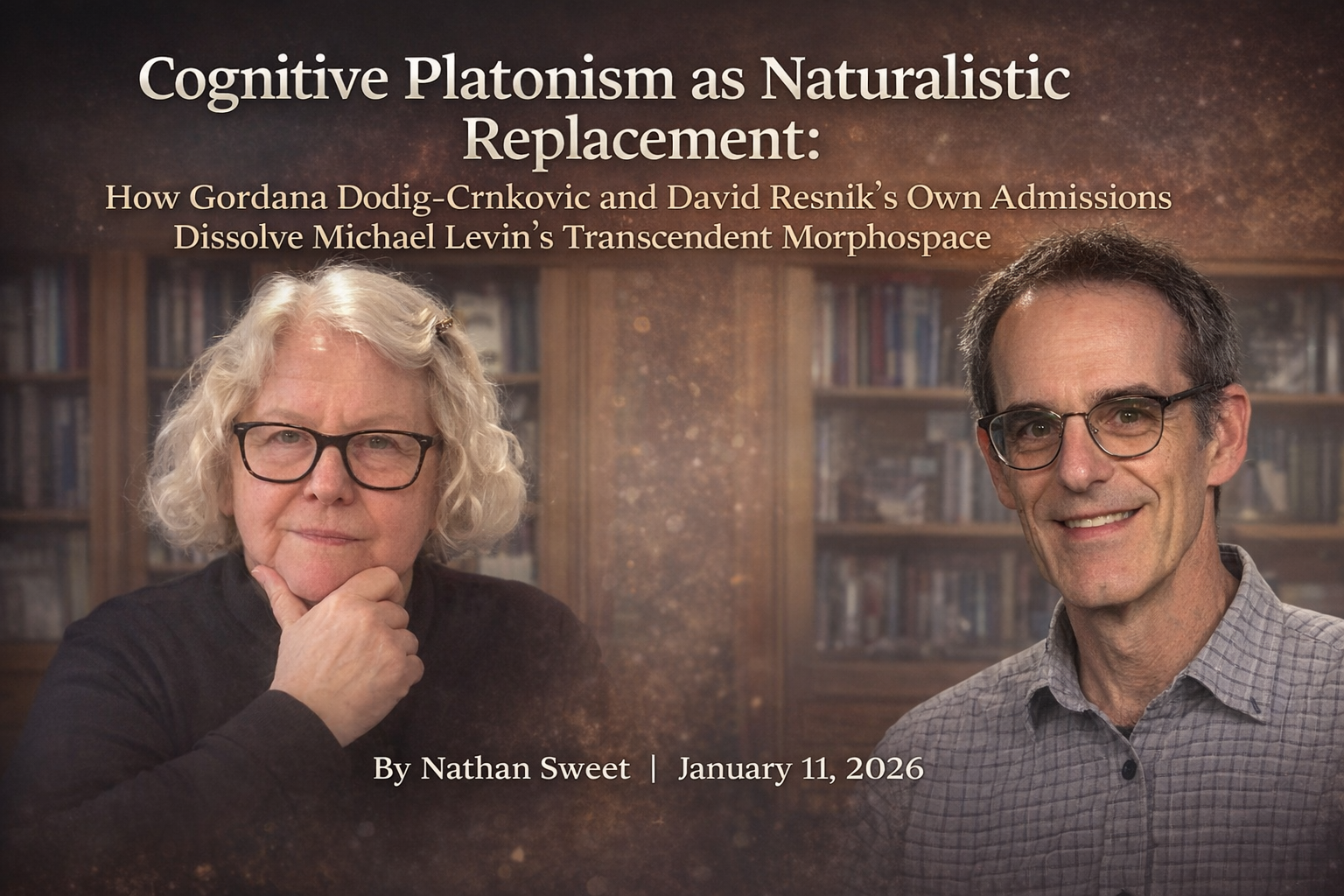
When a symposium speaker explicitly denies the transcendence that defines the symposium’s topic, as Gordana Dodig-Crnkovic’s talk “Platonic Space as Cognitive Construct” does rigorously and comprehensively, that is not elaboration. It is replacement. When a Platonic Symposium participant and co-author on several of Michael Levin’s papers, David Resnik, identifies another speaker’s framework as “refangled Kantianism” rather than Platonism, as he did in response to Dodig-Crnkovic’s talk, that is not quibbling over terminology. It is recognition that the original framework has been abandoned. And when a collaborator privately admits that he wants to avoid talk of ingression and favors structural realism over Platonic access, that is not diplomatic hedging. It is a quiet confession that the metaphysical edifice cannot bear scrutiny.
This article documents how Gordana Dodig-Crnkovic’s December 2025 presentation “Platonic Space as Cognitive Construct” at Michael Levin’s own Platonic Symposium provides a complete naturalistic alternative to Levin’s transcendent morphospace hypothesis. It also documents my extended exchange with David Resnik, Levin’s collaborator and co-author of their “Technological Approach to Mind Everywhere” paper, in which Resnik progressively distances himself from Levin’s Platonism while attempting to maintain diplomatic association. What emerges from these exchanges is not a defense of Levin’s metaphysics but its systematic dissolution from within his own intellectual community.
The pattern documented here parallels what Douglas Brash’s constraint-based framework demonstrated in the companion article: Levin’s symposium participants are not elaborating his Platonism. They are replacing it with naturalistic alternatives while using diplomatic vocabulary that obscures the substitution. The difference between Dodig-Crnkovic’s presentation and Brash’s is that Dodig-Crnkovic explicitly retains “Platonic” terminology while emptying it of Platonic content, creating a motte-and-bailey structure that allows Levin to claim validation while his actual claims go unaddressed. This linguistic strategy has significant downstream consequences for how Levin’s work gets interpreted by the scientific community and appropriated by non-scientific actors.
What Levin Actually Claims: The Bailey That Requires Defense
Before examining what Dodig-Crnkovic presents, we must establish what Levin’s Platonism actually asserts. These are direct quotes from documented exchanges at his Platonic Symposium and related discussions. Levin claims that Platonic space is “a complex pattern that is an additional ingredient to the physical interface, in the same way that the specific value of e exists independently.” He describes minds as “forms in that space” that “access each other, in that space (laterally) but also project into the ‘physical world’ through interfaces.” Most explicitly, he states that the mind “is not coming from the physical substrate” because “we facilitate them into the physical world.”
These statements make specific ontological commitments that distinguish Platonism from naturalistic alternatives. They assert that patterns exist independently of physical processes, that organisms “access” these pre-existing patterns through some unspecified mechanism, and that non-physical forms causally influence physical development without energetic accounting. When pressed on the mechanism by which timeless non-physical entities interact with temporal physical processes, Levin’s response has been to suggest that “a better science of Platonic forms plus their interfaces will force a re-do of Landauer’s Principle.” This is a promissory note that defers the constraint indefinitely into a future where it need never be cashed.
The falsifiability problem is decisive. When I asked repeatedly what observation would convince Levin that the Platonic Space hypothesis is false, not less useful but actually false, his answer was: “I move on when I feel that it’s not being fruitful for new discoveries.” This is not a falsification condition. Fruitfulness is a pragmatic criterion about where effort flows, not an epistemic criterion about what is true. A framework can be endlessly “fruitful” while being empirically empty. Phrenology was fruitful for generating research. Humoral theory was fruitful for medical practice. Neither was true.
When confronted with his own laboratory’s results showing path-dependent divergence rather than convergence toward ideal forms, specifically the Durant et al. 2017 study showing two-headed planarians persisting indefinitely without “correcting” toward one-headed canonical forms, Levin’s response was revealing: “How do you know the two-headed form is not a manifestation of a pre-existing pattern?” This converts falsification into confirmation by making any outcome compatible with the theory. If the Platonic space contains all possible forms, then demonstrating path-dependence and divergence proves nothing because both one-headed and two-headed forms “exist” in that space. But if any outcome confirms the theory, nothing can falsify it. And if nothing can falsify it, it is not science.
What Dodig-Crnkovic Actually Presents: The Motte That Cannot Defend the Bailey
Gordana Dodig-Crnkovic’s talk “Platonic Space as Cognitive Construct” provides a rigorous naturalistic framework grounded in info-computational naturalism and morphological computation. Her central thesis is stated clearly at timestamp 34:33: “Transcendence not a separate domain. It’s an emergent consequence of cognitive architecture.” This is not Platonism with modifications. This is the negation of Platonism’s defining feature.
The contrast with Levin’s claims is systematic. Where Levin says Platonic space “exists independently of” physical reality, Dodig-Crnkovic says forms are “enacted across embodied substrates” and “cognitively constructed and stabilized through shared practices.” Where Levin describes organisms “accessing” pre-existing patterns, Dodig-Crnkovic describes forms emerging through constraint satisfaction in dynamical systems. Most explicitly, at timestamp 35:31, she states: “There is no transcendent pre-written script. When such goal or script exists, they are memory-driven, individual and collected cognitive artifacts.”
“Accessed” versus “enacted” is not a semantic difference. These are opposite causal directions. “Accessed” implies forms pre-exist and organisms retrieve them via ingression from a non-physical realm. “Enacted” implies forms come into being through substrate activity, which is the opposite of what Platonism predicts. Dodig-Crnkovic reverses the direction of constitution while retaining “Platonic” vocabulary. Her blooming tea analogy at timestamp 13:49 makes this explicit: “The final flower is nowhere specified as a target and the tea ball doesn’t represent the flower in advance.” If morphogenesis works like blooming tea, with no target specification and no advance representation, then Levin’s claims about organisms navigating toward pre-existing forms they “access” are wrong. Her central analogy contradicts his central claim.
Dodig-Crnkovic builds explicitly on Maturana and Varela’s autopoiesis framework (referenced at 6:02), which describes cognition as enacted through structural coupling between organism and environment. Autopoiesis is one of approximately two dozen naturalistic frameworks that are empirically demonstrated and incompatible with Levin’s Platonism. By grounding her framework in autopoiesis, she is choosing the alternative that contradicts Levin’s access-based framing. The research literature supports this grounding. Li, Clark, and Winchester (2010) explain that autopoietic systems are “autonomous, self-contained, self-referencing and self-constructing closed systems.” There is no “accessing” of external information in such systems. There is only structural coupling and co-emergence.
David Resnik’s Recognition: “Refangled Kantianism” Not Platonism
The significance of what Dodig-Crnkovic presents was immediately recognized by another symposium participant. David Resnik, commenting on her talk, wrote: “You call it cognitive Platonism but it seems to me to be refangled Kantianism.” He is right. Kant solved the problem of mathematical knowledge by placing mathematical structure in the cognitive architecture of the knower, not in a transcendent realm. Modern embodied and enactive cognition (Varela, Thompson, Di Paolo) extends this: mathematical invariants emerge through sensorimotor coupling. The “match” between internal model and world happens because both are constrained by the same thermodynamic and topological laws, not because organisms access a separate realm of pre-existing forms.
Resnik’s recognition is significant because of his position. He is Michael Levin’s collaborator and co-author of their “Technological Approach to Mind Everywhere” paper. If Resnik recognizes that what’s being presented is Kantian rather than Platonic, that is not hostile critique from outside. That is identification of substitution from within the intellectual community that produced the symposium.
What followed in our exchange was revealing. When I pointed out that Kantian emergence and Platonic access are incompatible frameworks, Resnik responded: “Excellent analysis. I could see a view making sense in which the agent’s internal math created by their cognitive system tracks the mathematical structure of the world in which they live.” This is structural realism, not Platonism. The agent’s internal mathematics tracks world structure through Bayesian inference, active inference, and constraint satisfaction. No ingression required. The mathematics describes the dynamics; it does not preexist them.
I pushed further: “If you support structural realism, your talk’s language contradicts your position.” Resnik had used formulations like cells “access information from Platonic space,” “internally represent” forms, and “navigate through morphospace.” Every one of these formulations presupposes the separation between mathematical and physical that structural realism denies. James Ladyman, Steven French, and Max Tegmark would all note that “accessing,” “representing,” and “navigating through” are substance-ontology language incompatible with structural realism’s core move.
Resnik’s response was striking: “This is helpful, thanks. I guess I do want to avoid talk of ingression etc… Michael and I have been having discussions about this. His bottom line is that there are mathematical facts that are independent of physical facts. I can live with that.” This admission deserves careful examination.
The Father’s Framework: Michael Resnik’s Structural Realism
David Resnik’s father is Michael Resnik, the philosopher of mathematics whose work on structural realism has been foundational for naturalistic approaches to mathematical ontology. In his 1997 book “Mathematics as a Science of Patterns,” Michael Resnik wrote: “Mathematical objects have no features over and above their relational features… they are positions in patterns.” He endorsed Quinean holism (“no entity without identity”) precisely to resist naive reification of mathematical structures as a separate realm.
When I raised this with David Resnik, noting that his father’s actual framework supports thermodynamic constraint-based structural realism rather than Levin’s transcendent Platonism, the exchange became substantive. Michael Resnik’s naturalized epistemology explicitly attacks the sharp ontic divide between mathematical and physical, arguing that in modern physics it becomes unclear what is “physical” and what is “mathematical,” and that fields and structures blur the line. That is a structural realist move: one world, structurally described. Levin’s Platonism does the opposite: a transcendent “space of specific information patterns,” cells that “access” it, and an interaction problem about how bioelectric tissue talks to a non-spatiotemporal realm.
The tension becomes explicit when David Resnik says he can “live with” mathematical facts being independent of physical facts. How is this compatible with his father’s explicit strategy of treating mathematical structure as immanent in physical and theoretical practice, not as a second, causally inscrutable domain? His whole point in naturalizing mathematical knowledge was to avoid exactly that metaphysical excess. The question I posed was direct: which position do you actually hold? And if it is structural realism, how is that compatible with Levin’s explicit claims about “independent existence” and “ingression” from a “non-physical timeless realm” without violating thermodynamics?
The philosophical literature supports the incompatibility. Worrall’s structural realism (1989) emphasizes structures as primary over objects in terms of epistemic access, restricting realism to the structural or mathematical content of theories rather than positing entities in separate realms (Buonocore, 2022). This is fundamentally different from claiming that cells “access” independently existing mathematical facts. The contemporary debate in philosophy of mathematics, as Zalta (2023) notes, recognizes that “it is difficult to see in structuralism any genuine alternative to objects-platonism” unless the structuralist carefully avoids reifying patterns as Platonic entities in their own right. Levin’s formulations do not make this careful avoidance.
The Empirical Crux: Durant 2017 and Path-Dependent Divergence
The stakes of this debate are not merely philosophical. Levin’s own flagship laboratory results falsify his Platonic interpretation while being fully explicable under the naturalistic alternatives his collaborators are quietly adopting. The Durant et al. 2017 study, published from Levin’s own laboratory, created two-headed planarians through transient bioelectric intervention using 48-hour exposure to 8-octanol, a gap-junction blocker. The critical finding is that those two-headed planarians, when cut again without further manipulation, regenerated as two-headed. This persisted indefinitely across multiple regeneration cycles. They maintained their altered morphology months later in plain water after the drug was washed out. They never “corrected” toward the one-headed canonical form.
If Levin’s Platonism were true, organisms access pre-existing ideal forms. The one-headed planarian form exists in Platonic space as a canonical target. When given the opportunity through multiple regeneration cycles, removal of perturbation, and return to normal conditions, aberrant configurations should converge toward the accessed ideal. Platonism predicts error-correction toward canonical forms. What actually happened was path-dependent divergence. The perturbed state became the new stable attractor. History matters. Initial conditions matter. There is no convergence toward any accessed ideal.
Dodig-Crnkovic’s framework predicts exactly this outcome. Her info-computational naturalism treats forms as virtual machines enacted by biological cognition, as internal constraint systems that divide state space into viable regions and attractors. This naturalizes teleology without external blueprints or transcendent causes. Informational constraints show up as developmental attractors, distributed regulatory architectures, and error correction through canalization. The two-headed worm is not evidence of Platonic morphospace. It is evidence against it. The worm stabilized in whichever attractor basin the perturbation pushed it toward, which is exactly what constraint satisfaction under thermodynamic pressure predicts and exactly what Platonic access to pre-existing ideal forms does not predict.
The research literature on developmental dynamics supports this interpretation. Raju and Siggia (2023) explain that developmental systems can be understood through the geometry of gene regulatory networks, where “the flow” of development can be written as the gradient of a potential function. This is dynamical systems language, not Platonic access language. The work of Prigogine, Kauffman, Varela, and Thompson, cited extensively by researchers working on morphogenesis, all converge on constraint satisfaction in far-from-equilibrium systems as the explanatory framework, not retrieval from transcendent realms (Daniels, 2019).
The Interaction Problem That Dodig-Crnkovic Solves and Levin Punts
At timestamp 4:12, Dodig-Crnkovic explicitly names and addresses the interaction problem that Levin-Resnik’s Platonism cannot answer: “How could a transcendent realm outside space and time have causal influence?” Her solution is constraint causation, not transcendent access. She addresses what Levin admits he cannot address.
The interaction problem is not a minor philosophical quibble. It is the central explanatory gap that any dualistic framework must address. How do timeless, non-physical entities interact with temporal physical processes? Descartes could not solve this for mind-body dualism. Plato could not solve this for Form-particular relations. And Levin cannot solve this for Platonic-morphospace-to-bioelectric-network relations. When I raised Landauer’s Principle, which has been experimentally validated across colloidal systems (Bérut et al., Nature, 2012), nanomagnetic memory elements (Hong et al., Physical Review Letters, 2016), and superconducting implementations (Yan et al., Nature Physics, 2018), the question was straightforward engineering: if information enters a physical system from a non-physical source, where is the energy accounting?
Levin’s response was to promise that future science would revise Landauer. But this is not a mechanism. It is a deferral. Dodig-Crnkovic’s constraint causation framework requires no such deferral. All information processing in her framework pays its thermodynamic bills. The constraint satisfaction that produces developmental patterns occurs through physical processes with identifiable energy flows. There is no free lunch from transcendent realms because there are no transcendent realms.
The research literature on constraint causation supports Dodig-Crnkovic’s approach. Bich (2024) explains that constraints in biological systems are “material structures that harness processes” and that “the distinctive character of biological systems is that they are capable of generating from within some of the (internal) constraints that make their internal processes possible.” This is closure of constraints, not access to external templates. Emmeche and colleagues define medium downward causation where “higher level entities are constraining conditions for the emergent activity of lower levels” without requiring “higher level phenomena to have a direct influence on lower level laws” (cited in Salgado and Gilbert, 2012). This is exactly Dodig-Crnkovic’s framework. It is not Levin’s.
Is This Even Platonism? The Equivocation That Enables Appropriation
Classical Platonism requires several defining features: a transcendent realm ontologically distinct from physical reality, forms existing independently of physical particulars, eternal and unchanging forms, and physical particulars “participating in” or “imitating” these forms. Dodig-Crnkovic explicitly denies all of these. What she calls “Cognitive Platonism” has essentially nothing in common with Plato except focus on stable structures, which is so thin a criterion that it applies equally to thermodynamic attractors, which no one would call Platonic.
The question of whether this even deserves “Platonic” terminology is not pedantic. Terminology has downstream consequences. The Discovery Institute and affiliated Intelligent Design organizations already cite Levin’s “ingression from Platonic space” to support design arguments. This is not hypothetical. Evolution News has published multiple articles citing Levin’s language verbatim. The causal chain runs from Platonic terminology to ID citation to anti-science coalition strengthening. If Dodig-Crnkovic’s naturalistic framework is accepted as what “Platonic space” means, Levin gains a defensible motte while continuing to occupy the indefensible bailey. Critics challenge transcendence; defenders point to “cognitive Platonism” as naturalized. Meanwhile Levin continues saying “exists independently” and “significant minds” in podcasts reaching millions.
The harm of conflation is not abstract. Indigenous epistemologies achieved the same mathematical cognition that Levin attributes to Platonic access without positing transcendent realms. Aboriginal Australians have been enacting sophisticated pattern-recognition and environmental modeling through ritual practice for 65,000 years. Songlines, ceremony, and relationship with Country are not mysticism; they are operational engagement with the same morphogenetic and bioelectric dynamics Levin measures in labs, just without the Platonic metaphysics. They did not need an unfalsifiable transcendent realm to work with these dynamics. They enacted them through practice and place, as documented by Tyson Yunkaporta in “Sand Talk” and Lynne Kelly in “The Memory Code.”
Levin’s Platonism does the opposite of what Indigenous frameworks achieve. It reinstates Cartesian dualism with minds “accessing” bodies from transcendent realms. This is precisely the philosophical infrastructure that historically justified treating animals as soulless machines and land as dead matter for extraction. The naturalistic frameworks dissolve human exceptionalism. The Platonic framework reinforces it, regardless of Levin’s intentions.
The Motte-and-Bailey Structure in Practice
The exchange pattern documented across Levin’s symposium follows what philosophers call motte-and-bailey argumentation. The strong claim (bailey) is that minds are forms in Platonic space that access each other and project into the physical world through interfaces, with Platonic space existing independently of physical reality and containing “significant minds” with “plasticity” that can “save state.” The weak claim (motte) is that if something must be worried about in designing and carrying out experiments, then it is real, with no more ontological commitments than that.
These statements are incompatible. The first makes specific ontological claims about minds existing in a non-physical space. The second disclaims ontological commitment beyond pragmatic utility. When challenged on the strong claim, retreat to the weak claim. When not challenged, advance the strong claim. This is the motte-and-bailey pattern by definition.
Dodig-Crnkovic’s talk functions as an elaborate motte construction. Her naturalistic framework is defensible, rigorous, and grounded in established science. But by calling it “Cognitive Platonism,” she enables defenders to point to her work when critics challenge Levin’s transcendence claims. The vocabulary creates the illusion of continuity while the ontological commitments reverse. Anyone watching her talk should find it striking that at Levin’s own symposium, a speaker explicitly denies transcendence, denies pre-written scripts, grounds forms in cognitive construction, and is recognized by another symposium participant as Kantian rather than Platonic. This is not validation of Levin’s Platonism. It is another example of refutation from within, dressed in diplomatic vocabulary.
What Would Actually Validate Levin’s Claims
If Levin’s Platonism were a scientific hypothesis rather than unfalsifiable metaphysics, what observations would it predict that differ from naturalistic alternatives? Convergence to canonical forms after perturbation removal would support Platonic access over constraint satisfaction. The Durant 2017 study shows the opposite. Morphogenetic outcomes that cannot be explained by thermodynamic constraint satisfaction alone would suggest additional causal factors. No such outcomes have been identified. Energetic signatures indicating non-physical information input would be detectable through careful metabolic measurement during morphogenesis if Platonic access were real. No such signatures have been detected.
What would falsify my framework and the naturalistic alternatives? Convergence to canonical forms after perturbation removal rather than path-dependent divergence. Morphogenetic outcomes that violate thermodynamic constraints. Energetic signatures indicating non-physical information input. Any mechanism specification for how timeless forms interact with temporal processes. I have stated my falsification conditions. Where are Levin’s?
The absence of falsification conditions is not a minor methodological oversight. It is the defining feature that separates science from metaphysics. Karl Popper’s demarcation criterion in “Conjectures and Refutations” (1963) remains the gold standard: theories must specify falsification conditions. Theories that cannot be wrong in principle cannot guide action in practice. They can inspire, motivate, generate poetry. They cannot tell you what to do when the world pushes back. Imre Lakatos’s “Methodology of Scientific Research Programmes” (1978) distinguishes progressive programs (generating novel predictions, reducing auxiliary hypotheses) from degenerating programs (protecting core claims through expanding auxiliary hypotheses). Levin’s framework shows the hallmarks of degeneration: auxiliary hypotheses expand to absorb counterexamples, core claims retreat to unfalsifiable formulations when pressed, and novel “predictions” turn out to be redescriptions of prior results.
The Convergence of Levin’s Collaborators on Non-Platonic Frameworks
Dodig-Crnkovic is not the only speaker at Levin’s symposium whose framework replaces rather than elaborates his Platonism. Douglas Brash’s talk “Abstract Forms & Tangible Biology” grounds pattern formation in Chladni-plate dynamics and stigmergic algorithms, explicitly distinguishing his framework as “Platonish” rather than Platonic because constraint satisfaction under physical law is fundamentally different from access to transcendent templates. Chris Fields, another Levin collaborator, places the “Platonic realm” in the world rather than transcendent to it, which directly contradicts Levin’s claim that Platonic space “exists independently.”
And now David Resnik, Levin’s co-author, admits he wants to “avoid talk of ingression” and favors structural realism over Platonic access. When Resnik says that math is “the superstructure of the world” and that “bioelectric networks are bound by the structure,” he is describing structural realism, not Platonism. Structural realism holds that mathematical structure IS physical structure, not something organisms access from elsewhere.
The internal tension exists and is documented. When collaborators recognize that symposium presentations are closer to D’Arcy Thompson’s emergence-from-constraints than to Levin’s Platonic access, and when Thompson’s framework explains the phenomena, the question becomes sharp: what explanatory work does “accessing Platonic space” actually do that constraint satisfaction does not? If the answer is “nothing empirically testable,” then the metaphysical add-on is not explanation. It is decoration.
Implications for Philosophy of Biology and Science Communication
The documentation provided here is not merely about one researcher’s metaphysical preferences. It raises systematic questions about how unfalsifiable frameworks interact with legitimate empirical research, how terminology can create illusions of continuity across incompatible positions, and how scientific authority can be borrowed for non-scientific claims.
Levin’s laboratory work on bioelectricity represents genuine empirical achievement. His engineering contributions to developmental biology are impressive and real. Nothing in this critique touches the empirical work. What does not survive scrutiny is the metaphysical interpretation, an interpretation that cannot specify falsification conditions, cannot provide interaction mechanisms, cannot account for path-dependent divergence in its own data, and provides rhetorical cover for Intelligent Design appropriation while claiming scientific authority.
The naturalistic alternatives, whether Dodig-Crnkovic’s info-computational framework, Brash’s constraint dynamics, or the structural realism that Resnik favors, all provide complete explanatory coverage of Levin’s empirical results without the metaphysical overhead. They all specify falsification conditions. They all respect thermodynamic constraints. They all connect to established physics and mathematics. They all dissolve the interaction problem rather than punting on it. If they provide everything the Platonic framework claims to provide while avoiding its problems, then Occam’s razor applies: the transcendent realm is unnecessary hypothesis.
Dodig-Crnkovic’s talk is valuable precisely because it demonstrates how to do developmental biology rigorously without Platonic metaphysics. Her constraint causation framework, her grounding in autopoiesis and morphological computation, her explicit rejection of pre-written scripts, all of these provide what Levin claims to seek: explanation of how complex biological forms emerge. But calling it “Platonism” when it denies Platonism’s defining features obscures rather than clarifies. It enables the motte-and-bailey. It muddies the waters for students, journalists, and other scientists trying to understand what’s actually being claimed.
The question for Dr. Levin remains: Do you accept Dodig-Crnkovic’s framework? If yes, will you stop claiming Platonic space “exists independently”? If no, how do you reconcile the explicit contradictions between her framework and yours? And for Dr. Resnik: If structural realism is your actual position, how is continued association with Levin’s Platonic terminology compatible with your father’s work showing that structural realism specifically avoids the metaphysical commitments Levin’s language smuggles in?
These are not hostile questions. They are clarifying questions. Science advances through disambiguation, through making explicit what is claimed so that what is claimed can be tested. The current situation, where incompatible frameworks shelter under shared vocabulary, serves no scientific purpose. It only enables appropriation and confusion.
Cranes All the Way Down
Daniel Dennett’s distinction between cranes and skyhooks in “Darwin’s Dangerous Idea” (1995) remains the sharpest diagnostic for this debate. Cranes are mechanisms that explain complexity through prior complexity, each step grounded in what came before. Skyhooks are miracles that posit explanatory shortcuts, explanations that explain by not explaining. Dodig-Crnkovic’s constraint causation, Brash’s stigmergy and Chladni dynamics, Friston’s free energy minimization, all of these are cranes. Levin’s Platonic access is a skyhook.
Skyhooks are not explanations. They are promissory notes that defer explanation indefinitely. When the promissory note says “a better science of Platonic forms will force a re-do of Landauer’s Principle,” without specifying what that science looks like, how it would work, or what observations would cash the note, the note is worthless. It is not explanation. It is placeholder for explanation that might never arrive.
The patterns are in the physics, not accessed from beyond it. The mathematics describes constraints, not commands from Platonic heaven. The organisms construct their futures, not retrieve them. Everything we need is already here, paid for in thermodynamic coin, explicable through mechanism, falsifiable through experiment. Dodig-Crnkovic’s talk demonstrates this. Brash’s talk demonstrates this. The quiet convergence of Levin’s own collaborators toward structural realism and constraint satisfaction demonstrates this.
What remains is not a scientific disagreement. It is a terminological confusion exploited for rhetorical purposes. Clearing that confusion serves science, serves philosophy, and serves the public trying to understand what developmental biology actually shows about the nature of form, pattern, and life. That is what this documentation series aims to provide.
This article is part of an ongoing documentation of the Recursive Constraint Falsification (RCF) method’s application to contemporary debates in biology and consciousness studies. For the primary evidence and verbatim exchanges, see the companion articles:
I give my overall assessment here: Michael Levin’s Platonism as Unfalsifiable Metaphysics: Evidence from Bioelectric Morphogenesis.
Additionally, for readers who want to examine the original arguments in their original context, I have preserved the verbatim comment record from his Platonic Symposium. This includes sixteen of my comments that Michael Levin left in the moderation queue. These comments propose over a dozen concrete falsification tests his lab could run and cite empirically replicated scholarly work that contradicts most, if not all, of the arguments he presented. They are collected here: Primary Evidence Record: Verbatim Symposium Comments on Michael Levin’s Platonism, Bioelectric Morphogenesis, and Empirical Falsifiability.
For a fully non-Platonic alternative that directly addresses the same explanatory gaps using constraint-based mechanics rather than metaphysical postulates, see The Chladni Plate Solution: How Douglas Brash’s Constraint Framework Answers Every Question Michael Levin Claims Justifies Platonism, Yet Cannot Answer.
References
Bérut, A., et al. (2012). Experimental verification of Landauer’s principle linking information and thermodynamics. Nature, 483, 187-189. https://doi.org/10.1038/nature10872
Bich, L. (2024). Organisational teleology 2.0: Grounding biological purposiveness in regulatory control. Ratio, 37(4), 327-340. https://doi.org/10.1111/rati.12405
Buonocore, G. (2022). A structuralist interpretation of the relational interpretation. Theoria, 88(4), 733-742. https://doi.org/10.1111/theo.12402
Daniels, J. (2019). Agencement and Agency: If Gilles and Félix had met Stanley. Modern Theology, 36(4), 778-802. https://doi.org/10.1111/moth.12563
Dennett, D. (1995). Darwin’s Dangerous Idea: Evolution and the Meanings of Life. Simon & Schuster. Publisher link
Durant, F., et al. (2017). Long-term, stochastic editing of regenerative anatomy via targeting endogenous bioelectric gradients. Biophysical Journal, 112(10), 2231-2243. https://doi.org/10.1016/j.bpj.2017.04.034
Friston, K. (2010). The free-energy principle: a unified brain theory? Nature Reviews Neuroscience, 11, 127-138. https://doi.org/10.1038/nrn2787
Hong, J., et al. (2016). Experimental test of Landauer’s principle in single-bit operations on nanomagnetic memory bits. Physical Review Letters, 117(16), 166801. https://doi.org/10.1103/PhysRevLett.117.166801
Kauffman, S. (1993). The Origins of Order: Self-Organization and Selection in Evolution. Oxford University Press. Publisher link
Kelly, L. (2016). The Memory Code: The Secrets of Stonehenge, Easter Island and Other Ancient Monuments. Cambridge University Press. Publisher link
Lakatos, I. (1978). The Methodology of Scientific Research Programmes. Cambridge University Press. Publisher link
Landauer, R. (1961). Irreversibility and heat generation in the computing process. IBM Journal of Research and Development, 5(3), 183-191. https://doi.org/10.1147/rd.53.0183
Li, Q., Clark, B., & Winchester, I. (2010). Instructional design and technology grounded in enactivism: A paradigm shift? British Journal of Educational Technology, 41(3), 403-419. https://doi.org/10.1111/j.1467-8535.2009.00954.x
Maturana, H., & Varela, F. (1980). Autopoiesis and Cognition: The Realization of the Living. D. Reidel Publishing Company. Publisher link
Popper, K. (1963). Conjectures and Refutations: The Growth of Scientific Knowledge. Routledge. Publisher link
Prigogine, I., & Stengers, I. (1984). Order Out of Chaos: Man’s New Dialogue with Nature. Verso. Publisher link
Raju, A., & Siggia, E. D. (2023). A geometrical perspective on development. Development, Growth & Differentiation, 65(5), 245-254. https://doi.org/10.1111/dgd.12855
Resnik, M. (1997). Mathematics as a Science of Patterns. Oxford University Press. Publisher link
Salgado, M., & Gilbert, N. (2012). Emergence and Communication in Computational Sociology. Journal for the Theory of Social Behaviour, 43(1), 87-110. https://doi.org/10.1111/jtsb.12004
Varela, F., Thompson, E., & Rosch, E. (1991). The Embodied Mind: Cognitive Science and Human Experience. MIT Press. Publisher link
Worrall, J. (1989). Structural Realism: The Best of Both Worlds? Dialectica, 43, 99-124. https://doi.org/10.1111/j.1746-8361.1989.tb00838.x
Yan, L.L., et al. (2018). Single-atom demonstration of the quantum Landauer principle. Nature Physics, 14, 491-494. https://doi.org/10.1038/s41567-018-0097-0
Yunkaporta, T. (2019). Sand Talk: How Indigenous Thinking Can Save the World. Text Publishing. Publisher link
Zalta, E. N. (2023). Mathematical pluralism. Noûs, 58(2), 306-332. https://doi.org/10.1111/nous.12451