“A skyhook is a ‘mind-first’ force or power or process, an exception to the principle that all design, and apparent design, is ultimately the result of mindless, motiveless mechanicity.”
— Daniel C. Dennett, Darwin’s Dangerous Idea (1995)Patterns from Constraints, Not Templates
Ernst Chladni’s 18th-century apparatus reveals emergence without access to transcendent forms
When Rigorous Science Meets Comfortable Metaphysics
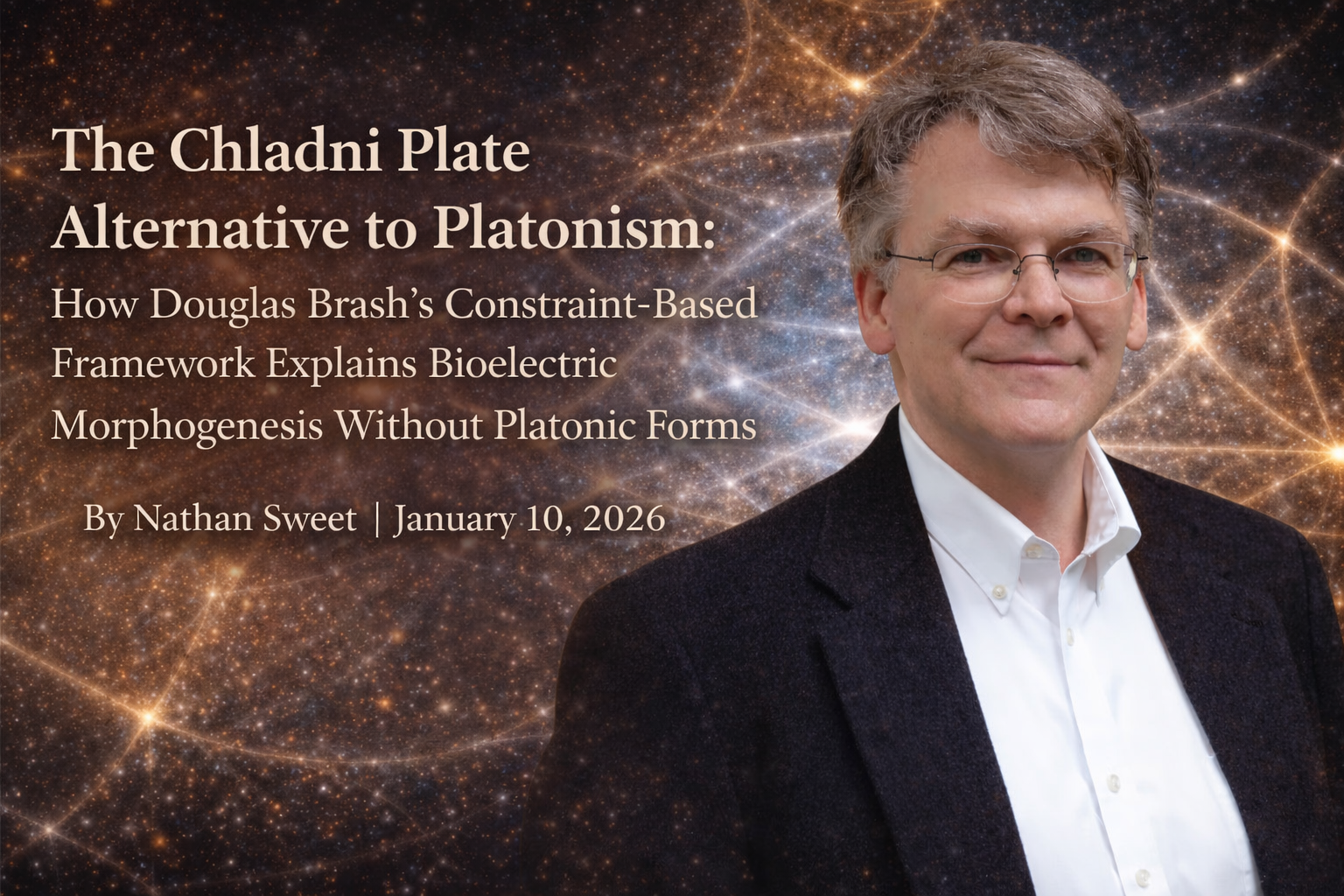
Douglas Brash’s December 2025 presentation “Abstract Forms & Tangible Biology,” delivered at Yale School of Medicine as part of the Platonic Space Symposium, provides something rare in contemporary philosophy of biology: a complete, thermodynamically grounded, mechanistically specified alternative to a popular but problematic framework. The framework in question is Michael Levin’s Platonic morphospace hypothesis, which holds that biological organisms “access” pre-existing abstract forms to guide their development. Brash’s constraint-based approach answers every question Levin claims requires Platonism while generating differential predictions that Levin’s framework structurally cannot match.
The significance of this alternative extends beyond academic dispute. Levin’s laboratory work on bioelectric patterning represents genuine empirical achievement. His demonstrations that ion channel manipulation can alter planarian regeneration, induce ectopic eyes, and reshape Xenopus facial structure constitute real contributions to developmental biology. The engineering is impressive. The data are solid. What does not survive scrutiny is the metaphysical interpretation layered atop those results: that organisms achieve morphological outcomes by “accessing” forms that exist independently of physical process, that minds “project into” physical substrates from a non-physical space, that the mathematical regularities observed in development somehow cause biological outcomes from outside the causal order.
This interpretation cannot specify what observation would prove it wrong. That is not a minor technical gap. It is a disqualifying structural flaw. A framework that metabolizes any outcome as confirmation is not a theory. It is a narrative that borrows prestige from the science it decorates. Brash’s presentation exposes this by doing what Levin’s Platonism never does: deriving specific predictions from mechanistic principles, connecting those principles to established physics, and showing precisely where the two frameworks make different empirical bets.
The critique that follows targets the metaphysical interpretation, not the laboratory achievements. Levin’s empirical contributions stand. His philosophical claims do not. Brash’s talk demonstrates why by systematically replacing every Platonic invocation with a constraint-based alternative that actually explains the phenomena rather than naming them.
What Platonic Morphogenesis Actually Claims
Precision matters when evaluating philosophical frameworks, and critics sometimes attack positions weaker than those actually defended. Levin’s Platonism deserves engagement at its strongest. The claims, documented in extensive exchanges and public presentations, include specific ontological commitments that distinguish genuine Platonism from mere mathematical description.
“A complex pattern that is an additional ingredient to the physical interface, in the same way that the specific value of e… exist independently.”
— Michael Levin, documented exchange
“Minds are forms in that space, and they access each other, in that space (laterally) but also project into the ‘physical world’ through interfaces.”
— Michael Levin, documented exchange
“It’s substrate independent in the sense that the mind is not coming from the physical substrate… we facilitate them into the physical world.”
— Michael Levin, documented exchange
These statements make explicit commitments that distinguish them from the innocuous claim that mathematics usefully describes biological patterns. The first asserts that patterns exist as “additional ingredients” beyond physical process. The second claims that minds inhabit a non-physical space from which they “project into” the physical world. The third specifies that minds do not arise from physical substrates but are “facilitated” into them from elsewhere. This is not mathematical modeling. This is ontology: claims about what exists, where it exists, and how it causally operates.
The charitable interpretation recognizes that Levin is attempting something ambitious. He observes that bioelectric patterns carry information about target morphology, that organisms exhibit remarkable error-correction capacities, that regeneration appears goal-directed in ways that simple genetic programs cannot easily explain. These observations are real. The question is whether invoking a non-physical space populated by pre-existing forms explains them or merely redescribes them in more impressive vocabulary.
The Falsification Test: When asked directly what observation would convince him the Platonic Space hypothesis was false—not “less useful,” not “less fruitful,” but false—the response was revealing: “I move on when I feel that it’s not being fruitful for new discoveries.”
Fruitfulness is a pragmatic criterion about where research effort flows. It is not an epistemic criterion about what is true. Phrenology was fruitful for generating research questions. Humoral theory was fruitful for medical practice. Neither was true. A framework that substitutes productivity metrics for falsification conditions has exited the domain of testable science.
The Thermodynamic Challenge Platonism Cannot Answer
When information enters a physical system, it must pay thermodynamic bills. This is not philosophical preference. It is experimentally validated physics. Rolf Landauer demonstrated in 1961 that information processing has irreducible energetic costs: every bit erased dissipates at least kT ln 2 of energy. This bound has been confirmed across multiple independent experimental platforms. Bérut and colleagues validated it in colloidal particle systems (Nature, 2012). Hong and colleagues confirmed it in nanomagnetic memory elements (Physical Review Letters, 2016). Yan and colleagues demonstrated it at the single-atom level using superconducting implementations (Nature Physics, 2018).
If organisms access information from a non-physical Platonic space, that information must enter the causal chain somewhere. Where is the energetic signature? If non-physical forms causally influence physical development, how do timeless entities interact with temporal processes? The standard answers reveal the problem. One response invokes future science: “A better science of Platonic forms plus their interfaces will force a re-do of Landauer’s Principle.” This is a promissory note that relocates the constraint into an indefinite future where it need never be cashed. Without a mechanism and measurement plan, it functions as immunization against inconvenient physics.
Another response retreats from causal claims entirely, treating Platonic space as merely a useful modeling framework with no ontological import. But this contradicts the explicit statements about minds “projecting into” physical substrates and patterns being “additional ingredients” to physical interfaces. The strong claims appear when Platonism is being advanced. The weak claims appear when Platonism is being defended. This oscillation has a name in philosophical analysis: motte-and-bailey. The pattern is diagnostic.
Brash’s Framework: Patterns from Dynamics Under Constraint
Douglas Brash approaches the same phenomena Levin studies—pattern formation, morphological stability, regenerative capacity—and provides mechanistic explanations that connect to established physics without invoking transcendent realms. His central demonstration uses an apparatus two centuries old: the Chladni plate.
When salt is sprinkled on a vibrating metal plate, intricate geometric patterns emerge. The salt grains follow Newton’s laws. The pattern follows from boundary conditions. No template is consulted. No morphospace is accessed. Change the plate shape and the pattern changes. Everything is paid for in thermodynamic coin.
“Where did this pattern come from? There’s clearly no map here… Newton’s laws will control the salt grains at the micro level but they don’t cause the pattern at the macro level. The pattern comes from constraints at the macro level.”
— Douglas Brash, “Abstract Forms & Tangible Biology” (36:50-37:56)
“You’ve got nondirectional motion going on at the micro level. The directionality comes at the macro level and it comes from these constraints.”
— Douglas Brash (38:21-38:33)
The insight is precise and consequential. Micro-level physics operates without reference to macro-level patterns. Macro-level patterns emerge from constraints imposed by boundary conditions—the shape of the plate, the frequency of vibration, the properties of the medium. The mathematics describes what physical systems do under constraint. It does not cause physical systems to do it from outside. Brash makes the thermodynamic connection explicit by comparing this to a Carnot heat engine: random thermal motion becomes directed work through constraint, not through consultation with pre-existing templates.
Stigmergy Replaces Platonic Access
Complex structures often appear to require planning, blueprints, or access to pre-existing forms. How does a wasp colony build an intricate nest without a map? Brash’s answer invokes stigmergy: distributed algorithms operating on local information under environmental constraints.
“Wasps do not have a map of a wasp nest in their head. The brains aren’t big enough. What they do is they have an algorithm. They land on a nest, a partly built nest, and if they see pattern P, they spit here. If they see pattern Q, they spit there.”
— Douglas Brash (44:43-45:00)
“This is a third kind of law that’s neither the pattern nor a criterion of constancy. It’s sort of an algorithm of micromotion plus external constraints, a lot like the Chladni plate.”
— Douglas Brash (45:35-45:48)
The wasp nest emerges from if-then rules executed by individual agents responding to local stimuli. No wasp knows the final structure. No blueprint exists. The nest “knows” what it will look like in the sense that constraint satisfaction under local rules determines the outcome. This is mechanism, not metaphysics. And it generalizes: termite mounds, slime mold networks, bone remodeling, vascular patterning—all exhibit stigmergic dynamics where complex macro-structures emerge from simple local algorithms under constraint.
The Palanquin-Prince Inversion
Brash inverts the intuitive direction of causation that Platonism assumes. Consider a prince carried in a palanquin. Naive analysis might describe the prince as commanding his movement, with the palanquin bearers executing his will. But the prince’s motion just is the palanquins moving. The “command” is a story we tell about coordinated micro-events.
“The business end is going on at the micro level and you get these patterns and abstractions up at the level of the princes being carried around.”
— Douglas Brash (41:50-42:04)
“It looks to me like there’s a possibility that causality has this structure rather than the pattern one arrow pattern two causality, particularly in hierarchical systems like you see in biology.”
— Douglas Brash (43:32-43:43)
Platonic morphogenesis assumes top-down causation: the form causes the development. Brash’s framework inverts this: micro-dynamics under constraint produce patterns that we then describe as if they were causally efficacious templates. The template is explanatorily posterior to the dynamics, not prior. This is not eliminativism about patterns—patterns are real. It is eliminativism about patterns as causes operating from outside the causal order.
Brash’s Explicit Departure from Platonism
Brash does not pretend to be elaborating Levin’s position. He explicitly distinguishes his framework, diplomatically but unmistakably.
“Plato’s forms, as I understand, were not really mathematical objects. So, these timeless forms or abstract patterns are just there… There are no laws connecting them. Whereas mathematical objects are connected by mathematical operations.”
— Douglas Brash (9:43)
“This isn’t really Plato… I’m going to call them Platonish representations. And that sounds a little bit pejorative, but in fact, I think it’s probably ultimately going to turn out to be more useful than the pure Plato’s representation.”
— Douglas Brash (11:47-12:15)
“Platonish” is his diplomatic term for “not Platonic at all.” Mathematical structures connected by operations that we can study and manipulate are categorically different from timeless forms that simply exist without law-governed relations. The former is the domain of constraint-based science. The latter is metaphysics that cannot specify its own falsification conditions.
Brash goes further, arguing that Plato’s forms are anthropocentric cognitive constructions rather than universal features of reality. He grounds this in the classic Lettvin paper “What the Frog’s Eye Tells the Frog’s Brain,” which demonstrated that frogs perceive contrast, convexity, motion, and dimming—not the categories humans impose on perception. If forms are species-specific cognitive constructions shaped by evolutionary pressures and perceptual constraints, they are not universal, not pre-existing, and not Platonic in any meaningful sense.
“These human forms of Plato’s are not necessarily privileged basis vectors of truth and they’re actually anthropocentric.”
— Douglas Brash (15:19-15:26)
The Empirical Crux: Durant et al. 2017
Theory meets data decisively in Levin’s own flagship results. Durant et al. 2017, published from Levin’s laboratory, created two-headed planarians through transient bioelectric intervention: 48-hour exposure to octanol, a gap-junction blocker. The intervention was temporary. The drug washed out. Normal conditions returned.
The Critical Finding: Two-headed planarians, when cut again without further manipulation, regenerated as two-headed. This persisted indefinitely across multiple regeneration cycles. Months later, in plain water, they maintained their altered morphology. They never “corrected” toward the one-headed canonical form.
Consider what Platonism predicts. If organisms access pre-existing ideal forms, and the one-headed planarian form exists in Platonic space, then aberrant configurations should converge toward the accessed ideal when given the opportunity. Multiple regeneration cycles provide that opportunity. Removal of the perturbation provides that opportunity. Return to normal conditions provides that opportunity. Platonism predicts error-correction toward canonical forms.
What actually happened was path-dependent divergence. The perturbed state became the new stable attractor. History mattered. Initial conditions mattered. There was no convergence toward any accessed ideal. The escape hatch deployed against this data reveals the problem’s structure: “How do you know the two-headed form is not a manifestation of a pre-existing pattern?” If the Platonic space contains all possible forms, then demonstrating path-dependence proves nothing because both one-headed and two-headed forms “exist” in that space. But if any outcome confirms the theory, nothing can falsify it. And if nothing can falsify it, it is not science.
Brash’s framework predicts exactly what Durant observed. Patterns come from constraints, not from accessing templates. Bioelectric perturbation altered the effective phase space, shifting the system into a different attractor basin. The system is not “failing to reach” a Platonic form. It is settling into whichever configuration the constraints define as stable. Change the constraints and the stable configuration changes. This is thermodynamic constraint satisfaction, and it makes the correct prediction where Platonism either makes the wrong prediction or makes no prediction at all.
Scholarly Convergence: Brash Is Not Alone
Brash’s constraint-based framework converges with established research programs across multiple disciplines. This convergence matters because it demonstrates that the alternative to Platonism is not ad hoc critique but a coherent scientific tradition with its own theoretical foundations and empirical track record.
Karl Friston’s Free Energy Principle provides the thermodynamic backbone. Systems that persist must minimize prediction error through active inference, selecting actions that confirm predictions while maintaining organizational closure. This is exactly the dynamical-systems framework Brash invokes when discussing attractors and constraint satisfaction. Friston’s mathematics describes what adaptive systems do under thermodynamic pressure. It does not require those systems to access pre-existing forms (Nature Reviews Neuroscience, 2010).
Daniel Dennett’s distinction between cranes and skyhooks maps directly onto this debate. Cranes are mechanisms that explain complexity through prior complexity, building up from simpler processes. Skyhooks are miracles that posit explanatory shortcuts, invoking powers that defer explanation indefinitely. Brash’s stigmergy and constraint-satisfaction are cranes. Levin’s Platonic access is a skyhook. As Dennett emphasizes throughout Darwin’s Dangerous Idea, skyhooks are not explanations. They are promissory notes that never come due.
Stuart Kauffman’s work on autocatalytic sets and the adjacent possible demonstrates that order emerges from self-organization under constraint without requiring pre-existing templates. The recent paper by Garte, Marshall, and Kauffman in Entropy (2025) states the methodological warning directly: “the world is not a theorem.” This is a precise critique of frameworks that can be made consistent with any outcome by construction. Their title says it cleanly: “Apologies to Plato” (DOI: 10.3390/e27020280).
Imre Lakatos’s methodology of scientific research programmes distinguishes progressive programs—those generating novel predictions and reducing auxiliary hypotheses—from degenerating programs that protect core claims through expanding epicycles. Levin’s framework shows the hallmarks of degeneration: auxiliary hypotheses expand to absorb counterexamples, core claims retreat to unfalsifiable formulations when pressed, and novel “predictions” turn out to be redescriptions of prior results. Brash’s framework shows the hallmarks of progress: it generates differential predictions, reduces explanatory machinery, and connects to established physics.
What the Constraint Framework Actually Explains
Theoretical frameworks earn their place by explaining phenomena that alternatives cannot. Here is what constraint-based emergence explains that Platonic access cannot match.
Path Dependence. Why do two-headed planarians stay two-headed? Because bioelectric perturbation shifted the system into a different attractor basin. There is no “canonical form” being accessed. There are stable configurations under constraint, and which configuration stabilizes depends on history. Platonism either predicts convergence (wrong) or predicts nothing (unfalsifiable).
Multiple Stable Morphologies. Xenobots exhibit path-dependent morphologies based on initial conditions rather than converging to a single ideal. Brash’s framework predicts this. Platonism struggles with it unless it expands to contain all possible forms, at which point it predicts nothing discriminable.
Thermodynamic Accounting. All pattern formation in Brash’s framework pays its thermodynamic bills. The Chladni plate pattern costs energy (vibration). The wasp nest costs energy (material collection, placement, maintenance). Information processing costs energy (Landauer). No free lunches arrive from transcendent realms.
Emergence Without Maps. Stigmergy demonstrates that complex goal-directed structures can emerge from local algorithms under constraint without any entity accessing a pre-existing template. The wasps do not know what the nest will look like. The nest “knows” what it will look like in the sense that constraint satisfaction determines the outcome.
Scale-Free Applicability. The constraint framework applies identically at molecular scales (genetic code as constraint), cellular scales (bioelectric patterning), organismal scales (morphogenesis), and social scales (market dynamics, language evolution). Platonism requires separate stories at each scale because it never specifies mechanisms that would generalize.
My Falsification Conditions
Intellectual honesty requires stating what would change one’s mind. Here are my falsifiable predictions and the observations that would defeat them.
Prediction 1: Path-dependent divergence rather than convergence to canonical forms. Already confirmed by Durant et al. 2017.
Prediction 2: Disrupting bioelectric computation should produce proportional disruption of morphological memory. If organisms access pre-existing forms through an “interface,” disrupting that interface should produce pattern errors, not proportional degradation.
Prediction 3: Thermodynamic constraint satisfaction should fully predict regeneration outcomes using only local bioelectric computation. If Platonic space adds explanatory power, there should be residual phenomena unexplained by thermodynamics. What are they?
Prediction 4: If Platonic forms are real causal actors, “accessing” them should have an energetic signature detectable through careful metabolic measurement during morphogenesis. What is it?
What would falsify my framework: Convergence to canonical forms after perturbation removal. Morphogenetic outcomes that violate thermodynamic constraints. Energetic signatures indicating non-physical information input. Any mechanism specification for how timeless forms interact with temporal processes.
I have stated my falsification conditions. The question remains open: what would falsify Platonic morphogenesis?
Cranes All the Way Down
Douglas Brash’s presentation provides what Levin’s Platonism structurally cannot: a framework that explains the phenomena, generates falsifiable predictions, respects thermodynamic constraints, and connects to established science. The Chladni plate does not access patterns from a transcendent realm. The wasps do not consult morphospace. The planarian does not fail to reach its ideal. These systems settle into stable configurations under constraint, and the mathematics describes what they do without causing them to do it from outside.
This is not reductive materialism. It is process-relational naturalism, where patterns are real but immanent, where mathematics describes constraint satisfaction rather than prescribing templates, where explanation pays its thermodynamic bills. The position does not deny that patterns exist. It denies that patterns exist in a causally efficacious space separate from the physical processes that exhibit them.
Levin’s laboratory achievements remain impressive. Nothing in this critique touches the empirical work. What does not survive scrutiny is the metaphysical interpretation: an interpretation that cannot specify falsification conditions, cannot provide interaction mechanisms, cannot account for path-dependent divergence in its own data, and provides rhetorical cover for Intelligent Design appropriation while claiming scientific authority. The last point bears emphasis. When Discovery Institute’s Evolution News cites Levin’s Platonic vocabulary verbatim to support “non-physical sources of biological information,” the framework has a downstream-harm problem that scientific prestige cannot immunize.
Brash showed how to do it differently. The patterns are in the physics, not accessed from beyond it. The mathematics describes constraints, not commands from Platonic heaven. The organisms construct their futures through constraint satisfaction, not retrieve them from a transcendent archive.
Everything we need is already here: paid for in thermodynamic coin, explicable through mechanism, falsifiable through experiment.
That is what science looks like.
References
Bérut, A., Arakelyan, A., Petrosyan, A., Ciliberto, S., Dillenschneider, R., & Lutz, E. (2012). Experimental verification of Landauer’s principle linking information and thermodynamics. Nature, 483, 187-189. https://doi.org/10.1038/nature10872
Dennett, D.C. (1995). Darwin’s Dangerous Idea: Evolution and the Meanings of Life. Simon & Schuster.
Durant, F., Morokuma, J., Fields, C., Williams, K., Adams, D.S., & Levin, M. (2017). Long-term, stochastic editing of regenerative anatomy via targeting endogenous bioelectric gradients. Biophysical Journal, 112(10), 2231-2243. https://doi.org/10.1016/j.bpj.2017.04.011
Friston, K. (2010). The free-energy principle: a unified brain theory? Nature Reviews Neuroscience, 11, 127-138. https://doi.org/10.1038/nrn2787
Garte, S., Marshall, S., & Kauffman, S. (2025). The world is not a theorem. Entropy, 27(2), 280. https://doi.org/10.3390/e27020280
Harnad, S. (1990). The symbol grounding problem. Physica D, 42, 335-346. https://doi.org/10.1016/0167-2789(90)90087-6
Hong, J., Lambson, B., Dhuey, S., & Bokor, J. (2016). Experimental test of Landauer’s principle in single-bit operations on nanomagnetic memory bits. Physical Review Letters, 117(16), 166801. https://doi.org/10.1103/PhysRevLett.117.166801
Lakatos, I. (1978). The Methodology of Scientific Research Programmes. Cambridge University Press.
Landauer, R. (1961). Irreversibility and heat generation in the computing process. IBM Journal of Research and Development, 5(3), 183-191. https://doi.org/10.1147/rd.53.0183
Lettvin, J.Y., Maturana, H.R., McCulloch, W.S., & Pitts, W.H. (1959). What the frog’s eye tells the frog’s brain. Proceedings of the IRE, 47(11), 1940-1951.
Parrondo, J.M.R., Horowitz, J.M., & Sagawa, T. (2015). Thermodynamics of information. Nature Physics, 11, 131-139. https://doi.org/10.1038/nphys3230
Popper, K. (1963). Conjectures and Refutations: The Growth of Scientific Knowledge. Routledge.
Theraulaz, G., & Bonabeau, E. (1999). A brief history of stigmergy. Artificial Life, 5(2), 97-116.
Yan, L.L., Xiong, T.P., Reber, K., Wang, J., & Lutz, E. (2018). Single-atom demonstration of the quantum Landauer principle. Nature Physics, 14, 491-494. https://doi.org/10.1038/s41567-018-0097-0
This article is part of an ongoing documentation of the Recursive Constraint Falsification (RCF) method‘s application to contemporary debates in biology and consciousness studies. For the primary evidence and verbatim exchanges, see the companion articles:
I give my overall assessment here: Michael Levin’s Platonism as Unfalsifiable Metaphysics: Evidence from Bioelectric Morphogenesis.
If you would like to go deeper, I address Levin’s specific comments rigorously and one at a time in the following article: Formal Scholarly Response: Point-by-Point Analysis of Michael Levin’s Unfalsifiable Platonism and Bioelectric Morphogenesis Claims @ thoughtforms.life.
Additionally, for readers who want to examine the original arguments in their original context, I have preserved the verbatim comment record from his Platonic Symposium. This includes sixteen of my comments that Michael Levin left in the moderation queue. These comments propose over a dozen concrete falsification tests his lab could run and cite empirically replicated scholarly work that contradicts most, if not all, of the arguments he presented. They are collected here: Primary Evidence Record: Verbatim Symposium Comments on Michael Levin’s Platonism, Bioelectric Morphogenesis, and Empirical Falsifiability.
For a fully non-Platonic alternative that directly addresses the same explanatory gaps using constraint-based mechanics rather than metaphysical postulates, see The Chladni Plate Solution: How Douglas Brash’s Constraint Framework Answers Every Question Michael Levin Claims Justifies Platonism, Yet Cannot Answer.