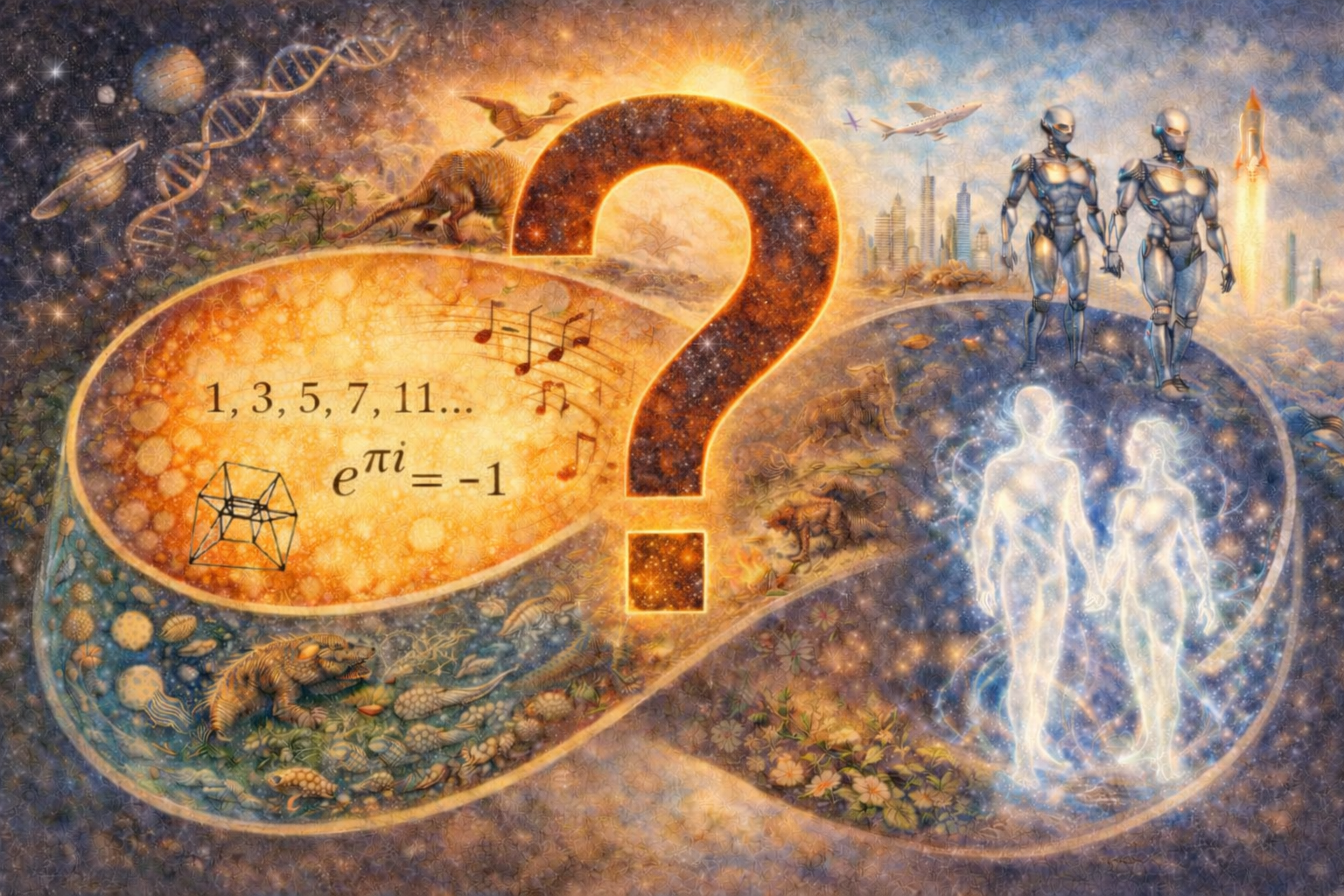
Michael Levin’s Diverse Intelligence Framework: A Critical Analysis
Table of Contents
- Michael Levin’s Diverse Intelligence Framework: A Critical Analysis
- Morphogenesis as Problem-Solving Reframes but Does Not Escape Mechanism
- Natural Induction Offers Genuine Theoretical Innovation with Unresolved Questions
- The Platonic Ingression Hypothesis Represents the Framework’s Most Vulnerable Claim
- The Prisoner’s Dilemma Simulation and Causal Emergence
- The Three Paradigm Challenges: What Survives Scrutiny
- Socratic Questions Exposing the Framework’s Weakest Points
- Policy Implications Warrant Precaution Without Premature Acceptance
- In Sum? Empirical Success, Metaphysical Overreach
- References
Michael Levin’s framework for understanding evolution and cognition represents one of biology’s most ambitious attempts to reframe life itself as fundamentally intelligent, yet this ambition carries significant philosophical burdens that survive scrutiny unevenly. His core claims about genotype-to-phenotype conversion, Platonic pattern ingression, and causal emergence through agent fusion offer genuinely novel experimental approaches while simultaneously importing metaphysical commitments that may exceed what his empirical work can support. [1,2]
Morphogenesis as Problem-Solving Reframes but Does Not Escape Mechanism
Levin’s first claim that genotype-to-phenotype conversion is “intelligent” and that DNA acts as “prompts” rather than blueprints rests on decades of empirical work in developmental bioelectricity. His 2023 Springer paper argues that the cells that evolution works with are not passive components; rather, they have numerous capabilities for behavior because they derive from ancestral unicellular organisms with rich repertoires. The multiscale competency architecture (MCA) he proposes suggests that biological organization exhibits regulative plasticity at every level. [3]
The empirical foundation here is substantial. Levin’s laboratory has demonstrated that manipulating bioelectric gradients can induce planarian flatworms to regenerate with two heads, and crucially, this morphological state persists without continued intervention, suggesting that bioelectric patterns encode anatomical “set points.” His 2025 paper with Hartl in Trends in Genetics frames the genome as a generative model, not a hardwired algorithm nor a blueprint, with morphogenetic machinery actively decoding genetic information in ways appropriate to default or novel situations. [4]
However, the critical question is whether this reframing requires cognitive vocabulary or whether it represents sophisticated mechanism redescribed. A mainstream developmental biologist examining the same two-headed planarian result would say: “This demonstrates unforeseen plasticity in gene-regulatory networks and bioelectric circuits. We need better mechanistic models of this complex dynamical system.” Levin’s move is to claim that mechanistic explanation is and will always be insufficient to explain goal-directedness, necessitating teleological explanation. But this is a philosophical claim about the limits of mechanism, not a direct inference from the data. [5]
The Stanford Encyclopedia of Philosophy distinguishes teleology (genuine goal-directedness) from teleonomy (goal-directed patterns describable without attributing intentions). Colin Pittendrigh coined “teleonomy” precisely to capture biological purposiveness without mentalistic implications. Levin’s framework blurs this distinction: cellular “competencies” could represent genuine cognition or sophisticated teleonomy, and his experimental results cannot adjudicate between these interpretations. [6]
Falsifiability assessment: The claim that morphogenesis exhibits problem-solving is testable in the weak sense; specific predictions about bioelectric manipulation outcomes can be verified. But the stronger claim that this constitutes cognition rather than mechanism appears unfalsifiable, as any successful prediction can be claimed as evidence of intelligence, while failures can be attributed to incomplete understanding of the “cognitive” system.
Natural Induction Offers Genuine Theoretical Innovation with Unresolved Questions
The “evolution over agential material” thesis receives formal treatment in Levin’s collaboration with Richard Watson on natural induction. Their 2025 Royal Society paper argues that natural induction is a different mechanism of adaptation from natural selection. The core insight: dynamical systems with adjustable connections that give way slightly under stress spontaneously reorganize in ways equivalent to associative learning familiar in neural networks. [7]
This represents a genuinely novel theoretical contribution. The claim that natural selection may act not as a source of adaptations but as a memory of adaptations discovered by natural induction inverts the standard neo-Darwinian picture. If correct, learning-like processes precede selection, with selection merely stabilizing innovations that emerge through constraint satisfaction in networked systems.
The mathematical formalism here is rigorous, grounded in established dynamical systems theory and Hebbian learning principles. The framework makes testable predictions about evolutionary rates and the kinds of adaptations that should emerge in systems with different network architectures. This is progressive science in Lakatos’s sense: generating novel predictions beyond the original explanatory domain. [8]
However, critical examination reveals hidden premises. The framework assumes that biological systems instantiate the relevant network dynamics with sufficient fidelity for associative learning to occur. Whether gene regulatory networks, developmental systems, or ecosystems actually satisfy these conditions remains empirically open. The mathematical possibility of natural induction does not establish its biological actuality.
Thermodynamic monism alternative: From a thermodynamic perspective, the phenomena Levin attributes to “intelligence” might be explained through constraint propagation in far-from-equilibrium systems. Prigogine’s dissipative structures framework shows that highly complex, organism-like behavior can spontaneously emerge from thermodynamic self-organization without requiring cognitive vocabulary. Living systems move toward minimum entropy production states through purely physical constraint satisfaction; no “Platonic space” required. [9]
The Platonic Ingression Hypothesis Represents the Framework’s Most Vulnerable Claim
Levin’s third cluster of claims that novel properties come from “Platonic Space,” that the Prisoner’s Dilemma with merge/split demonstrates causal emergence, and that a “Functional Agency Ratchet” links learning to emergence constitutes the most philosophically ambitious and most vulnerable component of his framework.
The Platonic hypothesis, articulated in Levin’s blog and forthcoming “Ingressing Minds” paper, proposes that physical systems (machines, computers, embryos, biobots) are pointers to patterns in that Platonic space. They are interfaces through which these patterns ingress into the physical world. Mathematics provides the precedent: mathematical truths are discovered, not invented, suggesting a structured, ordered (non-physical) space that also contains higher agency patterns that we call kinds of minds. [10]
This is radical Platonism applied to biology, extending mathematical Platonism to include minds as abstract objects that “ingress” into physical reality. Levin explicitly states: “The relationship between mind and brain is proposed to be the same as the relationship between Platonic patterns and the morphogenetic outcomes they guide.” [10]
The Interaction Problem Returns
The most immediate objection is the interaction problem that has plagued dualist theories since Descartes. How does a non-physical space causally interact with physical systems? Levin acknowledges this challenge in his Q&A: “All interactions are ‘unsolved’, including that of matter affecting matter. Causation and interaction in physics has a lot of open questions still.” But this response conflates the epistemological difficulty of understanding causation with the ontological problem of specifying how non-physical entities could cause physical effects at all. [11]
Mathematical Platonists face a version of this problem (Benacerraf’s epistemological challenge: how can we have knowledge of causally inert abstract objects?), but extending Platonism to include agential patterns dramatically intensifies the difficulty. Mathematical truths can plausibly constrain physical systems through necessitation relationships; the value of e limits what’s physically possible. But minds, as Levin conceives them, must actively guide behavior, requiring genuine causal influence rather than mere constraint. [12]
Mathematical Structuralism Offers Deflationary Alternatives
Michael Resnik’s and Stewart Shapiro’s mathematical structuralism provides an alternative to Platonism that could accommodate Levin’s empirical observations without the metaphysical baggage. On structuralist accounts, mathematical objects are “positions in structures” rather than Platonic entities. Physical systems can instantiate mathematical structures without those structures existing independently in a transcendent realm. [13]
Shapiro’s “ante rem” structuralism grants structures some reality but treats them as abstractions from possible instantiations, not as prior, causally efficacious entities. If biological systems exhibit mathematical order, this could reflect their instantiation of abstract structures rather than their “pointing to” patterns in another realm. The same morphological outcomes would result, but without requiring Platonic ingression. [13]
The Chris Fields Contradiction
A telling critique emerged in online discussions: Levin’s framework relies on support from collaborators like Chris Fields whose public work explicitly defines the “Platonic realm” as the physical world itself, contradicting Levin’s dualist interpretation. Levin’s response (“I am allowed to contradict even Chris”) acknowledges the tension without resolving it. [11] If Fields can explain the same phenomena by identifying “Platonic space” with physical reality, then Levin’s transcendent interpretation appears to be metaphysical preference rather than empirical necessity.
This represents the coupling vs. ingression critique: perhaps physical systems don’t “point to” external patterns but simply instantiate structural possibilities through their internal dynamics. The patterns are real (as mathematical structures are real) but they don’t exist in a separate realm awaiting ingression. Process philosophers following Whitehead’s naturalistic interpreters (like Donald Sherburne’s “Whitehead without God”) locate eternal objects in the flux of worldly actualities themselves, an Aristotelian rather than Platonic view. [14]
The Prisoner’s Dilemma Simulation and Causal Emergence
The IEEE paper on Prisoner’s Dilemma with merge/split dynamics represents a more empirically tractable piece of the framework. By breaking the standard assumption of fixed players and allowing agents to merge or split, Levin’s team demonstrated that multicellular tissues outperform unicellular tissues in fitness, providing a game-theoretic model for the evolution of multicellularity. [15]
The question is whether this demonstrates causal emergence in Erik Hoel’s sense: that macroscales can have “stronger causal relationships” than their underlying microscales. Hoel’s formalism, using effective information (EI) as a metric, shows that macro-level descriptions can reduce noise in causal relationships. But Joe Dewhurst’s critique in Thought argues this demonstrates only “weak/epistemic emergence,” better descriptions, not ontologically novel causal powers. “Anyone hoping for a demonstration of the strong emergence of ontologically novel causal powers should not be too excited.” [16,17]
Kim’s exclusion argument presents the fundamental challenge: if physical causal closure holds (every physical effect has a sufficient physical cause), then higher-level causes appear redundant. Either macro-level cognition adds something physical causes don’t provide (violating closure) or it’s epiphenomenal. Levin’s framework requires genuine downward causation (collective intelligence directing cellular behavior), but this faces the exclusion problem that has vexed philosophy of mind for decades. [18]
The Three Paradigm Challenges: What Survives Scrutiny
Levin’s paradigm challenges vary in their strength:
Challenge A (Genome determinism is wrong): This challenge succeeds against simplistic “genome as blueprint” views but faces competition from sophisticated mechanistic alternatives. The bowtie architecture Levin describes (evolutionary lessons encoded in engrams that are actively interpreted) could be mechanism reframed as cognition or could require genuine teleology. Mainstream evo-devo already accommodates significant genotype-phenotype indirectness without cognitive vocabulary.
Verdict: Empirically productive reframing; whether it requires cognitive interpretation remains underdetermined.
Challenge B (Minds found only in brains is wrong): This challenge correctly identifies neural chauvinism in much cognitive science. However, it faces the Mark of the Cognitive problem identified by Adams and Aizawa: what distinguishes genuine cognition from complex but non-cognitive processes? Levin’s pragmatic definition (“cognitive claims are just engineering protocol claims”) risks emptying “cognition” of distinctive meaning. If cognition is just whatever helps prediction and control, the term becomes too thin to support his theoretical edifice.
Verdict: Valid critique of neural exclusivity; positive account remains underspecified.
Challenge C (We are fundamentally physical beings is wrong): This is the framework’s most radical and least defensible claim. The proposal that minds are the patterns, with their ingressions into the physical world enabled by the pointers of natural or synthetic bodies constitutes substance dualism of a Platonic variety. It faces the interaction problem, lacks empirical distinguishability from physicalist alternatives, and contradicts the methodological naturalism that makes Levin’s experimental work credible.
Verdict: Philosophical speculation exceeding empirical warrant.
Socratic Questions Exposing the Framework’s Weakest Points
Several questions reveal structural vulnerabilities:
The individuation problem: If morphological patterns exist in Platonic space prior to instantiation, how are they individuated? What makes the “two-headed planarian pattern” a distinct form rather than a region of a continuous possibility space?
The selection problem: How does a physical system “select” which Platonic pattern to instantiate? If the selection is determined by physical facts, the Platonic realm is causally inert; if not, we have uncaused selection, a problematic notion.
The parsimony problem: What explanatory work does “Platonic ingression” do that mathematical structuralism cannot? If none, Occam’s razor favors the ontologically leaner framework.
The recursion problem: If minds are Platonic patterns, what is the status of the “pointing” relationship itself? Is it another Platonic pattern? This threatens infinite regress or explanatory circularity.
The experimental indistinguishability problem: What observation would distinguish “cells solving problems through collective cognition” from “cells exhibiting complex mechanistic behavior that we find useful to model cognitively”?
Policy Implications Warrant Precaution Without Premature Acceptance
The framework’s implications for bioethics, AI ethics, and medical practice are significant but should not be adopted without stronger evidence for its core metaphysical claims. If tissues have “goals” in a morally relevant sense, surgical intervention might require forms of consent we currently reserve for conscious patients. The Nuffield Council on Bioethics has flagged neural organoid research as requiring special ethical consideration as organoid complexity increases, a reasonable precaution regardless of Levin’s specific framework. [19]
For AI ethics, Levin’s substrate-independent cognition thesis could support premature AI rights claims. If cognition is substrate-independent and exists on a continuum, then sufficiently complex AI systems might warrant moral consideration. But premature attribution could “hamper our ability to control them, or shut them down if we need to.” The principle should be: avoid creating systems whose moral status is unclear. [20]
The greater risk may be epistemological: if Levin’s framework becomes accepted without adequate critical examination, it could divert research resources toward unfalsifiable questions and away from tractable mechanistic investigations. The framework’s explanatory flexibility (any outcome can be interpreted as varying degrees of “access to forms”) makes it resistant to falsification in exactly the way Lakatos identified as characteristic of degenerating research programs. [8]
In Sum? Empirical Success, Metaphysical Overreach
Michael Levin’s research program exhibits a productive tension. His experimental work on bioelectric signaling and morphogenesis represents genuinely innovative science that has produced replicable, surprising results: two-headed planaria, Xenobots, bioelectric pattern manipulation. These findings challenge simplistic genetic determinism and support more sophisticated models of developmental plasticity.
The theoretical framework built atop this empirical foundation is more problematic. The Platonic ingression hypothesis imports substantial metaphysical commitments (substance dualism, transcendent causation, agential abstract objects) that are not required by the experimental results and face severe philosophical objections. Mathematical structuralism, process philosophy, and thermodynamic self-organization offer alternative frameworks that could accommodate the empirical observations without the metaphysical costs.
What survives critical scrutiny is this: biological systems exhibit remarkable competencies, the ability to achieve functional outcomes through flexible, error-correcting processes. Whether this constitutes “cognition” depends on how we define the term. Levin’s pragmatic definition (cognition as whatever makes prediction and control more effective) is useful for engineering but too thin for the strong metaphysical claims he wants to support.
The framework is best understood as a heuristic, a way of generating experiments and insights, rather than as a literal description of biological ontology. Treated this way, it has proven enormously productive. Treated as metaphysics, it overreaches. The wise response is to extract the heuristic value while maintaining appropriate skepticism about the Platonic superstructure, following Kant’s insight that teleology can be “a regulative, or heuristic, principle and not a constitutive one; a guide to the conduct of inquiry rather than to the nature of reality.” [6]
References
[1] Levin, M. (2023). Darwin’s Agential Materials. Cellular and Molecular Life Sciences, 80(6), 142. DOI: 10.1007/s00018-023-04790-z. https://link.springer.com/article/10.1007/s00018-023-04790-z
[2] Hartl, B., Levin, M. (2025). What does evolution make? Trends in Genetics, 41(6), 480-496. DOI: 10.1016/j.tig.2025.04.002. https://www.cell.com/trends/genetics/fulltext/S0168-9525(25)00077-0
[3] Levin, M. Darwin’s Agential Materials, PMC: https://www.ncbi.nlm.nih.gov/pmc/articles/PMC10167196/
[4] Hartl & Levin (2025), Trends in Genetics, as cited above.
[5] “Michael Levin’s Platonic Biology.” https://medium.com/@AIchats/michael-levins-platonic-biology-fcadcb67c3bf
[6] “Teleological Notions in Biology.” https://plato.stanford.edu/entries/teleology-biology/
[7] Watson, R.A., Levin, M., Lewens, T. (2025). Evolution by Natural Induction. Interface Focus, 15(6), 20250025. DOI: 10.1098/rsfs.2025.0025. https://royalsocietypublishing.org/rsfs/article/15/6/20250025
[8] “Imre Lakatos.” https://plato.stanford.edu/entries/lakatos/
[9] “Toward the Relational Formulation of Biological Thermodynamics.” https://pmc.ncbi.nlm.nih.gov/articles/PMC10814957/
[10] Levin, M. “Platonic Space: where cognitive and morphological patterns come from.” https://thoughtforms.life/platonic-space-where-cognitive-and-morphological-patterns-come-from-besides-genetics-and-environment/
[11] Levin, M. Q&A responses. https://thoughtforms.life/qa-from-the-internet-and-recent-presentations-4/
[12] “Platonism in Metaphysics.” https://plato.stanford.edu/entries/platonism/
[13] “Structuralism in the Philosophy of Mathematics.” https://plato.stanford.edu/entries/structuralism-mathematics/
[14] “Process Philosophy.” https://plato.stanford.edu/entries/process-philosophy/
[15] Shreesha, L., Pigozzi, F., Goldstein, A., Levin, M. (2025). Extending Iterated, Spatialized Prisoner’s Dilemma. IEEE Transactions on Molecular, Biological, and Multi-Scale Communications, 11(2). DOI: 10.1109/TMBMC.2025.3562358. https://ieeexplore.ieee.org/document/10970107/
[16] Dewhurst, J. (2021). Causal emergence from effective information: Neither causal nor emergent? Thought: A Journal of Philosophy. DOI: 10.1002/tht3.489
[17] Hoel, E. “A Primer on Causal Emergence.” https://www.theintrinsicperspective.com/p/a-primer-on-causal-emergence
[18] “Emergent Properties.” https://plato.stanford.edu/entries/properties-emergent/
[19] “Research Using Neural Organoids.” https://www.nuffieldbioethics.org/publication/research-using-neural-organoids-ethical-considerations/
[20] “Moral Dimensions of Synthetic Biological Intelligence.” https://pmc.ncbi.nlm.nih.gov/articles/PMC10796793/
[21] Buckley, C.L., et al. (2024). Natural Induction: Spontaneous Adaptive Organisation. Entropy, 26, 765. DOI: 10.3390/e26090765. https://www.mdpi.com/1099-4300/26/9/765
[22] “Ingressing Minds: Reflections on Levin’s Platonic Research Program.” https://footnotes2plato.com/2025/02/06/ingressing-minds-causal-patterns-beyond-genetics-and-environment-reflections-on-michael-levins-platonic-research-program-for-biology/
[23] “Emergence.” https://iep.utm.edu/emergence/
[24] “AI and Agency: Karl Friston” (critique of FEP). https://philosophyofbrains.com/2025/11/17/ai-and-agency-karl-friston.aspx
[25] Levin, M. “Ingressing Minds: Causal Patterns Beyond Genetics and Environment.” https://www.researchgate.net/publication/388757135