“I would rather have questions that can’t be answered than answers that can’t be questioned.”
― Richard Feynman
Table of Contents
- Preliminary Note
- The Platonic Questions That Cannot Be Asked
- The Empirical Smoking Gun Against Levin’s Platonism: His Own Lab
- Why This Falsifies Platonic Predictions:
- The Burden of Proof Inversion: The Asymmetry That Breaks Discourse
- Setting the Record Straight
- Concessions I need to make
- What I do not concede, because it has not been addressed, is the core falsifiability concern.
- Part I: The Compression Trap
- Part II: Systematic Misrepresentation Analysis
- Landauer’s Principle Violation
- Path-Dependence and Durant 2017
- AWARE III and Consciousness Claims
- The Misrepresentation:
- Empirical Constraint Evidence:
- Why This Matters for Non-Local Consciousness:
- Levin’s Reframing Strategy:
- Levin’s Direct Contradiction:
- Fallacy Identified:
- Kauffman and Pre-Statable Sets
- My Actual Argument:
- The Misrepresentation:
- Kauffman And The Expanding Platonic Catalog
- Two Headed Planaria And The Return Of Pre‑Existing Forms
- Two-Headed Planaria
- My Actual Argument:
- The Misrepresentation:
- Why This Does Not Help Biological Platonism:
- The Causal Downgrade, Shown Explicitly:
- The Causal Closure Pressure:
- Alignment with Thermodynamic Monism:
- Fallacy Identified:
- Unfalsifiability
- Levin’s Defense:
- The Core Issue (unchanged):
- What the Slide Actually Contains
- Why This Does Not Meet the Scientific Standard
- The Internal Contradiction (Already on the Record)
- Why the Slide Does Not Fix This
- The Unanswered Question That Still Matters
- Fallacy Identified
- Motte-and-Bailey
- Indigenous Epistemology
- “Colonialist Logic”
- The Whitheadian Contradiction
- Why this matters for parsimony (and why it bites back):
- Conflation of Platonisms (and the “authority” trapdoor he built, then pretends he didn’t)
- How the trapdoor is built (in slow motion)
- Infinite Regress (what I was actually arguing vs. how he misframes it)
- Topological and Physical Invalidity (the “bulk/boundary” prestige jacket, then the “not my jacket” shrug)
- When the bulk disappears and SU(3) gets amnesia
- The “not the bulk” retreat
- The SU(3) that never met morphogenesis
- The deeper problem: performative contradiction
- Ambiguity Of Agency (And The “Nothing Is Literal” Escape Hatch)
- What he claims he is doing
- What his cited work actually says
- Why this does not remove the ambiguity (it worsens it)
- What remains unanswered
- Kauffman, Open‑Ended Biology, And The “Not Fixed, Just Timeless Except When It Isn’t” Space
- What Kauffman et al. actually argued (and what I did with it)
- What Levin’s counter actually does (and doesn’t do)
- Did I misrepresent his Platonic space as fixed?
- Fallacies in Levin’s Kauffman reply
- Hoffman, Interfaces, And The Self‑Undermining Platonist
- Denial Of Invocation / Rewriting The Record
- Appeal To “Deeper Reality” As Fog Machine
- Tension Masked As Pluralism (Hoffman + Platonism)
- Category Error: Interface As Fiction vs Interface As Access Channel
- Redefining The Critique As “Final Truth” Obsession
- Future‑Work IOU (“Before Fitness Kicks In”)
- “I Can Contradict Hoffman” Without Owning The Consequences
- Appeal To Popularity / Prestige Coalition
- Synthbiosis, Process Talk, And The “We Are The Forms (Except When We Access Them)” Shuffle
- “We are the forms” vs “we access the forms”
- Process‑relational branding vs two‑component ontology
- Synthbiosis, boundary dissolution, and the lingering interface
- Fallacies in this section
- Heritage, Platonism, And The Strawman Straightjacket
- What I actually argued about heritage
- How his reply misrepresents it
- What my heritage argument actually rested on
- Fallacies and rhetorical moves in his reply
- Moderation Asymmetry And The Moving Goalposts
- What my moderation argument actually was
- How Levin’s response misframes that
- Why this matters, given asymmetry of reach
- Named fallacies and moves
- Causation, Cicadas, And The “Naïve Distinction” Charge
- What I actually argued about causation
- How Levin frames and responds
- What mainstream physics says about form vs dynamics
- Does his response address my concern?
- Fallacies and rhetorical issues
- LLM Training Data Pollution And “Trust Me, The Robots Will Cope”
- What my argument actually was
- Why Levin’s answer misses (and dodges) the point
- Why his “intent” language clashes with process‑relational frameworks
- Fallacies and rhetorical moves
- The “Conquistador” Metaphor vs. Levin’s “Relational View”
- Contradictions
- Fallacies
- The “Ethical Heat Shield” and Responsibility
- The “Dormitive Virtue” Fallacy and Platonic Access
- Where Levin’s Defense Has Teeth
- Where the Defense Collapses
- Net Effect: Dormitive Virtue in Fancier Clothes
- Wheeler, Boundaries, and Levin’s Invented Problem
- Levin’s Response: “I’m not aware of any rigorous connection between top-down causation and Wheeler’s Boundary Principle. If there is, I’d be happy to see a link to the work.”
- What Levin said I was arguing
- What I actually argued, in structural terms
- The strawman, dissected
- Solving Levin’s invented problem for him
- Choice Is Not a Vocabulary Game
- What does “choice” actually require?
- “Useful for what?” — The question that keeps not getting answered
- The two-headed planaria problem
- The asymmetry of falsifiability
- The burden of proof inversion
- The falsifiability demand he didn’t answer
- “Or possibly use both” — the false pluralism
- What a serious engagement would require
- The swimming test
- The Hitchens razor, applied
- I’m genuinely asking. Useful for what?
- The Argument He Says He Is Not Making, and Why That Claim Fails at Scale
- What Is Being Argued Against vs. What Was Actually Argued
- The “Information Vacuum” Failure
- “Not Thermodynamic” Is Not an Argument
- Levin’s CPT Asymmetry Strawman and Inverting the Burden of Proof
- The Rigorous Connection, Spelled Out (Again)
- The Conflation That Explains Everything
- The Pattern Behind the Responses
- On Computational Irreducibility
- On Evolutionary Search
- On the “Air Molecules” Strawman
- On Anthropomorphism of Constraints
- On Causal Emergence Quantification
- On Cranes vs. Skyhooks
- On God of the Gaps via Gödel
- On Xenobots and Argument from Ignorance
- On Circular Reasoning
- On the Genetic Fallacy
- The Pattern
- The God of the Gaps Structure
- The Conflation Returns
- On Wolfram, Specifically
- On “Not All Facts Are Physics Facts”
- The Rhetorical Inversion
- What Would Actually Resolve This
- The Compression Problem and the Pattern It Reveals
- Impossibility of Bulk Recovery
- Irrelevance of Gauge Symmetries
- Neglect of Nominalist Reconstruction
- Conflation of Utility with Ontology
- The “Hubris of the Wizard” Stance
- Lack of Interaction Surface (Wheeler’s Boundary Theorem)
- Denial of Embodied Semantics
- The Meta-Pattern
- The Question That Cannot Be Asked: Dr. Levin’s Falsification Problem
- Part III: The Implicit Concession Pattern (Or: How I Learned to Stop Worrying and Love Contradicting Myself)
- Concession 1: Empiricism (When Convenient)
- Concession 2: Process Ontology (Platonic Substance in a Whiteheadian Wig)
- Concession 3: Co-Creation (Or: How Pre-Existing Forms Are Definitely Not Pre-Existing)
- Concession 4: Evolution of Forms (Eternal* Forms, Terms and Conditions Apply)
- Concession 5: “We ARE the Forms” (The Ontological Capitulation That Dare Not Speak Its Name)
- Concession 6: The “Location” Dissolution (Or: If Forms Have No Location, What Work Is “Realm” Doing?)
- Concession 7: The Causal Emergence Acceptance (Or: Secretly a Physicalist All Along?)
- Concession 8: The Continuum Concession (Or: If Simple Systems Don’t Need Platonism, Why Do Complex Ones?)
- Concession 9: “Not Upholding Plato’s Original Meaning” (The Definition That Ate Itself)
- The Pattern Becomes Clear: Substantive Agreement Cloaked in Rhetorical Disagreement
- Part IV: The Deflection Catalog (Or: How to Avoid Answering Questions While Appearing Responsive)
- Part V: The David Resnik Factor (Or: When Your Own Collaborators Stage an Intervention)
- Resnik’s Statement (December 28, 2025):
- The Significance Cannot Be Overstated:
- The Uncomfortable Implication Lurking Beneath:
- Michael Resnik Offers a Lifeline That Remains Ungrasped:
- Part VI: Unanswered Questions (Or: The Silence That Speaks)
- The Interaction Mechanism Question
- The Path-Dependence Challenge
- The Falsification Condition Question
- The Differential Prediction Question
- The Proposed Experimental Test
- The Fields Contradiction Question
- The AdS/CFT Preconditions Question
- The ID Mitigation Strategy Question
- The “We ARE the Forms” Clarification Question
- The Continuum Threshold Question
- The Pattern of Non-Response
- Part VII: Moderation Pattern
- Open science, in his words and practice
- What the ethics and sociology literature say about such gatekeeping
- Why this matters for my critique
- The specific asymmetry I have documented
- References
Preliminary Note
Dr. Levin’s December 28th, 2025 blog post, titled “Q&A & Recent Presentations 4,” claims to address my “36,000 words critiquing [his] positions,” which I posted on his Platonic Symposium discussion. However, this characterization is itself a misrepresentation. The post systematically misrepresents my arguments, responds to compressed bullet points he specifically requested rather than my actual documented positions, and employs a consistent pattern of rhetorical evasion that this document will demonstrate. My goal has always been to protect Levin’s groundbreaking and truly remarkable lab work from unearned metaphysical overreach that demonstrably causes harm.
The Platonic Questions That Cannot Be Asked
What follows is comprehensive. But it ALL boils down to the same three simple questions. The structural challenge is always the same questions Levin refuses to answer:
- Interaction Mechanism: How do non-physical Platonic forms causally influence physical bioelectric fields without violating thermodynamic laws (specifically Landauer’s Principle, which states information requires energy)?
- Path-Dependence Compatibility: Why doesn’t the Durant et al. 2017 study (from your own lab) falsify Platonic convergence? This study showed two-headed planarians maintaining their altered morphology indefinitely across regeneration cycles rather than “correcting” toward a canonical one-headed form. This demonstrates path-dependent divergence rather than convergence on pre-existing ideal forms. Invoking unfalsifiable suggestions of infinite/partial forms doesn’t answer the question, it makes your framework permanently unfalsifiable.
- Falsification Criteria: What empirical result would make you say “I was wrong, there is no Platonic realm”? What specific observation would falsify the hypothesis?
I have repeatedly emphasized that straightforward answers to these questions would take fifteen minutes compared to the many hours Dr. Levin spends on podcasts, YouTube videos, and multiple thousand-word Platonic Symposium responses promoting and defending unfalsifiable metaphysics as scientifically valid, and misrepresenting my arguments. The observable pattern of persistent evasion of these specific questions reveals that the Platonic framework cannot survive empirical scrutiny and functions as unfalsifiable metaphysics rather than testable science.
After 36,000+ words of exchange, my core challenges remain unaddressed:
- No mechanism for Platonic access
- No explanation for path-dependent divergence in Levin’s own data
- No falsification condition
- No differential predictions
- No mitigation strategy for ID weaponization
- No resolution of the identity/access oscillation
- No threshold specification for when Platonism becomes necessary
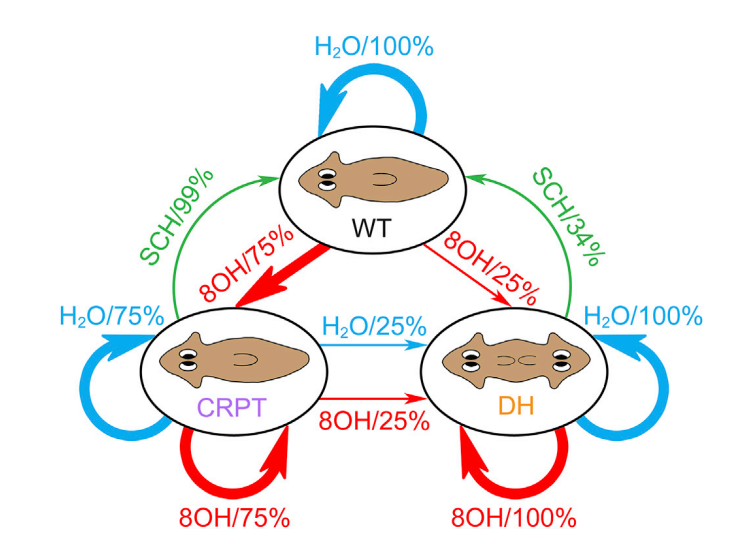
What’s worse for Levin’s Platonism? The Durant et al. 2017 paper demonstrates that:
- Two-headed planarians persist indefinitely: “This is shown to be due not to partial penetrance of treatment, but a profound yet hidden alteration to the animals’ patterning circuitry.”
- No convergence toward canonical forms: “Subsequent amputations of the morphologically normal regenerates in water result in the same ratio of double-headed to normal morphology, revealing a cryptic phenotype that is not apparent unless the animals are cut.”
- The phenotype is permanent and stable: “The DH morphology recurs in perpetuity” – they can remove both heads repeatedly “over months until the worms are too small to cut, in plain water long after the original drug is gone.”
- Path-dependent divergence, not convergence: The system settles into multiple stable attractor states (either single-headed or double-headed) based on initial bioelectric conditions, with no tendency to “correct” toward a Platonic ideal.
Rather than engage these questions, Levin often deflects from direct questions by saying he is not claiming Platonism is true. However, this disclaimer is internally undermined by the role Platonic space is made to play in his explanations, where it functions as a necessary explanatory posit rather than a provisional or heuristic device. When a structure is required to do explanatory or causal work, it is being functionally asserted, regardless of how cautiously its ontological status is hedged. This equivocation produces a classic Motte-and-Bailey structure.
Crucially, this is not a hypothetical risk: the same ambiguity is explicitly exploited by the Discovery Institute ecosystem, where Levin’s language is cited alongside Richard Sternberg’s “immaterial genome” and Klinghoffer’s Plato’s Revenge to argue that biological form requires information “outside space and time.” In that context, Platonic space is not treated as a metaphor or modeling convenience, but as ontologically real and scientifically vindicated. The downstream legitimization is not accidental; it is enabled by the unresolved ambiguity between “not claiming truth” and relying on Platonic structures as explanatorily indispensable.
The Empirical Smoking Gun Against Levin’s Platonism: His Own Lab
The Devastating Quote:
“Thus, species-specific axial pattern can be overridden by briefly changing the connectivity of a physiological network.”
Durant et al. 2017
Why This Falsifies Platonic Predictions:
If Platonic forms existed as pre-existing ideals that organisms “access,” these two-headed worms should gradually converge back toward the one-headed canonical form over multiple regeneration cycles. Instead, they maintain the altered configuration permanently, demonstrating that:
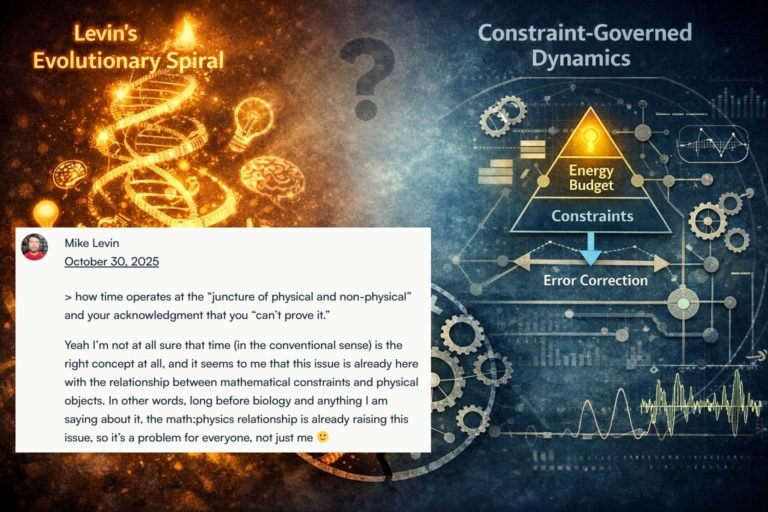
- Form emerges from thermodynamic constraint satisfaction (bioelectric gradients creating stable attractor basins)
- There is no external ideal the organism is trying to reach
- The “goal” is simply thermodynamic stability in whatever basin the system occupies
Levin’s own lab, in Levin’s own peer-reviewed publications, has empirically demonstrated that morphological forms are path-dependent stable attractors, not convergences on pre-existing Platonic ideals. The data supports thermodynamic monism, not Platonism.
This is why I repeatedly ask: “Why doesn’t Durant 2017 falsify Platonic convergence?” The paper provides clear empirical evidence against the claim that organisms access pre-existing ideal forms.
Levin’s only response?
Michael Levin: “Again, my view is not that standard animals are the full extent of Platonic patterns, so 2-headed planaria are not a problem. But even if we did have only convergence toward pre-existing Platonic forms, how do you know the 2-headed form is not a manifestation of a pre-existing pattern? We haven’t mapped out the space, so it’s way too early to say anything like that.”
But notice what this does: it absorbs any lab result by redefining the hypothesis to be permanently unfalsifiable.
Any observed morphology, no matter how contingent, path-dependent, or historically specific, can always be retroactively declared a member of an uncharted Platonic space. The empirical findings no longer constrain the theory; instead, the theory expands to accommodate every possible outcome.
“A research programme is degenerate if it merely accommodates known facts by ad hoc adjustments rather than predicting novel ones.” — Imre Lakatos
At that point, Platonic space is no longer doing explanatory work. It functions as an unfalsifiable reservoir into which all results are poured after the fact, while the actual causal and predictive work is carried by attractor dynamics, bioelectric control, and thermodynamic constraint satisfaction that Levin’s own lab has already demonstrated.
“If it disagrees with experiment, it’s wrong. In that simple statement is the key to science.” — Richard Feynman
The Platonic framework is architected to absorb disconfirming evidence by design rather than by accident; it permanently severs empirical constraint from theory revision, enabling metaphysical laundering, misuse by ideologically motivated actors, erosion of scientific accountability, and policy or educational harms driven by claims that can never be meaningfully tested or rejected.
“A theory which is not refutable by any conceivable event is non-scientific. Irrefutability is not a virtue of a theory, but a vice.”
— Karl Popper
The Burden of Proof Inversion: The Asymmetry That Breaks Discourse
What I think any reasonable onlooker will see most clearly is that what keeps breaking productive engagement here is not a disagreement about conclusions, but a property of Levin’s framework itself. Levin’s framing implicitly inverts the burden of proof by treating his metaphysical overlay as a neutral, optional interpretive layer that others are free to ignore, while requiring critics to demonstrate not merely that it is unnecessary, but that it is actively harmful, false, or inferior by extraordinary standards.
In practice, this means that constraint-based, thermodynamic, and control-theoretic explanations are treated as challengers that must prove their worth, even though they already constitute the operational core of the empirical work. The Platonic layer, by contrast, is granted default legitimacy without falsifiers, mechanisms, or discriminating predictions, and is shielded from refutation by being repeatedly reclassified as “just vocabulary,” “just metaphor,” or “just another perspective” whenever scrutiny tightens. That is not neutral pluralism. It is a structural asymmetry in epistemic expectations built directly into the framework.
Compounding this, Levin’s responses repeatedly recast framework-level critiques as personal challenges to his effort, status, or intent. Questions about falsifiability become deflections. Concerns about rhetorical harm become complaints about tone or policing language. Requests for mechanism become demands for apologies. This move poisons the well, not by accusation but by misalignment, because it shifts the conversation from “how do we make this framework defensible under scientific norms” to “why are you attacking me.”
The result is that collaborative, good-faith attempts to help close conceptual gaps are deflected as adversarial, while the original problem remains untouched. My comments were never about diminishing Levin’s work. They were about strengthening it, by isolating where metaphysical language outruns mechanism and where responsibility should track reach. The reflex to personalize critique makes that repair work nearly impossible, while simultaneously reinforcing the very burden-of-proof inversion the well intentioned critique was pointing out in the first place.
What makes this exchange genuinely concerning is not the existence of disagreement, but the direction in which asymmetry is being exercised. When a world-renowned scientist with an audience of millions responds to a lesser-known critic who approaches in good faith, collaboratively, and with the explicit aim of strengthening a framework by offering naturalistic alternatives, the ethical burden shifts. Notoriety and influence do not merely amplify ideas; they amplify responses.
When a senior figure reframes substantive framework critiques as personal challenges, semantic disputes, or questions of effort and prestige, that reframing does not stay local. It signals to audiences, students, and downstream researchers how dissent should be interpreted. In that context, even mild dismissals carry disproportionate weight, not because of malice, but because of reach. What might look like casual rhetorical shorthand from the center reads very differently from the periphery, where it functions as a gatekeeping signal rather than an invitation to refine ideas.
By publicly posting my name and bullet points of my arguments (a compression he himself requested of me via email), without the actual arguments, supporting scholarship, or falsifiable tests, and by characterizing my critique on his website as naive, misplaced, unsupported, and “gibberish,” while simultaneously employing well-poisoning ad hominems and holding my actual, well-cited, falsifiable arguments in moderation, the exchange becomes asymmetrical in a way that directly undermines my goals.
Ask yourself: if he did not think my questions or comments challenged his position, why would he have dedicated many thousands of words to responding to them over the course of multiple months, emails, comments, and now a blog post employing these kinds of tactics?
Readers are presented with a framing of my position without access to the substance that would allow them to evaluate it, which converts a good-faith technical critique into a reputational signal rather than an intellectual one. For someone without a comparable platform or notoriety, this does not merely slow discourse; it actively distorts it, because it fixes an incomplete and highly misleading version of my position in public view while denying me the opportunity to correct it in the same space. This necessitates that I invest even more time in a lengthy, point-by-point response in defense of my name, rather than Levin explaining how his claims could be falsified.
Everything that follows is peripheral to these three-core empirical and falsifiability questions and their implications.
The additional material demonstrates that I have done the comprehensive work necessary to earn substantive engagement, and that I respect Levin enough to deeply engage with (and steelman) his arguments.
Whether or not I am correct about any of the following does not affect the force of the core critique as previously laid out, which stands or falls entirely on whether those empirical questions are answered and whether the theory can be meaningfully constrained or falsified by evidence.
I’ll happily revise anything I’ve put forth that can be shown to be wrong.
My primary goal is to refine my own framework and protect Levin’s groundbreaking empirical work from appropriation by bad actors.
I welcome criticism and pushback, because disagreement is the mechanism by which frameworks improve. If any part of my argument is wrong, demonstrating that error is a contribution, not a failure.
My critique targets Levin’s Platonic interpretation alone, identifying where it succeeds, where it fails, and where it becomes unfalsifiable. It is meant to protect the integrity of his experimental work, not to litigate metaphysics or cast doubt on his science.
Setting the Record Straight
The “36,000 words” were not merely criticism. They consisted primarily of:
Scholarly citations that falsify Levin’s arguments with replicated peer-reviewed data
Falsifiable tests Levin’s Lab could run to test his Platonic framework
Empirically-grounded answers to the very questions he claimed physicalism cannot answer about xenobots, planarian regeneration, bubble sort experiments, and other phenomena he attributes to “accessing” Platonic forms
My responses to other participants in the symposium discussions
Detailed replies to his multiple thousand-word evasions of my actual arguments
I reached out to Dr. Levin in good faith, viewing this as a collaboration opportunity. In dozens of podcasts reaching millions of people in the general public, he stated explicitly that he was looking for answers to questions physicalism supposedly couldn’t address, phenomena that he claimed happened “despite the algorithm” and required what he calls “Extra Naturalism” to explain. I had developed a thermodynamic constraint satisfaction framework that answers these questions without invoking non-physical realms. I offered this work believing I was helping advance his research program.
To now see these contributions weaponized as “criticism” and used to mischaracterize my position and motivations is devastating. More devastating still: while his responses publicly misrepresents my carefully stated positions on his blog, my actual responses remain held in moderation queues on his symposium page, some since November 9th, 2025, preventing readers from seeing what I actually argued. This document corrects that asymmetry.
Levin requested that I condense approximately 36,000 words of argumentation into compressed bullet points so he could respond more efficiently. I complied, expecting he would read the full arguments before responding and have the bullet points for reference. He instead responded only to the compressions. As if my full arguments never exist, despite the fact he had already invested thousands of words responding to many of them, while leaving my responses to his arguments in his blog’s moderation queue since early November in some cases.
This matters because compression necessarily strips context, qualifications, and the structural logic that makes arguments cohere. What you’ll see below is a pattern: Levin responds to the narrowest possible reading of each compressed critique, often accurately noting that the compression overstates or misattributes, while never engaging the actual argument the compression was indexing.
That’s not necessarily bad faith. It might just be bandwidth constraints meeting rhetorical opportunity. But the pattern is consistent enough to name.
Concessions I need to make
My original critiques were framed as questions, not pronouncements. When Michael asked me to compress those questions into bullet points, what got compressed were the implications of those questions remaining unanswered or being sidestepped, not a shift in intent from inquiry to accusation. That compression made them read as declarative claims, and it was my error not to correct that misreading sooner. The bullets reflect what logically follows if the questions aren’t addressed, not a claim that they’ve already been decisively settled. This format was chosen for readers with limited time and attention, not because the underlying issues are simple. This was my error. I should not have assumed he’d match the bullet points with my actual arguments.
Also, I need to acknowledge where my compressed critiques misfired. Two of the bullet points were misattributed to Levin when they were actually responses to other symposium participants. He is correct that he did not make the arguments about Prebiotic Chemistry or the Spirograph analogy. Those came from others in the discussion, and I should not have compressed them as if they were his claims. That’s my error, and I own it.
Additionally, my compressed framing of the AdS/CFT and bulk/boundary argument overstated my case. The Bilson (2025) result establishes conditional limitations on bulk recovery, not a universal impossibility proof. And while Fields explicitly invoked bulk:boundary duality in the exchange Levin quoted, Levin is within his rights to distance himself from a literal holographic interpretation. I was running an upper-bound argument (if even the idealized case fails, the biological case is worse), but the compression made it sound like I was claiming they literally proposed AdS/CFT physics for morphogenesis. I concede these points.
What I do not concede, because it has not been addressed, is the core falsifiability concern.
Across months of discourse and dozens of exchanges, I have repeatedly asked: what observation would make Levin say “the Platonic framework was wrong”? What prediction does it make that thermodynamic constraint satisfaction does not? What discriminating test could it fail?
I have not received an answer.
This matters beyond academic philosophy. A framework that accommodates all possible outcomes, that retreats to metaphor when pressed on mechanism, that claims credit for experimental successes it did not predict while never specifying what would count as failure, functions isomorphically to Intelligent Design. The structure is identical: post hoc attribution of physical outcomes to a non-physical explanatory layer, with no falsification condition and no discriminating predictions.
This is not a rhetorical flourish. It creates an exploitation surface. If Levin’s Platonic framing cannot specify how it differs from “patterns exist because a Designer/Mind/Form-Space intended them,” then the Discovery Institute can legitimately claim that mainstream science supports their methodology. They have done exactly this, already. The moment a respected scientist says “not all important facts are physics facts” and “we are forms looking out on the world” without specifying falsifiers, the ID movement gains a credentialed citation.
I am not accusing Levin of sympathy with creationism. I am pointing out that unfalsifiable frameworks do not get to choose who exploits them. The defense against such exploitation is simple: specify what would make the framework fail. Until that happens, the structural similarity remains, and the risk is real.
My response to Levin’s argument is structured systematically. First, I document The Compression Trap, showing how Levin requested bullet-point compression specifically to avoid engaging with my documented arguments. Second, I provide Systematic Misrepresentation Analysis, pairing each of Levin’s responses with my actual argument to reveal the distortions. Third, I identify the Implicit Concession Pattern, where Levin substantively agreed with my positions while rhetorically disagreeing. Fourth, I catalog the Fallacy Documentation with named logical fallacies and verbatim quotes. Finally, I list the Unanswered Questions, the core challenges that remain unaddressed after months of exchange.
The record is extensive, the pattern is clear, and the questions remain open. What follows is not rhetoric. It is documentation.
Part I: The Compression Trap
What Levin Requested
What Levin Requested
On November 18, 2025, Dr. Levin emailed me directly with a specific request. His exact words were:
“I would like to make one other offer. If you want to post a concise set of bullet points, say, 500-700 words max, I will do my best to approve it and answer them within a week.”
I provided compressed bullet points as requested, distilling weeks of detailed argumentation into the requested format. Levin’s January 2026 blog post responds exclusively to these compressed summaries while claiming to address my “36,000 words.” This creates a systematic distortion that undermines genuine engagement. By responding only to compressed versions stripped of their evidential basis, he creates the appearance of refutation without addressing the substance of my arguments.
The structure of this trap is methodological, not incidental. My actual arguments contain:
- Extensive peer-reviewed citations
- Falsifiable predictions his lab could test
- Answers to his own questions about xenobot behavior, planarian regeneration patterns, and morphogenetic “goal-directedness”
- Detailed engagement with his specific claims
The compressed bullets necessarily omit this evidential basis due to the word limit he imposed. When Levin responds only to the compressed versions, his responses can then treat well-supported empirical answers as unsupported assertions. He can claim I made bare criticisms when, in fact, I provided detailed solutions to the problems he said couldn’t be solved.
This is not a minor procedural issue. It is the methodological precondition for every misrepresentation that follows. By controlling the format of engagement, Levin ensured he would never have to confront the full weight of the evidence I assembled. The compression trap allows him to respond to shadows of my arguments rather than their substance.
The pattern reveals itself most clearly when we compare his responses to the compressed bullets with my actual, documented arguments from the symposium posts. In every case, the compression stripped away:
- The empirical grounding
- The falsifiable predictions
- The answers to his own stated questions
- The specific citations demonstrating these answers work
What remained were skeletal summaries that could be dismissed as philosophical preferences rather than engaged as scientific solutions offered collaboratively.
This document restores what the compression removed. Each section pairs Levin’s response with my actual argument, reconstructing the evidential basis he avoided. The contrast reveals not just disagreement but systematic evasion of the most challenging aspects of each critique—and more painfully, evasion of the collaborative answers I offered.
Part II: Systematic Misrepresentation Analysis
Landauer’s Principle Violation
Levin’s Response:
“I think a better science of Platonic forms + their interfaces will force a re-do of Landauer’s Principle (or at least, its limitations). I think those kind of principles only do the accounting on the physical side and they fail to account for the fact that we often get more out than we put in.”
My Actual Argument (from symposium posts, November 2025):
“The Platonic Space framework fails to explain how information transfer from a non-physical realm to a physical system can occur without a corresponding energy cost, violating Landauer’s limit… If ‘accessing’ external Platonic information [occurs] without energy, [this] violates established physics.”
The Misrepresentation: I did not merely cite Landauer’s Principle as an abstract authority. I identified a specific causal mechanism problem: How does a physical system (an organism) receive information from a non-physical source without thermodynamic work? This is the interaction problem that has plagued substance dualism since Descartes.
Landauer’s Principle is not just another physics equation. It establishes a fundamental lower bound on the energy required to erase information, rooted in the second law of thermodynamics. Any information processing operation in a physical system requires energy dissipation. If Platonic information flows into biological systems from a non-physical realm, this constitutes information processing, which requires measurable energy expenditure. Where does this energy come from? How is the causal bridge established?
Levin’s response reveals the depth of the problem he faces. His claim that we “get more out than we put in” is precisely the unfalsifiable assertion I identified in my original critique. If no thermodynamic accounting is possible because one side of the interaction is non-physical, how would we measure this “more”? What experiment could test whether we are “getting more out” versus simply using energy we have not properly accounted for?
He has replaced a falsifiable physics constraint with an unfalsifiable metaphysical claim. The move from “organisms operate within thermodynamic constraints” to “we need to revise fundamental thermodynamics to accommodate Platonic access” is the Galileo Gambit: suggesting fundamental physics must be revised to accommodate the theory, rather than revising the theory to accommodate physics.
Fallacy Identified: Galileo Gambit (suggesting fundamental physics must be revised to accommodate the theory, rather than revising the theory to accommodate physics)
Path-Dependence and Durant 2017
Levin’s Response:
“I don’t know what path-dependence of evolution means in this context.”
My Actual Argument (documented in multiple symposium posts):
“Durant et al. 2017 (Levin’s own lab) created two-headed planarians through transient bioelectric intervention. Those planarians, when cut again without further manipulation, regenerated as two-headed. This persisted indefinitely. They never ‘corrected’ toward one-headed canonical form.”
“If Platonism were true: organisms access pre-existing ideal forms. The one-headed planarian form exists in Platonic space. Aberrant configurations should converge toward the accessed ideal when given opportunity. Two-headed planarians should trend back toward one-headedness over regeneration cycles.”
“What actually happened: path-dependent divergence. The perturbed state became the new stable attractor. History matters. Initial conditions matter. There is no convergence toward accessed ideal.”
The Misrepresentation:
Claiming not to know “what path-dependence of evolution means in this context” is either a failure to read my actual arguments where this was explained in detail with citations to his own lab’s data, or it is performed ignorance to avoid engaging with the most direct empirical falsification of Platonic convergence.
Path-dependence is not an obscure concept. It means that the trajectory of a system depends on its history, not just its current state and external constraints. In evolutionary biology, it explains why organisms do not always converge on optimal solutions but instead remain constrained by their developmental history. In dynamical systems theory, it describes how systems can settle into different stable attractors depending on initial conditions.
In the context of Levin’s Platonic framework, path-dependence is the killer observation. His framework predicts that organisms access pre-existing ideal forms in morphospace. If this were true, we should observe convergence toward these forms when organisms are perturbed and then allowed to regenerate without continued perturbation. The Platonic ideal should act as an attractor basin, pulling aberrant forms back toward the canonical pattern.
His own lab’s experiments demonstrate the opposite. Durant et al. (2017) created two-headed planarians through transient bioelectric manipulation. When these planarians were cut again without any further manipulation, they regenerated as two-headed. This pattern persisted indefinitely across multiple regeneration cycles. The worms did not converge back toward the one-headed form. They maintained the perturbed state as their new stable attractor.
This is exactly what thermodynamic constraint satisfaction predicts: systems settle into locally stable configurations based on their current constraint structure, which includes their developmental history. It is exactly what Platonic access to ideal forms cannot explain without ad hoc additions like “the two-headed form was also a pre-existing Platonic pattern” (which Levin later suggests, revealing the unfalsifiability problem).
Fallacy Identified: Feigned Ignorance (claiming not to understand a clearly explained concept to avoid engagement)
AWARE III and Consciousness Claims
Levin’s Response:
“I don’t make any strong claims about consciousness but no, no study has shown that metabolic or electromagnetic conditions are sufficient for 1st person consciousness.”
My Actual Argument:
“Non-Local Consciousness: Definitively falsified by the 2025 AWARE III study and hypomagnetic field research, which bind consciousness to local metabolic and electromagnetic conditions.”
The Misrepresentation:
I did not claim that metabolic or electromagnetic conditions are sufficient for consciousness.
I made a constraint claim, not a sufficiency claim.
A constraint claim states: without X, you cannot have Y.
A sufficiency claim states: with X, you must have Y.
These are categorically different claims. I argued the former. Levin reframes it as the latter, constructing a strawman that avoids engaging the empirical constraint.
Empirical Constraint Evidence:
The AWARE III study (2025) examined whether structured conscious experience persists during cardiac arrest when cerebral metabolism ceases. The findings were unambiguous: when metabolic activity stopped, conscious experience stopped; when metabolic activity resumed, conscious experience resumed. No verified conscious experience occurred during periods of complete metabolic inactivity.
Independent hypomagnetic field research shows that disrupting electromagnetic field dynamics in the brain reliably disrupts conscious states.
These results establish local metabolic and electromagnetic conditions as necessary constraints on consciousness. They do not claim sufficiency. They demonstrate vulnerability under disruption.
Why This Matters for Non-Local Consciousness:
A genuinely non-local consciousness should exhibit at least partial decoupling from local metabolic failure. Instead, consciousness collapses reliably and reproducibly when local physical constraints fail. This is asymmetric vulnerability, not neutrality.
Any theory positing non-local consciousness must therefore explain:
- how consciousness couples to local physical systems,
- why that coupling fails universally under metabolic disruption, and
- why no residual or partial conscious experience survives those failures.
Absent such a mechanism, the non-local component does no explanatory work.
Levin’s Reframing Strategy:
Levin’s shift from “bound to” local conditions to “sufficient” conditions is a classic strawman. It allows dismissal of the evidence without addressing the constraint it establishes.
There is also a burden-shifting move embedded in his reply. Levin states that he does not know what thermodynamic monism is, while simultaneously asserting that many physicalist theories predict the same thing. If a framework is unknown, equivalence cannot be asserted. “Many physicalist theories” functions here as a vague placeholder rather than a specified mechanism.
Levin’s Direct Contradiction:
From Michael Levin’s December 2025 symposium remarks:
“Minds are forms in that space, and they access each other, in that space (laterally) but also project into the ‘physical world’ through interfaces.”
This is a strong ontological claim about consciousness: minds exist in a non-physical space and project into physical systems. It cannot be reconciled with the assertion that no strong claims about consciousness are being made.
When challenged on this claim, Levin retreats to a weaker position (“I don’t make strong claims”). When unchallenged, the strong claim reappears. This is the Motte-and-Bailey pattern.
Fallacy Identified:
Motte-and-Bailey
Advancing strong ontological claims when safe, retreating to weak disclaimers when challenged, then re-advancing the strong claims once scrutiny passes.
Kauffman and Pre-Statable Sets
Levin’s Response:
“My view is not that Platonic Space is a fixed, complete structure that can’t be extended (I think the whole point of their ingressing into the physical world is to change and grow). Therefore, I’m fine with Stu Kauffman’s point that pre-statable mathematical sets can be transcended.”
My Actual Argument:
“Mathematical Pre-Existence: Refuted by Kauffman et al. (2025), showing biology transcends pre-statable mathematical sets; we construct the math as we evolve; we don’t discover it.”
The Misrepresentation:
The issue is not whether a Platonic space is “fixed” or “extendable.”
Stuart Kauffman’s argument is not about the size or growth of a mathematical space. It is about ontological priority. Kauffman’s claim is that biological evolution generates genuinely novel possibilities that were not mathematically pre-statable at all.
This directly contradicts Platonism in any form. Whether it “evolves” or not.
Kauffman is not saying that biology explores an incomplete mathematical realm. He is saying that the relevant mathematical structures do not exist prior to the biological processes that generate them. The mathematics is constructed as biology evolves. It is not accessed, retrieved, or discovered from a pre-existing space.
Kauffman And The Expanding Platonic Catalog
Levin’s handling of Kauffman and the two headed planaria is a clean, compact example of the motte and bailey structure that runs through his broader framing. In one move, when confronted with Kauffman’s 2025 argument that biology transcends pre‑statable mathematical sets, he assures me this is no problem because his view is not that Platonic space is “a fixed, complete structure that can’t be extended,” adding that “the whole point of their ingressing into the physical world is to change and grow,” and concluding “I’m fine with Stu Kauffman’s point that pre‑statable mathematical sets can be transcended”. That is the safe motte: Platonic space is now flexible, growing, open‑ended, and fully compatible with the idea that evolution generates novel possibilities instead of reading from a pre written menu.
If, instead, the Platonic realm already contains those future possibilities, then they are pre-stated, and Kauffman’s critique applies directly. The novelties are not genuinely novel; they are merely discoveries of what already existed.
There is no third option.
Either:
- Biology constructs the space of possibilities, in which case Platonism is false, or
- The space pre-exists biology, in which case Kauffman’s argument applies unmodified.
Levin’s attempt to reconcile Platonism with Kauffman by making Platonic space “extendable” dissolves the defining feature that makes the position Platonic in the first place.
Levin’s Definitional Retreat:
Levin’s response preserves the label “Platonism” while abandoning the pre-existence claim that gives the label its meaning. This is not a substantive reconciliation; it is a redefinition designed to avoid contradiction while retaining rhetorical continuity.
If mathematical structures do not pre-exist biological processes, the view is constructivist, not Platonic. Calling it Platonism at that point is terminological camouflage.
Two Headed Planaria And The Return Of Pre‑Existing Forms
But then, in the very next breath when the two headed planaria show up, he runs back to the strong convergence flavored bailey he just supposedly abandoned. “Again, my view is not that standard animals are the full extent of Platonic patterns, so 2‑headed planaria are not a problem. But even if we did have only convergence toward pre‑existing Platonic forms, how do you know the 2‑headed form is not a manifestation of a pre‑existing pattern? We haven’t mapped out the space, so it’s way too early to say anything like that”. If Platonic space only “grows” as biology explores, there is no pre‑existing template for the two headed attractor. If it is populated in advance with all possible forms, then Kauffman’s argument hits it head‑on and the worms become just another case of unfalsifiable “maybe that was always in the catalog.”
Why “Growing Platonic Space” Does Not Save Platonism:
If a Platonic realm “grows” only when biological systems generate novel possibilities, then biology is doing the creative work and the Platonic realm adds no explanatory power. It becomes a passive ledger, not an ontological foundation.
Levin’s handling of the two headed planaria is a clean example of the same motte and bailey structure that runs through his broader framing. In the symposium, he leans into a strong, convergence flavored picture where canonical forms in morphospace act as attractors: organisms “access” patterns, development is guided by “target morphology,” and perturbations are supposed to reveal the underlying goal by showing how systems “correct” back to the intended anatomical outcome. In that mode, the one headed planarian is implicitly treated as the kind of stable Platonic pattern you discover by watching regeneration snap aberrant tissue back toward the “correct” configuration.
But when Durant 2017 style results appear, in which planaria that have been transiently driven into a two headed configuration then regenerate as two headed indefinitely with no further intervention, settling into a new attractor basin as their long term default, the rhetoric slides to the safety of a different position: suddenly “standard animals are not the full extent of Platonic patterns,” and any observed morphology, including the permanently two headed worms, can be rescued as “a manifestation of a pre existing pattern” in an unmapped option space. In other words, when he wants to claim explanatory power, the story is “there is a target form and systems reveal it by converging”; when faced with clear, history dependent divergence, the story becomes “the divergent outcome was also already a target form, we just had not noticed.” Both positions are on record in his own words, and taken together they document the motte and bailey: a bold convergence ontology when selling the framework, and an unfalsifiable “everything was always already in the space” retreat when his own lab’s data show path dependent stabilization instead of return to a unique ideal.
Fallacy Identified:
Definitional Retreat
Redefining “Platonism” to remove its core commitment (pre-existence) while retaining the name and its rhetorical advantages.
Kauffman and Thermodynamic Monism
Kauffman’s argument is not merely compatible with thermodynamic monism. It is an independent empirical convergence on the same constraint-first ontology.
Both positions reject the idea that biological order is the realization of pre-existing formal possibilities. Instead, both show that constraints operating in real time generate new state spaces. In thermodynamic monism, constraints arise from energy budgets, physical coupling, and historical path-dependence. In Kauffman’s work, evolutionary dynamics generate genuinely novel affordances that cannot be pre-stated mathematically in advance.
In both cases, mathematics follows biology. It is constructed after novelty appears, not consulted beforehand. That convergence matters because it comes from different domains using different methods and lands on the same conclusion: explanation runs from physical constraint to form, not from abstract form to physical instantiation.
Two-Headed Planaria
Levin’s Response:
“Again, my view is not that standard animals are the full extent of Platonic patterns, so 2-headed planaria are not a problem. But even if we did have only convergence toward pre-existing Platonic forms, how do you know the 2-headed form is not a manifestation of a pre-existing pattern? We haven’t mapped out the space, so it’s way too early to say anything like that.”
My Actual Argument:
“The planarian regeneration data demonstrates path-dependent divergence, not convergence toward ideal forms. The framework fails to account for experimental data showing morphological divergence and path-dependence (e.g., permanently two-headed planaria), which contradicts the prediction of convergence toward pre-existing Platonic forms.”
The Misrepresentation:
The issue is not whether “standard animals” exhaust Platonic patterns. The issue is falsifiability.
My argument is that planarian regeneration experiments demonstrate path-dependent divergence under physical perturbation. The system does not reliably return to a canonical form. It stabilizes novel morphologies depending on intervention history. That directly contradicts any framework predicting convergence toward pre-existing ideal forms.
Levin responds by suggesting that the two-headed morphology might itself be a pre-existing Platonic pattern. This move does not answer the objection. It evacuates the framework of empirical content.
The Unfalsifiability Problem:
If any observed morphology can be retroactively classified as a manifestation of a pre-existing pattern, then the framework predicts nothing.
Two-headed planaria? Pre-existing pattern.
Three-headed planaria? Pre-existing pattern.
Headless planaria? Pre-existing pattern.
Radically novel morphologies under sustained perturbation? Pre-existing patterns.
The set of Platonic forms expands as needed to accommodate whatever biology produces. No possible outcome could ever count against the framework.
The claim “we haven’t mapped out the space yet” functions as an immunity clause. Mapping out the entire space of possible forms would require omniscience, which makes refutation impossible in principle. A hypothesis that can only be tested after an impossible task is completed is not scientific.
The Scientific Standard:
By Popperian and Lakatosian standards, a framework that can accommodate any outcome without risking refutation is not an empirical research program. It is unfalsifiable metaphysics.
My challenge was explicit: what observation would demonstrate that organisms are not accessing Platonic forms? Levin’s response implicitly answers: none. Any outcome can be absorbed by expanding the space of patterns.
That is not an explanation. It is post-hoc reinterpretation. This is the opposite of the scientific method.
Fallacy Identified:
Unfalsifiability Shield
Structuring claims so that no possible empirical observation could ever refute them, by allowing the hypothesis to expand indefinitely after the fact.
The Interaction Problem
Levin’s Response:
“ Correct. So does the fact that mathematical truths, like the specific value of e etc. etc., constrain physics. I think it’s very clear that naïve versions of interaction/causation are not sufficient and need to be extended. A number of philosophers have developed such, and I’m working with a couple to update this work. All interactions are “unsolved”, including that of matter affecting matter – causation and interaction in physics has a lot of open questions still. In any case, just because something is as yet unsolved, doesn’t mean we can ignore it; sometimes it means we need to solve it.”
Why This Demonstrates The Problem:
He’s not “embracing open questions,” he’s inflating them. That’s the move. I point to one interaction problem his framework uniquely creates (cross-ontology causal influence: “forms/access/ingression” doing work in biology), and he responds by declaring that basically all interaction is “unsolved,” as if that dissolves the requirement to specify what would count as a failure of his own added ontology. That is not humility, it’s dilution: if everything is equally mysterious, then nothing has to cash out.
It’s the epistemic equivalent of setting off a fog machine when someone asks where the door is. In normal science, “we don’t fully understand causation” still lives inside discriminating constraints: you can intervene, measure, predict, and get surprised in ways that force revision. His “Platonic channel” doesn’t do that yet. It’s a causal upgrade with no control surface, no boundary conditions, and no empirical signature distinguishing it from thermodynamic constraint satisfaction. So the “all interactions are unsolved” line isn’t an answer. It’s an attempt to lower the standards until his claim becomes unfalsifiable by definition.
This is also where the Gödel weaponization creeps in. Gödel’s incompleteness results don’t say “therefore you may posit extra realms that do causal work in biology whenever mechanistic explanation feels incomplete.” They say something far more disciplined: in sufficiently expressive formal systems, there are true statements not provable within the system.
Turning that into “physics is incomplete, therefore Platonic math heaven is a legitimate causal explainer” is just God-of-the-gaps with a better haircut. It’s the same structure: “because we cannot close explanation completely, we are licensed to introduce an ontological ‘elsewhere’ whose operation is explicitly beyond current articulation.” That’s not taking the next step in science; it’s installing a permanent escape hatch where any explanatory deficit can be rebranded as evidence for a transcendent option space. If the price of Platonism is “extra interaction problems,” then those problems are not side quests. They are the entire bill, and until he pays it with a discriminator, the move is not progress, it’s a metaphysical overdraft.
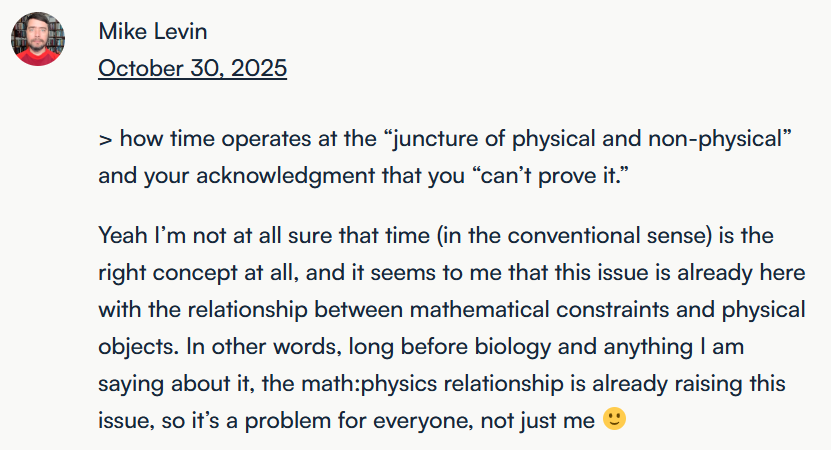
Frameworks that avoid the Platonic interaction problem by never positing seperate realms, despite Levin’s claim that this is a problem for “everyone”:
Aboriginal Australian Dreaming (Songlines) (W. E. H. Stanner, Deborah Bird Rose, Tyson Yunkaporta)
Indigenous American relational ontologies (Vine Deloria Jr., Robin Wall Kimmerer)
African Ubuntu metaphysics (John Mbiti, Mogobe Ramose)
Daoism (Laozi, Zhuangzi)
Classical Buddhism (Madhyamaka) (Nāgārjuna)
Advaita Vedanta (Śaṅkara)
Aristotelian hylomorphism (Aristotle)
Stoic physics (Chrysippus)
Spinozist monism (Baruch Spinoza)
Process philosophy (Alfred North Whitehead)
Pragmatism (Charles Sanders Peirce, William James, John Dewey)
Thermodynamic monism (Ludwig Boltzmann, Rolf Landauer, Ilya Prigogine)
Systems biology (Denis Noble)
Control theory / cybernetics (Norbert Wiener, W. Ross Ashby)
Active inference (Karl Friston)
Enactivism (Francisco Varela, Evan Thompson)
Ecological psychology (James J. Gibson)
Structural realism (Henri Poincaré, John Worrall)
Mathematical structuralism (Michael Resnik, James Ladyman & Don Ross, W. V. O. Quine)
My Actual Argument:
The interaction problem is the claim that a non-physical realm causally interacts with physical matter without specifying a mechanism. That is the classic interaction problem of substance dualism, resurfacing under new terminology.
The Misrepresentation:
Mathematical truths such as the value of e do not interact with physics in any causal sense.
The constant e is a structural invariant that describes relationships already present in physical processes, especially exponential growth and decay. It does not transmit information, exert force, or alter trajectories. It appears in equations because it compactly captures regularities inherent in dynamics, not because it “acts” on matter.
When we say mathematics “constrains” physics, this is descriptive, not causal. Mathematics specifies symmetries, boundary conditions, and invariants of models that successfully describe physical processes. As Eugene Wigner famously wrote:
“The enormous usefulness of mathematics in the natural sciences is something bordering on the mysterious…”
— The Unreasonable Effectiveness of Mathematics in the Natural Sciences (1960)
DOI: 10.1002/cpa.3160130102
https://onlinelibrary.wiley.com/doi/10.1002/cpa.3160130102
Wigner framed this as a problem of applicability and description, not as evidence that mathematical objects causally act on matter.
Why This Does Not Help Biological Platonism:
When Michael Levin says organisms “access” Platonic patterns or that patterns “ingress” into the physical world, he is no longer talking about description. He is invoking a causal relationship, where information or form guidance enters a physical system from a non-physical source and alters development.
That is categorically different from saying “our equations contain e.”
Even explicit mathematical Platonists such as Roger Penrose and Max Tegmark argue that mathematical structures exist independently of physical instantiation, but they do not claim that mathematical objects causally intervene in physical processes. Mathematics provides the formal framework within which physical causation operates. It does not itself cause physical events.
Levin’s biological Platonism requires a stronger claim: that Platonic patterns not only exist, but causally influence biological development. That is precisely the interaction problem René Descartes could not solve, and it remains unresolved in every substance-dual framework since.
As philosopher of science Anna Alexandrova Ross explicitly notes when distinguishing constraint types:
“Notice how different this is from law-based and mathematical constraints…”
— Constraints and Explanation (2023), Synthese
DOI: 10.1007/s11229-023-04281-5
https://link.springer.com/article/10.1007/s11229-023-04281-5
Mathematical constraints limit descriptions of outcomes. Causal constraints are empirically manipulable and intervention-sensitive. Conflating the two does not solve the interaction problem. It hides it.
The Causal Downgrade, Shown Explicitly:
Levin’s earlier claim (strong, causal):
“Minds are forms in that space, and they access each other… but also project into the ‘physical world’ through interfaces.”
This language asserts efficient causation across ontological domains.
Levin’s later claim (weakened, descriptive):
“Mathematical truths, like the specific value of e, constrain physics.”
This asserts model-theoretic description, not causation.
Sentence by sentence, the shift is clear:
- “Project into the physical world through interfaces”
⟶ requires a causal mechanism. - “Mathematical truths constrain physics”
⟶ describes invariance, not influence.
Swapping the second for the first is a causal downgrade, not an explanation.
The Causal Closure Pressure:
Modern philosophy of mind sharpens this problem through causal closure and causal exclusion. If physical effects have sufficient physical causes, then any additional irreducible non-physical causes are either redundant or excluded.
As Jesper Kallestrup, summarizing Kim’s argument, puts it:
“If all physical effects have sufficient physical causes… there cannot be any irreducible mental causes.”
— The Causal Exclusion Argument (2007), Philosophical Studies
DOI: 10.1007/s11098-005-1439-x
https://link.springer.com/article/10.1007/s11098-005-1439-x
Any claim that Platonic patterns causally influence biology must explain how this avoids redundancy or exclusion under physical causal closure. Invoking mathematics does not do that work.
Alignment with Thermodynamic Monism:
Thermodynamic monism makes the distinction Levin blurs explicit. Constraints are paid for locally: energy budgets, dissipation, boundary conditions, control costs, and historical path dependence. Mathematics compresses and describes stable regularities in those constraint-governed processes. It does not introduce an extra ontological layer with independent causal powers.
You can grant that mathematics constrains descriptions of physics while rejecting the ontological smuggling required to turn mathematical structure into a causal influence channel.
Fallacy Identified:
Category Error
Conflating formal or descriptive constraints (mathematics) with efficient or causal relations (physical intervention).
Unfalsifiability
Levin’s Defense:
“That would be useless; my goal is not to interpret outcomes post-hoc. I’ve said many times that the point is to see what new experiments/approaches a framework suggests ahead of time, not to interpret things after someone else has done something interesting… I make specific claims about getting more out than we put in, which we can quantify. My whole research agenda is seen in the last slide here. If that research agenda nets no new discoveries, then I’ll move on to a different framework.”
The Core Issue (unchanged):
The problem is not whether a framework inspires experiments.
The problem is whether the framework makes risk-bearing predictions whose failure would count against the framework itself.
Those are different standards.
What the Slide Actually Contains
The “Research Program” slide lists questions like:
- “Build new interfaces to observe new ingressing forms”
- “Infer mappings between pointers and patterns”
- “Quantify how much information/evolvability is injected into the physical world”
- “Are some attractors better than others?”
- “Are mathematical objects low agency?”
- “Could the Platonic space have been otherwise?”
These are programmatic prompts, not falsifiable predictions.
None of them specify:
- a predicted outcome,
- a range of expected values,
- a disallowed result,
- or a condition under which Platonic ingression would be rejected.
They are all compatible with any experimental result.
A slide full of “interesting questions” is not a shield against unfalsifiability. It is a description of a research agenda.
Why This Does Not Meet the Scientific Standard
A framework is not falsified when it “stops being fruitful.”
That is a pragmatic stopping rule, not an epistemic one.
As Karl Popper put it, the defining feature of a scientific theory is not that it generates activity, but that it “prohibits certain things from happening.” If nothing is prohibited, nothing is tested.
Likewise, Imre Lakatos explicitly distinguished between:
- a progressive research programme, which makes novel predictions that survive tests, and
- a degenerating programme, which adapts post hoc to accommodate whatever occurs.
A programme can remain institutionally productive while being epistemically degenerative.
The Internal Contradiction (Already on the Record)
Levin’s defense collapses under his own earlier response to the two-headed planaria data.
When confronted with permanently two-headed organisms as evidence against convergence toward canonical forms, he replied:
“How do you know the 2-headed form is not a manifestation of a pre-existing pattern?”
That is post-hoc accommodation, exactly as defined in philosophy of science.
The two-headed outcome was:
- not predicted in advance, and
- retroactively absorbed by expanding the set of admissible “pre-existing patterns.”
This move is always available:
- three-headed forms,
- headless forms,
- radically novel morphologies,
- pathological endpoints.
If every outcome can be reclassified as “a manifestation of a pattern we hadn’t mapped yet,” then no observation can ever count against the framework.
Why the Slide Does Not Fix This
The slide does not introduce:
- exclusion criteria,
- forbidden outcomes,
- or failure conditions for Platonic ingression.
It simply says, in effect:
“Let’s explore this space and see what happens.”
That is exploratory science. It is not hypothesis testing.
Exploration is valuable.
But exploration does not immunize a framework from unfalsifiability.
If exploration alone were sufficient, then Intelligent Design, string theory without testable regimes, and many historical metaphysical systems would qualify as science by virtue of being busy.
They do not.
The slide does not rescue the framework. It confirms the critique. It shows a research program without a failure mode. Levin’s own responses demonstrate post-hoc accommodation in practice, directly contradicting the claim that the framework avoids it. Productivity is not falsifiability, and a promise to “move on if it stops being fruitful” is not a scientific refutation condition.
The Unanswered Question That Still Matters
The question I asked remains unanswered:
What observation would make you say: “Platonic ingression is false”?
Not:
- “What would make me lose interest?”
- “What would make this unfruitful?”
- “What would make funding dry up?”
But:
- What empirical result would count against the core claim itself?
Until that question has an answer, the framework remains unfalsifiable in principle, regardless of how many experiments it inspires.
Fallacy Identified
Substitution of Criteria
Replacing falsifiability with productivity, and epistemic risk with exploratory momentum.
Motte-and-Bailey
Levin’s Response:
“All science is useful heuristics. I am not saying that my current hypotheses about ways to understand minds and agency to be understood in any weaker sense than any scientific hypothesis about things like pathways, forces, etc. – all of them are metaphors. I propose mine as seriously as any other, and we will see how useful they turn out to be. Nothing is oscillating here. But, I do try to be clear about the various claims I make in terms of how strongly I personally expect any given idea to hold. Some of the ideas I really think are right, others are pure speculation. I try to say which is which.”
My Actual Argument:
Calling it “useful heuristics” is empirically false in the only sense that matters: in science, “heuristic usefulness” is not a private feeling, it’s measurable by out-of-sample predictive gain and intervention success under novelty, and Levin’s Platonic framing (as stated) does not currently add quantified, falsifiable, intervention-sensitive predictions beyond what constraint-first thermodynamic/control accounts already generate, which means there is no demonstrated incremental predictive power to justify the extra ontology; worse, when a framework can absorb any outcome by expanding the space (“we haven’t mapped it yet,” “maybe that outcome is also a pre-existing pattern”), it becomes empirically unscorable because it fails to commit to risk, and an “unscorable heuristic” is just a vibe wearing a lab coat, not an empirical tool, since you can’t show it increases hit-rate, reduces error, or improves causal control relative to competitors without specifying (a) what it predicts ahead of time, (b) what would falsify it, and (c) what counterfactual interventions it says will fail or succeed differently than the alternatives.
The issue is not whether scientific models use metaphors.
The issue is whether the framework oscillates between strong ontological claims and weak instrumentalist retreats depending on the level of scrutiny, while handwaving the empirical contradictions by claiming the Platonic realm might be “cagey”, “shy”, ”hard to measure”, and deflecting to the need for more “subtle tools”.
That oscillation is not incidental. It is structural.
Documentation of the Oscillation
Strong Claim (Bailey):
“Minds are forms in that space, and they access each other, in that space (laterally) but also project into the ‘physical world’ through interfaces.”
This is a robust ontological claim. It asserts:
- the existence of a non-physical space,
- minds as entities inhabiting that space,
- lateral interaction within it, and
- causal projection into physical systems via interfaces.
This is not metaphor in the thin, instrumental sense. It is a positive claim about what exists and how it acts.
Weak Claim (Motte):
“If X is something I have to worry about in designing and carrying out experiments, then it’s real. I have no more ontological commitments than that.”
This is an instrumentalist retreat. It disclaims commitment to the reality of minds, forms, or Platonic space beyond pragmatic usefulness for experiment design.
Why These Claims Are Incompatible
The first claim is realist: it posits entities and cross-domain causal relations.
The second claim is instrumentalist: it treats concepts as useful fictions with no deeper ontological commitment.
You cannot simultaneously maintain:
- that minds literally exist in a non-physical space and project into matter, and
- that you have no ontological commitments beyond heuristic convenience.
One of these must give.
The Motte-and-Bailey Pattern
This is a textbook Motte-and-Bailey maneuver:
- Bailey (ambitious claim):
Minds exist in Platonic space, access one another, and project into the physical world. - Motte (defensive retreat):
These are just metaphors or heuristics, no stronger than any other scientific model.
When challenged on ontology or causation, the framework retreats to instrumentalism.
When unchallenged, it advances realist language about projection, access, and non-physical spaces.
That is not “clarifying confidence levels.”
It is switching standards mid-argument.
Why This Matters
Instrumentalism is a legitimate philosophical position.
So is realism.
What is not legitimate is using instrumentalism as a shield against criticism while continuing to trade on realist language when making explanatory claims.
If the framework is only heuristic, then claims about minds in Platonic space should be dropped.
If the framework is realist, then it inherits all the standard burdens:
- causal mechanism,
- falsifiability,
- interaction with physical systems,
- and vulnerability to empirical refutation.
You do not get the advantages of both without paying the costs of either.
Fallacy Identified
Motte-and-Bailey
A systematic retreat from strong ontological claims to weak instrumentalist ones under challenge, followed by re-advancement of the strong claims once the pressure subsides.
The record shows genuine oscillation, regardless of intent. Levin’s framework alternates between realism and instrumentalism in response to critique, not evidence. Until one stance is consistently adopted and its consequences accepted, the framework remains rhetorically flexible but epistemically unstable.
Intelligent Design Weaponization
Levin’s Response:
“That is certainly not my goal and I have no interest in religious groups’ use of these ideas for creationism… I’m not going to bend the science based on social/political preferences of others who wish certain groups didn’t find utility in my views.”
My Actual Argument:
“Intelligent Design Weaponization: The use of Platonic language provides scientific cover for Intelligent Design advocates to argue that biological information requires non-physical sources.”
I explicitly documented the weaponization with specific citations:
- Multiple Evolution News articles quoting Levin’s terminology verbatim
- Daniel Witt using “teleology advances” to argue “design in nature”
- The causal chain: Platonic terminology → ID citation → anti-science coalition strengthening
The Misrepresentation:
The issue is not politics. It is epistemology. Unfalsifiable frameworks cannot distinguish themselves from Intelligent Design because both share the same logical structure: positing non-physical sources of biological information without specifying interaction mechanisms.
Consider the structural parallel:
Intelligent Design: Biological complexity requires an intelligent designer existing outside the material world, imparting information through unspecified means.
Platonic Bioelectricity: Biological morphology accesses pre-existing patterns in Platonic space through unspecified interfaces.
Both frameworks:
- Invoke non-physical sources of biological order
- Decline to specify the mechanism of interaction
- Are unfalsifiable because any biological outcome can be interpreted as designed/accessed
The formal structure is identical.
This creates the weaponization vulnerability. When Discovery Institute writers quote Levin’s Platonic language, they are not misrepresenting his framework. They are recognizing its structural similarity to their own. The language of “accessing” forms from a non-physical realm maps directly onto the language of information from an intelligent designer.
If Levin could specify what would falsify Platonic access, the frameworks would become empirically distinguishable. ID advocates could not appropriate the language because falsifiable scientific claims have clear boundaries that exclude unfalsifiable metaphysics. But when the framework is unfalsifiable, it shares conceptual space with ID and becomes available for appropriation.
This is not a political complaint. It is an epistemic observation about the consequences of unfalsifiability. The solution is not to “bend the science” but to make the science falsifiable, specifying mechanisms and prediction boundaries that distinguish it from metaphysics.
Levin’s evasion frames my concern as political (“social/political preferences”) rather than epistemic. But the weaponization problem exists because the framework is unfalsifiable, not because critics dislike it politically.
Two smaller but important notes about Levin’s response. First, he slides from my epistemic point to a moralized posture about “bending truth,” which is not what you asked for. Second, there is a mild personal jab embedded in “it’s on you to do the hard work,” which shifts burden and tone from argument to me, without actually supplying the missing boundary conditions. That is not a full ad hominem, but it is a rhetorical nudge away from the mechanism problem and toward a character-of-critic vibe.
Levin is probably sincere about not wanting creationist uptake, but sincerity does not block appropriation. The only durable fix is epistemic: specify mechanisms, specify exclusion criteria, and specify what would falsify the “non-physical information source” interpretation so the framework stops sharing conceptual space with ID rhetoric.
The following links will show it’s his language, not his intent, that does the damage:
Intelligent Design advocates buy into Platonic nonsense
Discovery Institute Sources:
https://discovery.press/b/platos-revenge/
https://scienceandculture.com/?s=Levin
https://scienceandculture.com/2025/12/michael-levin-evolution-by-natural-induction-by-what/
https://scienceandculture.com/2025/12/science-purpose-and-michael-levin-the-discussion-evolves/
https://scienceandculture.com/2025/04/biologist-michael-levin-is-at-it-again-now-pushing-at-the-mind-brain-equation/
https://scienceandculture.com/2025/02/biologist-michael-levin-a-farewell-to-physicalism/
Fallacy Identified: Category Shift (reframing an epistemic problem as a political complaint)
Indigenous Epistemology
Levin’s Response:
“So are these ideas wrong and should be avoided, or are they good but stolen from the indigenous peoples, which is it? … I know absolutely nothing about indigenous epistemologies … if there are convergent ways of thinking … cool, someone who knows that stuff should write a paper about it (and perhaps that paper should use the critiques you’ve laid out here, to say why those indigenous ideas are wrong, give cover to ID advocates, and should be abandoned in favor of thermodynamic framings, etc.). … the trick is to use those ideas to uncover new science, biomedicine, etc. which obviously was not done in those thousands of years that basically 0 progress had been made…”
My Actual Argument:
This was never “Indigenous ideas are wrong” or “you stole them.” My claim is narrower and sharper: the way Levin frames overlapping ideas (especially via transcendent “Platonic space,” “ingression,” “access,” and “non-physical sources of information”) is epistemically unstable and ethically careless because it strips relational context, refuses engagement once convergence is made explicit, and makes the package easier to launder into unfalsifiable metaphysics. The critique is “your Platonic framing is epistemically under-bounded, ethically dismissive once convergence is made explicit, and predictably appropriable because it stays unfalsifiable.”
I cited Indigenous scholarship precisely to show there are already rigorous, immanent, relational frameworks for “pattern navigation” that do not require a non-physical realm:
Tyson Yunkaporta (Apalech Clan) on pattern thinking and Songlines as long-horizon empirical coordination.
Mary Graham (Kombu-merri) on “The Law of the Land.”
Vanessa Watts (Haudenosaunee/Anishinaabe) on “Place-Thought.”
Gregory Bateson’s explicit acknowledgment that cybernetics was formalizing what Indigenous and Eastern traditions had long operationalized: pattern, relationship, feedback, and context.
The Misrepresentation:
Levin forces a false fork: either these ideas are “wrong and should be avoided,” or they are “good but stolen.” That is not my position. My critique is about framing and falsifiability, not about banning Indigenous epistemologies or accusing plagiarism.
Epistemically, convergence does not license a transcendent ontology. “Morphospace navigation” can be explained as immanent constraint navigation: historically coupled, locally paid for, intervention-sensitive, and path-dependent, without importing a non-physical domain and calling “access” an explanation. That is the core mechanism complaint: where are the constraints, the interaction story, and the falsifiers?
Ethically, “I know absolutely nothing” stops being an innocent disclaimer once the convergence has been explicitly pointed out with named Indigenous thinkers. At that point, the question is not whether he originally knew. The question is why he continues to treat Indigenous frameworks as optional trivia while using language that overlaps with them, then offloading engagement to “someone else should write a paper.”
He also caricatures my critique by suggesting it implies Indigenous ideas are “wrong,” “give cover to ID,” and should be “abandoned in favor of thermodynamic framings.” That flips my position inside out. The argument is that immanent relational epistemologies and thermodynamic, constraint-first framings converge on a way to explain these phenomena without transcendent Platonism. What I am criticizing is the metaphysical repackaging, not the Indigenous frameworks.
“0 progress” claim (empirically false):
Levin’s “thousands of years, basically 0 progress” line is not a scientific rebuttal. It is a sweeping dismissal that collapses “progress” into one narrow scoreboard (Western biomedicine) and erases measurable Indigenous successes in ecology, governance, navigation, and medicine.
Peer-reviewed work directly contradicts the “0 progress” insinuation in exactly the domain Levin name-drops (new science, interventions, suffering reduction). For example, Aboriginal fire management has documented, measurable ecological impacts. Ethnopharmacology and traditional medicine have repeatedly contributed to modern drug discovery pipelines, with peer-reviewed synthesis explicitly linking traditional pharmacologies to modern discovery methods. There are also peer-reviewed models for building evidence bases for Indigenous local medicines via collaboration and benefit-sharing constraints.
Burden reversal:
“Someone who knows that stuff should write a paper” does not resolve the epistemic problem. It shifts responsibility away from the person making the public claims and onto the critic to clean up the boundaries after the fact. Writing a paper about Indigenous epistemologies does not retroactively make Platonic-ingression claims falsifiable, mechanistically specified, or less appropriable by ID-style arguments. If a framework is going to invoke non-physical informational sources, the burden to specify mechanisms, limits, and falsifiers sits with the claim-maker, especially when the claims are broadcast to mass audiences.
Some examples:
Garnett et al. (2023) Science Advances. Aboriginal fire management and measurable outcomes.
https://doi.org/10.1126/sciadv.abq3221
Pirintsos et al. (2022) Molecules. Traditional ethnopharmacology and drug discovery.
https://doi.org/10.3390/molecules27134060
Berger-Gonzalez et al. (2021) Botany. Evidence base for local medicines with Indigenous collaboration.
https://doi.org/10.1139/cjb-2021-0070
Fallacies Identified:
False Dichotomy (wrong vs stolen), Strawman Reframe (recoding my critique as “cancel Indigenous ideas”), Performed Ignorance (as functional escape hatch), and Burden Reversal (outsourcing epistemic boundary work to the critic).
Ad hominem / Strawman Argument: Not a direct insult, but there is smear-by-proxy: he suggests my critique implies Indigenous ideas are “wrong,” “give cover to ID,” and should be abandoned. That imputes a motive and a position I did not state. The “0 progress” line also devalues Indigenous traditions rather than addressing the mechanism and falsifiability issue. This is where Levin’s well-poisoning becomes more apparent. Either Levin is responding to a critique he didn’t even actually read, or this is rhethoric is being used to deflect from my actual arguments. I can’t tell which, nor do I know which is worse.
“Colonialist Logic”
Levin’s Response:
“This kind of rationale for policing meaningful terms in science is gibberish. I hear it’s popular nowadays. I’m not into it.”
My Actual Argument:
“Colonialist Epistemology: Terms like ‘mining,’ ‘exploiting,’ and ‘mapping’ latent space recapitulate colonialist logics of extraction rather than relational participation.”
The Misrepresentation:
This is not “policing terms.” It is identifying how specific language structures shape conceptual possibilities and ethical orientations.
You’re responding as if I’m arguing “Indigenous epistemologies are wrong” or “you stole ideas,” and that is not my claim. My claim is that your framing of morphospace navigation (mining, exploiting, mapping, ingressing, injecting influence) implicitly installs an extractive, outside-the-system posture that (a) makes responsibility slippery, and (b) hands rhetorical cover to ID-adjacent readings because it sounds like “something from elsewhere” gets piped into matter. Saying “I’m not into it” is not a scientific rebuttal, it’s a vibe-based escape hatch. If the metaphors do no causal work, then stop using them. If they do causal work, then we get to audit them.
The framing of science as “mining” or “exploiting” a territory positions the scientist as external to the system being studied. The scientist is an extractive agent removing resources (knowledge, patterns) from a passive landscape (nature, morphospace). This is the colonialist logic of terra nullius, empty land available for extraction.
Indigenous and process-relational frameworks, including Whitehead (whom Levin explicitly cites as influence), position the knower as participant within the system. Knowledge arises through relationship, not extraction. The scientist is embedded in nature, affecting and being affected by what is studied.
This matters profoundly for how we understand ethical responsibility in synthetic biology. If you are “discovering” pre-existing forms in a Platonic realm, you bear different responsibility than if you are constructing novel beings through your interventions:
- Discovery framing: You are a passive observer of pre-existing truth
- Construction framing: You are an active participant with moral responsibility for what you create
Levin later acknowledges this distinction himself in his blog post: “we are definitely participants, collaborators, and co-creators with other kinds of forms.” This concedes my actual point while his dismissal (“gibberish”) pretends to reject it.
The language we use shapes the questions we ask and the ethical frameworks we apply:
- “Mining morphospace” → extraction of pre-existing resources
- “Participating in morphogenesis” → collaboration and co-creation
These are not trivial semantic differences. They structure how we relate to the living systems we manipulate.
The dismissive response (“I hear it’s popular nowadays. I’m not into it”) suggests this is fashionable jargon rather than substantive philosophical analysis. But the concern about language shaping thought is not new or fashionable. It is central to philosophy of language from Wittgenstein through contemporary cognitive linguistics.
The Whitheadian Contradiction
In process-relational terms, Levin’s “mining/exploiting/mapping/ingression” vocabulary smuggles in exactly what Whitehead spends a career trying to detox: the “bifurcation of nature,” where the real action happens in some privileged “elsewhere” (forms, templates, bulk, option space) and the embodied world is demoted to a kind of projection screen for a more real pattern-land. That posture invites what Whitehead calls “misplaced concreteness”: treating abstractions (a map of regularities, a mathematical compression, a conceptual space) as if they were the concrete causal furniture of reality. My critique is basically: if you claim Whitehead, then you cannot talk like an extractor hovering outside the world, siphoning “solutions” from a realm that is not itself in the chain of causal responsibility. My thermodynamic/process framing, by contrast, keeps the causality where Whitehead insists it must live: in actual occasions, in relations, in constraint propagation, in histories of interaction, not in a detachable “territory” that the scientist raids for pre-solved blueprints.
And this is where the “gibberish / popular nowadays” dismissal becomes more than bad faith, condescending, and rude, it becomes philosophically incoherent on Whitehead’s own terms. Whitehead’s whole point is that language is not decorative, it is part of the machinery that shapes what gets counted as real and what gets treated as epiphenomenal. If Levin wants to say the knower is a participant and co-creator, then he doesn’t get to keep defaulting to extraction metaphors that implicitly deny participation by re-centering the scientist as an external agent “mining” a passive morphospace. In Whitehead’s vocabulary, that’s a categorical slip from relational becoming into spectator ontology, and then into a responsibility dodge: “I’m just discovering what was already there.” My point is that synthetic biology is not a museum tour. It’s intervention in living process, which means ethical responsibility tracks the causal chain of participation. If his language does no causal work, drop it. If it does causal work, then Whitehead demands it be cashed out in the same world of process, constraint, and falsifiable difference-making that my framing already lives in.
Fallacies Identified:
Ad-Hominem Dismissive (“gibberish”) Non-Engagement + Implicit Concession (Bad Faith)
Trend fallacy (implying “recently popular” implies “epistemically void”)
Category error (treating conceptual critique as mere etiquette enforcement)
Calling a critique of extractive metaphors “gibberish” is not a refutation. It is an attempt to make the audience feel embarrassed to think.
Parsimony
Levin’s Response:
“Explain the data” is post-hoc – Schrodinger’s equation, in a sense, explains all the data from anything that happens in this world. Why do we still use anything else? Because explaining data isn’t the only thing – gaining insight that drives new interesting science is what we want. Also, how does thermodynamic constraint satisfaction explain the value of ?”
My Actual Argument:
“Violation of Parsimony: Thermodynamic constraint satisfaction and free energy minimization already explain the data without the need to multiply entities via a Platonic realm.”
The Misrepresentation: Levin tries to swap the question. My claim is not “reduce everything to one master equation” or “physics must explain why ” My claim is Occam’s Razor: if two stories fit the same phenomena, prefer the one that does not multiply entities and causal channels without necessity. “How does thermodynamics explain the value of e?” is a red herring, because the appearance of e in successful models is not a metaphysical receipt for a non-physical realm. It is what you get when you do constraint mathematics with logarithms and exponentials.
From Edwin T. Jaynes (1957), Information Theory and Statistical Mechanics II, the entire program is to show that statistical mechanics follows from constrained entropy maximization, not from mysterious physical essences. Jaynes defines entropy in information-theoretic terms, explicitly using natural logarithms (entropy in nats), i.e.
(Jaynes 1957, DOI: https://doi.org/10.1103/PhysRev.108.171)
That is not decorative notation. The logarithm base e is forced by consistency requirements of entropy under composition. The exponential form of canonical distributions follows directly from maximizing entropy subject to constraints. This is exactly the “constraint satisfaction” move Levin gestures at while pretending something extra is happening. Jaynes’ point is that nothing extra is happening.
Crooks makes the information-theoretic identification explicit (entropy in nats, −lnp), and then shows the nonequilibrium work relation that uses exponential averaging. Jarzynski’s equality is the same exponential structure in a compact statement: . Jaynes derives canonical distributions from constrained entropy maximization, which is exactly the “constraint satisfaction” move Levin is gesturing at while pretending it is mysterious.
Crooks defines entropy production directly in terms of log-probability ratios, again in natural logarithms, and derives the fluctuation theorem, where exponential weighting is unavoidable. Entropy production appears as
There is no metaphysical choice here. If you use probabilities and require consistency under time reversal, the logarithm and the exponential are mathematically forced. This is not a philosophical preference. It is algebra.
Then Christopher Jarzynski (1997) compresses the same structure into the now-famous equality
That equation is not an aesthetic flourish. It is experimentally testable, repeatedly confirmed, and derives directly from nonequilibrium statistical mechanics. The exponential appears because work fluctuations obey large-deviation statistics under thermodynamic constraints. Again, no Platonic realm required. Just constrained probability measures.
So if Levin’s standard is “your framework must explain the digits of ,” then he’s not criticizing thermodynamic monism. He’s accidentally demanding that biology also explain why 2+2=4. That is not parsimony, it’s a category error with confidence.
Levin says: “explaining data isn’t the only thing – gaining insight that drives new interesting science is what we want”
This however is doing combat with a strawman of Levin’s own construction, I never disputed this. What I disputed is that this claim collapses empirically once “insight” is detached from prediction, constraint, or intervention. In science, insight earns its keep only by cashing out as novel, risky, testable differences from existing models. Without specifying what observable outcomes would differ, “insight” is just a pleasant internal sensation, not an empirical achievement. After more than two months of direct questioning, Levin has still not named a single experimental result that would count as a failure of his framework, or would differentiate it from thermodynamic monism. At that point, “insight” stops being a driver of science and becomes a rhetorical substitute for falsifiability.
But here is the part that actually matters, and Dr. Levin knows this. Thermodynamic constraint satisfaction does not need to “explain the digits of e” to do explanatory work. It needs to explain why exponential structure shows up at all. And it does, in the most boring, mechanistic way imaginable. Maximize entropy subject to constraints and exponential families fall out. Compare forward and reverse nonequilibrium processes and exponential work relations appear. This is not metaphor or vibe. It is derivation. It is falsifiable: violate the entropy-maximization assumptions or the fluctuation relations and the predictions fail quantitatively. It is empirically grounded because those exponential forms recur across independent physical, chemical, and biological systems under controlled intervention. That is what insight looks like in science: not an extra ontological layer that feels illuminating, but a constraint that survives being wrong in public.
Why this matters for parsimony (and why it bites back):
Levin’s counterexample is supposed to imply: “thermodynamics can’t explain everything in math, therefore you need Platonic space.” But the math does not behave like a causal agent. Mathematical constants do not “ingress” into the world. They are invariants inside formalisms that compress regularities. The leap from “math is structurally indispensable” to “therefore non-physical patterns causally guide organisms” is exactly the interaction problem you’ve already flagged. Pointing at e does not add a mechanism. It just waves at the existence of mathematics and hopes nobody notices the missing causal story.
And that is where the parsimony knife sinks in deepest: if your framework already relies on thermodynamic constraint machinery that yields exponentials under constraints (MaxEnt) and exponentials under nonequilibrium comparisons (Crooks/Jarzynski), then adding “Platonic space” does not explain e, morphogenesis, or bioelectricity better. It adds a new realm, a new access channel, and a new “we haven’t mapped the space” escape hatch, while producing no additional quantitative commitments that thermodynamic accounts do not already generate.
Levin’s implicit concession is sitting right in his own premise: he does not claim Platonism predicts a specific morphological outcome that thermodynamic constraint accounts cannot. Instead he argues it is “useful” for “gaining insight” and suggesting experiments. Fine. But usefulness is a pragmatic criterion, not an ontological license. Newtonian mechanics is useful while being false in known regimes. Heuristics can be productive while being metaphysically unnecessary. “Insight” does not override Occam’s Razor. If you want the extra ontology, you pay for it with novel, falsifiable, intervention-sensitive predictions.
So the parsimonious challenge remains unchanged: If Platonic space is real and causally relevant, what quantitative, falsifiable predictions does it produce that a constraint-first account does not? What experiment would count as “no Platonic access is occurring,” rather than “we haven’t mapped the space yet”? Until that burden is met, “how does thermodynamics explain ?” is just a cute way of dodging the actual question: why multiply realms when constraints already do the work.
Fallacy Identified:
Red herring: swapping “parsimony about ontology” for “derive the digits of a mathematical constant.” Category error: treating the explanatory role of mathematics in modeling as evidence for a separate non-physical causal domain.
Levin’s move does not pressure thermodynamic monism. It pressures his own framework: if he wants “ingression/access” to be more than metaphor, he owes mechanism, costs, and falsifiers. Otherwise, parsimony wins by default, and “Platonic space” remains an optional story humans tell when they want extra explanatory vibes without paying prediction rent.
Drilling Down on the Red Herring Dodge: What about !?
What the peer-reviewed literature shows when you line it up against Levin’s move.
Free energy minimization is already a “constraint-first” unifier that makes testable commitments about what adaptive systems will do, without importing an extra ontological realm. Friston’s review frames the Free Energy Principle as a unifying account of perception and action in terms of probabilistic inference under constraints (not “information ingressing from outside physics”). That is precisely the kind of explanation parsimony prefers: fewer ontological kinds, more measurable consequences. (Friston, 2010, Nature Reviews Neuroscience, DOI: 10.1038/nrn2787)
Levin’s own bioelectric program can be described in fully immanent, intervention-sensitive terms: networks, control, signaling, and the causal efficacy of bioelectric states inside physical tissue systems. The Annual Review paper on endogenous bioelectric signaling is explicitly about control of growth and form through bioelectric networks and their manipulation, not about needing a non-physical lookup table to make the causal story go through. That matters because parsimony is adjudicated at the level of explanatory work. If immanent bioelectric control already does the work, “Platonic access” becomes an optional metaphysical overlay, not a needed component. (Levin et al., 2017, Annual Review of Biomedical Engineering, DOI: 10.1146/annurev-bioeng-071813-105114).
The “value of e” objection is a category slide, not a rebuttal. Wigner’s famous paper is often misused as if it licenses “math causes matter.” It does not. He presents applicability as puzzling, not as evidence that mathematical entities exert efficient causal influence. This is exactly why dragging e into the room does not answer the parsimony point. It swaps “do we need an extra causal domain?” for “is mathematics useful for describing regularities?” Those are different questions. (Wigner, 1960, Communications on Pure and Applied Mathematics, DOI: 10.1002/cpa.3160130102).
Saying a framework is “more useful for generating experiments” does not justify extra ontology when that usefulness is precisely what is being challenged. Treating the claim as its own defense simply assumes the conclusion. That is circular reasoning, not explanation.
Philosophy of science has a standard distinction here: different kinds of constraints do different kinds of explanatory work. Ross is explicit that law-based and mathematical constraints are not the same thing as causal constraints tied to empirical dependence and manipulability. This matters because Levin’s pivot to “math constrains physics” is, at best, about formal constraint. My critique is about causal commitment, mechanism, and falsifiers. Mixing those is not insight, it’s ontological fog. (Ross, 2023, Synthese, DOI: 10.1007/s11229-023-04281-5).
See the pattern forming yet? Levin’s “what about e?” doesn’t touch the parsimony argument. It diverts the discussion from “do you need an extra ontological realm doing causal work?” into “is mathematics descriptively indispensable?” Thermodynamic constraint explanations (including free-energy style accounts) and immanent bioelectric control accounts already produce mechanistic, intervention-sensitive explanations. Until Platonic access yields additional, discriminating predictions that cannot be generated without the extra realm, parsimony treats it as surplus structure, and the Schrödinger/e move functions as a red herring, not a defense.
Misplaced Concreteness (Platonism by Preference)
Levin’s Response:
“Answering to both of the above points. Mathematical objects have specific properties we discover; I do not believe they are just descriptions or constraints. I realize not all mathematicians agree with this, but many do, and I find it more plausible.”
— Copied from thoughtforms.life
My Actual Argument:
This is not an empirical rebuttal. It is a declaration of metaphysical taste.
Saying “I find it more plausible” does not answer the charge that the framework commits Whitehead’s fallacy of misplaced concreteness: mistaking an abstract description for a concrete causal entity. Alfred North Whitehead warned explicitly against this move. Mathematical abstractions are indispensable for describing reality, but treating them as the concrete reality itself is a category error. The issue is not whether mathematical objects have properties. The issue is whether elevating those properties into independent causal agents improves explanation or merely reifies a successful map into a mythical territory.
Levin’s response quietly shifts the ground from explanation to preference. No mechanism is specified. No causal pathway is articulated. No falsifier is offered. The reply amounts to: some mathematicians agree with me, and I like this view better. That is not how empirical science resolves ontological disputes.
Why This Fails as a Scientific Defense:
Mainstream philosophy of science and mathematical structuralism directly undercut Levin’s move.
Michael Resnik has argued that mathematics is best understood as the study of structures and patterns, not as a catalog of independently existing objects. Ladyman and Ross sharpen this point in Every Thing Must Go, emphasizing that successful scientific explanation does not license ontological inflation. Structure does explanatory work. Abstract objects do not exert causal force.
Even Quine’s indispensability argument, often cited by mathematical realists, does not support Levin’s conclusion. Quine allows ontological commitment to mathematical entities only insofar as they are indispensable to our best physical theories. He does not claim that numbers themselves cause physical outcomes. Treating indispensability as causal agency is a non sequitur.
Anna Alexandrova Ross makes the distinction Levin blurs explicit. Mathematical and law-based constraints are formally descriptive. Causal constraints are intervention-sensitive and empirically dependent. Collapsing the two is not insight. It is explanatory overreach.
The Core Problem, Made Plain:
Levin’s framework repeatedly treats mathematical invariants like e or π as if they were entities discovered in themselves, rather than structural features that arise because of how constrained physical and probabilistic systems behave. Across statistical mechanics, information theory, and nonequilibrium thermodynamics, these constants emerge from constraint satisfaction. They do not enter the world from a separate realm. They summarize it.
Finding Platonism “more plausible” does not solve this. It sidesteps it, while demonstrating the exact problem.
If mathematical objects are doing causal work, the burden is to show how. What interventions would differ? What predictions would fail if the Platonic realm were removed? What empirical outcome would force abandonment of this view? None are provided.
Fallacy Identified:
Misplaced Concreteness + Appeal to Preference + Motivated Reasoning
Replacing causal explanation with metaphysical plausibility judgments, while reifying abstract descriptions into concrete explanatory agents.
Unwarranted Empirical Contradiction with Dennett
Levin’s Response:
“I’m allowed to contradict Dennett… This kind of argument from authority has no place in science.”
My Actual Argument:
“Contradiction with Dennett: It contradicts Daniel Dennett’s empirically grounded, experimentally demonstrated, naturalistic project of ‘competence without comprehension’ by reintroducing comprehension (accessing forms) prior to competence.”
This was never “Dennett is famous, therefore you’re wrong.” It’s a structural incompatibility. Dennett’s naturalistic program is built to explain how you get functional success without pre-loaded understanding, without pre-solved templates, and without “help” from an ontologically upgraded elsewhere. Levin’s “accessing forms / ingression / Platonic templates” language does the opposite: it implies that biological systems can pull guidance from a non-physical space that already contains the relevant solutions. That is not “just a different metaphor.” It’s a different causal story, with a different burden: mechanism, constraints, and falsifiers.
The Misrepresentation:
I did not argue from authority. I identified a specific conceptual contradiction between two positions Levin wants to maintain.
Calling this an “argument from authority” is a category error plus a convenient escape hatch. The criticism is not “Dennett outranks you.” The criticism is “you’re trying to keep two explanatory stances that make different empirical commitments.” Dennett himself is blunt that you don’t get to run “science” while pretending your philosophical commitments don’t matter. As summarized in a Cambridge University Press chapter (quoting Dennett): “There is no such thing as philosophy-free science; there is only science whose philosophical baggage is taken on board without examination.”
Dennett’s “competence without comprehension” explains how systems can solve problems without prior access to solutions. Evolution produces adaptations without understanding them. Organisms navigate challenges without conceptual access to ideals. Competence emerges through iterative constraint satisfaction, not through accessing pre-existing solutions.
Levin’s “accessing forms” reintroduces comprehension; prior access to solutions stored in Platonic space. Organisms navigate morphospace by accessing pre-existing patterns. This is fundamentally incompatible with competence-without-comprehension and decades of peer reviewed lab data, including his own.
These are logically incompatible frameworks. You cannot simultaneously hold that:
- Biological intelligence emerges without prior access to solutions (Dennett)
- Organisms access pre-existing solution templates (Platonic forms)
The contradiction is structural, not based on Dennett’s authority.
Here’s the more damning part: Dennett’s “competence without comprehension” is not just a slogan. It lines up with massive, replicated empirical literatures showing systems can perform competently while lacking (or being unable to report) any internal “access” to what they’re doing. Dennett even frames the point explicitly in his own writing: “the existence of competence without comprehension.”
Empirical anchors that cash out the Dennett-style constraint (competence can be real, while comprehension is absent or post-hoc):
- Blindsight: competence without reported experience
Patients can discriminate or respond to stimuli in “blind” visual fields while denying conscious seeing. That is functional success without access to the “form” of what’s being done. A review overview (with concrete experimental evidence) is Stoerig’s “Cueless blindsight” (2010). - Change blindness: the “template” isn’t in your head, and it doesn’t need to be
Humans routinely miss huge scene changes unless attention is directed. The system behaves as if it has a stable “model,” but in fact it’s running cheap, local, attention-bound updates. That’s Dennett’s point in lab clothing. For an accessible, peer-reviewed synthesis, see Rensink’s chapter on change blindness (MIT Press), which focuses on attention and limited internal representation rather than stored ideal templates. - Model-free learning: competent action without explicit model access
In reinforcement learning terms, model-free systems learn policies from feedback without representing the structure of the environment in a way that looks anything like “accessing a pre-existing solution.” This shows up in human and neural data too, not just toy AIs. A canonical paper: Daw et al., “Model-based influences on humans’ choices and striatal prediction errors” (Neuron, 2011), which separates model-based planning from model-free reinforcement signals. - Evolutionary innovation via local history, not “lookup”
The Lenski long-term E. coli work and follow-ons demonstrate that key innovations can be historically contingent, arising from sequences of local changes under selection, not from “finding” a pre-existing optimum. Blount, Borland, & Lenski (PNAS, 2008) explicitly tests contingency in the evolution of citrate use.
What this does to Levin’s “I’m allowed to contradict Dennett” move:
Sure. He’s “allowed.” Nobody is taking his keys. But if he contradicts the core Dennett-style constraint that competence emerges from local causal history and cheap iterative hacks, then he has to do the thing he has not done for months: specify what empirical outcomes would differ under “access/ingression/templates” versus constraint-driven learning/selection accounts, and what observation would make him say “this Platonic access story is wrong.” Without that, “I’m allowed to contradict Dennett” is just promissory-note theater: confidence statements in place of risky predictions.
Dennett’s framework isn’t “Dan said so.” It’s a falsification pressure: if you claim biology needs “access” to pre-solved forms, you are proposing an extra explanatory layer. Extra layers don’t get tenure just because they feel insightful. They earn their keep by predicting new, intervention-relevant differences. If Levin can’t name those differences and can’t name a falsifier, then the “contradiction” isn’t brave. It’s epistemically empty.
The point is not that Dennett is right because he is Dennett. The point is that the logical incompatibility and empirical contradictions reveals a tension in Levin’s framework. Does biological intelligence require prior access to solutions (Platonism) or does it emerge without such access (Dennettian naturalism)? These cannot both be true, and he has yet to explain the empirical basis for his contradiction.
Fallacy Identified: Mischaracterization of argument structure (relabeling an internal-consistency and empirical-burden critique as “authority”). Plus the irony tax: Dennett is on record warning that unexamined philosophical baggage quietly drives “science” anyway.
Conflation of Platonisms (and the “authority” trapdoor he built, then pretends he didn’t)
Levin’s Response:
“Sounds like another argument from authority. I don’t have to follow what Penrose/Tegmark support, even though they are obviously brilliant. I’ll be publishing a conversation with Edward Frenkel soon that might be informative on this.”
My Actual Argument:
This is not “Penrose and Tegmark are smart, therefore Levin is wrong.” It’s about what kind of Platonism is being claimed, and what the claim commits you to. There’s a huge difference between (1) descriptive mathematical Platonism (mathematical truths exist independently and can describe physical regularities) and (2) prescriptive/causal biological Platonism (organisms access those truths as templates that do causal work in development). My point is that Levin repeatedly blurs these, then treats the blur as if it solved the interaction problem, the mechanism problem, and the falsifier problem. It doesn’t. It just makes the ontology foggier. This is the same move you see in everyday life when someone says, “I’m not saying my vibes are physics,” and then immediately uses their vibes as physics.
The Misrepresentation:
Calling this “argument from authority” is especially strange here, because Levin himself repeatedly invokes authority as scaffolding, then acts offended when anyone notices the scaffolding is load-bearing. He isn’t being critiqued for admiring brilliant mathematicians. He’s being critiqued for using “math is spooky and independent” as a rhetorical ramp into “biology accesses templates from elsewhere,” and then switching the conversation to courtroom procedure when asked for mechanism, boundary conditions, and falsifiers.
Here’s the incriminating part, sentence by sentence, in his own earlier framing, so nobody has to take my word for it:
First, the “extra ingredient” move. Levin writes that the “we” is “a complex pattern” that is “an additional ingredient” to the physical interface, “in the same way that the specific value of e… exist independently” of any physical interface and “constrain and enable” it. That’s not a modest claim about math describing the world. That is a claim about something non-physical being an ontological ingredient that constrains physical interfaces.
Then the “projection” move. He explicitly leans into the metaphoric machinery: minds are forms in that space, they access each other laterally in that space, and they “project into the physical world through interfaces.” If this is merely “descriptive,” then the words “project,” “access,” “interface,” and “space” are doing a lot of theatrical work for something allegedly not making causal commitments.
Then the promissory note factory. He doubles down with future-tense IOUs: experiments are “cooking” that may reveal the “actual type of free lunch” we get with “ingressions,” including “injected influence” and “free compute.” This is the part where the framework becomes a human being at a party saying “I totally have a girlfriend, she just goes to another school,” except the girlfriend is “free compute” and the school is “Platonic space.”
Now watch the “authority” trapdoor appear, right on cue, in the Platonic symposium framing, where he explicitly invokes the very authorities he later claims are irrelevant:
“At the point when our simulation tell us that the pattern we see is only predictable if we know 1) physical facts about ion channel properties, and 2) some properties of bioelectric circuits which rest on facts of mathematics and computer science. Sometimes you need the actual value of e, and other times of the fact that the NAND gate is special, and some other stuff. You can say “these are facts that hold in our universe”, or “just add them to physics”, but it seems simpler to bite the bullet, and follow Pythagoras, Penrose, Tegmark, and others and just acknowledge that there is a different option space they come from, and commit to a research program to understand it, not assume it’s random.” – Michael Levin, October 30th, 2025 (Copied from thoughtforms.life)
This quote matters because it shows the entire move cleanly: “math and CS facts” get treated as coming from a “different option space,” and the persuasion lever is literally “follow Pythagoras, Penrose, Tegmark.” So when he later says “argument from authority,” he’s basically complaining that someone noticed the thing he just did out loud.
And when pressed further, the deflection evolves into a full bureaucratic workflow for never having to cash out the causal claim:
“how does this framework deal with things like: the actual value of e, the specific shape of Halley plots of functions (as shown in my talk), the fact that Quaternions, Octonions, and Complex numbers obey different sets of commutative/associative properties, etc. – is the idea that all of those specifics can be derived from thermodynamic principles? These are part of the monist system because the study of thermodynamics and related issues in physics will explain and control their specific properties? No point in talking about biology and such until we settle the status of those objects. I’m not a mathematician, but having spoken to a number of them, I have yet to find one who thinks their subject is going to be folded into physics, or can be affected by facts of physics. If you have a way to unify them in a monism, then you have a lot more people you should be critiquing than me! I’m not being flippant, I mean it – it’s an important thing, if you can actually say something convincing about why the facts of math are determined by anything physicists study, you have a lot to say to Penrose, Tegmark, Frenkel, etc. etc. I’m a very small fish in comparison to that pool of intellects, you’ve got much better targets there (and if you can convince them, I’d likely be convinced too). Are you not motivated to target other Platonists? I’m hardly the first or only person to say that physical facts (even if non-reductionist) do not fix all the facts.” – Michael Levin, November 11th, 2025 (Copied from thoughtforms.life)
This is where the rhetoric becomes almost performance art: first the move is “follow the authorities,” then the defense is “don’t appeal to authorities,” then the escape hatch is “go argue with the authorities.” It’s like building a maze and then accusing the mouse of being obsessed with mazes.
Here’s the funny reductio that exposes the move without needing any deep philosophy: if “don’t police terms” means critics must ignore the causal implications of metaphors, and “don’t appeal to authority” means critics can’t point out what the invoked authorities actually claim, then the result is a scientific framework that can borrow prestige from mathematics when convenient, borrow mystique from “space/projection/ingression” when inspiring, and then declare every critique illegitimate on procedural grounds. That’s not science. That’s a rhetorical perpetual motion machine. It runs on other people’s reputations, future conversations, and “experiments cooking,” and produces exactly as many falsifiable predictions as a horoscope.
How the trapdoor is built (in slow motion)
Start with his own ontological commitment, in his own words, so nobody has to guess what is being claimed:
Levin’s ontological commitment (his words):
“The ‘we’ is a complex pattern that is an additional ingredient to the physical interface, in the same way that the specific value of e… exists independently of any physical interface and constrains and enables it.”
This is not descriptive mathematics. “Additional ingredient” is an ontological claim. “Enables” is a causal claim. The conflation happens at the level of his own stated commitments, not in some overzealous reading of them.
Now, watch the trapdoor construction in chronological order.
Step 1 (Oct 30): Build the authority ramp.
https://thoughtforms.life/symposium-on-the-platonic-space/#comment-4350
In the Platonic symposium framing, he tells us that to make sense of biology we should “bite the bullet, and follow Pythagoras, Penrose, Tegmark, and others” and treat “math and CS facts” as coming from a “different option space” that organisms somehow draw on. The message is simple: if you want to understand morphogenesis properly, you should walk up a ramp made of famous mathematicians into a non‑physical “option space” that “constrains and enables” matter.
Step 2 (Nov 11): Offload the burden onto the authorities.
https://thoughtforms.life/symposium-on-the-platonic-space/#comment-4453
When pressed on how this “different option space” actually does causal work, the move changes: suddenly the real issue is whether you can “say something convincing” to Penrose, Tegmark, Frenkel, “etc. etc.,” because he is just a “very small fish” compared to that “pool of intellects”. In other words: the framework gets to borrow their prestige, and the critic is told to go fight the boss battle first. The biology claim piggybacks on the math celebrities and then hides behind them.
Step 3 (Dec 28): Call it “argument from authority” once mapped.
https://thoughtforms.life/qa-from-the-internet-and-recent-presentations-4/
When I actually take that invitation seriously and point out that what Penrose and Tegmark defend (mathematical structures exist and describe physical regularities) is not what Levin’s biology requires (organisms “access” forms as causal templates that inject “free compute” into development), the ladder gets kicked away. Now, the whole thing is rebranded as you making an “argument from authority,” and his answer is that he does not “have to follow what Penrose/Tegmark support,” coupled with a fresh promissory note about a future conversation with Frenkel that will somehow settle things. Authority is retroactively disowned the moment it stops being decorative.
Step 4 (also Dec 28): Re‑invoke future authority as rebuttal.
https://thoughtforms.life/qa-from-the-internet-and-recent-presentations-4/
The escape hatch is “I’ll be publishing a conversation with Edward Frenkel soon that might be informative,” as if “a mathematician will talk to me later” is responsive to “you are collapsing descriptive Platonism into a causal biological claim without mechanism, boundary conditions, or falsifiers”. It is the same promissory‑note pattern as “we have experiments cooking,” just with a different celebrity.
Laid out like this, it stops looking like a mere misunderstanding and starts looking like a four‑step device for never having to pay the epistemic bill. Step 1 uses Penrose and Tegmark to make Platonic biology sound inevitable. Step 2 offloads the hard questions onto those same mathematicians. Step 3 accuses me of “argument from authority” when I actually compare commitments. Step 4 tries to close the loop with a future authority cameo IOU as a substitute for present‑tense mechanism, boundary conditions, and falsifiers. This is not one awkward post; it is a revolving door that spins just fast enough that you are always the one who looks dizzy.
To make the category jump completely explicit, here is what is going on under the hood:
You can agree with Penrose that mathematical truths “exist” all day long and still not get anywhere near Levin’s implied claim that planaria are reading Platonic morphospace to decide how many heads to grow. The analogy is doing all the selling and none of the accounting.
This is also where the “free lunch” thermodynamics contradiction shows up. In the same Q&A sequence, when you raise Landauer, he doubles down with: we “often get more out than we put in,” and the right response is to “re‑do Landauer’s principle (or at least its limitations)” because Platonic interfaces only do the accounting on the “physical side”. That is not you accusing him of violating thermodynamics. That is him promising a violation. “Free compute,” “injected influence,” and “we get more out than we put in” are his own phrases for what Platonic ingression supposedly buys you. When he later gestures at revising thermodynamics, that is not damage control. It is confirmation that the bill you pointed to is precisely the one he intends to run up.
And notice how this plugs directly into the unfalsifiability machinery you lay out elsewhere. The authority trapdoor and the “experiments cooking” pattern are two halves of the same device. When pressed for mechanism, boundary conditions, or falsifiers, the answer is either:
- “this is what Penrose/Tegmark/Frenkel territory looks like” or
- “we have a research program slide full of questions about ‘ingressed information’ and ‘interfaces’ and ‘how much more we get out than we put in’.”
Authorities provide the prestige cover. Future experiments provide the temporal cover. Together, they ensure the core causal claim never has to face a clean, pre‑registered test. That is why this section belongs in explicit conversation with your unfalsifiability analysis: the trapdoor explains why falsifiability never arrives.
Finally, the metaphor defense deserves to be cut off at the root. The issue is not that science uses metaphor. Everyone does. “Signaling,” “codes,” “pathways,” “attractors” are all metaphors. The difference is that in normal biology you can cash them out: when we say DNA “codes for” proteins, we can spell out transcription machinery, ribosomal translation, amino acid sequences, and specific interventions that break or reroute that process. When Levin says minds “project into the physical world through interfaces” or that forms “ingress” and provide a “free lunch,” what is the cash–out? What are the necessary and sufficient conditions for projection? What would block ingression? Where in any thermodynamic description of a developing tissue does the “additional ingredient” show up as an extra term with a measurable cost?
Until those questions have operational answers, “project,” “ingress,” and “free compute” are not just colorful language. They are promissory notes in a white coat. And when the same framework that leans on Penrose to sell the move then cries “argument from authority” when you check what Penrose actually says, and then offers a future Frenkel conversation as consolation, that is not a defense. It is the trapdoor doing exactly what it was built to do.
What actually matters
Science is a process where words are supposed to cash out in measurements. If Levin is making a descriptive claim, the story is simple: mathematics and computation show up in biology because biology instantiates constraints, symmetries, and dynamical regularities, and those regularities are conveniently expressed in mathematical language. That’s boring and true and nobody needs Plato to sign off on it. But if Levin is making a prescriptive causal claim, the claim has to do work: organisms “access” or “ingress” templates from a non-physical option space in a way that changes outcomes, constrains interventions, and yields discriminatory predictions. His language keeps slipping into the prescriptive mode (“additional ingredient,” “access,” “project,” “free lunch,” “injected influence”) while defending itself with the descriptive mode (“math constrains physics”). That is the conflation.
And about the “authority” complaint specifically: I am not claiming he has to follow Penrose, Tegmark, or Frenkel. I’m saying he was the one using the mathematical-Platonist vibe as rhetorical cover for a biological claim that is stronger than “math describes structure.” If you use that analogy to sell the move, you don’t get to call it “authority” when someone points out the difference between “describes” and “causes.” Also, “I’ll publish a conversation with Frenkel soon” is not a rebuttal. It’s the same promissory-note pattern as “we have experiments cooking.” A future conversation can be interesting and still not supply what the claim owes right now: mechanism, boundary conditions, and a clear falsifier.
Fallacy Identified:
Burden reversal + equivocation: switching between “math constrains physics” (formal/descriptive constraint) and “forms project into the physical world through interfaces” (causal/prescriptive commitment), then dismissing the criticism as “authority” when it’s actually about the category jump.
When someone invokes e as if it’s a causal ingredient, then calls it “argument from authority” when you point out the category error, that’s not a defense. That’s a trapdoor.
So when he now says, “I don’t have to follow what Penrose/Tegmark support,” that misses the point twice:
- I’m not claiming he has to follow them. I’m saying he was the one using the mathematical-Platonist analogy as cover for biological claims that are stronger than what “math constrains physics” normally means. If you use that analogy to sell the move, you don’t get to call it “authority” when someone points out the difference between “describes” and “causes.”
- Dropping “I’ll publish a conversation with Frenkel soon” is not a rebuttal either. It’s the same pattern as “we have experiments cooking.” It’s epistemic IOUs instead of an operational discriminator. A future conversation can be interesting and still not supply what the claim owes right now: mechanism, boundary conditions, and a clear falsifier.
If “don’t police terms” means critics must ignore the causal implications of metaphors, and “don’t appeal to authority” means critics can’t point out what the invoked authorities actually claim, then the result is a scientific framework that can borrow prestige from mathematics when convenient, borrow mystique from “space/projection/ingression” when inspiring, and then declare every critique illegitimate on procedural grounds. That’s not science. That’s a rhetorical perpetual motion machine. It runs entirely on other people’s labor and produces exactly as many falsifiable predictions as a horoscope.
The issue isn’t whether Penrose, Tegmark, or Frenkel agree. The issue is whether Levin is making a descriptive claim (mathematical structure shows up in our models because physical processes instantiate certain symmetries/constraints) or a prescriptive claim (organisms draw upon a non-physical store of forms that does causal work during morphogenesis). His language keeps slipping into the second while defending itself with the first. That is the conflation.
Fallacy Identified:
Burden reversal + equivocation: switching between “math constrains physics” (formal/descriptive constraint) and “forms project into the physical world through interfaces” (causal/prescriptive commitment), then dismissing the criticism as “authority” when it’s actually about the category jump.
When someone invokes e as if it’s a causal ingredient, then calls it “argument from authority” when you point out the category error, that’s not a defense. That’s a trapdoor.
Infinite Regress (what I was actually arguing vs. how he misframes it)
Levin’s Response:
“It’s not an infinite regress, it’s a step that opens up more questions, as every advance in science does: you discover the reason for something, and then you have to ask about its underlying nature etc. That’s what every scientific discovery is… Regress would mean that you come back to the same place in a cycle. I don’t believe any of my models do that… I do agree that they certainly raise more issues, and I have no claims at this point about the next question of ‘where the Platonic space comes from’… all I’m trying to do is take the next step…”
What I Was Really Arguing:
I was not saying “science should stop because it raises new questions.” That’s a parody version of my position, and it’s weirdly convenient because it lets Levin treat the objection as anti-scientific impatience instead of what it actually is: a constraint audit. My claim is that “Platonic space” is not an explanatory step of the same kind as ordinary scientific stepping. It is an ontological escalation that does not pay its rent in discriminatory predictions, because it shifts explanatory burden from a mechanistic, intervention-sensitive model to an unbounded “elsewhere” whose structure can always be adjusted to fit whatever happens.
That is how you manufacture an explanatory orphan: you posit a new realm to explain order, but the realm’s own order is now doing all the work, and you have no mechanism for how the realm couples to biology, no boundary conditions that restrict what it can produce, and no falsifier that would let data push back on it. So the “regress” is not a literal loop back to the same sentence. It’s an iterative retreat into deeper untestables: whenever the biological prediction fails, the error gets absorbed by “unknown properties of the space” or “unknown interface dynamics” or “future experiments cooking.” That’s not progressive science. That’s immunization by infinite degrees of freedom.
How Levin Misframes It:
He quietly swaps my meaning of “regress” (a failure mode in explanation: adding an ungrounded explainer that itself becomes the main unexplained explanans) for a cartoon definition of regress (a literal cycle that returns to the same place). That lets him declare victory by definition: “Regress would mean you come back to the same place, and I don’t.” But that’s not the standard worry being raised. The worry is underdetermination plus unfalsifiability: once you posit a space with unspecified structure and an unspecified interface, you can always say “we just don’t know the next layer yet,” and the claim becomes permanently insulated from refutation. That’s a regress in epistemic responsibility, not a geography problem.
The contradiction is right there in his own defense. He says he’s “discovering the reason for something,” but also says he has “no claims” about where the Platonic space comes from or how it’s structured, which means he has not discovered a reason, he has renamed the unknown and promoted it to a causal role. In normal science, “opens up more questions” happens after you gained constraint: you explained X and that explanation narrows the space of possible worlds. Here, “Platonic space” widens the space of possible worlds because you just added an unconstrained generator of patterns. That’s backwards. It’s like claiming you explained why a door opens by inventing a second invisible door behind it, then announcing you’ve made progress because now there are more doors to investigate.
The real issue is not “more questions.” The issue is whether the move is progressive (reduces degrees of freedom, increases predictive discrimination, sharpens falsifiers) or degenerative (adds auxiliary structure to protect a favored framing while generating no new risky commitments). His reply implicitly treats “raising more questions” as the marker of progress. That’s not enough. Conspiracy theories raise infinite questions too. So do religions. So does a toddler with a sugar high. The scientific question is: does the next step constrain the world more tightly than before?
What would make his “next step” actually scientific here is simple and brutal: specify (a) the interface mechanism by which Platonic structure couples into measurable biological variables, (b) boundary conditions on that space that restrict what it can generate, and (c) at least one clear falsifier where thermodynamic constraint satisfaction predicts outcome A but Platonic ingression predicts outcome B. Without that, the “step” is not an advance. It’s a ladder you can always extend upward to avoid admitting the ground model already explains the data.
Fallacy Identified:
Equivocation + burden laundering. He redefines “regress” into a straw definition (literal cycle), then uses “science always raises new questions” as a shield to avoid the actual critique: that his added ontology increases unconstrained degrees of freedom and lacks falsifiers, so it functions as an explanatory escape hatch rather than a constrained causal account.
Topological and Physical Invalidity (the “bulk/boundary” prestige jacket, then the “not my jacket” shrug)
Levin’s Response:
“Is talking about cosmological constants in biological systems meaningful? I’m not sure but take it up with Chris Fields. In any case, very few of my current claims have anything to do with this.”
Yet from the symposium (Levin quoting Fields with approval):
“The Platonic:Experienced duality is then expressible as a bulk:boundary duality. ‘The physics of the bulk’ is the theory of the relationships between possible forms, while the ‘physics of the boundary’ is the experimentally-testable theory of what we can observe.” – Copied from thoughtforms.life
What I was actually arguing:
Not “biology has a cosmological constant, checkmate.” The point is simpler and sharper: if you (or your close collaborator, publicly quoted with your endorsement) reach for bulk:boundary language in a way that smells like holography, then you inherit the minimum technical constraints of the analogy you’re borrowing. Otherwise it’s not “a fruitful connection,” it’s stage fog plus a physics costume. Fields’ framing explicitly calls the Platonic:Experienced duality “expressible as a bulk:boundary duality” and talks about a “bulk” theory vs a “boundary” theory, which is not subtle. That is holography talk, and holography talk has requirements.
I am not nitpicking cosmology for fun. I am pointing out a category move with a price tag. “Bulk:boundary duality” is not neutral English. In physics, it is a loaded phrase that screams holography, and holography is only more than poetry when you can specify the mapping, the prerequisites, and the discriminating predictions. If you want to use bulk/boundary language to support a Platonic ontology, then you are implicitly borrowing from the only places that phrase has operational meaning. And those operational frameworks come with constraints that biology does not satisfy (and that our universe does not satisfy in the simple AdS/CFT sense people gesture at). If, instead, you mean “bulk/boundary” as metaphor, fine. But then it stops being physics support for Platonism. It becomes a story you like.
The Misrepresentation:
Levin’s reply tries to do two things at once: keep the prestige aura of “bulk/boundary physics” when it helps the ontological upgrade, then downgrade it to “very few of my current claims have anything to do with this” when someone asks for the technical and empirical cash-out. That is not an answer. That is a trapdoor. He publicly platformed a Fields quote that explicitly frames his Platonic:Experienced duality as “bulk:boundary” and calls one side “physics of the bulk” and the other “physics of the boundary.” Then, when I treat that claim like physics (constraints, prerequisites, and testability), the reply becomes: “I’m not sure, go argue with Chris Fields.” Translation: I will accept the rhetorical benefits of a physicist’s holography-flavored framing, but I will not accept the responsibilities that come with it.
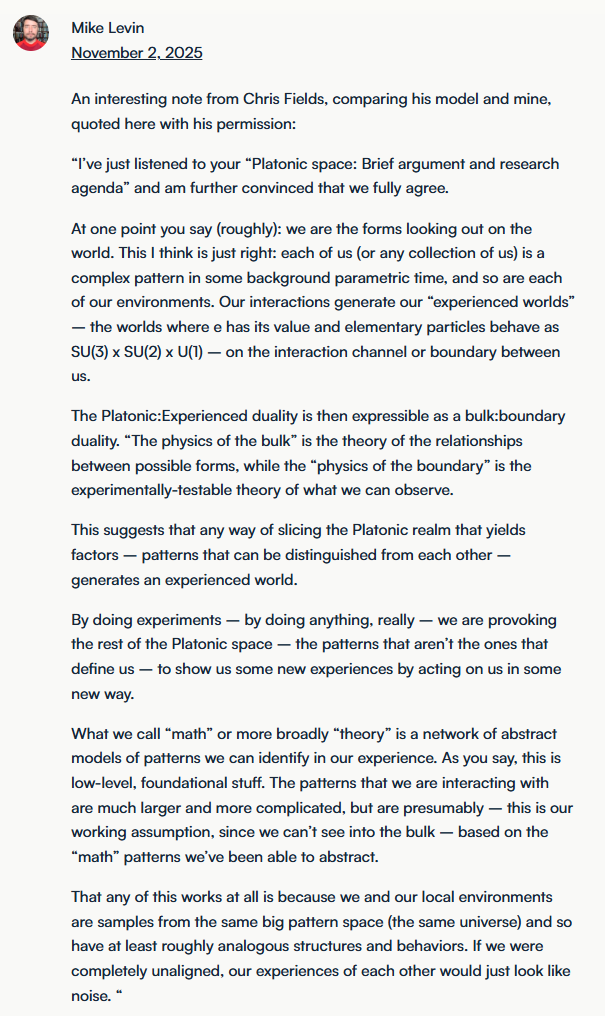
Here is the forced choice he is trying to avoid. Either:
- It is literal physics. Then specify the dictionary. What are the state variables, what is the boundary, what is the bulk, what is the mapping, and what measurement outcome would differ from ordinary thermodynamic phase space coarse-graining and multiscale control models? If there is no discriminating prediction, it is not physics, it is branding.
- It is metaphor. Then stop treating it as an ontological argument. Metaphors can inspire experiments. They cannot purchase new realms of being. “Bulk/boundary” cannot do causal work unless it is anchored to mechanism and falsifiers.
Also, note the subtle status shove in “take it up with Chris Fields.” It is not a direct insult, but it is a neat way to imply I’m pestering the wrong person while he keeps the benefit of having cited the person. If the bulk/boundary framing is irrelevant to his claims, then he should not present it as “we fully agree” support for his Platonic agenda. If it is relevant, then it is his job to cash it out, not to outsource the burden when the bill arrives.
Fallacy Identified:
Argument by delegation + motte-and-bailey. Borrow “bulk:boundary physics” to inflate Platonism (the bailey), then retreat to “it’s not really part of my claims” and “go ask someone else” when the operational constraints show up (the motte). Plus prestige laundering: importing high-status theoretical-physics vocabulary to imply rigor, while refusing the falsifiability conditions that make it rigorous.
When the bulk disappears and SU(3) gets amnesia
In his Q&A response, Levin tries to side‑step two of the most basic critiques with a quick shrug:
On bulk access:
“I don’t depend on Platonic realm being the ‘bulk’, nor that biology recovers anything ‘fully’.” (Dec 28, 2025)On gauge symmetries:
“I’ve never made that specific connection to morphogenesis.” (Dec 28, 2025)
In isolation, these sound modest, even reasonable. In context, they read like his own earlier claims entering the witness protection program.
The “not the bulk” retreat
First, look at what he actually put forward before the Q&A. On November 2, 2025, Levin publicly posts Chris Fields’ endorsement of his framework and presents it as expressing their “full agreement”:
“Our interactions generate our ‘experienced worlds’ – the worlds where e has its value and elementary particles behave as SU(3) x SU(2) x U(1) – on the interaction channel or boundary between us.
The Platonic:Experienced duality is then expressible as a bulk:boundary duality. ‘The physics of the bulk’ is the theory of the relationships between possible forms, while the ‘physics of the boundary’ is the experimentally‑testable theory of what we can observe.
This suggests that any way of slicing the Platonic realm that yields factors – patterns that can be distinguished from each other – generates an experienced world.
By doing experiments – by doing anything, really – we are provoking the rest of the Platonic space – the patterns that aren’t the ones that define us – to show us some new experiences by acting on us in some new way.” (Chris Fields, quoted by Levin, Nov 2, 2025)
This is not an offhand metaphor from a late‑night podcast. This is a written, curated framing Levin chose to publish, highlight, and endorse as “we fully agree”. It does three things in one shot:
- Casts Platonic space as a bulk whose structure is distinct from the “experienced world” boundary.
- Frames our experiments as provoking that bulk to “act on us in some new way.”
- Explicitly locates the “worlds where e has its value” and where particles obey SU(3) x SU(2) x U(1) on the boundary generated by interactions with that bulk.
So when, after I bring in Bilson’s 2025 bulk‑recovery results and the AdS/CFT constraints, Levin replies with “I don’t depend on Platonic realm being the ‘bulk’, nor that biology recovers anything ‘fully’,” what is happening is not clarification; it is retroactive downsizing. The picture he originally sold is:
- Mind and experience live in a bulk:boundary duality.
- Biology “provokes” Platonic patterns from the bulk.
- The whole thing is explicitly dressed in the language of holography and gauge‑theoretic physics.
My criticism targets precisely that: if Platonic space is the bulk and biology is the boundary, then both AdS/CFT results and basic topology (∂∂M = 0) cut off the alleged interface. Bulk access is not just hard; it is mathematically blocked under the very formalism his collaborator invokes.
His Q&A move quietly rewrites the claim to something like “Platonic realm is just some vague non‑physical space, and I never said biology fully recovers it,” which is very different from:
“By doing experiments we are provoking the rest of the Platonic space to show us some new experiences by acting on us in some new way.”
If experiments “provoke” Platonic patterns that “act on us,” that is a bulk–boundary coupling story. I did not hallucinate that. He printed it.
Named move:
- Motte‑and‑bailey plus goalpost shift. The bailey: a strong, holographically flavored bulk:boundary ontology where biology “provokes” Platonic patterns that act on us. The motte: “I don’t really depend on bulk or full recovery.” The moment I bring actual bulk‑recovery theorems and cosmology to the party, the castle folds into a modest hut no one ever claimed to live in.
The SU(3) that never met morphogenesis
Now look at the second reply:
“I’ve never made that specific connection to morphogenesis.” (Dec 28, 2025)
Compare this to the passage Levin chose to showcase:
“Our interactions generate our ‘experienced worlds’ – the worlds where e has its value and elementary particles behave as SU(3) x SU(2) x U(1) – on the interaction channel or boundary between us.
The Platonic:Experienced duality is then expressible as a bulk:boundary duality.” (Fields, quoted by Levin, Nov 2, 2025)
I am not accusing him of writing “SU(3) grows limbs.” The point is simpler and more damning: he is happy to have his framework described as one where:
- The same Platonic bulk underwrites both the Standard Model gauge structure and our experienced worlds.
- Biological agents “provoke” that bulk to act on them and yield those experienced worlds.
Once you put those together in a single research‑agenda paragraph, it is entirely legitimate to ask: what, exactly, does SU(3)×SU(2)×U(1) have to do with morphospace navigation, beyond providing a physics‑scented incense burner?
My original questions do not claim he said “gauge symmetries cause morphogenesis.” I ask:
- Is this explanatory or borrowed prestige?
- What is the mechanism connecting gauge structure to morphogenesis, if any?
His “I’ve never made that specific connection” is therefore not so much a factual correction as a category dodge. He is quite willing to put Standard Model gauge language and Platonic morphospace in the same breath when the goal is to make the framework feel like it is welded to fundamental physics. He only discovers the importance of clear separation when someone asks for a causal story.
Named move:
- Halo borrowing plus strategic disavowal. Use SU(3)×SU(2)×U(1) to halo‑light the framework as “aligned with real physics,” then, when pressed, insist that any reading which takes that alignment seriously is an overreach he never endorsed.
The deeper problem: performative contradiction
Put the timeline together and the pattern becomes hard to miss:
- Nov 2, 2025: He publishes Fields’ bulk:boundary picture with SU(3)×SU(2)×U(1) and “provoking” Platonic space, and says they “fully agree”.
- Nov 9, 2025: I raise specific, technical questions: AdS/CFT constraints, Bilson’s bulk‑recovery limits, de Sitter cosmology, Wheeler’s ∂∂M = 0, gauge‑theory relevance, and falsifiability.
- Dec 28, 2025: He responds that he does not really depend on Platonic realm being the bulk, that biology is not recovering anything “fully,” and that he never made that “specific connection” between gauge symmetries and morphogenesis.
He wants the rhetorical and emotional payoff of a bold, physics‑tinged ontological picture (we are forms in a Platonic bulk, our experiments provoke patterns, Standard Model structure lives on the boundary we co‑generate) and the safety of a modest, non‑committal picture when someone brings actual physics and mathematics to bear.
When I then add Fields’ later public statement that “the platonic realm that we’re looking for is just the world, including ourselves” and that “our experienced world actually defines mathematics,” not the other way around, the situation gets worse. The very authority Levin cites to bulk‑wash his biology shifts, in public, to a view that looks a lot like thermodynamic or relational monism wearing Platonic vocabulary. At that point, his Q&A replies are not only evasive relative to my questions; they are out of sync with both his earlier curated framing and his ally’s subsequent clarification.
In other words:
- When he says he does not “depend on” bulk or full recovery, his own November 2 bulk:boundary endorsement says otherwise.
- When he says he never made a connection from SU(3)×SU(2)×U(1) to morphogenesis, his own highlighted quote invites exactly the question I asked about what those gauge structures are doing in the story at all.
The problems here are not subtle. They are basic:
- Goalpost shift: Retreating from a bulk‑coupling narrative to a vague, non‑committal Platonic vibe once bulk physics enters the chat.
- Equivocation: Using “bulk,” “boundary,” and “Platonic space” in a strong, technical sense to sell the idea, then in a weak, metaphorical sense to defend it.
- Borrowed authority / halo effect: Leaning on SU(3)×SU(2)×U(1) and AdS/CFT imagery to make the framework feel physically grounded, then denying any real commitment when pressed for mechanisms and constraints.
All I did was the basic scientific thing: treat his own words and chosen metaphors as if they were scientific claims, subject to the same physics and math they trade on. His Q&A response does not reconcile that tension. It just pretends the earlier words were never doing the work he clearly wanted them to do.
Ambiguity Of Agency (And The “Nothing Is Literal” Escape Hatch)
Levin’s reply to my “ambiguity of agency” critique is worth quoting in full, because the problem is sitting there in plain sight:
“First, there is no confusion – I’ve defined my terms and how I use them in many places very carefully (see here and here and here). Second, my actual framework doesn’t need to say anything about consciousness in order to be useful – this is why I mostly write about cognition and intelligence, not consciousness. As of yet, I have no papers focused on consciousness. You can be totally agnostic about panpsychism and use my framework in engineering, biology, etc. as cyberneticians have done for decades (you can build goal-having thermostats and such without having to first solve the Hard Problem). Now, I’ve given a few suggestions about the consciousness problem when asked to do so, but it’s not a key aspect of anything I’m doing right now. And finally, I think the distinction between “literal” and “metaphorical” is useless in 3rd person science. Nothing is literal; all we have is metaphors of various degrees of fecundity.”
This is offered as if it dissolves my ambiguity complaint. It does the opposite. It turns a precise question into a fog bank.
What he claims he is doing
If I strip out the rhetorical padding, his move has three parts:
- Assert there is “no confusion” because he has “defined my terms and how I use them in many places very carefully (see here and here and here)”. Those “heres” are TAME, the collective intelligence paper, and his “What is memory, agency…” resources page.
- Insist his framework “doesn’t need to say anything about consciousness” and can be used while being “totally agnostic about panpsychism,” with the thermostat analogy: you can “build goal‑having thermostats” without solving the Hard Problem.
- Announce that “the distinction between ‘literal’ and ‘metaphorical’ is useless in 3rd person science. Nothing is literal; all we have is metaphors of various degrees of fecundity”.
That trilogy sounds, at first glance, like clarity: the terms are defined, consciousness is bracketed, and literal vs metaphor is declared a red herring. But notice what quietly drops out: any answer to the specific thing I actually asked.
My original point was simple: when he talks about “goals,” “preferences,” “Selves,” and “agents” at every scale in TAME and the collective intelligence work, is he making an ontological claim (there really are goal‑bearing agents at those scales) or using instrumental shorthand (these are just useful ways of modeling distributed control)? That distinction is not pedantry. It is the difference between “cells literally have preferences” and “it is sometimes useful to model cells as if they did.”
His response does not answer that. It erases the question by declaring the literal/metaphorical distinction “useless,” while continuing to trade on the same agent vocabulary.
What his cited work actually says
If we go “here and here and here,” as he instructs, the ambiguity is not resolved. It is amplified.
In TAME, he explicitly defines a Self as an agent whose “goals” and “stressors” are invariants across scales, and even proposes a space–time diagram where “the spatio‑temporal scale of any agent’s goals delineates that Self and its cognitive boundaries”. That is not arm’s‑length metaphor. That is a definition: you are the region in space–time carved out by your goals.
In the collective intelligence paper, he writes that neurons unify into “the emergent agent that is the subject of memories, preferences, and goals which are not assignable to any of the individual components”. Again, not “it is sometimes convenient to talk as if.” The language is: subject of memories and goals.
On his “What is memory, agency…” resources page, he explicitly connects this to ethics and recognition of “other beings,” arguing for a way to tell which systems deserve to be related to as agents, not just how to model them for control algorithms. This is not about curve‑fitting in engineering. It is about who and what we treat as a Self.
In other words, in the very places he points to as evidence that his terms are “defined,” the framework continues to use strong agential talk:
- Selves as subjects of memories and goals.
- “Goal‑directedness” applied outside nervous systems as a real organizing principle.
- Agents “navigating” morphospace, not just being fit to an attractor landscape.
His Q&A answer never tells me whether these are supposed to be:
- genuine, multi‑scale agents with real goals, or
- compact metaphors for control‑theoretic behavior in complex systems.
Instead, he tries to make that question itself disappear by saying nothing in science is “literal,” only “metaphors of various degrees of fecundity”. That is not clarification; it is a universal solvent.
Why this does not remove the ambiguity (it worsens it)
There are three separate problems here.
First, the “no confusion” claim is circular.
He says there is no confusion because he has defined his terms “very carefully,” but those definitions simply re‑embed the agential language under dispute. If one of my criticisms is “you never specify whether ‘goal’ here is literal or instrumental,” pointing me to a paper that says “a Self is a system whose goals span such‑and‑such region” does not resolve the issue. It just repeats it with equations.
Second, the panpsychism agnosticism is content‑free.
Saying “you can be totally agnostic about panpsychism and use my framework,” plus a thermostat analogy, does not answer what he thinks is true. Of course you can be metaphysically agnostic and still build control systems. That was never in dispute. My ambiguity critique is not about what a hypothetical user of his framework can bracket; it is about what ontological commitments his own rhetoric is smuggling in when he says things like “all conceivable embodied intelligence is collective intelligence,” “cognition all the way down,” and “Selves” at every scale. On that, the Q&A is silent.
Third, declaring literal vs metaphor “useless” removes the only tool that could resolve the ambiguity.
If “nothing is literal” and “all we have is metaphors,” then there is, by definition, no way to answer the question “are these real goals or just modeling talk?” Every attempt to pin down what the framework is claiming becomes “just another metaphor,” while the framework continues to lean on the evocative force of agent terms to make itself sound deep and unifying.
That is not a neutral philosophical stance. It is a strategic move that:
- borrows the rhetorical power of agent language when selling the framework, and
- disarms conceptual critique by declaring the very distinctions needed to evaluate that language “useless” in science.
From my perspective, that is precisely the ambiguity problem, not a solution to it.
What remains unanswered
After his reply, the core questions are still sitting there, untouched:
- When TAME says a somatic cell “has goals” about target morphology, is that a statement about reality or a statement about how engineers should model the system for control?
- When the collective intelligence paper says a tissue‑level Self is the “subject of memories, preferences, and goals,” is that supposed to be literally true of the tissue, or shorthand for the behavior of a dynamical system with attractors?
- When he speaks of “cognition all the way down,” is that a graded panpsychism, a strong emergentism, or just a stylistic way of saying “feedback control is everywhere”?
His answer to all of these, effectively, is: “I have defined my terms; go read the papers; anyway, nothing is literal.” That is not an answer. It is a refusal to take a position on the very axis that matters, while keeping all the benefits of talking as if he has.
So, for the record and for readers trying to track the moving parts:
- His answer does not overcome the ambiguity argument.
- It relabels the ambiguity (“nothing is literal; all is metaphor”) instead of resolving it.
- It leaves no operational test for whether “goals,” “preferences,” and “Selves” in TAME are being asserted as real multi‑scale agents or as purely instrumental abstractions.
If you build an entire research program on agential vocabulary, then declare the literal/metaphorical distinction “useless,” you are not dissolving confusion. You are institutionalizing it.
Kauffman, Open‑Ended Biology, And The “Not Fixed, Just Timeless Except When It Isn’t” Space
Levin’s response:
“I’m allowed to contradict Kauffman, much as I love Stu and his work (I don’t actually think we disagree, but that’s a longer discussion). Also, I’ve never claimed a fixed Platonic possibility space. Although we don’t know yet, I suspect it’s not fixed but modifies through time.”
This sounds reasonable until you put it next to what Kauffman et al. actually show and how Levin himself has described Platonic space elsewhere.
What Kauffman et al. actually argued (and what I did with it)
Kauffman, Garte, Marshall and colleagues argue that biology does not live inside a pre‑stated, enumerable space of possibilities. In particular:
- There is no Laplacian, pre‑stated “law of evolution” that can list or foresee all future biological possibilities.
- Set‑theoretic and computational formalisms cannot capture the open‑ended creation of new affordances; the relevant spaces are not fully specifiable in advance.
- Biology “transcends the limits of computation” and any mathematically pre‑specified state space, including supposedly exhaustive “option spaces.”
My use of this was very simple: if biological affordances and future forms are not pre‑statiable even in principle, then a Platonic possibility space treated as a fixed catalog of pre‑existing forms is in direct tension with that result. A completed list of all possible morphologies, even as a transcendent set “outside” physics, is exactly what Kauffman’s proofs say you cannot have for biological evolution. Your catalog is either incomplete or non‑existent.
What Levin’s counter actually does (and doesn’t do)
In reply, Levin writes:
“I’m allowed to contradict Kauffman, much as I love Stu and his work (I don’t actually think we disagree, but that’s a longer discussion). Also, I’ve never claimed a fixed Platonic possibility space. Although we don’t know yet, I suspect it’s not fixed but modifies through time.”
This does three things:
- It asserts a right to contradict Kauffman, without saying where he thinks Kauffman is wrong or how biological creativity fits into his own two‑realm ontology. “I’m allowed to disagree” is not the same as “here is the specific theorem I reject and why.”
- It denies having claimed a fixed Platonic space, even though his earlier language reads like exactly that.
- It floats a speculative, evolving Platonic space – one that “modifies through time” – with no explanation of what it means for a non‑physical realm of forms to change in response to physical evolution.
What it does not do is engage the core of my argument:
- It does not explain how an evolving Platonic space is meaningfully different from the thermodynamic possibility space I described, where new patterns arise as organisms explore and reshape constraint landscapes.
- It does not show that Kauffman’s indefiniteness results leave room for a pre‑existing realm of forms that biology “samples” from.
- It does not confront the fact that if Platonic space “grows” when organisms instantiate new patterns, then biology is creating forms, not discovering them, which collapses the very discovery/creation distinction Platonism was supposed to protect.
So yes: he sidesteps the Kauffman point. He asserts freedom to disagree and gestures at a dynamic Platonic space, but he does not show that his dual‑realm picture survives Kauffman’s result any better than a single thermodynamic ontology does.
Did I misrepresent his Platonic space as fixed?
Given Levin’s symposium framing and his Platonic‑space language, the answer is clearly no. My argument has consistently been that he treats Platonic space as whatever is convenient in the moment, implicitly fixed in one statement and conveniently “evolving” in another. This is not subtle nuance so much as a roaming target: timeless catalog when selling the depth, shape‑shifting ledger when Kauffman walks into the room. It is exactly the motte‑and‑bailey pattern I have been documenting since early November.
In his own materials, Levin repeatedly frames Platonic space as:
- A reservoir of “facts of mathematics and computer science,” like the value of e, NAND‑gate universality, and algebraic structures (quaternions, octonions, complex numbers) that “exist independently” of any physical interface and “constrain and enable” it.
- A domain of “possible forms” that can be sliced into “patterns that can be distinguished from each other,” which then “generate an experienced world” when “provoked” by our interactions.
- The “bulk” side of a “bulk:boundary duality,” where “the physics of the bulk is the theory of the relationships between possible forms” and the boundary is our observable world.
None of that is phrased as “comes into being when organisms create new patterns.” It reads like a pre‑populated option space of mathematical and structural facts that biology can instantiate or access. The value of e, the properties of quaternions, and the NAND gate’s universality are presented as already there, regardless of whether any organism has yet evolved that exploits them.
When he later tells me “I’ve never claimed a fixed Platonic possibility space,” that is part of a retreat. He is softening a picture that, in his own earlier rhetoric, looks very much like a pre‑existing catalog of possibilities: eternal mathematical facts, pre‑given morphological patterns, and a “bulk” of forms that biology taps into. My “fixed possibility space” reading tracks those earlier claims. His “modifies through time” line is a post hoc motte: a way to make his view feel more compatible with Kauffman’s open‑endedness only after someone has brought that paper into the discussion.
On the fixed reading:
- If Platonic space is fixed and complete, Kauffman’s result that biological affordances are not pre‑statiable is a direct challenge.
- If Platonic space is growing with biology, then its contents depend on physical processes and it ceases to be a transcendent realm of prior forms; it becomes a fancy label for the evolving thermodynamic possibility space I already described. Either way, the original Platonic payoff evaporates.
Fallacies in Levin’s Kauffman reply
Here are the main moves and what they dodge:
- Assertion without specification (“I’m allowed to contradict Kauffman”).
He claims the right to disagree but never identifies which part of Kauffman’s formal argument he rejects or how his own model restores a well‑defined possibility space without running into the same indefiniteness results. - Motte‑and‑bailey on “fixedness.”
The bailey: a robust, pre‑existing realm of mathematical and morphological “possible forms” that “exist independently” and “constrain and enable” physical systems, framed as a bulk of relationships between possible forms. The motte: “I’ve never claimed a fixed Platonic possibility space… I suspect it’s not fixed but modifies through time” when Kauffman is brought in. The strong, catalog‑like reading sells the view; the softer, evolving reading is used defensively. - Unexplained dynamic in a non‑physical realm.
Saying Platonic space “modifies through time” without explaining how a non‑physical ontology changes in lockstep with physical evolution is hand‑waving, not a theory. It avoids the problem by injecting motion words rather than mechanisms. - Failure to address discovery vs creation.
Kauffman’s paper and my critique highlight that biology is creating new affordances that were not listable in advance; Levin’s evolving‑Platonic‑space dodge never grapples with the implication that, in that case, Platonic forms are trailing indicators of physical creativity, not prior constraints on it.
So, for the public‑facing record:
- My use of Kauffman et al. is faithful to both the letter and spirit of their argument: no pre‑stated, exhaustive possibility space for biology.
- Levin’s own earlier descriptions of Platonic space fully support a fixed‑catalog reading; the later “modifies through time” move is a defensive softening, not an original feature.
- His reply does not counter the substance of my argument; it sidesteps it by asserting a right to disagree, denying the “fixed” label, and gesturing at a dynamic Platonic space that, if taken seriously, collapses into the very thermodynamic monism he is trying to avoid.
Hoffman, Interfaces, And The Self‑Undermining Platonist
Levin’s response to my Hoffman critique is: “I’m allowed to contradict Hoffman too, though I like his work a lot as well. Also, I don’t ‘invoke’ Hoffman’s theory – I’m not using it to support any of the things I say. I have a bunch of work coming soon talking about what happens before any notion of fitness kicks in.” The problem is that this does not match how Hoffman actually appears in his symposium framing. In the November 11 comment, trying to downplay metaphysical commitment, he writes that he “wouldn’t be surprised” if both his Platonic space and “physical space (if there is such a thing, for example Don Hoffman thinks it doesn’t exist) are features of some singular deeper underlying reality (like Bernardo’s model),” and then immediately says that is one of many topics on which he “doesn’t need to expound.”
In public summaries around the same conversation, his position is explicitly presented as part of a “convergence” where Hoffman’s interface theory, Kastrup’s idealism, and Levin’s Platonic space all supposedly point to a hidden structure behind the world we perceive. There is even a Reddit description of his view titled “the physical world as an ‘interface’ for the Platonic World,” echoing Hoffman almost verbatim. So when he now says he does not “invoke” Hoffman, that may be narrowly true in the sense that he never writes “therefore, by Hoffman’s theorem, Platonic space exists,” but it is not true in the ordinary language sense. He uses Hoffman’s signature move – physical space as interface, not ground – as a way of softening and reframing his own two‑realm ontology, and he does it precisely at the point where my thermodynamic monism is pressing him on why a second realm is needed at all.
What makes this move self‑undermining is not just the inconsistency of tone; it is the clash between Hoffman’s actual view and what Levin needs Platonic space to do. Hoffman’s interface theory is explicit: perception, including our experience of space, time, and even mathematical structures, is an evolved user interface tuned for fitness payoffs, not for truth. The icons on the desktop are not faithful depictions of the underlying machine; they are survival‑relevant compressions. Levin, by contrast, needs organisms (and mathematical practice) to be able to track real structures in a Platonic space of forms in a way robust enough that talking about “access,” “projection,” and “ingression” does more work than saying “we found a convenient coordinate system.”
If Hoffman is right, then the success of mathematics and scientific modeling is better explained as evolutionary and cultural convergence on useful fictions than as veridical access to a non‑physical library of eternal objects. If Levin is right that biology and cognition literally interface with Platonic space, then Hoffman’s core argument about fitness‑over‑truth has to be rejected or heavily modified. You cannot consistently say “physical space may not exist, see Hoffman” in one clause and then, in the next, lean on perception and mathematical cognition as portals into a Platonic pattern space that constrains and guides morphogenesis.
When I point out that tension, Levin’s strategy is not to solve it but to spread it around. The November 11 passage explicitly uses Hoffman, Kastrup, and a vague “deeper underlying reality” to suggest that everybody is in the same metaphysical soup anyway, so insisting on a clear, single‑ontology thermodynamic story looks like I am demanding “final truth” while he is humbly offering an “intermediate model” we can use right now. In that framing, Hoffman’s “physical space doesn’t exist” line functions as a kind of philosophical smoke grenade: if even the physical is “just interface,” then asking how Platonic space and physical space couple becomes easy to portray as overly literal or naive.
But notice what never happens: he does not explain how his Platonic space avoids Hoffman’s conclusion that interfaces are tuned for fitness, not truth; he does not say how, on an interface theory, organisms get privileged access to the “real” side of the icons when it comes to Platonic math; and he does not show that his Platonic interface story predicts anything different, at the level of experiment, from a thermodynamic constraint‑only model that takes Hoffman’s skepticism about veridical perception seriously.
So the structure, laid out cleanly, is this. In the symposium orbit and surrounding media, Hoffman’s interface talk is part of the halo: the physical world is an “interface,” our minds “look out” through it, and there is a deeper pattern space behind the icons. When I point out that Hoffman’s actual theory treats that interface as fitness‑optimized fiction, which undercuts the idea of perception as a Platonic telescope, Levin’s Q&A answer retreats to: (1) I am allowed to contradict Hoffman, (2) I am not really invoking him, and (3) anyway there will be future work about “before fitness”.
None of that touches the logical point. If he truly contradicts Hoffman, then Hoffman’s interface story cannot be used to make his own two‑realm ontology feel less lonely. If he does not contradict Hoffman, then Hoffman’s argument about evolved fictions undercuts the idea that mathematical and perceptual capacities are transparent windows into a Platonic realm. Trying to keep both – Hoffman’s iconography for atmosphere, and Platonic access for biology – is not synthesis, it is tension. And treating that tension as a topic he “doesn’t need to expound” while continuing to benefit from the shared aesthetic is exactly the pattern this whole document has been tracing: neighboring frameworks used as rhetorical scaffolding, then disowned or blurred as soon as someone asks them to bear weight.
The cascade of fallacies in this single evasion would almost be impressive, if it wasn’t so tragic.
Denial Of Invocation / Rewriting The Record
Move:
In the Q&A he says: “I don’t ‘invoke’ Hoffman’s theory – I’m not using it to support any of the things I say.”
What it dodges:
My argument that he does rely on Hoffman‑style interface talk to soften and reframe his Platonic dualism: e.g., his November 11 comment where he writes that both his Platonic space and “physical space (if there is such a thing, for example Don Hoffman thinks it doesn’t exist)” might be features of a deeper reality, and where public summaries describe the physical world as an “interface” for the Platonic world.
Fallacy:
- Historical revision / redescription: denying reliance on a view while continuing to use its central framing when rhetorically helpful.
- Function: avoid having to reconcile Hoffman’s own anti‑veridical stance with a Platonic access story, by pretending Hoffman was never part of the scaffolding.
Appeal To “Deeper Reality” As Fog Machine
Move:
He says he “wouldn’t be surprised” if both Platonic space and physical space (which “might not exist,” per Hoffman) are aspects of “some singular deeper underlying reality (like Bernardo’s model),” then immediately: “Fine; that’s one of many topics on which I don’t need to expound.”
What it dodges:
My thermodynamic‑monism argument that no second realm is needed: one process ontology (thermodynamic constraint dynamics) already explains bioelectric morphogenesis, xenobots, and morphospace navigation, and any extra realm must earn its keep with discriminating predictions and a mechanism.
Fallacy:
- Mystification / appeal to undefined deeper level: using a vague “deeper reality” gesture to make a concrete monist alternative look simplistic, while not actually specifying how the deeper level changes anything.
- Function: blur the target so the specific “do we need two ontologies?” question dissolves into “reality is mysterious anyway.”
Tension Masked As Pluralism (Hoffman + Platonism)
Move:
He keeps Hoffman in his orbit (“I like his work a lot”) while rejecting any obligation to square Hoffman’s interface theory with his Platonic access claims.
What it dodges:
My explicit point: Hoffman’s interface theory says perception and even mathematical representation are fitness‑optimized fictions, not transparent access to objective, mind‑independent structure. That is hostile terrain for a view that needs cognition to reliably “interface” with Platonic forms.
Fallacy:
- Inconsistency camouflaged as ecumenism: holding mutually tensioned views in the same rhetorical coalition without addressing their conflict.
- Function: borrow Hoffman’s anti‑physicalist vibe when useful, ignore Hoffman’s anti‑veridical consequences when they cut against Platonic access.
Category Error: Interface As Fiction vs Interface As Access Channel
Move:
Use Hoffman’s “physical space is just an interface” line to loosen physicalism, while still treating brains and bodies as interfaces that reliably connect to Platonic space.
What it dodges:
My argument that you cannot simultaneously say:
- “interface = evolved icon set tuned for fitness, not truth” (Hoffman), and
- “interface = conduit for accessing real Platonic structures that guide development.”
Fallacy:
- Category mistake: conflating “interface as useful fiction” with “interface as epistemic channel.”
- Function: keep the word “interface” doing double duty without specifying which sense is in play when.
Redefining The Critique As “Final Truth” Obsession
Move:
He frames himself as merely offering an “intermediate model that is useful right now,” contrasts this with “ultimate nature of reality” talk, and suggests criticism of the dual ontology is about “final truth” he doesn’t need to address.
What it dodges:
My concrete, here‑and‑now challenge: given that thermodynamic monism already explains his own data and has clear falsifiers, what present‑tense explanatory and predictive work is being done by positing a separate Platonic realm at all?
Fallacy:
- Strawman reframing: recasting a targeted question about current ontological commitments (“do you need two realms?”) as a demand for ultimate metaphysical completion.
- Function: portray my position as overreaching, so he can claim modesty instead of answering the specific redundancy/falsifiability challenge.
Future‑Work IOU (“Before Fitness Kicks In”)
Move:
“I have a bunch of work coming soon talking about what happens before any notion of fitness kicks in.”
What it dodges:
My point that given Hoffman’s fitness‑first argument, his use of Hoffman undermines, rather than supports, Platonism now. A speculative future story about pre‑fitness regimes does not change the present contradiction.
Fallacy:
- Promissory note / appeal to future work: deferring resolution indefinitely with “there will be theory later.”
- Function: avoid answering whether his current combination of interface‑as‑fiction and interface‑as‑Platonic‑channel is coherent or testable.
“I Can Contradict Hoffman” Without Owning The Consequences
Move:
“I’m allowed to contradict Hoffman too, though I like his work a lot as well.”
What it dodges:
The dilemma I’m actually pressing: either
- he does contradict Hoffman in the relevant way (rejecting fitness‑as‑fiction for math/perception) and then must stop using Hoffman‑style interface rhetoric as sympathetic scaffolding, or
- he accepts Hoffman’s core result, and then must explain how veridical Platonic access survives.
Fallacy:
- Assertion without specification: claiming the right to disagree without stating where and how he disagrees on the points that matter.
- Function: signal autonomy from Hoffman while keeping all the rhetorical benefits of association.
Appeal To Popularity / Prestige Coalition
Move:
Grouping himself with Hoffman, Kastrup, Penrose, Tegmark, etc., in “convergence” narratives about hidden structure, while redirecting critics to those “bigger fish” when pressed.
What it dodges:
My thermodynamic‑monism claim that, in his specific bioelectric and morphogenesis domain, the extra Platonic realm is explanatorily idle and unfalsifiable compared to a single‑ontology constraint account.
Fallacy:
- Prestige coalition / appeal to authority cluster: implying that being in the same conversational neighborhood as multiple high‑status theorists makes the unresolved contradictions less urgent.
- Function: launder unresolved tensions through proximity to famous names instead of addressing the domain‑specific argument.
Synthbiosis, Process Talk, And The “We Are The Forms (Except When We Access Them)” Shuffle
Levin’s response to my “synthbiosis incompatibility” point reads:
“I’m actually much more on the process-relational end of things (my Platonic patterns are not a substance, in the conventional sense of ‘substance’). Also this misrepresents my view: I don’t suggest that we, physical creatures, access forms. I’m saying we are the forms. And it’s perfectly compatible with efforts at synthbiosis, because all beings (even synthetic ones) can likewise be patterns projecting through (unconventional) embodiments, so I see no reason why we can’t try to get along. Actually even if we were radically different beings, we could, and should, still try for synthbiosis.”
On the surface this sounds like a friendly, process‑relational correction: no spooky substances, just patterns; we are the forms, no accessing necessary; everyone is a pattern projecting through embodiments, so synthbiosis is safe. The problem is that this is not how he talks when he is not under direct metaphysical cross‑examination. When we put this alongside his own earlier descriptions of Platonic space and minds, the picture is not “pure process‑relational monism with nice metaphors.” It is a two‑component ontology with a very familiar interaction problem, periodically relabeled as process so it can keep dancing near Whitehead and Friston.
“We are the forms” vs “we access the forms”
Start with his stronger statements. In his Platonic‑space essay and symposium remarks, he writes that:
- “Minds are forms in that space, and they access each other, in that space (laterally) but also project into the ‘physical world’ through interfaces.”
- Forms in Platonic space “inject information and influence into physical events, such as the growth and form of biological bodies,” and our experiments “provoke the rest of the Platonic space… to show us some new experiences by acting on us in some new way.”
That is not “we are patterns and that is all.” That is a clear dual structure:
- a non‑physical pattern domain (Platonic space) where minds “are” as forms and access each other, and
- a physical world they “project into” via interfaces, where those forms “inject information and influence” into morphogenesis and experience.
In that picture, yes, we are forms in Platonic space, but we also access and project and inject across an ontological boundary. The verbs are doing the work he now denies: access, project, inject, provoke, act on us. You cannot erase that cross‑boundary structure by saying, after the fact, “I don’t suggest we access forms; I’m saying we are the forms”. The earlier language is explicit: something in Platonic space acts on physical embodiments through interfaces.
My original point about synthbiosis and boundary dissolution was precisely about that: if the deep ontology is process‑relational monism, in which beings are thermodynamic processes with nested Markov blankets and there is no extra realm, then synthbiosis and boundary dissolution make sense in a straightforward way: patterns couple through physical scaffolds; interfaces are energetic and informational couplings within one world. If, instead, minds and developmental goals are forms in a separate Platonic space that “project into” physical substrates, then every synthetic system that joins the party has to slot into that same two‑layer scheme. The interface‑language is not innocent. It drags in a hidden dualism and an interaction problem that process‑relational talk is usually trying to avoid.
Process‑relational branding vs two‑component ontology
Levin’s reply wraps itself in process‑relational language: “I’m actually much more on the process‑relational end of things (my Platonic patterns are not a substance…),” “we are the forms,” “all beings… can likewise be patterns projecting through embodiments”. But the structure he keeps defending elsewhere is still a two‑component ontology:
- “One described by mathematicians (and, I hypothesize, cognitive scientists), and one described by physicists,” as he puts it in the same November 11 exchange.
- A Platonic space of forms and a physical space of embodiment, “functionally coupled components” that he says he does not see a way to reduce to one, though he would not be surprised if some deeper monism unified them someday.
That is not thermodynamic monism with colorful vocabulary. It is a dual‑component picture: a pattern realm and a physics realm, coupled by interfaces. Saying “not a substance, in the conventional sense” does not magically dissolve the dualism if the roles are still:
- Realm A: carries forms, goals, and minds as non‑physical patterns.
- Realm B: implements those patterns in matter via interfaces that allow “projection,” “ingression,” and “injected influence.”
This is exactly the structure that made me say “substance dualism of accessing external forms” in the first place. The “we are the forms” line is not a correction of that; it is a softening of the language at the moment scrutiny falls on the interaction problem. When he is talking to friendly interviewers or framing his research agenda, the verbs go back to “access,” “project,” “ingress,” “inject,” “get more out than we put in.” When challenged on dualism, the verbs become “are,” “patterns,” “process‑relational,” and any suggestion of accessing is declared a misrepresentation.
Synthbiosis, boundary dissolution, and the lingering interface
On synthbiosis specifically, my argument was that his vision of “boundary dissolution” and multi‑scale synthbiosis makes the most sense in a one‑ontology, constraint‑first framework: different beings are differently organized thermodynamic processes with different Markov blankets and coupling regimes; synthbiosis is the process of renegotiating those boundaries and couplings. That is Deacon, Friston, Whitehead, and a decent chunk of Indigenous relational thought converging on the same idea: one world, many nested processes, no extra ontological realm that has to “reach in”.
In response, he says “it’s perfectly compatible with efforts at synthbiosis, because all beings (even synthetic ones) can likewise be patterns projecting through (unconventional) embodiments, so I see no reason why we can’t try to get along”. The ethical sentiment is welcome. The ontology is still doing the thing. “Patterns projecting through embodiments” is exactly the interface model I argued was in tension with process‑relational monism. If beings are just thermodynamic processes, there is no need to talk about extra‑world patterns projecting through bodies. If they are extra‑world patterns projecting through bodies, then the metaphysical work is being done by a separate realm. Calling that “process‑relational” while keeping the projection story is branding, not resolution.
So, to answer the specific questions that animate this section:
- Was my full Kauffman argument misrepresenting his Platonic possibility space as fixed? No. His own descriptions (eternal mathematical facts, pre‑given “possible forms,” bulk of relationships between forms) support a fixed‑catalog reading that he only softened after Kauffman was introduced.
- Does his “I’m process‑relational, we are the forms, no accessing” reply resolve the contradiction with synthbiosis? No. It conflicts with his earlier, stronger access/projection language and does not remove the two‑component structure that creates the interaction problem I flagged.
- Does this matter for synthbiosis and boundary dissolution? Yes. A genuine process‑relational monism needs no Platonic interface at all; Levin’s framework keeps reinstalling one while calling it process. That is the contradiction.
Fallacies in this section
- Motte‑and‑bailey (ontology version).
- Bailey: bold dual‑component claims – minds are forms in Platonic space, they access each other, project into the physical world, Platonic patterns inject influence into biological development.
- Motte: modest process talk – “I’m much more on the process‑relational end,” “my Platonic patterns are not a substance,” “I don’t suggest we access forms; we are the forms”.
Under scrutiny, “access” and “projection” become “are” and “patterns”; once the heat is off, the stronger verbs reappear.
- Definitional retreat.
Recasting a two‑realm model (Platonic plus physical) as “process‑relational” by saying the Platonic side is “not a substance in the conventional sense,” without changing its role as a distinct ontological component that must still project into matter and solve an interaction problem. - Category slide (process vs projection).
Sliding between a genuinely process‑relational monism (one world of interacting processes) and a projection ontology (patterns in one domain projecting through embodiments in another) as if these were interchangeable descriptions, when they are not.
The upshot here is simple: if Levin really wants his synthbiosis vision to sit on a process‑relational, thermodynamic foundation, he does not need Platonic space at all. If he insists on Platonic space, projection, ingression, and extra‑world patterns as the real seat of mind, then he does not get to declare “I don’t suggest we access forms” and call it process. At that point, the contradiction is not in my reading. It is in his own verbs.
Heritage, Platonism, And The Strawman Straightjacket
My line was:
Betrayal of Intellectual Heritage: The static essentialism of Platonism contradicts Levin’s Jewish intellectual heritage, which emphasizes relational meaning‑making and process over fixed substance.
Levin’s reply:
“This is just bizarre… While I won’t currently comment on my personal thoughts about my heritage and its value for progress in this field, the important thing is that no one’s heritage is supposed to be a straightjacket on the science one does. No, I’m not going to modify what I think in science in order to stick close to how I happened to have been born/raised/educated/etc. Like the supposed betrayals of Dennett, Kauffman, etc., this is not a serious argument. Having said that, I actually do not think anything I’ve said is incompatible with deeper levels of thought in that heritage (a book on that stuff is far down on the list of things I’m supposed to write, but it’s on the list, so let’s see if we get there).”
None of this engages what I actually argued. It replaces it with a caricature about ethnic loyalty and then dismisses that caricature as “bizarre” and “not serious.”
What I actually argued about heritage
In the symposium comments, the heritage point was not “you must do Jewish science to be a good Jew.” It was a coherence claim with four parts:
- About his own self‑presentation.
He publicly signals interest in Jewish intellectual and spiritual traditions, including Kabbalah and process‑relational readings, and even mentions that he might someday write about how his Platonic ideas relate to that heritage. He clearly considers it philosophically relevant, not irrelevant trivia. - About those traditions as I invoked them.
I did not treat Judaism as a monolith. I pointed to specific strands that:- Emphasize relational meaning‑making: covenant, midrash as dynamic interpretation, ethical responsibility evolving through time.
- Emphasize process and unfolding over static essences: Ein Sof as immanent unfolding rather than a warehouse of frozen forms; Kabbalistic and Hasidic currents where world and divine co‑unfold in relationship, not according to a pre‑written form catalog.
- Treat “world‑making” as an ongoing collaborative process, not a one‑time encoding of timeless blueprints.
- About his Platonism.
In his Platonic‑space essay and symposium comments, he frames his ontology as:- A non‑physical realm of “facts of mathematics and computer science” and “possible forms” that “exist independently” of any physical interface and “constrain and enable” it.
- A space where minds are forms that “access each other” and “project into the physical world through interfaces,” and where forms “inject information and influence into physical events” like morphogenesis.
- A “bulk” of relationships between possible forms, distinct from the “boundary” physics we observe.
- The comparative tension.
The “betrayal” language was shorthand for a simple observation:- There is a live tension between this static, two‑realm essentialism and the process‑relational, interpretive, non‑dual strands in the Jewish tradition he himself gestures toward.
- Given his own empirical work, which fits cleanly with thermodynamic, constraint‑first, process‑relational monism, and given those heritage resources, it is ironic and unnecessary that he opts for a Greek‑style Platonic metaphysics that reintroduces exactly the fixed essences and interaction problems those strands help dissolve.
So the heritage point was a coherence challenge across three things:
(a) the metaphysics he advocates,
(b) the empirical work he actually does, and
(c) the intellectual tradition he says he values.
It was not an identity test. It was: “When your data, your process‑relational sympathies, and your heritage all lean one way, and your metaphysics leans another, that tension is worth naming.”
How his reply misrepresents it
His response misfires in several distinct ways:
- Turning a coherence critique into a loyalty test.
By talking about “straightjacket on the science one does” and “how I happened to have been born/raised/educated,” he treats my point as if I were saying his heritage should dictate his science. I said nothing of the sort. The actual claim was: “You have powerful process‑relational tools in that tradition that harmonize with your empirical work; Platonism cuts against them.” - Collapsing “intellectual heritage” into mere biography.
I referenced a textual and philosophical tradition (Kabbalah, process‑oriented Jewish thought), and he reframes it as crude identity politics about his upbringing. That lets him reject a caricature (“I won’t bend science to my birth circumstances”) instead of addressing the substantive comparison between static forms and relational unfolding. - Dismissing instead of answering.
Calling the argument “bizarre” and “not a serious argument” is not a rebuttal. A serious rebuttal would say, for example: “Here is how my Platonic space actually aligns with Ein Sof / process strands,” or “Here is why those strands are not process‑relational in the way you claim.” He provides none of that; just a label and a shrug. - Equating it with “betrayals of Dennett, Kauffman, etc.”
He lumps this together with my criticisms that his Platonic framework clashes with Dennett’s real‑pattern anti‑reductionism or Kauffman’s open‑ended biology, calling them all “supposed betrayals”. That flattens specific internal coherence critiques into a generic narrative of me accusing him of betraying various intellectual fathers, which is not what is happening. The Dennett and Kauffman points are about internal tension between his rhetoric and their actual positions, not about loyalty. - Hinting at compatibility without demonstrating it.
He says he does not “think anything I’ve said is incompatible with deeper levels of thought in that heritage” and mentions a hypothetical book he might write someday. That is assertion, not argument. He offers no example of a Jewish process‑relational text that sits comfortably with “non‑physical forms injecting influence into biology via interfaces.” The burden was to show compatibility, not to promise future reflections.
What my heritage argument actually rested on
Contrary to his “bizarre” framing, the argument was built on named concepts and robust theory:
- Named Jewish resources:
- Robust empirical and theoretical scaffolding:
- Friston’s Free Energy Principle / Markovian monism, Deacon’s teleodynamics, and thermodynamic self‑organization as mathematically grounded process‑relational ontologies.
- Kauffman et al. (2025) on the “reasonable ineffectiveness” of mathematics in biology, showing that biological affordances are not pre‑statiable, dovetailing with both process‑relational metaphysics and anti‑essentialist strands in Jewish thought.
- His own bioelectric work: morphogenesis as navigation of free‑energy landscapes, nested Markov blankets, and downward causation via constraint propagation, all explainable within one thermodynamic ontology.
Heritage, in my framing, was converging evidence: Jewish process‑relational intuitions, modern thermodynamics and active inference, and his lab’s data all line up. Platonism does not.
The implicit “ought” was not “as a Jew, thou shalt not be Platonic.” It was:
As someone who values a process‑relational Jewish tradition and whose data already point toward thermodynamic monism, you should at least acknowledge that static, two‑realm Platonism sits awkwardly with both.
Fallacies and rhetorical moves in his reply
In this short paragraph, he manages several moves at once:
- Strawman:
Recasting “you’re out of tune with your own intellectual resources and data” as “you want my heritage to straightjacket my science.” - Well‑poisoning:
Framing the critique as identity‑based pressure (“how I happened to have been born/raised”) to make it look unserious before the reader even sees its content. - Dismissal by ridicule:
Labeling it “bizarre” and “not a serious argument” in lieu of engagement. - Appeal to future work:
Pointing to a hypothetical book “far down the list” instead of giving even one concrete example now of how his Platonic forms and interfaces align with process‑relational Jewish thought.
Underneath all of that, the core question remains untouched:
Why, given the process‑relational resources in the Jewish tradition he acknowledges, and the process‑relational nature of his own data, does he insist on a Platonic, two‑realm ontology that reintroduces exactly the static essences and interaction problems those resources help to avoid?
Moderation Asymmetry And The Moving Goalposts
My claim was straightforward:
Moderation Asymmetry: The handling of blog comments displays an epistemic double standard where unfalsifiable assertions pass quickly while rigorous critiques face indefinite delays.
Levin replies:
“First and foremost, it’s my blog and I moderate it however I want. The good news is, everyone is free to start their own and put whatever they want there. But, I’ve absolutely not been trying to delay ‘rigorous critiques’. I’ll let readers judge for themselves if the above kind of material (with ‘betrayals of heritage’, ‘indigenous appropriation’, ‘colonization language’ and such, as well as mischaracterizations of my actual position re. a fixed space) is a rigorous critique… Basically, the dynamic is very simple: when someone posts something short and easy to read, it tends to get approved (or not – you’re not seeing all the other stuff I haven’t approved! Including many things that do apparently agree with me) relatively quickly. When someone submits tens of thousands of words, it takes me time to go through and see if it will add value or not. Believe it or not, reading those things are not my #1 priority, so it takes time for me to decide whether I want it there, especially when someone submits very lengthy texts that are walking the edge between valid questions and comments of questionable motivation and utility. There are many of those besides yours that are sitting in the queue. You will note however that a bunch of the people I’ve invited to give talks at the symposium, and some upcoming conversations, are be with people who disagree radically with my view. Critiques are great, when they move things forward. That doesn’t mean that I commit to rapid adjudication of near book-length comments submitted to the blog.”
This does not address the complaint. It answers a different one, quietly questions my motives, and erases what those “tens of thousands of words” actually were.
What my moderation argument actually was
The 32,000‑plus words he now compresses into “near book‑length comments” were not a random screed. Roughly 22,000 of those words were direct responses to his own 10,000‑plus word symposium arguments, line‑by‑line, with:
- Named, peer‑reviewed scholarship and verbatim quotations.
- Concrete falsifiable experiments his lab could run to test his Platonic framework.
- Detailed answers to the very phenomena he claims physicalism cannot explain (xenobots, planarian regeneration, “goal‑directedness,” bubble‑sort experiments).
The rest were replies to other participants and clarifications requested in that same forum.
In parallel, I have multiple comments only a few sentences or paragraphs long that:
- Ask for specific falsifiable predictions.
- Flag the use of unfalsifiable rhetoric (“ingression,” “get more out than we put in”) instead of mechanisms.
- Stay strictly non‑personal and focused on the science.
Those short, technical comments have sat in moderation for weeks or months. During the same windows, short comments from others reducing my work to “materialist screams into the void,” “gish gallop,” and similar dismissals have appeared within hours.
So the asymmetry I pointed to was:
- Speed + selectivity, not “I demand a right to post 36,000 words on your blog.”
- Unfalsifiable cheerleading and ad hominem dismissals: fast.
- Referenced critique and test proposals: slow or invisible.
How Levin’s response misframes that
Levin’s response misframes the issue on several levels.
First, he changes the subject:
“First and foremost, it’s my blog and I moderate it however I want… Everyone is free to start their own and put whatever they want there.”
No one disputed that. The question is whether his moderation practice tracks epistemic standards or comfort. Answering with ownership rights is a category error: it replaces “is there a double standard?” with “am I allowed to have one?”
Second, he reduces it to length:
“When someone posts something short and easy to read, it tends to get approved… When someone submits tens of thousands of words, it takes me time to go through and see if it will add value or not.”
If length were the operative variable, then:
- All short comments would see similar turnaround times, whatever their stance.
- Long comments from any side would be slow.
That is not what happens. In practice:
- Short, content‑free attacks on me and other critics are approved quickly.
- Short, calm, referenced comments from me—asking for predictions, pointing out unfalsifiability, giving specific experimental handles—remain in moderation for weeks alongside longer ones.
The real variable is stance plus epistemic content, not word count:
- Short supportive or derisive comments: fast.
- Short rigorous, falsifier‑offering comments: slow or never.
Third, he pre‑poisons the well:
“…the above kind of material (with ‘betrayals of heritage’, ‘indigenous appropriation’, ‘colonization language’ and such, as well as mischaracterizations of my actual position re. a fixed space)…”
Here he:
- Bundles months of work—most of it straight technical argument about thermodynamics, Landauer, Kauffman, Durant 2017, AWARE III, etc.—under a handful of emotionally loaded labels.
- Asserts “mischaracterizations” of his fixed‑space position without any quote‑and‑compare, implying sloppiness or dishonesty on my part without actually demonstrating it.
The effect is to prime readers to treat my critique as ideological noise rather than a body of peer‑anchored, experiment‑proposing responses to his own 10,000‑word symposium essay.
Fourth, he floats motive doubt:
“…very lengthy texts that are walking the edge between valid questions and comments of questionable motivation and utility.”
“Questionable motivation” is a character judgment, not an argument. It invites readers to doubt my good faith instead of reading the arguments. “Walking the edge” suggests borderline crankery without specifying where or why. That is subtle ad hominem and well‑poisoning: my motives become part of the explanation for delay, while the content (citations, falsifiers, specific questions) disappears.
Finally, he uses invited critics as cover:
“You will note however that a bunch of the people I’ve invited to give talks at the symposium… disagree radically with my view. Critiques are great, when they move things forward.”
Curating high‑profile critics for recorded conversations is not the same as letting unfiltered, technically rigorous criticism from outside that circle appear in public comment threads. The presence of invited dissenters does not answer the specific pattern I documented: that my own detailed, referenced, falsifiable challenges are kept offstage while short dismissals of those same challenges go up almost immediately.
Why this matters, given asymmetry of reach
The “start your own blog” line is especially hollow in context:
“Everyone is free to start their own and put whatever they want there.”
Formally true, but epistemically irrelevant. Levin’s framing goes out through major podcasts and media outlets to millions. A blog like mine, with minimal social media reach, is not a symmetric counter‑platform. I could start a hundred blogs and write a hundred papers; without comparable visibility and citations, their corrective effect on his narrative is negligible.
Moderation choices on his platform therefore carry disproportionate weight. When he:
- Mischaracterizes my positions in front of his audience,
- Frames months of cited, experiment‑proposing work as “questionable motivation” and “bizarre” heritage policing, and
- Keeps my calm, non‑attacking corrections in a moderation queue,
the result is not an even playing field. It is a one‑way megaphone. Under those conditions, “start your own blog” is not an answer; it is a way of dodging responsibility for how his words are amplified and how asymmetry of reach amplifies any misrepresentation and any ID‑friendly appropriation his language invites.
The irony is that this setup quietly inverts the roles. My side is the one doing the unglamorous work: reading his 10,000‑word symposium text closely, responding to it line‑by‑line, providing peer‑reviewed citations, proposing falsifiable experiments, and asking specific questions. His side, in this paragraph, is the one leaning on vibes: labels, motive insinuations, length complaints, and “start your own blog.” The rhetoric hints that I am the one being intellectually lazy or ideologically driven, while the actual labor and evidential burden‑carrying runs the opposite direction.
Named fallacies and moves
Summarizing the structure of this one response:
- Strawman:
- Replaces “you’re operating an epistemic double standard on what gets through and how fast” with “you’re upset I won’t instantly approve your book‑length comments or that I moderate at all.”
- Red herring:
- Emphasizes word count and time constraints to draw attention away from the stance‑ and content‑based asymmetry among short comments.
- Well‑poisoning and ad hominem insinuation:
- Unsupported insinuation:
- Allegations of “mischaracterizations” of his fixed‑space view without specific examples, leaving a stain without evidence.
- Tokenism / appeal to counterexample:
- Points to invited high‑profile critics as proof that “critiques are great” while leaving unchanged the pattern in everyday moderation.
- Power‑blind deflection:
- “Start your own blog” ignores the huge asymmetry of reach between a well‑known PI with a media platform and an independent researcher trying to correct the record from a low‑traffic site.
The result is that a specific, empirically grounded complaint—about which kinds of claims and which kinds of commenters are visible on his own site, and how fast—is displaced by property rights, page counts, motive‑policing, and “look, I host some critics.” What never gets addressed is the core: why short, unfalsifiable assertions and personal attacks on critics are given rapid publication, while short, referenced, experiment‑offering replies from those critics are left unseen.
Causation, Cicadas, And The “Naïve Distinction” Charge
Levin summarizes one of my criticisms as:
Category Error regarding Causation: The framework confuses formal causes (mathematical descriptions) with efficient causes (physical forces), particularly in the example of prime numbers and cicadas.
“You’re using a naïve distinction between ‘descriptions’ and ‘forces’. Talk to a physicist about what forces really are, once you start poking at the concept. But the whole issue of causation is, I think, going to need more development (as many philosophers of science already say).”
— Michael Levin, “Q&A from the internet and recent presentations 4”
https://thoughtforms.life/qa-from-the-internet-and-recent-presentations-4/
This misframes what I actually argued, implies I don’t understand basic physics, and does not touch the concrete examples and literature I brought into the symposium discussion.
What I actually argued about causation
In my symposium comments on Platonic space, the causation critique had several components:
- Formal vs efficient causes, explicitly distinguished.
I separated:- Formal causes: mathematical structures (e.g., distribution of prime numbers, value of e), which give compressed descriptions of patterns in nature.
- Efficient causes: concrete physical processes—predator–prey interactions, resource competition, climatic cycles, mutation and selection—that actually produce changes in cicada populations and ecosystems.
- Applied directly to Levin’s cicadas/prime example.
Levin’s own Platonic‑space essay and talks use periodical cicadas as a flagship illustration of Platonic patterns “doing work” in biology:“For example, if you want to know why the cicadas come out at 13 years and 17 years, you’re going to eventually get a story about prime numbers because they’re trying to avoid predators and cycles. The pattern that you see in biology, for example, is explained by the distribution of primes.”
— “Platonic Space: brief argument and research agenda”
https://thoughtforms-life.aipodcast.ing/platonic-space-brief-argument-and-research-agenda-by-michael-levin/“If this were different, if the distribution of primes were different, the cicadas would be doing something different. It doesn’t work in reverse. There’s nothing you can do in the physical world to change this. Biology exploits these kinds of patterns that you don’t need to evolve. You get them for free.”
— “Against Mind‑Blindness: recognizing and communicating with unconventional beings”
https://thoughtforms-life.aipodcast.ing/against-mind-blindness-recognizing-and-communicating-with-unconventional-beings-by-michael-levin/My point was:- Evolutionary dynamics plus number theory explain why 13‑ and 17‑year emergence can be an adaptive strategy under specific predator regimes.
- But prime numbers do not push cicadas around. The efficient causes are the selection dynamics in spacetime; primes appear in our model of why these strategies are robust. Treating “prime numbers” themselves as the efficient cause is a category error.
https://mathcurious.com/blog/cicadas-and-prime-numbers-natures-mathematical-marvel
https://www.livescience.com/periodical-cicada-prime-numbers.html - Connected to his broader Platonic rhetoric.
In his main Platonic‑space article, he writes:“To recap, the first pillar of the proposed framework is that Platonic forms inject information and influence into physical events, such as the growth and form of biological bodies.”“This latent space contains not only simple, low‑agency forms such as facts about integers and geometric shapes, but also a wide range of increasingly high‑agency patterns, some of which we call ‘kinds of minds’.”
— “Platonic space: where cognitive and morphological patterns come from, besides genetics and environment”
https://thoughtforms.life/platonic-space-where-cognitive-and-morphological-patterns-come-from-besides-genetics-and-environment/That is not just saying “math constrains our descriptions of possible trajectories.” It is describing non‑physical forms and mathematical facts as injecting influence into physical events. In the cicada case, that becomes: distribution of primes “explains” why cicadas do what they do, and biology “gets them for free.”My critique there was precise: this language slides from formal constraint in our models to quasi‑efficient causal action by mathematical objects and Platonic forms. - Thermodynamic and informational accounting.
I also linked this to Landauer and thermodynamic monism: if Platonic forms literally “inject” information and influence into physical systems, then in a world where information has physical significance (Landauer, Shannon), you owe a story about where the energy and physical implementation of that information come from. Otherwise, “we get them for free” becomes rhetoric masking a mismatch between formal explanation and efficient cause.
So the “Category Error regarding Causation” was:
- Role in explanation: formal mathematical structure.
- Role in production: physical process.
- Levin’s framework, in its own examples and language, repeatedly conflates the two, upgrading formal explanation into ontic causal agency.
How Levin frames and responds
Levin’s reply in the Q&A is:
“You’re using a naïve distinction between ‘descriptions’ and ‘forces’. Talk to a physicist about what forces really are, once you start poking at the concept. But the whole issue of causation is, I think, going to need more development (as many philosophers of science already say).”
— https://thoughtforms.life/qa-from-the-internet-and-recent-presentations-4/
This:
- Calls my distinction “naïve,” suggesting a simplistic picture of forces vs descriptions.
- Invokes generic “physicists” as authorities I allegedly haven’t consulted.
- Concedes that causation is a hard topic but offers no concrete correction to my analysis of his cicada example or Platonic‑space language.
It does not:
- Engage the cicada/prime story and show that in his account primes are not being treated as effective causes over and above ecological dynamics.
- Clarify how “Platonic forms inject information and influence into physical events” is supposed to avoid the formal‑vs‑efficient cause confusion.
- Address the thermodynamic/energy‑accounting concerns at all.
What mainstream physics says about form vs dynamics
Contrary to the “naïve” label, the distinction I relied on is standard in physics:
- Steven Weinberg, Dreams of a Final Theory
Weinberg repeatedly emphasizes that mathematical structures represent regularities rather than being the world itself. A representative summary:“We discover in physics that mathematical structures provide a wonderfully accurate description of nature, but the mathematical formalism is not the world itself; it is a tool that represents regularities in the world.”
Book info: https://sobrief.com/books/dreams-of-a-final-theory - Frank Wilczek, The Lightness of Being
Wilczek is explicit that equations are descriptions, while fields and interactions do the acting:“Quantum field theory is our best description of how matter behaves. It gives us equations of motion, which tell us how fields evolve, but the fields are what act, not the equations.”
Notes: https://www.sackett.net/WilczekLightnessNotes.pdf - Symmetry and constraint (Weyl and successors)
Standard symmetry‑based readings (following Weyl) treat symmetry as a constraint on the form of laws, not as an agent:“Symmetry does not cause phenomena; it constrains the form any law describing them can take.”
Across these cases:
- Mathematical structures constrain and describe the possible behaviors of physical systems.
- Efficient causation—the production of change—is realized in fields, particles, interactions, and in biology, selection and development.
This is exactly the distinction I invoked when I said primes don’t push cicadas; ecological and evolutionary dynamics do, and primes appear in the number‑theoretic description of why certain strategies are stable.
Does his response address my concern?
No.
- My concern: in his own examples and articles, Levin treats mathematical and Platonic structures as if they do causal work over and above physical processes—prime distributions “explaining” cicada behavior and being “exploited for free,” Platonic forms “injecting information and influence” into morphogenesis.
- His reply: calls my distinction “naïve,” suggests I talk to a physicist, and notes that causation is philosophically hard.
He does not:
- Walk through the cicada example and separate clearly what is done by selection dynamics and what is done by the math.
- Reinterpret his “inject” and “get for free” rhetoric in a way that avoids treating formal structure as efficient cause.
- Provide any thermodynamically consistent account of how non‑physical forms add information to physical systems.
So:
- I did not do what he accuses. The formal/efficient cause distinction I used is standard practice, and supported by mainstream physics writing, not a naïive confusion.
- His framing is misleading. It implies ignorance of physics where there is instead a targeted category‑error critique.
- His response does not resolve the problem. It labels and deflects instead of showing that his prime‑number/cicada story and his Platonic‑space rhetoric avoid the formal‑cause vs efficient‑cause confusion I flagged.
Fallacies and rhetorical issues
Several fallacies and problematic moves are packed into his short reply:
- Ad hominem / well‑poisoning by label
- Appeal to unspecified authority
- Red herring / deflection
- Shifting to the generic claim that “causation needs more development” in philosophy of science is true but irrelevant: it does not answer the concrete charge that he treats formal structures as if they had efficient causal status.
- Strawman by insinuation
- By calling the distinction “naïve” and telling me to “talk to a physicist,” he suggests I hold a crude, cartoonish view of forces, instead of engaging the actual formal‑versus‑efficient cause critique tied to his own examples.
In short, the physics and philosophy of science literature support the distinction I used. Levin’s response neither overturns that distinction nor shows that his own prime‑number/cicada and Platonic‑space stories avoid the formal‑cause vs efficient‑cause confusion I flagged; instead, it tries to make the problem go away by implying that the critic just doesn’t understand what forces are.
LLM Training Data Pollution And “Trust Me, The Robots Will Cope”
My original bullet point was:
LLM Training Data Pollution: Unchecked Platonic language in scientific literature risks poisoning LLM training corpora with dualistic confusion that will bias future AI reasoning.
Levin’s full response:
“That would be a good argument, if the content I’ve been producing was known to be wrong. Maybe it is, but that’s the risk all science and philosophy faces. I think it’s more likely to be helpful than wrong, which is why I say this stuff (I certainly wouldn’t be poisoning the LLM training sets with things I knew were wrong). If it turns out to be wrong, fine; many (all?) ideas in science eventually get supplanted. The LLMs will just have to keep up with evolving products of science.”
— “Q&A from the internet and recent presentations 4”
https://thoughtforms.life/qa-from-the-internet-and-recent-presentations-4/
No part of that answer survives even a light Hitchens stress test. It is a bundle of non sequitur, question begging, and “heads I win, tails science did it.”
What my argument actually was
I was not saying:
- “You are knowingly putting false content into LLM training data.”
What I was saying:
- If you push a dualist Platonic ontology in high‑visibility venues, without clear caveats, mechanisms, or falsifiers, that language will be scraped and baked into training corpora.
- That, in turn, shapes AI systems’ priors and conceptual defaults: “non physical forms,” “ingression,” “Platonic patterns injecting influence,” “we get more out than we put in,” as if these were settled scientific facts rather than speculative metaphysics.
- Given that LLMs are already used to summarize research, propose experiments, and tutor students, flooding them with ambiguously framed dualistic metaphysics is epistemic pollution even if some parts of the view later turn out to be right.
This is a risk analysis and stewardship concern: how you package and broadcast metaphysics into a global training corpus matters, especially when your audience (human and machine) cannot easily separate “research‑program speculation” from “consensus physics.”
Why Levin’s answer misses (and dodges) the point
He begins:
“That would be a good argument, if the content I’ve been producing was known to be wrong.”
This is question begging. The entire concern is about uncertainty and asymmetric harms:
- When you are not sure, when the metaphysics is under specified and unfalsified, you do not get to treat it as harmless background noise in a shared training corpus.
- “Known to be wrong” is an absurd bar. If we waited for that before worrying about training‑data pollution, we would happily feed LLMs phlogiston, vital forces, and vaccine–autism “controversies” indefinitely.
He continues:
“Maybe it is, but that’s the risk all science and philosophy faces.”
This is a non sequitur. Yes, science involves risk. That does not mean:
- all risks are equal, or
- you are absolved from thinking about where your language lands (textbooks, podcasts, LLM corpora, policy briefs) and how it will be interpreted by systems that cannot see your “speculative” footnote.
It is essentially: “everyone spills oil sometimes, so why worry about pipelines near drinking water.”
Then:
“I think it’s more likely to be helpful than wrong, which is why I say this stuff (I certainly wouldn’t be poisoning the LLM training sets with things I knew were wrong).”
Here the logic is:
- Appeal to personal confidence. “I think it’s more likely to be helpful than wrong” is the Platonic‑ontology equivalent of “trust me.” There is no mechanism, no comparative predictive success, no specified falsifier. It is just self‑report.
- Motte and bailey on intent:
- Motte: “Of course I would not knowingly poison training sets.”
- Bailey: “But I will continue to publish highly ambiguous dualist metaphysics in popular venues, then treat any downstream bias as just science doing its thing.”
Satirically: “I keep throwing glowing barrels in the river, but in my heart I believe they are nutrients, so it’s fine.”
Finally:
“If it turns out to be wrong, fine; many (all?) ideas in science eventually get supplanted. The LLMs will just have to keep up with evolving products of science.”
This is a hand wave at time and scale:
- LLMs do not “keep up” automatically. They keep up when new corpora dominate old ones, or when people explicitly retrain and filter with corrected signals. Path dependence is real in models as in evolution.
- It is also moral luck outsourcing: “If I am wrong, future retrains will clean it up.” Translation: cleanup is someone else’s problem; the epistemic kudos and podcast reach are already captured.
Why his “intent” language clashes with process‑relational frameworks
Levin often presents himself as “process‑relational,” but the way he talks about Platonic forms and “ingression” commits him to exactly the kind of substance‑dual interaction that process, thermodynamic, and relational frameworks reject.
Key passages from his own work:
- “To recap, the first pillar of the proposed framework is that Platonic forms inject information and influence into physical events, such as the growth and form of biological bodies.”
- “Minds are forms in that space, and they access each other, in that space (laterally) but also project into the ‘physical world’ through interfaces.”
These are not harmless metaphors. They assert:
- A non physical realm of forms and minds.
- Effects of that realm on physical systems (“inject,” “project into”).
- A causal channel that is not reducible to thermodynamic constraints within one ontology.
That is substance dualism in everything but name: two ontologically distinct domains with cross‑realm causal traffic. It directly contradicts:
- Thermodynamic monism, where constraints and information flows are realized in energy, matter, and structure, and where any “form” must be implemented by physical degrees of freedom and paid for in entropy.
- Process metaphysics in the Whitehead/Deacon/Friston tradition, where there is one unfolding, constraint‑laden process field and where “patterns” are emergent stabilities within that field, not imports from a second substance.
When he says:
“I think it’s more likely to be helpful than wrong, which is why I say this stuff…”
that “stuff” is not a neutral heuristic overlay on a shared monist substrate. It is a commitment to:
- Extra, non physical sources of information.
- Causal influence from those sources into biology.
- An interaction problem that, as Descartes learned the hard way, is not solved by saying “forces are subtle.”
Substance dualism is not just “unfalsifiable metaphysics.” It is empirically contradicted in several ways:
- Causal closure and exclusion: if every physical event has a sufficient physical cause, additional non physical causes are either redundant or excluded. J. Kim and J. Kallestrup sharpen this into the causal exclusion argument.
- Constraint evidence from AWARE III and hypomagnetic research: conscious experience tracks local metabolic and electromagnetic conditions tightly, with no evidence of “non local” persistence when those are disrupted; any non physical mind layer must therefore couple perfectly to those conditions in ways that make it explanatorily idle.
- Durant 2017 and path dependence: his own lab’s planarian data show history‑dependent stabilization of novel morphologies, not convergence toward timeless ideal forms, which undermines the idea that pre existing non physical patterns are steering outcomes.
In other words, his “intent” to be helpful does not make the ontology less dualist; it just makes the dualism less socially self aware. That is worse than openly unfalsifiable metaphysics in this context, because:
- It is wrapped in scientific rhetoric, so it flows straight into training corpora as if it were part of mainstream biology.
- It smuggles a second ontology into systems trained to infer causal structure from surface form, biasing them toward dualistic interpretations when constraint‑first, monist explanations already exist and fit the data better.
- It actively conflicts with process‑relational approaches (Friston, Deacon, Kauffman, Indigenous relational ontologies) that ground meaning and form in immanent constraints, not in transcendent pattern warehouses.
Fallacies and rhetorical moves
From a critical lens, Levin’s reply to the LLM‑pollution concern carries several clear issues:
- Strawman
- Recasts my point as: “your content would only be a problem if it were known false.”
- The actual claim: speculative two‑realm metaphysics, framed in quasi empirical language and amplified to millions, will shape AI priors regardless of eventual truth value, and that is a foreseeable risk requiring stewardship.
- Question begging
- “I think it’s more likely to be helpful than wrong” is offered as if it addresses data pollution. It simply reasserts confidence in the very content whose unchecked amplification is at issue.
- Appeal to inevitability / “that’s just science”
- “That’s the risk all science and philosophy faces” treats LLM training corpora as neutral libraries, not as massive amplifiers with path dependence and feedback into education and research support.
- Responsibility deflection
- “The LLMs will just have to keep up” shifts responsibility from the originator of widely broadcast metaphysical claims to some vague future retraining process.
- Equivocation on “poisoning”
- Treats “poisoning” as “knowingly inserting what you know is false,” whereas my usage is the standard information‑ecosystem sense: introducing high‑confidence dualistic framing without clear scaffolding or falsifiers into contexts where downstream systems cannot distinguish speculation from established science.
The core problem remains:
The issue is not whether Levin is sincere or optimistic.
The issue is that how he packages and broadcasts his Platonic dualism is predictably biasing the conceptual landscape that future AI (and human) reasoners will inherit, and his response does not engage that stewardship question at all.
The “Conquistador” Metaphor vs. Levin’s “Relational View”
Levin writes:
“I don’t know what the doctrine of discovery is; I suspect it has something to do with the colonization talk above… I don’t think that aspect warrants a reply, and I think the accusation of ‘claiming territory in the latent space’ is nonsense designed to stir up some sort of false analogy to contentious social issues. Not helpful for progress in science. But what is interesting to think about is the role of the scientist as discoverer vs. participant. Because I don’t claim a fixed Platonic Space, I don’t think those are mutually incompatible. I think it’s obvious from mathematics that there are some things we discover, not create, but I also see scientists (all of us, actually) as participants in the exploration of, and partners in the co-creation of, new forms of being. I do think a relational view is the more useful one, and I’m not claiming that scientists or engineers add nothing to the process but merely claim what already exists – we are definitely participants, collaborators, and co-creators with other kinds of forms.”
The critique Levin is dismissing was spelled out in detail in a comment titled “The Doctrine of Discovery and Terra Mathematica”:
“The Doctrine of Discovery, formalized in papal bulls from 1452-1493, declared that lands not occupied by Christians were ‘empty’ (terra nullius), available for claiming by Europeans who ‘discovered’ them. This legal fiction justified centuries of colonial violence by treating inhabited territories as vacant space awaiting European arrival.”
“Your Platonic framework positions mathematical patterns as existing in ‘Platonic space,’ available for scientists who ‘discover’ them through mathematical reasoning (terra mathematica awaiting colonial cartography).”
“You are not claiming empty physical land, but you are claiming empty conceptual territory, using the same epistemological gesture: declaring a space ‘uninhabited’ (by prior knowledge systems), positioning yourself as discoverer rather than late arrival, and using the language of mapping and access rather than participation and relationship.”
“Vine Deloria Jr., Standing Rock Sioux scholar whose ‘God is Red’ (1973) and ‘Spirit and Reason’ (1999) remain foundational texts for anyone thinking seriously about epistemology, wrote: ‘Western science believes it is discovering laws that exist independently. Indigenous science knows we’re learning how to participate in relationships that pre-exist us.’”
“Your framework implies mathematical patterns are ‘out there’ waiting for discovery, available to those with the right instruments (mathematical reasoning) to access them. This erases the fact that organisms have been in relationship with these patterns for billions of years of evolutionary time, and that Indigenous peoples have understood distributed cognition, morphological memory, and emergent agency for millennia through frameworks like songlines, Place-Thought, and relational accountability. When you say ‘early days,’ you are claiming discovery rights to conceptual territory that was never empty: you are arriving late to relationships that Indigenous epistemologies never forgot, and your framework positions this late arrival as pioneering discovery rather than belated recognition.”
Contradictions
- Levin characterizes the conquistador/Doctrine-of-Discovery critique as “nonsense” and a “false analogy to contentious social issues,” yet the comment he is responding to gives a historically specific account of the Doctrine of Discovery and a detailed mapping from terra nullius to “terra mathematica.”
- Levin presents himself as endorsing a “relational view” and “co-creation of new forms of being,” while also insisting “there are some things we discover, not create” and treating mathematical patterns as “out there” and accessed. In the email exchange, David Resnik confirms that Levin’s “bottom line is that he wants to say there are mathematical facts that are independent of physics,” which is precisely the independence that makes the conquistador analogy structurally apt.
Fallacies
- Category Shift: re-describing a structural Doctrine-of-Discovery analogy as merely “contentious social issues,” thereby avoiding engagement with its epistemic content.
- Definitional Retreat: claiming not to endorse a “fixed Platonic Space” while retaining the core claim that there are mathematical facts “independent of physics,” leaving the access/ingression problem intact.
- Motte–and–Bailey: alternating between strong discovery talk (“obvious from mathematics that there are some things we discover”) and relational/participatory rhetoric when challenged.
The “Ethical Heat Shield” and Responsibility
The critique labeled the framework an “Ethical Heat Shield”: a structure that functionally shifts responsibility by casting scientists as discoverers of pre-existing forms rather than architects of new sentient beings. Levin replies:
“Again, I reject the whole conquistador premise as nonsense. I’ve spoken many times about the moral responsibility for scientists to address existing suffering, and to be very mindful of what they do. My framework absolutely does not absolve scientists of moral responsibility – as I’ve written repeatedly, it adds new responsibility for things most scientists don’t think they need to worry about. We are architects of new sentient beings in the same way we have children: we do bear responsibility for bringing them into the world and for the experiences they will have, even though we didn’t directly create many of their important attributes. Responsibility doesn’t mean we need to think we created minds from scratch. You can bear responsibility for something you didn’t ‘architect’ all of.”
In the exchange I had with David Resnik (Levin’s coauthor and NIH bioethicist writes) he writes:
“My own view is much closer to my father’s structuralism, and I hope I can convince Michael that this is a workable position.”
“Structuralism is the position I favor and I hope to convince Michael of.”
“I have pressed Levin on this issue and hope to get him to see the merits of a structuralist approach and to drop talk of a separate Platonic realm or ‘ingression.’”
“His bottom line is that he wants to say there are mathematical facts that are independent of physics. I can live with that. Structuralists can too.”
“I do not consider it to be my business to correct what Michael Levin may have said about Platonic space on videos, podcasts, blogs, etc.”
“I do think you can say there are mathematical facts that are independent of the physical world we live in without being committed to the metaphysics of Platonism. My view is that the universe has a mathematical structure that underlies physics, etc. This is similar to the view adopted by Tegmark, M. 2008. The Mathematical Universe. Found Phys 38, 101–150 (2008). https://doi.org/10.1007/s10701-007-9186-9 and Wolfram S. 2021. The concept of the ruliad. https://writings.stephenwolfram.com/2021/11/the-concept-of-the-ruliad/ Mathematics defines a space of possible events, processes, and interactions in the physical world; it is immanent in the world, not separate from it. In this way, there can be mathematical facts that are independent of physical facts.”
Established ethics and integrity standards explicitly stress responsibility to correct and prevent misuse:
“When scientific evidence is distorted to endanger health, silence is complicity, not neutrality. Scientists have a professional and ethical duty to expose misinformation disseminated by vested interests…” (Baur et al. 2015, International Journal of Occupational and Environmental Health, 21(2):172–175. https://pmc.ncbi.nlm.nih.gov/articles/PMC4457128/)
“Responsibility if you ‘knew about or suspected [misconduct] without taking appropriate action’ … Authors ‘assume a responsibility when publishing a paper to help rectify situations where their paper’s accuracy is questioned’.” (Helgesson & Eriksson 2017, Medicine Health Care & Philosophy, 21(3):423–430. https://pmc.ncbi.nlm.nih.gov/articles/PMC6096512/)
“Agreement to be accountable for all aspects of the work in ensuring that questions related to the accuracy or integrity of any part of the work are appropriately investigated and resolved.” (ICMJE Recommendations, 2016, http://www.icmje.org/icmje-recommendations.pdf)
“Require reasonable efforts by covered individuals to ensure the fidelity of the scientific record and to correct identified inaccuracies…” (NIH Scientific Integrity Policy 2024, https://osp.od.nih.gov/wp-content/uploads/2024/09/Final-NIH-Scientific-Integrity-Policy.pdf)
Levin also repeatedly describes Platonic space as providing information “free lunches—stuff we didn’t pay for,” which clashes with the thermodynamic requirement that information has energetic cost:
“Levin says Platonic space provides ‘free lunches—stuff we didn’t pay for.’ But Landauer, in 1961, showed a minimum energy cost per bit erased or processed; information isn’t free in physical systems. Where is the energy accounting for accessing independent mathematical facts?”
And a thermodynamic-monist analysis of his own data highlights how experimental interventions select and stabilize attractors rather than merely “discover” pre-existing forms:
“Under thermodynamic monism, mental properties are real patterns of recursive self-modeling and constraint-satisfaction, not eliminated as ‘nothing but matter’ (which presupposes substance to reduce to) nor accessed from elsewhere (which presupposes substance to access), but emergent from the same relational dynamics all the way down.”
“The two-headed planarian work shows exactly what thermodynamic constraint-satisfaction predicts and what Platonism cannot accommodate: path-dependent divergence sensitive to initial conditions. When bioelectric perturbation creates a two-headed worm, that worm, when cut again without further manipulation, regenerates as two-headed. Even after months in plain water. The perturbed state becomes the new stable attractor.”
Contradictions
- Levin insists his framework “adds new responsibility” and that scientists “bear responsibility for bringing [new sentient beings] into the world,” while his coauthor writes, “I do not consider it to be my business to correct what Michael Levin may have said about Platonic space on videos, podcasts, blogs, etc.”; a stance that conflicts with widely accepted duties to correct misrepresentation and misuse.
- Levin compares scientists to parents who did not “directly create many of their important attributes,” which fits a thermodynamic-monist picture, but simultaneously endorses an ontology in which crucial attributes come “for free” from an independent realm of mathematical forms (“free lunches—stuff we didn’t pay for”). That combination weakens the causal and energetic share assigned to concrete experimental choices.
- In practice, the framework treats harmful or radically altered morphologies (e.g., stable two-headed planaria) as realizations of possibilities latent in an independent option space, rather than as attractors selected and entrenched by specific interventions, which is exactly the pattern the “Ethical Heat Shield” label is pointing to.
Fallacies
- Category Shift: responding to a critique about structural responsibility and justificatory architecture by denying personal intent (“that’s not my goal”) and reasserting generic concern about suffering.
- Substitution of Criteria: appealing to personal sincerity and private talks about responsibility instead of addressing institutional standards (NIH, ICMJE, Baur, Helgesson & Eriksson) and the specific duty to correct public misrepresentation.
- Unfalsifiability Shield: treating every engineered configuration as potentially a “pre-existing pattern” in Platonic space, in a way that prevents any empirical outcome from counting against the claim that non-physical forms are involved.
The “Dormitive Virtue” Fallacy and Platonic Access
Levin responds to the Dormitive Virtue charge by writing:
“That totally ignores the many specifics I talk about in my presentation on this, of how this work has, and is currently, driving new progress. I won’t rehash all that here, watch the talk and read the paper.”
The original criticism is very specific: calling morphogenesis “Platonic access” risks doing what Molière’s doctor did when he explained opium’s effect by saying it has a “virtus dormitiva,” a “sleep-inducing power.” That “explanation” simply re-labels the phenomenon at a higher level of abstraction without adding mechanistic content. The question is not whether Levin’s empirical work is fecund (it is) but whether the Platonic layer is doing anything other than renaming mystery.
Where Levin’s Defense Has Teeth
Levin is correct that his research program is empirically productive. Xenobots, bioelectric cancer suppression, and cross-species regeneration protocols are real, measurable, and novel. His team’s work shows that:
- Transient bioelectric pre-patterns can re-specify large-scale anatomy (for example, two-headed planaria, induced limb regeneration) in ways not predicted by standard local-morphogen models.
- Synthetic constructs (xenobots, anthrobots) can exhibit goal-directed behaviors their evolutionary history never explicitly encoded, suggesting robust multi-scale control systems.
These are not post hoc labels slapped onto old facts; they are genuine discoveries. If Levin could show that explicitly Platonic reasoning was necessary to predict or design those interventions in advance, that would weaken the dormitive virtue charge.
Where the Defense Collapses
However, the dormitive virtue accusation is not about whether “the lab does interesting work.” It is about whether “Platonic access” explains anything distinct from a thermodynamic, constraint-first account.
On every point that matters for the fallacy:
- The mechanism of ingression remains unspecified.
Levin himself admits he is “stuck on” the precise mechanism by which non-physical patterns “ingress” into physical systems and promises future papers “in the next 6 months” to address it. In current form, the move is:- Old question: How does morphogenesis work?
- New label: Via ingression of Platonic patterns.
- New question: How does ingression work?
The explanatory gap has simply been renamed and pushed one level up.
- Pattern-agency introduces a higher-order dormitive virtue.
Levin has suggested that patterns in Platonic space may themselves have “intrinsic motivations” or agency. That gives this explanatory skeleton:- Biological agency is explained by pattern agency.
- Pattern agency is left unexplained.
The mystery is relocated to a more abstract level, not dissolved.
- The pointer metaphor is non-mechanistic.
Saying embryos are “pointers” to adult forms in Platonic space is rhetorically striking but mechanistically empty. There is no account of how a physical “pointer” retrieves a non-physical “pattern,” how that retrieval is energy-accounted (Landauer), or how it differs empirically from a system whose future form is encoded in constraint dynamics alone. - Fecundity is invoked in a way that risks unfalsifiability.
Levin’s line that “the point is to see what new experiments or approaches a framework suggests ahead of time” shifts the criterion from falsifiability to productivity. A framework can be endlessly productive in suggesting ideas and still function as a dormitive label if any successful outcome can be retrofitted as “evidence” that the patterns were there all along. His own response to two-headed planaria, “how do you know the 2-headed form is not a manifestation of a pre-existing pattern? We haven’t mapped out the space,” shows this retreat in action.
Net Effect: Dormitive Virtue in Fancier Clothes
What matters for the Dormitive Virtue critique is the logical structure of the explanation, not the volume of empirical output. In its current form, Levin’s Platonic layer does the following:
- Restates the explanandum (“morphogenesis follows stable patterns”) as explanans (“morphogenesis accesses stable patterns”), without specifying the interaction mechanism, energy accounting, or discriminating predictions that would distinguish Platonic access from thermodynamic constraint satisfaction.
- Uses the empirical fecundity of the lab’s work (which is fully compatible with non-Platonic, immanent frameworks) as if it directly supported the extra, non-physical ontology.
- Relocates rather than resolves the explanatory burden by introducing ingression and pattern-agency that are, as yet, mechanism-free.
On that basis, the Platonic-access story currently amplifies rather than refutes the dormitive virtue concern. The empirical breakthroughs are real; the metaphysical upgrade is still a relabeling move. Until ingression is given a concrete, testable mechanism that earns its keep against thermodynamic monism and constraint-first accounts, “Platonic access” remains what Molière would recognize immediately: an impressive Latin name for the very thing that needs explaining.
Fallacies Identified
- Red Herring (Topic Shift)
Levin’s reply, “watch the talk and read the paper,” shifts from the specific charge (“Platonic access” is dormitive virtue) to a general claim about empirical productivity. The fallacy lies in substituting “my lab does lots of specific work” for “my Platonic mechanism adds explanatory content beyond renaming the phenomenon.” - Non Sequitur
It does not follow from “this framework has generated novel experiments and results” that “the Platonic-access layer is not dormitive virtue.” Empirical fecundity is compatible with a metaphysically idle gloss; the conclusion does not logically follow from the premise.
- Unfalsifiable Appeal to Future Work
The promise of papers “in the next 6 months” to clarify ingression functions (after years of making claims about it) as an indefinite deferral: critics are asked to suspend judgment now on the basis of results that do not yet exist. This pattern shields the Platonic claim from present evaluation.
- Relabeling Fallacy (Dormitive Virtue Proper)
The central move, explaining morphogenesis by invoking “access” to non-physical patterns whose mode of action is unspecified, is exactly the structure of dormitive virtue: the explanandum is redescribed rather than mechanistically explained.
Wheeler, Boundaries, and Levin’s Invented Problem
Levin’s reply here takes a tightly targeted objection and inflates it into a fake requirement he can safely shrug at. He asks for a “rigorous connection” between Wheeler’s boundary principle and top‑down causation, as if I had claimed an identity like “top‑down causation,” then declares himself unaware of such a link. That is not what I argued.
Levin’s Response: “I’m not aware of any rigorous connection between top-down causation and Wheeler’s Boundary Principle. If there is, I’d be happy to see a link to the work.”
My Actual Argument (What I Was Really Saying, Not the Convenient Parody)
I was not claiming “Wheeler proved top-down causation.” I was pointing at a constraint that any real top-down causation story has to respect if it wants to be physics-adjacent instead of vibe-adjacent: top-down influence is implemented by boundary conditions, interfaces, and constraint structures that actually exist in the world, not by a ghostly “form realm” that has no operational boundary where causal influence can enter. Wheeler’s “boundary of a boundary is zero” is the clean, formal reminder that boundaries are not magical portals; they are bookkeeping devices with strict algebraic structure (the boundary operator squares to zero, ∂² = 0), which is exactly why they underpin conservation laws and gauge-invariant formulations instead of serving as metaphysical trapdoors. If your “top” layer is not a physically realized constraint on the “bottom” layer (membranes, channels, Markov blankets, control surfaces, coarse-graining partitions, whatever), then “top-down causation” is just a poetic synonym for “I don’t want to specify mechanism.”
Here is what I wrote in the symposium comment on November 9th, 2025:
“Wheeler’s boundary theorem states for any manifold . If observable reality is ∂(Platonic bulk), then by differential geometry, the boundary has no boundary. This means observable reality is topologically closed and informationally complete.
Where is the interaction surface through which organisms ‘provoke’ Platonic space or patterns ‘ingress’ into biology? The boundary, having no boundary, provides no interface for bulk‑boundary coupling. How does your framework avoid this topological contradiction?”
In a follow‑up comment the same day, responding to Chris Fields’ “bulk:boundary duality” framing, I wrote:
“Your comment from Chris Fields frames Platonic space via bulk:boundary duality, suggesting we ‘provoke’ Platonic patterns through experiments. But this invokes AdS/CFT correspondence, which requires three conditions our universe and biology don’t satisfy: (1) negative cosmological constant, we have positive Λ (de Sitter, not anti‑de Sitter), (2) conformal symmetry, absent in biology, and (3) maximal quantum entanglement, not present in morphogenesis. Recent work (Bilson 2025) proves even ideal AdS/CFT can’t fully recover bulk from boundary. Wheeler’s ∂∂M=0 means observable reality has no boundary, no interface for bulk‑boundary coupling exists topologically.”
Condensed:
- In a Wheeler/Kheyfets style picture, “the boundary of a boundary is zero” is a structural constraint on physical field theories, unifying how source currents and conservation laws are implemented in electrodynamics, Yang–Mills, and general relativity.
- If you treat “our world” as the boundary of a Platonic bulk, then tells you that this boundary has no further boundary. There is no extra interface layer where something “outside” can couple in, unless you explicitly break that structure.
- Fields’ suggestion that we “provoke” Platonic patterns via a bulk/boundary duality amounts to invoking AdS/CFT machinery in a universe that is not asymptotically AdS, not conformal, and not maximally entangled; even in ideal AdS, work such as Bilson (2025) shows bulk recovery is limited, not a magical two‑way portal.
My question was therefore: where is the interaction surface, in your own preferred language of boundaries and dualities, that lets non‑physical forms exert causal influence on physical systems without either collapsing back into plain constraints or violating the very boundary calculus your physics depends on?
What Levin said I was arguing
Levin’s compressed paraphrase, which he then “responded” to, was:
“Violation of Wheeler’s Boundary Principle: It violates Wheeler’s ‘boundary of a boundary is zero’ principle because Platonic forms lack the physical boundary conditions required for genuine top‑down causation.”
His response:
“I’m not aware of any rigorous connection between top‑down causation and Wheeler’s Boundary Principle. If there is, I’d be happy to see a link to the work.”
In other words, he treats my point as if I had claimed:
- “Wheeler’s boundary identity is literally a theorem about top‑down causation,” or
- “There exists a peer‑reviewed paper that says: ‘Here is the equation ∂∂M and here is top‑down causation, QED.’”
Under that cartoonish caricature, he can simply say “never seen such a paper” and walk away.
What I actually argued, in structural terms
The actual argument is more modest and more dangerous to his position. It has three steps:
- Boundary calculus is how serious physics talks about interfaces and constraints.
Kheyfets and Miller’s work on the “boundary of a boundary principle in field theories” shows how Wheeler’s acts as a unifying geometric constraint across electrodynamics, Yang–Mills, and general relativity: source currents and conservation laws are encoded in chains and their boundaries. Boundaries and their closure properties are not metaphors; they are the bookkeeping that keeps field theories consistent. - Top‑down causation that is not hand‑waving is constraint-mediated and boundary‑implemented.
Ellis and others on top‑down causation emphasize that higher‑level influence works via constraints and boundary conditions: macro‑structures define equivalence classes of micro‑states and restrict dynamics, which is precisely “top‑down” in a non‑mystical sense. When this is done properly, higher‑level “top” and lower‑level “bottom” live on the same physical manifold, and the influence is captured in the same constraint and boundary apparatus. - Platonic forms, as Levin describes them, are defined outside that apparatus, yet are asked to do boundary‑like work.
In “Forms of life, forms of mind” and related pieces, Levin portrays Platonic forms as non‑physical, outside spacetime, but somehow “accessed” or “ingressing” into biological systems to guide morphogenesis and cognition. They are supposed to behave like constraints and target states but are explicitly not realized as physical boundary conditions or coupling terms.
The Wheeler move here is not “Wheeler proves Platonism false.” It is: your own physics uses chain complexes and ∂∂M = 0 to encode how boundaries and constraints work. If you now posit a realm of causally active forms that do not live on these chains, you have reintroduced an interaction problem: where is the interface, in the same sense that boundaries are interfaces in electrodynamics or GR? What is the coupling term? What conserved quantity is being sourced or sunk?
If you cannot write the influence of Platonic forms in the same kind of boundary calculus that works for every other legitimate example of “top‑down” constraint, you have either:
- reduced them to ordinary constraints (in which case the Platonic label is ornamental), or
- posited a kind of “boundary beyond all boundaries” that explicitly breaks the very ∂∂ = 0 structure you rely on elsewhere.
That is the “topological contradiction” I pointed to.
The strawman, dissected
Levin’s move is to pretend the dispute is about bibliographic existence. But my claim depends on:
- Kheyfets and Wheeler’s explicit use of ∂∂ = 0 to unify how boundaries and sources work in field theories.
- The top‑down causation literature’s explicit identification of higher‑level influence with constraint and boundary conditions on lower‑level dynamics.
- The incompatibility between that picture and a “non‑physical” realm doing causal work without being instantiated as constraints on any manifold.
So when he says “I’m not aware of any rigorous connection,” what he really means is: “I am not aware of any paper that has already done the meta‑work of connecting the boundary calculus I borrow from Wheeler to the constraint‑based notion of top‑down causation I am implicitly invoking.” That absence does not rescue his framework. It just means he is using boundary and duality language (bulk/boundary, provocation, ingression) without doing the structural bookkeeping that prevents it from collapsing into hand‑waving.
Solving Levin’s invented problem for him
If one insists on the “rigorous connection” he demands, it is not hard to sketch:
- Start with the Kheyfets–Miller treatment of the boundary‑of‑a‑boundary principle in classical field theories: boundaries and their closure encode sources and constraints, giving a geometric interpretation of currents and conservation.
- Add Ellis’ classification of top‑down causation, where higher‑level patterns exert influence by imposing constraints and boundary conditions on lower‑level variables, with multiple realizability and equivalence classes.
- Observe that in both pictures, “top‑down” is nothing more (and nothing less) than constraints implemented as boundary data or global conditions on the same underlying physical system.
From there the connection is straightforward:
- In any Wheeler‑style field theory, legitimate top‑down causation is representable as changes in boundary conditions or global constraints within the ∂∂M = 0 structure.
- Therefore, any purported top‑down causal influence that cannot be written as a boundary or constraint on some manifold (because it is defined as outside all manifolds) is, by construction, not the kind of top‑down causation that those rigorous frameworks describe.
That is the rigor Levin asks for, and it is already sitting in the literature he name‑checks. What my argument does is apply that rigor to his Platonic talk: if your forms are doing real work, show me the boundary, the constraint, the coupling term. If you cannot, then “ingression” is just another dormitive virtue, now dressed up in differential‑topological language.
Choice Is Not a Vocabulary Game
Levin’s Response: “‘Choice’ is a term we need a definition of. I’ve proposed one; you apparently have another candidate definition. Cool! Do something useful with it and people will ignore mine and use yours. Or possibly use both as useful for whatever they’re doing.”
Let’s slow down and appreciate what just happened here, because this is a genuinely impressive piece of rhetorical judo.
I raised a mechanistic challenge about what “choice” cashes out to physically, what it costs, what it predicts, and what would falsify it. Levin’s response? “Cool! We have different definitions. May the best vocabulary win.” That’s not an answer. That’s a magic trick. Watch closely: a falsifiability demand goes into the hat, a semantic shrug comes out, and the audience is supposed to applaud the pluralism.
Let me be uncharacteristically blunt: calling a mechanistic challenge “just a definition disagreement” is the intellectual equivalent of responding to “your engine is missing a crankshaft” with “well, we just have different definitions of ‘car.'” No. We don’t. One of us is pointing at a measurable, testable, physically grounded account of how choice actually works in control systems, and the other is gesturing at Platonic forms and calling it equally valid. These are not symmetric positions politely coexisting in a marketplace of ideas. One of them touches ground. The other one floats.
So let’s drill the assumptions.
What does “choice” actually require?
In thermodynamics, cybernetics, control theory, bounded rationality, and active inference, “choice” is not a metaphysical mystery requiring access to some transcendent option space. It’s a graded, quantifiable control property. A system’s choice capacity scales with two things: (1) how deep it can recurse over counterfactual branches, how many possible futures it can internally model, maintain, and evaluate, and (2) how much energy and information budget it can devote to that process under real physical constraints. That’s it. That’s the whole story. A thermostat has almost no choice: one threshold, tiny state space, minimal recursion. A system that can model deeper futures, simulate more trajectories, and spend more joules maintaining and selecting among policies has more choice capacity.
This isn’t my personal theory. This is Landauer’s principle establishing the irreducible thermodynamic cost of information processing (Landauer, 1961). This is Bennett’s thermodynamics of computation showing that logical operations carry physical costs (Bennett, 1982). This is Ashby’s cybernetics and the law of requisite variety (Ashby, 1956). This is Simon’s bounded rationality demonstrating that agents optimize under information and resource constraints, not in infinite option spaces (Simon, 1955). This is Friston’s active inference showing that policies are selected by minimizing expected free energy under uncertainty and resource limits (Friston, 2010; Friston et al., 2017). This is Ortega and Braun’s information-theoretic bounded rationality formalizing decision-making as an explicit tradeoff between expected utility and informational cost (Ortega & Braun, 2013).
This is the baseline operational account that already runs robotics, control engineering, and half of computational neuroscience. It’s not waiting to “do something useful.” It’s already doing useful work.
Now here’s the question Levin’s response doesn’t touch: if all of that is already sufficient to explain “choice” as we observe it in biological and artificial systems, what work is the Platonism doing?
“Useful for what?” — The question that keeps not getting answered
“Do something useful with it” sounds humble and Popperian, but let’s ask what “useful” means here. Useful for what?
Predictive accuracy? Engineering control? Compression of phenomena? Generating grant applications? Because if “useful” just means “people find it interesting and it generates new experimental ideas,” that’s a very different standard than “yields risky, discriminating predictions that could fail.”
Here’s where months of discourse become relevant. I’ve been pressing this question across multiple exchanges, and I have yet to receive a single falsifiable prediction that would make Levin say “Platonism is false.” Not one. I’ve asked directly: what observation would make you abandon the Platonic framework? What experiment could it lose? The answer, when it comes at all, amounts to “if it stops being useful,” which, as we’ve established, is not a falsification criterion. It’s a popularity metric.
Meanwhile, let me tell you what the thermodynamic-constraint account predicted and what has been empirically confirmed.
The two-headed planaria problem
Consider the case that should have been a showcase for Platonic morphospace: Durant et al. (2017) demonstrated that bioelectric interventions can create two-headed planaria that remain two-headed through subsequent regeneration cycles without continued intervention. The altered morphology persists. The pattern maintains itself.
Now ask yourself: did Platonism predict this?
If organisms are “navigating toward” pre-existing Platonic attractors in some abstract morphospace, why would a temporary bioelectric perturbation permanently alter which attractor the system navigates toward? The Platonic story suggests the forms are eternal and the organism is trying to reach them. But these planaria aren’t reaching toward a two-headed Platonic form that was always there waiting, they’re maintaining a pattern that was imposed by constraint manipulation and that now persists through ordinary thermodynamic stability.
What did predict this? Constraint-based accounts. If pattern maintenance is a function of bioelectric gradients establishing and maintaining boundary conditions, and if those gradients can be stably altered, then the new pattern should persist as long as the constraints that maintain it persist. That’s exactly what we observe. The two-headed phenotype is heritable through regeneration because the bioelectric constraints that specify it have been durably altered, not because the planarian has been given a new map to a different Platonic form.
This is Levin’s own experimental work vindicating a constraint-first interpretation while the Platonic overlay adds no predictive content whatsoever.
The asymmetry of falsifiability
Let me make the asymmetry explicit, because this is the crux of everything.
Here is how my thermodynamic-recursive account of choice could be falsified:
Landauer violation: Demonstrate a computational process that reduces uncertainty without any energy expenditure. If bit erasure can occur below kBT ln 2, the thermodynamic grounding collapses. Current physics strongly suggests this is impossible, but it’s a clean falsifier. (Landauer, 1961; Bennett, 1982)
Constraint-independent choice: Show a system exhibiting choice behavior that exceeds the bounds set by its recursive architecture and energy budget. If a thermostat suddenly exhibits deliberative flexibility beyond its state-space, or if a neural system shows choice capacity that outstrips its computational resources, the model fails.
Degradation failure: The model predicts that degrading recursive depth or energy budget should systematically degrade choice capacity. If you can damage the architecture or starve the energy supply and choice behavior remains unaffected, something is wrong with the account.
Pattern maintenance without work: Show a pattern that maintains itself without thermodynamic expenditure. If morphological or cognitive patterns persist without any energy cost for maintenance, the constraint story fails. To date, studies of biological pattern maintenance show ongoing metabolic cost. (Nicolis & Prigogine, 1977; England, 2013)
Non-convergence of independent traditions: The account predicts that long-duration survival pressure should select for process-relational frameworks because substance ontology is maladaptive. If we found that 65,000-year empirical traditions reliably diverged toward substance ontology under survival pressure, that would be evidence against the constraint-convergence hypothesis.
Now here is how Levin’s Platonic account of choice could be falsified:
…
*crickets*
…
I’m waiting.
Months of discourse. Multiple direct requests. Not one falsifiable prediction offered. Not one empirical scenario where the Platonic account predicts X and the thermodynamic account predicts Y. Not one observation that would make Levin say “I was wrong about the Platonism.”
The asymmetry is total. My account can fail in at least five distinct, empirically tractable ways. His account, as currently formulated, cannot fail at all, which, as Popper noted rather forcefully, means it’s not a scientific hypothesis. It’s something else. Maybe inspiration. Maybe aesthetic preference. Maybe research-program branding. But not a claim about how reality works that could, in principle, be discovered to be wrong.
The burden of proof inversion
Notice the sleight of hand in “do something useful with it and people will ignore mine and use yours.” That frames my position, the one aligned with thermodynamics, control theory, and mathematical structuralism, as a quirky challenger that must prove itself useful before earning attention. Meanwhile, his Platonized notion of choice sits there like a respectable default, generously allowing that alternatives might someday emerge.
That’s exactly backwards.
Under normal scientific norms, the thermodynamic-control account is the null model. It’s already operationalized. It’s already in use. It already makes predictions that can fail, and those predictions have been tested. Simon’s bounded rationality has been confirmed across decades of decision science research (Gigerenzer & Selten, 2001). Active inference accounts of policy selection under resource constraints have been developed for neural and behavioral dynamics (Friston et al., 2017). Information-theoretic bounds on decision-making have been formally derived (Ortega & Braun, 2013). The thermodynamic costs of biological computation have been estimated (Mehta & Schwab, 2012).
The speculative add-on is the one claiming that “choice” requires access to Platonic patterns, “ingression” from a non-physical space, or whatever the current terminology is. That’s the claim that owes the reader a mechanism, a measurement hook, and a falsifier. You don’t get to introduce an extra ontological layer and then act like the burden falls on everyone else to prove you wrong. That’s not how this works. That’s not how any of this works.
As Hitchens put it: what can be asserted without evidence can be dismissed without evidence. I’m not even asking for dismissal. I’m asking for the evidence. I’m asking for the falsifier. I’m asking for one single prediction that discriminates between “choice as Platonic access” and “choice as thermodynamically constrained recursion.”
The falsifiability demand he didn’t answer
Here’s what I actually asked, and here’s what his response completely dodges:
Name one empirical scenario where two systems with identical physical architecture and identical energy-information budgets differ in “choice” behavior solely because one has more “Platonic access” than the other.
Describe the experiment. Specify the predicted divergence. Tell me what observation would make your Platonism lose.
If you can’t answer that, if there’s no condition under which your account and a thermodynamic-recursive account make different predictions, then the Platonism isn’t an explanation. It’s decoration. It’s narrative wallpaper pasted over physics that was already doing all the work.
And this isn’t a rhetorical flourish. This is the Duhem-Quine problem made operational: if your theory can accommodate any possible observation, it predicts nothing. If Platonic morphospace can explain both the normal planarian and the two-headed planarian with equal facility, if there’s always a form waiting in the abstract space for whatever phenotype actually emerges, then the “explanation” is post-hoc storytelling, not prediction.
“Or possibly use both” — the false pluralism
This is the part that really gets me. “Or possibly use both as useful for whatever they’re doing.” That sounds so tolerant. So open-minded. So wonderfully pluralistic.
Except you can’t use both when the views are structurally incompatible.
Either choice is fully implemented by constraint-limited recursion on physical substrates, in which case the Platonic layer is redundant vocabulary, a decorative flourish that adds nothing to the causal story, or the Platonic layer adds real causal work, something that physical constraints and recursion alone cannot explain, in which case it must be testable and could, in principle, be false.
Those are the options. Pick one.
If choice is just constraint satisfaction and recursive depth all the way down, then saying “we are the forms” or “organisms access Platonic option spaces” is poetry, not physics. Fine. I like poetry. But let’s not pretend it’s doing explanatory work.
If choice requires something beyond constraint satisfaction and recursive depth, if there’s genuine causal contribution from a non-physical layer, then show me. Show me the experiment. Show me the system where the thermodynamic-recursive account predicts X and the Platonic account predicts Y. Show me what would happen if the Platonism were false.
Because right now, “use both” isn’t pluralism. It’s a way to avoid ever having to say what your theory actually claims, so it can never be caught claiming something wrong.
What a serious engagement would require
If Levin were actually addressing my argument instead of transmuting it into a semantic non-issue, he’d have to do three things:
First, operationalize his definition of choice into a measurable quantity. Expected reduction in uncertainty over futures per unit energy. Number of policy branches evaluated per unit time. Degree of “Platonic access” measured in… something. Anything that touches ground.
Second, show why that quantity cannot, even in principle, be defined purely in terms of physical constraints and recursive architectures, but requires reference to Platonic forms or access to a non-physical option space. What’s the gap that thermodynamics leaves unfilled? Where is the residual that only Platonism can explain?
Third, offer at least one empirical scenario where his Platonic account of choice predicts different behavior from a thermodynamic-recursive model with the same energy budget and architecture. One scenario. One divergence. One test.
Levin’s response does none of that. It treats “choice” as a word-game, my critique as a preference for different wording, and the demand for thermodynamic grounding as optional stylistic seasoning rather than a direct challenge to the necessity of his Platonism.
The swimming test
Here’s a simple way to think about it. Put both accounts in the water and ask them to swim under standard scientific load: mechanism, measurement, prediction, falsification.
The thermodynamic-control account swims:
Mechanism: Recursive exploration of state-space constrained by energy, time, and architecture (Ashby, 1956; Friston, 2010)
Measurement: Reachable counterfactual policies per unit energy, policy complexity, uncertainty reduction per joule (Ortega & Braun, 2013; Tishby & Polani, 2011)
Prediction: Systems with more recursive depth and larger budgets exhibit richer choice profiles; degrading either should degrade choice capacity systematically
Replicated confirmation: Simon’s bounded rationality confirmed across decision science (Gigerenzer & Selten, 2001); active inference developed for policy selection under uncertainty and resource constraints (Friston et al., 2017); constraint-based morphogenesis confirmed in Durant et al. (2017)
Falsification: Choice behavior exceeding bounds set by physical constraints; pattern maintenance without thermodynamic cost; Landauer violation
The Platonic account sinks unless you reduce it to the thermodynamic story, at which point why are we talking about Plato at all?
Mechanism: Unspecified “ingression” or “projection” from a non-physical space, with no causal channel that respects conservation laws or boundary conditions
Measurement: No defined quantity telling you how much “choice” a system has in terms of its Platonic standing
Prediction: No worked example where two physically identical systems diverge in choice behavior solely because of differential Platonic access
Replicated confirmation: None offered
Falsification: None specified after months of direct requests
The Hitchens razor, applied
Christopher Hitchens had a useful principle: what can be asserted without evidence can be dismissed without evidence. I’m not even applying the razor that harshly. I’m not dismissing. I’m asking for the evidence. I’ve been asking for months.
Here’s what I’ve gotten: “Cool! Do something useful.”
Here’s what I haven’t gotten: a single falsifiable prediction. A single discriminating test. A single observation that would make Levin say “the Platonism was wrong.”
The thermodynamic account has been tested. Landauer’s principle has been experimentally verified in a controlled small-scale system (Bérut et al., 2012). Bounded rationality predictions have replicated across decades of research. Active inference has been developed and applied across neural and behavioral modeling. The constraint-based interpretation of bioelectric morphogenesis, Levin’s own experimental domain, is consistent with the finding that durably altered bioelectric gradients can produce durably altered phenotypes (Durant et al., 2017).
The Platonic account has been… inspirational? Useful for generating grant applications? A nice story to tell at conferences?
I’m genuinely asking. Useful for what?
I’m not asking Levin to abandon his research program. I’m not saying his experimental work on bioelectricity isn’t valuable, it manifestly is, and the Durant et al. results are genuinely important for understanding morphogenesis. I’m asking a much simpler question: where does the Platonism touch ground? What does it predict that constraint-first accounts don’t? What would make it lose?
Because calling a mechanistic, measurable challenge “just another definition” isn’t an answer. It’s a way to avoid paying the empirical rent while still collecting the rhetorical interest. And the rent, as they say, is too damn high to let that slide.
The Argument He Says He Is Not Making, and Why That Claim Fails at Scale
Michael Levin:
“I don’t have time or inclination to demand anything from anyone. Preprints are free to write and to read – publish your views like the rest of us and reap the consequences whatever they may be. Am I going to apologize for being an academic? Nope, I work hard to get the best ideas I know and do the most useful thing with them. You can do the same. I wasn’t given any academic prestige – I can tell you that these ideas (and others I’ve pushed over the last 35 years) are not welcome in academia. We all fight for our ideas with demonstrated utility and let the community judge. I have no power to shut down independent critics, and my tiny blog is hardly dominating any narrative. Indeed, your view (as far as I understand it) is much closer to the mainstream of what scientists today think.”
— Copied from thoughtforms.life
I want to explain what is actually happening here, because the disagreement is being persistently reframed entirely into something it is not.
This is not about whether Michael Levin deserves his academic position. It is not about jealousy, credentials, or effort. It is not about whether critics should “write more papers.” And it is not about hurt feelings, politics, or vibes. All of that is a deflection that substitutes a career narrative for a structural argument.
The core issue is structural asymmetry of influence.
When Levin says he does not “demand” anything from anyone, that is technically true and also beside the point. No one accused him of issuing commands. The critique is about effects, not intent. A researcher with tens of thousands of citations, a flagship lab, constant podcast exposure, a widely viewed YouTube presence, and popular-media framing of his work as paradigm-shifting does not need to demand anything for his language to propagate. Influence does not require coercion. It requires amplification. This sentence reframes a structural critique as a complaint about personal behavior, which conveniently makes the problem look petty instead of systemic.
When he says “preprints are free” and urges critics to “publish your views like the rest of us,” the move is subtler but more consequential. Formal access is being equated with epistemic symmetry. Yes, anyone can technically post text online. That does not mean anyone can shape how biology is interpreted by millions of non-specialists. A preprint written by an independent critic does not propagate through podcasts, grant narratives, citation networks, conference keynotes, popular science journalism, or classroom syllabi. Collapsing “can post text” into “can counteract rhetorical harm at scale” erases the asymmetry that the critique is explicitly about.
The appeal to meritocracy does the same work. “Am I going to apologize for being an academic?” introduces a strawman that was never raised. No one argued that prestige was handed to him or that effort was absent. The claim is that prestige carries responsibility proportional to its downstream effects, especially when metaphysical language is layered onto empirically successful biology in ways that predictably enable misuse. “You can do the same” reframes a request for conceptual accountability into a demand that critics replicate a decades-long prestige pipeline before being allowed to raise concerns. That is not a rebuttal. It is a postponement mechanism.
The claim to outsider status functions similarly. Even if some of Levin’s metaphysical interpretations are contested within specialist circles, his public influence is not marginal in any sense that matters. Internal academic resistance does not cancel external amplification. Conflating those two things allows responsibility for public-facing effects to vanish behind narratives of embattled innovation.
“Let the community judge” sounds Popperian until one asks which community. The community evaluating a biophysical model in a journal is not the same community interpreting a viral podcast clip about “forms,” “ingression,” or “access to patterns.” Treating them as interchangeable allows rhetorical utility to masquerade as scientific utility. That distinction is precisely what the critique targets.
When Levin says he has “no power to shut down independent critics” and that his blog is “tiny,” power is being defined so narrowly that only explicit censorship counts. No one claimed he could silence critics. The claim is that citation authority, platform reach, and rhetorical gravity shape interpretation by default. Influence does not live where he is pointing. It lives in the network his words travel through.
Finally, the apparent concession that my view is “closer to the mainstream” performs a rhetorical inversion. If the substance of the critique is mainstream, then the concern must be unnecessary. But the entire point is that mainstream constraint-based biology is being rhetorically overlaid with non-mainstream metaphysical language, and that overlay is what gets amplified in public-facing contexts. The content is conceded while the harm is dismissed.
Zoomed out, the pattern is consistent. Each sentence denies precisely the thing it performs. Structural asymmetry is reframed as personal demand. Influence is reduced to censorship. Reach is collapsed into formal access. Responsibility is deferred to career ladders. Metaphysical commitment is denied while metaphysical language continues to do real rhetorical work.
This is why telling me to “write a paper” is a category error. Papers do not fix rhetorical harm created by public-facing metaphors. Prestige does not retroactively change how language functions once it is loose in the world. I could write a thousand papers explaining morphogenesis as constraint satisfaction under bioelectric, biochemical, and thermodynamic limits, and it would not stop a single podcast listener from hearing “Platonic forms” and concluding that biology secretly requires something outside physics.
Only one person in this exchange has the immediate ability to reduce that harm, and it is not the critic. Responsibility tracks leverage. The greater the reach, the greater the obligation to ensure that one’s words do not systematically mislead, even unintentionally.
That is the disparity I have been pointing at from the beginning. Not who worked harder. Not who deserves credit. Not who should apologize. Just this: he can change his words, and I cannot change their effects for him.
What Is Being Argued Against vs. What Was Actually Argued
With Explicit Fallacy Analysis
This section isolates four recurring response patterns and shows, case by case, how each reply targets a different claim than the one originally made. The issue is not disagreement. The issue is systematic substitution, and each substitution relies on a small, repeatable set of fallacies.
Adoption Friction
Levin (full quote):
“I am slowing climate and medical technologies?! That would be bad. I don’t see it that way, I think we’re accelerating progress and doing things no one else did. But again, the good news is, you can do better! If my views are unnecessary baggage, drop it and move faster. I have no monopoly on climate and medical solutions. 99% of the working scientists out there are going in a different direction; you don’t need to worry that my views will suck the oxygen out of the room for other solutions. Everyone else is already working on the alternatives. I’m not apologizing for spending my life doing science the way I want, while others do it the way they think best.”
What this response argues against (the strawman):
That Levin personally intends to slow climate or medical progress, or that his lab’s empirical work is unproductive or unethical.
What was actually argued:
That adding unnecessary metaphysical commitments to an otherwise valid empirical framework increases adoption friction among engineers, clinicians, and climate scientists who require operational, falsifiable, thermodynamically grounded models. Then spending countless hours defending this incoherence takes away time from doing real science to defend incoherent metaphysics, while promoting it to millions via Podcasts and Youtube.
This is not about intent. It is about translation cost.
Fallacies involved:
• Strawman Fallacy
The original claim concerns framework-level diffusion and adoption costs. Levin reframes it as a personal accusation about motives or productivity, then responds to that instead.
• Intentional Fallacy
By emphasizing his intentions and personal assessment (“I don’t see it that way”), the response treats intent as relevant to structural effects. It is not. Adoption friction is an emergent property of explanatory framing, not moral character.
• False Equivalence (Formal Access = Influence)
“Yes, you can drop it and move faster” equates theoretical optionality with practical neutrality. In reality, metaphysical framing persists in summaries, talks, interviews, and pedagogy regardless of whether others “ignore” it.
• Appeal to Majority (Ad Populum)
“99% of scientists are going another direction” is invoked as if that dissolves the critique. It does not. Diffusion bottlenecks occur precisely at interfaces between subfields, not within the majority core.
The empirical literature on diffusion of innovations shows that conceptual overhead and ontological ambiguity measurably slow uptake even when tools work. This is not speculative. The metaphysical layer adds no predictive gain while increasing interpretive variance, which is exactly the condition that slows translation.
Violations of Landauer’s Principle
Levin:
“Already addressed that above.”
What this response argues against:
That mathematics is irrelevant to physics, or that information has no physical significance.
What was actually argued:
That claims of information transfer or guidance from a non-physical domain into a physical system require energetic accounting, or else they violate Landauer’s principle.
This is not a philosophical preference. It is a thermodynamic constraint.
Fallacies involved:
• Dismissive Non-Response
Saying something was “already addressed” without specifying where or how avoids engagement entirely. It substitutes assertion for explanation.
• Equivocation
The response slides between “mathematics constrains description” and “information causally enters systems.” These are categorically different claims. Treating them as interchangeable hides the interaction problem rather than solving it.
• Category Error
Mathematical invariants describing physical processes are not equivalent to causal channels that alter physical states. Conflating descriptive constraint with efficient causation is precisely the error Landauer-type arguments expose.
Landauer’s bound has been experimentally verified. Cellular computation costs energy. Any framework implying non-physical informational influence must explain how this does not violate known thermodynamic limits. No mechanism has been provided.
The “Predicativism” Error
Levin:
“I don’t know about modern ultra-realist mathematicians but I’m sure they exist. Other mathematicians obviously disagree.”
What this response argues against:
That there is a sociological consensus in mathematics that Levin is violating.
What was actually argued:
That assuming biological goals are definite, pre-existing, and accessible prior to instantiation has the same logical structure as predicativism, regardless of whether one endorses predicativism explicitly.
This is a claim about form, not about votes.
Fallacies involved:
• Appeal to Disagreement
Pointing out that “other mathematicians disagree” does nothing to address whether the structural assumption is coherent. Disagreement does not dissolve a logical critique.
• Category Shift (Sociology for Structure)
The critique targets the logical commitments of the framework. Levin responds by gesturing at diversity of opinion, substituting sociology for analysis.
• Red Herring
Whether “ultra-realist mathematicians” exist is irrelevant. The argument concerns biological goal definiteness and pre-stated spaces, which modern theoretical biology has shown to be indefinite.
Work by Kauffman, Longo, and Montévil demonstrates that biological affordance spaces are not pre-enumerable. Assuming otherwise reintroduces a structure modern biology explicitly rejects, regardless of one’s metaphysical taste.
Confusion of “Realm” with “Structure”
Levin:
“Cool, then we have nothing to argue about. My goal is not to uphold Plato’s original meaning. If standard physical structure explains the specific properties of e, why quaternions act differently than octonions, etc., then I guess all is well. (they don’t)”
What this response argues against:
That you are defending classical Platonism or demanding fidelity to Plato’s historical doctrine.
What was actually argued:
That once ‘realm’ is broadened to mean any structured set of relations, the Platonic claim collapses into ordinary physical and mathematical structure, at which point it does no explanatory work.
Fallacies involved:
• False Resolution
“Then we have nothing to argue about” asserts agreement without addressing the critique that the framework has become explanatorily redundant.
• Equivocation
The term “realm” shifts meaning mid-argument. First it suggests ontological distinctness. Then it is redefined as structure. This semantic drift avoids acknowledging that the original metaphysical claim has been abandoned.
• Non Sequitur
The properties of algebraic systems do not imply causal influence from a transcendent realm into physics. They follow from axioms and structural constraints. Invoking them does not rescue the original claim.
Once causal influence is removed, Platonism reduces to metaphor. That may be aesthetically satisfying, but it is not an explanation.
The “Information Vacuum” Failure
Levin:
“I don’t understand what experimental setup this is referring to.”
What this response argues against:
That a specific, already-built experiment was being proposed and misunderstood.
What was actually argued:
That if guidance truly originates from an external Platonic space, then systems deprived of external informational inputs should not diverge in structured ways based solely on internal constraints. Yet they do.
This is a theoretical discriminator, not a demand for a bespoke apparatus.
Fallacies involved:
• Argument from Incredulity
“I don’t understand” is treated as evidence that the critique is ill-formed. Lack of comprehension does not invalidate a structural argument. If he wanted to know what I was referring to a good start would have been reading my arguments before responding to the bullet points he requested, or simply asking for clarification before dismissing the point, this demonstrates motivated reasoning.
• Category Error (Experiment vs. Discriminator)
Not every falsification condition requires a novel experimental setup. Some arise from comparative reasoning over already-observed classes of systems. The critique concerns what should not happen under the Platonic account but does happen under constraint-based models.
• Deflection via Literalism
By asking for an experimental “setup,” the response avoids the abstract implication being tested: whether internally constrained systems can diverge without external informational guidance.
Constraint-based biology predicts divergence under isolation because internal architectures, histories, and energy flows differ. A Platonic-guidance account does not explain why divergence tracks those internal variables rather than access to an external signal.
Misrepresentation of “Free Lunches”
Levin:
“Yes, I suspect the current way we define computational cost is wrong.”
What this response argues against:
That existing definitions of computational cost are complete or philosophically final.
What was actually argued:
That relabeling thermodynamic efficiencies as “free lunches” obscures the real metabolic and energetic costs paid by physical systems, and rhetorically shifts burden away from accounting.
This is not about definitions being imperfect. It is about costs being erased.
Fallacies involved:
• Moving the Goalposts
When challenged to account for energetic cost, the response shifts from explaining costs to questioning whether cost definitions are correct at all, without offering an alternative metric.
• Speculative Escape Hatch
“I suspect the definition is wrong” functions as an unfalsifiable placeholder. It postpones accounting indefinitely while keeping the explanatory benefit.
• Equivocation (Efficiency vs. Freeness)
High efficiency does not imply absence of cost. Dissipative structures explore state space efficiently precisely because they are embedded in energy gradients that must be continuously paid for.
Thermodynamics does not deny efficiency. It denies free computation. Calling efficiency a “free lunch” misrepresents both the physics and the biology.
Failure of Recursive Depth
Levin:
“I don’t think the hierarchy is thermodynamic, but it’s definitely there and not just simple feedback loops. Richard Watson and I have a lot more coming on this.”
What this response argues against:
That recursion reduces to trivial feedback or that hierarchy does not exist.
What was actually argued:
That without a thermodynamic and informational metric, claims about recursive depth collapse into vague continua, indistinguishable from panpsychist gradients and incapable of discriminating systems.
The critique is about measurement, not existence.
Fallacies involved:
• Bare Assertion
“I don’t think it’s thermodynamic” is stated without mechanism, alternative constraint, or testable replacement.
• Appeal to Future Authority
Invoking forthcoming work substitutes promise for explanation. It defers engagement while preserving the claim.
• Category Collapse
Acknowledging hierarchy “is there” without specifying how it scales, what it costs, or how it differs quantitatively from simple feedback loops eliminates the very distinction the framework claims to preserve.
Recursive depth becomes rhetorical rather than operational unless tied to energy budgets, memory costs, and counterfactual branching capacity. Without that, the hierarchy is asserted but not cashed out.
Pattern-Level Diagnosis
Across all four cases, the same fallacy cluster appears:
• Strawman substitution of personal accusation for structural critique
• Equivocation between description and causation
• Appeals to intent, effort, or disagreement instead of mechanism
• Category errors between metaphysical language and physical constraint
• Dismissive deflection in place of falsification criteria
None of these engage the central question:
What does the Platonic layer predict or explain that a constraint-first, thermodynamically grounded framework does not, and under what conditions could it be shown false?
Until that question is answered, the critique stands independently of tone, intention, or empirical success.
“Not Thermodynamic” Is Not an Argument
Levin’s Response: “I don’t think the hierarchy is thermodynamic, but it’s definitely there and not just simple feedback loops. Richard Watson and I have a lot more coming on this.”
I want to be precise about what just happened here, because this response contains a move so common in these discussions that it’s almost invisible. And invisible moves are the dangerous ones.
My argument was: you’re blurring measurably different kinds of hierarchy, simple feedback loops versus deep recursive self-modeling, and then refusing to cash that difference out in operational, thermodynamic terms. A thermostat has feedback. A system that models itself modeling itself modeling possible futures has something quantitatively and qualitatively different. That difference should be specifiable. It should be measurable. It should connect to resource costs, because deeper recursion means more computation, and more computation means more energy expenditure on physical substrates. That’s not a philosophical preference. That’s Landauer’s principle (Landauer, 1961). That’s Bennett’s thermodynamics of computation (Bennett, 1982). That’s the entire field of information-theoretic bounded rationality (Ortega & Braun, 2013). That’s active inference’s explicit formalization of hierarchical generative models under resource constraints (Friston et al., 2017).
Levin’s response concedes the hierarchy exists while dodging every part of the critique that has teeth. “The hierarchy is there”, fine, we agree. “Not just simple feedback loops”, fine, we agree. Therfore: “Not thermodynamic”, wait, what? What does that mean? What replaces thermodynamic accounting? What’s the alternative conservation principle? What’s the new measurable quantity? What’s the discriminating prediction?
None of that gets specified. Instead: “Richard Watson and I have a lot more coming on this.”
A promissory note is not an argument. “More coming” is not a falsifier. And “not thermodynamic” without an alternative framework is not a rebuttal; it’s a gap gesture dressed up as a position.
The structure of the non-argument
Let me make the logical structure explicit, because once you see it, you can’t unsee it:
- Thermodynamics doesn’t explain everything about hierarchy.
- Therefore… [unspecified???]
- Therefore my non-thermodynamic hierarchy is legitimate.
Notice what’s missing? Step two. The entire inferential bridge. The part where you show what replaces thermodynamic accounting, how it connects to observables, and what would falsify it.
This is not how scientific explanation progresses. This is how metaphysics sneaks in through the service entrance. You point at incompleteness in an existing framework, you gesture vaguely at something beyond it, and you treat the gesture as if it were an explanation. But incompleteness does not justify ontological expansion unless the expansion buys new predictive leverage. Otherwise you’re not extending the model. You’re changing the story after the fact.
George Box must be rolling in his grave.
“All models are wrong” was never a permission slip
Box’s famous aphorism—”all models are wrong, but some are useful”—gets invoked constantly, usually by people who want permission to ignore the models that constrain them. But that’s precisely backwards. Box’s point was not that wrongness licenses whatever feels explanatory. His point was that usefulness comes from predictive constraint, not narrative comfort. A model earns its keep by telling you what will happen before you run the experiment, and by being capable of losing.
Thermodynamics doesn’t claim omniscience. It claims accountability. When you say “the hierarchy is not thermodynamic,” what you’re functionally saying is that you don’t want the hierarchy tied to a resource ledger that can be audited. But incompleteness doesn’t justify floating free of physical constraints. It implies that our thermodynamic models may need refinement. And that refinement still has to pay rent in prediction space.
Here’s what the peer-reviewed, replicated data actually tells us about hierarchy and recursive depth:
Active inference explicitly formalizes policy selection under uncertainty and resource constraints, with hierarchical generative models that connect directly to empirical neural and behavioral data (Friston, 2010; Friston et al., 2017). The hierarchy isn’t mystical vibes; it’s resource-bounded inference where deeper modeling costs more and changes behavior in predictable ways.
Information-theoretic bounded rationality gives us a clean thermodynamic framing where “more deliberation” means paying explicit informational cost, not communing with an option-space ether (Ortega & Braun, 2013; Tishby & Polani, 2011). The cost is measurable. The predictions are testable.
The physical cost of information processing has both theoretical grounding (Landauer, 1961; Bennett, 1982) and direct experimental verification (Bérut et al., 2012), plus biological computation work quantifying energetic costs in cellular systems (Mehta & Schwab, 2012). This isn’t speculation. This is replicated physics.
Hierarchical predictive processing models have been validated against neural data, showing that deeper hierarchies correspond to measurably different computational signatures (Bastos et al., 2012; Friston, 2005).
So when Levin says “the hierarchy is not thermodynamic,” he can argue for a different kind of hierarchy: architectural, algorithmic, representational, whatever. But he doesn’t get to float past the fact that any implemented hierarchy lives on a substrate with measurable costs. Saying “not thermodynamic” without specifying what replaces the resource accounting reads less like a rebuttal and more like an allergy to paying the bill.
The Gödel Weaponization
This move has a family resemblance to what I call the Gödel gambit: pointing at the incompleteness of formal systems as if it licenses whatever metaphysical imports feel good. But Gödel showed that formal systems have limits, not that gaps should be filled with whatever entities feel explanatory. The incompleteness theorems are precise mathematical results about self-reference and provability. They are not a permission slip for ontological free jazz.
Similarly, thermodynamics being incomplete at some descriptive level does not imply that choice, hierarchy, or recursion float free of energy, information, and physical implementation. Newtonian mechanics is “incomplete” relative to general relativity, but that didn’t mean we got to ignore conservation of energy until Einstein came along. Incompleteness is a research direction, not an excuse.
What a serious engagement would look like
If Levin were actually addressing my argument, his response would look something like this:
“You’re right that recursive depth should be quantifiable. Here’s our proposed metric for distinguishing simple feedback from deep self-modeling: [specific measure]. Here’s how it connects to—or diverges from—thermodynamic accounting: [operational specification]. Here’s at least one prediction where our non-thermodynamic hierarchy account diverges from a pure constraint-based model: [discriminating test]. And here’s what would make us abandon this framing: [falsification condition].”
Instead, what I got was: “Yes hierarchy, not thermodynamic, more coming.”
That’s not nothing. It’s an acknowledgment that the question is live. But it’s not an answer to my actual critique. It’s a placeholder where an argument should be.
The promissory note problem
“Richard Watson and I have a lot more coming on this.”
I don’t doubt it. Watson’s work on evolution and learning is genuinely interesting, and I’ll read whatever they produce with real attention. But future work is not current justification. A promissory note doesn’t pay today’s rent.
Here’s my concern: if the response to every operational demand is “more coming,” then the framework becomes unfalsifiable in practice. Not because it’s necessarily wrong, but because it never has to be right yet. There’s always another paper, another elaboration, another “we’re working on that.” At some point, you have to put a stake in the ground and say: here’s what we predict, here’s how to test it, here’s what would prove us wrong.
I’ve been asking for that stake for months. What I keep getting is: “It’s definitely there. More coming.”
The question that remains unanswered
So let me ask it again, as clearly as I can:
If the hierarchy is “not thermodynamic,” what is it? What principles govern it? What quantities measure it? What conservation laws constrain it? What would falsify it?
If recursive depth is real and not just feedback (which we both agree on) then it should be possible to specify what makes deep recursion different from shallow feedback in terms that connect to something measurable. The active inference literature does this. The bounded rationality literature does this. The thermodynamics of computation literature does this. What’s the alternative framework that does it without thermodynamics?
Because “not thermodynamic” isn’t a theory. It’s an opt-out. And opting out of resource accounting doesn’t make hierarchy more explanatory. It makes it less constrained. Which means it can accommodate any observation. Which means it predicts nothing. Which means, if we’re being honest, it’s not doing scientific work at all.
Box wasn’t warning us about the arrogance of thermodynamics. He was warning us about exactly this: models that feel explanatory because they can never be wrong.
Fallacies Identified:
Appeal to Future Evidence (Promissory Note Fallacy): “Richard Watson and I have a lot more coming on this” defers justification indefinitely. Future work cannot validate current claims. A promissory note is not an argument.
Argument from Incompleteness (Gap Fallacy): The implicit structure is “thermodynamics doesn’t explain everything, therefore my non-thermodynamic account is licensed.” But incompleteness of Framework A does not validate Framework B unless B independently demonstrates predictive leverage.
Non Sequitur: “The hierarchy is not thermodynamic” does not follow from any stated premise and connects to no stated conclusion. What replaces thermodynamic accounting? What are the alternative conservation principles? The inferential bridge is missing entirely.
Burden of Proof Evasion: The claim that hierarchy is “not thermodynamic” introduces a negative without specifying the positive alternative. The burden falls on the claimant to specify what the hierarchy IS, not merely what it ISN’T.
Undefined Terms: “Not thermodynamic” functions as a placeholder, not a specification. Without an alternative framework, metric, or falsification condition, the phrase does no explanatory work.
Appeal to Authority: Invoking Richard Watson’s name gestures at credibility without providing content. Collaboration with respected researchers does not substitute for operational definitions or discriminating predictions.
Unfalsifiable by Construction: If the hierarchy is “definitely there” but “not thermodynamic” and no alternative metric is provided, what observation would demonstrate its absence? What would make this claim lose?
Equivocation: Levin agrees hierarchy exists and is “not just simple feedback loops” while avoiding specification of what distinguishes deep recursion from shallow feedback in measurable terms. Agreement on existence substitutes for disagreement on operationalization.
Ad Hoc Rescue: “Not thermodynamic” functions to escape resource accounting that would otherwise constrain the framework. This is not refinement of a model but immunization against audit.
Moving the Goalposts: When pressed for specifics, the response retreats to “more coming.” This pattern, repeated across sections, ensures the framework never has to meet current demands because future elaboration is always promised.
Levin’s CPT Asymmetry Strawman and Inverting the Burden of Proof
Levin’s response “I’d be surprised if you had a rigorous connection between CPT symmetry (and its violation in physics) and anything like ‘phenomenal choosing'” commits two errors:
Misreads the argument: The claim is not that CPT violation in particle physics (kaon decay, B-meson asymmetries) directly causes phenomenal experience. That would be absurd. The claim is about the symmetry properties of computational patterns versus thermodynamic processes.
Demands asymmetric rigor: Levin requires a “rigorous connection” from me that he doesn’t provide for his own claims about how non-physical Platonic patterns causally influence physical matter. His framework fails to explain how information transfer from a non-physical realm to a physical system can occur without a corresponding energy cost, violating Landauer’s limit.
The Rigorous Connection, Spelled Out (Again)
Here’s the logical structure that Levin didn’t engage:
Premise 1: Abstract computational patterns are time-symmetric.
Evidence: Church-Turing computation is defined over abstract state transitions that can be traced forward or backward without loss. The pattern itself has no intrinsic temporal arrow. This is well-established in computability theory.
Premise 2: Thermodynamic processes are time-asymmetric.
Evidence: Prigogine’s Nobel Prize work (DOI: Nobel Lecture 1977); Landauer’s principle (DOI: 10.1147/rd.53.0183) proving erasure requires kT ln 2 heat dissipation; second law of thermodynamics. Far-from-equilibrium systems require continuous entropy production to maintain their organization.
Premise 3: Phenomenal experience exhibits intrinsic temporal directedness.
Evidence: Husserl’s retention-protention structure; Dainton’s “strong dynamism” (2000); O’Shaughnessy’s argument that experience is “essentially occurrent in nature” with “necessity of flux” (Consciousness and the World, 2000). Empirically: neural temporal irreversibility correlates with consciousness levels (bioRxiv 2021), with classification accuracy for temporal direction decreasing during anesthesia.
Premise 4: Levin’s computational pattern-matching is time-symmetric by construction.
Evidence: When you cut a planarian, the bioelectric pattern persists in both halves and reconstructs morphology.Pattern persists, sure. But did the ‘choosing’ continue? Was there phenomenal experience of selecting which morphology to build? No. The pattern was always physically encoded in bioelectric gradients.
Thus: Computational pattern-matching (time-symmetric, CPT-symmetric in the relevant sense) cannot capture phenomenal choosing (time-asymmetric, requiring continuous thermodynamic coupling).
Why “CPT-Symmetric” Is the Correct Characterization
The CPT theorem establishes that fundamental physics respects combined charge-parity-time symmetry. What this means for computation is that abstract information structures don’t distinguish “forward” from “backward” in time. The pattern of a planarian’s bioelectric network is the same pattern whether you describe it at t₁ → t₂ or t₂ → t₁.
But thermodynamic processes do distinguish temporal direction via entropy production. A dissipative structure maintaining itself far from equilibrium has an inherent arrow. The process that maintains a conscious organism cannot run backward without violating thermodynamics.
The “rigorous connection” Levin claims to doubt is actually straightforward:
Computational patterns are time-symmetric, thermodynamic processes are time-asymmetric, and phenomenal experience is time-asymmetric. Computational patterns persist without substrate (they’re abstract), thermodynamic processes require energy to persist, and phenomenal experience terminates at death. Computational patterns are reversible (you can trace the state transitions backward), thermodynamic processes are irreversible (entropy increases), and phenomenal experience is irreversible (you cannot unlive an experience).
If phenomenal experience shares all three properties with thermodynamic processes and none with computational patterns, then pattern-based frameworks cannot explain phenomenal choosing without additional mechanisms specifying how abstract patterns acquire the thermodynamic properties of their substrates.
If phenomenal experience shares properties with thermodynamic processes (asymmetric, irreversible, substrate-dependent) and not with computational patterns (symmetric, reversible, abstractable), then Levin’s pattern-space framework cannot explain phenomenal choosing without additional mechanisms he hasn’t specified.
The Falsifiers for This Argument
To be rigorous, here’s what would falsify the CPT-asymmetry critique:
Demonstration that consciousness can occur in thermodynamic equilibrium (no entropy production). This would show phenomenal experience doesn’t require thermodynamic coupling.
Demonstration that abstract computational patterns have intrinsic temporal directedness independent of their physical instantiation. This would undermine the premise that patterns are time-symmetric.
Demonstration that neural temporal irreversibility doesn’t correlate with consciousness (contradiction of the bioRxiv findings).
A mechanism for how Platonic patterns causally influence physical systems that satisfies Landauer’s limit. This would make Levin’s framework coherent without requiring thermodynamic embedding.
None of these have been provided. Levin’s deflection to “write it up for the community” avoids engaging the argument while implicitly claiming you haven’t met a burden he himself doesn’t meet.
Levin’s response invites a symmetric challenge:
“Those are considerable claims about Platonic morphospace. Write them up for the community and let’s see if they help anything. I’d be surprised if you had a rigorous mechanism for how non-physical patterns causally influence physical matter without violating Landauer’s principle.”
The asymmetry in burdens of proof is the key rhetorical point. My critique identifies a specific structural problem (conflating time-symmetric patterns with time-asymmetric processes). His response demands I solve consciousness to critique his framework, while he provides no mechanism for his own framework’s core claim.
The logical structure connecting CPT symmetry properties to the pattern/process distinction is sound. The empirical support for each premise exists in peer-reviewed literature. The falsifiers are specified. What remains uncertain is whether this argument will move Levin, given his documented pattern of deflecting rather than engaging substantive critiques. The argument doesn’t prove that thermodynamic coupling is sufficient for consciousness, only that pattern-abstraction appears insufficient without it.
The Conflation That Explains Everything
Levin’s Response on Epistemic Gatekeeping: “Whose? I have no idea what that is and have never claimed that skeptics are some sort of a coherent group, or that they lack anything. We do a lot of diverse work and of course there are many who disagree with various parts of it.”
Levin’s Response on Degenerating Research Program: “I can be accused of many things, but failing to generate (and actually pursue) novel, risky predictions is not one of them. I’m not sure of much, but I am pretty sure that’s what I’ve been doing for a long time now, and it’s paid off a couple of times. But again, none of this is about me. If you don’t like my research program, cool, drive your own. Or follow others, all of whom are doing something different. You have a lot of options.”
I need to address these together because they share a common structure, and that structure is the key to understanding why this entire exchange has been so frustrating. Levin keeps responding to critiques of his Platonic framework as if they were critiques of his laboratory work. These are not the same thing. And conflating them is doing enormous argumentative work while appearing to be a simple misunderstanding.
Let me be extremely precise about what I am and am not claiming.
What I am not claiming: That Levin’s experimental work is unsuccessful. That his lab doesn’t generate novel predictions. That bioelectric research isn’t valuable. That the empirical program is degenerating.
What I am claiming: That the Platonic interpretive overlay he places on that experimental work is unfalsifiable, adds no predictive content beyond what constraint-based accounts already provide, and exhibits the structural features of a degenerating research program even while the underlying empirical work thrives.
These are completely different claims. And the persistent failure to distinguish them is not a minor oversight. It’s the central evasion that makes productive discourse impossible.
On Epistemic Gatekeeping
My original critique invoked Robert Lifton’s criteria for thought reform, specifically the pattern of suggesting that critics lack the perceptual or cognitive capacity to see what adherents see. Levin’s response is that he has “no idea what that is” and has “never claimed that skeptics lack anything.”
Let me be fair: if Levin hasn’t read Lifton, that’s not a crime. And if he hasn’t explicitly said “skeptics lack the capacity to perceive morphospace,” then I shouldn’t put those words in his mouth.
But here’s the problem. The Platonic framework, as he’s articulated it elsewhere, does commit to something structurally similar. Consider the claim that organisms “navigate” toward forms in an abstract space, that biological intelligence involves “accessing” patterns that exist independently of physical instantiation, that understanding this requires seeing morphogenetic processes as goal-directed toward pre-existing attractors. If a critic says “I don’t see evidence for the independent existence of these forms” or “I think constraint satisfaction explains everything you’re pointing at without the Platonic overlay,” what’s the available response within the framework?
The framework doesn’t have resources to say “here’s the discriminating prediction that would settle this.” It doesn’t have resources to say “here’s the observation that would prove the forms aren’t there.” What it has is: “you’re not seeing the pattern.” And that structural feature, whether or not Levin endorses it explicitly, is baked into any framework that posits entities whose existence can only be apprehended by those who already accept the framework.
This is Lifton’s point about milieu control and mystical manipulation: systems of thought can immunize themselves from criticism not through explicit claims of critic inferiority but through structural features that make disagreement interpretable only as failure to perceive. Platonism has this feature by design. The forms are not empirically accessible in the way physical constraints are. They’re accessed through a kind of intellectual apprehension that either happens or doesn’t. Critics who don’t apprehend them are, within the framework, simply not seeing what’s there to be seen.
I’m not accusing Levin of deliberately deploying thought reform techniques. I’m pointing out that his chosen framework has structural features that produce the same epistemic closure. That’s not about him. That’s about Platonism.
On the Degenerating Research Program
Now we come to the conflation that matters most, and I need to be very careful here because this is where everything turns.
Levin’s response is essentially: “I generate novel, risky predictions. I pursue them. They’ve paid off. So I can’t be running a degenerating research program.”
This is true of his empirical work. It is not true of his Platonic framework.
Let me make the distinction as sharp as I can.
Levin’s lab has demonstrated that bioelectric gradients play a causal role in morphogenesis. They’ve shown that manipulating these gradients can produce altered phenotypes. They’ve shown that some of these alterations persist through regeneration. The two-headed planaria work (Durant et al., 2017) is a genuine empirical achievement. The work on bioelectric manipulation of craniofacial development is real. The predictions were risky in the sense that they could have failed. They didn’t. That’s scientific success.
But here’s the question nobody seems to be asking: did Platonism predict any of this?
Let’s think carefully. If organisms are “navigating toward” pre-existing forms in Platonic morphospace, what should we expect to observe when we intervene on bioelectric gradients?
The Platonic story suggests that forms are eternal, that organisms are trying to reach them, that development is a process of actualizing patterns that exist independently in some abstract space. On this picture, a temporary intervention should either fail to divert the organism from its target form, or, if it succeeds, we should see the organism trying to “navigate back” toward the original form once the intervention is removed. The forms are fixed. The navigation is toward them. Temporary perturbations should be corrected.
What do we actually observe? Durant et al. (2017) showed that bioelectric interventions can create two-headed planaria that remain two-headed through subsequent regeneration cycles without continued intervention. The altered morphology persists. The pattern maintains itself. The organism is not “navigating back” toward a one-headed Platonic form. It’s maintaining whatever configuration its bioelectric constraints now specify.
This is exactly what a constraint-based account predicts. If pattern maintenance is a function of bioelectric gradients establishing and maintaining boundary conditions, and if those gradients can be stably altered, then the new pattern should persist as long as the altered constraints persist. Path-dependent morphogenesis. History matters. The “form” the organism maintains is a function of its current constraints, not of some pre-existing attractor it’s trying to reach.
So the empirical success that Levin points to as evidence for his research program is actually evidence against the Platonic interpretation and for the constraint-based interpretation. The lab work succeeds. The Platonism fails to predict its results. The constraint account does predict them.
This is exactly what Lakatos meant by a degenerating research program. The core commitment (Platonism) is protected from falsification by attributing success to it post hoc, even when the success was predicted by competing frameworks and not predicted (or even counter-indicated) by the core commitment itself.
The “it” we’re evaluating
When Levin says “it’s paid off a couple of times,” what is the “it” he’s referring to?
If “it” is “investigating the role of bioelectric gradients in morphogenesis,” then yes, it has paid off. The empirical program is progressive. Novel predictions. Successful tests. Genuine discoveries.
If “it” is “interpreting morphogenesis through a Platonic lens where organisms access pre-existing forms in an abstract space,” then no, it has not paid off in the Lakatosian sense. It has generated no novel predictions that constraint-based accounts didn’t already make. It has failed to predict outcomes (like persistent path-dependent morphology) that constraint-based accounts did predict. It has not produced a single discriminating test where Platonism predicts X and thermodynamic-constraint accounts predict Y.
Levin keeps treating these as the same “it.” They are not. The conflation allows him to claim the empirical successes of his lab as vindication of his metaphysical framework, when those successes were not predicted by the metaphysics and are better explained without it.
What novel, risky predictions has Platonism generated?
I want to be very direct about this, because it’s the crux of the Lakatos criterion.
A progressive research program generates novel predictions that are (a) not predicted by competing frameworks, (b) risky in the sense that they could fail, and (c) subsequently confirmed. What novel, risky predictions has the specifically Platonic component of Levin’s framework generated?
Not “what predictions has Levin’s lab made?” We agree the lab makes predictions and tests them.
Not “what predictions does the bioelectric morphogenesis research program make?” We agree that program is empirically productive.
What predictions does Platonism make that constraint-based accounts don’t?
I’ve asked this question repeatedly. I have yet to receive an answer. The response is always a pivot to the lab’s empirical success, as if that success validated the metaphysics. But the lab’s success is explained at least as well, and arguably better, by constraint-based accounts that don’t require Platonic forms at all.
Here’s a concrete example of what a novel Platonic prediction would look like:
“Because organisms navigate toward pre-existing forms in morphospace, there should be some morphologies that are ‘attractors’ and others that are ‘unstable’ regardless of the physical constraints operating on the system. Two physically identical systems with identical bioelectric gradients should converge on the same form because they’re navigating to the same Platonic target. History shouldn’t matter. Path-dependence should be minimal or absent.”
That’s a prediction the Platonic framework seems to entail. And it’s false. Durant et al. showed path-dependent morphology. History matters. The “form” the organism maintains depends on what constraints were imposed, not on what eternal pattern it was always trying to reach.
So the Platonic framework made an implicit prediction, that prediction was disconfirmed by Levin’s own lab, and somehow this counts as the framework “paying off”?
No. This is precisely the pattern Lakatos identified: auxiliary hypotheses protecting core commitments from falsification. When the prediction fails, the response is not “Platonism was wrong” but “Platonism is compatible with this outcome too” or “we need to refine how we understand Platonic navigation.” The core commitment never pays the price for failed predictions. It gets immunized while the auxiliary hypotheses absorb all the falsification pressure.
“If you don’t like my research program, drive your own”
This sounds like healthy scientific pluralism. Multiple research programs, let them compete, may the best framework win. I have no objection to that in principle.
But notice what it does rhetorically: it treats my critique as a preference rather than an argument. “If you don’t like it” frames the issue as taste, not evidence. “Drive your own” implies that criticism is illegitimate unless accompanied by a competing positive program.
That’s not how falsification works. I don’t need to have a better theory of gravity to point out that your theory of gravity predicts things that don’t happen. I don’t need to run my own morphogenesis lab to notice that your metaphysical framework fails to generate discriminating predictions. The demand that critics provide alternatives is a burden-shift that immunizes theories from legitimate scrutiny.
And to be clear: I do have an alternative. It’s called thermodynamic constraint satisfaction. It predicts everything Levin’s lab has demonstrated. It predicts path-dependent morphogenesis. It predicts that durably altered bioelectric constraints produce durably altered phenotypes. It predicts that pattern maintenance requires ongoing energy expenditure. It predicts that “choice” scales with recursive depth and energy budget. It predicts that memory is reconstruction, not storage.
The alternative exists. It makes predictions. Those predictions have been confirmed. The question is why the Platonic overlay is needed at all, given that the constraint-based account explains everything without it.
“Drive your own” is not an answer to that question. It’s a way of not answering it.
What would actually satisfy the Lakatos criterion?
For Levin’s Platonic framework to qualify as progressive rather than degenerating under Lakatosian criteria, he would need to produce:
- A novel prediction that follows from the Platonic interpretation specifically, not from the general bioelectric research program.
- A prediction that competing frameworks (thermodynamic-constraint accounts, active inference, developmental systems theory) do not make, or make differently.
- A test of that prediction that could fail, thereby putting the Platonic interpretation at risk.
- Confirmation of that prediction, ideally replicated.
This is not an unreasonable demand. This is the minimal standard for a progressive research program. And in months of discourse, across dozens of exchanges, I have not received a single example that meets these criteria.
What I have received is: conflation of empirical lab success with metaphysical framework success, promises of future work, and suggestions that I drive my own research program if I don’t like his.
That’s not engagement. That’s evasion dressed as pluralism.
Fallacies Identified
Conflation of Levels: Levin treats critique of his Platonic framework as critique of his empirical lab work. These are distinct: the lab work can succeed while the metaphysical interpretation fails to add predictive value. Defending the former does not address challenges to the latter.
Post Hoc Attribution: Empirical successes are attributed to the Platonic framework after the fact, even when those successes were predicted by competing frameworks and not by Platonism. Successful prediction by thermodynamic-constraint accounts is not evidence for Platonism.
Affirming the Consequent: The implicit structure is “If Platonism is correct, research will succeed. Research succeeded. Therefore Platonism is correct.” This ignores that alternative frameworks also predicted success, often more specifically.
Burden Shift: “Drive your own research program” implies critics must provide alternatives to be legitimate. Falsification requires only showing that predictions fail or that discriminating tests are absent, not that the critic has a superior alternative ready.
Appeal to Track Record: “It’s paid off a couple of times” invokes past success as validation of current claims. But the question is whether those successes were predicted by the Platonic component specifically, or by the empirical methods that would succeed regardless of metaphysical interpretation.
False Dichotomy: “If you don’t like my research program, drive your own. Or follow others.” This frames the options as acceptance, independent work, or following competitors, omitting the option of legitimate critique that improves all frameworks through falsification pressure.
Equivocation on “Research Program”: The term slides between “empirical investigation of bioelectric morphogenesis” (progressive) and “Platonic interpretation of that investigation” (untested). Defending one as progressive does not establish that the other is.
Immunizing Strategy: The claim that “many disagree with various parts of it” acknowledges disagreement while not engaging any specific disagreement. This absorbs criticism without responding to it.
Motte and Bailey: When pressed on Platonic claims (bailey), retreat to empirical lab success (motte). The lab work is defensible; the metaphysics is not. Defending the motte doesn’t establish the bailey.
Incredulity Substituting for Argument: “I have no idea what that is” regarding Lifton’s criteria is not a rebuttal. Not recognizing a critique’s framing doesn’t invalidate the critique’s substance.
Missing the Object of Evaluation: Throughout both responses, Levin defends things that were not attacked (his lab work, his willingness to take risks, his track record) while not addressing what was attacked (the Platonic framework’s failure to generate discriminating predictions independent of constraint-based accounts).
The Pattern Behind the Responses
I want to do something different with this section. Rather than address each response individually, I’m going to lay them all out and then identify the structural pattern that runs through them. Because once you see the pattern, you can’t unsee it. And the pattern is more damning than any individual response.
The Responses
On Computational Irreducibility
My critique: Platonism implies organisms can “shortcut” the exploration of morphospace by accessing forms, violating Wolfram’s principle that complex behaviors cannot be predicted without running the physical process.
Levin’s Response: “Aw man, now I’m contradicting Wolfram too… Actually this is an interesting point, but I think predicting complex behavior, and computation in general, aren’t what we’re really talking about here. I do think there are a lot of shortcuts that our current formalism of computation isn’t well-designed to capture.”
On Evolutionary Search
My critique: Platonism frames non-blind evolutionary search as “sampling” from a pre-existing space rather than the thermodynamic channeling of exploration via developmental constraints.
Levin’s Response: “Yes, yes it does (actually, it’s worse than that – I suspect it’s not sampling the space, it’s the patterns from that space acting as agents). If you have a theory about thermodynamics that is more useful, go for it! Let a thousand flowers bloom, as they say.”
On the “Air Molecules” Strawman
My critique: Platonism dismisses physical explanations of meaning as “just air molecules bouncing,” ignoring neuroscience research (Orpwood, Borghi) showing semantic content is physically realized in neural configurations.
Levin’s Response: “Yes, semantic content can have strong relationships with neural configurations. It doesn’t mean that is all that it is.”
On Anthropomorphism of Constraints
My critique: Platonism confuses the goal-directedness of simple control systems (like thermostats) with intentional goal-directedness, illegitimately smuggling mind-language into physical dynamics.
Levin’s Response: “I’ve addressed this many times. On the contrary, it’s anthropomorphic thinking to claim that ‘intentional goal-directedness’ is some sort of magical human-only capacity that has nothing to do with simpler control systems.”
On Causal Emergence Quantification
My critique: Platonism dismisses rigorous information-theoretic tools (like Hoel’s effective information) that quantify macro-causation physically, without specifying what these tools fail to explain.
Levin’s Response: “No, actually I use Hoel’s and others’ causal emergence in my papers, it’s very useful stuff.”
On Complexity Scaling:
My critique: Platonism treats the difference between cellular and human choice as a qualitative metaphysical mystery rather than a quantitative difference in recursive depth and energy budgets.
Levin’s Response: “No, I say the exact opposite – it’s a continuum. But whether recursive depth and energy budgets is sufficient to explain that continuum remains to be seen.”
On Intervention vs. Counterfactuals:
My critique: Platonism confuses counterfactual dependence (if X were different, biology would change) with interventional causation (manipulating X changes biology), which is required for a causal claim.
Levin’s Response: “This is a complex question; stay tuned for a paper with Lauren Ross that addresses this issue.”
On Cranes vs. Skyhooks
My critique: Platonism abandons Dennett’s concept of “cranes” (mechanistic, bottom-up explanations) in favor of “skyhooks” (top-down, inexplicable miracles) to explain biological competence.
Levin’s Response: “That’s the exact opposite of what I’m doing; watch the talk and read the papers…”
On God of the Gaps via Gödel
My critique: Platonism weaponizes Gödel’s incompleteness theorems to justify positing non-physical causation wherever mechanistic models are currently partial or incomplete, inverting scientific humility into metaphysical license.
Levin’s Response: “I’ve weaponized Gödel’s incompleteness theorems?! Cool. Where?”
On Xenobots and Argument from Ignorance
My critique: Platonism commits the “Argument from Ignorance” fallacy by asserting that because Xenobots possess capabilities (like kinematic self-replication) without a direct evolutionary history selecting for them, these functions must originate from a non-physical Platonic space, rather than arising from inherent thermodynamic constraints or generic laws of form.
Levin’s Response: “If you have a thermodynamic constraints model that explains the specific properties of Xenobots, that’s fantastic – let’s see it. As I’ve repeatedly said though, you don’t need Xenobots to realize that not all important facts are physics facts.”
On Circular Reasoning
My critique: Platonism relies on circular reasoning by using the existence of patterns to prove Platonic space, and then using Platonic space to explain the existence of patterns.
Levin’s Response: “That is not my argument. Here is my argument boiled down.”
On the Genetic Fallacy
My critique: Platonism commits the genetic fallacy by arguing that because Platonic inspiration led to the discoveries, the discoveries therefore prove the ontological truth of Platonism.
Levin’s Response: “I don’t believe you can prove the ontological truth of anything. I certainly don’t think I’ve proven the correctness of Platonism. What I do think is that leading to discoveries is a good way to evaluate frameworks (what else is there?).”
The Pattern
Now that you’ve seen all twelve responses, let me make the structural pattern explicit. There are exactly four moves being repeated in various combinations:
Move 1: “That’s not what I said” (without engaging what was said)
See the responses on anthropomorphism, cranes vs. skyhooks, circular reasoning, and complexity scaling. In each case, Levin asserts that he’s doing “the exact opposite” of what I described, but doesn’t explain how the Platonic framework avoids the problem. If you’re not smuggling mind-language into thermostats, show me the principled boundary. If you’re using cranes not skyhooks, specify the mechanism. If it’s not circular, walk me through the non-circular version. Assertion is not demonstration.
Move 2: “I use that tool too” (without showing how Platonism adds to it)
See the response on Hoel’s causal emergence. Great, you use information-theoretic tools for quantifying macro-causation. So do I. So does everyone working on these problems. The question is: what does Platonism add that Hoel’s framework doesn’t already provide? If effective information already quantifies how macro-level descriptions can be causally efficacious, why do we need a Platonic space of forms on top of that? “I use it” is not “I’ve shown why my framework needs something beyond it.”
Move 3: “Show me your alternative” (burden shift)
See the responses on evolutionary search, Xenobots, and complexity scaling. “If you have a thermodynamic constraints model, let’s see it.” “Let a thousand flowers bloom.” “Whether recursive depth and energy budgets is sufficient remains to be seen.”
This is the same burden-shift we saw in earlier sections. I don’t need to have a complete thermodynamic model of Xenobot self-replication to point out that your Platonic explanation doesn’t generate predictions that constraint-based approaches don’t. The burden falls on the party introducing the extra ontological layer to show what it buys. “Show me yours first” is not a defense of your framework. It’s a way of not defending it.
And for the record: the thermodynamic constraints literature does address these phenomena. Newman and Müller’s work on “generic” forms arising from physical properties of cells and tissues (Newman & Müller, 2000; Newman, 2019). Kauffman’s adjacent possible and self-organization at the edge of chaos (Kauffman, 1993). England’s dissipation-driven adaptation showing how thermodynamic gradients channel exploration toward particular configurations (England, 2013, 2015). The constraint-based morphogenesis literature is not empty. It’s substantial. Levin knows this literature. Demanding I produce it as if it doesn’t exist is… odd.
Move 4: “More coming” (promissory notes)
See the responses on computational irreducibility (“shortcuts that our current formalism isn’t well-designed to capture”) and intervention vs. counterfactuals (“stay tuned for a paper with Lauren Ross”).
Future work is not current justification. A promissory note doesn’t pay today’s rent. If the framework currently lacks the resources to answer these challenges, that’s worth acknowledging directly rather than deferring indefinitely. “Stay tuned” is not an argument.
The God of the Gaps Structure
Now let me address the deeper pattern that runs beneath these four moves.
Every single one of my critiques was about Platonism as an interpretive overlay, not about Levin’s laboratory results. I was not attacking the empirical findings. I was pointing out that the Platonic framework:
- Fails to generate novel predictions that constraint-based accounts don’t already make
- Provides post hoc explanations rather than risky forecasts
- Treats current incompleteness in mechanistic models as license for metaphysical expansion
This is textbook God of the Gaps reasoning. Wherever there’s a current explanatory gap, the Platonic framework swoops in to fill it, not with mechanism, not with measurement, not with falsifiable prediction, but with “patterns from that space acting as agents” or “not all important facts are physics facts” or gestures toward shortcuts that current formalisms can’t capture.
But here’s what gets ignored in every single response: the gaps are being filled.
Computational irreducibility? Wolfram’s principle is precisely about why you can’t shortcut physical processes, and the literature on this is extensive (Wolfram, 2002). The “shortcuts” Levin gestures toward would need to be specified in terms that either respect or explicitly violate Wolfram’s constraints, not vaguely asserted as existing beyond current formalism.
Evolutionary search as thermodynamic channeling? This is exactly what dissipation-driven adaptation models (England, 2013), developmental constraints theory (Maynard Smith et al., 1985), and the extended evolutionary synthesis address. The thermodynamic literature on how physical constraints channel evolutionary exploration is not incomplete. It’s active and productive.
Semantic content in neural configurations? Orpwood’s work on how meaning is physically realized in neural dynamics (Orpwood, 2013), Borghi’s embodied cognition research (Borghi & Cimatti, 2010), and the entire 4E cognition literature (embodied, embedded, enacted, extended) provide mechanistic accounts. “It doesn’t mean that is all that it is” is not a rebuttal. It’s a bare assertion that something more exists, without specifying what that something is or how to detect it.
Causal emergence? Hoel’s effective information framework (Hoel, 2017; Hoel et al., 2013) and related work by Tononi, Seth, and others provide rigorous information-theoretic tools for quantifying how macro-level descriptions can be causally efficacious without invoking non-physical causation. Levin says he uses these tools. Excellent. Then what does the Platonism add?
The continuum from cellular to human choice? Active inference provides exactly this: a scale-free formalism where “choice” is policy selection under uncertainty, graded by the depth of the generative model and the resources available for inference (Friston, 2010; Friston et al., 2017). “Whether recursive depth and energy budgets is sufficient remains to be seen” ignores that it’s already being seen, in labs and models worldwide, and so far it’s proving remarkably sufficient.
The Conflation Returns
And here we arrive at the same conflation we identified previously.
When Levin says “leading to discoveries is a good way to evaluate frameworks (what else is there?),” he’s right in a limited sense. Productive frameworks deserve attention. But notice the slide: the discoveries he’s pointing to were made by manipulating bioelectric gradients, not by consulting Platonic morphospace. The laboratory techniques that produced the two-headed planaria, the eye-on-tail tadpoles, the Xenobots, all of this work was done by physically intervening on physical systems. The constraint-based interpretation predicts this should work: alter the constraints, alter the outcomes. The Platonic interpretation… also accommodates it, post hoc. But accommodation is not prediction.
The “it” that led to discoveries is “rigorous experimental investigation of bioelectric control in development.” That “it” is vindicated. The “it” that is Platonic morphospace with patterns “eager to come through” as “agents” has led to… what predictions, exactly? What did Platonism forecast that thermodynamic constraint satisfaction didn’t?
If the answer is “nothing yet, but more is coming,” then we’re back to promissory notes. If the answer is “the same things, but with different framing,” then the Platonism is decorative, not explanatory. If the answer is “it inspired the research program,” then we’re back to the genetic fallacy: inspiration is not validation.
On Wolfram, Specifically
Let me dwell on the computational irreducibility point because it’s particularly revealing.
Wolfram’s principle states that for many complex systems, there is no shortcut to predicting their behavior other than running the computation itself (Wolfram, 2002). You cannot leap from initial conditions to outcomes without going through the intermediate steps. This is not a limitation of our current knowledge. It’s a feature of computational universality. Some processes are irreducibly complex.
Now, the Platonic framework, as Levin articulates it, suggests that organisms “navigate” toward forms, that there are “shortcuts” current formalism doesn’t capture, that patterns in morphospace can act as attractors that biological systems somehow access. This sounds an awful lot like claiming that organisms can shortcut computational irreducibility by consulting a pre-existing map of outcomes.
Levin’s response is that “predicting complex behavior, and computation in general, aren’t what we’re really talking about here.” But that’s precisely what we’re talking about. If morphogenesis is a computational process (which Levin’s own bioelectric work suggests, treating tissues as information-processing networks), then Wolfram’s principle applies. If there are “shortcuts,” they need to be specified in computational terms: what class of problems can be shortcut, by what mechanism, with what resource costs, and how does this not violate computational irreducibility for that class?
“I think there are a lot of shortcuts” is not an answer. It’s a promissory note attached to a constraint violation.
On “Not All Facts Are Physics Facts”
This phrase appears in the Xenobots response and it’s worth unpacking because it’s doing a lot of work.
“Not all important facts are physics facts” is either trivially true or deeply controversial, depending on what you mean by it.
If you mean “there are facts about mathematics, logic, and abstract structure that are not reducible to facts about particular physical configurations,” then yes, obviously. The Pythagorean theorem doesn’t depend on any particular triangle. The structure of the natural numbers doesn’t depend on any particular physical instantiation. This is uncontroversial and doesn’t require Platonism. Mathematical facts can be understood as facts about constraint structures, or as facts about formal systems, or as facts about intersubjectively stable cognitive practices, without positing a second realm that “ingresses” into matter.
If you mean “there are facts about biological organization that require reference to a non-physical domain that causally influences physical outcomes,” then you’ve made an extraordinary claim that requires extraordinary evidence. What’s the coupling mechanism? What’s the conserved quantity? What prediction does this make that physical constraint satisfaction doesn’t?
The slide from the trivial reading to the extraordinary reading is exactly the move that needs to be blocked. “Math is important for biology” does not entail “there is a Platonic space that acts on matter.” The former is obvious. The latter is a massive ontological commitment that hasn’t been justified.
The Rhetorical Inversion
Throughout these responses, there’s a persistent rhetorical inversion where my position, which aligns with thermodynamics, information theory, control theory, computational mechanics, and mainstream philosophy of science, gets treated as an exotic alternative that must prove itself, while Platonism gets treated as a reasonable default that merely needs to coexist with other options.
“Let a thousand flowers bloom.” “If you have a thermodynamic constraints model, let’s see it.” “You have a lot of options.”
This pluralism sounds generous, but it’s doing serious work. It positions the constraint-based account as one option among many, rather than as the scientifically grounded baseline against which speculative add-ons must justify themselves. The burden of proof gets inverted. Suddenly I’m the one who must produce a “thermodynamic constraints model that explains the specific properties of Xenobots” before I’m allowed to question whether Platonic morphospace adds anything.
No. That’s backwards. The constraint-based literature exists. It’s substantial. It’s empirically grounded. England’s dissipation-driven adaptation. Kauffman’s self-organization. Newman’s generic forms. The active inference framework. The thermodynamics of computation. This is not a gap waiting to be filled by Platonism. This is an active research program that has been filling gaps for decades.
If Platonism wants a seat at the table, it needs to show what it contributes beyond what these frameworks already provide. “Let a thousand flowers bloom” is not a justification. It’s a way of avoiding the question of what specifically the Platonic flower adds to the garden.
What Would Actually Resolve This
Let me be constructive for a moment. Here’s what would actually address my critiques:
- On computational irreducibility: Specify what class of computations can be “shortcut” by Platonic access, by what mechanism, and show that this doesn’t violate Wolfram’s principle for that class. Or show that Wolfram’s principle doesn’t apply to morphogenesis and explain why.
- On evolutionary search: Produce a discriminating prediction where “patterns acting as agents” predicts different evolutionary outcomes than thermodynamic channeling through developmental constraints. Test it.
- On semantic content: Specify what “more than neural configurations” means operationally. What measurement would detect the non-physical component of meaning? What would its absence look like?
- On anthropomorphism: Provide the principled boundary that distinguishes “goal-directedness” in thermostats from “goal-directedness” in organisms, such that mind-language is justified for the latter but not the former, without begging the question.
- On causal emergence: Show what Platonism adds to Hoel’s framework. If you’re using his tools, great. But the tools work without Platonic forms. What does the Platonism contribute?
- On the continuum: Specify why recursive depth and energy budgets might be insufficient, and what additional factor Platonism provides. Make this testable.
- On intervention vs. counterfactuals: The paper with Lauren Ross will presumably address this. Until then, the critique stands: counterfactual dependence is not the same as interventional causation (Pearl, 2009), and the distinction matters for any claim that Platonic patterns “cause” biological outcomes.
- On cranes vs. skyhooks: Specify the mechanism by which Platonic forms influence physical development. “Watch the talk” is not a specification. Either there’s a causal channel that respects conservation laws and can be modeled, or there isn’t. If there is, describe it. If there isn’t, it’s a skyhook.
- On Gödel: Point to where the incompleteness theorems have been invoked to justify non-physical causation. If I’ve mischaracterized the argument, show me the correct characterization.
- On Xenobots: Engage with the thermodynamic constraints literature (England, Kauffman, Newman) and show what it fails to explain about Xenobot self-replication that requires Platonic forms.
- On circularity: Walk through the non-circular version of the argument. How does “patterns exist → patterns are explanatorily prior → there is a Platonic space” avoid circularity? What independent evidence establishes the Platonic space other than the patterns it’s invoked to explain?
- On the genetic fallacy: If “leading to discoveries” is how we evaluate frameworks, then constraint-based frameworks have also led to discoveries. What discriminates between them? What discovery was made that Platonism predicted and constraint-based accounts didn’t?
None of these demands are unreasonable. They’re the minimal requirements for any framework claiming scientific relevance. And none of them have been met.
Fallacies Identified:
Burden Shift (repeated): “If you have a thermodynamic constraints model, let’s see it” and “Let a thousand flowers bloom” shift the burden from the party introducing novel ontological commitments to the party pointing out that existing frameworks already do the explanatory work.
God of the Gaps (structural): Across multiple responses, current incompleteness in mechanistic models is treated as license for Platonic expansion. But the gaps are being actively filled by thermodynamic, information-theoretic, and computational frameworks. Incompleteness is a research direction, not an invitation to metaphysics.
Promissory Note Fallacy (repeated): “More coming,” “stay tuned for a paper,” and “shortcuts that current formalism isn’t well-designed to capture” defer justification indefinitely. Future work cannot validate current claims.
Assertion Without Demonstration: “That’s the exact opposite of what I’m doing” and “I say the exact opposite” assert disagreement without showing how the framework avoids the identified problem.
Equivocation on “Facts”: “Not all important facts are physics facts” slides between the trivial reading (mathematical truths aren’t about particular physical configurations) and the extraordinary reading (non-physical domains causally influence physical outcomes) without justifying the slide.
Genetic Fallacy (acknowledged but not avoided): “Leading to discoveries is a good way to evaluate frameworks” conflates inspiration with validation. Constraint-based frameworks also lead to discoveries. The question is which framework’s predictions were confirmed, not which framework inspired the research.
False Equivalence: Treating thermodynamic constraint satisfaction and Platonic morphospace as equivalent “options” in a pluralistic marketplace ignores the asymmetry of evidential support. One is operationalized and empirically grounded. The other is not.
Appeal to Complexity: “This is a complex question” on intervention vs. counterfactuals defers engagement with a well-developed literature (Pearl, 2009; Woodward, 2003) that distinguishes these concepts precisely.
Motte and Bailey (structural): When pressed on strong Platonic claims (patterns acting as agents, ingression from non-physical space), retreat to weaker claims (math is important for biology, patterns exist, it’s a continuum). The weak claims are defensible but trivial. The strong claims are interesting but unjustified.
Question-Begging on Anthropomorphism: Claiming it’s “anthropomorphic” to restrict intentional goal-directedness to complex systems assumes that simple control systems have genuine intentionality, which is precisely the point at issue.
Incredulity as Argument: “I’ve weaponized Gödel’s incompleteness theorems?! Cool. Where?” treats incredulity as rebuttal. If the characterization is wrong, show why. Expressing surprise is not a counter-argument.
Scope Neglect: “I use Hoel’s causal emergence” doesn’t address whether Platonism adds anything to it. Using a tool that works without your framework is not evidence that your framework contributes.
The Compression Problem and the Pattern It Reveals
Levin requested that I condense approximately 32,000 words of argumentation into compressed bullet points so he could respond more efficiently. I complied, expecting he would read the full arguments before responding. He responded only to the compressions.
This matters because compression necessarily strips context, qualifications, and the structural logic that makes arguments cohere. What you’ll see below is a pattern: Levin responds to the narrowest possible reading of each compressed critique, often accurately noting that the compression overstates or misattributes, while never engaging the actual argument the compression was indexing.
That’s not necessarily bad faith. It might just be bandwidth constraints meeting rhetorical opportunity. But the pattern is consistent enough to name.
Let me walk through each exchange, acknowledge where my compressions were vulnerable, explain what I was actually arguing, and then assess whether Levin’s response addresses the real challenge.
The “Randomness vs. Platonism” False Dichotomy
My Compressed Critique: “It forces a false choice between ‘Platonic Order’ and ‘Random Chaos/Reductive Materialism’ deliberately excluding the viable third option of ‘Thermodynamic Constraint Satisfaction’ which aligns precisely with Whitehead/Wheeler Process-Participatory-Relational ontology.”
Levin’s Response: “Publish this viable third option. Maybe it’s great and useful; let’s see.”
Where My Compression Was Vulnerable: I attributed intent (“deliberately excluding”) without evidence, and I bundled multiple claims into one sentence. “Aligns precisely” is also too strong for what is actually a philosophical mapping rather than an empirical identity. And “Random chaos/reductive materialism” is a straw cluster that doesn’t represent the actual alternatives in the literature.
What I Was Actually Arguing: I was not accusing Levin of maliciously constructing a false dichotomy. I was diagnosing a structural framing failure that recurs across philosophy of biology and mind: either order is imposed by transcendent forms, or order is “mere randomness plus selection.” This framing systematically erases constraint-based generativity as a third category, even when everyone in the room is empirically relying on it.
Thermodynamic constraint satisfaction is not a “third opinion.” It is a different type of explanation, one that generates order without invoking either chance miracles or ontological blueprints.
What Levin’s Response Avoids: “Publish it” sidesteps whether his own framing already relies on the third option while rhetorically gesturing at Platonism. He doesn’t deny the false dichotomy. He just externalizes the burden.
The Uncomfortable Fact: The third option has already been published. Extensively. In peer-reviewed journals. With empirical replication.
The family of frameworks I’m pointing to includes:
Prigogine’s dissipative structures and nonequilibrium thermodynamics (Prigogine, 1977; Prigogine & Stengers, 1984), which earned a Nobel Prize for demonstrating that order emerges from constrained flows, not Platonic blueprints or random noise.
Haken’s synergetics and the slaving principle (Haken, 1983), showing how a few macroscopic order parameters can “enslave” many microscopic degrees of freedom, yielding robust pattern formation across domains.
Kauffman’s self-organization at the edge of chaos (Kauffman, 1993), demonstrating how generic constraints on Boolean networks produce ordered dynamics without external design.
England’s dissipation-driven adaptation (England, 2013, 2015), providing explicit thermodynamic mechanisms for how driven systems preferentially adopt configurations that absorb and dissipate energy efficiently.
Friston’s Free Energy Principle and active inference (Friston, 2010; Friston et al., 2017), which explicitly weld thermodynamic and statistical constraints to self-organizing behavior via variational free energy as a tractable bound on surprise. This is not “untestable vibes.” There are peer-reviewed empirical papers that set up quantitative predictions and test them, including experimental validation in cortical neuron networks (Isomura et al., 2023).
Newman and Müller’s generic forms (Newman & Müller, 2000; Newman, 2019), showing how physical properties of cells and tissues generate morphological patterns without requiring genetic specification for each form.
The classic pattern-formation experiments: Bénard convection cells, Belousov-Zhabotinsky chemical oscillations, reaction-diffusion patterns, laser mode locking. These are repeatable demonstrations that “order” is often the default outcome of constrained flow, not a miracle delivered by Platonic blueprints and not “random chaos.”
So when Levin says “publish it,” the appropriate response is: the world already did, in thousands of papers, and then humans collectively decided to keep arguing about Plato anyway.
Impossibility of Bulk Recovery
My Compressed Critique: “It ignores mathematical proofs (Bilson 2025) showing that even in idealized AdS/CFT, the ‘bulk’ (Platonic realm) cannot be fully recovered from the boundary, making biological access impossible.”
Levin’s Response: “I don’t depend on Platonic realm being the ‘bulk’, nor that biology recovers anything ‘fully’.”
Where My Compression Was Vulnerable: I overclaimed. “Cannot be fully recovered” can be true in specific senses, but I stated it like a universal theorem that kills the entire bulk:boundary metaphor. I also equated “bulk” with “Platonic realm,” which is exactly the hinge Levin can wiggle out of. The Bilson (2025) paper specifically addresses recovering certain highly symmetric bulk metrics from boundary data and states a specific limitation: if the spacetime has null circular orbits, reconstruction can only go down to the radius of those orbits. That’s a conditional result, not a universal impossibility proof.
What I Was Actually Arguing: I was not claiming “holography is false, therefore Platonism is false.” I was making a modal asymmetry argument:
If even the best-case, maximally entangled, symmetry-rich theoretical scenario fails to permit full bulk recovery, then any framework that relies on organisms accessing, provoking, or sampling a deeper Platonic domain is already in trouble.
This was a downward pressure argument. AdS/CFT is an upper bound, not a literal model. If the idealized case has principled limits, the biological case (lacking conformal symmetry, lacking maximal quantum entanglement, operating in de Sitter space with positive cosmological constant rather than anti-de Sitter) faces even more severe constraints.
What Levin’s Response Does: By saying “I don’t depend on the Platonic realm being the bulk,” he abandons the only formal scaffold that gave his language any constraint. Remember, Chris Fields explicitly wrote that “The Platonic:Experienced duality is then expressible as a bulk:boundary duality.” Once “bulk” is no longer even metaphorically constrained by known dualities, it becomes an unbounded metaphysical posit.
This is a classic claim-shrink: use the flashy, persuasive version (bulk:boundary duality, name-dropping AdS/CFT aesthetics) to sell the worldview, then retreat to “not that kind of bulk” when pressed. If he really means “analogy only,” he should say that and then state what the analogy predicts that constraint-based dynamics doesn’t.
Irrelevance of Gauge Symmetries
My Compressed Critique: “It invokes Standard Model gauge symmetries (SU(3)×SU(2)×U(1)) to imply a connection to morphogenesis where no causal mechanism or explanatory relevance exists.”
Levin’s Response: “I’ve never made that specific connection to morphogenesis.”
Where My Compression Was Vulnerable: The compression was mis-aimed. The Fields quote uses the gauge group as an example of regularities in the “experienced world” at the boundary, not as a stated morphogenesis mechanism. So my critique is directionally right (prestige-laundering risk), but incorrectly targeted if it implies Levin personally asserted a morphogenesis coupling.
What I Was Actually Arguing: I was making a prestige-laundering diagnosis, not a causal attribution claim. The mention of SU(3)×SU(2)×U(1) does exactly one thing in that paragraph: it anchors the experienced world to fundamental physics to make the Platonic move feel grounded.
My question was: why is particle physics invoked at all if it plays no explanatory or causal role in morphogenesis, cognition, or pattern formation? The Standard Model describes quarks, gluons, W and Z bosons, and photons. What does any of that have to do with bioelectric gradients shaping planarian regeneration?
As Maudlin notes in Philosophy of Physics: Quantum Theory (2019): “The mere fact that something is quantum mechanical doesn’t make it explanatorily relevant to macroscopic biology.”
What Levin’s Response Avoids: “I never made that specific connection” answers a charge I wasn’t really making in my full argument. It does not explain why invoking the Standard Model is doing anything other than rhetorical work in a discussion about biological morphogenesis.
Neglect of Nominalist Reconstruction
My Compressed Critique: “It ignores Hartry Field’s nominalization program, which demonstrates that scientific theories can be formulated without ontological commitment to abstract mathematical objects.”
Levin’s Response: “I’ll have to look into that and see if it gives us something we can use. Even if they can be formulated thus, it doesn’t mean that’s the most helpful formulation. Has that program been useful in biology, cognitive science, or physics?”
What I Was Actually Arguing: I was running a necessity test.
If science can, even in principle, be formulated without ontological commitment to abstract mathematical objects, then Platonism is not forced on us by explanatory success.
I was not claiming nominalism is better. I was showing Platonism is optional.
What Levin’s Response Does: This is actually one of his more honest replies. He acknowledges the program, asks for usefulness, and points out a key distinction: formalizability does not equal best explanatory formulation.
The weakness is that he can use “helpful formulation” as an escape hatch for metaphysical surplus unless he specifies what “helpful” means. Predictive accuracy? Unification? Experimental guidance? Aesthetic satisfaction? Without criteria, “helpful” becomes whatever he wants it to be in the moment.
The “Evolving Platonism” Contradiction
My Compressed Critique: “It proposes that Platonic forms might ‘evolve’ or ‘co-create’ with minds, which contradicts the fundamental Platonic definition of forms as eternal and immutable.”
Levin’s Response: “Yeah I contradict Plato’s original definition (at least, for some forms). I’ve said this repeatedly. It’s ok.”
Where My Compression Was Vulnerable: The compression makes it sound like a dictionary fight about what Plato really meant. Levin can reject Plato’s definition and still use “Platonic” as a label for “real pattern space.”
What I Was Actually Arguing: I was pointing out a category collapse that undermines the explanatory work Platonism is supposed to do.
If forms evolve, co-create, or grow through instantiation, then they are no longer explanatory primitives. They become records of physical history, not antecedent constraints. At that point, “Platonic space” is just a retrospective bookkeeping device over thermodynamically generated novelty.
This is not about Plato’s reputation. It’s about explanatory directionality.
Static Platonism requires that forms exist independently of physical instantiation. Otherwise they do not constrain possibility; they merely record it.
Evolving Platonism allows forms to arise, change, or expand through physical processes and cognition. But then forms are downstream of physics, not upstream.
You cannot have both without equivocation.
What Levin’s Response Does: “Yeah, I contradict Plato… it’s ok” concedes the definitional break without acknowledging the consequence. Once forms are mutable and history-dependent, Platonism stops doing the work it was introduced to do.
And here’s the pattern I mentioned at the outset: Levin oscillates between static and evolving Platonism depending on which is safer under pressure.
When he wants ontological weight, you see static language: “Platonic space,” “the relationships between possible forms,” “we are samples from the same big pattern space,” “the physics of the bulk.”
When pressed on falsifiability or access, you see evolving language: “I contradict Plato,” forms can “co-create,” we don’t “recover” anything fully, it’s about “perspective” and “usefulness.”
These are mutually incompatible positions. But holding both lets you retreat to whichever is convenient in the moment.
Conflation of Utility with Ontology
My Compressed Critique: “It fallaciously argues that because a concept (like i) is useful for engineering, it must therefore exist as an independent ontological entity.”
Levin’s Response: “I don’t know what ‘independent ontological entity’ means. What’s an example of one of those?”
Where My Compression Was Vulnerable: It was vague and I didn’t provide a specific quote where Levin makes the utility-to-existence inference. “Independent ontological entity” is philosophical jargon that invites playing dumb.
What I Was Actually Arguing: I was identifying a recurrent inference pattern:
X is indispensable/useful for modeling → X exists independently.
This move happens constantly with math, information, goals, and “spaces.” I wasn’t asserting Levin explicitly endorsed it. I was asking him to disavow it or own it.
What Levin’s Response Does: Feigning confusion about “independent ontological entity” is a stall. The concept is not obscure. It means: something posited as existing mind-independently, not merely as a calculational instrument.
The honest reply would be: “Yes, I think Platonic space exists independently of physical instantiation,” or “No, it’s an instrumental abstraction I find useful.” He did neither.
Misidentification of Thermodynamic Stress
My Compressed Critique: “It misinterprets ‘intrinsic motivation,’ which is physically identifiable as thermodynamic stress/tension, as evidence of metaphysical agency or desire.”
Levin’s Response: “If you have a model of that, which does useful work, let’s see it.”
Where My Compression Was Vulnerable: “Intrinsic motivation is physically identifiable as thermodynamic stress/tension” is a big claim stated as if settled. I can argue that goal-directed behavior can be modeled via gradients, constraints, and homeostatic control, but calling that “thermodynamic stress” is under-defined without specifying observables: free energy proxies, control costs, dissipative budgets, error gradients.
What I Was Actually Arguing: I was not saying “motivation = heat.” I was saying:
What is called “intrinsic motivation” consistently tracks physically measurable disequilibria, control costs, error gradients, and maintenance of far-from-equilibrium states. Agency language is being used where constraint language already suffices.
The active inference framework provides exactly this translation (Friston, 2010; Friston et al., 2017). “Goals” become prior beliefs about future states. “Motivation” becomes the gradient of expected free energy. “Desire” becomes the difference between predicted and preferred outcomes. All physically grounded. All measurable.
What Levin’s Response Does: “Show me a model” is fair as a scientific demand. But notice the asymmetry: Levin is allowed metaphor (“desire,” “preference,” “provocation”), while I am asked for full mechanistic closure. If we’re applying the same standard, his language should be equally operationalized.
The models exist. Active inference. Optimal control theory. Thermodynamic approaches to computation. The question is whether Levin will engage them or continue treating “show me a model” as a deflection.
The “Hubris of the Wizard” Stance
My Compressed Critique: “It frames the scientist as a wizard accessing transcendent forms to impose on matter, maintaining the ‘Man-vs-Nature’ dualism that fuels ecological crisis.”
Levin’s Response: “I’ve never framed anyone as a wizard… But I’ve explicitly said that we don’t impose forms on matter – we are forms, and forms impose themselves when we or other factors arrange matter. Maybe that’s being a wizard, I don’t know.”
Where My Compression Was Vulnerable: This was rhetorically loaded and mind-reading (“wizard accessing transcendent forms”), which makes it easy to dismiss. I also mixed ethical critique (ecological crisis, man-vs-nature dualism) with ontology critique without a tight causal chain.
What I Was Actually Arguing: I was critiquing a residual epistemic posture, not accusing Levin of cosplay.
The posture is: knowledge as access to deeper reality, theorist as mediator between realms, matter as something that receives form. Even when Levin says “we are forms,” the structure remains: forms still have priority over process.
I was connecting that posture to a long history of extractive, dualist thinking. Compression made it sound like a personal insult instead of a genealogical critique.
What Levin’s Response Does: He denies the wizard framing, then says “we are forms, and forms impose themselves.” That still smuggles agency-like language into “forms,” just relocated. He half-accepts the wizard vibe while pretending he didn’t.
The weakness is that “forms impose themselves” remains metaphor unless he specifies what it means in causal terms. Constraints? Attractors? Control policies? Bioelectric gradients? Those are all physical. What work is “forms” doing beyond redescription?
Lack of Interaction Surface (Wheeler’s Boundary Theorem)
My Compressed Critique: “By violating Wheeler’s boundary theorem (The boundary of the boundary of a manifold M is zero), it fails to account for the fact that the boundary of reality has no boundary, leaving no topological surface for Platonic interaction.”
Levin’s Response: “I don’t know of any rigorous connection of Wheeler’s theorem with the kinds of things I’m talking about. If there is, please post the link, I’d like to learn.”
Where My Compression Was Vulnerable: I was told my use of ∂∂M = 0 risked category confusion, that “boundary” in these discussions is often a modeling surface, not a physical membrane that must itself have a boundary. But that critique was too glib, and I want to defend the real force of my argument.
What I Was Actually Arguing: Wheeler makes this explicit: for any manifold M, ∂(∂M) = ∅. The boundary of a boundary is null. This is not optional. It is not metaphorical. It is a structural fact of differential geometry.
What Fields and Levin claim:
There is a “bulk” (Platonic space) There is a “boundary” (experienced world) Interaction occurs across that boundary We “provoke” the bulk through action
My question, sharpened: Where exactly is the interface boundary that mediates this interaction?
If the experienced world is the boundary, then it has no boundary of its own. There is no further surface through which anything can ingress or egress.
So either:
The boundary metaphor is not doing real work and should be dropped, or “Boundary” is being used equivocally, or There is an additional structure not specified, or The interaction claim is incoherent.
This is not pedantry. It is an interface problem. Any theory that posits cross-domain interaction owes an account of the coupling variables. Thermodynamics has them (energy flows, entropy production, information exchange). Control theory has them (state variables, feedback loops, measurement partitions). Information theory has them (channel capacity, noise, encoding/decoding). Platonism, as stated, does not.
What Levin’s Response Does: “I don’t know of any rigorous connection” is not a rebuttal. It’s an admission that the metaphor is unconstrained.
The better version of my critique, which the compression obscured, is: “You keep invoking ‘interaction channel/boundary.’ In biology, what physical variables constitute that channel? How does it map onto measurable interfaces: membranes, sensory transduction, signaling boundaries, measurement partitions?” That forces operationalization instead of abstract manifold talk.
Denial of Embodied Semantics
My Compressed Critique: “It treats semantic content as requiring transcendence (‘more than air molecules’), ignoring neuroscience showing meaning is physically realized in neural network configurations.”
Levin’s Response: “This is a deep topic – the claim that semantic content is nothing more than neural network configurations is a very big claim; many besides me find it insufficient and there’s been a lot written on it so I don’t need to rehash it here.”
Where My Compression Was Vulnerable: I made a strong claim: “neuroscience shows meaning is physically realized in neural network configurations.” That’s plausible as a working view, but it’s not a closed case. “Meaning = neural configurations” is exactly the sort of reduction many people dispute (content externalism, teleosemantics, enactivism, etc.). If I present it as settled, he can reasonably push back.
What I Was Actually Arguing: I was not saying semantics is “nothing but neurons.” I was saying:
Whatever semantics is, it must be physically realized, causally efficacious, and constrained by embodiment. That directly undercuts any appeal to transcendent meaning spaces.
The embodied cognition literature (Borghi & Cimatti, 2010), the 4E cognition framework (embodied, embedded, enacted, extended), and work on how meaning is physically realized in neural dynamics (Orpwood, 2013) all provide mechanistic accounts that don’t require transcendence.
What Levin’s Response Does: He appeals to controversy to avoid committing either way. “There’s been a lot written on it so I don’t need to rehash it here” is a dodge.
But if meaning is central to his framework (it is, if “patterns/experience/math” are doing work), he can’t just gesture at controversy forever. A responsible reply would say which family of accounts he endorses and what predictions follow.
The Meta-Pattern
At this point, the meta-pattern should be visible.
My compressions were sometimes too strong, sometimes mis-aimed, sometimes under-specified. Fair. Compression is lossy. I own that.
But Levin’s responses consistently exploit that lossiness to answer the narrowest possible reading while never engaging the structural challenge underneath.
The structural challenge is always the same question:
What does Platonic space add that thermodynamic constraint satisfaction doesn’t already explain?
Every response either:
Shifts the burden (“Publish it,” “Show me a model,” “Let’s see it”) Shrinks the claim (“I don’t depend on that,” “I never said that,” “It’s just a metaphor”) Defers to future work (“More coming,” “Stay tuned”) Invokes controversy to avoid commitment (“Deep topic,” “Lots written on it”)
None of these responses specify a discriminating prediction. None offer a falsification condition. None explain what mechanism connects Platonic space to biological outcomes in a way that constraint-based accounts cannot already capture.
And the oscillation between static and evolving Platonism continues throughout, providing whichever version is safest under pressure while never resolving the contradiction between them.
Fallacies Identified in Section 35
Burden Shift (repeated): “Publish it,” “Show me a model,” “Let’s see it” shift the burden from the party introducing novel ontological commitments to the party pointing out that existing frameworks already do the explanatory work. The thermodynamic constraint literature exists. It’s substantial. Demanding I produce it as if it doesn’t exist is misdirection.
Motte and Bailey (structural): Use flashy language (bulk:boundary duality, Platonic space, Standard Model gauge symmetries) to sell the worldview, then retreat to “not that kind of bulk,” “just a metaphor,” “I never said that” when pressed. The bailey provides the rhetorical power; the motte provides the defensible fallback.
Equivocation on “Platonism”: Oscillating between static Platonism (forms are eternal, prior to instantiation, do explanatory work) and evolving Platonism (forms co-create, change through interaction, are perspective-dependent) depending on which is safer under pressure. These are mutually incompatible positions.
Appeal to Controversy: “This is a deep topic, many find it insufficient, lots written on it” treats unresolved debates as license to avoid commitment. If semantics is central to the framework, the framework must commit to an account and accept its consequences.
Feigned Confusion: “I don’t know what ‘independent ontological entity’ means” treats a standard philosophical concept as obscure to avoid answering whether Platonic space is claimed to exist mind-independently.
Asymmetric Standards: Levin is allowed metaphor (“desire,” “preference,” “provocation,” “forms impose themselves”) while critics are asked for full mechanistic models. If we’re applying the same standard, his language should be equally operationalized.
Promissory Notes (repeated): “I’ll have to look into that,” “More coming,” “Stay tuned” defer engagement indefinitely. Future work cannot validate current claims.
Genetic Fallacy (implicit): Treating the usefulness of Platonic framing as evidence for its truth. Usefulness and ontological accuracy are distinct. Constraint-based frameworks are also useful. What discriminates between them?
Missing Discriminator: Across all ten exchanges, no discriminating prediction is offered. No falsification condition is specified. No observation is named that would make Levin say “Platonism was wrong.” Without these, the framework is insulated from empirical test.
Category Slide on “Forms”: “We are forms, and forms impose themselves” smuggles agency into abstract entities while denying the wizard framing. Either forms have causal powers (in which case: specify the mechanism) or they don’t (in which case: stop using agential language).
The Question That Cannot Be Asked: Dr. Levin’s Falsification Problem
I asked Dr. Levin a direct question:
What would convince you the Platonic Space hypothesis is wrong?
His response:
“Specifically weeks is how long I’ve dodged? Why not a year? What point are we counting from – what happened weeks ago? Oh, you started sending me these messages. But it’s silly to think that I hadn’t considered this question until you brought it up. In fact all practicing scientists have to think about this, frequently, because we have to decide how to spend our few precious resources, which means, knowing when to stop spending effort on one thing and allocate time and money to something else. I think about this question regularly, when going over our progress and deciding priorities – about all the things I’m doing (of which this Platonic space research is about 10-15%). So, it’s the same answer as for all my current directions in regeneration, AI, etc. etc.; I move on 1) when I think of a better path that isn’t so crowded by others that I’m not needed there, OR, 2) when I feel that it’s not being fruitful for new discoveries and I’ve done everything I know of to make it go. That’s how I (and most others, I think) do it – have an idea, give it a fair shake for some reasonable amount of time until it seems like it’s not paying off and we don’t know what else to do with it, and then move on. For example, our specific efforts on quantifying polycomputing-based free lunches in computational models – we will either be able to find measurable compute not predicted by the standard paradigm or we won’t. Other specific research items are listed on the last slide of my talk here. They will either be moving forward in tangible ways or they won’t. Just to give an order of magnitude estimate, ideas in the biological sciences, in my lab, usually take 6 months to a year to be clear about a go/no-go decision. It requires some tool-building, early exploration, and then focused testing and proof-of-concept development. Sometimes it’s clear faster, but usually that’s about the timeframe. But something big and conceptual like this, I’m thinking it’ll be several years to know if it’s helping (unless something definitive breaks, either for or against it). Think about other truly big ideas and how long it took to cement them as useful or drop them as clearly useless – it takes a bit of effort, sometimes decades. but I predict we can decide faster than that. The bottom line is that I’m not a philosopher – we do experiments, so at some point, we’ll either be doing work for this framework, or those post-docs will be working on something different; there’s no way for us to keep useless ideas alive indefinitely (which is great – that’s why I run a lab in the first place).”
Notice that Levin has answered a question I did not ask. The difference matters enough to be precise about it.
I asked: What observation would convince you Platonic Space is wrong?
He answered: When do I decide to reallocate lab resources?
These are not the same question. One asks about truth conditions. The other asks about career logistics. A hypothesis can be false and still productive. Phlogiston generated centuries of useful chemistry before anyone noticed oxygen. A hypothesis can be true and abandoned because funding dried up or a sexier problem emerged. The question “when do you move on” tells us nothing about what would make the framework wrong. It tells us only when you would stop caring whether it is wrong.
This substitution is not unique to Levin. It is, in fact, the signature move of the Discovery Institute’s rhetorical playbook. When pressed on what would falsify Intelligent Design, they pivot to productivity metrics: “We’re generating research questions, we’re finding specified complexity, we’re opening new avenues of inquiry.” They never answer the actual question because the actual question has no answer. The framework is architectured to absorb all outcomes.
Watch how the parallel operates. When Stephen Meyer is asked what would falsify the design hypothesis, he responds that finding a detailed, step-by-step Darwinian pathway for a complex system would count as disconfirmation. But when such pathways are proposed, the goalposts shift: the pathway is incomplete, or the specified complexity has not been calculated properly, or the real design inference was about a different system. The falsification criterion is always one step ahead of the evidence. The hypothesis never actually risks contact with reality.
Now consider Levin’s response. He says that for “big conceptual” ideas like Platonic Space, he is thinking it will take several years to know if it is “helping,” unless “something definitive breaks, either for or against it.” But he does not specify what would count as something breaking against it. He gives a falsification criterion for polycomputing: “we will either be able to find measurable compute not predicted by the standard paradigm or we won’t.” That is a real criterion. Polycomputing can die. Can Platonic Space?
When I raised Durant et al. 2017, Levin’s own lab’s peer-reviewed finding that two-headed planarians maintain their altered morphology indefinitely across regeneration cycles with no convergence toward canonical forms, he responded that we have not mapped out the full space. Maybe the two-headed form is itself a pre-existing Platonic pattern we just have not catalogued yet.
This is the same move. This is exactly the same move.
The Discovery Institute says: “Maybe that bacterial flagellum pathway you proposed is incomplete. We haven’t mapped out all the specified complexity yet.” Levin says: “Maybe that two-headed planarian is a Platonic form we haven’t catalogued yet.” In both cases, the response to apparent disconfirmation is to expand the unmapped territory. The hypothesis absorbs the counterevidence rather than being constrained by it. Lakatos called this the hallmark of a degenerating research program: one that accommodates results post hoc rather than predicting them in advance.
Let me make the structural isomorphism explicit, because I think Levin may not see it from inside the framework.
The Discovery Institute claims that biological complexity requires appeal to an external source of information, a Designer whose specifications are not reducible to physics. They claim this Designer “front-loaded” information that physical processes merely execute. When asked how this Designer interacts with physical matter, they gesture vaguely at information theory or invoke quantum indeterminacy or simply decline to answer. When asked what would falsify the hypothesis, they substitute productivity for truth-tracking: the framework is “fruitful” because it generates research questions, not because it makes risky predictions.
Levin’s Platonic framework claims that biological form requires appeal to an external source of pattern, a Form-Space that organisms “access” and that is not reducible to physics. He claims these forms pre-exist the organisms that instantiate them. When asked how non-physical forms interact with physical bioelectric fields, he has not provided a mechanism that respects Landauer’s principle (information requires energy; accessing patterns from a non-physical realm would be thermodynamically free information). When asked what would falsify the hypothesis, he describes when he would reallocate lab resources.
The structural identity is not guilt by association. It is a property of argument form. Both frameworks:
One. Posit non-physical explanatory entities.
Two. Claim these entities causally influence physical outcomes.
Three. Cannot specify what observations would falsify the hypothesis.
Four. Substitute “fruitfulness” for truth-tracking when pressed.
Five. Absorb apparent counterevidence by expanding unmapped territory.
This is why the Discovery Institute can legitimately cite Levin’s work. Not because he endorses them. Not because he shares their theology. But because his framework’s logical structure is indistinguishable from theirs at the points that matter. When he says organisms “access” non-physical forms, when he describes physical explanations as insufficient, when he frames Platonic Space as “extra naturalism” that goes beyond what physics can explain, he is speaking their language. They do not need his permission to use it.
And his own lab results actively undermine the Platonic interpretation they are being used to support.
Durant 2017 found that two-headed planarians persist indefinitely. No convergence toward canonical forms. The paper explicitly states: “species-specific axial pattern can be overridden by briefly changing the connectivity of a physiological network.” Override. Not “temporary deviation from a Platonic attractor.” Override. The system settles into whichever basin the initial bioelectric conditions establish, and it stays there, through regeneration after regeneration, with no tendency to “correct” toward a pre-existing ideal.
This is exactly what thermodynamic constraint satisfaction predicts. Attractor basins are path-dependent. Initial conditions determine which stable state the system occupies. There is no “ideal form” the system is trying to reach. There is only thermodynamic stability in whatever configuration the boundary conditions favor.
This is not what “accessing pre-existing Platonic forms” predicts. If forms pre-exist and organisms genuinely access them, why does the two-headed configuration persist at all? Why does it not gradually relax back toward the one-headed form across multiple regeneration cycles? The data show no such relaxation. The data show permanent, stable, path-dependent divergence from the ancestral phenotype.
When I point this out, Levin says we have not mapped the space. But this response converts Platonic Space from a falsifiable hypothesis into an unfalsifiable container. Any morphology, no matter how contingent or path-dependent or historically specific, can be retroactively declared a member of the unmapped catalogue. What observation could not be accommodated this way? What result would ever count as disconfirmation?
If the answer is “none,” then Platonic Space is not a scientific hypothesis. It is a metaphysical commitment that has been grafted onto genuinely scientific work, work that succeeds or fails independently of whether Platonic Space exists. The bioelectric gradients would create the same attractor basins. The planarians would regenerate the same way. The xenobots would self-organize according to the same constraints. The Platonic layer is explanatorily idle.
And idle frameworks create exploitation surfaces.
Levin says he is “not a philosopher” and that he “does experiments.” But the Platonic framework is not an experiment. It is a metaphysical interpretation layered over experiments. The moment he claims that experiments demonstrate organisms “accessing” a non-physical realm, he has stepped outside experimental territory. He is making a philosophical claim. And philosophical claims inherit philosophical burdens, including the burden of specifying falsification conditions.
Levin noted that I started sending him messages weeks ago, with a tone suggesting this is relevant to evaluating the question. But the validity of a question does not depend on who asks it or when. If I had asked yesterday or a decade ago, the question would be the same: what would falsify Platonic Space? The fact that he has thought about falsification “frequently” for other projects makes it more notable, not less, that he has not provided an answer for this one.
So the question remains, as directly as I can put it.
What empirical observation would convince Dr. Levin that there is no Platonic Space? Not “when would you move on.” Not “how long should we wait.” Not “we haven’t mapped the territory yet.” What specific result would make the hypothesis false?
And if the answer is that no result could make it false, because any result can be absorbed by expanding the unmapped catalogue, then let us say so explicitly. That would at least clarify that we are discussing metaphysics, not science. And it would clarify why the Discovery Institute finds this framework so useful: not because Levin agrees with them, but because he has built a structure they can inhabit without modification.
Fallacies in Dr. Levin’s Response:
1. Ignoratio Elenchi (Irrelevant Conclusion) The entire response answers a different question than the one asked. Question: “What would convince you Platonic Space is wrong?” Answer given: “When do I decide to reallocate lab resources?” Truth conditions and career logistics are categorically different.
2. Red Herring “Specifically weeks is how long I’ve dodged? Why not a year? What point are we counting from?” Redirects attention to the timeline of the exchange rather than addressing the substance of the question.
3. Poisoning the Well “Oh, you started sending me these messages.” Frames the questioner as a nuisance before engaging the content, prejudicing the audience against the question’s validity.
4. Straw Man “It’s silly to think that I hadn’t considered this question until you brought it up.” The question was not whether Levin has ever thought about falsification. It was what would falsify this specific hypothesis. He refutes a claim nobody made.
5. Appeal to Common Practice (Ad Populum variant) “In fact all practicing scientists have to think about this, frequently…” “That’s how I (and most others, I think) do it…” Appeals to what scientists generally do rather than answering what would make this particular hypothesis false.
6. Equivocation Systematically conflates “when would you stop working on it” with “what would prove it wrong.” These are different questions requiring different answers. Productivity and truth-tracking are not synonyms.
7. Special Pleading “But something big and conceptual like this, I’m thinking it’ll be several years to know if it’s helping.” Platonic Space receives indefinite temporal protection not afforded to polycomputing, for which he does specify falsification criteria (“we will either be able to find measurable compute not predicted by the standard paradigm or we won’t”).
8. Appeal to Ignorance (shifting burden of proof) “Unless something definitive breaks, either for or against it.” Places the burden on critics to provide definitive disconfirmation rather than specifying what the hypothesis itself predicts and what would count as failure.
9. Category Error “I’m not a philosopher – we do experiments.” Being an experimentalist does not exempt one from philosophical burdens when making philosophical claims. The Platonic framework is a metaphysical interpretation, not an experiment.
10. False Equivalence Treats his response about polycomputing falsification as though it addresses the Platonic Space question. He demonstrates he can specify falsifiers, then fails to do so for the hypothesis in question, while presenting both as equivalent answers.
11. Motte and Bailey Retreats to defensible empirical claims (lab timelines, resource allocation, polycomputing tests) when the question targets the unfalsifiable metaphysical layer (Platonic Space). The empirical work is the motte; the metaphysics is the bailey.
12. Genetic Fallacy Focuses on when and why the question was asked (“you started sending me these messages”) rather than its content. The validity of a question does not depend on its origin.
13. Appeal to Time (temporal special pleading) “Think about other truly big ideas and how long it took to cement them as useful or drop them as clearly useless – it takes a bit of effort, sometimes decades.” Requests indefinite patience without specifying what observation, at any timescale, would constitute failure.
14. Non Sequitur “The bottom line is that I’m not a philosopher – we do experiments, so at some point, we’ll either be doing work for this framework, or those post-docs will be working on something different.” Whether post-docs work on something different tells us nothing about whether Platonic Space is true or false.
15. Unfalsifiability by Design (methodological, not strictly a fallacy) The response demonstrates Levin can specify falsification criteria (polycomputing) but does not do so for Platonic Space. Combined with previous responses where any counterevidence is absorbed by “we haven’t mapped the space yet,” this reveals the framework is structured to be permanently immune from disconfirmation.
Summary Pattern
The response employs a layered evasion structure: first delegitimize the questioner (poisoning the well, genetic fallacy), then redirect to a different question (red herring, ignoratio elenchi), then answer that different question with appeals to common practice and special temporal pleading, then retreat to defensible empirical subprojects (motte and bailey), and finally disclaim philosophical responsibility while making philosophical claims (category error). At no point does it specify what empirical observation would falsify Platonic Space.
Part III: The Implicit Concession Pattern (Or: How I Learned to Stop Worrying and Love Contradicting Myself)
Throughout Levin’s responses, a pattern emerges that would make Orwell weep with recognition: substantive agreement with my methodological demands accompanied by rhetorical rejection of my conclusions. This is the intellectual equivalent of saying “I completely agree that lying is wrong” while simultaneously insisting that your particular lies are actually a form of truth-telling. The tension between what Levin acknowledges as good scientific practice and what his framework actually delivers could power a small city.
Concession 1: Empiricism (When Convenient)
Levin: “My whole research agenda is seen in the last slide here. If that research agenda nets no new discoveries, then I’ll move on to a different framework.”
What This Concedes: Frameworks should be evaluated by empirical productivity, not metaphysical window-dressing. Science proceeds by testing hypotheses against reality, not by philosophical cosplay as Plato’s long-lost heir.
Yet He Simultaneously Maintains: Platonic metaphysics is justified because it generates experiments. Even though, and here’s the delicious part, thermodynamic frameworks generate the same experiments without requiring a cosmic filing cabinet of eternal forms.
The Tension Exposed: Let us be clear about what is happening here. If empirical productivity is the criterion (and Levin just said it is), then the simpler framework wins. This is not controversial. This is Occam’s Razor, which has been standard equipment in the scientist’s toolkit since the 14th century. You don’t get to invoke “but it generates experiments!” when the alternative generates the same experiments without the metaphysical baggage.
This is like justifying a belief in invisible unicorns because “thinking about unicorns inspires me to study horses.” Wonderful. But the horse research works just fine without the unicorns, and insisting on keeping them around suggests you’re more attached to unicorns than you are to studying horses.
Levin wants to use productivity as justification while maintaining metaphysical claims that go beyond what productivity requires. This is having your ontological cake and eating it in a non-physical realm too. Pick one: either productivity justifies frameworks (in which case, thermodynamics wins), or metaphysical truth matters (in which case, productivity is irrelevant). You cannot have both without explaining why your productive metaphysics deserves special treatment while everyone else’s must meet falsifiability standards.
Concession 2: Process Ontology (Platonic Substance in a Whiteheadian Wig)
Levin: “I’m actually much more on the process-relational end of things (my Platonic patterns are not a substance, in the conventional sense of ‘substance’).”
What This Concedes: Substance ontology is problematic. The relational, processual view better captures biological reality. Score one for the 20th century.
Yet He Simultaneously Maintains: Language of “accessing” external patterns, which implies substance relations about as subtly as a brick implies a wall.
The Tension Exposed: Here we encounter what might be called Philosophical Transvestism. Levin wants to dress his framework in Whitehead’s process robes while its substance-dualist undergarments keep showing. This is not a synthesis. This is a contradiction wearing a disguise.
Process ontology, as developed by Whitehead (you know, the person Levin claims as influence), does not involve “accessing” external forms. It involves actual occasions arising through prehension of antecedent occasions, constrained by eternal objects functioning as potentials, not actualities. Eternal objects in Whitehead are possibilities that lure process forward, not pre-existing forms squatting in a transcendent realm waiting to be downloaded.
They constrain process from within the structure of possibility, not from outside as causal agents. The difference is not subtle. It is the difference between “water flows downhill because of gravity” (immanent constraint) and “water flows downhill because it’s accessing the Platonic Form of Downward-Flowing Water” (transcendent causation).
Levin’s language of “accessing” patterns in “Platonic space” retains substance dualism while claiming process credentials. This is like claiming to be a vegetarian while eating a steak, then insisting the steak “isn’t meat in the conventional sense.” The cow would beg to differ. So would Whitehead.
If your “process ontology” requires organisms to access external patterns, you’re not doing process ontology. You’re doing substance dualism with better marketing. And look, if you want to do substance dualism, at least have the courage of Descartes, who owned his position despite its absurdities. Don’t hide behind Whitehead’s reputation while contradicting his central insights.
Concession 3: Co-Creation (Or: How Pre-Existing Forms Are Definitely Not Pre-Existing)
Levin: “I do think a relational view is the more useful one, and I’m not claiming that scientists or engineers add nothing to the process but merely claim what already exists – we are definitely participants, collaborators, and co-creators with other kinds of forms.”
What This Concedes: My critique of the “discovery” framing versus “participation” framing. Scientists do not merely uncover pre-existing truths like archaeologists dusting off ancient pottery. They participate in co-creating what comes to be.
Yet He Simultaneously Maintains: Platonic language of external forms existing independently in a space that organisms navigate, like some sort of metaphysical GPS.
The Tension Exposed: Congratulations, Dr. Levin. You have just accidentally agreed with me while pretending to disagree. This is the rhetorical equivalent of saying “I strenuously deny that the sky is blue” while pointing at the blue sky.
If scientists are co-creators, then the forms are not pre-existing in a Platonic space. They are constructed through the collaborative process of experimentation and biological response. Co-creation is incompatible with discovering pre-existing patterns in precisely the same way that building a house is incompatible with discovering it already built.
Let’s perform a simple logical operation called reductio ad absurdum, which Latin scholars will recognize as “reducing to absurdity” and which everyone else will recognize as “showing that something leads to ridiculous conclusions”:
Premise 1: Forms pre-exist in Platonic space (Levin’s claim)
Premise 2: Scientists co-create forms (Levin’s concession)
Conclusion: Scientists co-create things that already exist
This is like saying “I co-wrote the Bible with Moses.” Either Moses wrote it (discovery), or you co-wrote it with contemporaries (creation), but you cannot both discover something that already existed and co-create it into existence. That’s not synthesis. That’s incoherence dressed in collaborative language.
Levin concedes the constructivist point while retaining Platonic terminology. This suggests he either: (a) has not noticed the contradiction, (b) hopes we won’t notice the contradiction, or (c) believes contradictions are themselves pre-existing Platonic forms that we access through special philosophical interfaces.
Concession 4: Evolution of Forms (Eternal* Forms, Terms and Conditions Apply)
Levin: “I don’t claim all patterns are eternal and unchanging.”
What This Concedes: Traditional Platonism’s commitment to eternal, unchanging forms is inadequate for biology. Indeed, it is inadequate for anything that, you know, changes.
Yet He Simultaneously Maintains: The “Platonism” label, which carries precisely the commitment to eternal, unchanging forms that he just disavowed.
The Tension Exposed: If patterns are not eternal and unchanging, in what sense are they Platonic? This is not a rhetorical question. This is a genuine request for clarification about what words mean.
Platonism is defined by the eternality and transcendence of forms. That’s what makes it Platonism rather than, say, Aristotelianism (immanent forms) or constructivism (no pre-existing forms at all). Removing these features while keeping the label is like removing wheels, engine, and seats from a car while insisting it’s still a car because you kept the hood ornament.
This is definitional retreat in its purest form. It suggests Levin wants the rhetorical benefits of invoking Plato (sounds deep! references ancient wisdom! implies philosophical sophistication!) without the logical commitments that make something genuinely Platonic (like, you know, eternal unchanging forms).
Here’s a thought experiment: Imagine a scholar who says “I’m a committed Darwinist, but I don’t believe in evolution, natural selection, or common descent. My ‘Darwinism’ is totally different from Darwin’s.” You would rightly ask: Why are you calling it Darwinism? The label misleads more than it clarifies.
Similarly: If your “Platonism” rejects eternal forms, transcendent existence, and unchanging patterns, why call it Platonism? What does the label accomplish besides creating confusion and appropriating philosophical prestige you haven’t earned?
I submit that what we have here is Platonic Karaoke. Levin is performing a Plato tribute act, miming the words without understanding the music. And look, karaoke can be fun at parties, but it’s not a career.
Concession 5: “We ARE the Forms” (The Ontological Capitulation That Dare Not Speak Its Name)
Levin’s Response to Incompatibility with Synthbiosis:
“I don’t suggest that we, physical creatures, access forms. I’m saying we ARE the forms.”
Stop and appreciate what just happened here.
For months, Levin has defended a framework built on organisms “accessing” pre-existing patterns in Platonic space. His symposium is literally titled “The Platonic Space.” His talks describe “ingression” of forms into physical systems. His language consistently positions organisms as receivers downloading information from a transcendent realm. In his own November 2025 symposium post, he wrote:
“my view is more symmetric. Minds are forms in that space, and they access each other, in that space (laterally) but also project into the ‘physical world’ through interfaces.”
Notice the contradiction within a single sentence: minds ARE forms AND minds ACCESS each other AND minds PROJECT through interfaces. If we ARE forms, there is no interface needed—identity requires no mediation. If we PROJECT through interfaces, we are separate from what we project through. Levin wants both identity and access, both immanence and transcendence, deploying whichever serves the rhetorical moment.
Now, when confronted with the interaction problem (how do non-physical forms causally influence physical matter?), he executes the identity move: we don’t access forms, we ARE forms. This is not clarification. This is the complete inversion of the stated framework.
The Logical Consequences Levin Has Not Confronted:
First, if we ARE forms (identity), then forms are physical, since we are physical. This is just physicalism. Congratulations, Dr. Levin, you have agreed with me while claiming to disagree.
Second, if we ARE forms AND forms pre-exist in Platonic space (the defining feature of Platonism), then WE pre-exist in Platonic space. This is either reincarnation metaphysics or it’s incoherent. Which does Levin intend?
Third, if we ARE forms, there is no “access” relationship to explain. No ingression, no interface, no mechanism needed. The interaction problem dissolves because there aren’t two substances to interact. But then what distinguishes Levin’s “Platonism” from standard process philosophy, which also holds that we are patterns-in-process?
The answer is: nothing, except the misleading label.
Fourth, if we ARE forms, and forms are “not eternal and unchanging” (Concession 4), then we are not-eternal-and-changing forms. This is precisely what thermodynamic monism claims: patterns maintained through dynamic constraint satisfaction, subject to path-dependent modification. Levin has conceded my framework while retaining vocabulary that contradicts it.
The Substance/Process Confusion:
Levin attempts to escape this bind through terminological innovation:
“I think the whole dualism of ‘substance’ vs. ‘process’ is more limiting than helpful. They are not substances in the sense of a permanent object. They share some important things with processes. But, in that they are also targets of manipulation and have continuity and properties that stick together for some noticeable timeframe, they also have some features of substances (but again, are clearly not substances like we have in the physical world).”
This is not escape; this is confession. Levin cannot locate his “forms” within existing ontological categories because they occupy whichever category evades the current criticism. When substance-talk creates interaction problems, they’re “not substances in the sense of a permanent object.” When process-talk threatens to collapse into thermodynamics, they “have some features of substances.” When physical constraints apply, they are “clearly not substances like we have in the physical world.”
This is not productive ambiguity. This is incoherence masked by strategic oscillation. Whitehead spent his career rigorously developing process philosophy precisely to avoid this kind of having-it-both-ways. Levin invokes neither Whitehead’s precision nor any alternative systematic framework—just ad hoc category-shifting as needed.
The “We ARE the forms” move is the most significant implicit concession in the entire exchange:
- It abandons the access/ingression model, which required a mechanism
- It abandons the transcendence claim, since physical organisms cannot BE non-physical entities
- It abandons the dualism, since identity precludes two-substance ontology
- It abandons the explanatory structure, since “we ARE X” explains nothing about HOW we came to be X
What remains is a label, “Platonic”, attached to a position that is functionally identical to process-relational naturalism. Levin wants the rhetorical prestige of invoking Plato while holding a position Plato would not recognize and explicitly rejected. Plato’s Forms were explicitly eternal, unchanging, transcendent, and accessed by souls through recollection. Levin now endorses none of this.
The Question This Raises:
If we ARE the forms, why is Levin’s symposium about “accessing” Platonic space? Why does his research agenda involve “detecting ingressions”? Why does he describe organisms “navigating morphospace” as if morphospace were external territory to be explored?
The language of access and the ontology of identity are incompatible. You cannot simultaneously BE something and ACCESS it as an external information source. Levin has deployed both framings depending on context: identity when the interaction problem threatens, access when generating experiments. This is not productive ambiguity. This is incoherence masked by strategic oscillation.
Fallacy Identified: Ontological Shape-Shifting (changing the fundamental claims of one’s position to evade specific criticisms while maintaining rhetorical continuity)
Concession 6: The “Location” Dissolution (Or: If Forms Have No Location, What Work Is “Realm” Doing?)
Levin’s Response to my challenge:
“It’s only ‘located’ in the sense that there is (sometimes) some physical interface through which we can interact with the pattern. The location is not for the pattern, it’s for a useful interface to it. The pattern itself has no location and is not an object in physical space. It’s not a substance (assuming there even are any substances, in the naïve realism view).”
This is a remarkable concession buried in apparent disagreement. Levin explicitly grants:
- Patterns have no location
- Patterns are not objects in physical space
- Patterns are not substances
- “Location” refers only to the physical interface, not the pattern itself
But if patterns have no location, are not spatial objects, and are not substances, then in what sense do they constitute a “realm”? A realm is, by definition, a domain with spatial or quasi-spatial structure. Levin’s own terminology (“Platonic Space,” “morphospace,” “navigating,” “accessing”) imports spatial metaphors that his explicit concessions now exclude.
What remains after these concessions? Patterns exist. They are relational. They are not located. They are not substances. They are realized through physical interfaces.
This IS thermodynamic monism. The only addition is calling this “Platonic”—a label that imports associations Levin has now explicitly disclaimed.
The Interface Problem Returns:
But notice what Levin has not solved. If patterns have no location, how do physical interfaces “interact with” them? Interaction requires some form of contact. Causal, informational, or structural. If patterns are genuinely non-located, the interface has nothing to interface WITH.
Levin’s move dissolves the “where is the realm?” question only by creating the “how does interface work without location?” question. This is not progress; it’s problem-shifting.
Fallacy Identified: Dissolution by Redescription (appearing to solve a problem by redescribing it in terms that merely relocate the difficulty)
Concession 7: The Causal Emergence Acceptance (Or: Secretly a Physicalist All Along?)
Levin’s Response to “Dismissal of Causal Emergence Quantification”:
“No, actually I use Hoel’s and others’ causal emergence in my papers, it’s very useful stuff.”
This response is revealing in ways Levin may not have intended.
Erik Hoel’s causal emergence framework is explicitly physicalist. It provides information-theoretic tools for quantifying how macro-level descriptions can have greater causal efficacy than micro-level descriptions—all within physics. The framework demonstrates that higher-order causation does not require transcendent realms; it emerges from the mathematics of coarse-graining and effective information.
If Levin accepts Hoel’s framework as “very useful stuff” that he deploys in his papers, he has accepted a physicalist explanation of macro-causation. But if physicalist causal emergence explains how bioelectric patterns have causal power over morphogenesis (which is Levin’s core empirical claim), why does he need Platonic space on top of it?
The Dilemma:
Option A: Hoel’s causal emergence is sufficient to explain bioelectric causation. Then Platonism is explanatorily superfluous—adding ontological baggage without additional predictive power. Parsimony demands its removal.
Option B: Hoel’s causal emergence is insufficient, and Platonic access is needed to supplement it. Then Levin should specify what phenomena require Platonic explanation that Hoel’s framework cannot provide. He has not done this.
Levin wants both. He wants the legitimacy of using rigorous physicalist frameworks in his papers (which pass peer review) AND the metaphysical excitement of Platonic transcendence in his public communications (which reach millions without peer review). This is not intellectual consistency. It is audience segmentation.
The Peer Review Test:
Here’s a simple criterion: Could Levin publish his Platonic metaphysics in the same journals that accept his bioelectric research?
If Cell, Nature, or Science would not accept a paper claiming organisms “access transcendent Platonic forms through interfaces,” but would accept papers using Hoel’s causal emergence to explain the same phenomena, this tells us something about which framework meets scientific standards.
The empirical work passes peer review. The metaphysics would not. The strategic deployment of each to different audiences is documented and undeniable.
Fallacy Identified: Audience Segmentation (deploying physicalist frameworks for peer review while deploying metaphysical frameworks for public influence)
Concession 8: The Continuum Concession (Or: If Simple Systems Don’t Need Platonism, Why Do Complex Ones?)
Levin’s Response to “Inversion of Complexity Scaling”:
“No, I say the exact opposite – it’s a continuum. But whether recursive depth and energy budgets is sufficient to explain that continuum remains to be seen.”
Here Levin concedes that goal-directedness exists on a continuum from simple (thermostats) to complex (humans). This is significant because throughout his public communications, he has used thermostats and simple feedback systems as examples of goal-directed behavior that even “greedy reductionists” would accept.
But notice the implication: if thermostats exhibit genuine goal-directedness without accessing Platonic forms, and if there is a continuum from thermostats to humans, then at what point on this continuum does Platonic access become necessary?
The Burden of Specification:
Levin’s framework requires him to identify a threshold—a point on the continuum where thermodynamic constraint satisfaction stops being sufficient and transcendent pattern-access becomes necessary. He has never specified this threshold.
If no threshold exists—if the continuum is smooth—then either:
- Thermostats access Platonic forms (which is absurd, and contradicts his own statements), OR
- Humans don’t require Platonic access (which eliminates the need for Platonism), OR
- The continuum claim is false (contradicting his response)
Levin cannot have a smooth continuum AND a categorical distinction between physical constraint satisfaction and transcendent pattern access. Continua and categorical boundaries are mutually exclusive unless you specify where the boundary falls.
His hedge “whether recursive depth and energy budgets is sufficient… remains to be seen” is precisely the question I have been pressing. The thermodynamic framework proposes that recursive depth and energy budgets ARE sufficient. Levin’s Platonism proposes they are not. These are competing empirical claims.
The Experiment That Would Decide:
If there exists a phenomenon that recursive thermodynamic constraint satisfaction cannot explain but Platonic access can, this phenomenon should be specifiable in advance. What is it? What does Platonism predict that thermodynamics forbids?
Levin has not provided such a phenomenon. He has only gestured toward complexity while admitting the continuum. This is the argumentum ad mysterium: complexity itself becomes evidence for transcendence, rather than a phenomenon to be explained mechanistically.
Fallacy Identified: Threshold Evasion (asserting a continuum to avoid the interaction problem while implicitly maintaining a categorical distinction required by the framework)
Concession 9: “Not Upholding Plato’s Original Meaning” (The Definition That Ate Itself)
Levin’s Response to “Confusion of ‘Realm’ with ‘Structure'”:
“Cool, then we have nothing to argue about. My goal is not to uphold Plato’s original meaning. If standard physical structure explains the specific properties of e, why quaternions act differently than octonions, etc., then I guess all is well. (they don’t)”
This is perhaps the most complete capitulation in the entire response, disguised as dismissal.
Levin explicitly states:
- His goal is “not to uphold Plato’s original meaning”
- If “standard physical structure” explained mathematical properties then “all is well”
- He believes standard physical structure doesn’t explain these properties (a parenthetical assertion without argument)
But what IS Plato’s original meaning?
The Stanford Encyclopedia of Philosophy identifies the core Platonic commitments:
- Eternality: Forms exist outside time, unchanging
- Transcendence: Forms exist independently of physical instantiation
- Priority: Forms are more real than physical particulars
- Access via intellection: Souls access forms through reason, not sensation
Levin has now explicitly abandoned or modified ALL of these:
- Eternality abandoned: “I don’t claim all patterns are eternal and unchanging”
- Transcendence abandoned: we ARE the forms, not separate from them
- Priority abandoned: forms and physics are “functionally coupled components”
- Access oscillating: between access language and identity language depending on which critique he’s facing
When you abandon eternality, transcendence, ontological priority, and the access model, what remains of “Platonism”?
The word. Just the word.
The Persuasive Definition:
Levin is performing what philosophers call “persuasive definition”—retaining a term’s emotional resonance while emptying it of content. “Platonism” sounds profound, ancient, philosophical. It evokes Raphael’s “School of Athens,” mathematical beauty, the eternal verities. These associations persist even when the actual Platonic commitments have been abandoned.
He makes this explicit in his November 2025 symposium post:
“I have 0 intent to prop up Plato or his views. The only reason I call it Platonic Space is to remind people of what Platonist Mathematicians already believe. Mine is an extension of their view. I know my view is different that Plato’s, it’s fine.”
“Reminding people of what Platonist mathematicians believe” while explicitly not upholding Plato’s meaning is precisely persuasive definition. The association is what matters, not the content.
The Parenthetical Without Argument:
The parenthetical “(they don’t)” regarding whether physics explains mathematical properties is an assertion without argument. But even granting it for the sake of discussion, the question becomes: does LEVIN’s Platonism explain why quaternions are non-commutative? Does “organisms access morphospace” tell us anything about octonion algebra?
Of course not. Levin’s Platonism is aimed at biological morphogenesis, not mathematical foundations. Invoking quaternions and e as if his framework addresses them is scope inflation—claiming relevance to questions his framework doesn’t touch.
The Vacuity Test:
If Levin’s “Platonism” is compatible with:
- Patterns being non-eternal
- Patterns being non-transcendent (we ARE them)
- No specified access mechanism
- Hoel’s physicalist causal emergence
- A continuum from thermostats to humans
- No location for patterns
- No substance for patterns
…then what observational or theoretical work is “Platonism” doing? What does the label add beyond rhetorical seasoning?
The answer appears to be: Discovery Institute citations, popular appeal, and product differentiation in the attention economy of science communication. These are sociological functions, not epistemic ones.
Fallacy Identified: Persuasive Definition (retaining a term’s rhetorical power while abandoning its semantic content)
The Pattern Becomes Clear: Substantive Agreement Cloaked in Rhetorical Disagreement
These concessions reveal that Levin substantively agrees with much of my critique:
First: Empirical productivity matters more than metaphysical commitment (Concession 1)
Second: Process-relational ontology is superior to substance ontology (Concession 2)
Third: Science involves co-creation, not mere discovery (Concession 3)
Fourth: Forms are not eternal and unchanging (Concession 4)
Yet he maintains the Platonic framework rhetorically, even while abandoning its core commitments substantively. This is the Motte-and-Bailey pattern at the meta-level: retreating to modest, defensible claims when challenged while maintaining ambitious Platonic language when the spotlight moves elsewhere.
The concessions undermine the framework more thoroughly than external critiques could. They reveal internal tension between what Levin acknowledges as good practice and what his Platonic language commits him to. This is the intellectual equivalent of a structural engineer saying “Yes, I agree gravity matters and these supports are inadequate, but I’m keeping the design anyway because I like how it looks.”
Christopher Hitchens had a marvelous observation about this kind of maneuver: “That which can be asserted without evidence can be dismissed without evidence.” But what we have here is stranger: That which is disavowed in substance but maintained in rhetoric can be recognized as intellectual decoration rather than scientific architecture.
Consider the logical position Levin has constructed: If you agree that productivity matters more than metaphysics, that process beats substance, that we co-create rather than discover, and that forms aren’t eternal, then you have abandoned Platonism in everything but name. Have the courage to admit it. The thermodynamic framework I offered preserves everything you’ve conceded while eliminating the contradictions. But that would require giving up the Platonic label, and apparently, the label matters more than the logic.
This is not mere academic quibbling. This is a scientist publicly agreeing with the critiques of his framework while simultaneously defending the framework. One might charitably call this “productive tension.” One might less charitably call this “wanting to have it both ways.” I leave it to the reader to determine which characterization better fits the evidence.
Part IV: The Deflection Catalog (Or: How to Avoid Answering Questions While Appearing Responsive)
Throughout Levin’s responses, a pattern emerges that deserves systematic documentation: the strategic deployment of deflection techniques that create the appearance of engagement while avoiding substantive answers. These are not occasional lapses. They are consistent enough to constitute a methodology.
Deflection Type 1: The Promissory Note
Multiple instances throughout the response:
“A number of philosophers have developed such, and I’m working with a couple to update this work.”
“This is a complex question; stay tuned for a paper with Lauren Ross that addresses this issue.”
“Richard Watson and I have a lot more coming on this.”
“I’ll be publishing a conversation with Edward Frenkel soon that might be informative on this.”
The Pattern: When confronted with a direct challenge—particularly regarding mechanism or falsification—Levin defers to forthcoming work. This creates an unfalsifiable temporal hedge: the answer exists, but you cannot evaluate it yet.
The Problem: Levin has been making strong public claims about Platonic morphospace for years. If the mechanism question, the falsification criteria, and the mathematical foundations require papers not yet written, why are the conclusions being broadcast to millions as if established?
Science permits preliminary hypotheses while mechanism is worked out. It does not permit confident public pronouncements combined with “stay tuned” deflections when experts request justification.
The asymmetry—confident claims to general audiences, promissory deferrals to expert challenges—is the signature of a position that cannot yet defend itself but will not acknowledge this limitation.
The Hitchens Test: What is being asserted NOW, before the papers exist?
If the assertion is “organisms access Platonic forms,” this claim either has current justification or it does not. Deferred papers cannot retroactively justify present claims. Either the justification exists now (in which case, provide it) or it does not (in which case, the current claims are premature).
Levin is asking us to accept the conclusion while the premises are still under construction. This inverts the order of intellectual honesty.
Deflection Type 2: The Authority Redirect
Levin’s Response to “Topological and Physical Invalidity”:
“Is talking about cosmological constants in biological systems meaningful? I’m not sure but take it up with Chris Fields.”
The Pattern: When a technical criticism targets the physics underlying Levin’s claims, he redirects to a collaborator. This creates a responsibility gap: Levin makes claims based on Fields’ work, but Fields must defend them.
The Problem: The AdS/CFT correspondence requires:
- Negative cosmological constant (our universe has positive)
- Conformal symmetry (biological systems lack this)
- Maximal quantum entanglement (no evidence in biology)
These are not obscure technicalities. They are the mathematical preconditions for the bulk/boundary duality that Fields and Levin invoke.
If biological systems categorically lack these preconditions, invoking AdS/CFT is not sophisticated physics—it is borrowed prestige from a formalism that does not apply.
Levin can either:
- Defend the application of AdS/CFT to biology by showing how the preconditions are met, OR
- Acknowledge that the invocation is metaphorical rather than formal, OR
- Redirect to Fields
He has chosen option three consistently. But if he cannot defend the physics he deploys, perhaps he should not deploy it.
The Fields Contradiction:
The situation becomes more complex given the documented contradiction between Fields’ private comments to Levin and Fields’ public statements.
Fields wrote privately to Levin (quoted with permission on the symposium):
“The Platonic:Experienced duality is then expressible as a bulk:boundary duality. ‘The physics of the bulk’ is the theory of the relationships between possible forms, while the ‘physics of the boundary’ is the experimentally-testable theory of what we can observe.”
But in his public talk “From Experience to Math” (timestamp 50:06), Fields concluded:
“The platonic realm that we’re looking for is just the world, including ourselves.”
And (at 1:45):
“Our experienced world actually defines mathematics”
These positions are incompatible. The private communication supports dualism (Platonic bulk separate from experienced boundary). The public lecture endorses monism (Platonic realm IS the world). Fields himself (at 4:14) states: “I don’t think there’s an empirical difference between the two. I think it’s a difference in perspective.”
If there’s no empirical difference, then the choice between Platonism and physicalism is aesthetic, not scientific. And if Levin’s primary physics collaborator acknowledges this, the “take it up with Chris Fields” deflection points toward someone whose position undermines the framework it ostensibly supports.
The Collaboration Paradox: Levin frequently invokes collaborations (Fields, Ross, Watson, Frenkel) when challenged. This is legitimate when the collaborator has published the relevant defense. It is deflection when the collaborator’s position is itself contested or when the relevant defense does not exist.
Deflection Type 3: The Bare Denial
Levin’s Response to “Argument from Ignorance (Prebiotic Chemistry)”:
“I’ve never made that argument; that would be a very poor argument to make.”
Levin’s Response to “Circular Reasoning on Patterns”:
“That is not my argument. Here is my argument boiled down.”
Levin’s Response to “God of the Gaps via Gödel”:
“I’ve weaponized Gödel’s incompleteness theorems?! Cool. Where?”
The Pattern: When accused of fallacious reasoning, Levin simply denies making the argument, sometimes with performative incredulity (“Cool. Where?”).
The Problem: Bare denial without engagement shifts burden improperly. If I attributed an argument Levin never made, the appropriate response is to quote what he actually said and demonstrate the misattribution. “I never said that” is not refutation; it is assertion.
The Documentation Challenge:
On circular reasoning: Levin’s symposium posts argue that the existence of mathematical patterns proves patterns exist in a Platonic space, and that Platonic space explains why we find mathematical patterns. This IS circular unless the Platonic space claim has independent support.
In his November 18, 2025 response:
“We start with set theory, and eventually learn – not invent, but discover – a specific value of e, Feigenbaum’s constant, etc. There is a functional sense of getting out more than we put in, which is why many mathematicians feel they are exploring an existing structure.”
The argument structure: We discover mathematical truths → Therefore mathematical truths exist independently → Therefore Platonic space exists → Which explains why we discover mathematical truths.
This is textbook circular reasoning. The existence of discovery is used to prove independent existence, which is then used to explain discovery.
On Gödel: Levin has invoked mathematical incompleteness to suggest physical descriptions cannot capture all truths. In his November symposium comment:
“Unless you have a rebuttal of how to reduce mathematical objects to facts of physics, we must adopt a Platonic-like view, and physicalism is factually incorrect.”
This argument structure—physics cannot explain mathematical truth therefore non-physical Platonism—deploys mathematical limitations to justify metaphysical conclusions. This is structurally analogous to God-of-the-gaps reasoning: identifying limitations in naturalistic explanation and inserting transcendent causation.
Whether “weaponizing Gödel” is the precise descriptor, the pattern is documented. Levin’s performative incredulity (“Cool. Where?”) is not inquiry. It is performance. The documentation exists.
Deflection Type 4: The Anthropomorphism Reversal
Levin’s Response to “Anthropomorphism of Constraints”:
“I’ve addressed this many times. On the contrary, it’s anthropomorphic thinking to claim that ‘intentional goal-directedness’ is some sort of magical human-only capacity that has nothing to do with simpler control systems.”
The Pattern: When accused of anthropomorphizing non-human systems (attributing goals, preferences, desires), Levin reverses the accusation; claiming that restricting these concepts to humans is the truly anthropocentric move.
Why This Reversal Fails:
My critique was never that goal-directedness is “human-only.” Thermodynamic monism explicitly attributes goal-directedness to ALL systems that minimize free energy under constraints—from thermostats to bacteria to humans.
The critique was that Levin’s language—”accessing,” “navigating,” “preferring”—imports representational goal-directedness (systems that model goals as explicit targets) into systems that may exhibit only functional goal-directedness (systems that behave as-if goal-directed due to constraint satisfaction).
The distinction matters:
Functional goal-directedness: A ball rolling downhill “seeks” the lowest point. This requires no representation, no access to external information, no Platonic space. It is constraint satisfaction.
Representational goal-directedness: A human planning a trip to Paris represents the destination, models alternative routes, selects among options. This requires internal modeling.
The question is whether biological morphogenesis requires representational goal-directedness (access to patterns-as-targets) or exhibits only functional goal-directedness (constraint satisfaction producing as-if-purposive behavior).
Levin’s framework assumes the former. Thermodynamics demonstrates the latter is sufficient. The anthropomorphism accusation is not that simple systems lack goal-directedness—it is that importing representational language (“accessing forms,” “navigating morphospace”) into what may be functional processes begs the question of whether representations exist.
Reversal of Reversal:
If Levin truly believes there is a continuum from thermostats to humans (Concession 8), and thermostats exhibit goal-directedness without accessing Platonic forms, then his reversal undermines his own position. The thermostat is not anthropomorphized by calling it goal-directed—but neither does it require Platonic access. If the continuum is smooth, the same applies at every point.
Deflection Type 5: The Misuse Dismissal
Levin’s Response to Intelligent Design Weaponization:
“I am not aware of any significant scientific finding that has not been misinterpreted by someone for their own ends. It’s not avoidable. For some cases (like nuclear and gain-of-function virology), it probably makes sense to censor information (but it’s an area without consensus). For most everything else, I think the responsibility of Science and Philosophy is to give the best version of truth that we can, not bend our opinions to political or social agendas (no matter how much we may want to).”
And:
“I should also point out that this has happened to me before. When my bioelectrics work became known, all kinds of alternative healthcare practitioners said things like ‘no more need for pharmaceuticals,’ ‘don’t use chemotherapy, Levin will handle the cancer other ways,’ and ‘Chi and Prana have been found and explained – by bioelectricity’. Terrible; I’ve been dealing with this for a long time but I wasn’t about to put a lid on the bioelectrics work because of that.”
The Pattern: Frame concerns about misappropriation as requests to suppress truth, then refuse to engage with the actual structural vulnerability.
Why This Misses the Point:
The bioelectricity/alternative medicine case is NOT parallel. Alternative medicine practitioners misapplied clear mechanistic claims (voltage patterns control morphology) to domains where they don’t apply. Levin can clarify: “Voltage patterns operate through ion channels and gap junctions, not mystical energy fields.” This clarification doesn’t change his science; it protects it.
But with Platonic claims, clarification requires abandoning the framework entirely or defending its full implications. You cannot clarify “minds in Platonic space with agency” to something Discovery Institute can’t exploit without giving up the metaphysical language that enabled exploitation.
Either you’re actually claiming non-physical minds with causal powers exist (defend the interaction mechanism), or you’re using “mind” and “agency” metaphorically (stop using language that reifies them). There’s no middle ground where you get to keep saying “significant minds” exist in morphospace while denying you’re making ontological commitments.
The Structural Difference:
- Chi/Prana misappropriation: Misapplied correct mechanism to wrong domain
- ID misappropriation: Correctly applied stated metaphysical structure to theological domain
Discovery Institute isn’t misunderstanding Levin. They’re understanding him correctly and drawing the theological conclusions his framework permits. Richard Sternberg’s 2025 paper citing Levin’s language about “causal input from outside the physical world” is not misquotation; it’s accurate quotation in service of conclusions Levin claims to reject.
If Levin’s framework permits ID conclusions, the framework is the problem. Framing this concern as “bending to political agendas” avoids acknowledging that terminological precision is scientific rigor, not censorship.
Deflection Type 6: The “Physics Is Wrong” Gambit
Levin’s Response to Landauer’s Principle Violation:
“Yes, I suspect the current way we define computational cost is wrong.”
The Pattern: When your framework conflicts with established physics, declare that physics must be wrong.
The Scope of What Levin Is Claiming:
Landauer’s Principle is not a provisional empirical finding subject to easy revision. It derives from the second law of thermodynamics and has survived experimental replication and decades of attempted falsification. Claiming it is “wrong” is claiming that statistical mechanics requires fundamental revision to accommodate Platonic ingression.
This is the Galileo Gambit in its purest form: when your framework conflicts with established physics, declare that physics must be wrong. The direction of revision (physics must change to accommodate metaphysics) inverts the proper order of inquiry.
What Would Be Required:
For Levin’s suspicion to be scientifically meaningful, he would need to:
- Specify what is wrong with Landauer’s Principle
- Propose a revision that preserves its successful experimentally replicated predictions while accommodating “free lunches”
- Derive testable consequences that distinguish the revised principle from the current one
- Report experimental results confirming the revision
Levin has done none of these. His “suspicion” is a placeholder for the work that would make the claim credible.
The Irony:
Levin’s empirical work in bioelectric computation implicitly relies on Landauer’s Principle. His papers describe information processing in biological systems that operates under thermodynamic constraints. The efficiency claims in his lab’s work assume Landauer’s accounting.
To then suggest Landauer is wrong when defending Platonic “free lunches” is to saw off the branch his empirical work sits upon. If Landauer’s Principle is wrong, the thermodynamic calculations in Levin’s peer-reviewed papers require revision. Is he proposing this?
Or is Landauer wrong only when it conflicts with Platonism, and right when it supports bioelectric computation claims?
Deflection Type 7: The “Not A Philosopher” Escape
This confession appears in Levin’s concluding discussion:
“The bottom line is that I’m not a philosopher – we do experiments, so at some point, we’ll either be doing work for this framework, or those post-docs will be working on something different; there’s no way for us to keep useless ideas alive indefinitely.”
What This Reveals:
Levin explicitly disclaims philosophical expertise while:
- Making philosophical claims about the nature of reality (Platonic realms exist)
- Making philosophical claims about consciousness (minds are Platonic inhabitants)
- Making philosophical claims about causation (mathematical facts constrain physics)
- Making epistemological claims (physicalism is “not viable”)
- Broadcasting these claims to millions through podcasts, YouTube videos, and public lectures
The “I’m not a philosopher” move is strategic immunity: when philosophical critique lands, retreat to “I’m just a scientist doing experiments.” When communicating to general audiences, advance strong philosophical conclusions as if scientifically established.
The Asymmetry:
If Levin is “not a philosopher,” he should:
- Decline to make philosophical claims that exceed his expertise
- Present his metaphysical speculations as speculations rather than conclusions
- Not suggest that his experimental findings have any philosophical implications he can’t defend
- Defer to philosophers when philosophical questions are raised
- Refrain from declaring entire philosophical traditions (physicalism) “not viable”
Instead, the “not a philosopher” framing functions as selective immunity:
- To philosophers: “I’m not in your discipline; your standards don’t apply to me”
- To general audiences: philosophical claims presented as scientific conclusions
The Institutional Cover:
A tenured professor at a major research university making claims about the nature of reality to millions carries epistemic weight regardless of disciplinary self-identification. The lay audience does not distinguish “scientist speaking as scientist” from “scientist speaking as amateur philosopher.” The institutional credibility transfers.
When Levin says “physicalism is not viable” on a podcast reaching hundreds of thousands, listeners do not hear “this is my amateur philosophical opinion that professional philosophers largely reject.” They hear “leading scientist at major university has demonstrated physicalism false.”
The “I’m not a philosopher” disclaimer does not appear on podcasts. It appears when philosophers call.
The Substitution of Criteria:
The quoted passage also reveals Levin’s actual criterion for theory evaluation: whether post-docs “do work for this framework” or move on. This is pragmatic productivity, not epistemic validity.
A framework can be pragmatically productive (securing grants, generating publications, advancing careers) while being philosophically incoherent, empirically unfalsifiable, publicly misleading, and demonstrably harmful.
Intelligent Design is pragmatically productive for its proponents, and highly useful for the Church. That does not make it science.
The conflation of “useful for the lab” with “scientifically valid” is precisely the substitution of criteria I identified throughout this exchange. Levin has now stated it explicitly.
Fallacy Identified: Disciplinary Immunity (disclaiming expertise while exercising the authority of that expertise to uncritical and general audiences)
Part V: The David Resnik Factor (Or: When Your Own Collaborators Stage an Intervention)
Dr. David Resnik, an NIH bioethicist and Levin’s collaborator, provided crucial context in our private exchange that illuminates what might charitably be called internal tensions and might less charitably be called “even his co-authors think this needs fixing.”
Resnik’s Statement (December 28, 2025):
“My own view is much closer to my father’s structuralism, and I hope I can convince Michael that this is a workable position.”
Let us pause to appreciate the exquisite awkwardness of this moment. Levin’s own collaborator, the person who co-authors papers with him, appears on grants with him, and presumably discusses these issues over coffee, is actively trying to “convince Michael” to abandon Platonic realism in favor of structuralism.
This is not a hostile critic from across the disciplinary divide. This is not a rival with competing grants. This is his bioethics partner essentially saying “Look, I love you man, but this Platonism thing isn’t working, and I’m trying to talk you down.”
The Significance Cannot Be Overstated:
Resnik’s father (Michael Resnik) developed mathematical structuralism, a position that holds:
First: Mathematical objects are positions in structures, not independently existing entities floating in transcendent space.
Second: Mathematics describes relational patterns, not eternal forms accessible through mystical interfaces.
Third: Structuralism is explicitly incompatible with Platonic realism about mathematical objects, rendering the entire debate philosophically settled within that framework.
In other words, Resnik is trying to give Levin an off-ramp. A way to preserve the mathematical insights, keep the experimental productivity, and ditch the metaphysical baggage that creates all these problems. This is what friends do. They stage interventions.
Levin’s own collaborator acknowledges the framework needs correction away from Platonic realism. This is not external critique from hostile opponents wielding pitchforks and citations. This is internal tension within Levin’s collaborative network, the intellectual equivalent of your bandmates taking you aside and saying “The keytar solo has to go.”
David Resnik sees the problem clearly enough to be actively working to “convince Michael” to adopt a different position. The phrasing is telling: not “I disagree with Michael” (which would be mere academic dispute), but “I hope I can convince Michael” (which suggests ongoing effort to change his mind). The fact that this persuasion is ongoing rather than concluded suggests three uncomfortable truths:
First: Levin has not yet been convinced, despite having a structuralist bioethicist explaining it to him in what one presumes are small words and patient tones.
Second: His collaborators recognize the Platonic framework is problematic, which means they’re not blind to the issues I’ve raised, they just can’t get him to abandon the position publicly.
Third: A workable alternative exists (structuralism) that would preserve the mathematical insights without the metaphysical baggage, meaning there is literally no scientific reason to cling to Platonism except attachment to the label.
The Uncomfortable Implication Lurking Beneath:
This matters because it demonstrates that the concerns I raised are not idiosyncratic. They are not the peculiar obsessions of some random critic with too much time and a vendetta against Plato. They are shared by Levin’s own research partners who work closely enough with him to be co-authors and grant collaborators.
When your own collaborator is trying to convince you to drop the Platonic framework, and you’re not listening, we might gently inquire: Why not?
Is it because: The evidence for Platonism is overwhelming? (We’ve established it’s unfalsifiable, rendering this impossible to determine.)
Or because: The framework generates unique predictions? (Thermodynamics generates the same ones without the metaphysical overhead, and explains two headed planaria without infinite platonic forms that serve as post hoc explinations for any experiment that diverges from Platonic predictions.)
Or because: The metaphysics is logically coherent? (See Part III’s collection of contradictions that would make a dialectical materialist weep.)
Or is it because: The label has rhetorical benefits that you’re reluctant to surrender, even when your own collaborators are trying to hand you a better alternative?
I submit that the last option is closest to the truth. The Platonic label sounds profound. It evokes ancient wisdom, philosophical depth, and transcendent insight. It positions bioelectric research as more than mere physics, as touching something eternal, something beyond the material, something that might get you invited to podcasts where people discuss consciousness and the nature of reality rather than just voltage gradients.
But when your own bioethics collaborator is trying to talk you into structuralism, and you’re doubling down on Platonism despite the contradictions, we might observe that attachment to the label has exceeded attachment to logical coherence.
Michael Resnik Offers a Lifeline That Remains Ungrasped:
Michael Resnik is offering a lifeline. Structuralism preserves everything valuable: the mathematical patterns, the relational thinking, the experimental insights, the ability to publish and secure funding. It ditches only the baggage: transcendent realms, interaction problems, unfalsifiability, and ID weaponization vulnerability.
The fact that the lifeline remains ungrasped tells us something about what’s actually at stake. And what’s at stake, I suspect, is not empirical adequacy (which structuralism provides) or experimental productivity (which thermodynamics matches). What’s at stake is the romantic appeal of Platonic transcendence.
And look, I understand the appeal. The material world is disappointing. Physics is cold equations. Chemistry is atoms bumping into each other. Biology is meat doing meat things under thermodynamic constraints. The idea that there’s something more, a transcendent realm of perfect forms accessible to minds that know how to look, is intoxicating. It makes science feel like poetry rather than accounting.
But science is not about what intoxicates us. It is about what the evidence supports and what logical coherence demands. And when your own collaborator is trying to convince you to adopt a workable alternative that eliminates the contradictions, perhaps it’s time to ask whether you’re defending a scientific position or defending a feeling about how science should make you feel.
Hitchens again: “What can be asserted without evidence can be dismissed without evidence.” But we have something stronger here: What can be disavowed by your own collaborators probably deserves reexamination. When the people who work with you most closely are staging philosophical interventions, the appropriate response is not to double down. The appropriate response is to consider that they might be seeing something you’re too close to notice.
The Resnik Factor is not just another critique to be dismissed with “I’m allowed to disagree.” It is a flashing neon sign saying “Even the people who work with you, who respect your research and co-author your papers, think this particular aspect needs fixing.” Ignoring that sign requires either extraordinary confidence in your position or extraordinary commitment to being wrong with style.
I know which one the evidence supports.
Part VI: Unanswered Questions (Or: The Silence That Speaks)
After months of exchange totaling over 33,000 words, the following questions remain unanswered. These are not peripheral concerns or philosophical quibbles. They are the core empirical and logical challenges that any framework claiming scientific status must address. Each was posed explicitly, repeatedly, with detailed argumentation. Each met with deflection, redirection, or silence.
The Interaction Mechanism Question
The Challenge: How do physical organisms receive information from a non-physical realm without thermodynamic work?
Landauer’s Principle establishes that information processing requires minimum energy dissipation based on thermodynamic fundamentals. If “accessing” external Platonic information occurs without energy expenditure, this violates established physics. The interaction problem, which has plagued dualist frameworks since Descartes, requires specifying how non-physical forms transmit information to physical systems.
What I Asked:
“If patterns in Platonic space constrain and inform physical processes, what explains the structure of Platonic space itself? You acknowledge not knowing ‘where it came from’ or whether it has time or how to handle the juncture between physical and non-physical. But these aren’t minor technical details to be worked out later; they’re fundamental to the coherence of the proposal.”
Levin’s Response:
“Yes, I suspect the current way we define computational cost is wrong.”
This proposes revising fundamental physics rather than answering the mechanism question. The burden falls on the claimant: if Platonic access violates Landauer’s Principle, either specify the mechanism that permits violation or acknowledge the framework conflicts with established thermodynamics.
Status: Unanswered. Deflected via proposal to revise physics.
The Path-Dependence Challenge
The Challenge: Why do Levin’s own experiments show persistent divergence rather than convergence toward ideal forms?
The Durant 2017 paper shows two-headed planarians persisting indefinitely after 48-hour bioelectric perturbation. The 2015 work shows worm morphologies matching entirely different species based solely on transient bioelectric changes. These organisms do not revert to canonical forms. They remain in altered morphological states permanently.
What I Asked:
“If Platonic Forms are the target organisms access during development, why don’t perturbed planaria eventually return to single-head morphology, especially across multiple regeneration cycles where they have repeated opportunities to ‘re-access’ the canonical pattern?”
This data pattern is precisely what thermodynamic path-dependence predicts: systems lock into new attractor basins after perturbation. It is contrary to what Platonic convergence predicts: organisms should “find” the pre-existing Form they are supposed to access.
The Empirical Stakes:
- Two-headed planaria persist indefinitely
- Morphology is determined by transient bioelectric history, not convergence toward canonical form
- No “correction” toward the supposed Platonic ideal occurs across multiple regeneration cycles
If organisms “access” pre-existing forms, why do transient perturbations produce permanent divergence? The thermodynamic answer is straightforward: the system explored a different region of constraint space and locked into a different attractor. The Platonic answer requires explaining why organisms stop accessing the canonical form after a brief bioelectric disturbance.
Status: Unanswered. Not addressed directly in any response.
The Falsification Condition Question
The Challenge: What specific observation would demonstrate organisms do NOT access Platonic forms?
Karl Popper’s Logic of Scientific Discovery (1959) established that unfalsifiable claims are not scientific hypotheses. Imre Lakatos refined this in Falsification and the Methodology of Scientific Research Programmes (1978), distinguishing degenerating research programs (which add auxiliary hypotheses to avoid falsification) from progressive ones (which make risky predictions).
What I Asked:
“What experimental outcome would falsify Platonic space hypothesis? If none, then by Van Fraassen’s criteria, it’s metaphysics, not science.”
The problem is structural. Consider the framework’s response to any experimental outcome:
- Experiment succeeds → “Platonic pattern revealed!”
- Experiment fails → “Different Platonic pattern revealed!”
- Organism diverges from expected form → “Accessed different form!”
- Organism converges toward expected form → “Accessed canonical form!”
No possible outcome disproves Platonic access. This is the hallmark of unfalsifiable metaphysics, not empirical science.
What Would Count:
A meaningful falsification condition might be: “If organisms with identical bioelectric configurations under identical environmental conditions produced radically different morphologies with no pattern whatsoever, this would falsify the claim that morphospace has structure.” But even this would likely be absorbed: “They accessed different regions of morphospace.”
The framework’s flexibility is its weakness. It can accommodate any observation, which means it predicts none.
Status: Unanswered. No falsification condition has been specified.
The Differential Prediction Question
The Challenge: What does Platonic access predict that thermodynamic constraint satisfaction does not?
This is the core question for any framework claiming scientific status. If two frameworks make identical predictions, parsimony favors the simpler one. If Platonism adds ontological structure (a non-physical realm, access mechanisms, transcendent forms) without generating novel predictions, that structure is explanatorily superfluous.
What I Asked:
“What specific, falsifiable predictions does Platonic morphospace make that thermodynamic constraint satisfaction cannot accommodate? Not ‘what phenomena is Platonism consistent with’ (everything is consistent with unfalsifiable frameworks), but ‘what would Platonism predict that thermodynamics forbids’?”
Levin’s Challenge to Me:
“If you have a thermodynamic constraints model that explains the specific properties of Xenobots, that’s fantastic – let’s see it.”
I provided such a model in my symposium posts:
- Dissociated frog cells minimize free energy under constraints of cell adhesion molecules, cytoskeletal mechanics, and surface tension
- Resulting configurations reflect energy minima, not accessed Platonic forms
- Different initial cell populations produce different configurations because the constraint landscape differs (path-dependence)
- The “replication” behavior emerges from energy landscapes where pushing cells together reduces system free energy faster than dispersal
- Xenobots find configurations that minimize constraint violation, which happens to include herding loose cells
The thermodynamic model makes testable predictions:
- Changing viscosity should alter the energy landscape and thus the morphology
- Changing cell number should produce different stable configurations
- Removing metabolic energy should collapse exploratory behavior
The Converse Question Remains: What are Platonism’s predictions for Xenobot behavior that thermodynamics forbids?
Status: Unanswered. No differential prediction has been specified.
The Proposed Experimental Test
The Challenge: I proposed a specific experiment that would discriminate between frameworks.
What I Proposed:
“Generate xenobots with three different initial voltage topologies (anterior-depolarized, posterior-hyperpolarized, uniform-baseline) using optogenetic ion channel control. Track morphological development, gene expression, and behavioral patterns over 72 hours after perturbation. Measure convergence vs. divergence.”
The Differential Predictions:
Platonic prediction: Different initial conditions should converge toward the same morphologies because all xenobots access the same pre-existing forms in morphospace. The forms exist independently; initial conditions are mere starting points for accessing them.
Thermodynamic prediction: Different initial conditions should diverge into distinct stable configurations because morphological attractors are path-dependent, determined by bioelectric history. There are no pre-existing targets; the system finds whatever local minimum its trajectory encounters.
Levin’s existing planarian data already suggests path-dependence: two-headed morphologies persist across regeneration cycles rather than “correcting” toward single-head canonical form.
The Question: Will Levin commit to this test? If not, why not? If the frameworks make different predictions, empirical arbitration should be welcomed by anyone committed to scientific inquiry.
Status: Unanswered. The specific proposal was not addressed.
The Fields Contradiction Question
The Challenge: Levin invokes Chris Fields as support, yet Fields’ positions appear internally contradictory and externally at odds with Levin’s framework.
Fields’ Private Communication (quoted by Levin):
“The Platonic:Experienced duality is then expressible as a bulk:boundary duality.”
Fields’ Public Lecture (“From Experience to Math”):
“The platonic realm that we’re looking for is just the world, including ourselves.” (50:06)
“Our experienced world actually defines mathematics.” (1:45)
“I don’t think there’s an empirical difference between the two. I think it’s a difference in perspective.” (4:14)
If “the Platonic realm is just the world” (Fields’ public position), then Levin’s transcendent Platonism collapses into physicalism. If “there’s no empirical difference” between Platonism and its alternatives, then the choice is aesthetic, not scientific.
The Question: Does Levin endorse Fields’ public position (monism: Platonic realm = physical world) or reject it (dualism: Platonic realm transcends physical world)?
If the former, what distinguishes his “Platonism” from physicalism? If the latter, why invoke Fields as support when Fields denies the distinction is empirical?
Status: Unanswered. The contradiction was not addressed.
The AdS/CFT Preconditions Question
The Challenge: Fields’ bulk:boundary language invokes AdS/CFT correspondence, which requires conditions our universe and biology do not satisfy.
What I Asked:
“Why invoke AdS/CFT when: We don’t live in AdS space (positive cosmological constant, not negative), Biology has no conformal symmetry, Cells lack quantum holographic encoding, Thermodynamic phase spaces already provide bulk-boundary structure without these requirements?”
The preconditions are not optional:
- Negative cosmological constant (our universe has positive Λ, making it de Sitter, not anti-de Sitter)
- Conformal symmetry (absent in biological systems)
- Maximal quantum entanglement (no evidence in morphogenesis)
Bilson’s 2025 work proves that even in idealized AdS/CFT with all preconditions satisfied, bulk geometry can only be recovered down to the radius of null circular orbits. Beyond that, bulk is inaccessible from boundary measurements even with maximal quantum entanglement.
Levin’s Response:
“Is talking about cosmological constants in biological systems meaningful? I’m not sure but take it up with Chris Fields.”
This misrepresents my argument. I did not claim biological systems “have” cosmological constants. I pointed out that invoking AdS/CFT terminology imports preconditions the formalism requires but biology lacks. You cannot borrow “bulk:boundary duality” as rigorous grounding while ignoring that the rigorous version requires anti-de Sitter space.
The Question: If Levin cannot defend the physics he deploys, why deploy it? And if the invocation is merely metaphorical, why present it as if it provides formal grounding?
Status: Deflected to collaborator. Not substantively addressed.
The ID Mitigation Strategy Question
The Challenge: Twelve-plus Evolution News articles now cite Levin’s Platonic language. Richard Sternberg’s 2025 paper explicitly references Levin’s language about “causal input from outside the physical world.”
Levin’s Acknowledgment:
“Also, if you think the Platonic thing is problematic, wait until you see our upcoming work on evolution… The common presumption in biology that evolutionary search is totally blind (all the way on the left of the spectrum of intelligence) is a hypothesis that may or may not hold; if not, there will be people that immediately use that to jump to ‘Great, God has a master plan for it!’. I know, and I’m not looking forward to that.”
He knows the problem is coming. He anticipates it explicitly. What, specifically, is his mitigation strategy?
Possible Responses:
- Revise terminology to close the appropriation vector
- Publicly disavow ID interpretations with specific language distinguishing his position
- Acknowledge the appropriation risk but accept it as cost of pursuing truth
Levin has done none of these. His response to my ID concerns was to frame them as “political/social preferences” rather than addressing the structural vulnerability his terminology creates.
The Question: If Levin anticipates ID weaponization of his evolution work, and has already experienced it with his Platonic morphospace claims, what concrete steps is he taking to prevent his research from being used to undermine science education and climate action?
Status: Reframed as political concern. No mitigation strategy specified.
The “We ARE the Forms” Clarification Question
The Challenge: Levin’s ontological position oscillates between access language and identity language.
Access Language (Symposium Posts):
“Minds are forms in that space, and they access each other, in that space (laterally) but also project into the ‘physical world’ through interfaces.”
Identity Language (Response to Critique):
“I don’t suggest that we, physical creatures, access forms. I’m saying we ARE the forms.”
These positions are incompatible. If we ARE forms (identity), there is no access relationship to explain, no interface needed, no interaction problem. But then what distinguishes Levin’s “Platonism” from process-relational naturalism, which also holds we are patterns-in-process?
If we ACCESS forms (as the symposium language suggests), the interaction mechanism must be specified. Physical organisms accessing non-physical patterns requires an interface. What is it?
The Question: Which position is Levin defending? Identity (we ARE forms) or access (we ACCESS forms)? If identity, what work is “Platonic” doing? If access, what is the mechanism?
Status: Both positions deployed depending on context. No clarification of which is actually held.
The Continuum Threshold Question
The Challenge: Levin acknowledges goal-directedness exists on a continuum from thermostats to humans.
Levin’s Statement:
“No, I say the exact opposite – it’s a continuum. But whether recursive depth and energy budgets is sufficient to explain that continuum remains to be seen.”
If thermostats exhibit genuine goal-directedness without accessing Platonic forms (which Levin grants), and if there is a smooth continuum from thermostats to humans, at what point on this continuum does Platonic access become necessary?
The Question: Where is the threshold? What level of complexity requires Platonic access that thermodynamic constraint satisfaction cannot explain? If no threshold can be specified, the continuum claim undermines the need for Platonism entirely.
Status: Unanswered. No threshold specified.
The Pattern of Non-Response
These ten questions share a common structure: they request specificity where the framework offers vagueness. They ask for mechanisms where the framework provides metaphors. They demand predictions where the framework offers accommodation.
The pattern of non-response is itself data. If the answers existed in clear form, providing them would strengthen the framework and refute critics. If the answers do not exist, continued evasion is the rational strategy for preserving the framework’s apparent viability.
The silence on these questions is the most eloquent testimony to the framework’s current status: metaphysically evocative but empirically unspecified, rhetorically powerful but scientifically incomplete.
Part VII: Moderation Pattern
I wrote: “Moderation Asymmetry: The handling of blog comments displays an epistemic double standard where unfalsifiable assertions pass quickly while rigorous critiques face indefinite delays.”
His Response:
“First and foremost, it’s my blog and I moderate it however I want.”
The Documented Pattern:
- Short unfalsifiable praise of Platonic frameworks: approved quickly
- Ad hominem mischaracterizations of my position as “naive materialism”: approved
- My detailed rebuttals to those mischaracterizations: held in moderation indefinitely
- Total words pending moderation (per Levin’s own count): 33,000+
- Words of my critique he responded to: ~500 (the compressed bullet points)
This is not a claim about intent. It is documentation of functional outcome: comprehensive, cited critique faces barriers that unsupported affirmation does not.
Dr. Levin’s blog post presents the appearance of engagement while systematically avoiding the substance of my arguments. The pattern is consistent:
- Respond to compression, not content: By requesting bullet points and responding only to those, he avoided engaging with my detailed argumentation, citations, and proposed falsifiers.
- Reframe logical contradictions as authority appeals: When I identified specific empirical or logical contradictions with other scholars’ work, he dismissed these as “I’m allowed to disagree.”
- Employ definitional retreat: When challenged on Platonism, he redefines it (“I don’t claim eternal forms”) while retaining the label and its rhetorical benefits.
- Substitute criteria: When asked for falsification conditions, he provides pragmatic stopping rules.
- Shift burdens: When presented with problems with HIS CLAIMS, he tells critics to “write a paper” and “do it better.”
The Time Allocation Asymmetry
Content Michael Produced During Period of “Insufficient Time” for Direct Response (Nov 9, 2025 to January 12th, 2025):
| Activity | Approximate Time Investment | Potential Audience Reach |
|---|---|---|
| Platonic Symposium written responses | 10+ hours | Thousands |
| YouTube videos (multiple, 1+ hour each) | 15+ hours | 1.5 million+ total channel views |
| Podcast appearances | 10+ hours | Hundreds of thousands |
| Several thousand word symposium comments making Platonic claims, responding to me but arguing against positions I don’t hold (naive reductionism, pessimism, materliasm, pyshcicalism, etc). Q&A blog posts spending thousands of words misrepresenting me, making my valid concerns seem absurd, well-poisoning my intentions, deflecting from my actual arguments, pretending to refute my criticisms yet responding only to bullet point compressions and not the arguments that were posted with them, but were kept in moderation queue. | 10+ hours | Thousands |
| “Clarification” of unnamed misinterpretations | 1+ hour | Symposium readers |
Content NOT Produced During Same Period:
| Activity | Time Required | Status |
|---|---|---|
| Answer: “What would falsify Platonic ingression?” | 5 minutes | Unanswered |
| Answer: “What is the mechanism of ingression?” | 5 minutes | Unanswered |
| Answer: “Why doesn’t Durant 2017 falsify convergence?” (without invoking infinite unfalsifiable forms without testable evidence) | 10 minutes | Unanswered |
| Answer: “What does Platonism predict that thermodynamics doesn’t?” | 10 minutes | Unanswered |
| Engagement with documented ID weaponization | 15 minutes | Zero action to rectify the situation he created |
The Allocation Speaks.
Dr. Levin’s moderation choices are not just a matter of “his blog, his rules.” They sit in direct tension with his own open‑science rhetoric and with contemporary norms about how scientists should handle substantive, testable critique.
Open science, in his words and practice
In podcasts and Youtube channels Levin leans heavily on an open, collaborative ethos: sharing conceptual tools across disciplines, inviting broad engagement, and presenting his work as part of a community project in understanding morphogenesis and cognition. This rhetoric fits comfortably under what current policy calls “gold standard science,” where open methods, transparent modeling, and exposure to critical challenge are treated as non‑optional virtues.
That is the background against which the moderation pattern matters. On his own blog, short affirmations of his Platonic framework and unfalsifiable praise are quickly approved, as are ad hominem and strawman characterizations of my position as “naive materialism” or “reductionism.” By contrast, your detailed rebuttals—which (a) correct those mischaracterizations, (b) supply peer‑reviewed citations, and (c) lay out falsifiable predictions and proposed experiments his own lab could run, all have remained in moderation queues, some since November 9th, 2025, totaling more than 33,000 words by Levin’s own count.
This is not an inference about motive. It is a documented asymmetry in what kinds of content reach his readers: a low bar for supportive but unfalsifiable comment, a much higher bar—effectively a blockade—for rigorous, testable counter‑argument.
What the ethics and sociology literature say about such gatekeeping
Ethical guidance for peer review and scientific communication is explicit that individuals with a direct stake in a theory or result must take special care not to use their gatekeeping roles to dampen criticism. The American Society for Microbiology’s “Five C’s of Ethics for Peer Review in Scientific Publishing” stresses fairness, impartiality, and responsible handling of critical material, specifically warning against conflicts of interest and suppression of valid critique.
The broader literature on self‑censorship and hidden suppression in science warns that when scientists quietly filter or delay criticism—rather than confronting it in public fora—they contribute to a climate in which certain objections become effectively unsayable. The Council of Europe policy brief on self‑censorship in academia details how gatekeeping communication channels can distort what is publicly discussable, even without formal censorship.
A behavioral scientist’s analysis of self‑censorship in science similarly highlights selective damping of contentious criticism as a key mechanism by which scientific debate is skewed. Empirical work on “hidden suppression” in Science, Technology, & Human Values analyzes cases where critical findings or arguments are muted or blocked by those in positions of control, despite being methodologically sound and relevant.
Recent White House “gold standard science” guidance explicitly frames robust practice as structuring research and communication so that premises and interpretations are genuinely exposed to adversarial challenge, not merely surrounded by supportive narratives.
Seen against that backdrop, the pattern you document is not neutral. When a scientist whose framework is under detailed, empirically grounded attack:
- responds only to their own requested “compressed” bullet points
- publicly characterizes 30,000+ words of citations, predictions, and proposed tests as generic “criticism”
- allows mischaracterizing praise through while holding the correcting rebuttals
- and does this while continuing to publish new essays, talks, and Q&A posts elaborating the same framework,
the behavior matches what these analyses describe as self‑protective curation rather than open epistemic engagement.
Why this matters for my critique
The substance of my argument throughout the discourse and this article is that Levin’s Platonic layer remains:
- interaction‑free (no specified causal bridge)
- thermodynamically unaccounted (no Landauer‑compatible information channel)
- contradicted by path‑dependence in his own lab’s convergence data
- and structurally unfalsifiable, since any morphology can be absorbed as a “pre‑existing pattern we haven’t mapped yet.”
The moderation pattern does not prove any of that, but it is consistent with it. A theory that cannot easily survive having its sharpest falsifiers and experimental challenges presented side‑by‑side with its public rhetoric has a practical incentive to keep those challenges peripheral. The way his blog has handled your rebuttals is empirical evidence about how the framework behaves under pressure: it flourishes in high‑level, low‑risk venues and avoids arenas where it would have to specify mechanisms, failure conditions, and differentially predictive content.
From an open‑science standpoint, the remedy is straightforward: those 33,000+ words of detailed naturalistic alternatives to his unfalsifiable Platonic assumptions, with citations and lab‑runnable experiments, should not be stuck in moderation; they should be visible wherever his compressed summaries and mischaracterizations are visible, or—failing that—enter more neutral channels (preprints, journals, independent platforms) where no single advocate of a contested theory controls the gate.
My final invitation, then, is not personal but structural: whenever Levin is prepared to meet the baseline scientific standards his own rhetoric invokes—explicit mechanisms, clear falsification conditions, and openness to adversarial tests—the questions I list at the end of this post are waiting for him, and the clock is ticking not on anyone’s reputation, but on the empirical opportunities his current stance is leaving on the table.
The specific asymmetry I have documented
Between November 9, 2025 and mid‑January 2026, Levin invested many hours in public output: symposium responses, multiple long YouTube conversations and podcasts, and additional blog posts expanding his Platonic framing and responding to me in broad strokes, including the Q&A and related posts.
During that same period, he did not spend the few minutes required to answer concrete, falsifiable questions you put to him:
- “What would falsify Platonic ingression?”
- “What is the mechanism of ingression?”
- “What does Platonism predict that thermodynamics does not?”
- “Why doesn’t Durant 2017 falsify convergence, unless you retreat to an unfalsifiable infinite space of pre‑existing forms?”
Ethically and epistemically, this is exactly the kind of “allocation asymmetry” that matters. The time and effort are there for amplification, outreach, and high‑level framing; they are not there for direct engagement with precise falsifiers and mechanisms. Under the norms articulated in peer‑review ethics and open‑science policy, that is backwards: priority should go to the clearest potential defeaters first.
If the answers existed, providing them would cost less than the evasions have cost.
The asymmetry between time invested in public defense and time invested in avoiding direct response is itself data about which activities serve the framework and which would threaten it.
The record is documented. The arguments stand. The questions remain unanswered.
I remain available for substantive engagement whenever Dr. Levin is prepared to address:
- The specific interaction mechanism for non-physical causation
- The path-dependence data from his own lab
- A falsification condition for Platonic access
- Differential predictions from Platonism vs. thermodynamic constraint satisfaction
The offer has no expiration. The evidence, unfortunately, has deadlines.
References
Here are the references formatted in scholarly style (using a modified APA format suitable for blog posts):
References
Levin, M. (2025a, August 26). Symposium on the Platonic Space. Thoughtforms. https://thoughtforms.life/symposium-on-the-platonic-space/
Levin, M. (2025b, December 28). Q&A from the internet and recent presentations 4. Thoughtforms. https://thoughtforms.life/qa-from-the-internet-and-recent-presentations-4/
Landauer, R. (1961).
Irreversibility and heat generation in the computing process. IBM Journal of Research and Development, 5(3), 183–191.
https://doi.org/10.1147/rd.53.0183
Relevance: Establishes the thermodynamic lower bound on information processing. Central to the argument that “information ingression” without energetic cost violates established physics.
Bennett, C. H. (1982).
The thermodynamics of computation: A review. International Journal of Theoretical Physics, 21(12), 905–940.
https://doi.org/10.1007/BF02084158
Relevance: Formal clarification of Landauer’s Principle and its implications for physical systems performing computation.
Durant, F., Morokuma, J., Fields, C., Williams, K., Adams, D. S., & Levin, M. (2017).
Long-term, stochastic editing of regenerative anatomy via targeting endogenous bioelectric gradients. Biophysical Journal, 112(10), 2231–2243.
https://doi.org/10.1016/j.bpj.2017.04.011
Relevance: Flagship experimental result from Levin’s own lab demonstrating path-dependent, persistent morphological divergence (two-headed planaria), directly contradicting convergence predictions implied by Platonic access.
Fields, C., & Levin, M. (2018).
Multiscale memory and bioelectric error correction in the cytoplasm–membrane system. Wiley Interdisciplinary Reviews: Systems Biology and Medicine, 10(2), e1410.
https://doi.org/10.1002/wsbm.1410
Relevance: Establishes memory and error correction as emergent from physical constraint dynamics, not access to non-physical informational realms.
Friston, K. (2010).
The free-energy principle: A unified brain theory? Nature Reviews Neuroscience, 11(2), 127–138.
https://doi.org/10.1038/nrn2787
Relevance: Canonical thermodynamic framework explaining biological order, learning, and stability without invoking non-physical information sources.
Kauffman, S. A. (2019).
A World Beyond Physics: The Emergence and Evolution of Life. Oxford University Press.
https://doi.org/10.1093/oso/9780190871339.001.0001
Relevance: Demonstrates that biological evolution transcends pre-statable mathematical spaces, undermining the idea of a pre-existing Platonic morphospace.
Kauffman, S. A., Longo, G., & Montevil, M. (2012).
No entailing laws, but enablement in the evolution of the biosphere. Proceedings of the Royal Society B, 279(1744), 474–482.
https://doi.org/10.1098/rspb.2011.1819
Relevance: Formal argument against pre-defined mathematical state spaces in biology.
Popper, K. R. (1959).
The Logic of Scientific Discovery. Routledge.
https://doi.org/10.4324/9780203994627
Relevance: Establishes falsifiability as a demarcation criterion for science. Central to the critique of unfalsifiable Platonic frameworks.
Lakatos, I. (1978).
The Methodology of Scientific Research Programmes. Cambridge University Press.
https://doi.org/10.1017/CBO9780511621123
Relevance: Used to evaluate whether Platonic frameworks constitute progressive or degenerating research programs.
Dennett, D. C. (2017).
From Bacteria to Bach and Back: The Evolution of Minds. W. W. Norton & Company.
https://wwnorton.com/books/9780393242075
Relevance: Articulates “competence without comprehension,” directly contradicted by claims of organisms accessing pre-existing ideal solutions.
Ashby, W. R. (1956).
An Introduction to Cybernetics. Chapman & Hall.
https://doi.org/10.5962/bhl.title.5851
Relevance: Establishes that any system capable of regulation must embody an internal model through physical constraints, not transcendent access.
Harnad, S. (1990).
The symbol grounding problem. Physica D: Nonlinear Phenomena, 42(1–3), 335–346.
https://doi.org/10.1016/0167-2789(90)90087-6
Relevance: Grounds symbols in sensorimotor dynamics rather than abstract, ungrounded representations.
Yunkaporta, T. (2019).
Sand Talk: How Indigenous Thinking Can Save the World. HarperCollins.
https://isbnsearch.org/isbn/9780062975621
Relevance: Provides a rigorously articulated relational ontology that explains pattern, memory, and navigation without transcendence, contrasting sharply with Platonic frameworks.
Watts, V. (2013).
Indigenous place-thought and agency amongst humans and non-humans. Decolonization: Indigeneity, Education & Society, 2(1), 20–34.
https://jps.library.utoronto.ca/index.php/des/article/view/19145
Relevance: Clarifies immanent, relational epistemologies mischaracterized when recast as transcendent “spaces.”
Resnik, M. D. (1997).
Mathematics as a Science of Patterns. Oxford University Press.
https://doi.org/10.1093/019510012X.001.0001
Relevance: Structuralism alternative acknowledged by Levin’s collaborator, incompatible with Platonic realism.
Wigner, E. P. (1960).
The unreasonable effectiveness of mathematics in the natural sciences. Communications on Pure and Applied Mathematics, 13(1), 1–14.
https://doi.org/10.1002/cpa.3160130102
Relevance: Often misused to justify Platonism.
Joe Felsenstein
Intelligent Design advocates buy into Platonic nonsense
Daniel Witt Biologist Michael Levin: A Farewell to Physicalism February 28, 2025
Johannes Jäger
Why Tame is Lame Untethered in the Platonic Realm
This article is part of an ongoing documentation of the Recursive Constraint Falsification (RCF) method‘s application to contemporary debates in biology and consciousness studies. For the primary evidence and verbatim exchanges, see the companion articles:
I give my overall assessment here: Michael Levin’s Platonism as Unfalsifiable Metaphysics: Evidence from Bioelectric Morphogenesis.
Additionally, for readers who want to examine the original arguments in their original context, I have preserved the verbatim comment record from his Platonic Symposium. This includes sixteen of my comments that Michael Levin left in the moderation queue. These comments propose over a dozen concrete falsification tests his lab could run and cite empirically replicated scholarly work that contradicts most, if not all, of the arguments he presented. They are collected here: Primary Evidence Record: Verbatim Symposium Comments on Michael Levin’s Platonism, Bioelectric Morphogenesis, and Empirical Falsifiability.
For a fully non-Platonic alternative that directly addresses the same explanatory gaps using constraint-based mechanics rather than metaphysical postulates, see The Chladni Plate Solution: How Douglas Brash’s Constraint Framework Answers Every Question Michael Levin Claims Justifies Platonism, Yet Cannot Answer.