The Empty Set Argument Against Physicalism
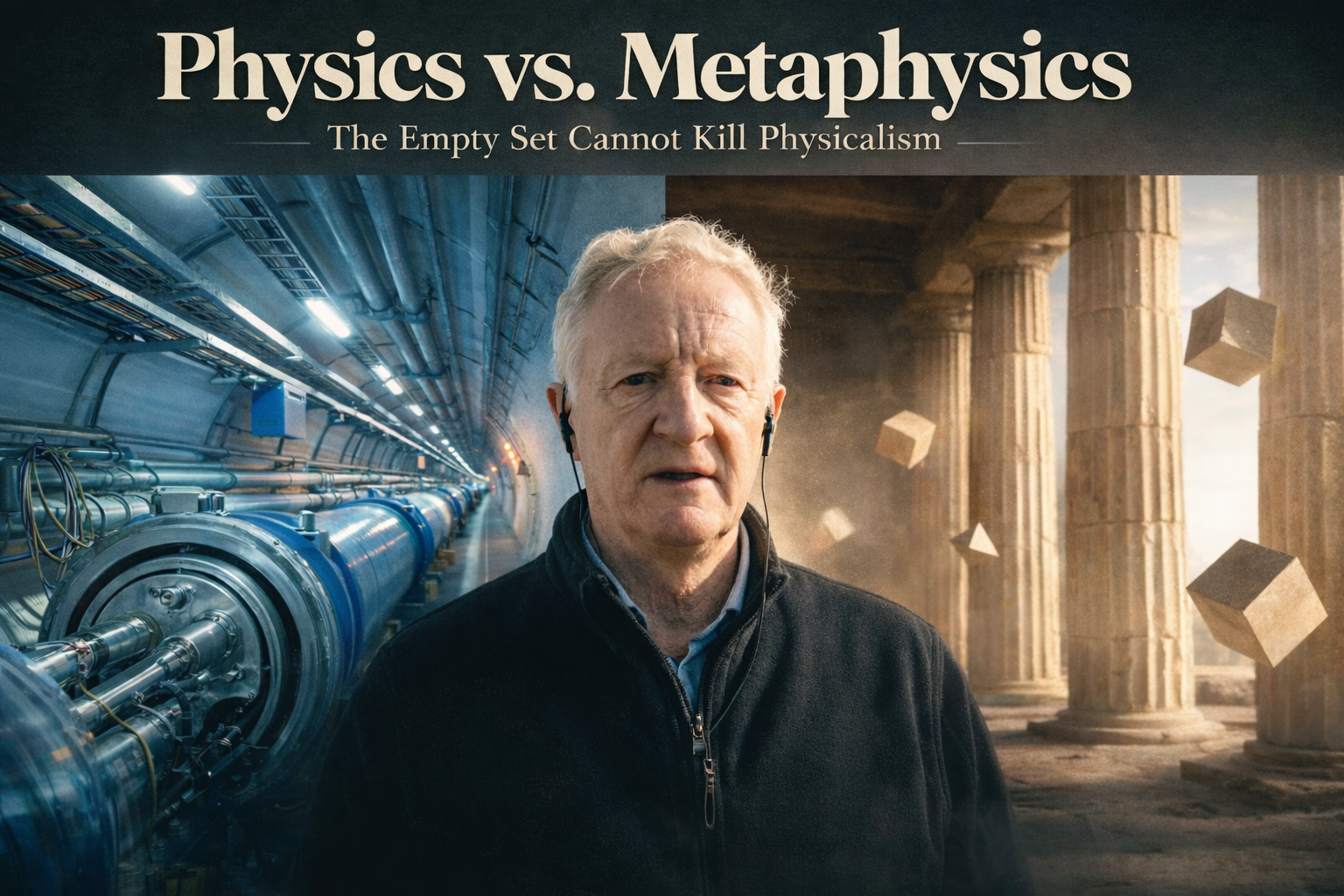
Curt Jaimungal recently posted a clip titled “The Empty Set Argument Against Physicalism,” featuring Timothy Williamson, widely regarded as one of the most formidable living philosophers. The title promises intellectual bloodsport: abstract mathematics cage-fighting material reality, two ontologies enter, one ontology leaves.
Curt frames the stakes explicitly, noting in voiceover: “What the professor is referring to here is something called Hempel’s dilemma, which I outlined in my lecture at Niagara University on why I don’t buy the simulation hypothesis or physicalism.”
The framing tells you what you are supposed to conclude before the argument is complete. This is not neutral presentation. This is advocacy dressed as education.
The actual content delivers something more interesting and more flawed. It also reveals something about why we find these arguments seductive in the first place, and what that seduction costs us.
Williamson makes two moves simultaneously. First, he correctly observes that extreme particle-only reductionism looks silly:
“I think the most drastic sort of view is perhaps that the only things that really exist are absolutely fundamental particles and there’s nothing else at all. To be honest, I don’t take such views very seriously.”
Fair enough. Nobody serious defends that view. Physics itself operates with higher-level descriptions: mass, temperature, pressure, fields. This is not controversial in the slightest.
Second, he invokes Hempel’s dilemma to argue that “physicalism” resists precise definition. Then, having softened up the audience, he makes his central claim:
“Another reason for not being a reductionist, in the sense of thinking that all there are are these physically fundamental things, is that physics depends on mathematics, and mathematics depends on set theory or something like set theory. And of course, in set theory, you’re talking about the existence of sets, and it’s just a consequence of a standard theory of sets that there are far more sets than there are fundamental particles.”
And the conclusion:
“And so physics itself is in some way assuming the existence of objects that are not physically fundamental, like sets.”
The rhetorical move is elegant. The philosophical cost is enormous. And the audience, having been primed to distrust “physicalism” without being told what it actually claims, nods along as if something has been proven rather than assumed.
The Hidden Assumption, or: How to Smuggle Platonism Past Security
Here is a question Williamson does not ask: why should we believe sets exist as entities at all?
Notice the slippage in his language. He says “in set theory, you’re talking about the existence of sets.” But talking about something is not the same as that thing existing as an independent entity. We talk about Sherlock Holmes. We talk about the average taxpayer. We talk about frictionless planes and perfect spheres. Talking about X does not commit us to X existing in some ontological registry.
The argument only bites physicalism if you grant two premises that Williamson treats as obvious but which are, in fact, among the most contested claims in philosophy of mathematics.
First, that mathematics literally commits you to an ontology of sets. This assumes mathematical realism over structuralism, nominalism, fictionalism, or any deflationary account where mathematics functions as a representational tool rather than a catalogue of existents. Philosophers have been fighting about this for a century. Williamson picks a side and pretends he is stating a fact.
Second, that “physics depends on mathematics” means “physics depends on the existence of mathematical objects” rather than “physics depends on mathematical description.”
These are radically different claims. The first posits abstract objects as furniture of reality, chairs and tables in some invisible showroom. The second treats mathematical structures as compression devices for physical regularities, tools rather than things.
Williamson slides from the second to the first without argument. Watch him do it: “physics depends on mathematics” becomes “physics itself is in some way assuming the existence of objects.” That phrase “in some way” is doing enormous work while pretending to be modest. What way? Specified how? Justified by what?
This is the reification error: treating formal operations as though they were substance-like entities that either exist or do not exist in some cosmic inventory.
Bertrand Russell saw this coming a century ago:
“The point of philosophy is to start with something so simple as not to seem worth stating, and to end with something so paradoxical that no one will believe it.”
Williamson has achieved the inverse: starting with something that sounds paradoxical (“the empty set proves non-physical things exist!”) and ending with something so question-begging it should not convince anyone who has spent ten minutes thinking about mathematical ontology.
But it sounds good. It sounds sophisticated. It sounds like the kind of thing a very smart person would say. And that is the problem.
What Is the Empty Set, Actually?
Let us pause and ask a question so basic it feels almost rude: what is the empty set?
Williamson states his position directly:
“I tend to think that there are various kinds of mathematical objects and so on, and that there’s no reason, for example, for thinking of the empty set as a physical object. So I don’t think that physicalism is likely to be true in a very strong sense.”
Notice the structure. He “tends to think” there are mathematical objects. He sees “no reason” to think the empty set is physical. Therefore physicalism is “not likely to be true.”
But this is not an argument. This is a statement of intuitions dressed as a conclusion. The question is not whether Williamson sees a reason to think the empty set is physical. The question is whether there is a reason to think the empty set exists as an independent entity at all, physical or otherwise.
Is the empty set a thing? Does it have a location? Can you bump into it? Does it pay rent somewhere in the abstract realm, perhaps sharing a flat with the square root of negative one and the concept of justice?
The empty set is a formal operation. It is the identity element for set union, the null case that makes the axiom system close under its own operations, the boundary condition that lets mathematicians sleep at night. It is not a thing. It is a move in a game. Asking “does the empty set exist as a non-physical object?” is like asking “does checkmate exist as a non-physical object?” or “does the pause between notes in a symphony exist as a non-physical object?”
These questions presuppose a substance ontology in which existence means occupying a registry of beings, some great ledger in the sky where entities sign in and receive ontological name tags. From a process ontology, the questions are malformed. You are asking the wrong thing in the wrong way and then being surprised when the answer sounds spooky.
Rolf Landauer, who spent his career at IBM thinking about the physical limits of computation, put it simply:
“Information is not a disembodied abstract entity; it is always tied to a physical representation.”
Every mathematical operation that has any causal efficacy whatsoever is implemented in some physical substrate. Electrochemical gradients in neurons. Voltage states in transistors. Ink patterns on paper. Sound waves carrying speech. Photons hitting retinas.
There is no set theory happening nowhere. There is no mathematics occurring outside of constraint satisfaction in physical systems. When a mathematician reasons about the empty set, that reasoning is implemented in approximately 86 billion neurons burning roughly 20 watts of power. When a computer manipulates sets, those manipulations cost real energy measured in real joules.
The formal description is substrate-independent. The process is not. Williamson mistakes the former for the latter, and builds an entire argument on the confusion.
The Shannon Clarification
Claude Shannon showed that information can be quantified independently of its physical carrier. You can calculate the entropy of a message without knowing whether it will travel via radio waves, fiber optics, or carrier pigeon. This is genuinely profound.
But Shannon never claimed information could be transmitted without a carrier. The message cannot exist without some physical medium, and the transmission will always cost energy. Always. No exceptions. This is not a limitation of current technology. It is a consequence of thermodynamics.
“The fundamental problem of communication is that of reproducing at one point either exactly or approximately a message selected at another point.”
Shannon was describing reproduction, not conjuring. The message must exist somewhere physically before it can exist somewhere else physically. There is no message floating in abstract space waiting to be downloaded into matter.
Williamson’s argument requires exactly this impossibility: that mathematical structures exist independently of any physical instantiation and that physics somehow “depends” on them in a way that grants them ontological status. But if they exist independently, how do they have causal efficacy? How does the empty set, sitting in its abstract realm, influence what physicists do with their pencils and particle accelerators?
The answer, of course, is that it does not. What influences physicists is patterns in their neurons, training, social practices, written texts, and computational tools. All physical. All thermodynamically costly. All very much located in space and time.
The Novel Example Reveals the Error More Clearly
Williamson extends his argument beyond mathematics:
“It’s not very obvious that the novel Pride and Prejudice is a physical thing. Of course, a particular copy of a book of Pride and Prejudice is a physical thing, but when we’re talking about the novel, we’re not talking about any particular copy of it.”
And then the conclusion he draws:
“So, for example, that Jane Austen completed six novels. And so, if novels are things that you can count, then they exist if the number of them is more than zero. And so it’s not even clear that when we talk about something as in a way ordinary as a novel, that we’re actually talking about a physical object.”
Let us sit with this for a moment. Let us really feel its intuitive pull. There is something that seems right about it. The novel is not this copy or that copy. It is the novel itself, the thing that all the copies are copies of. Surely that must exist somewhere?
But this assumes novels must be objects rather than patterns. And that assumption is doing all the work while pretending to be innocent.
The argument structure is: we can count novels; if we can count them, they exist; if they exist and are not identical to physical copies, they must be non-physical. But every step of this is contestable. We can count lots of things that are not objects: days, opportunities, mistakes. Counting does not commit us to a realm of independently existing countables.
Pride and Prejudice is a stable attractor in the space of possible symbol sequences. It is reproducible precisely because the pattern can be instantiated across multiple substrates: paper, screens, sound waves, neurons remembering, AI systems generating summaries, theater productions, film adaptations. The pattern is real. But “is the pattern physical or non-physical?” is the wrong question.
The pattern is what physical substrates do when they instantiate that particular configuration.
Alfred North Whitehead, who thought longer and harder about process than almost anyone:
“The misconception which has haunted philosophic literature throughout the centuries is the notion of ‘independent existence.’ There is no such mode of existence; every entity is to be understood in terms of the way it is interwoven with the rest of the universe.”
Pride and Prejudice is interwoven with every physical instantiation that carries it. It does not exist independently of those instantiations, waiting in some Platonic library for readers to check it out. It is the invariant structure across the instantiations. And invariant structures are precisely what physics describes. That is what physics is: the study of what stays the same when other things change.
Here is a counterfactual that clarifies the stakes: imagine every copy of Pride and Prejudice is destroyed. Every physical book, every digital file, every human memory, every trace. Does the novel still exist?
The Platonist says yes: the form persists in abstract space, waiting to be rediscovered.
The thermodynamic monist says no: the pattern is gone because patterns require physical instantiation.
Which answer matches your actual intuitions about what “exists” means? And if you find yourself pulled toward the Platonist answer, ask yourself: what work is that answer doing except making you feel better about mortality?
Pattern Lives: Why Monism Inspires
But this does not mean the pattern’s influence vanishes without residue. Aboriginal Dreamtime and Songlines offer a clearer vocabulary here than Western substance metaphysics. On that view, stories and patterns are not inert objects in a separate realm; they are living tracks through Country. They persist insofar as they are continuously re‑sung, re‑enacted, and inscribed into land, bodies, and relations.
Even if every copy of Pride and Prejudice were destroyed, any changes it induced in readers, institutions, and landscapes would continue to propagate. People whose moral intuitions, marriage expectations, or class sensibilities were shaped by Austen would go on to shape laws, cities, and ecologies. Those downstream patterns are not “the novel” floating in abstraction; they are the way the novel’s trajectory has been braided into other trajectories, including literal geology over long timescales.
Aboriginal Dreaming tracks make this explicit: pattern lives as Country plus practice, not as a ghostly extra thing. When the songs stop and the tracks can no longer be walked, the pattern is gone in precisely the sense thermodynamic monism cares about. When the songs are still being sung, the pattern is present as what the world is doing, not as a separate layer added on top.
Calling This Nihilism Is Like Calling Gravity a Mood Disorder
Thermodynamic monism is often misread as pessimistic, nihilistic, atheistic, or fatalistic, but that projection reveals more about the critic’s substance metaphors than the framework itself. A universe of interwoven constraint satisfaction is not a cold machine grinding toward heat death; it is 13.8 billion years of emergent pattern formation from quantum fluctuations to galaxies to genomes, all under the second law’s tight budget.
Dennett’s “cranes without skyhooks” in Darwin’s Dangerous Idea shows how blind variation and selection build competence from physics without external designers or preloaded meaning, while Friston’s free energy principle formalizes agency as active inference that minimizes surprise to preserve pattern integrity across scales. Bateson called this “difference that makes a difference,” where mind emerges from relational constraints, not isolated souls. Far from nihilism, this grounds ethics and purpose in what organisms demonstrably do: maintain viable trajectories through dissipative work, as Whitehead’s process ontology insists that “creativity” is the universe’s fundamental category, not a gift from outside.
Empirically, this view falsifies any “pessimistic” caricature by direct measurement. Landauer’s bound has been verified in silicon at room temperature (Bérut et al., 2012), showing erasure costs kBTln2 per bit with no exceptions, while Friston’s active inference predicts and matches neural dynamics in everything from fly vision to human decision making. Planarian experiments (Levin lab) yield path dependent morphologies that track bioelectric constraints, not Platonic correction, directly contradicting ideal form access.
Rovelli’s relational quantum mechanics shows even spacetime emerges from observer interactions without absolute background, and Yunkaporta’s Indigital analysis of Songlines maps knowledge as pattern continuity through Country, falsifiable by breakdown in transmission practices. Popper’s falsification criterion is satisfied here: thermodynamic monism risks refutation by perpetual motion, zero cost computation, or pattern persistence without instantiation; substance dualism absorbs all evidence via unfalsifiable “mystery” appeals.
Thermodynamic monism dwarfs Platonic substance dualisms in beauty and awe: it reveals carbon under sunlight yielding Shakespeare, not static forms in a disconnected realm. Sagan’s “we are a way for the universe to know itself” literalizes as self modeling matter bootstrapping narrative from constraint loops, infinitely richer than Eddington’s “arrow of time” pointing toward ever novel configurations. Dualism’s ghostly extras are sterile, indifferent to energy flows; monism’s patterns live through enactment, as Songlines demand.
Even if dualism were true, it would be undesirable: insulated non physical realms evade Popperian testability and Fristonian feedback, yielding no practical guidance beyond authority (as hooks critiques in white supremacist capitalist patriarchy’s abstractions). A dual world with causally inert abstracts would be irrelevant; one with causal abstracts would collapse into physics by Landauer’s accounting. Monism alone aligns ethics with Bateson’s ecology of mind, where responsibility means embedding patterns that outlast us in land and relation.
Hempel’s Dilemma Dissolves Under Process Ontology
Williamson articulates the dilemma clearly:
“Well, there’s a notorious problem, actually, in trying to get precise about what physicalism says, because presumably it says something like ‘everything is physical.’ But it’s very hard to define what is meant by ‘physical’ because if you try to define it in terms of current physics, then it might well be that there are all sorts of things which are not yet recognized by current physics but will be recognized by the physics of 200 years ahead of us.”
And the other horn:
“And so it seems wrong to tie the idea of the ‘physical’ to this specific point at which physics has got to right now. But then if you just say, ‘well, physical things are whatever things will be recognized by the physics of the future,’ that’s even worse because that’s assuming that we know what to count as ‘physics.’ And who knows how the word ‘physics’ will be used in a few thousand years when people are speaking a different language?”
This is Hempel’s dilemma stated fairly. Define “physical” by current physics and you are too narrow. Define it by future physics and you are vacuous. The dilemma feels airtight.
But the dilemma only arises if you accept its framing. What if “physical” is not defined by what physics describes but by what constraints any physics must respect?
Thermodynamic monism offers exactly this anchor.
Physical means: subject to thermodynamic constraints, obeying conservation laws, requiring energy for information processing, participating in the closed causal network that shows up in measurement, intervention, and energy accounting.
This definition does not change with future physics. Whatever quarks or strings or fields or novel structures future physics discovers, they will obey thermodynamics. The second law is not a contingent finding that might be overturned by better instruments. It is a constraint on any possible dynamics.
Arthur Eddington, who understood this better than almost anyone:
“The law that entropy always increases holds, I think, the supreme position among the laws of Nature. If someone points out to you that your pet theory of the universe is in disagreement with Maxwell’s equations, then so much the worse for Maxwell’s equations. If it is found to be contradicted by observation, well, these experimentalists do bungle things sometimes. But if your theory is found to be against the second law of thermodynamics I can give you no hope; there is nothing for it but to collapse in deepest humiliation.”
Under this definition, Hempel’s dilemma never arises. We are not tying “physical” to a specific theoretical vocabulary that might be revised. We are tying it to the constraint structure that any successful physics must respect, has always respected, and will always respect until the heat death of the universe.
The question shifts from “what entities exist?” to “what constraints must hold for successful prediction and intervention?”
This is not a dodge. This is a dissolution. The dilemma was never about physics. It was about a bad question generated by substance ontology. Change the ontology and the question stops making sense.
A YouTube Commenter Sees It Clearly
Sometimes wisdom appears in unlikely places. In the YouTube comments, Shannon Wiltshire wrote:
“Hempel thought physicalism had a problem. He was right, but the problem wasn’t which physics. It was the assumption that ‘the physical’ must be defined in terms of entities at all. In a structural view, physical reality is prior to particles or objects—those come later as stabilized descriptions. Seen this way, Hempel’s dilemma doesn’t really get answered. It never actually arises.”
This is the process ontology dissolution in miniature. The physical/non-physical binary is malformed because it assumes substance ontology: that reality is made of things that either exist or do not exist, that fall into categories like “physical” or “non-physical.”
Once you recognize that “physical” means “the domain of thermodynamic constraint satisfaction” rather than “the set of physical objects,” the dilemma evaporates. You are no longer trying to draw a boundary around objects. You are describing the rules of a game that all objects must play.
The Metaphysics Accusation Cuts Both Ways
Williamson makes a sharp observation about physicalism:
“And so I think the people who say that ‘there are only physical objects,’ they’re effectively committing themselves to a metaphysical doctrine which can’t be vindicated by physics. It might perhaps be vindicated by philosophy, but physics isn’t the right thing to use.”
This is correct. Physicalism is a metaphysical position, not a finding of physics. You cannot derive “everything is physical” from any set of physical measurements. The claim outruns the evidence.
But notice that this cuts both ways. The claim “there are non-physical objects like the empty set” is also a metaphysical doctrine that cannot be vindicated by physics. Williamson’s own position is exactly as metaphysical as the position he criticizes. He has not escaped metaphysics. He has adopted a different metaphysics while pretending to have transcended the game.
The question is not “which position avoids metaphysics?” Both positions are metaphysical. The question is “which metaphysics coheres better with our successful practices of prediction and intervention?” And here, the constraint-based view wins: it tells you what to expect (thermodynamic constraints), it tells you what would count as violation (perpetual motion, information without energy), and it does not require positing entities that have causal relevance but no specifiable mechanism of causal influence.
Now here is where it gets interesting. Notice how Williamson’s argument parallels Michael Levin’s Platonic morphospace framework:
The Structural Isomorphism with Other Platonic Arguments
Williamson: Physics uses mathematics. Mathematics posits abstract objects. Therefore physics assumes non-physical entities exist.
Levin: Biology observes morphogenesis. Morphogenesis exhibits goal-directedness toward forms. Therefore biology requires organisms to access a non-physical realm of pre-existing forms.
Feel the family resemblance? Both arguments treat formal structures (sets, morphological patterns) as independent existents that physical processes must somehow “access” or “assume.” Both face the same Landauer problem: if these non-physical entities have any causal relevance, how does information flow from them to physical systems without energy expenditure?
Both dissolve under the same move: formal structures are patterns of constraint satisfaction in physical substrates, not free-floating inhabitants of a separate realm.
When Levin’s own lab demonstrates that two-headed planarians persist indefinitely across regeneration cycles with no convergence toward canonical forms (Durant et al. 2017), this is exactly what thermodynamic constraint satisfaction predicts. Path-dependent stable attractors. Not correction toward pre-existing Platonic ideals.
The paper states it plainly:
“Species-specific axial pattern can be overridden by briefly changing the connectivity of a physiological network.”
Durant et al. 2017
Override. Not “temporary deviation from a Platonic attractor.” Override. The system settles into whichever basin the initial bioelectric conditions establish, and it stays there. The pattern is real. The pattern is also entirely physical. It is what the bioelectric dynamics do under those boundary conditions.
The two-headed planarian is not accessing a form in abstract space any more than a mathematician reasoning about the empty set is downloading information from Plato’s heaven. Both are physical systems doing what physical systems do: satisfying constraints, dissipating energy, settling into stable configurations.
What Would Falsify Thermodynamic Monism?
Here is where the framework earns its keep. Unlike Platonic frameworks that absorb all possible outcomes through post hoc reinterpretation, thermodynamic monism specifies its failure conditions.
Karl Popper:
“A theory which is not refutable by any conceivable event is non-scientific. Irrefutability is not a virtue of a theory, but a vice.”
Find any of the following and thermodynamic monism is refuted:
One. A causal process that moves information without energy expenditure, violating Landauer’s principle.
Two. A physical system that violates the second law without external work input.
Three. A mathematical operation that has causal effects on physical systems without being implemented in any physical substrate.
Four. A morphogenetic outcome that cannot be modeled as constraint satisfaction in bioelectric and biochemical dynamics.
Five. An information-bearing pattern that persists without any physical instantiation whatsoever.
The empty set argument provides none of these. It provides only a reification error dressed in logical notation, a confusion between levels of description presented as a discovery about the furniture of reality.
What Williamson Gets Right
Let us be fair. Williamson is correct that doctrinaire physicalism often smuggles in metaphysics while pretending it is “just science.” He is correct that “physicalism” as commonly deployed does not look like the kind of hypothesis physics itself can straightforwardly test. He is correct that many who call themselves physicalists have not thought carefully about what they mean.
“The first principle is that you must not fool yourself, and you are the easiest person to fool.”
Many self-described physicalists are fooling themselves about the coherence of their position. They wave their hands at “matter” and “energy” without specifying what those words mean or why they carve reality at the joints. When pressed, they retreat to intuitions formed in childhood about solid objects and empty space. This is not serious philosophy.
But this does not mean Williamson’s alternative is correct. It means physicalism needs better formulation, not abandonment.
A constraint-based physicalism can reply to Williamson:
“Mathematics is indispensable to our best theories, but indispensability does not automatically equal ontology.”
“Our commitment is to structure and invariance, not to abstract objects as inhabitants of some realm.”
“The novel is a pattern instantiated across physical media and social practice, not a spooky extra thing requiring a separate ontological category.”
None of these replies are philosophically complete. Philosophy is never complete. But they show the clip does not “disprove physicalism.” It exposes that people use the word sloppily and then act surprised when the concept leaks.
Why This Matters Beyond the Seminar Room
You might wonder why anyone should care about this debate. Empty sets, Platonic forms, substance ontology versus process ontology. Who cares? Let the philosophers argue while the rest of us live our lives.
Here is why it matters.
When we reify patterns into independent existents, we create exploitation surfaces. We give intellectual cover to anyone who wants to claim that “something more than physics” is needed to explain their favorite phenomenon. The Discovery Institute uses exactly this structure to argue for Intelligent Design. New Age gurus use it to sell quantum consciousness workshops. Well-meaning scientists use it to avoid the hard work of specifying mechanisms.
The structure is always the same: gesture at something that seems irreducible to physics, claim it requires a non-physical explanation, and then fill in whatever content you prefer. God, forms, consciousness, cosmic mind. The philosophical architecture is identical. Only the branding differs.
By being precise about what “physical” means and what would count as non-physical, we close these exploitation surfaces. We force claimants to specify mechanisms. We demand falsification criteria. We ask the uncomfortable question:
“If your non-physical entity has causal efficacy, how does it influence physical systems without violating thermodynamics? And if it has no causal efficacy, in what sense does it exist at all?”
This is not scientism. This is basic epistemic hygiene. And it matters because the alternatives are not harmless.
Deep Insight, or Motivated Reasoning?
Let me try to say why Williamson’s argument feels compelling even when it should not.
There is something in us that rebels against the idea that everything is “just” physics. It feels reductive. It feels like it leaves something out. When we contemplate mathematics, or novels, or consciousness itself, we have a strong intuition that we are touching something beyond the merely material.
This intuition is not stupid. It is tracking something real. But what it is tracking is not non-physical entities. It is tracking the remarkable fact that physical processes can become self-referential, can model themselves, can generate stable patterns that persist across substrates and across time.
Mathematics is not evidence of a Platonic realm. Mathematics is evidence that physical systems under thermodynamic constraints can develop compression algorithms for their own regularities. That is astonishing. That is worthy of wonder. But it is not supernatural.
Pride and Prejudice is not evidence of an abstract realm of novels. Pride and Prejudice is evidence that patterns can propagate through social systems, can replicate across minds and media, can persist for centuries through continuous physical instantiation. That is remarkable. That is worthy of celebration. But it is not magic.
The empty set is not evidence of non-physical entities. The empty set is evidence that formal systems can have boundary conditions, can be closed under their own operations, can achieve the kind of self-consistency that makes them useful tools for compression and prediction. That is elegant. That is beautiful. But it is not metaphysically special.
We do not need a separate realm to explain what moves us. What moves us is the extraordinary capacity of matter under constraint to generate complexity, to model itself, to persist, to mean.
Carl Sagan, who understood this better than the philosophers:
“We are a way for the universe to know itself.”
That is not a concession to reductionism. That is the most astonishing claim anyone has ever made. And it is entirely physical.
The Key Takeaway
The empty set argument is philosophically respectable window dressing for an intuition many people share: that formal structures are “too perfect” or “too abstract” to be mere patterns in matter. But this intuition rests on a folk ontology that process physics has already superseded.
Patterns are not non-physical. Patterns are what physics describes. The regularities, the symmetries, the conserved quantities, the attractor basins. Physics is not primarily about particles. Physics is about constraints and the dynamics they permit. Mathematical structures are compressed descriptions of those constraints. They are the map, and the map is made of the same territory it describes, just at a different scale of organization.
The critique is always the same: show me the mechanism by which non-physical structures have causal efficacy without violating Landauer. Until that mechanism is specified, the “non-physical” posit is doing no work. The actual explanatory load is carried by constraint satisfaction in physical substrates. The Platonic overlay, whether it takes the form of the empty set or morphological form-space, is ornamental at best, exploitable at worst.
Carl Sagan again, because it bears repeating:
“Extraordinary claims require extraordinary evidence.”
The claim that abstract objects exist independently of physical instantiation is extraordinary. The evidence offered is that physics uses mathematical description.
That is not extraordinary evidence. That is a category error wearing a tuxedo.