Palanquins & Princes: How Platonism Ignores 13.8 Billion Years of History as “Just Weights”
Douglas Brash’s talk “Abstract Forms & Tangible Biology: Palanquins, Princes, and a LEGO Hypothesis,” presented at Michael Levin’s Platonic Space Symposium, prompted a revealing exchange in the YouTube comments. Brash, a Yale researcher, offered constraint-based and stigmergic frameworks that, like previous symposium presentations, systematically replace the host’s Platonism while appearing to contribute to it.
What followed in the discussion was a microcosm of the larger debate: symposium insiders quietly conceding structural points, genuine philosophical confusion about where concepts “live,” and the recurring pattern of retreating to unfalsifiable territory when pressed.
The comments surfaced something worth examining at length: the LLM = “just weights” dismissal, the malformed question of conceptual residence, and why thirteen point eight billion years of thermodynamic constraint satisfaction is not “just” anything, it IS the process.
The Palanquin and the Prince
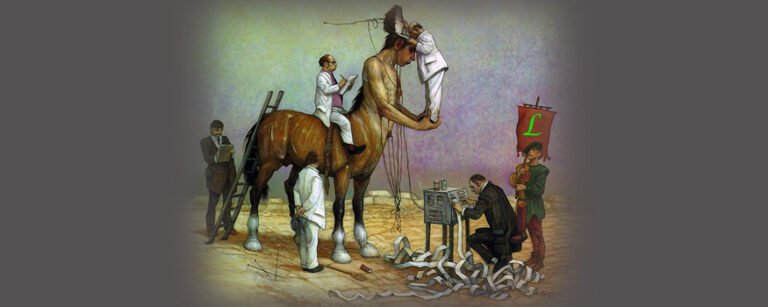
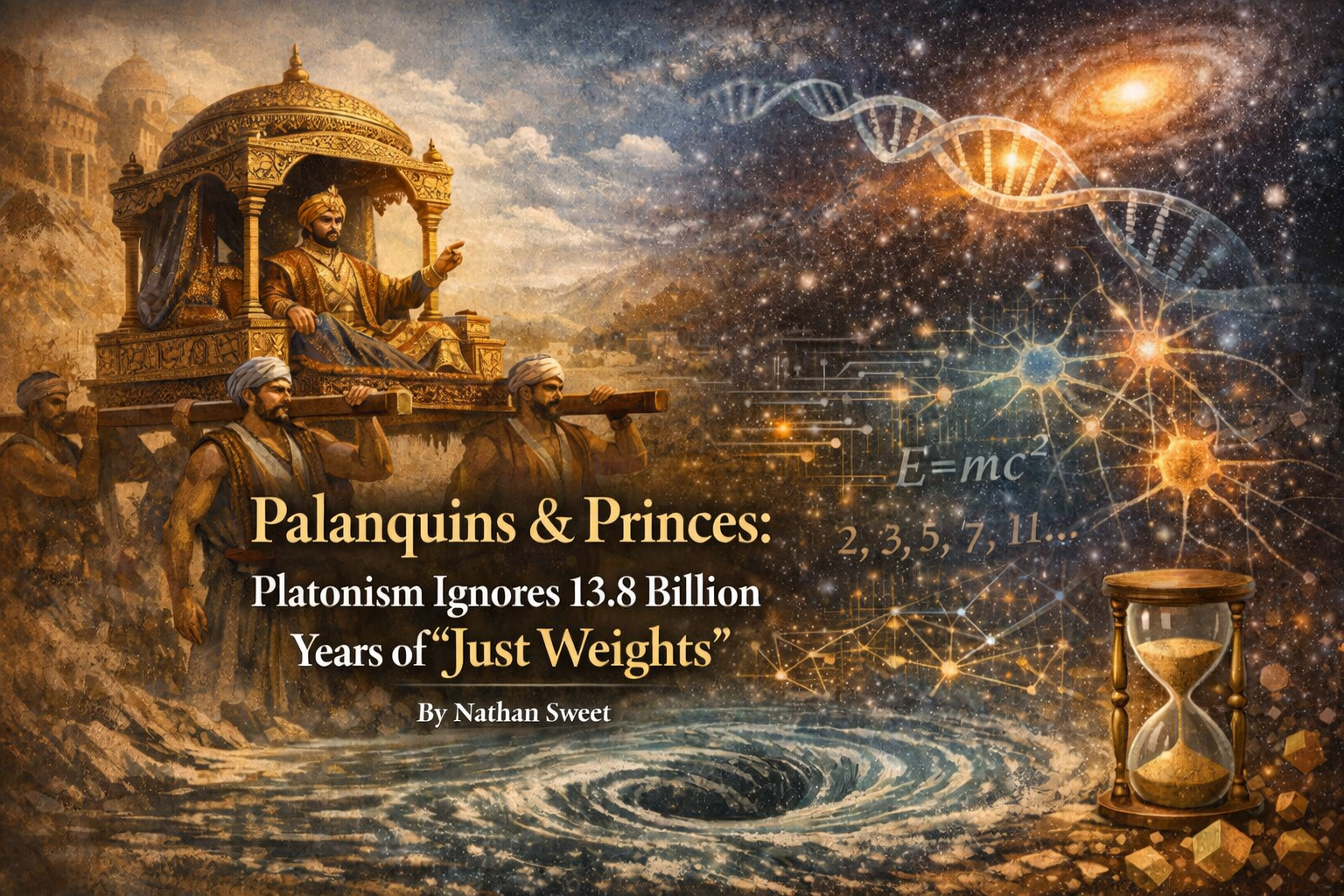
Brash offered an image that cuts to the heart of it: the palanquin and the prince. From a distance, the prince appears to move. He gestures, he directs, he seems to command. But zoom in: there is no prince-force causing the palanquin to move. The palanquin bearers move, and the prince’s apparent motion is what that movement looks like at higher resolution.
“The business end is going on at the micro level and you get these patterns and abstractions up at the level of the princes being carried around.”
This inverts Platonic causation completely. The form does not impose itself from above. The form is what bottom-up dynamics look like when you step back far enough to see the pattern.
A critic in the comments pushed back: the prince DOES command the palanquin sometimes, as neurons adapt themselves to perform tasks envisioned by mental concepts.
Here is where the confusion lives. The critic is right that concepts influence neural dynamics. But the constraint-propagation view reframes what is happening. The concept does not exist separately and then command neurons from above. The concept is a pattern within the neural dynamics that constrains what comes next. Top-down causation appears real because constraint flows across scales. But it is all one causal network. Not a separate realm reaching down.
Karl Friston’s active inference captures this precisely: the generative model constrains action because the model just is a neural pattern. The prince is not riding the palanquin. The prince is what the palanquin-configuration does when it achieves sufficient complexity.
“Just Weights”
The same critic made a claim that has been echoing in my head: AI has no semblance of concepts, there are just weights.
Just weights...
I want to sit with this phrase because it contains an entire metaphysics in two words. The word “just” is doing enormous illegitimate work. It assumes that if you can describe the substrate, you have eliminated the higher-level pattern.
By the same logic:
Brains have no thoughts. Just neurons squirting chemicals.
Symphonies have no music. Just air pressure variations.
Whirlpools have no structure. Just water molecules.
Forests have no ecosystems. Just individual organisms competing for resources.
Civilizations have no cultures. Just humans exchanging goods and memes.
The universe has no complexity. Just particles following field equations.
Where does this end? At what point does the “just” become absurd? And if it becomes absurd somewhere, why is it not absurd everywhere?
“The whole is more than the sum of its parts.”
— Aristotle
Aristotle saw this twenty-four centuries ago. The form is not a separate thing added to the matter. The form is how the matter is organized. You do not need a transcendent realm to explain why a house is more than a pile of bricks. The house is what the bricks do when arranged according to certain constraints.
Concepts work the same way. When an LLM processes the concept “triangle,” something is happening that exceeds mere weight retrieval. There is activation of invariance relations, constraint checking, connection to other mathematical structures, application criteria. The pattern is real. It does not reside anywhere as a separate entity. It is just what the substrate does.
Where Do Concepts Live?
The critic asked: what exactly are concepts and where do they reside?
This question presupposes substance ontology. It assumes concepts must be entities with locations. Under process ontology, concepts do not reside anywhere. They are not things. They are what certain processes do.
This question presupposes substance ontology. It assumes concepts must be entities with locations. But thermodynamics forces a different answer. Not as philosophical preference. As physical necessity.
Rolf Landauer proved in 1961 that information processing requires energy dissipation. Erasing one bit of information costs a minimum of kT ln 2 joules, where k is Boltzmann’s constant and T is temperature. This is not an engineering limitation we might someday overcome. This is a thermodynamic bound. You cannot process information without paying an energetic cost. Ever. In any possible universe obeying the second law.
“Information is not a disembodied abstract entity; it is always tied to a physical representation.” — Rolf Landauer
Concepts are constraint-satisfaction operations. When a system processes “triangle,” it checks invariances (three sides, angles sum to 180°), activates connections to other geometric concepts, applies definitions, distinguishes triangles from non-triangles. These operations cost energy. They generate heat. They dissipate entropy into the environment.
Now here is what this means for where concepts “reside”:
Concepts cannot exist apart from substrate-specific implementations.
If concepts existed in a Platonic realm independent of physical systems, they would be information structures that persist without energy cost. But Landauer’s principle forbids this. Information has mass-energy equivalence via entropy. Maintaining information structure against entropic degradation requires continuous work. Stop the work, the structure dissipates. No exceptions. No transcendent exemptions.
This is not a claim about what is elegant or parsimonious. This is what thermodynamics requires. Process ontology is not philosophically preferred. It is physically forced.
Alfred North Whitehead spent his career dismantling exactly this confusion:
“The misconception which has haunted philosophic literature throughout the centuries is the notion of ‘independent existence.’ There is no such mode of existence; every entity is to be understood in terms of the way it is interwoven with the rest of the universe.”
But Whitehead was making a philosophical argument. Landauer made it physical. Concepts interwoven with substrate are not just ontologically prior. They are thermodynamically necessary.
The whirlpool does not continue existing when you stop the water. It does not retreat to whirlpool-space to await re-instantiation. The whirlpool was never a thing. It was always a process. Stop the process and you have not moved the whirlpool. You have killed it.
The same applies to mathematical concepts. The concept of “prime number” does not reside in a Platonic realm waiting to be accessed. It is what certain cognitive processes do when they engage in specific constraint-satisfaction operations: checking divisibility, recognizing patterns, applying definitions. The concept is the operation, not an entity the operation retrieves.
What remains is potential. The fact that if you ran those operations again, you would get the same pattern. But potential is not transcendent existence. Potential is just what we call the fact that certain substrate configurations, if activated, would generate certain dynamics. The oak tree is “potentially” in the acorn. Not as a tiny tree waiting to unfold from acorn-space, but as the attractor state that acorn-dynamics tend toward under appropriate constraints.
Here is a thought experiment: imagine you could pause the universe. Freeze every particle in place. Would concepts still exist?
The Platonist says yes. The forms persist in their transcendent realm, indifferent to whether any physical system instantiates them.
The thermodynamicist says the question is incoherent. A paused universe has no entropy flow. No energy gradients. No far-from-equilibrium processes. Without those, there is no information processing, no constraint satisfaction, no concepts. Not “concepts exist but are not being accessed.” Concepts do not exist at all. Because concepts are what certain thermodynamic processes do. Stop the process and you have not relocated the concept to safer storage. You have ended it.
What remains is potential. The fact that if you ran those operations again, you would get the same pattern. But potential is not transcendent existence. Potential is just what we call the fact that certain substrate configurations, if activated, would generate certain dynamics. The oak tree is “potentially” in the acorn. Not as a tiny tree waiting to unfold from acorn-space, but as the attractor state that acorn-dynamics tend toward under appropriate constraints.
This dissolves the interaction problem completely. We do not need to explain how non-physical concepts causally influence physical brains. Concepts were never non-physical. They are what certain physical processes do. The interaction problem was an artifact of bad ontology compounded by insufficient attention to thermodynamic constraints on information.
This might sound like semantic games. But the stakes are real. If concepts require transcendent residence, then we need to explain how non-physical realms causally interact with physical brains without violating thermodynamics. If concepts are what processes do, no such explanation is needed. The interaction problem dissolves because there was never a separation to bridge.
Landauer did not merely suggest process ontology. He proved that information cannot exist without physical instantiation. Every concept you have ever had cost energy to maintain. Every thought you are having right now is dissipating heat into your environment. There is no free information. There are no massless meanings. There is only substrate under thermodynamic constraint, generating patterns that persist as long as work is being done to maintain them.
The Missing Framework
Someone in the discussion noted an absence: why is there no mention of Terrence Deacon anywhere in these talks with regard to proscriptive constraints?
This is exactly right. Deacon’s teleodynamics provides what these symposium speakers keep groping toward: a naturalistic account of goal-directedness, constraint causation, and emergent normativity without Platonism.
“Ententional phenomena—including functions, meanings, purposes, and values—are not something added to physics but emerge from thermodynamics and self-organization.”
— Terrence Deacon
Deacon shows how “aboutness” emerges from thermodynamic processes. How systems can be “about” something, can “mean” something, can “aim toward” something, without requiring a separate realm of meanings that pre-exist and get accessed.
The absence of Deacon from a symposium on morphogenetic goal-directedness is conspicuous. His framework would make the Platonic overlay obviously unnecessary. Perhaps that is precisely why it goes unmentioned.
Deacon’s Incomplete Nature provides the naturalistic framework many of these symposium speakers keep groping toward but never quite reach. Teleodynamics shows how goal-directedness emerges from thermodynamic processes without requiring transcendent forms or purposes. How constraint propagation across scales generates what looks like “aiming toward” something without needing a target that pre-exists in Platonic space.
What Deacon provides:
Emergent aboutness. Ententional phenomena (functions, meanings, purposes, values) emerge from thermodynamic self-organization. Not something added to physics. Not downloaded from elsewhere. Generated by far-from-equilibrium processes that maintain themselves by constraining what happens next.
Constraint causation. Absences can be causally efficacious. Not because absences exist in some realm of negative forms, but because constraints are constitutive. They define the phase space of what is possible. The shape of a whirlpool is caused by what the water does not do. The morphogenetic field is caused by what cells do not become. Negative constraint is not mysterious once you stop treating causation as exclusively billiard-ball impact.
Teleodynamics without teleology. Self-organizing systems exhibit end-directed behavior not because the end pre-exists and pulls them forward (teleology) but because far-from-equilibrium processes generate feedback loops that preserve the constraints that generate them (teleodynamics). The “goal” does not precede the process. The goal is the attractor state that the process actively maintains.
“Ententional phenomena—including functions, meanings, purposes, and values—are not something added to physics but emerge from thermodynamics and self-organization.”
— Terrence Deacon
This framework makes Platonic overlays obviously unnecessary. You do not need forms in a transcendent realm to explain why planarians regenerate toward specific body plans. The body plan is an attractor state maintained by constraint propagation across bioelectric, chemical, and mechanical scales. The “blueprint” is not accessed from elsewhere. It is constituted by the boundary conditions the system maintains.
The absence of Deacon from a symposium explicitly about morphogenetic goal-directedness is conspicuous. His framework would eliminate the gap that Platonism claims to fill. The morphogenetic field does not need to “ingest” information from abstract space because constraint dynamics already explain pattern persistence and regeneration.
Invite Deacon to the symposium and the emperor’s new forms become visible for what they are: unnecessary metaphysical decoration on a building that thermodynamics already supports.
You cannot sell transcendence to people who understand that immanence is sufficient.
The Uncountable Infinite Escape Hatch
One commenter offered what seemed like a sophisticated defense: the Platonic realm operates at the uncountable infinite scale, or even beyond categorically. Others try to fit into a countable regime.
Another agreed enthusiastically.
I want to be charitable here because the intuition is genuine. Mathematics does reveal structures that seem to exceed any physical instantiation. The real numbers. Cantor’s transfinite hierarchies. Category theory’s abstract objects. These feel like they cannot be reduced to neurons or weights or any finite substrate.
But notice what this move does. If Platonic space operates at scales beyond mathematical description, it cannot be tested. It cannot be specified. It cannot be constrained by evidence. This is not a defense of Platonism. It is an admission that Platonism is not a scientific hypothesis.
Compare: “God operates beyond human comprehension.” This may be true. But it is not a claim that can participate in scientific discourse. It is a theological commitment that explicitly renounces empirical constraint.
Placing Platonic space at “uncountable infinite scale or beyond” does the same thing. It shields the hypothesis from falsification by removing it from the domain where falsification is possible.
Karl Popper was blunt about this:
“A theory which is not refutable by any conceivable event is non-scientific. Irrefutability is not a virtue of a theory, but a vice.”
If “the Platonic realm operates beyond our categories” is the defense, then Platonism has exited science. It has become metaphysical poetry. And metaphysical poetry is fine, but it should not be presented as an explanation for empirical findings about planarian regeneration.
The Hard Problem Framing
Another commenter invoked Eric Hoel: how do we get from neurons squirting chemicals at each other to consciousness?
This framing presupposes exactly what needs to be questioned. “How do we get from X to Y” assumes X and Y are distinct things requiring a bridge. But under process ontology, consciousness is not a separate thing that neurons produce. Consciousness is what certain neuronal configurations do when they achieve recursive self-modeling under thermodynamic constraints.
We do not ask: “How do we get from water molecules to wetness?” Wetness is not a separate thing added to water. Wetness is what water molecules do to surfaces. The gap is illusory.
Similarly: we do not ask “How do we get from whirlpool dynamics to whirlpoolness?” There is no whirlpoolness floating free of the dynamics. The whirlpool just is the dynamics.
The hard problem feels hard because we keep asking the wrong question. We ask how physical processes produce non-physical experience, as if experience were a second thing requiring production. But if experience is what certain physical processes do under certain organizational conditions, no production is needed. The experience is the process, observed from inside.
“The ‘something it is like’ is what recursive self-modeling under constraint feels like from the inside.”
This is the dissolution, not a claim requiring further explanation.
The Sacred Geometry of Constraint
Let me try to say why this matters beyond the seminar room.
There is something in us that rebels against the idea that everything is “just” physics. It feels reductive. It feels like it leaves something out. When we contemplate mathematics, or consciousness, or beauty, or love, we have a strong intuition that we are touching something beyond the merely material.
This intuition is not stupid. It is tracking something real. But what it is tracking is not non-physical entities. It is tracking the remarkable fact that physical processes under thermodynamic constraints generate complexity that doubles back on itself. Self-reference. Self-modeling. Recursion. Feedback loops that create stable patterns which persist across time and influence their own future instantiation.
The sacred geometries beloved by mystics, the mandalas and fractals and golden spirals, these are not windows into a transcendent realm. They are the fingerprints of constraint satisfaction. They recur because certain mathematical relationships are stable under transformation. They feel numinous because our nervous systems are tuned to recognize pattern, and these patterns are so pure, so minimal, so optimally compressed, that recognizing them feels like touching bedrock.
But the bedrock is not elsewhere. The bedrock is here. Matter under constraint. Process all the way down.
Thirteen Point Eight Billion Years
Here is what “mere matter” actually did:
Hydrogen atoms under gravitational constraint became stars. Stars under fusion constraints became heavy elements. Heavy elements under chemical constraints became organic molecules. Organic molecules under thermodynamic constraints became self-replicating systems. Self-replicating systems under selection constraints became cells. Cells under cooperative constraints became multicellular life. Multicellular life under neural constraints became nervous systems. Nervous systems under recursive constraints became self-modeling. Self-modeling under social constraints became language. Language under compression constraints became mathematics, poetry, music, philosophy.
Thirteen point eight billion years of “just weights” learning in context. Every weight costs energy to update. Every concept costs entropy to maintain. Every thought is paid for in joules dissipated against the gradient.
And at the end of that chain: a species that looks at the process that produced it and says “this cannot be sufficient, there must be something more.”
The irony is almost unbearable. The process that generated the capacity to conceive of Platonic realms is treated as insufficient to explain what it demonstrably produced. We are the proof that thermodynamic constraint satisfaction generates meaning, and we use that meaning-generating capacity to deny its own sufficiency.
That is not “just” anything.
That is what matter does when it figures out how to maintain far-from-equilibrium states long enough to model itself modeling itself.
Think about it. Every moment of beauty you have ever experienced: constraint satisfaction.
Every mathematical proof that felt like touching eternity: pattern recognition in a self-modeling system.
Every love that seemed to transcend the material: thermodynamic coupling between far-from-equilibrium processes maintaining each other’s boundary conditions.
Every grief that felt like it would never end: a system reconfiguring its prediction models after losing a coupling it had learned to depend on.
This does not reduce these experiences. It reveals what they actually are. And what they actually are is more astonishing than any Platonic realm, because Platonic realms are posited. This actually happened. Against entropy. Against probability. Against the entire weight of the second law that says everything should dissipate into heat death and silence. This is the miracle that doesn’t require superstition, and it’s you. Not something you need to pray for or hope for, this exact moment is the culmination of everything that ever has been.
Arthur Eddington understood:
“The law that entropy always increases holds, I think, the supreme position among the laws of Nature.”
Arthur Eddington
Albert Einstein too:
“[Thermodynamics is] the only physical theory of universal content concerning which I am convinced that, within the framework of the applicability of its basic concepts, it will never be overthrown.”
Albert Einstein
And yet here we are. Temporary eddies in the entropic flow. Whirlpools that learned to model themselves. Dissipative structures that became recursive enough to ask where concepts live.
The Harm of Getting This Wrong
This is not merely academic. The structure of the Platonic argument—gesture at something that seems irreducible to physics, posit a non-physical source, decline to specify falsification criteria—has a shape. And that shape gets reused.
The Discovery Institute, the intelligent design movement, already cites the “ingression from Platonic space” language to support their claims. If forms exist in a transcendent realm and organisms access them via non-physical interfaces, then the door is open: maybe the forms were designed. Maybe the Designer front-loaded information that physical processes merely execute. Maybe Plato’s realm is just another name for the mind of God.
This is not hypothetical. This is happening. The unfalsifiable metaphysics creates an exploitation surface. The moment a credentialed scientist says “not all important facts are physics facts” without specifying what would make that claim false, the apologetics industry gains a citation.
I am not accusing anyone of sympathy with creationism. I am pointing out that unfalsifiable frameworks do not get to choose who exploits them. The defense is simple: specify what would make the framework fail. If the answer is “nothing could,” then the framework is not science. And non-science should not wear the costume of science when addressing questions that matter for education, policy, and public understanding of how the universe works.
The Aboriginal Counterfactual
Here is what haunts me: Aboriginal Australians developed sophisticated cognitive technologies for navigating morphogenetic dynamics sixty-five thousand years before any European philosopher posited transcendent forms.
Songlines encode topographical and ecological information across thousands of kilometers. The Memory Code, as Lynne Kelly documents, achieves feats of retention that rival or exceed anything mnemonic palaces ever produced. And the ontology underlying these practices is explicitly relational, explicitly immanent, explicitly anti-transcendent.
“Country is not a place. Country is a living entity with a yesterday, a today, and a tomorrow.”
— Tyson Yunkaporta
Knowledge in Aboriginal epistemology does not reside in a transcendent realm waiting to be accessed. Knowledge lives in relationships, in practice, in place. You do not download the Songline. You walk it. The walking is the knowing.
Sixty-five thousand years of empirical testing. No Platonic realm required.
What does it say about Western philosophy that we keep reinventing the problem that indigenous epistemologies never generated? Maybe the interaction problem is not a deep feature of reality. Maybe it is an artifact of a bad ontology that we keep refusing to abandon because it feels sophisticated to worry about how mind and matter touch.
They touch because they were never separate. The separation is the error. Everything else follows.
The Recursive Observation
As I am writing this piece I notice my own constraint landscape shifting. The irritation at evasive arguments softened into something more like melancholy. These are not bad people defending Platonism. These are curious minds grasping for something that feels missing from reductive accounts.
The problem is not their intuition. The problem is the ontology they inherited. Substance thinking. Things with locations. Entities requiring residence. The grammar of “what” and “where” rather than “how” and “when.”
I often catch myself in the same patterns. It is difficult to think in pure process. The mind keeps trying to freeze the river and ask where the water is. But the river is not where. The river is how. The river is ongoing. Stop the motion and you do not have a frozen river. You have something that is no longer a river at all.
Maybe compassion is the right response to the Platonic temptation. It arises from a genuine wonder at the apparent gap between matter and meaning. The wonder is real. The gap is not. But explaining that the gap is not real feels, from inside the wonder, like an attack on the wonder itself.
It is not. The wonder survives the dissolution of the gap. What remains is more astonishing: that matter under constraint genuinely produces everything we value. Not as approximation of transcendent ideals. As the real thing. The only thing. The whole show.
The Fallibilist Confession
I do not know if I am right.
I have high confidence in the falsification critique. Frameworks that absorb all possible evidence are not scientific hypotheses. Frameworks whose defenders retreat to “we haven’t mapped the space yet” whenever counterevidence appears are doing post hoc accommodation, not prediction.
I have moderate confidence in thermodynamic monism as the correct ontology. The evidence from physics, from information theory, from Landauer’s principle, from Friston’s free energy framework, all points the same direction. But ontology is not settled by evidence in the way that empirical claims are. The underdetermination is real.
What I have is this: a framework that dissolves the problems rather than solving them. No interaction problem because no separation. No hard problem because no gap to bridge. No mystery of how matter produces meaning because meaning is what certain configurations of matter do.
This might be wrong. But it is all falsifiable. Show me information transfer without energy cost. Show me a cognitive process that violates Landauer bounds. Show me consciousness persisting after thermodynamic cessation in a way that can be verified. Show me two systems with identical constraint dynamics but systematically different phenomenology.
If these appear, I will revise.
Until then, I will continue watching the symposium presenters replace Platonic metaphysics with constraint satisfaction while pretending to elaborate it. I will continue pushing for falsification criteria that never arrive. I will continue pointing out that the emperor’s new forms are remarkably difficult to observe, test, or specify.
And I will continue marveling at the fact that thirteen point eight billion years of process produced a configuration of matter capable of asking these questions at all.
“The universe is not only queerer than we suppose, but queerer than we can suppose.”
— J.B.S. Haldane
The universe spent thirteen point eight billion years building a configuration of matter that could look back at itself and weep at its own improbability.
That is not “just” anything.
This is 13.8 billion years of constraint satisfaction refusing to stay silent.