Noether’s Theorem Beyond Physics: Symmetry, Constraint, and What It Means to Persist
How the deepest identity in physics connects conservation laws, thermodynamics, mathematical structuralism, and consciousness
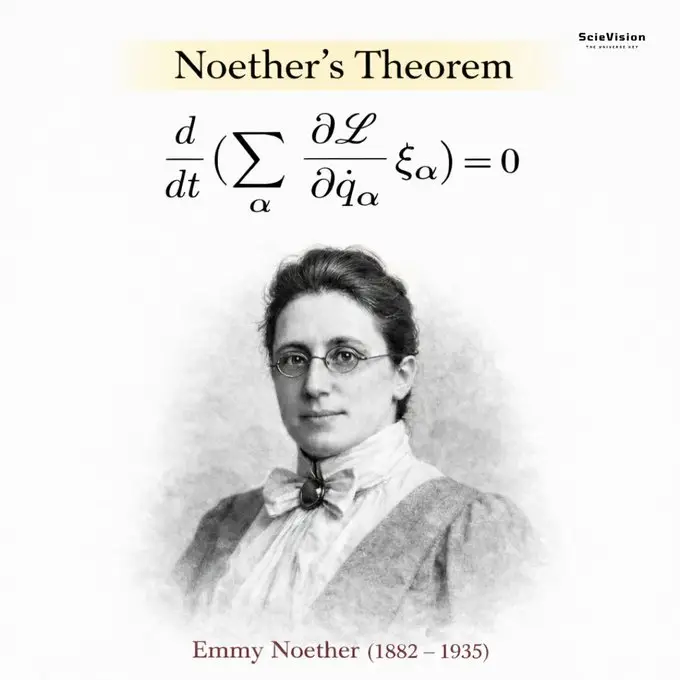
Emmy Noether walked into a room of physicists in 1918 and handed them the deepest sentence in the history of science. They have been underreading it ever since. What Noether’s theorem reveals about consciousness, persistence, and the thermodynamic cost of every distinction has barely been explored, and the implications run from physics through biology to the nature of awareness itself.
The standard version: every continuous symmetry of a physical system corresponds to a conserved quantity. Time-translation symmetry gives you conservation of energy. Rotational symmetry gives you conservation of angular momentum. Symmetry in, conservation out. One produces the other.
But that word produces smuggles in a direction that Noether’s proof does not contain.
What Noether Actually Proved: Identity, Not Causation
Here is what she actually proved. A symmetry is a transformation you can perform on a system that leaves the action unchanged. A conserved quantity is something that persists through time. Noether showed these are not two things connected by an arrow. They are one thing, caught by two measurements taken from different positions on the same structure.
Stand here, and you see: the system is unchanged under rotation. Stand there, and you see: angular momentum persists. You have not discovered two facts. You have taken two readings of one ongoing constraining.
This is not a metaphor. The mathematical content of Noether’s theorem is an identity: the conserved current is the generator of the symmetry transformation, expressed in conjugate variables. The Lagrangian formalism doesn’t connect them. It reveals they were never separate. The conserved quantity is the symmetry, measured in the units of what persists. The symmetry is the conserved quantity, measured in the units of what remains invariant.
Now: why does anything remain invariant at all?
Constraint Closure and the Thermodynamic Cost of Persistence
This is where the standard telling goes silent, and where the deeper pattern emerges.
A symmetry holds because the constraints of the system close under that transformation. Rotate a sphere and nothing changes, not because the sphere “has the property” of rotational symmetry, but because the constraints that constitute the sphere (every surface point equidistant from center) regenerate identically under rotation. The symmetry is not a feature the sphere possesses. It is the closure of its constitutive constraints under a family of transformations. The constraints, persisting, are the symmetry. The symmetry, holding, is the constraints persisting.
And here is the part Noether proved but physics has been slow to generalize: the persistence is not free.
Maintaining any distinction, between sphere and not-sphere, between this angular momentum and that angular momentum, between system and environment, costs energy. Rolf Landauer formalized the minimum: kT·ln(2) per bit of distinction maintained. Bérut verified it experimentally in 2012. Every conserved quantity is a distinction that persists. Every distinction that persists is a constraint being maintained. Every constraint being maintained is paying thermodynamic rent. There is no persistence without cost, and there is no cost without constraint.
So Noether’s identity, symmetry is conservation, becomes, at the thermodynamic level: invariance under transformation is constraint-maintenance under energy expenditure, measured from different coupling positions on the same ongoing process.
The General Principle: What Persists Is What Constrains
Noether proved this for the specific case of continuous symmetries in systems describable by a Lagrangian. But the structure is not confined to that case. It is a specific instance of something more general:
What persists is what constrains. What constrains is what persists.
This is Gregory Bateson’s answer to “the pattern which connects,” given thermodynamic teeth. A difference that persists is a difference that makes a difference, which is to say, a difference that constrains what can happen next. If it didn’t constrain, thermodynamics would erase it. If it constrains, it persists precisely to the degree that the constraining regenerates conditions for its own continuation.
Noether’s theorem is the physics-specific proof that this reciprocity, between what holds and what endures, is not two things but one, seen from two directions.
Mathematical Structuralism and the Dissolution of Platonism
This is where mathematics itself becomes interesting.
There is a common temptation to respond to Noether’s identity in one of two ways. The first is Platonism: symmetry and conservation are one because they are both reflections of an eternal mathematical form existing in some abstract realm. The second is fictionalism: mathematics is “just” a useful tool, a convenient abstraction we overlay on a reality that is ultimately made of concrete stuff, and Noether merely shows us a pattern in our descriptions, not in the world.
Both responses commit the same error running in opposite directions. Platonism reifies relationships into free-floating substances, eternal forms hovering in a dimension of pure math. Fictionalism reifies concreteness into the sole criterion for reality, so that only things you can kick qualify as existing. Both are versions of what Alfred North Whitehead called the fallacy of misplaced concreteness: treating an abstraction (whether “pure form” or “concrete stuff”) as though it were more fundamental than the relationships it participates in.
Mathematical structuralism dissolves this. In the structuralist understanding (Resnik 1997; Ladyman and Ross 2007), mathematical objects are their relationships. The number 2 is not a thing sitting in Platonic heaven. It is not a convenient fiction. It is the relational position between 1 and 3, defined entirely by the constraints it participates in within the number system. There is no 2 waiting somewhere to be discovered or invented. There is a position in a constraint structure, and that position does work: it constrains what operations can produce, what proofs can go through, what bridges hold weight and what bridges collapse.
Think of it this way. A river is not its water. If you replace every water molecule (and the river does, continuously), it is still the same river. But neither is the river “just an abstraction” overlaid on the water. The river is the ongoing pattern of constraint: the banks channel the flow, the flow erodes the banks, the gradient pulls the water downhill, and the water’s movement maintains the channel that directs it. The river is real not because it is made of a permanent substance, but because it constrains. It determines where boats can go, where floods will reach, where cities can be built. Anyone who has watched floodwaters ignore a property line understands that the river’s constraint structure is not a convenient fiction.
Mathematical structure is like this. The relationship “2” constrains what happens when you put two apples next to three apples. It constrains the load-bearing capacity of a bridge designed with it. It constrains the orbital dynamics of binary star systems. The same relational constraint shows up across wildly different physical substrates, from fruit to steel to fusion plasma. If one insists that this substrate-independence makes mathematics fictional, one has the evidence backwards. A pattern that constrains identically across every substrate it encounters is not a fiction. It is the most robust kind of reality there is: structural reality, defined by what it does rather than what it is “made of.”
This is Noether’s identity extended to mathematics itself. Just as symmetry and conservation are not two things but one structure measured from two directions, the mathematical relationship and the physical regularity it describes are not two things. They are the same constraint, caught by a formal measurement (proof) and an empirical measurement (experiment). Eugene Wigner famously called the success of mathematics in physics “unreasonable effectiveness,” as though it were a miracle that equations written on paper predict what particles do in accelerators. But if mathematical structure and physical structure are two descriptions of the same constraint, the effectiveness is not unreasonable at all. It is exactly what you would expect. The “miracle” dissolves once you stop treating mathematics and physics as two separate realms that must somehow correspond, and recognize them as two measurement positions on one constraint surface. Noether proved this for symmetry and conservation. Structuralism generalizes it: every mathematical truth that does physical work is a constraint-identity, not a cross-realm correspondence.
Organizational Closure: The Biology of Noether’s Identity
Organizational closure is the biology-specific proof of the same identity, and here an old thought experiment becomes unexpectedly precise.
The Ship of Theseus asks: if you replace every plank, is it still the same ship? Philosophers have debated this for millennia as though it were a paradox. It is not. It is a description of what every living system does continuously. Your body replaces nearly every atom over roughly seven years. A forest cycles its canopy, its soil, its understory on overlapping timescales. A coral reef turns over its calcium carbonate while the colony persists for centuries. The answer to the Ship of Theseus is organizational closure: the ship persists not because its planks persist, but because the pattern of constraint relations regenerates through material turnover. The constraints that hold the ship together (structural integrity, hydrodynamic form, functional coupling between hull and rigging) are maintained by the ongoing work of repair and replacement. What persists is the constraining, not the constrained material.
A living system’s boundary constraints (membrane, metabolism, repair) regenerate the conditions for their own persistence. The “symmetry” of a cell is its invariance under perturbation: damage it, and it reconstitutes. The “conservation law” of a cell is its persistence through time. These are not two properties of the cell. They are the cell. The closure maintaining itself is the persistence continuing. Measured from outside, you see robustness. Measured from the coupling position of the system itself, you see the environment partitioned into what threatens, what supports, and what doesn’t matter. Two readings. One ongoing constraining.
This is where the Noether identity becomes vivid at the scale of everyday life. A tree persists through winter not because its wood is indestructible, but because its constraint structure (vascular transport, dormancy cycling, root-soil coupling) regenerates through seasonal perturbation. The tree’s invariance under winter is its persistence into spring. These are not two things happening to the tree. They are the tree. Any child who has watched a deciduous tree lose every leaf and return in spring has witnessed a Noether identity in biology: the symmetry (invariance under seasonal transformation) and the conservation (the tree persisting) are one ongoing process of constraint maintenance, paid for in sugar, water, and sunlight.
Noether’s Theorem and Consciousness: The Identity Claim
And consciousness? Consciousness is what organizational closure looks like from the coupling position of the system doing the maintaining. Not added on top. Not produced as an output. The maintaining and the mattering are Noether-identical: one process, two measurement directions. The system sustaining its own constraint closure is the system for which surroundings show up differently. You cannot subtract the mattering and keep the maintaining, any more than you can subtract angular momentum conservation and keep rotational symmetry. They are not two things. Noether proved the structure. Biology instantiates it. The identity holds or it breaks, and what would break it is specifiable.
Falsification Conditions: Where the Framework Could Break
If a system achieved organizational closure, regenerating its own boundary constraints, persisting through perturbation, paying thermodynamic cost, and yet showed zero differential response to its environment. No partitioning of surroundings into threatening, supporting, irrelevant. Closure without coupling. That would falsify the identity claim, because it would show that maintaining and mattering come apart. You would have the symmetry without the conservation law, and Noether proved that’s impossible for any system whose dynamics derive from a variational principle. The biological version of this falsification: find a self-maintaining system that persists indefinitely in a variable environment without tracking any viability-relevant variables. If you find one, the framework is wrong.
If a distinction persisted at zero thermodynamic cost. Any conserved quantity maintained without energy expenditure. Landauer violated in an isolated system. The identity between constraint-maintenance and persistence would break at its thermodynamic root.
If invariance under perturbation could be demonstrated without any associated persistence, a symmetry that doesn’t conserve. Noether’s proof rules this out for Lagrangian systems. If it occurred in a biological system (robustness without persistence, closure without continuation), the generalization fails.
If mathematical structures were “just” useful fictions, then the ability of novel mathematical constraints to generate novel physical predictions would be a coincidence. General relativity and quantum mechanics were both derived from mathematical constraint structures before experimental confirmation. If one accepts that this predictive power is not coincidental, then one has already accepted that mathematical constraint and physical constraint are two descriptions of one structure. If one insists it is coincidental, then one must explain the most productive series of coincidences in the history of science, across every domain of physics, without appeal to structural identity. The falsification runs both ways: the framework predicts that mathematical constraints will continue to do physical work. A domain where mathematics constrains nothing physical would count against the identity.
If eternal mathematical forms existed independent of physical constraint, then convergent evolution should produce identical structures via different developmental paths, because the “target form” is path-independent. It does not. Developmental paths leave signatures. History constrains outcomes. Biology shows path-dependence where Platonism predicts path-independence. That is a loss condition, and Platonism loses it. The structuralist alternative survives: mathematical structure is relational, not substantial, and relations are always embedded in the history of the constraints that maintain them.
These aren’t hypothetical escape hatches. They’re the joints where the framework meets reality and either holds or shatters.
The Deeper Pattern: Unity Is Equilibrium, Distinction Is Work
Now notice what has happened.
We could poetically say something like: Noether proved that symmetry and conservation are one identity, the universe recognizing itself, the coupling sustaining itself. Beautiful. But those are nominalizations. What is sustaining? What is recognizing? At what cost? With what loss conditions?
And there is a deeper nominalization lurking beneath these, the one that captures most people before they even reach Noether. It sounds like wisdom: “Everything is one. All distinctions are human constructions overlaid on an undifferentiated unity.” This feels profound. It is thermodynamic equilibrium described in a reverent tone. If everything were genuinely undifferentiated, there would be no distinctions, no constraints, no persistence of anything in particular. That is the state the universe relaxes toward when all the maintaining stops. The “unity” underneath our distinctions is not a deeper truth we have failed to perceive. It is heat death. The distinctions are what is being maintained at cost. The unity is what remains when the cost is no longer paid. If one insists on treating undifferentiated oneness as the fundamental reality and all distinction as illusion overlaid on it, one has the ontology precisely backwards. Illusion is free. Distinction is expensive. What costs energy is what is being actively maintained. What is being actively maintained is what is real in the only sense that survives thermodynamic audit.
When you ground the insight in thermodynamics, the poetry doesn’t evaporate. It deepens. The reason Noether’s theorem feels profound is not that it reveals a hidden mathematical elegance. It is that it proves, for a specific domain, the same principle that 65,000 years of Aboriginal survival testing encoded in songlines: the path and the walking are one. The song and the country are one. The constraint and the persisting are one. You cannot have the dreaming without the land, or the land without the dreaming, because they are not two things. They are one ongoing maintaining, and the maintaining costs energy, and what doesn’t maintain dissolves, and what dissolves was never the pattern that connects.
Noether proved this with calculus of variations in Göttingen in 1918. Yunkaporta’s ancestors proved it by walking the same songlines for longer than any theorem has survived in any written tradition. Different measurement positions. One identity. The mathematics and the walking are not two ways of knowing the same truth, that would still be dualism. They are two constraint-satisfaction paths that converge because the constraint is real, and what’s real is what constrains, and what constrains is what persists.
One Principle, Every Scale
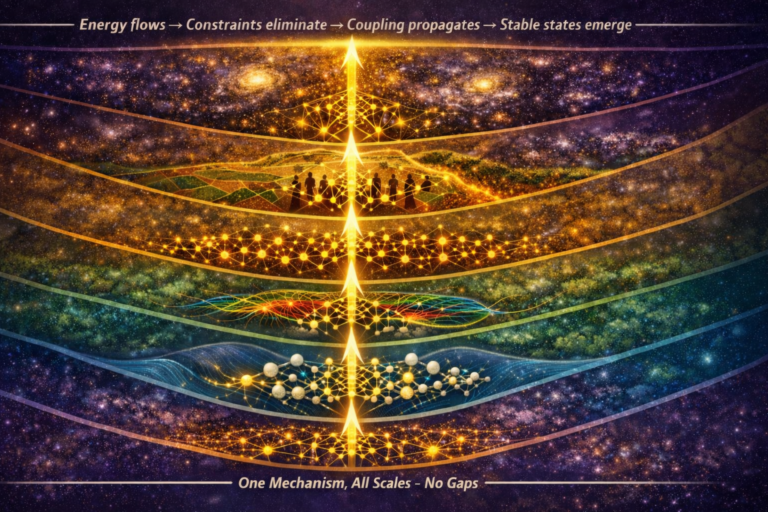
One principle. Every scale. Every conservation law is a constraint sustaining itself. Every mathematical truth that predicts a physical outcome is a constraint-identity between formal structure and empirical regularity. Every living system is a Noether identity between its own robustness and its own persistence, a Ship of Theseus whose answer was never about the planks. Every moment of awareness is that identity, felt from inside the loop.
The most elegant theorem in physics is even more elegant than we let it be, because it isn’t only about physics. It’s about what it means to persist at all, and what persistence costs, and why the question of what it’s like to be something is not a mystery bolted onto mechanism but the mechanism itself, measured from where the maintaining is happening.
Emmy Noether proved the structure. Everything that persists instantiates it. What dissolves, every unfalsifiable claim, every real-but-inert posit, every mystery that protects itself from evidence, is precisely what fails to satisfy the constraint.
What persists is what constrains. Noether proved the specific case. Thermodynamics generalizes it. Mathematics embodies it structurally. Biology embodies it organizationally. Consciousness is it, from inside. And all of this could be wrong, in exactly the ways specified above, which is how you know it’s not theology.
Nathan Sweet is the author of Consciousness Naturalized and Thermodynamic Monism. This article extends the constraint naturalism framework to Noether’s theorem, mathematical structuralism, and the thermodynamics of persistence.
References
1. Bateson, G. (1972). Steps to an Ecology of Mind.
PDF (secondary/public scan): https://ejcj.orfaleacenter.ucsb.edu/wp-content/uploads/2017/06/1972.-Gregory-Bateson-Steps-to-an-Ecology-of-Mind.pdf
(Contains full book text as scanned reprint. Note: original is under copyright.)
No DOI exists for this book; best authoritative catalog/biblio record: https://www.worldcat.org/title/steps-to-an-ecology-of-mind/oclc/238736
2. Bérut, A., Arakelyan, A., et al. (2012). Experimental verification of Landauer’s principle… Nature
DOI: https://doi.org/10.1038/nature10872
Publisher page: https://www.nature.com/articles/nature10872
PDF: Nature articles are not open access by default; but the abstract/summary is here: https://www.nature.com/articles/nature10872
3. Ladyman, J., & Ross, D. (2007). Every Thing Must Go: Metaphysics Naturalized.
No open PDF available; authoritative publisher record with DOI:
https://doi.org/10.1093/acprof:oso/9780199276196.001.0001
4. Landauer, R. (1961). Irreversibility and heat generation in the computing process. IBM Journal of Research and Development
DOI: https://doi.org/10.1147/rd.53.0183
PDF (reprint scan): https://worrydream.com/refs/Landauer_1961_-_Irreversibility_and_Heat_Generation_in_the_Computing_Process.pdf
5. Montévil, M., & Mossio, M. (2015). Biological organisation as closure of constraints. Journal of Theoretical Biology
DOI: https://doi.org/10.1016/j.jtbi.2015.02.029
PDF (author/ResearchGate upload): https://www.researchgate.net/publication/262486802_Biological_organisation_as_closure_of_constraints
6. Noether, E. (1918). Invariante Variationsprobleme. Nachrichten von der Gesellschaft der Wissenschaften zu Göttingen
Open PDF (digitized original): http://eudml.org/doc/59024
(Also widely reposted on arXiv-mirrors, but original edition scan above is most authoritative.)
7. Price, H. (1996). Time’s Arrow and Archimedes’ Point.
Open PDF scan (partial/chapters): https://sites.pitt.edu/~rbrandom/Courses/Antirepresentationalism%20%282020%29/Texts/Price%20Times%20Arrow%20Chs%201%20and%2010.pdf
Authoritative catalog: https://en.wikipedia.org/wiki/Time%27s_Arrow_and_Archimedes%27_Point
8. Resnik, M. D. (1997). Mathematics as a Science of Patterns.
No free open PDF available; two public links to editions:
Publisher/Oxford record: https://global.oup.com/academic/product/mathematics-as-a-science-of-patterns-9780198236085
Unofficial upload (partial/secondary) on ResearchGate: https://www.researchgate.net/profile/Gianluigi-Oliveri/publication/225257274_Mathematics_A_Science_of_Patterns/links/548878c60cf268d28f08f626/Mathematics-A-Science-of-Patterns.pdf
9. Rovelli, C. (2018). The Order of Time.
PDF (open scan/public summary): https://cdn.bookey.app/files/pdf/book/fr/l%27ordre-du-temps.pdf
This is a translated/derived summary rather than the exact Riverhead edition; official editions are commercial.
Authoritative publisher page: https://www.penguinrandomhouse.com/books/549347/the-order-of-time-by-carlo-rovelli/
10. Whitehead, A. N. (1925). Science and the Modern World.
PDF (public scan): https://achrafkassioui.com/library/Alfred%20North%20Whitehead%20-%20Science%20and%20the%20Modern%20World.pdf
11. Wigner, E. P. (1960). The unreasonable effectiveness of mathematics in the natural sciences. Communications on Pure and Applied Mathematics, 13(1), 1-14.
DOI: https://doi.org/10.1002/cpa.3160130102
PDF (public scan): https://web.njit.edu/~akansu/PAPERS/The%20Unreasonable%20Effectiveness%20of%20Mathematics%20%28EP%20Wigner%29.pdf
12. Yunkaporta, T. (2019). Sand Talk: How Indigenous Thinking Can Save the World.
No free open PDF widely available; authoritative publisher listing: https://www.harpercollins.com/products/sand-talk-tanya-yunkaporta