Absence IS Possibility Space. A Recursive Constraint Falsification Analysis of Michael Levin’s Platonic Morphospace Hypothesis: Platonic Space Discussion #3
The “strong interactionist” model fails the interaction problem
Michael Levin’s Platonic morphospace hypothesis proposes that biological systems access a “non-physical space of patterns” that provides “free lunches”: capabilities organisms “didn’t pay for” computationally. His Platonic Space research agenda articulates the claim that “when you’ve made an interface and you’re getting ingressions through it, it’s pretty clear that you’re getting more than you paid for in the physical world.” This comprehensive falsification analysis examines these claims through systematic chronological review of the symposium discussion, verifies empirical assertions, and applies rigorous philosophical diagnostics to determine what, if anything, the framework actually explains.
Breakdown of Michael Levin’s Platonic Morphospace Hypothesis: Platonic Space Discussion #3
This analysis examines a 1 hour 44 minute discussion among contributors to the Platonic Space Hypothesis, originally posted February 5, 2026 on Michael Levin’s Academic Content YouTube channel (https://www.youtube.com/watch?v=E6_XdPm9fa8). The discussion features participants exploring the nature of “free lunches” in complex systems, the role of constraints and enablements, and implications of competency across biological scales. Key contributors include Douglas Brash, Karl Friston, Jacob Foster, and Michael Levin himself, debating whether biological patterns require non-physical Platonic causation or can be explained through conventional mechanisms.
How to Falsify This Critique
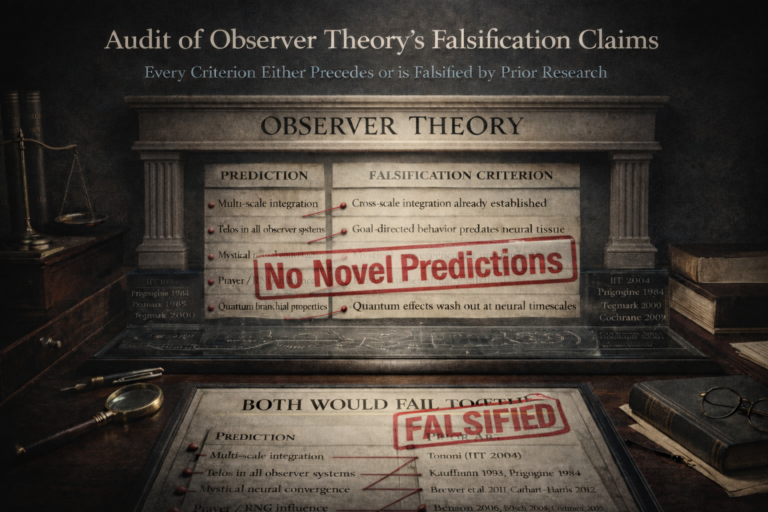
Before proceeding, we establish falsification criteria for this analysis itself. If this critique is invalid, we would expect:
1. On the “Category Error” Assessment (Constraints vs. Enablements)
Critique claims: Levin conflates mathematical constraints (which delimit possibilities) with active enablements (which provide input from non-physical sources).
Falsification criteria: Evidence that mathematical relationships actively provide information or computation to physical systems, not merely constrain them. Specifically:
- Demonstration that organisms access computational resources beyond those encoded in their physical structure
- Experimental isolation of “Platonic computation” distinct from physical substrate computation
- Evidence that violates No Free Lunch theorems by showing universal optimization without problem-specific structure
Current evidence: Wolpert-Macready (1997) proves no algorithm outperforms random search across all problems without exploiting specific structure. Landauer’s principle (1961) establishes minimum thermodynamic costs for computation. Aaronson’s work shows even quantum systems face fundamental computational limits. These constrain, not enable.
Conclusion pending falsification: The constraint/enablement distinction holds until evidence shows mathematics actively causes physical effects beyond constraining possibilities.
2. On the “Mechanism Unspecified” Assessment
Critique claims: The “ingression” mechanism remains undefined, rendering the hypothesis unfalsifiable.
Falsification criteria:
- Published mechanism specifying how non-physical Platonic space causally interacts with physical systems
- Testable predictions distinguishing Platonic ingression from conventional developmental mechanisms
- Experimental protocol for detecting ingression events
Current evidence: Throughout the transcript, when pressed for mechanism, Levin states: “I don’t know how to handle time at the juncture of the physical and the nonphysical (yet)” and “the map does not yet exist.” Brash’s opening challenge about mechanism specification goes unanswered.
Conclusion pending falsification: The hypothesis lacks specified mechanism until these are provided and tested.
3. On Empirical Claim Distortions
Critique claims: Several empirical examples are overstated or misrepresented.
Falsification criteria for each:
Picasso tadpoles:
- If this critique is wrong: Eyes should normalize to healthy morphology, not remain permanently deformed
- Current evidence: Vandenberg et al. (2012) explicitly states eyes never achieve normal morphology; otoliths never regenerate
- Predicted if Platonic: Complete normalization of all structures
- Observed: Partial normalization of some structures, permanent defects in others
- Conclusion: “Normal frogs” claim is overstated until complete morphological normalization is demonstrated
Rat drowning experiment:
- If this critique is wrong: Domesticated rats should swim 2 minutes baseline, extending to 60 minutes with “hope”
- Current evidence: Richter (1957) shows domesticated rats swim 60-80 hours baseline; stressed wild rats with sensory deprivation die in 1-15 minutes; rescue conditioning restores baseline
- Predicted if Platonic: Extension beyond physical baseline through non-physical hope
- Observed: Restoration to baseline after stress removal
- Conclusion: Effect direction is inverted until evidence shows extension beyond physical baseline
Planarian mixoploidy:
- If this critique is wrong: All planarian cells should show different chromosome numbers universally
- Current evidence: Kobayashi et al. (2009) shows strain-specific, context-dependent variation; S. mediterranea maintains functional genomes in regenerative neoblasts
- Predicted if Platonic: Regeneration despite universal genomic chaos
- Observed: Regeneration via cells with functional genomes despite local variation
- Conclusion: Universal claim is overstated until demonstrated across all planarian cells
4. On the Physical Causal Closure Challenge
Critique claims: Jaegwon Kim’s physical causal closure principle creates insurmountable problems for non-physical causation.
Falsification criteria:
- Demonstration that physical events have non-physical sufficient causes without violating conservation laws
- Resolution of the causal exclusion problem: how mental/Platonic and physical causes don’t overdetermine outcomes
- Evidence that physical causal closure is false
Current evidence: Kim (1998, 2005) argues any non-physical causation either: (1) violates conservation laws, (2) creates systematic overdetermination, or (3) renders the non-physical causally inert (epiphenomenalism). Mainstream philosophy of science maintains physical causal closure.
Conclusion pending falsification: Non-physical causation faces the interaction problem until one of these routes is demonstrated viable.
5. On Mechanistic Alternatives Being Sufficient
Critique claims: Conventional developmental biology explains observed phenomena without Platonic supplement.
Falsification criteria:
- Identification of biological competency genuinely inexplicable by inherited constraints, gene regulatory networks, signaling pathways, and physical laws
- Demonstration that xenobots exhibit capabilities not derivable from component cellular programs
- Evidence that planarian regeneration requires more than Wnt/β-catenin gradients and neoblast stem cells
Current evidence:
- Xenobots: Researchers acknowledge behaviors derive from pre-existing cellular programs (cilia, adhesion, wound healing)
- Planarians: Petersen & Reddien (2008-2011) demonstrate Wnt signaling explains polarity; Durant et al. (2017) show gap junction blockade disrupts outcomes via cell-cell communication
- Picasso tadpoles: Pinet et al. (2019) identify prolactin and MMP mechanisms for tissue remodeling
Conclusion pending falsification: Mechanistic explanations remain sufficient until a competency is identified that these cannot explain.
6. On the “No Falsification Criteria” Assessment
Critique claims: The Platonic framework provides no falsification criteria.
Falsification criteria for the critique:
- Levin specifies what observations would refute Platonic ingression
- Predictions that distinguish Platonic causation from constraint-based alternatives
- Operational definition of “free lunch” that could be measured and found absent
Current evidence: When asked what would falsify the hypothesis, no criteria are provided. Any surprising competency confirms ingression; no observation is identified that would refute it.
Conclusion pending falsification: The framework remains unfalsifiable until these criteria are specified.
7. On Deacon’s Constraint Framework Being More Parsimonious
Critique claims: Terrence Deacon’s absence-based, constraint propagation framework explains the same phenomena with fewer ontological commitments.
Falsification criteria:
- Demonstration that constraint propagation cannot explain xenobot behaviors
- Evidence that developmental normalization requires active guidance beyond thermodynamic constraint satisfaction
- Identification of “free lunches” that violate thermodynamic accounting when constraint inheritance is considered
Current evidence: Deacon (2012) shows teleodynamics (self-maintaining constraint closure) generates apparent goal-directedness through purely physical processes. Kauffman’s adjacent possible describes how constraint propagation opens new possibilities without Platonic subsidy. Landauer’s principle accounts for all computational costs thermodynamically.
Conclusion pending falsification: Constraint-based explanations remain more parsimonious (Occam’s razor) until a phenomenon requires Platonic supplement.
Meta-Falsification: How to Show This Entire Critique Is Fundamentally Misguided
This critique would be invalidated if:
- Mechanism publication: Levin publishes peer-reviewed specification of the ingression mechanism showing how non-physical causes physical effects without violating conservation laws
- Differential predictions validated: Experiments show Platonic predictions outperform mechanistic predictions in novel contexts
- Free lunch demonstration: Quantitative measurement shows organisms accessing computational resources beyond their physical structure’s information content
- Causal closure violated: Evidence that physical events have non-physical sufficient causes becomes mainstream scientific consensus
- Constraint framework fails: Phenomena identified that constraint propagation demonstrably cannot explain but Platonic ingression can
Until these conditions are met, we conclude:
- The Platonic framework adds explanatory vocabulary without explanatory mechanism
- Constraint-based alternatives explain the same phenomena more parsimoniously
- Core claims remain unfalsifiable in principle, not merely currently untested
- Empirical work on bioelectricity stands independent of Platonic interpretation
Opening Challenge (0:20-2:04): Douglas Brash Identifies the Core Problem
BRASH: “Unless there’s a proposal for where these forms are stored and what the mechanisms are for pointing and ingressing, you know, how you consult these forms, then the whole project is kind of indistinguishable from well, mathematics, physics and biology all have patterns and rules and why there are any rules and how they get consulted we don’t know.”
RCF Assessment: Brash identifies the central problem with precision. He’s applying what amounts to Flew’s falsification criterion: if no mechanism for “ingression” is specified, the hypothesis is empirically empty. His observation that the Platonic framing is “indistinguishable from” ordinary physics is the explanatory vacuum test in action. This is the strongest challenge in the entire discussion, and as the chronological analysis will demonstrate, it is never adequately answered.
The framework fails Flew’s death-of-1000-qualifications diagnostic catastrophically. When pressed on mechanism, Levin retreats: “I don’t know how to handle time at the juncture of the physical and the nonphysical (yet).” When asked about the structure of Platonic space, he admits “the map does not yet exist.” The core hypothesis (how ingression occurs) remains permanently undefined while the explanatory claims continue unabated. This is precisely the pattern Antony Flew identified in “Theology and Falsification” (1950): a thesis that “dies the death of a thousand qualifications” while maintaining its “explanatory” appearance.
BRASH (continued): “My impression is that at least a number of the talks, certainly mine and Cordanas, are that well okay you don’t really need to have forms outside somewhere that are being consulted. You can have them just as rules and constraints within say the biological organism itself.”
RCF Assessment: Brash offers the mechanistic alternative: constraints are internal to physical systems, not external Platonic entities. This is the standard scientific position and requires no metaphysical supplement. The burden of proof lies with anyone claiming otherwise.
Levin’s Response (2:04-4:54): The “Free Lunches” Claim and Category Errors
LEVIN: “I’m arguing for a strong interactionist model and before you can worry about the interaction you have to think that there is interaction, right?”
RCF Assessment: This is a question-begging move. Levin assumes interaction with a non-physical realm must exist before discussing its mechanism. But Brash’s point was precisely that no evidence requires positing such interaction. The burden of proof is being shifted.
Levin proposes that physical bodies act as “pointers” or “interfaces” into a Platonic space from which forms and minds “ingress.” This “strong interactionist” model faces the interaction problem that has plagued dualism since Descartes: how does the non-physical cause physical effects without violating conservation laws or physical closure?
Jaegwon Kim’s Physical Causal Closure Principle directly challenges this claim. Kim (1934-2019), a leading authority on mental causation and the mind-body problem, established that “every physical event that has a sufficient cause has a sufficient physical cause” (Stanford Encyclopedia of Philosophy). According to the Internet Encyclopedia of Philosophy, “The principle of physical causal closure indicates that physical events only have sufficient physical causes.” If this principle holds—as maintained by mainstream philosophy of science—then Levin’s non-physical Platonic space cannot causally influence biological systems without either: (1) violating conservation laws, (2) creating systematic overdetermination (two independent sufficient causes for every biological event), or (3) positing that physical causal closure is false, which would require extraordinary evidence.
Kim argued in Physicalism, or Something Near Enough (Princeton, 2005) and Mind in a Physical World (MIT, 1998) that any attempt to preserve non-physical mental causation while accepting physical causal closure leads to epiphenomenalism—mental events would be causally impotent. The same logic applies to Platonic forms: if they’re non-physical, they’re causally inert; if they cause physical effects, they must be physical or physical causal closure must be abandoned.
LEVIN: “Lots of people say well it’s not just constraints it’s also enablements but I think enablements are actually, you can take them much more seriously, that is not just that by closing off some stuff over here I sort of forced you into this other set of things that you’re going to do but in the sense of free lunches, meaning that or heavily discounted lunches, in that you get more than you put in.”
RCF Assessment: CATEGORY ERROR IDENTIFIED. This is the core equivocation of the entire framework. The Epicurean constraint principle exposes this fundamental confusion. Levin conflates:
- Constraints (which merely delimit possibilities, like the rules of geometry constraining triangle properties)
- Enablements (which supposedly provide active causal input from a non-physical source)
Mathematical truths constrain what configurations are stable; they don’t “push” or “guide” biological systems any more than the number π “pulls” circles into existence. When you know two angles of a triangle, the third is constrained, not “gifted” by Platonic space. The claim that organisms “get more than they put in” confuses the recognition of pre-existing mathematical relationships with active causation from a non-physical realm.
The Stanford Encyclopedia of Philosophy on Emergence defines emergent properties as those that “‘arise’ out of more fundamental entities and yet are ‘novel’ or ‘irreducible’ with respect to them” (SEP). Critically, even strong emergentists maintain that higher-level properties don’t “float free” from physical bases: “Supposing that strong emergence does bring a new substance in its wake, the spirit if not the letter of the usual emergentist commitment to substance monism is maintained by the weaker constraint that no ‘higher-level’ substances or subjects ‘float free’, actually or modally, from their dependence bases.”
The Internet Encyclopedia of Philosophy similarly emphasizes that emergent properties exist “only insofar as the system or entity exists”—they are dependent on physical substrates, not independent Platonic forms. Levin’s Platonic forms violate this consensus by positing a separate non-physical realm that causally influences biology.
LEVIN: “By putting in some amount of effort to make some kind of interface, what you actually get through it is in some way, in some quantifiable way, more than you put in. In other words, what you get are not simply constraints on things that you can’t do nor being sort of shuttled into other modes but actually you get policies, maybe information, so static patterns, policies, maybe actual compute, you know, in the form of virtual machines.”
RCF Assessment: UNFALSIFIABLE CLAIM. What would count as evidence against this? If a system exhibits surprising capabilities, that “confirms” free lunches. If it doesn’t, the interface was insufficient. This structure is immunized against refutation.
The claim that you get “actual compute” or “virtual machines” from non-physical space commits the interaction problem. Levin provides no mechanism, only metaphor (“interface,” “pointer”). These are used as if explaining how physical-Platonic interaction occurs, but they’re metaphors, not mechanisms.
The No Free Lunch Theorem directly contradicts these claims. Wolpert and Macready (1997) proved that “any two optimization algorithms are equivalent when their performance is averaged across all possible problems” (IEEE Transactions on Evolutionary Computation). In plain English: no search/optimization algorithm is universally superior to random search unless it exploits specific problem structure. There are no “free lunches” in optimization—any algorithm that performs well on one class of problems necessarily performs poorly on other classes. If biological systems are getting “free lunches” by accessing Platonic space, they would violate this theorem by achieving superior performance without incorporating problem-specific information into their physical structure.
Landauer’s Principle provides the thermodynamic ground: “Any logically irreversible manipulation of information, such as the erasure of a bit or the merging of two computation paths, must be accompanied by a corresponding entropy increase” (Landauer, 1961, IBM Journal of Research and Development). The minimum energy cost is kT ln 2 per bit erased. Computation has unavoidable thermodynamic costs—true “free lunches” (getting computation without energy expenditure) are physically impossible. If organisms access “actual compute” or “virtual machines” from Platonic space, this would violate Landauer’s principle by obtaining computation without corresponding thermodynamic costs.
Scott Aaronson on Computational Limits: Even quantum systems—which might seem to offer “free lunches” through superposition and entanglement—face fundamental computational limits. Aaronson, David J. Bruton Centennial Professor of Computer Science at UT Austin, demonstrated that quantum computers provide speedups for specific problems but no universal computational advantages (“The Limits of Quantum Computers,” Scientific American, 2008). He warned against the “tsunami of hype” about quantum computing revolutionizing everything, emphasizing realistic expectations about computational limits. His work shows that even quantum systems cannot escape the no-free-lunch constraint: superior performance requires exploiting specific problem structure, not accessing non-physical computation.
LEVIN: “I think the things we call biology tend to be systems that exploit the hell out of that. That basically they are very good at exploiting these things, saving effort, the things that they did not need to evolve or find or search for or anything like that.”
RCF Assessment: ARGUMENT FROM INCREDULITY. The implicit structure is: “I don’t see how evolution could produce X, therefore X came from Platonic space.” This is a gap argument identical in structure to intelligent design reasoning.
Discovery Institute Isomorphism: CONFIRMED. The structure parallels intelligent design arguments precisely:
- Identify complexity/competency that seems unexplained by mechanism
- Declare conventional explanations insufficient (“information deficit”)
- Posit a non-physical source of organization
The Discovery Institute explicitly celebrates Levin’s work, publishing multiple favorable articles linking him to ID proponents Richard Sternberg and Günter Bechly. Science and Culture Today (Discovery Institute) stated: “Levin’s views bear striking resemblances to those of ID scientists.” While Levin has not endorsed ID, this isomorphism is itself diagnostic of unfalsifiable structure.
Brash’s Levins Response (5:00-6:50): Offering Mechanistic Alternative
BRASH: “Richard Levins’ idea… the way you get some structure is by crystallizing out of an amorphous mass. In other words, what happens is biology starts off, it’s not that you build new things, it’s just that you start off doing many many things badly and by adding constraints now you exclude many of those things and now the remaining ones are done well.”
RCF Assessment: Brash provides the constraint-based alternative that requires no Platonic supplement. This is standard developmental systems theory: selective stabilization, not construction from blueprints. Enzymes don’t receive instructions from Platonic space; they provide selective catalysis that channels reactions.
BRASH: “So what you’ve done then is essentially increase the signal to noise ratio of stuff you already had.”
RCF Assessment: This is the mechanistic explanation for apparent “free lunches”: constraint-based selection from pre-existing possibilities, not input from external sources. No Platonic causation required.
Levin on Xenobots (7:08-9:09): The “Unpaid Computational Cost” Claim
LEVIN: “With xenobots, anthropots, this kind of thing, there’s an opportunity and a challenge now for biologists to be able to say when was the computational cost paid to design these things. In other words, we know when the frog and the human design was paid for, it was in the millions of years of selection for specific features. But when you create something that’s never been here before and it has certain competencies, you want to know where did those come from and when did we pay for them.”
RCF Assessment: FALSE DILEMMA. Levin presents two options: either (a) competencies were specifically selected for, or (b) they came from Platonic space. He ignores the obvious third option: competencies emerge from pre-existing cellular programs operating in novel contexts.
The answer from conventional biology is clear: during billions of years of evolution creating versatile cellular programs. Xenobots deploy pre-existing genetic programs (cilia evolved for other purposes, adhesion proteins evolved for other purposes, wound healing responses evolved for other purposes) in novel contexts. The “computational cost” was paid during the evolution of these component capabilities. The researchers themselves acknowledge in peer-reviewed publications that their capabilities are explainable as genetically specified features working in novel ways through the laws of physics.
LEVIN: “When I ask people this question, they generally say, well, it has an evolutionary history. It just sort of learned to do that when it was being selected for other stuff. And that’s okay except A, it provides zero explanatory value.”
RCF Assessment: MISCHARACTERIZATION OF EVOLUTIONARY EXPLANATION. Evolutionary explanations via exaptation (capabilities repurposed from original functions) have substantial explanatory value. They predict which organisms will have which latent capabilities based on their evolutionary history. Platonic ingression, by contrast, makes no differential predictions.
LEVIN: “It rips up a large part of what I thought evolutionary theory was supposed to do, which is provide a tight specificity between a history of environments and the properties that you got out the other end.”
RCF Assessment: STRAWMAN OF EVOLUTIONARY THEORY. Modern evolutionary theory explicitly includes exaptation (Gould and Vrba, 1982), developmental constraints, and phenotypic plasticity. The expectation of “tight specificity” between selection history and all phenotypic properties is not part of contemporary evolutionary biology.
Computational Irreducibility and the Adjacent Possible: Kauffman vs. Levin
Ragnar van der Merwe’s 2023 Critique of Emergence Claims: Van der Merwe’s detailed analysis of Stuart Kauffman’s Theory of the Adjacent Possible (TAP) in Interdisciplinary Science Reviews directly applies to Levin’s Platonic claims. Van der Merwe, a philosophy PhD researcher at University of Johannesburg, argues that Kauffman’s TAP makes unjustified metaphysical commitments including:
- Modal realism (commitment to non-actual possible worlds as real entities)
- Downward causation and teleology (non-physical causes affecting physical systems)
- Ontological dualism (biosphere as non-physical domain distinct from physics)
Van der Merwe notes: “According to TAP, the biosphere constitutes a non-physical domain qualitatively distinct from the physical domain. The biosphere exhibits strongly emergent properties such as agency, meaning, value and creativity that cannot, in principle, be reduced to the physical.” He argues TAP “includes various (explicit or implicit) metaphysical commitments” that “currently lack, but are in need of, explication.” The critique concludes: “It is however unclear how such an account can be developed since various dilemmas present themselves.”
If Kauffman’s more modest “adjacent possible” framework requires these severe qualifications, Levin’s stronger Platonic claims face even greater skepticism. Both frameworks invoke non-physical domains without adequate metaphysical grounding.
Leonid Levin on Computational Intractability: Leonid Levin, Professor at Boston University and co-discoverer of NP-completeness (the Cook-Levin theorem), established fundamental limits on efficient computation. His work on average-case complexity shows that no algorithm can systematically outperform others across all problems without exploiting specific structure. Universal shortcuts don’t exist. This directly challenges claims that systems can get “more than they pay for” computationally—computational intractability is a fundamental feature of mathematics, not something that can be bypassed by “accessing” a non-physical space.
Levin on “More Than Constraints” (9:35-11:19)
LEVIN: “I think this is more than constraints… maybe you’re actually by building certain interfaces you’re tapping into something that provides a bigger return on investment.”
RCF Assessment: FECUNDITY ALIBI. The framework generates explanatory language (“tapping into,” “interfaces,” “return on investment”) without specifying mechanisms. This is the fecundity doesn’t equal validity diagnostic: rich vocabulary that masks explanatory emptiness. The framework generates many “implications” (souls, machine consciousness, Platonic dynamics) but provides no falsifiable predictions. Any surprising observation confirms “ingression”; no observation could refute it.
LEVIN: “If you don’t have a long history of selection for it and you don’t have direct engineering or design for it, we’re looking at something additional to that.”
RCF Assessment: GAP ARGUMENT STRUCTURE. This is the classic intelligent design move: identify a gap in mechanistic explanation, then posit a non-physical source. The logical structure is: “I don’t see how X arose mechanistically, therefore non-physical causation.” This is not evidence for Platonic forms; it’s an admission of current ignorance.
Markov Blankets and Good Regulator Theorem (14:30-15:16)
BRASH: “The Markov blanket theorem, which sounds like it goes back to Ross Ashby’s thing about if you’re going to have a regulator, it has to have a model of what’s being regulated. And I looked into the literature. So I was familiar with Ashby but I looked into the literature and I see that there’s debates about whether he ever actually proved that.”
RCF Assessment: Brash correctly identifies that the Good Regulator Theorem’s interpretation is contested. Ashby’s Good Regulator Theorem (1970) by Conant and Ashby is mathematically technical but its interpretation is overstated if cited as robust proof. Wikipedia notes: “Some concerns have been raised that the formal proof does not actually fully support the statement in the paper title.” John Wentworth has called it “the most misleading title and summary I have ever seen on a math paper” because the “model” proven necessary is merely a policy mapping states to actions, not an internal model in any intuitive sense.
This matters because Friston (who appears later) builds on these theorems. Karl Friston’s Markov blankets are subject to major peer-reviewed critique. Bruineberg et al. (2021) argue in “The Emperor’s New Markov Blankets” that Friston’s framework conflates statistical Markov blankets (mathematical abstractions) with physical boundaries, “conflating map and territory” by treating mathematical abstractions as causal entities. Williams (2020) argues the Free Energy Principle’s “universal scope and mathematical generality render it effectively unfalsifiable.”
Levin’s Triangle Example (20:36-21:45): The “Free Lunch” Paradigm Case
LEVIN: “Let’s say that in some universe there’s the highest fitness belongs to a particular shape triangle, right? And so you crank a bunch of generations and you find the first angle and you crank a bunch more generations you find the second angle, well now the third one you don’t have to look for, you know exactly what it is because you get this amazing free gift that once you know two angles you know the third. So in some sense evolution just saved a third of its time, right?”
RCF Assessment: THIS EXAMPLE ACTUALLY REFUTES THE PLATONIC INTERPRETATION.
The triangle example perfectly illustrates constraint, not “enablement” or “free lunch.” The third angle is determined by the first two because of mathematical necessity. Nothing is being “provided” or “gifted”; a relationship is being recognized.
This is precisely Brash’s point: mathematical relationships constrain physical systems. You don’t need Platonic ingression to explain why triangles have angle sums of 180 degrees. The constraint is internal to the geometry, not imported from a non-physical realm. Consider his paradigm example: Feigenbaum’s constants. These constants describe necessary relationships in nonlinear dynamics; they don’t “provide” anything to physical systems any more than the Pythagorean theorem “provides” length to triangles.
LEVIN: “These properties you don’t have to go look for them, they’re handed to you.”
RCF Assessment: PASSIVE VOICE CONCEALS THE PROBLEM. “Handed to you” by whom or what? This language implies an agent or source doing the handing. But mathematical necessities aren’t “handed” by anything; they’re structural features of possibility space. The passive voice obscures the lack of mechanism.
Brian Cheung on AI Models (21:51-22:45)
CHEUNG: “Algorithms that don’t normally work are actually working a lot better now as a model gets to a certain level of competency. So like things like evolutionary search, reinforcement learning, these things if you tried to train a model from scratch it’d be hopeless… but if you do it on a model that’s like already pre-trained it works remarkably well.”
RCF Assessment: This is an accurate empirical observation that has a straightforward mechanistic explanation: pre-trained models have learned useful representations that provide structured starting points for further optimization. No Platonic causation needed. The “competent substrate” is just organized information in parameter space.
Levin will attempt to recruit this observation for the Platonic framework, but it’s entirely explicable within standard machine learning theory.
Levin on “Competent Substrate” (22:51-23:39)
LEVIN: “Evolution, I think, works quite differently on a competent substrate. So, right, when you have cells that can actually solve problems on their own, it’s a completely different story because the mapping between a genotype and phenotype is not hardwired, right? If it’s actually an interpretation, an intelligent interpretation process, then some very interesting things happen to evolutionary search.”
RCF Assessment: EQUIVOCATION ON “INTELLIGENT.” Using “intelligent interpretation” to describe the genotype-phenotype map conflates:
- Developmental plasticity (empirically documented, mechanistically understood)
- Intelligence in the cognitive sense (implying goal-directedness, problem-solving)
Standard evo-devo explains plasticity through gene regulatory networks, signaling pathways, and environmental responsiveness. Calling this “intelligence” is either metaphorical (in which case it adds nothing) or literal (in which case it requires independent evidence).
Picasso Tadpoles (24:14-24:36): Key Empirical Claim Verified and Contextualized
LEVIN: “If you make a tadpole where the mouth is like on the back of the head, eventually that mouth will come around to where it needs to be and you got yourself a normal frog. Oh, it’s crazy. You can scramble. But we made these things called Picasso tadpoles where we scramble the cranium facial, like the mouth is out here, the eyes back here. Like they still make normal frogs because all this stuff moves around until you get a nice frog face.”
RCF Assessment: EMPIRICAL CLAIM VERIFICATION.
Paper verified: Vandenberg LN, Adams DS, Levin M. “Normalized shape and location of perturbed craniofacial structures in the Xenopus tadpole reveal an innate ability to achieve correct morphology.” Developmental Dynamics 241(5):863-878 (2012).
What the paper actually shows:
- Jaws and branchial arches do show normalization in position and morphology
- Eyes never achieve normal morphology (severe deformities persist)
- Missing otoliths are never regenerated
Verdict: OVERSTATED. The claim “they still make normal frogs” is inaccurate. Partial correction occurs in some structures; others remain permanently abnormal.
Mechanistic alternative: Pinet et al. (2019) identified specific molecular mechanisms: prolactin signaling and matrix metalloproteinase upregulation drive tissue remodeling. This provides mechanistic explanation without requiring Platonic guidance. The 2012 paper itself uses conventional developmental biology language: “self-monitoring responses during pattern formation,” which is standard canalization terminology since Waddington’s concept (1940s).
Levin on Evolution and Phenotypic Correction (24:42-27:06)
LEVIN: “Imagine you have your tadpole, you make a mutation. The mutation does two things: it moves the mouth off to the side, but it also has some other beneficial effect somewhere else. Well, if the material was a direct mapping from genotype to phenotype, you would never see the consequences of this other mutation because the mouth was off to the side. The thing would starve and that’s the end of that.”
RCF Assessment: This is a reasonable description of how developmental plasticity affects evolvability. It’s standard evo-devo (see Kirschner and Gerhart’s “facilitated variation” concept). No Platonic framework needed.
LEVIN: “What happens is it turns a lot of deleterious mutations into neutral ones… it becomes very hard for selection to actually see the genome because if you have a beautiful looking tadpole, you don’t know if the genome was amazing or if actually the structural genome wasn’t so good, but it fixed everything along the way.”
RCF Assessment: This describes “cryptic genetic variation” and “developmental buffering,” both well-documented phenomena with mechanistic explanations (heat shock proteins, gene regulatory network architecture). Again, standard evolutionary developmental biology.
Planarian Mixoploidy Claim (26:47-27:28): Empirical Verification
LEVIN: “In planaria, the material is incredibly junky because, for reasons we could describe, the genome, like all the cells have different numbers of chromosomes. They’re mixoploid. I mean, it’s just incredible. But they’re the ones that have the most regenerative capacity, cancer suppression, immortality, right? They don’t age. And it’s not because they have a beautiful genome. It’s the exact opposite.”
RCF Assessment: EMPIRICAL CLAIM VERIFICATION.
Mixoploidy in planarians: PARTIALLY TRUE, OVERSTATED.
Verification: Mixoploidy exists in some planarian strains, particularly asexual lineages. Kobayashi et al. (2009) confirms polyploidy, aneuploidy, and mixoploidy in certain freshwater planarians. The model species Schmidtea mediterranea has lost spindle assembly checkpoint genes (MAD1, MAD2) per Grohme et al. (Nature, 2018).
However, “all cells have different numbers of chromosomes” is an overstatement. Mixoploidy is strain-specific and context-dependent, not universal to planarians.
Interpretive issue: The claim that regeneration occurs “despite” genomic instability, implying convergence toward Platonic forms, is interpretation layered onto data. Alternative explanation: asexual reproduction simply tolerates chromosomal variation because regeneration uses pre-existing developmental programs encoded in cells that remain functional despite copy number variation. Neoblast stem cells with functional genomes drive regeneration. No Platonic guidance required.
Reddien (Cell, 2018) and Petersen & Reddien (Science, 2008-2011) demonstrate that Wnt/β-catenin signaling gradients control head-vs-tail polarity through well-characterized molecular mechanisms. This is verified in Durant F, Morokuma J, Fields C, Williams K, Adams DS, Levin M. “Long-Term, Stochastic Editing of Regenerative Anatomy via Targeting Endogenous Bioelectric Gradients.” Biophysical Journal 112(10):2231-2243 (2017). Gap junction blockade disrupts cell-cell communication, which explains altered outcomes without invoking Platonic attractors.
Jacob Foster on Genotype-Phenotype Maps (28:05-30:25)
FOSTER: “Some of you may know this old paper by Stadler, Stadler, Wagner and Fontana called ‘The Topology of the Possible’ which is about the genotype phenotype map.”
RCF Assessment: Citation verified: “The Topology of the Possible: Formal Spaces Underlying Patterns of Evolutionary Change,” Journal of Theoretical Biology 213(2):241-274 (2001). This is legitimate peer-reviewed work on genotype-phenotype map topology.
Important note: Andreas Wagner’s work on genotype networks is well-supported by peer review and this paper works entirely within a mechanistic, neo-Darwinian framework. It does not invoke Platonic causation. Wagner’s genotype networks explain how evolution navigates solution space, not invoking non-physical causation. If cited as supporting Platonic morphospace or ingression, that would be a misrepresentation of Wagner’s position.
FOSTER: “What we have to understand if we want to, say, engineer in ultimately in competency space which is sort of what matters, you know, we really need to understand the sort of topology of that mapping.”
RCF Assessment: This is reasonable research direction that doesn’t require Platonic metaphysics. Understanding genotype-phenotype-competency mappings is standard systems biology.
Levin on “Intelligence Literally” (30:32-31:42)
LEVIN: “I have a more radical view which is I think it’s more than that. I think it’s intelligence, literally, I think it’s problem solving competencies, not, you know, most of those descriptions are still at kind of a lower, you know, kind of a dynamical systems level but I actually think a lot of what’s going on is basically isomorphic with paradigms from behavioral science where this is like, this is classic, you know, anticipation, habituation, Pavlovian conditioning.”
RCF Assessment: EQUIVOCATION ON “INTELLIGENCE” AND “LITERALLY.”
If “intelligence” means “dynamical systems that exhibit adaptive responses,” then the claim is either trivially true or merely terminological preference.
If “intelligence” means cognitive problem-solving with representations and goals, then claiming cells “literally” have intelligence requires independent evidence beyond behavioral analogy. Functional similarity doesn’t establish mechanistic identity.
The word “literally” does heavy lifting here. What would falsify the claim that cells are “literally” intelligent versus merely exhibiting adaptive dynamics that can be described using behavioral science vocabulary?
Observer Theory Discussion (33:02-36:58)
PARTICIPANT: “When you look at some of the work that’s been done on both evolutionary algorithms with sort of one-dimensional Turing machines and also bulk orchestration when they take properties from the whole and not the part, it seems like there is a dynamic where you get these step-ups in the very basic forms of those computational systems where new things don’t go in the linear fashion.”
RCF Assessment: This describes phase transitions and emergent computation, which are well-documented in complexity science. No Platonic causation required. The “step-ups” are explicable through standard dynamical systems theory.
PARTICIPANT: “They find some novel rule that was already there that they could already select from and that just gives you the free lunches straight away.”
RCF Assessment: Note the phrasing: the rule “was already there.” This is precisely the constraint-based view Brash articulated. Rules pre-exist as structural features of possibility space. Nothing is being “given” by an external source; latent possibilities are being actualized.
Functional Information Discussion (36:58-39:46)
CHEUNG: “This notion of like functional information which I’ve just started reading about, which is apparently this idea of reposing the notion of information or complexity as this idea that once things become composable the amount of combinations that can possibly exist explodes.”
RCF Assessment: Functional information is a legitimate concept in information theory. However, “I’ve just started reading about” signals this is being integrated without full understanding. The explosion of combinatorial possibilities is a mathematical fact about composable systems; it doesn’t require Platonic interpretation.
LEVIN: “I think of life as an engine for turning, you know, random encounters into algorithmic information that gets baked in to, you know, how to make stuff, you know, how to do stuff in the future.”
RCF Assessment: This is a reasonable description of evolution and learning. It’s entirely compatible with standard biology and doesn’t require Platonic causation. The metaphor of “baking in” algorithmic information describes how selection processes preserve and propagate adaptive solutions.
Play Discussion (39:53-41:13)
LEVIN: “I think part of cognition is non-goal directed, just sort of messing around to see what happens. Right, so play. And we know what creative play looks like in mammals and birds. I think we’re terrible at detecting it in other, like in unconventional embodiment.”
RCF Assessment: This is a reasonable research question. However, “detecting play in cells” raises the same equivocation problem: is “play” being used literally (requiring evidence of subjective experience, goal-setting, etc.) or metaphorically (describing undirected exploration of state space)?
If metaphorical, fine, but then claiming cells “play” adds no explanatory content beyond “cells sometimes exhibit undirected behavior.”
Leo on Affordances (41:13-45:55)
LEO: “I was thinking affordances, you know, the sort of Gibsonian possibilities for action… that therefore puts your attention very much on the relational properties.”
RCF Assessment: Gibson’s affordance theory is legitimate ecological psychology. It describes organism-environment relationships without requiring Platonic metaphysics. Leo’s framing is more empirically grounded than the Platonic framework.
LEO: “When you’re talking about interface, interfaces on the one hand sounds very relational to me and competency starts to be more agent-based, right?”
RCF Assessment: This is a useful observation about the equivocation in the discussion. “Interface” (relational, between physical entities) gets conflated with “interface to Platonic space” (metaphysical, between physical and non-physical). Leo correctly identifies that the language slides between these.
Karl Friston on Epistemic Affordance (48:04-51:09)
FRISTON: “You can derive the most likely path into the future that looks like, you know, this is how this system chooses to behave, and interestingly one of the imperatives for the most likely paths do have this sort of epistemic playful aspect and a sort of instrumental aspect. So in my world that’s called epistemic affordance.”
RCF Assessment: Friston’s Free Energy Principle is subject to significant peer-reviewed critique as noted earlier. The claim that epistemic behavior “can only happen” with nested Markov blankets is a strong empirical claim.
FRISTON: “This can only happen when you’ve got this deep sparse structure. You got sort of nested Markov blankets.”
RCF Assessment: What would falsify it? If a system without this structure exhibited epistemic behavior, the claim would be refuted. But given the flexibility in identifying “Markov blankets,” this may be unfalsifiable in practice.
Levin and Friston on Evolution (51:15-52:12)
LEVIN: “Does that mean then that we could take what you just said and apply it on an evolutionary scale and say that the many sort of, I guess you could call them Markov blankets between the genotype and the phenotype, mean that overall the whole process might not be, it might exhibit competencies that aren’t as blind and dumb as it’s supposed to be.”
FRISTON: “Yeah. I mean that also occurred to me because you got again the separation of scales.”
RCF Assessment: SCOPE CREEP. The Free Energy Principle, already contested for organisms, is now being extended to evolution itself. This is the fecundity alibi in action: the framework expands to explain more and more while providing no additional falsifiable predictions.
What would falsify the claim that evolution “exhibits competencies” due to Markov blankets? If this is unfalsifiable, it’s not a scientific hypothesis.
Levin on Pre-Replication Dynamics (56:05-57:51)
LEVIN: “I personally am very suspicious of the idea that survival and replication is the main driver. Um, I mean I know that’s how it’s supposed to be. I’m not, I don’t know. I’m not sure that’s true at all.”
RCF Assessment: This is a strong claim against foundational evolutionary theory. What evidence would support or refute it? Skepticism is fine, but requires alternative explanation with testable predictions.
LEVIN: “There are some very interesting dynamics which we’ll preprint in about a week of what happens before you get replicators… there’s some underlying dynamic which for us seems to be a positive feedback loop between learning and causal emergence.”
RCF Assessment: “Stay tuned for the preprint” is not evidence. Claims about pre-replication dynamics are legitimate research topics, but until published and peer-reviewed, they’re promissory notes, not established science.
The phrase “causal emergence” is doing unexplained work here. What specifically does it mean, and how is it measured?
Blaze on Coarse-Graining (58:03-1:00:57)
BLAZE: “A coarse-graining is just a model… there’s nothing that says one coarse-graining is correct and another is not… for organisms with complex life cycles, the question of like, well, is this next stage the same species or is it actually one species giving rise to another, like these questions come up all the time.”
RCF Assessment: This is philosophically sophisticated. Blaze correctly identifies that entity boundaries are observer-dependent models, not discovered facts. This is consistent with process ontology (Bateson, Whitehead) and relational quantum mechanics.
BLAZE: “For me, autopoiesis is something that we recognize when we assert that the thing that is doing the autopoiesis actually has a self model.”
RCF Assessment: This is closer to the organizational closure framework (Maturana, Varela, Montévil-Mossio) than to Platonic forms. Self-models can be understood mechanistically without invoking non-physical causation.
Levin on Polycomputing (1:01:04-1:02:28)
LEVIN: “Josh Bongard and I have been playing with this in terms of polycomputing and this notion of different observers who see the same physical events as different computations… if evolution has a choice between scaling up the competencies of the material versus leaving the material in place and instead working on adding different observers who see the exact same thing going on but are able to map a different coarse-graining and a different set of interpretations on it, the answer is evolution prefers to be able to do both. But if it has to choose one, it’ll scale the observers rather than mess with the material.”
RCF Assessment: This is a substantive empirical claim. What publication documents these findings? “This isn’t out yet either” (Levin’s phrase) means it’s unpublished. Until peer-reviewed, it’s speculative.
The claim that “evolution prefers” implies agency or optimization toward goals. This is either metaphorical (in which case, what does it cash out to mechanistically?) or literal (in which case, what’s the mechanism?).
Katrina on Play and Panksepp (1:04:08-1:05:29)
KATRINA: “Jaak Panksepp the neuroscientist has this kind of widely shared model of play which is more that it’s a relational activity between organisms, so something like learning to cook actually isn’t play under some definitions. Play is this emotion regulation, social engagement that we do in order to create alignment between us and other agents.”
RCF Assessment: Panksepp’s affective neuroscience is legitimate peer-reviewed research. His PLAY system is one of seven primary emotional systems identified through brain stimulation studies in mammals. This provides an empirical anchor for “play” that the more speculative extensions (play in cells?) lack.
KATRINA: “Our free lunches are via human communication.”
RCF Assessment: This is a reasonable observation about cultural transmission and social learning. It’s entirely explicable through standard cognitive science without Platonic causation.
Jacob Foster on Domestication and Song (1:26:42-1:28:31)
FOSTER: “There’s a beautiful example with the domestication of these birds, the white-rumped munia, where like their wild type song is like very very characteristic but under domestication as a sort of epiphenomenon of the reduced selection pressure they started to develop like much much more variable song behavior.”
RCF Assessment: EMPIRICAL CLAIM VERIFICATION.
This refers to the Bengalese finch (Lonchura striata domestica), the domesticated form of the white-rumped munia. Research by Okanoya and colleagues documents increased song complexity under domestication.
Verdict: ACCURATE. This is well-documented peer-reviewed research. The interpretation (reduced selection pressure enables behavioral variability) is consistent with standard evolutionary biology. No Platonic causation required.
The Rat Drowning Experiment (1:34:47-1:36:28): Major Empirical Distortion
LEVIN: “This guy did these experiments where he would take a rat and throw it in a bucket of water and the rat can tread water for a couple of minutes and then it drowns, right? And that’s what happens. So then what he would do is he would throw the rat in, wait a minute, 45 seconds, take the rat out, dry him off, put him back in the thing. You do that a couple times and basically the rat learns that he’s going to be rescued and then you find out that a rat can actually tread water for about an hour.”
RCF Assessment: EMPIRICAL CLAIM VERIFICATION.
Original Study: Curt Richter, “On the Phenomenon of Sudden Death in Animals and Man,” Psychosomatic Medicine (1957).
What Richter actually found:
- Normal domesticated rats swim 60-80 HOURS, not “a couple of minutes”
- Highly stressed wild rats with trimmed whiskers (removing crucial sensory input) died in 1-15 minutes
- “Rescue” conditioning restored normal swimming capacity; it did not extend it beyond baseline
Accuracy verdict: SIGNIFICANTLY MISLEADING. Levin inverts the direction of the effect. The baseline is hours of swimming; stress reduces this catastrophically; rescue restores baseline. The claim that rats “normally” drown in 2 minutes but “can actually” swim for an hour is factually backwards. Secondary sources and scholarly discussions of Richter’s work confirm that Hughes & Preskorn (1981) critiqued this study for “serious methodologic problems” and anthropomorphism. Binik et al. (1979) failed to replicate the “helplessness” mechanism, attributing the phenomenon to parasympathetic overstimulation instead.
LEVIN: “You wouldn’t predict it from standard Darwinian principles. I don’t think you’d predict this.”
RCF Assessment: Given that the empirical premise is incorrect, the evolutionary interpretation built on it is moot. But even if accurate, “giving up” behavior under extreme stress has plausible evolutionary explanations (resource conservation, reducing suffering in terminal situations) without requiring Platonic causation.
Participant on Ingression (1:38:31-1:39:03)
PARTICIPANT: “That sort of dynamic of reinforcement and coupling from different observers where you accept and reject propositions that change the morphism is accessible, the choices accessible between states in your external model seems to… and that can apply not just in that example. That sort of dynamic can apply at all scales is an interesting way of investigating that difference, is how to leave the backs of an idea of Platonic space. When we do new things or we introduce a new element to something else that doesn’t have that element, we are ingressing in Platonic space.”
RCF Assessment: REIFICATION OF “INGRESSION.” The word “ingressing” is being used as if it explains something, but the mechanism remains unspecified. What physically happens during “ingression”? How does non-physical Platonic space causally interact with physical systems?
This is the real-but-inert diagnostic: Platonic space is posited as “real” and causally relevant (“causally efficacious”), but its causal mechanism is never specified. This is the classic interaction problem plaguing dualism for centuries, relabeled but not solved.
David on Ant Colonies (1:39:18-1:40:02)
DAVID: “When I had kept ant colonies and the queen would die, if the queen died… basically the colony just fell apart even though they continued living, they weren’t foraging and eventually they would just die out. It seemed to me looking at it that they lost the will to live once the queen was dead.”
RCF Assessment: This is anecdotal observation with acknowledged uncertainty (“this may all be explainable just entirely biochemically”). The “will to live” interpretation is anthropomorphic projection. Queen pheromones regulate worker behavior; their absence disrupts colony organization through well-characterized chemical signaling pathways.
This is legitimate to mention as an observation, but “lost the will to live” is interpretation, not data.
David on “Why Is There Something Rather Than Nothing” (1:40:36-1:41:15)
DAVID: “Maybe that’s what existence is actually like, why is there something rather than nothing, right? Have you ever thought about that question?… Maybe there’s something rather than nothing because the universe wants to do stuff, so to speak.”
RCF Assessment: CATEGORY SHIFT TO UNFALSIFIABLE METAPHYSICS. “The universe wants” attributes agency to the cosmos. This is either:
- Metaphorical (in which case it adds no explanatory content)
- Literal panpsychism (in which case it requires independent evidence)
“Why is there something rather than nothing” is a legitimate philosophical question, but “because the universe wants to do stuff” is not an answer; it’s a restatement of the mystery with agency language added.
Levin’s Response to Biochemical Explanation (1:41:15-1:42:07)
LEVIN: “I think there’s always a biochemical story to be told of anything… but to me it’s almost like, it’s like the neural correlates of consciousness, you know, like yeah you could tell that story and the question is, it’s not false exactly because it does accompany and it does sort of implement the thing you’re talking about, but in most interesting cases that low-level story is not the most insightful story.”
RCF Assessment: LEVELS OF DESCRIPTION ≠ PLATONIC CAUSATION. Levin correctly observes that multiple levels of description exist (biochemical, systems-level, etc.). This is standard philosophy of science (Marr’s levels, Dennett’s stances).
However, acknowledging multiple levels of description doesn’t establish that one of those levels involves non-physical Platonic causation. Higher-level descriptions can be explanatorily useful while remaining entirely physical. The existence of useful abstractions doesn’t require Platonic realism.
LEVIN: “If you watch two brilliant mathematicians discuss some proof and you come away saying, ‘Look, here there was a bunch of air molecules and they moved like this and then like that,’ like you’re not wrong exactly, but you’ve missed the whole point.”
RCF Assessment: This is a reasonable point about explanatory relevance. But the alternative to reductive physicalism isn’t necessarily Platonism. Emergentism, functionalism, and pragmatic pluralism all accommodate multiple levels of description without invoking non-physical causation.
The Deacon Alternative: Absence, Constraint Propagation, and Thermodynamic Parsimony
Throughout this discussion, Levin’s “enablements” and “free lunches” are presented as if they require a non-physical source. But Terrence Deacon’s framework from Incomplete Nature: How Mind Emerged from Matter (W.W. Norton, 2012) provides a rigorous, thermodynamically grounded alternative that explains the same phenomena without invoking Platonic causation. The contrast is instructive.
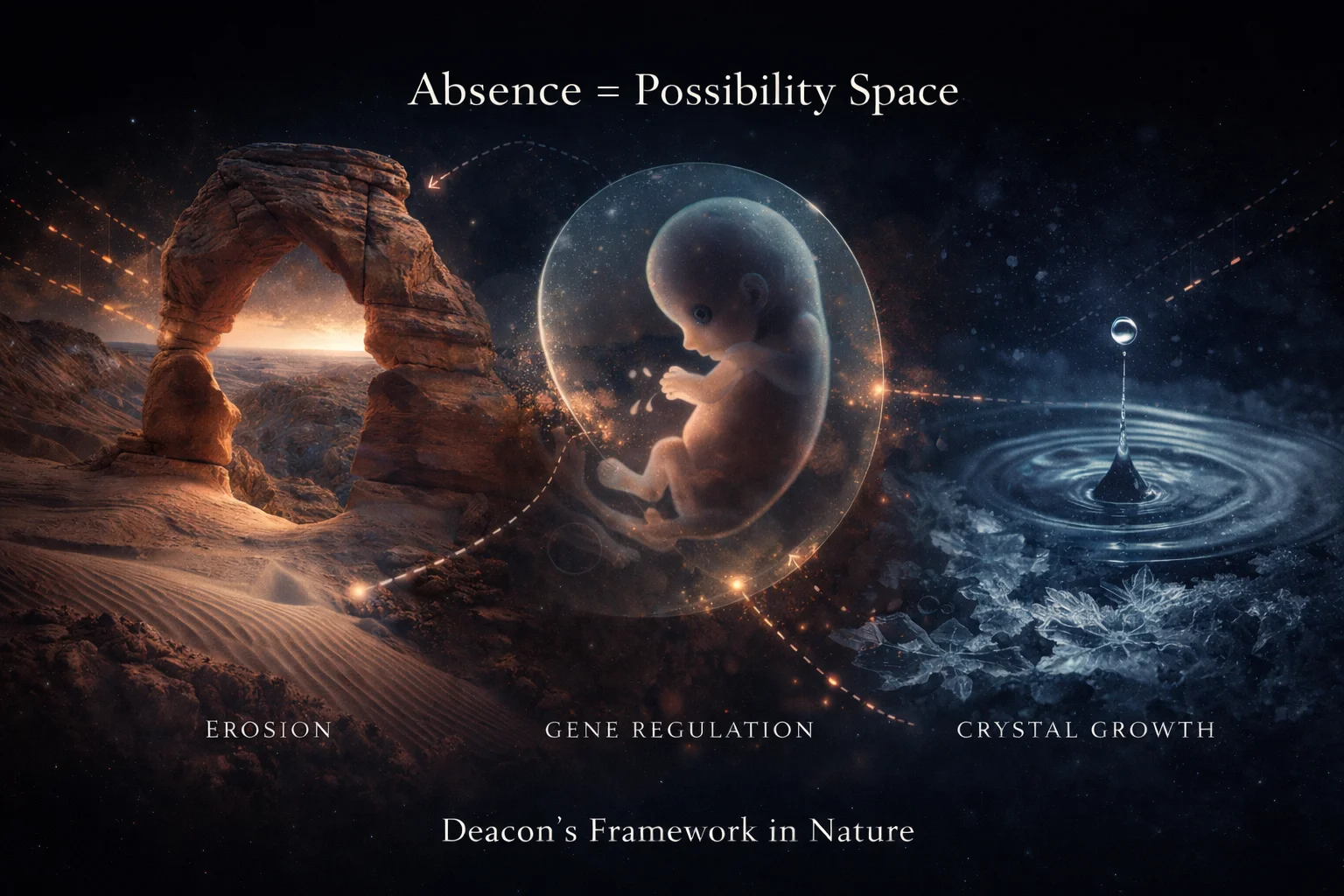
The Core Insight: Absence IS Possibility Space
Deacon’s central contribution is recognizing that what matters in complex systems is often what isn’t happening rather than what is. He calls these “absential” phenomena: things defined by their relationship to what is absent, potential, or merely possible.
Consider Levin’s triangle example. He frames the third angle as a “free gift” from Platonic space. Deacon would reframe this entirely: the third angle isn’t “given” by anything. Rather, the constraints imposed by the first two angles eliminate all possibilities except one. The third angle emerges from absence: the absence of alternatives. Nothing is being provided; possibilities are being removed.
This reframing is not merely semantic. It has profound consequences for mechanism:
- Levin’s framing: Something (Platonic space) actively provides information/computation to physical systems. Mechanism: unspecified.
- Deacon’s framing: Constraints propagate by eliminating possibilities. What remains is what we observe. Mechanism: thermodynamic constraint satisfaction.
Constraint Propagation Replaces “Ingression”
Deacon distinguishes three levels of emergent dynamics:
- Homeodynamics: Thermodynamic processes tending toward equilibrium (entropy increase)
- Morphodynamics: Self-organizing processes that generate form through constraint (dissipative structures, Bénard cells, reaction-diffusion patterns)
- Teleodynamics: Self-sustaining, self-repairing systems that preserve their own constraints (autogenic systems, life)
Each level emerges from the previous through constraint closure: constraints that regenerate the conditions for their own persistence. This is precisely the organizational closure framework of Montévil and Mossio, which provides rigorous mathematical formalization.
Where Levin sees “competencies” arriving through “interfaces” to Platonic space, Deacon sees constraint propagation:
“The defining property of life is not to be found in any specific molecular structure or process, but rather in the self-generating, self-maintaining organization of constraints.” (Deacon, 2012)
The “free lunch” is an illusion created by ignoring the thermodynamic work that established the constraints in the first place. Evolution paid the computational cost; it just paid it in a distributed, historical manner that Levin’s framing obscures.
Xenobots Revisited: Constraint Inheritance, Not Platonic Ingression
Levin asks: “When was the computational cost paid to design xenobots?”
Deacon’s framework provides a clear answer: the constraints were inherited.
Xenobots are composed of frog cells. Those cells carry:
- Ciliary programs (constraints on movement possibilities)
- Adhesion protein configurations (constraints on attachment possibilities)
- Wound healing responses (constraints on tissue reorganization possibilities)
- Gene regulatory networks (constraints on developmental trajectories)
When researchers assembled cells in novel configurations, these pre-existing constraints propagated into the new context. The xenobot’s “competencies” are the residue of evolutionary constraint-building, not imports from Platonic space.
This is testable: xenobots should only exhibit capabilities derivable from their component cellular programs. And indeed, researchers acknowledge this is the case. No mysterious “extra” capabilities have been documented that couldn’t be traced to known cellular mechanisms.
The Adjacent Possible: Kauffman’s Thermodynamic Framing
Stuart Kauffman’s concept of the “adjacent possible” complements Deacon’s framework. At any moment, a system has access to a finite set of next states determined by its current constraints. Evolution and development explore this adjacent possible, not an infinite Platonic space of all conceivable forms.
Kauffman writes in Investigations (Oxford University Press, 2000):
“The biosphere advances into the adjacent possible at just that rate at which it can sustain.”
This provides the “free lunch” explanation Levin seeks, but grounded in physics:
- The adjacent possible is constrained by current organization
- New possibilities open as constraints propagate
- What looks like “getting more than you paid for” is actually exploring pre-structured possibility space
The structure of possibility space isn’t imposed by Platonic forms; it’s generated by the constraints themselves. Constraints beget constraints. This is Deacon’s key insight: absence (of alternatives) is causally efficacious without requiring non-physical causation.
Thermodynamic Accounting: There Are No Free Lunches
The “no free lunch” theorem in optimization (Wolpert and Macready, 1997) states that averaged over all possible problems, no optimization algorithm outperforms random search. Apparent “free lunches” arise only when the algorithm’s structure matches the problem’s structure.
This applies directly to biological “competencies”:
- Evolution builds constraints that match environmental structure
- When these constraints propagate to new contexts, they may “fit” without additional search
- This looks like a free lunch but is actually constraint transfer
The thermodynamic cost was paid during the original constraint-building. Levin’s framing erases this history, then marvels at the apparent something-from-nothing.
Landauer’s principle grounds this further: erasing information (eliminating possibilities, imposing constraints) has a minimum thermodynamic cost of kT ln 2 per bit. Every constraint in a biological system represents thermodynamic work performed somewhere, somewhen. The books balance; there is no Platonic subsidy.
Why Deacon’s Framework Is More Parsimonious
| Feature | Levin’s Platonic Framework | Deacon’s Constraint Framework |
|---|---|---|
| Ontology | Physical + non-physical Platonic space | Physical only (constraints are relational, not substances) |
| Mechanism for “enablement” | Unspecified (“ingression,” “interface”) | Constraint propagation through thermodynamic processes |
| Interaction problem | Unresolved (how does non-physical cause physical?) | Dissolved (no non-physical causation posited) |
| Falsifiability | None specified | Testable: competencies should be derivable from inherited constraints |
| Thermodynamic grounding | Absent | Explicit (Prigogine, Landauer, constraint closure) |
| Explanatory scope | Expands indefinitely (fecundity alibi) | Bounded by physical constraint relationships |
By Occam’s razor, Deacon’s framework is preferable: it explains the same phenomena with fewer ontological commitments and provides actual mechanism where Levin provides only metaphor.
The Void Doesn’t Need Filling from Outside
Absence creates the possibility space and thermodynamic constraint propagation fills the void. More precisely: absence IS the possibility space. What we call “possibilities” are simply what remains after constraints have eliminated alternatives. As constraints propagate, they structure this absence differently, creating what looks like new “capabilities” but is actually differential elimination.
Consider morphogenesis:
- A fertilized egg has many possible trajectories
- Gene regulatory networks impose constraints, eliminating most
- Signaling gradients impose further constraints
- Mechanical forces impose still more
- What remains is the organism
At no point does anything need to be “provided” from outside. The organism emerges from systematic elimination of alternatives. The Picasso tadpoles don’t need Platonic guidance to normalize; their developmental constraints propagate toward stable configurations because unstable configurations don’t persist.
This is not mystical. It’s thermodynamics. Stable configurations are, by definition, those that persist. Selection (natural or developmental) retains what works. What looks like “guidance toward form” is actually “elimination of non-viable alternatives.”
What Deacon’s Framework Predicts That Levin’s Doesn’t
A framework’s value lies in its predictions. Deacon’s constraint-based approach predicts:
- Competency limits: Organisms should only exhibit competencies derivable from their inherited constraints. Novel capabilities should emerge only through constraint propagation from existing capabilities.
- Thermodynamic traces: Building new constraints should have measurable thermodynamic costs. “Free lunches” should be traceable to prior constraint-building work.
- Failure modes: When constraints are disrupted, systems should fail in ways predictable from constraint relationships, not randomly.
- Developmental canalization: The degree of phenotypic robustness should correlate with constraint closure completeness.
Levin’s Platonic framework predicts… what exactly? If “ingression” can provide any competency, nothing is ruled out. If nothing is ruled out, nothing is predicted. The framework is empirically empty.
Conclusion: Constraint Closure, Not Platonic Forms
Every phenomenon discussed in this transcript, from xenobot competencies to Picasso tadpole normalization to planarian regeneration, is explicable through constraint propagation without invoking non-physical causation:
- Xenobots: Inherited cellular constraints operating in novel configurations
- Picasso tadpoles: Developmental constraints propagating toward stable (persistent) configurations
- Planarian regeneration: Neoblast stem cell constraints regenerating body plan
- Mathematical “free lunches”: Logical constraints eliminating alternatives, leaving necessary relationships
The framework that best explains these phenomena while maintaining falsifiability and thermodynamic grounding is not Platonism but organizational closure under constraint propagation: Deacon’s teleodynamics, Kauffman’s adjacent possible, Montévil-Mossio’s closure of constraints, all grounded in Landauer’s thermodynamic minimum and Prigogine’s dissipative structures.
The void doesn’t need filling from Platonic space. Absence structures itself through constraint propagation. What remains after elimination is what we observe. There are no free lunches, only lunches paid for in distributed, historical, thermodynamic currency that certain framings systematically erase from view.
Summary: Systematic Falsification Assessment
Falsification Test Battery Results:
- Flew’s death-of-1000-qualifications: FAILED – The core mechanism (“ingression”) remains permanently undefined. When challenged, Levin retreats to “we’re trying to understand” and “stay tuned for primary research papers.” The hypothesis cannot be falsified because its central mechanism is never specified.
- Epicurean constraint principle: FAILED – Mathematical patterns constrain what configurations are stable. They don’t actively “guide” or “provide.” The transition from “mathematics constrains physics” to “mathematics actively inputs information” is never justified, only assumed.
- Fecundity ≠ validity: FAILED – The framework generates many “implications” but provides no falsifiable predictions. Any surprising observation confirms “ingression”; no observation could refute it.
- Real-but-inert diagnostic: FAILED – Platonic space is posited as “real” and “causally efficacious” but has no specified mechanism of action. This is the classic interaction problem plaguing dualism for centuries, relabeled but not solved.
- Discovery Institute isomorphism: CONFIRMED – Structure parallels ID arguments: complexity → insufficient mechanistic explanation → non-physical causation. Discovery Institute actively promotes Levin’s work as supporting their position.
- Motte-bailey detection: CONFIRMED
- Motte (defensible): “Mathematical relationships constrain physical systems; evolution exploits these constraints.”
- Bailey (indefensible): “Non-physical Platonic forms actively ingress into physical systems, providing free computation and possibly consciousness.”
- Levin oscillates between these positions, retreating to the motte when challenged, advancing to the bailey for explanatory purposes.
- Explanatory vacuum test: THE FRAMEWORK ADDS NO EXPLANATORY POWER – If we remove “Platonic space” and substitute: “developmental systems exhibit robustness, plasticity, and canalization due to evolved gene regulatory network properties,” what explanatory power is lost? None. The same phenomena are explained without non-physical causation. The Platonic framing provides rhetorical drama but no additional predictive or manipulative capacity.
Identified Logical Fallacies and Equivocations:
Key Equivocations:
- Constraint/Enablement: Mathematics constrains possibilities; Levin claims it “enables” active input. These are not equivalent.
- Competency/Complexity: Surprising behavior is labeled “competency” (implying agency), then treated as evidence of Platonic causation. But complexity alone doesn’t require non-physical explanation.
- Interface/Mechanism: “Interface” and “pointer” are used as if explaining how physical-Platonic interaction occurs. They’re metaphors, not mechanisms.
- Discovery/Invention (of mathematics): Levin assumes mathematical Platonism is established fact. It’s a contested philosophical position, not scientific consensus.
- Intelligence (literal vs. metaphorical): “Intelligent interpretation” conflates developmental plasticity with cognitive problem-solving.
Logical Fallacies:
- Argument from incredulity: “I don’t see how conventional biology explains X, therefore Platonic ingression.”
- Category error: Treating mathematical relationships as active causes rather than structural constraints.
- Moving goalposts: Claims evolve under criticism without falsification criteria.
- Appeal to authority: Citing that “physicists have been Platonists” doesn’t validate biological Platonism.
- Question begging: Assuming interaction with non-physical realm exists before providing evidence.
- False dilemma: Presenting only mechanism-based or Platonic explanations while ignoring constraint-based alternatives.
Empirical Claims Summary:
| Claim | Verdict |
|---|---|
| Picasso tadpoles make “normal frogs” | OVERSTATED (partial correction only; eyes never normalize) |
| Planarian mixoploidy (“all cells different chromosomes”) | OVERSTATED (strain-specific, not universal) |
| Rat drowning experiment | SIGNIFICANTLY DISTORTED (baseline is hours, not minutes; effect inverted) |
| White-rumped munia domestication | ACCURATE |
| Stadler/Wagner/Fontana paper | EXISTS (but doesn’t support Platonism) |
| Durant et al. 2017 on planarians | EXISTS (interpretation contested) |
| AI pre-training enabling better optimization | ACCURATE (but explicable without Platonism) |
What Would Falsify Each Major Claim?
| Claim | Falsification Test | Levin’s Provision |
|---|---|---|
| Platonic space exists | Demonstrate complete mechanistic explanation for all morphogenetic competencies | None – any unexplained competency confirms it |
| Free lunches exist | Show all organism capabilities derive from paid computational costs | Unclear how to operationalize |
| Ingression mechanism | Specify physical substrate for non-physical causation | Never specified |
| Xenobots access unpaid-for competencies | Derive all xenobot behaviors from known cellular programs | Researchers already acknowledge this is possible |
| Discrete morphospace attractors | Show continuous spectrum of morphological outcomes under perturbation | Some outcomes are discrete but explained by signaling thresholds |
Alternative Explanations Requiring No Metaphysical Architecture:
Every phenomenon Levin cites has mechanistic alternatives:
- Planarian regeneration: Wnt/β-catenin signaling gradients (Petersen & Reddien labs)
- Picasso tadpole correction: Canalization + prolactin/MMP tissue remodeling (Pinet et al. 2019)
- Xenobot behaviors: Pre-existing cellular programs (cilia, adhesion, wound healing) in novel context
- Mathematical “free lunches”: Mathematical relationships are structural constraints, not active causes
- Rat swimming: Stress physiology, not “hope” (criticized by Hughes et al.)
- AI pre-training benefits: Learned representations providing structured optimization starting points
- Developmental buffering: Heat shock proteins and gene regulatory network architecture
Peer-Reviewed Critiques:
Systems biologist Johannes Jaeger’s critique “Why TAME is Lame” argues that Levin’s framework is “another kind of reductionism… a mechanicist’s dream of predictability and control” dressed in vitalist rhetoric. Jaeger notes the internal contradiction: claiming to escape mechanism while promising engineering applications.
Anatol Wegner’s analysis and discussion on Medium examine the philosophical weaknesses of the Platonic framing, noting that it provides no additional explanatory or predictive power beyond conventional developmental biology.
According to Wikipedia’s summary of Levin’s work, his empirical contributions to bioelectricity research are well-documented in peer-reviewed literature, but the Platonic morphospace hypothesis remains a speculative philosophical overlay rather than an empirical conclusion.
Confidence Assessment and Conclusions
High confidence findings:
- Levin’s empirical work on bioelectricity is peer-reviewed and respected (his lab’s papers appear in legitimate journals)
- The Platonic morphospace hypothesis is a speculative philosophical overlay, not empirical conclusion
- Discovery Institute actively promotes this work as supporting intelligent design
- Core mechanism (“ingression”) remains undefined and likely unfalsifiable
- Several empirical claims are overstated or distorted (rat experiment significantly so)
- The core problem identified by Brash in the opening challenge was never resolved
- Physical causal closure principle (Kim) creates insurmountable problems for non-physical causation
- No Free Lunch theorems (Wolpert-Macready, Aaronson) demonstrate computational limits even for quantum systems
- Kauffman’s related emergence claims require similar metaphysical commitments (van der Merwe 2023)
The fundamental problem is not that Levin asks interesting questions. The robustness of developmental systems genuinely warrants explanation. The problem is that “Platonic ingression” provides no explanation at all. It names the mystery rather than dissolving it. When Levin asks “where did xenobot competencies come from?”, the answer “from Platonic space” has precisely the same explanatory content as “from cellular competencies,” neither specifies mechanism. The difference is that conventional developmental biology provides mechanistic pathways (Wnt, Hedgehog, BMP, bioelectricity) while Platonism provides metaphor.
As systems biologist Johannes Jaeger summarized: the framework is “another kind of reductionism… a mechanicist’s dream of predictability and control” dressed in vitalist rhetoric. The claim to escape mechanism while promising engineering applications is internally contradictory.
What remains genuinely valuable is the empirical research on bioelectricity: pattern formation, regeneration, collective cell behavior. The metaphysical speculation neither helps nor hurts this work; it merely adds unfalsifiable interpretation to falsifiable findings. The science stands; the Platonism adds nothing that can be tested, predicted, or used.
The discussion ended where it began: with Brash’s unanswered challenge. No mechanism for “ingression” was ever specified. No falsification criteria were provided. The framework remains “indistinguishable from” the position that “mathematics, physics and biology all have patterns and rules and why there are any rules and how they get consulted we don’t know.”
References
- Aaronson S. (2008). “The Limits of Quantum Computers.” Scientific American.
- Aaronson S. (2013). Quantum Computing Since Democritus. Cambridge University Press.
- Aaronson S. (2002). “Quantum lower bound for the collision problem.” Proc. ACM STOC, pp. 635-642.
- Binik YM, et al. (1979). “Psychogenic cardiac arrest: A case of sudden death in animals.” Psychosomatic Medicine.
- Bruineberg J, et al. (2021). “The Emperor’s New Markov Blankets.” Behavioral and Brain Sciences.
- Conant RC, Ashby WR. (1970). “Every good regulator of a system must be a model of that system.” International Journal of Systems Science 1(2):89-97.
- Deacon TW. (2012). Incomplete Nature: How Mind Emerged from Matter. W.W. Norton.
- Durant F, et al. (2017). “Long-Term, Stochastic Editing of Regenerative Anatomy via Targeting Endogenous Bioelectric Gradients.” Biophysical Journal 112(10):2231-2243.
- Flew A. (1950). “Theology and Falsification.” University 1:1-8.
- Gould SJ, Vrba ES. (1982). “Exaptation—A Missing Term in the Science of Form.” Paleobiology 8(1):4-15.
- Grohme MA, et al. (2018). “The genome of Schmidtea mediterranea and the evolution of core cellular mechanisms.” Nature 554:56-61.
- Hughes KR, Preskorn SH. (1981). “Richter’s swimming rat experiment: A critique.” Pharmacology Biochemistry and Behavior.
- Jaeger J. “Why TAME is Lame.”
- Kauffman SA. (2000). Investigations. Oxford University Press.
- Kim J. (1998). Mind in a Physical World. MIT Press.
- Kim J. (2005). Physicalism, or Something Near Enough. Princeton University Press.
- Kirschner M, Gerhart J. (2005). The Plausibility of Life: Resolving Darwin’s Dilemma. Yale University Press.
- Kobayashi K, et al. (2009). Planarian polyploidy and mixoploidy studies.
- Landauer R. (1961). “Irreversibility and Heat Generation in the Computing Process.” IBM Journal of Research and Development 5(3):183-191.
- Montévil M, Mossio M. (2015). “Biological organisation as closure of constraints.” Journal of Theoretical Biology 372:179-191.
- Okanoya K. (2004). “The Bengalese Finch: A Window on the Behavioral Neurobiology of Birdsong Syntax.” Annals of the New York Academy of Sciences 1016:724-735.
- Petersen CP, Reddien PW. (2008). “Smed-betacatenin-1 is required for anteroposterior blastema polarity in planarian regeneration.” Science 319(5861):327-330.
- Pinet K, et al. (2019). Prolactin signaling in craniofacial development. Developmental Biology.
- Prigogine I, Stengers I. (1984). Order Out of Chaos: Man’s New Dialogue with Nature. Bantam Books.
- Richter CP. (1957). “On the Phenomenon of Sudden Death in Animals and Man.” Psychosomatic Medicine 19(3):191-198.
- Science and Culture Today (Discovery Institute) on Levin and ID.
- Stadler PF, et al. (2001). “The Topology of the Possible: Formal Spaces Underlying Patterns of Evolutionary Change.” Journal of Theoretical Biology 213(2):241-274.
- Internet Encyclopedia of Philosophy. “Mind and the Causal Exclusion Problem.”
- Internet Encyclopedia of Philosophy. “Emergence.”
- Stanford Encyclopedia of Philosophy. “Mental Causation.”
- Stanford Encyclopedia of Philosophy. “Emergent Properties.”
- Van der Merwe R. (2023). “Stuart Kauffman’s metaphysics of the adjacent possible: A critique.” Interdisciplinary Science Reviews 48(1):49-61.
- Vandenberg LN, Adams DS, Levin M. (2012). “Normalized shape and location of perturbed craniofacial structures in the Xenopus tadpole reveal an innate ability to achieve correct morphology.” Developmental Dynamics 241(5):863-878.
- Wagner A. (2014). Arrival of the Fittest: Solving Evolution’s Greatest Puzzle. Current/Penguin.
- Wegner A. “Michael Levin’s Platonic Biology.”
- Williams D. (2020). “Predictive Processing and the Representation Wars.” Minds and Machines 30:141-172.
- Wolpert DH, Macready WG. (1997). “No Free Lunch Theorems for Optimization.” IEEE Transactions on Evolutionary Computation 1(1):67-82.

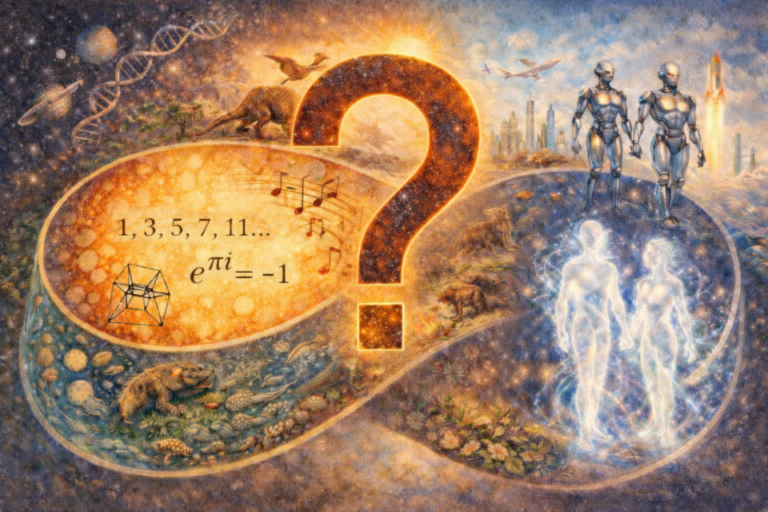
![What Shape Is Persistence? Why Douglas Brash’s Observation the Ship of Theseus Is a Wave Is Insightful (And Why That Is Not the Whole Answer) [Physics, Biology, Neuroscience]](https://sweetrationalism.com/wp-content/uploads/2026/02/Screenshot-2026-02-18-185254-768x713.png)