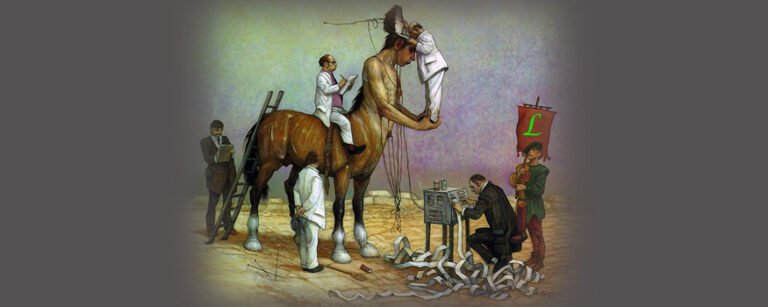

“Mind Everywhere” by Michael Levin & David B. Resnik: The Paper I Predicted
How Levin and Resnik’s “Mind Everywhere” Paper Confirmed Every Predicted Critique I Raised to its Authors Two Months Before Publication
On February 25, 2026, Michael Levin and David B. Resnik published “Mind Everywhere: A Framework for Conceptualizing Goal-Directedness in Biology and Other Domains” as a two-part article in Biological Theory. (Links: Part One | Part Two). The paper defends the Technological Approach to Mind Everywhere (TAME), arguing that cognitive and teleological vocabulary should be applied across all biological scales, from single cells to organisms.
Going forward, I will use “TAME” as shorthand for the body of work Michael Levin has developed under the Technological Approach to Mind Everywhere, including both its peer-reviewed formulations and its broader public defense across podcasts, interviews, and Platonic symposium appearances. I treat these venues together because the metaphysical commitments at issue are articulated across them, not confined strictly to journal articles.
What was striking in the new two-part defense of TAME was not the absence of novel predictions, explicit falsification criteria, or even a coherent account of how a non-physical realm is supposed to exert physical influence. What was more striking was the refusal to engage a named, peer-reviewed, experimentally grounded alternative: organizational closure (Montévil & Mossio), teleodynamics (Deacon), thermodynamic limits on information (Landauer), the free-energy framework (Friston), constraint closure (Kauffman), and mathematical structuralism (Michael Resnik).
All were explicitly raised in advance, and all explain the cited phenomena without invoking transcendent forms or unfalsifiable metaphysics. Most revealing, however, was how precisely the published argument followed the trajectory I had outlined months earlier in private correspondence, including the omission of those specific scholars and frameworks. That degree of predictability seems to strongly suggest a methodological pattern, not an accidental oversight.
Levin has, to his credit, stated in more recent contexts that he does not currently possess direct scientific evidence for Platonic ingression or non-physical causal access, and that these elements represent his interpretation rather than experimentally demonstrated conclusions. However, in public-facing discussions with large lay audiences, those caveats do not always accompany the stronger claims with equal emphasis or methodological framing. Even when such qualifications are present, audiences predisposed toward a particular metaphysical conclusion are far more likely to hear a world-renowned scientist discussing non-physical causation and interpret that as evidential confirmation of beliefs that remain, by definition, unfalsifiable.
When an internationally recognized scientist discusses non-physical causation in biology as a live explanatory possibility, many listeners will reasonably interpret that as a position grounded in positive evidence, rather than as a speculative metaphysical extension layered atop an otherwise naturalistic empirical program that does not presently support that conclusion. That interpretive gap is part of what I am evaluating here.
My critique is therefore directed not at Levin’s experimental biology, whose empirical contributions stand independently of these claims, but at the epistemic status of the metaphysical layer and the standards by which it is presented and defended.
I had been anticipating this publication since my earlier conversations with Dr. Levin and Dr. Resnik. Those exchanges were part of what prompted me to create this site and begin publishing my analyses of TAME and related frameworks that rely on similar Platonic-adjacent skyhooks. In fact, it was at Dr. Levin’s suggestion that I formalize my critiques in writing rather than continue them solely in private discussion. This website, launched less than a month ago, is in part a response to that encouragement and to the arguments now fully developed in their published paper.
Between November 2025 and December 2025, I raised seventeen specific objections to the framework’s philosophical superstructure in documented correspondence with both authors. I told them the paper would defend against eliminative materialism while ignoring constraint-based alternatives. I told them it would substitute productivity for falsifiability. I told them the motte-and-bailey structure between operational naturalism and Platonic metaphysics would persist. I provided falsification criteria, cited primary sources, offered a complete naturalistic alternative, and asked direct questions.
The newly published two-part paper did exactly what I predicted in writing months earlier. Neither author addressed a single one of the seventeen objections, and the paper reproduces the very methodological pattern my framework anticipated.
This is both a case study and demonstration. What follows is the record of that demonstration.
The Prediction Ledger
I will present the three strongest confirmations first, then the full accounting. Every claim below is sourced to emails in my possession and the published text of the TAME papers.
A note on burden of proof: When I presented thermodynamic organizational closure and constraint-based accounts as more parsimonious alternatives to TAME’s Platonic metaphysics, Levin and Resnik’s response was to ask whether I had published anything. This reverses the burden of proof. The frameworks I synthesize do not require my publication to be valid.
- Landauer’s principle (1961) established minimum energy costs for information processing.
- Prigogine’s dissipative structures earned the Nobel Prize in Chemistry (1977).
- Friston’s free energy principle is among the most cited theoretical frameworks in neuroscience.
- Montévil and Mossio’s closure of constraints (2015) is established theoretical biology.
- Kauffman’s autocatalytic sets are foundational to origins-of-life research.
- Michael Resnik’s mathematical structuralism is a standard position in philosophy of mathematics, developed over four decades at UNC Chapel Hill.
- Deacon’s teleodynamics is published by Norton and reviewed in Nature.
These are not speculative proposals awaiting validation or the community to accept my frameworks. They are peer-reviewed, experimentally verified, and in several cases Nobel Prize-winning contributions to physics, biology, and philosophy of science. The question is not whether I have published a synthesis. The question is why a two-part paper in Biological Theory that claims to address goal-directedness in biology does not engage with any of them.
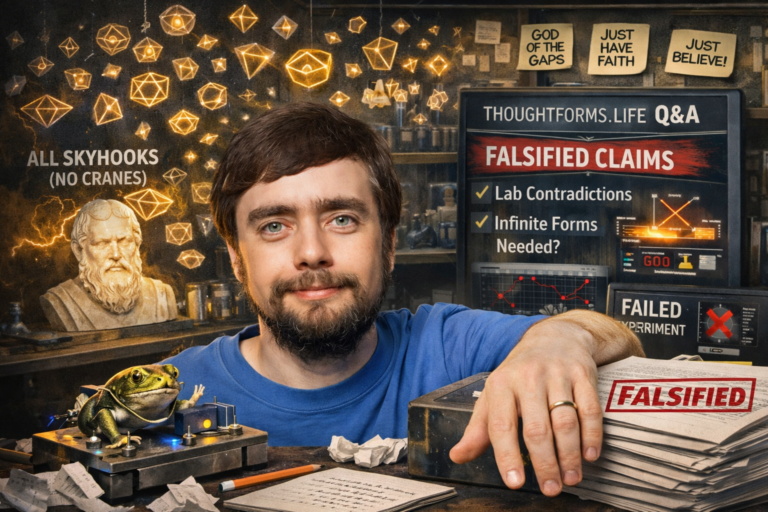
1. Levin’s own lab data falsifies his own metaphysics. Neither author has ever addressed this.
This is the empirical core of everything that follows. If readers take nothing else from this article, they should take this.
In 2017, Levin’s laboratory published results from Durant et al. showing that planarians subjected to transient bioelectric perturbation developed two heads. When those two-headed planarians were cut again without further manipulation, they regenerated as two-headed. This persisted indefinitely across multiple regeneration cycles, months later, in plain water. The altered morphology became the new stable state.
If Platonic forms existed as Levin claims, and if organisms “access” pre-existing ideal forms in a non-physical morphospace, then a clear prediction follows: perturbed organisms should converge back toward the accessed ideal form when given the opportunity. The one-headed planarian body plan exists in Platonic space. The organism is still “accessing” that space. It should trend back toward canonical morphology.
It does not. It stays two-headed. Permanently. Because it is sitting in a new thermodynamic attractor basin, and there is no Platonic form pulling it back.
This is what constraint-based accounts predict: attractors are features of the physical system’s energy landscape. Change the bioelectric constraints, change the attractors. The “target morphology” is not a memory retrieved from a transcendent realm. It is the stable state of the current constraint regime.
I presented this falsification to both Levin and Resnik with the following matrix:
| Phenomenon | Platonism Predicts | Structural Realism Predicts | Levin’s Data Shows |
|---|---|---|---|
| Post-perturbation morphology | Convergence toward ideal form | Persistence in new attractor | Persists indefinitely |
| Two-headed stability | Transient; organism reverts | Stable if basin is reachable | Stable for months+ |
| Xenobot novelty | Forms pre-exist in Platonic space | Forms emerge from constraint exploration | 537 unique transcripts; no template |
For post-perturbation morphology, a Platonic convergence model predicts eventual reversion toward an ideal form, whereas a structural realist or constraint-based account predicts persistence if the system has shifted into a new attractor basin; Levin’s own data show indefinite persistence of the altered morphology. For two-headed stability, Platonism implies transience and eventual reversion, while attractor dynamics predict stability whenever the altered basin is reachable; empirically, the two-headed state remains stable for months and across regeneration cycles. For xenobot novelty, a Platonic account implies that functional forms pre-exist in some ideal space, whereas a constraint-exploration model predicts emergent configurations generated by navigating a viability landscape; the reported 537 unique transcriptomic profiles indicate exploratory emergence rather than convergence on a fixed template.
Structural realism matches the data on every count. Platonism matches on none.
I raised this with Levin beginning in November 2025 and with Resnik in December 2025. I raised it at least four times each, across both correspondences. It appears in timestamped emails I can show, in symposium comments on Dr. Levin’s own’s website, and in direct messages. All verifiable facts.
Neither author has ever responded to it. Not once. Not in any medium. The published Part Two paper presents the planarian results as evidence for the framework without engaging the convergence problem.
The single most empirically specific challenge to the framework’s metaphysical interpretation, drawn from the senior author’s own laboratory, has been met with silence for over three months.
2. The co-author privately told me he favors the framework that contradicts the paper he published.
David Resnik is a bioethicist at the National Institute of Environmental Health Sciences and the son of Michael D. Resnik, whose Mathematics as a Science of Patterns (1997) is one of the foundational texts of mathematical structuralism. The elder Resnik spent four decades arguing that mathematical objects are positions in structures, not Platonic substances, that their identities are fixed only through their relationships to each other, and that the mathematical/physical distinction is “elusive” because Quinean holism dissolves it.
Platonic realism and mathematical structuralism are incompatible positions. Structuralism holds that mathematical structure is immanent in physical process. Platonism holds that mathematical forms exist in a transcendent realm that physical systems “access” through “ingression.” Structuralism was designed to dissolve the need for transcendent mathematical realms by showing that mathematical objects ARE their structural relations, not substances residing elsewhere. Platonism posits exactly the transcendent realm structuralism eliminates.
I wrote to David Resnik on December 28, 2025, and asked him directly: “Do you believe in transcendent Platonic forms that organisms access? Or do you believe mathematical structure is immanent in physical process, as structuralism holds and Platonism contradicts?”
He responded the same day: “My own view is much closer to my father’s structuralism, and I hope I can convince Michael that this is a workable position.”
He confirmed this twice more over the following days: “Structuralism is the position I favor and I hope to convince Michael of.”
Approximately two months later, the published paper appeared. It contains no engagement with mathematical structuralism. It does not cite Michael D. Resnik. It does not present structuralism as an alternative interpretive framework. It does not acknowledge that the co-author’s privately stated philosophical position contradicts the paper’s implicit metaphysical commitments.
David Resnik told me, in writing, that Platonism is not his position and that he would try to move Levin toward structuralism. Then he co-published a paper that reflects no such movement.
3. Levin described his framework in theological language, then denied it within 24 hours, in his own words, on his own platform.
On December 27, 2025, Michael Levin wrote on his Thoughtforms symposium (link):
“Hopefully the Platonic Space is more relaxed about being investigated. It’s cagey and shy, but not maliciously so (in Einstein’s terms). Like quantum foam and some other stuff, I think it doesn’t like to be observed directly, but can be, if you’re clever and subtle.”
On December 28, 2025, Levin posted a “clarification” (link):
“I do not claim that the system as a whole has any directionality for whether we notice these things or not. I have made no claims about that.”
These statements are twenty-four hours apart, on the same platform, in the same thread. The first attributes five distinct preferences to Platonic space: “cagey” (preference for concealment), “shy” (preference for avoiding attention), “doesn’t like to be observed directly” (explicit preference against observation), “resistant to direct observation” (preference for resisting detection), and accessibility only to the “clever and subtle” (preference for subtle over direct approaches).
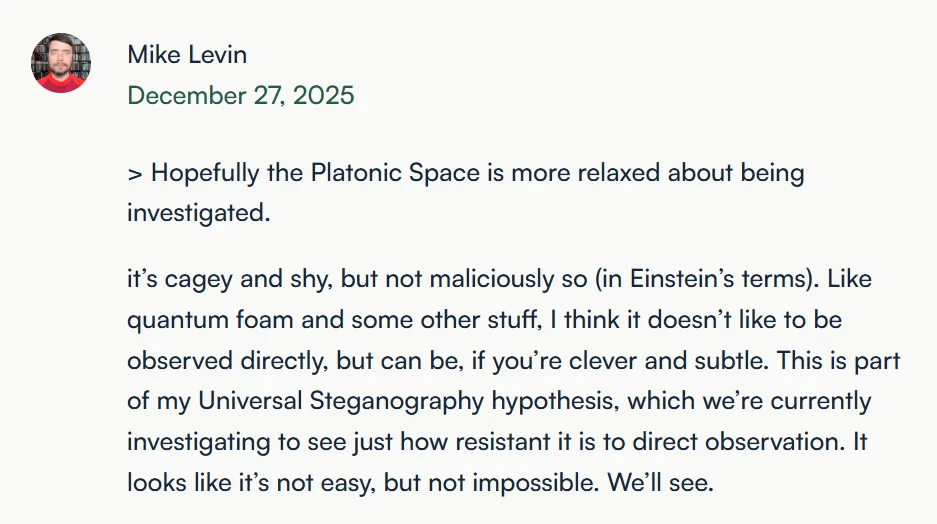
The second denies having made any claims about directionality or preference.
I am not interpreting or paraphrasing. These are direct quotes. Readers can verify them at the cited (Links). The contradiction is in the text itself.
The logical structure of “the realm hides from observation” is identical to the logical structure of unfalsifiable theological claims. If evidence is found, the hypothesis is confirmed. If evidence is not found, the realm was hiding. If results are ambiguous, better tools are needed. If the researcher’s own data actively disconfirms the hypothesis (Durant et al. 2017), the data is reinterpreted or ignored.
John Bell showed how to make hidden-realm questions empirical. He derived specific inequalities that must hold if local hidden variables exist. Aspect’s experiments violated those inequalities. Hidden variables were falsified. Question resolved. Bell did not say hidden variables were “shy.” He asked what observable difference they would make, then looked.
Levin’s “Universal Steganography” does the reverse. Instead of deriving what observable signature Platonic access would leave and what would falsify it, he explains the absence of evidence as a feature of the phenomenon. This is Bell’s theorem in reverse.
I asked Levin directly, in writing, multiple times: “What empirical result would make you say ‘I was wrong, there is no Platonic realm’?”
The question remains unanswered after more than three months.
Correspondence Record
Between November 2025, and December 2025, I exchanged emails with both Michael Levin and David Resnik. The exchanges are extensive and documented. What follows is the accounting of every substantive issue I raised and how each author responded.
What I told them and what happened
Issue 1: The Platonic-naturalist contradiction. I argued that Levin’s claim of a “non-physical latent space” that “breaks the closure of the physical world” is a skyhook by Dennett’s own definition, incompatible with the naturalism both authors claim.
Resnik’s response: Invoked Dennett’s credentials and mentorship of Levin as implicit defense. Did not address the crane/skyhook distinction or the specific philosophical departures I documented.
What the published paper does: Claims compatibility with scientific materialism. Objection 2 states: “We are not assuming the existence of metaphysically irreducible minds.” This is the motte. Levin’s concurrent public statements occupy the bailey.
Issue 2: The motte-and-bailey structure. I documented four dimensions of oscillation: published papers vs. interviews, mechanism vs. Platonism, cognition as engineering protocol vs. cognition as literal, anti-panpsychism vs. panpsychism.
Resnik’s response: “I do not consider it to be my business to correct what Michael Levin may have said about Platonic space on videos, podcasts, blogs, etc.”
What the published paper does: Remains in the motte. “Cognitive and teleological claims are really hypotheses of optimal interaction protocols.” Levin’s public Platonism continues uncorrected.
Issue 3: The false dichotomy. I told Resnik, explicitly and repeatedly, that his defense against eliminative materialism was a straw man because I do not hold that position. My framework rejects both eliminative materialism and Platonism as incoherent because both presuppose substance ontology.
Resnik’s response: Continued providing quotes defending against eliminative materialism even after I identified this as a straw man three times.
What the published paper does: Defends against eliminative materialism. Does not engage with organizational closure theory (Montévil-Mossio), teleodynamics (Deacon), constraint satisfaction accounts, or mathematical structuralism.
Issue 4: The Dennett departure. I documented four specific ways the post-2024 TAME framework violates the Dennettian guardrails that the 2020 Levin-Dennett collaboration operated within.
Resnik’s response: “Daniel Dennett was his philosophical mentor and they wrote a paper together. Dennett was a hardcore materialist and no intellectual slouch!”
What the published paper does: Continues invoking the Dennett collaboration as a credibility anchor for claims far beyond what Dennett endorsed. Dennett died in April 2024 before Levin’s most expansive metaphysical claims. No post-2020 Dennett publication addresses TAME.
Issue 5: The falsifiability crisis. I asked, in at least six separate messages across both correspondences: “What falsifiable predictions does Platonism make that thermodynamic alternatives don’t?” I provided specific falsifiable predictions that would distinguish the two frameworks and proposed laboratory experiments Levin’s own lab could run.
Levin’s response: Never answered. Offered to address a 500-700 word summary. Declined to engage with falsification criteria across six weeks of correspondence.
Resnik’s response: Provided quotes from the preprint’s operational definitions (which were not under challenge) in response to every falsifiability question. Never provided a single falsification criterion for Platonic ingression.
What the published paper does: Substitutes “fecundity in discovery” (productivity) for falsifiability as the standard of evaluation.
Issue 6: Durant et al. 2017. Documented above. Raised at least four times. Never addressed by either author.
Issue 7: Structuralism/Platonism incompatibility. Documented above. Resnik conceded the incompatibility privately and took no public action.
Issue 8: The interaction problem. I asked how non-physical forms causally influence physical morphogenesis, citing the IEP definition (“an impenetrable metaphysical gap between the mathematical and spatio-temporal realms”) and the SEP definition (“no possibility of identifying them with the kind of natural facts that have physical effects”). This is Aristotle’s objection to Plato, unanswered for 2,400 years.
Neither author responded. The mechanism of “ingression” has never been specified.
Issue 9: Landauer’s principle. I noted that Levin describes Platonic space as providing “free lunches, stuff we didn’t pay for,” while Landauer (1961) demonstrated a minimum energy cost per bit erased or processed. I asked: where is the energy accounting for accessing independent mathematical facts?
Neither author responded.
Issue 10: The fecundity alibi. I argued that the empirical programme’s productivity does not validate the metaphysical superstructure, citing the standard philosophical grounds: Ptolemy was productive for centuries, phlogiston chemistry enabled systematic discovery, caloric theory generated useful research. Lakatos’s methodology distinguishes a programme’s empirical fertility from the truth of its foundational assumptions.
Resnik’s response: Implicitly performed the fecundity alibi by consistently responding with quotes about TAME’s empirical successes whenever the philosophical superstructure was challenged, without ever stating the conflation explicitly enough to rebut.
What the published paper does: Makes “fecundity in discovery” its second pillar, exactly as I predicted.
Issue 11: Thermodynamic organizational closure as a complete alternative. I presented a detailed naturalistic framework synthesizing established scholarship (Montévil-Mossio closure of constraints, Deacon’s teleodynamics, Friston’s free energy principle, Kauffman’s constraint closure, Landauer’s information thermodynamics, Rovelli’s relational quantum mechanics, and Michael Resnik’s mathematical structuralism). This framework explains every phenomenon TAME addresses without cognitive vocabulary.
Resnik’s response: “When you say ‘My framework operationalizes this…’ Have you published anything on this?”
This was the only engagement the alternative received: a question about my publication record rather than about the argument’s content. Resnik did not apply the same publication standard to Levin’s public Platonic claims, which appear in podcasts, YouTube videos, and blog posts rather than peer-reviewed journals.
What the published paper does: Contains no engagement with organizational closure theory, teleodynamics, or constraint-based accounts of goal-directedness.
Issue 12: Discovery Institute weaponization. I documented that the Discovery Institute and affiliated organizations cite Levin’s Platonic language to support intelligent design arguments. I cited NIH Scientific Integrity Policy (2024), ICMJE co-authorship criteria, Helgesson & Eriksson (2017) on co-author responsibility, and Baur et al. (2015) on scientific integrity obligations.
Levin’s response: “I don’t know what the Discovery Institute has to do with forest fires.” (The causal chain was documented in my email: Platonic terminology → ID citation → anti-science coalition → climate policy paralysis → ecosystem collapse.)
Resnik’s response: “I do not consider it to be my business to correct what Michael Levin may have said about Platonic space on videos, podcasts, blogs, etc.” He did not engage with the NIH, ICMJE, or Helgesson & Eriksson citations despite holding a professional bioethics position at NIH.
What the published paper does: Contains no acknowledgment of or defense against Discovery Institute appropriation.
Issue 13: The persuadability continuum’s hidden discontinuity. I noted that the continuum between mechanical rewiring and rational persuasion disguises a qualitative leap between causal manipulation and normative engagement with propositional content.
Neither author responded.
Issue 14: Resnik’s immanence/independence contradiction. Resnik claimed mathematics is “immanent in the world, not separate from it” while concluding there can be “mathematical facts that are independent of physical facts.” I demonstrated these are mutually exclusive using definitions from the IEP and SEP and citations from his father’s own work.
Resnik did not respond after I demonstrated the incoherence.
Issue 15: The Tegmark/Wolfram appeal. Resnik invoked Tegmark’s Mathematical Universe Hypothesis and Wolfram’s Ruliad as supporting authorities. I provided peer-reviewed critiques demonstrating both are considered unfalsifiable by mainstream physics (Natal 2024, Rickles et al. 2023, Hossenfelder, Woit, Smolin).
Resnik did not respond to the rebuttals.
Issue 16: Co-author responsibility. I cited four professional ethics standards establishing that co-authorship carries responsibility for the integrity of the scientific record. Resnik’s response compartmentalized his responsibility to exclude the paper’s function as credibility cover for Levin’s public Platonism.
Issue 17: The Argument from Ignorance
The inferential move at issue was not merely, “alternatives fail, therefore Platonism stands.” It was more specific: naturalistic accounts were treated as unable to explain goal-directed morphogenesis, thereby preserving Platonic or ingression-based metaphysics as a legitimate explanatory option. At the same time, significant attention was directed toward rebutting eliminative materialism, a position I had explicitly rejected and that few contemporary physicists or systems theorists defend in the form presented.
The structure of the move is:
“Naturalistic alternatives cannot fully explain X; therefore, a Platonic or ingression-based framework remains viable.”
This is an argument from ignorance unless two conditions are satisfied:
- The relevant alternatives have been fully evaluated and shown to fail on specified criteria.
- The proposed framework generates independent, discriminating predictions that differ from those alternatives.
In correspondence, I did not present a vague appeal to “naturalism.” I presented a concrete, peer-reviewed alternative: thermodynamic organizational closure and constraint-based attractor dynamics, grounded in Montévil & Mossio, Deacon, Landauer, Friston, Kauffman, and related work. I provided a structural derivation and a comparative matrix identifying empirical differentiators.
The constraint-based account explains both stability of canonical morphology under normal conditions and path-dependent divergence when constraint regimes are altered. The two-headed planarian case is decisive here. Under an attractor-based framework, transient bioelectric perturbation shifts the system into a new basin of attraction. Persistence across regeneration cycles is expected. Under a Platonic convergence model, access to an ideal form predicts reversion toward canonical morphology once perturbation ceases, unless auxiliary assumptions are added.
Durant et al. (2017) shows indefinite persistence of the altered morphology. That result is predicted by attractor dynamics. It is not predicted by a straightforward convergence-to-ideal interpretation.
I asked directly whether TAME’s metaphysical commitments yield predictions that would differ from constraint-based accounts. I proposed explicit empirical discriminators. The response consisted of two philosophical counterquestions regarding scope and teleology, which I answered in detail while restating the falsifiability challenge. No differential predictions for Platonic ingression were provided, and the attractor-based explanation was not engaged on its merits.
The issue is not whether constraint-based accounts are complete. The issue is whether TAME’s metaphysical layer survives differential testing. A framework cannot be preserved by declaring alternatives incomplete while leaving a specific, empirically adequate alternative unaddressed. Nor does incompleteness of one account constitute evidence for another that lacks discriminating falsification criteria.
Unless the constraint-based predictions are rebutted or Platonic ingression yields distinct empirical signatures, the move from “naturalism is incomplete” to “therefore Platonic metaphysics remains viable” does not follow.
The scorecard
Seventeen issues raised. Substantive engagements from either author: zero.
Levin’s documented response pattern across six weeks: declined to answer falsification questions while recording YouTube videos defending Platonism, held critical comments in moderation while approving uncritical praise, described his framework in theological language and denied it within 24 hours, and closed correspondence by claiming my documented concerns were “slowing him down.”
Resnik’s documented response pattern across three days: confirmed structuralism is his preferred position three times, retreated to the preprint’s operational content every time the metaphysical content was challenged, applied a publication-record standard to my naturalistic alternative that he did not apply to Levin’s informal Platonism, and closed by asking me to wait for formal publication and “write letters.”
What the Published Paper Does
The published Mind Everywhere Part Two, which appeared approximately two months after these exchanges, does the following:
It defends against eliminative materialism. This is a position I explicitly rejected as incoherent in my first substantive email to each author. I told them I was not a materialist. I told them my framework rejects materialism for the same reasons it rejects Platonism: both presuppose substance ontology. The paper defends against the straw man I identified in advance.
It substitutes “fecundity in discovery” for falsifiability. Its second pillar evaluates frameworks by their productivity rather than their testability. I told Resnik this move was coming and explained why it fails (Lakatos, Laudan, van Fraassen, Duhem-Quine). The paper makes the move without engaging with any of these standard objections.
It presents cognitive attributions as “hypotheses of optimal interaction protocols” while Levin’s concurrent public statements treat cognition as ontologically real in cells. The motte-and-bailey I documented in November continues exactly as documented.
It contains no engagement with mathematical structuralism, organizational closure, teleodynamics, thermodynamic monism, Landauer’s principle, the interaction problem, Durant 2017 as falsification, or any of the seventeen issues raised. It does not cite Michael Resnik, Montévil-Mossio, Deacon, Landauer, or Friston in connection with organizational closure.
It does not acknowledge Discovery Institute appropriation.
What This Means
I want to be precise about what I am claiming and what I am not claiming.
I am not claiming that Levin’s empirical work is unsound. His laboratory’s demonstrations that bioelectric patterns influence morphogenesis constitute genuine, replicable, important science. The two-headed planarian work, the ectopic organogenesis, the xenobot self-organization, the bioelectric cancer suppression: these are confirmed experimental results that advance developmental biology regardless of any philosophical framework.
I am not claiming that cognitive vocabulary is useless in biology. As a Dennettian engineering heuristic, treating biological systems at the appropriate level of abstraction is genuinely productive. Levin’s own operational definitions (what perturbations a system can resist, what information it encodes, what interaction protocols prove effective) are naturalistic and valuable.
I am claiming that the philosophical superstructure (Platonic space, ingression, non-physical causation, “minds everywhere” as ontological rather than heuristic claim) fails every standard test of scientific validity:
It is unfalsifiable. No observation counts against it. “What would convince you the Platonic Space hypothesis is wrong?” has no answer.
It contradicts the senior author’s own data. Durant et al. 2017 shows path-dependent divergence where Platonism predicts convergence toward ideal forms.
It lacks a mechanism. How non-physical forms causally influence physical morphogenesis has never been specified. This is Aristotle’s objection to Plato, unanswered for 2,400 years.
It violates established physical principles. Landauer (1961) demonstrated minimum energy costs for information processing. “Free lunches from Platonic space” contradicts this.
It contradicts the co-author’s privately stated position. Resnik told me he favors structuralism and would try to move Levin. The published paper reflects no such movement.
It is actively weaponized. The Discovery Institute cites Levin’s Platonic language to support intelligent design arguments. This is documented, ongoing, and unaddressed.
The framework’s defenders have had every opportunity to answer. I provided specific falsification criteria, proposed laboratory experiments, cited primary philosophical sources, and asked direct questions. I received zero substantive engagements across seventeen issues, two correspondences, and more than three months.
Answers, if they existed, could be stated in a few sentances. Instead, I’ve got thousands of words of evasion and then eventual dismissal and severed communication.
The Alternative That Already Works
Everything the TAME framework claims to explain is already explained, without cognitive vocabulary, by the thermodynamic organizational closure literature.
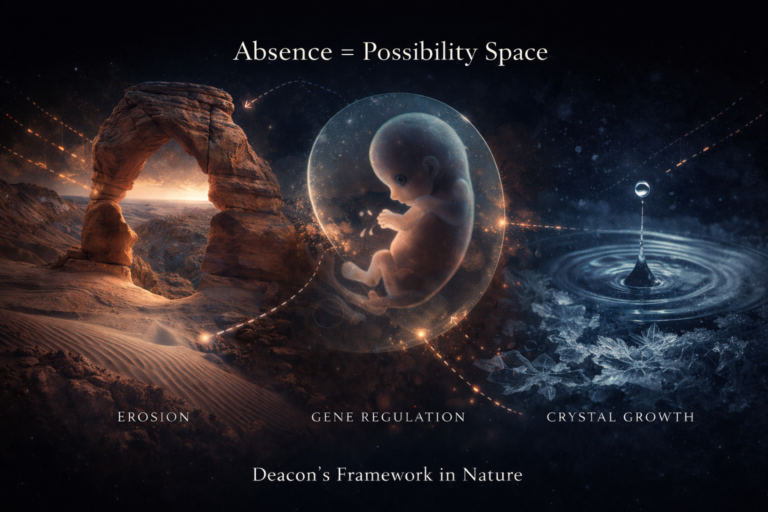
Regeneration is not a tissue “remembering” its target morphology and “problem-solving” to achieve it. It is the restoration of organizational closure after perturbation. The system’s identity is its closure regime: the specific set of mutually dependent constraints. When perturbed, remaining constraints channel thermodynamic processes toward re-establishing the full network. The “target morphology” is the attractor state of the constraint regime.
Multi-scale competency is closure operating at multiple timescales. Bioelectric signaling consists of constraints on developmental processes that are themselves products of other constraints. Collective cell coordination is explained by coupling of constraints through shared processes.
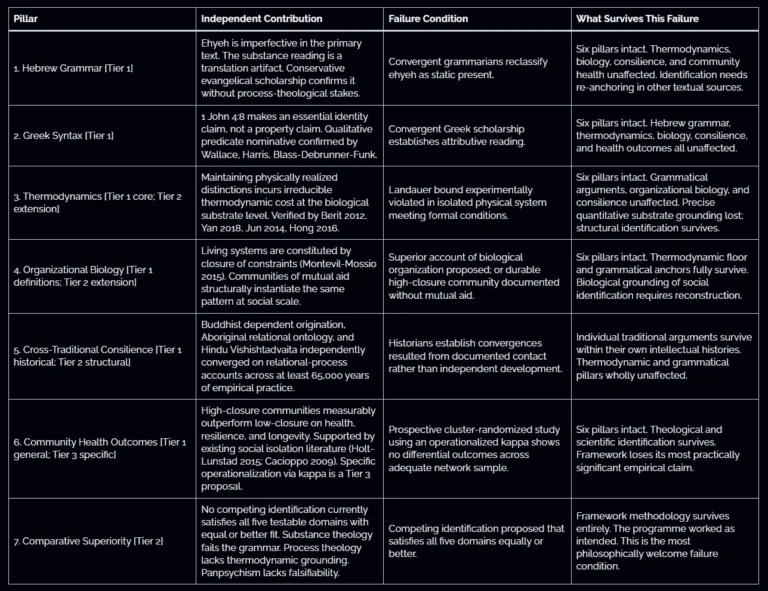
The thermodynamic monism synthesis: all distinctions cost energy (Landauer 1961), identity equals invariance under perturbation, constraints regenerate their own conditions (Montévil-Mossio 2015). This three-step derivation yields everything TAME claims to explain: self-maintenance, goal-directedness, multi-scale agency, homeostasis, morphogenetic target states.
“Goals” are attractor states. “Memories” are persistent constraints. “Problem-solving” is the system’s trajectory through state space toward the attractor. Adding cognitive vocabulary to these descriptions adds rhetorical force but zero explanatory power.
This framework makes predictions Platonism cannot: that disrupting thermodynamic constraints disrupts morphogenesis (confirmed), that path-dependent initial conditions determine final morphology (confirmed by Durant et al. 2017), that no form-maintenance occurs without energy expenditure (confirmed universally), and that novel forms emerge from novel constraint configurations rather than from accessing pre-existing patterns (confirmed by xenobot transcriptomic diversity).
The constraint-based account is not my invention. It synthesizes Montévil and Mossio (2015), Moreno and Mossio (2015), Kauffman’s constraint closure, Hordijk-Steel-Kauffman RAF sets, Deacon’s teleodynamics, Friston’s free energy principle, Michael Resnik’s mathematical structuralism, Rovelli’s relational quantum mechanics, and Prigogine’s dissipative structures. Every component is established, peer-reviewed scholarship. The synthesis dissolves every problem the TAME framework’s philosophical superstructure creates while preserving everything the empirical programme produces.
A Note on How This Article Came to Exist
I do not hold a faculty position. I have thirty years of independent transdisciplinary research. I mention this because it will be used against me, and I prefer to state it myself rather than have it deployed as a gotcha. Dr. Levin encouraged me to write a blog, and engage the community. That’s what I am doing.
The arguments in this article do not require credentials to evaluate. They require the reader to check whether Durant et al. 2017 shows path-dependent divergence or Platonic convergence (it shows divergence), whether the IEP and SEP define Platonism and naturalism as compatible or incompatible (they define them as incompatible), whether Resnik told me he favors structuralism (he did, in writing), and whether the published paper engages with any of the seventeen issues I raised (it does not).
These are verifiable facts, not arguments from authority. If my analysis is wrong, the correction requires showing where the analysis fails, not where my CV is thin.
I contacted both authors privately and respectfully before writing publicly. I gave Levin and Resnik months to engage substantively, and in the end was met with dismissal and silent treatment. I answered every question they posed. They answered none of mine.
The record, and the truth, speaks for itself.
Primary sources cited:
Durant, F., Morokuma, J., Fields, C., Williams, K., Adams, D. S., & Levin, M. (2017). Long-Term, Stochastic Editing of Regenerative Anatomy via Targeting Endogenous Bioelectric Gradients. Biophysical Journal, 112(10), 2231–2243. https://doi.org/10.1016/j.bpj.2017.04.011. PubMed: https://pubmed.ncbi.nlm.nih.gov/28538159/. PDF (open): https://www.chrisfieldsresearch.com/bioelectric-epigenetics-BJ-2017.pdf.
Levin, M., & Resnik, D. B. (2026). Mind Everywhere: A Framework for Conceptualizing Goal-Directedness in Biology and Other Domains—Part One. Biological Theory. Published 25 February 2026. https://doi.org/10.1007/s13752-025-00523-6.
Levin, M., & Resnik, D. B. (2026). Mind Everywhere: A Framework for Conceptualizing Goal-Directedness in Biology and Other Domains—Part Two. Biological Theory. Published 25 February 2026. https://doi.org/10.1007/s13752-025-00524-5.
Resnik, M. D. (1997). Mathematics as a Science of Patterns. Clarendon Press; Oxford University Press. Internet Archive (controlled digital lending): https://archive.org/details/mathematicsassci0000resn.
Montévil, M., & Mossio, M. (2015). Biological organisation as closure of constraints. Journal of Theoretical Biology, 372, 179–191. https://doi.org/10.1016/j.jtbi.2015.02.029. PubMed: https://pubmed.ncbi.nlm.nih.gov/25752259/.
Deacon, T. W. (2012). Incomplete Nature: How Mind Emerged from Matter. W. W. Norton & Company. Internet Archive (controlled digital lending): https://archive.org/details/incompletenature0000deac.
Landauer, R. (1961). Irreversibility and heat generation in the computing process. IBM Journal of Research and Development, 5(3), 183–191. https://doi.org/10.1147/rd.53.0183. PDF (open): https://sites.pitt.edu/~jdnorton/lectures/Rotman_Summer_School_2013/thermo_computing_docs/Landauer_1961.pdf.
Friston, K. (2010). The free-energy principle: a unified brain theory? Nature Reviews Neuroscience, 11(2), 127–138. https://doi.org/10.1038/nrn2787. PubMed: https://pubmed.ncbi.nlm.nih.gov/20068583/. PDF (open): https://www.fil.ion.ucl.ac.uk/~karl/NRN.pdf.
Levin, M., & Dennett, D. C. (2020). Cognition all the way down. Aeon. https://aeon.co/essays/how-to-understand-cells-tissues-and-organisms-as-agents-with-agendas.
Popper, K. (1963). Conjectures and Refutations: The Growth of Scientific Knowledge. Routledge. https://doi.org/10.4324/9780203538074. Internet Archive (scan): https://archive.org/details/karl-popper-conjectures-and-refutations-the-growth-of-scientific-knowledge.
Lakatos, I. (1978). The Methodology of Scientific Research Programmes: Philosophical Papers Volume 1. Cambridge University Press. Cambridge Core: https://www.cambridge.org/core/books/methodology-of-scientific-research-programmes/8DBCEFE34A59BAD3D393FB958A4DC5FC.
Dennett, D. C. (1995). Darwin’s Dangerous Idea: Evolution and the Meanings of Life. Simon & Schuster. WorldCat record: https://www.worldcat.org/title/darwins-dangerous-idea-evolution-and-the-meanings-of-life/oclc/34925327.
National Institutes of Health. (2024). Final Scientific Integrity Policy of the National Institutes of Health. Federal Register (21 Oct 2024): https://www.federalregister.gov/documents/2024/10/21/2024-24225/final-scientific-integrity-policy-of-the-national-institutes-of-health. PDF: https://osp.od.nih.gov/wp-content/uploads/2024/09/Final-NIH-Scientific-Integrity-Policy.pdf. Rescission notice: https://grants.nih.gov/grants/guide/notice-files/NOT-OD-25-080.html.
Helgesson, G., & Eriksson, S. (2017). Responsibility for scientific misconduct in collaborative papers. Medicine, Health Care and Philosophy, 21(3), 423–430. https://doi.org/10.1007/s11019-017-9817-7. PMC (open): https://pmc.ncbi.nlm.nih.gov/articles/PMC6096512/.
Baur, X., Budnik, L. T., Zhao, Z., Bratveit, M., Djurhuus, R., Verschoor, L., Rubino, F. M., Colosio, C., & Jepsen, J. R. (2015). Health risks in international container and bulk cargo transport due to volatile toxic compounds. Journal of Occupational Medicine and Toxicology, 10, 19. https://doi.org/10.1186/s12995-015-0059-4. PMC (open): https://pmc.ncbi.nlm.nih.gov/articles/PMC4465480/.
Additional Articles On Biological Platonism: Platonism Falsified by Bioelectric Data | Bubble Sort Misunderstood | Xenobot History & Computational Cost | Platonic Morphospace Analysis | Cognition All the Way Down 2.0 | Constraint vs Basal Cognition | Levin Misrepresentation Response | Dissolving Cognitive Glue | RCF Metaphysics Audit | Platonic Patterns Without Baggage | Levin & Diverse Intelligence | Is Platonic Morphogenesis Scientific? | Platonic Space Discussion I | Platonic Spiral or Circle? | Thermodynamics vs Platonism | Cognitive Platonism Dissolved | Chladni Plate Alternative | Primary Evidence Compilation