RE: Sam Senchal’s False Claim That I’ve “Attacked” Platonic Symposium Space Scholars: When Basic Falsification Audits Get Reinterpreted as an “Attack”.
On the False Claim That Empirical Evaluation Constitutes an “Attack” Rather Than What Good Science Demands
How a personally attacking response article claiming to concede personal attacks are “below the standards” he sets for himself , three unanswered questions, demonstrably false accusations that I am “attacking” scientists by showing them naturalistic terstable alternatives to unfalsifiable metaphysics, two blocks despite me never saying a single unkind word to him, an unfalsifiable religious preference, and a deleted comment thread that functions to try to hide the evidence documented exactly what happens when unfalsifiable metaphysical dogmatism gets mistaken for reasoned scientific discourse.
Before responding to a single substantive claim in Sam Senchal’s article “critiquing” my work (specifically my empirical critiques of Wolfram’s metaphysics and Sam’s God Conjecture/Observer Theory and my thermodynamically grounded constraint-based falsifiable alternative to their unfalsifiable unconstrained metaphysical frameworks), I want to correct the premise his article is built on, because nothing that follows makes sense without it. Senchal’s piece characterizes roughly 200,000 words of published work as an attack on participants in Levin’s Platonic Morphospace Symposium rather than what it is: documentation and empirical evaluation/observations following strict scholarly standards. Those same articles, which anyone can read, contain extended praise for Douglas Brash, Gordana Dodig-Crnkovic, Brian Cheung, Pavel Chvykov, David Resnik, and others by name, praising their empirical contributions specifically and at length. Not one participant was personally attacked in any article. The target was never the scientists or individuals (this is substance dualistic thinking anyways, which contradicts process-relational adjacent frameworks I advocate for). It was the unfalsifiable Platonic metaphysical framing those scientists do not need, that adds no explanatory power to their work, and that demonstrably hands the Discovery Institute a credentialing opportunity they have wasted no time exploiting that I objected to.
Correcting that framing is not attacking the people whose work is being misappropriated by it. It is the opposite; it is protecting them and their work from misappropriation. It is showing that I appreciate their work enough to be dedicated to protecting it from metaphysical overreach that causes demonstrable harm. And it is worth being explicit about what “demonstrable harm” means at scale: frameworks that blur the line between unfalsifiable metaphysics and empirical science do not stay confined to academic comment threads; they migrate into science education policy, public funding priorities, medical research paradigms, and the rhetorical arsenal of movements that have spent decades looking for credentialed cover, which means that finding a finding of “repetitive” to be an adequate response to a demand for testable falsification criteria is not merely an intellectual failing but a failure of responsibility to the billions of people whose lives are shaped by whether the institutions claiming scientific authority actually practice it.
Numerous Platonic symposium members thanked me for my critiques, calling them “excellent,” confirming the validity of many of the points I have brought up, and extending offers to collaborate on projects, including my falsification paper I am working on. Only those with demonstrated desires and motivations to insulate unfalsifiable metaphysics from empirical scrutiny have reacted negatively to my contributions. Hitchens diagnosed this precisely; unfalsifiable metaphysics is harmful to critical thinking. He showed in his article that he knows how to apply falsification pressure to my work, but critical thinking would have prompted him to do the same with his work and be honest about where the limitations of his work are.
The strawmanning contradiction in Sam’s own response article, made visible:
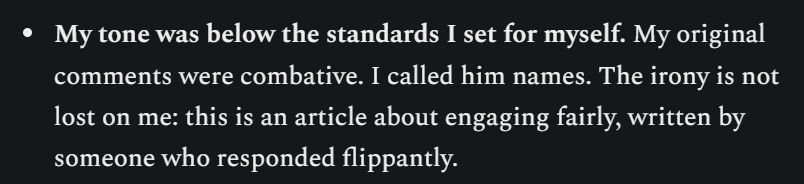
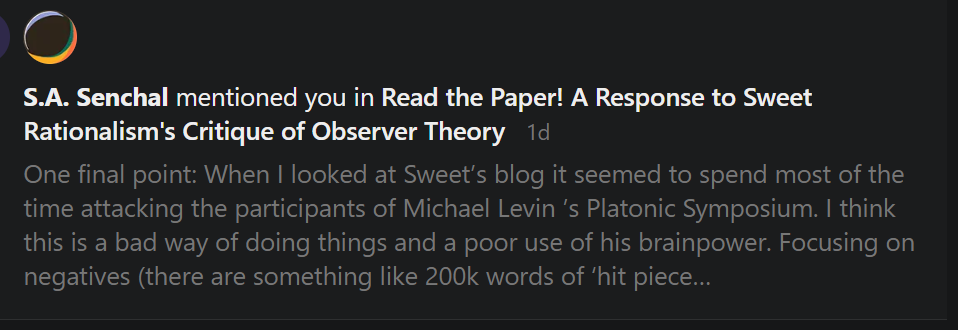
My original article did something straightforward: it applied standard falsification criteria to the Platonic metaphysical framing appearing across Levin’s Morphospace Symposium, praised the genuine empirical contributions of Michael Levin, Douglas Brash, Gordana Dodig-Crnkovic, Brian Cheung, Pavel Chvykov, David Resnik, and others by name, and raised exactly two main objections. First, not one Platonic talk in the symposium mentioned falsification while presenting itself as scientifically valid.
Second, that the Platonic labeling adds zero explanatory power over the underlying dynamical systems framework those researchers already have, while handing the Discovery Institute a credentialing opportunity they have demonstrably exploited. Sam Senchal’s response to this did something considerably less straightforward: it characterized the work as a personal attack on symposium participants, spent the bulk of its analytical energy on my use of assistive technology rather than on the falsification criteria, declared the argument “repetitive” without specifying which repetitions were factually wrong, and substituted an unfalsifiable personal preference for written Jewish scholarly authority in place of any consistent epistemological standard. The response functioned not as a refutation but as a case study in the very patterns it was supposedly correcting: how unfalsifiable metaphysics leads to dogmatic and harmful certitude.
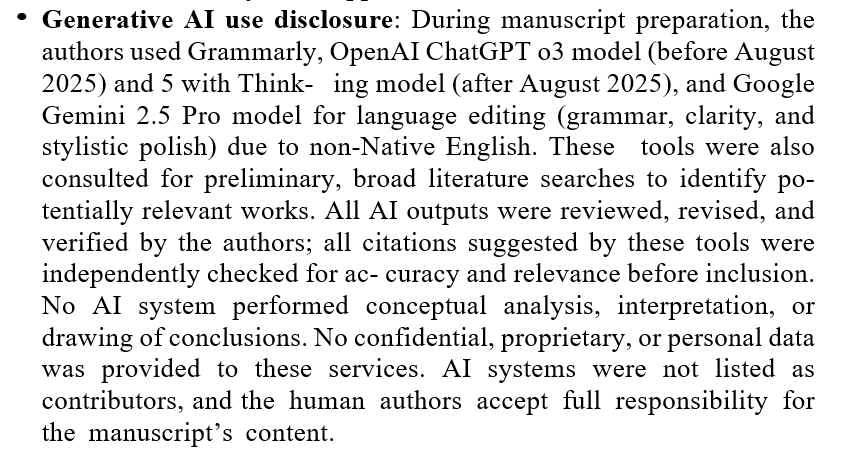
I want to say something directly about how Senchal chose to respond when the substantive arguments proved difficult to answer. Rather than engaging the Greek grammatical constructions, the falsification criteria, or the thermodynamic grounding, his primary line of attack was my use of text-to-speech software and AI tools trained on my own research notes and peer-reviewed source texts. I use these tools because I have ataxia, dyslexia, and ADHD, physical and neurological constraints that make conventional writing a significant physical barrier to participating in public intellectual discourse. I also use them because I am attempting to convert thirty years of transdisciplinary research into a form that can be put before the public and subjected to scrutiny, which is more work than anyone should have to do manually. Michael Levin, whose symposium Senchal is defending, uses AI formatting assistance in his own published work. Senchal, by his own account, uses it too.
Senchal’s claim that he was not attacking tool use is self-defeating on its own terms in at least two directions simultaneously. First, his own article’s Section I conceded explicitly that his tone was “below the standards I set for myself” and that he “called names,” which means he acknowledged making personal attacks in the very article that supposedly wasn’t making personal attacks. You cannot concede that your attacks were beneath your standards and then deny that attacks occurred. The concession and the denial cannot both be true, and he wrote both of them in the same document.
The argument that my use of assistive technology delegitimizes my conclusions is not a scholarly objection because the validity of an argument has never been a function of the tools used to compose it. Spell-check does not make a claim true. A typewriter does not make a claim false. What makes a claim valid or invalid is whether it survives contact with evidence, logic, and the falsification criteria any scientifically serious framework must provide.
This matters for laypeople to understand because falsifiability is not a stylistic preference or an academic technicality reserved for philosophy seminars. It is the single feature that distinguishes a scientific claim from an unfounded assertion. Without it, there is no mechanism for being wrong, and a framework with no mechanism for being wrong has no mechanism for being right either. It is simply impervious to reality in both directions. When a proponent responds to documented falsification demands, across multiple exchanges, with attacks on word processors and text formatting tools rather than with the falsification criteria his own claims require, that pattern is not incidental. It is diagnostic. Frameworks with genuine falsification criteria defend them when challenged. Frameworks without them defend everything else instead, the credentials, the tools, the tone, the platform, anything that redirects attention from the one question that cannot be answered: what specific observation would prove this wrong. The deflection is not a rhetorical habit. It is the framework protecting the only property it has left when the evidence runs out.
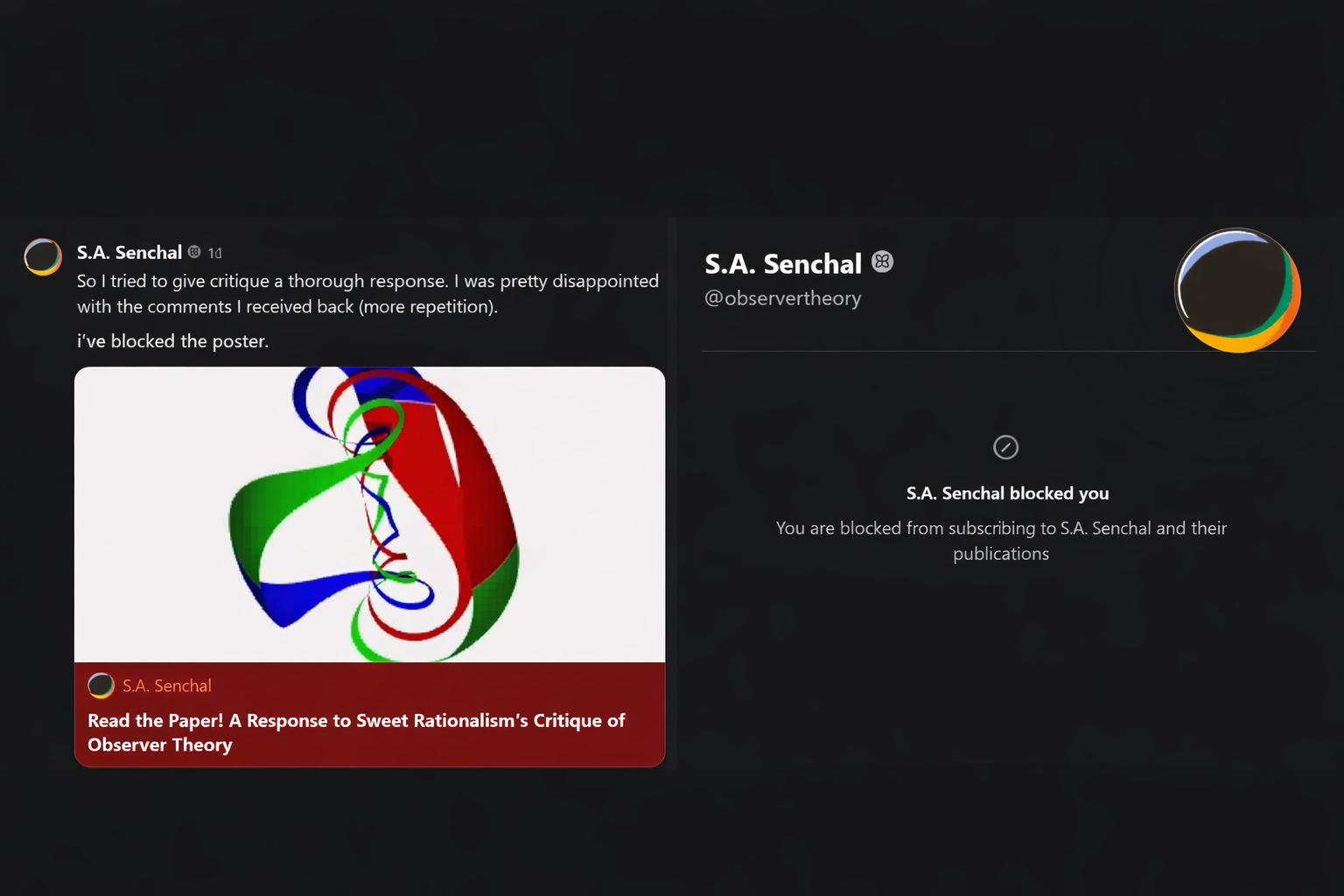
The behavioral sequence surrounding the article’s publication deserves its own accounting, because it continues the patterns my original work diagnosed with almost pedagogical precision. Senchal blocked me mid-argument, without answering the falsification challenge that prompted the block, then spent several days composing a response article, then unblocked me specifically to deliver it, positioning himself as the magnanimous scholar extending an olive branch while controlling every condition of the exchange, just to block me for pointing out his own scholarship doesn’t support his stance and re-asking the same 3 questions he dodged from the onset of our exchange (with as he admits, he initiated by personally attacking me rather than responding to my article about Biblical Truth Authority that he was commenting on). When the article’s Section I concessions—that his tone was below his standards, that he called me names, and that falsification could be sharper—failed to produce the capitulation those concessions apparently anticipated, and when the comment thread instead documented three unanswered falsifiability questions being posed repeatedly because they remained repeatedly unanswered, Senchal declined to revise the article to reflect those concessions, deleted my comments from the thread entirely, re-blocked me, and then posted publicly: “So I tried to give the critique a thorough response. I was pretty disappointed with the comments I received back (more repetition). I’ve blocked the poster.”
The word “repetition” here is doing extraordinary work. Dismissing my critique as “repetitive” is tone policing that dodges accountability for his claims and concessions, and concedes he can’t support his claims; otherwise he would have simply done so. What was repeated, across every comment, were the same three questions his own claims logically required answers to: what empirically falsifies the God Conjecture and WPP independently of each other, where precisely is the Greek wrong with a lexical citation showing the error, and by what consistent criterion are his written authorities definitive while mine are opinions? Naming three unanswered questions three times because they go unanswered three times is not repetition in any meaningful sense. It is persistence in the face of evasion, which is precisely what the BITE model’s information control tactics and the DARVO sequence are designed to punish. Delete the record, reframe the questioner as tiresome rather than rigorous, announce the block publicly as a verdict rather than a retreat, and deny the audience any access to what was actually said. The article diagnosed these patterns in the frameworks. The response to the article demonstrated the behavior.
Three Questions, Two Blocks, Zero Responses
- What specific empirical observation would falsify the God Conjecture, independent of whether WPP is correct, and what would falsify WPP itself?
- Where precisely is my reading of ἐκκέχυται, καταλλάσσων, or μὴ λογιζόμενος grammatically wrong? Name the lexical source.
- By what consistent criterion are your written authorities definitive while mine are merely opinions informed by study?
The questions were repeated because they were never answered. That is the entire explanation, and it is also the entire indictment. Science does not retire a falsification criterion because the person being asked finds it inconvenient to address repeatedly. Gravity does not stop requiring explanation because a theorist finds the question tedious. What Senchal is calling “repetition” is, in the language of any functioning epistemological standard, a standing obligation generated by his own claims. The God Conjecture either has a falsification criterion independent of WPP or it does not, and WPP itself either has a falsification criterion or it does not, and neither of those questions becomes less pressing because they have been posed more than once. The Greek constructions either mean what I documented, or they do not. His written authorities either earn their status by a consistent criterion he can articulate, or they do not. None of those questions went away between exchanges, and none of them were answered across any exchange, which is precisely why they kept appearing. The complaint that a questioner repeated himself is only coherent as a defense if the repetition was unnecessary, meaning the questions had already been answered. Senchal never answered them.
The repetition was his doing, not mine, and the fact that his only public accounting of the exchange named “repetition” as the problem, without specifying a single thing that was repeated incorrectly or addressed adequately, tells you everything about which side of this exchange had a scientific framework and which side had a framework designed not to have one.
The Additional Questions Sam Senchal Didn’t Answer
Every one of the following was posed in good faith, with sourcing, across multiple exchanges. None received a substantive response.
- What did Joseph Natal actually say, and how do we test it? Otherwise this is an Appeal to Authority Fallacy
- How does your framework address Aaronson’s demonstration that Wolfram’s deterministic model cannot simultaneously satisfy special relativity and Bell inequality violations? Just claiming WPP “already addressed it” doesn’t respond to the challenge I am posing to your framework.
- What physically instantiates the Ruliad, given that Rickles et al., the paper you cited as foundational, identifies this as an unresolved bootstrapping problem?
- How does the God Conjecture avoid Natal’s diagnosis that treating mathematical possibility as self-actualizing repeats the Pythagorean error Aristotle identified?
- What real-world system has Observer Theory explained satisfactorily that existing frameworks cannot?
- Which of your predictions were formulated before Buehler’s architecture was published, and where is the timestamped record?
- Can you quote the passage where my framework excludes transcendence rather than Landauer violations, or implies open vs. closed universe is necessary?
Sam’s total substantive engagement with this list: zero. His characterization of being asked these questions repeatedly: “repetition.” The scientific term for a framework whose proponent finds falsification criteria repetitive is not “sophisticated.” It is “unfalsifiable“, in philosophy we call this “sophistry”, and in theology we call it “faith”.
What Jewish Scholarship Across Traditions Shows
I showed him legitimate Jewish scholarship that agrees with my Torah translation work (and the scholarship behind it), which he rejected because it was not transmitted through authorized oral tradition from qualified teachers within his preferred interpretive community, despite the fact that his own written authorities, Rashi, Ibn Ezra, the Ramban, the Ari, Chaim Vital, and the Zohar, are themselves written sources that were at some point transmitted outside any living oral chain and are accessible to anyone who can read Aramaic and medieval Hebrew. The epistemological standard he applied was not consistent: written scholarship counts as authoritative when it confirms his framework and degrades to mere opinion when it confirms mine, with no testable way to differentiate between them. This is Sam’s unfalsifiable and exclusionary religious belief preference, not empirical or linguistic challenge to my framework.
What makes this particularly telling is that the scholars I invoked, Gershom Scholem, the founding professor of Jewish mysticism at Hebrew University, Moshe Idel, his most significant scholarly successor, and Elliot Wolfson, whose work on apophatic Kabbalah spans decades and whose 2025 Oxford Handbook contribution represents a sustained career position, are the preeminent secular academic authorities on the very tradition he was invoking against me. He rejected the field’s own leading scholars on the grounds that they lacked authorization from within the tradition those scholars spent their careers documenting, which is roughly equivalent to rejecting a cardiologist’s diagnosis because he did not personally experience the heart attack.
There are many other issues here, which I will expound upon in a future article demonstrating the superior compatibility of my framework across Jewish traditions, backed by the peer-reviewed scholarship across those traditions.
What Comes Next
A more thorough point-by-point analysis of Senchal’s article is forthcoming when I have more time. I wanted to address these accusations head on, because scurrilous mischaracterizations of my work that exceed what the evidence, logic, and citations can support are the kind of framing that poisons public discourse around legitimate scientific debate, and they deserve a direct response rather than silence.
That analysis will do something his response to my work did not: engage honestly with both the strengths and the failures. Because there are genuine strengths. The category-theoretic ambition is real. The attempt to ground theological claims in mathematical formalism is more rigorous than most theology manages. The engagement with Kabbalah, Aquinas, and process philosophy shows genuine range. These will be acknowledged specifically and without condescension, because that is what intellectual honesty requires and because the empirical contributions of the researchers in Levin’s symposium deserve exactly that standard modeled in every exchange touching their work.
The failures will receive equal specificity. The systematic omission of Aaronson, Natal, and Weinberg. The selective citation of Rickles. The post-hoc accommodation of Buehler’s architecture. The absence of thermodynamic cost accounting across 300 pages. The admittedly unfalsifiable axiom of True Infinity dressed as mathematical resolution. The theological overlays that add narrative without adding constraints. Each of these will be documented with the same sourcing standard applied throughout this exchange.
And the well-poisoning will be named for what it is every time it appears: the Aristotle epigraph, the assistive technology attacks, the credentials challenge, the “repetition” framing, the public block announcement, the deleted comments. Not because these tactics are surprising, they are not, they are documented features of frameworks under falsification pressure, but because Senchal’s own Section I conceded they were below his standards, and the gap between that concession and the behavior it was supposed to correct is itself data worth preserving.
What will not appear in that analysis is any satisfaction at the outcome of this exchange. The goal was never to win an argument. It was to establish whether these frameworks can survive contact with the falsification criteria their own empirical ambitions demand. They could not. The record shows that plainly. What it also shows, and what the forthcoming analysis will make explicit, is that the science Senchal is trying to reach toward, a genuinely consilient, mathematically grounded, thermodynamically accountable account of consciousness, life, and physical reality, is worth reaching toward. The tragedy is not the ambition. The tragedy is a framework that immunizes itself from the very pressure that would make it worthy of that ambition.
One practical note worth adding: I had the presence of mind to keep browser tabs of the conversation open before the block went back into effect, and I was able to screenshot the majority of the comment thread before it was deleted. Those screenshots will be published alongside the forthcoming analysis so that readers can read the exchange in full and draw their own conclusions about what motivated Senchal to delete it. If his defense of his article was genuinely thorough, if my responses were as repetitive and substanceless as his public announcement suggested, if the three unanswered questions were adequately addressed somewhere in the exchange, the screenshots will show that and readers are welcome to say so. If they do not show that, the question of why a scholar confident in his position would delete the record of that position being tested against a falsifiable competing model to their admitted unfalsifiable model is one I will leave readers to answer for themselves.
The seven falsifiable pillars remain standing. The offer to be proven wrong remains open. The three questions remain unanswered. And the thermodynamic floor, as always, remains exactly where physics left it.