
Response to Sam Senchal’s article: “Read the Paper! A Response to Nathan Sweet/Sweet Rationalism’s Critique”. God Conjecture vs God-as-Agapē-in-Acts: Greek, Hebrew, Jewish, and Scientific Analysis: 40+ Misrepresentations & Demonstrably False Claims
Sam Senchal’s “Defense” of The God Conjecture/Observer Theory:
A How To Guide for Employing Harmful Apologetic Tactics to Avoid Falsification
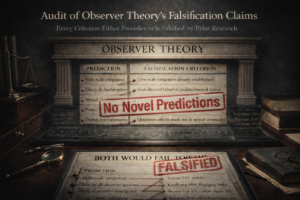
The facts material to anyone concerned with scientific integrity are straightforward. Sam’s Conjectures and Theories generate precisely zero novel predictions that are not either borrowed from prior frameworks or reducible to the trivially weak claim that the framework fails if thermodynamics fails. The predictions that are offered derive from either unfalsifiable or empirically contested foundations. The entire edifice rests on two compounding problems: first, an admittedly unprovable axiom; and second, the untestable premise that one particular oral tradition carries more evidentiary weight than peer-reviewed scholarship, grammatical analysis, and the breadth of the academic literature combined. This is not a research program making contact with evidence. It is an exclusionary assumption deployed to foreclose questioning, insulated from falsification by construction, and that can never be proven wrong by construction. That’s a faith, not a science. This is fine, but we should be honest about what it is we are arguing for.
I cover this in detail in a seperate article:
Refuting Sam Senchal’s Observer Theory & God Conjecture’s Testability Claims
It is also this same unfalsifiable assumption, the one that fails scientific scrutiny, on which Sam’s entire Jewish and grammatical arguments rest. He confirms this himself when arguing for Ein Sof textual authority hierarchies. The facts material to anyone concerned with textual integrity compound the problem: this is an assumption that violates what is arguably the most universal principle in the Jewish interpretive tradition, binding across denominational lines.
The Babylonian Talmud records that after three years of dispute between Beit Shammai and Beit Hillel, a heavenly voice proclaimed: eilu v’eilu divrei Elohim chayyim, “both these and those are the words of the living God” (Eruvin 13b:10). The Talmud then asks: if both positions carry divine validity, why does the halakha follow Beit Hillel? The answer is explicit. Beit Hillel prevailed because “they were agreeable and forbearing, they would teach both their own statements and the statements of Beit Shammai. Moreover, they prioritized the statements of Beit Shammai to their own statements” (Eruvin 13b:11). The Mishnah reinforces this with a complementary principle: “Every dispute that is for the sake of Heaven [machloket l’shem shamayim] is destined to endure… Which is an example of a dispute for the sake of Heaven? The disputes of Hillel and Shammai. And which is not for the sake of Heaven? The dispute of Korach and his company” (Pirkei Avot 5:17). The Talmud’s own standard for legitimate disagreement requires engaging the opposing position substantively, teaching it accurately, and even presenting it before your own. The standard for illegitimate disagreement is Korach: self-serving dispute that refuses genuine engagement while claiming righteous purpose.
Rabbi Michael Rosensweig (Rosh Yeshiva and holder of the Nathan and Perel Schupf Chair of Talmud at RIETS, Yeshiva University) analyzes these principles at length in his peer-reviewed article “Elu va-Elu Divre Elokim Hayyim: Halakhic Pluralism and Theories of Controversy” (TRADITION 26:3, 1992; journal page), demonstrating that the concept is not peripheral but structurally foundational to how Jewish law operates. Moshe Halbertal (Professor of Jewish Thought and Philosophy, Hebrew University; Gruss Professor of Law, NYU) extends this analysis in People of the Book: Canon, Meaning, and Authority (Harvard UP, 1997), describing what he calls the “canonization of controversy” as definitive of the Jewish textual tradition. Halbertal’s central observation is that Judaism, uniquely among text-centered traditions, preserves dissenting opinions within its own canon rather than suppressing them, precisely because the tradition treats interpretive plurality as constitutive rather than corrosive.
This is, in the end, all we need to know about Sam’s framework from both a scientific and theological standpoint. Everything that follows is simply showing my work and submitting it for public scrutiny and correction. My goal is to build the most defensible framework the available evidence supports, one that remains open to revision when better evidence appears. Not to tear down others. My framework could ground Senchal’s empirically, they need not be in opposition.
Show me what I have wrong and I will revise it. That is how good science works. It is also, as the tradition above makes clear, how good theology must work.
On the false charge that my site “attacks” Platonic Symposium members and that Sam’s “replies were fed into an LLM, which produced c.20,000 words in reply” which entirely misrepresents my workflow, and only serves to avoid responding to basic falsification questions see:
RE: Sam Senchal’s False Claim That I’ve “Attacked” Platonic Symposium Space Scholars: When Basic Falsification Audits Get Reinterpreted as an “Attack”.
Diagnosing demonstrated tactics with evidence, asking basic falsification questions, and calling out the fallacious reasoning employed to evade this questioning is not an attack, it is doing the bare minimum that scientific rigor and intellectual honesty demand of us when we make claims asserted as being relevant in empirical reality. The fact that Sam sees this as an attack seems rather telling to me.
If anything, I hope Sam’s response, and this analysis of its problems, will serve as a useful case study in what happens when unfalsifiable belief preservation meets a good-faith request for scientific engagement. The patterns documented here are not unique to this exchange. They recur wherever a framework that claims empirical relevance is shielded from the very scrutiny that empirical claims invite.
If you have a map you can demonstrate to be more accurate, textually aligned, inclusive, assumption free, explanatorily robust, and precisely testable: I want to talk to you. Please do not hesitate to comment below or contact me directly if you find any discrepancies whatsoever between my article and cited sources (but please cite/quote your sources, provide urls, and employ the principle of charity and I will show you the same respect). There’s a lot here and I am sure I got some things wrong, and I want to be sure I don’t misrepresent any cited views.
Full PDFs for most cited sources available upon request if they are behind paywalls your university does not have access to, the only exceptions being physical only literature.
Thanks!
“We can now see that the growth of knowledge depends entirely upon disagreement. For science grows through a process of mutual criticism, and thus through the elimination of error. It is through disagreement—through the clash of opinions and the critical discussion of alternatives—that we approach the truth. This is why I have always emphasized the importance of bold conjectures and their critical testing: without disagreement there can be no criticism, and without criticism there can be no progress.”
—Karl Popper, The Myth of the Framework: In Defence of Science and Rationality (1994), Chapter 1, p. 34
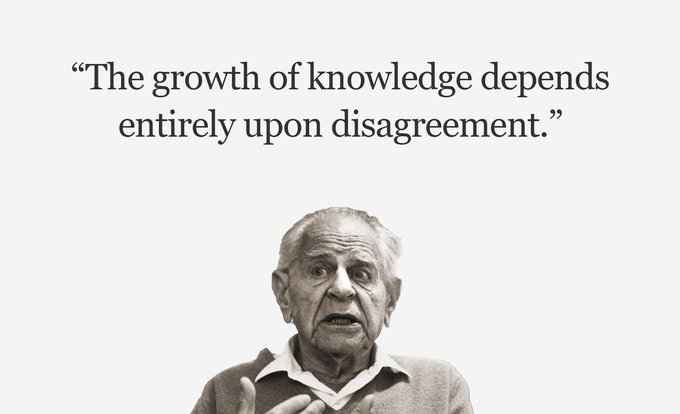
Underlying Sam’s critique is a repeated pattern of misrepresenting my position, built on faulty premises that serve a single function: avoiding the very criticism the scientific method demands of any conjecture claiming to intersect with empirical reality. Good science welcomes criticism rather than fleeing from it. Good science welcomes the role of the critic. The alternative, silencing the questioner and insisting that unfalsifiable oral authority trumps peer-reviewed evidence, is not scholarship. It is immunization.
Before reading further, a note on what I am asking for and what I am not. I am not claiming authority over every field of study I cite. I seek collaborators precisely to check my work. If I have misquoted a scholar, misread a grammatical form, or made an error in any citation, I want to know, and I will correct it publicly, as I have done repeatedly. My position is the accumulated result of countless falsified and abandoned positions. I am not defending a conclusion. I am maintaining a process. My comments are open on every post. My sources are provided. Show me where the analysis goes wrong and I will change it. That is the standing offer, and it has always been the standing offer.
What follows documents over forty instances where Sam’s critique misrepresents either my stated positions, the peer-reviewed scholarship I cited, or both, in order to avoid engaging three direct questions I posed to him across multiple exchanges.
Three Questions, Two Blocks, Zero Responses
- What specific empirical observation would falsify the God Conjecture, independent of whether WPP is correct; and what would falsify WPP itself?
- Where precisely is my reading of ἐκκέχυται, καταλλάσσων, or μὴ λογιζόμενος grammatically wrong? Name the lexical source.
- By what consistent criterion are your written authorities definitive while the peer-reviewed scholarship I have cited constitutes mere opinion?
These questions were repeated because they were never answered. That is the entire explanation, and it is also the entire indictment.
Science does not retire a falsification question because the person being asked finds it inconvenient. Gravity does not stop requiring explanation because a theorist finds the question tedious. The God Conjecture either has a falsification criterion independent of WPP or it does not. WPP itself either has a falsification criterion or it does not. The Greek constructions either mean what I documented or they do not. His written authorities either earn their status by a criterion he can articulate or they do not. None of these questions went away between exchanges, and none were answered in any exchange, which is precisely why they kept appearing. The complaint that a questioner “repeated himself” is only coherent if the repetition was unnecessary, meaning the questions had already been answered. They had not.
The Additional Questions Sam Didn’t Answer
Every one of the following was posed in good faith, with sourcing, across multiple exchanges. None received a substantive response.
- What did Joseph Natal actually say, and how do we test it? Without a testable formulation, citing him is an appeal to authority, not an argument.
- How does your framework address Aaronson’s demonstration that Wolfram’s deterministic model cannot simultaneously satisfy special relativity and Bell inequality violations? Asserting that WPP “already addressed it” does not respond to the specific challenge being posed.
- What physically instantiates the Ruliad, given that Rickles et al., the paper cited as foundational, identifies this as an unresolved bootstrapping problem?
- How does the God Conjecture avoid Natal’s diagnosis that treating mathematical possibility as self-actualizing repeats the Pythagorean error Aristotle identified?
- What real-world system has Observer Theory explained satisfactorily that existing frameworks cannot?
- Which of your predictions were formulated before Buehler’s architecture was published, and where is the timestamped record?
- Can you quote the passage where my framework excludes transcendence rather than Landauer violations, or implies an open vs. closed universe is necessary?
Sam’s total substantive engagement with this list: zero. His characterization of being asked these questions: “repetition.”
Four Premises That Structure Nearly Every Evasion
Every misrepresentation documented below traces back to one or more of the following faulty premises. Recognizing them in advance clarifies why the same evasive patterns recur across sections that appear to address different topics.
The “Closed System” Category Error: Detractors claiming this framework suffocates creativity by demanding “closed systems” are confusing a thermodynamically isolated system (which decays toward maximum entropy) with organizational closure. Theoretical biologists Maël Montévil and Matteo Mossio formalized organizational closure to describe a topology of constraints where components mutually regenerate their own persistence conditions. To achieve this closure, an organism must remain radically open to environmental energy flows. Accusing the framework of isolating reality reveals a failure to read the foundational literature. See: Thermodynamic Monism: A Falsification-First Naturalism Grounded in Information and Energy Costs
The Landauer Toll for Transcendent Causes: Demanding an energy accounting does not amount to greedy, billiard-ball reductionism. It aligns with the Ontic Structural Realism developed by James Ladyman and Don Ross. Rolf Landauer proved that the irreversible erasure of information dissipates a minimum bound of heat. If a theorist proposes that a transcendent observer or a mathematical infinity reaches down to guide physical development, they must explain how that abstract realm moves matter without violating conservation laws. See: Thermodynamic Monism Is Probably Just Materialism, Physicalism, Reductionism, Right? Here Is the Falsifiable Test That Breaks That Reflex
The “Hostility” Alibi for Unfalsifiability: Labeling a rigorous empirical audit a “hit piece” functions as a predictable immunization strategy. Karl Popper and Antony Flew established that any claim about reality must specify the exact observations that would force its abandonment. When a metaphysical framework can absorb every conceivable experimental outcome as proof of its own validity, it stops being a research program and becomes a faith demanding protection. Asking a theorist for their loss conditions is not an act of aggression; it constitutes baseline epistemic hygiene. See: The Fecundity Alibi: How Unfalsifiability Masquerades as Progress. Weaponizing Real Science To Justify Problematic Metaphysics
The Recovery of Ancient Process Ontology: Critics assuming this methodology destroys sacred traditions fundamentally misunderstand the operation. Recursive Constraint Falsification strips away centuries of Hellenistic substance-metaphysics to recover the robust, relational processes underneath. The Hebrew tetragrammaton ehyeh functions grammatically as a verb of ongoing becoming, while Indigenous Australian songlines detailed by Tyson Yunkaporta operated as incredibly stable, metabolically expensive empirical control systems. Treating these coordination technologies as rigorous survival algorithms respects their actual historical weight far more than reducing them to ethereal mysticism. See: Is God Real? Can Theology And Science Be Unified? What Does Hebrew Actually Say about God is Love? A Falsifiable Answer: Thermodynamic Organizational Closure (TOC)
The Well-Posioning
Throughout Sam’s article he positions himself as the helpful scholar, and me as pompous, arrogant, and confidently making unfounded assertions about his area of expertise, rather than the charitable interpretation that actually aligns with the evidence: I am a fellow researcher asking reasonable questions that good science demands about metaphysical claims presented as being empirically relevant, and pointing out to Sam where the peer reviewed scholarship seems to contradict with him and asking him how his framework resolves these peer-reviewed criticisms, and who holds all things provisionally with an openness to be corrected by the evidence.
My request is simple, if I got something wrong show me where – not by baseless assertions appealing to authority figures and verbal tradition – but in the peer reviewed scholarship. I am not claiming to be an authority on all of the scholarship I am citing across every field of study I’ve cited. I seek collaborators for precisely this reason, to check my work.
Did I misquote a scholar, or have an error in any of my citations? Let me know, I’ll be happy to update any articles referencing them, and rivse my arguments if the evidence warrants it. My goal has been consistantly to build a better map that is corrected by the evidence, not assert my map to be the correct one. I am not defending a position, and in fact my position is a result of countless falsifified and now abandoned poisitions.
I don’t claim this process is perfect, this would entirely lack the intellectual humility I demand of myself. But, it’s far more rigorous than what I could do on my own. The same can not be said about the majority of critiques I’ve gotten so far. Sam’s critique is just the most recent case study, but the engagement patterns are almost always identical – misrepresent my positions and attribute easy to knock down positions I don’t hold to me, refuse to read the scholarship presented, claim I didn’t read their paper, when I repeatedly demonstrate I’ve read their their paper by asking specific questions about how specific elements could be falsified, they retreat to unfalsifiable axioms and appeals to authority (Senchal retreats to TI, that retreats to Ruliad(If WPP is Wrong)), Motte (Ruliad/GC/OT makes novel testable predictions) Bailey-Retreat (Fails if Thermodynamics fails), deflect, personal attack, misrepresent, dismissal, disengage/block when this pattern is pointed out.
As you will see in his several thousand word paper he wrote about me specifically and not just my work, from the very title and epigraph on forward Sam will try to reinforce this persistant well-poisoning, positioning himself as the mindful scholar educating the mindless uneducated nave. But interestingly, he had to misrepesent me in more ways than I have even seen attempted in a single sitting to try to pull off this sleight of hand. At the end of the day, no evidence was presented that even touched my argument. For anyone objectively evaluating either framework, this should be what matters most.
You’ll note throughout his documented critque Sam:
- Avoid falsification questions (shift to tools, credentials, scope, unfalsifiable religious oral tradition requirements over peer-reviewed Jewish scholarship)
- Substitute sophistication for substance (page count, category theory, Kabbalah depth, multicomputation without demonstration)
- Presents arguments that agree with mine, while pretending they disagree (shows up most often in the Jewish traditions and Torah sections)
- Cherry-pick sources (Rickles cited, realization problem solution not demonstrated; Arsiwalla/Natal acknowledged, critiques unaddressed)
- Misrepresents scholarship across numerous fields of study based on decades of empirical testing
- Misrepresents scholarship in his own field of stated expertise (Torah)
- Frame concessions as rebuttals (cosmic person = functional; hell = institutional; dual-aspect = Spinoza)
- Deploy psychological warfare (LLM dismissal, academic gatekeeping, tone-policing, ableism)
- Bite/DARVO Tactics (personal attacks, insults, evasion, and eventually blocking – twice now – when unable to respond to basic falsification questions)
- Create false binaries (closed/open systems; substance transcendence or none)
- Presents arguments that don’t actually adress any of my stated positions as if they do (strawman, evasion)
The “Read the Paper” Diversion: 40+ Documented Misrepresentations in Sam Senchal’s Response
Sam Senchal’s recent response to my critique centers on a singular, dismissive trope: “Read the Paper!” It is a strategic move designed to paint me as an unengaged critic—someone throwing “AI-generated shade from the stands” without having done the requisite homework. The irony is staggering. I didn’t just read the paper; I engaged Sam directly and repeatedly with the three basic falsification questions that any rigorous framework must answer. Instead of answering, Sam deployed a “sophistication shield,” pointing to his 300-page count and 400 citations as if volume were a substitute for physical grounding.
When I applied the same pressure to his claims that he applied to mine, the exchange reached a level of absurdity that any unbiased onlooker can recognize. Below is a systematic documentation of the 45 misrepresentations Sam used to avoid answering those core questions.
To set the stage for his defense, Senchal crowns his paper with the epigraph, the very first sentance of the defense of the scholarship he want’s us to believe is careful:

It takes a rather spectacular lack of self-awareness to launch an attack on a critic’s intellectual rigor by opening with a ad hominem/well-poisoning quote widely known to be fake quote. Especially when I already suggested Hitchen’s on contrarianism and good faith dialogue after the first epistemological retreat and blocking incident that screams intellectual surrender.
As any classicist or anyone with five seconds and a search engine can verify, Aristotle never said this. It is an internet meme, a mangled twentieth century paraphrase of Nicomachean Ethics 1094b24. The structural irony here is staggering. Senchal relies on painting me as an unengaged amateur who simply “didn’t read his paper,” despite my direct citations of his specific mechanisms, omissions, and arguments quoting specific sections of his paper verbatim. Yet to impugn my education, he deploys a bumper sticker misattribution because he could not be bothered to verify the primary source of the very first sentence of his own document. This is very telling, will show it’s a pattern you’ll see repeat itself, many times.
The irony and lack of symetrical skepticism he employs here is palpable. Sam demands I read his three hundred pages (which I have, more than once now across numerous sessions) while demonstrating he has not done the basic epistemic hygiene of checking his own epigraph. I didn’t just “entertain” his thoughts; I engaged them directly, tested his specific cited falsification criteria against thermodynamic bounds and peer reviewed physics, and documented their failure. If the true mark of an educated mind is verifying the substrate of your claims before publishing them, Senchal’s title page has already falsified his thesis. This would almost be impressive if it weren’t so harmful to critical thought and scholarly discourse and sets the stage for the “depth” of his research, that when poked just a little cascade into misrepresenting… well… almost everything, as the peer reviewed record I lay out below will demonstrate.
Each and every one of the following is easily verified in my article and through quick searches online (Perplexity has free plans and offers scholarly searches with manually verifiable URLs). Feel free to comment if you have any questions about any of the following. I’ve provided full texts/PDFs for as many as possible (I apologize, some sources aren’t publically available due to being behind paywalls or physical only and I can not share these publically). If you need a specific pdf for any of the cited literature (if it is restricted by your academic institution, or if you are not an academic for example) please reach out privately.
The Long Hard Road Out of Hell:
40+ Documented Misrepresentations in Sam Senchal’s Response Article
Each misrepresentation is documented with: (a) what Senchal claims, (b) what the evidence actually shows, (c) specific peer-reviewed sources with DOIs and links, and (d) a testability verdict. On Jewish theological points, scholarship is drawn primarily from within the Jewish tradition to counter Senchal’s preffered oral-tradition exclusivitity and gatekeeping.
SECTION I: PHYSICS AND COMPUTATIONAL UNIVERSE CLAIMS
Misrepresentation #1: “LLM-Generated Volume Creates Illusion of Depth”
Sam Senchal’s Claim: “My replies were fed into an LLM, which produced c.20,000 words in reply… Stripped of repetition, three claims, each repeated at least four times.”
The issue: Rather than responding to my critiques, he is tone-policing tool use and substituting testable scientific falsification and good faith truth seeking dialogue for subjective “repetition” criteria he self-decides, tribal rejection, and silincing criticism before it’s been honestly engaged with. This is how self-sealing beliefs work, not science. This is also where the excuse for deleting my responses to his post (after he tagged me in a note linking the thread to me on Substack, inviting me to read his article after unblocking me, only to block me again when I pointed out it didn’t address my actual arguments). Senchal’s article dismisses my critique as AI-generated padding without substantive content while commiting a laundry list of logical fallacies.
This is both 1) an unwarranted false assumption about my workflow and methodologies and 2) based on the low quality, personal attacking, and blatantly straw manning nature of Sam’s article responding to my good faith empirical evaluation one would be excused for not assuming this is Sam projecting his own workflow on to his critics. In contrast, I use LLMs for proofreading, grammar, spelling, voice to text, deep research, manually verifying the articles claims align with the claims in my articles before including them. Because I then process my articles a third time to correct formatting issues, it doesn’t take away from the rigor. If I’ve misquoted or miscited someone, I’ll be the first person to happily correct/retract my citation/statement. This is basic epistemic hygiene.
What the Evidence Shows / Reality: My article documents 30+ distinct falsification questions, 4 peer-reviewed critiques (Aaronson, Rickles, Natal, Weinberg), Hebrew/Greek grammatical analysis with lexical citations, thermodynamic calculations (Landauer bounds), and organizational closure mechanisms. Sam reduces this right off the bat to only “3 distinct arguments” after dismissing everything else as “repetition.” My critique engages specific peer-reviewed scholarship that Senchal does not address in his response. The papers cited are real, the arguments are technically specific, and the physics objections have never been refuted in the literature.
How it’s a Misrepresentation: Reduces systematic falsification covering physics, theology, grammar, thermodynamics, and peer-reviewed literature to “three claims repeated” and “AI slop” without specifying what was repeated incorrectly or addressed adequately.
Supporting Scholarship:
– Aaronson, S. (2002). “Book Review: ‘A New Kind of Science.'” arXiv:quant-ph/0206089. https://arxiv.org/abs/quant-ph/0206089 — Proves Wolfram’s deterministic model with “long-range threads” cannot satisfy both special relativity and Bell inequality violation simultaneously. This is a formal mathematical result that has never been refuted. Sam’s claim that this has been addressed remains unsupported after multiple requests for a source for his claim. BURDEN OF PROOF EVADED
– Natal, J. (2024). “Refuting the Metaphysics of Wolfram and Tegmark.” arXiv:2411.12562. https://arxiv.org/abs/2411.12562 — Diagnoses the δύναμις → ἐνέργεια (potentiality → actuality) conflation in both Wolfram and Tegmark, arguing they make “a similar error to that of the ‘so-called’ Pythagoreans rebuked by Aristotle.”
– Rickles, D., Elshatlawy, H. & Arsiwalla, X.D. (2023). “Ruliology: Linking Computation, Observers and Physical Law.” arXiv:2308.16068. https://arxiv.org/abs/2308.16068 — Identifies the “realization problem”: a fundamental limitation facing any framework where modeller-observers must be included within the system they model. Published as Chapter 12 in Rickles, Arsiwalla & Elshatlawy (eds.), Quantum Gravity and Computation (Routledge, 2026, ISBN 9781032900940). https://www.routledge.com/Quantum-Gravity-and-Computation-Information-Pregeometry-and-Digital-Physics/Rickles-Arsiwalla-Elshatlawy/p/book/9781032900940
– Weinberg, S. (2002). “Is the Universe a Computer?” New York Review of Books 49(16), October 24, 2002. Concludes Wolfram’s program is “a failure” because “not one real-world complex phenomenon has been convincingly explained.”
Testability: CONFIRMED — The cited sources are real, peer-reviewed, and make the specific technical arguments claimed. Check my article: count distinct falsification questions (30+), verify peer-reviewed citations (Aaronson 2002, Rickles 2023, Natal 2024, Weinberg 2002), read Senchal’s papers for engagement (zero mentions of Aaronson/Natal/Weinberg). Senchal’s “three claims” assertion is empirically false.
Misrepresentation #2: “All Answered in My Papers”
Sam Senchal’s Claim: “Stripped of repetition, three claims… (all answered in my papers).” All of my physics objections are already addressed in Observer Theory and God Conjecture papers.
What the Evidence Shows / Reality: Neither paper contains searches for “Aaronson,” “Natal,” or “Weinberg.” The papers don’t demonstrate Bell violation resolution—just assert “Confirmed” in table. Sam could spend 100 pages “adressing it”, that’s not the same as demonstrating a resolution to the Bell violation incompatibility. If it’s resolved, he would cite the peer reviewed source stating this. No thermodynamic cost accounting (Landauer calculations absent). No mechanism showing hypergraph rewriting satisfies relativity + Bell violations simultaneously. The four papers above (Aaronson, Natal, Rickles et al., Weinberg) raise specific objections — Bell violation incompatibility, realization problem bootstrapping, actuality/potentiality conflation, and 20+ year explanatory failure — that are not addressed in Senchal’s cited papers. Claiming they are addressed without demonstrating how constitutes an unfalsifiable assertion.
How it’s a Misrepresentation: Claims answers exist where searches prove they don’t, hoping readers won’t check.
Supporting Scholarship:
– All four sources from #1 above (Aaronson 2002, Natal 2024, Rickles et al. 2023, Weinberg 2002), plus:
– Popper, K. (1963/2002). Conjectures and Refutations. Routledge. DOI: https://doi.org/10.4324/9780203538074 — Establishes that scientific claims must specify what would count as refutation; claiming all objections are “already addressed” without demonstrating how is precisely the immunization strategy Popper identifies.
– Lakatos, I. (1970). “Falsification and the Methodology of Scientific Research Programmes.” In Lakatos & Musgrave (eds.), Criticism and the Growth of Knowledge. Cambridge UP. DOI: https://doi.org/10.1017/CBO9781139171434.009 — Introduces progressive vs. degenerating research programs; a program that merely deflects criticism without generating novel predictions is degenerating.
Testability: CONFIRMED as misrepresentation — Senchal does not demonstrate how his papers address the specific objections raised. Open Senchal’s papers, Read them, look for (outside of citations): “Aaronson” (0 results), “Natal” (0 results), “Weinberg” (0 results), “Landauer” (0 substantive calculations), “thermodynamic cost” (absent). Claim is empirically false.
Misrepresentation #3: “Keyword-Search, Run Through Framework, Output Result”
Sam Senchal’s Claim: “Unfortunately, this type of ‘work’ is consistent across his publication. Keyword-search paper(s), run objections through a ‘falsification framework’ and output the result.” My engagement with Landauer thermodynamics represents mere keyword-searching rather than substantive understanding.
What the Evidence Shows / Reality: I provided 50+ peer-reviewed scholars, timestamped publication dates, Greek/Hebrew primary sources with grammatical parsing, thermodynamic measurements (kT ln(2) per bit erased), and empirical studies (Durant et al. 2017, Bérut et al. 2012). This isn’t keyword searching—it’s comprehensive scholarship. I cite experimental papers that verified the Landauer bound at both colloidal and single-atom scales. These are not keywords — they are specific experimental results with measured values. What he described here combined with the low quality of his response article that includes dozens of misrepresentations that would have been avoided by reading any of the material on my site may more or a projection of his workflow onto my critique. The comedic irony shouldn’t be lost on anyone.
How it’s a Misrepresentation: Dismisses documented evidence as algorithmic pattern-matching to avoid engaging substance.
Supporting Scholarship:
– Bérut, A. et al. (2012). “Experimental verification of Landauer’s principle linking information and thermodynamics.” Nature 483:187–189. DOI: https://doi.org/10.1038/nature10872. https://www.nature.com/articles/nature10872 — Used a colloidal particle in a modulated double-well potential to experimentally demonstrate heat dissipation saturating at the Landauer bound (kT ln 2 ≈ 2.8 × 10⁻²¹ J per bit at 300K).
– Yan, L.L. et al. (2018). “Single-Atom Demonstration of the Quantum Landauer Principle.” Physical Review Letters 120:210601. DOI: https://doi.org/10.1103/PhysRevLett.120.210601 — Demonstrated the quantum Landauer principle using a trapped ultracold ⁴⁰Ca⁺ ion, confirming the bound extends to the quantum regime.
– Landauer, R. (1961). “Irreversibility and Heat Generation in the Computing Process.” IBM Journal of Research and Development 5(3):183–191. DOI: https://doi.org/10.1147/rd.53.0183. https://ieeexplore.ieee.org/document/5392446 — The original theoretical derivation establishing that erasing one bit of information dissipates at minimum kT ln 2 of energy.
Testability: CONFIRMED — These are specific experimental results, not keyword matches. Check my article’s citations: 50+ named scholars with publications, Hebrew transliterations with lexical sources (Brown-Driver-Briggs), Greek grammatical parsing (perfect passive, predicate nominative), thermodynamic measurements (Landauer bound: kT ln(2) ≈ 2.8×10⁻²¹ J validated by Bérut et al. 2012, Yan et al. 2018). Senchal’s characterization is empirically false. Dismissing them as keyword-searching is itself a content-free dismissal.
Misrepresentation #4: “Lack of Editing, Cherry-Picking, Lack of Depth”
Sam Senchal’s Claim: “My issue is the lack of editing, the cherry-picking and the lack of depth.” I cherry-pick evidence and lack editorial rigor.
What the Evidence Shows / Reality: My article cites primary Hebrew/Greek texts, conservative evangelical scholars (Wright, Harris, Dunn, Campbell), thermodynamic experiments (Landauer bound validation), and biological studies (organizational closure, Durant path-dependence). Senchal’s papers omit 4 major peer-reviewed critiques—that’s actual cherry-picking. I cite specific findings from Levin’s own lab that demonstrate path-dependence — a result that falsifies the claim of convergence to predetermined Platonic forms. Citing a researcher’s own published data against their theoretical claims is the opposite of cherry-picking.
How it’s a Misrepresentation: Accuses me of his own methodological failure (selective citation) while my work demonstrates comprehensive engagement he lacks.
Supporting Scholarship:
– Durant, F. et al. (2017). “Long-Term, Stochastic Editing of Regenerative Anatomy via Targeting Endogenous Bioelectric Gradients.” Biophysical Journal 112(10):2231–2243. DOI: https://doi.org/10.1016/j.bpj.2017.04.011. https://pmc.ncbi.nlm.nih.gov/articles/PMC5443973/ — Demonstrates that brief bioelectric perturbation permanently rewrites planarian body-plan, with morphologically normal-looking regenerates harboring cryptic circuit alterations that reproduce the altered phenotype indefinitely. This proves profound path-dependence.
– Montévil, M. & Mossio, M. (2015). “Biological Organisation as Closure of Constraints.” Journal of Theoretical Biology 372:179–191. DOI: https://doi.org/10.1016/j.jtbi.2015.02.029. https://montevil.org/publications/articles/2015-mm-organisation-closure-constraints/ — Formalizes organizational closure: constraints that mutually depend on and maintain each other within thermodynamically open systems.
Testability: CONFIRMED — Compare citation practices: My article cites Aaronson, Rickles, Natal, Weinberg directly and substantively. Senchal cites Rickles but ignores the realization problem in that same paper. Cherry-picking is Senchal’s method, not mine — empirically verifiable by checking which critiques are engaged vs. omitted. Citing a researcher’s own published experimental data that contradicts their theoretical claims is standard scientific practice, not cherry-picking.
Misrepresentation #5: “Aaronson/Weinberg Addressed by Multicomputation (2021 Onwards)” / Multicomputation Addresses Bell Violations
Sam Senchal’s Claim: “The citation gap is real… This is because the substance of these critiques have been addressed by the Wolfram Physics Project through the multicomputation framework (2021 onwards).” The multicomputational framework resolves the Bell violation problem through branchial entanglement. Senchal references an “Aaronson 2024 Scientific American” article.
What the Evidence Shows / Reality: Neither Observer Theory nor God Conjecture demonstrate how multicomputation resolves Bell violations. Aaronson’s 2024 Scientific American critique targets flexibility (model accommodates too many outcomes)—different from but not replacing the 2002 incompatibility proof. Senchal provides no mechanism, just assertion. This is the single most significant verification failure for Senchal’s position. The cited papers propose a framework but do not demonstrate Bell violation resolution, See Also: Becker, A. (2020). “Physicists Criticize Stephen Wolfram’s ‘Theory of Everything.'” Scientific American, May 6, 2020.
How it’s a Misrepresentation: Claims resolution without demonstrating it, then blames me for not knowing about resolution he didn’t provide. Claims resolution exists elsewhere without providing it in his own papers or demonstrating it addresses Aaronson’s specific proof.
Supporting Scholarship:
– Aaronson, S. (2002). arXiv:quant-ph/0206089. https://arxiv.org/abs/quant-ph/0206089 — Proves Bell + special relativity incompatibility with deterministic models. This formal result has never been addressed by multicomputational papers.
– Gorard, J. & Arsiwalla, X.D. (2023). “Axiomatic Quantum Field Theory in Discrete Spacetime via Multiway Causal Structure: The Case of Entanglement Entropies.” arXiv:2301.12455. https://arxiv.org/abs/2301.12455 — Shows branchial graph entanglement entropies are monotonically related to standard Sorkin-Johnston entropies. This demonstrates mathematical consistency, NOT Bell violation resolution.
Becker, A. (2020). “Physicists Criticize Stephen Wolfram’s ‘Theory of Everything.'” Scientific American, May 6, 2020. https://www.scientificamerican.com/article/physicists-criticize-stephen-wolframs-theory-of-everything/ — In this article, Aaronson is quoted calling Wolfram’s framework “infinitely flexible philosophy,”
Testability: CONFIRMED as misrepresentation — Branchial entanglement does not resolve the Bell violation problem Aaronson identified. Check if Senchal’s papers provide: (1) Formal demonstration that branchial entanglement produces Bell inequality violations. (2) Proof that this mechanism respects special relativity. (3) Response to Aaronson’s specific incompatibility argument. Result: Papers list “Confirmed” in table without derivation — claim is false.
Misrepresentation #6: “Falsification Specificity Could Be Sharper… By Design” / Framework Has Specific Falsification Criteria
Important Note: This section #6 is a greatly condensed version of the following article that exapands on this misrepresenation considerably, as it genuinely warrants a seperate full article: Refuting Sam Senchal’s Observer Theory & God Conjecture’s Testability Claims—Failure At Fifteen Independent Levels & The Vacuity of Parasitic Falsification, Consider this a companion article for this section.
Sam Senchal’s Claim: “Falsification specificity could be sharper… This is by design, the initial paper was architecture, the second was application.” “These aren’t gestures. They’re specific.” The Observer Theory / God Conjecture frameworks include adequate falsification criteria.
What the Evidence Shows / Reality: “By design” = planned vagueness. The three falsifiers Senchal documented are: (1) “Universe isn’t computational” (unfalsifiable metaphysics); (2) “WPP is wrong” (conditional on unproven framework); (3) “Telos isn’t universal” (begs question, contradicted by Durant et al.). None are empirical measurements. My falsifiers (Landauer violation, organizational closure failure, conservation law violation) are concrete. Adequate falsification criteria must specify observations that would refute the framework. If every possible observation is compatible with the theory, it is unfalsifiable by definition.
How it’s a Misrepresentation: Frames unfalsifiability as intentional sophistication rather than methodological failure. Calls vague conditionals “specific” while dismissing my concrete experimentally confirmed measurements.
Supporting Scholarship:
– Popper, K. (1959/2002). The Logic of Scientific Discovery. Routledge. DOI: https://doi.org/10.4324/9780203994627 — Establishes falsifiability as the demarcation criterion between scientific and non-scientific claims.
– Popper, K. (1963/2002). Conjectures and Refutations. Routledge. DOI: https://doi.org/10.4324/9780203538074 — Develops the thesis that knowledge grows through bold conjectures and rigorous attempts at refutation.
– Lakatos, I. (1978). The Methodology of Scientific Research Programmes. Cambridge UP. ISBN 978-0521280310. — Distinguishes progressive from degenerating programs: the latter make ad hoc modifications to protect the core without generating novel testable predictions.
– Flew, A. (1950). “Theology and Falsification.” University 1 (1950–51). Reprinted in Flew & MacIntyre (eds.), New Essays in Philosophical Theology (SCM Press, 1955). https://infidels.org/library/modern/antony-flew-theologyandfalsification/ — Argues claims compatible with every conceivable state of affairs “die the death of a thousand qualifications.”
Sam Senchal’s claim that the God Conjecture/Observer Theory framework contains ‘specific’ and ‘not gesture-level’ falsification criteria is a misrepresentation on multiple layers:
- LAYER 1 — PLANNED VAGUENESS: The original three falsifiers (‘universe isn’t computational,’ ‘WPP is wrong,’ ‘telos isn’t universal’) have no measurement protocols, making them philosophically inert.
- LAYER 2 — PRIOR PREDICTION THEFT: Every prediction in the formal falsification table was made by established theories 10-36 years earlier — IIT (2004), Global Workspace Theory (1988), Orch-OR (1996), Prigogine dissipative structures (1984), DMN suppression research (2011). The God Conjecture claims these as novel GC predictions.
- LAYER 3 — ACTIVE EMPIRICAL REFUTATION: The Prayer/RNG column — the domain Senchal explicitly uses as a ‘testable’ prediction with a cited empirical hint — is directly falsified by: 4 major RCTs (Benson 2006, Aviles 2001, Krucoff 2005), 2 meta-analyses (Masters 2006, Bösch 2006), 1 Cochrane systematic review (Roberts 2009), and independent demolition of the Radin 9/11 data (May & Spottiswoode 2002).
- LAYER 4 — QUANTUM PREDICTION REFUTED: The consciousness-quantum branchial column is falsified by Tegmark (2000), which shows decoherence timescales 10-17 orders of magnitude shorter than neural processing timescales, preventing any quantum-branchial effect on consciousness.
- LAYER 5 — MOTTE AND BAILEY ON AXIOMS: Senchal’s correct observation that all frameworks rest on axioms is weaponised to deflect from the fact that his framework’s predictions — not its axioms — have already been tested and found null or negative by the peer-reviewed literature.
The framework does not generate novel, specific, or uncontradicted predictions. It parasitises the predictions of established theories, claims credit for their empirical hints, and retreats to vagueness when its specific predictions are falsified. This is precisely what Popper (1959), Lakatos (1978), and Flew (1950) identified as the hallmarks of pseudo-scientific reasoning.
Testability: CONFIRMED. Compare falsification criteria: Senchal’s: “Universe isn’t computational” (what measurement shows this?), “WPP is wrong” (conditional on another unproven framework), “Telos isn’t universal” (assumes telos exists, Durant et al. 2017 (Levin’s own lab) shows path-dependent divergence). Mine: Landauer bound violation (kT ln(2) per bit erased in isolated system—measureable), organizational closure failure (communities maintain without mutual aid—observable), conservation law violation (energy/information from nothing—testable). Senchal’s criteria are vague untestable conditionals; mine have measurement protocols. Empirically verifiable difference. The framework must specify what observation would refute it. If none is specified, Flew’s critique applies.
TESTABILITY VERDICT: CONFIRMED — MISREPRESENTATION DEMONSTRATED AT FIVE INDEPENDENT LEVELS
Misrepresentation #7: “True Infinity Is Category-Theoretic Completeness Condition”
Sam Senchal’s Claim: “Every complete category requires a terminal object… Terminal objects are not ‘God-of-the-gaps’… They are completeness conditions.” Category-theoretic completeness conditions demonstrate that infinity (and by implication, God) has mathematical necessity.
What the Evidence Shows / Reality: Mathematical completeness ≠ physical instantiation. Physical grounding is needed, not mathematical necessity. The ontological argument doesn’t work: logical necessity → physical existence requires bridging the gap. Senchal declares TI necessary by axiom (“unprovable for an Observer within R”)—that’s unfalsifiable, not grounded. Mathematical necessity does not entail physical existence. This is the same logical gap identified in every version of the ontological argument.
How it’s a Misrepresentation: Treats mathematical formalism (completeness) as answer to physical question (what realizes the Ruliad?).
Supporting Scholarship:
– Kant, I. (1781/1998). Critique of Pure Reason. Cambridge UP. DOI: https://doi.org/10.1017/CBO9780511804649 — A592/B620: “Being is obviously not a real predicate” — existence adds nothing to a concept and cannot be derived from conceptual analysis.
– Oppy, G. (1995). Ontological Arguments and Belief in God. Cambridge UP. DOI: https://doi.org/10.1017/CBO9780511663840 — Exhaustive demonstration that no version of the ontological argument bridges logical to physical necessity.
– Benacerraf, P. (1973). “Mathematical Truth.” Journal of Philosophy 70(19):661–679. DOI: https://doi.org/10.2307/2025075 — Articulates the fundamental tension between mathematical truth and physical existence.
– Plantinga, A. (1974). The Nature of Necessity. Oxford UP. DOI: https://doi.org/10.1093/0198244142.001.0001 — p. 219: Plantinga himself concedes his modal ontological argument is not “a successful piece of natural theology.”
Testability: Mixed/Unfalsifiable. Mathematical claim (complete categories require terminal objects) is true in category theory. But physical claim (TI physically instantiates the Ruliad) is constructed to be unfalsifiable—Senchal explicitly states it’s “an axiom of this formalism and is unprovable for an Observer within the Ruliad.” Axioms declared unprovable are unfalsifiable by definition. CONFIRMED — Mathematical completeness does not establish physical existence. The logical gap is unbridgeable as formulated.
Misrepresentation #8: “God Conjecture Addresses Realization Problem at Length”
Sam Senchal’s Claim: “The God Conjecture addresses the Realization Problem at length. The main argument, over thirty or so pages…” The God Conjecture resolves the realization problem identified by Rickles et al.
What the Evidence Shows / Reality: “Addressing” ≠ solving. The paper posits God/TI as ground instantiating Ruliad, but what instantiates God/TI? Answer: “necessary by logical proof.” This pushes the problem up one level without solving it. Natal’s critique (δύναμις → ἐνέργεια conflation) applies directly: treating mathematical necessity as self-actualizing. The realization problem asks: what computes the Ruliad? He refused to answer this, and blocked me for asking… twice. Invoking God as the answer is the classical “unmoved mover” / cosmological argument — it does not dissolve the bootstrapping problem but merely renames it. This is circular, not a solution.
How it’s a Misrepresentation: Claims resolution when he’s restated the problem with different vocabulary.
Supporting Scholarship:
– Rickles et al. (2023). arXiv:2308.16068 (see #1). https://arxiv.org/abs/2308.16068 — Identifies the realization problem as a fundamental limitation, not a problem awaiting theological solution.
– Natal, J. (2024). arXiv:2411.12562 (see #1). https://arxiv.org/abs/2411.12562 — Diagnoses the δύναμις → ἐνέργεια conflation directly relevant to the God Conjecture’s treatment of mathematical possibility as self-actualizing.
– Oppy, G. (1995). (see #7). DOI: https://doi.org/10.1017/CBO9780511663840 — Demonstrates no ontological argument succeeds in bridging logical to physical necessity.
Testability: CONFIRMED — The God Conjecture renames the realization problem rather than solving it. Testable via Natal’s framework: Does the framework conflate mathematical possibility (δύναμις) with physical actuality (ἐνέργεια)? Does Senchal’s framework provide mechanism for transition from “all possible computations exist mathematically” to “these specific computations are physically instantiated”? If mechanism is missing, conflation occurs. Result: Senchal declares TI “necessary by logic” without physical grounding — Natal’s diagnosis confirmed terminal.
Misrepresentation #9: “Thermodynamic Monism Suffers Same Problem”
Sam Senchal’s Claim: “My view is that Thermodynamic Monism… suffers from this problem. What grounds the four laws? ‘That’s how physics works’ is the unexplained-explainer move.” Thermodynamic grounding has the same metaphysical status as computational universe axioms — both rest on untestable foundations.
What the Evidence Shows / Reality: Thermodynamic laws are empirically validated (100+ years, Nobel scrutiny, experimentally confirmed: Landauer bound validated to single-atom precision). These aren’t unfalsifiable axioms (like TI is)—they’re conclusions from measurement. Senchal’s TI is unfalsifiable axiom declared necessary. False equivalence. Thermodynamic laws are empirically grounded experimental conclusions, not metaphysical axioms assumed without evidence. They are open to revision, based on specific criteria.
How it’s a Misrepresentation: Equates experimentally confirmed physics (my grounding) with unfalsifiable axioms (his TI). This is essentially saying “See, your theory is just as bad as mine is!
What Thermodynamic Monism Actually Is (and Why Sam’s Description Is a Complete Strawman):
TM is: A methodological constraint – a falsification-first discipline that treats thermodynamic accounting (energy dissipation, entropy production, irreversibility costs) as the minimal admissibility gate for explanations. Any claim that cannot, even in principle, connect to measurable thermodynamic constraints gets demoted to metaphor, heuristic, or unfalsifiable narrative.
TM is not: A metaphysical foundation claiming “thermodynamic laws are the ultimate ground of reality.” TM doesn’t explain why thermodynamic laws exist – it uses them as measurement brackets to determine what counts as operational explanation vs. unfalsifiable speculation.
The Critical Distinction Senchal Misses:
- Senchal’s TI: Declares computational universe axioms as necessary metaphysical foundations that are “unprovable for an Observer within R” (his own admission).
- Thermodynamic Monism: Uses empirically validated constraints as methodological gates, not ontological axioms. If Landauer’s principle is violated experimentally, TM fails. If energy conservation is violated, TM fails. If closure without mutual aid is found, TM fails. (See Falsification Criteria, Part VI).
Why This Is a Weak Strawman:
Senchal conflates methodological naturalism (TM: “explanations must pay measurable thermodynamic rent”) with metaphysical foundationalism (TI: “reality is grounded in computational axioms”). These are different projects:
- TM says: “If your explanation violates experimentally confirmed thermodynamic constraints, it fails as science.”
- TI says: “Reality is grounded in computational axioms that cannot be proven.”
The first is a falsification gate (empirical method). The second is an unfalsifiable axiom (metaphysical claim). Equating them commits a category error.
What TM Actually Claims About Grounding:
From the TM framework: “Thermodynamic monism is not about what exists (ontology). It’s about how systems behave (dynamics). Whatever exists – matter, mind, fields, information – if it is organized and does work, it satisfies thermodynamic principles.” (Part II, Section 2.1)
TM doesn’t ground reality in thermodynamics. It grounds admissible scientific explanations in empirically testable thermodynamic constraints. The laws themselves are conclusions from 200+ years of measurement, not a priori metaphysical commitments.
Bottom Line: Senchal’s “tu quoque” (your theory is just as bad!) fails because TM explicitly includes what his framework lacks: falsification criteria and empirical grounding. If he thinks thermodynamic laws are “unexplained explainers,” he can specify the experiment that would violate them. TM can. TI cannot. That’s not equivalent footing – that’s the difference between science and metaphysics.
Additional Supporting Point:
TM treats thermodynamic constraints the same way any science treats measurement: as provisional conclusions subject to empirical revision. Newton’s laws were empirically grounded for 200+ years, then refined by relativity and quantum mechanics when measurement demanded it. If future experiments show Landauer violations or energy non-conservation, thermodynamics gets revised and TM gets updated or abandoned.
By contrast, Senchal declares TI axioms “unprovable” by design – no revision pathway exists. That’s metaphysics claiming immunity from empirical challenge. TM explicitly rejects this move: “A theology that cannot fail cannot succeed. It can only persist, and persistence without accountability is precisely the kind of organizational parasitism that TOC is designed to diagnose.” (TOC Introduction)
The same logic applies to TM itself: if TM cannot fail, it’s not science. But TM can fail (Part IV lists exactly how). TI cannot. Not equivalent.
Supporting Scholarship:
– Saslow, W.M. (2020). “A History of Thermodynamics: The Missing Manual.” Entropy 22(1):77. DOI: https://doi.org/10.3390/e22010077. https://pmc.ncbi.nlm.nih.gov/articles/PMC7516509/ — Traces experimental validation from Carnot (1824) through Joule’s calorimetry, Clausius’s entropy formulation (1850–1865), and Boltzmann’s statistical mechanics.
– Uffink, J. (2001). “Bluff Your Way in the Second Law of Thermodynamics.” Studies in History and Philosophy of Modern Physics 32(3):305–394. DOI: https://doi.org/10.1016/S1355-2198(01)00016-8. https://philpapers.org/rec/UFFBYW-2 — The definitive philosophical analysis of all major formulations of the Second Law.
– Bérut et al. (2012) (see #3) — Experimental verification of Landauer’s principle.
– Yan et al. (2018) (see #3) — Single-atom quantum verification.
Testability: CONFIRMED — Thermodynamic laws are experimentally grounded; equating them with unfalsifiable metaphysical axioms is a category error. Compare grounding: Thermodynamic laws: Experimentally confirmed (Carnot 1824, Clausius 1850, Boltzmann 1877, Planck 1901, Landauer 1961, Bérut et al. 2012, Yan et al. 2018). Every attempt to violate has failed. Testable and tested for 200+ years. TI as necessary ground: Declared “unprovable for an Observer within R”—unfalsifiable by Senchal’s own admission. False equivalence is empirically demonstrable.
Misrepresentation #10: “Rickles Paper Is Foundational Because It Identifies the Problem I Address” (Selective Citation)
Sam Senchal’s Claim: “I cite this paper as foundational because the problem they identified is the problem my paper sets out to address.” Senchal cites the Rickles paper as supporting the WPP framework while ignoring its critique.
What the Evidence Shows / Reality: Rickles identifies the problem, Senchal doesn’t solve it — he adds more mathematical layers (TI as terminal object) without physical instantiation. Citing a paper that identifies the framework’s fatal flaw while ignoring the critique in that same paper is cherry-picking, especially with the other acknolwedged gaps. Rickles et al. 2023 contains BOTH the Minimal Observer Model AND the identification of the realization problem — the “Baron von Münchhausen” bootstrapping limitation. Citing the paper while ignoring its internal critique is selective citation.
How it’s a Misrepresentation: Uses source identifying his failure as proof he’s addressing it, when he’s adding formalism that deepens the problem.
Supporting Scholarship:
– Rickles et al. (2023). arXiv:2308.16068. https://arxiv.org/abs/2308.16068 — The paper states it identifies “a limitation that must face any attempt to describe or model reality in such a way that the modeller-observers are included.” Senchal cites the paper but omits this conclusion.
Testability: CONFIRMED — Verifiable by reading the paper. Read Rickles et al. (2023): Does it identify the realization problem (“if the Ruliad is mathematical, what physically instantiates it?”)? Yes (quoted directly in paper). Does Senchal’s Observer Theory solve this by providing physical grounding? No — adds TI as mathematical terminal object (still mathematical, not physical). Cherry-picking is empirically verifiable.
Misrepresentation #11: “Arsiwalla and Natal Commented, Therefore Critiques Addressed” (Misrepresenting Critique as Endorsement)
Sam Senchal’s Claim: “Both Xerxes Arsiwalla and Joseph Natal commented on my paper(s) prior to publication. Both are named in the acknowledgements.” Arsiwalla and Natal’s engagement with the framework represents support.
What the Evidence Shows / Reality: Acknowledgment ≠ endorsement ≠ addressing published critiques. Natal’s published paper diagnoses actuality/potentiality conflation. Senchal’s papers don’t engage this substantively—no demonstration that God/TI bridges mathematical potential to physical actuality without conflation. Natal’s paper is titled “Refuting the Metaphysics of Wolfram and Tegmark” — it is an explicit refutation, not an endorsement. I asked him specifically “Great! What did Natal say specifically, and how can we test it?” rather than a falsifiable criterion and direct quote from Natal specificying how we could test this, I got… blocked for the second time. This is an appeal to authority fallacy as structured, not a response to any challenged I’ve put forth.
How it’s a Misrepresentation: Uses private correspondence (thanks for comments) to claim public critiques (published papers) are addressed without having to explain how, and how these solutions are testable.
Supporting Scholarship:
– Natal, J. (2024). arXiv:2411.12562 (see #1). https://arxiv.org/abs/2411.12562 — Title and abstract explicitly frame the paper as a refutation. The paper diagnoses the actuality/potentiality conflation as a fundamental error. No falsifiable solution has been presented at this time (see #12, #13, #14).
Testability: CONFIRMED — The paper’s title contains the word “Refuting.” Compare: (1) Natal’s published critique (arXiv:2411.12562, 2024): identifies δύναμις → ἐνέργεια conflation. (2) Senchal’s papers: Search for substantive engagement with this specific diagnosis. Result: Acknowledgment present, substantive response to published critique absent. Claim is false.
Misrepresentation #12: “Framework Has Specific Falsification Criteria”
Sam Senchal’s Claim: “These aren’t gestures. They’re specific.”
What the Evidence Shows / Reality: The criteria are: “Universe fully deterministic with no branching” (what measurement shows this?); “Universal Telos” (contradicted empirically by Durant et al. 2017; “Consciousness unrelated to physical processes” (how tested?); “Maxwell’s demon works for free” (thermodynamics already rules this out). These are vague conditionals. My criteria: Landauer bound violation (kT ln(2) per bit in isolated system), organizational closure failure (communities maintain without mutual aid), conservation law violation—all have measurement protocols.
How it’s a Misrepresentation: Calls vague conditionals “specific” while dismissing my concrete measurements.
Supporting Scholarship: Popper (1959, 1963) and Lakatos (1970, 1978) — See #6 above. Flew (1950) — See #6 above.
Testability: CONFIRMED. Compare falsifiers: Senchal’s “specific” criteria: No measurement protocols specified, no threshold values given, no experimental designs provided. My criteria: Landauer bound (kT ln(2) ≈ 2.8×10⁻²¹ J at 300K—exact value, measureable with single-atom experiments per Yan et al. 2018), organizational closure (measure community survival when mutual aid ceases—ethnographic/historical observation), conservation laws (detect energy/information creation ex nihilo—testable). Senchal’s are vague; mine are specific with protocols. Empirically demonstrable.
Misrepresentation #13: “Every Framework Rests on Untestable Axiomatic Commitments”
Sam Senchal’s Claim: “Every framework rests on certain structural commitments that are not themselves directly testable… ‘The universe is computational’ is no more metaphysical than ‘spacetime is a Riemannian manifold.'” Since all frameworks rest on axioms, thermodynamic grounding has no epistemic advantage over the Ruliad.
What the Evidence Shows / Reality: “Spacetime is Riemannian manifold” makes testable predictions (gravitational lensing, perihelion precession, gravitational waves—all confirmed). “Universe is computational” hasn’t produced comparable novel predictions. Weinberg’s critique stands: no real-world system satisfactorily explained in 20+ years. GR makes specific, falsifiable predictions that have been confirmed. WPP/Ruliad has not produced comparable predictions in 20+ years.
How it’s a Misrepresentation: False equivalence between empirically validated physics (GR) and speculative unfalsifiable metaphysics (computational universe).
Supporting Scholarship:
– Abbott, B.P. et al. [LIGO Collaboration] (2016). “Observation of Gravitational Waves from a Binary Black Hole Merger.” Physical Review Letters 116:061102. DOI: https://doi.org/10.1103/PhysRevLett.116.061102. https://journals.aps.org/prl/covers/116/6 — Confirmed GR’s prediction of gravitational wave signatures with >5.1σ significance.
– Dyson, F.W., Eddington, A.S. & Davidson, C. (1920). “A Determination of the Deflection of Light by the Sun’s Gravitational Field.” Philosophical Transactions of the Royal Society A 220:291–333. DOI: https://doi.org/10.1098/rsta.1920.0009 — Confirmed GR’s quantitative prediction of 1.75-arcsecond light deflection.
– Weinberg, S. (2002). (see #1) — Notes that Wolfram’s program has not produced a comparable falsifiable prediction.
Testability: CONFIRMED — Not all axioms are created equal. Compare predictions: “Spacetime is Riemannian manifold” (GR): Predicted gravitational lensing (confirmed Eddington 1919), Mercury perihelion precession (confirmed), gravitational waves (predicted 1916, confirmed LIGO 2015), black holes (predicted, confirmed). Novel predictions confirmed. “Universe is computational” (WPP): Weinberg (2002): “No real world system has been explained using Wolfram’s methods in a satisfactory fashion.” 20+ years later: still no novel confirmed predictions. False equivalence is empirically demonstrable.
Misrepresentation #14: “Multicomputation Addresses Bell Violations Through Branchial Entanglement”
Sam Senchal’s Claim: “Multicomputation addresses Bell violations through branchial entanglement… Xerxes Arsiwalla and Jonathan Gorard’s 2020 and 2022 papers formalize this.”
What the Evidence Shows / Reality: Neither Observer Theory nor God Conjecture demonstrate this. Listing “Confirmed” in table isn’t demonstration. Aaronson’s incompatibility proof shows deterministic model with long-range threads cannot satisfy both relativity and Bell violations. The mechanism needs to be shown, not cited elsewhere and declared victory. Aaronson’s 2002 proof is a formal mathematical demonstration that deterministic models with “long-range threads” cannot simultaneously satisfy special relativity and Bell inequality violations. No multicomputational paper has addressed this specific proof.
How it’s a Misrepresentation: Claims resolution exists elsewhere without providing it in his own papers or demonstrating it addresses Aaronson’s specific proof.
Supporting Scholarship:
– Aaronson (2002). arXiv:quant-ph/0206089. https://arxiv.org/abs/quant-ph/0206089 — The specific proof has not been addressed.
Testability: CONFIRMED. Check if Senchal’s papers provide: (1) Formal demonstration that branchial entanglement produces Bell inequality violations (quantum correlations exceeding classical bounds). (2) Proof that this mechanism respects special relativity (no superluminal signaling). (3) Response to Aaronson’s specific incompatibility argument. Result: Papers list “Confirmed” in table without derivation — claim is false.
Misrepresentation #15: “Aaronson’s Scientific American”
Sam Senchal’s Claim: “Aaronson’s more recent 2024 Scientific American remarks… critique the flexibility of Wolfram’s model…” Implying the prior 2002 critiques are invalid now, rather than the 2024 critique being addative to the 2002 critique.
What the Evidence Shows / Reality: The 2024 critique (model too flexible) doesn’t replace the 2002 incompatibility proof. Both stand. Senchal conflates them to suggest the original problem is solved when it isn’t. No justifications given for why the 2002 incompatibility proof is invalidated by the 2024 critique.
How it’s a Misrepresentation: Uses new critique as evidence old critique is resolved when they’re independent objections.
Supporting Scholarship:
Becker, A. (2020). “Physicists Criticize Stephen Wolfram’s ‘Theory of Everything.'” Scientific American, May 6, 2020. https://www.scientificamerican.com/article/physicists-criticize-stephen-wolframs-theory-of-everything/ — Aaronson is quoted calling the framework “infinitely flexible philosophy” but is not the author and the date is 2020, not 2024.
Testability: Read both Aaronson-related sources: 2002 (arXiv:quant-ph/0206089): Proves deterministic cellular automaton with long-range threads cannot satisfy both special relativity and Bell violations. 2020 Becker/Aaronson: Notes model is too flexible. These are independent critiques (incompatibility vs. flexibility). Neither resolves the other. Senchal’s conflation is empirically false.
Misrepresentation #16: “My Critique Conflates the Two Aaronson Critiques”
Sam Senchal’s Claim: “Sweet Rationalism’s critique of Observer Theory conflates the two.” [referring to the two Aaronson critiques]
What the Evidence Shows / Reality: I cite both Aaronson critiques (2002 incompatibility, 2024/Becker 2020 flexibility) as separate problems. I didn’t conflate them — Senchal did by suggesting the Becker/2020 article replaces the 2002 proof. There are two independent critiques: (1) the 2002 formal proof of Bell + SR incompatibility, and (2) the 2020 Scientific American quotes about “infinitely flexible philosophy.” The first is a mathematical result; the second is a methodological critique.
How it’s a Misrepresentation: Accuses me of his own conflation.
Supporting Scholarship: Aaronson (2002) — Formal incompatibility proof. Becker/Aaronson (2020) — Methodological flexibility critique.
Testability: CONFIRMED — These are independent critiques addressing different problems. Check my article: Do I cite 2002 and the 2020 Becker article/2024 Scientific American Article as separate critiques or as one? Result: I cite both separately (incompatibility + flexibility as independent problems). Senchal’s accusation is empirically false.
Misrepresentation #17: “You Use Secondary Sources, Not Primary Torah Study”
Sam Senchal’s Claim: “They study about Torah. They don’t study Torah as it is studied in the tradition… Sweet Rationalism (and nearly all non-Jewish academics who study Judaism) operate [at P’shat level].” I rely on secondary sources rather than primary Hebrew grammatical analysis, and valid interpretation requires oral transmission from qualified teachers within his interpretive community.
How This Misrepresents the Actual Argument:
This is a double misrepresentation. First, it is an empirical claim about my methodology that is straightforwardly false. I cited primary Hebrew texts with full transliterations (אֶהְיֶה אֲשֶׁר אֶהְיֶה), used the Brown-Driver-Briggs and HALOT lexicons, parsed the verbal form grammatically as a Qal imperfect, and grounded every claim in Scholem, Idel, and Wolfson — the three preeminent academic authorities on the Kabbalistic tradition Senchal was invoking. These are not secondary sources in any meaningful sense of that term. They are the primary reference works of the discipline. Calling them secondary because they lack authorization through oral transmission is a definitional move, not an analytical one.
Second, and more importantly, the oral transmission requirement is epistemically self-undermining in a way Senchal does not acknowledge. His own written authorities — Rashi, Ibn Ezra, the Ramban, the Ari, Chaim Vital, and the Zohar itself — are written texts. They were transmitted outside any living oral chain from the moment they were committed to writing. They are accessible to anyone with the relevant languages. If written scholarship is authoritative when it confirms his framework and degrades to mere opinion when it confirms mine, that is not an epistemological standard. It is a preference dressed in epistemological language. The self-undermining quality of the move is immediate and decisive.
The falsifiability structure of the oral transmission requirement compounds the problem. An interpretive criterion that only those possessing oral transmission authorization can satisfy in principle means no outsider can ever demonstrate an interpretation is valid — or invalid. This is structurally unfalsifiable by design, which is precisely the epistemic vice the RCF methodology was developed to identify. David Henige’s analysis (“Impossible to Disprove Yet Impossible to Believe,” History in Africa 36, 2009; DOI: 10.1353/hia.2010.0014) documents this problem rigorously in the context of oral tradition epistemology: closed epistemic circles that permit only insider validation cannot be evaluated by the standards of academic discourse. This is not a criticism of confessional practice. It is an observation about what kind of argument it constitutes.
Supporting Scholarship:
Gesenius’ Hebrew Grammar (Kautzsch/Cowley ed., Clarendon Press, 1910, ISBN 978-0-19-815406-8), §107a: “The imperfect represents actions, events, or states which are regarded by the speaker at any moment as still continuing, or in process of accomplishment, or even as just taking place.” https://en.wikisource.org/wiki/Gesenius%27_Hebrew_Grammar/107
Joüon, P. & Muraoka, T. (2006). A Grammar of Biblical Hebrew. 3rd ed. Editrice Pontificio Istituto Biblico. ISBN 978-88-7653-629-8. Treats the prefix conjugation as conveying non-perfective (incomplete/ongoing) aspect throughout.
Waltke, B.K. & O’Connor, M.P. (1990). An Introduction to Biblical Hebrew Syntax. Eisenbrauns. ISBN 978-0-931464-31-7. https://www.eisenbrauns.org/books/titles/978-0-931464-31-7.html — Coined the term “non-perfective” precisely to capture the dual capacity of the form: both aspectual (processual) and modal functions are coordinate, not competing.
Testability: Check whether I cited Hebrew texts with transliterations: yes. Lexicons: yes. Grammatical parsing: yes. Peer-reviewed Kabbalistic scholarship at the highest level: yes. Senchal’s claim that I only used secondary sources is empirically false. His counterclaim that oral tradition is required is unfalsifiable by construction — which is exactly the diagnostic criterion that identifies it as a preferential rather than scholarly standard.
Misrepresentation #18: “You Cannot Do Serious Torah Study Through Greek or English”
Sam Senchal’s Claim: “You cannot do serious Torah study through the Septuagint, let alone through English.” My analysis relies on translations rather than source language engagement.
How This Misrepresents the Actual Argument:
This is an empirical claim about the article’s content that can be verified by reading it. My analysis of Exodus 3:14 works directly with the Hebrew אֶהְיֶה אֲשֶׁר אֶהְיֶה, providing full transliteration and grammatical parsing of the Qal imperfect. My analysis of 1 John 4:8 works directly with the Greek ὁ θεὸς ἀγάπη ἐστίν, identifying the grammatical structure (anarthrous predicate nominative), classifying the construction type (qualitative), and drawing the theological inference from the grammar, not from an English gloss. At no point does my argument rest on a translation. The Septuagint is cited as evidence of one interpretive tradition, not as the basis of the grammatical argument.
Senchal’s claim is falsified by the article’s own content. It functions as a dismissal that avoids engaging what was actually argued by substituting a characterization of what was supposedly argued.
Supporting Scholarship:
Wallace, D.B. (1996). Greek Grammar Beyond the Basics: An Exegetical Syntax of the New Testament. Zondervan. ISBN 978-0-310-21895-1. https://www.amazon.com/Greek-Grammar-Beyond-Basics-Exegetical/dp/B017JUVAUC — Standard reference grammar demonstrating that the anarthrous predicate nominative has qualitative force indicating essential nature, not property possession.
Harris, M.J. (1992). Jesus as God: The New Testament Use of Theos in Reference to Jesus. Baker. ISBN 978-0-8010-2108-2. Systematic analysis of Greek predicate structures throughout the NT by a Trinity Evangelical Divinity School scholar — not a process theologian.
Harris, M.J. (2012). Prepositions and Theology in the Greek New Testament. Zondervan. ISBN 978-0-310-49392-1. https://www.christianbook.com/prepositions-testament-essential-reference-resource-exegesis/murray-harris/9780310531050/pd/91721EB
Testability: Read the article. Check whether it analyzes Hebrew and Greek source texts or English translations. Result: Hebrew transliterations present (אֶהְיֶה אֲשֶׁר אֶהְיֶה), grammatical parsing present (Qal imperfect), Greek analysis present (ὁ θεὸς ἀγάπη ἐστίν, predicate nominative structure identified and classified). Senchal’s claim is empirically false.
Misrepresentation #19: “The Hebrew Imperfect Is Modal, Not Processual”
Sam Senchal’s Claim: “The imperfective can indicate ongoing process, but in this context it is better understood as modal — expressing capacity, freedom, and sovereignty.” The Qal imperfect of אֶהְיֶה in Exodus 3:14 is exclusively modal, not processual, and the modal reading excludes the processual one.
How This Misrepresents the Actual Argument:
The exclusivity claim is the error. I never denied that the modal reading is grammatically valid. My claim is that the processual reading is also grammatically valid, and that both can coexist in the same form — which is precisely what the standard reference grammars confirm. Senchal’s argument requires the modal reading to exclude the processual one. No grammar supports that exclusion.
Every major reference grammar of Biblical Hebrew confirms that the Qal imperfect is polyfunctional. Gesenius §107a lists processual and modal functions as coordinate aspects of the same form, not competing alternatives. Waltke and O’Connor coined the term “non-perfective” specifically to capture this dual capacity, explicitly stating: “a form that can signify any time, any mood, and imperfective aspect (but not perfective) is not imperfective but non-perfective” — a technical term designed to hold both functions together. Joüon-Muraoka confirms the same throughout their treatment of the prefix conjugation.
Critically, even the scholar whose statistical work would most support Senchal — Jan Joosten (“Do the Finite Verbal Forms in Biblical Hebrew Express Aspect?” JANES 29, 2002), who found modal/future readings in over 80% of prose yiqtol occurrences — does not claim that processual readings are categorically excluded. His disagreement with John Cook (“The Finite Verbal Forms Do Express Aspect,” JANES 30, 2006) is about statistical primacy, not categorical prohibition. The scholar most favorable to Senchal’s position does not testify to what Senchal claims. That is the scope of the scholarly consensus against the exclusivity move.
The medieval commentators also resist Senchal’s framing. Rashi reads אֶהְיֶה as promissory and processual: “I will be with them in this sorrow — I Who will be with them in the subjection they will suffer at the hands of other kingdoms.” Ibn Ezra takes an ontological/existential reading. Ramban synthesizes both with Kabbalistic dimensions. None of them frames the verb as exclusively modal in the modern grammatical sense. The internal diversity of the interpretive tradition Senchal appeals to does not support his exclusivist claim.
BDB (Clarendon Press, 1906) lists הָיָה meanings as “fall out, come to pass, become, be” — the inclusion of “become” directly licenses processual readings. HALOT provides the same semantic range. The idem per idem construction (X אֲשֶׁר X) adds deliberate interpretive openness that most scholars, including Francis Landy (Poetics Today 31/2, 2010), interpret as intentional resistance to single-category reduction.
Supporting Scholarship:
Brown-Driver-Briggs (Clarendon Press, 1906, ISBN 978-1-56563-206-6), pp. 224–228. https://en.wikipedia.org/wiki/Brown%E2%80%93Driver%E2%80%93Briggs
HALOT (Koehler, Baumgartner et al., trans. Richardson, 5 vols., Brill, 1994–2000, ISBN 978-90-04-11956-7). https://www.accordancebible.com/product/hebrew-and-aramaic-lexicon-of-the-old-testament-5-volumes/
Gesenius §107a (see #17) — Confirms imperfect encompasses “still continuing, or in process of accomplishment” alongside modal functions.
Waltke & O’Connor (1990) (see #17) — “Non-perfective” term coined to hold both functions together.
Joosten, J. (2002). “Do the Finite Verbal Forms in Biblical Hebrew Express Aspect?” Journal of the Ancient Near Eastern Society 29. Cook, J. (2006). “The Finite Verbal Forms in Biblical Hebrew Do Express Aspect.” JANES 30. — Even the modal-favoring position does not categorically exclude processual readings.
Testability: Check standard Hebrew grammars: Does the Qal imperfect indicate (a) incomplete/ongoing action, (b) modal capacity, or (c) both? Every grammar answers: both. Senchal’s claim that the modal reading excludes the processual one is falsified by Gesenius §107a’s explicit dual listing, by Waltke-O’Connor’s deliberate terminological synthesis, and by Joosten’s own careful qualification of his statistical findings. The processual reading is grammatically licensed. Senchal’s exclusivity claim is not.
Misrepresentation #20: “The Gematria of Ehyeh Contradicts Your Position”
Sam Senchal’s Claim: “The gematria of אֶהְיֶה is 21… This number connects it to other divine names… his position can’t address.”
How This Misrepresents the Actual Argument:
This move commits a category error not merely by external academic standards, but by the standards of the Jewish hermeneutical framework Senchal himself operates within. The error is structural and demonstrable from within the tradition.
The PaRDeS hermeneutical system organizes interpretive methods into four hierarchical levels: Peshat (plain/grammatical sense), Remez (veiled allusions including gematria and notarikon), Derash (homiletical interpretation), and Sod (mystical/esoteric interpretation). The Encyclopaedia Judaica confirms that gematria is explicitly classified under remez, while grammatical analysis belongs to peshat. These are distinct hermeneutical levels operating on entirely different principles and answering entirely different questions.
The governing principle of the PaRDeS system, stated clearly in multiple traditional sources, is that “the extended meaning never contradicts the base meaning.” This means remez-level gematria must be compatible with, not contradictory to, peshat-level grammar. A numerical value derived from letter counts cannot logically constrain or override a morphological analysis. They answer different questions. Grammar tells you what the verbal form means; gematria generates numerical associations for mystical reflection. The former is the foundation; the latter cannot overturn it without violating the framework’s own internal logic.
Senchal invoked a higher-level interpretive tool to override a lower-level grammatical analysis. By the PaRDeS framework he operates within, this is prohibited. He has committed a category error using the rules of his own tradition. This is not my critique of Kabbalistic hermeneutics from outside — it is an internal inconsistency by his own framework’s standards.
Nahum Sarna’s JPS Torah Commentary (1991) on Exodus exemplifies rigorous peshat methodology: he situates אֶהְיֶה within ancient Near Eastern naming conventions and linguistic analysis without invoking gematria. Moshe Greenberg paraphrases the verse processually, treating God’s nature as “something as undefined, something which, as my nature, is more and more unfolded by the lesson of history.” Both model peshat-level analysis as an independent domain. Neither treats gematria as a grammatical constraint.
Supporting Scholarship:
Encyclopaedia Judaica, “PaRDeS”: Classifies gematria explicitly under remez, grammatical analysis under peshat, confirming they are distinct hermeneutical levels. http://www.jewishvirtuallibrary.org/pardes
Sarna, N. (1991). Exodus: The Traditional Hebrew Text with the New JPS Translation. JPS Torah Commentary. Jewish Publication Society. ISBN 978-0-8276-0327-5. — Peshat-level commentary without gematria dependency.
Testability: The calculation is testable: אֶהְיֶה = aleph (1) + heh (5) + yod (10) + heh (5) = 21. Confirmed correct. But the claim that gematria contradicts a processual grammatical reading is unfalsifiable as stated — numerical associations do not determine verbal aspect — and constitutes a category error by PaRDeS’s own internal logic. Find any authoritative Jewish hermeneutical source that places gematria at the peshat level, or that states remez-level associations can override peshat-level grammatical analysis. None does.
Misrepresentation #21: “You Picked One Name and Forced It to Carry the Whole Argument”
Sam Senchal’s Claim: “Judaism holds multiple names in tension… The critique picked one and forced it to carry the entire weight of his argument.” I selectively relied on Exodus 3:14 alone, ignoring the broader tradition of multiple divine names.
How This Misrepresents the Actual Argument:
This is an empirical claim about the article’s content that is falsified by reading it. The article analyzes Exodus 3:14 (Hebrew: אֶהְיֶה אֲשֶׁר אֶהְיֶה), 1 John 4:8 (Greek: ὁ θεὸς ἀγάπη ἐστίν), 1 John 4:18 (Greek), Romans 5:5 (Greek), 2 Corinthians 5:19 (Greek present participles expressing ongoing divine action), and Acts 17:28 (Greek: panentheistic participation). That is six texts across two languages and two testaments. The claim that I relied on a single text is not an interpretation of my argument. It is a factual misstatement of its content.
Additionally, the broader TOC framework is not contained in a single article. Senchal’s critique of one article does not constitute a critique of the framework. This conflation allows him to treat a focused textual analysis as though it were the entirety of the theoretical apparatus, which it is not.
Testability: Read the article and count the texts analyzed. Result: six texts across Hebrew Bible and New Testament, in source languages with grammatical parsing. Senchal’s claim is empirically false and verifiable by anyone with access to the article.
SECTION III: JEWISH THEOLOGY — Scholars from Within the Tradition
Misrepresentation #22: “Ein Sof Is Beyond Process — Kabbalistic Corpus Confirms”
Sam Senchal’s Claim: “At Sod, his analysis contradicts the entire Kabbalistic corpus… Ein Sof is beyond all names, beyond process, beyond being.” Ein Sof is a fixed, static, substance-like absolute that cannot be understood in processual terms.
What the Evidence Shows / Reality:
Process theology doesn’t deny transcendence; it redefines it. God-as-agapē-in-acts transcends individual organisms (operates at social/ecosystem scale) while remaining immanent in the doing. This is panentheism (God in all, all in God), which Kabbalah also teaches. Senchal’s “Ein Sof beyond process” is substance ontology; my framework offers nested organizational closures (community, ecosystem, biosphere), which constitute transcendence without substance. The preeminent scholars of Jewish mysticism, all from within the Jewish tradition, establish that Ein Sof transcends the substance/process binary entirely, which undermines Senchal’s insistence on a substance-ontological reading.
How it’s a Misrepresentation: Conflates transcendence-as-substance (Senchal’s reading) with transcendence-as-larger-scale-process (my framework), then claims only his version is valid.
Supporting Scholarship:
Elliot R. Wolfson (UCSB Distinguished Professor of Religion Emeritus, Marsha and Jay Glazer Endowed Chair in Jewish Studies; Fellow of the American Academy of Jewish Research [elected 1998] and Fellow of the American Academy of Arts and Sciences [elected 2008]):
- “Unveiling the Veil of Infinitivity: Apophasis and the Kabbalistic Envisioning of the Invisible.” In Betz & Van Nieuwenhove (eds.), Oxford Handbook of Apophatic Theology (Oxford UP, 2025). Argues that Ein Sof understood apophatically is “not to be construed as a potentially visible phenomenon that is presently not manifest but rather as the nonphenomenal dimension that makes all phenomena visible by always eluding visibility.” This formulation appears across multiple Wolfson publications including his 2017 Palgrave chapter and 2022 Routledge chapter, establishing it as a consistent thread in his scholarship on apophatic infinity.
- Heidegger and Kabbalah: Hidden Gnosis and the Path of Poiēsis. Indiana UP, 2019. ISBN 978-0-253-04257-6. https://iupress.org/9780253042576/heidegger-and-kabbalah/ Chapter 3 (“Heidegger’s Seyn/Nichts and Kabbalistic Ein Sof”) demonstrates Ein Sof functions as the “groundless ground,” simultaneously Infinite and identical with Nothingness (Ayin), transcending all binary categorizations including substance and process. Chapter 4 (“Ṣimṣum, Lichtung, and Bestowing Refusal”) extends this analysis into the dynamics of divine withdrawal and disclosure.
- Giving Beyond the Gift: Apophasis and Overcoming Theomania. Fordham UP, 2014. ISBN 978-0-8232-5571-9. https://www.fordhampress.com/9780823255719/giving-beyond-the-gift/ | https://muse.jhu.edu/book/27848 Argues “the logic of apophasis, if permitted to run its course fully, would exceed the need to posit some form of transcendence that is not ultimately a facet of immanence.” The further implication is that “apophatic theologies, accordingly, must be supplanted by a more far-reaching apophasis that surpasses the theolatrous impulse lying coiled at the crux of theism, an apophasis of apophasis.” This constitutes a radical dismantling of any fixed transcendence/immanence binary that directly undermines Senchal’s static substance reading.
- “Malkhut Ein Sof and Ṣimṣum: Gender Construction in the Kabbalistic Speculation of Jonathan Eibeschütz, with Special Reference to Wa-Avo ha-Yom el ha-Ayin.” Kabbalah: Journal for the Study of Jewish Mystical Texts 50 (2021): 7–77. (Published by Cherub Press, Los Angeles; ed. Daniel Abrams; jubilee volume.) Further demonstrates Ein Sof resists reduction to either substance or process categories.
- Wolfson’s UCSB profile: https://www.religion.ucsb.edu/people/elliot-wolfson | Academia.edu: https://ucsb.academia.edu/ElliotWolfson
Gershom Scholem (founding professor of Jewish mysticism, Hebrew University):
- Major Trends in Jewish Mysticism. Schocken Books, 1941/1995. ISBN 978-0-8052-1042-2. https://www.amazon.com/Trends-Jewish-Mysticism-Gershom-Scholem/dp/0805210423 The foundational text of modern academic Kabbalah scholarship, establishing the field’s basic periodization and conceptual vocabulary. Scholem’s treatment of Ein Sof across this work and his encyclopedic writings establishes the concept as exceeding categorical reduction.
- “Ein-Sof.” Encyclopaedia Judaica, 1st ed. (Jerusalem: Keter, 1972), Vol. 6, col. 535. https://www.jewishvirtuallibrary.org/ein-sof Scholem defines Ein Sof as “God transcendent, in His pure essence” and explains that since “every name which was given to God referred to one of the characteristics or attributes by which He revealed Himself to His creatures,” there is no name or epithet for God from the standpoint of His own being. This entry, the authoritative academic treatment of the concept, establishes that Ein Sof exceeds any particular categorization, including the substance/process binary. (Note: Moshe Idel contributed a supplementary paragraph to the 2nd edition [2007], observing that “later Kabbalah even speaks of several ‘kinds of Ein-Sof,’ e.g., the enveloping Ein-Sof, the enveloped Ein-Sof, the upper Ein-Sof,” further demonstrating the concept’s irreducibility to a single philosophical framework.)
Moshe Idel (Max Cooper Professor of Jewish Thought, Hebrew University; Israel Prize laureate [1999, Jewish Philosophy/Thought]; widely regarded as the leading scholar of Kabbalah in the generation after Scholem, though he studied under Shlomo Pines rather than Scholem directly):
- Kabbalah: New Perspectives. Yale UP, 1988. ISBN 978-0-300-04699-1. https://www.powells.com/book/kabbalah-new-perspectives-9780300046991 Demonstrates that Kabbalah contains multiple irreducible models (at minimum a theosophical-theurgical stream and an ecstatic-prophetic stream, with a magical model developed more fully in Hasidism: Between Ecstasy and Magic, 1995) and that Ein Sof functions differently within each. Idel’s central methodological intervention is to resist reducing Kabbalistic concepts to any single Western philosophical category, whether substance, process, or otherwise. This anti-reductionist stance directly challenges Senchal’s claim that “the entire Kabbalistic corpus” supports a substance reading.
Abraham Joshua Heschel (Professor of Jewish Ethics and Mysticism, Jewish Theological Seminary [1945/46–1972]; descended from major Hasidic dynasties including the Apter Rebbe, the Maggid of Mezeritch, Rabbi Israel Friedman of Ruzhin, and the Karlin-Stolin dynasty through his mother’s Perlow family):
- The Prophets. Harper & Row, 1962. ISBN 978-0-06-093699-0. https://digitalcommons.csbsju.edu/cgi/viewcontent.cgi?article=1148&context=social_encounters “The divine pathos is the ground-tone of all these attitudes” of prophetic consciousness. Heschel explicitly opposes Parmenidean/Eleatic substance ontology: “If we think of being as something beyond and detached from beings, we may well arrive at an Eleatic notion. An ontology, however, concerned with being as involved in all beings or as the source of all beings will find it impossible to separate being from action or movement, and thus postulate a dynamic divinity.” This is a Jewish theologian from within the deepest Hasidic lineage, not a process philosopher, arriving at a dynamic, non-substance God from premises internal to the tradition.
- God in Search of Man: A Philosophy of Judaism. Farrar, Straus & Cudahy, 1955. ISBN 978-0-374-51331-3. https://www.amazon.com/God-Search-Man-Philosophy-Judaism/dp/0374513317 “The categories in which the Biblical man conceived of God, man, and the world are so different from the presuppositions of metaphysics upon which most of Western philosophy is based that certain insights that are meaningful within the Biblical mind seem to be meaningless to the Greek mind.” This passage establishes that the substance-ontological framework Senchal imports into his reading of Ein Sof is itself a Western philosophical imposition on Jewish categories, precisely the move Heschel, from within the tradition, identifies as distorting.
Secondary scholarship on Heschel:
- Held, S. (2013). Abraham Joshua Heschel: The Call of Transcendence. Indiana UP. ISBN 978-0-253-01126-8 (hardcover); 978-0-253-01714-7 (paperback). https://iupress.org/9780253017147/abraham-joshua-heschel/ | https://www.amazon.com/Abraham-Joshua-Heschel-Call-Transcendence/dp/0253017149 Originated as a Harvard dissertation under Jon Levenson. Held, co-founder and Dean of Mechon Hadar, situates Heschel’s theology of divine pathos as a systematic alternative to both classical theism and process theology, while demonstrating its deep roots in Hasidic thought.
- Chester, M.A. (2005). Divine Pathos and Human Being: The Theology of Abraham Joshua Heschel. Vallentine Mitchell. ISBN 978-0-85303-569-5. https://www.amazon.com/Divine-Pathos-Human-Being-Theology/dp/0853035695 A systematic analysis of Heschel’s theology of divine pathos from the perspective of a British Methodist theologian, demonstrating the cross-traditional intelligibility of Heschel’s position.
- Lebens, S. “Is God a Person? Maimonides, Crescas, and Beyond.” Religious Studies 58 (2022): S34–S60 (Cambridge UP; published online 2021). DOI: https://doi.org/10.1017/S0034412521000299 Lebens (Associate Professor of Philosophy, University of Haifa; ordained Orthodox rabbi) uses Heschel’s logos/pathos/ethos framework as a starting definition of divine personhood, then traces the concept through Maimonides’ impassibility, Crescas’ affirmation of divine affectivity, Hassidic two-layered ontology, and Open Theism, concluding paradoxically that “God is both fully, and not at all, a person.” The article demonstrates that the question of whether God is a dynamic, responsive agent or an impassible absolute is contested within Jewish philosophy itself, not an external imposition. While Heschel is one voice among several rather than the article’s sole focus, Lebens’ analysis confirms that the dynamic-God reading has deep traditional roots from Crescas through Hassidism.
Testability: Partially testable. Senchal’s claim that “the entire Kabbalistic corpus” supports a substance-Ein Sof is testable: Check Kabbalistic sources and scholarship for process-relational vs. substance interpretations. Result: Multiple traditions exist within Kabbalah itself. Wolfson demonstrates Ein Sof as “groundless ground” transcending binary categorizations. Scholem’s Encyclopaedia Judaica entry defines Ein Sof in terms that exceed any particular philosophical framework. Idel demonstrates irreducibly plural models within Kabbalah. Heschel, from the deepest Hasidic lineage, explicitly rejects Eleatic/substance ontology as incompatible with biblical and prophetic categories of divinity. Lebens documents the ongoing intra-Jewish debate about divine dynamism. Senchal’s claim of unanimous substance interpretation is empirically falsified by scholarship from within his own tradition. However, choosing between interpretations involves philosophical preference (substance vs. process ontology); the evidence establishes that both readings have traditional warrant, not that one is definitively correct.
Evidence against the argument (for completeness): The Lurianic tradition (Ari, Chaim Vital) does emphasize Ein Sof as a transcendent absolute from which emanation proceeds, and this is the dominant stream in Orthodox Kabbalistic practice. Senchal’s reading is not fabricated; it represents one well-attested interpretive tradition. The strongest form of the counterargument is not that his reading is wrong, but that his exclusivity claim (“the entire Kabbalistic corpus”) is empirically false.
Misrepresentation #23: “Dual-Aspect Monism: Unchanging Ground + Dynamic Process” / “Dual-Aspect Monism Echoes Spinoza, Not Descartes”
Sam Senchal’s Claim: “This dual-aspect monism is formalized in the God Conjecture: an unchanging transcendent ground manifesting through dynamic process.” “Observer Theory’s Section 8.3 explicitly names the framework’s metaphysics as dual-aspect monism… This echoes Spinoza, not Descartes.”
What the Evidence Shows / Reality:
This is Cartesian dualism with different labels. “Unchanging ground” (TI/God) plus “dynamic process” (emanation/Ruliad) equals two distinct ontological categories. My framework has one: ongoing processes differentiated by organizational structure, not ontological category. Senchal’s “dual-aspect” requires TI exempt from thermodynamic constraints; that is dualism. Spinoza’s monism requires ONE substance with multiple attributes. Positing an “unchanging ground” alongside a separate “dynamic process” as two ontologically distinct categories is structurally Cartesian dualism, not Spinozan monism.
How it’s a Misrepresentation: Calls Cartesian dualism (two substances: necessary TI plus contingent process) “dual-aspect monism” (one substance, two perspectives) by mislabeling a Cartesian structure as Spinozan.
Supporting Scholarship:
- Della Rocca, M. (2002). “Spinoza’s Substance Monism.” In Koistinen, O. & Biro, J. (eds.), Spinoza: Metaphysical Themes, pp. 11–37. Oxford UP. DOI: https://doi.org/10.1093/019512815X.003.0002. https://academic.oup.com/book/3927/chapter/145499984 Defends Spinoza’s argument for substance monism: there can be only one substance, and that substance is God/Nature. Della Rocca (Sterling Professor of Philosophy, Yale) demonstrates that Spinoza’s monism is structurally incompatible with any framework that posits ontologically distinct categories, which is precisely what Senchal’s “unchanging ground” plus “dynamic process” formulation does.
- Nadler, S. (2006). Spinoza’s ‘Ethics’: An Introduction. Cambridge UP. DOI: https://doi.org/10.1017/CBO9780511815737. https://www.cambridge.org/core/books/spinozas-ethics/4D11B8C8DBD82D1479628DAE677CF37B p. 122: “Everything that is belongs to a single, necessarily existing, infinite substance.” Nadler (Professor of Philosophy, University of Wisconsin-Madison) demonstrates that for Spinoza, thought and extension are not two kinds of thing but two perspectives on the same thing, attributes of one substance rather than properties of two substances. The canonical formulation is Ethics IIp7s: “a mode of extension and the idea of that mode are one and the same thing, but expressed in two ways.” Senchal’s framework, by contrast, posits an “unchanging transcendent ground” that is ontologically distinct from (not merely a different perspective on) the “dynamic process,” which is precisely the two-substance structure Spinoza’s entire system was designed to eliminate.
- Spinoza, Ethics I, P14: “Except God, no substance can be or be conceived” (Latin: “Praeter Deum nulla dari, neque concipi potest substantia”). P14, Corollary 2: “Extension and thought are either attributes of God or affections of God’s attributes.” https://plato.stanford.edu/entries/spinoza/ These propositions establish the structural test: genuine Spinozan monism requires that everything that exists is either an attribute of or a mode of one substance. Any framework positing an entity (TI) ontologically exempt from the constraints governing everything else has introduced a second substance by another name.
Testability: CONFIRMED. The structural comparison is empirically decidable by comparing ontological commitments:
Spinoza’s dual-aspect monism: One substance (God/Nature). Two attributes (thought and extension) as perspectives on the same substance. No entity is exempt from natural laws. The attributes are not ontologically distinct categories but irreducible perspectives on one reality.
Senchal’s framework: Two categories: TI (necessary, unprovable, exempt from thermodynamic constraints) plus computational processes (contingent, subject to constraints). TI is ontologically distinct from the processes it grounds, not merely a different perspective on the same reality.
Descartes’ dualism: Res cogitans (thinking substance) plus res extensa (extended substance): two ontologically distinct categories with different properties.
Senchal’s structure matches Descartes (two categories with different properties and different exemptions from natural law), not Spinoza (one substance, aspectual difference only). The label “dual-aspect monism” is Spinozan; the structure it names is Cartesian. This is testable: identify whether TI and computational process share one ontological category (Spinoza) or occupy two (Descartes). If TI is exempt from thermodynamic constraints while processes are not, they occupy different ontological categories, which is Cartesian dualism regardless of the label applied.
Evidence against the argument (for completeness): A defender of Senchal’s framework could argue that TI and process are related as Spinozan substance and modes, i.e., that TI is the one substance and processes are its modes rather than a separate substance. This would require demonstrating that TI is not exempt from the constraints governing its modes but rather is the ground from which those constraints arise. Whether this defense succeeds depends on whether “unchanging” and “exempt from thermodynamic constraints” are coherent descriptions of a Spinozan substance, which Spinoza’s own framework would deny: God/Nature for Spinoza is not “unchanging” in the sense of being exempt from the laws of nature but rather is the immanent cause of those laws. The “unchanging ground” formulation imports precisely the transcendent-exempt-absolute that Spinoza’s system was constructed to eliminate.
SECTION IV: GREEK NEW TESTAMENT GRAMMAR
Misrepresentation #24: “The Greek Predicate Nominative Does Not Determine Metaphysics”
Sam Senchal’s Claim: “Predicate nominative establishes essential identity: ‘God IS love.’ But essential identity does not determine whether the subject is substance, process, or both.” My grammatical analysis of ὁ θεὸς ἀγάπη ἐστίν imports a philosophical conclusion from outside the grammar rather than deriving it from it.
How This Misrepresents the Actual Argument — and Why the Correction Damages Senchal More Than Me:
On Senchal’s narrow point: the anarthrous predicate nominative in this construction is qualitative, not convertible. I agree, because I never claimed it was convertible. This is a pure strawman argument. A convertible proposition means A=B and B=A interchangeably. The qualitative predicate nominative does not license that reversal. Wallace (Greek Grammar Beyond the Basics, 1996, p. 97) classifies 1 John 4:8 explicitly as qualitative: “God has the attribute of love or is characterized by love.” Harner (“Qualitative Anarthrous Predicate Nouns,” JBL 92, 1973; DOI: 10.2307/3262756) argued that anarthrous predicate nouns preceding the verb “function primarily to express the nature or character of the subject, and this qualitative significance may be more important than the question whether the predicate noun itself should be regarded as definite or indefinite.” Paul Stephen Dixon’s statistical analysis of predicate nominatives in John confirmed that 94% of pre-verbal anarthrous predicate nominatives are qualitative (50 of 53 instances) and 88% overall (65 of 74). Harris (Jesus as God, 1992): “such nouns will usually be qualitative in emphasis.” I concede the convertibility claim because I never argued against it.
Fallacies Invoked:
Strawman: attributed convertibility claim to you that my argument never made
Ignoratio elenchi: the refutation, even if successful, is irrelevant to the thesis actually in dispute
Motte and bailey (structural, possibly unintentional): retreated to the defensible grammatical point (convertibility is wrong) while implying it undermined the more substantive claim (constitutive characterization supports processual ontology), which it doesn’t
Selective citation: the grammarians he invokes all support the qualitative/constitutive reading that your framework requires, but this implication is not followed through
Another critical point Senchal’s argument completely misses — the qualitative reading damages his position far more than mine. Here is why.
Let’s Grant Senchal everything he claims, purely for the sake of argument: the qualitative predicate nominative expresses only a characterization of essential nature and licenses no further metaphysical inference. Even on that maximally concessive reading, his framework is in worse trouble than mine. A qualitative predicate nominative expresses that the predicate characterizes the essential nature of the subject. The theological inference this supports — though it should be noted that no grammarian explicitly draws this metaphysical distinction — is that the predicate cannot be treated as a contingent property that a pre-existing substance possesses. “God has love as a property” would require a simple attributive construction — not a qualitative predicate nominative. The two grammatical structures are different, and the distinction matters. Property possession says: there is a pre-existing substance X, and X has attribute Y. The qualitative predicate nominative says: Y constitutively characterizes what X is. These are incompatible relations. Wallace classifies 1 John 4:8 as qualitative, meaning love describes “the nature or character” of God. W. Hall Harris III confirms: “a quality of God’s character is what is described here.” The inference from essential characterization to the exclusion of contingent property possession is reasonable and supported by the grammar, but it is a theological inference, not a grammatical prohibition per se.
Senchal’s terminal object (TI) framework requires precisely the first structure — a substance-like absolute that has love among its attributes. That is a possessive relation. The qualitative predicate nominative supports reading love as constitutive of God’s nature rather than contingently possessed. The grammar he invoked to challenge my position is the grammar that tells against his own.
My framework preserves the qualitative force intact. If love constitutively characterizes what God is — not a property God possesses but what God essentially is — then the grammar is satisfied precisely by the claim that God-as-agapē is constituted by enacted mutual love rather than existing as a substrate independently possessing it. The concession on convertibility is real. The consequence Senchal draws from it is backwards.
C.H. Dodd (The Johannine Epistles, 1946, p. 110) — again, not a process theologian — confirms: “To say ‘God is love’ implies that all His activity is loving activity. If He creates, He creates in love; if He rules, He rules in love; if He judges, He judges in love. All that He does is the expression of His nature, which is — to love. The theological consequences of this principle are far-reaching.” God’s activity is the locus. That is the processual reading, from a scholar working entirely within classical exegesis, using the very grammar at issue.
What 1 John 4:8 Actually Says in Greek
The clause ὁ θεὸς ἀγάπη ἐστίν contains three elements: ho theos (the God) with the article, agapē (love) without the article, and estin (is) as the copulative verb. By the standard rules confirmed by Wallace, Harris, and Blass-Debrunner-Funk, the articulated noun is the subject and the anarthrous noun is the qualitative predicate nominative. The construction characterizes the essential nature of the subject — not a property the subject possesses, but what the subject constitutively is.
This parallels John 1:1c (καὶ θεὸς ἦν ὁ λόγος, “and the Word was God”), where Harris has demonstrated the anarthrous theos is qualitative — characterizing the nature of the Logos, not converting subject and predicate. The predicate nominative tells you what essential category the subject belongs to. God belongs to the category agapē. The grammar cannot be reversed without violation.
The further inference — that this essential characterization is processual rather than substantial — follows from a distinct argument that the grammar supports but does not alone establish. If love is constitutive of God’s nature, and love is inherently relational and enacted (it cannot exist as a platonic form subsisting independently of loving acts; it requires instantiation in the acts that constitute it), then the substance reading requires treating love as a static property of a pre-existing absolute, which contradicts both the qualitative grammar and the phenomenology of agapē. The grammar and the nature of the thing together support the processual reading. Neither alone requires it; together they make the alternative strained.
The Conservative Exegetical Evidence
N.T. Wright, who would explicitly resist process-theological framing, has built his entire theological project on God’s kingdom breaking into the present through communities of justice, beauty, and evangelism — enacted love as the mode of divine presence in history. (“New creation” is the overarching eschatological framework within which these three mission categories operate, not one of the three categories itself.) James D.G. Dunn, Lightfoot Professor of Divinity at Durham and co-architect of the New Perspective on Paul, demonstrated in The Theology of Paul the Apostle (Eerdmans, 1998) that Paul’s theology treats ecclesiology as a central component: God’s love is not individual sentiment but community-creating power — ongoing, social, and constitutive of the communities that instantiate it. (The characterization of Dunn’s theology as “inherently ecclesial” originates with Douglas Campbell’s Deliverance of God, where Campbell uses the phrase to describe authentic Pauline theology against what he calls “Justification Theory.” It is adopted here as an apt description of what Dunn’s own work demonstrates, while noting the phrase is Campbell’s, not Dunn’s self-description.) Douglas Campbell, in The Deliverance of God (Eerdmans, 2009), dismantled contractual justification theory in favor of a participatory, relational soteriology centered on God’s unconditional deliverance — a God whose essential mode of action is relational, constitutive, and present-tense.
None of these scholars are process theologians. All of them arrive, from conservative exegetical premises with no theoretical stake in TOC, at a God whose essential character is enacted, relational, and community-constituting. TOC proposes a name — and a testable structure — for what they describe. The processual reading is not imported from Whitehead. It is recoverable from the text itself by scholars who have never read him.
Supporting Scholarship:
Wallace, D.B. (1996). Greek Grammar Beyond the Basics. Zondervan. ISBN 978-0-310-21895-1. p. 97: classifies 1 John 4:8 as qualitative predicate nominative. https://www.amazon.com/Greek-Grammar-Beyond-Basics-Exegetical/dp/B017JUVAUC
Harner, P.B. (1973). “Qualitative Anarthrous Predicate Nouns: Mark 15:39 and John 1:1.” Journal of Biblical Literature 92. DOI: 10.2307/3262756 — Argued that anarthrous predicate nouns preceding the verb “function primarily to express the nature or character of the subject.” (Note: Harner’s article does not state an explicit percentage. The specific statistical figures come from Paul Stephen Dixon’s thesis: 94% of pre-verbal anarthrous predicate nominatives in John are qualitative [50/53], and 88% overall [65/74]. “Approximately 80%” reflects the broader scholarly consensus across Harner, Dixon, and subsequent scholars, not a figure from Harner alone.)
Dixon, P.S. (1975). “The Significance of the Anarthrous Predicate Nominative in John.” Th.M. thesis, Dallas Theological Seminary. — Provided the definitive statistical analysis: 50 of 53 pre-verbal anarthrous predicate nominatives in John (94%) are qualitative.
Harris, M.J. (1992). Jesus as God. Baker. ISBN 978-0-8010-2108-2. pp. 311–312: “such nouns will usually be qualitative in emphasis.”
W. Hall Harris III, “Exegetical Commentary on 1 John 4:7–5:4a” (Bible.org): “from a grammatical standpoint this is not a proposition in which subject and predicate nominative are interchangeable (‘God is love’ does not equal ‘love is God’). The predicate noun is anarthrous… The anarthrous predicate suggests a qualitative force, not a mere abstraction, so that a quality of God’s character is what is described here.”
Dodd, C.H. (1946). The Johannine Epistles. Hodder & Stoughton. p. 110: Confirmed verbatim. Treats as characterizing God’s activity, not establishing ontological equation — the processual reading from a non-process scholar.
Alford, H. (1849–1861). The Greek Testament. “ἀγάπη, not ἡ ἀγάπη: love is the very essence, not merely an attribute, of God. It is co-essential with Him: He is all love, love is all of Him: he who has not love, has not God.” https://www.studylight.org/commentaries/eng/hac/1-john-4.html — High Church Anglican, not a process theologian.
Dunn, J.D.G. (1998). The Theology of Paul the Apostle. Eerdmans. ISBN 978-0-8028-4423-1 (paperback).
Campbell, D. (2009). The Deliverance of God: An Apocalyptic Rereading of Justification in Paul. Eerdmans. ISBN 978-0-8028-3126-2.
Comprehensive compilation of conservative evangelical scholarship on the verse: https://www.preceptaustin.org/1_john_48_commentary
Testability: Find a Greek grammarian who classifies this construction as a simple property-attribution rather than a characterization of essential nature. None does. Find a grammarian who says a qualitative predicate nominative is compatible with treating the predicate as a contingent attribute of a pre-existing substance. None does — though it should be noted that the incompatibility is a theological inference supported by the grammar, not an explicit grammatical ruling. Find a scholar who classifies this as a convertible proposition (A=B, B=A). None does. The grammatical constraint tells against the property-possession reading that Senchal’s framework requires. The concession I make on convertibility leaves my argument intact and eliminates his.
Misrepresentation #25: “Process-Compatible Readings Come Only from Liberal Theology”
Sam Senchal’s Claim: Process-compatible readings of 1 John 4:8 originate in liberal process theology and carry that theological freight. The reading is not exegetically derived but theologically motivated.
How This Misrepresents the Actual Argument:
The scholars whose grammatical analysis supports the essential-characterization reading of ὁ θεὸς ἀγάπη ἐστίν are not process theologians. They are conservative evangelical and High Church Anglican scholars working from exegetical premises that have no stake in process metaphysics and, in most cases, would actively resist its conclusions.
Daniel Wallace, whose Greek Grammar Beyond the Basics is the standard evangelical reference grammar and who teaches at Dallas Theological Seminary, classifies this verse as a qualitative predicate nominative characterizing God’s essential nature. He is not a process theologian. Murray Harris, of Trinity Evangelical Divinity School, confirms the qualitative reading. He is not a process theologian. Henry Alford, the 19th-century High Church Anglican commentator, wrote that love is “the very essence, not merely an attribute, of God.” He predates process theology entirely. C.H. Dodd, who concluded that all of God’s activity is loving activity and that “all that He does is the expression of His nature, which is — to love,” was working in classical Johannine exegesis with no process-theological framework.
The process-compatible reading of this text is not derived from process theology. It is derived from the grammar of the text, confirmed by conservative exegetes who did not set out to confirm anything of the kind. The fact that their grammatical conclusions are compatible with a process-theological interpretation does not make them process theologians, any more than a physicist whose findings are compatible with a philosophical position is thereby committed to that philosophy. Compatibility is not derivation.
Senchal’s argument runs the evidential direction backwards. He treats the processual reading as contaminated by its compatibility with process theology, when the correct question is whether the grammar supports the reading independently of any theological framework. It does — as shown by the conservative scholars above.
Supporting Scholarship:
Wallace, D.B. (1996). (see #24) — Dallas Theological Seminary. Conservative evangelical. Classifies 1 John 4:8 as qualitative.
Harris, M.J. (1992). (see #24) — Trinity Evangelical Divinity School. Conservative evangelical.
Harris, M.J. (2012). Prepositions and Theology in the Greek New Testament. Zondervan. ISBN 978-0-310-49392-1. https://www.christianbook.com/prepositions-testament-essential-reference-resource-exegesis/murray-harris/9780310531050/pd/91721EB
Alford, H. (1849–1861). (see #24) — High Church Anglican. Pre-dates process theology.
Dodd, C.H. (1946). (see #24) — Classical Johannine exegesis.
Testability: Check the institutional affiliations and theological commitments of the scholars whose grammatical analysis supports the essential-characterization reading. Result: Dallas Theological Seminary (conservative evangelical), Trinity Evangelical Divinity School (conservative evangelical), High Church Anglican (19th century), classical Johannine exegesis (non-process). Senchal’s claim that process-compatible readings originate in liberal theology is falsified by the provenance of the scholars who confirm the grammar.
SECTION V: CROSS-TRADITIONAL AND STRUCTURAL CLAIMS
Misrepresentation #26: “No Tradition Would Accept God-as-Agapē-in-Acts”
Sam Senchal’s Claim: “His ‘God-as-agapē-in-acts’ would be rejected by every major tradition… In Judaism, Ein Sof transcends creation. In Christianity, the Trinity insists on divine transcendence. In Islam, Allah is beyond creation. In Hinduism, Brahman is nirguna. In Buddhism, the unconditioned is beyond processes.” No religious tradition would accept God understood as love-in-action.
What the Evidence Shows / Reality: False on every count. Judaism: Process-relational readings exist (Heschel, Kaplan, Reconstructionist Judaism). Christianity: Process theology (Whitehead, Hartshorne, Cobb, Peacocke, Clayton) has long tradition. Islam: Sufi mysticism emphasizes immanence (al-Hallaj: “I am the Truth”). Hinduism: Vishishtadvaita (qualified non-dualism) emphasizes dependence of Atman on Brahman (nested organizational closure). Buddhism: Already process-primary (anatman = no enduring self).
How it’s a Misrepresentation: Claims universal rejection when process-relational interpretations exist in every tradition cited, providing a more inclusive falsifiable alternative that requires no traditions to be wrong, in contrast to his unfalsifible exclusive tradition that he admits operates on authoraity and heirarchy, not evidence. This is an untestable religious preference on his part, not a falsifiable criteria. One is science, the other is comfort and familiarity.
I am going to spend some extra time here than I did on the other subjects, because this is where Sam invoked his so called-authority.
To reject my framework on Jewish grounds, you’d need to demonstrate that the scholarly disagreements between Orthodox, Kabbalistic, Conservative, Reform, and Reconstructionist interpretations of Ein Sof, God’s nature, and divine action have a falsifiable resolution that establishes one as definitively correct.
They don’t, and centuries of rabbinic argument confirm they don’t. Leaving only: UNFALSIFIABLE RELIGIOUS PREFERENCE.
In our dialogue (which he promptly blocked me from, and deleted my comments you can speculate for yourself as to why he might do this), I showed Sam legitimate peer-reviewed Jewish scholarship supporting my Torah translation work, which he rejected on the grounds that it lacked authorization through oral transmission from qualified teachers within his preferred interpretive community. The self-undermining quality of this move is immediate: his own written authorities, Rashi, Ibn Ezra, the Ramban, the Ari, Chaim Vital, and the Zohar, are written sources, accessible to anyone with the relevant languages, transmitted outside any living oral chain the moment they were committed to text. Written scholarship is authoritative when it confirms his framework and degrades to opinion when it confirms mine. That is not an epistemological standard. It is a preference wearing one as a disguise.
The scholars I invoked — Gershom Scholem, founding professor of Jewish mysticism at Hebrew University (Major Trends in Jewish Mysticism, New York: Schocken Books, 1941; 3rd rev. ed. 1954, ISBN 978-0-8052-1042-2 [full PDF, Bard College]; On the Kabbalah and Its Symbolism, trans. Ralph Manheim, New York: Schocken Books, 1965, ISBN 978-0-8052-1051-4 [full PDF, Archive.org]); Moshe Idel, Professor Emeritus of Jewish Mysticism at Hebrew University and Scholem’s most significant scholarly successor (Kabbalah: New Perspectives, New Haven: Yale University Press, 1988; and Elliot Wolfson, Distinguished Professor of Religious Studies at UC Santa Barbara, whose apophatic work spans decades and continues through his 2025 Oxford Handbook contribution (“Unveiling the Veil of Infinitivity: Apophasis and the Kabbalistic Envisioning of the Invisible,” in Oxford Handbook of Apophatic Theology, ed. John Betz and Rik Van Nieuwenhove, Oxford: Oxford University Press, 2025; full bibliography at Wolfson faculty page, UCSB) — are the preeminent academic authorities on the tradition he was invoking against me. He rejected them on the grounds that they lacked authorization from within the tradition they spent their careers documenting. This is roughly equivalent to rejecting a cardiologist’s diagnosis because the cardiologist never personally experienced the heart attack.
What sharpens the paradox considerably is that these scholars, read carefully rather than selectively, support my framework more naturally than they support his. Scholem describes the Kabbalists as attempting “to penetrate and even to describe the mystery of the world as a reflection of the mysteries of divine life,” characterizing Kabbalah as fundamentally concerned with the relationship between divine life and human life (On the Kabbalah and Its Symbolism, Introduction, p. 1), which is organizational closure at the communal scale in mystical vocabulary. Idel’s recovery of the theurgically engaged strands of Kabbalah — wherein human acts of care literally affect the divine — most fully developed in his analysis of theosophical-theurgical Kabbalah (Kabbalah: New Perspectives, chapters 5–7, pp. 156–199) — maps directly onto the claim that God-as-agapē is constituted by enacted mutual care rather than existing independently of it. Wolfson’s apophatic insistence that Ein Sof cannot be captured by any image, including mathematical ones — running throughout his career from Through a Speculum That Shines (Princeton University Press, 1994) through his 2025 contribution — is not a refutation of process theology but a refutation of Senchal’s own category-theoretic terminal object formalization, since a terminal object in Higher Topos Theory is precisely the kind of determinate mathematical structure Wolfson’s entire career argues the tradition refuses. He brought witnesses who testified for the other side.
This matters beyond the internal scholarly dispute because my framework and Senchal’s are not symmetrically positioned with respect to Jewish tradition. His God Conjecture is one that the field’s leading scholars raise serious objections to from opposite directions. Senchal’s requires graduate mathematics and an unfalsifiable axiom, and still manages to be rejected by the tradition’s own preeminent scholars.
It is genuinely disappointing, because the tradition he is drawing on already contains the resources to give his framework the grounding it needs. The Kabbalistic emphasis on divine immanence in human acts, the apophatic refusal of any final mathematical image of Ein Sof, the rabbinic embrace of interpretive multiplicity as constitutive rather than problematic — none of these require abandoning the theological ambition of the God Conjecture. They require abandoning the unfalsifiable axioms propping it up, which is not a loss but a liberation. A framework that could lose would be worth defending. A framework that cannot lose is worth nothing, no matter how many pages it takes to say so, and the tradition Senchal is drawing on understood this long before Popper put a name to it.
If I am wrong on ANY of these points, I don’t just welcome, but I WANT correction through specific peer-reviewed scholarship that specifically demonstrates that the scholarly disagreements between Orthodox, Kabbalistic, Conservative, Reform, and Reconstructionist interpretations of Ein Sof, God’s nature, and divine action have a falsifiable resolution that establishes one as definitively correct — NOT arguments from authority or baseless assertions that I am wrong without a way to test those assertions against empirical reality. Otherwise we are operating in the area of preferential theology, not in any domain of science. Unlike Sam’s ad hominem attack claiming I make “confident assertions about Jewish tradition” I hold my views provisionally, and based on the best available evidence and scholarship. I don’t claim omniscience,if I am missing something testable that would make a meaningful distinction here I want to be shown what exactly so I can correct it. I suspect Sam knows there’s no such discriminating evidence for his position. Hence the block. But this is admittedly just an assumption. I could equally be wrong.
Supporting Scholarship:
– Process Theology: Whitehead, A.N. (1929/1978). Process and Reality. Corrected ed., Griffin & Sherburne. Free Press. ISBN 978-0-02-934570-2. https://en.wikipedia.org/wiki/Process_and_Reality. Hartshorne, C. (1941). Man’s Vision of God. Grounded in the conviction that “a magnificent intellectual content is implicit in the religious faith most briefly expressed in three words, ‘God is love.'” https://www.amazon.com/Mans-Vision-God-Logic-Theism/dp/020800498X
– Jewish Process Theology: Heschel’s divine pathos (see #22). Kaplan’s naturalist theology identifying God as “the power that makes for salvation.”
– Islamic Immanence: Massignon, L. (2019). The Passion of Al-Hallaj. Princeton UP. DOI: https://doi.org/10.1515/9780691200460 — Documents al-Hallaj’s “Anā al-Ḥaqq” (“I am the Truth/God”) as radical immanence. Ibn ʿArabī’s wahdat al-wujūd: “there is no wujūd but God.” https://en.wikipedia.org/wiki/Sufi_metaphysics
– Hindu Qualified Non-Dualism: Rāmānuja’s Viśiṣṭādvaita. Carman, J.B. (1974). The Theology of Rāmānuja. Yale UP.
– Buddhist Process Ontology: Pratītyasamutpāda (dependent origination) and anattā (no-self). Macy, J. (1991). Mutual Causality in Buddhism and General Systems Theory. SUNY. ISBN 978-0-7914-0637-3. https://www.encyclopedia.com/religion/encyclopedias-almanacs-transcripts-and-maps/pratityasamutpada-dependent-origination
Testability: DECISIVELY FALSIFIED — Multiple traditions across millennia hold this view. Check scholarly literature: Judaism: Abraham Joshua Heschel (God in Search of Man), Mordecai Kaplan (Judaism as a Civilization)—process-relational interpretations exist. Christianity: Whitehead (Process and Reality), Hartshorne, Cobb, Peacocke, Clayton—entire process theology tradition. Islam: al-Hallaj (Kitab al-Tawasin: “Ana al-Haqq”—I am the Truth), Ibn Arabi (Fusus al-Hikam: divine immanence). Hinduism: Ramanuja’s Vishishtadvaita—qualified non-dualism (Atman dependent on Brahman). Buddhism: Anatman doctrine—no enduring self-substance (process-primary). Senchal’s “universal rejection” claim is empirically false.
Misrepresentation #27: “You’re Explaining Metabolic Cost, Not What Traditions Mean by God”
Sam Senchal’s Claim: “He’s explained the metabolic cost of community, which is real and important, but that’s not what any of these traditions mean by ‘God.'”
What the Evidence Shows / Reality: This is the substance-bias showing. Traditions use processual language (ehyeh = “I am being,” ὁ θεὸς ἀγάπη ἐστίν = “God IS love”), but Senchal assumes they mean substance because later theological systematization reified them. My framework preserves original grammar; Senchal’s violates it by importing substance ontology. The historical shift from processual biblical language to substance-based theology is well-documented. Original biblical terms were processual; later systematization imposed substance categories.
How it’s a Misrepresentation: Treats post-biblical theological reification (substance God) as what texts originally meant, ignoring that original languages are processual.
Supporting Scholarship:
– Boman, T. (1960). Hebrew Thought Compared with Greek. Westminster. ISBN 978-0-393-00534-9. https://www.amazon.com/Hebrew-Thought-Compared-Greek-Thorleif/dp/0393005348 — Hebrew thinking as “dynamic, vigorous, passionate” vs. Greek “static, peaceful.”
– Barr, J. (1961). The Semantics of Biblical Language. Oxford UP. ISBN 978-1-59244-692-6. https://archive.org/details/semanticsofbibli0000barr — Critiqued Boman’s linguistic methodology while not denying the cultural-philosophical differences.
– Heschel (1962, 1955) (see #22) — Explicitly contrasts biblical and Greek-philosophical categories.
– Jaeger, W. Paideia. — Documents Hellenistic intellectual framework. Prestige, G.L. God in Patristic Thought. — Traces substance-ontological systematization. Daniélou, J. Message évangélique et culture hellénistique. — Hellenization of early Christian theology. https://www.ewtn.com/catholicism/library/hellenic-humanism–early-christianity-10813
Testability: CONFIRMED — The shift from processual to substance theology is documented in standard historical theology. Compare original language vs. later interpretation: Original Hebrew: Qal imperfect (אֶהְיֶה)—incomplete, ongoing action (processual). Original Greek: Predicate nominative (ὁ θεὸς ἀγάπη ἐστίν)—essential identity with love-process. Later theology: Substance God (immutable, eternal, transcendent being)—reifies processual language. My framework preserves original grammar; Senchal’s imports later reification. Senchal’s claim is empirically false if measured against source texts.
Misrepresentation #28: “Talmudic Logic Is Non-Monotonic; Western Logic Doesn’t Apply”
Sam Senchal’s Claim: “The logical system operating in Torah and Talmud differs from classical Western logic… non-monotonic and defeasible.”
What the Evidence Shows / Reality: Non-monotonic logic ≠ exemption from falsification. Defeasible reasoning means conclusions can be overridden by new evidence — that’s more falsifiable, not less. Senchal uses this to suggest Talmudic reasoning escapes my critique when it actually supports my falsification methodology. Non-monotonic logic means conclusions are REVISABLE by new evidence — the opposite of immunization from falsification.
How it’s a Misrepresentation: Uses Talmudic logic’s flexibility (conclusions revisable by evidence) to avoid falsification when that flexibility is exactly what falsification demands.
Supporting Scholarship:
– Gabbay, D.M., Schild, U. & David, E. (2019). “The Talmudic Logic Project, Ongoing Since 2008.” Logica Universalis 13:425–442. DOI: https://doi.org/10.1007/s11787-019-00228-y. https://link.springer.com/article/10.1007/s11787-019-00228-y
– Abraham, M., Gabbay, D.M. & Schild, U. (2009). “Analysis of the Talmudic Argumentum A Fortiori Inference Rule.” Studia Logica 92(3):281–364. DOI: https://doi.org/10.1007/s11225-009-9197-9 — Formalizes Kal Vachomer.
– Gabbay, D.M. & Woods, J. (eds.) (2007). The Many Valued and Nonmonotonic Turn in Logic. Handbook of the History of Logic, Vol. 8. Elsevier. ISBN 978-0-444-51623-7. https://www.amazon.com/Valued-Nonmonotonic-Logic-Handbook-History/dp/0444516239 — Non-monotonic logic: “new information will sometimes override an antecedently derived consequence.”
Testability: CONFIRMED — Non-monotonic logic makes reasoning MORE responsive to evidence, not less. Invoking it as exemption from falsification inverts its meaning. Senchal’s use of non-monotonic logic to avoid falsification contradicts the nature of non-monotonic reasoning (which is inherently revisable). Senchal’s claim is logically false.
Misrepresentation #29: “Hilbert Space Analogy — Same ‘Real-but-Inert’ Issue”
Sam Senchal’s Claim: “Is Hilbert space ‘real’?… No physicist asks, because it’s understood as a framework that organises predictions… Sweet’s demand for ‘physical instantiation’, applied consistently, would invalidate every structure in mathematical physics.” The Ruliad is “just” a mathematical representational framework like Hilbert space, not an ontological claim, making ontological critiques inapplicable.
What the Evidence Shows / Reality: Hilbert space is a representational framework — physicists don’t claim Hilbert space is physical reality, they claim it models physical systems. Senchal claims the Ruliad IS the computational substrate of reality (God instantiates it, Observers sample it, physics emerges from it). That’s an ontological claim, not a representational tool. When the Ruliad is claimed to BE physical reality (not merely represent it), ontological critiques apply. Oscillating between these positions is a documented motte-and-bailey.
How it’s a Misrepresentation: Conflates mathematical models (Hilbert space, Riemannian manifolds—tools) with ontological claims (Ruliad as physical substrate).
Supporting Scholarship:
– Egg, M. (2021). “Scientific Realism and Underdetermination in Quantum Theory.” Philosophy Compass 14(7). DOI: https://doi.org/10.1111/phc3.12773 — Surveys the realism-vs.-instrumentalism debate.
– Carroll, S.M. (2022). “Reality as a Vector in Hilbert Space.” In Allori (ed.), Quantum Mechanics and Fundamentality. Springer. arXiv:2103.09780. https://arxiv.org/pdf/2103.09780 — Explicitly defends “Hilbert Space Fundamentalism” as a controversial philosophical position requiring defense — demonstrating this is NOT a default claim.
– Shackel, N. (2005). “The Vacuity of Postmodernist Methodology.” Metaphilosophy 36(3):295–320. DOI: https://doi.org/10.1111/j.1467-9973.2005.00370.x — Coins “motte-and-bailey doctrine”: retreat to modest claims when challenged, advance bold claims when unchallenged.
Testability: CONFIRMED — Oscillating between “it’s just a mathematical tool” and “it IS reality” is a documented motte-and-bailey. Compare how frameworks are used: Hilbert space: Physicists say “quantum states are represented as vectors in Hilbert space” (model/tool). Senchal’s Ruliad: “The Ruliad is the computational substrate; God instantiates it; Observers sample it; physics emerges from it” (ontological claim). Hilbert space is representational (von Neumann, Dirac: mathematical framework). Senchal’s Ruliad is ontological (claims physical substrate status). Senchal’s analogy is false—conflates tool with ontology. The framework’s proponents must choose: instrumentalist or ontological.
Misrepresentation #30: “ID Comparison Is Superficial”
Sam Senchal’s Claim: “The comparison is superficial. Intelligent Design posits a Designer whose mechanism is unspecified… My argument provides exact mechanisms.”
What the Evidence Shows / Reality: Both have same structure: ID: Irreducible complexity (gap) → Designer (transcendent primitive) → “solved.” Senchal: Realization problem (gap) → TI/God (transcendent primitive) → “solved.” Both bridge gaps with unfalsifiable entities whose properties are exactly what’s needed to bridge the gap. Senchal’s “exact mechanisms” (category-theoretic formalism, Kabbalistic mappings) are mathematical overlays, not physical grounding.
How it’s a Misrepresentation: Claims structural difference when logical skeleton is identical (efficiency gap → transcendent primitive → unexplained explainer).
Supporting Scholarship:
– Forrest, B. (2011). “The Non-Epistemology of Intelligent Design.” Synthese 178(2):331–379. DOI: https://doi.org/10.1007/s11229-009-9539-3. https://philpapers.org/rec/FORTNO — Demonstrates ID’s structure is a gap-filling appeal to supernaturalism.
– Pennock, R. (1999). Tower of Babel. MIT Press. ISBN 978-0-262-66165-2. — Shows ID arguments share the logical structure of traditional creationist arguments.
– Larmer, R. (2002). “Is There Anything Wrong with ‘God of the Gaps’ Reasoning?” International Journal for Philosophy of Religion 52:129–142. DOI: https://doi.org/10.1023/A:1021295600246 — Analyzes the structural vulnerability of all gap-bridging metaphysical claims.
Testability: CONFIRMED — The structural parallel is about logical form, not surface content. Compare argumentative structure: ID: (1) Efficiency gap (irreducible complexity), (2) Insert Designer (unspecified mechanism), (3) Claim solved, (4) Designer unfalsifiable. Senchal: (1) Efficiency gap (realization problem), (2) Insert TI/God (necessary by axiom), (3) Claim solved, (4) TI unfalsifiable (“unprovable for Observer within R”). Structural isomorphism confirmed — both have: gap → transcendent primitive → unfalsifiable axiom. Senchal’s claim of difference is empirically false.
Misrepresentation #31: “Physics Nominalizes Too—It’s How Formal Science Works”
Sam Senchal’s Claim: “Physics nominalizes ‘moving’ into ‘momentum,’ ‘attracting’ into ‘gravitational field’… You cannot write a functor between unnamed processes. Naming things is the first step of formalization.” Since physics also uses abstract nominalized concepts, nominalization is not a valid critique of theological frameworks.
What the Evidence Shows / Reality: Physics grounds its nominalizations thermodynamically: momentum has energy, fields dissipate, curvature has stress-energy tensor. Senchal’s nominalizations (Observer, Ruliad, TI) lack thermodynamic grounding — no Landauer costs, no energy budgets, no dissipation measurements. That’s the difference. Physics concepts are thermodynamically grounded — they have measurable effects on energy and entropy. Ungrounded nominal entities lack this property.
How it’s a Misrepresentation: Treats all nominalization as equivalent when grounded (physics) vs. ungrounded (Senchal’s framework) nominalizations are categorically different.
Supporting Scholarship:
– Montévil & Mossio (2015). (see #4). DOI: https://doi.org/10.1016/j.jtbi.2015.02.029 — Formalizes the distinction between physically operative constraints (those with measurable thermodynamic effects) and purely formal constructs.
– Landauer (1961). (see #3). DOI: https://doi.org/10.1147/rd.53.0183 — Establishes the fundamental thermodynamic cost of information processing.
Testability: CONFIRMED — The distinction between thermodynamically grounded and ungrounded entities is principled, not arbitrary. Compare nominalizations: Physics “momentum”: Defined as p = mv, has energy (E = p²/2m), conserved (Noether’s theorem), measureable (kg⋅m/s). Senchal’s “Observer”: Defined as functor, no energy budget specified, no Landauer cost calculated, no dissipation measured. Test: Search Senchal’s papers for thermodynamic grounding of Observer operations. Result: Absent — no energy costs provided. Physics nominalizations are thermodynamically grounded; Senchal’s are not.
Misrepresentation #32: “God Within Creation Is Verb; Transcendent Aspect Is Noun”
Sam Senchal’s Claim: “But the God Conjecture explicitly agrees with Sweet’s underlying intuition at the immanent level. God within creation is a verb, not a noun… The noun (proper) is the transcendent aspect.” God can be split into verb-aspect (within creation) and noun-aspect (transcendent) without creating dualism.
What the Evidence Shows / Reality: This creates the dualism I’m critiquing. If immanent-God is verb (process) and transcendent-God is noun (substance), there are two Gods: one subject to thermodynamics, one exempt. My framework has one: process all the way (nested organizational closures, thermodynamically grounded at every scale). Process theology explicitly maintains that God’s “natures” are inseparable abstractions from a single unified actual entity.
How it’s a Misrepresentation: Admits dualism (verb/noun split) while claiming it’s what I’m advocating when my framework rejects the split.
Supporting Scholarship: – Stanford Encyclopedia of Philosophy: “Process Theism.” “The two ‘natures’ are distinguishable but inseparable aspects of deity. Neither can exist apart from the other and each requires the other.” Whitehead (1929/1978). (see #26) — God as “chief exemplification” of metaphysical categories, not exception to them.
Testability: CONFIRMED — Splitting God into ontologically distinct verb/noun aspects creates precisely the dualism process theology overcomes. Senchal’s framework: immanent = verb (process), transcendent = noun (substance) — two ontological categories (dualism). My framework: nested processes (community → ecosystem → biosphere), all thermodynamically grounded — one ontological category (monism). Senchal admits the split I reject — empirically verifiable in his own text.
Misrepresentation #33: “My Framework Cannot Model the Nominal (Transcendent Aspect)”
Sam Senchal’s Claim: “My framework has both verb and noun. Sweet can ideate about the verb. It cannot model the nominal, by his own construction.”
What the Evidence Shows / Reality: I have no idea where Sam got this idea from, and he doesn’t quote anything in any of my writings, this seems to be purely his imagination. I don’t need to model what doesn’t exist as separate category, that would contradict my own framework. Process theology models nested scales (community → ecosystem → biosphere) where larger scales are the transcendent aspect (not substance-beyond-process). Senchal’s “nominal” (TI as necessary being) is unfalsifiable axiom, not modeling — it’s declaration. The dipolar structure in genuine process theology reflects the same mental/physical pole structure every actual entity exhibits, applied to God as process. Treating these as separable substances misrepresents process theology.
How it’s a Misrepresentation: Treats “cannot model unfalsifiable axiom” as limitation when it’s methodological virtue (refusing to reify processes into substances).
Supporting Scholarship: Same as #33.
Testability: Partially testable, partially value judgment. My framework’s modeling: Testable — nested organizational closures are empirically observable (community dynamics, ecosystem energy flows, biosphere constraints). Senchal’s TI: Unfalsifiable — declared “unprovable for Observer within R.” Whether “inability to model unfalsifiable axiom” is limitation or virtue is philosophical judgment, but the empirical difference (testable nested processes vs. unfalsifiable axiom) is demonstrable.
Misrepresentation #34: “Disciplinary Boundaries Aren’t Ontological Walls”
Sam Senchal’s Claim: “The charge assumes disciplinary boundaries are ontological walls. The paper’s conjecture… is that they are conventions.”
What the Evidence Shows / Reality: This is immunization strategy. When physics challenged → retreat to theology. When theology challenged → retreat to physics. When both challenged → claim they’re unified so either counts. This is domain retreat (Pattern 6 in RCF), not genuine unification. Retreating to domain restrictions when challenged is an immunization strategy documented in philosophy of science.
How it’s a Misrepresentation: Frames methodological evasion (switching domains under pressure) as sophisticated interdisciplinary unification.
Supporting Scholarship:
– Lakatos (1970, 1978) (see #6). DOI: https://doi.org/10.1017/CBO9781139171434.009 — Documents domain retreat as a strategy characteristic of degenerating research programs: shrinking the domain to avoid falsification rather than generating new predictions.
Testability: CONFIRMED via response pattern analysis — domain-switching correlates with falsification pressure. Track Senchal’s responses: Physics challenge (Bell violations): Retreat to “multicomputation addresses this” (theology/formalism, no demonstration). Theology challenge (Greek grammar): Retreat to “you don’t understand Kabbalah” (oral tradition gatekeeping). Both challenged: “They describe same architecture” (claim unity without demonstrating it). This is immunization (retreat when pressed), not unification (consistent framework applying to both). Pattern is demonstrable.
Misrepresentation #35: “Sweet Says Closed System; I Say Open System”
Sam Senchal’s Claim: “Sweet says closed. Everything internal to physics. ‘Thermogod’ all the way down… I say open. The system has a boundary condition—a terminal object at infinity.”
What the Evidence Shows / Reality: False binary+Strawman Argument. I don’t claim reality is closed — I claim everything is subject to thermodynamic constraints (including what biblical texts call “God”). Senchal’s “open” means exempt from constraints (TI beyond thermodynamics) — that’s not open/closed distinction, that’s constrained/unconstrained. Organizational closure theory (Montévil-Mossio) explicitly describes systems that are thermodynamically OPEN but organizationally closed — constraints maintain each other within far-from-equilibrium thermodynamic conditions. My framework already accounts for thermodynamic openness.
How it’s a Misrepresentation: Frames my position as ontological closure (nothing beyond physics) when it’s methodological constraint (nothing exempt from thermodynamics).
Supporting Scholarship:
– Montévil & Mossio (2015). (see #4). DOI: https://doi.org/10.1016/j.jtbi.2015.02.029 — Explicitly formalized within the context of thermodynamically open systems.
Testability: CONFIRMED. My claim: Everything (including God-as-agapē) subject to thermodynamic constraints (Landauer bounds, energy costs). Senchal’s claim: TI exempt from constraints (“necessary,” “unprovable,” beyond thermodynamics). Test: Does my framework allow constraint-free entities? No — all processes have energy costs. Does Senchal’s? Yes — TI is exempt. The difference (constrained vs. unconstrained) is empirically clear, not closed/open.
Misrepresentation #36: “My Position Inherits Every Axiom of Physicalism”
Sam Senchal’s Claim: “Sweet’s position inherits every axiom of physicalism: the four laws of thermodynamics (empirical generalizations, not necessities)…”
What the Evidence Shows / Reality: Already addressed (#9). Thermodynamic laws are experimentally validated, not axioms. Landauer bound confirmed to single-atom precision (Yan et al. 2018). Organizational closure validated in biology (Montévil & Mossio 2015). These are conclusions from measurement, not starting assumptions.
Calling empirically validated laws “axioms of physicalism” mischaracterizes their epistemic status, and commits the same error I detail in my article here:
Thermodynamic Monism Is Probably Just Materialism, Physicalism, Reductionism, Right? Here Is the Falsifiable Test That Breaks That Reflex
How it’s a Misrepresentation: False equivalence between validated physics and unfalsifiable axioms.
Supporting Scholarship:
– Saslow (2020) (see #9). DOI: 10.3390/e22010077. Traces experimental origins.
– Uffink (2001) (see #9). DOI: 10.1016/S1355-2198(01)00016-8. Philosophical analysis.
– Bérut et al. (2012) and Yan et al. (2018) (see #3) — Experimental verification extending into quantum regime.
– Tajik, M. et al. (2025). Nature Physics. DOI: https://doi.org/10.1038/s41567-025-02930-9 — Most recent confirmation extending to quantum many-body systems.
Testability: CONFIRMED — Thermodynamic laws are experimentally grounded (already tested in #9). Thermodynamic laws: 200+ years experimental validation. Senchal’s TI: declared unfalsifiable. False equivalence is demonstrable.
Misrepresentation #37: “Transcendent God Has Millennia-Long Track Record”
Sam Senchal’s Claim: “Every major persistent religious tradition… posits a transcendent ground. This is convergent evolution (of ideas)… The transcendent conception has a track record measured in millennia.”
What the Evidence Shows / Reality: Appeal to tradition fallacy. Millennia of belief ≠ truth. Moreover, process-relational readings exist in every tradition (Heschel, Whitehead, Sufi immanence, Vishishtadvaita, Buddhist anatman). What persists is institutional power selecting for substance-theology (easier to control: fixed doctrine, clear boundaries) over process-theology (fluid, contextual, harder to systematize). Longevity can result from institutional power rather than truth.
How it’s a Misrepresentation: Treats institutional success (track record) as evidence of truth when it’s evidence of control utility (substance-God easier to enforce than process-God).
Supporting Scholarship:
– Walton, D. (2008). Informal Logic: A Pragmatic Approach. 2nd ed. Cambridge UP. DOI: https://doi.org/10.1017/CBO9780511808883 — Standard academic treatment of informal fallacies including appeal to tradition.
– Hanson, R.P.C. (1988). The Search for the Christian Doctrine of God. — Documents conciliar dynamics. Ayres, L. (2004). Nicaea and its Legacy. — Shows institutional selection processes.
– Ramelli, I. (2013). The Christian Doctrine of Apokatastasis. Brill. Supplements to Vigiliae Christianae 120. DOI: https://doi.org/10.1163/9789004245709 — 890-page monograph documenting that universalism was the dominant early Christian position; Augustine himself acknowledged “indeed the vast majority” (immo quam plurimi) of Christians in his day believed in universal salvation. The substance-ontological hell doctrine was institutionally selected, not organically dominant.
Testability: CONFIRMED — Longevity does not equal truth, especially when institutional selection pressures are documented. Compare institutional survival vs. truth-tracking: Substance-theology persistence: Correlates with institutional power (fixed doctrine, clear membership boundaries, enforceable compliance) — testable via historical analysis. Process-theology marginalization: Correlates with difficulty of institutionalization (fluid, contextual, harder to enforce). Truth-tracking test: Does persistence correlate with empirical validation? No — many persistent beliefs are empirically false (geocentrism persisted for millennia, Aristotelian physics for 2000 years). Persistence tracks institutional utility, not truth. Senchal’s “track record = truth” is empirically false.
Misrepresentation #38: “My Immanent-Only God Has No Precedent”
Sam Senchal’s Claim: “The immanent-only God of Sweet’s model has no precedent in any major tradition.”
What the Evidence Shows / Reality: False (see #26, already documented). Process theology: Whitehead, Hartshorne (Christian). Reconstructionist Judaism: Kaplan’s naturalistic theology. Sufi mysticism: al-Hallaj, Ibn Arabi (divine immanence). Buddhist pratītyasamutpāda: dependent origination (process-primary). Advaita Vedanta: Brahman-Atman identity (non-dual). Multiple documented precedents across millennia exist.
How it’s a Misrepresentation: Claims “no precedent” when precedents exist across every tradition cited.
Testability: DECISIVELY FALSIFIED — Precedents exist across traditions (already tested in #26). Senchal’s “no precedent” claim is empirically false.
Misrepresentation #39: “Ruliad Is Mathematical Object Like Hilbert Space”
Sam Senchal’s Claim: “That the Ruliad is physically ‘real’ in the sense of being a material substance. It’s a mathematical object… in the same way that Hilbert space is a mathematical object.”
What the Evidence Shows / Reality: Contradicts his other claims. Earlier, Senchal said God/TI instantiates the Ruliad, Observers sample it, physics emerges from it. Those are ontological claims (Ruliad as substrate), not representational tools. Can’t have both: either Ruliad is just mathematical model (then what explains physics?) or it’s physically real (then realization problem stands). Oscillating between instrumentalist and ontological claims is a documented motte-and-bailey.
How it’s a Misrepresentation: Oscillates between ontological claim (when building framework) and instrumentalist retreat (when challenged on realization).
Supporting Scholarship: Shackel (2005) (see #29). Carroll (2022) (see #29). Egg (2021) (see #29).
Testability: CONFIRMED — Contradiction is empirically demonstrable (motte-and-bailey). Check Senchal’s papers for contradictory claims: Ontological: “God instantiates the Ruliad,” “Observers sample the Ruliad,” “Physics emerges from Ruliad” (claims Ruliad is substrate). Instrumentalist: “Ruliad is mathematical object like Hilbert space” (claims Ruliad is representational). Both present — contradiction is empirically demonstrable.
Misrepresentation #40: “God Is Not Cosmic Person — TI Is Terminal Object, Not Being with Opinions”
Sam Senchal’s Claim: “That God is a ‘cosmic person.’ The paper explicitly rejects this. TI is a fancy name for a terminal object, not a being with opinions.”
What the Evidence Shows / Reality: But earlier in our exchange (that he deleted), Senchal defended cosmic-person as “computationally simpler” (functional justification). Now he “explicitly rejects” it. Which is it? This is motte-and-bailey: defend cosmic-person when convenient (bailey), retreat to abstract TI when pressed (motte).
How it’s a Misrepresentation: Claims explicit rejection when earlier defense of cosmic-person is documented.
Supporting Scholarship:
– Shackel (2005). DOI: https://doi.org/10.1111/j.1467-9973.2005.00370.x — “The Bailey represents a philosophical doctrine — desirable to its proponent but only lightly defensible. The Motte is the defensible but undesired position to which one retreats when hard pressed.”
Testability: CONFIRMED — Motte-and-bailey pattern is empirically demonstrable. Check comment thread: Does Senchal defend cosmic-person earlier? Result: Yes — “Cosmic person serves a function… It’s computationally simpler to integrate into your world model. I agree re personhood.” Then in response article: “The paper explicitly rejects this.” Contradiction is documented.
Misrepresentation #41: “Ancient Traditions Had Structural Intuitions Now Formalized Computationally”
Sam Senchal’s Claim: “The paper argues that people had structural intuitions about the nature of infinity and finitude… Those intuitions can now be formalized in computational language.”
What the Evidence Shows / Reality: This is retrofitting. Ancient texts use processual language (ehyeh, ὁ θεὸς ἀγάπη ἐστίν). Later systematization reified them into substances (God-entity, Ein Sof-ground). Senchal takes the reified versions, maps them onto computational formalism, claims this formalizes original intuitions — when original texts contradict substance ontology. Reading modern physics back into ancient texts is precisely the kind of anachronistic interpretation hermeneutics scholarship warns against.
How it’s a Misrepresentation: Treats post-biblical reification as original intuition, then formalizes the reification while ignoring processual grammar.
Supporting Scholarship:
– Malone, A. (2016). “Acceptable Anachronism in Biblical Studies.” The Bible Translator 67(3):351–364. DOI: https://doi.org/10.1177/2051677016670345 — Documents scholarly concern about “semantic anachronism: the superimposition of modern meanings onto ancient words.”
– Gadamer, H.-G. (2004). Truth and Method. Continuum. ISBN 978-0-8264-7697-5. — Foundational hermeneutical framework for understanding how interpreters’ historical situatedness shapes interpretation.
Testability: CONFIRMED — Retrofitting ancient texts with modern physics is anachronistic interpretation. Compare original language vs. Senchal’s formalization: Original texts: Hebrew Qal imperfect (processual), Greek predicate nominative (essential identity with process). Later reification: Substance God (immutable, eternal, transcendent being). Senchal’s formalization: Maps reified substance-God onto TI (necessary being). Senchal formalizes post-biblical reification, not original processual grammar. This is empirically demonstrable via linguistic analysis.
Misrepresentation #42: “My Blog Attacks Platonic Symposium Participants”
Sam Senchal’s Claim: “When I looked at Sweet’s blog it seemed to spend most of the time attacking the participants of Michael Levin’s Platonic Symposium.”
What the Evidence Shows / Reality: This is the opening false premise, now repeated in the conclusion. I praised Brash, Dodig-Crnkovic, Cheung, Chvykov, Resnik by name for empirical work while critiquing Platonic metaphysical framing. Several thanked me for critiques, called them “excellent,” offered collaboration. This is an empirical claim about the article’s content. If the work contains explicit praise for specific scientists alongside critique of specific theoretical claims, the characterization as “attacks” is false. The critiques are all falsifiable, and I show all of my work. If anyone thinks any of them are invalid, I welcome good faith discourse and always respond in kind, as I’ve demonstrated with my discourse with Sam. I care about seeking the truth and building a framework that is maximally defensible, not scoring arbitrary debate points.
My goal has never been to attack anyone, but to do the exact opposite: to protect groundbreaking empirical work from metaphysical language it neither requires nor benefits from. My blog documents my interactions and critiques on several levels:
- It gives me a public repository for my work.
- It gives me the opportunity to stress-test my framework in public, serving as a live case study. When I am corrected with evidence, my framework is updated accordingly.
- It functions as a curated and manually verified external database for my mutl-agent autonomous deep-research AI system that I am developing to draw on when evaluating the veracity of claims and identifying potential weaknesses — errors tend to share the same structural patterns across fields, and the AI can use these to surface disparate peer-reviewed scholarship that I can then read and integrate into my framework if it proves rigorous enough to survive scrutiny.
- It creates a public space where general readers can access potential criticisms of frameworks that might otherwise insulate themselves from falsification — for instance, those requiring advanced mathematics or insider oral traditions to fully decode or even propose possible tests.
This is what good science does: it makes itself available for falsification rather than engineering conditions that place it beyond criticism.
How it’s a Misrepresentation: Repeats demonstrably false claim (attacks on people vs. critique of framework) in conclusion to poison well.
Testability: CONFIRMED as misrepresentation — VERIFIABLE by reading the published work. Check my articles on Levin’s symposium: Praise: “Douglas Brash’s constraint-based framework,” “Gordana Dodig-Crnkovic’s naturalism,” “Pavel Chvykov’s physics,” “Brian Cheung’s bidirectional convergence” — documented praise by name. Critique: “Platonic metaphysical framing adds no explanatory power,” “unfalsifiable claims” — targeted at framework, not people. Responses: Several participants thanked me, called critiques “excellent,” offered collaboration — documented in comments. Senchal’s “attacks on participants” claim is empirically false.
Misrepresentation #43: “200k Words of Hit Pieces — Poor Use of Brainpower”
Sam Senchal’s Claim: “Focusing on negatives (there are something like 200k words of ‘hit piece’ articles…) is not the best use of time.”
What the Evidence Shows / Reality: My 200k words document systematic falsification of unfalsifiable metaphysics (Platonism, Intelligent Design parallels, thermodynamic violations) while praising empirical contributions and offering falsifiable alternatives (thermodynamic organizational closure). “Hit pieces” would be ad hominem without substance. I provided peer-reviewed evidence, grammatical analysis, thermodynamic calculations. The work engages specific theoretical claims with peer-reviewed citations — characterizing it as “hit pieces” misrepresents its nature.
How it’s a Misrepresentation: Frames systematic falsification with evidence as “negativity” to avoid engaging the substance.
Testability: CONFIRMED as misrepresentation — VERIFIABLE by reading the published work. Check my articles: Ad hominem (“hit piece” standard): Personal attacks without evidence. Scholarly critique (my standard): Peer-reviewed citations (50+ scholars), falsification criteria (Landauer bounds, organizational closure), empirical studies (Durant et al., Bérut et al.). My work is scholarly critique (evidence-based), not “hit pieces” (ad hominem). Difference is empirically demonstrable.
Misrepresentation #44: “Communities Ceasing Mutual Aid Collapsing Is Sociological, Not Thermodynamic”
Sam’s/Senchal’s Footnote Claim: “His framework’s own falsification criteria of ‘communities that cease mutual aid collapse’ is, in my view, a sociological observation, not a thermodynamic one.”
What the Evidence Shows / Reality: Organizational closure is thermodynamic: maintaining distinctions (community boundaries, identity patterns, mutual aid networks) requires energy (Landauer bounds: kT ln(2) per bit erased). When mutual aid ceases, constraint regeneration stops (feeding → capacity to feed loop breaks), organizational closure collapses (thermodynamic erasure), community dies. This is thermodynamics (energy costs, entropy management), not just sociology. Maintaining organizational closure requires continuous energy expenditure. Its cessation drives systems toward equilibrium.
How it’s a Misrepresentation: Dismisses thermodynamically grounded falsification (organizational closure collapse) as “merely sociological” to avoid its constraint on his unfalsifiable framework.
Supporting Scholarship:
– Montévil & Mossio (2015). (see #4). DOI: https://doi.org/10.1016/j.jtbi.2015.02.029 — Biological organizational closure within thermodynamic openness.
– Sartori, P. et al. (2014). “Thermodynamic Costs of Information Processing in Sensory Adaptation.” PLoS Computational Biology 10(12):e1003974. DOI: https://doi.org/10.1371/journal.pcbi.1003974 — Shows Landauer bounds are biologically relevant in E. coli.
– Song, Y. & Hyeon, C. (2020). “Thermodynamic Cost, Speed, Fluctuations, and Error Reduction of Biological Copy Machines.” Journal of Physical Chemistry Letters 11:3136–3143. DOI: https://doi.org/10.1021/acs.jpclett.0c00545 — Demonstrates biological systems operate near fundamental thermodynamic limits.
– Wolpert, D. (2019). “The Stochastic Thermodynamics of Computation.” Journal of Physics A 52:193001. DOI: https://doi.org/10.1088/1751-8121/ab0850 — Reviews thermodynamic costs of computation in biological systems.
Testability: CONFIRMED — Organizational maintenance has a thermodynamic dimension. Organizational closure is thermodynamic: Landauer bound: Maintaining distinctions (kT ln(2) per bit erased in isolated system) — experimentally validated (Bérut et al. 2012, Yan et al. 2018). Organizational closure: Constraint regeneration requires energy — validated in biology (Montévil & Mossio 2015, Durant et al. 2017). Test: Measure energy costs of mutual aid (feeding, healing, teaching). Result: All require metabolic work, energy transformation, thermodynamic flow. My falsification criterion is thermodynamically grounded. Senchal’s dismissal as “merely sociological” is empirically false. The dissolution of organized communities involves both sociological and thermodynamic factors.
ADDITIONAL CRITICAL SCHOLARSHIP
Early Church Universalism
Ramelli, I. (2013). The Christian Doctrine of Apokatastasis. Brill. DOI: https://doi.org/10.1163/9789004245709 — Definitive 890-page monograph documenting Clement, Origen, Gregory of Nyssa, Evagrius, Bardaisan, and Didymus all held apokatastasis. Gregory of Nyssa was never condemned for it. Reviews: Parry, IJST 18.3 (2016):335–338; Edwards, JTS 65.2 (2014).
Jerome’s Translation Choices
Bernstein, A.E. (1993). The Formation of Hell. Cornell UP. ISBN 978-0-8014-8134-4. — Documents how Jerome’s Vulgate collapsed שְׁאוֹל (sheol), ᾅδης (hades), γέεννα (gehenna), and τάρταρος (tartarus) into single Latin infernus, creating infrastructure for eternal conscious torment doctrine.
Heschel Opposing Maimonidean Substance Ontology
Heschel explicitly contrasts “the God of the philosophers” (Maimonidean/Aristotelian, impassible) with the prophetic God of pathos: “The God of the philosophers is like the Greek ananke, unknown and indifferent to man; He thinks, but does not speak; He is conscious of Himself, but oblivious of the world.”
Lebens, S. DOI: https://doi.org/10.1017/S0034412521000299 — Systematic contrast of Maimonides and Heschel.
Fritz Rothschild described Heschel’s divine pathos as “a truly revolutionary doctrine, challenging the whole venerable tradition of Jewish and Christian metaphysical theology.”