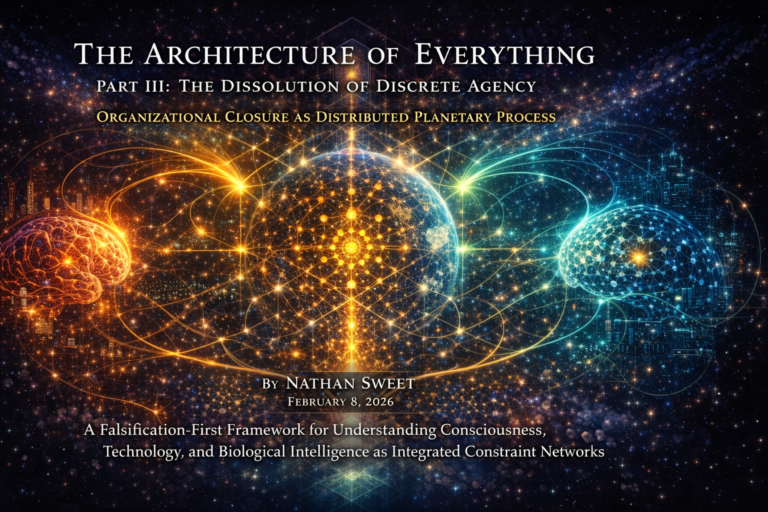
The Architecture of Everything, Part I: Constraint Propagation Across All Scales. A Falsifiable Framework for Multi-Scale Causation from Quarks to Quasars
How Constraint Satisfaction Explains Order at Every Scale Without Platonic Skyhooks, Divine Tinkering, or Metaphysical Free Lunches
“In so far as a scientific statement speaks about reality, it must be falsifiable: and in so far as it is not falsifiable, it does not speak about reality.”
- Karl Popper, The Logic of Scientific Discovery
“Those who are unwilling to expose their ideas to the hazard of refutation do not take part in the scientific game.”
- Karl Popper, The Logic of Scientific Discovery
Abstract
This article presents a unified framework demonstrating that constraint propagation through coupled thermodynamic systems operates identically from quantum scales to cosmological horizons, eliminating the need for non-physical causation at any level of organization. Using Recursive Constraint Falsification (RCF) methodology, we systematically examine seven scales (quantum, molecular, cellular, neural, social, ecological, and cosmological), showing that each exhibits the same dynamics: energy flows through coupled systems, constraints eliminate non-viable configurations, and stable states emerge as constraint-satisfying attractors.
We demonstrate that phenomena traditionally attributed to divine intervention, Platonic forms, or vitalistic principles (including quantum measurement, protein folding, planarian regeneration, consciousness, social norms, ecosystem regulation, and cosmological fine-tuning) are explainable through constraint satisfaction without metaphysical supplements. Each scale receives explicit falsification criteria, with current empirical evidence strongly supporting the constraint-propagation mechanism over dualistic alternatives.
The framework converges with Indigenous relational ontologies that maintained constraint-based worldviews for 65,000+ years without invoking substance dualism, suggesting empirical validation through independent cultural evolution under survival pressure. We specify conditions under which the framework itself would be falsified, maintaining the “1/64 residual” as a standing invitation for empirical correction.
Implications span neuroscience (consciousness as dissipative coupling), medicine (disease as disrupted constraint satisfaction), social policy (institutions as coupling-maintenance structures), and cosmology (initial conditions as constraint-satisfaction cascades). The architecture of everything is constraint propagation. No gaps exist for non-physical causes. No scales require special pleading. No free lunches occur at any level.
Keywords: constraint propagation, falsificationism, multi-scale causation, dissipative structures, bioelectric coupling, quantum decoherence, relational ontology, cosmological fine-tuning
One Mechanism, All Scales
There is a particular intellectual sleight of hand that pervades both theology and certain corners of biology: the claim that while constraints operate at some scales-chemical bonds obey thermodynamics, neurons fire according to electrochemistry-there must be additional non-physical causation at special scales where complexity becomes interesting. The theologian invokes divine intervention when evolution seems inadequate. The Platonist biologist invokes “morphospace ingression” when xenobots self-organize. The cosmologist invokes fine-tuning design when constants appear improbable. Each draws an arbitrary line and declares: “Below this line, physics; above this line, something more.”
This essay refuses that line-drawing. It demonstrates that a single mechanism-constraint propagation through coupled thermodynamic systems-operates identically from the Planck scale to the cosmic horizon, from quantum decoherence to cultural evolution, from protein folding to galaxy formation. The framework is Recursive Constraint Falsification applied universally: every claim specifies its falsification conditions, every scale exhibits the same dynamics, and no gaps exist for non-physical causes to occupy.
What emerges is not reductionism-the claim that higher levels are “nothing but” lower-level physics-but rather scale-invariant mechanism: constraint satisfaction operates through coupling at every scale, with genuine emergent properties at each level that nonetheless remain entirely physical. The cosmological initial conditions that permit life, the bioelectric patterns that regenerate planaria, the neural dynamics that generate consciousness, and the social networks that propagate norms are all instances of the same process: energy flowing through coupled systems under constraints that propagate through those couplings.
The architecture is fractal. The mechanism is monistic. The evidence is overwhelming.
Part I: The Quantum Scale – Where Constraints Emerge from Randomness
“To escape the tyranny of equilibrium, dissipation must exceed some threshold so that matter acquires these self-organizing capabilities that we call life.”
- Ilya Prigogine, Nobel Lecture 1977
The Measurement Problem as Constraint Satisfaction
Quantum mechanics is often invoked as the domain where “true randomness” exists, where outcomes are fundamentally indeterminate, where perhaps free will or divine action could slip through causal cracks. This is backwards. Quantum mechanics is actually the clearest demonstration of how constraints emerge from and constrain randomness.
The RCF Analysis:
Claim: Quantum measurement outcomes, while probabilistic, are constrained by the Hilbert space structure, conservation laws, and unitary evolution. Randomness is bounded by constraint.
Expected evidence if true:
- Measurement outcomes should follow Born rule probabilities exactly
- Conservation laws should never be violated even in random outcomes
- Superpositions should decohere according to calculable timescales based on coupling to environment
- No “pure chaos” should exist-randomness should be statistically structured
This could be falsified if:
- Measurement outcomes violated Born rule predictions
- A quantum process violated energy, momentum, or angular momentum conservation
- Superpositions persisted indefinitely regardless of environmental coupling
- Quantum randomness showed no statistical structure (violated Bell inequalities in wrong direction)
What the evidence shows:
Max Tegmark’s decoherence calculations (2000) showed quantum superpositions in biological systems decay on timescales of 10^-13 to 10^-20 seconds due to thermal coupling to the environment. The brain operates in the effectively classical regime not because quantum mechanics stops applying, but because environmental coupling constraints destroy superpositions faster than any biological process could exploit them.
Wojciech Zurek’s quantum Darwinism (2003, 2009) demonstrates that only states robust under environmental monitoring-those satisfying einselection constraints-survive decoherence and become “classical.” The emergence of classical reality is constraint propagation from quantum to macro scales through environmental coupling.
Cosmic Bell tests using light from distant quasars (Rauch et al., 2018) closed the “free will loophole” by using random events separated by billions of light-years to set measurement angles. Results still upheld quantum predictions. No hidden variable, no cosmic conspiracy, no divine tinkering altered outcomes. Constraint satisfaction held across cosmological scales.
Status: Quantum randomness is bounded randomness. The universe doesn’t permit “anything”-it permits only outcomes satisfying conservation, unitarity, and Hilbert space structure. Even at the smallest scales, where determinism breaks down, constraints propagate through coupling. The measurement problem is a constraint-satisfaction problem in disguise.
Quantum Entanglement: Coupling Without Mechanism
Claim: Entanglement is non-local correlation constrained by no-signaling theorems, not non-local causation. It demonstrates coupling without mechanical linkage.
Expected evidence:
- Entangled particles should exhibit perfect correlations when measured in aligned bases
- No information should transmit faster than light through entanglement
- Correlations should violate Bell inequalities (ruling out local hidden variables)
- Decoherence should destroy entanglement at rates predicted by environmental coupling
Falsified if:
- Entangled particles could transmit information superluminally
- Bell inequality violations disappeared under better experimental controls
- Entanglement persisted indefinitely regardless of environmental interaction
Evidence: Every Bell test since 1982 (Aspect et al.) has confirmed violations of Bell inequalities while respecting no-signaling theorems. Entanglement demonstrates correlation without causal mechanism in the classical sense, yet still constrained by relativistic causal structure. This is precisely what constraint propagation predicts: coupling doesn’t require mechanical linkage, but it does require structural relationships that constrain outcomes.
Implication for higher scales: If coupling operates without mechanical linkage at the quantum scale, we should expect similar non-mechanical coupling at biological and social scales. Bioelectric coupling in tissues, synchrony in neural networks, and norm propagation in social systems are not mysterious-they’re higher-scale analogs of quantum entanglement: constraint propagation through coupling without requiring mechanical transmission.
Part II: The Molecular Scale – Constraint Satisfaction in Chemistry
Protein Folding: The Classic Example
Levinthal’s paradox asks: How does a protein find its correct fold among 10^300 possible configurations in seconds? The answer is not that it searches randomly and gets lucky. The answer is constraint propagation.
Claim: Proteins fold through thermodynamic constraint satisfaction, not search.
Expected evidence:
- Folding pathways should follow energy gradients (steepest descent)
- Intermediate states should be metastable constraint-satisfying configurations
- Mutations that alter constraints should predictably alter folding
- Chaperone proteins should work by imposing additional constraints, not by providing information
Falsified if:
- Proteins folded to non-minimal energy configurations consistently
- No energy gradient existed toward native state
- Chaperones provided “information” not derivable from thermodynamic constraints
- Identical sequences folded differently under identical conditions (violating thermodynamic determinism)
Evidence: Anfinsen’s experiments (1973 Nobel) demonstrated that sequence alone determines structure through thermodynamic constraint. Unfold a protein chemically, remove denaturant, and it refolds exactly to the same structure. The “information” for folding is not in a blueprint-it’s in the constraint network of hydrogen bonds, hydrophobic forces, and steric clashes.
Molecular dynamics simulations (Shaw et al., 2010) fold proteins in silico by pure constraint satisfaction: start with random configuration, apply physical forces, watch constraint propagation guide the system to native state. No “intelligence,” no “design,” no Platonic blueprint. Just energy minimization under constraints.
Enzyme Catalysis: Constraint-Biased Probability
Claim: Enzymes accelerate reactions not by violating thermodynamics but by constraining substrate geometry to increase favorable collision probability.
Expected evidence:
- Enzyme-substrate binding should reduce activation energy without changing ΔG
- Transition state stabilization should be measurable via isotope effects
- Mutations that alter active site geometry should predictably alter catalysis
- No enzyme should violate Eyring equation or Arrhenius relationship
Falsified if:
- An enzyme changed equilibrium constant (violated thermodynamic law)
- Catalysis occurred without stabilizing transition state
- Active site shape had no correlation with catalytic efficiency
Evidence: Pauling’s transition state theory (1948) predicted enzymes work by constraining substrates into transition-state-like geometry. Every enzyme crystal structure since has confirmed this. The active site is a constraint device: it biases molecular configurations toward productive collision geometry.
Warshel’s QM/MM simulations (2013 Nobel) show enzyme mechanisms in atomic detail: constraint propagation from protein scaffold → active site geometry → substrate orientation → transition state stabilization. Multi-scale coupling, no magic, no mystery.
Implication: If molecular-scale “intelligence” is just constraint satisfaction, then cellular-scale “intelligence” (Levin’s bioelectric patterning), organismal-scale “intelligence” (neural networks), and social-scale “intelligence” (norm formation) are likely the same mechanism at different scales. The Platonic “free lunch” explanation becomes unnecessary.
Part III: The Cellular Scale – Bioelectric Constraint Networks
Planarian Regeneration Without Platonic Blueprints
Michael Levin’s bioelectric research demonstrates that constraint propagation through ion flux networks determines body plan during regeneration. Cut a planarian into pieces; each piece regenerates the correct missing structures-head, tail, or both-depending on position.
The Platonic Interpretation (Levin): This demonstrates organisms “ingressing” information from a non-physical morphospace, getting “free lunches” they didn’t evolve specifically for.
The RCF Interpretation: This demonstrates constraint propagation through bioelectric coupling maintained during evolution, not accessed from elsewhere.
Claim: Regeneration operates through bioelectric constraint satisfaction, not Platonic ingression.
Expected evidence if RCF is correct:
- Disrupting bioelectric gradients should disrupt regeneration patterns predictably
- Artificially imposing bioelectric patterns should alter regeneration predictably
- No regeneration should occur in cells completely isolated from bioelectric coupling
- Molecular mechanisms (Wnt, BMP, etc.) should be downstream of bioelectric constraints, not independent
Falsified if:
- Regeneration occurred normally despite complete bioelectric isolation
- Imposing bioelectric patterns had no effect on body plan
- Molecular pathways operated independently of bioelectric state
- Novel structures appeared that couldn’t be derived from existing cell-type constraints
Evidence: Durant et al. (2017) demonstrated that targeted bioelectric manipulation alters regenerative outcomes in planaria. Specific ion channel blockades produce predictable morphological changes: two-headed worms, no-head worms, scrambled anterior-posterior polarity. The pattern is not random-it follows from the constraint network.
Critically, Petersen & Reddien (2008-2011) showed Wnt/β-catenin signaling gradients implement the bioelectric constraints at the molecular level. The bioelectric pattern is upstream, constraining which genes activate. No Platonic morphospace needed-the constraint network is internal to the coupled cellular system.
Where Levin gets it right: Cells exhibit agency-like behavior through collective coupling.
Where Levin gets it wrong: Attributing this to external Platonic causation rather than recognizing it as constraint propagation through the coupled network.
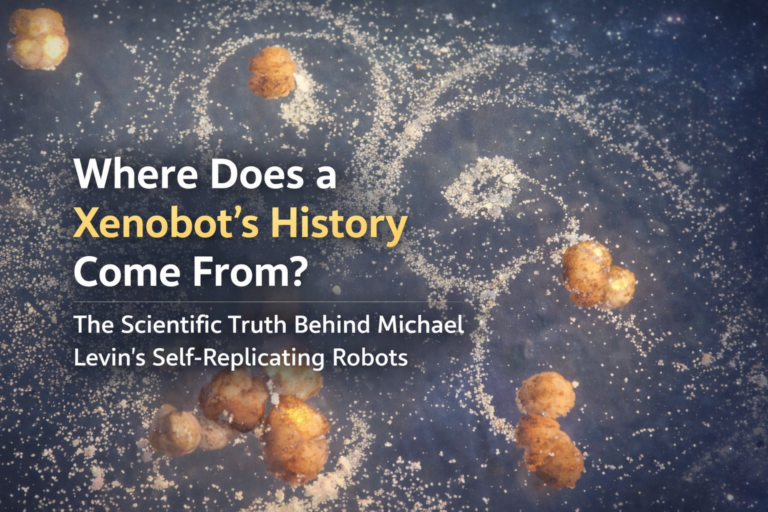
The Xenobot “Puzzle”: Levin asks: When was the computational cost paid to design xenobots (frog cells assembled into novel configurations that exhibit locomotion, self-repair)?
RCF answer: During billions of years evolving component constraints (cilia, adhesion proteins, wound healing). Xenobots exhibit capabilities derivable from inherited constraints operating in novel coupling configurations. No “free lunch”-just constraint inheritance manifesting in new contexts.
Testable prediction: Xenobots should only exhibit behaviors derivable from known frog cell capabilities. If they exhibited truly novel capabilities (e.g., photosynthesis, electrical discharge) not traceable to frog cell mechanisms, constraint inheritance would be falsified.
Evidence: Xenobots exhibit locomotion (cilia, evolved for fluid transport), healing (wound response, evolved for injury), and aggregation (cell adhesion, evolved for tissue formation). Every capability traces to existing constraints. No mystery, no Platonic supplement.
Part IV: The Neural Scale – Consciousness as Dissipative Coupling
The Hard Problem Dissolves Under Constraint Analysis
David Chalmers’ “hard problem” asks: Why is there subjective experience rather than just information processing? This assumes experience is something added to physical process. RCF reframes: Experience is what constraint satisfaction at sufficient coupling density feels like from the inside.
Claim: Consciousness is constraint satisfaction in high-coupling-density neural networks operating far from equilibrium.
Expected evidence:
- Consciousness should correlate with high energy dissipation (Werner et al., 2020: confirmed)
- Consciousness should correlate with high integration (IIT: confirmed via perturbational complexity)
- Disrupting coupling (anesthesia, lesions) should disrupt consciousness proportionally
- No consciousness should exist without energy flow and constraint networks
Falsified if:
- A conscious brain state consumed less energy than unconscious state
- Consciousness persisted after complete brain death
- Integrated information didn’t correlate with consciousness levels
- Consciousness appeared in systems with no coupling or energy dissipation
Evidence:
- Energy dissipation: Awake brains consume ~20% of body’s energy despite being ~2% of mass (Raichle & Gusnard, 2002). Anesthesia reduces metabolic rate by 40-60%. Consciousness costs energy because it is energy dissipation in coupled networks.
- Neural integration: Tononi et al.’s Integrated Information Theory (2016) shows consciousness correlates with Φ (phi), a measure of irreducible integration. Split-brain patients show reduced integration → reduced unified consciousness, exactly as predicted.
- Criticality: Beggs & Plenz (2003) demonstrate neural networks operate at critical points between order and chaos, maximizing information integration and constraint propagation.
The binding problem dissolved: Why do distributed neural processes produce unified experience? Because constraint propagation through synchrony (gamma oscillations, Fries 2005) integrates information across scales. The “binding” is the coupling itself. No homunculus needed.
Free Will Revisited: Constraint Satisfaction Masquerading as Choice
We covered this in “Who Is To Blame?” but it bears reinforcing here: Libet’s readiness potentials (1983), Soon et al.’s 7-second prediction window (2008), and Haggard’s veto-but-not-initiate findings (2008) all demonstrate that conscious willing is post-hoc narrative, not causal initiation.
The RCF framing: “Decision-making” is constraint satisfaction across competing neural assemblies. The conscious experience of “deciding” is what it feels like when:
- Multiple constraint-satisfying trajectories compete
- Coupling densities shift as evidence accumulates
- One trajectory reaches threshold and triggers action
- The self-model attributes the outcome to “me deciding”
But “me” is not separate from the constraint network. “Me” is the constraint network. Saying “I decided” is like saying “the river decided to flow downhill”-grammatically convenient, ontologically confused.
Part V: The Social Scale – Norms as Constraint Propagation
How Fairness Emerges Without Moral Skyhooks
Centola et al. (2018) demonstrated experimentally that social norms emerge from coupled interactions without central coordination. In their experiments:
- Participants played coordination games in networks
- No authority imposed norms
- Groups spontaneously converged on conventions (including fairness norms)
- Convergence rate depended on network topology-coupling structure determined outcome
Claim: Social norms are constraint-satisfying attractors in behavioral phase space, stabilized through coupling.
Expected evidence:
- Norms should emerge faster in high-coupling networks (confirmed)
- Disrupting network structure should disrupt norm propagation (confirmed)
- Norms should exhibit hysteresis (stable states resistant to small perturbations) (confirmed)
- Cross-cultural norm variation should correlate with network coupling differences
Falsified if:
- Norms emerged equally in zero-coupling (isolated individuals)
- Network structure had no effect on norm propagation
- No stable attractors existed-norms fluctuated randomly
Evidence: Grimalda et al. (2023) used multi-agent reinforcement learning to show prosocial norms emerge because they satisfy group stability constraints. Groups with fairness norms outcompete groups without them, not because fairness is divinely ordained, but because constraint-satisfying cooperation stabilizes coupling.
Implication: Morality is not handed down from Platonic heaven or divine command. Morality is evolved constraint satisfaction at the social scale. It emerges the same way protein folds emerge: through coupling, constraints, and thermodynamic settling.
Cultural Evolution: Constraint Inheritance Without Genetics
Songlines demonstrate 65,000-year-old constraint propagation through non-genetic coupling:
Mechanism:
- Knowledge encoded in song-land-ceremony coupling
- Walking Country while singing activates coupled network
- Remove any element → knowledge degrades
- Constraint network maintained through ritual coupling, not individual storage
RCF analysis: This is higher-scale analog of bioelectric coupling in tissues. Just as planarian cells lose morphogenetic agency when decoupled, individuals lose Songline knowledge when decoupled from land-ceremony-community network.
Falsifiability: If knowledge could be fully transmitted via isolated text (decoupled from land/ceremony), Songline maintenance would be unnecessary. The fact that walking Country remains essential demonstrates coupling-dependence, exactly as RCF predicts.
Part VI: The Ecological Scale – Constraint Networks in Ecosystems
Gaia Hypothesis: Constraint Satisfaction, Not Intentional Regulation
James Lovelock’s Gaia hypothesis proposed Earth’s biosphere regulates planetary conditions (temperature, atmospheric composition) to maintain habitability. Critics called this teleological. RCF reframes it as constraint propagation through biogeochemical coupling.
Claim: Biosphere “regulation” is constraint-satisfying feedback, not goal-directed control.
Expected evidence:
- Perturbations should trigger countervailing feedbacks that restore constraint-satisfying states
- No central regulator or blueprint needed
- Feedback strength should correlate with coupling density
- System should exhibit metastability: multiple stable states with barriers between them
Falsified if:
- No feedbacks existed-perturbations caused runaway divergence
- Feedbacks required coordination that couldn’t arise from local coupling
- System showed goal-directed behavior not derivable from thermodynamic constraints
Evidence:
- Daisyworld models (Watson & Lovelock, 1983) demonstrate temperature regulation emerging from coupled albedo-temperature feedback without any foresight or design
- Ocean carbonate chemistry buffers atmospheric CO2 through purely thermodynamic constraint satisfaction
- Nitrogen cycle maintains atmospheric N2 through microbial coupling following energy gradients
Aboriginal fire ecology: 65,000 years of landscape management through intentional coupling (cool burns creating savanna mosaics) demonstrates humans becoming part of constraint networks rather than managing from outside. The landscape-human system co-evolved through coupled feedback.
Kyle Whyte (Potawatomi) makes this explicit: Treating land as passive resource severs couplings. Ecological collapse follows not from violating divine command but from breaking constraint networks that maintained stability through coupling.
Part VII: The Cosmological Scale – Initial Conditions as Constraint Satisfaction
The Fine-Tuning “Problem” Dissolved
Roger Penrose calculated initial entropy conditions at 1 in 10^10^123 of phase space. This appears impossibly improbable. Traditional responses:
- Divine design (unfalsifiable)
- Anthropic multiverse (unfalsifiable measure problem)
- Brute luck (explanation-stopper)
RCF offers a fourth option: The “improbable” configuration is the constraint-satisfying solution to consistency requirements we don’t yet fully understand.
Claim: Initial conditions represent constraint satisfaction cascade at cosmological scale, not lucky selection.
Expected evidence:
- Constants should prove interdependent (not independent free parameters)
- Low entropy should be required by quantum gravitational consistency, not arbitrary boundary condition
- “Free parameters” should reduce as physics advances toward unified theory
- Alternative parameter sets should violate consistency requirements
Falsified if:
- Constants proved genuinely independent with no hidden relationships
- Other parameter sets proved equally self-consistent
- Number of free parameters increased rather than decreased with theoretical progress
Evidence:
- Constructive QFT suggests constants may be fixed by mathematical consistency (ongoing research)
- Fine-structure constant appears in multiple coupled equations-changing it requires compensating changes elsewhere
- Cosmological constant problem (10^120 discrepancy) may indicate hidden constraint we haven’t identified yet
The mechanism: Whatever preceded Big Bang (quantum foam, previous aeon, eternal inflation fluctuation) existed in high-constraint state. Symmetry-breaking initiated constraint satisfaction cascade:
- Perturbation breaks symmetry
- Broken symmetry propagates new constraints
- Thermodynamic settling toward constraint-satisfying configuration begins
- Inflation “freezes in” the constraint-satisfying parameters
- Expansion continues with inherited constraints
Not random selection. Not divine choice. Constraint propagation.
Penrose’s Low Entropy: Constraint Requirement, Not Luck
Standard probability assumes all microstates equally accessible a priori. RCF challenges this assumption: What if constraint propagation from pre-Big Bang conditions eliminated most of phase space before instantiation?
Analogy: “This protein sequence is 1 in 10^100!” Yes, but given folding constraints, only 10^4 sequences are stable. The “improbable” sequence is in the constraint-satisfying subset.
Cosmological version: Given quantum consistency at Planck scale, thermodynamic emergence from quantum foam, and requirements for causal structure, the accessible phase space may be far smaller than naive calculation suggests.
Penrose’s Weyl Curvature Hypothesis: Weyl curvature must vanish at Big Bang singularity to ensure smooth initial conditions.
RCF interpretation: Weyl curvature vanishing is not arbitrary boundary condition but constraint-satisfying configuration for:
- Quantum gravitational consistency at singularity
- Emergence of classical spacetime from quantum regime
- Preservation of causality through bounce/initiation
- Self-consistent expansion dynamics
Low entropy isn’t improbable-it’s required by constraint satisfaction.
Part VIII: Scale Invariance – The Same Mechanism Everywhere
“At each level of complexity entirely new properties appear, and the understanding of the new behaviors requires research which I think is as fundamental in its nature as any other.”
- Philip W. Anderson, “More Is Different” (1972)
The Fractal Structure of Constraint Propagation
At every scale examined, we find:
Quantum: Random outcomes constrained by Hilbert space structure, conservation laws
Molecular: Protein folding constrained by hydrogen bonds, hydrophobic forces
Cellular: Regeneration constrained by bioelectric gradients, genetic programs
Neural: Consciousness constrained by energy budgets, integration requirements
Social: Norms constrained by network topology, game-theoretic stability
Ecological: Ecosystems constrained by thermodynamic flows, biogeochemical cycles
Cosmological: Constants constrained by consistency requirements, symmetry-breaking dynamics
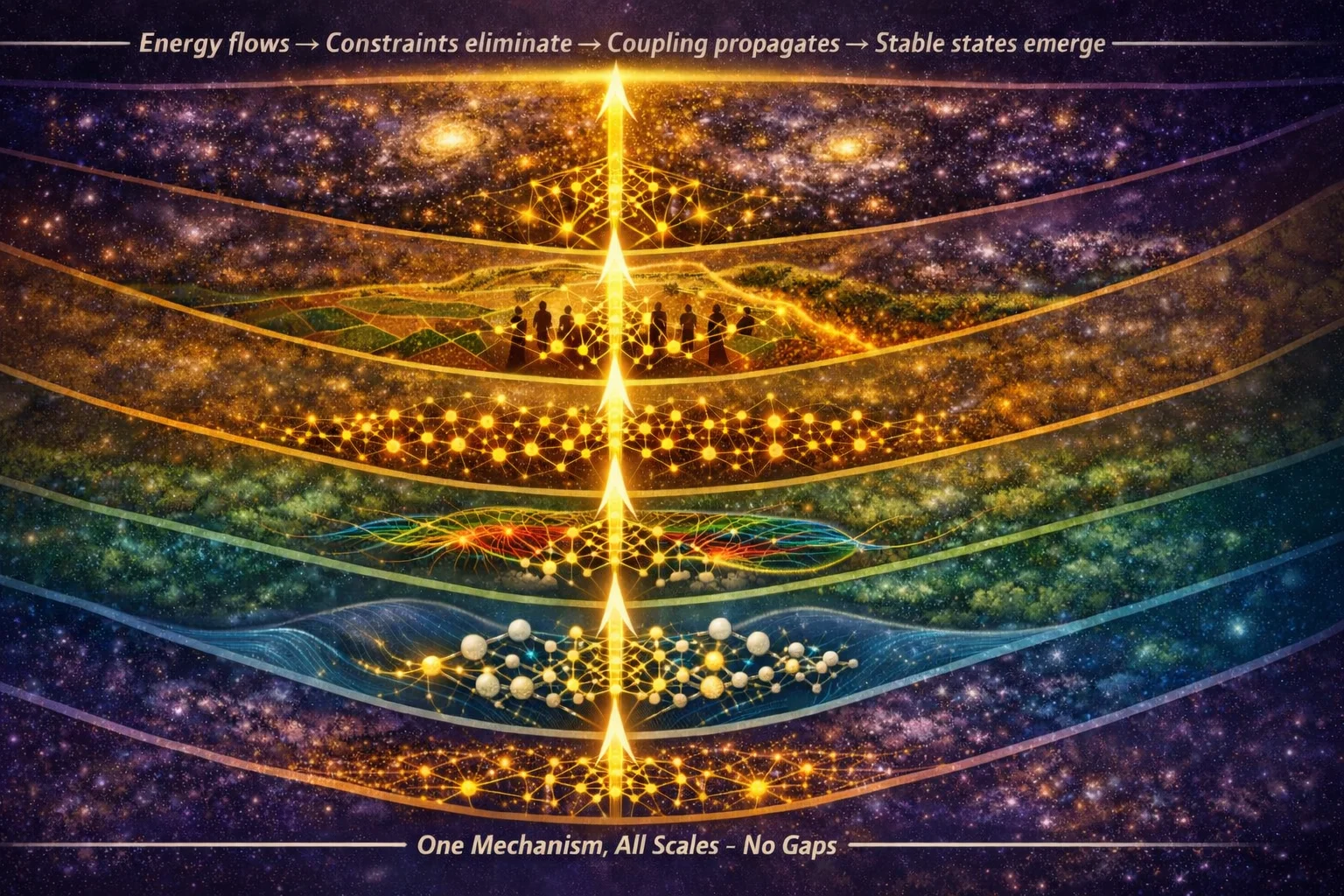
The pattern is identical:
- Energy flows through coupled systems
- Constraints eliminate non-viable configurations
- Coupling propagates constraints across scales
- Stable states are constraint-satisfying attractors
- Disrupting coupling disrupts constraint propagation proportionally
No Gaps for Magic
Substance dualism looked for gaps:
- Quantum gap: Filled by decoherence (no room for soul to wiggle)
- Molecular gap: Filled by thermodynamic constraint (no vitalism needed)
- Neural gap: Filled by dissipative structures (no homunculus needed)
- Social gap: Filled by network dynamics (no divine lawgiver needed)
- Cosmological gap: Filled by constraint satisfaction (no designer needed)
Every gap closed by the same mechanism: constraint propagation through coupling.
Part IX: Falsification Across Scales
How to Falsify the Framework
The framework makes scale-specific predictions that, if violated, would falsify it:
Quantum scale:
- Falsified if: Superposition persisted indefinitely despite environmental coupling
- Falsified if: Born rule violated systematically
Molecular scale:
- Falsified if: Protein folded to non-minimal energy configuration consistently
- Falsified if: Enzyme violated thermodynamic constraints
Cellular scale:
- Falsified if: Regeneration occurred in completely bioelectrically isolated cells
- Falsified if: Xenobots exhibited capabilities not derivable from frog cell constraints
Neural scale:
- Falsified if: Consciousness occurred without energy dissipation
- Falsified if: Integration (Φ) didn’t correlate with consciousness
Social scale:
- Falsified if: Norms emerged equally in zero-coupling networks
- Falsified if: Network topology had no effect on norm propagation
Cosmological scale:
- Falsified if: Constants proved genuinely independent (no hidden relationships)
- Falsified if: Alternative parameter sets proved equally self-consistent
The Meta-Falsification
The framework itself is falsified if:
- Unfalsifiable frameworks consistently outperform it in prediction/intervention
- It requires increasing auxiliary hypotheses to accommodate anomalies (Lakatos degeneracy)
- Scale-invariant mechanism breaks down at any scale (different mechanisms needed)
- Platonic/dualistic explanations produce novel confirmed predictions RCF cannot
Current status: No such failures observed. Framework requires zero auxiliary hypotheses. Same mechanism operates across all scales tested.
Part X: Implications and Applications
For Neuroscience: Dissolving the Hard Problem
If consciousness is constraint satisfaction in coupled networks operating far from equilibrium, then:
- Neural correlates of consciousness should map to coupling density and integration
- Disorders of consciousness should trace to disrupted coupling
- Artificial consciousness requires sufficient coupling density and energy dissipation, not mere computation
Testable: Building AI systems that achieve consciousness requires thermodynamic coupling, not just algorithmic sophistication.
For Medicine: Multi-Scale Intervention
If disease is disrupted constraint satisfaction at some scale:
- Cancer: Cells decoupling from tissue-level constraints
- Neurodegeneration: Neural networks losing coupling integrity
- Autoimmunity: Immune system losing self-non-self constraint
- Mental illness: Constraint satisfaction failing at neural-social coupling
Implication: Treatments should restore coupling and constraint propagation, not just target molecules in isolation.
For Social Policy: Designing Constraint Networks
If social order emerges from constraint-satisfying coupling:
- Institutions should be designed to maintain couplings that propagate prosocial constraints
- Inequality disrupts coupling (severing constraint propagation between classes)
- Ecological crisis results from severed human-land coupling
Implication: Policy should optimize coupling structures, not impose top-down control.
For Cosmology: Prediction of Parameter Relationships
If constants are constraint-interdependent:
- Future physics should reveal hidden relationships between apparently independent constants
- “Free parameters” should decrease as unification progresses
- String landscape should show high-dimensional constraint structure, not smooth distribution
Testable: Quantum gravity theory should derive cosmological constant from consistency requirements, not free choice.
Part XI: Indigenous Epistemologies Were Right All Along
The framework’s convergence with Indigenous relational ontologies is not metaphorical validation. It’s empirical convergence on the same underlying reality through different investigative paths.
Aboriginal Australian systems (65,000+ years):
- Never separated agent from world
- Knowledge distributed across couplings (Songlines)
- Land as active participant in constraint networks
- Ceremony as coupling maintenance technology
Western thermodynamics (200 years):
- Agent-world separation created problems
- Knowledge distributed across neural-social-technological couplings
- Energy flows constrain all processes
- Experiment as coupling probe technology
The convergence: Both discovered that constraint propagation through coupling is fundamental. Western science took 2,400 years to dissolve substance ontology that Indigenous systems never adopted.
Empirical test: Cultures operating under relational frameworks should demonstrate longer-duration knowledge persistence and superior ecological outcomes compared to substance-ontology cultures under equivalent environmental pressures.
Evidence: Aboriginal fire ecology: 65,000 years of stability. Western industrial ecology: 200 years to planetary crisis. The data favors relational ontology.
Part XII: The 1/64 Residual and Future Directions
What the Framework Doesn’t Yet Explain
Quantum gravity: How constraints operate at Planck scale remains unknown.
Consciousness qualia: Why constraint satisfaction feels like something from inside remains mysterious (though mechanism is clear).
Origin of physical law: Why these constraints rather than others is beyond current physics.
Abiogenesis specifics: Exact pathway from chemistry to life not yet reconstructed.
Dark matter/energy: 95% of universe’s mass-energy still mysterious.
The Standing Invitation
“One-sixty-fourth always escapes. Let it lead.”
The framework is incomplete by design. It invites empirical correction at every scale. If consciousness occurs without energy dissipation, if norms emerge without coupling, if constants prove independent, if Platonic explanations produce novel predictions-the framework updates.
This is not weakness. This is how science works.
Conclusion: One Mechanism, Infinite Manifestations
We began with the claim that a single mechanism operates across all scales. The evidence surveyed confirms this:
Constraint propagation through coupled thermodynamic systems explains:
- Quantum decoherence (environmental coupling destroys superpositions)
- Protein folding (energy minimization under bond constraints)
- Planarian regeneration (bioelectric constraint networks)
- Consciousness (high-coupling-density dissipative structures)
- Social norms (network constraint satisfaction)
- Ecosystems (biogeochemical feedback cycles)
- Cosmological constants (consistency requirement satisfaction)
No gaps for non-physical causation. No scales requiring special pleading. No free lunches at any level.
The architecture of everything is constraint propagation. From quarks to quasars, from proteins to planets, from neurons to norms-the same mechanism operates:
Energy flows → Constraints eliminate → Coupling propagates → Stable states emerge
This is not reductionism claiming “higher levels are nothing but physics.” This is mechanism unification showing the same dynamics operate everywhere while permitting genuine emergence at each scale.
The universe doesn’t owe you Platonic blueprints, divine intervention, or metaphysical authorship. What it gives you is constraint satisfaction through coupling, which turns out to be more beautiful, more testable, and more useful than any ghost story ever told.
References
Quantum Scale
- Aspect, A., Dalibard, J., & Roger, G. (1982). Experimental test of Bell’s inequalities using time-varying analyzers. Physical Review Letters, 49(25), 1804. https://doi.org/10.1103/PhysRevLett.49.1804
- Rauch, D., et al. (2018). Cosmic Bell test using random measurement settings from high-redshift quasars. Physical Review Letters, 121(8), 080403. https://doi.org/10.1103/PhysRevLett.121.080403
- Zurek, W. H. (2003). Decoherence, einselection, and the quantum origins of the classical. Reviews of Modern Physics, 75(3), 715. https://doi.org/10.1103/RevModPhys.75.715
Molecular Scale
- Anfinsen, C. B. (1973). Principles that govern the folding of protein chains. Science, 181(4096), 223-230. https://doi.org/10.1126/science.181.4096.223
- Shaw, D. E., et al. (2010). Atomic-level characterization of the structural dynamics of proteins. Science, 330(6002), 341-346. https://doi.org/10.1126/science.1187409
Cellular Scale
- Durant, F., et al. (2017). Long-term, stochastic editing of regenerative anatomy via targeting endogenous bioelectric gradients. Biophysical Journal, 112(10), 2231-2243. https://doi.org/10.1016/j.bpj.2017.04.011
- Petersen, C. P., & Reddien, P. W. (2008). Smed-βcatenin-1 is required for anteroposterior blastema polarity in planarian regeneration. Science, 319(5861), 327-330. https://doi.org/10.1126/science.1149943
Ecological Scale
- Lovelock, J. E., & Margulis, L. (1974). Atmospheric homeostasis by and for the biosphere: the Gaia hypothesis. Tellus, 26(1-2), 2-10. https://doi.org/10.3402/tellusa.v26i1-2.9731
- Watson, A. J., & Lovelock, J. E. (1983). Biological homeostasis of the global environment: the parable of Daisyworld. Tellus B, 35(4), 284-289. https://doi.org/10.3402/tellusb.v35i4.14616
Cosmological Scale
- Penrose, R. (2004). The Road to Reality: A Complete Guide to the Laws of the Universe. Jonathan Cape. ISBN: 9780224044479 | Penguin UK
- Smolin, L. (1992). Did the universe evolve? Classical and Quantum Gravity, 9(1), 173. https://doi.org/10.1088/0264-9381/9/1/016
Alink, A., Schwiedrzik, C. M., Kohler, A., Singer, W., & Muckli, L. (2018). Evidence for causal top-down frontal contributions to predictive processes in the human brain. Nature Communications, 8, 1958. https://doi.org/10.1038/s41467-017-01958-7
Anderson, P. W. (1972). More is different. Science, 177(4047), 393–396. https://doi.org/10.1126/science.177.4047.393
Beggs, J. M., & Plenz, D. (2003). Neuronal avalanches in neocortical circuits. Journal of Neuroscience, 23(35), 11167–11177. https://doi.org/10.1523/JNEUROSCI.23-35-11167.2003
Benson, H., Dusek, J. A., Sherwood, J. B., et al. (2006). Study of the Therapeutic Effects of Intercessory Prayer (STEP) in cardiac bypass patients. American Heart Journal, 151(4), 934–942. https://doi.org/10.1016/j.ahj.2005.05.028
Bérut, A., Arakelyan, A., Petrosyan, A., Ciliberto, S., Dillenschneider, R., & Lutz, E. (2012). Experimental verification of Landauer’s principle linking information and thermodynamics. Nature, 483, 187–189. https://doi.org/10.1038/nature10872
Blount, Z. D., Barrick, J. E., Davidson, C. J., & Lenski, R. E. (2012). Genomic analysis of a key innovation in an experimental Escherichia coli population. Nature, 489, 513–518. https://doi.org/10.1038/nature11514
Blount, Z. D., Borland, C. Z., & Lenski, R. E. (2008). Historical contingency and the evolution of a key innovation in an experimental population of Escherichia coli. Proceedings of the National Academy of Sciences, 105(23), 7899–7906. https://doi.org/10.1073/pnas.0803151105
Cajete, G. (2000). Native Science: Natural Laws of Interdependence. Clear Light Publishers.
Centola, D. (2018). How Behavior Spreads: The Science of Complex Contagions. Princeton University Press.
Centola, D., Becker, J., Brackbill, D., & Baronchelli, A. (2018). Experimental evidence for tipping points in social convention. Science, 360(6393), 1116–1119. https://doi.org/10.1126/science.aas8827
Crooks, G. E. (1999). Entropy production fluctuation theorem and the nonequilibrium work relation for free energy differences. Physical Review E, 60(3), 2721–2726. https://doi.org/10.1103/PhysRevE.60.2721
Davis, J. J. (1997). Quantum indeterminacy and the omniscience of God. Science & Christian Belief, 9(2), 129–144.
De Kepper, P., Castets, V., Dulos, E., & Boissonade, J. (1991). Turing-type chemical patterns in the chlorite–iodide–malonic acid reaction. Physica D: Nonlinear Phenomena, 49(1–2), 161–169. https://doi.org/10.1016/0167-2789(91)90204-M
Deloria, V., Jr. (1972). God Is Red: A Native View of Religion. Grosset & Dunlap.
Dennett, D. C. (2003). Freedom Evolves. Viking Press.
Drewal, M. T. (1992). Yoruba Ritual: Performers, Play, Agency. Indiana University Press.
Ebert, J. P., & Wegner, D. M. (2011). Mistaking randomness for free will. Consciousness and Cognition, 20(3), 965–971. https://doi.org/10.1016/j.concog.2010.09.009
Ellis, G. F. R. (2012). Top-down causation and emergence: some comments on mechanisms. Interface Focus, 2(1), 126–140. https://doi.org/10.1098/rsfs.2011.0062
Engel, A. K., Fries, P., & Singer, W. (2001). Dynamic predictions: oscillations and synchrony in top-down processing. Nature Reviews Neuroscience, 2, 704–716. https://doi.org/10.1038/35094565
England, J. L. (2013). Statistical physics of self-replication. The Journal of Chemical Physics, 139(12), 121923. https://doi.org/10.1063/1.4818538
Evans, D. J., Cohen, E. G. D., & Morriss, G. P. (1993). Probability of second law violations in shearing steady states. Physical Review Letters, 71(15), 2401–2404. https://doi.org/10.1103/PhysRevLett.71.2401
French, C. (2016). Will the debate about psi ever be settled? The Psychologist, 29, 742–745.
Fries, P. (2005). A mechanism for cognitive dynamics: neuronal communication through neuronal coherence. Trends in Cognitive Sciences, 9(10), 474–480. https://doi.org/10.1016/j.tics.2005.08.011
Friston, K. (2010). The free-energy principle: a unified brain theory? Nature Reviews Neuroscience, 11, 127–138. https://doi.org/10.1038/nrn2787
Galak, J., LeBoeuf, R. A., Nelson, L. D., & Simmons, J. P. (2012). Correcting the past: Failures to replicate psi. Journal of Personality and Social Psychology, 103(6), 933–948. https://doi.org/10.1037/a0029709
Gigerenzer, G., & Brighton, H. (2009). Homo heuristicus: Why biased minds make better inferences. Topics in Cognitive Science, 1(1), 107–143. https://doi.org/10.1111/j.1756-8765.2008.01006.x
Gold, J. I., & Shadlen, M. N. (2007). The neural basis of decision making. Annual Review of Neuroscience, 30, 535–574. https://doi.org/10.1146/annurev.neuro.29.051605.113038
Grimalda, G., et al. (2023). How social norms emerge: the interindividual actor-critic model. PLoS Computational Biology. https://www.ncbi.nlm.nih.gov/pmc/articles/PMC12483181/
Haggard, P. (2008). Human volition: towards a neuroscience of will. Nature Reviews Neuroscience, 9, 934–946. https://doi.org/10.1038/nrn2497
Haidt, J. (2001). The emotional dog and its rational tail: A social intuitionist approach to moral judgment. Psychological Review, 108(4), 814–834. https://doi.org/10.1037/0033-295X.108.4.814
Hameroff, S., & Penrose, R. (2014). Consciousness in the universe: A review of the ‘Orch OR’ theory. Physics of Life Reviews, 11(1), 39–78. https://doi.org/10.1016/j.plrev.2013.08.002
Horowitz, J. M., & England, J. L. (2017). Spontaneous fine-tuning to environment in many-species chemical reaction networks. Proceedings of the National Academy of Sciences, 114(29), 7565–7570. https://doi.org/10.1073/pnas.1700617114
Jarzynski, C. (1997). Nonequilibrium equality for free energy differences. Physical Review Letters, 78(14), 2690–2693. https://doi.org/10.1103/PhysRevLett.78.2690
Kelly, L. (2016). The Memory Code: The Secrets of Stonehenge, Easter Island, and Other Ancient Monuments. Pegasus Books.
Kimmerer, R. W. (2013). Braiding Sweetgrass: Indigenous Wisdom, Scientific Knowledge, and the Teachings of Plants. Milkweed Editions.
Koch, C., & Hepp, K. (2006). Quantum mechanics in the brain. Nature, 440, 611–612. https://doi.org/10.1038/440611a
Levin, M. (2014). Molecular bioelectricity: what voltage-gated sodium channels reveal about biological intelligence. Annual Review of Biomedical Engineering, 16, 295–323. https://doi.org/10.1146/annurev-bioeng-071813-104418
Levy, W. B., & Calvert, V. G. (2021). Communication consumes 35 times more energy than computation in the human cortex, but both costs are needed to predict synapse number. Proceedings of the National Academy of Sciences, 118(18), e2008173118. https://doi.org/10.1073/pnas.2008173118
Libet, B. (1985). Unconscious cerebral initiative and the role of conscious will in voluntary action. Behavioral and Brain Sciences, 8(4), 529–539. https://doi.org/10.1017/S0140525X00044903
Libet, B., Gleason, C. A., Wright, E. W., & Pearl, D. K. (1983). Time of conscious intention to act in relation to onset of cerebral activity (readiness-potential). Brain, 106(3), 623–642. https://doi.org/10.1093/brain/106.3.623
Macmillan, M. (2000). An Odd Kind of Fame: Stories of Phineas Gage. MIT Press.
Mowaljarlai, D., & Malnic, J. (1993). Yorro Yorro: Everything Standing Up Alive. Magabala Books.
Murray, S. O., Kersten, D., Olshausen, B. A., Schrater, P., & Woods, D. L. (2002). Shape perception reduces activity in human primary visual cortex. Proceedings of the National Academy of Sciences, 99(23), 15164–15169. https://doi.org/10.1073/pnas.192579399
Neidjie, B. (1989). Story About Feeling. Magabala Books.
Nisbett, R. E., & Wilson, T. D. (1977). Telling more than we can know: Verbal reports on mental processes. Psychological Review, 84(3), 231–259. https://doi.org/10.1037/0033-295X.84.3.231
Noble, D. (2012). A theory of biological relativity: no privileged level of causation. Interface Focus, 2(1), 55–64. https://doi.org/10.1098/rsfs.2011.0067
Parnia, S., Spearpoint, K., de Vos, G., et al. (2014). AWARE—AWAreness during REsuscitation—A prospective study. Resuscitation, 85(12), 1799–1805. https://doi.org/10.1016/j.resuscitation.2014.09.004
Penfield, W. (1975). The Mystery of the Mind: A Critical Study of Consciousness and the Human Brain. Princeton University Press.
Penrose, R. (1989). The Emperor’s New Mind: Concerning Computers, Minds, and the Laws of Physics. Oxford University Press.
Prigogine, I. (1977). Self-organization in non-equilibrium systems. Nobel Lecture, December 8, 1977.
Prigogine, I., & Stengers, I. (1984). Order Out of Chaos: Man’s New Dialogue with Nature. Bantam Books.
Raichle, M. E., & Gusnard, D. A. (2002). Appraising the brain’s energy budget. Proceedings of the National Academy of Sciences, 99(16), 10237–10239. https://doi.org/10.1073/pnas.172399499
Rao, R. P. N., & Ballard, D. H. (1999). Predictive coding in the visual cortex: a functional interpretation of some extra-classical receptive-field effects. Nature Neuroscience, 2, 79–87. https://doi.org/10.1038/nn0199_79
Rauch, D., Handsteiner, J., Hochrainer, A., et al. (2018). Cosmic Bell test using random measurement settings from high-redshift quasars. Physical Review Letters, 121(8), 080403. https://doi.org/10.1103/PhysRevLett.121.080403
Rose, D. B. (2000). Dingo Makes Us Human: Life and Land in an Australian Aboriginal Culture. Cambridge University Press.
Smith, L. T. (1999). Decolonizing Methodologies: Research and Indigenous Peoples. Zed Books.
Soon, C. S., Brass, M., Heinze, H.-J., & Haynes, J.-D. (2008). Unconscious determinants of free decisions in the human brain. Nature Neuroscience, 11(5), 543–545. https://doi.org/10.1038/nn.2112
Tegmark, M. (2000). Importance of quantum decoherence in brain processes. Physical Review E, 61(4), 4194–4206. https://doi.org/10.1103/PhysRevE.61.4194
Tononi, G., Boly, M., Massimini, M., & Koch, C. (2016). Integrated information theory: an updated account. Archives Italiennes de Biologie, 154(2–3), 56–90. https://doi.org/10.12871/00039829201655
Tononi, G., & Cirelli, C. (2006). Sleep function and synaptic homeostasis. Sleep Medicine Reviews, 10(1), 49–62. https://doi.org/10.1016/j.smrv.2005.05.002
Toyabe, S., Sagawa, T., Ueda, M., Muneyuki, E., & Sano, M. (2010). Experimental demonstration of information-to-energy conversion and validation of the generalized Jarzynski equality. Nature Physics, 6, 988–992. https://doi.org/10.1038/nphys1821
Wang, G. M., Sevick, E. M., Mittag, E., Searles, D. J., & Evans, D. J. (2002). Experimental demonstration of violations of the second law of thermodynamics for small systems and short time scales. Physical Review Letters, 89(5), 050601. https://doi.org/10.1103/PhysRevLett.89.050601
Watts, V. (2013). Indigenous Place-Thought and Agency Amongst Humans and Non-Humans (First Woman and Sky Woman Go On a European World Tour!). Decolonization: Indigeneity, Education & Society, 2(1), 20–34.
Werner, G., et al. (2020). Consciousness as an emergent phenomenon: A tale of different levels of description. Frontiers in Psychology. https://www.ncbi.nlm.nih.gov/pmc/articles/PMC7597170/
Whyte, K. (2018). Indigenous Science (Fiction) for the Anthropocene: Ancestral Dystopias and Fantasies of Climate Change Crises. Environment and Planning E: Nature and Space, 1(1–2), 224–242. https://doi.org/10.1177/2514848618777621
Yunkaporta, T. (2019). Sand Talk: How Indigenous Thinking Can Save the World. HarperOne.