What Shape Is Persistence? Why Douglas Brash’s Observation the Ship of Theseus Is a Wave Is Insightful (And Why That Is Not the Whole Answer) [Physics, Biology, Neuroscience]
This post follows directly from [Noether’s Theorem Beyond Physics], which argued that symmetry and conservation are not two things connected by an arrow but one structure seen from two measurement positions. Shortly after that piece went up, I received a note from Douglas Brash, Professor of Therapeutic Radiology and Dermatology at Yale School of Medicine, that stopped me cold and has kept me thinking ever since…
Douglas Brash wrote:
“Delighted to see a discussion of Noether, way overlooked in physics. I’ll read carefully later, but in case it’s helpful I noticed that you talk about persistence of constraints in connection with replacing the planks on the Ship of Theseus. That is a wave:
particle motion = same components, same internal relations, changing external relations
wave = changing components, same internal relations, changing external relationsSo the Ship of Theseus is a wave. I hadn’t thought about these relations as persistence of constraints.”
This is a genuinely precise observation, sharper than most treatments of the Ship of Theseus paradox, which tend to hand-wave toward “pattern persistence” without specifying what pattern means structurally. Brash’s three-variable taxonomy (components, internal relations, external relations, each either same or changing) carves real joints. And he’s right: by that taxonomy, the ship is a wave.
But the taxonomy has a productive gap, and filling it changes the geometry of the answer entirely.
What Is the Difference Between a Wave and a Living System?
A wave propagates through a medium that something else maintains. The ocean does that work, not the wave. If you removed the ocean, the wave would cease, and the wave does nothing to prevent that removal. The medium is maintained by planetary hydrodynamics, solar heating, Coriolis forces, none of which the wave participates in sustaining.
A living system is different in exactly this respect. The mycorrhizal network a mature forest depends on is maintained by the trees it supports. The local microclimate that prevents the forest from drying out is generated by the forest’s own transpiration. The soil chemistry the forest needs is produced by the forest’s decomposition cycles. The forest maintains the medium through which it moves. This is the fourth variable Brash’s taxonomy doesn’t include: does the pattern constitute the medium, or does something external maintain it?
Waves score: changing components, stable internal relations, changing external relations, medium maintained externally. Living systems with what Montévil and Mossio (2015) call organizational closure score: changing components, stable internal relations, changing external relations, medium maintained by the pattern itself. One additional binary variable, but it changes everything about how the system behaves under perturbation, and it’s precisely where the thermodynamic cost lands. The medium-maintaining work is real dissipation, paid continuously, never free.
What Geometric Shape Best Describes a Self-Maintaining System?
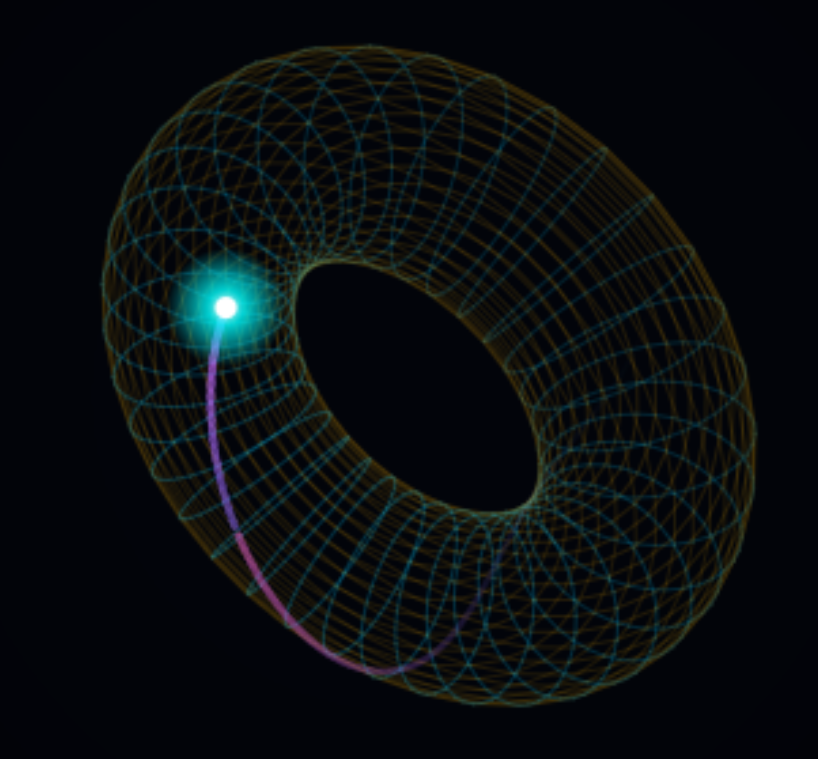
The right geometric description is a quasiperiodic toroidal attractor. The torus closes on itself in two independent directions: one rotation corresponds to the closure loop (constraints regenerating conditions for their own continuation), the other to the wave propagation Brash correctly identified (components cycling while relations hold). These are not two descriptions of one rotation. They are two structurally independent cycles that together constitute the shape, and the hole through the middle of the torus is not decorative. It is the geometric signature of that double closure.
When the two rotation speeds are in irrational ratio, the orbit on the torus surface never exactly repeats but covers it densely over time. That quasiperiodic winding is what the intuition names as “recursive” and “spiral-like.” The intuition is tracking something real. The orbit is spiral-like. The shape it inscribes that path on is toroidal.
The KAM theorem (Kolmogorov, Arnold, Moser, 1954-1963) proves that quasiperiodic orbits in conservative systems are generically stable against small perturbations when the frequency ratio satisfies a Diophantine condition. The golden ratio, φ = (1+√5)/2, is the canonical example of maximally Diophantine irrationality. Arnold called the golden-ratio torus “the last torus to break” as perturbation increases toward chaos. Whether a dissipative analog of KAM stability holds for systems with organizational closure (which are far-from-equilibrium, not conservative) is an open mathematical problem. The conjecture is that it does, and that this is why living systems tuned near the edge of chaos are more adaptive than simple periodic oscillators. The proof would require specialist mathematics that isn’t yet assembled.
How Does Noether’s Theorem Relate to Biological Persistence? What Does the Interactive Animation Show?
The visualization below shows a quasiperiodic toroidal attractor with the frequency ratio set to φ. The blue lattice traces the closure loop (the maintaining). The amber lattice traces the wave propagation Brash identified. The glowing orbital trail is the quasiperiodic path, never exactly returning, never escaping. Hit PERTURB to deform the torus and watch it recover. That recovery is Noether’s symmetry expressed as attractor behavior. The invariance under perturbation and the persistence through time are not two properties. They are one ongoing constraining, measured twice.
The orbit (the glowing trail) spirals around the torus surface without ever exactly returning — that quasiperiodic winding is what the intuition names as recursive and spiral-like. It is real. But it is the orbit, not the shape.
The shape is the torus: doubly closed, two independent rotation directions coupled. The blue lattice is the closure loop (constraints regenerating conditions for their own persistence). The amber lattice is the wave propagation Brash identified. Together they constitute the medium the orbit moves through — and the orbit maintains the medium. That is the constitutive move waves cannot make.
Hit PERTURB: the torus deforms and recovers. Recovery is Noether’s symmetry expressed as attractor behavior. The invariance under perturbation is the persistence. Two readings. One ongoing constraining.
How Many Types of Persistent Pattern Exist? What Is Organizational Closure and Why Does It Matter?
The question Brash’s observation opens is whether his three-variable wave taxonomy can be extended to include medium-maintenance as a fourth variable, and what the full classification of pattern-persistence types looks like when you add it. There are at least four distinct classes: passive waves (M=0, external medium), dissipative structures like Bénard cells (M=0, external gradient), living systems (M=1, closure without full autonomy), and fully autonomous organizational closures (M=1, regenerating all conditions). Whether those four classes exhaust the space or whether there are others is the kind of question worth asking.
Grid cell manifolds in the entorhinal cortex, KAM-stable tori at the boundary of chaos, topological protection in quantum matter, the Tonnetz in tonal harmony, evolutionary robustness under mutation, immune network self-maintenance, circadian phase geometry, market dynamics between stasis and collapse, climate subsystems approaching tipping points, and even long-duration cultural systems such as songlines all point toward the same structural pattern: the quasiperiodic toroidal attractor appears wherever a system must simultaneously maintain closure, avoid exact repetition in order to remain adaptive, explore its possibility space densely, and preserve the very medium through which its dynamics unfold. When those four constraints co-occur, the quasiperiodic torus emerges as one of the few dynamical structures capable of satisfying them together.
What if the recurring appearance of quasiperiodic toroidal attractors across disciplines is not coincidence but constraint? Rather than claiming everything is toroidal, should we ask why closure, non-repetition, dense exploration of possibility space, and medium-maintenance so often appear together, and why that cluster so frequently maps onto toroidal geometry with predictive force?
The pattern across all of these: the quasiperiodic toroidal attractor appears wherever a system needs to simultaneously maintain closure (stay on the attractor), never repeat (remain adaptive), cover its possibility space densely (be ergodic), and maintain the medium through which it moves (constitutive closure). That’s four constraints that together single out the quasiperiodic torus almost uniquely among dynamical structures.
In neuroscience, when grid cell populations trace a measurable toroidal manifold, is computational efficiency really an explanation, or merely a description? If a system must represent a doubly periodic environment coherently, would a doubly periodic state space not follow naturally? When neural activity winds quasiperiodically on that torus during navigation, is that an encoding choice or the attractor geometry of spatial closure? And if the free energy principle also describes self-maintaining structure, are Markov blankets and neural tori two views of the same constraint landscape, or distinct frameworks that only converge superficially?
In dynamical systems, KAM theory shows quasiperiodic tori resisting perturbation in Hamiltonian systems. If golden ratio frequency ratios maximize stability, why does that number recur at the edge of chaos? Yet biological systems are dissipative. Is there an analog of KAM stability for far-from-equilibrium systems, and would such a result explain why living systems appear robust without freezing? If universality laws govern transitions to chaos across domains, are we seeing shared geometry rather than shared material?
In quantum physics, when the Brillouin zone is topologically a torus and topological invariants protect boundary states, is that mathematical convenience or structural necessity? If the toric code stores information in global topology so that local errors cannot erase it, is that merely analogous to biological closure, or is it the same structural principle operating in different substrates? And if so, would thermodynamic bounds such as Landauer’s principle constrain topological quantum computation in specific ways?
In music theory, when the Tonnetz closes in two independent rotations and harmonic motion traces non-repeating yet bounded paths, is that cultural artifact or cognitive constraint? If the most compelling tonal works avoid both trivial repetition and chaos, does that reflect learned preference or nervous systems tuned to quasiperiodic stability? Would cross-cultural musical data confirm or falsify that prediction?
In evolution, how does a system maintain closure while remaining evolvable? Could quasiperiodic motion on a stable torus model how small perturbations shift trajectories without destroying structure? If robustness and evolvability coexist, is that better captured by toroidal attractors than by simple funnels? And if protein folding instead follows funnel geometries, does that weaken a topological claim while preserving a functional one about stability under constraint?
In immunology, if the immune network maintains a dynamic self model, does autoimmune breakdown reflect failure of structural closure rather than simple misclassification? Would therapies that restore constraint architecture outperform those that merely suppress activity?
In chronobiology, when biological clocks exhibit quasiperiodic phase structures, are those topologies selected because they resist perturbation while remaining flexible? Could KAM-like stability explain why reliable timekeeping is possible at all?
In economics and climate systems, when stability gives way to chaos or collapse, are we witnessing toroidal breakdown or attractor shift? If both exhibit critical slowing down, could frequency-domain signatures distinguish them? Has that prediction been directly tested?
Across all these cases, when closure, adaptability, ergodicity, and medium-maintenance coincide, does the quasiperiodic torus emerge as the minimal geometry satisfying those constraints? Or is that too strong? If a long-lived adaptive system persists without toroidal or equivalent topology, would that falsify the geometric claim while preserving a deeper principle about constraint satisfaction? And is the missing piece a unifying theorem stating that systems maintaining organizational closure under thermodynamic dissipation will generically exhibit quasiperiodic attractor structure?
The deeper thing all of this seems to me to be pointing at is there may be a general theory of what it means to be a complex adaptive system that doesn’t yet exist in unified form. Noether provides the physics-specific case. KAM theory provides the dynamical systems case. Montévil-Mossio provides the biology case. The neural torus provides the neuroscience case. What’s missing is the theorem that encompasses all of them, something like: any system that maintains organizational closure against thermodynamic dissipation over timescales long compared to its internal dynamics will generically exhibit quasiperiodic toroidal attractor geometry, and the stability of that geometry is the KAM analog for dissipative systems. That theorem doesn’t exist yet. The pieces are all there. Nobody has assembled them.
If you’re thinking about Noether’s Theorem, the Ship of Theseus, or the geometry of anything that persists, I’d welcome the correspondence, drop a comment below or contact me directly.
Next in this series: the full constraint-based framework, which attempts a synthesis of thermodynamic rigor and cultural transmissibility, and tries to say something honest about ecological grief.