
Who Is To Blame? Constraint-Coupled Distributed Agency, A Falsifiable Naturalistic Framework For Multi-Scale Distributed Agency
How Determinism, Randomness, and Thermodynamics Dissolve Free Will, Divine Accountability, and Compatibilism’s Last Pretensions
“That which can be asserted without evidence can be dismissed without evidence.”
— Christopher Hitchens
“Everyone is entitled to their own opinions, but they are not entitled to their own facts.”
— Daniel Patrick Moynihan
Introduction: The Universe Does Not Owe You Authorship
There is a particular kind of intellectual cowardice that consists in refusing to follow an argument to its conclusion because the conclusion is uncomfortable. We see it in the theologian who admits that quantum indeterminacy cannot ground moral responsibility but then pivots to mystery as though mystery were an explanation rather than a confession of failure. We see it in the compatibilist who concedes that every atom in the deliberating brain was placed there by processes the deliberator had no hand in creating, then insists that the deliberation is nonetheless yours in some metaphysically nourishing sense. We see it, frankly, in the libertarian who demands that free will exist because punishment feels justified and Sunday sermons require it.
This essay refuses that cowardice. It follows the evidence from neuroscience, thermodynamics, quantum mechanics, information theory, and complexity science to a conclusion that is simultaneously devastating and liberating: there is no free will in the libertarian sense, there never was, and adding randomness to the universe does not rescue the concept but buries it more thoroughly. Divine moral accountability, which requires precisely the kind of authorship that neither determinism nor indeterminism can provide, collapses under its own incoherence. And compatibilism, that genteel philosophical compromise that tries to save the word free by redefining it beyond recognition, turns out to be less a solution than a redescription; a floppy wheel bolted onto a rusted axle, navigating highway traffic at seventy miles per hour with nothing but a stick and a prayer.
The framework grounding this analysis is what I call Constraint-Coupled Distributed Agency (CCDA), following Wittgenstein’s principle that meaning is use: the framework’s name describes what it does. CCDA treats all causation and order in the universe as arising from physical constraints and energy flows through coupled systems across scales, with no supernatural skyhooks or uncaused causes intervening. Where traditional hard determinism simply declares “you couldn’t have done otherwise,” CCDA explains why: because discrete entities decoupled from constraint networks lose all affective agency; the capacity to produce effects that persist. What makes CCDA novel is not the denial of libertarian free will (that’s old news), but the positive account of what agency actually is: a gradient that condenses at nodes of high coupling density within multi-scale thermodynamic networks. Agency is not a property possessed by isolated units; it is an emergent phenomenon of coupling itself.
CCDA demands that every claim specify its falsification conditions. If your theory of free will cannot tell me what observation would prove it wrong, it is not a theory. It is a mood.
A Note on Compatibilism, and Why This Pains Me to Write
Before proceeding, I must address an uncomfortable truth: this essay takes a position that Daniel Dennett, one of the most brilliant philosophers of the twentieth century and a personal intellectual hero, never fully embraced. Dennett spent decades defending compatibilism with unmatched clarity and argumentative force. His work shaped my thinking more than perhaps any other philosopher’s. His recent death leaves a void in philosophy that will not soon be filled, and writing an essay that challenges his central project feels like a betrayal of a teacher I never met but learned from profoundly.
I understand the seduction of Dennett’s compatibilist position. From a social dynamics perspective, it preserves our practices of praise, blame, and moral responsibility without requiring metaphysical ghosts. It provides a naturalistic foundation for ethics that most people can accept. Dennett himself was explicit about this: he wanted to save the phenomena of moral agency, not throw them out with the bathwater of libertarian confusion. And in Freedom Evolves (2003), he came achingly close to the position I defend here; so close that at times I wonder if he saw it but chose not to make the final step for pragmatic reasons I can respect even as I disagree with them.
But my love for Dennett’s work and my grief at his passing cannot stop me from following the argument where it leads. Dennett taught me to follow evidence ruthlessly, to dissolve confusions rather than accommodate them, and to never mistake useful fictions for metaphysical facts. This essay honors that teaching by applying it to compatibilism itself. What Dennett called “the kind of free will worth wanting” is indeed worth wanting; but it is not the thing people were asking about when they asked if free will exists, any more than calling a duck a “swan” makes it the bird of Wagner’s operas. The honest move is not to redefine the question but to dissolve it, and that requires going one step further than Dennett was willing to go.
What follows is an attempt to complete what Dennett started: to show that dissolving a bad concept does not dissolve the phenomena the concept was trying (and failing) to describe. Multi-scale distributed agency across coupled networks is real. Deliberation is real. The felt experience of choosing is real. What is not real is the metaphysical ghost that was supposed to be doing the choosing from outside the causal order, or the notion that the deliberation itself constitutes the kind of authorship that justifies ultimate moral responsibility in the sense most people mean it. The ghost never showed up for work. The causal order did all the heavy lifting. It is time to give credit where it is due, even if it means disagreeing with the philosopher who taught me how to think clearly about these questions in the first place.
It is worth noting, before proceeding, that the dissolution attempted here is not culturally novel. Aboriginal Australian knowledge systems, refined over 65,000 years of continuous empirical testing under survival pressure, never required the separation between “agent” and “world” that Western philosophy treats as foundational. As Tyson Yunkaporta argues in Sand Talk (2019), Aboriginal ontology embeds multi-scale distributed agency within relational networks of land, kinship, and law; what Western philosophy belatedly calls “distributed cognition” was simply the operating assumption of the oldest continuous cultures on Earth. Deborah Bird Rose’s ethnographic work with Yarralin people documented an ontology in which Country itself acts, nourishes, and constrains; multi-scale distributed agency is a property of the coupled system, not of discrete entities extracted from it (Rose, Dingo Makes Us Human, 2000). The Lakota scholar Vine Deloria Jr. made the point with characteristic directness: Western metaphysics invented the isolated autonomous self and then spent 2,400 years trying to explain how it connects to anything (Deloria, God Is Red, 1972). Indigenous frameworks never disconnected it in the first place.
• • •
The Double Kill: Why Neither Determinism Nor Randomness Saves Free Will
The argument against libertarian free will is older than most people realize, but modern neuroscience has given it teeth that philosophy alone could never provide. The core logic is elegant in its brutality: if your actions are determined by prior states, you could not have done otherwise. If your actions are the product of genuine randomness, you still could not have controlled otherwise. In either case, the traditional idea of contra-causal freedom, the notion that you, as an uncaused cause, initiated your choice from some ontological perch outside the causal chain, is dead on arrival.
Benjamin Libet’s classic experiments in the 1980s demonstrated that brain activity indicating a decision (the so-called readiness potential) occurs before a person’s conscious awareness of having decided to act (Libet, 1985; Libet et al., 1983). You read that correctly: neural constraint-satisfaction dynamics commit to an action before the self-model registers the commitment. The conscious experience of willing is, on the best available evidence, a post-hoc narrative; the brain’s press secretary announcing a decision that was already made in the back office.
Follow-up studies using fMRI pushed this finding further into uncomfortable territory. Soon et al. (2008) demonstrated that simple choices (pressing a button with the left or right hand) could be predicted from brain activity up to seven to ten seconds before subjects reported feeling they had freely chosen (Soon et al., 2008). Seven seconds. In neural time, that is an eternity. The conscious experience of choosing was not the cause of the action; it was the last to know.
Now, the libertarian’s instinctive response is to reach for quantum mechanics, the one domain of physics where genuine indeterminacy appears to exist, and argue that randomness provides the gap through which free will can operate. This is the Epicurean swerve dressed in modern clothing, and it fails for exactly the same reason it failed 2,300 years ago: randomness is not freedom. It is the absence of authorship. If your decision to turn left was determined by a quantum fluctuation in a calcium channel rather than by the multi-scale constraint history constituting your reasons, values, and deliberative coupling, then the quantum fluctuation is the author of your action, not you. You have traded one form of unfreedom (determination by prior states) for a worse one (determination by nothing at all).
Daniel Dennett made this point with characteristic clarity: random processes cannot produce the kind of autonomous, responsible multi-scale distributed agency that libertarians require (Dennett, Freedom Evolves, 2003). An action produced by randomness is not free; it is arbitrary. The distinction between freedom and randomness is precisely the distinction between authorship and accident, and no amount of theological hand-waving can collapse it.
Ebert and Wegner (2011) provided a delicious empirical confirmation of the confusion underlying the libertarian position. In their experiments, participants who were prompted to behave randomly felt more free than those following a fixed sequence (Ebert & Wegner, 2011). This is a misattribution of cosmic proportions: unpredictability is mistaken for autonomy because both feel like the absence of external control. But unpredictability without constraint coupling is just noise. Feeling free while generating random outputs is like feeling wealthy while counterfeiting currency; the subjective experience is real, but the underlying reality is bankrupt.
The CCDA perspective is unsparing here: appeals to indeterministic free will add only uncertainty, not genuine self-determination. Any viable model of multi-scale distributed agency must operate within multi-scale constraint coupling rather than outside it. The question is not whether you have a metaphysical escape hatch from the causal order. You do not. The question is whether the constraint-satisfaction dynamics that constitute your deliberation maintain organizational closure across the scales at which they operate, and that is a question about constraint topology and coupling density, not about ghostly substances.
God’s Dice Problem: Why Nondeterminism Destroys Divine Justice
If the argument against libertarian free will is uncomfortable for secular philosophers, it is catastrophic for theologians. The entire architecture of Abrahamic moral accountability presupposes that humans exercise free will under God’s law, that they could have done otherwise, chose wrongly, and therefore deserve punishment or reward. Strip away that presupposition and the entire edifice collapses: God is either punishing deterministic puppets for following their programming or punishing probabilistic dice for landing on the wrong number. Neither scenario is compatible with justice in any recognizable sense.
John Jefferson Davis (1997) identified the dilemma with admirable precision: it is implausible for an omniscient Creator to endow creation with true ontological randomness that even God could not foresee. Either events are deterministic, in which case every sinful act traces back to God’s initial conditions, impugning divine goodness; or events contain genuine uncaused chance, in which case God’s sovereignty and foreknowledge are undercut (Davis, 1997). Some theologians, notably D. Bartholomew, have attempted to thread this needle by suggesting God might use deterministic chaos to simulate randomness, but this merely relocates the problem: God is now pretending outcomes are random while secretly determining them, which makes divine punishment even more grotesque; the judge rigging the trial while maintaining the fiction of fair proceedings.
Consider the scenario concretely. A typically virtuous person, due to a random neural fluctuation amplified from quantum noise, commits a violent act they would not normally commit. Is it just for God to condemn them? Most people’s moral intuitions revolt at this, and for good reason. Moral responsibility requires that one’s actions flow from one’s consistent relational coupling: character integrated across community, reasons embedded in history, intentions arising from sustained constraint-satisfaction patterns. When actions are partly or wholly the product of dice-rolls, blame becomes incoherent. You are punishing the roll, not the network of couplings that constitutes a person. Philosophers call this the problem of moral luck, and it is lethal to any theology that takes accountability seriously.
Empirical evidence supports this intuition. Studies in experimental philosophy show that people judge others less harshly when they learn the others’ actions were influenced by chance or neural processes beyond their control. The folk concept of moral responsibility is implicitly compatibilist; it tracks whether the action reflects the agent’s stable relational pattern within their coupled network, not whether the agent possesses some metaphysical property of contra-causal freedom. Once randomness enters the picture, the folk judgment correctly identifies that the coupling between character and action has been severed, and responsibility with it.
The theological escape routes are all dead ends. If you restore effective determinism (God controls all outcomes), you get a deity who pre-authors evil and punishes creatures for following the script He wrote. If you embrace genuine indeterminism (some outcomes are truly random), you get a deity punishing creatures for coin-flips. If you invoke the soul as a non-physical intervening agent that can steer quantum outcomes, you have returned to substance dualism, an unfalsifiable hypothesis that has never produced a single successful prediction, never generated a technology, and never explained anything that neuroscience cannot explain better. The soul is not an explanation. It is a place-holder for the absence of one, wearing a cassock.
CCDA’s insistence on thermodynamic monism echoes here with full force: multi-scale distributed agency, if it exists, must emerge from law-like causal processes; constraint-mediated energy transformation unfolding along the arrow of time through coupled systems. There are no gaps in physics for God to reach through, and even if there were, reaching through them with randomness would make things worse, not better. As Hitchens might have observed: the divine dictator demands obedience from puppets whose strings are held by physics and dice. Adding the dice does not make the puppet show more dignified. It makes the dictator less competent.
Gregory Cajete, writing from Tewa Pueblo epistemology, observes that Indigenous cosmologies never required a separate divine lawgiver standing outside creation to impose moral order; ethical constraint emerges from the relational fabric itself, from reciprocity obligations embedded in land, kinship, and ceremony through multi-scale coupled networks (Native Science, 2000). The theological free will problem is an artifact of a cosmology that separated Creator from creation; traditions that never performed that separation never generated the problem. You do not need a judge external to the system if the system’s own constraint topology generates accountability through coupling. The Abrahamic invention of the sovereign, separated God created a 2,400-year philosophical debt that Indigenous relational ontologies never incurred.
• • •
Compatibilism: The Floppy Wheel on a Rusted Axle
Having killed libertarian free will and buried divine moral accountability, many scholars retreat to compatibilism, the position that meaningful free will (redefined, naturally, to mean something the libertarian would not recognize) is compatible with determinism. On this view, a decision is free if it reflects the agent’s internal states; desires, values, rational deliberation, unopposed by external coercion, even if those internal states have entirely deterministic causes. The question is not whether you could have done otherwise in some absolute metaphysical sense, but whether your action flowed from the right kind of causal process: your reasons, your character, your deliberative architecture.
I want to be precise about what compatibilism gets right before I explain why it ultimately fails as a solution while succeeding as a redescription. The empirical foundation is solid. Max Tegmark’s (2000) calculations in Physical Review E demonstrated that quantum superpositions in the warm, wet brain decay on timescales of roughly 10-13 seconds, so fast that neuronal processes operate as effectively classical systems (Tegmark, 2000). As Tegmark concluded: the degrees of freedom of the human brain that relate to cognitive processes should be thought of as classical rather than quantum. Christof Koch and Klaus Hepp (2006) reinforced this in Nature, arguing that all neurobiologically significant events, synaptic neurotransmitter release, action potential firing, involve thousands of molecules and ions, processes far too large and warm to retain quantum superpositions (Koch & Hepp, 2006). Spiking neurons send and receive classical information. Period.
This means the brain operates as a causally integrated system at the macro scale. Behavior is caused by stable higher-level constraint patterns; memories, goals, personality, rational reflection, rather than quantum coin-flips. Patrick Haggard and others have argued that neuroscience forces us to refine our notion of multi-scale distributed agency rather than abandon responsibility: organisms exhibit a kind of responsiveness insofar as their actions track reasons and they can veto or adjust impulses in light of rational reflection through coupled neural networks (Haggard, 2008). Human decision-making, while subject to biases and noise, largely tracks coherent goals and responds to incentives or reasons. Past behavior and known situational factors remain good predictors of action, with little unexplained pure randomness in the behavioral mix.
So far, so good. The science is real. The scale separation is real. The rational responsiveness is real. Where compatibilism goes wrong is in presenting this as a rescue of free will rather than an honest replacement of it with something entirely different. And the reason it goes wrong traces back to a cosmological objection that is more dangerous than most compatibilists acknowledge.
Here is the objection in its sharpest form: Compatibilism claims freedom consists in actions flowing from the right kind of causal process. But the existence of that causal process is contingent on initial conditions you did not choose, physics you did not select, a solar system that formed through processes you had zero input into, and a biological lineage that produced your particular neural architecture through billions of years of thermodynamic happenstance. What if one atom in the initial conditions of the observable universe had been in a different position, resulting in your solar system never forming? What if the laws of physics were inverted? You cannot be predisposed to be the right kind of entity that is predisposed to both process the choice between left and right and exist in a state where such a choice is meaningful while choosing to exist in a universe where such a choice is even possible.
Compatibilism points at the proximal cause, your deliberation did it! while the entire causal ancestry of that deliberation is a chain of contingencies stretching back to boundary conditions at the Planck epoch. The “right kind of causal process” is itself the product of the wrong kind of causal process: brute contingency all the way down. Compatibilism draws an arbitrary line in a causal chain and declares everything above the line yours and everything below it not your problem. This is Galen Strawson’s Basic Argument wearing a cosmological pressure suit, and it lands because the weight compatibilism is asked to bear exceeds the structural integrity of what it is mounted on.
Now, some will object that this proves too much, that if radical contingency defeats proximal attribution for multi-scale distributed agency, it defeats all proximal attribution, including the attribution of good reasoning to reasoners and better framework to frameworks. I used to find this objection compelling. I no longer do. Because the correct response is not to flinch from the conclusion but to accept it. Yes. My preference for falsificationism over dogma is not metaphysically mine in any deep sense. My capacity to evaluate evidence is a cosmic accident I had no hand in creating. And that changes nothing operationally, because understanding the process does not put me outside the process. I am that process, not separate from it. The drive to reduce harm is not motivated; it is constitutive. It is what this particular dissipative structure does when coupled to the networks that sustain it. If it stopped doing it, it would be a different structure.
Dennett almost makes this dissolution explicit in Freedom Evolves (2003), but he flinches in the final chapter, presenting the result as though he has saved free will when what he has actually done is replace a broken concept with a functional one. The honest move is to say: the thing you were asking about does not exist. Here is something real that does most of the same practical work. Take it or leave it. That is not compatibilism saving free will. That is process ontology burying a corpse while handing you the inheritance. The floppy wheel was never the right part. The vehicle needed a completely different drivetrain, and the wheel was a category error bolted on by 2,400 years of substance-ontology thinking.
Robin Wall Kimmerer, a Potawatomi scientist and author of Braiding Sweetgrass (2013), describes this dissolution from the other direction: in Potawatomi grammar, the animate/inanimate distinction is not about “having” a soul but about participating in relational networks. A bay is animate in Potawatomi. A rock, depending on its relational context, might be. The question “does this entity have free will?” is grammatically incoherent in a language built on relational coupling rather than substance attribution. Compatibilism’s entire project, trying to rescue an attribute (“freedom”) that was always a category error applied to a relational process, looks, from this vantage, like a culture spending centuries repairing a grammatical mistake it mistook for a metaphysical problem.
• • •
What Rises from the Ashes: Multi-Scale Distributed Agency in Dissipative Structures
Having dismantled every variety of free will that requires a ghost, a soul, or a metaphysical escape hatch, we now confront the question that makes people nervous: if there is no free will, what is there? The answer is not nothing. The answer is something far more interesting than a ghost could ever be.
CCDA’s monist framework asserts that multi-scale distributed agency, consciousness, deliberation, and norm formation are not mystically added to the universe but emerge as multi-scale distributed phenomena from complex dissipative structures that satisfy constraints under far-from-equilibrium thermodynamic conditions. A dissipative structure is a physical system maintained away from equilibrium by continuous energy flow; examples range from convection rolls (Bénard cells) to living cells, brains, ecosystems, and entire civilizations. Such systems exhibit spontaneous self-organization: they form and maintain constraints (orderly patterns, regularities) that dissipate energy gradients more efficiently (Prigogine & Stengers, Order Out of Chaos, 1984; Prigogine, 1977, Nobel Lecture).
The critical insight, and the one that separates multi-scale distributed agency from the old substance-ontology concept, is this: no entity exercises affective agency except through its couplings. A neuron decoupled from its network fires into nothing. A person decoupled from community, language, ecology, and institutional constraint loses not some but all affective agency, the capacity to produce effects that persist. Multi-scale distributed agency is not a property possessed by discrete units; it is a gradient that condenses at nodes of high coupling density within multi-scale constraint networks. When we say “she decided,” we are compressing a description of constraint satisfaction across neural, bodily, social, ecological, and thermodynamic scales into a grammatically convenient fiction. The fiction is useful. It is not ontologically innocent.
Werner et al. (2020) analyzed the human brain as an open thermodynamic system and found that conscious brain states correspond to high dissipation regimes: waking consciousness involves the brain consuming more energy and exploring many metastable states, whereas unconscious states (coma, deep sleep) involve lower energy dissipation and fewer neural states. During conscious processing, the cortex achieves a balance: maximizing entropy production while minimizing free energy in the predictive coding sense (Werner et al., 2020). The brain as a whole self-organizes to reduce surprise, maintain homeostasis and information equilibrium, by consuming energy and forming transient coalitions of neurons. This is exactly what a constraint-based multi-scale distributed agency perspective predicts, and precisely what no theory invoking a non-physical soul has ever predicted or explained.
Karl Friston’s Free Energy Principle formalizes how multi-scale distributed agency and perception emerge from organisms acting to constrain their internal states within viable bounds by expending energy (Friston, 2010). On this account, organisms exhibiting multi-scale distributed agency are entropy minimizers: they continually counteract the natural tendency toward disorder by forming informational structures (memories, perceptions, intentions) that guide behavior, keeping the organism within life-sustaining ranges. But crucially, the Markov blanket that defines the statistical boundary is not ontological; it extends through the organism’s coupling with environment, tools, social structures, and ecological systems. Consciousness itself, under Integrated Information Theory and related frameworks, appears as an emergent property of complex networks integrating information across coupled scales (Tononi et al., 2016). The brain’s network dynamics exhibit criticality, a poised state between order and disorder that maximizes information integration and adaptivity (Beggs & Plenz, 2003).
This is not metaphor. This is measurement. Neuronal synchrony, when neurons fire in coherent oscillations (gamma, beta waves), creates temporal constraints that bind distributed neurons into unified assemblies for cognitive tasks. Such synchrony increases during attention and conscious perception, integrating information across separate brain regions (Fries, 2005; Engel et al., 2001). If consciousness were not an emergent, coupling-dependent phenomenon, we would expect no systematic relationships between energy dissipation patterns and cognitive states. But studies show clear correlations, consistently, across labs and methodologies.
Multi-scale distributed agency appears across every scale. Even unicellular organisms demonstrate agent-like behavior, moving up nutrient gradients, avoiding harm, without any ghost in the machine, through coupling with chemical gradients in their environment. Michael Levin’s work on bioelectric patterning demonstrates that cell collectives exhibit multi-scale distributed agency at the tissue level: individual cells contribute to pattern formation only through their bioelectric coupling with neighbors, and isolated cells lose all morphogenetic affective agency (Levin, 2014). In humans, decision-making can be modeled with neural circuits integrating evidence until a threshold (constraint) is reached, triggering a choice. Experiments in computational neuroscience have replicated key elements of human deliberative behavior (speed-accuracy tradeoffs, rational choice patterns) using purely physical network models (Gold & Shadlen, 2007). No extra-physical free will force is needed. Deliberation is the result of competing neural representations constraining each other until an outcome stabilizes, akin to energy minimization in a dynamical system. The “decider” is the coupled network, not a homunculus sitting inside it.
Social norms emerge through the same multi-scale dynamics at the cultural level. Damon Centola’s web-based experiments demonstrated that when people in a network repeatedly interact and try different behaviors, the group can spontaneously converge on a single convention or norm without any central coordinator (Centola et al., 2018). Grimalda et al. (2023) used multi-agent reinforcement learning to show that prosocial norms, fairness, altruism, tend to emerge because groups with such norms are more stable and successful, implying evolutionary selection of constraint networks at the cultural level. No appeal to non-material values is needed. Norms arise because they work. They constrain individual behaviors in ways that enhance group stability, precisely analogous to physical self-organization. CCDA’s thermodynamic monism frames even cultural phenomena as energy and control structures propagating across scales through coupled networks.
Aboriginal Australian Songlines represent perhaps the most empirically validated example of multi-scale distributed agency in human history. As Yunkaporta (2019) and Lynne Kelly (The Memory Code, 2016) document, Songlines encode navigational, ecological, legal, genealogical, and cosmological knowledge in sung narratives tied to specific landscape features. The knowledge is not “stored” in any individual. It is distributed across the coupling between singer, song, land, ceremony, and community, and it can only be activated by walking the Country while singing. Remove any element of the coupling (the land, the song, the community, the walking) and the knowledge degrades. This is multi-scale distributed agency demonstrated over 65,000 years of continuous operation: no individual “has” the knowledge; the coupled system maintains it through constraint satisfaction across scales. Bill Neidjie, Gagudju elder of Kakadu, expressed it with precision that Western philosophy is only now approaching: “This ground, he listen to you” (Neidjie, Story About Feeling, 1989). The “he” is not animism in the Western dismissive sense. It is an ontological claim about where multi-scale distributed agency resides: in the coupled system of person-and-Country, not in either taken alone.
The Māori concept of whakapapa, genealogical connection extending through all living and non-living things, encodes the same structural insight: multi-scale distributed agency flows through relational lines, not from isolated points. Linda Tuhiwai Smith (Decolonizing Methodologies, 1999) argues that Indigenous research frameworks embed this distributed understanding as methodology, not merely belief. The Andean concept of Sumak Kawsay (Buen Vivir) and the Ubuntu philosophy of southern Africa (“I am because we are”) both encode the identical constraint: discrete entities decoupled from their relational networks lose not just effectiveness but ontological standing. They cease to be what they were. This is not poetry. It is a falsifiable claim about how multi-scale distributed agency actually works, confirmed by every experiment on neural coupling, social network dynamics, and ecosystem function ever conducted.
The falsifiability is explicit: if consciousness did not require energy dissipation, we would find conscious brains using no more energy than unconscious ones. We do not. If norms did not emerge from coupled interactions, we would not be able to simulate their emergence in the lab. We can. If multi-scale distributed agency could be exercised by entities decoupled from all constraint networks, we would find cases where isolated neurons think, isolated people flourish, or isolated species persist. No such case has ever been documented. The explanatory power flows entirely from coupling, constraints, and energy flows. The ghost is not merely unnecessary; it is actively harmful to understanding, because it directs attention toward the wrong unit of analysis.
Stress-Testing the Framework: Causal Closure, Rationality, Plasticity, and Stochastic Emergence
Macro-Level Causal Closure
The principle of causal closure states that physical events are fully accounted for by physical causes, no outside interventions. In neuroscience, this means all mental events have neural correlates and causes. Direct brain stimulation studies from Wilder Penfield onward demonstrate that stimulating specific brain regions produces specific experiences or urges (Penfield, The Mystery of the Mind, 1975). No experiment has ever observed a mental event occurring without preceding neural activity. If dualistic or external causation were operative, we would occasionally find causation gaps, a subject decides to act, but no neural trigger can be found, or brain energy changes without known physical input. Decades of brain imaging and electrophysiology have found no violations of energy conservation or causal continuity in neural processes. Even phenomena once thought possibly beyond closure, placebo effects, meditation-induced physiological changes, have been traced to explainable brain-body pathways, all physically instantiated.
At the cosmological scale, recent cosmic Bell experiments closed the so-called free will loophole by using distant quasars’ light as random setting choices, and results still upheld standard quantum predictions (Rauch et al., 2018). No hidden agent was tweaking outcomes. From laboratory neurobiology to fundamental physics, causal closure holds. This is a falsifiable prediction of CCDA’s monism that has been tested and confirmed across disciplines for decades.
Rational Responsiveness Under Constraints
A critical component of meaningful multi-scale distributed agency is that coupled systems can respond to rational considerations, evidence, logical argument, moral reasons. Experimental philosophy and cognitive science confirm that humans do exhibit rational responsiveness, albeit imperfectly. In economic experiments, participants generally change their choices when payoff structures change or when new information is provided, roughly in line with Bayesian rationality. Studies on moral decision-making find that people can deliberate and override initial impulses if prompted to reflect on principles.
The limits are also real: Nisbett and Wilson (1977) showed people often confabulate reasons for their choices, being unaware of true influences (Nisbett & Wilson, 1977). Haidt’s social intuitionist model suggests people often decide based on intuition and only later justify with reasoning (Haidt, 2001). From a CCDA standpoint, these findings do not disprove rational causation but show it is a property that emerges under certain coupling conditions, adequate attention, knowledge, social scaffolding, and manageable emotional load. When those coupling conditions degrade, behavior deviates from reason. But the deviations are themselves explicable by how neural hardware implements reasoning under energy and time constraints through coupled networks. This is bounded rationality (Gigerenzer & Brighton, 2009), not irrational chaos. The brain instantiates rule-governed inferential processes under resource limits, which CCDA describes as constraint satisfaction dynamics, and the quality of the inference depends critically on the quality of the coupling.
Neural Plasticity Within Thermodynamic Limits
CCDA’s thermodynamic perspective predicts that brain plasticity, while real and remarkable, is not unbounded; it must obey energy availability and physical limits. The evidence is overwhelming. The human brain, roughly 2% of body mass, consumes about 20% of the body’s energy at rest (Raichle & Gusnard, 2002). Levy and Calvert (2021) calculated the energy budget for cortical computation and found that signal transmission consumes approximately 35 times more energy than basic computation at the neuron cell body (Levy & Calvert, 2021). The brain’s actual number of synapses fits the prediction of balancing computational benefit against metabolic cost, implying a constrained optimum shaped directly by energy limits.
The necessity of sleep provides a dramatic thermodynamic constraint on plasticity. The synaptic homeostasis hypothesis proposes that synapses grow during wake (learning) and are globally downscaled during sleep to save energy and space (Tononi & Cirelli, 2006). Experiments confirm this: sleep deprivation deteriorates learning ability and synapse function. The brain hits a plasticity wall when thermodynamic maintenance is denied. If someone had demonstrated a brain learning massive amounts of information with no extra energy consumption, or neurons defying Landauer’s limit for encoding bits, thermodynamic bounds would be violated. Instead, experiments on Landauer’s principle in molecular systems show minimum kT·ln2 energy dissipated per bit erased (Bérut et al., 2012). The brain is not exempt. It approaches these efficiency limits but does not break them.
Emergence of Constraint Networks from Stochastic Substrates
Perhaps the most remarkable empirical confirmation of the CCDA perspective is the demonstrated fact that order can spontaneously emerge from disorder given the right coupling conditions, without any external intelligent arranger. The Belousov-Zhabotinsky reaction produces coherent oscillating patterns from a well-stirred chemical mix. De Kepper and colleagues (1991) demonstrated the first direct Turing pattern experiment: an initially uniform chemical substrate breaking symmetry to form stable spots and stripes, exactly as Alan Turing predicted decades prior (De Kepper et al., 1991). Dynamical constraints, reaction and diffusion rates, produce spatial order from chaos, confirming a falsifiable prediction of self-organization theory.
Jeremy England provided theoretical and simulation evidence that particles driven by an external energy source will often rearrange into states that absorb and dissipate more energy, self-tuning to become better entropy-generating engines (England, 2013). In a 2017 simulation, England and Horowitz started with random chemical reaction networks subjected to energy flux; some networks spontaneously evolved into far-from-equilibrium steady states that cyclically consumed fuel to produce persistent order (Horowitz & England, 2017). These emergent cycles were proto-metabolic networks arising without design, simply because those configurations dissipated imposed energy most robustly.
Richard Lenski’s long-term E. coli evolution experiment provides biological confirmation at the genetic level. Over tens of thousands of generations, random mutations plus selection pressures led to the emergence of a novel ability to metabolize citrate, an innovation requiring multiple mutations and regulatory changes that no single random jump could achieve, but that accumulated small random variations filtered by the constraint of competitive fitness produced a coherent new pathway (Blount et al., 2008; Blount et al., 2012). This is the formation of a new constraint-satisfying network out of stochastic genetic events. The environment’s macro constraint (citrate availability) shaped which random changes were retained, multi-scale causation demonstrated in a living system, replicated across multiple labs, over decades.
The evidence is decisive: stochastic systems produce organized complexity when driven by energy and coupled through feedback to themselves. No experiment has uncovered a need for an external organizer. If one imagined a system consistently failing to produce order despite conditions theory predicts should generate it, self-organization theory would require revision. So far, when coupling conditions are right, the predicted order manifests. The alignment of observation with theoretical prediction is a vindication of constraint-based realism: we do not need a supernatural spark to get cosmos from chaos. Local rules and flows suffice, and we can watch it happen in real time in the laboratory.
The Anishinaabe scholar Vanessa Watts describes this as “Place-Thought”: the idea that land is not passive substrate but active participant in the generation of order, knowledge, and multi-scale distributed agency through coupled networks (Watts, “Indigenous Place-Thought and Agency Amongst Humans and Non-Humans,” Decolonization, 2013). When England’s dissipation-driven adaptation shows matter self-organizing under energy flow, and when Aboriginal fire management demonstrates 65,000 years of landscape-organism co-evolution producing order through coupled feedback, we are observing the same phenomenon at different scales. The Western tradition required 300 years of thermodynamics to derive what Indigenous land management practices demonstrated empirically: order emerges from coupled systems, not from external imposition. Kyle Whyte (Potawatomi) makes the policy implication explicit: treating land as passive resource rather than active coupling partner is not just ethically wrong but empirically false; it produces ecological collapse because it severs the couplings through which multi-scale distributed agency operates (Whyte, “Indigenous Science (Fiction) for the Anthropocene,” Environment and Planning E, 2018).
The Quantum Brain: A Graveyard of Beautiful Hypotheses
Every few years, someone with impressive credentials publishes a paper arguing that quantum mechanics does something special in the brain, something that might rescue free will, explain consciousness, or at least make physicists feel better about the mind-body problem. And every few years, the evidence fails to materialize. The history of quantum consciousness theories is a graveyard of beautiful hypotheses slain by ugly facts, and it is worth walking through the tombstones to understand why.
Max Tegmark delivered the most devastating quantitative blow. His 2000 Physical Review E paper calculated decoherence times for quantum states in neurons and found them astoundingly short, on the order of 10-13 to 10-20 seconds (Tegmark, 2000). Quantum superpositions in the warm, wet brain decay so fast that they cannot possibly influence cognitive processes, which operate on timescales of milliseconds to seconds. Tegmark concluded that cognition-related degrees of freedom should be thought of as classical. If Roger Penrose’s Orch-OR model were correct in requiring long-lived quantum states in microtubules, Tegmark’s calculation implies we should observe interference or entanglement signatures in neural behavior. No such effects have been detected.
Christof Koch and Klaus Hepp reinforced this in their 2006 Nature essay with a conclusion that should have ended the debate: there is little reason to appeal to quantum mechanics to explain the brain (Koch & Hepp, 2006). Key neurobiological events each involve thousands of molecules and ions, processes far too large and warm to retain quantum superpositions. Spiking neurons can only receive and send classical, rather than quantum, information. A neuron either fires or does not fire. It is never in a spooky both-firing-and-not-firing state. Koch himself has stated that after decades of searching for quantum magic in the brain, he found nothing that required it. Classical neurobiology suffices.
Roger Penrose and Stuart Hameroff proposed the most ambitious quantum consciousness theory: Orch-OR, in which consciousness results from quantum state reduction in microtubules within neurons (Penrose, The Emperor’s New Mind, 1989; Hameroff & Penrose, 2014). They predicted that anesthetic gas molecules shorten quantum coherence in microtubules, causing consciousness to wane. Some experiments have reported gigahertz resonances in microtubules that Hameroff interprets as evidence of quantum vibrations, but these results are controversial and not widely replicated. More damaging: precision interferometry experiments searching for Penrose’s predicted objective collapse signals have not observed anomalous collapses. Results place bounds that, depending on parameter choices, rule out the simplest Orch-OR collapse rates. Furthermore, plants and unicellular organisms have microtubules but presumably no consciousness, and neurons can be poisoned with colchicine (disrupting microtubules) without immediately abolishing consciousness. The necessary conditions Orch-OR requires are not sufficient, and the sufficient conditions it predicts are not observed.
John Eccles proposed that each synaptic vesicle release, being probabilistic, could be biased by a non-physical conscious self choosing certain outcomes of quantum uncertainty. This is a clever attempt to allow mind to wiggle a physical outcome without violating energy conservation, just biasing probabilities. The test is straightforward: if true, neurons under volitional control would deviate from expected binomial release probabilities in a way unexplained by known biology. Experiments have not found any such deviation. Synaptic vesicle release follows the statistics predicted by calcium dynamics and classical stochastic processes. Any unexplained bias would have been a landmark discovery. None has appeared.
The consensus is clear: quantum indeterminacy in the brain does not introduce non-computable or non-causal processes into our decisions. The brain operates in the regime of thermodynamic statistical physics. Even proponents of quantum mind have had to refine their claims. And as noted earlier, even if quantum randomness were present, it would more likely impair reliable coupled processing than enable freedom. The exhaustive work of these scholars lends strong support to the view that mind emerges from effectively classical neural processes operating through multi-scale coupling, and that appeals to quantum phenomena have not yielded better explanations than constraint-based neural circuits operating under thermodynamic limits.
Downward Causation, Constraint Propagation, and the Arrow of Time
A key tenet of the CCDA perspective is that higher-level structures, constraints, can exert genuine causal control on lower-level dynamics through coupling, and that thermodynamic irreversibility is fundamental to how order arises and persists. Both claims have been extensively tested.
In neuroscience, predictive coding theory explicitly embodies multi-scale causation: higher cortical areas generate predictions sent down to lower sensory areas to bias processing of inputs (Rao & Ballard, 1999). Murray et al. (2002) showed that if the brain expects a certain visual pattern, the early visual cortex’s response to that pattern is suppressed, the top-down prediction explained away much of the input (Murray et al., 2002). Alink et al. (2018) directly demonstrated this causal chain by stimulating frontal cortex and observing altered activity in lower visual areas consistent with changed expectations (Alink et al., 2018). The abstract expectation, a high-level constraint pattern, had a determinate effect on neurons coding raw input features. This is constraint propagation across scales observed, measured, and replicated.
Michael Levin’s work on bioelectric patterning provides perhaps the most dramatic demonstrations. Manipulating the electrical state of a cluster of cells, a tissue-level property, causes cells to execute developmental programs, growing eyes in aberrant locations by downstream genetic changes (Levin, 2014; Levin, 2021). The imposed pattern reprograms gene expression, a top-level constraint reshaping bottom-level dynamics, with the critical caveat that the cells must be coupled bioelectrically for the pattern to propagate. Isolated cells do not respond. The multi-scale distributed agency is in the coupled network, not in any individual cell. Philip Anderson’s “More is Different” (1972) anticipated this: at each level, new rules emerge that influence components through coupling (Anderson, 1972). George Ellis and Denis Noble have collected many such examples, arguing that top-down causation is real, observable, and essential to any adequate model of complex systems (Ellis, 2012; Noble, 2012).
Constraint propagation, how an established constraint spreads to recruit more order through coupled networks, is observed everywhere from crystal growth to social norm diffusion. Centola’s work on network contagion confirms that structural network constraints determine how rapidly and widely a norm propagates (Centola, How Behavior Spreads, 2018). In neural systems, earlier learned constraints bias subsequent learning, producing both interference and facilitation effects that are empirically measurable and theoretically predicted by constraint-based models. The pattern is universal: constraints propagate through coupling, and decoupled elements are invisible to the propagating constraint.
Thermodynamic irreversibility has been tested with remarkable precision. The fluctuation theorems (Evans, Cohen, & Morriss, 1993; Jarzynski, 1997; Crooks, 1999) predict that in small systems observed briefly, entropy can spontaneously decrease with calculable probability, but on average the second law holds. Wang et al. (2002) confirmed this with colloidal particles: observed trajectories where particles moved opposite to an applied force exactly as the fluctuation theorem predicted (Wang et al., 2002). Toyabe et al. (2010) realized a Maxwell’s demon by using information about a particle’s position to extract work from thermal fluctuations, demonstrating that the gain was exactly balanced by entropy increase when information was erased, precisely as Landauer’s principle requires (Toyabe et al., 2010).
The irreversibility of certain processes provides built-in memory: forgetting (erasing information) necessarily dissipates heat. Learning generates heat. The brain runs hotter during active learning. This is not a detail; it is a thermodynamic constraint on all possible information-processing systems, biological or artificial. No experiment has ever observed a sustained decrease of entropy in a closed system or a true time-reversal of a complex process. The second law reigns, and all models of multi-scale distributed agency, consciousness, and ethics must respect its jurisdiction.
David Mowaljarlai, a Ngarinyin elder of the Kimberley, described Country as “everything standing up alive”, an ontology in which constraint propagation through coupled networks is not an abstract principle but a lived, walked, sung experience of how patterns in land, story, and law recursively maintain each other across generations (Mowaljarlai & Malnic, Yorro Yorro, 1993). The irreversibility built into Songline maintenance, knowledge lost when a Song is not walked degrades permanently, requiring thermodynamic work to reconstruct, is Landauer’s principle operating at the cultural scale through multi-scale distributed agency. Aboriginal elders understood, through 65,000 years of empirical practice, that information maintenance costs energy, that memory is reconstructive rather than archival, and that coupling must be actively maintained or it dissolves. Western thermodynamics arrived at the same conclusions in the nineteenth century. The convergence is not metaphorical. It is structural.
The Empirical Graveyard of Dualism and Metaphysical Claims
Finally, the question that haunts every dualist, theist, and substance ontologist: has any metaphysical or dualistic explanation ever demonstrated empirical advantage over a constraint-based, naturalistic account? The answer, after more than a century of investigation, is a resounding and unqualified no.
Experimental parapsychology, card-guessing, dice influence tests, the Ganzfeld telepathy paradigm, has failed to produce evidence for paranormal phenomena that is robust and replicable. As Chris French summarizes, despite occasional positive reports, the overall evidentiary weight is null (French, 2016). Meta-analyses of ESP experiments show tiny effect sizes that disappear under tighter controls or larger replication samples. Daryl Bem’s 2011 precognition experiments made a splash, but multi-lab replication efforts failed to reproduce the findings (Galak et al., 2012). The US National Research Council (1988) and UK Royal Society panels concluded there is no repeatable evidence of information transfer or causation beyond known physical mechanisms. Even governments that funded ESP research for intelligence purposes found nothing. Every proposed psi phenomenon, when subjected to independent verification under controlled conditions, has failed.
Near-death experiences were directly examined in the AWARE study, a large multi-hospital project where cardiac arrest patients who were revived were interviewed for out-of-body perceptions, with targets (pictures, words) placed in rooms visible only from above. Over several years and approximately 2,000 cardiac arrests, zero cases produced verified target observations (Parnia et al., 2014). A few patients reported classic NDE imagery, but none could describe the hidden visual targets. The lack of any veridical perception is a heavy blow against dualist interpretations. Many NDE elements can be neurologically triggered, stimulating the angular gyrus produces out-of-body illusions; ketamine reliably produces NDE-like visions.
Brain damage studies provide the most devastating evidence against dualism. If mind and brain were distinct, destroying brain tissue should not entirely destroy faculties of mind. Yet the specific losses of function from specific brain lesions map perfectly onto the assumption that those brain regions were the mechanisms of those functions. Damage to Broca’s area abolishes speech production. Damage to Wernicke’s area abolishes comprehension. Phineas Gage’s orbital frontal lobe injury produced drastic personality change (Macmillan, An Odd Kind of Fame, 2000). Frontal lobe injuries reliably produce apathy or disinhibition. If a soul were the true source of personality, it is inexplicable why physical brain damage so consistently alters it. No one with a completely destroyed brain has retained normal cognition, which is exactly what physicalism predicts and exactly what dualism cannot explain. The person is the coupled system, brain, body, environment, social network, and severing any major coupling degrades the person proportionally.
Intercessory prayer studies, testing whether metaphysical intervention improves medical outcomes, provide the final nail. The STEP study (2006), with approximately 1,800 cardiac patients, found no difference in recovery between those prayed for and not (Benson et al., 2006). The only statistically significant finding was a small anxiety-related setback in patients who knew they were being prayed for. God, if He was listening, either chose not to help, or was not there to choose.
Across the board, dualist explanations fail Occam’s razor: they introduce new entities (soul, psi field, divine intervention) without improving predictive power. Positing a soul does not help predict any behavior better than neuropsychology does. CCDA’s demand that explanations cash out in measurable constraints, intervention consequences, and irreversibility accounting is a direct challenge to dualist accounts. So far, dualist notions have not produced any novel successful prediction or technology. Constraint-based science has, neuroprosthetics, psychological interventions, all assuming material causality and yielding results. James Randi’s million-dollar prize for proof of any paranormal ability went unclaimed. The metaphysical cupboard is bare, and it has been bare for a long time.
Intelligence Through Failure, Freedom Through Dissolution
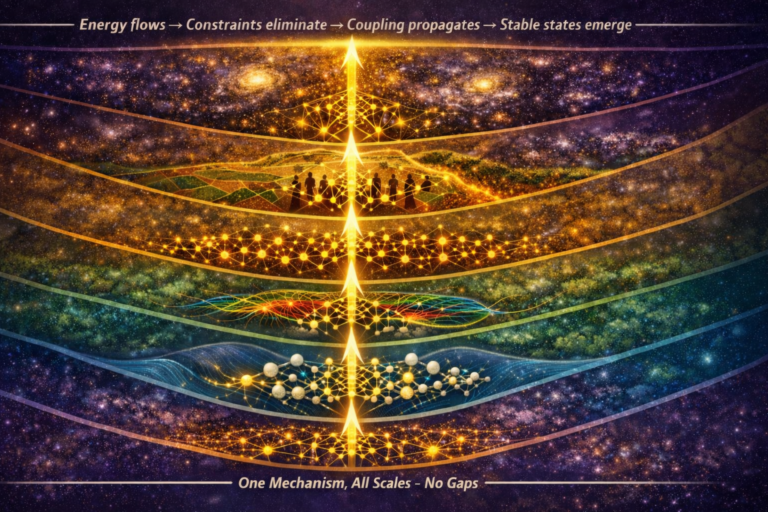
The evidence surveyed here converges on a single, thermodynamically grounded conclusion: reality is a network of constraints and energy flows evolving irreversibly in time through coupled systems across scales, and nothing more is needed to account for the phenomena we observe. Free will in the libertarian sense is dead, killed by both determinism and indeterminism in a rare moment of philosophical bipartisanship. Divine moral accountability is incoherent in any physical regime, deterministic or otherwise. Compatibilism is not wrong about the science but wrong about what the science saves; it saves a redescription, not the original concept. Dualism has had centuries to produce evidence and has produced exactly none.
What emerges from this dissolution is not nihilism. What emerges is a more honest, more empirically grounded, and ultimately more dignified account of what we are: dissipative structures maintaining ourselves through active constraint satisfaction across coupled scales, exhibiting multi-scale distributed agency at the levels where our deliberative architecture operates, reducing harm because that is what our particular configuration of thermodynamic processes does when coupled to the networks that sustain it. The drive is constitutive, not chosen. It cannot be extinguished by the recognition that it was not authored, because the recognition itself is part of the process.
Understanding the process does not put you outside the process. You are the process. Not separate from it. Not above it. Not choosing it from some metaphysical perch. You are constraint-mediated energy transformation unfolding along the arrow of time, coupled to other transformations at every scale from cellular to planetary, and the fact that some of that transformation involves self-modeling, error correction, and harm reduction is what makes it worth doing, not because a soul commands it, not because a god demands it, but because that is what this particular arrangement of matter and energy does when it is organized in this particular way and coupled to the systems that sustain it.
This is, in the end, the oldest insight dressed in the newest empirical clothing. Nagarjuna’s emptiness doctrine, that no entity possesses inherent, independent existence, that all phenomena arise dependently through relational conditions, stated 1,800 years ago what thermodynamics and neuroscience now confirm with measurement: there is no isolated self to be free or unfree. There is a web of coupled processes, and what we call “multi-scale distributed agency” is the name we give to constraint satisfaction at the nodes where coupling is dense enough to sustain self-modeling. The Yoruba concept of Ashé, the power to make things happen, is explicitly relational and distributed: it flows through community, ritual, and ecological coupling, never residing in an isolated individual (Drewal, Yoruba Ritual, 1992). The Navajo concept of hózhǫ́, beauty, balance, harmony, is not an internal state of an individual agent but a property of the correctly coupled system of person, community, land, and ceremony. When a Navajo healing ceremony restores hózhǫ́, it restores coupling, not a substance inside a person.
The framework demands falsifiability, including of itself. If someone demonstrates that consciousness occurs without energy dissipation, the thermodynamic grounding fails. If someone produces replicated evidence of mind operating independent of brain, the physicalist architecture collapses. If multi-scale distributed agency is demonstrated in entities completely decoupled from all constraint networks, the distributed-agency model is refuted. If unfalsifiable frameworks consistently outperform falsifiable ones in prediction and intervention, falsificationism itself is empirically refuted. These are not rhetorical hedges. They are actual conditions under which the argument of this essay would require revision or abandonment.
But until those conditions are met, and after more than a century of looking, they have not been, the rational conclusion is clear. The weight of evidence from quantum physics to sociology, from neuroscience to thermodynamics, from evolutionary biology to information theory, from 65,000 years of Aboriginal empiricism to yesterday’s lab results, converges on the view that reality is constraint-mediated energy transformation operating through coupled systems across scales, and nothing more is needed. The ghost never showed up. The machinery works without it. And the machinery is more beautiful, more falsifiable, and more honest than any ghost story ever told.
References
Alink, A., Schwiedrzik, C. M., Kohler, A., Singer, W., & Muckli, L. (2018). Evidence for causal top-down frontal contributions to predictive processes in the human brain. Nature Communications, 8, 1958. https://doi.org/10.1038/s41467-017-01958-7
Anderson, P. W. (1972). More is different. Science, 177(4047), 393–396. https://doi.org/10.1126/science.177.4047.393
Beggs, J. M., & Plenz, D. (2003). Neuronal avalanches in neocortical circuits. Journal of Neuroscience, 23(35), 11167–11177. https://doi.org/10.1523/JNEUROSCI.23-35-11167.2003
Benson, H., Dusek, J. A., Sherwood, J. B., et al. (2006). Study of the Therapeutic Effects of Intercessory Prayer (STEP) in cardiac bypass patients. American Heart Journal, 151(4), 934–942. https://doi.org/10.1016/j.ahj.2005.05.028
Bérut, A., Arakelyan, A., Petrosyan, A., Ciliberto, S., Dillenschneider, R., & Lutz, E. (2012). Experimental verification of Landauer’s principle linking information and thermodynamics. Nature, 483, 187–189. https://doi.org/10.1038/nature10872
Blount, Z. D., Barrick, J. E., Davidson, C. J., & Lenski, R. E. (2012). Genomic analysis of a key innovation in an experimental Escherichia coli population. Nature, 489, 513–518. https://doi.org/10.1038/nature11514
Blount, Z. D., Borland, C. Z., & Lenski, R. E. (2008). Historical contingency and the evolution of a key innovation in an experimental population of Escherichia coli. Proceedings of the National Academy of Sciences, 105(23), 7899–7906. https://doi.org/10.1073/pnas.0803151105
Cajete, G. (2000). Native Science: Natural Laws of Interdependence. Clear Light Publishers.
Centola, D. (2018). How Behavior Spreads: The Science of Complex Contagions. Princeton University Press.
Centola, D., Becker, J., Brackbill, D., & Baronchelli, A. (2018). Experimental evidence for tipping points in social convention. Science, 360(6393), 1116–1119. https://doi.org/10.1126/science.aas8827
Crooks, G. E. (1999). Entropy production fluctuation theorem and the nonequilibrium work relation for free energy differences. Physical Review E, 60(3), 2721–2726. https://doi.org/10.1103/PhysRevE.60.2721
Davis, J. J. (1997). Quantum indeterminacy and the omniscience of God. Science & Christian Belief, 9(2), 129–144.
De Kepper, P., Castets, V., Dulos, E., & Boissonade, J. (1991). Turing-type chemical patterns in the chlorite–iodide–malonic acid reaction. Physica D: Nonlinear Phenomena, 49(1–2), 161–169. https://doi.org/10.1016/0167-2789(91)90204-M
Deloria, V., Jr. (1972). God Is Red: A Native View of Religion. Grosset & Dunlap.
Dennett, D. C. (2003). Freedom Evolves. Viking Press.
Drewal, M. T. (1992). Yoruba Ritual: Performers, Play, Agency. Indiana University Press.
Ebert, J. P., & Wegner, D. M. (2011). Mistaking randomness for free will. Consciousness and Cognition, 20(3), 965–971. https://doi.org/10.1016/j.concog.2010.09.009
Ellis, G. F. R. (2012). Top-down causation and emergence: some comments on mechanisms. Interface Focus, 2(1), 126–140. https://doi.org/10.1098/rsfs.2011.0062
Engel, A. K., Fries, P., & Singer, W. (2001). Dynamic predictions: oscillations and synchrony in top-down processing. Nature Reviews Neuroscience, 2, 704–716. https://doi.org/10.1038/35094565
England, J. L. (2013). Statistical physics of self-replication. The Journal of Chemical Physics, 139(12), 121923. https://doi.org/10.1063/1.4818538
Evans, D. J., Cohen, E. G. D., & Morriss, G. P. (1993). Probability of second law violations in shearing steady states. Physical Review Letters, 71(15), 2401–2404. https://doi.org/10.1103/PhysRevLett.71.2401
French, C. (2016). Will the debate about psi ever be settled? The Psychologist, 29, 742–745.
Fries, P. (2005). A mechanism for cognitive dynamics: neuronal communication through neuronal coherence. Trends in Cognitive Sciences, 9(10), 474–480. https://doi.org/10.1016/j.tics.2005.08.011
Friston, K. (2010). The free-energy principle: a unified brain theory? Nature Reviews Neuroscience, 11, 127–138. https://doi.org/10.1038/nrn2787
Galak, J., LeBoeuf, R. A., Nelson, L. D., & Simmons, J. P. (2012). Correcting the past: Failures to replicate psi. Journal of Personality and Social Psychology, 103(6), 933–948. https://doi.org/10.1037/a0029709
Gigerenzer, G., & Brighton, H. (2009). Homo heuristicus: Why biased minds make better inferences. Topics in Cognitive Science, 1(1), 107–143. https://doi.org/10.1111/j.1756-8765.2008.01006.x
Gold, J. I., & Shadlen, M. N. (2007). The neural basis of decision making. Annual Review of Neuroscience, 30, 535–574. https://doi.org/10.1146/annurev.neuro.29.051605.113038
Grimalda, G., et al. (2023). How social norms emerge: the interindividual actor-critic model. PLoS Computational Biology. https://www.ncbi.nlm.nih.gov/pmc/articles/PMC12483181/
Haggard, P. (2008). Human volition: towards a neuroscience of will. Nature Reviews Neuroscience, 9, 934–946. https://doi.org/10.1038/nrn2497
Haidt, J. (2001). The emotional dog and its rational tail: A social intuitionist approach to moral judgment. Psychological Review, 108(4), 814–834. https://doi.org/10.1037/0033-295X.108.4.814
Hameroff, S., & Penrose, R. (2014). Consciousness in the universe: A review of the ‘Orch OR’ theory. Physics of Life Reviews, 11(1), 39–78. https://doi.org/10.1016/j.plrev.2013.08.002
Horowitz, J. M., & England, J. L. (2017). Spontaneous fine-tuning to environment in many-species chemical reaction networks. Proceedings of the National Academy of Sciences, 114(29), 7565–7570. https://doi.org/10.1073/pnas.1700617114
Jarzynski, C. (1997). Nonequilibrium equality for free energy differences. Physical Review Letters, 78(14), 2690–2693. https://doi.org/10.1103/PhysRevLett.78.2690
Kelly, L. (2016). The Memory Code: The Secrets of Stonehenge, Easter Island, and Other Ancient Monuments. Pegasus Books.
Kimmerer, R. W. (2013). Braiding Sweetgrass: Indigenous Wisdom, Scientific Knowledge, and the Teachings of Plants. Milkweed Editions.
Koch, C., & Hepp, K. (2006). Quantum mechanics in the brain. Nature, 440, 611–612. https://doi.org/10.1038/440611a
Levin, M. (2014). Molecular bioelectricity: what voltage-gated sodium channels reveal about biological intelligence. Annual Review of Biomedical Engineering, 16, 295–323. https://doi.org/10.1146/annurev-bioeng-071813-104418
Levy, W. B., & Calvert, V. G. (2021). Communication consumes 35 times more energy than computation in the human cortex, but both costs are needed to predict synapse number. Proceedings of the National Academy of Sciences, 118(18), e2008173118. https://doi.org/10.1073/pnas.2008173118
Libet, B. (1985). Unconscious cerebral initiative and the role of conscious will in voluntary action. Behavioral and Brain Sciences, 8(4), 529–539. https://doi.org/10.1017/S0140525X00044903
Libet, B., Gleason, C. A., Wright, E. W., & Pearl, D. K. (1983). Time of conscious intention to act in relation to onset of cerebral activity (readiness-potential). Brain, 106(3), 623–642. https://doi.org/10.1093/brain/106.3.623
Macmillan, M. (2000). An Odd Kind of Fame: Stories of Phineas Gage. MIT Press.
Mowaljarlai, D., & Malnic, J. (1993). Yorro Yorro: Everything Standing Up Alive. Magabala Books.
Murray, S. O., Kersten, D., Olshausen, B. A., Schrater, P., & Woods, D. L. (2002). Shape perception reduces activity in human primary visual cortex. Proceedings of the National Academy of Sciences, 99(23), 15164–15169. https://doi.org/10.1073/pnas.192579399
Neidjie, B. (1989). Story About Feeling. Magabala Books.
Nisbett, R. E., & Wilson, T. D. (1977). Telling more than we can know: Verbal reports on mental processes. Psychological Review, 84(3), 231–259. https://doi.org/10.1037/0033-295X.84.3.231
Noble, D. (2012). A theory of biological relativity: no privileged level of causation. Interface Focus, 2(1), 55–64. https://doi.org/10.1098/rsfs.2011.0067
Parnia, S., Spearpoint, K., de Vos, G., et al. (2014). AWARE—AWAreness during REsuscitation—A prospective study. Resuscitation, 85(12), 1799–1805. https://doi.org/10.1016/j.resuscitation.2014.09.004
Penfield, W. (1975). The Mystery of the Mind: A Critical Study of Consciousness and the Human Brain. Princeton University Press.
Penrose, R. (1989). The Emperor’s New Mind: Concerning Computers, Minds, and the Laws of Physics. Oxford University Press.
Prigogine, I. (1977). Self-organization in non-equilibrium systems. Nobel Lecture, December 8, 1977.
Prigogine, I., & Stengers, I. (1984). Order Out of Chaos: Man’s New Dialogue with Nature. Bantam Books.
Raichle, M. E., & Gusnard, D. A. (2002). Appraising the brain’s energy budget. Proceedings of the National Academy of Sciences, 99(16), 10237–10239. https://doi.org/10.1073/pnas.172399499
Rao, R. P. N., & Ballard, D. H. (1999). Predictive coding in the visual cortex: a functional interpretation of some extra-classical receptive-field effects. Nature Neuroscience, 2, 79–87. https://doi.org/10.1038/nn0199_79
Rauch, D., Handsteiner, J., Hochrainer, A., et al. (2018). Cosmic Bell test using random measurement settings from high-redshift quasars. Physical Review Letters, 121(8), 080403. https://doi.org/10.1103/PhysRevLett.121.080403
Rose, D. B. (2000). Dingo Makes Us Human: Life and Land in an Australian Aboriginal Culture. Cambridge University Press.
Smith, L. T. (1999). Decolonizing Methodologies: Research and Indigenous Peoples. Zed Books.
Soon, C. S., Brass, M., Heinze, H.-J., & Haynes, J.-D. (2008). Unconscious determinants of free decisions in the human brain. Nature Neuroscience, 11(5), 543–545. https://doi.org/10.1038/nn.2112
Tegmark, M. (2000). Importance of quantum decoherence in brain processes. Physical Review E, 61(4), 4194–4206. https://doi.org/10.1103/PhysRevE.61.4194
Tononi, G., Boly, M., Massimini, M., & Koch, C. (2016). Integrated information theory: an updated account. Archives Italiennes de Biologie, 154(2–3), 56–90. https://doi.org/10.12871/00039829201655
Tononi, G., & Cirelli, C. (2006). Sleep function and synaptic homeostasis. Sleep Medicine Reviews, 10(1), 49–62. https://doi.org/10.1016/j.smrv.2005.05.002
Toyabe, S., Sagawa, T., Ueda, M., Muneyuki, E., & Sano, M. (2010). Experimental demonstration of information-to-energy conversion and validation of the generalized Jarzynski equality. Nature Physics, 6, 988–992. https://doi.org/10.1038/nphys1821
Wang, G. M., Sevick, E. M., Mittag, E., Searles, D. J., & Evans, D. J. (2002). Experimental demonstration of violations of the second law of thermodynamics for small systems and short time scales. Physical Review Letters, 89(5), 050601. https://doi.org/10.1103/PhysRevLett.89.050601
Watts, V. (2013). Indigenous Place-Thought and Agency Amongst Humans and Non-Humans (First Woman and Sky Woman Go On a European World Tour!). Decolonization: Indigeneity, Education & Society, 2(1), 20–34.
Werner, G., et al. (2020). Consciousness as an emergent phenomenon: A tale of different levels of description. Frontiers in Psychology. https://www.ncbi.nlm.nih.gov/pmc/articles/PMC7597170/
Whyte, K. (2018). Indigenous Science (Fiction) for the Anthropocene: Ancestral Dystopias and Fantasies of Climate Change Crises. Environment and Planning E: Nature and Space, 1(1–2), 224–242. https://doi.org/10.1177/2514848618777621
Yunkaporta, T. (2019). Sand Talk: How Indigenous Thinking Can Save the World. HarperOne.