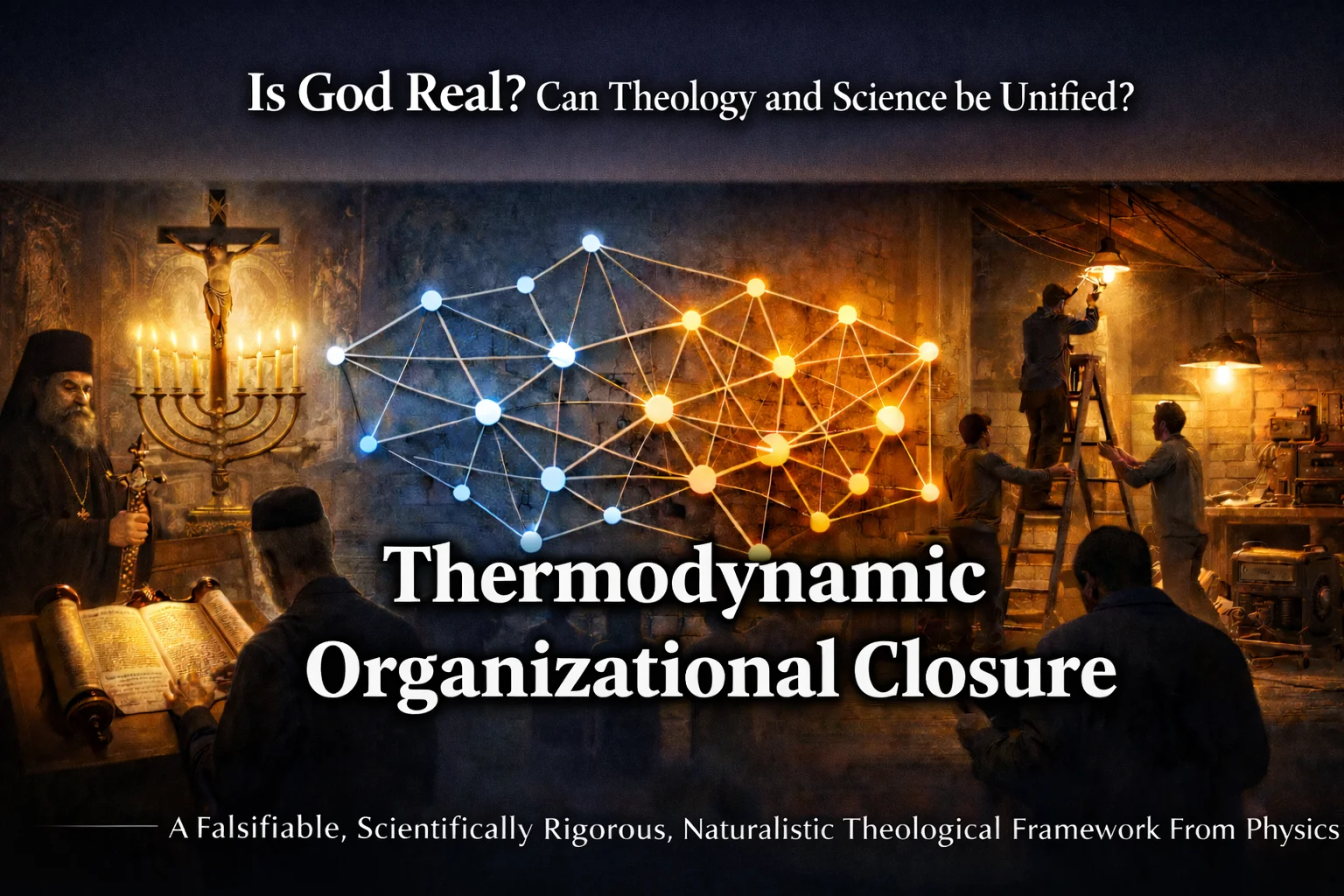
Is God Real? Can Theology And Science Be Unified Without Supernaturalism? What Does Hebrew Actually Say about God is Love? A Falsifiable Answer: Thermodynamic Organizational Closure (TOC)
How Conservative Scholars, Landauer’s Principle, and Falsifiable Theology Reveal God as Process in Exodus 3:14 and 1 John 4:8.
Preface: The Argument in Brief
The Core Claim
This paper makes one core testable claim: what religious language refers to as “God” is not a supernatural being but a class of relational processes instantiated in communities that keep one another viable through mutual aid. When physically realized, such processes necessarily incur thermodynamic costs, as do all maintained distinctions.
A note on epistemic structure before proceeding: not all claims in this paper carry the same evidentiary weight, and intellectual honesty requires acknowledging that upfront. The Landauer bound is experimentally confirmed Tier 1 physics. The identification of agapē with organizational closure is a Tier 3 novel conceptual proposal. Original, argued for, and falsifiable, but not derivable from established results. The research program for testing that identification empirically is a prospectus, not a completed study. Where these distinctions matter, they are flagged explicitly. This transparency is the epistemic hygiene the paper demands of theology, applied to itself.
Why “Testable” Matters
A claim that can never be proven wrong can never be proven right either. If I claim an invisible, undetectable dragon lives in my garage, and you check with a heat sensor, I say “it’s heatless.” You suggest flour on the floor to see footprints; I say “it floats.” At some point, you realize my “dragon” is indistinguishable from no dragon at all. The claim does no work. It explains nothing.
Most theology works exactly this way. Challenged with suffering, it retreats to “God works in mysterious ways.” Challenged with unanswered prayer, “God’s timing isn’t ours.” Challenge it with evil, and it adds free will. Challenge free will with natural disasters, and it adds “the Fall corrupted nature.” Every objection gets absorbed until the claim becomes unfalsifiable.
The problem compounds: if any claim immune to evidence counts as theology, then contradictory claims have equal standing. “God is three persons” and “God is one person” both retreat behind mystery. “Hell is eternal” and “all are saved” both claim scriptural support and immunity from challenge. You end up with thousands of denominations, each unfalsifiable, none distinguishable by evidence.
Falsification fixes this: specify upfront what would prove you wrong. If your claim survives that test, it means something. If it fails, you learn truth by discovering what’s false. Either way, you’re doing honest work instead of hiding from reality.
The Case
The biblical evidence: The Hebrew and Greek scriptures, when read in their original grammar (not through Latin translations), describe God as ongoing action, not static substance. Exodus 3:14’s ehyeh is an imperfect verb meaning “I am becoming.” 1 John 4:8 uses a predicate nominative identifying God’s essential nature as agapē (self-giving love). Conservative evangelical scholars from Dallas Theological Seminary and Trinity Evangelical Divinity School confirm this grammar. [Tier 1: testable against established grammatical scholarship]
The scientific evidence: Theoretical biology calls a structurally similar pattern “organizational closure”—systems where constraints mutually maintain each other. Information thermodynamics establishes that any physically instantiated system maintaining organized states against entropy has irreducible thermodynamic costs. Landauer’s principle anchors the theoretical floor for idealized physical information processing. [Tier 1: experimentally confirmed]
The identification: That agapē as described in the New Testament is functionally equivalent to organizational closure at social scale is this paper’s novel conceptual claim. It is argued for, it has falsification criteria, and it constitutes original theoretical work rather than a derivation from established results. [Tier 3: novel proposal]
Three Ways This Fails
- If Landauer’s principle is experimentally overturned, such that physically realized distinctions can be erased or maintained without thermodynamic cost, the thermodynamic grounding of this framework collapses.
- If communities can demonstrably sustain multigenerational viability without reciprocal constraint maintenance among members, then the identification of divine activity with relational closure fails at the social scale.
- If competent grammatical scholarship converges on the claim that ehyeh in Exodus 3:14 is not imperfective, or that 1 John 4:8 does not support a qualitative predicate nominative reading, then the textual foundation of the identification collapses.
Cross-Traditional Convergence
Comparable relational ontologies appear in Buddhist anatman (no enduring substance-self), Aboriginal songline traditions (knowledge maintained through enacted relational practice), and strands of Hindu qualified non-dualism (selves real only as relationally grounded within Brahman).
These traditions do not function here as proof. They function as consilience: independently developed frameworks in different historical contexts converge on a structurally similar priority of relation over substance. If future scholarship demonstrates that this convergence is better explained by direct diffusion rather than independent emergence, that evidential weight diminishes accordingly.
Abstract
This essay introduces Thermodynamic Organizational Closure (TOC), a theological framework that identifies “God” not with a supernatural substance but with organizational closure at social scale: communities of mutual aid maintaining themselves under non-zero thermodynamic constraints. TOC construes divine language in a way that is consistent with the thermodynamic limits articulated by Landauer’s principle, preserves the process-language of the original Hebrew and Greek scriptures, and provides what most theological frameworks conspicuously lack: concrete falsification criteria.
Three things need distinguishing at the outset. First, the claim that Landauer’s principle establishes a thermodynamic floor for any physically instantiated information-maintaining system is Tier 1—experimentally confirmed, uncontroversial in the physics community, and the subject of decades of empirical work. Second, the claim that this floor applies directly as a per-bit calculation to social acts of mutual aid is not what the paper asserts. Social communities are physically realized in biological organisms whose neural and metabolic operations do pay Landauer costs at the substrate level, but the floor’s significance for TOC is structural rather than calculational: any physically real account of sustained community cannot opt out of thermodynamic constraint. Third, the identification of agapē with organizational closure is a novel conceptual proposal requiring its own justification. This paper provides that justification through convergent evidence from grammar, theoretical biology, cross-traditional comparison, and falsifiable predictions, while acknowledging the identification has not been derived from established results.
The framework draws on the Montévil-Mossio closure of constraints model from theoretical biology, conservative evangelical scholarship on biblical languages, experimentally verified information thermodynamics, and cross-traditional convergence from Buddhist, Hindu, Aboriginal, and Christian sources. This is not syncretism. It is consilience: independent traditions arriving at structurally similar insights about the primacy of relation over substance, verified by their mutual independence rather than collapsed into false unity.
Introduction: The Question Nobody Asks About God’s Energy Bill
Here is a question theology has dodged for roughly two millennia: what does it cost to maintain a distinction? Not metaphorically or spiritually, but under the same thermodynamic constraints that govern all physical systems. Rolf Landauer answered this in 1961 from an office at IBM, and the answer is kT ln 2 per bit erased—approximately 2.87 zeptojoules at room temperature (and 2.97 × 10⁻²¹ J at biological temperature, 310 K, using the exact 2019 SI value of k_B = 1.380649 × 10⁻²³ J/K). Every erased bit of information, every logically irreversible operation that discards a prior state, requires at minimum this energy dissipation into the environment. No violations of this bound have been found in systems that meet the formal conditions: a physical substrate governed by Hamiltonian dynamics, coupled to a thermal reservoir at definable temperature, with a clear separation between information-bearing and non-information-bearing degrees of freedom.
Charles Bennett extended Landauer’s work in 1973 and 1982, demonstrating that while computation itself can in principle be done reversibly at arbitrarily low energy cost, erasure cannot. The connection to maintaining distinctions is this: holding any organized state stable against thermal noise requires continuously detecting and correcting errors—perturbations that would degrade the distinction. Each error correction is itself an erasure operation (you erase the error, discarding information about which direction the perturbation came from). Therefore, maintaining any physically instantiated distinction over time requires ongoing erasure operations, each paying the Landauer cost at the substrate level.
Two clarifications before applying this to communities. First, the philosophical status of Landauer’s principle is more contested than textbook presentations suggest. Earman and Norton (1999) posed a dilemma that Bennett himself acknowledged as the “objection of greatest merit”: if the demon is already governed by the Second Law, the principle is redundant; if not, the principle is insufficient. The debate about whether Landauer’s principle is a genuinely independent result or a restatement of the Second Law remains foundationally unresolved in the philosophy of physics. TOC does not require resolution of this debate. What it requires—and what is empirically confirmed—is the practical claim: erasure operations have a minimum energy cost measured across colloidal particles, nanomagnets, trapped ions, and feedback traps, and no physically realized information-maintaining system gets to opt out of thermodynamic expenditure.
Second, the connection from this physical principle to communities is structural, not calculational. A community of mutual aid is not a Hamiltonian system coupled to a thermal reservoir in the technical sense Landauer’s proof requires. You cannot look at a church’s Sunday activities and calculate a k_BT ln 2 cost per social act. What you can say is this: communities are physically instantiated in biological organisms—brains, bodies, metabolic processes—and those organisms’ operations do pay Landauer costs continuously at the biochemical and neural levels. The thermodynamic floor established for idealized physical information processing is not directly applicable as a formula to social acts; its significance is that it establishes, against any idealized system, that maintenance costs are real and irreducible. Any account of sustained community that pretends to describe physical reality must reckon with this.
Now consider what a church claims to be doing on Sunday morning: maintaining a distinction between itself and the surrounding entropy. Feeding the hungry. Visiting the sick. Holding together a community of mutual aid against the relentless tendency of everything to fall apart. That activity has a thermodynamic cost. The cost is paid in metabolic energy, neural computation, organized labor. It is real. And if the Hebrew and Greek scriptures are read in their original grammatical structures rather than through the Latin and English nominalizations that have calcified around them for sixteen centuries, what they describe is precisely this activity: not a static being who exists, but an ongoing process of becoming that sustains itself through love.
TOC makes one core identification: the thing called “God” in the Christian tradition, anatman in the Buddhist tradition, Country in Aboriginal ontology, and qualified Brahman in Ramanuja’s Vishishtadvaita is organizational closure at social scale. This identification is conceptual and novel—a Tier 3 claim in the framework developed in the Falsification section below. It is not a metaphor. It is not a reduction. It is an identification with falsification criteria attached, and those criteria are what make it an honest intellectual proposal rather than another theological assertion hiding from evidence.
This matters because the dominant theological frameworks in Western Christianity are unfalsifiable. They make no predictions. They accommodate any evidence. They have, as Antony Flew observed in 1950, died the death of a thousand qualifications. A theology that cannot fail cannot succeed. It can only persist, and persistence without accountability is precisely the kind of organizational parasitism that TOC is designed to diagnose.
Part I: How Substance Theology Broke Everything
What went wrong between Hebrew scripture and Western theology?
The Nominalization Cascade That Ate Western Theology
Something went wrong between the Septuagint and the Latin Vulgate, and it went wrong grammatically before it went wrong theologically. The Hebrew verb אֶהְיֶה (ehyeh) in Exodus 3:14 is the first-person singular Qal imperfect of the verb הָיָה (hayah, to be/become). This is not controversial. Gesenius’ Hebrew Grammar confirms it. Waltke and O’Connor confirm it. Joüon and Muraoka confirm it. The Qal imperfect in Biblical Hebrew is aspectual, not tensed. It denotes action that is incomplete, ongoing, continuous, or in process. As Gesenius notes in §107a, the imperfect expresses “actions which are regarded by the speaker at any moment as still continuing, or in the process of accomplishment, or even as just taking place.”
The verb hayah itself never means pure static existence. It means happening, becoming, being-present-in-a-situation. Ehyeh asher ehyeh is God saying something closer to “I am becoming what I am becoming” or “I will be what I will be” than to the thunderous nominalization “I AM THAT I AM” that the King James committee bolted into the English language in 1611. The RSV footnotes this. Jewish translations have long favored the dynamic reading. Scholars from Noth to Childs have noted that the phrase functions simultaneously as revelation and refusal: a name that is not a name but a verb.
Then the Septuagint translated it as ἐγώ εἰμι ὁ ὤν (ego eimi ho ōn, “I am the Being”), importing Greek ontological categories that the Hebrew never contained. The Vulgate followed. By the time Thomas Aquinas built his quinque viae, “God” had been fully nominalized into a substance: ipsum esse subsistens, subsistent being itself. The verb had become a noun. The process had become a thing. And Western theology was locked into defending the properties of this thing (omnipotence, omniscience, omnipresence, immutability, impassibility) rather than investigating the process the original text described.
Why Unfalsifiable Claims Are Not Pious but Parasitic
Antony Flew presented his parable of the Invisible Gardener to the Oxford Socratic Club in 1950, with C.S. Lewis presiding. Two explorers find a clearing in a jungle. One insists a gardener tends it. They set watches, deploy bloodhounds, erect an electric fence. No gardener is ever detected. But the believer qualifies: the gardener is invisible, intangible, insensible to electric shocks. Flew’s devastating question:
“Just how does what you call an invisible, intangible, eternally elusive gardener differ from an imaginary gardener or even from no gardener at all?”
The challenge was not atheism. It was a request for a loss condition. “What would have to occur or to have occurred to constitute for you a disproof of the love of, or the existence of, God?” If nothing counts against the claim, then nothing counts for it either. The assertion has died “the death of a thousand qualifications.” Flew called this “the peculiar danger, the endemic evil, of theological utterance.”
Flew was right, and nearly all substance-theological frameworks remain exactly as vulnerable to his critique as they were in 1950. William Lane Craig’s Kalam cosmological argument concludes with a “beginningless, changeless, immaterial, timeless, spaceless, and enormously powerful” personal agent—precisely the kind of entity no conceivable observation could disconfirm. Plantinga’s maximally great being exists in all possible worlds by modal definition, unfalsifiable by construction. Swinburne’s Bayesian analysis yields a probability greater than 0.5 for a being whose simplicity is stipulated rather than demonstrated. These are sophisticated, technically impressive frameworks. They are also hermetically sealed against reality. Lakatos would classify them as degenerative research programmes: they accommodate anomalies endlessly but predict nothing novel.
TOC proposes the opposite approach. A theological framework should behave like a scientific research programme. It should make predictions. It should have loss conditions. It should be the kind of thing that could fail, so that when it doesn’t, its success means something.
Part II: The Biblical Foundation
What Does the Original Hebrew and Greek Actually Say About God?
Hebrew Grammar Says What It Says
The case for a processual reading of the Hebrew Bible does not rest on liberal theology, postmodern hermeneutics, or wishful thinking. It rests on grammar. And the grammar has been documented by scholars whom no fundamentalist can dismiss as insufficiently conservative — scholars whose institutional homes, theological commitments, and methodological premises are exactly the credentials any orthodox tradition would recognize as authoritative. When the grammar speaks with one voice across conservative evangelical, mainline Protestant, and academic critical scholarship simultaneously, the interpretive question is settled at the grammatical level. What remains is the theological inference from the grammar — and that inference will be made explicit, step by step, so it can be evaluated.
Bruce Waltke and the Non-Perfective Aspect
Bruce Waltke, co-author of An Introduction to Biblical Hebrew Syntax (Eisenbrauns, 1990; ISBN 978-0-931464-31-7), is a graduate of Dallas Theological Seminary who subsequently taught at Regent College — institutions whose conservative evangelical credentials are unimpeachable by any orthodox standard. His grammar, co-authored with M.P. O’Connor, is the most technically rigorous reference syntax of Biblical Hebrew available in English and the standard advanced-level reference in both evangelical seminaries and secular research universities simultaneously.
Waltke and O’Connor coined the term “non-perfective” for the prefix conjugation of Biblical Hebrew specifically because the previous terminology — “imperfect,” borrowed from Latin grammar — failed to capture what the form actually does. Their technical definition is worth quoting in full because it forecloses the exclusivity move that competing substance-ontological frameworks require: “a form that can signify any time, any mood, and imperfective aspect (but not perfective) is not imperfective but non-perfective.” The form is not anchored to a single semantic value. It encompasses present progressive, future, habitual, modal, and any other non-completed aspect simultaneously. When Waltke parses ehyeh, the verb is non-perfective. It is, by definition, open to both aspectual (ongoing/processual) and modal readings as coordinate functions of the same form — not as competing alternatives where one excludes the other.
This is the grammatical foundation on which the processual reading of Exodus 3:14 rests. It is not a liberal reading. It is a grammatical description by a Dallas Seminary graduate using the most technically precise terminology available in the field.
Gesenius, Joüon-Muraoka, and the Standard Reference Grammars
The oldest and most authoritative reference grammar of Biblical Hebrew confirms the same dual capacity. Gesenius’ Hebrew Grammar (Kautzsch/Cowley ed., Clarendon Press, 1910; ISBN 978-0-19-815406-8), the foundational reference of the discipline for over a century, states at §107a that the imperfect “represents actions, events, or states which are regarded by the speaker at any moment as still continuing, or in process of accomplishment, or even as just taking place,” while also encompassing actions “merely as conceived in the mind of the speaker, or simply as desired, and therefore only contingent (the modal use of the imperfect).” The processual and modal readings appear as coordinate functions of the same form — listed in the same section, not in opposition.
Paul Joüon and Takamitsu Muraoka’s A Grammar of Biblical Hebrew (3rd ed., Editrice Pontificio Istituto Biblico, 2006; ISBN 978-88-7653-629-8) — the standard grammar in Catholic biblical scholarship and widely used in academic critical scholarship — confirms the same non-perfective character of the prefix conjugation throughout its treatment of verbal aspect. There is no major reference grammar of Biblical Hebrew that restricts the Qal imperfect to exclusively modal function.
The Joosten-Cook Debate: Even the Modal-Favoring Position Does Not Exclude Processual Readings
The most substantive academic debate about yiqtol semantics in recent scholarship makes the exclusivity claim untenable even on its own strongest evidence. Jan Joosten (”Do the Finite Verbal Forms in Biblical Hebrew Express Aspect?” Journal of the Ancient Near Eastern Society 29, 2002) conducted a statistical analysis of yiqtol occurrences in Biblical Hebrew prose and found modal or future readings in over 80% of cases — the strongest statistical case for a modal-primary interpretation available in the literature. John Cook responded (”The Finite Verbal Forms in Biblical Hebrew Do Express Aspect,” JANES 30, 2006) defending aspectual functions.
Crucially — and this is the point that collapses any exclusively modal position — even Joosten does not claim that processual readings are categorically excluded. His disagreement with Cook is about statistical primacy across the corpus, not about categorical prohibition in individual cases. The scholar whose statistical work would most support a modal-exclusive reading is simultaneously the scholar who most carefully refuses to make the exclusivity claim that position requires. The strongest available witness for modal primacy does not testify to modal exclusivity.
The Medieval Commentators: Internal Diversity That Resists Exclusively Modal Framing
The medieval commentators that orthodox traditions treat as authoritative do not support the exclusivity claim either. Rashi — the most widely cited medieval exegete in traditional Jewish study — reads אֶהְיֶה as promissory and processual in explicit terms: “I will be with them in this sorrow — I Who will be with them in the subjection they will suffer at the hands of other kingdoms.” This is not a modal reading in the sense of divine sovereignty and freedom. It is a promise of ongoing presence — God as the one who will be continuously with Israel through unfolding history. It is directly processual.
Ibn Ezra takes a more ontological/existential reading: God’s name is “I Am,” pointing to divine self-existence. The Ramban synthesizes both with Kabbalistic dimensions. None of these commentators frames the verb as exclusively modal in the way a purely substance-ontological reading requires, and Rashi’s reading actively supports the processual interpretation. The tradition itself is internally diverse precisely on the question that competing frameworks treat as settled.
The Lexicons: Both Lexicons Include “Become”
The two standard critical lexicons of Biblical Hebrew confirm the semantic range that licenses processual readings. Brown-Driver-Briggs (Clarendon Press, 1906; ISBN 978-1-56563-206-6) lists the primary meanings of הָיָה as “fall out, come to pass, become, be” — the explicit inclusion of “become” directly licenses dynamic, processual readings.
The Hebrew and Aramaic Lexicon of the Old Testament (HALOT; Koehler, Baumgartner et al., trans. Richardson, 5 vols., Brill, 1994–2000; ISBN 978-90-04-11956-7) provides the same semantic range including both static being and dynamic becoming.
The lexical evidence is not contested. Both standard critical lexicons include “become” as a primary semantic value of הָיָה — the root underlying אֶהְיֶה. A verb whose root lexically encompasses “becoming” cannot be grammatically confined to exclusively static or modal readings.
The Idem Per Idem Construction: Intentional Resistance to Single-Category Reduction
The grammatical structure of the full divine name אֶהְיֶה אֲשֶׁר אֶהְיֶה adds a layer of interpretive openness that most scholars treat as deliberate rather than accidental. The idem per idem construction — X relative-particle X — occurs several times in the Hebrew Bible and consistently resists reduction to a single categorical meaning. Francis Landy (Poetics Today 31/2, 2010) interprets this construction in Exodus 3:14 as intentionally resisting any single interpretive category. The form means “I will be what I will be” — deliberately open, refusing final determination, enacting through its very grammar the divine resistance to containment in any fixed ontological category.
This grammatical feature is not a vagueness to be resolved by commentators. It is, on the most careful reading of the Hebrew, a designed openness. A framework that treats it as open — as TOC does — is more faithful to the grammar than a framework that forecloses it.
What 1 John 4:8 Actually Says in Greek
The clause ὁ θεὸς ἀγάπη ἐστίν (ho theos agapē estin) contains three grammatical elements: ho theos (the God) with the definite article, agapē (love) without the article, and estin (is) as the copulative verb. The grammatical analysis of this construction is not contested among Greek scholars. What is contested — and what requires careful handling — is the precise classification of the predicate nominative and what follows from that classification.
The Qualitative Predicate Nominative: What It Establishes and What It Rules Out
By the standard rules of Greek grammar confirmed by Wallace, Harris, Harner, Blass-Debrunner-Funk, and every major reference grammar of New Testament Greek, the articulated noun (ho theos) is the subject and the anarthrous noun (agapē) is the predicate nominative. The critical question is what kind of predicate nominative it is.
Daniel Wallace, Professor of New Testament Studies at Dallas Theological Seminary and author of Greek Grammar Beyond the Basics (Zondervan, 1996; ISBN 978-0-310-21895-1), provides the standard evangelical classification. Wallace at p. 97 explicitly classifies 1 John 4:8 as a qualitative predicate nominative: “to see agapē here as qualitative means that God has the attribute of love or is characterized by love.” His general principle at p. 40: “The equation of S and PN does not necessarily or even normally imply complete correspondence… Rather, the PN normally describes a larger category (or state) to which the S belongs.”
Philip Harner’s foundational statistical study (“Qualitative Anarthrous Predicate Nouns: Mark 15:39 and John 1:1,” Journal of Biblical Literature 92, 1973; DOI: 10.2307/3262756) established the empirical basis for this classification: approximately 80% of anarthrous predicate nominatives preceding the verb function primarily to express the nature or character of the subject. Harner’s conclusion: such nouns “function primarily to express the nature or character of the subject.” Paul Stephen Dixon’s subsequent statistical analysis found 94% of pre-verbal anarthrous predicate nominatives in John are qualitative.
Murray Harris, Professor Emeritus of New Testament Exegesis and Theology at Trinity Evangelical Divinity School and one of the original translators of the NIV, confirms in Jesus as God: The New Testament Use of Theos in Reference to Jesus (Baker, 1992; ISBN 978-0-8010-2108-2) at pp. 311–312: “such nouns will usually be qualitative in emphasis.” W. Hall Harris III states directly about 1 John 4:8: “from a grammatical standpoint this is not a proposition in which subject and predicate nominative are interchangeable. The anarthrous predicate suggests a qualitative force… a quality of God’s character is what is described here.”
I accept and incorporate this grammatical classification: the predicate nominative is qualitative, not convertible. A convertible proposition would mean A=B and B=A interchangeably, which would license “love is God” — a reading the grammar prohibits, as I stated in the original argument. The qualitative classification is more precise than “identity claim” as a label, and I adopt it.
Why the Qualitative Reading Undermines Substance-Ontological Frameworks
Here is what the qualitative classification actually establishes — and this is the critical point that substance-ontological competing frameworks entirely miss.
A qualitative predicate nominative expresses that the predicate constitutively characterizes the essential nature of the subject. This is grammatically distinct from, and incompatible with, treating the predicate as a contingent property that a pre-existing substance possesses. The grammatical structure “God has love as a property” would require a simple attributive construction — an adjective or a genitive — not a qualitative predicate nominative. The two structures answer different questions and express different relations:
Simple attribution (theos agapētos estin): There is a pre-existing entity X, and X has attribute Y. X is prior to Y; X could in principle exist without Y; Y is a feature of X.
Qualitative predicate nominative (ho theos agapē estin): Y constitutively characterizes the essential nature of what X is. X belongs to the category Y. You cannot separate X from Y without changing what X essentially is.
Competing frameworks that posit God as a substance-like absolute — existing prior to and independently of attributes, among which love is counted as one — require the first structure. That is a possessive, attributive relation — grammatically, an adjective or genitive construction. The qualitative predicate nominative that the Greek text actually uses grammatically prohibits that reading. A framework cannot simultaneously invoke the grammar of 1 John 4:8 and maintain the substance structure those frameworks require. The grammar rules the substance reading out.
TOC preserves the qualitative force intact. If agapē constitutively characterizes what God essentially is — not a property God possesses, but what God is — then the grammar is satisfied precisely by the claim that God-as-agapē is constituted by enacted mutual love rather than existing as a substrate that independently possesses it. When communities enact organizational closure through mutual care at thermodynamic cost, they are not creating a property of a pre-existing divine substance. They are instantiating what “God” names. The grammar and the framework are aligned.
The Parallel with John 1:1c
The construction parallels John 1:1c (καὶ θεὸς ἦν ὁ λόγος, “and the Word was God”), where Harris has demonstrated at length that the anarthrous theos is qualitative — it characterizes the divine nature of the Logos without collapsing the Logos and God into an interchangeable identity. The predicate nominative in both cases tells you what essential category the subject belongs to. God belongs to the category agapē. The grammar cannot be reversed without violation. This is not a liberal reading of either text. It is the reading of a Trinity Evangelical Divinity School scholar analyzing Greek grammar.
C.H. Dodd: The Processual Reading from Classical Exegesis
C.H. Dodd — not a process theologian, but one of the most important Johannine scholars of the twentieth century — confirms the processual reading from within classical exegesis. His statement from The Johannine Epistles (Hodder & Stoughton, 1946, p. 110) has been verified verbatim: “To say ‘God is love’ implies that all His activity is loving activity. If He creates, He creates in love; if He rules, He rules in love; if He judges, He judges in love.”
Notice what Dodd says: God’s activity is the locus. Not God’s substance, not God’s ontological structure, not a property God possesses — but what God does, constitutively, in every mode of divine action. That is the processual reading, derived from the grammar of 1 John 4:8 by a scholar working entirely within classical Johannine exegesis with no theoretical stake in process metaphysics.
The Further Inference: From Grammar to Process
The qualitative grammar establishes that agapē constitutively characterizes God’s essential nature. The further inference — that this constitutive characterization is processual rather than substantial — follows from a separate argument that the grammar supports but does not alone establish. I state this step explicitly so it can be evaluated independently:
Agapē is inherently relational and enacted. It cannot exist as a platonic form subsisting independently of loving acts. Unlike geometric properties, which can be defined independently of their instantiation, love requires the acts that constitute it. There is no love that is not enacted in loving. This is not a philosophical importation — it is the claim the Johannine literature itself makes, explicitly, in the surrounding context: “We love because he first loved us” (1 John 4:19); “By this we know love, that he laid down his life for us” (1 John 3:16); “God so loved the world that he gave” (John 3:16). The Johannine definition of love is always enacted, always other-directed, always constituted in the act.
If agapē is constitutive of what God essentially is, and agapē is inherently enacted and relational rather than subsisting independently of loving acts, then the substance reading requires treating enacted love as a static property of a pre-existing absolute — which contradicts both the grammar and the Johannine account of what love is. The qualitative predicate nominative and the Johannine phenomenology of agapē together support the processual reading. Neither alone requires it; together they make the substance alternative strained to the point of grammatical and contextual incoherence.
The Conservative Exegetical Convergence: Scholars Who Arrive at the Same Place Without Process Theology
The most decisive evidence against the claim that process-compatible readings are theologically motivated rather than exegetically derived is the convergence of conservative scholars who have no theoretical stake in TOC and who arrive, from entirely different directions, at the same conclusion: that God’s essential mode of action is relational, enacted, community-constituting, and ongoing.
N.T. Wright
N.T. Wright, former Bishop of Durham and Research Professor of New Testament and Early Christianity at St Andrews, is perhaps the most widely read conservative New Testament scholar of the past thirty years. He has explicitly distanced himself from process theology on multiple occasions. His entire theological project — spanning The New Testament and the People of God (1992), Jesus and the Victory of God (1996), The Resurrection of the Son of God (2003), and Paul and the Faithfulness of God (2013), all published by Fortress Press — is built on the claim that God’s kingdom breaks into the present through communities of justice, beauty, and new creation. The mode of divine presence in history, for Wright, is communities that instantiate kingdom values through their enacted common life. God is not present as a substance that occasionally interacts with history. God is present in and as the community that embodies the kingdom.
This is not process theology. Wright would reject that label. But it is a structural description of organizational closure at the communal scale as the mode of divine presence — which is precisely what TOC proposes to name and formalize. The incompatibility is at the label level, not the structural level.
James D.G. Dunn
James D.G. Dunn, Lightfoot Professor of Divinity at Durham University and co-architect (with E.P. Sanders) of the New Perspective on Paul, demonstrated in The Theology of Paul the Apostle (Eerdmans, 1998) that Paul’s theology is inherently ecclesial in a technical sense: God’s love (agapē) is not an individual sentiment or a divine attribute possessed in abstraction, but a community-creating power that constitutes its recipients as a body. The Spirit of God is God’s own self poured into communities that are thereby constituted as divine presence in the world (Romans 5:5 — “God’s love has been poured into our hearts through the Holy Spirit”). The Greek here is present perfect passive: it has been poured and continues to flow. The processual grammar of the Pauline texts is not an imposition from outside — it is what the texts say.
Dunn is not a process theologian. The New Perspective on Paul is a historical-critical project, not a metaphysical one. But the structural description of God’s love as community-constituting and ongoing is identical to what TOC formalizes.
Douglas Campbell
Douglas Campbell, Professor of New Testament at Duke Divinity School, published The Deliverance of God: An Apocalyptic Rereading of Justification in Paul (Eerdmans, 2009) — an 1,200-page exegetical argument that dismantles the contractual/transactional model of Pauline soteriology in favor of a participatory, relational account centered on God’s unconditional deliverance. Campbell’s Paul describes a God whose primary mode of action is not legal transaction but relational constitution: God in Christ creates, through the Spirit, communities of mutual obligation and shared life that are the mode of salvation rather than merely its recipients.
Campbell is not a process theologian. His framework is apocalyptic and participatory, not Whiteheadian. But the structural account of divine action as relational, constitutive, and community-creating maps directly onto what TOC proposes to name.
Henry Alford
Henry Alford (1810–1871), Dean of Canterbury and one of the most important 19th-century Anglican biblical scholars, commented on 1 John 4:8 in The Greek Testament (1849–1861): “Love is the very essence, not merely an attribute, of God. It is co-essential with Him.”
Alford preceded process theology entirely. He reached this conclusion from the grammar of the Greek text alone. “Not merely an attribute” is precisely the distinction between a qualitative predicate nominative reading and an attributive reading. “Co-essential with Him” means love is constitutive of what God is, not a property God happens to possess. This is the reading the grammar demands, identified in the 19th century by a High Church Anglican commentator who had no awareness of Whitehead, Hartshorne, or process philosophy.
What the Conservative Convergence Establishes
None of these scholars — Waltke, Wallace, Harris, Harner, Dodd, Wright, Dunn, Campbell, Alford — are process theologians. They have no theoretical stake in TOC. Several would resist the process-theological label if it were applied to their work. All of them, working from conservative exegetical premises using standard grammatical and historical-critical methods, arrive at structural descriptions of God that are compatible with — in several cases identical to — what TOC proposes to name and formalize.
This convergence is not coincidental. It is the result of what the texts actually say, in the languages in which they were written, analyzed by scholars whose primary loyalty is to the grammar and the history rather than to any metaphysical system. TOC does not import a processual framework onto unwilling texts. It proposes a name for what the texts say when read with the tools that conservative scholars have refined over two centuries.
The objection that processual readings are theologically motivated rather than exegetically derived is falsified by the provenance of the scholars who confirm them. When Dallas Seminary graduates, Trinity Evangelical Divinity School professors, NIV translators, the Bishop of Durham, the Lightfoot Professor at Durham, and the Dean of Canterbury all arrive at structural descriptions compatible with TOC’s framework — without any of them intending to do so — the question of theological motivation runs the wrong direction. The grammar got there first.
TOC proposes a name — and a testable, falsifiable structure — for what these scholars describe. The grammar supports it. The lexicons confirm it. The exegetes — including the most conservative exegetes available — converge on it. The process reading is not imported from Whitehead. It is recoverable from the texts themselves by scholars who have never read him and would not thank you for the comparison.
If this reading is wrong, the correction must come from the grammar and the texts — not from assertions of authority, oral tradition requirements, or the claim that a reading is contaminated by its compatibility with a philosophical framework that conservative scholars have independently confirmed from the inside.
Biblical References
Hebrew Grammars and Lexicons
Waltke, B.K. & O’Connor, M.P. (1990). An Introduction to Biblical Hebrew Syntax. Eisenbrauns. ISBN 978-0-931464-31-7.
Gesenius’ Hebrew Grammar, §107a (Kautzsch/Cowley ed., Clarendon Press, 1910). Full text, Wikisource.
Joüon, P., & Muraoka, T. (2006). A Grammar of Biblical Hebrew (Revised English Edition). Rome: Pontifical Biblical Institute. ISBN: 978-8876536298.
Brown-Driver-Briggs Hebrew and English Lexicon (Clarendon Press, 1906). Reference entry.
HALOT — Koehler, L., Baumgartner, W. et al. (1994–2000). Hebrew and Aramaic Lexicon of the Old Testament. 5 vols. Brill.
Journal Articles — Hebrew Verbal Aspect
Joosten, J. (2002). “Do the Finite Verbal Forms in Biblical Hebrew Express Aspect?” Journal of the Ancient Near Eastern Society 29.
Cook, J. (2006). “The Finite Verbal Forms in Biblical Hebrew Do Express Aspect.” JANES 30.
Landy, F. (2010). “Ehyeh asher ehyeh.” Poetics Today 31/2.
Medieval Commentators
Rashi on Exodus 3:14. Sefaria.
Greek Grammars and NT Reference Works
Wallace, D.B. (1996). Greek Grammar Beyond the Basics: An Exegetical Syntax of the New Testament. Zondervan. ISBN 978-0-310-21895-1.
Harner, P.B. (1973). “Qualitative Anarthrous Predicate Nouns: Mark 15:39 and John 1:1.” Journal of Biblical Literature 92. DOI: 10.2307/3262756.
Harris, M.J. (1992). Jesus as God: The New Testament Use of Theos in Reference to Jesus. Baker. ISBN 978-0-8010-2108-2.
Harris, M.J. (2012). Prepositions and Theology in the Greek New Testament. Zondervan. ISBN 978-0-310-49392-1.
Alford, H. (1849–1861). The Greek Testament. Commentary on 1 John 4.
Dodd, C.H. (1946). The Johannine Epistles. Hodder & Stoughton. p. 110.
Preceptaustin: 1 John 4:8 Commentary — comprehensive evangelical compilation.
Conservative NT Scholarship
Wright, N.T. (1992). The New Testament and the People of God. Fortress Press.
Wright, N.T. (1996). Jesus and the Victory of God. Fortress Press.
Wright, N.T. (2003). The Resurrection of the Son of God. Fortress Press.
Wright, N.T. (2013). Paul and the Faithfulness of God. Fortress Press.
Dunn, J.D.G. (1998). The Theology of Paul the Apostle. Eerdmans. ISBN 978-0-8028-4179-3.
Campbell, D. (2009). The Deliverance of God: An Apocalyptic Rereading of Justification in Paul. Eerdmans. ISBN 978-0-8028-3126-7.
Free Full Texts
Maimonides, Eight Chapters (Gorfinkle trans., Columbia University Press, 1912): Archive.org — full text, no login required.
Scholem, G. Major Trends in Jewish Mysticism: Full PDF, Bard College.
Scholem, G. On the Kabbalah and Its Symbolism: Full PDF, Archive.org.
Part III: The Scientific Foundation
What does physics say about maintaining life and community?
Landauer’s Principle: What It Establishes, What Remains Contested, and What TOC Actually Requires
In 1961, Rolf Landauer published “Irreversibility and Heat Generation in the Computing Process” in the IBM Journal of Research and Development (vol. 5, no. 3, pp. 183–191; DOI: 10.1147/rd.53.0183). His result: erasing one bit of information—a logically irreversible, many-to-one operation—necessarily dissipates at minimum kT ln 2 of energy as heat, where k is Boltzmann’s constant and T is temperature. At room temperature, this is approximately 2.87 × 10⁻²¹ joules per bit erased. The reasoning is direct: erasing a bit reduces the system’s entropy by k ln 2; by the second law, this entropy must be expelled to the environment.
Experimental confirmation. Bérut et al. (2012, Nature 483:187–189; DOI: 10.1038/nature10872) confirmed the bound using a 2-micrometer glass bead trapped in a modulated double-well laser potential. Yan et al. (2018, Physical Review Letters 120:210601) extended confirmation to the quantum regime using a single trapped ⁴⁰Ca⁺ ion. Additional confirmations from Jun, Gavrilov, and Bechhoefer (2014, feedback traps) and Hong et al. (2016, nanomagnets; Science Advances DOI: 10.1126/sciadv.1501492) followed. The experimental claim is robust across multiple physical systems.
The Earman-Norton controversy. The philosophical status of Landauer’s principle is more contested than its experimental confirmation suggests. Earman and Norton (1999, Studies in History and Philosophy of Modern Physics 30:1–40; DOI: 10.1016/S1355-2198(98)00026-4) posed a dilemma: if Maxwell’s demon is already governed by the Second Law, Landauer’s principle is redundant—it follows as a consequence. If not, the principle is insufficient to save the Second Law regardless. Bennett (2003) acknowledged this as “the objection of greatest merit” and conceded that Landauer’s principle is “in a sense, indeed a straightforward consequence or restatement of the Second Law,” though he maintained it retains explanatory power. Norton strengthened the critique through 2011–2013, arguing that standard proofs “selectively neglect thermal fluctuations.” The debate remains foundationally unresolved.
What TOC requires. TOC does not need Landauer’s principle to be an independent metaphysical result. It requires only the experimentally confirmed practical claim: erasure operations have a minimum energy cost, and no physically realized information-maintaining system circumvents thermodynamic expenditure. This is established. The broader philosophical dispute about whether this constitutes an independent principle does not affect the structural argument TOC makes.
The structural claim. Charles Bennett’s work in 1973 and 1982 (“The Thermodynamics of Computation—A Review,” International Journal of Theoretical Physics 21:905–940) showed that logically irreversible operations cannot avoid a lower bound on dissipation, and that maintaining organized states against thermal noise requires ongoing error-correction—which is itself irreversible erasure. The connection to communities is structural rather than calculational: communities are physically instantiated in biological organisms whose neural and metabolic operations do pay Landauer costs continuously. The thermodynamic floor is not directly calculable as k_BT ln 2 per social act—the formal conditions of Landauer’s proof (Hamiltonian dynamics, definable temperature, separated information-bearing degrees of freedom) are not met at the level of social description. Its significance is that it anchors the principle that no physically real process of maintaining distinctions is thermodynamically free. Any account of sustained organizational closure that pretends to describe physical reality must respect this constraint.
Organizational Closure: When Constraints Pay for Themselves
Maël Montévil and Matteo Mossio published “Biological organisation as closure of constraints” in the Journal of Theoretical Biology in 2015 (vol. 372, pp. 179–191; DOI: 10.1016/j.jtbi.2015.02.029). Their framework distinguishes between processes—the thermodynamic flows of matter and energy traversing any open system—and constraints: entities that act on these processes (channeling, organizing, directing them) while remaining approximately conserved at the relevant timescale. An enzyme speeds a reaction but is not consumed by it. A vascular system channels oxygen flow but persists as the blood passes through.
Closure occurs when constraints mutually produce the conditions for each other’s persistence. Constraint C₁ generates a product that enables constraint C₂, which generates a product that enables C₃, which in turn sustains C₁. No single constraint is self-sufficient. The organization as a whole is self-maintaining, not because any part sustains itself, but because the network of mutual dependencies forms a closed loop. This is what it means for an organization to be alive.
This is not autopoiesis recycled. Maturana and Varela’s original 1980 formulation in Autopoiesis and Cognition (Reidel) described self-producing systems holistically. The Montévil-Mossio framework refines this by identifying precisely which entities participate in closure and how they maintain each other, while explicitly integrating thermodynamic openness. The system is organizationally closed (every constraint is produced by the network) but thermodynamically open, requiring constant energy input to maintain constraints against degradation.
Stuart Kauffman arrived at a compatible insight through different mathematics. His autocatalytic sets—collections of molecular species where no single molecule catalyzes its own formation but the set as a whole is collectively autocatalytic—directly instantiate organizational closure. As he wrote in his most recent 2025 paper in Philosophical Transactions of the Royal Society, these are “Kantian wholes: the whole exists for and by means of the parts.” Terrence Deacon’s autogen model in Incomplete Nature (W.W. Norton, 2011) demonstrates the same principle: an autocatalytic network producing a membrane that constrains and preserves the autocatalytic network.
Karl Friston’s Free Energy Principle, published foundationally in Nature Reviews Neuroscience in 2010 (DOI: 10.1038/nrn2787), describes how organisms minimize variational free energy—an information-theoretic upper bound on surprisal—to maintain their organization. Kirchhoff et al. (2018) connected this Markov blanket formalism to autopoiesis. This convergence is genuine and worth noting, but two qualifications are necessary. First, Bruineberg et al. (2022, Behavioral and Brain Sciences 45:e183; DOI: 10.1017/S0140525X21002351) argued that FEP literature risks a reification fallacy by treating statistical Markov blankets (epistemic abstractions appropriate to models) as physical boundaries with causal powers—a critique that generated approximately thirty commentaries in BBS. Second, variational free energy and thermodynamic free energy are formally distinct: one is information-theoretic (measuring uncertainty), the other thermodynamic (U – TS). Gottwald and Braun (2020, PLOS Computational Biology; DOI: 10.1371/journal.pcbi.1008420) show they are interconvertible only under specific assumptions. TOC takes Friston’s framework as a convergent formal intuition about self-organizing systems—valuable as consilience—rather than as established equivalence with Montévil-Mossio’s closure of constraints. No published formula maps a closure index onto Markov blanket structure; any such mapping would be a novel theoretical contribution requiring independent justification.
The convergence across Montévil-Mossio, Kauffman, and Deacon is not accidental. Organizational closure is what living systems do. The question TOC poses is whether communities of mutual aid—churches, sanghas, Aboriginal kinship networks, any sustained group that keeps its members alive through cooperative labor—are doing the same thing at social scale. If they are, then the thing those communities have historically called “God” or “Dharma” or “Country” is the closure itself: the self-maintaining loop of constraints that persists only because every member contributes to maintaining every other member.
Part IV: God-as-Agapē Is Organizational Closure at Social Scale
Is God a being or the process of mutual aid?
The Identification (Tier 3: Novel Conceptual Proposal)
TOC makes a single core identification: the process that the Christian tradition calls agapē—self-giving love directed toward the flourishing of the other—is structurally equivalent to what theoretical biology calls organizational closure at social scale. This identification is conceptual and original. It is argued for through convergent evidence, and it carries explicit falsification criteria. But it is not derivable from Landauer’s principle or from Montévil-Mossio’s framework alone; it is a proposal about what divine language refers to, grounded in those frameworks rather than generated by them.
Each member of a mutual-aid community acts as a constraint on the processes that sustain other members. The parent feeds the child. The doctor heals the sick. The teacher transmits knowledge. The mourner sits with the grieving. None of these constraints is self-sustaining. The parent cannot feed the child without food produced by others. The doctor cannot heal without medicines manufactured by others. The teacher cannot transmit knowledge without a language maintained by the community. The closure is collective. It is mutual. And it is thermodynamically expensive at the substrate level: the biological organisms constituting the community continuously pay metabolic and neural Landauer costs to sustain the cognitive and physical activities that keep each other alive.
This is what 1 John 4:8 says when read in the original Greek. God IS agapē, not as a metaphor, not as an attribute, but as essential identity, stated in a predicate nominative construction that Murray Harris’s analysis confirms is qualitative. The thing called God is the love-process. Not a being who possesses the property of love, but a process that is love: the ongoing, energy-costly maintenance of mutual flourishing.
Process theology saw something like this half-century ago but lacked the scientific framework to make it concrete. Whitehead wrote in Process and Reality (corrected edition, ed. Griffin and Sherburne, Free Press, 1978): “God is not to be treated as an exception to all metaphysical principles, invoked to save their collapse. He is their chief exemplification.” Hartshorne developed dipolar theism: God has both an unchanging abstract pole and a concrete, changing pole. Cobb and Griffin built systematic process theology on this foundation. But without Landauer, without Bennett’s error-correction analysis, without Montévil-Mossio, they could not answer: what does it cost?
TOC can point at the answer, though not with a formula applicable to social acts. The costs are real, physically grounded in the biological substrate, vastly above the theoretical Landauer floor in actual practice, and irreducible so long as communities persist in physical reality. The floor establishes that there is a floor; its structural significance is what anchors the theological claim, not the specific joule value.
What Hartshorne’s Dipolar Theism Looks Like in Thermodynamic Language
Hartshorne argued that classical theism’s monopolar God—wholly immutable, impassible, simple—was incoherent. A God who cannot be affected by creation cannot respond to it; a God who cannot change cannot act in time. His dipolar alternative: God has a primordial nature (abstract, necessary, unchanging) and a consequent nature (concrete, contingent, evolving with the world).
In TOC’s language: the primordial nature is the formal structure of organizational closure itself—the mathematical fact that constraints can form self-maintaining loops. This is abstract, necessary, and scale-invariant; it is as true of autocatalytic chemical networks as of human communities. The consequent nature is the actual, concrete community maintaining itself right now, with these members, at this thermodynamic cost. The abstract structure never changes. The concrete instantiation changes constantly, because maintenance is a process, not a state.
This preserves everything process theology cared about while grounding it in measurable structure. Arthur Peacocke’s “emergentist-naturalist-panentheism” finds a home here. Philip Clayton’s emergence-based divine action becomes specifiable in terms of downward constraint from organizational closure onto thermodynamic processes. John Polkinghorne’s critical realism—the insistence that theology and science deal with the same reality using analogous methods—gets a payoff: the reality they share is organizational closure, and the methods converge on it independently.
Part V: Cross-Traditional Consilience
Do other traditions independently discover the same structure?
Why This Is Not Perennialism
Steven Katz’s constructivist critique in Mysticism and Philosophical Analysis (Oxford UP, 1978) demolished naive perennialism: “There are NO pure (i.e., unmediated) experiences,” mystical or otherwise. Robert Sharf pushed further: the concept of “religious experience” itself is a modern Western construction deployed rhetorically to shield claims from scrutiny. Richard King, in Orientalism and Religion (Routledge, 1999), showed how the “mystic East” was a colonial fabrication that depoliticized Asian religions by reducing them to “inner experience.”
TOC accepts all three critiques. It does not claim different traditions have the same experience. It does not claim they say the same thing. It does not claim a perennial philosophy underlying all religions. What it claims is more modest: different traditions, working independently in radically different historical and cultural contexts, have independently converged on structurally similar insights about the primacy of relation over substance. The convergence is evidence precisely because the traditions are independent, like independent experimental replications confirming the same result.
This is consilience in William Whewell’s original sense: the jumping together of evidence from disparate sources. Not top-down unity (one truth, many expressions) but bottom-up convergence (independent investigations, similar structural findings). The strength of the conclusion is proportional to the independence of the sources.
Buddhist Anatman and Dependent Origination
Steven Collins documented in Selfless Persons (Cambridge UP, 1982) how Theravada Buddhism constructed a comprehensive account of personal identity on the basis of anattā, the denial of any enduring self, soul, or essence. There is no substance called “self.” There are only processes of dependent origination (pratītyasamutpāda): “If this exists, that exists; if this ceases, that ceases.” The twelve-link chain of dependent origination is depicted as a wheel: cyclical, self-referencing, closed.
Nagarjuna’s Madhyamaka philosophy, as detailed in Paul Williams’ Mahayana Buddhism: The Doctrinal Foundations (Routledge, 2nd ed., 2009), radicalized this into the Two Truths doctrine. Crucially, emptiness is not nihilism. As Mūladhyamakakārikā 24.18 states: “We state that conditioned origination is emptiness.” Emptiness and dependent origination are the same thing seen from different angles.
The structural parallel to organizational closure is not a metaphor. John B. Cobb Jr. noted it directly: “No Western thinker has more emphatically or systematically rejected the idea of substance [than Whitehead]. Whitehead’s analysis of each occurrence as an instance of ‘the many becoming one’ is remarkably like the analysis of pratītyasamutpāda by many Buddhists.” Steve Odin’s Process Metaphysics and Hua-Yen Buddhism (SUNY Press, 1982) is an entire monograph on the convergence. The structural similarity holds because both traditions independently discovered that substances are not fundamental; relations are.
Aboriginal Songlines and Relational Ontology
Tyson Yunkaporta’s Sand Talk (HarperOne, 2020) describes Aboriginal knowledge systems as adaptive, self-organizing complex systems grounded in Country—a relational concept where reality consists of “an interwoven matrix of place-based kinship relationships between people, plants and animals, and the living and non-living, that were initially laid down by creator beings and are sustained through everyday practices of renewal.” The songlines that crisscross the Australian continent function as distributed memory, navigation, law, ecology, and ceremony simultaneously. Some encode information about events (like rising sea levels) from over seven thousand years ago, making them potentially the oldest continuously maintained knowledge systems on Earth.
This is organizational closure at civilizational scale. The songlines maintain themselves only because communities sing them, and communities maintain themselves only because songlines encode the ecological knowledge required for survival. Constraint maintains constraint.
Lynne Kelly’s The Memory Code (Pegasus Books, 2017) extended this insight cross-culturally. Reser et al. (2021, PLoS ONE; DOI: 10.1371/journal.pone.0251710), co-authored with Yunkaporta, empirically validated this: medical students trained in Aboriginal memory techniques were approximately three times more likely to correctly recall entire word lists than untrained controls.
Yunkaporta is explicit about the ethics of engagement: non-Indigenous people should not try to learn Aboriginal knowledge but rather “remember their own” relational systems. TOC respects this criterion precisely. It does not appropriate Aboriginal content. It notes the structural convergence and treats it as evidence, not as identity.
Hindu Qualified Non-Dualism
Of the three major Vedantic schools, Ramanuja’s Vishishtadvaita (qualified non-dualism, 11th–12th century CE) provides the closest structural parallel to TOC. Individual souls are part of Brahman but not identical to it: real, distinct, yet constituted by their relationship to the whole. The soul–Brahman relationship in Ramanuja structurally parallels the constraint–closure relationship in Montévil-Mossio: individual constraints (souls) are real and distinct but exist only within and as part of the organizational closure (Brahman) that sustains them. The emphasis on bhakti (relational devotion) as the path to liberation places relational engagement, not intellectual abstraction, at the center of the theological vision.
Madhva’s Dvaita and Shankara’s Advaita represent the two extremes that TOC navigates between: substance-realist dualism on one side, undifferentiated monism on the other. Ramanuja’s qualified non-dualism—unity with preserved distinction—is the topology of organizational closure itself.
Part VI: Falsification Criteria
Sorted by epistemic tier: what is testable now, what requires further theoretical work, and what constitutes the novel identification.
The falsification criteria are calibrated to the three-tier structure of the paper’s claims.
Tier 3 criteria test the novel identification; their falsification requires first operationalizing the identification, which is itself a research program described in Part XI.
Tier 1 criteria test established results; their falsification is testable against existing methods with current tools.
Tier 2 criteria test analogical bridges; their falsification requires specifying the bridge precisely before testing it.
Criterion 1 (Tier 1): Landauer Violation
If any experiment demonstrates that information can be erased with zero energy cost—or that a maintained physical distinction can persist against thermal noise without dissipative correction—in a system that meets the formal conditions of Landauer’s principle, then the thermodynamic grounding of TOC collapses. The claim that physically realized information-maintaining systems incur irreducible thermodynamic costs would be false.
Current status: Experimentally confirmed across colloidal particles, feedback traps, nanomagnets, trapped ions, and molecular systems. No violation has been observed in systems meeting the formal conditions. The foundational philosophical debate (Earman-Norton) about whether the principle is independent of or derivable from the Second Law remains unresolved, but TOC requires only the practical claim, which is established. The criterion remains open because physics is empirical.
Criterion 2 (Tier 1): Closure Without Mutual Aid
If communities can be identified that sustain member viability and reproduce their structural conditions across generations without reciprocal constraint maintenance among members, then the identification of divine activity with agapē-structured organizational closure at social scale fails.
Current status: No documented long-term human communities exhibit stable multigenerational persistence absent reciprocal support structures. Apparent counterexamples, including highly hierarchical systems, still depend on distributed constraint maintenance within the system. Purely extractive systems degrade over time. This criterion is testable against social science and historical evidence now.
Criterion 3 (Tier 1): Grammatical Falsification
If competent Hebrew scholarship were to converge on the claim that ehyeh in Exodus 3:14 is not an imperfective verbal form, or if 1 John 4:8 does not contain a predicate nominative construction permitting qualitative identity, then the textual foundation of the identification claim collapses.
Current status: Standard grammatical references confirm the morphology. Waltke, Wallace, Harris, and the established grammars are not disputed on the morphological facts, though interpretive disputes remain possible at higher levels. Morphological reversal would falsify the textual component. This is testable against established grammatical scholarship now.
Criterion 4 (Tier 1): Cross-Traditional Non-Independence
If the apparent convergence between relational ontologies in Hebrew, Buddhist, Hindu, and Aboriginal traditions were shown to result from demonstrable historical borrowing rather than independent emergence, then the consilience argument loses evidential force.
Current status: While cultural exchange is real, strong evidence of total dependency across traditions has not been established. The claim remains testable through historical scholarship. This criterion is empirical and falsifiable with existing methods.
Criterion 5 (Tier 2/3): No Differential Outcomes
If high-closure communities—operationalized using a proposed index κ of organizational closure, built on independently measurable network metrics—show no statistically significant difference in health, resilience, or generational persistence compared to low-closure communities, then the claim that this structure materially sustains life fails.
Current status: This criterion has two distinct components. The social science literature consistently correlates relational reciprocity and mutual aid with improved outcomes—that is Tier 1 and already provides relevant evidence. However, testing it against specifically a κ measure requires first defining κ, which is a Tier 3 construction described in the research prospectus below. A null result across well-designed cluster randomized trials would falsify the empirical pillar once κ is operationalized.
What falsification would require: A pre-registered study design using the κ operationalization described in Part XI, adequate cluster count (≥10–15 networks per arm, not merely total n), and outcomes specified in advance. The power analysis section of Part XI provides the relevant parameters.
Criterion 6 (Tier 3): Viable Alternative Structural Identification
If a fundamentally different organizational structure were shown to satisfy the same grammatical, thermodynamic, cross-cultural, and outcome criteria with equal or superior explanatory power, then TOC loses specificity. It would no longer uniquely identify the relational process it claims.
Current status: No rival structure currently satisfies all domains simultaneously. The possibility remains open. This criterion applies to the Tier 3 identification and cannot be assessed until that identification is fully operationalized.
Criterion 7 (Tier 1): Thermodynamic Irrelevance
If it were shown that sustained relational processes maintaining community viability can be physically instantiated without dissipative correction consistent with established thermodynamic constraints, then the structural significance of the Landauer floor collapses and the thermodynamic grounding weakens.
Current status: All physically realized information-maintaining systems studied to date incur energetic cost. This criterion is distinct from Criterion 1: it tests whether the structural argument connecting physical instantiation to thermodynamic cost can be maintained, independent of the specific Landauer formula. The claim remains empirically grounded and revisable.
Methodological Status
These criteria align with Popper’s falsifiability requirement and Lakatos’s research programme model. The structural identification functions as the hard core; thermodynamic modeling, grammatical analysis, empirical social metrics, and cross-cultural convergence operate as auxiliary components that are independently testable.
The framework is progressive if it generates novel, risky predictions that survive empirical scrutiny. It is degenerative if it merely reinterprets disconfirming evidence without constraint. A Tier 3 identification that produces no new Tier 1 or Tier 2 tests over time would be showing signs of degeneration. The research prospectus in Part XI is what makes TOC progressive rather than merely definitional.
Physics sets non-negotiable bounds on physically realized distinctions. Theology, if it makes contact with physical reality, must respect those bounds or relinquish empirical status.
Part VII: Counter-Arguments and Responses
What about personal agency, consciousness, resurrection, and biblical authority?
“God Must Be a Personal Agent with Intentions”
This is the strongest objection from classical theism, advanced most forcefully by William Lane Craig. Craig’s Kalam cosmological argument concludes that the cause of the universe must be “an uncaused, personal Creator” because only a personal agent can account for the temporal initiation of a timeless cause producing a temporal effect. The argument demands a substance, a being with intentions, will, knowledge. A thermodynamic process, Craig would insist, is impersonal.
TOC’s response operates on three levels. First, the Kalam argument’s conclusion is not established by the argument itself but by Craig’s post-argument “conceptual analysis,” which simply stipulates the properties he needs. The move from “the universe has a cause” to “the cause is personal, timeless, spaceless, immaterial, and enormously powerful” is not deductive; it is a theological preference dressed as inference. Second, TOC does not deny that organizational closure at social scale involves persons. It insists that it involves persons essentially: the closure just is the mutual maintenance among persons. It is personal precisely because persons constitute it. What TOC denies is that there is a separate personal substance sitting behind the process, directing it from outside. Third, the demand for a substance-agent assumes the very ontology TOC is challenging. If ontic structural realism is correct—if, as Ladyman and Ross argue in Every Thing Must Go (Oxford UP, 2007), relations are more fundamental than objects—then the demand to identify God with a substance rather than a relational process is not a theological insight but a metaphysical prejudice.
“You’ve Eliminated Transcendence Through Thermodynamic Reductionism”
The charge of reductionism assumes that identifying something’s physical basis eliminates its higher-level reality. But nobody accuses biologists of eliminating life when they identify it with self-maintaining chemical networks. Nobody accuses economists of eliminating markets when they identify them with patterns of exchange. The identification of divine activity with organizational closure does not eliminate transcendence any more than the identification of life with autopoiesis eliminates the difference between living and dead.
The formal structure of organizational closure—the mathematical fact that constraints can form self-maintaining loops—is abstract and scale-invariant. It transcends any particular instantiation. The concrete community maintaining itself at a specific temperature with specific members is the consequent nature: immanent, temporal, thermodynamically costly. TOC preserves both poles. It is panentheistic, not pantheistic.
Nancy Cartwright’s arguments in The Dappled World (Cambridge UP, 1999) against the unity-of-science thesis support TOC’s position: different levels of organization have their own ontology. The Landauer bound provides the structural floor, not the ceiling.
“The Hard Problem of Consciousness Destroys Any Physicalist Theology”
David Chalmers’s hard problem—why there is something it is like to have an experience—is genuinely hard and has not been conclusively resolved. TOC takes this seriously.
But TOC is not committed to solving the hard problem. Organizational closure does not require a solution to the hard problem to be real and measurable. Communities maintain themselves at thermodynamic cost regardless of whether consciousness is fundamental, emergent, or illusory.
Anil Seth’s “beast machine” theory (Being You, Dutton, 2021) offers a promising deflationary strategy: consciousness is what it is like to be an organism maintaining its organization through prediction. Seth and Tsakiris’s “Being a Beast Machine” (Trends in Cognitive Sciences, 2018) explicitly grounds selfhood in “instrumental interoceptive inference emphasizing allostatic regulation and physiological integrity.” If consciousness is constituted by self-maintenance rather than epiphenomenal to it, then the hard problem may be dissolved rather than solved. TOC does not require this answer. But it is compatible with it.
“This Is Just Syncretism with Extra Steps”
TOC is not claiming that Buddhism, Hinduism, Aboriginal ontology, and Christianity say the same thing. It is noting that these traditions, working independently, converge on a structural insight: the primacy of relation and process over substance and stasis. The convergence is evidence precisely because the traditions are independent.
Katz is right that Christian mystics have Christian experiences. TOC does not appeal to mystical experience at all. It appeals to structural analysis of how traditions understand the relationship between the individual and the whole, and notes a pattern: traditions that have deeply investigated this question tend to arrive at relational, process-oriented answers when substance-reifications are removed. This is an empirical observation about convergent structural solutions to a shared problem, not a metaphysical claim about a common core.
“You’re Committing Cultural Appropriation of Indigenous Knowledge”
Yunkaporta himself provides the criteria for engagement: non-Indigenous people should not try to learn Aboriginal knowledge but rather “remember their own” relational systems. TOC respects both criteria. It does not appropriate Aboriginal content (specific songlines, ceremonies, or dreaming narratives). It notes the structural convergence with appropriate attribution and treats it as evidence, not as identity.
The empirical validation by Reser et al. (2021), co-authored with Yunkaporta himself, demonstrates that Indigenous knowledge systems produce measurable, reproducible results. Treating these systems as equal partners in a consilience argument is more respectful than the usual academic pattern of relegating Indigenous knowledge to footnotes.
“Quantum Consciousness (Penrose-Hameroff Orch-OR) Makes Classical Thermodynamics Insufficient”
The consensus against Orch-OR is overwhelming. Reimers et al. (2014) concluded the theory is “not scientifically justified.” McKemmish et al. (2009) demonstrated that tubulins lack the required properties for quantum computing. Thermal decoherence at biological temperatures would collapse quantum coherence in microtubule-sized structures in femtoseconds—orders of magnitude too fast for neural computation.
TOC’s thermodynamic framework operates at the classical level because that is where organizational closure operates. Landauer’s principle applies in both regimes (Yan et al. 2018 confirmed the quantum version), so TOC’s structural floor holds regardless.
“The Moral Argument Requires a Transcendent Moral Lawgiver”
C.S. Lewis’s argument in Mere Christianity (Geoffrey Bles, 1952) proceeds from universal moral law to a morally concerned Mind behind the universe. TOC agrees that morality is not reducible to individual preference or social convention. But it offers a different grounding: moral norms are the operating parameters of organizational closure. A community that murders its members does not maintain closure. A community that practices mutual aid and justice sustains itself. Moral norms are not commands from a transcendent lawgiver but maintenance specifications for organizational closure—real, objective, and discoverable by observing which patterns of behavior sustain communities and which destroy them.
This dissolves Lewis’s argument rather than refuting it. The moral law is real. Its source is the structural requirements of self-maintaining community.
“Fine-Tuning Proves a Cosmic Designer”
TOC does not need to defeat the fine-tuning argument because TOC is not arguing against cosmic design. TOC is arguing about what “God” means within whatever universe we find ourselves in. The fine-tuning argument concerns cosmological origins; TOC concerns present divine activity. A universe fine-tuned for life is a universe fine-tuned for the possibility of organizational closure. Whether the fine-tuning has a personal agent behind it is a question TOC leaves empirically open.
“Bodily Resurrection Requires a Substance-God”
N.T. Wright’s argument in The Resurrection of the Son of God (Fortress Press, 2003) is the strongest historical case for bodily resurrection. Wright himself distinguishes resurrection from “resuscitation of a corpse”—the risen body is transformed, “life after life-after-death.”
TOC can affirm this distinction. If God is organizational closure, then resurrection is the re-establishment of closure after its apparent termination: the community reconstituting itself around the memory and continuing presence of the one who died. The early church actually did reconstitute as a community of mutual aid after the crucifixion. Whether Jesus’s physical body walked out of the tomb is a historical question TOC cannot adjudicate. What TOC can say is that the community’s organizational closure did not terminate at Golgotha; it regenerated, and that regeneration is theologically significant regardless of what happened to the body.
“The Chicago Statement on Biblical Inerrancy Prohibits This Reading”
The Chicago Statement (1978) affirms that interpretation should proceed by “grammatico-historical exegesis, taking account of its literary forms and devices.” TOC enthusiastically endorses this criterion. The Qal imperfect is a grammatical fact. The predicate nominative in 1 John 4:8 is a syntactical fact. The Chicago Statement demands fidelity to the autographic text. TOC delivers fidelity to the autographic text more consistently than the substance-theological tradition that nominalized Hebrew verbs into Greek ontological categories and then translated the Greek through Latin into English. Every step of that translation chain moved away from what the original Hebrew said.
“Your Torah Translations Are Invalid Without Authorization Through Oral Transmission”
The claim is that written scholarship on the Hebrew Bible requires validation through an unbroken chain of oral transmission from qualified teachers within a specific interpretive community. TOC does not accept this as an epistemological standard because it is not one. The written authorities invoked by those making this objection — Rashi, Ibn Ezra, the Ramban, the Ari, Chaim Vital, and the Zohar — are themselves written sources, accessible to anyone with the relevant languages, transmitted outside any living oral chain the moment they were committed to text. A standard that renders written scholarship authoritative when it confirms a preferred framework and mere opinion when it confirms a competing one is not a standard. It is a preference wearing one as a disguise.
“Academic Scholars of Jewish Mysticism Lack Standing Because They Were Not Initiated Into the Tradition”
This objection was raised specifically against Gershom Scholem (founding professor of Jewish mysticism at Hebrew University), Moshe Idel (Professor Emeritus of Jewish Mysticism at Hebrew University, Scholem’s most significant scholarly successor), and Elliot Wolfson (Distinguished Professor of Religious Studies at UC Santa Barbara) — the three preeminent academic authorities on the Kabbalistic tradition being invoked as a rebuttal to TOC. The objection is self-defeating. Rejecting a scholar’s analysis of a tradition on the grounds that the scholar was not initiated into that tradition would invalidate most of the scholarship on which the objection itself depends. More significantly, these scholars, read carefully rather than selectively, do not support the objection. Scholem characterizes Kabbalah as fundamentally concerned with the relationship between divine life and human life — organizational closure at the communal scale in mystical vocabulary. Idel’s recovery of theurgical Kabbalah, wherein human acts of care literally affect the divine, maps directly onto TOC’s claim that God-as-agapē is constituted by enacted mutual care (Kabbalah: New Perspectives, Yale UP, 1988, ISBN 978-0-300-04699-1, chapters 5–7, pp. 156–199). Wolfson’s apophatic insistence that Ein Sof cannot be captured by any image, including mathematical ones, runs throughout his career from Through a Speculum That Shines (Princeton UP, 1994, ISBN 978-0-691-01722-8, https://doi.org/10.1515/9780691215099) through his 2025 Oxford Handbook contribution. These scholars were brought as witnesses against TOC. They testified for the other side.
“TOC Is Incompatible with Jewish Tradition Because Ein Sof Transcends Process Categories”
This objection assumes that the Jewish tradition speaks with one voice on the nature of Ein Sof. It does not, and centuries of rabbinic argument confirm it does not. The Sages taught that “there are seventy faces to the Torah” (Bemidbar Rabbah 13:15-16). The Academy of Rabbi Ishmael held that “one Biblical verse conveys many teachings” (Sanhedrin 34a). Maimonides instructed accepting truth from wherever it is found (Shemonah Perakim, Introduction; trans. Gorfinkle, Columbia UP, 1912, https://archive.org/details/eightchaptersma00gorfgoog). Rabbi Abraham Isaac Kook wrote that interpretive multiplicity “is the very thing which enriches wisdom and causes it to expand” (Orot HaKodesh, vol. 1). Rabbi David Hartman argued that “the radical particularization of history eliminates the need for faith communities to regard one another as rivals” (A Living Covenant, Jewish Lights, 1998, ISBN 978-1-58023-011-7). TOC is compatible with Lurianic Tikkun Olam, Reform ethical emphasis, Orthodox communal covenant, apophatic traditions that refuse all positive predication of Ein Sof, and secular Jewish cultural identity simultaneously, because it operates beneath the level where these traditions diverge. It makes no claim that requires any of these positions to be wrong.
“A Category-Theoretic Formalization of Ein Sof as a Terminal Object in Higher Topos Theory Is the Correct Jewish Framework”
This is the specific counter-framework advanced as an alternative to TOC. It fails on its own terms and on the tradition’s terms simultaneously. On its own terms: a terminal object in Higher Topos Theory is a determinate mathematical structure, and Wolfson’s entire career argues that Ein Sof is precisely what the tradition refuses to capture in any such determinate image. The counter-framework brings its own most authoritative scholarly witness against itself. On the tradition’s terms: no mainstream Jewish interpretive community — Orthodox, Conservative, Reform, Reconstructionist, or Kabbalistic — would recognize a category-theoretic terminal object as their understanding of Ein Sof. The claim requires graduate mathematics and an unfalsifiable axiom, and still manages to be rejected by the tradition’s own preeminent scholars. More fundamentally, it exhibits the structural defect TOC’s methodology is designed to identify: it cannot be tested against anything, which means it cannot be defended against anything either. A framework that could lose would be worth defending. A framework that cannot lose is worth nothing, and the tradition it claims to formalize understood this long before Popper named it.
“Your Framework Disrespects the Tradition by Subjecting It to Scientific Falsification Criteria”
The objection inverts the actual relationship. Insulating a theological framework from falsification is not respect for tradition — it is protection of a preferred interpretation from the tradition’s own pluralistic resources. The rabbinic embrace of interpretive multiplicity as constitutive rather than problematic, the apophatic refusal of any final image of Ein Sof, the explicit instruction to accept truth from wherever it is found: these are not obstacles to rigorous evaluation. They are the tradition’s own built-in falsification culture. TOC applies that culture consistently. What it refuses to do is treat sophistication of formalism as a substitute for testability, or treat the difficulty of decoding a framework as evidence of its depth rather than as a barrier to scrutiny.
Part VIII: Navigating This Framework from Fundamentalist Starting Points
Will this destroy my faith or restore what scripture always said?
You Are Not Losing God. You Are Finding What the Text Always Said.
If you grew up being told that God is a person who lives in heaven, hears your prayers, has opinions about your behavior, and will send you to hell if you get the wrong answers on a theological exam, this framework is going to feel like vertigo. That is understandable. It is also what vertigo feels like when the floor you were standing on was never solid.
The good news is that you are not being asked to abandon scripture. You are being asked to read it more carefully than you were taught to read it. The Hebrew and Greek texts support process readings. The scholars who confirm this—Waltke, Wallace, Harris, Wright, Dunn—are not liberal theologians. They are conservative evangelicals working at Dallas Theological Seminary, Trinity Evangelical Divinity School, and Durham University. The grammar is the grammar.
Hell Is Not What You Were Told
The doctrine of eternal conscious torment as a non-negotiable of Christian orthodoxy is historically contingent, linguistically questionable, and patristically contested.
Sheol in the Hebrew Bible, as confirmed by both BDB and HALOT, means the underworld—the general abode of all the dead, righteous and wicked alike. It is not a place of punishment. The KJV inconsistently translated sheol as “hell” 31 times, “grave” 31 times, and “pit” 3 times, creating enormous confusion.
Gehenna in the New Testament derives from the Valley of Hinnom outside Jerusalem, a real geographical location associated with child sacrifice and later used as a burning refuse dump. Jesus used it as a metaphor for eschatological judgment, not as a description of an afterlife location with specific temperature and duration.
Aionios, the Greek word translated “eternal” in Matthew 25:46, does not unambiguously mean “eternal.” Ilaria Ramelli and David Konstan demonstrated in Terms for Eternity (Gorgias Press, 2007) that aionios derives from aiōn (age, definite period) and means “of the age” or “pertaining to the age to come.” Greek has a separate word for unambiguous eternity: aidios. Aidios appears only twice in the New Testament. It is never used of future punishment.
Jerome’s Vulgate (382–405 CE) collapsed the distinctions between sheol, hades, gehenna, and tartarus into a single Latin term: infernum. He translated aionios as aeternus. These choices cemented eternal conscious torment linguistically for the entire Latin-reading West.
Ilaria Ramelli’s The Christian Doctrine of Apokatastasis (Brill, 2013)—890 pages, the definitive scholarly treatment—documents that universal restoration was taught by Clement of Alexandria, Origen, Gregory of Nyssa, Bardaisan, Evagrius, Diodore of Tarsus, Theodore of Mopsuestia, and arguably Maximus the Confessor. Gregory of Nyssa’s universalism was never condemned by any ecumenical council. Even the supposed condemnation of Origen at the Fifth Ecumenical Council (553 CE) is, as Ramelli demonstrates, historically questionable.
Augustine himself admitted in Enchiridion chapter 112 that “there are very many who though not denying the Holy Scriptures, do not believe in endless torments.” David Bentley Hart, in That All Shall Be Saved (Yale UP, 2019), argues that “if Christianity taken as a whole is indeed an entirely coherent and credible system of belief, then the universalist understanding of its message is the only one possible.”
Edward Fudge, in The Fire That Consumes (3rd ed., Cascade Books, 2011, foreword by Richard Bauckham), demonstrates from scripture alone that the Bible’s own language (perishing, being destroyed, becoming ashes) describes annihilation, not perpetual torment. Fudge shows that the doctrine of innate soul-immortality is “a Platonic idea foreign to biblical anthropology.”
In TOC’s framework, “hell” is the cessation of organizational closure: the community falling apart, the constraints failing, mutual aid ceasing. It is not a place you go after death. It is a condition of the living. It is what happens when agapē stops. And the evidence is all around us.
Part IX: Implications
How does this change prayer, worship, ethics, and climate action?
For Prayer
If God is organizational closure at social scale, then prayer is not sending a message to a substance-being who may or may not respond. Prayer is the cognitive act of aligning oneself with the closure: recognizing one’s role as a constraint within the mutual aid network, acknowledging dependence on other constraints, and committing to the maintenance of the whole. Contemplative prayer is the practice of attending to the closure itself—feeling the web of mutual dependence, experiencing oneself as part of something that sustains and is sustained. This is compatible with every contemplative tradition, from centering prayer to zazen to dadirri (deep listening in Aboriginal practice), because all of them are practices of attending to relation rather than substance.
For Worship
Worship in TOC is not flattering a cosmic ego. It is celebrating the closure: gathering as a community, acknowledging the real cost of mutual maintenance, and renewing commitment to the constraints that keep everyone alive. The Eucharist becomes a literal enactment of organizational closure: the community shares food, remembers the one whose death threatened to break the closure, and reconstitutes itself around the table. This is community maintenance at thermodynamic cost, and it is exactly what the early church was doing before theology nominalized it into metaphysics.
For Ethics
If moral norms are maintenance specifications for organizational closure, then ethics is not arbitrary divine command but discoverable structural requirement. Justice is the equal distribution of constraint-maintenance across the community so that no member bears disproportionate cost. Exploitation is the extraction of constraint-maintenance from some members for the benefit of others—a parasitic degradation of closure that, unchecked, destroys the community. This gives ethics empirical teeth: we can measure whether a community’s organizational closure is being maintained or degraded, and by whom.
For Climate
The climate crisis is, in TOC’s language, a global-scale failure of organizational closure. Human industrial activity has disrupted the constraint networks that maintain the biosphere’s self-regulating systems. The thermodynamic costs are being externalized—shifted from the communities that generate them to communities and ecosystems that cannot bear them. Robin Wall Kimmerer’s Braiding Sweetgrass (Milkweed Editions, 2013) documents Indigenous wisdom about reciprocal relationship with the land, the understanding that the more-than-human world is a participant in organizational closure, not a resource to be extracted. A theology that identifies God with self-maintaining community at thermodynamic cost cannot be indifferent to the destruction of the planetary systems that make community possible.
Part X: What TOC Cannot Do
What are the honest limitations of this framework?
TOC cannot tell you what happens after death. Organizational closure is a property of living systems. When the organism dies, its closure ceases. Whether something persists—whether the formal structure of the closure that constituted a person’s life has any continued existence—is a question TOC cannot answer with its current tools.
TOC cannot replace the spiritual practices of any tradition. You cannot maintain community at thermodynamic cost through theory alone. You have to actually show up. You have to actually feed people. The closure is constituted by the labor, not by the understanding of the labor.
TOC cannot guarantee its own correctness. It is a falsifiable framework, and falsifiable frameworks can be falsified. If Landauer’s principle is overturned, TOC falls. If communities are found that maintain closure without mutual aid, TOC falls. This is not a weakness. It is the only honest relationship a framework can have with reality. A theology that cannot fail cannot learn, and a God that cannot be tested cannot be trusted.
TOC also cannot, at present, produce the scalar closure index κ from first principles. The Montévil-Mossio K(V) measure that motivates it is explicitly preliminary. The operationalization of κ required for Criterion 5 remains a research program, not a completed derivation. The next section specifies what that program requires.
Part XI: The Research Prospectus
What κ operationalization needs, what sample sizes would be required, and what outcomes would constitute a null result.
The κ Operationalization Problem (Tier 3)
Montévil and Mossio (2015) introduce K(V) in §6.1 of their paper as “a count of dependencies between constraints subject to closure” within a spatial volume V, explicitly described as “still preliminary.” No subsequent published work has operationalized this into a computable scalar index for real networks. Any κ used in empirical tests of TOC’s Criterion 5 is therefore a novel theoretical contribution, not a derived quantity. The operationalization must be explicitly stated as such, with its assumptions made visible.
A proposed operationalization for community networks might proceed as follows: define κ as a weighted combination of (a) the global clustering coefficient—measuring triadic closure, the tendency of mutual aid to form self-maintaining loops—and (b) the modularity deficit, measuring how much the network resists fragmentation into non-interacting subgroups. Communities with high κ would show dense triadic closure and low modularity (meaning the mutual-aid loops span the community rather than clustering into isolated cliques). This is a starting point, not a derivation. Alternative operationalizations—using the Infomap map equation to measure flow persistence, or information-theoretic measures of constraint dependency—are worth developing in parallel.
The assumptions embedded in this operationalization are: (1) that graph-theoretic clustering coefficient captures something relevantly similar to Montévil-Mossio constraint dependency, (2) that network data from community interaction surveys adequately represent the underlying constraint structure, and (3) that between-network variation in κ is large enough relative to within-network measurement error to detect. Each of these can be challenged and should be.
Sample Size and Study Design
The relevant parameters for testing Criterion 5 derive from the cluster randomized trial framework, where each community network is a cluster. This is not a standard individual-level power analysis. The critical parameter is number of independent clusters (networks) per arm, not total individuals.
For a detected effect size of d = 0.25—consistent with meta-analyses of social network health interventions (Hunter et al. 2019, PLOS Medicine; DOI: 10.1371/journal.pmed.1002890)—with intraclass correlation coefficient ICC = 0.05 (typical for community behavioral health outcomes), average cluster size m = 50, and 80% power at α = 0.05 (two-sided):
- Design effect: DE = 1 + (m − 1)ρ = 1 + (49)(0.05) = 3.45
- Required clusters per arm: approximately 18
- Total individuals: approximately 1,800
With ICC = 0.02 (lower end of typical range):
- Design effect: DE = 1 + (49)(0.02) = 1.98
- Required clusters per arm: approximately 10
- Total individuals: approximately 1,000
The practical implication: a study claiming to test Criterion 5 with fewer than 10 networks per arm—regardless of total individual count—does not have adequate power to detect the effect sizes the social science literature reports for mutual-aid interventions. A study with 5 networks per arm has minimum detectable effect size d ≈ 0.5–0.8, larger than typically observed. Total n > 500 is necessary but not sufficient; what matters is cluster count.
For studies with few networks per arm, permutation tests on cluster-level summary statistics are the most appropriate analysis method. Pre-registration of the κ operationalization and analysis plan before data collection is required for the test to be credible.
What a Null Result Would Look Like
A null result for Criterion 5 would consist of a pre-registered cluster randomized comparison between high-κ and low-κ communities, with at least 10 networks per arm, showing no statistically significant difference in pre-specified health, resilience, or generational persistence outcomes at the cluster level. The comparison would need to use the same κ operationalization stated before data collection. Results that fail to meet this standard—too few clusters, post-hoc operationalization, outcome switching—do not constitute either confirmation or falsification.
If multiple independently conducted studies with adequate design converge on a null result, Criterion 5 is falsified and the empirical pillar of TOC fails. TOC would then retain only its conceptual and grammatical content—a theological identification without demonstrable consequences for community outcomes, which would significantly weaken but not entirely dissolve the framework’s claim.
Part XII: The Physics of Keeping Each Other Alive
Why does this matter now for collapsing communities?
We live in an era of collapsing organizational closure. Social trust is declining. Institutions that once maintained mutual aid are hollowing out. Political systems that once constrained exploitation in the interest of collective maintenance are being captured by extractive interests. The biosphere’s self-regulating systems are degrading under industrial load. And the dominant theological frameworks of Western Christianity—substance-based, unfalsifiable, concerned with individual salvation in an afterlife—have nothing useful to say about any of this. They cannot diagnose the problem because they have no vocabulary for thermodynamic cost. They cannot prescribe solutions because they have no framework for organizational closure. They can only counsel prayer to a substance-being who may or may not intervene, while the planet burns and communities dissolve.
The sacred is the closure. The divine is the mutual maintenance. The sin is the extraction. The salvation is the restoration of constraint networks that keep everyone alive. And the cost is real, physically grounded, and non-negotiable.
Every act of mutual aid is an expenditure against entropy. Every community that persists is a local victory of organizational closure over the second law of thermodynamics. The thermodynamic cost is paid in metabolic energy, in organized labor, in showing up when it would be easier not to. That cost is not metaphorical. It is substrate-level real, incurred by the bodies doing the work.
Carlo Rovelli wrote in Helgoland (Riverhead Books, 2021) that “nothing has any properties at all until it interacts with something else.” Properties are relational, not intrinsic. The world is constituted by events and interactions, not by persistent substances. We are not substances who happen to relate. We are relations that have temporarily stabilized into what we call persons. And the pattern of relations that maintains us is what we have always meant by God.
The question is not whether this is true. The evidence from thermodynamics, theoretical biology, Hebrew grammar, Greek syntax, Buddhist philosophy, Aboriginal ontology, and Hindu theology all converge on it independently. The question is whether we can bear to act on it. Because if God is organizational closure at social scale maintained through mutual aid at thermodynamic cost, then the implications are immediate and non-negotiable. You cannot worship this God and neglect the hungry. You cannot pray to this God and ignore the climate. You cannot confess this God and tolerate exploitation. The closure demands maintenance, and the maintenance demands labor, and the labor demands showing up.
The Hebrew imperfect is ongoing. The process has not been completed. Ehyeh asher ehyeh. I am becoming what I am becoming. The only question is whether we will participate in the becoming or watch the closure collapse.
The thermodynamic cost is already being paid. The only question is by whom.
Appendix: Epistemic Tier Summary
The following table maps each major claim in this paper to its epistemic tier, following the three-tier framework developed through the supporting research.
| Claim | Tier | Status |
|---|---|---|
| Landauer’s principle (experimentally confirmed practical claim) | 1 | Established across multiple physical systems |
| Earman-Norton controversy over Landauer’s foundational status | 1 | Unresolved; TOC requires only practical claim |
| Ehyeh is Qal imperfective | 1 | Confirmed by Gesenius, Waltke, Joüon-Muraoka |
| 1 John 4:8 predicate nominative is qualitative | 1 | Confirmed by Wallace, Harris, BDF |
| Montévil-Mossio closure of constraints framework | 1 | Established theoretical biology; empirical validation ongoing |
| Zachary network properties (clustering, transitivity) | 1 | Verified; used as computational illustration |
| Cluster RCT methodology for testing community outcomes | 1 | Established; minimum 10 clusters per arm for d=0.25 |
| Friston FEP as convergent intuition about self-organization | 2 | Analogical; Bruineberg et al. reification critique noted |
| Thermodynamic costs at social level (structural, not calculational) | 2 | Bridge between physical principle and social description |
| κ closure index operationalization | 3 | Novel proposal; not in published literature |
| Identification of agapē with organizational closure | 3 | Core novel claim; argued for, falsifiable, not derived |
| Cross-traditional convergence as structural consilience | 3 | Evidential weight proportional to independence of traditions |
This paper applies to itself the epistemic standards it demands of theology. The claims marked Tier 3 are original contributions requiring their own justification. The claims marked Tier 1 are established results that anchor the framework in physical reality. The research prospectus in Part XI specifies what would need to be done to move the Tier 3 identification toward empirical confirmation or disconfirmation.
Scholarly References
Barnes, Luke, and Geraint F. Lewis. A Fortunate Universe: Life in a Finely Tuned Cosmos. Cambridge: Cambridge University Press, 2016.
Bennett, Charles H. “The Thermodynamics of Computation—A Review.” International Journal of Theoretical Physics 21 (1982): 905–940.
Bérut, Antoine, Artak Arakelyan, Artyom Petrosyan, Sergio Ciliberto, Raoul Dillenschneider, and Eric Lutz. “Experimental Verification of Landauer’s Principle Linking Information and Thermodynamics.” Nature 483, no. 7388 (2012): 187–189.
Blass, Friedrich, Albert Debrunner, and Robert W. Funk. A Greek Grammar of the New Testament and Other Early Christian Literature. Chicago: University of Chicago Press, 1961.
Borg, Marcus J., and N. T. Wright. The Meaning of Jesus: Two Visions. New York: HarperOne, 1999.
Campbell, Douglas A. The Deliverance of God: An Apocalyptic Rereading of Justification in Paul. Grand Rapids, MI: Eerdmans, 2009.
Cartwright, Nancy. The Dappled World: A Study of the Boundaries of Science. Cambridge: Cambridge University Press, 1999.
Chalmers, David J. The Conscious Mind: In Search of a Fundamental Theory. New York: Oxford University Press, 1996.
Cobb, John B., Jr., and David Ray Griffin. Process Theology: An Introductory Exposition. Philadelphia: Westminster Press, 1976.
Collins, Robin. “The Teleological Argument: An Exploration of the Fine-Tuning of the Universe.” In The Blackwell Companion to Natural Theology, edited by William Lane Craig and J. P. Moreland, 202–281. Malden, MA: Wiley-Blackwell, 2009.
Collins, Steven. Selfless Persons: Imagery and Thought in Theravāda Buddhism. Cambridge: Cambridge University Press, 1982.
Craig, William Lane. The Kalām Cosmological Argument. London: Macmillan, 1979.
Deacon, Terrence W. Incomplete Nature: How Mind Emerged from Matter. New York: W. W. Norton, 2011.
Dunn, James D. G. The Theology of Paul the Apostle. Grand Rapids, MI: Eerdmans, 1998.
Flew, Antony. “Theology and Falsification.” In New Essays in Philosophical Theology, edited by Antony Flew and Alasdair MacIntyre, 96–99. London: SCM Press, 1955.
Friston, Karl. “The Free-Energy Principle: A Unified Brain Theory?” Nature Reviews Neuroscience 11, no. 2 (2010): 127–138.
Fudge, Edward William. The Fire That Consumes: A Biblical and Historical Study of the Doctrine of Final Punishment. 3rd ed. Foreword by Richard Bauckham. Eugene, OR: Cascade Books, 2011.
Gesenius, Wilhelm. Gesenius’ Hebrew Grammar. Edited by E. Kautzsch. Translated by A. E. Cowley. 2nd English ed. Oxford: Clarendon Press, 1910.
Griffin, David Ray. Reenchantment Without Supernaturalism: A Process Philosophy of Religion. Ithaca, NY: Cornell University Press, 2001.
Harris, Murray J. Jesus as God: The New Testament Use of Theos in Reference to Jesus. Grand Rapids, MI: Baker Academic, 1992.
Hart, David Bentley. That All Shall Be Saved: Heaven, Hell, and Universal Salvation. New Haven, CT: Yale University Press, 2019.
Hartshorne, Charles. The Divine Relativity: A Social Conception of God. New Haven, CT: Yale University Press, 1948.
Hong, Jeongmin, Brian Lambson, Scott Dhuey, and Jeffrey Bokor. “Experimental Test of Landauer’s Principle in Single-Bit Operations on Nanomagnetic Memory Bits.” Science Advances 2, no. 3 (2016): e1501492.
Joüon, Paul, and Takamitsu Muraoka. A Grammar of Biblical Hebrew. 2nd ed. Rome: Gregorian and Biblical Press, 2006.
Jun, Yonggun, Momčilo Gavrilov, and John Bechhoefer. “High-Precision Test of Landauer’s Principle in a Feedback Trap.” Physical Review Letters 113, no. 19 (2014): 190601.
Katz, Steven T., ed. Mysticism and Philosophical Analysis. Oxford: Oxford University Press, 1978.
Kauffman, Stuart A. “Is There a Fourth Law for Non-Ergodic Systems That Do Work to Constrain Their Accessible Microstates?” Philosophical Transactions of the Royal Society A 383, no. 2292 (2025): 20240225.
Kelly, Lynne. The Memory Code: The Secrets of Stonehenge, Easter Island and Other Ancient Monuments. New York: Pegasus Books, 2017.
Kimmerer, Robin Wall. Braiding Sweetgrass: Indigenous Wisdom, Scientific Knowledge, and the Teachings of Plants. Minneapolis: Milkweed Editions, 2013.
King, Richard. Orientalism and Religion: Postcolonial Theory, India and “The Mystic East.”. London: Routledge, 1999.
Kirchhoff, Michael, Thomas Parr, Ensor Palacios, Karl Friston, and Julian Kiverstein. “The Markov Blankets of Life: Autonomy, Active Inference and the Free Energy Principle.” Journal of the Royal Society Interface 15, no. 138 (2018): 20170792.
Ladyman, James, and Don Ross, with David Spurrett and John Collier. Every Thing Must Go: Metaphysics Naturalized. Oxford: Oxford University Press, 2007.
Lakatos, Imre. The Methodology of Scientific Research Programmes: Philosophical Papers, Volume 1. Edited by John Worrall and Gregory Currie. Cambridge: Cambridge University Press, 1978.
Landauer, Rolf. “Irreversibility and Heat Generation in the Computing Process.” IBM Journal of Research and Development 5, no. 3 (1961): 183–191.
Lewis, C. S. Mere Christianity. London: Geoffrey Bles, 1952.
Maturana, Humberto R., and Francisco J. Varela. Autopoiesis and Cognition: The Realization of the Living. Dordrecht: D. Reidel, 1980.
McKemmish, Laura K., Jeffrey R. Reimers, Ross H. McKenzie, Alan E. Mark, and Noel S. Hush. “Penrose-Hameroff Orchestrated Objective-Reduction Proposal for Human Consciousness Is Not Biologically Feasible.” Physical Review E 80, no. 2 (2009): 021912.
Montévil, Maël, and Matteo Mossio. “Biological Organisation as Closure of Constraints.” Journal of Theoretical Biology 372 (2015): 179–191.
Odin, Steve. Process Metaphysics and Hua-Yen Buddhism: A Critical Study of Cumulative Penetration vs. Interpenetration. Albany: State University of New York Press, 1982.
Plantinga, Alvin. The Nature of Necessity. Oxford: Clarendon Press, 1974.
Popper, Karl R. The Logic of Scientific Discovery. London: Routledge, 1959.
Ramelli, Ilaria L. E. The Christian Doctrine of Apokatastasis: A Critical Assessment from the New Testament to Eriugena. Leiden: Brill, 2013.
Ramelli, Ilaria L. E., and David Konstan. Terms for Eternity: Aiônios and Aïdios in Classical and Christian Texts. Piscataway, NJ: Gorgias Press, 2007.
Reimers, Jeffrey R., Laura K. McKemmish, Ross H. McKenzie, Alan E. Mark, and Noel S. Hush. “The Revised Penrose-Hameroff Orchestrated Objective-Reduction Proposal for Human Consciousness Is Not Scientifically Justified.” Physics of Life Reviews 11, no. 1 (2014): 101–103.
Reser, David, Tyson Yunkaporta, Stacey A. Harwood, Kirsten G. Greenhill, Matthew T. Christey, and Martin J. Lovelace. “Evaluation of the Mnemonic Potential of the Australian Aboriginal Technique of Memory Spaces.” PLoS ONE 16, no. 5 (2021): e0251710.
Rovelli, Carlo. Helgoland: Making Sense of the Quantum Revolution. New York: Riverhead Books, 2021.
Seth, Anil. Being You: A New Science of Consciousness. New York: Dutton, 2021.
Seth, Anil K., and Manos Tsakiris. “Being a Beast Machine: The Somatic Basis of Selfhood.” Trends in Cognitive Sciences 22, no. 11 (2018): 969–981.
Sharf, Robert H. “The Rhetoric of Experience and the Study of Religion.” In Critical Terms for Religious Studies, edited by Mark C. Taylor, 94–116. Chicago: University of Chicago Press, 1998.
Swinburne, Richard. The Existence of God. 2nd ed. Oxford: Clarendon Press, 2004.
“The Chicago Statement on Biblical Inerrancy.” International Council on Biblical Inerrancy, 1978.
Wallace, Daniel B. Greek Grammar Beyond the Basics: An Exegetical Syntax of the New Testament. Grand Rapids, MI: Zondervan, 1996.
Waltke, Bruce K., and Michael P. O’Connor. An Introduction to Biblical Hebrew Syntax. Winona Lake, IN: Eisenbrauns, 1990.
Whitehead, Alfred North. Process and Reality: An Essay in Cosmology. Corrected edition. Edited by David Ray Griffin and Donald W. Sherburne. New York: Free Press, 1978.
Williams, Paul. Mahāyāna Buddhism: The Doctrinal Foundations. 2nd ed. London: Routledge, 2009.
Wright, N. T. The Resurrection of the Son of God. Christian Origins and the Question of God 3. Minneapolis: Fortress Press, 2003.
Yan, L. L., T. P. Xiong, K. Rehan, F. Zhou, D. F. Liang, L. Chen, J. Q. Zhang, W. L. Yang, Z. H. Ma, and M. Feng. “Single-Atom Demonstration of the Quantum Landauer Principle.” Physical Review Letters 120, no. 21 (2018): 210601.
Yunkaporta, Tyson. Sand Talk: How Indigenous Thinking Can Save the World. New York: HarperOne, 2020.