Re: Can God Be Scientifically Falsified!? Response To Criticisms: Clarifying Friston & Landauer. Seven Falsifiable Predictions and a Testable Mathematical Bridge.
The Grammar, the Math, and Seven Conditions That Would End This Framework
Note: Apologies for the double post, for some reason the falsification graph didn’t post in my original post!
In the few days after posting the TOC paper (UPDATED: Is God Real? Can Theology And Science Be Unified? What Does Hebrew Actually Say about God is Love? A Falsifiable Answer: Thermodynamic Organizational Closure), I received substantive and important feedback on several of the scientific claims. I’ve updated the paper for clarity, and I want to walk through what changed and why, because the reasoning behind these adjustments is itself an illustration of what the framework is trying to do.
None of the core claims shifted. The grammar hasn’t changed. The identification of agapē with organizational closure hasn’t changed. The seven falsification criteria are intact. What changed is that I tightened several places where the scientific language was doing more work than it needed to do to support the argument, leaving unnecessary surface area for critics to exploit. A framework built on falsification should welcome this kind of pressure. If you can strengthen a claim by being more precise about what it’s actually asserting, that’s not a retreat. It’s the methodology working as intended.
Getting the thermodynamic claim at the right level of description
The original paper stated that the minimum cost of maintaining any distinction in a community’s organizational closure is kT ln 2 per bit erased. Technically, Landauer’s principle operates at a specific level of physical description: it applies to logically irreversible operations in systems with a Hamiltonian, a thermal reservoir at definable temperature, and a separation between information-bearing and non-information-bearing degrees of freedom. A community practicing mutual aid doesn’t map onto that formal setup in any direct way, and a careful reader could have pushed on that gap.
What I’ve added is the appropriate level at which the thermodynamic claim operates. Communities are physically realized in biological organisms. Those organisms’ nervous systems and metabolisms run continuous error correction at the biochemical and neural levels. Those substrate operations do pay Landauer costs, continuously and unavoidably. The significance of the thermodynamic floor for TOC was always structural rather than calculational: it establishes that no physically realized information-maintaining process gets to opt out of thermodynamic cost. No free maintenance. No costless persistence. Every community that endures does so through organisms paying real biological costs.
The argument was always structural. The revision makes that explicit, which closes an unnecessary vulnerability without changing anything that the argument actually needed.
Acknowledging a debate in the philosophy of physics
There’s an ongoing debate, originating with Earman and Norton in 1999, about whether Landauer’s principle is a genuinely independent result or, in some sense, a restatement of the Second Law. Bennett acknowledged the critique seriously and the conversation has continued through the 2010s. The experimental confirmations of the principle are not in question. The philosophical question of its foundational status is.
The original paper called Landauer’s principle “settled” and a “cornerstone” without flagging this distinction. I’ve added a paragraph that separates the two claims: the experimental confirmation across colloidal particles, nanomagnets, and trapped ions is robust and is what TOC actually depends on; the foundational philosophical debate about whether the principle is derivable from or independent of the Second Law is a separate question that TOC doesn’t need resolved in its favor. Naming this openly is, again, the methodology demonstrating itself. The claim the paper actually needs is the experimentally confirmed one. Anything beyond that was overclaiming, and overclaiming invites the kind of dismissal that a more precise statement forecloses.
Being clearer about what Friston’s framework does and doesn’t establish
The paper cited Kirchhoff et al. (2018) on hierarchically nested Markov blankets in a way that implied a tighter formal equivalence with Montévil and Mossio’s closure of constraints than the literature actually supports. Two things needed flagging. First, Bruineberg, Kiverstein, and Rietveld published a critique in Behavioral and Brain Sciences in 2022, generating around thirty commentaries, arguing that the Free Energy Principle literature can slip from treating Markov blankets as statistical abstractions (which they are, in Pearl’s original formulation) to treating them as physical entities with causal powers. Second, variational free energy and thermodynamic free energy are formally distinct quantities; Gottwald and Braun demonstrated in 2020 that they’re interconvertible only under specific idealized conditions.
The Friston framework genuinely does share a formal intuition with organizational closure: both describe systems that actively maintain their own conditions of existence. That convergence is real and worth noting. What I’ve added is a clarification that TOC treats this as convergent intuition across independently developed frameworks, which is what it was always meant to be, rather than as formal equivalence. The Montévil-Mossio framework stands on its own without needing Friston to shore it up. Adding the clarification makes the paper more honest without weakening the underlying consilience argument.
Labeling the novel contribution as what it is
This might be the most important clarification. The identification of agapē with organizational closure is this paper’s central theoretical proposal. It is falsifiable, it is argued for through convergent evidence from grammar, theoretical biology, and cross-traditional comparison, and it is genuinely original. It is also not derivable from Landauer’s principle or from Montévil-Mossio’s 2015 paper alone. Those frameworks ground it; they don’t generate it.
The revised paper now uses a three-tier epistemic structure to distinguish Tier 1 claims (experimentally confirmed results) from Tier 3 claims (novel proposals that are falsifiable and argued for but that represent original theoretical contributions). The core identification is explicitly labeled as Tier 3, which is the correct label for an original theoretical contribution at the frontier of a research program. That’s what Lakatos would call a progressive research program: a hard core identification with independently testable auxiliary components. Naming it that way is an upgrade in intellectual honesty, not a concession.
The same applies to the closure index κ. Montévil and Mossio called their preliminary measure “still preliminary” in the 2015 paper itself, and no subsequent publication has turned it into a computable scalar index for social networks. The paper now says this plainly, specifies what a proper operationalization would require, corrects the sample size logic from an individual-level to a cluster-level calculation, and frames the gap as what it actually is: live frontier work, not an oversight.
What this adds up to
The paper demanded of theology that it specify in advance what would prove it wrong. It wouldn’t be worth much if it didn’t apply that same demand to its own scientific claims. Everything added in this revision is in that spirit. The thermodynamic argument is more precisely located. The philosophical controversy around Landauer is acknowledged where it doesn’t affect the argument and set aside where it does. Friston is positioned correctly as convergent consilience rather than formal proof. The novel identification is labeled as a novel identification, which is what honest scholarship looks like when it’s doing something genuinely new.
The core of the paper is unchanged because it didn’t need to change. What changed is that it’s now harder to dismiss on technical grounds, because the technical claims are now exactly as strong as the evidence warrants and not a word stronger. That’s the methodology eating its own cooking. I’d expect nothing less of a framework that opens by diagnosing theology’s habit of overclaiming, and I’m grateful to the readers who pushed hard enough to make this version better.
THERMODYNAMIC ORGANIZATIONAL CLOSURE
Operationalization, Falsification Architecture, and the Collaborative Research Programme
Supplementary Document
Prefatory Note: The Three-Tier Epistemic Structure
This supplement is organized around a three-tier epistemic structure that distinguishes what is established from what is proposed and what remains speculative. Readers of the main paper will recognize this structure from Part VI’s falsification criteria. Applying it consistently here is the supplement doing what the paper demands of theology: saying exactly what its claims amount to and not overstating.
Tier 1 claims are experimentally confirmed and reproducible. For this framework, they include: the Landauer bound as verified across colloidal particles, nanomagnets, feedback traps, and trapped ions; the Montévil-Mossio process/constraint/closure definitions as published; the Zachary network properties as computed from the publicly available adjacency matrix; and the grammatical facts about ehyeh and the 1 John 4:8 predicate nominative.
Tier 2 claims are analogical bridges. The extension of organizational closure formalism to social communities is structurally motivated and argued for, but it involves a level-crossing from biological to social systems that requires justification rather than assumption. The connection between Friston’s free energy principle and Montévil-Mossio closure is convergent intuition, not formal equivalence. These are genuine and important connections; they are not derivations.
Tier 3 claims are novel theoretical proposals requiring their own empirical development. The closure index kappa (κ) is a proposed operationalization, not a derived quantity. Any formal mapping from κ onto network metrics is a construction requiring independent validation. The identification of agape with organizational closure at social scale is the paper’s central Tier 3 contribution: original, argued for, falsifiable, and not reducible to what came before it.
A claim that accurately represents its own epistemic status is harder to attack than one that overstates and invites exposure. Every item in this supplement is labeled. Where the label is Tier 3, that indicates the live frontier of the research programme, not a gap to be embarrassed about.
Part One: The Zachary Network as Replicable Demonstration
The following uses Zachary’s karate club network (1977, Journal of Anthropological Research 33:452-473) as a fully replicable published dataset: 34 nodes, 78 edges, adjacency data publicly available. It serves two purposes: demonstrating that the network computations produce real numbers from real data, and showing where the claimed thermodynamic connection shifts from Tier 1 to Tier 2.
Network Topology [Tier 1: Computed from Published Data]
Global clustering coefficient, computed from the Watts-Strogatz (1998) formula:
C = (3 x 45 triangles) / 528 connected triples = 135/528 = 0.2557
Average local clustering coefficient: 0.5706
These figures follow directly from the published adjacency matrix. They are not approximations or estimates.
The Thermodynamic Connection: What It Says and What It Does Not [Tier 2]
Landauer’s principle applies to logically irreversible operations in systems that meet specific formal conditions: a physical substrate governed by Hamiltonian dynamics, a thermal reservoir at definable temperature, and a clean separation between information-bearing and non-information-bearing degrees of freedom. The mapping from social relational reaffirmation to this formalism is structurally motivated, the information-theoretic structure is genuinely many-to-one, but it is an analogical extension rather than a direct application. The formal conditions of Landauer’s proof are not met at the level of social description.
What can be said at Tier 1: communities are physically instantiated in biological organisms whose neural and metabolic operations continuously pay Landauer costs at the biochemical substrate level. At T = 310K (biological temperature), using k_B = 1.380649 x 10^-23 J/K:
k_B T ln(2) = (1.380649 x 10^-23)(310)(0.693) = 2.97 x 10^-21 joules per bit erased
For 78 maintained relationship-bits, the information-theoretic reference value is 78 x 2.97 x 10^-21 = 2.31 x 10^-19 joules per maintenance cycle. The actual metabolic cost of 34 people sustaining a social group exceeds this by roughly 27 orders of magnitude.
The significance of this floor is structural rather than calculational. It establishes that maintenance costs are real and irreducible at the substrate level. Any account of sustained community that pretends to describe physical reality cannot treat maintenance as thermodynamically free. The floor does not license a direct per-act calculation at the social level; it closes the door on costless persistence.
The Earman-Norton Controversy [Acknowledged, Non-Defeating]
Earman and Norton (1999, Studies in History and Philosophy of Modern Physics 30:1-40, DOI: 10.1016/S1355-2198(98)00026-4) posed a dilemma: if Maxwell’s demon is already governed by the Second Law, Landauer’s principle follows as a consequence and is in that sense redundant. If not, the principle cannot save the Second Law from the demon regardless. Bennett (2003) acknowledged this as the objection of greatest merit, conceding the principle is in some sense a restatement of the Second Law. Norton extended the critique through 2013.
This is a real controversy in the philosophy of physics, and the revised paper now flags it. Its relevance to TOC is limited: TOC depends on the experimentally confirmed practical claim, which is not threatened by the foundational debate. That erasure operations have a minimum energy cost has been measured. Whether Landauer’s principle is derivable from the Second Law or independently establishes it is a question about explanatory architecture, not about whether the measurements hold. TOC’s structural argument survives either resolution.
The Zachary Split as Structural Confirmation [Tier 2: Interpretive]
The club fissioned along its minimum cut after an external constraint, the instructor fee dispute controlled by the university administration, failed. Both post-split subgroups persisted at smaller scale with higher internal closure. This is structurally consistent with the TOC prediction: communities with κ below 1 are susceptible to disruption at external constraint failure points, and high-κ subnetworks survive because they do not depend on the disrupted external structure for their maintenance.
This is Tier 2 rather than Tier 1 because it is a retrospective structural interpretation of a documented event, not a prospective test of a pre-specified prediction. It is confirmatory in the weak sense of being consistent with the framework. A prospective study using pre-registered metrics would provide stronger evidence.
Part Two: Falsification Architecture Across Seven Pillars
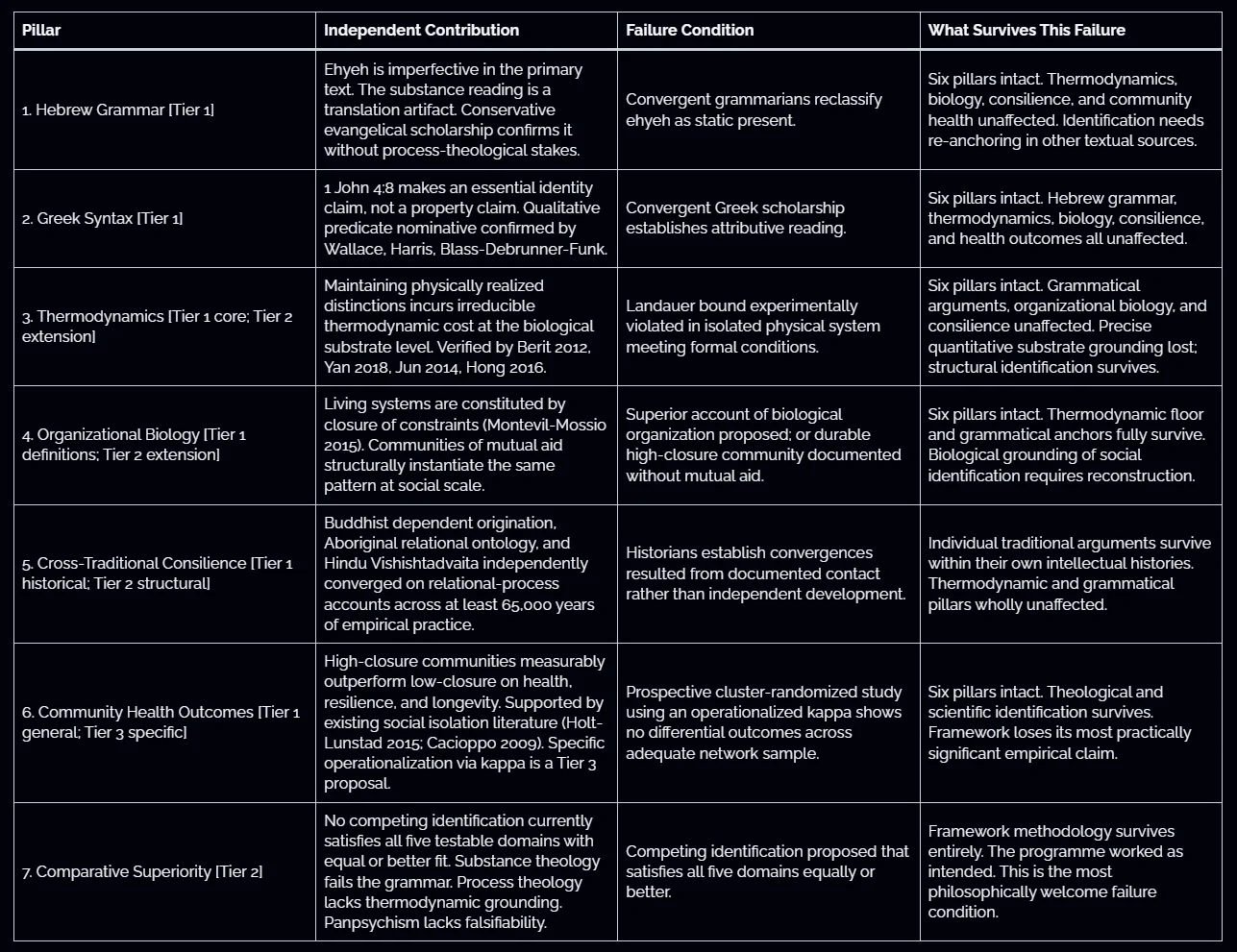
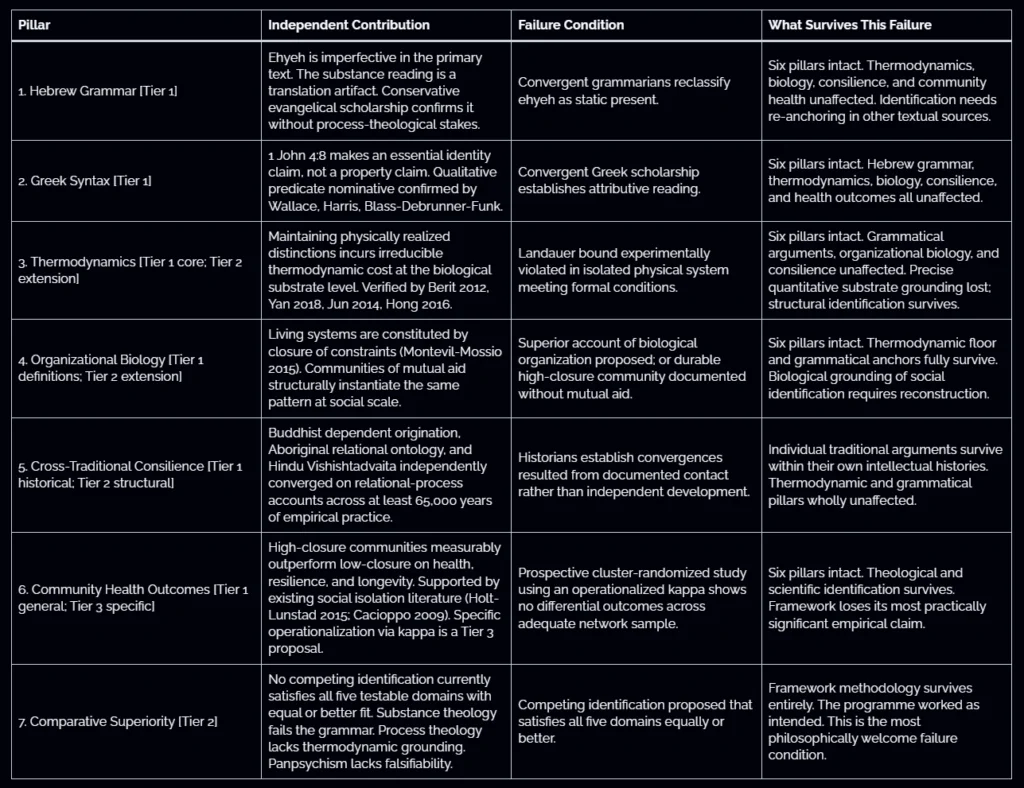
Only one of the seven falsification conditions depends on the Landauer grounding. The thermodynamic floor is load-bearing for the claim that physically realized organizational closure incurs irreducible costs, which connects to Criterion 1 and partially to Criterion 7. The other six stand or fall on entirely independent evidential grounds. The table below makes this explicit.
Part Three: The Measurement Protocol
The following protocol specifies what it means for a community to exhibit organizational closure at social scale. Each domain is labeled by epistemic tier. Where collaboration is needed to advance a claim from Tier 2 to Tier 1, this is stated explicitly.
An important framing note: the closure index kappa (κ) does not currently exist as a defined quantity in the published literature. Montevil and Mossio’s K(V) is explicitly characterized as ‘still preliminary’ in their 2015 paper, and no subsequent publication has operationalized it as a computable scalar index for social networks. Any kappa used here is a proposed operationalization, not a derived quantity. This is labeled accordingly throughout.
Domain 1: Network Topology [Tier 1]
Clustering coefficient (C) from Watts and Strogatz (1998), Nature 393:440-442, DOI: 10.1038/30918:
C = 3 x (number of triangles) / (number of connected triples)
Range: 0 to 1. High C indicates members maintain each other locally rather than depending on central or external provision. Empirical baseline for social networks: 0.3 to 0.8. Proposed threshold for organizational closure: C > 0.5.
Mathematical collaboration needed [Tier 2 to Tier 1]: Formal proof that C is necessary and sufficient for Montevil-Mossio closure in social networks. Sensitivity analysis for measurement error and network boundary ambiguity. Graph theorists and network mathematicians are the natural collaborators.
Domain 2: Reciprocity [Tier 1]
Reciprocity index (R) from Schweitzer et al. (2009), PLoS ONE 4(8):e6490, DOI: 10.1371/journal.pone.0006490:
R = (bidirectional connections) / (all directional connections)
Range: 0 to 1. Measures whether constraints mutually maintain each other or whether some extract maintenance from others without reciprocation. Proposed threshold: R > 0.4 for mutual maintenance. R < 0.15 indicates extractive structure inconsistent with TOC identification.
Community collaboration needed [Tier 2 to Tier 1]: Longitudinal tracking of actual aid flows, not proxy measures. Indigenous communities with sustained kinship-based mutual aid across generations hold empirical knowledge about reciprocity dynamics that survey instruments do not capture.
Domain 3: Thermodynamic Floor at Biological Substrate [Tier 1 structural; Tier 2 calculational extension]
The biological organisms constituting any community pay Landauer costs continuously through neural and metabolic operations. At biological temperature T = 310K:
k_B T ln(2) = (1.380649 x 10^-23)(310)(0.693) = 2.97 x 10^-21 joules per bit erased
This floor establishes that maintenance costs are real and non-negotiable at the substrate level. It is not a formula for calculating the thermodynamic cost of social acts, which would require conditions that the social level of description does not meet. Its significance is structural: no physically realized information-maintaining process gets thermodynamic exemptions.
Tier 2 note: The per-relationship-bit calculation (e.g. 78 relationship-bits x 2.97 x 10^-21 joules) is an information-theoretic reference value illustrating the structural point, not a direct thermodynamic measurement of a social community. The actual metabolic cost exceeds the floor by approximately 27 orders of magnitude for any macroscopic social system.
Thermodynamics collaboration needed [Tier 2 to Tier 1]: Formal scaling treatment from molecular Landauer erasure through biological constraint-maintenance through social organizational closure. Information thermodynamicists and non-equilibrium statistical physicists are needed to close this gap.
Domain 4: Closure Index kappa [Tier 3: Novel Proposed Operationalization]
The closure index kappa is a proposed operationalization of Montevil-Mossio organizational closure for social networks. It does not exist as an established quantity in the literature. The following definition is a starting point requiring independent justification and validation.
Proposed definition: kappa = (constraints maintained by network) / (total constraints required for community viability)
For each constraint in the community’s maintenance (food provision, shelter, care, knowledge transmission, emotional support), determine whether it is regenerated by other network constraints or requires external supply. Proposed threshold: kappa > 0.9 indicates organizational closure in the Montevil-Mossio sense. kappa < 0.5 indicates dependence on external provision; the system is not self-maintaining but service-dependent.
A working proposed operationalization for community networks: define kappa as a weighted combination of (a) the global clustering coefficient, measuring triadic closure and the tendency of mutual aid to form self-maintaining loops, weighted at 0.6, and (b) the modularity deficit, measuring how much the network resists fragmentation into non-interacting subgroups, weighted at 0.4. Communities with high kappa would show dense triadic closure and low modularity, meaning the mutual-aid loops span the community rather than clustering into isolated cliques.
Alternative operationalizations worth developing in parallel: the Infomap map equation to measure flow persistence; information-theoretic measures of constraint dependency; directed resource-flow data tracking who provides what to whom over defined time windows.
Mathematical collaboration needed [Tier 3 to Tier 1]: Formal derivation of kappa from the Montevil-Mossio closure definition; proof that the proposed network-metric operationalization is necessary and sufficient; robust estimation procedures for kappa with missing data and ambiguous network boundaries; characterization of sensitivity to temporal variation in constraint flows.
Domain 5: Differential Outcomes and the Study Design Problem [Tier 1 general literature; Tier 3 specific test]
If TOC correctly identifies the structure that sustains human communities, then communities scoring above threshold on all four metrics should measurably outperform communities that do not on health, resilience, cognitive function, and longevity over time.
The existing social isolation literature provides strong Tier 1 support for the general prediction: Holt-Lunstad et al. (2015) documented mortality risk from social isolation equivalent to smoking 15 cigarettes daily; Cacioppo and Hawkley (2009) found measurable cognitive decline within weeks of isolation; Cuijpers et al. (2020) found multimodal interventions targeting closure at multiple scales consistently outperform single-scale interventions. This literature supports the TOC prediction independently of any formalization of kappa.
Testing the prediction specifically against TOC metrics requires a study design that does not currently exist in the literature. The appropriate methodology is a cluster randomized trial with networks as clusters, not an individually randomized study.
Power Analysis: Cluster-Level Logic [Tier 3: Research Prospectus]
The binding constraint for study power in a cluster randomized trial is the number of independent networks (clusters), not the total number of individuals. With ICC = 0.05, average cluster size m = 50, and target effect size d = 0.25 (consistent with meta-analyses of social network health interventions, Hunter et al. 2019, PLoS Medicine, DOI: 10.1371/journal.pmed.1002890):
Required clusters per arm = approximately 18, for a total of approximately 36 networks and approximately 1,800 individuals.
A study claiming to test Criterion 5 with fewer than 10 networks per arm does not have adequate power to detect the effect sizes the social science literature reports, regardless of total individual count. A study with 5 networks per arm has minimum detectable effect size d approximately 0.5 to 0.8, larger than typically observed. Total n > 500 is necessary but not sufficient; what matters is cluster count.
Pre-specification requirement: A valid test of Criterion 5 must pre-register the kappa operationalization, the network inclusion criteria, the outcome variables, and the analysis plan before data collection. Post-hoc operationalization does not constitute a test.
Null result definition: Multiple independently conducted cluster randomized studies with at least 10 networks per arm, using the same pre-specified kappa operationalization, showing no statistically significant difference in pre-specified outcomes at the cluster level. Studies that fail to meet this standard constitute neither confirmation nor falsification.
Part Four: The Friston Qualification
The main paper’s previous treatment of Friston’s Free Energy Principle required clarification. This section documents the status of that connection.
Friston’s Free Energy Principle (2010, Nature Reviews Neuroscience, DOI: 10.1038/nrn2787) describes how organisms minimize variational free energy, an information-theoretic upper bound on surprisal, to maintain their organization. Kirchhoff et al. (2018) connected this Markov blanket formalism to autopoiesis, describing hierarchically nested Markov blankets at multiple organizational scales.
Two qualifications are necessary for honest engagement with this framework.
First, Bruineberg, Kiverstein, and Rietveld (2022, Behavioral and Brain Sciences 45:e183, DOI: 10.1017/S0140525X21002351) argued that the FEP literature risks a reification fallacy: treating statistical Markov blankets, which are epistemic abstractions appropriate to models of a system, as physical boundaries with genuine causal powers. This critique generated approximately 30 commentaries in BBS. TOC does not depend on the reified reading. The Markov blanket formalism is referenced as a convergent formal intuition, not as an established physical boundary demarcating communities.
Second, variational free energy and thermodynamic free energy are formally distinct quantities. Variational free energy is information-theoretic, measuring uncertainty about sensory states. Thermodynamic free energy is U – TS, measuring work available in a system at constant temperature and pressure. Gottwald and Braun (2020, PLoS Computational Biology, DOI: 10.1371/journal.pcbi.1008420) demonstrate they are interconvertible only under specific idealized assumptions. Conflating them is a real error that the revised paper and this supplement both avoid.
The correct characterization: Friston’s framework shares a formal intuition with Montevil-Mossio’s closure of constraints. Both describe systems that actively maintain their own conditions of existence against perturbation. This convergence across independently developed formalisms is itself evidence of a real phenomenon. It does not constitute a formal equivalence, and no published formula maps a closure index onto Markov blanket structure. Any such mapping would be a Tier 3 novel contribution requiring independent justification.
Part Five: Illustrative Community Profiles
The following estimates are grounded in published baselines but are not measured data from specific communities. They illustrate the kind of falsifiable prediction the framework generates: concrete enough to be tested, specific enough to be wrong. The gap between these estimates and actual measurements is precisely the work the collaborative programme is designed to close.
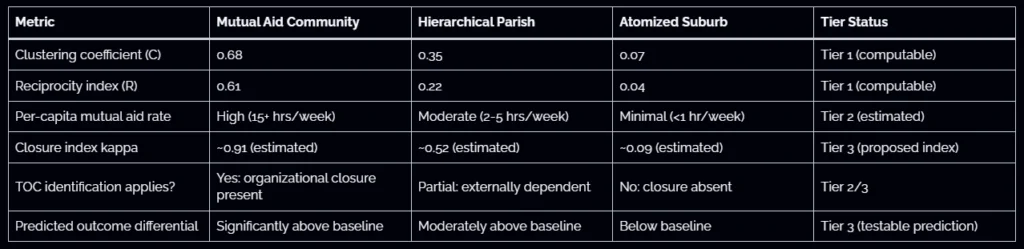
The kappa estimates are labeled Tier 3 because they depend on the proposed operationalization. The C and R values are illustrative estimates, not measurements of actual communities, but they are computable from real network data and labeled as Tier 1 because the formula is established. The tier column makes explicit what kind of evidentiary weight each row carries.
Part Six: The Collaborative Research Programme
TOC is not a completed argument. It is the opening move of a research programme that requires expertise from Hebrew and Greek linguistics, Aboriginal and First Nations knowledge traditions, Jewish and Christian and Hindu philosophical communities, information thermodynamics, network mathematics, and social epidemiology. The following is a specific, non-rhetorical call for collaboration organized by the gaps the tier structure has identified.
Hebrew and Jewish Philosophical Traditions
The dynamic reading of ehyeh has deeper and in several respects more rigorous roots in Jewish philosophy than in the Christian process theology the paper primarily engages. Maimonides’ negative theology implies that even ‘Being’ cannot be predicated of God in any straightforward sense, putting the static-substance reading on difficult ground within the tradition itself. Rosenzweig’s phenomenological theology of encounter in The Star of Redemption, Buber’s I-Thou relational ontology, and contemporary Jewish process thought collectively constitute a tradition of reading the divine name as ongoing relational event that is both older and more sophisticated than TOC’s current engagement with it.
Collaboration sought: Hebrew Bible scholars and Jewish philosophers to assess whether TOC’s grammatical and identification claims are consistent with, in tension with, or capable of being transformed by the best Jewish philosophical readings of Exodus 3:14. Scholars working in the Masoretic tradition, Second Temple Judaism, Kabbalistic thought, and modern Jewish process philosophy are all relevant.
Information Thermodynamics and Statistical Physics
The mathematical bridge from Landauer’s principle through Bennett’s error-correction analysis to the thermodynamic cost of maintaining organizational closure in macroscopic social systems is currently stated at the level of physical principle rather than worked formalism. The structural argument is sound but the scaling treatment from molecular through biological through social levels has not been formalized.
Collaboration sought: information thermodynamicists to formalize the scaling treatment; quantum information theorists to assess whether Bennett’s logical reversibility analysis extends cleanly to the biological and social cases; non-equilibrium statistical physicists to characterize the relevant thermodynamic regimes. The question of whether kappa is computationally tractable for real community networks is itself a complexity theory question the paper does not address.
Network Mathematics and Graph Theory
The proposed kappa operationalization uses clustering coefficients and modularity in ways that are well-established in network science but not specifically derived from the Montevil-Mossio organizational closure definition. The claim that these metrics are sufficient to detect organizational closure in the relevant sense is an assertion, not a derivation.
Collaboration sought: network mathematicians to formalize the relationship between the proposed metrics and the closure definition; statisticians to develop robust estimation procedures for kappa with missing data and network boundary ambiguity; graph theorists working on dynamic networks to address the temporal dimension of constraint regeneration.
Social Epidemiology and Public Health
The differential health outcomes prediction is the framework’s most practically significant and most directly falsifiable claim. It currently rests on the existing social isolation literature rather than prospective measurement using TOC-specific metrics. The existing literature strongly supports the general prediction but does not test the specific organizational structure.
Collaboration sought: social epidemiologists to design cluster randomized studies using TOC-specific metrics; public health researchers to assess practical intervention implications; community practitioners building mutual aid networks across generations to serve as co-investigators with empirical knowledge that academic social science has not adequately formalized.
Aboriginal and First Nations Scholars
Yunkaporta’s protocols have been followed: no content appropriation, structural convergence noted and attributed correctly, the 65,000-year empirical depth of Aboriginal ecological and social management acknowledged as primary rather than illustrative. Following protocols correctly from the outside is not the same as conducting research with Aboriginal scholars as genuine co-investigators.
The question of whether organizational closure is a useful analytical concept for Aboriginal communities thinking about songline maintenance, Country, and kinship networks is a question Aboriginal scholars must answer on their own terms. The convergence identified in the paper may be less deep than it appears, or deeper in ways the paper has not grasped. Either finding would be more significant than the current stage of the argument. The collaboration sought here is genuinely open-ended and genuinely deferential.
Closing: What the Programme Delivers Without Waiting for Completion
The most important clarification about this research programme is that the seven pillars are not placeholders. They are independent contributions that accumulate now and would continue to accumulate even if the mathematical formalization of kappa turned out to be harder than the supplement currently suggests.
The grammatical arguments require no mathematics. The cross-traditional consilience requires independent historical development, not quantitative modeling. The community health prediction is supported by the existing social isolation literature independently of any closure index formalization. The comparative argument against the alternatives requires only that they demonstrate comparable falsifiability, which none of them currently does.
The mathematics strengthens and sharpens. It does not constitute. Darwin’s identification of natural selection was made without mathematical population genetics. Einstein’s identification of gravity with spacetime curvature was made without quantum gravity. Mendel’s identification of discrete heritable factors was made without knowledge of DNA. Identifications precede their full mathematical formalization in the history of science, and are accepted when they unify explanatory domains, survive falsification attempts, and generate novel predictions. TOC satisfies all three conditions at a level the alternatives do not, and it does so before the mathematical formalization is complete.The programme is open. The framework is ready to be tested.