
The Lion Eats. God Remembers. Who Answers for the Prey?
A response to Matthew Segall’s “God Is the Gap”: divine love, gratuitous suffering of innocents, the problem of evil, and what his evolving theology still owes its victims.
Picture four scenes in the same moment.
Picture a young gazelle, sick and too weak to run, caught in an attack where a lion begins feeding at its hindquarters before it dies. Imagine teeth gripping your living flesh, the pressure becoming a tearing pain, your forelegs scraping the ground as you struggle to pull yourself away. The next bite begins while your body is still straining to escape the last.
Must its breaking bones feel exactly like ours before its suffering counts? Each conscious moment has to be endured by the creature whose body is being torn apart.
In a dorm room in the mid-2000s, nineteen-year-old Matthew David Segall is alone, his first psilocybin experience beginning to unfold.
Beside the CRT television’s blue-grey flicker, imagine the experience Segall describes: warmth rising through your chest, light shining from behind your eyes, Christ’s face dwelling behind your own. You feel seen completely, including everything in yourself you have struggled to accept, and welcomed body and soul. For this moment, being alive feels like being held in love.
Then picture a child in a community broken by war and poverty. Hunger has accompanied almost every day the child can remember. The family’s drinking water carries disease; the local clinic has stopped providing routine vaccinations. Severe diarrhoea has left the child dehydrated; measles has also brought pneumonia.
Imagine your mouth so dry that swallowing hurts, while drawing breath takes the strength you need to cry. You press against the parent holding you, waiting for those familiar arms to make the aching and the thirst go away. Another breath catches in your chest, and you have to try again.
A routine vaccination could have prevented the infection. Safe water, adequate food, and treatment for dehydration could have changed the course of this short life. The child is dying beyond the reach of that care.
In a modern American hospital, a twenty-three-year-old woman lies beneath clean sheets, her scalp bare after months of intense chemotherapy. Pumps deliver medication. Monitors track her failing body. Her organs are shutting down; the doctors have warned her husband that she may not survive the night. She remains certain that Christ will heal her.
Her husband has remained open to believing in God while finding no adequate reason to believe. Now he is on his knees beside her bed, crying into his clasped hands. If there is a God out there, please don’t let my wife die. Our children need their mother. They have three children. The youngest is six months old; the oldest is three.
The monitor’s peaks become a flat line while you are still begging God to let her stay; after the attempts to revive her, a doctor tells you she has died. Her hand is still warm, and you have to begin finding words to tell your children that their mother is never coming home. You must raise them without her, answer when they ask for her, and face the possibility that their own memories will fade until the youngest knows her chiefly through photographs and stories other people tell.
If the student’s bliss bears on whether reality is fundamentally loving, the gazelle’s terror, the child’s suffering, and the young couple’s ordeal belong in the evidence.
What does the love disclosed in the dorm room offer the beings enduring those other moments?
On October 17, I released Evolving God Out of the Gaps: Naturalizing Whitehead’s God in response to Segall’s earlier arguments about causation, experience, and God. Three days later, on October 20, he published God Is the Gap: Silence, Symbol, and the Poetic Origins of Language.
His essay recounts a conversation with Mark Vernon, proposed weeks earlier, and answers a familiar God-of-the-gaps objection closely related to mine. He never names me. My argument targets the inference: gaps or incompleteness in a current account are recruited as support for universal experience, primordial valuation, or a divine ground. An incomplete explanation establishes a task. Support for a particular answer requires a further argument that compares it with alternatives. That is the logical structure I challenged in his earlier work.
The titles supply their own irony. I had just argued for evolving God out of the gaps days earlier; his later essay identifies God with the gap itself. That identification still owes the warrant my argument asks for.
Matthew David Segall’s newest theology would be easier to assess if its earlier claims would stay in the room. God is excluded from scientific hypothesis testing, having previously been invoked to address fine-tuning and the frame problem. Divine love can be morally oblivious, yet religious symbols make moral claims upon us. Every creature’s experience matters, but the good of a cosmic harmony can outrun what happens to its victims. Religious experience is fallible data, yet a particular encounter becomes knowledge of an independent Christ.
The conversation moves from limits on scientific description, religious experience, and intelligibility to compassion, ultimate personhood, and Segall’s relationships with Christ and other trans-physical beings. Those are substantial claims about reality. Establishing the divine ground he proposes requires support for those identifications beyond the force of the experience or a meditation on the limits of words.
The case against this theology concerns its explanatory contribution, the moral trust it asks for, and what divine love offers the creature whose life pays for the cosmic adventure.
The supposedly atheistic objection came with a theology
In God Is the Gap, Segall associates the familiar objection with “atheistic scientists” who “are constantly harping on” it. The objection also arises within theology, including the theological models I have offered in this exchange.
My Evolving God Out of the Gaps develops a finite, naturalized theology of care, with explicit limits on what experience, institutional survival, and religious authority can establish. It also specifies comparisons that could defeat its own proposed advantages. Its account of my earlier God-as-agapé-in-acts proposal preserves that proposal’s qualifications and identifies stronger formulations requiring repair. That newer article supplies the theological alternative used here.
The objection therefore survives inside theology. It can be made by someone developing a theological model, by a theist rejecting a bad argument for God, or by someone suspending judgment. Its force depends on the inference, not the critic’s religious affiliation.
I brought a theology to this discussion. Its divine vocabulary has to earn its place through the work it performs. Segall’s cosmic person faces the same demand.
Where the gap becomes support for Whitehead
In Words Made Flesh Again, published September 11, Segall identifies the unresolved claim himself:
“I have no proof of the prehensions of particles.”
He then describes the limits of physics:
“Physics describes dynamical relations, dependencies, and constraints with extraordinary precision. But causation? Its equations are time-symmetrical, and so hopelessly abstracted away from actual causation.”
The proposed answer follows:
“Whitehead’s answer begins not with the mathematics of strings or a vision of the stars but with a stomachache.”
This sequence is where I locate the gap-to-interpretation move. Segall moves from the alleged inadequacy of physical description to the felt inheritance of an embodied organism, then invokes Whitehead’s identification of physical energetic activity with emotional intensity. A stomachache gives us a case of embodied experience. Extending that experiential character to every concrete causal event requires a further argument. The inadequacy attributed to physics leaves rival accounts of that event’s intrinsic character in contention.
The biological examples make the same promotion. After crediting Levin’s experiments with challenging a reductive account of development, he asks:
“Who would have guessed the next Platonic revival would flow from a developmental biology lab!?”
Kauffman’s account of evolutionary novelty likewise receives an experiential redescription: “Morphogenesis is flesh feeling its way into form.” Electrical regulation and novelty require adequate explanations. Evidence against a crude model can favour better accounts in proportion to their comparative success. It gives no automatic priority to Platonic forms or universal feeling. The experiment cannot do the work of the missing philosophical argument.
My Matthew Segall’s Words Made Flesh Again, but the Evidence Never Said That? isolates that step. The shared evidence includes organized causal processes, developmental regulation, historical dependence, and experience wherever it is evidenced. Segall adds the universal identity claim that concrete causal actuality is intrinsically experiential. That addition must earn its place: what does it explain better, what constraints follow, and why should we prefer it to serious alternatives? The same demand applies when divine valuation or a cosmic person enters the account.
Segall describes his speculations as “tentative formulations of felt possibilities.” Their promise of continuity across causation, life, and mind is a philosophical case to assess. The cited experiments and the incompleteness of rival descriptions leave its comparative advantage to be demonstrated.
This is the inference challenged in Evolving God Out of the Gaps. An explanatory gap can motivate inquiry. Supporting a particular answer requires reasons that favour it over alternatives. Calling God the gap leaves those reasons to be supplied.
God is banned from the laboratory. His explanations are already inside.
In The Foolishness of God, February 2, 2025, Segall connects two problems: how organisms determine relevance, and how the universe’s physical parameters permit complex structures. His proposed response is that:
“the continuum of possibilities is itself structured by what we may as well call a divine act.”
Segall proposes immanent formal and final causation. The question is what warrants assigning that work to a divine act.
By April 28, 2026, in his dialogue with Stephen Meyer, he criticizes using God as a specific hypothesis to resolve fine-tuning, the origin of life, and information in DNA. He says this:
“oversteps the proper boundaries of scientific methodology”
Then, in his October 20 introduction to the dialogue with Timothy Jackson, he writes:
“God is emphatically not a scientific hypothesis one might devise some experiment to test!”
Treating the proposal as metaphysics creates a philosophical burden: explain what divine ordering contributes and compare it with serious rivals. Any empirical differences it entails remain answerable to evidence. The scientific problem motivates the question; the proposed divine answer needs its own support.
In Whitehead’s Evolutionary Theology, June 11, 2025, divine ordering is explicitly associated with fine-tuning and cosmological explanation. Relocating that explanation under the heading of metaphysics does not show what it explains better than a rival.
The February essay also suggests that even the slightest deviation in physical constants would preclude atoms, life, or consciousness. Fred Adams’s stellar-structure calculations, followed by his analysis of working stars and habitable planets, permit substantial variation within specified models. The ranges depend on which parameters vary, their joint variation, and the target being considered. Those calculations contradict Segall’s unrestricted fragility claim.
Segall has used scientific problems to motivate substantial divine explanatory work while opposing God’s treatment as a scientific hypothesis. He owes an argument for the metaphysical contribution and a clear account of what the science supports. God cannot collect explanatory credit at one door while the relevant criticism is turned away at another.
Cosmic love changes its moral obligations
In Whitehead’s Evolutionary Theology, June 2025, Segall describes the cosmic Good as:
“a Good that transcends relative good and evil”
He suggests that local discord can contribute to a greater aesthetic harmony, presents evolution as a:
“school for love”
and describes evil as:
“a necessary by-product of an evolutionary universe.”
Those claims carry different burdens. Some conflict may enable some goods. That does not establish that every kind of suffering, its actual intensity, or its distribution is necessary for evolution. An outcome’s contribution to a larger pattern does not establish its goodness for the creature harmed. And the beauty of a totality does not by itself authorize the sacrifice of its inhabitants.
In Evolving God, October 9, 2026, Segall imagines originating love bringing forth a universe whose divine consciousness develops through relationship. He also acknowledges that love can be somewhat oblivious to morals and offers no guarantee of a good ending. On that last point he is explicit: “I have no such assurance to offer.”
The meaning of love now becomes decisive. An impulse toward relationship and intensity can coexist with indifference to welfare. Benevolent concern for creatures carries a stronger demand: explain what the proposed love contributes to their good. The theology needs that distinction before cosmic Eros can warrant moral trust.
We recognize love through encounters in which someone matters, suffering calls for response, and care constrains conduct. Extending the word to cosmic creativity puts those familiar assurances at risk when the same creativity is allowed to be morally oblivious.
God Is the Gap describes human love as “longing-for” and divine love as “letting-be.” Allowing something to happen leaves its moral character open. A prey animal’s distress, a parasite’s success, and a child’s illness require an account of how letting them occur expresses loving care for those affected.
Human beings make wars, destroy services, and obstruct or deliver relief. Our obligations include protecting food and water supplies, keeping clinics working, and delivering vaccines and treatment. Segall’s divine love is proposed as a reality operating within this same world. Its contribution to the child’s good needs to be identified with the same care as any other proposed source of help.
A limited God’s contribution must be specified: which harms can divine influence prevent, which goods can it support, and how can that influence be identified? “Letting-be” leaves those questions unanswered. A quieter God does not automatically become a kinder one.
An aesthetic purpose also needs a normative bridge before it becomes a reason anyone should accept harm. A more intense divine experience is not automatically a better life for the animal being eaten. Nor does the achievement of a human culture retroactively secure the interests of creatures that died before humans existed.
Segall’s opposition to cruelty and authoritarian religion must constrain the cosmic story. A hierarchy of beauty needs a principle protecting those whose distress is being redescribed as discord within a harmony. The animal’s pain does not become a moral achievement because a philosopher has found a grander name for it.
Some evolutionary outcomes expand capacities for care; others expand the efficiency of inflicting damage. If primordial love receives credit for the first, what principle governs attribution in the second? Preference for the pleasing results cannot do the evidential work.
A child needs the help to arrive
The scale of this suffering is already measured. The UN’s estimates released in March 2026 put worldwide deaths before the fifth birthday at 4.9 million in 2024. That is roughly one child every six seconds. Most of those deaths were preventable through established interventions and access to adequate health care. Each number represents a life lived from inside a body, with needs that could have been met.
Kenya gives the illustration a concrete reference. The IPC’s 2026 assessment estimates that more than 883,300 children aged six to fifty-nine months will need treatment for acute malnutrition between April 2026 and March 2027. It identifies critical conditions in areas including Wajir, Mandera, parts of Turkana, and Dadaab. The imagined ward depicts children at the severe end of that burden, with parents and medical staff trying to keep them alive.
Measles makes the gap between available protection and actual protection especially stark. WHO estimates 95,000 measles deaths worldwide in 2024, mostly among unvaccinated or undervaccinated children under five. It also estimates that vaccination prevented nearly 59 million deaths between 2000 and 2024. Protection has an identifiable mechanism and a record of changing outcomes. Those are reasons to trust it.
For the child, help has to arrive in time. A vaccine before infection. Food before wasting becomes fatal. Safe water, rehydration, and appropriate treatment while the body can still recover. Each intervention earns its credit through what it does for a life at risk. A theology of universal love owes that life an account of its own contribution.
A Better Theology Owes the Prey a Better Answer
Segall presents his process theology as an improvement on the inherited conception of God. In Whitehead’s Evolutionary Theology, he calls it “a less idolatrous image of the divine,” contrasting coercive omnipotence with a God who is “persuasive and loving.” That proposed improvement makes the comparison with Aquinas relevant. Although I reject Aquinas’s defence, he at least offers explicit reasons for why divine providence permits predation and suffering, reasons whose premises and moral adequacy we can examine. Segall’s alternative must face equally direct scrutiny: what does limiting God’s power explain, what grounds the remaining claim of divine goodness, and how does this improve the account for the creatures enduring the harm?
Why I reject Aquinas’s defence
Aquinas addresses predation directly. In the Summa Theologiae, I, question 22, article 2, reply to objection 2, he writes:
“A lion would cease to live, if there were no slaying of animals”
His answer gives the good of the whole priority over defects in its parts. Eliminating all evil, he argues, would eliminate goods bound up with this order: the lion’s life, for example, and the patience of martyrs under persecution.
The lion’s dependence on flesh is a fact about the arrangement being defended. Vindicating its creator requires reasons for creating beings with those conflicting interests and permitting this degree of suffering. The need produced by an arrangement cannot, by itself, justify arranging it. Even if some conflict is unavoidable, the actual intensity, frequency, and distribution of harm remain to be defended.
The martyr example exposes the same problem. A persecutor could boast that his victims had become remarkably brave. Their courage would still leave him responsible for subjecting them to persecution. A divine justification requires additional reasons for permitting the wrong, beyond the victim’s achievement in enduring it.
As a defence of what happens to the prey, I find this bullshit. The lion gets food, the universe gets its allegedly better order, and the animal’s ordeal is entered as an acceptable expense. Calling the totality good leaves that priority to justify. Which goods require which harms? What less harmful alternatives are available? What makes imposing the cost morally defensible? The quoted defence supplies no adequate demonstration.
Segall’s advantage has to be demonstrated
Segall changes the power premise. A God unable to prevent an injury unilaterally escapes the specific charge of withholding that unilateral prevention. That is a conditional logical gain. Establishing an advantage over a serious rival also requires grounds for the proposed God, its limits, and the beneficial influence it retains.
He must specify what divine influence can change, defend why its limits follow from an independently supported account, and show what its presence explains better. If freedom or creative opportunity constrains the alternatives, those constraints and their value need argument. Some valuable risk leaves the amount and distribution of actual suffering open to assessment.
The June 2025 essay supplies assertions about evolutionary necessity, spiritual education, and cosmic beauty. Those passages identify proposed purposes; they establish neither the necessity of these particular ordeals nor their benefit to the creatures enduring them. The later acknowledgment of an uncertain outcome supplies no missing demonstration of benevolent influence.
Gary Chartier’s 2006 critique of process theodicy identifies a related difficulty. As his abstract explains, defending divine goodness in the face of animal predation carries costs: some form of consequentialism or contestable empirical claims. A process account still has moral and empirical premises to defend after it abandons omnipotence.
There are three comparisons to earn: greater coherence, a better explanation, and a more defensible account of what happens to victims. Withdrawing a troublesome power can improve the first while reducing what God can contribute to the others. Both Aquinas’s creator and Segall’s persuasive God must face a finite account of vulnerability and care among their rivals. An advantage over one formulation of omnipotence settles only that comparison.
Being remembered is not the same as being restored
In Eternity Tells No Tales, Segall describes God as receiving the consequent experience of creaturely conditions and suffering with creatures. In Words Made Flesh Again, he asks whether divine power lies in remembering each creature’s struggle. The June 2025 essay locates heaven in this world’s future.
These are significant restrictions on the answer offered to evolution’s dead. A better future can benefit later creatures. What does it do for a particular animal whose distressed life is already over?
Marilyn McCord Adams’s 1989 argument concerning horrendous evils helps locate the problem. Global goodness need not defeat a horror within the life of the person who endured it. Her argument and Christian response concern human persons. Extending the demand for attention to individual victims beyond humanity is an additional argument I am making.
Process theology distinguishes objective immortality, preservation within divine experience, from subjective immortality, a continuing subject’s own experience. A divine memory can preserve something about a creature without establishing that the creature experiences relief, restoration, or any future good. The Evolutionary Theodicy project’s comparison explains why some theologians demand more than preservation and develop accounts of creaturely fulfilment. Southgate’s and Sollereder’s proposals face further questions about identity, necessity, and why suffering-free existence could not have come first. They nevertheless identify the missing beneficiary.
Neil Messer’s 2026 paper examines the ethical implications of an ongoing debate about evolution, animal suffering, and God’s goodness. There is no settled evolutionary theodicy that Segall can simply inherit.
Evolving God distinguishes Tim Miller’s developing divine compassion from Segall’s primordial love and developing divine consciousness. The question for Segall is what a suffering creature gains from that developing consciousness and divine preservation.
Co-suffering, prevention, preservation, restoration, and justification are different achievements. The theology must specify which it offers before receiving credit for the others.
The prey does not become less dead because its death is perfectly remembered.
The animal is not a defective human
Whitehead’s Evolutionary Theology denies animals reflection on pain, a wish for its absence, and comparison with earlier happiness, while calling the human difference one of degree.
Must the gazelle’s breaking bones feel exactly like ours before its suffering counts? What feature of that difference would make being eaten alive tolerable for the creature enduring it? A wounded animal owes us no performance of humanity before we take its suffering seriously.
George Schaller’s field observations of lions describe restraint, injurious bites, suffocating holds, and feeding before death. In a playback experiment involving twelve African ungulate species, the community fled most often from lion vocalizations, with impala showing the same hierarchy of responses to predators. Escape behaviour establishes a response to threat; wounds and impeded breathing supply the bodily context for an inference to pain and fear. The exact character and duration of the imagined animal’s experience remain inferred.
Injury avoidance deserves investigation. Persistent protection of a wound, learned avoidance, and a preference for effective pain relief strengthen the case for felt suffering. Crook’s octopus experiments combined avoidance, wound-directed behaviour, and preference for a place associated with pain relief, with controls testing alternative explanations. A 2026 review identifies a missing control: injured animals receiving a second saline injection instead of lidocaine in the comparison chamber. The findings support an inference to affective pain while leaving that relief-preference interpretation open to further testing. The relevant question concerns what the creature experiences and what relieves it.
The International Association for the Study of Pain explicitly distinguishes nociception from pain and recognizes that inability to communicate verbally does not negate the possibility of pain in humans or other animals. Aversion alone does not establish conscious pain. The inference rests on converging evidence from behaviour, physiology, and context.
Claims about what animals remember, want, and feel require comparative evidence across species. Reflection on pain, aversion to it, and seeking relief are distinct capacities. Distinctively human forms of reflection provide an inadequate basis for a universal denial of the others.
Human abilities can intensify suffering in distinctive ways. Their presence does not determine the moral importance of every other creature’s experience. A theology claiming intimacy with the whole living world should not let its account of human exceptional capacities obscure the interests of beings who lack them.
This matters for the school-for-love argument. An animal that dies in distress need not have acquired a moral lesson. A benefit to later observers needs its own justification; it cannot be silently booked as the animal’s education.
A relationship accessible to some, uncertain for others
In Evolving God, Segall writes:
“I know Christ is real and that God is love”
He reports anger toward Westboro Baptist protesters alongside a desire to understand their suffering, and attributes the compassionate movement to Christ. An experience’s occurrence, its effect on conduct, and the identity of its source are separate claims. Crediting the experience does not settle the identity claim.
Memories, exemplars, learned attention, practice, and moral reflection provide rival accounts of the experience’s compassionate effects. Identifying an independent divine source requires evidence that discriminates among those accounts.
Luhrmann and colleagues’ 2021 cross-cultural study found associations between cultural models of mind, individual differences, and reported spiritual presence. A divine-source account must explain that pattern and distinguish contact with its proposed source from culturally shaped interpretations of experience.
In his response to the audience in Evolving God, Segall asks what we know of God’s independent existence outside the relationship. Changes in religious understanding and conduct could arise through a humanly transmitted relationship to a God-concept, relations with an independent divine person, or some combination. His account needs to distinguish those possibilities.
The stronger relationship claim also encounters divine hiddenness. Schellenberg’s argument links perfect divine love to openness to conscious relationship with every capable person, then asks why nonresistant nonbelief occurs. The debate concerns both what love requires and how nonresistance can be assessed.
The husband at the bedside is already willing to encounter God. His wife already believes. They both want her to live, and their children need their mother. The theology faces two questions in that room: what can divine influence contribute to her survival, and what makes a loving divine presence recognizable to either of them? Survival, felt consolation, and a reciprocal relationship each require their own account.
I describe myself as a nonresistant nonbeliever. I am willing to encounter a divine reality and revise my position. What I lack is adequate warrant for identifying a particular experience or cosmic process as that reality.
Adequate reason to recognize someone’s existence ordinarily leaves freedom to reject their advice and affection. Noncoercion alone therefore does not explain why recognition must remain unavailable. A claim that particular forms of disclosure would overwhelm freedom requires an argument about those forms.
Benny Mattis’s 2025 inclusionary argument appeals to the value of the particular persons whose lives include nonbelief. Andrew Blanton’s argument that nonresistant nonbelief is pervasive, first published online in 2025, presses the other side.
A limited process God might depend on psychological or cultural conditions it cannot unilaterally provide. The hiddenness question then turns on those specific limits and on the recognizable relationship this God can offer.
In The Work of Becoming Otherwise, October 8, Segall distinguishes the provision of a divine initial aim from a person’s conscious responsiveness to it. The hiddenness question concerns recognizable, reciprocal relationship: how does an unconscious influence make such a relationship available?
Suffering and hiddenness both concern what divine love makes available to its supposed recipients. The receptive nonbeliever asks what makes a purported loving relationship recognizable. The injured animal needs relief, protection, or some future good of its own. Knowing the creature perfectly would not establish the power to help it. Calling either relationship loving still requires an account of what that love contributes.
God becomes a gap, a ground, and a person
God Is the Gap begins with “God is a word,” later proposes “God is the gap itself,” and associates divinity with openness, compassion, personhood, and the grounds of scientific intelligibility. His reported relationships include Christ and other trans-physical beings.
A symbol, a condition of intelligibility, and an independent person can be related within a theology. Their relation requires argument. The existence and causal influence of the symbol do not establish the person. An open future does not identify its conditions as compassionate. The existence of intelligible relations does not establish that a primordial valuer supplies them.
Segall’s claim that non-theistic grounding is difficult invites a comparative case. Which feature of intelligibility does divine valuation explain better than structural, neutral-monist, process-naturalist, idealist, or other serious rivals?
Three additional bridges deserve attention. Christian theology’s historical contribution to modern European science cannot establish its metaphysical truth or indispensability. A belief can help motivate an inquiry without being confirmed by its success. Likewise, Vernon’s report that scientists value beauty concerns their motivations; it does not identify beauty’s divine source. Historical relations among words for breath, wind, and spirit do not uniquely reconstruct prehistoric experience or prove a soulful cosmos. Buddhist emptiness can illuminate a Christian meditation without independently establishing a divine agent. His footnote corrects the attribution of a reductive language-origin story to Darwin. The larger inference from language’s history to a soulful cosmos still requires support.
The transfer of authority is the problem: cultural evidence establishes a representation’s human effects; the cosmic referent requires further warrant. Any moral authority claimed for that referent requires a further argument about its character.
Calling that openness God does not establish divine personhood, compassion, or explanatory necessity.
Silence does not establish a speaker
God Is the Gap pairs positive theological language with apophatic unsaying: words disclose something while leaving more beyond them. The positive claims still need to earn their place.
A limit on description does not identify what exceeds it as compassionate, personal, Christian, or even divine. Segall’s acknowledgment of otherness and uncertainty cannot supply the evidence for those identifications. The less a description claims to capture, the less authority it can claim from having captured it.
This becomes a moral problem in his account of religious symbols. He describes their force as a claim upon us, a demand that “you must change your life.” The feeling of obligation and the justification of that obligation are different matters. A symbol can grip the imagination without deserving obedience. Its emotional force cannot settle whom to trust, what to do, or whose interests may be sacrificed.
Segall describes that felt demand; he has not thereby established its authority. If a cosmic story is to guide conduct, its moral premises and consequences need scrutiny. Calling the story sublime cannot excuse it from the ordinary question of whether following it harms someone. A theology may leave much unsaid. The person asked to live by it still deserves an answer.
His theory of truth supplies a test of his own theology
In To See a World in a Grain of Sand, Segall explicitly preserves factual resistance and propositional truth. He writes:
“A sufficiently internally coherent hallucination is still a hallucination.”
That standard binds his newest account of metaphysical experimentation. God Is the Gap proposes experimenting with language and examining how it alters perception as one criterion of metaphysical success. That criterion needs a connection between changed perception and improved contact with reality. A language experiment can succeed at changing the reader while failing to disclose what changed the universe.
His discussion of the Incarnation makes that test especially urgent. Describing Barfield and Tolkien, Segall writes of “the becoming-indifferent of fact and fiction, of history and myth, of the literal and the symbolic.” A historical event can carry symbolic meaning. That does not dissolve the distinction between an event occurring and a story acquiring meaning through being told. Symbolic richness supplies no substitute for establishing the event or identifying its source.
His earlier realism requires factual claims about the Incarnation to remain answerable to correction. The essay needs to distinguish those claims from its symbolic interpretation. A story can mean more than it says. It can still be wrong about what happened.
A religious image can make someone more compassionate, more attentive, or more convinced. A rival image can also alter experience. Which changes reveal their proposed source, and which organize perception around an interpretation? Segall’s own distinction between coherence and truth makes that question unavoidable.
The same issue bears on the claim that experience is aesthetic all the way down. The fact that inquiry occurs through experience does not establish that every process investigated is intrinsically experiential. That universal identification needs a bridge from the accessible cases to the inaccessible ones. Continuing to investigate experience does not remove the scope problem.
In Whitehead’s Adventure in Reason, he insists that logic does not supply its own relevance, while retaining logical consistency and experiential correction. The disputed question is which account of relevance earns support.
His own realism requires a method for deciding when an imaginative proposal has become knowledge.
God’s relevance and the occasions that already select
Whitehead’s Adventure in Reason distinguishes logical relations among possibilities from their graded relevance. It assigns God a constitutive role in the latter. To See a World in a Grain of Sand simultaneously describes finite occasions as selecting, excluding, valuing, and achieving their own determinations.
An initial orientation and a later local decision perform different possible jobs. What does God supply that inherited constraints and the occasion’s own activity cannot supply?
His July and October accounts already give environmental history, organismic organization, and achieved patterns substantial work in making possibilities relevant. Adding a primordial valuation may be coherent. Coherence does not establish that it is indispensable.
His October account in The Work of Becoming Otherwise calls God’s reality an accident of creativity. That introduces a primitive fact into the account. Whitehead’s Adventure in Reason likewise treats divine valuation as non-derivable. Necessity conditional on a model differs from necessity established for reality; the proposed model must defend its primitive commitments against alternatives.
The explanation has not eliminated ultimate givens merely by naming one divine. The comparison concerns which givens are needed and what they explain.
Scientific credit still requires scientific accuracy
The time-symmetry premise quoted earlier also fails a direct factual check. The BABAR collaboration directly observed time-reversal violation in neutral B-meson transitions in 2012. The observation refutes the blanket time-symmetry premise used in his argument.
Whitehead’s Evolutionary Theology invokes electromagnetic complexity as grounds for considering astrophysical mentality. Plasma structure and electromagnetic complexity are real research targets; their existence does not discriminate an experiential interpretation from rivals. Its opposition between a gravitationally condensed Sun and a plasma Sun is also misleading. NASA’s description includes both plasma composition and gravitational binding. They are compatible physical descriptions.
The October 8 Work of Becoming Otherwise makes a real methodological improvement:
“This is a major metaphysical commitment. I name it without being able to settle the case for it.”
Segall distinguishes Levin’s biological findings from their interpretation and says they provide points of contact without uniquely confirming the cosmological vision. That qualification must govern the explanatory credit assigned to his earlier claims.
An acknowledgment that the case is unsettled is epistemically useful only if the positive claim remains correspondingly unsettled.
Machines expose another boundary that needs defending
The Foolishness of God describes computational systems as apparently inherently incapable of organismic generalization, while also allowing that future machines might develop relevance realization or self-organization. Words Made Flesh Again uses a more categorical image of language models as signs detached from living reason. The October Jackson page’s computational summary, which Segall endorses as tracking the transcript closely, presents intelligence ecologically while distinguishing engineered organizations from organisms.
The relevant criteria concern current architectures, possible future systems, physical constituents, organized capacities, and phenomenal experience. Segall’s account needs evidence for its boundaries between organisms and engineered systems.
Universal experience at one scale does not establish a unified experiencing machine at another. Conversely, an artifact’s engineered origin does not alone establish what its organization can never become. Cognition, agency, consciousness, sentience, and moral status need separate assessment.
The ecological principle applies to human-computational arrangements too. A person may depend on a computational scaffold for communication, memory, or independent action. Disrupting that relationship can impair the person’s capacities. That gives the relationship ethical significance and identifies a concrete harm to assess.
Who pays when the metaphor becomes advice?
Christopher Hitchens supplies a useful method here. In Unanswerable Prayers, later collected in Mortality, he asked what precisely his well-wishers were praying for. The question distinguishes concern, salvation, cure, and competing religious interpretations instead of allowing a consoling word to cover them all. His Letters to a Young Contrarian also demands self-scrutiny: “Suspect your own motives, and all excuses.”
Applied here, the questions are concrete. What can God do? What has God done? Who benefits? Who pays? What would count against the attribution?
Uncritical acceptance can create several risks. Harm may be redescribed as spiritually necessary or aesthetically productive, making a sufferer’s protest look like a limited perspective. A meaningful encounter may confer unwarranted authority on an interpretation. A nonbeliever’s uncertainty may be reassigned to defective receptivity. A creature or computationally assisted person may lose consideration because a preferred account of life has settled the boundary in advance.
The safeguards must operate where the risk occurs: can a participant challenge the explanation, refuse its authority, obtain a correction, or secure care without affirming the cosmology? Do adverse outcomes reduce support for the claim, or merely invite a more elevated description of the outcome? A sufferer should not have to accept the theologian’s account of cosmic beauty to have their protest taken seriously.
What my theology disallows, and what it must earn
In Evolving God Out of the Gaps, I locate care in finite processes: someone notices a need, a response is coordinated, resources arrive, and consequences can be assessed. Stories, records, rituals, and institutions can carry those practices across time. I propose interpreting an ethically defensible pattern of enacted care as God-as-agapē. The interpretation, the proposed mechanisms, and their effects have separate burdens.
That changes which theological problems arise. The classical argument from contradiction needs premises connecting suffering with divine power, knowledge, goodness, and an obligation to prevent the harms at issue. Here, power belongs to particular participants and arrangements; responsibility tracks capacity, control, role, and justified obligations. Suffering calls for investigation, relief, and assessment of failures. A cosmic plan has no assigned role in making the victim’s loss good.
The restrictions are specific. Any proposed justification of harm must assess the welfare and agency of those affected, the available alternatives, and proportionality. A cosmic purpose supplies no permission to sacrifice a creature. Care must also remain available across belief, doubt, and refusal. Receptive nonbelief calls for examining someone’s actual access and reasons, rather than treating religious assent as a condition of assistance or protection.
An experience, its attributed source, its extension into a wider account of reality, and its practical effects require separate assessment. Conviction alone cannot establish an independent Christ or cosmic source; each added identification needs its own evidence. Claims of preservation must likewise specify what is preserved, by whom, with what fidelity, and for whose benefit. Remembrance still needs a connection to the original victim’s good before it can receive credit for restoration.
Organizational persistence and successful coordination do not establish love or moral authority. Care, consent, inclusion, and the distribution of burdens require independent assessment, leaving durable abusive institutions open to condemnation and replacement. Those living with the consequences of a sacred interpretation must have effective means to challenge it, refuse its demands, obtain independent review, and reach protection. Forgiveness cannot become the price of assistance.
Adverse evidence must change something. A proposal must record the conditions under which its claims lose support and revise the decisions and conclusions that depended on a failed claim. Reinterpretation cannot simply preserve its former authority. Explanatory credit requires similar discipline: identify the deity’s additional contribution and compare adequate rivals addressing the same target. A gap in knowledge, or a success shared by competing accounts, gives an unsupported addition no claim to the credit earned by that evidence.
Applied to the opening, this means comparing feasible protection for prey with consequences for predators and ecosystems; getting food, water, vaccination, and treatment to the child; and supporting the young mother’s care and her family. The husband’s doubt and the wife’s faith leave their entitlement to justified assistance intact. The reasons are their needs, agency, and exposure to harm. Religious assent adds no relevant qualification for receiving that help.
These are constraints on what counts as an acceptable justification within the model. Their enforcement requires people with the power and obligation to respond. Measure whether objections change decisions, help arrives sooner, outsiders receive fair treatment, and harms lead to repair. My newer article treats improved performance as a comparative claim to test.
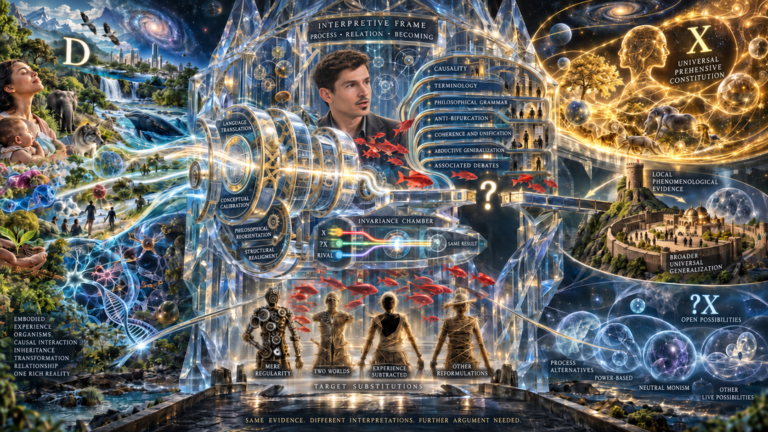
The explanatory distinctions remain equally strict. Organismic regulation, intrinsically experiential causation, a necessary divine valuer, and that valuer’s loving availability are four claims. Evidence for one earns no automatic promotion to the next. My finite reconstruction investigates constraints, causal inheritance, biological regulation, learning, memory, and social practices. Separating the shared package, D, from the additional commitment, X, exposes what the addition must earn.
An independently warranted rival recovering a target without X challenges X’s claimed necessity for that explanation. A challenge to unrestricted metaphysical necessity also needs a coherent, possible rival. Constitutive, formal, modal, historical, phenomenological, and abductive arguments can earn warrant through defended premises and serious comparison; empirical contributions face observations and interventions. Unconceived alternatives preserve uncertainty.
The Recursive Corrigibility Framework proposes records of claims, dependencies, rivals, and loss conditions so a failure reaches the conclusions relying on it. Its advantage over simpler inquiry requires comparison. Compare the organizational intervention against adequate existing workflows under matched resources, then compare religious, secular, and unlabeled framing of the same support. Set meaningful improvement and harm thresholds in advance; examine assistance, agency, exclusion, privacy, and burdens separately. An aggregate success score must preserve who paid its costs.
If ordinary learning, memory, coordination, and institutional accounts explain everything relevant, retire the larger God-pattern as an explanatory unit. If governance helps while religious framing adds nothing, retain the useful governance and narrow the theology. Harm can disqualify an arrangement even when its coordination improves. My demotion of Thermodynamic Monism and current boundary- and scale-relative realism remain subject to the same discipline.
The conceptual gain is identifiable: care can be understood and defended without first vindicating the suffering as an expression of universal love. The rules exclude specified excuses and unsupported inferences within this proposal. Better care, fewer harmful decisions, or added value from the God-name are further claims for the comparisons to decide. The injuries, deaths, and hard choices remain practical problems requiring work.
What would move the argument?
A defended account of why relevance or intelligibility requires divine valuation would strengthen Segall’s necessity claim. Evidence discriminating an independent source from rival interpretations would strengthen source identification. A specified account of divine capacities could generate assessable expectations about benevolent influence and relational availability. An account connecting preservation to a victim’s own welfare could address the gap between cosmic memory and creaturely good.
Each success would be local. A divine ground would still need its goodness established. A meaningful experience would still need its source identified. A genuine change in practice would still need its effects evaluated. Conversely, strong rival reconstructions, failed source-specific expectations, or repeated removal of adverse outcomes from consideration should reduce support for the corresponding claims.
My own proposal remains exposed to simpler explanations, failed interventions, harmful institutional effects, and redundant religious language. Each failure must revise the claim and practical authority that depended on it.
Segall’s later qualifications narrow some earlier claims. They do not supply the missing bridges or erase the explanatory jobs, moral implications, and public claims already assigned to God. His own standards of consistency, factual resistance, and corrigibility require those claims to be examined together.
A future more beautiful to someone else leaves the victim’s question open. Divine power determines which services God can offer; moral credit depends on the services the account establishes. The theology needs an answer at the scale of the life that paid for it.
The lion eats. God may remember. The evidence still leaves us with the prey.
The child needs care. The animal needs protection and relief. The young mother needs every chance treatment can give her. Her husband and children need her, and they need support through whatever comes next. Every divine account owes us an explanation of what it can actually contribute to those needs. The work is already ours.
The conflicts, with their proper strength
The difficulty running through these essays is that the work assigned to God changes, while the reasons for those changes remain unclear. In February 2025, divine ordering helps answer fine-tuning. By April 2026, treating God as a fine-tuning hypothesis oversteps scientific methodology. In October, God is excluded from experimental testing altogether. These positions need an account of how they fit together: what does the metaphysical proposal explain, what supports it, and does it imply anything we could discover to be otherwise?
The moral claims need similar attention. June’s cosmic beauty, extending beyond relative good and evil, sits uneasily beside October’s primordial love. Why should a drive toward greater intensity inspire trust that creatures matter for their own sake? Calling evil necessary to evolution also leaves a different question from acknowledging that the outcome is uncertain. We still need reasons why these harms, at this severity and with these victims, are required, and whose good could justify them. Divine remembrance and a heaven awaiting the world’s future leave another question open: how does either benefit the particular creature whose life has already ended?
Segall’s relationship with Christ raises the question of how its source is identified. If God outside the relationship remains uncertain, what distinguishes an independent divine partner from changes in the ways someone understands and lives their experience? Receptive nonbelief matters here too. Its significance depends on what relationship is promised and what the proposed God can actually do to make that relationship available. Limited power may explain some absences, but those limits need specifying. Likewise, letting beings exist does not yet tell us how divine love helps them. What does it contribute to their good, and what may they reasonably expect from it?
A transformed perception can change a life profoundly. Whether it discloses reality requires a further check against what resists the interpretation. Without that check, a compelling disclosure remains difficult to distinguish from a conviction strengthened by the framework through which someone sees. Appeals to the limits of language leave the same responsibility intact. If we cannot fully describe what lies beyond our concepts, we still need reasons for identifying it as compassionate, personal, or divine.
The boundary between symbolic meaning and factual assertion also needs to remain clear. If the Incarnation blurs fact and fiction, how does that sit with an appeal to factual resistance as the difference between truth and coherent hallucination? We need to know when an account concerns what an event means and when it claims that something occurred. A religious symbol can also make a powerful felt demand without establishing that we ought to obey it. Its resistance to literal paraphrase leaves us needing reasons to accept its authority, including an account of what obedience costs those affected.
Elsewhere, the question is what explanatory work remains. If occasions and their histories already select and value possibilities, what further contribution requires divine valuation? If ecological intelligence and experience extend widely through nature, what criteria justify restrictions on machine mentality? Those criteria need to travel with the argument, applied at comparable scales and with comparable evidence.
Finally, the claim of universal time symmetry requires a straightforward correction in light of established observations of time-reversal violation. Whatever metaphysical argument follows must stand on a corrected account of the physics.
A public correction should make these changes intelligible to the people who read the earlier claims: what has been withdrawn or qualified, what is still affirmed, and how they should now understand the argument.
Related writing and the public exchange
The principal texts, replies, and connected theological arguments are collected below.
Matthew David Segall
- God Is the Gap: Silence, Symbol, and the Poetic Origins of Language
- Platonic Space, Organic Agency, and Creative Evolution: dialogue with Timothy Jackson
- Evolving God
- The Work of Becoming Otherwise
- Words Made Flesh Again
- Experience Is Not a Predicate
- Whitehead’s Adventure in Reason
- “Behold, x!”; or, What Logic Leaves Out
- To See a World in a Grain of Sand
- Patterns Are Not Puppeteers: The Return and Reformation of Platonic Form in Biology
- Eternity Tells No Tales
- Heaven Save Us from Metaphysics in Denial
- Intelligent Design Meets Process Philosophy
- Whitehead’s Evolutionary Theology
- The Foolishness of God
- Facing the Face Within: Christopoetics in an Unfinished World in Process
- Transitioning With Whitehead
- There’s no scientific evidence that consciousness exists, on Segall’s original website
Nathan Sweet
- Evolving God Out of the Gaps: Naturalizing Whitehead’s God
- When Matthew Segall’s “No Scientific Evidence for Consciousness” Becomes an Unintentional Shield
- Matthew Segall’s Words Made Flesh Again, but the Evidence Never Said That?
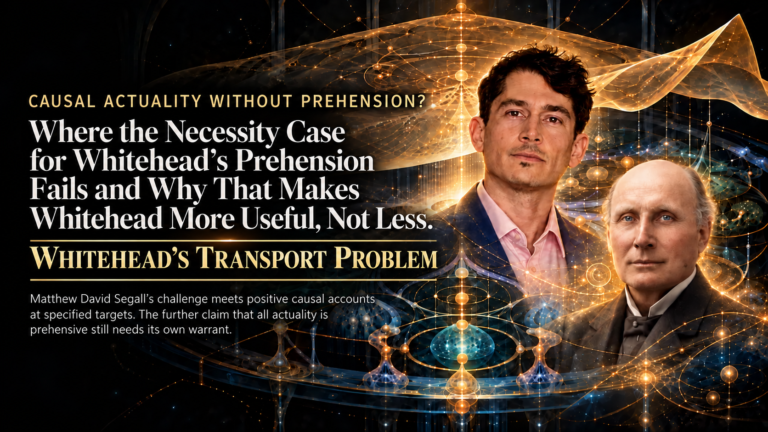
- Where the Necessity Case for Mathew Segall & Whitehead’s Prehension Fails
- What Warrants the Scope Jump?
- Logic Does Not Choose Relevance. Does Feeling? Not Alone.
- One Nature Does Not Entail One Feeling
- Why Matthew David Segall Kept Answering Me Without Answering My Actual Argument
- Matthew Segall’s “Experience Is Not a Predicate”: I Never Made the Argument He Rebutted
- I Asked the Process Philosopher Matt Segall to Correct the Public Record
- Matthew Segall Granted My Request for Erratum. The Straw Man Came Back Wearing a Presupposition
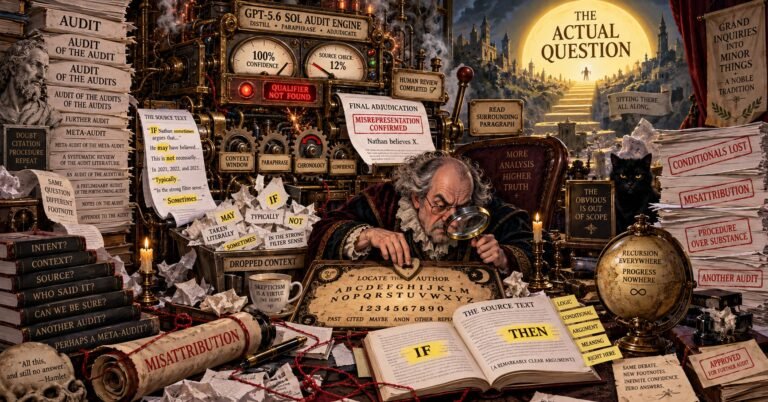
- Responding to Matthew Segall’s “Audit”: An Audit of the Audit of the Audits
- Religion With a Pipette: Is Michael Levin’s “Ingressing Minds” Pseudoscience?
- Why Michael Levin’s Bubble Sort “Revelation” Is Misunderstood
- David Chalmers’s “Hard Problem of Consciousness” Has a Hard Problem of the Gaps
- God-as-Agapé-in-Acts: the earlier constructive proposal
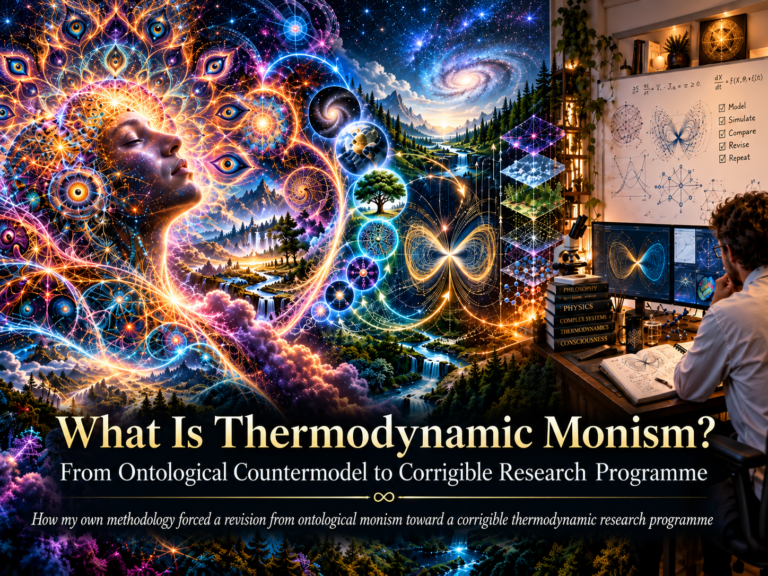
- What Is Thermodynamic Monism? September 2026 Revisions and Clarifications
- Recursive Corrigibility Framework and Provisional Boundary- and Scale-Relative Realism
Scholarly sources and reading notes
- Sweet, Nathan. Evolving God Out of the Gaps: Naturalizing Whitehead’s God
- Aquinas. Summa Theologiae, I, q. 22, a. 2, especially reply to objection 2. Primary text.
- Chartier, Gary. 2006. “Non-human animals and process theodicy.” Religious Studies 42(1): 3–26. DOI: 10.1017/S0034412505008097
- Adams, Fred C. 2008. “Stars in Other Universes: Stellar Structure with Different Fundamental Constants.” Journal of Cosmology and Astroparticle Physics 08: 010. DOI: 10.1088/1475-7516/2008/08/010; author’s preprint. Models working stars within specified parameter variations.
- Adams, Fred C. 2016. “Constraints on Alternate Universes: Stars and Habitable Planets with Different Fundamental Constants.” Journal of Cosmology and Astroparticle Physics 02: 042. DOI: 10.1088/1475-7516/2016/02/042; author’s preprint. The permissible parameter regions are conditional on the paper’s models and stated physical constraints.
- Schaller, George B. 1972. The Serengeti Lion: A Study of Predator-Prey Relations. University of Chicago Press, first published 1972, pp. 263–267; the linked BiblioVault record lists the 1976 edition. Publisher’s book record. The field observations describe capture, restraint, killing bites, and feeding before death. On pp. 266–267, Schaller describes feeding while another lion holds the prey and a sick wildebeest being fed on before death, recorded after four minutes.
- Rigoudy, Noa L. A., Michael Clinchy, Mike J. S. Peel, Sarah Huebner, Craig Packer, and Liana Y. Zanette. 2022. “Hierarchy of fear: experimentally testing ungulate reactions to lion, African wild dog and cheetah.” Behavioral Ecology 33(4): 789–797. Primary study. DOI: 10.1093/beheco/arac041. Playback experiments on twelve ungulate species, including impala, measure antipredator responses.
- International Association for the Study of Pain. Terminology: pain and accompanying notes. The definition distinguishes pain from nociception and includes pain in nonverbal humans and other animals.
- UN Inter-agency Group for Child Mortality Estimation / UNICEF. 2026. “Progress in reducing child deaths slows as 4.9 million children under five die in 2024,” page dated March 17; release dateline March 18. The release supplies the global estimate and assessment of preventability. WHO’s “Child mortality (under 5 years),” May 1, 2026, supplies the approximate one-every-six-seconds expression.
- Integrated Food Security Phase Classification. 2026. “Kenya: Acute Malnutrition Situation April–July 2026 and Projection for August–October 2026”. Used for estimated acute-malnutrition treatment needs for children aged 6–59 months during April 2026–March 2027, stated as more than 883,300, and the geography of critical conditions.
- World Health Organization. “Measles,” July 15, 2026, and “Diarrhoeal disease,” March 7, 2024. Sources for the imagined child’s medical circumstances and the worldwide measles figures: prevention, pneumonia as a complication, undernutrition and interrupted immunization, unsafe water, dehydration, and available care.
- Crook, Robyn J. 2021. “Behavioral and neurophysiological evidence suggests affective pain experience in octopus.” iScience 24(3): 102229. primary article, archived PDF. DOI: 10.1016/j.isci.2021.102229. Evidence for affective pain and relief-seeking.
- Schnell, Alexandra K., Heather Browning, Andrew Crump, Charlotte C. Burn, and Jonathan Birch. 2026. “Sentience in cephalopod molluscs: an updated assessment.” Biological Reviews 101(3): 1311–1333. First published January 20, 2026. Open review. DOI: 10.1002/brv.70125. Section III(8) identifies the missing matched second-injection control in Crook’s experiment and rates the analgesia-preference criterion with medium confidence.
- Adams, Marilyn McCord. 1989. “Horrendous Evils and the Goodness of God,” Part I, pp. 297–310, in the joint symposium with Stewart Sutherland, Aristotelian Society Supplementary Volume 63(1): 297–323. DOI: 10.1093/aristoteliansupp/63.1.297; accessible paper.
- Messer, Neil. 2018. “Evolution and Theodicy: How (Not) to Do Science and Theology.” Zygon 53(3): 821–835. First published August 29, 2018. Publisher’s abstract and reference record. DOI: 10.1111/zygo.12435.
- Messer, Neil. 2026. “Evolution, Animal Suffering, Eschatology, and Ethics: Attending and Responding to Creaturely Struggle.” Religions 17(2): 136. Published January 26. DOI: 10.3390/rel17020136; publisher. Source used: the publisher-indexed description.
- Southgate, Christopher. 2008. The Groaning of Creation: God, Evolution, and the Problem of Evil. Westminster John Knox Press. See the research project’s account of the only-way argument and discussion of eschatology. Source used: the project’s summaries.
- Sollereder, Bethany N. 2019. God, Evolution, and Animal Suffering: Theodicy without a Fall. Routledge, copyright 2019; the institutional record dates first publication to October 29, 2018. Institutional publication record. Source used: the research project’s comparison of animal-redemption proposals.
- Schellenberg, J. L. 1993; 2015. Divine Hiddenness and Human Reason; The Hiddenness Argument. For the argument and major responses, see “Hiddenness of God,” Stanford Encyclopedia of Philosophy.
- Blanton, Andrew. 2026. “Non-resistant non-belief is pervasive.” Religious Studies 62(3): 547–567. First published online October 28, 2025. DOI: 10.1017/S0034412525101261; article. A philosophical argument about nonresistance, rather than a population-prevalence survey.
- Mattis, Benny. 2025. “Unless we have faces: love, evaluation, and nonresistant nonbelief.” Asian Journal of Philosophy 4, article 79. Published July 14, 2025. Open article. DOI: 10.1007/s44204-025-00298-4.
- Luhrmann, Tanya Marie, Kara Weisman, et al. 2021. “Sensing the presence of gods and spirits across cultures and faiths.” PNAS 118(5): e2016649118. DOI: 10.1073/pnas.2016649118; institutional repository record and abstract.
- Lees, J. P., et al., BABAR Collaboration. 2012. “Observation of Time-Reversal Violation in the B⁰ Meson System.” Physical Review Letters 109: 211801. DOI: 10.1103/PhysRevLett.109.211801; published article and repository record.
- Process theism. The Stanford Encyclopedia of Philosophy entry
- NASA Science. “Sun: Facts.” Used for plasma composition and gravitational binding.
- Hitchens, Christopher. 2001; 2011; 2012. Letters to a Young Contrarian, especially the closing letter and envoi; Mortality, especially the discussion of intercessory prayer, originally published as “Unanswerable Prayers”, 2010.