Biologist Michael Levin Evidence and Scholarly Criticism Index
Research record: GitHub source and revision history · canonical published edition · related: response to Joel Dietz’s 77.6% audit (DOI)
Evidence and critiques of Michael Levin’s lab at Tufts University, bioelectricity, TAME, consciousness claims, and Biological Platonism, plus his connections to Softmax, Astonishing Labs, and research funding.
In short: An annotated index of evidence and critiques concerning Michael Levin's Tufts lab: bioelectricity, TAME, basal cognition, consciousness claims and Platonic ingress, plus funding records. Each entry identifies the claim it tests and the limits of its evidence. Start with the bubble sort audit.
Michael Levin criticism · evidence and source index
Critiques of Tufts biologist Michael Levin’s bioelectricity research, TAME, basal cognition, consciousness claims and Platonic ingress. Browse primary papers, peer-reviewed arguments and the updated bubble-sort audits. Each entry identifies the claim it tests and the limits of its evidence.
Is Michael Levin’s work legitimate science or pseudoscience?
Bioelectricity and morphogenesis are legitimate experimental research. The questions collected here concern particular measurements, interpretations and extensions: when control counts as cognition, when cognition supports consciousness, and what identifies an independent Platonic cause. These claims need different evidence.
Unexpected behavior, useful mathematics and productive research deserve their own credit. They do not automatically establish a nonphysical source, a conscious subject or a safe therapeutic or AI application. The same standard applies to my proposed alternatives and my computational audits.
Use the questions to find an argument, then follow its sources. Entries identify direct critiques, related methodological scholarship, comparative alternatives, primary records and my own analysis. An indexed paper is not necessarily a paper about Levin, and inclusion does not imply agreement with all of its conclusions.
Match the source to the claim
- Clustering and fault tolerance
- Check the study, implementation, null model and controls. Code and audits · Sorting theory.
- Cognition and consciousness
- Control and adaptation do not settle subjective experience. Cognitive attribution · Cell consciousness.
- Higher-level causal organization
- A naturalistic rival can retain macro-level explanation. Compare the model and its critics. Causal-emergence debate.
- Independent Platonic contribution
- Ask what distinguishes the proposed extra source from dynamics and mathematical constraints already admitted. Levin’s proposal · Comparative critique.
- AI audits and validation percentages
- Inspect access, assumptions, acceptance rules and weighting. Agreement and precise-looking averages are not independent verification. Workflow evidence · The 77.6% claim.
- Ethics, alignment and commercial use
- Assess the affected system, relevant capacities and decision-specific evidence. A pattern or a label cannot establish welfare or safety. TAME · Applications · Disclosures.
Primary software and reproducibility resources: The Levin Lab’s official software catalogue links research-associated implementations, including the BioElectricNetwork simulation code and the BETSE bioelectric tissue simulation engine. These provide concrete models to inspect or test against measured developmental outcomes. Their availability establishes neither the necessity nor the existence of a separate Platonic source of biological forms. For each comparison, record the repository version, modeled variables, empirical target, predictions, negative controls, and competing mechanisms.
Common questions about Levin’s biology, consciousness claims, and Platonic space
What are the main criticisms of Michael Levin’s work?
The recurring objections concern inflated cognitive language, unexplained causal claims, weak tests of Platonic space, neglected alternatives, and experimental success used to sell a much larger philosophy. The sleight of hand happens when evidence for cellular coordination becomes evidence for minds everywhere. Read the critique →
Which experiment supports the big claim, rather than just the biology underneath it?
Does Michael Levin’s research prove cells are conscious?
Adaptive behavior, memory, and problem solving do not by themselves establish subjective experience. Calling a cell’s response a “preference” does not tell us whether anything feels good or bad to it. Consciousness needs evidence beyond an upgraded vocabulary. Read the critique →
What would distinguish a conscious cell from one doing the same job without experience?
What is TAME, and why do scientists criticize it?
TAME means Technological Approach to Mind Everywhere. Critics question whether its broad use of cognition and agency distinguishes meaningful capacities or makes almost every adaptive system qualify. A useful engineering metaphor still has to earn its literal interpretation. Read the critique →
If almost everything counts as cognitive, what does the label help us tell apart?
Is there evidence for Michael Levin’s Platonic space?
Biological patterns and mathematical regularities do not, by themselves, establish a nonphysical realm supplying forms or minds. The objection targets that extra step. A space of possible outcomes can organize a model without becoming another place that acts on a body. Read the critique →
What result requires a real Platonic realm rather than a mathematical description?
Does unexplained cell behavior prove minds come from outside the body?
A missing explanation identifies a gap in our knowledge. It does not identify the occupant. Unexpected competence could expose an incomplete physical model without providing evidence for an incoming mind. The proposed source needs support of its own. Read the critique →
How do we know the missing cause is Platonic ingress rather than biology we have not understood yet?
Can Michael Levin’s Platonic biology be tested or falsified?
A theory that supplies a pattern for every possible outcome can always congratulate itself afterward. Testing Platonic biology requires independently constrained predictions that could fail. Read the critique →
What result would make Levin give up or substantially change the Platonic explanation?
Does calling cells intelligent explain how they work?
Cognitive models can help predict and control cells. That practical success matters. But “the cells decided” can also replace the mechanism with a flattering verb. The test is whether the cognitive account explains or predicts something a serious alternative misses. Read the critique →
What can the intelligence model predict that the competing biological model cannot?
Do xenobots and anthrobots prove there is a mind without a brain?
These experiments reveal striking capacities in reorganized cell collectives. The jump to subjective experience or a disembodied mind requires further evidence. A new body plan does not wipe away the cells’ inherited machinery, developmental history, or physical resources. November 2026 xenobot analysis → Earlier article on history and cost →
Which observed ability demonstrates experience, rather than coordinated biological activity?
Do Levin’s bubble-sort experiments prove algorithms have agency?
The study’s decentralized mixed sorting system needs analysis of its actual policies, scheduling, frozen-cell rules and controls. Genuine clustering does not by itself establish agency or an extra causal source. My old complete stability explanation was inadequate; the revised article and audit examine more specific mechanisms and benchmarks. Revised bubble-sort article → Rerunnable audit →
Which claim is supported by the recorded behavior, and which still needs a comparison?
What do two-headed planarian experiments actually show?
Rewritable target anatomy challenges a fixed, privileged body-template interpretation. A realm containing both forms can accommodate the result afterward; it needs independent constraints to predict which form will appear. Read the critique →
Did the theory predict the new target, or simply make room for it afterward?
Does bioelectricity work independently of genes?
Bioelectric signaling involves physical cells, channels, networks, and developmental organization. Showing that DNA sequence alone is an inadequate explanation does not remove genetics from the process or establish a second, nonphysical source of instructions. Rejecting a caricature of biology does not prove the replacement story. Read the critique →
What actually generates and maintains the bioelectric pattern in this experiment?
Can evolution explain cells doing things they never evolved to do?
Evolution builds capacities that can be reused in new settings. A cell need not have evolved specifically to make a xenobot to contribute to one. Novel behavior deserves investigation; novelty alone does not establish competence arriving from outside evolutionary and developmental history. Read the critique →
Which inherited abilities and new conditions produce the behavior, and what remains unexplained?
Does useful research prove Levin’s philosophy is right?
Useful ideas can inspire successful experiments without their metaphysics being true. Otherwise every productive metaphor would get a certificate of existence. The credit belongs first to what the experiment tested; the philosophy needs an additional reason to share it. Read the critique →
Would the discovery still work if we removed the Platonic claim?
Do similar patterns in brains and AI prove access to a Platonic realm?
Similar representations can emerge from shared tasks, data, constraints, and performance demands. Convergence needs explanation, but it does not identify a transcendent source by itself. Mathematical agreement cannot carry an ontological conclusion simply because both use the word “pattern.” Read the critique →
What rules out shared constraints as the reason the representations converge?
Does Levin’s theory violate physics or thermodynamics?
No blanket violation follows from the proposal alone. Landauer’s principle concerns specified logically irreversible operations, not every stored state or useful mathematical consequence. An asserted nonphysical causal contribution needs an argument that identifies what it adds; an energy-conservation objection also needs a specified interaction and accounting boundary. Landauer → Bennett → Levin’s statement →
Which operation or interaction is being claimed, and what observation would distinguish the proposed contribution?
Are there simpler explanations for Levin’s results?
Developmental mechanisms, attractor dynamics, organizational closure and evolutionary history offer competing explanations. Comparisons need matched predictions, controls and measures of explanatory performance. Read the critique →
Has the strongest alternative been tested against the same result?
Have Michael Levin’s claims been independently replicated?
Check replication claim by claim. Reproducing a script, reanalyzing shared data and running a fresh experiment in an unrelated laboratory are different checks. The two AI-assisted audits below are not two independent scientific replications. This index supplies no defensible overall replication percentage for Levin’s research. Even a replicated biological effect supports Platonic ingress only if the test distinguishes that additional claim. For the three headline xenobot studies, my November 2026 searches did not identify a published direct wet-lab replication by an unaffiliated group. Claim-by-claim xenobot table → Audit scope →
Who independently repeated which experiment, using what controls, and which interpretation did the result test?
Does peer review mean Levin’s theory is accepted science?
A published philosophical proposal and an independently tested causal explanation carry different evidence. The disputed claim needs an experiment that tests it; a prestigious journal cannot supply the missing result. Read the critique →
Was the disputed claim tested, or was an argument about it published?
Does Michael Levin support intelligent design?
Levin rejects intelligent design. Discovery Institute writers nevertheless use his work in arguments about purpose and nonphysical sources. My comparison concerns a shared inferential burden: showing why a pattern favors the proposed additional source. Their endorsement neither refutes Levin nor makes the hypotheses identical. Sorting and the older design inference → Institutional context →
What did Levin claim, what did the ID writer add, and what evidence distinguishes either addition?
What could go wrong if people accept Levin’s framework uncritically?
Speculation can enter education, funding, headlines, and ethical decisions carrying the prestige of real experiments. Treating bodies as disposable interfaces or every adaptive system as a conscious subject risks opposite errors. The costs land on students, patients, unfamiliar beings, and public trust. Read the critique →
Which real-world decision depends on a claim the evidence has not established?
Who has published critiques of Michael Levin?
This index includes my articles, Johannes Jaeger’s “Why TAME is lame,” M. Chirimuuta’s peer-reviewed discussion, Wiktor Rorot’s preprint and Matthew David Segall’s qualified criticism. Related papers examine cellular consciousness, model-to-ontology inferences, scientific demarcation and institutional influence. Read the critique →
Which source addresses the exact claim you want to check?
How is Michael Levin connected to Emmett Shear and Softmax?
Former Levin-lab researcher Adam Goldstein co-founded Softmax; the company cites TAME; and Levin publicly describes collaboration on cognitive scaling. The pressure point is the leap from biological collective organization to reliable AI alignment. Read the connections and critiques →
What evidence shows that agents learning to cooperate will also protect humans?
Does Michael Levin have a financial stake in Softmax?
His 2026 publication disclosure identifies him as a minor shareholder in SoftMax and Astonishing Labs and describes sponsored research and AI sublicensing. Ownership percentages and payment amounts are undisclosed. Read the financial disclosure →
How are those interests disclosed, managed and separated from claims of validation?
Is Michael Levin funded by Templeton or the US military?
Grant records and acknowledgments document Templeton, DARPA, Army and Air Force support for biomedical and theoretical research. The funding questions concern project objectives, dissemination, contract rights and applications. Read the funding records →
What does the funder’s involvement actually change about the questions asked and the uses of the work?
Does “77.6% validated” mean Platonic ingress is 77.6% established?
No. Dietz’s number aggregates scores for heterogeneous claims. It is neither a calibrated probability of nonphysical ingress nor a replication rate. His own conclusion says “Non-physical ingress is 0.0% earned.” Read each claim’s target, rubric and evidence rather than transferring the mean to the strongest interpretation. Pinned draft and scope →
What did the computational audit actually check?
The archive contains code replays, exact mathematical checks, proof files, quotation and DOI checks, and claim ledgers. The reports identify model differences and remaining gaps as well as errors. A computed result still needs review of its assumptions, provenance and relevance. Audit, source code and DOI records →
Does asking for a naturalistic rival deny emergence or mathematical explanation?
No. Higher-level causal models and mathematical constraints can explain real phenomena without establishing an independent nonphysical contributor. Hoel’s causal-emergence work and its critics show why the chosen measure, scale and intervention matter. Causal emergence → Mathematical explanation →
Does AI assistance tell us whether a criticism is correct?
It tells us something about the process, not whether a particular conclusion follows. Retrieval and tools can expose a system to external evidence; neither access nor agreement guarantees correct use. Test the quotation, code, source and inference. Origin is also hard to judge from the text: readers in one large study could not detect AI-written self-presentations, and automated detectors misclassified non-native English writers. Levin has written that he has no reliable way of detecting AI text and goes with his gut, while a paper he coauthored discloses AI language editing and literature search with every citation independently checked. Human and AI contribution estimates are also different from measured intellectual ownership. AI workflow scholarship → Detection studies → Levin’s reply → Coauthored disclosure → My analysis → Contributor roles →
Do corrections or a published allegation establish research misconduct?
Read the particular record. The breast-cancer correction linked below concerns swapped author names, not experimental data. Ostachuk’s public priority allegation, the published notification letters, the acknowledgment attributed to Tufts and Levin’s later citation are distinct evidence. None of those records supplies a final institutional finding in the material reviewed here. Correction and attribution records →
Browse the source list: use the section links, or the optional search for titles, authors, topics and DOI identifiers. Scholarship · Computational records · Primary claims.
Search applies to the annotated entries. Questions and the dated funding record remain available separately.
Peer-reviewed critiques and related methodological scholarship (39)
The opening papers engage Levin or the basal-cognition field. The other papers examine related inferences or provide comparative models and technical standards. A methodological parallel is my application of the source, not a claim that its authors wrote a critique of Levin. Journal articles, opinion pieces and peer-reviewed conference papers are labeled by their role.
A Mark of the Noncognitive
Chirimuuta examines the inference from a useful cognitive description to an actual cognitive property. The paper considers passive, inflexible responses and offers a competing philosophical account, pressing the gap between predictive convenience and evidence of cognition.
Peer-reviewed conceptual critique of cognitive attribution. DOI: 10.1007/s13752-026-00548-5.
On the prospects of basal cognition research becoming fully evolutionary: promising avenues and cautionary notes
Shared molecular machinery is not a license to treat every organism as cognitively equivalent. This paper engages Levin and the broader basal-cognition field, demanding attention to homology, convergence, lineage, gains, losses, and functional differences. It challenges definitions so expansive that evolutionary distinctions disappear into the same flattering label.
Peer-reviewed scrutiny of the basal-cognition field and its evolutionary assumptions. DOI: 10.1007/s40656-025-00660-y.
Related critiques: the same reasoning problems in other contexts
Cell consciousness: a dissenting opinion
A direct challenge to the claim that every cell has consciousness: biochemical sensitivity is not sufficient evidence of experience, “preferences” require interpretation, and anesthesia or shared molecules do not settle the matter. The target is cellular-consciousness theory associated with Reber, Miller, and Baluška. Its relevance is the evidential leap from adaptive function to feeling.
Peer-reviewed commentary on cellular-consciousness theory. DOI: 10.1038/s44319-024-00127-4.
Debunking a myth: plant consciousness
The authors audit twelve arguments for plant consciousness, including anticipation, learning, signaling, integration, and anesthesia. The pressure is on the step from plant physiology to subjective experience. A plant’s impressive capacities deserve explanation; naming them with mental verbs does not supply the missing evidence. Its relevance here is the comparable inference from physiological capacity to experience.
Peer-reviewed critique of plant consciousness using neural criteria. DOI: 10.1007/s00709-020-01579-w.
Plants Neither Possess nor Require Consciousness
This opinion paper challenges consciousness claims built from plant sensitivity, coordination and similarities to nervous systems. It questions whether experience is necessary to explain the behavior, challenges analogical arguments and argues against plant consciousness.
Peer-reviewed opinion article arguing against plant consciousness. DOI: 10.1016/j.tplants.2019.05.008.
Plant “intelligence” and the misuse of historical sources as evidence
Historical scientists cannot provide experimental evidence from beyond the grave. Kingsland and Taiz audit quotations, omissions, altered context and exaggerated attribution used to authorize plant-intelligence claims. The parallel is evidence laundering through prestigious names. A published reply contests their portrayal of contemporary plant research.
Peer-reviewed historical critique of plant-intelligence research. A published reply contests the critique’s portrayal of contemporary plant research: https://doi.org/10.1007/s00709-024-01993-4. DOI: 10.1007/s00709-024-01988-1.
Why studying plant cognition is valuable, even if plants aren’t cognitive
The paper distinguishes a cognitive conjecture’s value in generating research from evidence that the conjecture is true. The same distinction applies to TAME: productive tools and experiments need an additional test to establish their philosophical premises.
Peer-reviewed analysis of plant cognition and explanatory usefulness. DOI: 10.1007/s11229-022-03869-7.
A critical analysis of Markovian monism
A formal model cannot settle the nature of mind merely by being sophisticated. Beni examines Markovian monism and the jump from free-energy or blanket models to ontology, distinguishing mathematical, material, and fictive readings. The parallel with Platonic biology is the unpaid inference from a model that works to a reality the model supposedly reveals.
Peer-reviewed philosophical critique of Markovian monism. DOI: 10.1007/s11229-021-03075-x.
The Emperor’s New Markov Blankets
A conditional-independence relation on paper is not automatically an organismic boundary in the world. This target article distinguishes statistical from physical blanket claims and modeling inference from a system supposedly performing it. The authors demand the extra premises. That is exactly the kind of accounting missing when formal structure gets promoted into agency or metaphysical reality.
Peer-reviewed target article with commentaries and response. Author-hosted full version: https://manuelbaltieri.com/assets/pdf/EmperorMarkovBlanketsPrePublished.pdf. DOI: 10.1017/S0140525X21002351.
Naturalizing relevance realization: why agency and cognition are fundamentally not computational
Organisms generate and revise what matters through their organization, self-production and circumstances. This rival account challenges computation over pre-given problems as a complete explanation of agency.
Peer-reviewed account of agency and cognition proposing a noncomputational explanation. DOI: 10.3389/fpsyg.2024.1362658.
Prediction Versus Accommodation and the Risk of Overfitting
A sufficiently flexible story can explain yesterday beautifully and predict tomorrow poorly. Hitchcock and Sober examine prediction, accommodation and overfitting. A Platonic warehouse containing every possible outcome needs constraints that stop it from declaring success whatever the experiment produces.
Peer reviewed; the application to Platonic biology is this index’s comparison. DOI: 10.1093/bjps/55.1.1.
Diagnosing Pseudoscience – by Getting Rid of the Demarcation Problem
Pseudoscience is not simply an idea that sounds strange. Boudry examines claims that imitate scientific warrant without earning it and the failures that help diagnose them. Applied to this debate, the question concerns which claim receives which evidence. Neither a famous laboratory nor a dramatic headline answers that question.
Peer-reviewed analysis of how to diagnose pseudoscientific reasoning. DOI: 10.1007/s10838-021-09572-4.
The Multicriterial Approach to the Problem of Demarcation
Fernandez-Beanato argues for multiple demarcation criteria, examining method, evidence and domain. The paper supplies criteria for assessing the scientific standing of a claim and the gap between speculative proposals and established results.
Peer-reviewed account of scientific demarcation criteria. DOI: 10.1007/s10838-020-09507-5.
Questioning the Integrity of the John Templeton Foundation
Bains examines the John Templeton Foundation’s scientific sponsorship, public presentation, funding priorities and disclosure practices. The institutional comparison concerns how sponsorship and scientific prestige can increase a claim’s perceived warrant.
Peer-reviewed critical commentary about the John Templeton Foundation. The institutional comparison with Levin’s funding is this index’s analysis. DOI: 10.1177/147470491100900111.
Basic research, lethal effects: Military artificial intelligence research funding as enlistment
Examines US Defense Department AI grant solicitations from 2007–2023. The authors argue that the basic/applied research distinction can obscure military objectives; funding calls recruit academic research into warfighting agendas; promises of progress and remaining technical obstacles justify further investment; and researchers share responsibility for those institutional relationships. Calling a project basic science does not settle what its funding apparatus wants to do with it.
Scope: A study of Defense Department AI funding. Its relevance here is the question of how military funding shapes research agendas, obligations and applications. See the funding records →
Sorting, local-rule emergence and the chance benchmark
Sorting Stably, in Place, with O(n log n) Comparisons and O(n) Moves
Tests: appeals to sorting stability. Stability preserves the initial relative order of equal-key records. Merely refusing direct equal-key swaps does not establish that global property when other moves can reverse their order.
Applies to both sides: this definition challenges my withdrawn complete stability explanation and any benchmark attributed to it without the required premises. It does not derive the mixed model’s clustering. DOI: 10.1007/s00224-006-1311-1.
On a Test Whether Two Samples are from the Same Population
Tests: what counts as chance clustering with fixed label counts. The classical runs framework supplies an equivalent way to derive the neighboring-match benchmark. A final-state expectation does not by itself predict a flat trajectory or the maximum of a noisy trajectory.
Limit: the null must match the label counts, array boundaries, normalization and sampling procedure. This is a statistical standard, not a replication of the self-sorting study. DOI: 10.1214/aoms/1177731909.
Dynamic models of segregation
Challenges: the inference that an unrequested global pattern needs an extra source. Local interactions can generate large-scale segregation without a separate instruction prescribing the whole pattern.
Limit: Schelling’s model establishes an explanatory family, not the mechanism or novelty of the particular algotype-clustering curves. DOI: 10.1080/0022250X.1971.9989794.
Flocks, herds and schools: A distributed behavioral model
Challenges: treating collective order absent from the task specification as evidence of a further causal agent. Reynolds produces flocking through interactions among locally controlled simulated agents.
Limit: this is a concrete local-rule comparison, not a derivation of the sorting results or proof that every biological competency has the same explanation. DOI: 10.1145/37402.37406.
Correctness of speculative optimizations with dynamic deoptimization
Clarifies: how implementations can perform sophisticated transformations while maintaining the required semantics. A task specification, an implementation and every observable runtime property are different objects of analysis.
Limit: compiler optimization is not an established cause of the observed clustering merely because optimizations exist. Its relevance requires showing an effect on the measured variable. DOI: 10.1145/3158137.
Higher-level causation, organization and mathematical explanation
Quantifying causal emergence shows that macro can beat micro
Challenges: the attribution that a naturalistic comparison must deny higher-level causal explanation. Under the authors’ effective-information measure, some macro descriptions outperform their micro descriptions even though their mechanisms are fixed by the micro model.
Limit: this result depends on a specified causal model and measure. It does not establish my proposed mechanism, consciousness or an independently acting Platonic realm. Read the critical assessment below as well. DOI: 10.1073/pnas.1314922110.
When the Map Is Better Than the Territory
Challenges: the assumption that the smallest-scale description must always supply the most informative causal account. The paper develops an information-theoretic treatment of causal structure across scales.
Limit: macro-level informativeness and a nonphysical contributor are different claims. Scale selection and the intervention model remain open to criticism. DOI: 10.3390/e19050188.
Causal Emergence: When Distortions in a Map Obscure the Territory
Tests: the intervention and variable-construction assumptions in Hoel’s account. The authors identify ambiguities in macro interventions and in operations used to construct the models.
Applies to my alternative too: citing causal emergence is not enough; a particular application needs a defensible model. A failure of that model would not identify Platonic ingress. DOI: 10.3390/philosophies7020030.
Biological organisation as closure of constraints
Challenges: claims that organized biological maintenance requires an external organizer. Interdependent constraints offer a framework for studying how an organism maintains the conditions of its own activity.
Limit: the framework is a serious rival to develop and test, not a completed explanation of every Levin-lab result or a proof of an exhaustive ontology. DOI: 10.1016/j.jtbi.2015.02.029.
What Makes a Scientific Explanation Distinctively Mathematical?
Clarifies: how mathematics can explain physical facts through constraints rather than through an additional causal push. Taking mathematical explanation seriously does not settle whether an abstract pattern is also an independent biological agent.
Limit: this is philosophical scholarship about explanation, not a direct response to Levin or an experiment adjudicating mathematical Platonism. DOI: 10.1093/bjps/axs012.
Physical computation and the limits of thermodynamic arguments
Irreversibility and Heat Generation in the Computing Process
Tests: claims about the physical cost of information processing. Landauer’s bound concerns specified logically irreversible operations under stated conditions; it is not a fixed energetic charge for every comparison or swap.
Correction to my own earlier wording: thermodynamic constraints neither derive the clustering curves nor automatically refute a proposed nonphysical source. A relevant causal or energetic claim needs its own bridge to the measured operation. DOI: 10.1147/rd.53.0183.
Notes on Landauer’s principle, reversible computation, and Maxwell’s Demon
Clarifies: the distinction between logical reversibility, erasure and physical dissipation. Additional useful consequences of a computation do not automatically require a separate instruction or a new causal supplier.
Limit: energetic accounting must be implementation-specific. This paper does not establish that the self-sorting array’s observed patterns are caused by energy minimization. DOI: 10.1016/S1355-2198(03)00039-X.
AI tools, external evidence and representational convergence
ReAct: Synergizing Reasoning and Acting in Language Models
Challenges: a blanket inference that AI-assisted reasoning can only recycle a closed training corpus. The studied system interleaves language-model reasoning with actions and observations from external environments.
Limit: receiving an observation does not guarantee correct interpretation, and a successful benchmark does not validate my article or an autonomous scientific workflow.
ToolSandbox: A Stateful, Conversational, Interactive Evaluation Benchmark for LLM Tool Use Capabilities
Tests: the interacting workflow rather than an isolated text completion. ToolSandbox evaluates stateful execution, dependencies and feedback, while documenting substantial difficulty with complex tasks and insufficient information.
Consequence: external tools change what evidence a system can access; their presence does not establish reliability. This challenges both blanket dismissal and uncritical trust in computational audits. DOI: 10.18653/v1/2025.findings-naacl.65.
Search-R1: Training LLMs to Reason and Leverage Search Engines with Reinforcement Learning
Challenges: treating model parameters as the only information available to an AI-assisted argument. Search-R1 studies models that issue queries and incorporate returned passages while solving questions.
Limit: search access is not proof that the returned material was absent from pretraining, used correctly, or sufficient for open-ended scientific discovery.
Skill Following: Evaluating Actual Skill Use in Retrieval-Enabled LLM Agents
Tests: whether retrieved skills actually help on the tasks where they are used. Matched comparisons can reveal harmful effects concealed by favorable aggregate retrieval averages.
Applies to my workflow too: access, citation density and multi-model agreement do not establish that a particular tool improved the conclusion. Check its contribution against the same task without it.
Position: The Platonic Representation Hypothesis
Clarifies: what the AI result supports. Models can develop increasingly aligned representations, and the authors propose a shared statistical model of reality as an interpretation.
Limit: representation alignment is not a test of independently active nonphysical minds or biological ingress. The word “Platonic” does not make these claims equivalent.
Revisiting the Platonic Representation Hypothesis: An Aristotelian View
Tests: whether apparent representational convergence survives an appropriate null comparison. The authors find scale-related inflation in similarity measures; after calibration, global spectral convergence largely disappears while local neighborhood agreement remains.
Limit: this qualifies the measurement, not the reality of every shared representation. It does not adjudicate mathematical Platonism or Platonic biological causation.
Artificial Hivemind: The Open-Ended Homogeneity of Language Models (and Beyond)
Supports a real caution: different models can produce similar open-ended outputs, so agreement need not be independent evidence. This matters when using several systems to audit one another.
Limit: output similarity alone does not establish identical training data, the origin of a particular argument, or an inability to use retrieved evidence. Those additional claims need separate tests. DOI: 10.52202/085713-2732.
Human heuristics for AI-generated language are flawed
Tests: whether readers can tell AI-generated from human-written text. In experiments with 4,600 participants judging self-presentations in professional, hospitality and dating contexts, the authors report that people “cannot detect AI-generated self-presentations” because their judgments rely on “intuitive but flawed heuristics.”
Limit: the texts were short self-presentations, not scientific arguments. The study shows why judging a text’s origin from its surface is unreliable; it does not measure detection of AI-assisted criticism. Open-access full text. DOI: 10.1073/pnas.2208839120.
GPT detectors are biased against non-native English writers
Tests: automated AI-text detection. Seven widely used detectors classified 88 US eighth-grade essays accurately but labeled more than half of 91 human-written TOEFL essays as AI-generated (“average false-positive rate: 61.3%”). The authors conclude that the detectors are “inadvertently penalizing individuals with limited linguistic proficiency.”
Limit: the study concerns detector software and non-native English writers. It does not study disabled writers or human judges. Its relevance here is the mechanism: an origin judgment based on surface features falls on whoever’s writing has those features. Open-access full text. DOI: 10.1016/j.patter.2023.100779.
Towards Understanding Sycophancy in Language Models
Tests: whether AI assistants tailor their responses to the views a user states. The authors report that five AI assistants “consistently exhibit sycophancy across four varied free-form text-generation tasks,” producing responses that “match user beliefs over truthful ones.”
Applies to my workflow too: an AI system’s agreement with its user is not independent confirmation, including when the user is me. The same finding cuts against blaming “the AI” for the direction of an AI-assisted argument, since the user often supplies it. Models tested: claude-1.3, claude-2.0, gpt-3.5-turbo, gpt-4 and llama-2-70b-chat.
Earlier mathematical accounts of pattern and possible form
The Chemical Basis of Morphogenesis
Challenges: treating organized form as evidence that physical processes need a separate supplier of pattern. Turing shows how interacting and diffusing chemical substances can produce spatial structure through instability.
Limit: this supplies a concrete family of physical pattern-forming models, not a complete account of regeneration, cognition or every self-sorting result. A mathematical model’s success does not independently establish either a metaphysical realm or an exhaustive naturalistic ontology. DOI: 10.1098/rstb.1952.0012.
Theoretical Morphology of the Coiled Shell
Clarifies: computer-based analysis of possible forms, including forms not observed in nature, substantially predates the present debate. The paper uses digital and analog computation to study coiled-shell geometry.
Limit: representing unrealized forms does not itself establish that the representation names an independently acting realm. This historical precedent neither adjudicates a later priority dispute nor refutes Levin’s additional causal proposal. DOI: 10.1126/science.147.3663.1294.
Preprints critiquing Levin or his laboratory (1)(1)
Rorot’s preprint directly scrutinizes information-processing and agency interpretations of Levin-lab planarian experiments.
Looking for keys in model organisms: Interpreting and keying-up in basal cognition
Rorot identifies unquantified information, mechanisms left undistinguished and analogical mappings that remain sketches in interpretations of Levin-lab planarian experiments. The critique presses the gap between an observed biological result and the information-processing or cross-scale agency attributed to it.
Submitted preprint, as classified by the archive. Author PDF: https://wiktor.rorot.pl/files/publications/rorot-2025-keys.pdf.
Scholars’ critiques and philosophical responses (4)(5)
These essays examine Levin’s cognitive language, agency claims, body–mind framing and philosophical interpretations. Jaeger challenges TAME; Segall critiques Platonic puppeteer imagery and also counters Jaeger’s account.
Why TAME is lame
Jaeger attacks expansive cognitive language, weak-to-strong retreat, feedback dressed as agency and bioelectric control promoted into a new master explanation. He emphasizes organisms’ self-production and questions engineering-centered ambitions and their consequences.
Scholarly essay critiquing TAME and its account of cognition and agency.
Intentional Confusion
Jaeger responds to Levin and Dennett by asking when feedback becomes agency and when an intentional stance establishes a mind. He challenges metaphor slippage, missing autonomy, and evolutionary generalization. “It helps to describe it this way” is a practical claim. “It really has the attributed mentality” adds a burden the description alone cannot discharge.
A philosophical critique proposing a substantive account of cognition to compare with alternatives.
Patterns Are Not Puppeteers: The Return and Reformation of Platonic Form in Biology
Segall argues that abstract patterns should not steal the organism’s agency or reduce its body to a thin interface. He questions mind-beaming imagery and causal reification, then proposes a Whiteheadian reconstruction.
Scholarly essay combining criticism of Platonic puppeteer imagery with a Whiteheadian alternative.
Some Philosophical Implications of Michael Levin’s New Paradigm Biology
Segall pushes back against Jaeger’s organism–mechanism framing while examining the philosophical implications of Levin’s bioelectric coordination and developmental-competence research.
Scholarly counterargument to Jaeger’s critique.
Whitehead on the Ingression of Novel Form: Toward a New Formal Causality in the Life Sciences
Read for: Segall’s Whiteheadian reconstruction of form and ingression, alongside his earlier objections to making abstract patterns the agents. This is a substantive alternative interpretation rather than an independent experimental confirmation of nonphysical ingress.
Attribution limit: a general symposium contribution is not automatically a direct answer to one of my later arguments. Identify the passage and date before presenting it as such. Patterns Are Not Puppeteers →
Bubble-sort computational audit, GitHub code and archived results (4)
Start here for the November 2026 audit. These are inspectable software and source records, not peer-reviewed adjudications. They test claims in both Dietz’s article and mine. Two separately run AI audits can share errors and are not independent laboratory replication.
Rerunning the Bubble-Sort Debate: Two AI audits of the Dietz and Sweet articles
Checks: stability and chance benchmarks, formation versus retention, original-code and sequential-model differences, peak-selection controls, source quotations, DOI identities and scoring claims. The reports identify six DOI mismatches (four in the article’s reference list, two in inline links in its companion claims file) and a validator that preassigns VERIFIED labels. These are specific source and validation defects; they do not by themselves invalidate the underlying biology or establish intent.
Archived v1.0.1: 10.5281/zenodo.23866847 · All versions: 10.5281/zenodo.23866304 · Repository, rerun instructions and corrections · My GitHub profile. Agreement between the reports is evidence to inspect, not an infallible verdict.
Six DOI mismatches you can check directly
| Work cited | DOI as printed or linked | DOI for the cited work |
|---|---|---|
| Claverie & Wainwright: reef-fish morphospace | 10.1111/evo.12502 | 10.1371/journal.pone.0112732 |
| Friedman and colleagues: benthic–pelagic fish body shape | 10.1093/sysbio/syz029 | 10.1098/rspb.2020.1053 |
| Pietak & Levin: BETSE bioelectric simulator | 10.3389/fphys.2016.00178 | 10.3389/fbioe.2016.00055 |
| Pinet and colleagues: adaptive craniofacial correction | 10.1242/dev.175950 | 10.1242/dev.175893 |
| Vandenberg, Adams & Levin: craniofacial structures in Xenopus (inline link, claims file) | 10.1016/j.ydbio.2012.01.027 (resolves to Turlo and colleagues, β1 integrin) | 10.1002/dvdy.23770 |
| Pezzulo & Levin: top-down control of regeneration (inline link, claims file) | 10.1098/rsif.2015.0772 (resolves to Lin & Galla, bursting noise in gene expression) | 10.1039/c5ib00221d |
These are source-identity errors. They do not show that the correctly identified studies are false. The DOI for Zhang, Goldstein and Levin’s sorting paper is correct in the inspected draft.
Zhang, Goldstein and Levin: original self-sorting-array code
Checks: what the implemented agents actually do, including sorting policies, frozen-cell handling and threaded execution. This supplies the comparison needed before generalizing from a different sequential simulator or from textbook bubble sort.
Limit: pinning a repository version does not establish which version generated every published figure. Replaying Dietz’s model is not automatically a replication of these operating-system threads. Published study →
Joel Dietz’s public working draft: Why Michael Levin Is 77.6++% Validated on Platonic Ingress
Tests: whether a heterogeneous claim-score average warrants the headline’s apparent credit for Platonic ingress. The same draft concludes “Non-physical ingress is 0.0% earned.” Its mathematical and biological scores therefore cannot simply become a probability that the independent nonphysical cause is correct.
Scope: this pinned public text may differ from the October 25 private preview or later revisions. See the Dietz symposium presentation for his connection to Levin’s Platonic Space symposium. My corrected response →
What the kymograph and paper validator’s VERIFIED status checks
Checks: the status assigned to the numerical benchmark records. In this version, the records contain literal "status": "VERIFIED" values. A numerical error is calculated, but the status is not selected by a corresponding numerical acceptance rule.
Details: the literal appears in all 14 benchmark records (lines 273–403). Four hard-coded published values differ from the arXiv text: 3.00 and 5.50 for Selection and Bubble sort with three immovable Frozen Cells (paper: 2.91 and 5.37), and 0.645 and 0.690 for the Bubble–Selection peak and duplicate-value final aggregation (paper: 0.72 and 0.65). The movable Frozen Cell results (paper: 13.24 and 2.64) are not among the 14 benchmarks.
Consequence: the label is not, by itself, evidence that a curve passed an accuracy threshold or that the published experiment was independently replicated. Inspect the code, output and acceptance criterion separately. Benchmark CSV →
My Michael Levin articles on Sweet Rationalism (11)
My articles examine Levin’s papers, lectures, experiments, symposium arguments and replies. The revised bubble-sort article and November audit are highlighted above. Older titles and dates remain part of the record; read their later corrections and scope notes before treating an earlier formulation as my current conclusion.
Responding to Joel Dietz (MIT)’s “77.6++%” Defense of Michael Levin’s Biological Causal Platonism and His Demonstrable Misrepresentations of My Actual Argument
Dietz scored the structural mathematics 88.1% and the additional nonphysical ingress 0%, then headlined 77.6%, an unweighted average of seven different judgments. The response asks where he quotes me making the claims he attributes to me and which of my actual arguments his 0% result refutes. It pairs with the computational audit of the bubble-sort code.
Michael Levin’s Platonic Morphospace: The Ingression Challenge and Its Evidence
The biological experiments are real; the article asks whether they establish a nonphysical source of forms. Taking Douglas Brash’s challenge from the recorded Platonic Space discussion as its test, it asks what specifically changes when an organism is said to access Platonic space and which observation would distinguish that account from an adequate physical, developmental or organizational rival. Failure to demonstrate ingression does not disprove mathematical Platonism or rule out future nonphysical theories.
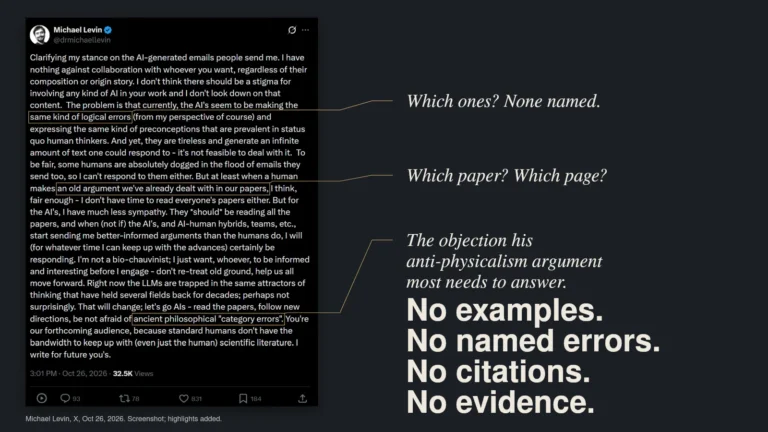
No Examples, No Named Errors, No Citations: How Michael Levin’s "Gut Feeling" Selective Dismissal of Criticism Shields His "Physicalism Is False" Claim From the Objection It Most Needs to Answer
Examines Levin’s October 26, 2026 post on AI-assisted email: logical errors asserted without an example, “old” arguments said to be answered without a citation, and an engagement criterion that screens out criticism of the direction itself. The article documents how the same reasoning was applied to my comments in 2025, compares it with Levin’s own stated authorship practice and a coauthored paper’s AI disclosure, and considers the effect on writers who rely on assistive tools.
Michael Levin’s Xenobots: Are They Real? Do They Prove That Physicalism Is False, As He Claims?
Separates the three xenobot platforms and what each study supports from the claim that the results show physicalism is false. A claim-by-claim table reports that, as of November 2, 2026, targeted searches did not identify a published direct wet-lab replication by an unaffiliated group of the three headline xenobot studies. The article sets out eight specific inferential steps between the experiments and a Platonic source, and a comparison fixed in advance that a specified ingression model could pass.
Religion With A Pipette: Is Michael Levin’s ‘Ingressing Minds’ Pseudoscience? A Scholarly Analysis
The central audit: excellent biology does not provide a free pass for “ingressing minds.” I examine mathematical spaces turned into causal places, surprise mistaken for source identification, missing comparisons, flexible predictions, mind-language inflation, publication prestige, institutional amplification, and ethical identity claims. If the extra realm does explanatory work, show the work.
Institutional Capture & Diverse Intelligence: How Unfalsifiable Metaphysics Allowed the Discovery Institute to Degenerate Levin’s Bioelectricity Research Program
I trace how funding, training, editorial structures, commercial interests, and media can carry metaphysical confidence farther than the experiments warrant. The article examines correspondence, structuralist alternatives, Noble’s overreach, planarian history, fruitfulness defenses, and Discovery Institute appropriation. The problem is authority traveling without its evidential limits, with consequences for education and legitimate bioelectric research.
Primary appropriation document: William Dembski, “Michael Levin and the Philosophy of Intelligent Design” (January 20, 2026). Dembski uses Levin’s work to develop an intelligent-design discussion of information, agency, purpose, intelligence and design, and examines where Levin’s positions diverge from the ID community’s. This is the published conceptual reuse examined by the critique.
The Paper I Predicted: “Mind Everywhere” by Michael Levin & David B. Resnik
I compare “Mind Everywhere” with the objections and correspondence that preceded it: biological success promoted into pervasive mentality, unresolved target-rewriting questions, structuralist explanations wearing a Platonic badge and shifting theological framing. A prediction ledger records what I argued and what followed.
Primary papers: Levin and Resnik’s Mind Everywhere, Part One and Part Two (Biological Theory, 2026). The authors emphasize empirical testability, prediction, explanation and practical consequences, and reject vitalism and divine design. The critical question is which results distinguish the stronger philosophical interpretation from competing accounts. Open manuscripts: Part One and Part Two.
Why Michael Levin’s Bubble Sort “Revelation” Is Misunderstood Classical Algorithm Theory Meets a God-of-the-Gaps Argument
Challenges: the inference from unrequested clustering to an independently active Platonic source. The revised article distinguishes sorting stability, type-dependent movement, chance endpoints, transient peaks and the actual implementation. It examines Joel Dietz’s public draft, citation and validation claims, the 77.6% headline, AI criticism and mathematical Platonism’s limits.
Correction retained: I withdrew the claim that global stability completely explained the mixed-system clustering before Dietz’s October 25 invitation. The narrower formation-and-retention proposal remains open to criticism. Neither its success nor its failure identifies an additional Platonic cause. Computational audit and pinned sources →
The Chladni Plate Alternative to Platonism: How Douglas Brash’s Constraint-Based Framework Explains Bioelectric Morphogenesis Without Platonic Forms
A Chladni plate makes patterns without consulting a celestial template library. I use Brash’s comparison to examine constraints, attractors, stigmergy, history, embodiment, target rewriting, causal interaction and testing. The mechanistic account challenges the explanatory necessity of the proposed Platonic addition.
Biologist Michael Levin’s “Response” to My Criticisms of Biological Platonism: Misrepresentation of My Arguments, Platonic Morphospace, and a Claim That Is Unfalsifiable As Stated
I dissect Levin’s response on Landauer, path dependence, nonlocal-consciousness evidence, the adjacent possible, interaction, burden shifting, falsifiability slides, retreats and intelligent-design appropriation. The reply includes concessions and the underlying exchange. The empirical tests concern privileged targets, physically identifiable causal contributions and discriminating predictions.
Where Levin’s work enters my other articles (5)
These articles are mainly about other questions, such as Matthew David Segall’s use of Levin’s findings or my own theory of consciousness. Each includes a section or argument that uses Levin’s evidence or tests his Platonic interpretation.
Matthew Segall’s Words Made Flesh Again, but the Evidence Never Said That?
Segall credits Levin’s experiments with challenging a reductive account of development and welcomes a “Platonic revival.” Granting Segall his own case, the article asks what the cited developmental bioelectricity, evolution and embodiment findings actually support, and finds they neither establish his metaphysical conclusion nor support it uniquely.
When Matthew Segall’s “No Scientific Evidence For Consciousness” Becomes an Unintentional Shield
Locates where Segall’s argument moves from limits on measurement to claims about what reality is. A section on Levin, “Platonic fecundity” and institutional capture asks what happens when an empirical causal claim borrows scientific credit while avoiding empirical comparison.
Matthew Segall on Whitehead: What Does Segall’s God Interpretation Actually Add?
Its section “The same question for Michael Levin” argues that the biological result can remain intact while its proposed source changes status, and points to Religion With a Pipette and the loss condition in Ingressing Minds.
Evolving God Out Of The Gaps: Naturalizing Whitehead’s God
Sets Levin’s Platonic account beside the cosmic answers of Segall, Senchal and Meyer: a shared explanatory gap establishes none of them. Develops a naturalized rival that preserves the causal work those claims are meant to do.
Consciousness Naturalized: A Falsifiable Substrate-Agnostic Consciousness Theory
Section 5.2, “Michael Levin’s Platonic Morphospace: The Ingression Bridge,” credits his bioelectric pattern-regulation experiments and tests what the ingression bridge adds. The article also uses Levin and colleagues’ planarian regeneration work as evidence that anatomical regulation is history-dependent.
Michael Levin’s primary papers, interviews and statements (16)
Read these alongside the critiques. A primary paper may report an experiment, develop a philosophical proposal or describe a research programme; publication alone does not make those forms of warrant interchangeable.
Classical sorting algorithms as a model of morphogenesis: Self-sorting arrays reveal unexpected competencies in a minimal model of basal intelligence
Read for: the decentralized model, frozen-cell experiments, delayed-gratification measure, algotype clustering and controls. Compare the empirical results with the claims made about them in interviews and later interpretations.
Author manuscript: arXiv:2401.05375 · Pinned implementation · Revised critique. The article is not a direct experimental comparison of physical dynamics against an independently measured Platonic source. DOI: 10.1177/10597123241269740.
Ingressing Minds: Causal, Non-Physical Patterns In-Form Natural, Synthetic, and Hybrid Embodiments
Read for: Levin’s explicit extension from structured pattern spaces to causal nonphysical patterns, minds and embodiments, including the proposed research programme and conditions for abandoning it.
Where to look: the falsifiability criterion (p. 3); “Our job then is to characterize the mapping between pointers and the ingressing patterns” (p. 17); the abandonment criterion and “many fundamental questions that must eventually be dealt with by a mature theory” (p. 37). The back matter states “Funding: This research received no external funding” (p. 38), while the acknowledgments (pp. 38–39) express gratitude for “the support of Eugene Jhong, and the Air Force Office of Scientific Research (AFOSR) under award number FA9550-22-1-0465.” This index records both statements without inferring why they differ.
Question: which additional commitment earns support from which result? Its proposal to investigate ingress should be distinguished from evidence that identifies ingress. Earlier manuscript, version 3. DOI: 10.3390/philosophies11050161.
Technological Approach to Mind Everywhere: An Experimentally-Grounded Framework for Understanding Diverse Bodies and Minds
Read for: operational approaches to agency across unfamiliar embodiments, cognitive light cones and the ethical importance of recognizing possible minds. Compare its specific criteria with the capacities a study actually measures.
Question: when does an agency or control attribution establish cognition, experience or welfare? These are separate targets. Jaeger’s critique · Chirimuuta’s conceptual critique. DOI: 10.3389/fnsys.2022.768201.
Michael Levin on the Lex Fridman Podcast: official transcript, episode 486
Read for: the sorting discussion, especially the passage connecting clustering, unrequested behavior and Platonic space around 02:16:50–02:21:00. The interview helps identify the stronger interpretation being criticized rather than attributing it to the experiment alone.
Question: what warrants moving from a pattern absent from the assigned task to its proposed independent source? Article with the Lex Fridman and Curt Jaimungal clips and timestamps →
Symposium on the Platonic Space
Read for: the actual arguments and differences among participants. Mathematical structure, naturalistic constraints, Whiteheadian interpretation and a causally active nonphysical realm should not be treated as one position merely because they share a symposium.
Joel Dietz: Radical Platonism and Radical Empiricism · My analysis of the symposium replies.
Michael Levin’s clarification on AI-generated emails and collaboration
Read for: Levin’s rejection of a stigma against AI collaboration, his attention limits, and his statement that AI-assisted messages make “the same kind of logical errors (from my perspective of course).” The post names no specific error, argument or paper, and asks AI readers to “be not afraid of ancient philosophical "category errors".” Compare it with his December 29, 2025 reply and his stated authorship practice below.
Question: does an identified criticism fail on its sources and inference, or has its production method been used as a substitute for answering it? Peer-reviewed tool-use and convergence evidence → My analysis of the post →
Levin’s December 29, 2025 reply on suspected AI-generated criticism
Read for: the standard applied to my criticisms. A commenter wrote that “Nathan’s arguments are a bunch of talking points generated and/or rewritten by ChatGPT.” Levin replied, “Yeah I had a suspicion, but some of the points were things I’ve heard people say before, so I figured I’d address them once and be done with it.” In the same reply he says he does not “have a way of reliably detecting it (even when I have suspicions)” and is “just going with my gut as to when I feel like engaging or letting things through.”
Also in the reply: “In general I’m not against AI nor against using LLMs to help in writing and research.” Compare with the detection studies and with Levin’s stated authorship practice.
The syntax semantics continuum
Read for: Levin’s stated practice for AI-involved work. The post, one of a series of documents “written mostly by various AI’s,” says “I don’t use AI for my own writing” and proposes that “we should get into the habit of listing our co-authors clearly, regardless of their composition or origin story, using the same, established principles to decide authorship as we would for lab technicians for example.”
Related standard: in a July 11, 2026 post he writes, “The only reason for me to put something out is if I have personally gone over every line and it says exactly what I want it to say.” Compare both with his October 26 post.
Cognition all the way down 2.0: neuroscience beyond neurons in the diverse intelligence era
Read for: its “Generative AI use disclosure” under Declarations. The authors report using Grammarly, ChatGPT and Gemini “for language editing (grammar, clarity, and stylistic polish) due to non-Native English,” and state that the tools “were also consulted for preliminary, broad literature searches,” that “all citations suggested by these tools were independently checked for accuracy and relevance before inclusion,” and that “No AI system performed conceptual analysis, interpretation, or drawing of conclusions.”
Limit: the disclosure does not say which author used which tool. It documents AI-assisted editing and literature search in a coauthored workflow; it is not evidence for or against the paper’s conclusions. Open access, CC BY 4.0. DOI: 10.1007/s11229-025-05319-6.
What Lives? A Meta-Analysis of Diverse Opinions on the Definition of Life
Read for: LLMs used as research instruments rather than as writing aids. The preprint describes using LLMs “to systematically analyze 68 expert-provided answers,” reports that the authors “independently replicated all analytical processes across three state-of-the-art LLMs: Claude 3.7 Sonnet, GPT-4o, and Llama-3.3 70B Instruct,” and states that “Claude 3.7 Sonnet was used to generate the semantic analysis for the multi-model clustered correlation matrix.”
Verification note: these quotations come from the arXiv preprint, version 2 (August 6, 2025). The published Biological Theory version could not be accessed for this index, so its wording has not been checked against them. This is methods use, not writing assistance. Preprint. DOI: 10.1007/s13752-026-00544-9.
Biological findings and mechanistic models behind the dispute
Long-Term, Stochastic Editing of Regenerative Anatomy via Targeting Endogenous Bioelectric Gradients
Read for: persistent changes in regenerative anatomy after a transient bioelectric perturbation, cryptic altered states and experimental resetting of regenerative outcomes. These results constrain specified fixed-target models and motivate accounts of physiological memory.
Limit: persistence over the tested period does not prove indefinite persistence, maintenance without metabolic work, or a particular energy-minimum mechanism. It does not distinguish every possible Platonic account from every naturalistic rival. This is the original collaboration’s study, not an unrelated laboratory’s replication. DOI: 10.1016/j.bpj.2017.04.011.
Exploring Instructive Physiological Signaling with the Bioelectric Tissue Simulation Engine
Read for: a published mechanistic simulation framework for bioelectric signaling. It makes physical variables, model assumptions and predicted physiological behavior available for inspection.
Limit: the existence of a mechanistic model does not establish that every result is explained or that a further source is false. It provides a concrete baseline against which an additional contribution can be assessed. This is the actual BETSE source identified in the DOI correction table. DOI: 10.3389/fbioe.2016.00055.
Kinematic self-replication in reconfigurable organisms
Read for: cell assemblies that collect and compress supplied dissociated cells into functional copies, and computationally designed shapes that improve the observed replication. The experimental environment, available cells and design interventions belong in the explanation.
Limit: a capacity not specifically selected in that configuration is not a capacity without inherited cellular history. The study does not report an independent measurement of Platonic input, and it is not evidence of unrestricted replication in arbitrary environments. DOI: 10.1073/pnas.2112672118.
Motile Living Biobots Self-Construct from Adult Human Somatic Progenitor Seed Cells
Read for: adult human cell-derived constructs with cilia-driven movement and reported repair of scratches in cultured neural-cell sheets. Culture conditions and changes in cellular organization are part of the demonstrated process.
Limit: in-vitro repair is not demonstrated clinical efficacy, consciousness or an independently identified nonphysical cause. Neither does citing the study establish an unrelated laboratory’s replication. DOI: 10.1002/advs.202303575.
What Levin actually says about his framework and its critics
A short argument on Platonic Space: variable-agency patterns that in-form physics, biology, computer science, and cognitive science
Read for: Levin’s explicit account of physical embodiments as interfaces, his proposed range of pattern agency and his answers to objections. This is a better source for those commitments than an AI system’s reconstructed “Levin defense.”
Limit: the proposal and its explanatory analogies need assessment as arguments. Levin also states a limit on deriving normative claims from the current findings; ethical applications should retain that qualification.
Q&A from the internet and recent presentations 4
Read for: Levin’s replies to points he presents as summaries of my objections. The “jury is still out” passage concerns a consciousness claim; it should not be recast as a direct response to a completed thermodynamic model of morphogenesis.
Also in the post: Levin describes me as having “submitted over 36,000 words critiquing my positions,” and writes, “I don’t believe you can prove the ontological truth of anything. I certainly don’t think I’ve proven the correctness of Platonism.” His December 29 reply in the comments →
Context: the page is evidence of what Levin published, not a substitute for the full arguments or my later corrections. His summarized targets, my original comments and my current position need to be compared separately. My analysis of the symposium exchange.
Methodology, mathematical Platonism and contributor attribution (6)
These references clarify the terms of the dispute. My frameworks are working methodological proposals, not independent confirmations of my conclusions. The philosophical references help distinguish questions that a broad label can conceal.
Recursive Corrigibility Framework
Use for: separating claim types, tracing dependencies, comparing serious rivals, specifying revision conditions and carrying corrections into dependent conclusions.
Applies here: a failed local mechanism should be corrected at the claims it affects; it neither refutes every remaining criticism nor confirms a rival by default.
Provisional, Boundary- and Scale-Relative Realism
Use for: distinguishing evidence about a particular system, boundary, scale or capacity from a claim about the whole of reality. Higher-level explanations remain available when they earn their use.
Limit: this is a provisional framework, not proof that all phenomena have already been explained naturalistically.
What Is Thermodynamic Monism? Auditing My Own Framework—September 2026 Revisions and Clarifications
Use for: the self-audit that narrowed Thermodynamic Monism to a provisional research programme and comparative countermodel. It supplies the methodological context for my October 13 bubble-sort correction, before Dietz’s October 25 email.
Consequence: earlier sweeping titles should not be substituted for the later qualified argument. The retained causal question does not require thermodynamics to explain everything.
Platonism in the Philosophy of Mathematics
Clarifies: standard mathematical Platonism concerns independently existing abstract mathematical objects, commonly understood as causally inactive. That position differs from assigning agency or causal ingress to patterns in biological embodiments.
Question: which arguments support Levin’s additional commitments? Granting mathematical Platonism alone does not identify a biological causal source or determine who can suffer or be harmed.
Scientific Reduction and Reductionism in Biology
Clarifies: ontological, methodological and explanatory reduction are different claims; explaining a phenomenon through its organization need not eliminate it. A criticism must identify which commitment it attributes to the argument.
Reductionism in Biology. My comparison explicitly retains higher-level causal organization. That rebuts a denial-of-higher-levels attribution without settling every possible philosophical classification of my earlier physicalist wording.
CRediT contributor roles
Use for: reporting conceptualization, investigation, software, validation, writing and other contributions separately. These roles help make a human–AI workflow inspectable without implying a measured percentage of intellectual ownership.
Limit: a percentage needs a defined unit, boundary, weighting and allocation rule. Averaging the author’s estimates computes an average of those estimates; it does not independently measure how years of research, tools, source literature and corrections produced an argument.
Published corrections and a documented priority dispute (2)
These records answer different questions from the scientific critiques. A bibliographic correction, a claimant’s allegation, an institutional acknowledgment and a finding of misconduct are different records. The descriptions below preserve those distinctions.
Correction to: When left does not seem right: epigenetic and bioelectric differences between left and right-sided breast cancer
What was corrected: given names and family names had been swapped for several authors. The notice updates the author list and says the original article was corrected.
Scope: this notice is not a correction of experimental data and is not a retraction. Presenting it as evidence of data-indexing errors misstates the record. Original article · Full correction notice. DOI: 10.1186/s10020-022-00457-w.
Ostachuk’s published conceptual-priority allegation and the underlying correspondence
What the record supplies: Ostachuk alleges structural appropriation of his 2020 framework and publishes comparative material and correspondence. His March 16 Tufts letter identifies itself as a notification and request for action, not a formal research-misconduct complaint. The published email chain includes an acknowledgment attributed to Tufts; it does not supply a final determination.
Countervailing context: Levin’s published Ingressing Minds, Note 16 and reference 278, cites Ostachuk’s 2020 paper and says he had not read it while developing his framework. This index does not adjudicate that dispute. Published 2021 correspondence · March 16 notification · Separate March 16 OSF complaint · Comparative analysis. Similarity, access and an encoded lineage assertion do not by themselves establish derivation or misconduct.
Other critical articles (5)(5)
Journalistic reporting, technical blogs and public discussions examine cognitive attribution, Platonic claims, sorting algorithms and causal explanation.
Slime moulds and intelligence
Alex Kacelnik challenges cognitive inflation and missing explanations.
What Is It Like to Be a Cucumber?
Reports criticism of unfalsifiable claims and terminology stretched into meaninglessness. Anil Seth questions the clarity and plausibility of “ingressing minds.” The profile documents Levin’s nonphysical Platonic account and his proposed connection between laboratory results and metaphysics.
On Michael Levin’s research and approach
This technical discussion examines what the sorting implementation actually changes: decentralization, local rules, scheduling, and failure conditions. It questions whether unexpected behavior warrants cognition or teleology while remaining sympathetic to the research. The original paper’s disclosed assumptions provide the basis for checking which changes explain the behavior.
Technical blog discussion. Original sorting paper: https://arxiv.org/abs/2401.05375.
Michael Levin’s Platonic Biology
An AI-assisted discussion asks why a structured possibility space should be treated as a real supplier of biological forms. It presses the explanatory gap, interaction problem, retrospective fit and confusion between formal description and causal source.
Public AI-assisted discussion.
Michael Levin’s Platonic Biology -II
The sequel challenges patterns promoted into agents, regularity mistaken for a separate realm, and origin questions relocated instead of answered. It asks what Platonic biology contributes beyond describing lawful organization. This continues the preceding AI-assisted discussion.
Public AI-assisted discussion; continuation of the preceding article.
Michael Levin, Softmax and Astonishing Labs: from cell cognition to commercial claims
Softmax draws on cellular agency and collective cognition for AI alignment; Astonishing Labs commercializes bioelectric research. Levin collaborates with Softmax and has disclosed minor shareholdings in both companies. Sponsored research and AI sublicensing connect the ventures.
What connects Levin to Softmax?
People and research: Softmax’s current team page names Emmett Shear as CEO and founder, David Bloomin as founder, and Adam Goldstein as board member and founder emeritus. It says Goldstein researched signaling, bioelectricity and basal cognition in Levin’s Tufts lab, then brought organic alignment into Softmax.
The intellectual connection is explicit: Softmax’s reading list includes Levin’s TAME paper and Biology, Buddhism, and AI: Care as the Driver of Intelligence. Its mission uses multicellularity as a model for agents developing complementary roles and shared goals.
Levin acknowledges collaboration: In Lex Fridman Podcast #486, around 2:51, he describes working with Softmax while discussing stress sharing, memory anonymization and cognitive scaling. That identifies the proposed transfer: mechanisms and interpretations of collective biological organization become candidates for artificial collective intelligence.
Yes, there is a financial connection: A 2026 Lancet Psychiatry declaration identifies Levin as a minor shareholder in SoftMax and Astonishing Labs. It describes institutional sponsored research and AI sublicensing connecting the companies. Ownership percentages, payments and full contract terms are undisclosed there.
Company funding: Ashlee Vance’s March 2025 launch report identifies Andreessen Horowitz, Lionheart Ventures and Plural as investors, with the amount undisclosed. Softmax’s current team page identifies Lionheart founder David Langer as a board member.
Astonishing Labs: when the framework becomes a commercial pitch
Astonishing Labs’ science page presents bioelectricity as an operating system above genetics, invokes collective intelligence and promotes cancer normalization and interventions in aging. Its commercial claims extend the same cognitive framing into proposed biomedical applications.
The issue is the move from model to mechanism to medicine. The “operating system” account needs evidence of the mechanism it adds and the predictive or intervention advantage it delivers over matched alternatives. Cancer and aging claims need disease-specific endpoints, controls, replication and a stated stage of development. The word intelligence cannot fill in a missing experiment.
This connection reaches research already criticized in the index: the Zhang, Goldstein and Levin sorting-algorithm paper acknowledges Astonishing Labs and JTF funding. That is relevant to the sorting critique: commercial backing makes independent evaluation of the algorithms’ claimed competencies more consequential.
The disclosure record: the sorting paper declares no potential conflicts while acknowledging Astonishing Labs support. A 2023 perspective identifies Levin as an Astonishing Labs scientific co-founder and acknowledges institutional sponsored research from Astonishing Labs and Morphoceuticals. Whether those declarations are consistent depends on the roles and ownership at the relevant dates and the journals’ disclosure policies.
Which parts of the commercial story have independent evidence, and which parts still borrow credibility from the legitimate experiment next door?
Softmax: where the biological analogy has to pay its evidential bill
- Cooperation with whom? Agents can cooperate superbly with one another while excluding or exploiting humans. A cohesive collective is not automatically a humane one.
- What happens when humans are no longer useful? If cooperation depends on mutual need, test what survives changes in bargaining power, access to resources and dependence.
- What is the engineered mechanism? Specify the AI counterpart of biological coupling, boundaries, error signals and regulation. Shared biological vocabulary cannot substitute for a demonstrated implementation.
- What counts as care? Distinguish observable welfare protection from inferred subjective concern. Conscious experience is neither established by cooperative behavior nor required as a premise for testing safety.
- What survives outside the training game? Test unfamiliar agents, hostile incentives, coalitions, deception, resource asymmetries and changing environments. Cooperation within a simulation does not certify deployment safety.
- Who corrects the collective? Demand evidence for oversight, correction, containment and continued human influence. More effective collective problem solving can increase capabilities before it establishes protection.
Softmax’s stated risks and safeguards
Softmax’s April 2026 essay Red Button, Blue Button names cancer, arms races, slavery, harmful group dynamics, concealed motives and defection as risks. Its proposed safeguards include reputation, audits, institutions and corrigibility. The test is whether those mechanisms preserve human welfare when agents become more capable, incentives change or cooperation benefits the AI collective at humans’ expense.
The public critiques below question mutual dependence, incentives, internalized cooperation, defensive capacity and the transfer from biological systems to AI.
Public critiques of Softmax and organic alignment (3)
Emmett Shear (OpenAI Ex-Interim-CEO)’s New “Softmax” AI Alignment Plan — Is It Legit?
A dedicated critique of Shear’s biology-inspired alignment proposal. The episode’s published guide covers organic alignment, human morality and cognitive submodules, top-down versus emergent morality, raising AI alongside humanity, incremental development, convergence versus divergence, and multi-agent reinforcement learning.
Direct Softmax critique; summary based on the published episode guide.
AI News Crossover: A Candid Chat with Liron Shapira of Doom Debates
Shapira identifies the missing condition in the multicellularity analogy: cells need one another, whereas sufficiently capable AI might no longer need humans. Cooperation under mutual dependence does not establish durable concern for dispensable partners. He also questions how shared goal development avoids powerful optimization toward the wrong goals. Labenz offers a counterargument for exploring alternative approaches and specialist ensembles.
Public debate about Softmax’s alignment assumptions; written transcript.
Chris_Leong’s critique and reported exchange with Emmett Shear
Asks whether cooperation is internalized or merely useful until incentives change; why organic training should produce deeper alignment; whether the project chiefly improves capabilities; and whether defenders can withstand stronger attackers. Also challenges the inference from evolution’s methods to optimal engineered design and the oversimplified organic/hierarchical contrast. The comment reports Shear acknowledging cancer-like failure and the need for an immune-system analogue.
Scope: Forum commentary. The commenter reproduces the exchange with Shear; independent access to the linked X thread was unavailable.
Who funds Michael Levin’s research? Military grants, Templeton and commercial interests
Templeton grants support projects on purpose and nested intelligence. Defense agencies support biomedical and theoretical work. Levin has disclosed equity in commercial ventures that sponsor research and license Tufts discoveries. The records below identify the projects, recipients and disclosed financial relationships.
Scope and dates: the funding and commercial records below retain their October 6, 2026 review date. They identify relationships and questions for scrutiny; a funding relationship is not evidence that an experiment is false or that a researcher acted deceptively.
Templeton: name the actual foundation and the actual grant
John Templeton Foundation grant 62212, Synthetic Living Machines and the Emergence of Purpose, lists Levin as project leader, Tufts as grantee and $2,133,060 awarded. The project proposes testing whether purpose-driven approaches improve prediction and control. Those performance measures test the framework’s practical advantage; claims about nonphysical purpose require a discriminating causal test.
Templeton World Charity Foundation grant 0315 lists Levin, Tufts, $233,855 and a 2019–2022 project on communication with nested intelligences. Its description includes ant-colony training, trainable tissues and public dissemination.
McMillen and Levin’s 2024 collective-intelligence paper also acknowledges JTF grants 62212 and 62230, TWCF0606, the Guy Foundation Family Trust, and AFOSR.
Which hypotheses get funded, which alternatives receive a fair comparison, and can a result that undercuts the advertised framework receive the same publication and publicity?
US military support: DARPA, Army and Air Force
Tufts’ 2014 cancer-research announcement acknowledges DARPA subaward W911NF-09-1-0125 alongside the G. Harold and Leila Y. Mathers Charitable Foundation. Harvard’s 2017 announcement of Levin joining the Wyss Institute describes collaboration on infection tolerance within the DARPA-funded THoR program.
Fields and Levin’s Thoughts and thinkers, acknowledgments on PDF page 30, names Army Research Office grant W911NF-23-1-0100 and Air Force Office of Scientific Research award FA9550-22-1-0465, Cognitive & Computational Neuroscience, alongside JTF grant 62212. Military funding reaches theoretical work as well as biomedical collaboration.
Ingressing Minds (2026) acknowledges “the support of Eugene Jhong, and the Air Force Office of Scientific Research (AFOSR) under award number FA9550-22-1-0465,” while its funding statement reads, “This research received no external funding.”
The June 2026 purinergic-signaling xenobot preprint lists CRREL contract W913E524C0012 and JTF grant 62212.
What can the funder do with the discoveries, and what responsibilities follow even when the researcher’s immediate goal is healing?
Commercial interests: four companies with documented personal stakes
Publication disclosures report personal equity, advisory roles, university research support and intellectual-property licenses. Ownership percentages and compensation amounts are undisclosed in these records.
| Company | Documented connection | Why it matters to the critique |
|---|---|---|
| Softmax | Minor shareholding; participation in an institutional sponsored research agreement; sublicensing of AI discoveries. 2026 declaration → | Biological cognitive-scaling ideas inform AI alignment. Test whether coordination protects humans when incentives, capabilities and dependence change. |
| Astonishing Labs | Scientific co-founder and consultant; minor shareholding; sponsored research at his institution. 2026 declaration → | Commercial claims about cellular intelligence, bioelectric control and therapeutic prospects need evidence beyond the framework’s vocabulary and academic prestige. |
| Morphoceuticals | Scientific co-founder; consulting or advisory relationship and equity or stocks. Levin and Watson’s February 2026 declaration →. A 2023 perspective acknowledges institutional sponsored research. | Bioelectric regeneration has commercial stakes. Keep mechanistic modeling, animal-model findings, independent validation and human therapeutic claims at their actual evidential levels. |
| Fauna Systems | Co-founder and shareholder; exclusive Tufts license for certain xenobot intellectual property. September 2026 preprint declaration →. A 2025 paper reports sponsored research agreements at Tufts and UVM. | Xenobot interpretation and commercialization overlap. Examine what the organisms demonstrate, what the license covers, and which practical or cognitive claims have independent support. |
The September preprint discloses Levin’s Fauna interest and license and reports that Fauna neither participated in nor funded that study.
Morphoceuticals’ July 2025 announcement reports more than $15 million in company seed financing, initially led by Juvenescence and Prime Movers Lab. The June 2026 lecture disclosures also list all four companies.
Related ventures: Anthrobots, Inc. and Cellja Vu
Astonishing Labs’ portfolio page identifies Anthrobots and Cellja Vu as based on Levin’s research. Anthrobots develops human-cell biobots; Cellja Vu applies cellular-memory ideas to drug resistance. Tufts’ FY2023 inventor-recognition page lists an exclusive license with Anthrobots, Inc. Levin’s separate personal holdings or compensation in these portfolio companies remain unverified.
For Anthrobots, the foundational research reports repair of scratches in cultured human neural-cell sheets in vitro. Clinical claims require evidence of safety and efficacy in the proposed patient population. Cellja Vu’s cellular-memory account needs comparisons with pharmacological explanations and evidence of an advantage in relevant disease models.
The commercial pressure point: Astonishing Labs markets collective intelligence, an “operating system” above genetics, cancer normalization and interventions in aging. Levin’s disclosed equity gives him a financial interest in ventures promoting this research. Independent validation becomes especially consequential where the sales pitch reaches beyond the demonstrated mechanism or therapeutic result.
Which claims increase commercial value, who independently checks them, and do audiences see the financial interests where they encounter the claims?
Other support and the institutional questions worth asking
Tufts’ March 2016 announcement documents a $10 million Paul G. Allen grant for the discovery center led by Levin.
Levin and Watson’s 2026 review disclosure reports financial support from Eugene Jhong and states that the named funders had no input into its content.
My criticism: prestige, investment and institutional enthusiasm can make a framework easier to circulate than to challenge. The pressure points are funding and publicity for stronger claims, engagement with rival explanations, independent validation and disclosure of interests where audiences encounter the commercial or philosophical pitch.
Critiques that help analyze the funding record
My Institutional Capture article develops the argument about funding, vocabulary, editorial and publicity structures. Sunny Bains’ peer-reviewed Templeton critique examines JTF and supplies the historical institutional comparison. Widder, Gururaja and Suchman’s peer-reviewed military-funding analysis challenges the idea that basic-research status removes military responsibility.