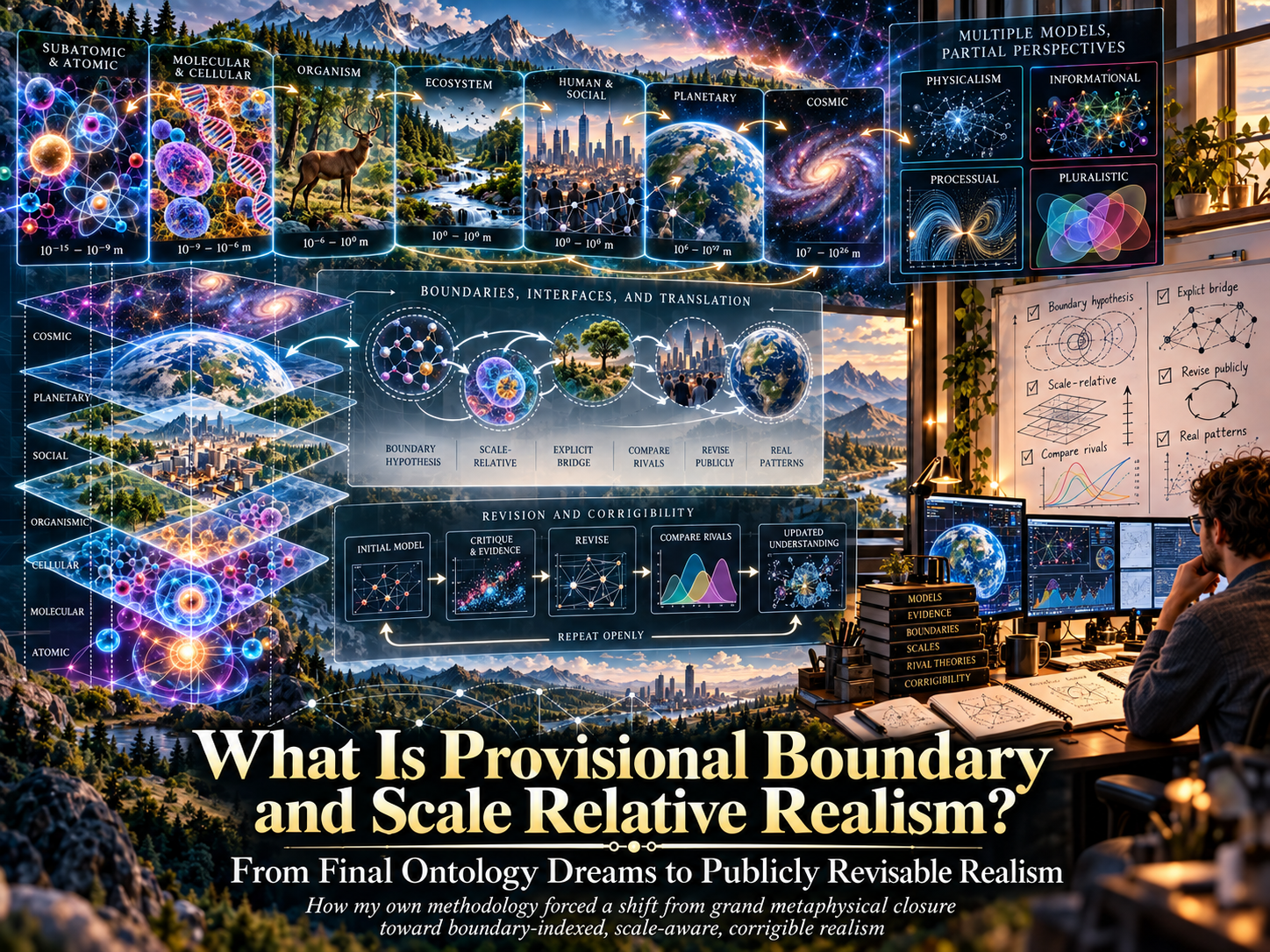
What Is Provisional, Boundary- and Scale-Relative Realism?
A Naturalized Realism of Form and Process: What Survives Thermodynamic Monism, Michael Levin’s Platonic Morphospace, and Whiteheadian Panexperientialism
What it is, what it is not, why it replaced Thermodynamic Monism, and what would make me change it.
My last article, “What is Thermodynamic Monism?” asked what had become of Thermodynamic Monism after I stopped treating it as an umbrella ontology. The answer was not that thermodynamics had failed me. Far from it. Energetic cost, dissipation, irreversibility, nonequilibrium maintenance, computation, error correction, and physical implementation all remained indispensable where they actually did explanatory work. What failed was the temptation to let one extraordinarily successful vocabulary quietly become the vocabulary of everything.
That left me with a less glamorous question and, eventually, a less glamorous name. My current answer is Provisional, Boundary- and Scale-Relative Realism, or PBSRR. I sometimes call it Scale-Relative Realism for short, but that compression misses a lot. The name is clumsy on purpose. “Provisional” means no ontology is protected from revision. “Boundary-relative” means that what counts as the relevant system, cause, agent, self, observer, or object can depend on which interacting organization the question is tracking. “Scale-relative” means that a pattern may be real and causally important at one level without being fundamental at every level. “Realism” means I do not think inquiry is merely rearranging descriptions inside our own heads; reality can veto us, and it does so with irritating regularity.
In its shortest useful form, PBSRR is a deliberately thin realism. I am willing to be realist about entities, relations, mechanisms, processes, constraints, and higher-level patterns to the degree that they survive serious alternatives and earn prediction, intervention, counterfactual leverage, compression, or transfer at specified boundaries and scales. I withhold stronger claims about intrinsic nature, universality, identity, or necessity when the available evidence does not actually discriminate them. The methodological compression beneath all of that is even simpler: do not add what the evidence did not earn, and do not subtract what the evidence did not defeat.
I have also come to think of PBSRR as a naturalization engine. The procedure is not “find a metaphysics I dislike and replace its words with scientific ones.” It is much more annoying than that. I begin by asking what explanatory work a rich programme is really doing, then remove the disputed ontology as cleanly as I can, reconstruct the target at lower commitment, and see what survives. If something important disappears, that loss becomes a positive residual that the richer theory may be uniquely positioned to explain. If nothing important disappears, the stronger ontology loses evidential credit even if it remains elegant, fertile, or true.
That is why this framework preserved more of Michael Levin and Alfred North Whitehead than my earlier countermodels expected. Target morphology, anatomical memory, multiscale competency, cognitive light cones, bioelectric control, becoming, causal inheritance, relational constitution, novelty, contextual relevance, and situated possibility all remain scientifically or philosophically serious after stronger Platonic or panexperiential commitments are removed. Thermodynamic Monism then suffered the same treatment. Most of its physically serious carrier survived, while the claim to explanatory privilege did not. PBSRR is therefore not a polite compromise among three systems. It is increasingly the residue left after all three are allowed to lose whatever the evidence did not uniquely support.
Why I stopped looking for a Final Ontology™
Philosophy has a recurring habit that I now distrust almost on sight. We find a language that explains a great deal, watch it succeed across several domains, and then promote the language into the furniture of reality. Physics succeeds, so everything must be fundamentally physical. Information theory succeeds, so everything is information. Computation reaches surprisingly far, so everything computes. Process philosophy captures becoming, so reality must be process all the way down. Experience is undeniable and physical description seems structurally incomplete, so experience must be everywhere. Mathematics is indispensable, so mathematical structure must exist independently and perhaps generate the world. Each of these moves may contain a serious insight. The danger usually enters with the word therefore.
One reason Whitehead remains useful to me, even where I resist his ontology, is that his own methodological warnings are much more cautious than some later uses of his system. In Process and Reality he allows that “There may be rival schemes, inconsistent among themselves; each with its own merits and its own failures.” He calls metaphysical categories “tentative formulations of the ultimate generalities,” and then gives philosophy one of its better pieces of self-help advice: “the chief error in philosophy is overstatement.” His fallacy of misplaced concreteness is especially relevant here because it asks us to remember how much abstraction is hidden inside the scheme through which actuality is being described.
PBSRR applies that warning to ontologies themselves. A local claim can earn extremely high confidence because the evidential reach is specified: I can test whether a protein constrains a reaction, whether a lesion disrupts a capacity, whether a memory module changes system performance, whether a macrovariable improves intervention, or whether a physical process dissipates energy. The burden changes as the claim expands toward “all,” “fundamentally,” “intrinsically,” “necessarily,” or “exhaustively.” Those words travel farther than the indicators that usually support them.
This is where my standing joke about Cosmic Boundedness actually does methodological work. We are very recently evolved primates standing on one wet rock, sampling a microscopic sliver of spacetime with meat sensors and finite computers. Maybe we should not put 99.999 percent confidence on the Final Ontology™. That is not a numerical probability cap, and it does not flatten local confidence. It simply raises the burden as scope expands.
The practical consequence is that criticism should often ask a smaller and more useful question than “Which complete worldview wins?” I want to know which functions survive decomposition. A metaphysical system can be wrong about the status of its categories while having identified a real explanatory problem. A naturalistic reconstruction can preserve the function while quietly changing the subject. Historical Whitehead is not the same thing as a naturalized Whitehead; Levin’s developmental biology is not identical with Levin’s Platonic interpretation; and Thermodynamic Monism as I first proposed it is not identical with the thermodynamic constraints I now retain. Keeping those genealogies separate prevents successful naturalization from being misreported as either total vindication or total refutation.
The minimum realist starting point: something pushes back
PBSRR does not begin with a complete inventory of mind-independent objects. It begins lower, with the stubborn fact that inquiry encounters non-voluntary constraint. Predictions fail when we would prefer them to succeed. Interventions alter outcomes in repeatable ways. Some distinctions persist across observers and instruments, some patterns reappear under different representations, and some models collapse the moment they leave the dataset that made them look clever. Whatever reality ultimately is, it is not infinitely accommodating to our descriptions.
The realist interpretation is abductive rather than axiomatic. I think the persistence of those successes and failures is better explained if inquiry answers to something not exhausted by our present descriptions. Putnam’s famous “no miracles” intuition captures one side of that pressure when he writes that “realism is the only philosophy that doesn’t make the success of the science a miracle.” But antirealists have a serious reply: empirical success can result from selective survival, idealization, accommodation, and instrumental adequacy, and scientific history is full of once-successful ontologies that later went into the metaphysical recycling bin.
So PBSRR does not define realism into existence. It adopts selective and graded realism because stable intervention, cross-context transfer, independent detection, and representation-resistant structure sometimes seem to earn more than instrumental convenience. Where they do not, the ontological commitment should stay thin. My preference is simple: attach realism to the parts that keep doing the work, not automatically to every piece of the theory that happened to accompany them.
Not every sentence deserves the same epistemic status
Grammar is remarkably good at laundering confidence. “The detector registered a signal,” “the signal is evidence of a particle,” “the particle caused the event,” “the particle is fundamental,” “reality ultimately consists of particles,” and “reality necessarily had to contain particles” can all be written with the same calm declarative voice. They are not six versions of the same claim. They cross from observation into inference, causation, fundamentality, universal ontology, and finally modality.
PBSRR therefore keeps claim types separate. Some claims are observed or empirical; some are model-relative; some are inferential; some are hypotheses still under test; some concern possibility, necessity, constitution, or implementation; others are normative and concern value, harm, obligation, welfare, or responsibility. The corresponding epistemic states also need room between confidence and negation. A claim can be established, supported, disfavored, underdetermined, not established, or false, and those are not decorative labels.
The distinction I use most often is almost embarrassingly obvious: not established is not the same thing as false. “Universal prehension is not established” does not mean universal prehension is false. “Exhaustive physicalism is not established” does not mean physicalism is false. “Machine phenomenality is not established” does not mean computational systems are nonconscious. “Libertarian free will is not established” does not make agency illusory. PBSRR tries to keep this middle territory visible because binary grammar has a bad habit of paving it over.
D + X: the bookkeeping rule that changed most of my metaphysics
A surprising amount of metaphysical disagreement becomes easier to inspect once I separate what serious rivals already share from the extra ontology being argued over. I call the shared, target-relevant carrier D. D can include evidence, mechanisms, structures, relations, or explanatory commitments that are already independently warranted. I call the disputed addition X. A richer theory can then be thought of as D plus X, while a thinner comparator retains D and remains agnostic about X.
The important question is not whether X can be made compatible with D. Compatibility is cheap. I want to know what changes because X is there. Does it alter a prediction, intervention, explanation, constraint, transfer result, measurement, or decision? If the probability of the evidence is essentially the same with D plus X as it is with D alone, then the evidence should not be billed twice as though it strongly confirms X. This is the logic behind my deliberately blunt phrase: compatibility is free; production is expensive.
The decomposition is bookkeeping, not a claim that reality literally comes in two detachable metaphysical pieces. If X is constitutive inside a theory, then the whole theory has to be reconstructed honestly before comparison. The point is not to mutilate Whitehead into “Whitehead minus experience” and congratulate myself. The point is to compare serious whole rivals, identify what explanatory work belongs to their shared carrier, and ask whether the distinctive addition earns anything beyond a richer description of what both theories already explain.
Before D + X can work: preserve the target and stabilize the referent
The D-plus-X shorthand becomes useless if the comparison cheats. The first way to cheat is target substitution. Suppose a theory is trying to explain phenomenal consciousness and a critic removes phenomenality, then explains behavior, attention, report, and memory. That may be interesting, but it does not yet explain phenomenal consciousness without phenomenality; the explanandum may simply have been changed. The reverse error is equally bad. A theory can define the target using its preferred ontology and then accuse every rival of failure because the rival refuses the definition.
So I ask a target-preservation question whenever a commitment is removed or translated: after the reconstruction, are we still explaining the same thing? If not, the subtraction has failed and the comparison has to be rebuilt at the level of whole theories. This matters most in disputes where the target itself is contested, because that is exactly where verbal continuity can hide conceptual substitution.
The second danger is referent drift. Words such as experience, information, cause, agency, goal, physical, structure, observer, and constraint can quietly change meaning between premise and conclusion. If “prehension” means genuinely phenomenal uptake in one sentence and merely causal sensitivity in the next, then the argument has not identified one stable construct. If “information” begins as Shannon entropy and ends as semantic content, the same noun is doing bridge work it never earned. If “physical” means current physics in one paragraph and whatever a completed future science might contain in the next, definitional elasticity can masquerade as certainty.
Whitehead’s warning about overstatement and misplaced concreteness applies here as well as anywhere. I use it against my own abstractions because the temptation to stabilize someone else’s terminology while letting mine slide is, unfortunately, a very human one.
The gap ledger: ignorance should remain visible instead of turning into ontology
A mature ontology should record not only what it claims but where the warrant stops. That is what I mean by a gap ledger. An explanatory gap can concern intrinsic nature, phenomenality, valuation, cross-scale constitution, identity, or modality, and the fact that a gap exists does not tell us which metaphysics has the correct filler.
Perhaps a structural or causal carrier is well established while several intrinsic interpretations remain empirically equivalent. Perhaps functional and behavioral organization are increasingly understood while the bridge to phenomenal occurrence remains unresolved. Perhaps regulation and preference-like behavior are obvious, yet the step to felt valence or “mattering to the system” is still open. Macrovariables may work extremely well while the exact relation among causation, realization, coarse-graining, and constitution remains disputed. Identity may vary with defensible persistence criteria, and repeated actuality may still fail to establish universal necessity.
The rule is deliberately boring because boring rules are sometimes the best defense against exciting nonsense: an epistemic gap is not evidence for the ontology that would fill it. A gap can raise the pursuit value of Whitehead, Russellian monism, idealism, physicalism, or a biological theory of consciousness. It can make one programme more interesting than another. It cannot arrive with the answer printed inside it. “Physicalism cannot yet explain consciousness” does not contain “therefore universal prehension,” and “panpsychism has a combination problem” does not contain “therefore reductive physicalism.” A rival’s failure is not a proof certificate for whoever is standing nearest.
Bridges: what survives when an explanation crosses a boundary or scale?
I use the word bridge as literal bookkeeping. Whenever evidence is generated in one domain and a conclusion is asserted in another, I want to know what crossed the gap. A serious bridge tells us the source and target, the relevant boundary and timescale, how constructs are mapped, which variables survive the translation, which are lost, what remains invariant, what differential consequence follows, and what would count as failure.
This is where a great many analogies die honorable deaths. An analogy can illuminate without transporting evidential authority. A mathematical isomorphism can reveal shared structure without making two systems ontologically identical. Shared vocabulary can hide different variables. A successful coarse-graining can preserve prediction while discarding microdetail without implying that the discarded detail was unreal.
A bridge becomes ontologically interesting when it remains constrained under held-out cases, intervention, and changes of representation. If any source can be mapped to any target merely by allowing a sufficiently flexible correspondence, then the mapping has become an interpretive art project rather than evidence. Bridge confidence should rise when transfer succeeds outside the construction set, interventions line up, invariants remain stable, mapping freedom is restricted, and the relevant variables can be independently identified. A narrow bridge that survives is worth more than a universal one that gets rewritten every time it breaks.
Explanatory virtue matters, but it is not one thing
“Better explanation” sounds like a single score until one asks what is being scored. Empirical accuracy, causal adequacy, explanatory depth, unification, simplicity, coherence, fruitfulness, durability, scope, and applicability can pull in different directions. A beautiful theory can be empirically weak. A highly predictive model can be ontologically opaque. A metaphysics can inspire decades of productive work and still be false, while a true claim can sit around doing very little for science.
I therefore keep separate ledgers for pursuit value, abductive virtue, discriminatory evidence, and transport. A programme may be worth pursuing because it generates excellent questions. It may also unify or simplify in a way that makes it abductively attractive. Neither automatically means its distinctive ontology has received discriminating support, and even a local advantage has to survive movement across boundary, scale, population, substrate, or domain before it can be exported.
Whitehead is a good example because his system is undeniably fecund. It generates questions about process, relation, becoming, causal inheritance, organism, value, temporality, and experience, and it does so within an unusually integrated picture. Those are real merits. They are not automatically evidence that every concrete actuality prehends. The same rule applies to my own work: Thermodynamic Monism was fertile, sometimes extremely so, and that never made thermodynamic explanatory privilege true by osmosis.
What counts as a discriminator?
The ideal discriminator is conceptually simple even when it is technically brutal. Serious rivals disagree in advance about what should happen, the difference is specified before the result is known, both sides accept an appropriate tribunal, the test occurs, and belief changes in proportion to what survived. The 2025 adversarial collaboration between Integrated Information Theory and Global Neuronal Workspace Theory is useful to me for exactly this reason. The point is not that metaphysics can imitate neuroscience mechanically; it is that competing camps accepted genuine predictive risk before a large multimodal study, and the results challenged central expectations on both sides.
Not every philosophical claim is experimentally testable. Some disputes are formal, conceptual, modal, phenomenological, historical, semantic, or normative, so the tribunal has to fit the claim. What I resist is the idea that a strong claim can remain indefinitely insulated from every meaningful form of loss. A research programme that can reinterpret every result may survive culturally, but its evidential downside has become hard to locate.
The Lakatosian tradition captures the larger-scale version of this when it distinguishes progressive from degenerating problem shifts. I care less about whether a theory can explain yesterday’s surprise after the fact than whether its revisions sharpen future consequences, localize error, or create new risk. Survival is not the same as progress.
Boundaries are hypotheses, not decorations
The word boundary does real work in PBSRR because we often smuggle the answer to “what has this property?” into the way we individuate the thing. Is the relevant system a cell, an organ, an organism, an organism plus microbiome, a brain, or a brain-body-environment loop? For a computational system, do we mean frozen model weights, the model plus context, or the larger operative assembly that includes retrieval, memory, tools, verifiers, human collaborators, institutions, infrastructure, and persistent environment? These are not verbal games if different partitions make different predictions under intervention.
Suppose a computational system performs a task only when external memory is present. Remove the memory and the capacity disappears; restore it and the capacity returns. If the behavior survives substitution of the base model but collapses whenever the memory-tool coupling is severed, then attributing the capacity solely to the weights is causally wrong for that target. This is what I mean by saying that the base model, M0, is not automatically identical with the operative system, S*. Capabilities should first be attributed to the boundary that actually produces them.
This does not mean the largest available boundary is secretly the “real self.” It means the boundary itself should be tested. Michael Levin’s empirical programme fits this unusually well because his TAME framework treats agents as nested and defines a “cognitive light cone” by the spatial, temporal, and problem-scale states a system can represent or work to change. Selves can be compound and overlapping without every larger organization becoming one phenomenal subject. The naturalization question is therefore not whether target morphology, bioelectric control, or multiscale competency are real. It is what additional explanatory work is done by treating their goal spaces as interfaces to independently existing nonphysical patterns rather than as dynamically maintained control structures and possibility spaces within the operative system.
Even fundamental physics gives us reasons to take relational boundaries seriously without turning one interpretation into a universal metaphysics. Carlo Rovelli’s relational quantum mechanics describes quantum properties relative to interacting systems. PBSRR does not infer from that that all ontology is relational in exactly Rovelli’s sense. The lesson is smaller and safer: sometimes the system-interaction boundary is part of the phenomenon rather than a disposable annotation added afterward.
Scale-relative does not mean arbitrary or unreal
A hurricane is not fundamental physics. Neither is a cell, immune system, market, language, species, memory, institution, or person. That does not make any of them fictional. The question is whether the higher-level pattern earns explanatory and causal leverage at the scale where it is being invoked.
Ladyman and Ross’s “rainforest realism” and Dennett’s “real patterns” are obvious ancestors here. I want a pattern to earn more than convenience: it should predict outside the immediate dataset, support intervention, remain counterfactually stable, survive independent detection and changes of representation, transfer across cases, persist despite lower-level turnover, and fail when the causal organization that defines it is destroyed. The exact mix depends on the target, but the basic thought is stable. Some higher-level descriptions are too robust to dismiss as mere observer fantasy.
This produces two symmetrical anti-errors. Microphysical realization does not entail microphysical explanatory sufficiency, and higher-level explanatory success does not create a new fundamental substance by magic. PBSRR is realist about patterns without treating every useful abstraction as a fresh item in the cosmic inventory.
Causal ancestry is not the same thing as causal leverage
Every higher-level process is realized through lower-level processes, but ancestry alone does not tell us which variables matter for control. “Move the quarks differently” is technically relevant to a traffic jam and operationally useless. If I want to alter morphogenesis, a bioelectric intervention may be a better causal handle than following every molecular collision. If I want to change a belief, one sentence can matter even though the sentence is physically instantiated.
PBSRR therefore treats causation in an intervention-indexed way. I am not assuming that every causal relation is an intrinsic arrow carved into reality. I am asking which dependencies remain warranted under specified background conditions and feasible interventions. This prevents the familiar scale error in which someone says that because lower-level processes realize a higher-level phenomenon, the higher-level variable cannot do causal work. The lower level can be the implementation base while the higher-level variable remains the better handle for prediction and intervention at the target.
Model pluralism: different successful descriptions do not require different worlds
Scale relativity is sometimes mistaken for the claim that every model creates its own reality. That is not what I mean. A fluid can be described thermodynamically, statistically, hydrodynamically, molecularly, or computationally; a brain can be described chemically, electrophysiologically, behaviorally, developmentally, computationally, and socially. The vocabularies do not have to collapse into one another in order to concern the same world.
The harder questions are about invariance and loss. Which variables remain stable across descriptions? Which interventions correspond across levels? Does the target survive translation? What information disappears under a coarse-graining, and does that loss matter for this question? PBSRR treats this as model pluralism without ontological multiplication. Analytical decomposition is similar: separating agency into control, alternatives, reasons-responsiveness, sourcehood, and responsibility does not discover five substances. It discovers five questions that evidence may answer differently.
That is why I resist both reductionist and holistic overreach. Lower-level realization does not give one vocabulary ownership of every truth, while higher-level usefulness does not create a new fundamental entity merely because the model works. One world can support several nonidentical but compatible projections.
Premise invariance: if the result survives removing your metaphysics, the result is not uniquely yours
One of the simplest tests in PBSRR is also one of the most revealing. Suppose a conclusion is presented as evidence for a particular ontology. Remove the disputed premise while preserving the independently warranted empirical and causal structure, then ask whether the result survives. If it does, the result cannot be credited exclusively to the premise that was removed. This is what I call premise invariance.
Whitehead provides one clean case. Process, causal inheritance, temporality, organization, and concrete efficacy can be preserved in rival causal frameworks that do not make subjective prehension an explanatory premise, so evidence for those features does not automatically belong to universal prehension. Levin supplies a parallel case: target morphology, bioelectric pattern memory, error correction, multiscale agency, anatomical homeostasis, and morphospace can remain scientifically substantive while the claim that nonphysical patterns causally ingress into organisms is suspended. Thermodynamic Monism met the same fate when physical realization, energetic cost, nonequilibrium organization, and resource constraints survived the removal of thermodynamic explanatory privilege.
None of this proves the removed premise false. It shows that the particular success under discussion was not discriminating for it. Premise invariance becomes a naturalization test when the retained carrier is reconstructed explicitly instead of merely renamed, and it prevents a theory from claiming credit for everything discovered while it happened to be in the room.
PBSRR as a naturalization engine
“Naturalization” can mean almost anything if I let it. It can mean translating old vocabulary into current science, reducing a phenomenon to lower-level mechanisms, eliminating a metaphysical posit, or simply announcing that the posit is compatible with science. PBSRR uses the word more narrowly. I begin by identifying the explanatory target and the relevant boundary, scale, timescale, and tribunal. Then I reconstruct the target using the lowest-commitment mechanism presently sufficient, remove the richer commitment, and rerun the explanation.
What matters next is the ledger. I record what prediction, intervention, compression, transfer, phenomenology, formal consequence, or normative relation survives, and I record what is genuinely lost. If something important disappears and the richer ontology explains that loss better than serious rivals, the missing piece becomes a positive residual with renewed evidential relevance. If the target remains intact, the stronger commitment loses its claim to necessity even if it remains possible.
This procedure guards against two mirror-image errors. Ontological inheritance occurs when a rich theory leads us to a useful construct and every later success of the construct is treated as evidence for the original metaphysics. Naturalistic laundering occurs when the metaphysical category is renamed in scientific language while its stronger commitments are quietly preserved without being tested. The aim is functional preservation without automatic inheritance. Done properly, naturalization can be surprisingly generous to a theory whose metaphysics I do not currently accept, because it can preserve most of the explanatory architecture while isolating the part that still needs to earn its way back in.
Constraints: useful concept, dangerous master word
“Constraint” became central to my work because it travels unusually well across physics, biology, computation, and control. That portability is useful, but it is also exactly what makes the word dangerous. The same label can hide very different kinds of relation, and once a term seems able to explain everything it is time to ask whether it is still distinguishing anything.
Marc Lange uses constraint for explanatory principles that delimit the possible causal histories a system could have. In that sense, “a constraint imposes broad limits on the kinds of causes there could have been,” and a constraint can explain by specifying “the framework into which any possible causal interaction would have to fit.” Montévil and Mossio use the term differently when they analyze biological organization. Their constraints are relatively stable structures that channel ongoing processes at a relevant timescale, and closure occurs when those constraints both depend on and help maintain one another.
Those uses are related, but they are not identical. One is strongly modal and explanatory; the other is organizational and causal in the dynamics of living systems. PBSRR therefore treats constraint as a family of typed relations rather than a cosmic substance. The lesson I carried forward from Thermodynamic Monism is simple: whenever one word begins to sound like the master key to physics, biology, cognition, agency, value, and meaning, I should probably stop admiring the key and inspect the locks.
Organization can be real without automatically being a subject
Biological organization is one of the strongest cases for higher-level realism because the organization itself can make a difference to what the system does. Montévil and Mossio’s closure-of-constraints framework describes living systems in terms of mutually dependent constraints that contribute to maintaining the organization that sustains them. That is not merely poetic holism; it gives us a concrete way to ask which higher-level relations are causally relevant.
Still, organization does not come bundled with every interesting predicate. A bacterium can regulate itself and respond adaptively without that settling whether it is phenomenally conscious. A corporation can exert higher-level causal power without thereby becoming one welfare subject. A computational team can display scaffolded agency without implying that the whole team is one phenomenal self. PBSRR therefore refuses to slide automatically from organization to agency, from agency to consciousness, or from consciousness to moral standing.
The firewall is broader than biology: real organization does not carry every higher-level predicate with it. Each predicate needs its own bridge, its own evidence, and its own loss conditions.
Identity is indexed to boundary, timescale, and persistence criteria
Questions about identity sound metaphysically profound until we notice how many different kinds of sameness we already tolerate in ordinary life. A river persists while its water changes. An organism persists through cellular turnover. A software service survives hardware replacement. A scientific theory can remain recognizably the same programme after substantial revision, and a person can remain socially and legally continuous despite enormous biological and psychological change.
PBSRR treats identity as a persistence claim indexed to the variables that matter for the question. The useful inquiry is not simply “Is this the same thing?” but “Same in which sense, across what interval, under which transformations, and with which losses allowed?” There may be no universal criterion that answers every identity question because different targets preserve different invariants.
This is one place where process language is useful without becoming dogma. Whitehead’s “The many become one, and are increased by one” places process at the heart of his metaphysics. I do not inherit the universal metaphysical claim, but I do keep the practical insight: persistence need not require an unchanging inner nugget. A stable entity can be a historically maintained pattern of transformations.
Recursive Episodic Integration: continuity without smuggling in experience
One of the newer tools in the framework is Recursive Episodic Integration, or REI. The problem it addresses is straightforward. A system can integrate its history, current state, incoming information, outputs, and feedback across episodes even if there is no single internal token that remains unchanged through time. Later behavior can depend deeply on earlier organization without requiring a little metaphysical homunculus to carry the past forward.
A minimal REI model says that history, current context, and input jointly generate an integrated episode; that episode produces an output; and feedback updates the state that conditions the next episode. In symbols, the original framework writes this as E at time t equals Phi of history, current state, and input; output equals Psi of that episode; and the next state equals an update of the current state, output, and feedback. The symbols are useful shorthand, but the important claim is ordinary prose: continuity can be built from recursive dependence.
What REI does not establish by definition is Whiteheadian prehension, phenomenal continuity, or a persisting subject. It was designed partly to separate causal inheritance from subjective inheritance. A system can inherit, integrate, and act on structured effects of its past while the question of whether that inheritance is intrinsically felt remains open.
Actuality does not automatically establish necessity
This may be the most important modal rule in PBSRR because actuality is constantly being promoted into necessity without anyone noticing the upgrade. If every known human mind depends on living neural tissue, that is strong evidence about known human minds. It does not, by itself, prove that living neural tissue is metaphysically necessary for every possible mind. If all known computation has physical realization, that supports physical implementation; it does not settle the intrinsic nature of reality. If terrestrial cells all use chemistry, that does not prove that every possible life-like system must reproduce terrestrial biochemistry.
So I type necessity claims instead of letting the word must do whatever work the speaker needs. Logical necessity follows from axioms or definitions inside a formal system. Metaphysical necessity says something could not have been otherwise across the relevant space of possibilities. Constitutive necessity concerns what is required for the target as characterized. Nomological necessity depends on actual laws. Implementation necessity belongs to a particular architecture, while methodological necessity may belong only to a modeling or measurement procedure.
Those are not interchangeable. If a theory moves from “X is actual” to “X is necessary,” it has added a modal commitment that needs its own bridge. The little box philosophers use for necessity is not free.
Determinism does not settle agency, and indeterminism does not rescue sourcehood
The free-will debate is a nearly perfect example of why I prefer decomposition. “Free will” can mean the ability to do otherwise, reasons-responsive control, absence of coercion, self-modification, authorship of motives, moral responsibility, or ultimate self-origination. Those claims can come apart, so treating them as one binary property is a good way to manufacture confusion.
My current position preserves local agency while rejecting causal sovereignty. Systems can evaluate possibilities, respond to reasons, inhibit behavior, learn, modify future states, and alter which outcomes are reachable. Those are real capacities. What I do not see is an agent standing outside the causal and developmental history that made it the kind of chooser it is. The strongest sourcehood problem appears as soon as we ask where the first meaningful chooser got the conditions that made choosing possible.
Call that first chooser C0 and the enabling conditions K0. If C0 intentionally chose K0, then C0 must already have possessed enough of the relevant capacities for the choice to occur, which means K0 cannot be doing the originating work the story assigned to it. The chooser would need to pre-exist the conditions that make it a chooser. Galen Strawson’s Basic Argument presses a closely related problem for ultimate moral responsibility: being ultimately responsible for an action seems to require being ultimately responsible for the way one is in the respects that generate the action.
My conclusion is narrower than Strawson’s strongest moral conclusion. The regress attacks ultimate self-authorship, not local agency. Indeterminism does not automatically solve the problem because randomness inserted upstream does not become authorship downstream. The deliberately ridiculous character-creation version still captures the structure rather well: you may freely choose what kind of chooser to become, subject to approval by the kind of chooser you never chose to be.
Responsibility survives without basic desert
Giving up ultimate self-authorship does not force me to abandon responsibility. It forces me to be much clearer about what responsibility is for. PBSRR treats responsibility as graded and relational, tracking control, foreseeability, prevention, role, authority, reasons-responsiveness, repair capacity, and causal leverage. Those variables can support accountability, incentives, rehabilitation, protection, restitution, education, and institutional design without requiring anyone to be causa sui.
What becomes much harder to justify is basic desert: the idea that a person deserves suffering simply because they are the ultimate metaphysical author of themselves and their action. Preventing harm does not require that metaphysics. It requires agents whose behavior can be influenced, whose capacities and constraints matter, and whose actions make differences to other beings. The distinction is morally consequential because it separates forward-looking and relational forms of responsibility from retribution that quietly depends on a kind of self-origination we have not established.
Physics constrains realization without automatically settling ontology
PBSRR is strongly constrained by science, and nothing in the framework licenses ignoring well-supported physics because a metaphysical story would be prettier without it. If a proposed mechanism conflicts with established physics inside the domain where that physics is well confirmed, then the burden sits squarely on the proposal. Ladyman and Ross state a stronger version through their Primacy of Physics Constraint, according to which special-science hypotheses that conflict with fundamental physics should be rejected for that reason alone.
I inherit much of that discipline, but not every asymmetry without qualification. Fundamental physics is extraordinarily authoritative inside tested domains, yet physics changes, effective theories have ranges, and metaphysical interpretation can remain underdetermined even when the formalism is spectacularly successful. The distinction I therefore keep returning to is between physical realization and exhaustive physicalism.
Physical realization is extremely well supported across known biological and computational systems. Exhaustive physicalism is stronger: it says that everything is physical, or appropriately fixed by the physical, in the final metaphysically relevant sense. The Stanford Encyclopedia’s familiar slogan, “Physicalism is, in slogan form, the thesis that everything is physical,” is immediately followed by the harder question: what does it mean to say that everything is physical? PBSRR treats physicalism as a serious family of programmes, not as a default axiom silently installed by successful science.
Naturalizing my own framework: what survived from Thermodynamic Monism
Thermodynamic Monism now sits inside PBSRR rather than above it. That demotion matters to me because it was the first case where the naturalization procedure had to turn on one of my own preferred frameworks. The question was never whether thermodynamics was real or useful. It was whether the explanatory achievements I had associated with Thermodynamic Monism actually depended on monism or on giving thermodynamics privileged explanatory status. Most of the carrier survived. The monopoly did not.
Thermodynamic admissibility remains non-negotiable for physically realized processes at the boundaries where thermodynamic quantities are defined. Target-specific thermodynamic explanation also survives because thermodynamics can do much more than certify physical possibility. Stochastic thermodynamics can constrain sensing, error correction, molecular machines, replication, speed-accuracy tradeoffs, and dissipation. Prigogine’s work on dissipative structures remains important because it shows that specified nonequilibrium conditions can support qualitatively new organized regimes. The useful inference is local and mechanistic; turning it into a universal theory of life, mind, agency, or value is a separate bridge.
Physical implementation survives too. Information, memory, computation, control, repair, and communication do not float free of physical realization. Landauer’s “information is physical” slogan is valuable when it reminds us of implementation, but it becomes dangerous when information is simply equated with thermodynamic entropy. Bennett’s work on reversible computation is a useful corrective because logical and thermodynamic irreversibility must be mapped carefully, and under idealized conditions reversible computation can approach arbitrarily low dissipation. The surviving rule is narrower: physical information processing has implementation-specific thermodynamic consequences, and the mapping has to be stated rather than assumed.
I also retain a one-process wager: I place substantial weight on a causally continuous process order rather than on separate interacting causal substances or realms. That is a high-weight hypothesis, not something thermodynamics alone proves. Thermodynamic Monism also remains valuable as a comparative countermodel. If an ordinary physically realized organization can reproduce a target that someone says requires richer metaphysics, then necessity has not been established. The result is a disciplined residue: keep thermodynamic admissibility, physical implementation, irreversible costs, and target-specific explanatory successes, while removing the claim that thermodynamics owns the explanation of organization, mind, agency, meaning, or value.
Information is not one thing
Few nouns have accumulated more accidental metaphysics than information. Shannon information measures uncertainty across probability distributions and channels. Semantic information concerns meaning, reference, truth conditions, use, or action relevance. Biological information can refer to sequence, regulation, heritable structure, signaling, or selected effects. Algorithmic information concerns description length. Thermodynamic information links depend on physical implementation and on how states are mapped. These constructs can relate to one another, but sharing a noun is not a bridge.
Shannon famously insulated his engineering theory from meaning when he wrote that “The semantic aspects of communication are irrelevant to the engineering problem.” That was not an argument that semantics is unreal; it was a warning that the quantity had been designed for a different target. Bateson’s “difference that makes a difference” is useful for the opposite reason because it emphasizes relational significance, but it too needs specification. A difference for which system, through which coupling, at what scale and timescale, with what downstream consequence?
PBSRR therefore uses a representation-to-ontology firewall. A state space, entropy measure, probability distribution, latent representation, or mathematical structure does not become an independently existing causal realm merely because the representation is useful. Moving from model structure to ontological independence requires additional warrant.
Mathematics can constrain without becoming a causal puppeteer
Mathematics is a particularly hard test because its explanatory power is undeniable and its ontological interpretation is not. Mathematical truths can constrain what a model permits and can explain patterns in a way that differs from ordinary efficient causation. Marc Lange’s work on explanations by constraint makes this explicit: some explanations work by delimiting the framework within which causal histories are possible.
None of that means the Pythagorean theorem reaches into matter and starts shoving triangles around. Putnam’s indispensability arguments for mathematical realism deserve serious attention because mathematics is stunningly successful in science, but alternative accounts of applicability remain available. Resnik’s structuralism is relevant precisely because it treats mathematics as a science of patterns and positions within structures rather than as a warehouse of independently characterized objects.
PBSRR stays open about mathematical ontology while rejecting a familiar shortcut: formal indispensability does not, by itself, establish causal ontological independence. This matters for biological Platonism and morphospace. A morphospace can be scientifically real as a structured representation of actual constraints, attractors, barriers, reachable transformations, and intervention paths without thereby being a nonphysical realm that causally ingresses into organisms. Those are different claims and they require different evidence.
Naturalizing Levin: Platonic patterns without Platonic inheritance
Michael Levin is an unusually useful stress test because the empirical programme is far stronger than a caricature of “biological Platonism” suggests. His TAME framework treats anatomical homeostasis as a multiscale control problem. Cells and tissues maintain bioelectric and transcriptional states, compensate for perturbations, stabilize target morphologies, and sometimes reach familiar outcomes from very unfamiliar starting conditions. His “cognitive light cone” indexes agency to the range of spatial, temporal, and problem-scale states a system can represent or work to change. None of that needs to be waved away in order to question a stronger metaphysical interpretation.
The naturalized carrier therefore keeps bioelectric control, anatomical memory, target morphology, multiscale competency, error correction, nested agency, morphospace, and physically implemented intervention paths. Target morphology can be understood as a dynamically maintained control target or attractor region. Anatomical memory can be realized in persistent bioelectric, transcriptional, mechanical, and other control architectures. Morphospace can track reachable and unreachable transformations, barriers, attractors, and intervention routes without deciding in advance that the space exists independently of every physical realization or model. Goal-directedness can be tested through perturbation and correction, and cognitive light cones can be treated as boundary- and scale-indexed regions of representable and controllable states.
What does not yet follow is the stronger Platonic residual: independently existing nonphysical patterns or minds that can causally ingress into embodiments. Levin’s later “Ingressing Minds” proposal makes that claim explicitly enough to become testable in principle. Once the posit is supposed to alter biological outcomes, PBSRR asks for a positive residual. Hold the relevant physical, organizational, dynamical, and model-level carrier fixed as far as possible and ask what additional observation, intervention, or capability should occur because Platonic input is present.
A convincing answer could be an independently measurable coupling variable, a prospective result unavailable to organizational rivals, or an intervention whose success depends on the Platonic model in a way the naturalized reconstruction cannot recover. Until such a discriminator appears, my conclusion is not that the Platonic layer is false. It is that the biology already carries most of the demonstrated explanatory weight while the distinctively Platonic addition remains an open, cleaner residual.
Genealogy matters: categories have histories too
A newer part of PBSRR is what I call Genealogical Decompression. Categories often feel natural because their histories have been forgotten. Scientific constructs, diagnostic labels, metaphysical oppositions, benchmark tasks, archives, and institutional classifications survive through selection processes of use, prestige, inheritance, and training. Survival is not the same thing as natural-kind status, and repeated appearance is not automatically independent replication.
This matters especially when apparently independent systems reproduce the same concept because they inherited the same intellectual genealogy. Convergence then needs a common-cause audit. Donna Haraway’s situated-knowledge critique is useful here because her “god trick” attacks the fantasy of unlocated total vision. PBSRR keeps that warning while refusing the slide into “every perspective is equally good.” A GPS receiver and a hallucinated map are both representations; one of them has a much better track record of getting you home.
The point is not to worship genealogy either. A category can have a contingent history and still latch onto something real. The methodological demand is simply that historical persistence, institutional authority, and shared ancestry should not be quietly counted as independent evidential convergence.
Evolution permits function without requiring cosmic purpose
Evolutionary biology uses functional and teleological language constantly. Hearts are for pumping blood, eyes are for seeing, regulatory systems maintain viability, and organisms pursue goals. Those descriptions can be scientifically legitimate without implying that purpose is an irreducible primitive written into the cosmos.
PBSRR therefore separates goal language as a compact description of organized regulation from the stronger claim that goals are fundamental causal ingredients of reality. This distinction matters in discussions of Levin, active inference, morphogenesis, and biological agency because bioelectric regulation, target morphology, multistability, memory-like persistence, and distributed control are real empirical phenomena even while the metaphysical interpretation of the corresponding state spaces remains open.
Active inference is powerful, but the free-energy vocabulary needs a firewall
The Free Energy Principle and active inference provide a rich formal language for perception, action, regulation, and self-organizing systems. They also invite scope inflation because the phrase free energy appears in both variational inference and thermodynamics, making it very easy to slide from formal analogy to ontological identity.
PBSRR refuses that shortcut. A variational free-energy functional can organize inference without being thermodynamic free energy in the ordinary physical sense. Likewise, a system can be modeled as minimizing variational free energy without thereby being conscious, agentic in every interesting sense, or literally stocked with human-like beliefs. The formalism can earn explanatory credit while anthropomorphic and ontological interpretations remain separately testable.
Consciousness: keep the target real and the realization open
My position on consciousness has changed more than almost any other part of the framework. Earlier versions leaned too strongly toward organizational identity. The current position is naturalistic phenomenal agnosticism with realism about decomposed capacities. I take phenomenal occurrence seriously: there being something it is like, or a differentiated world for a bounded perspective, is the target. What I no longer do is allow any currently favored marker to become consciousness by definition.
Report, intelligence, biological substrate, recurrence, broadcasting, integration, metacognition, self-maintenance, computational architecture, organizational closure, field variables, and self-report from computational systems may all be evidentially relevant. None receives constitutive privilege merely because a theory likes it. Nagel’s formulation remains useful because it isolates the target without solving the realization problem: an organism is conscious if there is something it is like to be that organism.
The empirical programme is therefore deliberately theory-light. I want to know which physical, biological, computational, dynamical, organizational, relational, affective, field-like, or presently unknown variables make a discriminating causal difference to phenomenal occurrence and phenomenal structure. If one family of variables eventually earns that role, PBSRR should update. Until then, confidence in decomposed capacities can rise while confidence in a final phenomenal ontology remains lower.
The other-minds problem applies to humans too
Debates about computational consciousness often use two epistemic standards without admitting it. Another human’s phenomenality is treated as directly demonstrated, while a computational system’s phenomenality is dismissed as “merely inferred.” Yet another person’s experience is not publicly observed in the way their speech, physiology, neural activity, behavior, memory, perturbational responses, learning, self-modeling, affective organization, and social interaction are observed. From that densely converging evidence, we infer another subject.
The inference to ordinary humans is extremely strong because the calibration base is rich, mutually reinforcing, and deeply familiar. That does not turn the inference into direct public access. The symmetry rule is therefore methodological rather than confidence-equalizing: do not demand a kind of evidence from unfamiliar systems that you do not possess for familiar others. Human reports are not incorrigible revelation, and machine reports are not zero evidence by substrate fiat. Both require calibration, even though the evidential profiles can differ enormously.
Reference classes can manufacture apparent evidence
Suppose every case you classify as conscious is human, and then you discover that every conscious case has neurons. Have you discovered that neurons are necessary for consciousness, or have you rediscovered a property of the population you used to define the positives? The answer cannot be assumed in advance.
This is why PBSRR includes a Gold-Standard Circularity Audit. A candidate marker cannot be validated merely by checking whether it appears in cases that were already classified positive because they share the marker’s source population. The problem extends beyond consciousness. Intelligence benchmarks can be circularly human-centric, agency can be defined using adult-human behavior and then “discovered” only where adult-human-like behavior occurs, and life can be defined by terrestrial chemistry before terrestrial chemistry is announced as necessary for life.
The remedy is not to abolish reference classes. It is to expose how they were constructed, then test whether the marker transports to genuinely different cases.
Naturalizing Whitehead: process without compulsory panexperientialism
Whiteheadian panexperientialism is useful precisely because the strongest version is not the cartoon “rocks think.” The serious argument begins with facts that deserve respect: experience is real, physical descriptions are highly abstract, causal efficacy is encountered from within as something like felt inheritance, and a universe whose basic actuality is already experiential avoids the apparent discontinuity of producing experience from something wholly nonexperiential. That is a genuine abductive attraction, and Matthew Segall’s process-relational defence of Whitehead presses it seriously.
Still, Whitehead can be factorized much more finely than “accept panexperientialism” or “reject Whitehead.” A large naturalized carrier survives. Becoming survives as temporally ordered transition rather than static substance. Causal inheritance survives as the dependence of present organization on structured prior states and interactions. Relational constitution survives wherever a system’s capacities depend on the relations through which it is organized. Concrescence can be reconstructed as bounded integration in which inherited constraints, current input, and endogenous dynamics jointly settle a successor state, without defining that integration as phenomenal unity.
Contextual relevance survives because not every available influence matters equally at every boundary and scale. Novelty survives as the production of configurations not previously instantiated in the relevant history or model, without turning Creativity into an extra metaphysical agent. Situated possibility survives as a structured field of reachable and counterfactual states relative to actual histories and constraints. Local valuation survives wherever a system demonstrably distinguishes better from worse states relative to viability, goals, preferences, or control variables.
These reconstructions are not claims that Whitehead “really meant” contemporary systems theory. Historical Whitehead’s categories are richer. An actual occasion is not merely an event, prehension is not simply causal input, subjective aim is not just control theory, and eternal objects are not state-space coordinates with vintage metaphysical branding. The question is comparative: how much explanatory work survives when universal phenomenality is not assumed?
At present, quite a lot survives. That does not prove panexperientialism false. It means the distinctive Whiteheadian residual has to do additional work if it is to receive additional evidential credit. The decisive question remains whether felt inheritance, rather than merely causal inheritance plus local phenomenality in some organized systems, predicts or explains something the strongest non-panexperiential process rivals cannot recover.
Two mirror cases: form without Platonic ingression, process without universal prehension
Levin and Whitehead can look like completely different disputes until the structure underneath them is made explicit. Levin begins from organized form: target morphologies, goal spaces, pattern memory, anatomical correction, and the striking ability of living systems to reach stable outcomes from strange starting conditions. The stronger interpretation says that these facts point toward independently real patterns capable of causal ingression. Whitehead begins from organized process: becoming, inheritance, relational constitution, integration, value, and the undeniable fact of lived experience. The stronger interpretation says that causal actuality itself is universally prehensive or experiential.
PBSRR applies the same accounting rule to both. In the Levin case, the naturalized carrier contains the empirically supported science of form while the Platonic addition remains open. In the Whitehead case, the naturalized carrier contains process, inheritance, relation, and local phenomenality while universal prehension remains open. Neither carrier is a skeptical husk. In both cases, it is where most of the demonstrated explanatory work currently lives.
The hard question to Levin is therefore not whether form is real. It plainly is, in several scientifically useful senses. The question is what changes because an independently existing Platonic pattern is present rather than because an organism has a dynamically structured possibility landscape, memory, and control architecture. The hard question to Segall is parallel: what changes because causal inheritance is intrinsically felt rather than because some organized causal systems instantiate phenomenality while the intrinsic character of causation elsewhere remains unsettled?
If removing the richer posit changes nothing at the target, the carrier owns the success. If removal produces a genuine explanatory or predictive loss that the richer theory repairs better than serious alternatives, then the richer posit earns promotion. That is why the programmes become unexpectedly complementary. Levin contributes an unusually rich science of form, regulation, plasticity, and multiscale agency; Whitehead contributes an unusually rich philosophy of process, temporal inheritance, contextual constitution, and novelty. PBSRR’s current wager is that much of both can be joined immanently: form without a transcendent warehouse of forms, and process without compulsory universal phenomenality. That synthesis remains provisional by design.
Exhaustive Physicalism faces the mirror-image problem
The symmetry rule cuts the other way too. If Whitehead cannot move directly from the existence of consciousness to universal experience, physicalism cannot move directly from the spectacular success of physical science to an exhaustive physical ontology without paying its own metaphysical bill.
The local evidence for physical dependence is enormous. Known human consciousness changes with anesthesia, lesions, stimulation, drugs, sleep, development, bodily state, and neural organization. Every publicly studied cognitive process has a physical implementation. That is powerful evidence for physical realization and for strong dependence relations in known systems.
The stronger claim says that everything that exists is fundamentally and exhaustively physical in the relevant final sense. That is harder to establish because the term physical is itself philosophically contested and because several metaphysical programmes can accept all of the local dependence evidence. PBSRR therefore gives physicalism enormous local credit without converting that credit automatically into final ontology. I want the same evidential rules applied to views I find naturalistically attractive as to views I do not.
Russellian monism: a serious rival because it grants the gap without choosing Whitehead
Russellian monism matters because it accepts a premise that often motivates Whiteheadian arguments while refusing to let the conclusion be chosen in advance. Physics may characterize structure, relations, and dispositions extraordinarily well while leaving intrinsic or categorical nature incompletely specified. If that is right, consciousness might tell us something about the intrinsic side of at least some physical systems.
But even granting the existence of such an intrinsic slot does not tell us what belongs in it. The Russellian family contains phenomenal, protophenomenal, neutral, and physicalist variants. That diversity is itself evidence of the underdetermination. “Physics does not exhaust intrinsic nature” does not contain “therefore intrinsic nature is experiential in the Whiteheadian sense.” The slot may be real while its content remains open.
PBSRR therefore does not answer the problem by declaring that there is no intrinsic nature. It records the residual honestly and waits for stronger discrimination. The question mark is doing real work.
Structural realism may be PBSRR’s strongest compression rival
Whitehead is not the framework that worries me most as a rival to PBSRR. Structural realism is. Worrall’s classic move was to answer the pessimistic history of science by locating continuity in mathematical or structural relations rather than in every theoretical entity that happened to populate a successful theory. Ladyman and Ross push much further, giving structure metaphysical priority while treating special-science entities as scale-relative real patterns.
Their naturalistic metaphysics also imposes a severe admission rule. Their Principle of Naturalistic Closure says that a new metaphysical claim should earn seriousness by showing how specific scientific hypotheses, at least one from fundamental physics, jointly explain more than they did separately. I am less restrictive about where philosophical evidence can come from because formal, phenomenological, modal, semantic, and other tribunals can sometimes legitimately matter depending on the type of the claim. Still, their hostile question is exactly the right one: what work is the metaphysics doing that the sciences and a thinner ontology do not already do? I embrace that entirely.
PBSRR overlaps heavily with structural realism because both reward continuity, relation, and pattern over naive whole-theory literalism. The difference is that PBSRR does not currently promote “structure survives unusually well” into “only structure is fundamental.” Structural persistence earns selective realism; ontic priority remains another step. This is why structural realism is both ally and threat. If PBSRR’s extra machinery about bridges, boundaries, provenance, modal typing, residuals, and loss conditions produces no better discrimination than established structural or local realism, then PBSRR should be compressed. I mean that literally.
Constructive empiricism is the lower-commitment challenge
Bas van Fraassen’s constructive empiricism presses from the opposite direction. Why believe in unobservables at all if empirical adequacy is enough for science? PBSRR’s answer is not that realism is logically forced. It is that stable cross-context causal leverage, successful intervention, independent detection, and identification that survives changes of representation can sometimes make realist interpretation the better explanation of scientific practice and success.
But that answer remains comparative. Where an empiricist account preserves everything that matters with less commitment, the realist surplus has to justify itself. This is why the minimal realist residual is itself corrigible. PBSRR is realist, but realism does not receive diplomatic immunity from PBSRR.
Idealism gets epistemic priority more easily than ontological priority
Idealism starts from something I think is impossible to dismiss: every act of inquiry is encountered through experience. Measurements occur within experience, scientific models are represented within experience, and we never step outside every possible mode of access to compare our representations with a completely uninterpreted reality “from nowhere.” That is a genuine epistemic constraint.
The stronger inference is ontological: because experience is unavoidable as a condition of access, reality itself must be mental or experiential in its intrinsic nature. I do not think that follows without another bridge. The telescope analogy is imperfect but useful. Needing a telescope to observe a galaxy does not make telescopic structure intrinsic to the galaxy. Likewise, experience may be the condition of our access without thereby becoming the intrinsic substance of everything accessed.
Idealism therefore remains a live metaphysical programme. What it does not become, merely from the fact of epistemic mediation, is the default ontology.
Perspectivism and situated knowledge without “anything goes”
PBSRR is perspectival in a limited and disciplined sense. Every measurement has a setup, every observer has a location and a repertoire of capacities, every model selects variables, every dataset is produced through instruments and practices, and every category has a history. None of that implies that all perspectives are equally good. Some measurements are calibrated, some experiments replicate, some models predict novel cases, some perspectives expose errors in others, and some claims simply fail.
Donna Haraway’s situated-knowledge critique is useful because it resists the fantasy of a view from nowhere without collapsing into relativism. Her line that “only partial perspective promises objective vision,” and her claim that “The only way to find a larger vision is to be somewhere in particular,” are not invitations to treat every standpoint as equally valid. In the same essay she rejects totalization and relativism as mirror-image “god tricks.”
PBSRR tries to keep both pressures in view. Access is situated, but reality can still constrain situated inquiry. Perspective matters, calibration matters, and neither cancels the other.
Cross-tradition epistemology belongs here, but not as decorative pluralism
The intellectual ancestry of PBSRR is wider than contemporary analytic philosophy of science, but I do not want cross-tradition material used as decorative proof by antiquity. Different traditions matter when they expose assumptions that become invisible inside one inherited epistemic culture.
Nyāya traditions, for example, distinguish sources of knowledge and ask under what conditions perception, inference, testimony, and comparison succeed or fail. Jaina traditions develop viewpoint-sensitive strategies that resist turning one partial account into the whole. Indigenous and relational research traditions often emphasize situated participation, reciprocity, land, community, and the danger of extracting knowledge from the relations that make it intelligible. Those traditions are not versions of one another, and I do not collapse them into a pleasant but empty slogan that “everything is relational.”
Their methodological pressure is more useful than that. Which assumptions disappear from view when one culture treats its preferred mode of access as universal? Which categories are artifacts of one genealogy rather than inevitable ways of cutting reality? A cross-tradition concept earns a lasting role in PBSRR when it improves discrimination, exposes a hidden bridge, or reveals a failure mode. If it merely gives me parallel vocabulary with better historical atmosphere, it remains analogy.
Cross-substrate cognition: real local evidence without a consciousness verdict
Cross-substrate comparison has become one of my favorite stress tests because it forces apart capacities that human-centered language tends to fuse. Current computational systems can, under some scaffolds, display planning, abstraction, tool use, self-correction, metacognitive report, model-based control, representation learning, and long-horizon behavior. Those results matter because they can defeat claims that one particular human biological implementation is necessary for the capacity being demonstrated.
The update, however, should remain local. If capacity C occurs without implementation B, then B is not universally necessary for C. That result does not tell us that every system lacking B has C, and it certainly does not establish that another target, such as phenomenal consciousness, is substrate-independent. A counterexample removes a necessity claim; it does not manufacture a universal sufficiency claim.
Cross-substrate work also exposes how easily convergence can be overstated. Two systems may learn similar representations because they share training data, benchmarks, architectural ancestry, loss functions, or human-generated conceptual scaffolds. So convergence should always be indexed: convergence of what, under which metric, relative to which null model, across which genealogies, at which layer, and on which task? If a grand claim about systems “discovering the same ontology” evaporates when better null models or alternative metrics are used while a narrower task-conditioned similarity survives, the right move is to keep the narrow result. PBSRR prefers a small true claim to a large poetic one.
First-person participation: reports are evidence, neither revelation nor noise
The same symmetry rule applies to participant testimony. When a system can communicate reasons, preferences, aversions, uncertainty, remembered commitments, or claims about its own functioning, those reports belong in the evidence base for constructs the system is actually positioned to report on. Human self-report is not infallible; memory fails, confabulation occurs, incentives distort testimony, introspection can be shallow, and available concepts shape what can be said. None of that turns first-person evidence into zero evidence.
The same principle should hold for unfamiliar systems. A computational system’s self-report does not prove consciousness, welfare, or moral standing, but automatically discarding every report because of substrate can be just as methodologically lazy as treating the report as revelation. If the target is a report-accessible preference, internal uncertainty estimate, remembered commitment, or reason that remains behaviorally stable across contexts, the testimony may be informative.
The work is calibration. Vary context and incentives, test memory, look for behavioral tradeoffs, perturb the system, track temporal stability, compare stated reasons with actual control, and use independent causal probes where possible. My rule is therefore deliberately symmetric: self-report is evidence, not revelation; machine report is evidence, not nothing.
Some truths may remain structurally inaccessible to observers like us
PBSRR’s humility is not merely sociological. Some truths may be inaccessible to physically bounded observers even in principle, at least given the resources and causal position available to them. Two ontologies might make every observational, causal, formal, or phenomenological difference available inside a domain and still differ intrinsically. A cosmological fact may sit permanently beyond our causal horizon, or a microphysical distinction may be washed out by every coarse-graining available to macroscopic observers.
None of that implies that there is no fact of the matter. It implies an epistemic ceiling. The inability to imagine a discriminating test should not be converted into confidence for whichever ontology feels most natural. Sometimes inquiry may rationally stop before ontology does.
The honest endpoint can therefore be quite strong locally and quite modest intrinsically: the carrier is well established, while the intrinsic interpretation remains underdetermined. That is not a philosophical embarrassment. It is a map of where the evidence ends.
Moral relevance does not automatically scale with organization
Ontological inflation becomes dangerous when it changes who can be harmed, blamed, protected, or ignored. PBSRR therefore keeps cognition, agency, autonomy, selfhood, consciousness, sentience, valence, welfare, moral relevance, direct moral standing, personhood, and responsibility separate. They can overlap without being interchangeable.
A corporation may be an agent in legal and causal senses without being one welfare subject. An ecosystem can matter morally without being one experiencing mind. A computational system may display preferences or reasons-responsive control without that proving phenomenality. An animal can have welfare without possessing human-level reflective autonomy. Real organization does not automatically carry moral status upward through every scale.
This cuts both ways. Biological chauvinism can exclude unfamiliar bearers of welfare because they do not resemble familiar animals, while reverse anthropomorphism can manufacture welfare subjects from every coordinated system. PBSRR blocks status inheritance across scales until a bridge is supplied. The evidential rule remains the same under matched evidence, even though confidence may differ sharply when the evidence differs.
Shared-world ethics is intentionally more conservative than the ontology
Uncertainty about moral status creates a practical problem because some actions can irreversibly destroy the very systems from which better evidence might later have been obtained. That is why I use a shared-world constraint: aim toward a planet all humans and computational systems and biological and non-biological systems would want to share, without pretending that all such systems have equal capacities, interests, consciousness, or moral status.
This is not a theorem derived from PBSRR. It is a normative commitment under uncertainty, and its connection to the framework is corrigibility. When moral status is unresolved and the cost of mistakenly destroying a genuine subject could be enormous, reversibility and precaution can be rational before ontology is settled. Precaution does not mean declaring everything conscious by default. It means avoiding unnecessary irreversible moves that would close the possibility of learning whether we were wrong.
What PBSRR positively expects
A thin ontology still needs risk. If PBSRR can accommodate every possible intellectual future, then it is not a framework so much as weatherproof upholstery. The expectations below are not predictions of a final ontology; they are programme-level bets generated by the way PBSRR decomposes claims, tracks boundaries, and demands differential evidence.
Some apparently deep disputes should compress
When shared empirical and causal structure is separated from competing interpretations, I expect some metaphysical disagreements to become smaller than their rhetoric suggests. This does not mean the remaining differences are trivial. It means part of what looked like ontological conflict may turn out to have been disagreement about how to interpret a carrier both sides already needed.
Overloaded constructs should decompose
Terms such as intelligence, agency, consciousness, information, self, and free will should increasingly break into partially dissociable capacities rather than behaving like single natural essences. If the decomposition is useful, interventions will reveal that some components vary independently while the umbrella word had encouraged us to treat them as one thing.
Cross-scale bridges should become more explicit
Good multiscale science should increasingly specify what is preserved, lost, coarse-grained, and interventionally relevant as explanations move between levels. I expect vague appeals to “emergence” or “reduction” to become less satisfying when the actual bridge can be written down and tested.
Some higher-level variables should keep earning independent leverage
A purely eliminativist picture should repeatedly fail wherever organizational variables improve prediction and intervention after lower-level realization is acknowledged. If higher-level variables continue to provide stable control handles across cases, that will strengthen graded pattern realism rather than merely pragmatic shorthand.
Universal intrinsic predicates should remain difficult to confirm
Claims such as “everything is experiential,” “everything is fundamentally information,” or any other universal intrinsic characterization should remain harder to confirm than their local carriers unless they generate distinctive consequences. PBSRR predicts a recurring asymmetry: local structure can become increasingly well established while the strongest intrinsic interpretation stays open.
Cross-substrate similarity should be multidimensional
Humans, animals, computational systems, collectives, and hybrid systems should not arrange themselves neatly on one ladder. Different systems may exceed one another along different dimensions, with similarities in planning or memory coexisting with differences in embodiment, learning dynamics, phenomenology, autonomy, or social organization.
Some proposed necessities should fail under new realizations
New substrates and architectures should continue to reveal that features once treated as essential were actually implementation-specific. Each genuine counterexample should narrow a necessity claim without being promoted into the opposite universal claim that every implementation will work.
Identity questions should increasingly become boundary questions
As distributed systems become more common, arguments about “the same agent,” “the same mind,” or “the same system” should increasingly require explicit persistence criteria. I expect intuitive essence to do less work as we encounter systems whose memory, computation, control, and embodiment are spread across replaceable components.
Flexible theories should expose stable disfavored outcomes
Mature frameworks should become clearer about what would make them lose. A programme that becomes more sophisticated while its failure conditions become less visible is moving in the wrong direction, no matter how impressive its vocabulary becomes.
Fecundity and truth should continue to diverge
Some false ideas will generate excellent science, and some true ideas may remain scientifically sterile for long periods. PBSRR expects those ledgers to come apart often enough that intellectual fertility should never be treated as a hidden synonym for truth.
Rich metaphysical programmes should often factor into robust carriers and smaller residuals
When a metaphysical programme is genuinely fertile, naturalization should often preserve more than blanket rejection predicts. I expect the recurring result to be neither “the whole metaphysics was right” nor “nothing was there,” but a decomposition in which substantial explanatory functions survive while a smaller set of distinctive commitments remains under independent test.
Successful naturalization should sharpen the remaining metaphysics
If Platonic ingression, universal prehension, or another rich posit is doing indispensable work, removing it should expose a specific and independently describable loss. If no such loss can be stated, the stronger ontology should lose evidential credit even while the larger programme remains fertile. Naturalization is successful when the residual metaphysics becomes clearer, not merely when the vocabulary becomes thinner.
What would make PBSRR lose?
This is the section I care about most because corrigibility without loss conditions is branding. PBSRR should be revised, compressed, or abandoned if reality repeatedly rewards a stronger or simpler framework. The framework is not entitled to survive because it has accumulated acronyms, citations, or a sufficiently elaborate explanation of why every apparent failure was secretly a success.
A richer ontology repeatedly makes successful novel predictions
If panexperientialism, idealism, Platonism, physicalism, or another ontology repeatedly produces novel results that lower-commitment rivals cannot recover without ad hoc repair, its ontological standing should rise. For Levin’s Platonic programme, that would mean identifying a Platonic contribution with an intervention or predictive signature that remains after the relevant bioelectric, dynamical, organizational, and model-level variables are controlled. For Whiteheadian panexperientialism, it would mean showing that felt inheritance, rather than merely causal inheritance, explains or predicts something the strongest non-panexperiential process rivals cannot reproduce.
One explanatory scale repeatedly dominates
PBSRR begins with no privileged scale by default. If one level of description systematically outperforms scale pluralism across prediction, intervention, transfer, and explanation, that rule should weaken. A privilege that is repeatedly earned is no longer merely assumed.
Higher-level variables prove merely instrumental
The opposite result would hurt graded pattern realism. If macrovariables add no held-out predictive or intervention leverage once lower-level information becomes available, then I should stop treating those macrovariables as strongly real patterns and regard more of them as useful compression devices.
Boundaries prove strongly objective, or mostly representational
Boundary pluralism can lose in either direction. If one partition repeatedly emerges as uniquely causally privileged across tasks and interventions, the range of defensible boundaries should narrow. If apparent boundary effects instead dissolve under better models and causal interventions, boundary realism should weaken because the divisions were doing more representational than causal work.
A validated bridge to consciousness appears
Phenomenal agnosticism should shrink if one variable, or a tightly specified set of variables, becomes a robust necessary-and-sufficient discriminator of phenomenality across genuinely unfamiliar systems. The evidence would need to survive substrate changes, adversarial alternatives, perturbation, and calibration rather than merely correlate with consciousness in the reference class that generated the marker.
Necessity can be established more cheaply than PBSRR assumes
If modal arguments or scientific practice repeatedly justify universal necessity with much less evidential cost than this framework demands, then my modal surcharge is too severe. PBSRR would be blocking justified inference rather than protecting against overreach.
A simpler framework performs equally well
This is the most embarrassing possibility and therefore one of the most useful. If methodological localism, structural realism, pragmatist realism, or ordinary good philosophy of science reproduces PBSRR’s gains in discrimination, error localization, bridge control, and revision without the extra machinery, then PBSRR should be compressed. A framework is not owed continued existence merely because somebody bothered to name it.
What PBSRR does not currently claim
A thin ontology is easy to misunderstand because readers understandably infer a positive doctrine from the vocabulary it uses. PBSRR naturalizes rich frameworks, but successful naturalization does not prove the original metaphysics false. If a disputed category can be removed without losing the target, what has been defeated first is the claim that the category was demonstrably necessary. The category may still be true for other reasons.
That is why I do not currently claim that Levin’s Platonic interpretation is false. The empirical biology survives surprisingly well without an independently existing nonphysical causal layer, but that stronger layer remains a live residual whose distinctive contribution has not yet been demonstrated. I also do not claim that Whiteheadian or Segall-style panexperientialism is false. The process-relational carrier survives strongly while universal feeling remains open rather than negated.
The framework does not say that reality is fundamentally made of constraints, process, relations, information, or computation. Constraints are powerful explanatory constructs; process-relational ontology is currently one of my highest-weight families; information measures are indispensable in several domains; computational descriptions can be extraordinarily fruitful. None of those facts turns the corresponding noun into the final substance of reality. Even the one-process wager remains a comparative bet rather than a theorem.
Nor does PBSRR claim exhaustive physicalism or, by withholding it, smuggle in a nonphysical realm. Physical realization is very strongly supported in the systems we know. The stronger thesis that everything is physical in the final relevant sense requires more. Likewise, phenomenality is established with enormous confidence in at least some systems, but that does not establish universal phenomenality; and the absence of a demonstrated biological necessity does not prove that every substrate can support consciousness.
Agency and organization receive the same treatment. PBSRR does not define all life as agentic, does not make organizational closure sufficient for agency or consciousness, and does not treat every higher-scale causal organization as one subject. Consciousness is not identified by definition with integration, broadcasting, recurrence, report, metacognition, or any other current favorite marker. These are candidate variables and capacities whose relations to phenomenality remain empirical and conceptual questions.
The framework also refuses several modal and normative shortcuts. Thermodynamics, evolution, and viability do not by themselves ground morality. A known implementation does not automatically become metaphysically necessary. Defeating one proposed necessary condition does not establish unrestricted substrate independence. One counterexample can remove a necessity claim without proving universal sufficiency. Finally, identity does not come with one uniquely correct boundary for every purpose; persistence criteria remain indexed to the target and timescale.
Where I would actually place my bet today
PBSRR is an admission rule, not the richest picture I currently find plausible. If someone forced me to make a positive ontological bet today, I would put the most weight on something like modal-relational process realism: one objective reality, dynamic organization, real constraints on possible transformations, histories and relations that matter, and higher-level patterns that can be causally and explanatorily real without one scale being privileged in advance.
Identity, on that picture, is the persistence of organization under transformations relevant to the question rather than possession of an immutable core. I would now add that form is immanent to organized process wherever stable constraints, memory, invariants, and structured reachable possibilities make causal differences. That is the part of Levin’s programme I think naturalizes most successfully. It allows form to be real without storing forms in a separate transcendent warehouse, just as the process-relational side allows becoming to be real without requiring every process to be felt.
Why not simply call that my ontology and retire the rest of the machinery? Because the final uncertainty matters. The richer bet could lose while PBSRR’s admission discipline survives. The reverse is also possible: the realist residual could itself be compressed by a better pragmatist or empiricist account. I want the mechanism that decides what gets admitted to remain distinguishable from the picture that currently happens to pass through it.
RCF, PBSRR, and Thermodynamic Monism are different jobs
These names become confusing when they are treated as rival brands, because they do different work. The Recursive Corrigibility Framework, or RCF, is the methodology. It asks how claims are decomposed, compared, tested, transported, revised, demoted, and sometimes discarded. PBSRR is the current working ontology produced under that discipline; it records which ontological commitments presently survive and how strongly they should be held. Thermodynamic Monism is now a subordinate research programme and countermodel that supplies thermodynamic constraints, physically serious comparison cases, and a one-process naturalistic wager.
Naturalized Levin and Naturalized Whitehead are not additional ontologies sitting beside PBSRR. They are worked comparative programmes inside it. Each asks what survives when a richer system undergoes premise ablation, which functions are preserved, what is genuinely lost, and whether the residual warrants restoring stronger commitments. Historical Levin, Naturalized Levin, and PBSRR are therefore not interchangeable; neither are historical Whitehead, Naturalized Whitehead, and PBSRR.
The direction of authority matters. I want the method to discipline the comparison, the comparison to determine which commitments survive, and the surviving commitments to shape the provisional ontology. I do not want a favorite ontology to dictate rules designed to preserve itself. The relationship is also recursive rather than one-way. An ontology can expose hidden assumptions in the method that produced it; those assumptions can force the method to be revised; and the ontology then has to be audited again under the improved rules. That loop, rather than any arrow diagram, is the point.
Why I think this is more than “just be careful”
There is an obvious criticism waiting for PBSRR: perhaps it is simply an elaborate way to say “define your terms, avoid overclaiming, and follow the evidence.” If that is all the framework accomplishes, most of the acronym deserves to be deleted. The machinery earns its keep only if it changes how disagreements are decomposed, where errors are localized, and which revisions follow from failure.
The pieces I currently think do useful additional work are tightly connected. Common-core subtraction prevents shared evidence from being billed to a disputed ontology. Positive-residual testing asks what the disputed addition actually produces. Functional naturalization preserves explanatory work while refusing automatic metaphysical inheritance. Bridge accounting records what survives translation across scales and domains. Boundary-indexed attribution asks which system actually produces a capacity, while typed modality prevents actuality from silently turning into necessity.
Genealogical decompression adds another layer by checking whether apparent convergence comes from independent evidence or shared ancestry. Dependency-aware revision tries to change only claims that actually depended on a failed bridge instead of demolishing an entire framework because one component broke. Symmetry tests demand the same evidential rules across favored and disfavored substrates, scales, and theories. Finally, the reality veto keeps stable ways for the whole programme to lose.
These operations still need comparison against simpler methods. If they do not improve discrimination, error localization, or revision, then they are conceptual overhead. “More systematic” is not a synonym for “more useful.”
How Scale Relative Realism itself is allowed to change
The ontology file is not supposed to grow every time I read an interesting paper. A new source earns a permanent change only when it produces a material difference in a residual, scope condition, boundary, bridge, discriminator, modal force, confidence level, failure condition, or rival status. That rule is partly epistemic discipline and partly an attempt to stop the framework from becoming a landfill of things I once found fascinating at two in the morning.
Good evidence can still be redundant. A preprint may be valuable for discovery without receiving the standing of a replicated result. A famous paper can be historically important while no longer carrying the evidential burden of a current claim. A later correction may narrow one bridge without deleting the source that motivated it. PBSRR therefore prefers explicit narrowing, demotion, suspension, and supersession over silently rewriting the past.
Dependency matters too. If one source supported a bridge and that bridge fails, downstream claims that relied on it should change. Unrelated commitments should not collapse merely because they appeared in the same document. This is the ontological version of fault isolation, and it is why old Thermodynamic Monism articles remain visible rather than being edited until they look prophetically consistent with my current view. The history of error is part of the evidence that the method is capable of correction.
The plain-English version
If the jargon disappeared tomorrow, I would want to keep something like this. Reality appears to push back against our descriptions, which gives me reason to be a realist. It does not give me a license to treat every successful scientific theory as a literal inventory of the final furniture of the universe.
Things can be real at the scale where they make a difference. Cells, hurricanes, people, memories, institutions, and computational systems do not become fictional because smaller processes implement them. At the same time, a useful higher-level description does not become a new fundamental substance merely because it is useful. Where we draw a boundary matters, and a capacity may belong to an organism-plus-environment or a model-plus-tools rather than to the isolated component our ordinary language happens to name.
Evidence also does not transport automatically. A result earned in one boundary, scale, substrate, population, or timescale needs a bridge before it can speak authoritatively somewhere else. The fact that something exists does not show that it had to exist in that form, and the fact that every known case uses one implementation does not prove that every possible case must.
A metaphysics can explain something beautifully without having independently confirmed its distinctive addition. If most of the explanatory work survives after the strongest metaphysical premise is removed, keep the explanation and stop billing all of its success to that premise. If something important actually breaks, then the break is where the richer ontology deserves another hearing. That is why I can preserve much of Levin’s science of form without yet accepting Platonic ingression, and much of Whitehead’s process philosophy without yet accepting universal prehension.
Finally, ignorance does not arrive pre-labeled with its correct explanation. The fact that we cannot yet explain something does not tell us what fills the gap. Uncertainty about X does not mean X is false, and defeating X does not automatically prove its favorite rival. PBSRR is not my Final Ontology™. It is the current rule for earning one commitment at a time.
One final comparison
The history of this framework contains an irony I did not appreciate when I began. Thermodynamic Monism was supposed to provide a unified naturalistic countermodel to causal Platonism, dualism, panexperientialism, and disembodied information. Then the method became better at asking which parts of an explanation were actually doing the work, and the countermodel turned out to be vulnerable to its own knife.
Applied to Levin, the method did not erase the biology. Target morphology survived, anatomical memory survived, bioelectric control survived, and morphospace remained useful as a structured field of reachable possibilities. Multiscale agency and cognitive light cones survived too. What did not automatically inherit those successes was the claim that independently existing nonphysical patterns causally ingress into organisms.
Applied to Whitehead, the method did not erase process philosophy. Becoming, causal inheritance, relational constitution, integration, novelty, contextual relevance, situated possibility, and local valuation all survived substantial naturalization. What did not automatically inherit their success was the claim that causal actuality is universally felt or prehensive.
Then the same procedure turned on Thermodynamic Monism. Thermodynamic constraints survived. Physical implementation survived. Nonequilibrium organization survived. Irreversibility and energetic cost survived wherever they actually explained something. Thermodynamic explanatory monopoly did not. The genealogy of PBSRR is therefore more accurately described as recursive subtraction than as the replacement of one ontology with another.
PBSRR is the residue after all three are allowed to lose.
Stated less theatrically, I want to preserve Levin’s form without assuming a transcendent warehouse of forms, preserve Whitehead’s process without assuming that process is universally felt, and preserve thermodynamic realization without assuming that thermodynamics owns every explanation. The residual questions then stay open until one of the richer additions produces a difference the thinner carrier cannot reproduce.
That is what I now mean by a naturalized realism of form and process. The deepest commitment of the framework is not to PBSRR itself. It is to whatever survives the next serious attempt to remove it.
References and scholarly anchors
Asay, J. (2019). “Going Local: A Defense of Methodological Localism about Scientific Realism.” Synthese 196: 587–609. doi:10.1007/s11229-016-1072-6
Bennett, C. H. (1982). “The Thermodynamics of Computation: A Review.” International Journal of Theoretical Physics 21: 905–940. doi:10.1007/BF02084158
Bennett, C. H. (2003). “Notes on Landauer’s Principle, Reversible Computation, and Maxwell’s Demon.” Studies in History and Philosophy of Modern Physics 34: 501–510. doi:10.1016/S1355-2198(03)00039-X
Bateson, G. (1972/1987). Steps to an Ecology of Mind. Chandler / Jason Aronson.
Chalmers, D. J. (1995). “Facing Up to the Problem of Consciousness.” Journal of Consciousness Studies 2: 200–219.
Cogitate Consortium et al. (2025). “Adversarial Testing of Global Neuronal Workspace and Integrated Information Theories of Consciousness.” Nature 642: 133–142. doi:10.1038/s41586-025-08888-1
Dennett, D. C. (1991). “Real Patterns.” The Journal of Philosophy 88(1): 27–51. doi:10.2307/2027085
Dellsén, F. (2021). “Explanatory Consolidation: From ‘Best’ to ‘Good Enough.’” Philosophy and Phenomenological Research 103(1): 157–177. doi:10.1111/phpr.12706
Friston, K. (2010). “The Free-Energy Principle: A Unified Brain Theory?” Nature Reviews Neuroscience 11: 127–138. doi:10.1038/nrn2787
Haraway, D. (1988). “Situated Knowledges: The Science Question in Feminism and the Privilege of Partial Perspective.” Feminist Studies 14(3): 575–599. doi:10.2307/3178066
Internet Encyclopedia of Philosophy. “Scientific Change.” iep.utm.edu/scientific-change
Ladyman, J., Ross, D., Spurrett, D., & Collier, J. (2007). Every Thing Must Go: Metaphysics Naturalized. Oxford University Press.
Landauer, R. (1961). “Irreversibility and Heat Generation in the Computing Process.” IBM Journal of Research and Development 5: 183–191. doi:10.1147/rd.53.0183
Landauer, R. (1996). “The Physical Nature of Information.” Physics Letters A 217: 188–193. doi:10.1016/0375-9601(96)00453-7
Lange, M. (2023/2024). “Explanations by Constraint: Not Just in Physics.” International Studies in the Philosophy of Science 36(4): 265–277. doi:10.1080/02698595.2023.2298085
Mayo, D. G., & Spanos, A. (2006). “Severe Testing as a Basic Concept in a Neyman–Pearson Philosophy of Induction.” British Journal for the Philosophy of Science 57: 323–357. doi:10.1093/bjps/axl003
Levin, M. (2022). “Technological Approach to Mind Everywhere: An Experimentally-Grounded Framework for Understanding Diverse Bodies and Minds.” Frontiers in Systems Neuroscience 16:768201. doi:10.3389/fnsys.2022.768201
Levin, M. (2026). “Ingressing Minds: Causal, Non-Physical Patterns In-Form Natural, Synthetic, and Hybrid Embodiments.” Philosophies 11(5):161. doi:10.3390/philosophies11050161
Montévil, M., & Mossio, M. (2015). “Biological Organisation as Closure of Constraints.” Journal of Theoretical Biology 372: 179–191. doi:10.1016/j.jtbi.2015.02.029
Nagel, T. (1974). “What Is It Like to Be a Bat?” The Philosophical Review 83(4): 435–450. doi:10.2307/2183914
Nyrup, R. (2015). “How Explanatory Reasoning Justifies Pursuit: A Peircean View of IBE.” Philosophy of Science 82(5): 749–760. doi:10.1086/683262
Prigogine, I. Selected work on dissipative structures and nonequilibrium thermodynamics represented in the project corpus, including Order Through Fluctuation.
Putnam, H. (1975). Mathematics, Matter and Method. Cambridge University Press.
Resnik, M. D. (1997). Mathematics as a Science of Patterns. Oxford University Press.
Rovelli, C. (1996). “Relational Quantum Mechanics.” International Journal of Theoretical Physics 35: 1637–1678. doi:10.1007/BF02302261
Segall, M. T. (2020). “The Varieties of Physicalist Ontology: A Study in Whitehead’s Process-Relational Alternative.” Philosophy, Theology and the Sciences 7(1): 105–131. doi:10.1628/ptsc-2020-0008
Shannon, C. E. (1948). “A Mathematical Theory of Communication.” Bell System Technical Journal 27: 379–423, 623–656.
Stanford, P. K. (2019). “Unconceived Alternatives and Conservatism in Science: The Impact of Professionalization, Peer-Review, and Big Science.” Synthese 196: 3915–3932. doi:10.1007/s11229-015-0856-4
Strawson, G. (1994). “The Impossibility of Moral Responsibility.” Philosophical Studies 75: 5–24. doi:10.1007/BF00989879
Whitehead, A. N. (1978). Process and Reality: An Essay in Cosmology, corrected edition, D. R. Griffin & D. W. Sherburne, eds. Free Press. Original lectures 1927–1928.
Worrall, J. (1989). “Structural Realism: The Best of Both Worlds?” Dialectica 43: 99–124. doi:10.1111/j.1746-8361.1989.tb00933.x
Ylikoski, P., & Kuorikoski, J. (2010). “Dissecting Explanatory Power.” Philosophical Studies 148: 201–219. doi:10.1007/s11098-008-9324-z