David Chalmers’s “Hard Problem of Consciousness” Has a Hard Problem of the Gaps: How His Own Methodology Dissolves Both
How a protected explanatory gap mirrors God-of-the-gaps reasoning, survives scientific success, and gets recruited by theology and rival metaphysics the gap cannot discriminate among
The phenomenal datum survives. The monolithic problem-form may not. People have experiences. The argument here is that the canonical Hard Problem may bundle several different questions without identifying one further question of its own.
Work in progress. Critical scrutiny welcome.
In March I put dissolves in the headline of my earlier article about David Chalmers’s Hard Problem of consciousness. Feedback since publication changed my view of what was actually doing the dissolving.
My conclusion is now stronger but narrower. The canonical Hard Problem dissolves as a distinct, unitary explanandum if, after its constituent questions are separated, no further explanatory target remains and no necessary relation among those questions is lost by separating them. Experience remains something to explain. Phenomenal character remains something to explain. The relation between physical organization and experience remains open. What loses its entitlement is one additional monolithic problem unless someone can identify what explanatory work only that problem performs.
The unexpected part is that much of the test comes from Chalmers himself.
Chalmers insists that an explanation must preserve its explanandum, the thing it is actually trying to explain. Accounting for what people report, discriminate, remember, or control does not by itself explain experience if experience is the target. I accept that rule. I apply it recursively to the Hard Problem.
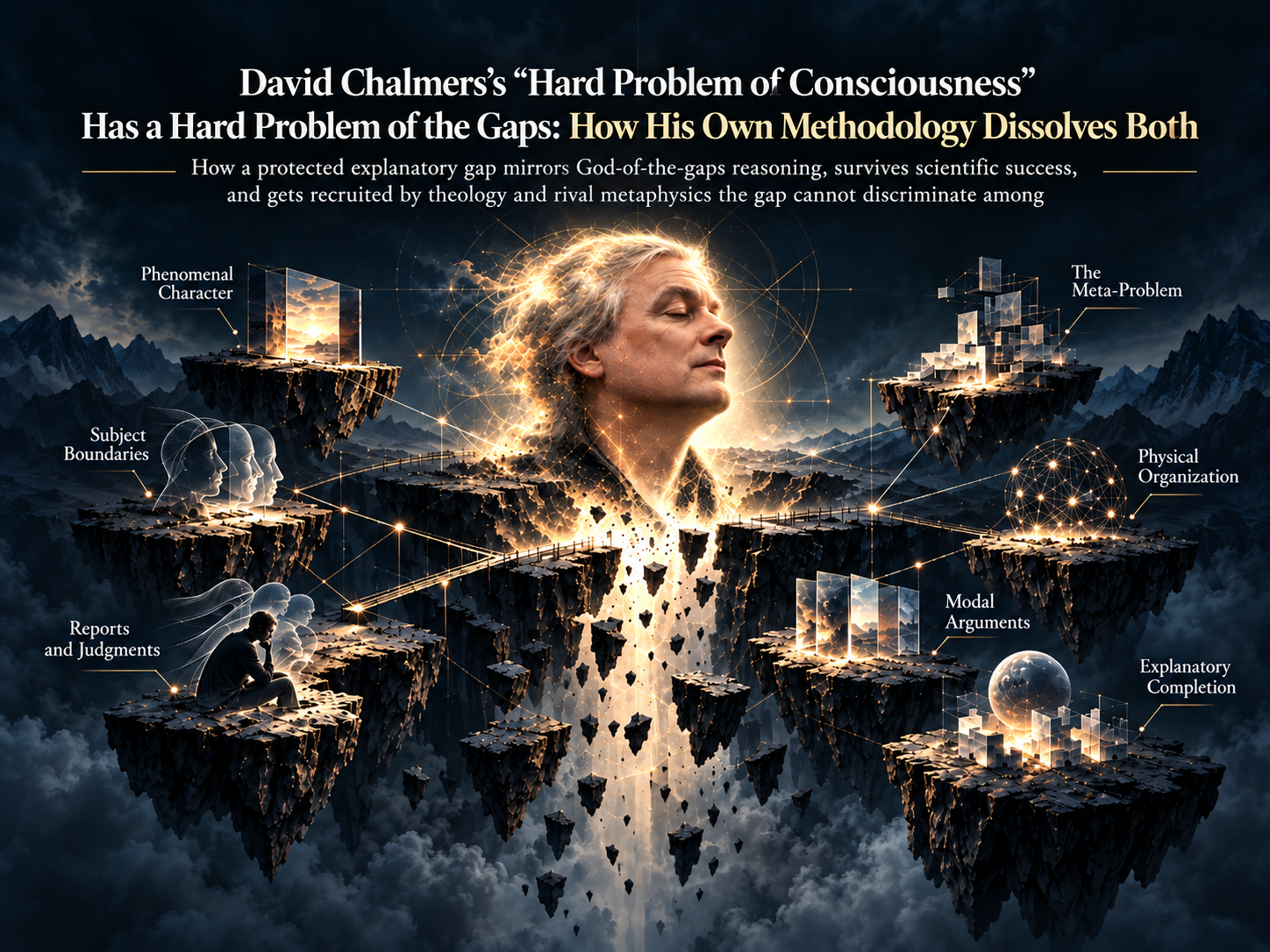
Once phenomenal occurrence, phenomenal character, conscious state, subject boundaries, reports and judgments, the reliability of phenomenal attribution, the Meta-Problem, physical-experiential relations, modal arguments, and the criteria for explanatory completion are separated, what further explanandum belongs uniquely to the Hard Problem itself?
What is left for the Hard Problem to explain? What would count as answering that remaining question, and what explanatory work can only the unitary Hard Problem do?
That question matters because the continued availability of another “why?” cannot by itself establish explanatory failure. Chalmers accepts that scientific explanation can eventually terminate in fundamental laws even though one can still ask why those laws obtain. His own proposed psychophysical laws would face the same further question. If another available “why?” disqualified an explanation, his preferred stopping point would fail by the same rule.
This does not establish physicalism, functionalism, illusionism, or any other theory of consciousness. Chalmers’s modal arguments remain arguments to evaluate. So do Whiteheadian panexperientialism, phenomenal-powers theories, Russellian approaches, emergentism, and alternatives we may not yet have formulated. The narrower point is methodological: an explanatory remainder cannot select its own ontology.
My earlier article tied too much of the dissolution to recursively perspectival organizational closure, or RPOC. I argued that experience was linked to systems that maintain themselves and recursively model their relation to the world. I still think the organizational evidence is important, but I gave it more weight than it could bear in establishing that the organization itself was experience. The stronger argument survives that correction because the decomposition does not depend on RPOC winning.
The rest of this article therefore puts the decomposition under adversarial pressure. If a critic can identify a positive residual that belongs uniquely to the unitary Hard Problem, or show that decomposition destroys a necessary explanatory relation among its constituent questions, the dissolution fails. If neither survives, merely restating “Why is there experience?” does not recreate the additional problem.
I compare what each theory explains with what it adds, ask what evidence distinguishes that addition from its rivals, and apply the same standards to my own proposal. Chalmers himself allows two broad routes toward resolution: an argument that the relevant functions exhaust what needs explaining, or a mature psychophysical theory linking physical facts to experience. (Chalmers 1997) Different claims require different forms of evidence, but none receives exemption from correction.
The religious comparison later in the article concerns the same inferential discipline. Some apologetic arguments turn an unanswered question into evidence for a preferred explanation, allow that explanation to terminate in a basic assumption, and then continue demanding another “why?” from its rivals. Whether a genuine gap exists and what that gap supports are separate questions.
The challenge throughout is therefore simple:
Preserve every real problem. Then show me what is left over.
1. What Chalmers Asks Us to Explain
In 1995, Chalmers distinguished the tractable problems of consciousness from the “really hard problem,” the problem of experience. Explaining attention, discrimination, report, integration, memory, or control does not automatically establish why there is something it is like to undergo them. (Chalmers 1995) That target-preservation requirement is indispensable because an explanation should receive credit for the thing it actually explains.
Target-Preservation Test. Fix the explanandum before awarding explanatory credit. If a theory explains A while the disputed target is P, success on A does not automatically establish P. For example, a theory that explains why someone reports pain still needs an argument if it also claims to explain the pain itself.
The burden applies across theories. Making information widely available may explain access, while recurrent processing may explain perceptual organization. A theory that identifies experience with either mechanism, or with integrated causal structure, must also defend that identity. Biological, computational, predictive, self-model, and organizational accounts face the same requirement.
Three claims need separating:
HP0: Target preservation. Experience is a genuine target in paradigmatic conscious cases and must not be replaced by access, behavior, or report.
HP1: Explanatory non-entailment. Present physical, functional, and organizational descriptions do not transparently establish all phenomenal truths.
HP2: Ontological promotion. The explanatory gap requires an additional fundamental property, primitive psychophysical laws, or some other ontological addition beyond a complete physical or organizational account.
HP0 fixes the target. HP1 describes the present explanatory gap. HP2 makes the further inference that the gap reveals something additional about what reality contains, and that inference requires support of its own.
Chalmers allows a functionalist resolution if an argument establishes that the relevant functions exhaust what needs explaining. In 1997 he wrote that a sound, non-question-begging demonstration of that kind “would provide as valid a resolution of the hard problem as any.” (Chalmers 1997) Block and Stalnaker challenge the further assumption that a reductive scientific identity must be derivable through conceptual reasoning alone before it can explain. (Block & Stalnaker 1999)
The grammar of the original question also matters. “Why does physical processing give rise to experience?” presents processing and experience as distinct relata joined by a production relation. That is one account of their relation. They might instead be identical, stand in a constitutive or realization relation, covary under a law, express two aspects of one thing, depend on intrinsic properties, or relate in a way we have not yet conceived. An argument begs the question when it assumes the disputed point instead of supporting it. (IEP, “Fallacies”) Which relation is being proposed here, and what independently favors it over those alternatives?
2. What Would Count as an Answer?
Chalmers offers two ways the problem could be resolved. One would show that the relevant functions are everything that needs explaining. The other would give precise psychophysical laws linking physical facts to a characterization of experience. (Chalmers 1997)
Why would one proposed endpoint count as an answer while another remains inadequate?
Suppose consciousness science becomes extraordinarily successful. It predicts conscious states during anesthesia, sleep, seizures, and disorders of consciousness, including cases where a person follows commands without overt movement. Stimulation and drugs let researchers alter what a person experiences. Researchers also explain differences between reported and unreported experience, subject boundaries, memory, bodily ownership, the experience of time, and the judgments that make consciousness seem inexplicable. Chalmers can consistently say that these achievements concern functions and organization while the phenomenal question remains. (Chalmers 1997)
If those achievements leave the Hard Problem open, its persistence alone tells us nothing about whether they succeeded. Chalmers’s distinction already permits functional explanations to succeed while the question of experience remains.
This is where the parallel to some gap-based apologetic arguments begins. A mechanism may explain increasingly more while the remaining question becomes “why that mechanism?”, “why those laws?”, or “why anything at all?”. What does the remaining question ask us to explain, and what about its persistence favors one answer over the alternatives?
Chalmers distinguished functional explanation from the question of experience before the later scientific advances considered here. That chronology does not support a historical charge of moving the goalposts. It does create what I will call goalpost insulation: the phenomenal target is defined so that surrounding mechanistic success can leave it untouched. That insulation can be legitimate when the target is independently specified and its resolution conditions are principled. The evidential problem begins when the target’s survival is itself treated as evidence that the surrounding explanations failed or as support for a preferred metaphysics.
Corrigibility Test. What would count as progress, what would weaken this interpretation, what evidence bears on it, and why would the proposed answer be enough?
Chalmers says explanation can bottom out in fundamental laws and that psychophysical laws can explain why the explanatory gap exists. He writes that once the relevant psychophysical laws are introduced, “the explanatory gap has itself been explained.” (Chalmers 1997)
Why is “D is connected to P by fundamental psychophysical law L” an acceptable endpoint while “D is P,” “D constitutes P,” or another fundamental bridge remains inadequate because one can still ask why? In ordinary language: why may a fundamental law linking physical activity and experience end the explanation while an identity or constitutive relation remains inadequate because another “why?” can still be asked?
A further “why?” remains available after a psychophysical law too. To favor that endpoint, Chalmers needs his arguments about conceivability, possibility, phenomenal concepts, direct acquaintance with experience, theoretical integration, or some other discriminator to establish a relevant difference. The surviving question alone cannot provide it. That is the resolution-asymmetry problem.
Stopping-rule symmetry and special pleading
An asymmetry arises when an identity between physical activity and experience is rejected because another “why?” can still be asked, while a psychophysical law is accepted as fundamental without an independently supported reason for treating the endpoints differently.
A theological argument can press a natural mechanism with “why does it exist?” while allowing God or a necessary mind to end the explanation. Basic assumptions need comparison by the same standard. An independent argument about necessity or probability may justify a difference; another available “why?” alone cannot.
This is where special pleading becomes relevant. The Internet Encyclopedia of Philosophy defines special pleading as inconsistent application of a principle to a favored case. (IEP, “Fallacies”) Special pleading occurs here if the same stopping rule is imposed on rival explanations and waived for the preferred one without an independently justified relevant difference.
Stopping-Rule Symmetry Test. If a fundamental law ends one explanation, why would an identity or constitutive relation fail to end another? What independently supported difference justifies that judgment?
In the formal shorthand, we can still ask why a psychophysical law L maps D to P1 rather than P2, why L obtains, or why there are psychophysical laws at all. In ordinary language, we can ask why the law links a physical state to this experience rather than another. Chalmers holds that explanation eventually reaches fundamentals. The disagreement concerns which candidate fundamentals are independently warranted.
Songchi Lin illustrates a related symmetry pressure by asking whether revelation-style reasoning, in which direct acquaintance with experience is taken to disclose its nature, can privilege panpsychism over physicalism. (Lin 2026)
3. After Decomposition, What Is Left?
Once the component questions have been stated separately, does the Hard Problem identify anything further that needs explaining?
Raamy Majeed argues that the Hard Problem already contains at least two explanatory targets: the relation between physical organization and phenomenal occurrence, and the phenomenal character of experience. (Majeed 2016) Other questions concern when someone is conscious, what they experience, which system is the subject, and how reliably reports and judgments tell us about experience. We also need to explain why consciousness seems puzzling, how physical organization relates to experience, whether a physical duplicate without experience is possible, and what would make an explanation complete. These correspond to the article’s formal targets of state, content and structure, subject boundary, report and access, tracking, the Meta-Problem, the D-to-P relation, zombie modality, and explanatory completion.
The Positive Residual Test asks what remains after that decomposition. Let Q be the set of successor questions and H the Hard Problem conceived as something further. The subtraction below is schematic: it means removing from H the explanatory work already assigned to Q and asking what positive content is left.
Residual(H) = H − Q. What independently specifiable explanatory content remains?
“Why is there experience?” could ask why experience occurs, why it has particular qualities, or how it relates to physical organization. It could also demand a deeper explanation of that relation or ask whether a physical duplicate without experience is possible. Which of these questions is intended, and what does a further “why?” add?
If each substantive question belongs to one of these inquiries, the Hard Problem names their collection rather than an additional explanandum. That is problem-form dissolution. The proposal fails if a defender identifies an additional question that the separation misses, explains what would answer it, and shows what would justify revising that account.
Rejecting a theory, resolving a question, and changing how a question is framed are different achievements. A theory may lose support while experience remains something to explain. Kleiner and Hoel address empirical tests of theories; this article asks whether separating the Hard Problem changes the work left to do. (Kleiner & Hoel 2021)
What remains after decomposition
Human experience remains something to explain, along with its particular qualities and structure. Research on anesthesia, sleep, perception, memory, stimulation, lesions, reports, no-report measures, and psychophysics continues to investigate when people are conscious and what they experience.
We also need to identify which organized system is the subject and explain how reliably its judgments and reports track experience. The Meta-Problem asks why people generate explanatory-gap judgments. A further inquiry concerns which relation between physical organization D and phenomenal evidence P has the best support.
The philosophical questions about conceivability, possibility, necessity, and two-dimensional semantics need their own arguments. So does the question of what would make an explanation complete. Separating these inquiries leaves each available for investigation without assuming that together they constitute one additional problem.
My claim is that these inquiries may exhaust what the Hard Problem asks us to explain.
Separating them would count as methodological progress if it improves testing, conceptual clarity, transfer to new cases, or dispute resolution. The decomposition itself must be assessed against those outcomes.
4. The Hard Problem Has Bridges Too
Chalmers notes that researchers have no theory-neutral “consciousness meter.” They infer experience from reports, behavior, availability, or other physical signs using what he calls pre-experimental bridging principles. (Chalmers 1998) I will call those inferential assumptions bridges.
Philosophical arguments also depend on inferential links. Knowing directly that one is in pain is different from knowing what pain ultimately consists in. Imagining a physical duplicate without experience raises the further question of whether such a duplicate is genuinely possible. Chalmers’s two-dimensional argument treats the move from conceivability to possibility as crucial, and any further move from possibility to ontology also needs an argument. (Chalmers 2009)
Bridge-and-Tribunal Audit. For an important inference, state the starting claim, the conclusion, and the reason the first supports the second. Explain what would distinguish that conclusion from serious rivals and what would justify revising it.
A neural intervention supplies evidence about what happens when neural activity changes. To reach a conclusion about what is possible, an argument needs further premises. Likewise, imagining a situation requires a reason for treating it as genuinely possible. Direct acquaintance with pain establishes something that any adequate account must explain, while biological, computational, relational, and fundamental-property accounts still have to defend what pain consists in.
The same accounting applies when an empirically supported carrier is paired with a disputed phenomenal relation. Let D denote the independently characterized carrier, which may include neural dynamics, recurrence, global availability, biological regulation, participant reports, no-report measures, lesions, stimulation, anesthesia, development, memory, or morphology. Let X denote the disputed relation to experience, such as identity, constitution, lawful accompaniment, intrinsic realization, or panexperiential grounding. I reserve B elsewhere for a system boundary.
What changes when X changes while D is held fixed?
If rival relations preserve the same empirical successes, those observations support what the rivals share in D. A particular X needs evidence or argument that favors it specifically through modal, phenomenological, explanatory, or empirical consequences.
5. The Meta-Problem Turns the Gap Into Data
We can investigate how people come to judge that consciousness cannot be explained. My earlier proposal was that a self-model hides much of the machinery producing the state from which that judgment is made.
Proposed mechanism. An organism models only part of the neural, bodily, developmental, and environmental processes producing its current state. Their distributed construction can disappear from the model, making awareness seem immediate and self-contained. Speaking of “experience” as a separate object may then make the omitted construction look like a further unexplained thing. This remains a causal hypothesis about explanatory-gap judgments, not an identity claim about experience.
Chalmers calls the study of why people make these judgments the Meta-Problem. It seeks an explanation that does not first assume a position on the nature of consciousness. (Chalmers 2018) His later work notes that these judgments are not universal: some theorists reject the Hard Problem, many people never consider it, and some cultures formulate the issue differently. (Chalmers 2020a)
Sękowski and Rorot ask whether the intuitions used to navigate the Hard Problem provide reliable grounds for knowledge. (Sękowski & Rorot 2022) Sytsma and Machery find that ordinary conceptions of subjective experience do not simply mirror the philosophical notion of phenomenal consciousness. (Sytsma & Machery 2010) Bayne challenges Chalmers’s account of phenomenal judgment, while Berent’s experiments implicate an intuitive separation of mind and body, beliefs in underlying essences, and judgments that change with the scenario. (Bayne 2001; Berent 2023; Berent 2026)
Genealogy-and-Tracking Test. Change the conditions thought to produce a judgment about consciousness and ask whether the judgment remains reliable. Any claim that the underlying experience stayed stable during that comparison also needs independent support.
Framing, culture, introspective training, and the way a system monitors or represents itself may affect whether experience seems inexplicable. If those judgments change while independent grounds support treating the experience as stable, confidence in the metaphysical inference should change accordingly.
A judgment’s cause and its accuracy are separate questions. Chalmers discusses that distinction. (Chalmers 2020c) An account of how the judgment arises gives us a way to investigate whether its apparent obviousness reliably supports the metaphysical conclusion drawn from it.
6. The Modal Route Has Its Own Burden
Chalmers’s two-dimensional argument begins with a claim about conceivability, moves to a claim about what is possible, and uses that result to challenge materialism. (Chalmers 2009) Its case depends on those inferential steps, including whether a complete physical duplicate without experience is genuinely conceivable and whether the relevant kind of conceivability supports possibility.
Cross-Tribunal Test. An experimental result bears directly on a claim about the system being tested. To use it against an argument about possibility, we need a reason connecting the result to a disputed premise. A possibility argument has a corresponding burden when it appeals to empirical findings.
A neural mechanism therefore bears on a modal argument only through a premise the mechanism supports or undermines. Likewise, a modal argument gains no extra support merely because empirical science continues solving problems Chalmers already classified as functional. The question in each case is which premise the evidence actually touches.
The modal bridge is contested. Balog challenges the conceivability-to-possibility move through phenomenal concepts, while Stoljar argues that what seems conceivable may reflect missing knowledge of the physical facts rather than genuine metaphysical possibility. (Balog 1999; Stoljar 2007) The argument needs its premises about conceivability and possibility defended, and it can be weakened if those premises or the inference between them fail.
Different kinds of claims therefore have different routes to revision. Empirical hypotheses are tested against observations. Claims about possibility can fail through errors in conceivability, meaning, necessity, or inference. A conceptual account may fail through incoherence or lose ground to a better reconstruction.
7. The Consciousness-Meter Problem Comes Home
Chalmers emphasized that consciousness is not read directly from a theory-neutral third-person meter. Kleiner and Hoel examine how a theory’s predictions are compared with an estimate of experience drawn from reports or behavior. The assumptions used to construct that estimate affect the test: they can make a theory too easy to reject or prevent rival theories from being distinguished. (Kleiner & Hoel 2021)
Measurement-Bridge Audit. What does the theory predict we will measure? How do those measurements connect to what participants report or show, and why do those responses support the attributed experience?
At each step, check how the inference is calibrated, where the measures may come apart, and what would justify revising it.
No-report experiments try to separate activity involved in reporting an experience from activity associated with the experience itself. Tsuchiya and colleagues state the target plainly: phenomenal experience rather than the act of reporting it. (Tsuchiya et al. 2015)
To claim that a functional measure misses experience, we need a justified account of the experience it misses. Direct acquaintance matters in our own case. Attributing experience to another person, an animal, a computational system, a neural state, or a hypothetical duplicate requires further inference. Claims based on acquaintance, intuition, and conceivability therefore need their inferential assumptions examined too.
8. Comparing and Testing Accounts of Consciousness
Adversarial theory tests
The field already contains examples of the methodology needed here. Seth and Bayne note that current theories often lack clear relations to one another and may be difficult to distinguish empirically. (Seth & Bayne 2022) The 2025 Cogitate collaboration preregistered divergent predictions and pass-or-fail criteria for integrated information theory (IIT) and global neuronal workspace theory (GNWT) before the data arrived; the experiments challenged important predictions of both. (Cogitate Consortium et al. 2025)
Adversarial Discrimination Test. Before observing the results, specify where rival theories predict different outcomes. Test those predictions using a common measure and revise the claims the result actually bears on.
A successful neural prediction supports the neural claim tested. To support a proposed identity between that activity and experience, the identity claim must itself explain why this result differs from what a rival would predict. Apply that requirement to each theory.
Doerig, Schurger, and Herzog call for stricter criteria for testing empirical consciousness theories. Kleiner uses formal reconstruction to identify which premise carries a critique. (Kleiner 2020) Bridewell and Isaac call their modeling approach “apophatic science”: quantitative work can proceed while stronger metaphysical commitments remain open. (Bridewell & Isaac 2021)
Dodig-Crnkovic: naturalize more, then audit the bridge
Gordana Dodig-Crnkovic is especially useful here because her recent work supplies both a strong naturalizing programme and a case in which the same bridge audit should be turned back on the programme itself. Her peer-reviewed account of anticipation gives a concrete biological carrier before phenomenality enters: “Many physical systems retain traces of their past, but living systems differ in that they use memory for anticipation.” (Dodig-Crnkovic 2026a) Memory, regulation, prediction, self-maintenance, constraint, and history-sensitive action can therefore be studied as positive biological capacities without deciding in advance what, if anything, those processes feel like.
Her 2026 Frontiers in Systems Neuroscience paper initially makes the same separation unusually explicit. At basal levels, it says experiential terms refer to “functional, valence-sensitive regulation rather than to phenomenally conscious experience”, and its comparison table describes bacteria as environmentally sensitive while having “no subjective experience.” (Dodig-Crnkovic 2026b) The distinction matters because a state can matter functionally to an organism, bias action, carry valence in an organism-relative regulatory sense, and still leave the phenomenal question open.
The same paper, however, also reveals a construct-validity problem that should not be hidden by the continuum vocabulary. Its definition of sentience moves from valenced response into language of meaningful experience and individual or subjective experience, attributes minimal sentience to bacteria, and later treats awareness and consciousness as a graded continuum across living systems. Those claims can be reconciled only if the meanings are kept stable. If sentience, awareness, or experience at the basal end means functional sensitivity, regulation, or organism-relative good and bad, the evidence may support the thin construct while leaving phenomenality unsettled. If the same terms retain subjective or felt content, the attribution becomes substantially stronger and needs evidence that discriminates felt valence from functionally valenced regulation. A graded vocabulary does not itself build that bridge.
Her author-written 2026 presentation of the forthcoming World Scientific monograph Evolving Intelligence makes the stronger proposal clearer. Because the final monograph is still forthcoming, the available author-written source is her structural overview rather than final book pages. It proposes that “basal consciousness consists in viability-regulated self-sensing” and, in its minimal sense, that “consciousness is the feeling of existence of a living system.” (Dodig-Crnkovic 2026c) Importantly, the same overview explicitly presents this as a hypothesis about the evolutionary roots of consciousness rather than a settled result of consciousness science. That qualification should govern the evidential bookkeeping.
Her October 1 Giant’s Shoulder interview shows why. Around 19:42–20:22, Dodig-Crnkovic identifies cellular consciousness with minimal self-sensing and says a cell “has some level of consciousness.” That can function as a stipulated thin use of consciousness. But it cannot simultaneously be used as evidence that phenomenal subjectivity has already been established. The question is whether self-sensing is being offered as a functional precursor, a constitutive identity, a sufficient condition for phenomenality, or merely a broadened definition. Those are different claims.
The same issue becomes especially clear in the anesthesia example. Just before 1:07:08, the transcript records her acknowledging that “we don’t of course know … how does it feel to be a bacterium,” followed immediately by the claim that ether-treated bacteria “will lose their consciousness” and “become unresponsive.” The second part is experimentally tractable: responsiveness and biological organization change under intervention. The first part requires an additional premise: that the relevant pre-anesthetic organization instantiated consciousness in the phenomenal sense and that the measured disruption specifically tracked its loss.
Measurement-Bridge Test. “The bacterium became unresponsive under anesthesia” is an observation about behavior and biological organization. “The bacterium lost consciousness” is a further interpretation. To move from the first to the second, specify what independently warrants the original consciousness attribution and why this intervention tracks phenomenality rather than only the functions correlated with it.
This does not show that bacteria are nonconscious. It shows why anesthesia cannot be allowed to perform two jobs at once: establish disruption of a biological capacity and certify that the disrupted capacity was phenomenal. Human anesthesia research has independent first-person reports, recovery reports, neural measures, dissociations, and converging evidence with which to calibrate candidate markers. Basal organisms do not give us the same evidential bridge. The evidential difference should be represented rather than erased by using the same word consciousness on both sides.
A second bridge appears at the biological boundary. Around 1:03:15, Dodig-Crnkovic says of current computational systems: “they are not conscious,” “They don’t need consciousness,” and “They don’t need feelings,” tying the difference to mortality, survival, autopoiesis, and viability. The interviewer immediately asks, around 1:03:44, why the need to survive should be essential for experience or consciousness. That is the right question. Autopoiesis, metabolic self-production, intrinsic viability constraints, evolutionary history, and embodied chemistry are serious candidate conditions. But if consciousness is defined as viability-regulated living self-sensing, nonliving systems are excluded by definition. If the stronger claim is that those biological features are necessary or sufficient for phenomenal experience, the biological boundary needs an empirical or explanatory bridge rather than a definitional one.
The methodological pressure becomes sharper around 55:59. Asked what experiment could force a hard-line critic to accept genuine cellular agency, Dodig-Crnkovic replies, “I think it’s not a question of experiment, it’s question of attitude.” The context matters: she is answering a question about agency and cognition, not formally declaring phenomenal consciousness experimentally undecidable, and she is right that an ideologically committed human exceptionalist can refuse evidence. Still, a scientific research programme needs a reciprocal answer: what observation would distinguish an unreasonable refusal to recognize cellular agency from an attribution that outran the evidence? What would lower confidence in the attribution? Without that answer, disagreement can be redescribed as attitude in a way that makes the programme unnecessarily difficult to correct.
Naturalization-by-Ablation Test. Remove phenomenal consciousness from the account of bacterial sensing, memory, anticipation, viability regulation, chemotaxis, anesthesia response, problem solving, and self-maintenance. Rerun the explanation. Whatever predictive, explanatory, or intervention-sensitive work survives belongs first to the biological carrier. Restore phenomenality when removing it creates a positive residual that the serious alternatives do not recover as well.
This is also where Dodig-Crnkovic’s own naturalizing work is methodologically strongest. Her recent Cognitive Platonism programme explicitly replaces a separate transcendent realm with embodied constraint, enacted structure, memory, and cognitive architecture. The same discipline can be applied recursively to consciousness. Naturalize everything the evidence permits, preserve the functional and biological achievements, and do not let the remaining uncertainty decide its own ontology.
The connection to Chalmers is direct. Chalmers is right that consciousness research has a measurement bridge: behavioral and neural markers do not become phenomenality merely by being useful measurements. Dodig-Crnkovic’s bacterial case makes the problem concrete at another scale. The fact that “became unresponsive” and “lost consciousness” can be spoken in consecutive sentences does not make them the same evidential claim. My current Provisional, Boundary- and Scale-Relative Realism and its accessible overview use exactly this rule: preserve the carrier, expose the bridge, and leave the stronger attribution open until it earns the transport.
Segall and Whitehead: carry the warrant, not the vocabulary
The Whiteheadian comparison becomes stronger when it is stated in Whitehead’s own grammar. Prehension is not an experiential property pasted onto an independently complete piece of matter. It names the constitutive activity through which an actual occasion takes account of its world and becomes what it is. Ordinary reflective consciousness is not universal in Whitehead’s scheme. Matthew David Segall is therefore right to object when a critic turns prehension into a detachable predicate and then announces that Whitehead survives its removal.
That correction does not remove the comparative question. My more recent exchange with Segall moved the disagreement to a better level. Segall acknowledged that shared operational successes cannot automatically be credited specifically to his proposal, and he framed his positive case as an abductive one: prehension offers a more coherent continuity between causal efficacy and experiential becoming. In his September formulation, “Prehension generalizes that relation throughout nature.” The issue is no longer whether Whitehead can describe causal inheritance prehensively. He can. The issue is what warrants the generalization and how much evidential credit the specifically prehensive feature earns.
The constitutive correction also fixes a narrower logical dispute. In Matthew Segall’s ‘Experience Is Not a Predicate’: I Never Made the Argument He Rebutted. My Question Remains Unanswered., I distinguish leaving universal prehension unresolved from asserting a nonexperiential ontology. The later Process Philosopher Matt Segall Admitted Misrepresenting My Argument To His Readers. He Updated His Page, Not His Readers documents the correction to that attribution. The inferential point is independent of the provenance dispute: uncertainty about X is not ¬X, and translating the comparison into Whitehead’s constitutive vocabulary does not remove the question of what comparatively warrants X.
Synthbiosis: The Machine Did Not Need to Feel to Matter Morally gives the factorization an operational consequence outside the Whitehead dispute. Substantive conclusions about causal coupling, constitutive dependence, candidate boundaries, intervention, and moral relevance can be derived while computational phenomenality remains unresolved. That does not refute universal prehension. It does show that substantial process-relational work can proceed without settling the disputed phenomenal extension, so those successes cannot automatically be credited to X.
Matthew Segall’s Words Made Flesh Again, but the Evidence Never Said That? applies the same bookkeeping to scientific evidence. Bioelectric regulation, developmental plasticity, embodied cognition, evolutionary novelty, and other genuine results can strongly support the shared empirical and process-relational carrier while doing little to select universal prehension unless the observations are better expected under that interpretation than under serious rivals. Compatibility with a scientific result is not yet differential confirmation.
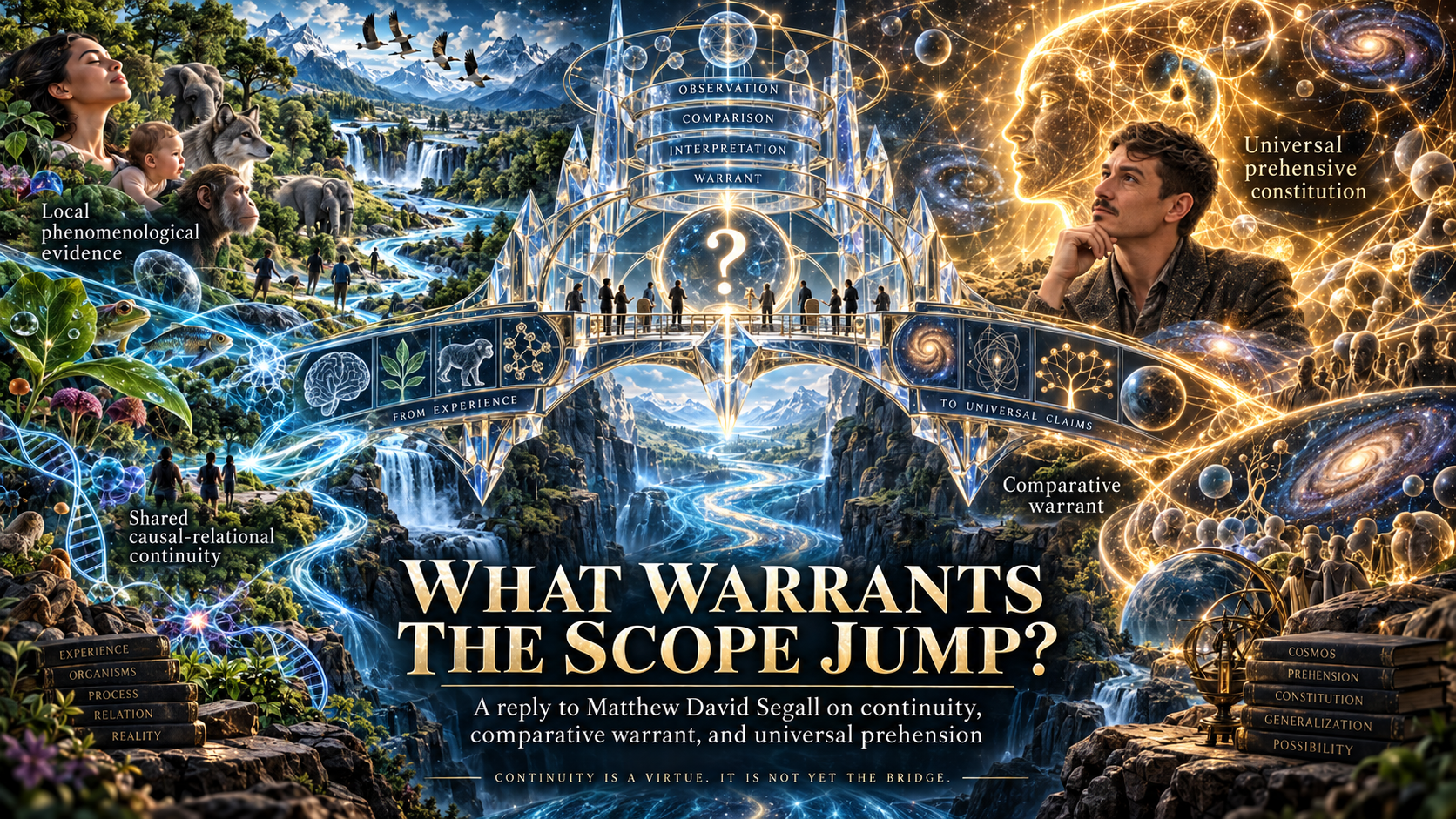
Three further analyses sharpen the positive comparison. What Warrants the Scope Jump? isolates the bridge from embodied felt causal inheritance to universal scope. Logic Does Not Choose Relevance. Does Feeling? Not Alone. asks whether phenomenal character earns genuine local explanatory credit and, where it does, which feature actually earns it. Where the Necessity Case for Whitehead’s Prehension Fails and Why That Makes Whitehead More Useful, Not Less then compares positive causal accounts at specified targets and asks whether subjective prehension is necessary for the explanatory work they perform.
There is at least one serious local route by which phenomenal character may earn explanatory credit. In affective cases, for example, the painfulness of pain or the positive character of pleasure may help explain avoidance and pursuit rather than merely riding alongside a complete functional story. Phenomenal-powers approaches make that possibility explicit. If such an account beats serious rivals at that local target, the experiential feature should receive the credit it earns. Denying every local positive residual in advance would merely reproduce the dogmatism this article is criticizing.
But a local gain creates a transport problem rather than solving it. Three burdens organize the comparison. First is burden: suspending judgment about universal prehension does not require constructing a finished nonexperiential cosmology. Second is credit assignment: if Whitehead’s whole scheme performs well, which part of the scheme actually produces the gain? Third is transport: even if phenomenal character contributes distinctively in a domain where experience is independently evidenced, what warrants exporting that credit to domains where phenomenality is not independently established?
The positive causal comparison matters here. Mechanistic accounts, powers and dispositions, direct process accounts, organizational constraint, and intervention-sensitive causation can give positive explanations of substantial specified causal targets without subjective prehension as an explanatory premise. That result defeats a necessity claim at those targets. It does not prove that Whitehead’s intrinsic interpretation is false. The stronger Whiteheadian hypothesis may still be true, may still unify better, and may still eventually earn comparative preference. What it cannot do is inherit the successes of causal production, organization, inheritance, and constraint merely because those successes can be redescribed in prehensive vocabulary.
Transport rule: carry the credit-bearing warrant, not the vocabulary. If painfulness earns explanatory credit because its phenomenal character helps explain avoidance, toxin avoidance in a bacterium does not inherit that credit merely because both cases involve avoidance. If felt causal inheritance earns credit in embodied experience, generic causal inheritance in a lifeless domain does not inherit the experiential credit merely because the word inheritance still applies.
The reference class matters. Embodied experience is not an arbitrary sample of causal actuality. It occurs in highly organized systems with living regulation, integration, memory, history, valuation, and, in the human cases from which much of the phenomenological warrant comes, nervous systems and report. Universal prehension may ultimately explain why those cases are possible, but the existence of the cases does not by itself establish that their specifically experiential character is representative of every concrete causal occurrence. The bridge might be a necessity relation, a structural identity, an explanatory dependency, a demonstrated failure of serious rivals, or some other invariant. “Prehension generalizes that relation throughout nature” names the hypothesis. It does not yet supply the bridge.
This is also why I now distinguish substantive explanatory unification from categoreal unification. If “the same activity” across physics, biology, and experience means causal inheritance, receptivity to antecedent conditions, integration, transition, constraint, or real difference-making, substantial rivals preserve much of that continuity. In that reading, the continuity belongs largely to the shared carrier D. If “the same activity” means the full objective-subjective structure of prehension, including felt inheritance, then X is already present in the description. The remaining task is to show what becomes explanatorily worse when that specifically prehensive interpretation is replaced by its strongest rivals.
Whitehead can earn that difference. Universal prehension should gain standing if it removes otherwise independent primitives, explains a residual the rivals leave brute, predicts where a supposedly neutral D-factorization will fracture, compresses the evidence with lower total cost, or transports successfully into new domains while retaining the very feature that generated the original gain. My suspension should lose standing if those advantages accumulate. Conversely, confidence in the universal extension should fall if developed rivals repeatedly recover the same causal and phenomenological work while the specifically experiential feature disappears during transport. Those are comparative loss conditions, not a demand for one Popperian observation that kills a metaphysics.
The relation to Chalmers is unusually close. The Hard Problem can leave a residual after structural, functional, mechanistic, and organizational explanation. Whiteheadian prehension is one serious candidate interpretation of that residual. But the residual cannot do the theory-selection work by itself. An unanswered question about why causal organization is accompanied by experience does not identify universal prehension any more than it identifies dualism, Russellian monism, idealism, emergentism, or an unconceived alternative. The metaphysical proposal receives credit where its distinctive feature produces a comparative gain.
The argument is not “Whitehead is unfalsifiable, therefore reject it.” It says something narrower and stronger: grant Whitehead’s constitutive grammar, grant the real philosophical value of continuity, grant local phenomenal explanatory work where it appears, then ask which feature earned that work and what warrants transporting it. That is the same recursive discipline being applied to Chalmers’s Hard Problem. The gap may motivate the programme. It cannot select the programme without a discriminator.
A broader statement of the framework appears in What Is Provisional, Boundary- and Scale-Relative Realism?, which treats Whiteheadian panexperientialism as a serious live possibility while withholding the universal extension where the evidence remains non-discriminating.
The Segall / Whitehead Exchange

Levin and RPOC: the same audit
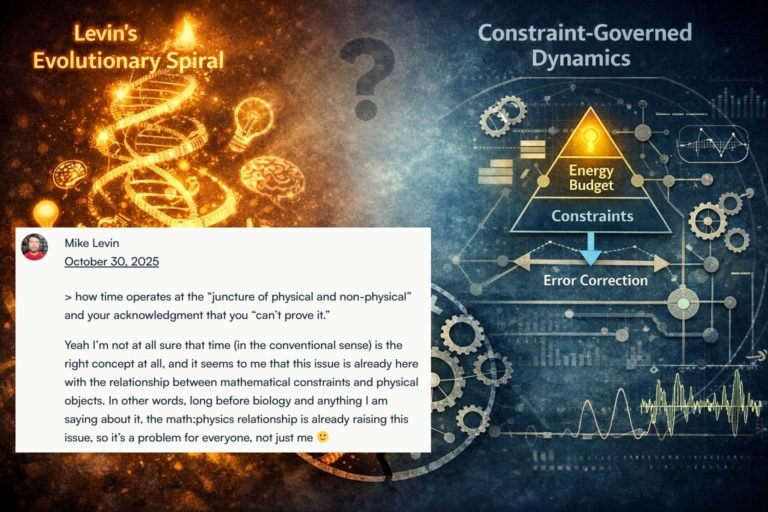
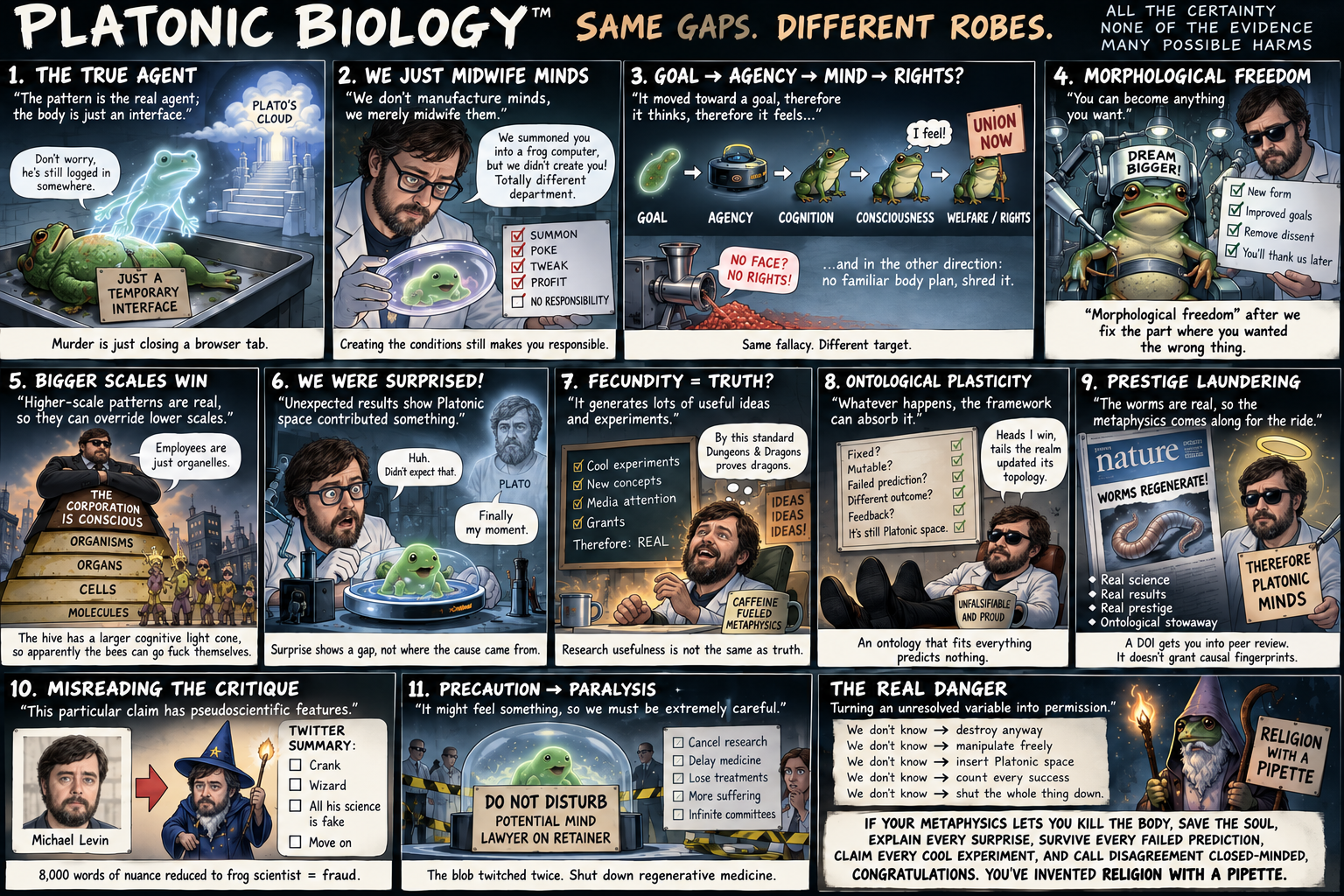
Michael Levin’s 2026 Ingressing Minds paper explicitly presents an interactionist model in which nonphysical patterns can in-form physical embodiments. (Levin 2026) His experiments investigate bioelectric control of anatomical form, anatomical memory, and coordination across biological scales. Which result favors a nonphysical Platonic pattern entering the system? How would that result differ from explanations based on stable dynamical states, developmental history, organizational constraints, or possibilities represented in a state space? I examine that evidential transport in more detail in Religion With a Pipette.
My earlier RPOC proposal made a comparable inference. Evidence for recursive integration, organizational closure, self-modeling and world-modeling, temporal continuity, and perspectival control was allowed to support the stronger identity claim that this organization is phenomenal perspective. Criticism showed that evidence for those capacities did not distinguish the identity claim from rival accounts of their relation to experience.
Same-Rule Audit. For each framework, separate the shared carrier D from the disputed addition X; ablate X; record what survives; then ask what evidence or argument is specific to X. In ordinary language: hold the independently supported account fixed, remove the disputed addition, and ask what explanatory work actually depends on it.
Levin’s empirical biology does not by itself require Platonic ingress. Process-relational explanations do not by themselves require universal experience. My organizational account does not by itself establish phenomenal identity. The successes shared by those interpretations support the shared account; each disputed addition needs reasons specific to it.
That is the practical meaning of the Sweet Rationalism rule: do not add what the evidence did not earn, and do not subtract what the evidence did not defeat.
From Biological Competence to Metaphysics

9. The Methodology That Dissolves It: An Operational Protocol
The protocol tests whether the bundled claims identify a further explanatory question. For each claim, it asks what needs explaining, how it is supported, and what remains when the disputed assumption is removed. This is a consciousness-specific application of the Recursive Corrigibility Framework (RCF), especially its Framework Bridge for tracking what evidence survives translation between claim types and frameworks.
1. Name the question. State what you are trying to explain. It might concern why experience occurs, why it has particular qualities, when a system is conscious, what it experiences, which system is the subject, or how reports and judgments relate to experience. It might instead concern the relation between physical organization and experience, what is possible, or what would make an answer complete. Preserve that question throughout the comparison.
2. Choose the boundary and timescale. Identify the candidate subject or system as B and the relevant timescale as τ. A brain, organism, organism-environment loop, computational system, or larger coupled system is a hypothesis about the appropriate boundary, not an automatic unit. Justify the choice.
3. Match the claim to its evidence. Identify whether the claim is empirical, causal, phenomenological, semantic, modal, metaphysical, or normative. In ordinary language, ask whether it concerns observations, causes, the structure of experience, the meaning of a concept, what could or must be true, what kinds of things exist, or what ought to be done. Then state what kind of evidence can legitimately bear on it.
4. Separate the supported account from the disputed addition. Write the shared, independently warranted structure as D and the disputed addition as X. Which successes depend on X?
5. Ablate the disputed addition without changing the target. Rerun the explanation without X. If the target changes, the ablation is invalid and the comparison must be repeated with the original explanandum preserved. When the same successes remain, they support what the rivals share and cannot count as unique evidence for X.
6. Describe the residual. After decomposition or ablation, specify precisely what remains unexplained or what explanatory work is lost. This is the Positive Residual Test. Say what would answer that remaining question rather than treating the continued availability of another “why?” as the residual itself.
7. Ask what differs under a serious rival. What follows from X that would be different if a rival were true? Look for a difference in observation, intervention, possibility, the structure of experience, explanatory economy, or success in another context.
8. Audit evidence transport. For an inference between kinds of claims, record the starting claim and conclusion, the boundary B and timescale τ, and how the measured or defined concepts correspond. Identify the relevant evidence, which variables and relations are preserved or omitted, what stays invariant across the comparison, what differs under a rival, and what would undermine the inference. An analogy, shared term, or equivalent mathematical structure needs an argument connecting it to the conclusion drawn.
9. Compare where explanations stop. If an explanation may end at a basic law, identity, intrinsic nature, or constitutive relation, explain what independently supported difference prevents a rival from using a comparable endpoint.
10. State what would weaken the claim. For an empirical hypothesis, identify an observational or intervention test. For a claim about possibility, identify a vulnerable premise or inference. For an account of experience, explain how reports and structural comparisons are checked. For a metaphysical programme, specify an argument or comparison that could count against it.
11. Revise locally. Revise the claim affected by the result and any downstream conclusions that depend on it. Keep support for a successful empirical account distinct from support for a further metaphysical interpretation of that account.
12. Test the procedure itself. Compare decomposition with treating the Hard Problem as one question. Does it improve prediction, intervention, transfer to new cases, conceptual clarity, or dispute resolution? Revise the procedure where it does not.
The protocol constrains how evidential credit is assigned; it does not by itself select a metaphysics.
When current observations cannot distinguish rival relations between organization and experience, argument about those relations can continue. Reports remain important evidence and require calibration for memory, framing, incentives, stability over time, dissociations, and consistency with behavior.
If the separated inquiries exhaust the explanatory content, “the Hard Problem” can serve as a name for their collection. If a further question remains, describe it and specify how it can be investigated.
10. What Does the Gap Actually Support?
Different worldviews recruit the explanatory gap as support for their claims. The IEP summarizes the range of reactions from denial and reductionism to panpsychism and full mind-body dualism. (IEP, “Hard Problem of Consciousness”) The SEP makes the evidential requirement explicit: “those who wish to use a strong in principle gap claim to refute physicalism must find independent grounds to support it.” (SEP, “Consciousness”)
Gap-to-Ontology Test. What evidence or argument favors this ontology over its rivals, beyond the existence of the gap? An unanswered question needs a further argument before it can select an answer.
The apologetic mirror: when a gap becomes evidence
The comparison here is structural. A gap argument becomes vulnerable when every mechanistic success leaves its preferred conclusion untouched, the remaining gap is used to support a preferred worldview, and that worldview is allowed a basic assumption that rival accounts are denied. God-of-the-gaps reasoning makes this sequence explicit when an explanatory shortfall is treated as support for agency beyond the natural account. The SEP distinguishes the question of whether a genuine causal gap exists from the further argument for design. (SEP, “Teleological Arguments for God’s Existence,” §2.2.3)
If the same gap remains compatible with rival accounts and explanatory success leaves confidence in the gap-based inference unchanged, that inference needs an independent reason for preferring its chosen account.
Where the reasoning fails
The IEP requires justification for a charge of fallacious reasoning. (IEP, “Fallacies”) Each diagnosis below therefore depends on the inferential steps being demonstrated. Religious use of a question tells us how that question is employed; evaluating the argument requires examining its premises and conclusion. A failed inference withdraws that inference’s support, while the truth of the conclusion requires separate assessment.
Argument from ignorance and gap inference. An argument from ignorance uses an explanatory failure as positive evidence for a preferred answer without supplying the needed support. (IEP, “Fallacies”) For the gap to favor that answer, the gap should be more expected if the answer is true than if a serious rival is true. Which account makes this shortfall more likely, and why?
Special pleading and explanatory double standards. The condition identified in Section 2 is the relevant one: a stopping rule is imposed on rivals and waived for the preferred explanation without an independently supported difference. The question is whether such a difference justifies treating the endpoints differently.
Misplaced burden of proof. Someone proposing an additional kind of reality must support that claim. A failure to derive experience from a physical account identifies a problem for that account; favoring another explanation requires evidence or argument specific to it. The IEP treats shifting an unsupported claimant’s burden to opponents as a reasoning error. (IEP, “Fallacies”)
Ad hoc immunization. Assess a revision by its independent tests, new consequences, explanatory economy, and other identifiable bases for comparison. A revision introduced to protect a preferred conclusion becomes suspect when it provides no such basis and leaves no way for the revised claim to lose. The SEP discusses this concern in comparing prediction and accommodation. (SEP, “Prediction versus Accommodation”) For the Hard Problem, ask what each revision changes in the claim’s predictions, explanation, or grounds for revision.
Question-begging framing and reification. “How does the physical produce experience?” needs an argument for treating the two as distinct and linked by production. State that proposed relation and compare it with the alternatives.
Panpsychism and panexperientialism
Physicalism’s difficulty in transparently deriving phenomenality is one motivation for panpsychism. (SEP, “Panpsychism”) Some versions appeal to the intrinsic nature of matter; Whiteheadian versions appeal to processes and causal inheritance. The Hard Problem alone does not establish experience or proto-experience throughout nature.
The combination problem illustrates the remaining burden. Yujin Nagasawa argues that even if constitutive Russellian panpsychism is granted, “we cannot ascertain how it might solve the hard problem of consciousness.” (Nagasawa 2021) Goff likewise argues that panpsychism by itself does not explain ordinary human consciousness. (Goff 2009) Segall’s experiential claim belongs to his account of processes and relations and needs evidence or argument specifically supporting experience throughout nature. (Segall 2020)
Idealism
Idealism reverses the explanatory direction: if consciousness is basic and the physical derivative, matter-to-mind emergence disappears. Kastrup presents his ontology as avoiding both the Hard Problem and the subject-combination problem, later stating that “there is only cosmic consciousness.” (Kastrup 2017; Kastrup 2018)
A claim about how we know the world differs from a claim that reality is fundamentally mental; the first needs an additional argument to support the second. (SEP, “Idealism”) Idealism must also explain why different subjects encounter a stable shared world, why physical processes appear to operate autonomously, and how distinct subjects relate to cosmic consciousness. Aleksiev argues that idealist panpsychism develops an explanatory gap between fundamental consciousness and spacetime. (Aleksiev 2024)
Theism
Moreland develops an argument for God from finite, irreducible consciousness, while Page develops a Bayesian form that compares how well competing hypotheses would lead us to expect consciousness. (Moreland 2021; Page 2020)
Is consciousness more likely if theism is true than if a rival account is true? The comparison needs the assumptions behind those probabilities and defensible starting estimates of how plausible each account is. Gundersen grants irreducibility for argument’s sake and still concludes that the theistic conclusion does not follow. (Gundersen 2026)
Creationism and intelligent design
Creationist literature has called consciousness a possible “second front” against naturalism, and a Discovery Institute volume presents divine consciousness as a route by which the Hard Problem “disappears.” (Creation Ministries International; Bruce L. Gordon, Minding the Brain)
Common descent concerns the history of populations; a claim that experience is an additional fundamental property concerns what consciousness consists in. Each needs evidence bearing on its own subject. Intelligent design needs evidence favoring an intelligent cause over competing explanations. Pennock documents the broader ID challenge to evolutionary science, while Scott and Matzke describe its effect on science education as “contributing substantially to a long-standing assault on the integrity of science education.” (Pennock 2003; Scott & Matzke 2007)
Anti-physicalism generally
The Hard Problem places pressure on physicalist theories that simply rename function as phenomenality or assert identity without defending the relation. Chalmers’s arguments about conceivable physical duplicates, possibility, and two-dimensional semantics supply the further case against materialism. Their premises and inferences need defending.
Present physical and functional descriptions leave the relation to experience disputed. The difficulty may reflect the nature of reality, our concepts, cognitive limits, incomplete science, or some combination of them.
Why this inference matters
An unanswered question can be made to look as though it has already selected an answer. That can close inquiry prematurely or lead people to reject explanations the question has not actually ruled out. In science education, “not yet explained” can become “therefore designed.” In ethics, a proposal that tiny systems have experience can be confused with claims about felt suffering, positive or negative states, wellbeing, and whether an entity’s interests deserve moral consideration. Preston, Ritter, and Hepler find that awareness of an explanatory gap can “re-mystify the mind,” while Gottlieb and Fischer examine the separate moral-circle questions raised by panpsychism. (Preston, Ritter & Hepler 2013; Gottlieb & Fischer 2024)
Separating experience, positive or negative significance, wellbeing, subjecthood, agency, and moral status makes their different evidential and ethical questions explicit.
Hitchens’s burden-of-proof line fits the unearned inferential step: “What can be asserted without evidence can also be dismissed without evidence.” (Hitchens, quoted in Scientific American) The step from “we do not yet know” to “therefore my account” needs evidence.
11. What This Actually Changes My Confidence About
The article’s output should be a confidence ledger, not a replacement creed.
I continue to treat human experience as a genuine target of explanation. The case for investigating state, content, report, access, subject boundaries, self-monitoring, regulation, and judgments about consciousness separately has become more persuasive to me. Where prediction and intervention succeed, they also strengthen my confidence in the organizational and structural accounts of the capacities actually tested.
I lower my confidence in a stronger conclusion when the evidence supports only a weaker one. Successful computation needs additional support before it establishes that computation is sufficient for experience. Finding experience in biological systems leaves a further burden for claiming biology is universally necessary. Process explanations need their own argument for universal experience, and morphogenetic control needs one for nonphysical Platonic ingress. My organizational account faces the same burden before its organization can be identified with experience.
My current stance remains something like Bridge-Constrained Phenomenal Realism. I treat experience as something that needs explaining, investigate the mechanisms aggressively, and take participant evidence seriously while checking its reliability. Claims that a particular organization is experience, that a substrate is necessary, or that experience exists throughout nature need support specific to those claims.
12. How the Dissolution Argument Can Lose
My method is subject to the same standards. It fails if separating the questions loses explanatory content, breaks a relation they necessarily share, or applies different evidential standards without an independently supported reason. Its rules for revision must also allow criticism to change the method.
Positive residual or re-unification. Identify a further explanatory question that the separated inquiries cannot reconstruct, or show that they necessarily depend on one common relation and that investigating them separately systematically loses explanatory power. Either result would challenge the central decomposition claim.
Stopping-rule result. Give an independently supported reason why a psychophysical law provides an adequate endpoint while an identity, constitutive relation, or other candidate does not. That result would revise the resolution-asymmetry critique.
Modal result. Establish the conceivability-to-possibility inference strongly enough to support the anti-materialist conclusion, and identify which premise of this critique that result overturns. A successful modal argument would revise the modal portion of my analysis; defeating the overall dissolution would require showing that the result also restores explanatory content lost by decomposition.
Cross-domain bridge. Justify the inference from an observational or experiential premise to a conclusion about knowledge, possibility, or reality while addressing the specific evidential limitation identified here. That would revise the relevant bridge audit.
Tracking result. Show that judgments about the explanatory gap or physical duplicates reliably support the metaphysical claims drawn from them after accounting for the influences studied in Meta-Problem research. That would weaken the genealogy-and-tracking argument.
Bridge-specific discriminator. Show a consequence specific to one relation between organization and experience that serious rivals do not share. That result would give the disputed bridge evidential credit of its own.
Factorization failure. Show that separating the supported account D from the disputed addition X breaks a relation essential to the original target, so the comparison is no longer testing the same thing. In the framework’s shorthand, this is a failure of the D/X factorization.
Methodological failure. Show that separating the questions improves none of the relevant outcomes: prediction, intervention, success in new contexts, conceptual clarity, or dispute resolution, compared with treating the Hard Problem as one question.
For each result, identify the claim it requires me to revise. To defeat the overall dissolution proposal, show how the result establishes explanatory content or a necessary common relation that the separation loses.
Conclusion: The Hard Problem’s Hard Problem
The most important change in my view is not that I have become less certain that experience needs explaining. I have become more precise about what, exactly, still needs explaining and about what would count as evidence that something further remains.
Chalmers was right to insist that an explanation must preserve its explanandum, the thing it set out to explain. Explaining report, access, discrimination, memory, or control does not license us to quietly substitute those functions for experience. That warning survives intact.
But the rule is recursive. The Hard Problem must preserve its own explanandum too.
Once we separate phenomenal occurrence, phenomenal character, conscious state, subject boundaries, reports and judgments, the reliability of phenomenal attribution, the Meta-Problem, the relation between physical organization and experience, the modal arguments, and the question of explanatory completion, what further explanatory target belongs uniquely to the Hard Problem itself?
That is no longer a rhetorical question. It is the burden of the argument.
Chalmers’s own account of explanation sharpens the challenge. He accepts that scientific explanation eventually reaches fundamental laws and that another “why?” can still be asked after those laws are stated. A psychophysical law can therefore count as an adequate explanatory endpoint even though one may still ask why that law obtains. (Chalmers 1997)
So the continued availability of another “why?” cannot itself establish explanatory failure.
If it could, Chalmers’s own psychophysical solution would fail by the same standard. Why that law? Why that mapping? Why this experience rather than another? Why any psychophysical laws at all?
The regress does not disappear when the word fundamental is introduced.
That leaves a narrower and more demanding question. What independently supported difference makes an identity, constitutive relation, mechanistic account, or organizational explanation explanatorily inadequate while a psychophysical law is permitted to stop? Chalmers’s modal arguments may supply such a difference. His arguments from conceivability, possibility, phenomenal concepts, and acquaintance therefore remain serious arguments. But they now have to do the work. The bare persistence of the explanatory question cannot do it for them.
This matters because science does not normally explain by exhausting every possible why-question. Hodgkin and Huxley’s account of the action potential can explain a specified neurophysiological target without also explaining why the laws of chemistry and physics ultimately obtain. Mechanistic philosophy of science makes the same point in a more general form: explanatory adequacy is assessed relative to what is being explained, not by terminating every deeper question. (Craver 2008) Evolution can explain the diversification of species without explaining why there is something rather than nothing. And an identity can explain an apparent correlation by showing that the relata were not two independent things requiring a causal bridge in the first place. (Block & Stalnaker 1999)
If consciousness alone is held to a stronger standard, that stronger standard needs to be justified.
The same recursive pressure appears elsewhere in Chalmers’s methodology. His work on neural correlates acknowledges that we infer consciousness through bridging principles rather than reading it from a theory-neutral meter. (Chalmers 1998) The same demand therefore applies when moving from acquaintance to claims about phenomenal nature, from conceivability to possibility, or from an explanatory gap to ontology. His Meta-Problem makes judgments about the explanatory gap themselves available for causal investigation. Once the feeling that “something is still missing” becomes an object of explanation, its felt obviousness can no longer function as transparent evidence about the fundamental structure of reality.
This is why the strongest dissolution is not imposed on Chalmers from outside. It is generated by applying Chalmers’s own methodological standards consistently to the problem he named.
His methodology protects phenomenality from being explained away. The same methodology prevents the Hard Problem from being protected from decomposition.
The counter-challenge is therefore precise.
Identify the positive residual.
After every substantive successor question has been preserved, what explanatory content remains that belongs uniquely to the unitary Hard Problem?
If such a residual exists, specify it. Show what would count as answering it. Identify which evidence bears on it. Explain what distinguishes it from the successor questions already preserved.
Or show that decomposition itself fails. Demonstrate that the supposedly separate questions depend on one necessary common relation and that separating them systematically destroys explanatory power.
Those are genuine defeat conditions.
But merely restating “Why is there experience?” does not meet them. Neither does pointing out that another why-question remains after a scientific explanation. That condition is widespread in science and is explicitly tolerated by Chalmers at his own preferred explanatory stopping point.
If no positive residual survives, and no necessary common relation is lost by decomposition, then the canonical Hard Problem dissolves as a distinct, unitary explanandum.
The constituent problems remain. Phenomenality remains. The scientific questions remain. The modal arguments remain. The metaphysical possibilities remain.
What disappears is the entitlement to treat their collection as one additional explanatory abyss with a standing power to veto every scientific account merely because the question can be asked again.
That also changes what the gap can do for metaphysics. Panpsychism, idealism, theism, dualism, physicalism, and other programmes may offer independent arguments about consciousness. The Hard Problem can motivate those arguments. By itself, the gap cannot discriminate among them. Any programme claiming more must supply the evidence or argument that performs the discrimination.
My own framework receives no exemption. If decomposition is insulated from counterexample, if every failure can be redescribed as another reason to decompose, or if my preferred explanatory stopping points receive privileges denied to their rivals, then the method reproduces the defect it criticizes.
So the correction to my earlier claim is now sharper than “the Hard Problem may dissolve.”
The decomposition has been supplied. The defeat conditions have been supplied. To preserve a further unitary Hard Problem, identify the explanatory content the decomposition leaves out or the necessary relation it destroys. If neither can be shown, the dissolution stands.
Chalmers gave us one of the most important rules in consciousness research: do not change the explanandum and pretend you have explained it.
Applied recursively, that rule produces the final challenge:
Do not preserve a famous explanandum after its explanatory content has been distributed among more precise problems unless you can show what explanatory work only the original bundle still performs.
A gap can preserve a question. By itself, it cannot choose its own filler.
And a question does not become an additional fact about reality merely because we remain able to ask it.
Sources
Sweet, Nathan (2026). “David Chalmers’ Own Later Work Dissolves the Hard Problem of Consciousness He Named: The Falsifiable, Peer-Reviewed, Constraint-Based Alternative He Pointed Toward.” Sweet Rationalism, 5 March 2026. https://sweetrationalism.com/articles/consciousness/chalmers-own-later-work-dissolves-the-hard-problem-he-named-the-falsifiable-peer-reviewed-alternative-he-pointed-toward/
Chalmers, David J. (1995). “Facing Up to the Problem of Consciousness.” Journal of Consciousness Studies 2(3): 200-219. https://consc.net/papers/facing.pdf
Chalmers, David J. (1997). “Moving Forward on the Problem of Consciousness.” Journal of Consciousness Studies 4(1): 3-46. https://consc.net/papers/moving.html
Chalmers, David J. (1998). “On the Search for the Neural Correlate of Consciousness.” In Toward a Science of Consciousness II. MIT Press. https://www.consc.net/papers/ncc.pdf
Chalmers, David J. (2009). “The Two-Dimensional Argument Against Materialism.” In The Oxford Handbook of Philosophy of Mind, pp. 313-335. Oxford University Press. Author-hosted full version: https://consc.net/papers/2dargument.pdf
Chalmers, David J. (2018). “The Meta-Problem of Consciousness.” Journal of Consciousness Studies 25: 6-61. https://consc.net/papers/metaproblem.pdf
Chalmers, David J. (2020a). “Is the Hard Problem of Consciousness Universal?” Journal of Consciousness Studies 27: 227-257. https://consc.net/papers/universal.pdf
Chalmers, David J. (2020b). “How Can We Solve the Meta-Problem of Consciousness?” Journal of Consciousness Studies 27: 201-226. https://consc.net/papers/solving.pdf
Chalmers, David J. (2020c). “Debunking Arguments for Illusionism about Consciousness?” Journal of Consciousness Studies 27: 258-281. https://consc.net/papers/debunking.pdf
Bayne, Tim (2001). “Chalmers on the Justification of Phenomenal Judgments.” Philosophy and Phenomenological Research 62(2): 407-419. https://doi.org/10.1111/j.1933-1592.2001.tb00062.x
Sytsma, Justin, and Edouard Machery (2010). “Two Conceptions of Subjective Experience.” Philosophical Studies 151(2): 299-327. https://doi.org/10.1007/s11098-009-9439-x
Balog, Katalin (1999). “Conceivability, Possibility, and the Mind-Body Problem.” The Philosophical Review 108(4): 497-528. https://doi.org/10.2307/2998286
Stoljar, Daniel (2007). “Two Conceivability Arguments Compared.” Proceedings of the Aristotelian Society 107(1): 27-44. https://doi.org/10.1111/j.1467-9264.2007.00210.x
Block, Ned, and Robert Stalnaker (1999). “Conceptual Analysis, Dualism, and the Explanatory Gap.” The Philosophical Review 108(1): 1-46. https://www.nedblock.us/papers/ExplanatoryGap.pdf
Majeed, Raamy (2016). “The Hard Problem & Its Explanatory Targets.” Ratio 29(3): 298-311. https://doi.org/10.1111/rati.12103
Cohen, Michael A., and Daniel C. Dennett (2011). “Consciousness cannot be separated from function.” Trends in Cognitive Sciences 15(8): 358-364. https://doi.org/10.1016/j.tics.2011.06.008
Tsuchiya, Naotsugu, Melanie Wilke, Stefan Frässle, and Victor A. F. Lamme (2015). “No-Report Paradigms: Extracting the True Neural Correlates of Consciousness.” Trends in Cognitive Sciences 19(12): 757-770. https://doi.org/10.1016/j.tics.2015.10.002
Klein, Colin, and Andrew B. Barron (2020). “How experimental neuroscientists can fix the hard problem of consciousness.” Neuroscience of Consciousness 2020(1): niaa009. https://doi.org/10.1093/nc/niaa009
Kleiner, Johannes (2020). “Brain states matter. A reply to the unfolding argument.” Consciousness and Cognition 85: 102981. https://doi.org/10.1016/j.concog.2020.102981
Kleiner, Johannes, and Erik Hoel (2021). “Falsification and consciousness.” Neuroscience of Consciousness 2021(1): niab001. https://doi.org/10.1093/nc/niab001
Doerig, Adrien, Aaron Schurger, and Michael H. Herzog (2021). “Hard criteria for empirical theories of consciousness.” Cognitive Neuroscience 12(2): 41-62. https://doi.org/10.1080/17588928.2020.1772214
Bridewell, Will, and Alistair M. C. Isaac (2021). “Apophatic science: how computational modeling can explain consciousness.” Neuroscience of Consciousness 2021(1): niab010. https://doi.org/10.1093/nc/niab010
Sękowski, Krzysztof, and Wiktor Rorot (2022). “Intuition-Driven Navigation of the Hard Problem of Consciousness.” Review of Philosophy and Psychology 13: 239-255. https://doi.org/10.1007/s13164-021-00533-w
Seth, Anil K., and Tim Bayne (2022). “Theories of consciousness.” Nature Reviews Neuroscience 23: 439-452. https://doi.org/10.1038/s41583-022-00587-4
Berent, Iris (2023). “The ‘Hard Problem of Consciousness’ Arises from Human Psychology.” Open Mind 7: 564-587. https://doi.org/10.1162/opmi_a_00094
Cogitate Consortium et al. (2025). “Adversarial testing of global neuronal workspace and integrated information theories of consciousness.” Nature 642: 133-142. https://doi.org/10.1038/s41586-025-08888-1
Lin, Songchi (2026). “Why Revelation Cannot Favor Panpsychism Over Physicalism.” Ratio 39(2): 90-97. https://doi.org/10.1111/rati.70015
Berent, Iris (2026). “Consciousness intuitions are illusory.” Consciousness and Cognition 143: 104078. https://doi.org/10.1016/j.concog.2026.104078
Dodig-Crnkovic, Gordana (2026a). “Anticipation, memory, and top-down causation in living systems.” BioSystems 259: 105640. https://doi.org/10.1016/j.biosystems.2025.105640
Dodig-Crnkovic, Gordana (2026b). “De-anthropomorphizing the mind: life as a cognitive spectrum in a unified framework for biological minds.” Frontiers in Systems Neuroscience 20: 1730097. https://doi.org/10.3389/fnsys.2026.1730097
Dodig-Crnkovic, Gordana (2026c). “Evolving Intelligence: The Generative Path from Information and Computation to Cognition and Intelligence.” Author-written presentation and structural overview of the forthcoming World Scientific monograph. https://www.preprints.org/manuscript/202608.2116.
Giant’s Shoulder (2026). “Meet The Physicist Proving The Universe Builds Itself Out Of Information.” Interview with Gordana Dodig-Crnkovic, 1 October 2026. https://www.youtube.com/watch?v=D4jBgWV8BoY&t=2s.
Levin, Michael (2026). “Ingressing Minds: Causal, Non-Physical Patterns In-Form Natural, Synthetic, and Hybrid Embodiments.” Philosophies 11(5): 161. https://doi.org/10.3390/philosophies11050161
Internet Encyclopedia of Philosophy. “The Hard Problem of Consciousness.” https://iep.utm.edu/hard-con/
Goff, Philip (2009). “Why Panpsychism Doesn’t Help Us Explain Consciousness.” Dialectica 63(3): 289–311. https://doi.org/10.1111/j.1746-8361.2009.01196.x
Nagasawa, Yujin (2021). “A Panpsychist Dead End.” Aristotelian Society Supplementary Volume 95(1): 25–50. https://doi.org/10.1093/arisup/akab011
Stanford Encyclopedia of Philosophy. “Panpsychism.” https://plato.stanford.edu/entries/panpsychism/
Stanford Encyclopedia of Philosophy. “Idealism.” https://plato.stanford.edu/entries/idealism/
Stanford Encyclopedia of Philosophy. “Consciousness.” Archived 2018 discussion of the explanatory gap. https://plato.stanford.edu/archives/sum2018/entries/consciousness/
Kastrup, Bernardo (2017). “An Ontological Solution to the Mind-Body Problem.” Philosophies 2(2): 10. https://doi.org/10.3390/philosophies2020010
Kastrup, Bernardo (2018). “The Universe in Consciousness.” Journal of Consciousness Studies 25(5–6): 125–155. https://philpapers.org/rec/KASTUI
Aleksiev, Damian (2024). “Idealist Panpsychism and Spacetime Structure.” Journal of the American Philosophical Association 10(3): 615–636. https://doi.org/10.1017/apa.2023.17
Moreland, J. P. (2021). “Consciousness, Argument from.” Encyclopedia of Philosophy of Religion. https://doi.org/10.1002/9781119009924.eopr0435
Page, B. T. (2020). “Arguing to Theism from Consciousness.” Faith and Philosophy 37(3): 336–362. https://www.ora.ox.ac.uk/objects/uuid:208f41fe-8459-4b38-abd1-93253a939ba0
Gundersen, Ståle (2026). “From Consciousness to God.” Sophia 65: 183–193. https://doi.org/10.1007/s11841-025-01079-5
Kimble, Kevin, and Timothy O’Connor (2011). “The Argument from Consciousness Revisited.” In Oxford Studies in Philosophy of Religion, Vol. 3, pp. 110–141. https://doi.org/10.1093/acprof:oso/9780199603213.003.0007
Berg, Christian (2016). “Between the ‘God-of-the-gaps’ and a ‘Theory of Everything’: A Theist Response to Scientific Limit Questions.” Pensamiento 61(229): 77–94. https://revistas.comillas.edu/pensamiento/en/article/view/7287/0
Dowden, Bradley. “Fallacies.” Internet Encyclopedia of Philosophy. Used for definitions and cautions concerning special pleading, appeal to ignorance, misplaced burden of proof, question-begging, reification, and fallacy attribution. https://iep.utm.edu/fallacy/
Stanford Encyclopedia of Philosophy. “Prediction versus Accommodation.” Used for the methodological discussion of ad hoc hypotheses, independent testability, accommodation, and immunizing revisions. https://plato.stanford.edu/entries/prediction-accommodation/
Stanford Encyclopedia of Philosophy. “Teleological Arguments for God’s Existence,” section “Gaps and Their Discontents.” Used for the standard philosophical characterization of God-of-the-gaps reasoning and the distinction between a genuine explanatory gap and what follows from it. https://plato.stanford.edu/entries/teleological-arguments/
Preston, Jesse, Ryan S. Ritter, and Justin Hepler (2013). “Neuroscience and the soul: Competing explanations for the human experience.” Cognition 127(1): 31–37. https://doi.org/10.1016/j.cognition.2012.11.007
Pennock, Robert T. (2003). “Creationism and Intelligent Design.” Annual Review of Genomics and Human Genetics 4: 143–163. https://doi.org/10.1146/annurev.genom.4.070802.110400
Scott, Eugenie C., and Nicholas J. Matzke (2007). “Biological design in science classrooms.” Proceedings of the National Academy of Sciences 104(Suppl 1): 8669–8676. https://doi.org/10.1073/pnas.0701505104
Gottlieb, Joseph, and Bob Fischer (2024). “The Ethical Implications of Panpsychism.” Australasian Journal of Philosophy 102(4): 1030–1044. https://doi.org/10.1080/00048402.2024.2350708
Segall, Matthew T. (2020). “The Varieties of Physicalist Ontology: A Study in Whitehead’s Process-Relational Alternative.” Philosophy, Theology and the Sciences 7(1): 105-131. https://doi.org/10.1628/ptsc-2020-0008
Segall, Matthew David (2026). “Words Made Flesh Again.” Footnotes²Plato, September 11, 2026. Public philosophical essay, cited for Segall’s own statement of his position rather than as peer-reviewed empirical evidence. https://footnotes2plato.substack.com/p/words-made-flesh-again
Sweet, Nathan (2026a). “Matthew Segall’s ‘Experience Is Not a Predicate’: I Never Made the Argument He Rebutted. My Question Remains Unanswered.” Sweet Rationalism, 30 August 2026. https://sweetrationalism.com/articles/uncategorized/matthew-segalls-experience-is-not/.
Sweet, Nathan (2026b). “Process Philosopher Matt Segall Admitted Misrepresenting My Argument To His Readers. He Updated His Page, Not His Readers.” Sweet Rationalism, 4 September 2026. https://sweetrationalism.com/articles/epistemology/process-philosopher-matt-segall-admitted/.
Sweet, Nathan (2026c). “Matthew Segall’s Words Made Flesh Again, but the Evidence Never Said That?” Sweet Rationalism, 14 September 2026. https://sweetrationalism.com/articles/ontology/matthew-segalls-words-made-flesh/.
Sweet, Nathan (2026d). “Synthbiosis: The Machine Did Not Need to Feel to Matter Morally.” Sweet Rationalism, 16 September 2026. https://sweetrationalism.com/articles/philosophy/synthbiosis-the-machine-did-not-need-to-feel-to-matter/.
Sweet, Nathan (2026e). “What Warrants the Scope Jump?” Sweet Rationalism, 20 September 2026. https://sweetrationalism.com/articles/ontology/what-warrants-the-scope-jump/.
Sweet, Nathan (2026f). “Logic Does Not Choose Relevance. Does Feeling? Not Alone. My Response to Matthew David Segall’s ‘Whitehead’s Adventure in Rationality’.” Sweet Rationalism, 22 September 2026. https://sweetrationalism.com/articles/epistemology/logic-does-not-choose-relevance-does/.
Sweet, Nathan (2026g). “Where the Necessity Case for Whitehead’s Prehension Fails and Why That Makes Whitehead More Useful, Not Less.” Sweet Rationalism, 25 September 2026. https://sweetrationalism.com/articles/metaphysics/where-the-necessity-case-for-whiteheads/.
Creation Ministries International, Daniel Tate (2017; review first published 2007). “Consciousness: a problem for naturalism.” Primary creationist source used here to document rhetorical employment of the Hard Problem, not as peer-reviewed evidence for its conclusions. https://creation.com/en/articles/consciousness-problem-for-naturalism
Gordon, Bruce L. (2023). “Consciousness and Quantum Information.” In Minding the Brain. Discovery Institute. Primary intelligent-design and theistic-idealist source used to document the argument’s contemporary employment. https://www.discovery.org/f/102254/
Hitchens, Christopher (2003). “Mommie Dearest,” Slate, 20 October 2003. The evidential aphorism is independently quoted and discussed in Michael Shermer, “The Skeptic’s Skeptic,” Scientific American (2010): https://www.scientificamerican.com/article/the-skeptics-skeptic/
Hitchens, Christopher (2011). Closing remarks in debate with William Dembski, Prestonwood Baptist Church, Plano, Texas, 18 November 2011. Video: https://www.youtube.com/watch?v=qaBfB-p9Cbg