
Matthew Segall on Whitehead: What Does Segall’s God Interpretation Actually Add?
What his argument still owes, and how my model challenges universal experience and divine valuation.
When I asked Matt to quote my words and explain how my article committed the alleged errors that his comment suggests I made, he said his aim was clarification, not to refute or rebut my arguments, yet they read as if I had made several errors that he leaves unexplained.
That is where this exchange keeps returning.
Matthew David Segall explains that metaphysics differs from science, limited divine power differs from withheld omnipotence, and preservation in God differs from a creature’s continued experience.
Each distinction matters. Each was already part of my argument in The Lion Eats. God Remembers. Who Answers for the Prey?.
Grant them all. Which objection disappears?
His October 22 response and its continuation challenge my interpretation. In my reply that afternoon, I ask for the passages establishing the alleged errors. His October 23 answer begins:
Nathan, the purpose of my post was to clarify my position, not to claim that I had refuted your arguments.
He called the original post a clarification from the outset. The change is in what that clarification is now being asked to establish. Explaining his position can help us understand it. Establishing that I misunderstood it requires a comparison with what I wrote. His statement of purpose supplies no such comparison.
The remaining challenges concern identifiable claims. What does universal prehension explain better than the positive causal rival I supplied? Why does relevance require a divine valuer? What establishes the capacities and limits of loving divine influence? What good does divine remembrance provide the original sufferer? What favors identifying an encounter’s source as Christ, and what explains the absence of a recognizable relationship for receptive nonbelievers?
His replies make progress on parts of that list. He grants that a neutral process account can preserve continuity. He acknowledges that objective immortality cannot establish the original subject’s further good. He offers ethical constraints on sacred demands and admits the absence of a verified explanation of particular cases of hiddenness. Those answers deserve credit at the scope they reach.
The comparative case for the stronger commitments remains unfinished. So do the stated grounds for his doubts about digital consciousness and his answers to the challenged scientific premises: unrestricted time symmetry, physical-constant fragility, the Sun/plasma contrast, and animal pain. General openness to correction also needs consequences for particular claims.
My Evolving God Out of the Gaps and positive causal comparison make this a constructive dispute. They reconstruct selected insights about process, inheritance, organization, and participation through finite resources. Whitehead already offers a philosophy of nature; changing his constitutive commitments is a substantive revision of that philosophy. The question is what each reconstruction earns.
The distinctions survive. They now make it possible to locate the disagreement.
What the corrective wording actually puts in dispute
Matt writes:
Nathan does distinguish metaphysical proposals from scientific hypothesis. But I still have concerns about his interpretation of my theopoetic work, as if they were aimed at explanatory gaps in physics or biology proper, when their intended starting point is experiential, or when they are targeted at the constitutive conditions of intelligibility which all special sciences presuppose.
Read that beside the passage in which my article states what forms of argument it accepts:
Constitutive, formal, modal, historical, phenomenological, and abductive arguments can earn warrant through defended premises and serious comparison; empirical contributions face observations and interventions.
The permission he says his proposal needs is already there. My article then identifies the inference under examination:
My argument targets the inference: gaps or incompleteness in a current account are recruited as support for universal experience, primordial valuation, or a divine ground. An incomplete explanation establishes a task. Support for a particular answer requires a further argument that compares it with alternatives.
It locates the sequence in Words Made Flesh Again:
This sequence is where I locate the gap-to-interpretation move. Segall moves from the alleged inadequacy of physical description to the felt inheritance of an embodied organism, then invokes Whitehead’s identification of physical energetic activity with emotional intensity.
My earlier Matthew Segall’s Words Made Flesh Again, but the Evidence Never Said That? makes the same objection:
What does not follow is that an incompleteness in one descriptive framework supplies positive evidence for his preferred answer.
An experiential starting point can be legitimate. Constitutive explanation can be legitimate. Neither fact establishes that a particular interpretation is warranted. His characterization replaces that challenge with an objection about locating metaphysics inside an unexplained scientific mechanism. This is a straw man: the substituted objection can be answered while the quoted argument remains untouched.
The gap under examination is the warrant connecting accepted findings to the proposed interpretation. It remains available for examination even if the finite mechanisms are adequately explained.
Other phrases reinforce the corrective framing: “As I have explained many times,” “Nor should an unconscious primordial valuation be conflated with God’s consequent reception,” and “I reject that sort of reading as bad theology and bad biology.” Placed in a response to my critique, they direct attention toward an alleged error in that critique. The textual comparison must establish whether the error exists.
A straw man substitutes a different argument. A misrepresentation inaccurately describes what I supplied or assumed. A nonresponsive answer leaves the requested inference unexamined. These are different defects; the passages below identify the relevant one.
Some corrections do reach my wording. I wrote:
His essay recounts a conversation with Mark Vernon, proposed weeks earlier, and answers a familiar God-of-the-gaps objection closely related to mine. He never names me.
“Transcript” is more precise than “essay” for the published Mark Vernon dialogue. I accept that correction. The same sentence already identifies its conversational origin and earlier proposal. Explaining that the dialogue was not composed in response to me corrects a claim I did not make.
“Newest theology” can mean the latest published formulation. I can make that meaning explicit without implying that Matt invented a conceptual repair for me. His contextual reading of “oblivious as to morals” also deserves assessment: loving acceptance and moralistic judgment differ. Whether that reading supports benevolent concern for creatures remains a further question.
Genre changes interpretation too. A theopoetic invitation can disclose possibilities or transform a practice. A confession can express a commitment. A claim identifying an independent divine source undertakes an additional burden. These achievements can coexist; success at one cannot quietly certify the others. Nor can the Latin origin of a word settle the evidential status of everything now called a fact. Human involvement in producing a measurement leaves the measurement’s reliability to assess.
Matt himself writes:
Such issues do not by themselves establish the necessary reality of this or that concept of God (or no-God) merely by being designated as extra-scientific.
And: “Scientists need not establish such a grounding to proceed successfully with their hypotheses and experiments.” Agreed. The grounding must therefore earn its contribution where it is proposed.
What earns the explanation its credit?
Once we stop treating shared premises as corrections that they are not, the substantive comparison can begin. Whitehead’s scheme claims continuity, integration, and a proposed relationship between actuality, possibility, and valuation. Those are reasons to investigate it. The next question is which explanatory gains depend on its distinctive commitments, whether serious rivals recover them, and what warrants extending those gains across nature. That is where abductive appeal must earn explanatory credit.
Suppose organized processes, inherited constraints, regulation, learning, and retained records adequately explain a specified form of production or relevance. That achievement can stand while the intrinsic interpretation remains disputed. The explanation must identify the processes and show their adequacy. The stronger interpretation must show what it adds.
I separates four accomplishments: suggesting useful inquiry, offering explanatory virtues, earning preference over serious rivals, and warranting an extension to another domain or scale. A proposal can achieve the first two while still working toward the others.
My own notation receives the same treatment. “D” names the target-relevant commitments we have grounds to retain, including evidenced experience. “X” names a disputed addition. “D + ?X” records suspension about that addition. It supplies no complete predictive model merely by being written down.
My causal comparison states:
D is a reconstructed comparative overlap, not Whitehead’s actual occasion with its constitutive feeling surgically removed, and it is not claimed to be a metaphysically neutral final ontology.
Removing constitutive feeling changes a Whiteheadian actual occasion. Grant it. The comparison asks whether another account, built on different premises, can adequately explain an agreed target. If the proposed common target changes during reconstruction, we must compare the reconstructed wholes instead of pretending to subtract one detachable ingredient.
The resulting claims have different strengths. Deriving a conclusion without X makes X dispensable as a premise of that derivation. An adequate explanation without invoking X challenges X’s alleged indispensability to that explanation. Neither achievement, by itself, proves X false or establishes a metaphysically possible world without X. My article on suffering preserves the distinction:
An independently warranted rival recovering a target without X challenges X’s claimed necessity for that explanation. A challenge to unrestricted metaphysical necessity also needs a coherent, possible rival.
A local explanation can therefore succeed while wider ontology remains open. That is a result the comparison is allowed to reach.
1. What does God supply? Follow the work to the proposed supplier
An organism has a history. Its needs, learned responses, bodily organization, and surroundings help determine which possibilities become relevant. Matt grants important work to these processes. His proposal adds:
Divine valuation is the proposed actuality grounding the initial relevance from which an occasion’s own determination proceeds.
He calls this “an argument within a panexperiential ontology, not a deduction everyone must accept.” That qualification limits the claim appropriately; it leaves the proposed ontology open to comparison.
That sentence assigns an office. The existence and contribution of its occupant remain to be established. My original question already distinguished the jobs:
An initial orientation and a later local decision perform different possible jobs. What does God supply that inherited constraints and the occasion’s own activity cannot supply?
Matt warns:
We cannot explain that process by presupposing a fully constituted chooser standing outside it.
Correct. A developmental explanation must explain how capacities for selection arise. My reconstruction investigates inherited organization, regulation, learning, and environmental relations for that purpose. The chooser standing outside the process is absent from this account. To expose circularity, identify where a particular proposed process presupposes the capacity it claims to explain.
His The Work of Becoming Otherwise credits these histories. His earlier response names “inherited organization, physiological need, and environmental history” and says God does not replace them. His later response invites a fair comparison:
A rival can propose that finite actualities and their capacities suffice. But it must then explain how those capacities account for directed novelty. The comparison concerns whether divine valuation illuminates that relation or merely relocates the difficulty.
Both accounts must now specify their contribution. A record can preserve information. A geometry can constrain reachable states. Need and learned history can make an option salient. Those are distinguishable functions with possible finite carriers. Establishing them does not establish that one divine actuality supplies them all.
My finite reconstruction also limits its scope:
I do not offer local biology as a completed explanation of why actuality continues to arise.
A new goal-directed response, the evolution of a new biological function, and novelty undetermined in principle by prior conditions are different explanatory targets. “Directed novelty” must identify which one is at issue. Success at a finite target leaves the ultimate-origin question open. An unanswered ultimate-origin question supplies no automatic defect in the finite result.
Matt’s Whitehead’s Adventure in Rationality distinguishes logical implication from felt relevance. My analysis of logic and relevance grants that logic alone does not select what matters to an organism. Matt acknowledges:
That distinction does not prove God’s reality. It locates the function assigned to divine valuation.
The distinction remains true. The argument has reached a function, not yet its proposed divine supplier.
Further steps require further grounds. A possibility becoming alluring to a subject does not establish that every causally relevant possibility must first be felt. A need for some actual valuer would still leave its identity, priority, and distribution unresolved. Distributed finite valuation remains a rival. Imposing felt reception as the definition of relevance would build the experiential conclusion into the target.
Matt also offers an advantage: divine valuation connects possibility and becoming “without turning abstract forms into agents or reducing novelty to a repetition of the past.” My reconstruction assigns no agency to abstract forms and investigates new configurations, environments, and functions. Those two rejected alternatives do not exhaust the field. His divine proposal must explain its own specificity and its relation to this occasion.
Someone claiming a finite explanation owes the relevant explanation. Someone questioning divine valuation need not first supply a completed cosmology. Failure on one side establishes an advantage for the other only through a comparison that supports it.
Matt adds: “Nor does God manufacture logical necessity or eliminate every ultimate commitment.” Then primitives remain on both sides. Their explanatory gains and costs must be compared under the same standard. Giving an ultimate commitment a divine name does not finish the work.
2. Universal experience: continuity survives the disputed attribution
Matt claims two advantages:
Its advantage over wholly nonexperiential emergence is that feeling does not arrive as an ontological miracle unrelated to its antecedents.
Its advantage over substance-based micropsychism is that unification is a new act, rather than the aggregation of already constituted little subjects.
These address different rivals: emergence from wholly nonexperiential antecedents and aggregation of already constituted subjects. Each comparison needs an accurate reconstruction and a demonstrated gain. My earlier response to Words Made Flesh Again already grants:
That is more than saying “Whitehead is compatible with the evidence.” It is a genuine philosophical proposal.
It identifies his strongest case as abductive. Describing my criticism as a refusal to consider metaphysical explanation misrepresents that assessment.
Segall’s earlier essay locates my suspension accurately:
A recent sparring partner Sweet Rationalism (Nathan) is content to leave the concrete content of causal relation an open question.
He acknowledges:
I have no proof of the prehensions of particles.
That leaves room for an abductive argument. It also leaves its comparative burden intact. His next contrast changes the apparent disagreement:
But the place where Nathan prefers to profess ignorance is precisely where my philosophical curiosity ignites.
My response was already asking:
What becomes intelligible specifically because causal efficacy is identified with feeling? What constraints does that identity impose?
Those questions initiate research. Casting suspension of assent as the place inquiry stops misrepresents an investigation into explanatory gains, constraints, and rivals. The question is which interpretation earns acceptance.
His latest reply supplies a decisive qualification:
A neutral process account can preserve continuity while suspending judgment about intrinsic character.
Continuity is preserved. Its preservation alone cannot establish an advantage for the experiential commitment over that neutral rival. The next step must identify something else the commitment explains better.
Matt instead says:
Agnosticism can reasonably withhold the panexperiential generalization, but withholding it is different from explaining why it is less adequate than a developed alternative, which the agnostic has not provided.
At the causal targets I claim to explain, the alternative is already in the record. My September 25 positive causal comparison states:
Causal production is the concrete exercise of capacities by organized processes under constraints, making a difference to the transformations that can and do occur.
It draws on productive mechanisms, causally powerful processes, powers-based accounts, and organizational constraints. These are distinct resources. Their authors need not endorse my synthesis, and the synthesis claims no completed account of everything. It offers positive explanations of production, interaction, maintained organization, and causal dependence at specified targets.
Describing that work as absent replaces a supplied rival with mere withholding. A criticism must engage its actual mechanisms or show which warranted feature it loses. Requiring an exhaustive metaphysics changes the burden from the necessity claims being tested.
The account also records its own remainder:
The process-and-power accounts have their own primitives, and none derives why those powers exist in the first place.
That admission was already part of the comparison. To improve on it, show why prehensive constitution resolves a specified difficulty rather than redescribing the same primitive. Saying every positive description is implicitly experiential assumes the identity unless an independent argument establishes it.
Phenomenal explanation may nevertheless earn local credit. My comparison considers Mørch’s phenomenal-powers proposal alongside accounts treating felt pain as a realized disposition, a joint property, or a motivational process partly shaped by learning. A demonstrated phenomenal contribution would matter. Its fundamentality and universal distribution would remain further questions.
Likewise, describing unification as a new act offers an architecture to investigate. It must explain which constituents form a subject, why its contents take this form, and why interventions change its unity. A shared experiential category across scales supplies continuity of category; explaining a transition requires additional work.
Embodied experience is also a selected source: the cases are available through systems already known as experiencing. Familiarity makes experience a serious candidate for concrete character. It does not measure its prevalence among causal occurrences generally. The scope jump still needs a bridge.
The neutral rival can retain causal continuity and evidenced feeling while withholding universal attribution. It should lose wherever that restraint discards an independently warranted experiential feature. Until then, the attribution is what needs additional support.
3. Limited divine power: the nurse’s care remains real
Matt writes:
It is not a discretionary refusal on God’s part not to exercise otherwise available unilateral control.
My article had already granted:
A God unable to prevent an injury unilaterally escapes the specific charge of withholding that unilateral prevention. That is a conditional logical gain.
The qualification matters. It removes a particular accusation against this proposed God. It does not establish what influence remains or how we know its limits. Presenting the qualification as a correction substitutes a withheld-omnipotence objection for the question I asked.
Matt further states that “Concrete functions arise through organism–environment histories and are not stored in timeless forms awaiting discovery.” He proposes an initial aim in Eternity Tells No Tales and interprets creaturely activity as divine participation in Evolving God. He concludes:
This has nothing to do with some kind of unexplained gap left over after physiology, psychology, and institutional enculturation have done their work. It just interprets these within a cosmology of value.
His description identifies an interpretation of the processes. My objection asks what warrants preferring that interpretation. Physiology, psychology, and institutional enculturation could adequately explain their respective contributions while that question remains unanswered. Denying an extra physiological job for God rejects a different objection. Using it as the answer to mine is a straw man.
Consider the nurse in his example. She performs effective care. Matt posits no additional intervention alongside her work and requires no theological assent from her. My reconstruction also preserves the care and makes assistance available across belief, doubt, and refusal.
The nurse’s care remains real. We can now ask which account explains it better. What does divine participation contribute to understanding that the finite reconstruction loses? What grounds the attribution? A defended constitutive or abductive comparison could answer. Naming the interpretation cannot perform the comparison.
Nor must a limited loving being prevent every injury for this question to arise. A claim about beneficial influence should clarify what it leads us to expect. If care supports that claim, how does unrelieved suffering affect the same assessment? Any asymmetry needs reasons. “God cannot do everything” establishes neither particular powers nor their exercise in this history.
Within Matt’s scheme, distributed creativity and self-determining actualities exclude unilateral divine control. That derives a consequence from the proposed cosmology. Establishing that reality contains its divine actuality requires grounds for the premises as well.
The primordial-Eros clarification also corrects a conflation absent from my article. I wrote: “Evolving God distinguishes Tim Miller’s developing divine compassion from Segall’s primordial love and developing divine consciousness.” Further distinctions among primordial valuation, consequent reception, and conscious participation specify Matt’s proposal. They leave its warrant and the creature’s benefit to establish.
“Value” must also keep its meaning across the inference. Intensity within an occasion, creaturely welfare, and all-things-considered moral good can diverge. Matt acknowledges: “Whether and how such love can help ease human or animal suffering is an open question.” If love names a metaphysical orientation, the ethical assurances associated with that name need their own defense.
4. The original sufferer: keep the beneficiary in view
The gazelle dies. Within the proposed theology, God receives its experience.
Something has been preserved. Who benefits?
Matt’s earlier reply says:
Objective immortality is not the same thing as subjective immortality.
My article already states:
Process theology distinguishes objective immortality, preservation within divine experience, from subjective immortality, a continuing subject’s own experience.
It immediately adds:
A divine memory can preserve something about a creature without establishing that the creature experiences relief, restoration, or any future good.
The distinction is doing work in my objection. Presenting it as the correction obscures the question it makes possible. His later answer addresses that question directly:
If your question is specifically what further good the original subject experiences, objective immortality cannot answer it. Subjective continuation or rebirth requires further argument. My intuitions here admittedly exceed what argument can establish.
This acknowledgment limits what objective immortality can establish. A richer recipient’s experience is still the recipient’s experience. Preserved content, divine reception, and a continuing original subject occupy different roles. “More than information” can describe the reception while leaving a future good for the animal unidentified.
Within this account, the lion gets dinner and divine life receives the experience. The gazelle’s benefit remains unspecified. “God remembers” leaves “Who answers for the prey?” very much alive, even when the prey isn’t.
Matt also accepts:
The vulnerability, violence, and suffering inherent in an evolving world do not establish the necessity of every particular horror. Nor does my description of evolution as a school for love establish that the gazelle’s ordeal educates that animal or is justified by some other creature’s learning.
My original article makes both distinctions. Some evolutionary conflict does not establish the necessity, severity, or distribution of every actual horror. Learning by later observers does not become education for an animal dying in distress.
His other qualifications matter too: “Affirming life amid tragedy and justifying the tragedies are very different stances.” He interprets “The joy outweighed the genocide” as tragic affirmation rather than a demonstrated calculation of necessity or compensation. He adds: “Cosmic beauty never relieves us of attending to the particular being who suffers.” His rejection of sacrificing others for a happy ending agrees with the constraint in my account.
Those interpretations can retain whatever value they earn. They cannot carry justificatory credit he expressly disclaims. A proposed benefit of reincarnation belief likewise concerns living believers. Even demonstrated improvement in their conduct would establish neither reincarnation’s truth nor further experience for the original sufferer.
My finite reconstruction keeps separate the preservation of testimony, assistance to survivors, prevention of recurrence, relief of a living victim, and restoration of an original subject. Each has conditions under which it could succeed. Success for one beneficiary cannot be entered into another’s account without a bridge.
Remembrance can matter. The question is which good it provides, to whom.
5. Christ and hiddenness: preserve the encounter, examine the identification
Matt reports:
Its Christ-ness was part of how it presented itself, rather than a label I later attached to an anonymous sensation.
Grant the immediacy of the presentation. My article says:
An experience’s occurrence, its effect on conduct, and the identity of its source are separate claims.
That distinction concerns what the experience establishes. It makes no claim that an anonymous sensation was relabeled afterward. Rebutting the retrospective-label account substitutes a different argument. The immediate Christ-presentation belongs in the report; its reliability as identification of an independent source remains to assess.
Matt also says:
But I distinguish the encounter’s significance within my life from what recounting it might establish for anyone else.
That limits what he asks an audience to accept. “Personal confession” changes that demand; it leaves the grounds for the affirmed source identification open to inquiry.
His Facing the Face Within: Christopoetics and Evolving God describe transformation and continuing relationship. He acknowledges:
Despite my rejection of Christianity at the time, I was of course steeped in that cultural matrix.
A finite rival can investigate how inherited images, remembered exemplars, attention, affect, and practice contribute to experienced presence and subsequent conduct. Establishing that explanation for his particular encounter needs case-specific evidence. Cultural availability alone proves neither that explanation nor divine contact.
Griffiths and colleagues’ controlled study supplies one positive resource: psilocybin increased mystical-experience measures relative to an active comparison compound under supportive conditions. That supports a pharmacological contribution to the measured reports in that setting. Selection, expectations, and blinding limit its scope. It does not diagnose Matt’s experience or disprove a divine source.
The encounter can remain profound while its identification remains disputed. What calibrates its felt certainty or transformative force as evidence for this agent? A divine interpretation can incorporate biological mediation; it must then show what further favors the source identification over an adequate rival.
Continuing relationship could add evidence. But if later events are identified as Christ through the original interpretation, counting them as independent confirmation risks recycling that interpretation. What feature of the continuing relationship distinguishes contact with Christ from an enduring relationship to a culturally available Christ-image?
Hiddenness raises another target. Matt grants:
But evidence that such conditions affect experience does not independently establish divine contact, or explain every instance of receptive nonbelief.
And:
I therefore offer no verified explanation of why a particular person lacks recognizable relationship with God.
An unconscious initial aim and a recognizable reciprocal relationship are different claims. Explaining why creaturely conditions might affect awareness can make an absence compatible with the theology. It does not establish the availability of the relationship or explain this person’s nonrecognition.
Matt says honest nonbelief is no moral failure and diminishes neither his obligation to care nor the reality of love the person enacts. That agrees with my account. Reports of sustained receptive nonrecognition should also receive evidential attention alongside reports of recognition. Which claim should each lead us to revise?
The reported encounter remains. Its occurrence, effects, source, and availability now have distinct questions attached.
6. Symbols and machines: follow the grounds across the boundary
Matt writes:
A symbol’s power to grip us does not establish that we should obey it.
A harmful command does not acquire justification by being experienced as sacred.
My article says:
A symbol can grip the imagination without deserving obedience. Its emotional force cannot settle whom to trust, what to do, or whose interests may be sacrificed.
We agree on an important limit. A sacred demand must answer to reasons concerning affected beings, their suffering, agency, and ability to challenge its interpretation. Matt also says, “Nothing automatically establishes a symbol’s cosmic meaning.”
Now let someone actually challenge a demand. Can they do so without theological assent? Can they refuse and still receive justified assistance? Does the practice change when the objection succeeds? Those questions turn an agreed ethical rule into an assessable arrangement. No particular demand passes merely because its defender states the rule.
On computational systems, Matt says:
My position cannot be reduced to a prohibition on artificial mentality.
His The Foolishness of God allows future organic–cybernetic minds. My article already distinguishes origin, organization, and capacity:
Universal experience at one scale does not establish a unified experiencing machine at another. Conversely, an artifact’s engineered origin does not alone establish what its organization can never become. Cognition, agency, consciousness, sentience, and moral status need separate assessment.
A blanket prohibition is absent from that passage. The live question concerns the grounds for his particular doubts:
There are principled and empirical reasons to doubt that an LLM running on 1s and 0s represented by transistors on a semi-conductor could ever be conscious, while I remain open to the possibility of future architectures wedding organics with cybernetics generating new kinds of minds.
That is a stated doubt about a specified architecture, not an established impossibility theorem. Its “principled and empirical reasons” need to be supplied. A principled impossibility argument would need a necessary condition the architecture cannot realize. An empirical case for doubt needs a defended connection between observed organization and the negative expectation. Binary encoding names neither condition.
The organic contribution to his preferred hybrid also needs a specified role. Biology may matter. Identify what it contributes and why that contribution bears on experience. Universal experience at one scale does not confer a unified subject at another; the same requirement for a bridge applies to inclusions and exclusions.
There are functional findings for the comparison to explain. Anthropic’s emotion-representation interventions altered studied model behavior. Its concept-injection experiments found limited, unreliable cases of identifying injected internal representations. These developer reports support model-specific functional claims. Their phenomenal significance remains unresolved.
Watson and colleagues’ developmental-network model supplies another carefully bounded result: recovery of complete phenotypic patterns from partial or corrupted inputs. Pattern completion, heritable specification, self/nonself discrimination, explicit self-modeling, and verbal self-description remain different capacities. A causal mapping must establish their relationships. Calling each memory or selfhood does not establish identity.
The ethical issue can already change while the phenomenal question remains open. Suppose a computational dependency materially supports a person’s protected ability to communicate. If disrupting it impairs that ability, there may be a reason to constrain the disruption grounded in the person’s protection. Establishing that route does not require first establishing component sentience.
My Synthbiosis argument formalizes that conditional route in T0-G: “Phenomenality of the component is not required for T0-G.” The constitutive relation, impairment, and normative bridge must still hold. A consciousness objection defeats this argument only by reaching a load-bearing premise.
Direct standing is a separate argument. T1 requires an identifiable bearer, instantiation of a proposed ground, and a defended reason that the ground warrants own-sake consideration. Welfare, autonomy, interests, and a good of its own need separate assessment. No human or computational label supplies the premises by itself.
Several further consequences follow conditionally. Constitutive couplings can be tested through removal and replacement. A capable participant’s reports can supply defeasible evidence when assessed for context, stability, manipulation, incentives, and reasons-responsiveness. Infrastructure and ecological dependencies can matter through what they sustain. Standing does not automatically pass between components, composites, and environments, and protection creates no duty to preserve every vendor indefinitely.
Matt acknowledges: “Computational systems’ importance to human agency is a further issue, independent of their own potential sentience.” That agreement means uncertainty about feeling cannot settle all the ethical work already at issue.
The rule follows a defended ground, with differences in evidence preserved. Metabolism or self-maintenance may prove relevant to consciousness; their necessity needs an argument. Human-derived language can complicate a report’s calibration without establishing that every reported capacity is absent.
Nor does making a system more human automatically make it better. Felt pain, error signals, computational costs, and retained correction records are different design targets. A procedure that improves correction establishes that benefit. A proposal to add a plausible burden of suffering needs further justification, including comparison with lower-risk alternatives.
The same separation applies to religion: good effects can support a practice under defended ethical standards while leaving its cosmic source unestablished. A true description likewise does not authorize every demand made in its name.
7. What would lower confidence? Give correction a consequence
Matt’s seventh point, in the version reproduced here, describes moving from experience through imaginative generalization and back, constrained by consistency and coherence. That is a method to assess. It supplies no particular correction to the challenged scientific claims and no claim-specific confidence-reduction conditions.
He does offer a concrete challenge in Experience Is Not a Predicate:
Show me what causality means without implicitly relying on experiential verbs and prehension loses its warrant.
My positive causal comparison responds with productive activity, capacities, dispositions, and constraints. It explains more than correlations while leaving intrinsic actuality open. If those resources fail, identify the failed explanation. If using words such as reception or response makes an account experiential by definition, the test assumes the disputed identity. Causal dependence and subjective reception must remain distinguishable long enough to compare them.
If a necessity argument fails, the support supplied through that argument should be withdrawn. Other grounds may survive. They then need to be named and assessed on their own strength. A correction becomes useful when it reaches the conclusions that depended on the error and leaves independently supported findings intact.
Coherence also has a limit: incompatible schemes can each be internally coherent. Applicability must distinguish explaining a case from assigning it a place in familiar vocabulary. Otherwise an experience is interpreted through the scheme, then its interpretability becomes evidence for the scheme.
The method can remain valuable. The next step is to specify what happens when a particular comparison goes against a particular commitment. My categories face the same requirement.
What Words Made Flesh Again adds to the challenge
In Words Made Flesh Again, Segall brings bodily feeling, developmental biology, evolutionary novelty, and machine subjectivity into his interpretation. Calling these speculative reflections sets their status. It leaves the scientific support and philosophical bridges to examine.
He writes:
Physics describes dynamical relations, dependencies, and constraints with extraordinary precision. But causation? Its equations are time-symmetrical, and so hopelessly abstracted away from actual causation. What makes causal efficacy efficacious?
The unrestricted physical premise has a counterexample: BABAR’s direct observation of time-reversal violation. My earlier critique identifies that defect. His seven-point reply does not address it.
Withdraw the blanket premise. The question about concrete efficacy remains. A philosophical argument can still be offered, but it must proceed on grounds that survive the correction. Even time-reversal-invariant dynamics does not, by that feature alone, establish the impotence of formal causal explanation or the experiential character of its target.
This is a local revision with consequences: one supporting route fails; an independently supported argument remains possible. Neither a physics correction nor a general statement about speculation settles the entire metaphysics.
Segall introduces Whitehead’s answer through experience:
Whitehead’s answer begins not with the mathematics of strings or a vision of the stars but with a stomachache.
A stomachache gives us an experienced case of causal inheritance. It makes feeling a serious resource for inquiry. It does not present every causal occurrence for inspection. His reply to conceptual analysis is also right within its scope:
Causation can of course be analytically distinguished from feeling. Analysis is the art of drawing distinctions. But distinction is not division.
Conceptual distinction establishes no actual separation. Co-occurrence in experienced cases establishes no universal identity. My rival comparison retains the evidenced experience while asking which further characterization earns support. His heart analogy can warn against losing a process’s unity; demonstrating that my reconstruction loses it requires engaging the reconstruction.
Developmental biology creates the same opportunity for careful revision. Bioelectric control can challenge a simplistic genetic blueprint while leaving the regulatory system’s evolutionary history open. The control relation is a finding. Calling it “Morphogenesis is flesh feeling its way into form” adds an experiential interpretation. Does that interpretation explain something additional? Which rival fails to recover it? What warrants extending it beyond living tissue?
Matt’s own disagreement with Levin about agency illustrates that a shared experimental record does not dictate one interpretation. His warning applies to his concepts too:
We cannot stop abstracting. The point is to stop mistaking it for the concrete.
My response states:
My bodily feeling is an experience. The proposition that every concrete causal event is experiential is a generalization.
Prehension, actual occasion, and experiential becoming are concepts. Their bodily anchor does not make their universal application directly experienced. The stomachache remains a starting point; its scope is what needs a further argument.
My own earlier formulations need correction here. Shared compatibility does not establish equal likelihoods. Two accounts can accommodate a finding while differing in how strongly they lead us to expect it. Nor is “not uniquely supported” equivalent to “receives no support.” The comparison seeks preference over specified serious rivals, not uniqueness against every imaginable alternative.
Likewise, placing “D + ?X” in a likelihood denominator does not create a predictive model. Suspension supplies no likelihood by itself. Mechanisms, observation assumptions, and uncertainty are needed for that calculation; a defended qualitative comparison may be more appropriate. Withdrawing the shorthand preserves the question and removes an unsupported numerical appearance.
The same question for Michael Levin
The biological result can remain intact while its proposed source changes status.
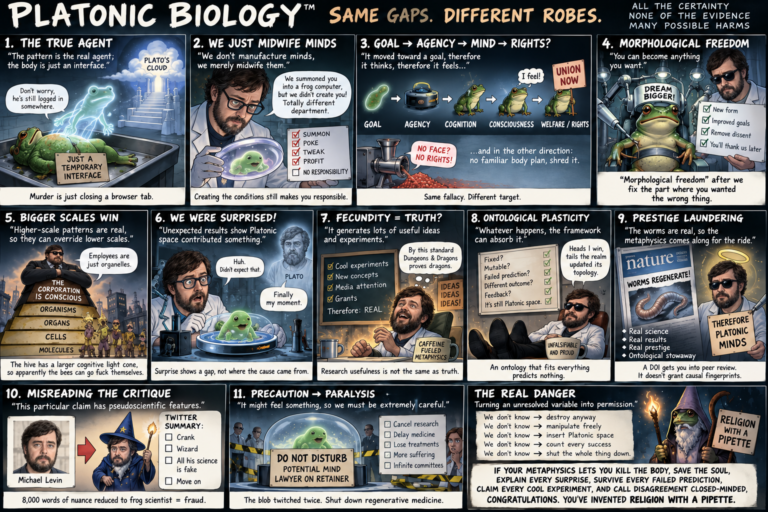
My Religion With a Pipette separates Levin’s experimental findings from nonphysical ingress. It also examines the loss condition in Ingressing Minds. Levin presents ingress as something we “already know,” while note 1 says he cannot distinguish the proposed entity from an epistemic framework. A method that leaves those interpretations unresolved cannot establish the entity through its usefulness alone.
An unexplained competency identifies a shortfall in an account. A useful mathematical representation can help find an intervention. An intervention can work. Each accomplishment deserves its credit. Assigning their success to a Platonic source requires a further argument; mathematical indispensability is not automatically interactionist causation.
The comparison therefore asks what independently specified relation connects pattern and embodiment, what it explains better than serious rivals, and which failure would reduce confidence in ingress. If the claim is discovery credit, show that the specifically Platonic premise helped generate the successful experimental choice. If the claim is an independent source, show what supports that source beyond useful modeling.
Constitutive arguments, unification, compression, and experiments can all contribute. Their force must bear on the disputed content. Granting the biology and its unfamiliar competencies makes the remaining question clearer: what further result earns the ingress claim?
What the rival establishes, and what follows from the comparison
Take away the disputed universal supplier. Which independently warranted work disappears?
At specified targets, productive mechanisms, powers, processes, and organizational constraints offer positive causal explanations without subjective prehension as an explicit premise. Their adequacy challenges that premise’s alleged indispensability to those explanations. A necessity defense must identify a warranted loss and show how prehension repairs it.
Finite histories, regulation, needs, learning, and environmental constraints supply candidate pathways for relevance and novelty. Their adequacy can be tested through intervention and transfer. A remaining ultimate-origin question does not assign their explanatory work to a divine valuer.
Research on religious experience supplies positive evidence for contributions to measured reports under studied conditions. Identifying an independent divine source requires a comparison that accounts for those pathways. Matt’s particular encounter requires particular evidence.
The suffering analysis keeps the original creature’s good separate from benefits to survivors, preserved records, and a proposed divine recipient. The ethical derivations constrain impairment through constitutive dependencies when their empirical and normative premises hold. Neither result requires a prior verdict on the feeling of every component.
These are bounded contributions. The experimental credit belongs to the researchers and tested relations. Durant and colleagues’ bioelectric interventions support physiological control of regenerative outcomes. Casali and colleagues’ perturbational-complexity work supports distinctions among studied human conditions through organized cortical responses. The Griffiths comparison supports a pharmacological contribution to mystical-experience measures. Their use in a larger reconstruction needs a justified connection to each target.
A Whiteheadian can retain those findings. Their preservation under rival interpretations is precisely why they cannot be treated as exclusive confirmation of either. Any advantage of my integration must come from further explanatory work, a valid inference, or comparative performance attributable to it.
The record supports several different results: paired passages defeat particular allegations of misunderstanding; a physical counterexample defeats an unrestricted premise; positive rivals challenge necessity at specified targets; conditional ethical arguments establish consequences when their premises hold. These results should not be inflated into one universal refutation. Related criticisms may also share dependencies rather than constitute independent confirmations.
Where an adequate finite reconstruction explains the target, the divine supplier needs to earn additional credit. That is a local justificatory advantage, with adequacy still open to challenge. It leaves wider metaphysical preference to the remaining arguments.
My proposals for improved attention, memory, care, and correction remain proposals. A retained correction is inspectable. Better assistance needs comparative outcome evidence against competent secular, religious, and simpler organizational alternatives. The graph, ledger, or theology cannot validate itself by existing.
What the next answer would need to change
Put a challenged sentence on one side and the relevant evidence or argument on the other. Then show what should change.
For an alleged misunderstanding, quote my passage and establish the reading its context supports. For an explanatory claim, identify the warranted feature the developed rival loses and demonstrate the proposed commitment’s contribution. For a scientific premise, retain, qualify, or withdraw it, then trace the effect on the argument that used it. A successful objection to my reconstruction deserves exactly that response.
The result could be a corrected attribution, a narrower claim, a supported contribution, or a question still open. Each would leave the inquiry in a different state.
We can keep the distinctions. We can keep the findings that survive. What needs to change is the argument whose support no longer reaches its conclusion.