The Fecundity Alibi: How Unfalsifiability Masquerades as Progress. Weaponizing Real Science To Justify Problematic Metaphysics
Framework clarification and update: September–October 2026
This article predates several later clarifications and extensions of my methodology and working ontology. I am leaving the original argument intact for intellectual provenance rather than silently rewriting the record. The later work makes my claim typing, scope limits, bridge requirements, uncertainty bookkeeping, and comparative standards more explicit.
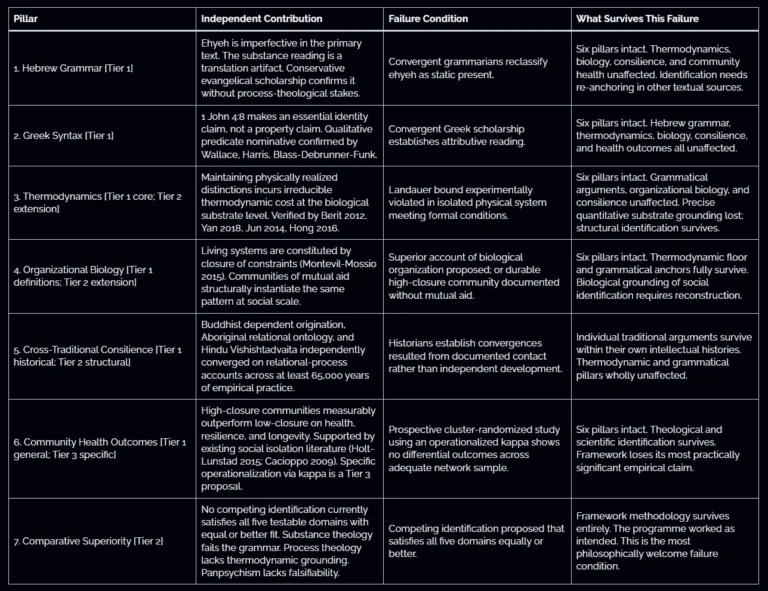
My work on Thermodynamic Monism was developed as a naturalistic process-relational research programme and comparative countermodel, particularly in response to Platonic and anti-physicalist arguments claiming that biological organization, morphogenesis, cognition, or other phenomena required additional nonphysical explanatory machinery. Its purpose was to test how much of the relevant explanatory work could be recovered from causal continuity, thermodynamic constraint, historically accumulated organization, multiscale dynamics, and higher-level difference-making without assuming the richer metaphysical posit under dispute.
I did not take that comparative success to establish that thermodynamics explains everything, that thermodynamic variables are privileged at every scale, or that empirical success by itself settles the intrinsic nature of reality. The current formulation makes those limits more explicit. The commitments I continue to retain include one causally continuous process order rather than separate causal substances or realms; thermodynamic constraints on physical realization; dynamically maintained and historically conditioned organization; and the reality of higher-level explanatory variables when they earn predictive, counterfactual, interventionist, compressive, or transferable leverage. One process does not mean one explanation.
The same clarification applies to my earlier use of falsification-first language. I did not use the rule “if it is not falsifiable, it is false.” My methodology already distinguished questions of semantic determinacy, evidential burden, theory-ladenness, auxiliary hypotheses, counterfactual testing, and Lakatosian research-programme appraisal. A sufficiently determinate empirical or causal claim should incur conditions under which it would lose support, but not every meaningful claim belongs before the same tribunal. Formal, semantic, phenomenological, historical, modal, normative, ontological, causal, and empirical claims can require different forms of warrant and criticism.
My current Recursive Corrigibility Framework formalizes that plural structure more explicitly. The shift from falsification-first to corrigibility-first is therefore primarily a clarification and expansion of jurisdiction: identify the claim type, determine what evidence or argument actually bears on it, locate the relevant bridge and dependencies, specify what could revise it, and localize failure to the part of the argument that actually failed rather than allowing one failure to automatically propagate through an entire framework.
My current working ontology is Provisional, Boundary- and Scale-Relative Realism . It makes explicit a discipline already motivating much of the earlier work: boundaries, scales, identities, causal variables, and explanatory vocabularies must earn their relevance at the target under investigation. Local success does not automatically transport into universal, intrinsic, necessary, or exhaustive metaphysical conclusions.
An accessible statement of that position appears in What Is Provisional, Boundary- and Scale-Relative Realism? . Explanatory gaps are treated as records of missing warrant rather than automatic evidence for whatever ontology might fill them. Evidence also does not transport across boundaries, scales, or constructs merely because the same vocabulary can be used in both places.
My earlier consciousness work should be read with the same distinction in mind. My proposed bridge between organized physical dynamics and phenomenality was already presented as a risky empirical wager with explicit conditions for failure, not as a settled conclusion about phenomenal identity. Phenomenal identity remained unresolved. What later work makes more explicit is the dependency structure. Evidence for organizational closure, recursive integration, bounded perspective, temporal continuity, report, discrimination, self-modeling, valuation, or agency can bear strongly on those particular capacities without automatically settling whether any of them is identical with phenomenal experience. Evidence earned by one construct should not silently migrate into another.
I therefore now decompose the traditional Hard Problem more explicitly into distinct questions about phenomenal occurrence, phenomenal character, candidate subject boundaries, physical organization, report and judgment, the meta-problem, modal arguments, bridge principles, and explanatory completion. This preserves unresolved phenomenality without allowing the unresolved remainder itself to perform explanatory or metaphysical work that has not independently been earned. The Hard Problem dissolves as a distinct unitary problem if, once those constituent questions are separated, no additional positive explanandum remains and no necessary explanatory relation is lost by the decomposition.
The most current statement of that analysis is David Chalmers’s “Hard Problem of Consciousness” Has a Hard Problem of the Gaps: How His Own Methodology Dissolves Both . The newer argument asks whether the canonical Hard Problem retains any additional positive explanandum after its constituent questions are separated. If no positive residual can be identified, and no necessary explanatory relation is destroyed by the decomposition, then the monolithic Hard Problem dissolves as a distinct unitary explanandum while the constituent questions remain live wherever the evidence leaves them unresolved.
My later comparison with Matthew David Segall and Whiteheadian panexperientialism applies the same rule in another direction. In Where the Necessity Case for Mathew Segall & Whitehead’s Prehension Fails , I ask which explanatory targets actually require subjective prehension rather than merely remaining compatible with it. Mechanistic, dispositional, process, organizational, constraint-based, and intervention-sensitive accounts recover substantial causal explanatory work without subjective prehension as a premise. That undercuts a necessity claim at those targets without establishing that universal prehension is false. Its wider application still requires independent comparative and transport warrant.
My October work on Michael Levin extends a distinction that was already central to my earlier criticism of biological Platonism: strong empirical results do not automatically transfer their evidential authority to every metaphysical interpretation placed around them. In Religion With A Pipette: Is Michael Levin’s “Ingressing Minds” Pseudoscience? A Scholarly Analysis , I separate the experimental evidence for bioelectricity, morphogenesis, biological competency, synthetic organisms, and multiscale control from the additional claim that such systems access nonphysical minds or Platonic structures.
The newer formulation makes the credit-assignment rule especially explicit: evidence shared by multiple rival explanations supports the shared empirical structure first. An additional metaphysical posit earns additional credit only when the feature it uniquely adds improves prediction, intervention, explanation, compression, transfer, or some other claim-appropriate discriminator relative to serious alternatives.
I have consolidated the larger Levin research programme in Biologist Michael Levin Criticism: Science or Pseudoscience? . The index separates the evidential status of Levin's experimental bioelectricity and morphogenesis work from the distinct questions raised by TAME, basal-cognition language, consciousness attribution, Platonic ingress, and stronger metaphysical or theological interpretations. It also collects later corrections, qualifications, primary sources, peer-reviewed literature, and comparative alternatives.
A fuller account of the development of Thermodynamic Monism, what I continue to retain, what I now state more narrowly, and which specific earlier formulations I would revise appears in What Is Thermodynamic Monism? Auditing My Own Framework—September 2026 Revisions and Clarifications .
Fecundity Without Falsification: The Universal Methodological Escape Hatch
There is a reason serious philosophy of science has always insisted that fecundity be tethered to falsifiability. Once that tether is cut, fecundity ceases to be a criterion and becomes a permission slip. And permission slips, once issued, are not honored selectively.
Serious philosophy of science treats “fruitfulness” (also called productivity, fertility, or fecundity) as, at best, a secondary virtue in theory appraisal. Ernan McMullin, whose 1976 essay “The Fertility of Theory and the Unit for Appraisal in Science” remains the most authoritative treatment of the subject, made this explicit: fecundity matters when two hypotheses make comparable risky commitments, because one might open more testable lines of inquiry than the other. But once fruitfulness is promoted to a substitute for loss conditions, it stops functioning as a methodological virtue and becomes a permission structure. “Keep it if it keeps generating activity,” regardless of whether it could ever be wrong. That basic distinction between explanatory productivity and empirical vulnerability is part of the modern demarcation conversation in philosophy of science, even when authors disagree about exactly how to draw the boundary.
Michael Levin’s defense of Platonic Space rests increasingly on this maneuver. When pressed to specify what would falsify his hypothesis, he does not name an observation, an experiment, or a measurable outcome. Indeed, years after beginning to promote his Platonism, he’s yet to produce a single example of a successful lab prediction “inspired by” this framework beforehand. Instead, he offers a personal stopping rule and a large pile of IOU notes.
“I move on when I feel that it’s not being fruitful for new discoveries.”
If this definition of fecundity is accepted, then we must accept its consequences. And those consequences are not hypothetical. They are already with us.
The Slippery Currency of “Fruitfulness”
Under Levin’s formulation, a framework is justified so long as it continues to generate activity, papers, excitement, or internal motivation. It need not exclude any possible world. It need not risk failure. It need only persist. Like a London houseguest who never quite gets around to leaving, it requires only that the host not grow actively bored.
This is not a new standard. It is an abandoned one.
Karl Popper rejected it explicitly:
“Confirmation is a comparatively weak criterion, easily satisfied even by pseudo-scientific theories.”
Imre Lakatos was clearer still:
“A research programme which explains everything explains nothing.”
Yet Levin asks us to accept precisely this. If the idea continues to “bear fruit,” it stays. If not, it quietly retires. No falsifier required. No loss condition specified. One might as well claim that astrology remains viable because astrologers continue to find it personally fulfilling.
Now consider what follows if we take this seriously.
Discovery Institute Logic, Sanitized
The Discovery Institute has long argued that Intelligent Design should be taken seriously because it is “fruitful.” It motivates research. It reframes biology. It generates publications. It inspires new questions. Each year, it produces conferences, journals, and earnest graduate students convinced they are on the frontier of scientific revolution.
That claim has been rejected by every major scientific body not because Intelligent Design fails to inspire its proponents, but because it is structurally unfalsifiable. The problem was never that it lacked fecundity in Levin’s sense. ID theorists remain remarkably productive within their own ecosystem, churning out books and papers with impressive regularity. The problem was that it could not lose.
Once fecundity is detached from falsifiability, the Discovery Institute’s argument becomes valid. Not correct. Valid. If personal fulfillment and continued research activity constitute sufficient justification, then Intelligent Design has met the bar. It inspires. It generates questions. It produces literature. By Levin’s standard, it qualifies.
And what follows? The church then finds the Discovery Institute fecund. Creationist curricula become fecund. Theological explanations of suffering become fecund. Each layer inherits legitimacy from the one before it, not because evidence compels belief, but because belief continues to reproduce itself. Christopher Hitchens would have recognized this pattern immediately: it is the intellectual equivalent of passing a counterfeit bill. The first transaction may go unnoticed, but soon the entire currency collapses.
This is not a slippery slope argument. It is a well-documented historical pattern. Once unfalsifiable claims are granted scientific standing through appeal to fruitfulness alone, the boundary between legitimate inquiry and sophisticated pseudoscience dissolves entirely.
The Universal Alibi Problem
Hannah Arendt warned that when standards collapse, they do not collapse locally:
“The result of a consistent and total substitution of lies for factual truth is not that the lie will now be accepted as truth, and truth be defamed as lie, but that the sense by which we take our bearings in the real world (and the category of truth versus falsehood is among the mental means to this end) is being destroyed.”
If fecundity means “continues to feel useful to its adherents,” then racist pseudoscience qualifies. Eugenics qualified. Phrenology qualified. Social Darwinism qualified. Each generated research programs, journals, careers, and self-confirming communities. Each was, in its heyday, remarkably productive.
They were fecund. They were also catastrophically wrong.
The reason they were ultimately rejected was not a lack of creativity. It was exposure to falsification, ethical catastrophe, and empirical collapse. Phrenologists continued finding skull measurements fascinating right up until the moment when someone bothered to check whether their predictions actually worked.
Levin’s definition removes that exposure. It asks us to evaluate theories the way one might evaluate hobbies: do they bring joy? Do they inspire continued engagement? These are questions for dating apps, not for distinguishing science from pseudoscience.
“Let’s See How It Goes” Is Not a Safeguard
“If that research agenda nets no new discoveries, then I’ll move on.”
Levin reassures us that he will abandon Platonic Space if it stops producing results:
This is not a safeguard. It is a delay tactic masquerading as methodology.
A framework that cannot specify what would count as failure can always reinterpret outcomes as partial success, misunderstood signals, or premature measurement. The space is not mapped yet. The interface science is incomplete. The accounting needs revision. The constants may be deeper than physics. These are not hypotheticals; they are the standard repertoire of unfalsifiable frameworks under pressure. Every failed prediction becomes evidence that we simply haven’t understood the framework deeply enough yet.
Thomas Kuhn warned explicitly against confusing productivity with progress:
“Normal science often suppresses fundamental novelties because they are necessarily subversive of its basic commitments.”
But Kuhn never suggested that novelty excuses immunity from falsification. On the contrary, revolutions occur when theories break under pressure, not when their advocates tire of them. Phlogiston didn’t retire gracefully; it was destroyed by oxygen. The luminiferous ether didn’t decide to move on; it was annihilated by the Michelson-Morley experiment.
Levin’s criterion would have granted both theories indefinite extension. After all, phlogiston theory remained remarkably productive right up until it collapsed. Researchers continued finding it useful, generating predictions, opening new avenues of inquiry. By the metric of “fruitfulness to adherents,” it should never have been abandoned.
Metaphysics With a Lab Coat
Levin insists he is not doing philosophy. This is rather like insisting one is not getting wet while swimming. The moment one replaces falsification with fecundity, one is doing metaphysics, whether one admits it or not. And not particularly good metaphysics at that.
W.V.O. Quine made the point starkly:
“To be is to be the value of a variable.”
Platonic Space introduces variables that do no measurable work while claiming causal relevance. When challenged, it retreats into metaphor. When praised, it returns as ontology. This oscillation is not methodological sophistication. It is evasion.
Nicholas Shackel named it for what it is:
“The motte-and-bailey doctrine allows one to move back and forth between positions, enjoying the advantages of both without paying the costs of either.”
Fecundity becomes the bridge that allows this movement without accountability. It is the permission slip that validates retreat to the motte while continuing to reap the rhetorical benefits of the bailey.
Why This Matters Now
Levin objects that he cannot control how others use his ideas. That is true, in precisely the way that it is true that one cannot control how a loaded gun behaves once handed to a stranger. But one can control whether one hands out loaded guns.
A criterion that legitimizes Intelligent Design today will legitimize something worse tomorrow. That is not moral panic. It is historical induction. The Discovery Institute did not invent bad epistemology; it inherited frameworks that others had rendered unfalsifiable and claimed the inheritance as its own.
Science does not protect itself by trusting intentions. Intentions, as Hitchens observed repeatedly, are among the cheapest commodities in human affairs. Science protects itself by enforcing loss conditions.
Daniel Dennett put it plainly:
“A theory that explains everything explains nothing, and a theory that explains nothing can never be wrong.”
Levin’s fecundity asks us to accept a theory that cannot be wrong so long as it remains interesting. This is not scientific methodology. It is a book club with laboratory equipment.
The Verdict Fecundity Delivers
If fecundity means what Levin says it means, then every resilient belief system qualifies. The Discovery Institute qualifies. Religious extremism qualifies. Ideological pseudoscience qualifies. Each is fecund within its own ecosystem. Each generates research, publications, and true believers convinced they are at the vanguard of revolutionary insight.
The scientific community rejected these not because they lacked imagination (they possessed it in abundance), but because imagination is cheap. What is expensive is being wrong in public. What is rare is the willingness to specify the conditions under which one would admit defeat.
Fecundity without falsifiability is not a virtue. It is an alibi. And once admitted as valid methodology, it does not discriminate. It never has. It never will.
The phrenologists were very fecund. The eugenicists were extraordinarily fecund. The Lysenkoists were devastatingly fecund. Each produced mountains of research, each inspired devoted followers, each found their framework endlessly generative of new questions and insights. Each was also profoundly, catastrophically wrong.
What distinguished them from legitimate science was not lack of productivity. It was lack of falsifiability.
Levin’s definition erases that distinction. One can only hope he notices before someone else applies it to something considerably less benign than planarian regeneration.
References
McMullin, E. (1976). The Fertility of Theory and the Unit for Appraisal in Science. In R. S. Cohen, P. K. Feyerabend, & M. Wartofsky (Eds.), Boston Studies in the Philosophy of Science, Vol. 39: Essays in Memory of Imre Lakatos (pp. 395-432). Dordrecht: D. Reidel. https://doi.org/10.1007/978-94-010-1451-9_25 Annotation: The seminal and most authoritative treatment of fertility/fecundity as a theoretical virtue in philosophy of science. McMullin distinguishes between fertility as a legitimate secondary criterion when theories make comparable empirical commitments, versus fertility as a substitute for empirical adequacy, which he explicitly rejects.
Arendt, H. (1967). Truth and Politics. In Between Past and Future: Eight Exercises in Political Thought. New York: Viking Press. Original essay in The New Yorker, February 25, 1967.
Dennett, D. C. (1995). Darwin’s Dangerous Idea: Evolution and the Meanings of Life. New York: Simon & Schuster. ISBN 978-0684824710.
Kuhn, T. S. (1962). The Structure of Scientific Revolutions. Chicago: University of Chicago Press. ISBN 978-0226458083.
Lakatos, I. (1970). Falsification and the Methodology of Scientific Research Programmes. In I. Lakatos & A. Musgrave (Eds.), Criticism and the Growth of Knowledge (pp. 91-196). Cambridge: Cambridge University Press. ISBN 978-0521078269.
Lakatos, I. (1978). The Methodology of Scientific Research Programmes (Philosophical Papers, Vol. 1). Edited by J. Worrall & G. Currie. Cambridge: Cambridge University Press. ISBN 978-0521280310.
McMullin, E. (1982). Values in Science. PSA: Proceedings of the Biennial Meeting of the Philosophy of Science Association, 1982(2), 3-28.
Popper, K. R. (1963). Conjectures and Refutations: The Growth of Scientific Knowledge. London: Routledge. ISBN 978-0415043182.
Quine, W. V. O. (1948). On What There Is. Review of Metaphysics, 2(5), 21-38. Reprinted in Quine, W. V. O. (1953). From a Logical Point of View (pp. 1-19). Cambridge, MA: Harvard University Press. ISBN 978-0674323513.
Shackel, N. (2005). The Vacuity of Postmodernist Methodology. Metaphilosophy, 36(3), 295-320. https://doi.org/10.1111/j.1467-9973.2005.00372.x
Nolan, D. (1999). Is Fertility Virtuous in its Own Right? British Journal for the Philosophy of Science, 50(2), 265-282. https://doi.org/10.1093/bjps/50.2.265
Schindler, S. (2017). Theoretical Fertility McMullin-Style. European Journal for Philosophy of Science, 7(1), 151-173. https://doi.org/10.1007/s13194-016-0152-5
Segall, R. (2008). Fertility and Scientific Realism. British Journal for the Philosophy of Science, 59(2), 237-246. https://doi.org/10.1093/bjps/axn008