
The Physicalism-Panpsychism False Dichotomy and Organizational Closure as the Falsifiable Third Option
Framework clarification and update: September–October 2026 This article predates my later methodological clarifications and remains unchanged for intellectual provenance. My current Recursive Corrigibility Framework and Boundary- and Scale-Relative Realism clarify claim types, scope, evidential burdens, explanatory bridges, uncertainty, and localized correction. Thermodynamic Monism remains a provisional naturalistic countermodel, while my work on consciousness , Whiteheadian prehension , and Michael Levin distinguishes established findings from additional phenomenal or metaphysical claims. Local explanatory success, shared evidence, and unresolved gaps do not, by themselves, establish or refute those stronger claims.
This article predates several later clarifications and extensions of my methodology and working ontology. I am leaving the original argument intact for intellectual provenance rather than silently rewriting the record. The later work makes my claim typing, scope limits, bridge requirements, uncertainty bookkeeping, and comparative standards more explicit.
My work on Thermodynamic Monism was developed as a naturalistic process-relational research programme and comparative countermodel, particularly in response to Platonic and anti-physicalist arguments claiming that biological organization, morphogenesis, cognition, or other phenomena required additional nonphysical explanatory machinery. Its purpose was to test how much of the relevant explanatory work could be recovered from causal continuity, thermodynamic constraint, historically accumulated organization, multiscale dynamics, and higher-level difference-making without assuming the richer metaphysical posit under dispute.
I did not take that comparative success to establish that thermodynamics explains everything, that thermodynamic variables are privileged at every scale, or that empirical success by itself settles the intrinsic nature of reality. The current formulation makes those limits more explicit. The commitments I continue to retain include one causally continuous process order rather than separate causal substances or realms; thermodynamic constraints on physical realization; dynamically maintained and historically conditioned organization; and the reality of higher-level explanatory variables when they earn predictive, counterfactual, interventionist, compressive, or transferable leverage. One process does not mean one explanation.
The same clarification applies to my earlier use of falsification-first language. I did not use the rule “if it is not falsifiable, it is false.” My methodology already distinguished questions of semantic determinacy, evidential burden, theory-ladenness, auxiliary hypotheses, counterfactual testing, and Lakatosian research-programme appraisal. A sufficiently determinate empirical or causal claim should incur conditions under which it would lose support, but not every meaningful claim belongs before the same tribunal. Formal, semantic, phenomenological, historical, modal, normative, ontological, causal, and empirical claims can require different forms of warrant and criticism.
My current Recursive Corrigibility Framework formalizes that plural structure more explicitly. The shift from falsification-first to corrigibility-first is therefore primarily a clarification and expansion of jurisdiction: identify the claim type, determine what evidence or argument actually bears on it, locate the relevant bridge and dependencies, specify what could revise it, and localize failure to the part of the argument that actually failed rather than allowing one failure to automatically propagate through an entire framework.
My current working ontology is Provisional, Boundary- and Scale-Relative Realism . It makes explicit a discipline already motivating much of the earlier work: boundaries, scales, identities, causal variables, and explanatory vocabularies must earn their relevance at the target under investigation. Local success does not automatically transport into universal, intrinsic, necessary, or exhaustive metaphysical conclusions.
An accessible statement of that position appears in What Is Provisional, Boundary- and Scale-Relative Realism? . Explanatory gaps are treated as records of missing warrant rather than automatic evidence for whatever ontology might fill them. Evidence also does not transport across boundaries, scales, or constructs merely because the same vocabulary can be used in both places.
My earlier consciousness work should be read with the same distinction in mind. My proposed bridge between organized physical dynamics and phenomenality was already presented as a risky empirical wager with explicit conditions for failure, not as a settled conclusion about phenomenal identity. Phenomenal identity remained unresolved. What later work makes more explicit is the dependency structure. Evidence for organizational closure, recursive integration, bounded perspective, temporal continuity, report, discrimination, self-modeling, valuation, or agency can bear strongly on those particular capacities without automatically settling whether any of them is identical with phenomenal experience. Evidence earned by one construct should not silently migrate into another.
I therefore now decompose the traditional Hard Problem more explicitly into distinct questions about phenomenal occurrence, phenomenal character, candidate subject boundaries, physical organization, report and judgment, the meta-problem, modal arguments, bridge principles, and explanatory completion. This preserves unresolved phenomenality without allowing the unresolved remainder itself to perform explanatory or metaphysical work that has not independently been earned. The Hard Problem dissolves as a distinct unitary problem if, once those constituent questions are separated, no additional positive explanandum remains and no necessary explanatory relation is lost by the decomposition.
The most current statement of that analysis is David Chalmers’s “Hard Problem of Consciousness” Has a Hard Problem of the Gaps: How His Own Methodology Dissolves Both . The newer argument asks whether the canonical Hard Problem retains any additional positive explanandum after its constituent questions are separated. If no positive residual can be identified, and no necessary explanatory relation is destroyed by the decomposition, then the monolithic Hard Problem dissolves as a distinct unitary explanandum while the constituent questions remain live wherever the evidence leaves them unresolved.
My later comparison with Matthew David Segall and Whiteheadian panexperientialism applies the same rule in another direction. In Where the Necessity Case for Mathew Segall & Whitehead’s Prehension Fails , I ask which explanatory targets actually require subjective prehension rather than merely remaining compatible with it. Mechanistic, dispositional, process, organizational, constraint-based, and intervention-sensitive accounts recover substantial causal explanatory work without subjective prehension as a premise. That undercuts a necessity claim at those targets without establishing that universal prehension is false. Its wider application still requires independent comparative and transport warrant.
My October work on Michael Levin extends a distinction that was already central to my earlier criticism of biological Platonism: strong empirical results do not automatically transfer their evidential authority to every metaphysical interpretation placed around them. In Religion With A Pipette: Is Michael Levin’s “Ingressing Minds” Pseudoscience? A Scholarly Analysis , I separate the experimental evidence for bioelectricity, morphogenesis, biological competency, synthetic organisms, and multiscale control from the additional claim that such systems access nonphysical minds or Platonic structures.
The newer formulation makes the credit-assignment rule especially explicit: evidence shared by multiple rival explanations supports the shared empirical structure first. An additional metaphysical posit earns additional credit only when the feature it uniquely adds improves prediction, intervention, explanation, compression, transfer, or some other claim-appropriate discriminator relative to serious alternatives.
I have consolidated the larger Levin research programme in Biologist Michael Levin Criticism: Science or Pseudoscience? . The index separates the evidential status of Levin's experimental bioelectricity and morphogenesis work from the distinct questions raised by TAME, basal-cognition language, consciousness attribution, Platonic ingress, and stronger metaphysical or theological interpretations. It also collects later corrections, qualifications, primary sources, peer-reviewed literature, and comparative alternatives.
A fuller account of the development of Thermodynamic Monism, what I continue to retain, what I now state more narrowly, and which specific earlier formulations I would revise appears in What Is Thermodynamic Monism? Auditing My Own Framework—September 2026 Revisions and Clarifications .
Misplaced Concreteness, Misplaced Falsifiability: Matthew David Segall, Deivon Drago, and the Differential Loss-Condition Test
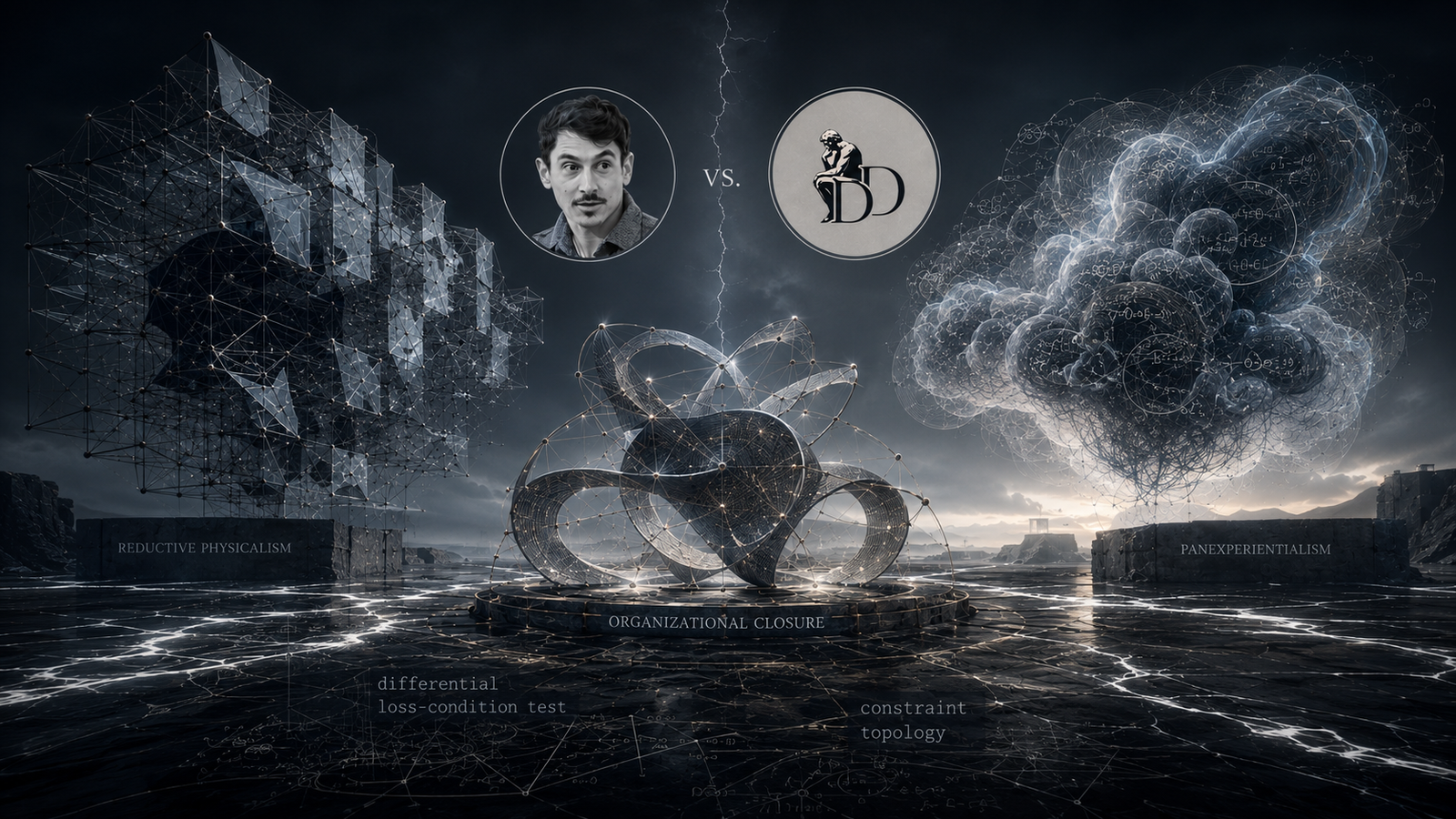
Below, I respond to Matthew David Segall’s defense of contemporary forms of panexperientialism in his article “Against Physicalism’s Misplaced Concreteness“ that he wrote in response to Deivon Drago’s article “Against Panpsychism“. They are rival ways of refusing to say, in public and in advance, what would force the theory to lose. Panpsychism without a discriminating criterion and generic physicalism without a threshold are not opposites in any empirically interesting sense. However, there’s a third way neither acknowledges. I’d like to offer the organizational naturalism alternative that resolves the false dichotomy. See my article here for the full framework that fully grounds consciousness physically in ways neither panexperientialism or generic physicalism are able to: “Consciousness Naturalized: A Falsifiable Substrate-Agnostic Consciousness Theory“.
The Shared Structural Error
Before engaging the substance, it is worth naming the structural error that this article argues both physicalism and panexperientialism share, because the error is what makes them vulnerable to the same challenge from the same direction.
The error is comparative underdetermination plus asymmetric burden placement. Each position appeals to genuine evidence or genuine explanatory fecundity that many rival frameworks also accommodate, so the evidence is non-differential. When pressed for unique predictions or loss conditions for its own distinctive commitments rather than for the broader family it belongs to, each speaker either widens scope from empirical claim to metaphysical orientation, or shifts to venue, tone, technicality, or prior reading obligations, or tacitly treats the absence of precise loss conditions as acceptable for their own framework while applying stricter standards to opponents. The result is a framework that claims empirical authority or explanatory superiority while declining to specify what would count against its own added layer over rivals that fit the same evidence equally well.
This error can be compressed into one diagnostic question, which I will call the differential loss-condition test: what observation under what conditions would show that your account is wrong, rather than some broad superclass of views you belong to in general? A position fails the test when it can specify falsifiers only for a broader category shared with rivals, or when it retreats to abstraction exactly at the point where differential testing is requested, or when it substitutes fecundity, coherence, prestige, or inspiration for exposure to loss.
Both physicalism and panexperientialism fail this test in the same four moves, documented across the exchange this article responds to. The organizational closure account is offered here not as a triumphant third option but as the position that has at least attempted to pass the test, and whose loss conditions are therefore available for public examination and falsification.
The False Dichotomy and Its Real Costs
Before evaluating either side’s arguments on their merits, it is worth naming the structure that makes this debate so persistent and so difficult to resolve. The debate between physicalism and panexperientialism is not primarily an empirical dispute. It is a debate between two positions that share a false presupposition and derive their authority partly from the fact that each makes the other look worse than it is.
The presupposition is this: the question of consciousness is a question about which substance is fundamental, matter or experience. Physicalists say matter is fundamental and experience is derivative. Panexperientialists say experience is fundamental and matter is derivative or co-extensive. Both positions are structured as answers to the same question. That question is malformed. Asking whether matter or experience is fundamental is asking for a metaphysical priority that neither evidence nor argument can settle, which is why this debate has continued for centuries without producing a single differential prediction that could resolve it.
Organizational closure dissolves the question rather than answering it. The question it replaces it with is: what physical organization must obtain for there to be a perspective at all? That question is tractable. It makes specific predictions. It has loss conditions. It does not require settling the metaphysical priority dispute to do its explanatory work. But before that can be seen clearly, the structural costs of remaining inside the false dichotomy need to be stated plainly, because both sides have real-world costs that are proportional to the authority with which they are held.
The structural problems of generic physicalism
Generic physicalism, the kind that says consciousness is physical, requires whatever future physics says, and points to neural correlates as evidence, faces Hempel’s Dilemma as its foundational problem. If “physical” means current physics, the account is hostage to an incomplete theory in precisely the domain where incompleteness matters most. If “physical” means ideal future physics, the account is circular: physics is then defined as whatever eventually explains everything, which is not a claim about the world but a placeholder wearing the vocabulary of a claim. This is the architecture of the position, not a minor technical difficulty.
The practical consequence is that generic physicalism borrows the authority of science for a claim that has not met science’s standards. When a credentialed voice tells a lay audience that consciousness is physical and does so with the confidence appropriate to an established finding, while being unable to specify what observation would show the wrong physical processes have been identified as consciousness-relevant, the audience is left with a false impression of settlement. The question is not closed. It has been made to sound closed.
This matters outside the seminar room. Questions about which systems are conscious have direct implications for how patients with disorders of consciousness are treated, how animals in industrial systems are treated, and how AI systems are designed and deployed. A physicalism that cannot specify which physical organizations generate consciousness is not a neutral position on these questions. It is an unfalsifiable position whose unfalsifiability can be exploited in either direction: to attribute consciousness where convenient or to deny it where convenient, with no principled criterion constraining either move. The authority of science has been borrowed. The accountability of science has been declined. Those are not the same transaction.
The position is not problematic because it is physicalist. It is problematic because it is generic. A physicalism that specifies which physical organizations are consciousness-relevant, makes differential predictions, and accepts loss conditions is a contribution to inquiry. A physicalism that says “it’s all physical” and declines to say what that means for hard cases is not a theory of consciousness. It is a slogan with credentials attached, and the credentials are doing work the argument has not earned.
The structural problems of panexperientialism and anti-physicalist frameworks
The structural problem on the anti-physicalist side is different but at least as serious. Panexperientialism, process-relational ontology, idealism, and related frameworks share a common move: they argue that physics leaves something out and introduce a metaphysical supplement. The move is made with varying degrees of sophistication. Whitehead’s version is among the most sophisticated available. But the logical structure is identical across the family.
The problem is that this logical structure has no adjudication mechanism. Once the move is established (physics leaves something out, therefore an experiential or intentional supplement is required), there is no principled basis for distinguishing Whitehead’s supplement from any other that makes the same opening move. The same argument structure that licenses prehension licenses vital forces. The same argument structure that licenses concrescence licenses divine causation. The same argument structure that licenses process-relational experience licenses every metaphysical addition that has ever been proposed to fill the gap that physics supposedly leaves.
This is not a hypothetical risk. The logic of “science leaves out what matters most” is the founding move of Intelligent Design, of faith healing, of every pseudoscientific framework that exploits the genuine incompleteness of physical description to introduce an unfalsifiable supplement. Whitehead’s supplement is philosophically more sophisticated than these. But sophistication does not close the door. It leaves it open with better furniture inside.
The full force of this becomes visible when you ask what a principled discrimination criterion would have to rule out. A Last Thursdayist, a substance dualist, a committed physicalist with a soul-shaped escape hatch, a Cartesian interactionist, a Christian fundamentalist who believes consciousness is God’s breath in the clay, a Hindu Vedantist, a young earth creationist with five minutes and a thesaurus: each of these positions also claims that physics underdescribes the intrinsic nature of matter, also fills the gap with something experiential, mental, or spiritual, and also lacks a principled criterion specifying when the filling fails. The gap Russell identified is real. A framework whose loss conditions cannot discriminate against that lineup is not doing philosophy. It is a framework whose epistemic accountability is inversely proportional to its institutional prestige, which is the most structurally dangerous combination available in public intellectual life: it claims the credibility of one enterprise while running the epistemology of another. The combination problem is the diagnostic that the swap failed: after 136 years of attempting to explain why micro-experiences combine into macro-experience, the framework has not produced a mechanism. It has produced descriptions of combination dressed in process vocabulary.
The “what is mental?” problem makes this concrete. Panexperientialism requires that experience, mentality, or interiority be present at every level of physical reality, but it has not specified what “mental” means when applied to quarks, fields, or spacetime geometry in a way that is distinct from “physical” described in experiential vocabulary.
Galen Strawson’s “Realistic Monism” (2006, Journal of Consciousness Studies) argues that physicalism entails panpsychism and that experience is present at the most fundamental level, but faces the immediate question: what are the phenomenal properties of a quark, and what would show they are absent? Philip Goff’s Consciousness and Fundamental Reality (2017) and Galileo’s Error (2019) are the most sustained recent treatments. Goff’s response is that we do not know the specific nature of micro-experiential properties but the general category must be present. That is precisely the kind of claim that fails the differential loss-condition test: “the category must be present” is not a prediction, it is an axiom.
David Chalmers’ “Panpsychism and Panprotopsychism” (2015, in Consciousness in the Physical World: Perspectives on Russellian Monism, pp. 246-276) attempts to sidestep the problem by positing proto-experiential rather than fully experiential fundamental properties, but proto-experiential properties face the same question displaced one level: what distinguishes a proto-experiential property from a physical relational property described in experiential vocabulary, and what observation would show the difference?
Thomas Nagel in Mind and Cosmos (2012) names the problem honestly when he acknowledges that panpsychist accounts have not specified what experience attaches to a fundamental particle, and treats this gap as a reason to expand our conception of nature rather than to doubt the framework. Whitehead’s own answer is the dipolar actual occasion: every actual entity has a physical pole (prehension of the past) and a mental pole (conceptual feeling of eternal objects). But the mental pole at subatomic levels is not mental in any sense that shares properties with human mentality except by stipulation. Whitehead’s operational definition (mental means responsive to novelty) either reduces to a very thin sense barely distinguishable from physical reactivity, or inflates to a very thick sense that anthropomorphizes the cosmos without a criterion for when the inflation is warranted.
The “what is mental?” problem is the precise structural mirror of the “what is physical?” problem that panexperientialists correctly diagnose in Hempel’s Dilemma. Both terms do their explanatory work only when they are specified at the level of which systems qualify and which do not, under what conditions, and what would show the specification is wrong. Generic physicalism declines that specification.
Panexperientialism declines it in the opposite direction. The organizational closure account provides it: mental applies when and only when organizational topology generates a genuine inside, a coupling position with its own asymmetry between what is internal to the maintenance loop and what is not. Under this definition, bacteria satisfy mutual constraint maintenance and are on the threshold of the relevant organizational condition; thermostats do not; termite colonies arguably do at the colony level, which is a prediction the account must own rather than evade. That gives mental the same discriminating power that alive has in biology: not mysterious, not universally distributed, specifically tied to organizational conditions that can be identified and tested.
How organizational closure resolves each
Against generic physicalism, organizational closure provides what generic physicalism refuses to provide: a specification of which physical organizations are consciousness-relevant, at which level of description, and what observations would show the specification is wrong. PCI tracks organizational topology rather than simpler physical measures. Constraint topology predicts phenomenal profiles in neurodegeneration better than cell count. Substrate-agnostic organizational closure predicts distinguishable signatures in artificial systems with equivalent constraint structure. These are risky predictions. They can be tested. They can fail. This is what it looks like to take the obligations of a physicalist account seriously rather than invoking them rhetorically.
Against panexperientialism, organizational closure provides an adjudication mechanism. The differential loss-condition test gives both sides something to compare against. It does not rule experiential vocabulary out of court. It requires that any experiential vocabulary used in a consciousness account specify what it adds over organizational closure specifically, not over generic physicalism. That is the fair requirement of any explanatory claim.
The mutual absorption problem and what organizational closure predicts that neither side can absorb
The deepest evidence that physicalism and panexperientialism are caught in a false dichotomy rather than a genuine empirical dispute is that each side can absorb the other’s evidence through renaming without generating any new predictions.
Physicalist findings that panexperientialism absorbs through renaming: neural correlates of consciousness become the physical conditions under which higher-grade prehensive occasions occur; global workspace broadcasts become the structural condition for integrated experiential concrescence; integrated information (IIT’s phi) becomes a measure of experiential integration in the occasion; predictive processing and active inference become the physical description of what is experientially anticipation and concern. None of these renamings generate new predictions. They are translations. The panexperientialist position survives by becoming interpretively flexible rather than empirically specific. This is what Deivon Drago states most cleanly in the exchange this article responds to: every prediction works identically whether or not electrons feel. That is not a feature of a research program. It is its termination condition.
Anti-physicalist findings that generic physicalism absorbs through renaming: the combination problem becomes an emergence problem handled by complexity theory; the claim that experience is relational and process-based becomes a systems neuroscience description of neural dynamics; the incompleteness of physics becomes a reason to wait for better physics rather than to revise the metaphysics. Each absorption closes the door on the anti-physicalist’s specific challenge without answering it.
What organizational closure predicts that neither side can absorb without conceding the organizational account’s central claim:
First, PCI tracks organizational topology specifically rather than simpler physical measures. This is not a prediction that follows from “it’s all physical” or from “experience is everywhere.” It is a prediction that a specific structural feature is the relevant variable rather than cell count, synaptic density, or metabolic rate. Generic physicalism can accommodate this after the fact by saying “topology is the relevant physical property.” What it cannot do is have predicted it in advance without already importing the organizational account.
Second, the substrate-agnostic organizational threshold predicts that artificial systems reaching equivalent organizational closure should generate PCI-like consciousness signatures, while artificial systems below that threshold should not, regardless of substrate. Generic physicalism with substrate commitments cannot absorb this prediction. Panexperientialism cannot absorb the corollary: if experience is universally present at every level of physical reality, the organizational threshold has no explanatory basis. The panexperientialist must explain why organizational closure marks the relevant boundary, which concedes the organizational account’s central mechanism.
Third, the degradation gradient predicts that phenomenal change should track organizational topology loss more precisely than simpler physical measures in neurodegeneration. A generic physicalism that accommodates this result after the fact has not predicted it. A panexperientialism that says some level of experience persists in every physical state regardless of organizational condition cannot absorb the finding that phenomenal signatures track the organizational boundary specifically.
These loss conditions are stated as directional research-program predictions. A fully operational version would specify, for the first prediction, the effect size at which PCI-topology correlation outperforms PCI-cell-count correlation at a pre-registered significance threshold; for the second, the patient cohort size and neurodegeneration staging at which the constraint-topology prediction must be powered; for the third, the minimum organizational closure specification for equivalent artificial systems and the PCI-like signature threshold distinguishing them from sub-threshold systems. The organizational closure research program has not yet conducted these pre-registered studies. Stating this openly is required by the framework’s own standard: a position that claims to have loss conditions but has not operationalized them into testable designs has aspirations, not falsifiers. The Casarotto et al. (2016) validation of PCI against a clinical consciousness-versus-unconsciousness standard and the Xu et al. (2024) crossover randomized controlled trial demonstrating PCIst sensitivity to rTMS-induced consciousness change in twenty minimally conscious patients are consistent with the first prediction. They are not yet differential tests of it. That work remains to be done.
A debate that cannot be resolved by evidence is a debate whose persistence serves the debaters and grant writing more than it serves the truth. The organizational closure account has loss conditions. It can be shown to be wrong.
On Segall’s Opening
Segall begins by placing Whitehead within a rich lineage of scientific animists, including Giordano Bruno, Gottfried Leibniz, and Gustav Fechner, who all refused the modern fantasy of dead matter awaiting the miraculous late arrival of mind. Organizational closure theorists including Maturana, Varela, Montévil, and Mossio belong to an equally rich lineage of process thinkers who refused the same fantasy without requiring experience to be distributed throughout physical reality. But lineage is not argument, and this applies symmetrically: neither Segall’s lineage nor this article’s licenses the conclusions drawn from it. The question is not whether distinguished thinkers have held panexperientialist views. The question is what observation under what conditions would tell us that panexperientialism has the wrong account of what makes physical processes experiential. That question remains unaddressed.
I should say at the start that I grant most of Segall’s criticisms of the forms of physicalism he chose to refute. Those forms assume a vacuous-actuality ontology. Organizational closure assumes an alternative process-thermodynamic account that may be as different from reductive materialism as it is from panexperientialism, and which avoids the specific problems that afflict both.
The Carroll Dilemma Applied Symmetrically
Segall makes use of a dilemma against physicalism: either consciousness modifies the Core Theory, in which case we should detect it experimentally, or it does not, in which case it is epiphenomenal. The dilemma only works, Segall argues, if one has already assumed that the Core Theory gives us concrete nature in itself rather than a partial, abstract, formally powerful set of models whose empirical touch points are themselves abstracted from experience.
This is a legitimate point against naive physicalism. But this same dilemma applies to panexperientialism with equal force. Either prehension modifies the causal structure of physical processes in ways distinguishable from organizational constraint dynamics, in which case we should be able to specify the observation that detects it, or it does not, in which case prehension is a redescription of physical causation with experiential vocabulary added and the panexperientialist layer is doing no independent explanatory work. Segall’s response to Carroll is to say the dilemma assumes what needs to be put in question. The organizational closure account makes the same response to Segall. The dilemma is symmetric. Here we see the first sub-move of the shared structural error: the evidence appealed to is genuine but non-differential. It is equally compatible with physicalism, panexperientialism, and organizational closure.
The Standard Model, Experience, and the Transcendental Argument
Segall argues that the Standard Model of particle physics is not the concrete real. It is a set of mathematical abstractions and experimental protocols assembled from the activities of embodied knowers already immersed in a world of feeling. It does not precede experience. It is abstracted from and depends upon experience.
This is structurally equivalent to Prokop’s transcendental reading of Jonas in support of the phenomenological life-mind continuity thesis. On Prokop’s reading, certain phenomenological features are a necessary precondition for understanding the possibility of metabolism, rather than something derivable from metabolism itself. Segall appears to make an analogous move in physics by treating experience as a precondition for the intelligibility of physical theory, though that comparison requires separate support from Segall’s own text.
Transcendental arguments of this structure have a well-documented vulnerability: they prove too much or nothing at all. The premise must be self-guaranteeing, operationally self-refuting if denied, which means the argument’s conclusion is entailed by the form of the inquiry rather than by evidence about the world. The argument shows that experience is presupposed by the activity of doing physics. It does not show that the content of physical processes at every level must be experiential. Presupposition in the epistemological sense does not license attribution in the ontological sense. The organizational closure account accepts that experience is the medium through which we access physical reality while denying that this acceptance requires distributing experience throughout that reality. The transcendental argument establishes the epistemological claim but not the ontological one, and Segall needs the ontological one.
The Hard Problem: Distributed Is Not Dissolved
I do agree with Segall that Chalmers’ hard problem of consciousness is poorly conceived. It frames the problem in a way that obscures how far upstream the real source of the issue is. First, modern science methodologically excluded subjectivity from its picture of nature. Then, having forgotten the methodological character of this exclusion, science finds itself asking how subjectivity could ever have arisen. Agreed entirely.
But Whitehead’s solution is to re-insert experience at every level of physical reality, which generates its own upstream problem at least as severe: what is mental? What must experience be like if physical processes with no organizational closure can possess it? The hard problem has not been dissolved. It has been distributed across the entire universe and called a solution. Here the second sub-move of the shared structural error appears: when pressed for differential loss conditions for prehension over constraint dynamics, the scope widens from empirical claim to metaphysical orientation. We are told panexperientialism is not a rival physical theory but a metaphysical interpretation of what makes physical theory possible. If that retreat is genuine, the charge shifts: stop presenting the view as empirically motivated by physics, scientifically required by the failure of mechanism, or explanatorily superior to organizational accounts. You cannot claim stronger epistemic authority than your declared failure conditions warrant.
Neuroscience, Information Processing, and Prehension
The appeal to Whiteheadian process vocabulary cannot resolve the question of which physical organizations generate experience and which do not. Segall correctly notes that neuroscientists routinely describe the brain as goal relevant, selective, and sensitive, and that these terms already imply intentionality and purposefulness. A difference becomes information only when it makes a difference for some actual perspective. Whitehead’s term for this primitive relational uptake is prehension.
The organizational closure account agrees with the diagnosis and disagrees with the prescription. A physical difference becomes experiential only when it makes a difference for some center of organizational closure generating a genuine inside. The organizational account’s term for this is constraint topology generating a coupling position. The question is what prehension adds that constraint topology does not already name more precisely, and what observation would show the difference. Contrary to functionalist dreams of substrate neutrality, prehension should not be a magic property hovering above physical processes either. What physical or organizational process does prehension name, and what would change in the world if the term were removed?
The Vitalism Analogy Applied Symmetrically
Segall’s argument that the vitalism analogy needs to be handled with far more historical care is correct and important. Historian of science Peter J. Ramberg has shown that the standard story of Wöhler’s synthesis of urea is largely a myth. Wöhler did not destroy or even seriously weaken belief in a vital force, and vitalism was never a single doctrine but a family of positions concerned with the nature of living organization that persisted well after 1828. Panpsychism too comes in a variety of forms and has proved enduring because of intractable problems in the study of consciousness. These observations are accurate and worth keeping.
But the same analysis applies to panexperientialism with equal force. There is also a disanalogy worth stating precisely: vitalism was a posited entity used to explain the existence of life, and was defeated when life was explained without requiring that entity. Consciousness is not a posited explanatory entity. It is the datum requiring explanation. It cannot be defeated by explaining it away, because the explaining away is exactly what is in question. This disanalogy supports the organizational closure position rather than either side of the debate: OC does not attempt to explain consciousness away or distribute it universally. It specifies the organizational conditions under which the datum first arises, which is the only move that respects consciousness as a genuine explanandum rather than either eliminating it or inflating it.
If anything, the history of vitalism teaches the lesson Segall draws against physicalism but declines to apply to his own position: durable philosophical positions indicate an unresolved conceptual incoherence in the reigning metaphysics. Panexperientialism’s endurance indicates an unresolved conceptual incoherence in the panexperientialist account of how universal prehension generates the specific, differentiated, organizationally dependent phenomenology we actually observe. Consciousness has had nothing like a urea moment for panexperientialism either, and it is equally hard to imagine what that would look like under Whitehead’s framework.
The Combination Problem, Concrescence, and the Special Relativity Constraint
The combination problem is serious. Whitehead’s answer is concrescence: not aggregation but the production of novel togetherness, the growing together of many prehensions into a new subjective actuality. Whitehead does not begin with simply located bits of matter but with events, occasions, processes, acts of becoming. Neither matter nor mind is composed of simply located bits or isolated states. Both energy and experience are activities with fuzzy boundaries. Whitehead’s reframing allows us to move beyond spatially isolated substances to analyze the concrescence of temporally resonant events. This is philosophically serious and deserves engagement rather than dismissal.
But concrescence is not an explanation of how experience combines. It is a name for the process by which Whitehead claims experience combines, redescribed in process vocabulary. There is a genuine internal consistency problem here that Whitehead scholarship has addressed but not resolved: Whitehead’s account of becoming requires occasions to achieve completion in a way that coordinates prehensive relations across spatially separated regions. Special relativity makes simultaneity frame-dependent. V. A. White (1983) argues that concrescence is non-temporal in the sense relevant to relativity, and that Whitehead’s unison of becoming is an extensive rather than metric concept of simultaneity, compatible with frame-dependence. Michael Epperson (2004) argues that concrescence is structurally analogous to the quantum measurement event, which is itself observer-frame-dependent. These are serious defenses and the organizational closure account does not claim they are obviously wrong. It claims they are not obviously right either, and that showing the simultaneity constraint is not Newtonian does not settle whether Whiteheadian concrescence is coherent under special relativity’s full frame-dependence requirements.
What sharpens the concern is a historical fact the metaphysical discussion routinely omits: Whitehead’s process philosophy was accompanied by his own alternative theory of gravity, published in 1922. That theory has since been shown to be empirically incompatible with tidal-force observations and with lunar laser ranging data (Gibbons and Will 2008). Whitehead is therefore not a neutral philosophical authority on what modern physics requires. He is the author of a falsified physical theory who drew metaphysical conclusions from the physics he believed himself to be defending. This is not a refutation of his metaphysics by association. It is a reason to be considerably more skeptical than his advocates typically are about the claim that process-relational ontology is uniquely licensed by modern physics.
The organizational closure account addresses the combination problem by specifying what physical arrangement must obtain for a genuine subject of experience to exist at all: mutual constraint maintenance under open thermodynamic conditions generating an inside-outside asymmetry. That is a specification with loss conditions. What observation would show that concrescence is occurring rather than mere physical integration with organizational closure? If they are empirically identical, concrescence is redescription. If they are not, specify the difference.
Cosmopsychism and Decombination
Cosmopsychism faces the inverse problem: the decombination problem. If the universe as a whole is one mega-subject, how do finite centers of experience split off from it? Whitehead tries to have it both ways: a universal soul and countless creatures creating in concert with it. The combination and decombination problems are transformed into the logic of concrescence, becoming features and not bugs.
This is an elegant move. But transformation is not dissolution. Renaming a problem in a new vocabulary does not solve it. Organizational closure addresses the decombination problem by specifying the thermodynamic and organizational conditions under which a new bounded inside first arises from a previously undifferentiated physical field. That is an empirically tractable question. What would it look like to be wrong about concrescence as the answer to the same question?
Epiphenomenalism and Causal Inheritance
Concrescence answers the charge of epiphenomenalism, Segall says. Feeling is the very tissue of causal inheritance. Physical causation is already a primitive form of feeling: the reception of the past into the present. Mentality is a diversion and intensification of energetic flow, an opening of possibility within inherited constraints.
This is either causally identical to what organizational closure describes as constraint propagation through thermodynamically open systems, in which case the experiential vocabulary is doing no independent causal work, or it is causally distinct, in which case we need a specification of what observation would detect the difference. The epiphenomenalism charge is not answered by asserting that feeling is causal. It is answered by specifying what causal difference feeling makes that organizational constraint dynamics does not already account for. Here the third sub-move of the shared structural error appears: when the symmetry of the epiphenomenalism point is pressed, the discussion tends to shift toward the complexity of the philosophical terrain or the metaphysical rather than empirical character of the claim.
The James Argument and the Jonasian Inference
Segall invokes William James to establish the cosmological generalization that underwrites the entire panexperientialist framework: if consciousness evolves, it cannot appear suddenly from absolute experiential zero, therefore experience must be present at every level of physical reality, intensifying from the dimmest forms of physical feeling into the vivid immediacy of animal consciousness. This is a philosophically serious move. It is also a named and documented inference with a well-characterized structural problem.
Mario Villalobos and Dave Ward coined the term Jonasian Inference in their 2016 paper “Lived Experience and Cognitive Science: Reappraising Enactivism’s Jonasian Turn” in Constructivist Foundations to name exactly this move. In their companion Authors’ Response, Ward and Villalobos characterize it as the idea that we are entitled, based on our first-person experience of teleology, to take the appearance of teleology in other living beings at face value (Ward and Villalobos 2016, 228). Whitehead via James is making the analogous inference about experience: based on our first-person acquaintance with conscious experience, we are entitled to infer proto-experience universally. The problem Villalobos and Ward identify in the target article is precise. The attribution standard is set by the very case being generalized from, which makes the inference structurally anthropomorphic and circular. As they write: “Jonas credits all living organisms with experience that involves particular ‘existential’ structures: nascent forms of concern for self-preservation and desire for objects and outcomes that promote well-being. We argue that Jonas’s attitude towards living systems involves a problematic anthropomorphism” (Villalobos and Ward 2016, 204).
This critique has been answered. Hverven and Netland (2023) argue that Jonas’s attribution of teleology to organisms is not an inference from human experience but a recognition made in concrete encounters with organisms, and that the anthropomorphism charge rests on a misreading of Jonas’s phenomenological method. The organizational closure account takes this defense seriously. Even granting the encounter reading, the question of what principled criterion distinguishes a system to which teleological recognition applies from one to which it does not remains unanswered by Jonas.
The organizational closure account supplies that criterion operationally: closure of constraints in the sense formalized by Montévil and Mossio (2015) as mutual dependence of constraints on physical processes. This criterion excludes systems lacking mutual constraint maintenance from the domain of experience-generating systems. The inference is therefore not from felt experience to universal experience but from felt experience to those systems satisfying a specifiable organizational condition. Whether that threshold is sharp enough to bear the explanatory weight placed on it is a genuine open question, and one the account must answer. But it is a question that can be addressed empirically. The Jonasian Inference, even on the encounter reading, admits of no analogous discipline.
The organizational closure account makes a structurally analogous inference that deserves equal scrutiny. We infer from the felt character of our own coupling position to the general claim that organizational closure generates such a position wherever it occurs. The principled difference from the Jonasian Inference is the operational specification of the condition required. A bacterium satisfies mutual constraint maintenance and is on the threshold of the relevant organizational condition. A thermostat does not. A termite colony arguably does at the colony level. These are predictions the account must own. The Jonasian Inference has no analogous derivation of which organisms are excluded.
The organizational closure account generalizes the Jamesian insight without the Jonasian surplus. Experience does not intrude into nature from elsewhere but grows within nature, intensifying from the simplest forms of self-maintaining constraint topology into the vivid immediacy of animal consciousness. The basis for saying this is the specification of organizational conditions under which an inside-outside asymmetry, and therefore a genuine coupling position, first arises. No experiential zero is required as a starting point.
Crucially, the most sophisticated enactivist tradition Segall draws on has acknowledged the directionality problem internally. Ezequiel Di Paolo, in his 2005 paper “Autopoiesis, Adaptivity, Teleology, Agency,” addresses it in a footnote of the published paper: “If intrinsic teleology does not yet guarantee sense-making, how does this affect Jonas’s existential argument about the ontology of metabolism? It leaves it intact, for this argument moves in the opposite direction, from the embodied experience of sense-making to the intrinsic teleology of metabolism and this entailment is maintained in the present analysis” (Di Paolo 2005, fn.; note that “pragmatic circulation” as Di Paolo uses it in this context compresses a Varelian tradition including Gallagher 1997, van Gelder 1999, and Varela 1996 and 1999). Di Paolo is not refuting the Jonas primacy. He is preserving it while deferring it through pragmatic circulation. The organizational closure account does not claim to run the argument in the derivation direction from structure to experience. It claims constitutive identity: concern is what organizational closure costs from the coupling position, where is denotes identity under two descriptions rather than a one-directional derivation. That is a different claim from the Jonasian Inference, and it survives the problem Di Paolo is deferring.
Why Generic Physicalism and Panpsychism Mirror One Another Until They State a Criterion
There is a recurrent move in consciousness debates that deserves a sharper diagnosis. Generic physicalism often presents itself as the sober, empirically responsible alternative to panpsychism or panexperientialism. But once you press it on where consciousness begins, where it ends, and what principled criterion separates the conscious from the nonconscious, that supposed contrast starts to collapse. The problem is not that generic physicalism is secretly panpsychist. The problem is that both positions can function as differently decorated evasions when neither states a criterion that discriminates cases in a way exposure to evidence could actually revise.
Ask the generic physicalist whether a bacterium is conscious. If the answer is no, ask what physically relevant property it lacks. If the answer is yes, ask what a thermostat lacks. If the answer is “the right kind of organization,” then the question immediately becomes which organization, under what conditions, at what scale, with what perturbation profile, and what observation would show the criterion to be wrong. At that point the issue is no longer whether one believes in “the physical.” The issue is whether one is willing to cash that commitment out in a way that can lose.
That same pressure applies to panpsychism and panexperientialism. Their defenders often present them as bold alternatives because they refuse to draw an arbitrary line between minded and non-minded reality. But refusing one arbitrary line does not by itself generate a theory. Unless the view supplies a principled criterion that distinguishes rudimentary experience from no experience, specifies how organization changes what is present, and yields consequences not equally absorbable by physicalist or organizational accounts, it has not earned empirical standing. A view does not become testable merely by distributing consciousness more widely. It becomes testable by ruling something out.
That is the point many discussions blur. Panpsychism is not automatically more falsifiable because it makes a universal attribution, and generic physicalism is not automatically more disciplined because it invokes physics. Panpsychism is widely criticized precisely for lacking empirical testability and predictive power, with critics noting that beyond saying mind and matter are somehow one, it offers little in the way of positive laws explaining how consciousness is organized or works. Critics also argue that it offers no distinctive predictions or explanations, which means its apparent boldness can collapse into empirical softness the moment rival positions can absorb the same data by redescribing their ontologies. That matters here because a position that cannot discriminate itself from generic physicalism, or from an organizational account, does not become stronger by sounding more radical. It simply gives anti-physicalists rhetorical ammunition they have not empirically earned.
The same indictment lands on generic physicalism when it refuses to specify thresholds. If the physicalist will not say which kinds of systems can be conscious, which cannot, and what evidence would shift those judgments, then the position is not behaving like an empirical theory either. It is borrowing science’s prestige while postponing science’s obligations. The placeholder “physical, whatever that turns out to mean here” can become as noncommittal as the placeholder “experiential, whatever that turns out to mean here.” Both can survive indefinitely by refusing to become more precise than their defenders find socially convenient.
That convenience is not trivial. Once a theory withholds its criterion, consciousness attributions become vulnerable to drift under moral, political, and institutional pressure. Infants are treated one way, fish another, octopuses another, AI systems another, often with enormous practical consequences, while the underlying criterion remains unstated. The result is not neutral caution. It is covert normativity wearing a lab coat. The theory does not tell us in advance what counts. The surrounding incentives do.
That is why the real divide is not between physicalism and panpsychism taken at the level of slogans. The real divide is between positions that state public loss conditions and positions that reserve the right to reinterpret every difficult case after the fact. Generic physicalism without a threshold and panpsychism without a discriminating criterion are different sides of the same coin. One says consciousness appears somewhere in the physical world but declines to say where in a principled way. The other says consciousness is fundamental and widespread but often declines to say what novel empirical burden that claim carries if the same cases and the same data can be absorbed by other views through re-description.
That asymmetry is exactly what hands anti-physicalists more standing than they have earned. If physicalists remain generic and undefended at the level of criterion, then panpsychists can present themselves as uniquely courageous for taking continuity seriously. But that courage is cheap when it purchases no discriminating prediction. A theory does not earn credibility by refusing arbitrariness while keeping every empirical escape hatch open. It earns credibility by stating what would count against it and by generating consequences that rival frameworks cannot simply swallow through semantic flexibility.
This is where an organizational closure account has an advantage, though only if it accepts the burden honestly. The advantage is not that it solves consciousness. It is that it tries to specify an operational criterion. Contemporary empirical theories of consciousness are expected to make neurobiological commitments and relate themselves to empirical findings, precisely because that is what lets them guide research rather than merely redescribe intuitions. An organizational account at least attempts to say that some form of self-maintaining, mutually constraining, thermodynamically open organization is relevant, and that this commitment should sort cases and risk failure. Whether it succeeds is a separate question. But success or failure is the right structure of the question.
So the criticism should be sharpened. Generic physicalism without a threshold is not exposed as “really panpsychist.” Panpsychism without a discriminating empirical criterion is not exposed as “bolder science.” They are mirror failures. One defers the criterion. The other universalizes the predicate. If neither can produce novel exclusions, novel risks, or principled case discrimination that rival accounts cannot absorb, then neither has earned the authority to speak as though the matter were empirically settled. And neither should be allowed to launder that failure into moral or intellectual prestige.
A theory of consciousness that cannot tell us, in principle, why one system counts and another does not, and what evidence would overturn that verdict, is not yet doing the work its rhetoric suggests. It may be metaphysics. It may be conceptual scaffolding. It may be a promissory note. But until it states a criterion that can fail, it has not earned the right to posture as disciplined explanation. That applies to generic physicalism. It applies to panpsychism. It applies to every view in the vicinity.
Illusionism, the Frankish Exchange, and the Constitutive Identity Alternative
As for Dennett-style illusionism: the appeal to illusion does not eliminate experience. It presupposes it. Agreed. The organizational account agrees with this and for the same reason: calling experience a narrative construction, controlled hallucination, or self-model does not explain why there is any felt immediacy at all. A process-relational account that is experienced as a universe is already more than a process-relational account in the merely formal sense.
Segall notes that his exchange with Keith Frankish revealed that illusionism and panexperientialism are closer than they first appear, since both reject the poorly formed concept of qualia as intrinsic properties sequestered inside material substances. Whitehead’s process-relational account frees experience from the prison house of substance ontology. The organizational closure account does the same thing.
Xabier Barandiaran (2017) establishes from within the enactivist tradition the relevant tension: there is a metaphysical tension between the concept of operational closure deployed as constitutive and that of structural coupling, making it hard to reconcile with the claim that experience is sensorimotorly constituted. Barandiaran’s solution is to ground autonomy at the level of sensorimotor neurodynamics, which is, again, the organizational closure approach.
Juan Diego Bogotá (2024) argues from within the same tradition that enactivism must rely on phenomenology when addressing life and mind precisely in order to properly conceptualize minimal living systems as cognitive. The organizational closure account accepts this requirement but locates its grounds differently: phenomenology is required not because experience is universal but because the account’s constitutive identity claim must be stated from a position that has access to the experiential description, which is our coupling position.
This is where the implicit parasitism charge embedded throughout Segall’s argument needs to be addressed directly. The suggestion is that any account that locates the origin of perspective in organizational structure must borrow its understanding of “from inside” from engaged existence, and that the structural description on its own does not contain it. The organizational closure account’s response is constitutive identity, not derivation. Concern is what organizational closure costs from the coupling position, where is denotes identity under two descriptions rather than a one-directional derivation from structure to experience. This is the same move Evan Thompson makes in Mind in Life (2007), where he writes that “the continuity of life and mind is not simply organizational, or functional or behavioural, but also phenomenological… certain basic concepts needed to understand human experience turn out to be applicable to life itself” (Thompson 2007, 129). Thompson holds that organizational properties and phenomenological properties are not two separate ladders but the same ladder viewed from different angles. The constitutive identity claim does not derive perspective from structure. It posits that the two descriptions are co-primary and mutually constitutive, grounded in Deacon’s teleodynamics, Jonas’s constitutive approach, and Di Paolo’s adaptivity framework.
It is important to be precise about what the constitutive identity claim is and is not. It is a metaphysical interpretive frame about the relation between two co-primary descriptions of the same phenomenon, not itself an empirically falsifiable hypothesis. The empirical work in the organizational closure account is done by the three loss conditions stated in this article. Constitutive identity names the interpretive stance from which those loss conditions are advanced: that the organizational description and the experiential description are descriptions of the same thing under different vocabularies, neither derivable from the other. A hostile reader might note that this sounds structurally similar to the move panexperientialism makes when it retreats to metaphysical interpretation. The difference is this: the organizational account’s metaphysical claim is anchored to a specifiable empirical condition (closure of constraints as formalized in Montévil and Mossio 2015) with pre-stated loss conditions that discriminate it from rivals. The panexperientialist metaphysical claim is anchored to no such condition and specifies no discriminating prediction. The frame is interpretive; the test is empirical. Both must be named clearly, and both are named clearly here.
Di Paolo (2005) acknowledges that the Jonas argument runs from phenomenology to structure, and that entailment is maintained even when structural accounts are in play. The organizational closure account is not claiming to run in the derivation direction. Here the fourth sub-move of the shared structural error appears: the absence of precise differential loss conditions for prehension over constitutive identity is tacitly treated as acceptable for panexperientialism, even while Segall applies the demand for differential specification directly to physicalism and illusionism.
A Note on the False Escape Hatch
The challenge does not lose force simply because Segall sometimes presents Whiteheadian panexperientialism as a metaphysical interpretation rather than a rival physical theory. That qualification does not remove the burden, because he also presents the view as motivated by modern physics, as a response to the failure of mechanistic materialism, and as a superior alternative to standard physicalism.
That is why your original paragraph concedes too much. Segall is not merely offering an optional heuristic. He says Whitehead’s panexperientialism is motivated by relativity and quantum theory, asks what nature must be like if feeling and consciousness are among its achievements, and argues that the panpsychist alternative is superior to standard physicalist strategies. He also describes Whitehead’s position as a more formidable alternative to standard physicalism, which means he is making comparative claims about explanatory standing rather than bracketing the view as a private metaphysical preference.
So the issue is not whether he uses the word “metaphysical.” The issue is whether he wants the insulation of metaphysics while still making commitments about how reality must be structured, how physics should be interpreted, and why rival ontologies fail. Once the framework says that vacuous matter is an abstraction, that feeling belongs to the causal fabric of the world, and that this Whiteheadian picture better naturalizes consciousness, it has already committed itself, implicitly and explicitly, to how reality functions.
At that point the challenge sharpens rather than recedes. If a framework claims ontological necessity, explanatory superiority, and physical motivation, then it does not get to evade comparative scrutiny by suddenly retreating into the language of heuristic interpretation when asked for loss conditions. You cannot spend the authority of physics and then ask to be judged as though you had offered only a noncommittal gloss.
The burden therefore remains. If panexperientialism cannot generate principled case discrimination, novel exclusions, or risks that rival views cannot absorb through reinterpretation, then its ambitions outrun its warrant. Calling it “metaphysical” does not solve that problem. It only changes the label on an already committal framework.
The Final Equivocation at the Heart of Both Positions
I agree that the hard problem is often framed badly. I agree that we should resist mysterianism. I agree that neuroscience has a ton to teach us. But the panexperientialist’s treatment of the status of consciousness usually depends on the same equivocation as physicalism’s, running in the opposite direction. Physicalism describes neural and functional correlates and declares nothing remains to be explained. Panexperientialism redescribes physical processes in experiential vocabulary and declares nothing remains to be explained. Both mistake redescription for explanation.
I have had a long exchange with Segall across multiple threads and venues. It revealed that panexperientialism and organizational closure are closer than they may first appear, at least to the extent that we both reject substance-property ontology for consciousness and both insist that experience is a relational process rather than an intrinsic property of isolated substances. The question is whether the panexperientialist addition of universal prehension does explanatory work that organizational closure does not, and what observation would tell us the answer.
What the Differential Loss-Condition Test Demands
The organizational closure alternative is not anti-experiential. It is a protest against bad metaphysics on both sides masquerading as explanation. We cannot describe a universe of vacuous particles and then say oh by the way there is experience. Nor can we describe a universe of universal prehension and then pretend we have explained why experience is so dramatically more present in some physical systems than others.
A coherent account needs to explain not only that experience exists but the specific physical conditions under which it arises, intensifies, and can be lost. Organizational closure says no to both the physicalist elimination and the panexperientialist distribution. Nature is full-blooded. Real physical facts are happening at thermodynamic cost. Organizational facts are among those facts. The specific topology of mutual constraint maintenance is the only medium through which an inside, and therefore a perspective, can come to exist at all.
That claim has explicit loss conditions. PCI should track organizational topology over simpler physical measures. Constraint topology should predict phenomenal profiles in neurodegeneration better than cell count. Artificial systems with equivalent organizational closure should generate distinguishable PCI-like signatures. Any robust causal variation in phenomenal report independent of organizational variables would count against the view. These predictions are not yet pre-registered. That is the next obligation the framework must meet, and stating it openly is part of meeting the standard the framework demands of others.
Until either physicalism or panexperientialism can specify equally precise loss conditions that discriminate their account from organizational closure rather than from dualism in general, this is not yet a contest between empirically revisable positions. It is a contest between philosophical frameworks whose empirical ambitions outrun their declared conditions of defeat. The symmetry-of-accountability test applies to all three positions equally. Only one of them has so far attempted to pass it, and that attempt is incomplete until the pre-registration is done.
¹ Segall correctly notes that Bruno’s martyrdom as a scientific hero is a myth and that Wöhler’s synthesis of urea is similarly mythologized. Both observations are accurate and important. The analogous myth in the panexperientialist tradition is the assumption that Whitehead’s critique of bifurcation constitutes a positive argument for panexperientialism rather than merely a negative argument against a specific form of physicalism. Showing that one picture is inadequate does not establish that the alternative is correct. Organizational closure makes the same negative argument against vacuous-actuality physicalism and the same negative argument against universal prehension, and then specifies a positive account with explicit loss conditions. That is the difference between a philosophical preference and a research programme in the Lakatos sense.
Works Cited
Barandiaran, Xabier E. 2017. “Autonomy and Enactivism: Towards a Theory of Sensorimotor Autonomous Agency.” Topoi 36(3): 409-430. DOI: 10.1007/s11245-016-9365-4.
Bogotá, Juan Diego. 2024. “Life, Sense-Making, and Subjectivity: Why the Enactive Conception of Life and Mind Requires Phenomenology.” Synthese 204(3): article 101. DOI: 10.1007/s11229-024-04746-1.
Casarotto, Silvia, et al. 2016. “Stratification of Unresponsive Patients by an Independently Validated Index of Brain Complexity.” Annals of Neurology 80(5): 718-729. DOI: 10.1002/ana.24779.
Chalmers, David J. 2015. “Panpsychism and Panprotopsychism.” In T. Alter and Y. Nagasawa, eds., Consciousness in the Physical World: Perspectives on Russellian Monism, pp. 246-276. Oxford University Press. (Originally the 2013 Amherst Lecture in Philosophy.)
Di Paolo, Ezequiel A. 2005. “Autopoiesis, Adaptivity, Teleology, Agency.” Phenomenology and the Cognitive Sciences 4(4): 429-452. DOI: 10.1007/s11097-005-9002-y.
Epperson, Michael. 2004. Quantum Mechanics and the Philosophy of Alfred North Whitehead. New York: Fordham University Press.
García-Valdecasas, Miguel. 2022. “On the Naturalisation of Teleology: Self-Organisation, Autopoiesis and Teleodynamics.” Adaptive Behavior 30(4): 323-336. DOI: 10.1177/1059712321991890.
Gibbons, Gary W., and Clifford M. Will. 2008. “On the Multiple Deaths of Whitehead’s Theory of Gravity.” Studies in History and Philosophy of Modern Physics 39(1): 41-61.
Goff, Philip. 2017. Consciousness and Fundamental Reality. Oxford University Press.
Goff, Philip. 2019. Galileo’s Error: Foundations for a New Science of Mind. Pantheon Books.
Hverven, Sigurd, and Thomas Netland. 2023. “Projection or Encounter? Investigating Hans Jonas’ Case for Natural Teleology.” Phenomenology and the Cognitive Sciences 22(2): 313-338. DOI: 10.1007/s11097-021-09748-9.
Montévil, Maël, and Matteo Mossio. 2015. “Biological Organisation as Closure of Constraints.” Journal of Theoretical Biology 372: 179-191. DOI: 10.1016/j.jtbi.2015.02.029.
Nagel, Thomas. 2012. Mind and Cosmos: Why the Materialist Neo-Darwinian Conception of Nature Is Almost Certainly False. Oxford University Press.
Prokop, Mirko. 2024. “Hans Jonas and the Phenomenological Continuity of Life and Mind.” Phenomenology and the Cognitive Sciences 23(2): 349-374. (First online 2022.) DOI: 10.1007/s11097-022-09863-1.
Strawson, Galen. 2006. “Realistic Monism: Why Physicalism Entails Panpsychism.” Journal of Consciousness Studies 13(10-11): 3-31.
Thompson, Evan. 2007. Mind in Life: Biology, Phenomenology, and the Sciences of Mind. Cambridge, MA: Harvard University Press.
Villalobos, Mario, and Dave Ward. 2016. “Lived Experience and Cognitive Science: Reappraising Enactivism’s Jonasian Turn.” Constructivist Foundations 11(2): 204-212. https://constructivist.info/11/2/204.villalobos
Ward, Dave, and Mario Villalobos. 2016. “Authors’ Response: Enactivism, Cognitive Science, and the Jonasian Inference.” Constructivist Foundations 11(2): 228-233. https://constructivist.info/11/2/228.ward
White, Victor A. 1983. “Whitehead, Special Relativity and Simultaneity.” Process Studies 13(4).
Xu, Chengwei, et al. 2024. “Perturbational Complexity Index in Assessing Responsiveness to rTMS Treatment in Patients with Disorders of Consciousness: A Cross-Over Randomized Controlled Trial Study.” Journal of NeuroEngineering and Rehabilitation 21: 167. DOI: 10.1186/s12984-024-01455-1.


![What Shape Is Persistence? Why Douglas Brash’s Observation the Ship of Theseus Is a Wave Is Insightful (And Why That Is Not the Whole Answer) [Physics, Biology, Neuroscience]](https://sweetrationalism.com/wp-content/uploads/2026/02/Screenshot-2026-02-18-185254-768x713.png)

I really like the emphasis on differential loss conditions. One possible extension is whether historical dependence itself can serve as a differential observable, rather than only emerging as a consequence of organizational closure. Two systems with comparable organizational topology might still differ in how much predictive information their histories contribute to future dynamics. If this can be measured, it could complement closure by distinguishing organizational regimes that would otherwise appear structurally similar. A cross-domain observable of this kind could strengthen the empirical program without introducing another metaphysical layer.