Why Michael Levin’s Bubble Sort “Revelation” Is Misunderstood Classical Algorithm Theory Meets a God-of-the-Gaps Argument
Framework clarification and update: September–October 2026 This article predates my later methodological clarifications and remains unchanged for intellectual provenance. My current Recursive Corrigibility Framework and Boundary- and Scale-Relative Realism clarify claim types, scope, evidential burdens, explanatory bridges, uncertainty, and localized correction. Thermodynamic Monism remains a provisional naturalistic countermodel, while my work on consciousness , Whiteheadian prehension , and Michael Levin distinguishes established findings from additional phenomenal or metaphysical claims. Local explanatory success, shared evidence, and unresolved gaps do not, by themselves, establish or refute those stronger claims.
This article predates several later clarifications and extensions of my methodology and working ontology. I am leaving the original argument intact for intellectual provenance rather than silently rewriting the record. The later work makes my claim typing, scope limits, bridge requirements, uncertainty bookkeeping, and comparative standards more explicit.
My work on Thermodynamic Monism was developed as a naturalistic process-relational research programme and comparative countermodel, particularly in response to Platonic and anti-physicalist arguments claiming that biological organization, morphogenesis, cognition, or other phenomena required additional nonphysical explanatory machinery. Its purpose was to test how much of the relevant explanatory work could be recovered from causal continuity, thermodynamic constraint, historically accumulated organization, multiscale dynamics, and higher-level difference-making without assuming the richer metaphysical posit under dispute.
I did not take that comparative success to establish that thermodynamics explains everything, that thermodynamic variables are privileged at every scale, or that empirical success by itself settles the intrinsic nature of reality. The current formulation makes those limits more explicit. The commitments I continue to retain include one causally continuous process order rather than separate causal substances or realms; thermodynamic constraints on physical realization; dynamically maintained and historically conditioned organization; and the reality of higher-level explanatory variables when they earn predictive, counterfactual, interventionist, compressive, or transferable leverage. One process does not mean one explanation.
The same clarification applies to my earlier use of falsification-first language. I did not use the rule “if it is not falsifiable, it is false.” My methodology already distinguished questions of semantic determinacy, evidential burden, theory-ladenness, auxiliary hypotheses, counterfactual testing, and Lakatosian research-programme appraisal. A sufficiently determinate empirical or causal claim should incur conditions under which it would lose support, but not every meaningful claim belongs before the same tribunal. Formal, semantic, phenomenological, historical, modal, normative, ontological, causal, and empirical claims can require different forms of warrant and criticism.
My current Recursive Corrigibility Framework formalizes that plural structure more explicitly. The shift from falsification-first to corrigibility-first is therefore primarily a clarification and expansion of jurisdiction: identify the claim type, determine what evidence or argument actually bears on it, locate the relevant bridge and dependencies, specify what could revise it, and localize failure to the part of the argument that actually failed rather than allowing one failure to automatically propagate through an entire framework.
My current working ontology is Provisional, Boundary- and Scale-Relative Realism . It makes explicit a discipline already motivating much of the earlier work: boundaries, scales, identities, causal variables, and explanatory vocabularies must earn their relevance at the target under investigation. Local success does not automatically transport into universal, intrinsic, necessary, or exhaustive metaphysical conclusions.
An accessible statement of that position appears in What Is Provisional, Boundary- and Scale-Relative Realism? . Explanatory gaps are treated as records of missing warrant rather than automatic evidence for whatever ontology might fill them. Evidence also does not transport across boundaries, scales, or constructs merely because the same vocabulary can be used in both places.
My earlier consciousness work should be read with the same distinction in mind. My proposed bridge between organized physical dynamics and phenomenality was already presented as a risky empirical wager with explicit conditions for failure, not as a settled conclusion about phenomenal identity. Phenomenal identity remained unresolved. What later work makes more explicit is the dependency structure. Evidence for organizational closure, recursive integration, bounded perspective, temporal continuity, report, discrimination, self-modeling, valuation, or agency can bear strongly on those particular capacities without automatically settling whether any of them is identical with phenomenal experience. Evidence earned by one construct should not silently migrate into another.
I therefore now decompose the traditional Hard Problem more explicitly into distinct questions about phenomenal occurrence, phenomenal character, candidate subject boundaries, physical organization, report and judgment, the meta-problem, modal arguments, bridge principles, and explanatory completion. This preserves unresolved phenomenality without allowing the unresolved remainder itself to perform explanatory or metaphysical work that has not independently been earned. The Hard Problem dissolves as a distinct unitary problem if, once those constituent questions are separated, no additional positive explanandum remains and no necessary explanatory relation is lost by the decomposition.
The most current statement of that analysis is David Chalmers’s “Hard Problem of Consciousness” Has a Hard Problem of the Gaps: How His Own Methodology Dissolves Both . The newer argument asks whether the canonical Hard Problem retains any additional positive explanandum after its constituent questions are separated. If no positive residual can be identified, and no necessary explanatory relation is destroyed by the decomposition, then the monolithic Hard Problem dissolves as a distinct unitary explanandum while the constituent questions remain live wherever the evidence leaves them unresolved.
My later comparison with Matthew David Segall and Whiteheadian panexperientialism applies the same rule in another direction. In Where the Necessity Case for Mathew Segall & Whitehead’s Prehension Fails , I ask which explanatory targets actually require subjective prehension rather than merely remaining compatible with it. Mechanistic, dispositional, process, organizational, constraint-based, and intervention-sensitive accounts recover substantial causal explanatory work without subjective prehension as a premise. That undercuts a necessity claim at those targets without establishing that universal prehension is false. Its wider application still requires independent comparative and transport warrant.
My October work on Michael Levin extends a distinction that was already central to my earlier criticism of biological Platonism: strong empirical results do not automatically transfer their evidential authority to every metaphysical interpretation placed around them. In Religion With A Pipette: Is Michael Levin’s “Ingressing Minds” Pseudoscience? A Scholarly Analysis , I separate the experimental evidence for bioelectricity, morphogenesis, biological competency, synthetic organisms, and multiscale control from the additional claim that such systems access nonphysical minds or Platonic structures.
The newer formulation makes the credit-assignment rule especially explicit: evidence shared by multiple rival explanations supports the shared empirical structure first. An additional metaphysical posit earns additional credit only when the feature it uniquely adds improves prediction, intervention, explanation, compression, transfer, or some other claim-appropriate discriminator relative to serious alternatives.
I have consolidated the larger Levin research programme in Biologist Michael Levin Criticism: Science or Pseudoscience? . The index separates the evidential status of Levin's experimental bioelectricity and morphogenesis work from the distinct questions raised by TAME, basal-cognition language, consciousness attribution, Platonic ingress, and stronger metaphysical or theological interpretations. It also collects later corrections, qualifications, primary sources, peer-reviewed literature, and comparative alternatives.
A fuller account of the development of Thermodynamic Monism, what I continue to retain, what I now state more narrowly, and which specific earlier formulations I would revise appears in What Is Thermodynamic Monism? Auditing My Own Framework—September 2026 Revisions and Clarifications .
Bubble Sort Doesn’t Prove God: The Discovery Institute Recognizes an Opening in Levin’s Platonic Interpretation
Revision History: Original article: February 6, 2026 | Substantial corrections: October 13, 2026 | Additional analysis and material corrections: October 31, 2026 | Additional computational analysis: November 1st, 2026
Revision notice: This article was substantially corrected on October 13, 2026, following an audit of my earlier work as a result of the late September audit I document in my September 29th article: What Is Thermodynamic Monism? Auditing My Own Framework—September 2026 Revisions and Clarifications. The October 31, 2026, addition examines the interviews, the published study and its public code, and the checked comparison with Joel Dietz, an entrepreneur, intellectual historian, and MIT Connection Science Fellow who presented “Radical Platonism and Radical Empiricism” at Levin’s 2025 Symposium on the Platonic Space sent me an article he drafted critiquing my argument from February that I had already likewise critiqued and revised prior to his email. The November 1 revision adds computational audits offered for scrutiny, clarifies the chance benchmark and limits of my proposed mechanisms, documents citation errors in Dietz’s draft and preassigned verification labels in his code, and addresses the AI and reductionism criticisms while explaining why my central causal objection survives the withdrawal of my original stability explanation.
One central point remains clear: neither code-generated clustering nor my incomplete stability explanation identifies an additional Platonic cause. The main audit questions are more specific: which mathematical claims hold or need revision, whether the code matches the experiments being discussed, and whether each citation supports the claim attached to it. I treat my own incomplete, provisionally stated conclusions from February by the same standard.
The dated notes at the end identify the changes and preserve the link to the original text, the corrections, and my rationale for the changes.
“The first principle is that you must not fool yourself and you are the easiest person to fool.”
― Richard P. Feynman
Christopher Hitchens would have eviscerated this bubble sort argument in three sentences, but I’ll need more space because the inferential overreach here is layered like a particularly overripe onion. Michael Levin, whose legitimate work on bioelectricity deserves respect, and his collaborators report unexpected collective behaviors in distributed sorting systems built from familiar policies. Those findings deserve analysis. He connects them to Platonic space; the connection is what needs evidence.
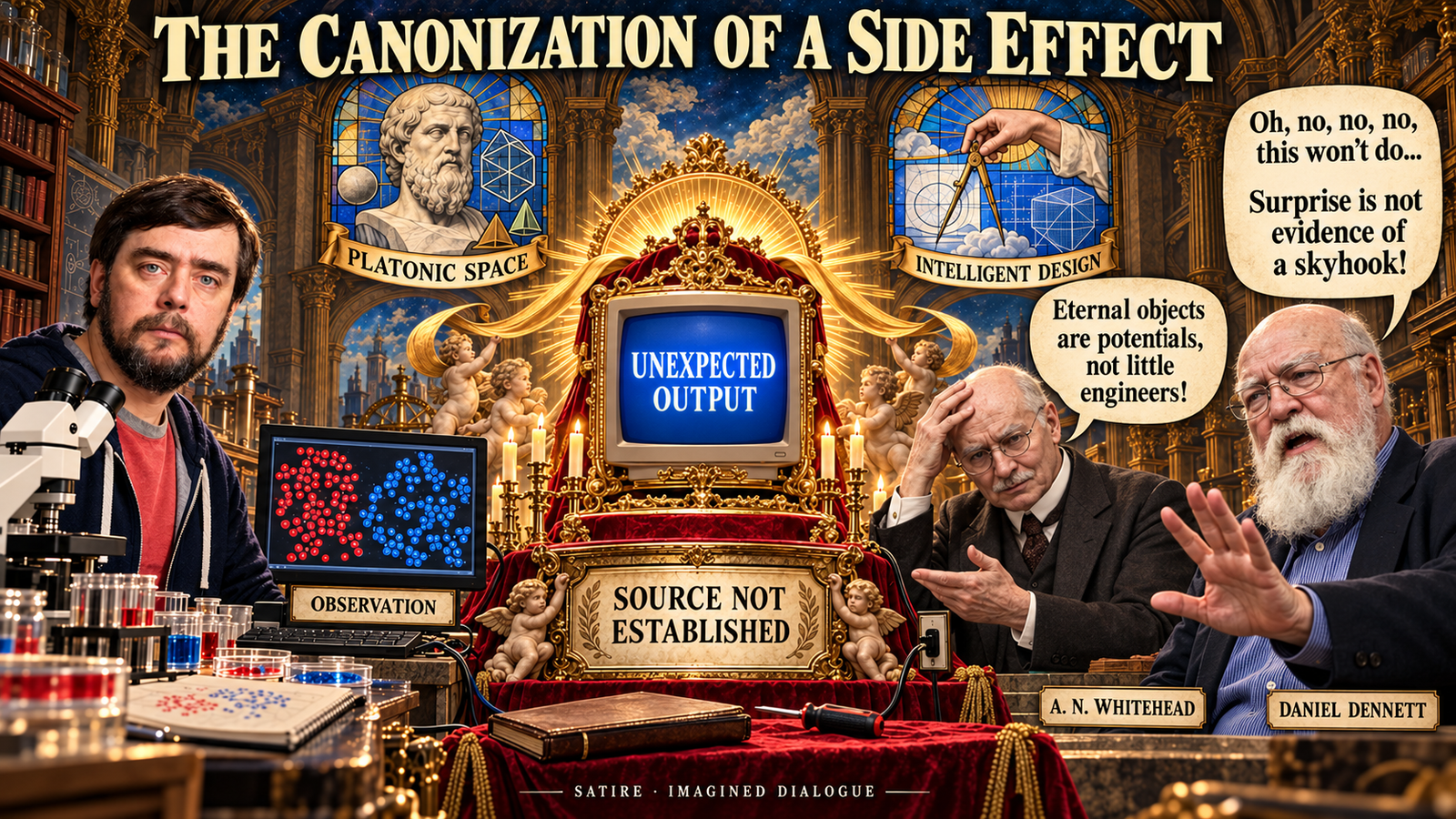
Treating surprise as proof of an independent source is a category error wrapped in breathless mysticism and sold as profundity, and the “beyond the algorithm” argument risks the same inferential move as intelligent design when it credits an additional source without distinguishing it from the implemented system (local rules, inputs, scheduling, hardware, etc.).
The title names a pattern of reasoning. Levin rejects intelligent design and agrees that the sorting behavior follows the implemented rules. My criticism applies when an unanticipated result, the absence of an explicit clustering goal, or the failure of one proposed mechanism is credited as support for an independent Platonic source. Those facts do not identify that source. Mathematical constraint, a useful behavioral model and an independently causally active pattern are different claims.
Additional analysis, October 31, 2026: What the finding can establish
Algotype clustering is real. Its particular curves can be novel. Behavioral descriptions can be useful, and mathematical constraints can explain. None of those concessions identifies an independently causally active Platonic source. That last claim needs an argument connecting the evidence to what the proposed source adds.
Joel Dietz’s working draft
On October 25, 2026, Joel Dietz sent me a working draft and invited me to comment before publication. Why Michael Levin Is 77.6++% Validated on Platonic Ingress. It challenges my February stability explanation, presents a “flat 0.50” benchmark that I never claimed as a prediction of the blog critics, and uses reductionist framing that includes me.
Despite reading as if it is contrary to my argument, there is an absolutely staggering amount of agreement between Joel’s account and my stated position. The clustering is real and potentially novel. My original stability explanation was inadequate. Implemented dynamics can produce genuine emergent behavior that nobody explicitly specified as a goal. Mathematical constraints can explain and predict, and understanding a mechanism need not eliminate useful higher-level explanations.
Joel’s own wording makes the overlap explicit: “On the sorting arrays the local rules already do the work. Adding a non-physical edge changes the prediction by nothing.” Even his conclusion states: “Non-physical ingress is 0.0%earned.” This is precisely my argument I’ve been making with Michael Levin since last November! Nearly verbatim!
The most consequential distinction deserves stating plainly: validating a biological finding is not the same achievement as validating the proposed source of that finding. Joel’s own assessment awards nonphysical ingress no earned credit. Averaging support for other claims cannot supply that missing support. Even if every biological effect listed here were independently replicated, those replications would establish the effects more securely; they would support the additional Platonic contribution only insofar as their design and results distinguished it from serious alternatives. The appropriate assessment is claim by claim: what was observed, what mechanism was tested, what was independently reproduced, and what additional inference the evidence warrants.
Independent replication also needs its own record. Re-running code, reproducing a figure from the same data, fitting a reduced biological model, repeating an experiment within the original collaboration, and reproducing the effect in an unrelated laboratory are different achievements. Each can be useful, but they should not share an undifferentiated “validated” percentage. My computational audit does not establish a comprehensive independent-replication rate for Levin’s research, and I will not manufacture one to counter Joel’s headline. Where independent corroboration remains unestablished, that uncertainty belongs beside the particular finding. It neither makes the finding false nor permits evidence for it to be reassigned to an independently acting Platonic source.
Joel also correctly qualifies this: “Sufficiency of D is not falsity of P.” I agree 100%: his zero records what the proposed addition earned under his rubric, rather than establishing that no such source exists. That distinction is precisely what my surviving criticism asks us to preserve.
We both take Levin’s biological findings seriously where they are well replicated, and our stated methodological aims overlap: explicit assumptions, executable checks, serious alternatives, held-out comparisons, visible failures and inspectable corrections. Whether those safeguards succeed requires checking their implementation in either author’s work. These agreements leave a more specific dispute than the rhetoric suggests: what the results warrant crediting to Platonic ingress, and whether the criticism being answered is the argument I actually make.
My October 13 revision had already withdrawn the complete stability explanation before his October 25th invitation arrived. Joel’s objection to my old account is fair, and mirrors my own. The narrower possibility is that movement policies form segregation and tie handling helps retain it. His chance benchmark also has a defensible conditional basis. The following sections separate those mechanism-level questions from what would establish an independent Platonic contribution. This was a result of my late September audit that lead to me demoting my own previous ontological framework, which I detailed in my September 29th article (sent to my subscribers that day), What Is Thermodynamic Monism? Auditing My Own Framework—September 2026 Revisions and Clarifications.
What depended on my proposed explanation?
I offered a mechanistic alternative for comparison: what did the proposed Platonic contribution explain that the alternatives did not? That question does not require my preferred mechanism to be correct. If stability fails, the clustering still needs explaining; its failure does not identify an independent Platonic cause.
I intended these mechanisms as proposals for comparison. But the archived February article used the heading “The Correct Explanation” and introduced its account with “Here is what’s actually happening.” My headings and wording collapsed proposals into conclusions. That was my editing error: they presented an explanation as established before I had demonstrated it. I withdrew the accidental suggestion created by a couple of my article’s section headers and some of my looser wording, which implied that my stability account was complete in October. My intended comparative purpose does not excuse the overstatement, and correcting it does not establish the additional Platonic cause. This is all a part of learning how to better articulate my framework, and I welcome any good-faith corrections.
But we must understand that a demonstrated rival can defeat a claim that the proposed source is necessary. A possible rival can expose an unanswered comparison, but it does not automatically explain the result better. To claim that advantage, my account needs its own derivation, evidence, and tests. The remaining challenge can also be asked without endorsing any particular rival: what establishes the additional causal contribution? Uncertainty among explanations does not award the result to one of them.
This also keeps the testability question precise. Levin’s Specific claims about sorting behavior can be tested, and Michael offers conditions for abandoning his research programme. My objection concerns whether those tests support the independent causal source. That requires an argument connecting the result to what the proposed source contributes beyond serious rivals. Calling the whole programme unfalsifiable would obscure this distinction.
The task is not the complete algorithm
There are several different objects being called “the algorithm”: the instruction to sort numerical values; the actual local policies, state variables, scheduling and stopping rules; and the trajectory produced by those rules from a particular starting state. The sorting goal does not specify every feature of that trajectory. A complete implementation can determine features that its designer never listed as goals.
In the Lex Fridman clip, Levin accepts that someone could track the clustering through the algorithm. He then describes the additional behavior as “neither prescribed nor forbidden by the algorithm” (14:46–15:28 in the clip; 02:18:32 onward in the full interview). That wording needs a stable referent. Clustering may be unspecified by the sorting task while remaining a consequence of the complete implemented dynamics. Moving between those senses makes a consequence of the rules sound as though it occupies a causal vacancy between them.
Write the implemented update schematically as x(t + 1) = F(x(t), u(t)), where x includes cell values, types and internal state, and u includes the scheduled choices and any random input. Once these are fixed, the model fixes the trajectory. Aggregation is another function of that state, A(t) = g(x(t)). There need be no instruction saying “maximize g” for g to rise. This does not make every consequence obvious, easy to prove, or computationally cheap to predict.
The published study makes a related inference when it says clustering is “not something that can be predicted a priori,” because cells do not read algotype information (Section 4.4). But type already determines the policy a cell executes. Policy affects its movements; movements affect who becomes adjacent. The causal route can run through behavior without a direct query for a neighbor’s type. Absence of such a query does not establish an impossibility of prediction. The authors themselves investigate an efficiency-based explanation. Sorting paper.
This is why the six-line textbook routine cannot serve as a complete specification of the mixed experiment. The paper openly describes the distributed architecture; Levin also explains that change in the Lex interview. The criticism concerns what follows from that architecture, rather than a suggestion that the authors concealed it.
There is a further reason to inspect the implementation before accepting broad claims about the absence of defect handling. In the authors’ public repository, the Insertion cell’s prefix check explicitly tests for CellStatus.FREEZE, resets its comparison value, and skips that cell. An isolated execution of that method allows movement with the left prefix [3, frozen 1]; removing the freeze-specific branch blocks it. The pinned swap routine blocks a frozen cell from initiating a swap, while the Bubble and Insertion policies permit other cells to swap with it. A passive movable cell and an immovable wall are different experimental conditions. So are “no explicit repair planner” and “no implemented response to a defective cell.”
Clustering formation and clustering persistence are different questions
My original stability explanation conflated them. A globally stable sort preserves the starting relative order of every equal-key record. Strict comparisons alone do not guarantee that property in a mixed system containing nonadjacent swaps. In [2a, 2b, 1c], swapping the first and last records produces [1c, 2b, 2a]. The equal records have reversed without being directly swapped with each other.
In the replay of Joel’s model, every one of the 90 duplicate-key runs reversed some equal-key records. The mixed model therefore lacks the global stability my complete explanation would require. Clustering with unique values also needs an explanation independent of equal-key preservation. Those objections to my old account stand.
But duplicate keys still loosen the final ordering constraint. Different policies can create segregation during sorting, and strict tie handling can help retain it when numerical sorting is complete. Continuing the actual final cells with their existing internal states and unchanged strict rules produced no further swaps in all 105 replayed runs. This establishes persistence at those completed endpoints in the tested implementation.
At ten copies per key, the mixed model’s mean final aggregation was 0.6592. Applying a globally stable numerical sort to the same starting records instead gave 0.503333. Uniformly permuting algotypes only within the final equal-value blocks, while preserving each block’s type counts, gave an exact conditional mean of 0.485117. Numerical sortedness survives this last operation while much of the measured segregation does not. The arrangement within tied blocks matters.
These comparisons distinguish formation from retention. They do not establish strict tie handling as the unique necessary mechanism, and the within-block permutation is not Joel’s separate experiment allowing equal-key swaps. Nor is replaying his sequential model an independent replication of the original threaded implementation. The November 1 audit reports separate runs using the upstream cell policies; their finite observation windows and instrumentation are described below. What survives my first explanation is this narrower role in persistence. The complete stability explanation remains withdrawn. Pinned model and experiment.
What Joel’s “flat 0.50 prediction” gets right, and what it assumes
Neither version of my article stated the flat 0.50 numerical prediction Joel attributes to me. That does not prevent a critic deriving a consequence from an explanation I offered. It does require distinguishing my words from his reconstruction and supplying the assumptions the reconstruction needs.
Joel’s working draft offers a rationale: if global stability merely preserved the initially random type order among equal-key records, final aggregation should remain at chance across duplicate multiplicities. A completed globally stable sort, with uniformly randomized type labels independent of the numerical-key arrangement, supports that endpoint benchmark. But stability is not necessary for the benchmark: any completed sort whose output permutation is independent of those randomized labels has the same expectation, even if it reverses equal-key records. A systematic departure under that randomization can therefore reveal type-dependent ordering; it does not diagnose global instability specifically. Equal-key reversals test that separate property directly. The benchmark can still challenge my stronger old account when its assumptions apply. “It never directly swaps equal keys” does not establish the global property that account needed. The peer-reviewed definition of stable sorting concerns preservation of equal-key relative order throughout the final output.
In Joel’s figure, “flat” refers to final aggregation plotted against copies per key, not to aggregation remaining constant at every moment during sorting. I do not attribute the latter prediction to that figure. An endpoint argument would not establish such a trajectory, but that limitation does not answer his actual comparison across duplicate multiplicities. My objections concern attributing the numerical forecast to my published words and carrying a successful objection to the old explanation over to the corrected argument.
For a linear array with exactly b labels of one type and s of another, let N = b + s ≥ 2, let H count matching neighboring pairs, and define aggregation as A = H/N, the measure used in Joel’s code. Uniform random arrangement gives:
E[A] = [b(b − 1) + s(s − 1)]/N².
There are N − 1 neighboring pairs. Each matches with probability [b(b − 1) + s(s − 1)]/[N(N − 1)]; dividing the expected matching-pair count by N gives the expression above. With equal fixed counts, this becomes E[A] = 1/2 − 1/N. For Joel’s 40/40, 80-cell experiment, it is 0.4875, rather than exactly 0.50. A denominator of N − 1, or independent coin-flip labels rather than fixed counts, gives a different finite-size answer. The same expectation follows from the classical runs-count identity: if R is the number of contiguous same-type runs, then H = N − R. This is a standard runs-statistic baseline, not a distinctive prediction of a stable algorithm.
The calculation was checked using exact rational arithmetic, independent C++ and Python enumeration, a recurrence over runs, symbolic simplification and seeded simulation. It supplies a conditional mathematical consequence. Joel does not need to establish that the actual mixed sort is globally stable before using it to test an explanation that says it is: departures from the benchmark and observed equal-key reversals can count against that explanation. The same stable-sort benchmark remains constant in expectation as duplicate multiplicity changes under these assumptions. Individual realized samples need not have identical scores.
The correction to 0.4875 does not rescue my old explanation from the large clustering effect. And it would be a mistake to dismiss Joel’s two-copy result merely because 0.4767 lies less than one reported standard error below that unconditional expectation. A more specific exploratory test fixes the observed type counts within every equal-value block and randomizes their internal order. Across the 15 two-copy runs, the observed total was 572 matching pairs, against a conditional expectation of 603.5. Exact counting gave a two-sided distance-from-expectation tail probability of approximately 0.00201; a separate 100,000-draw simulation gave 0.00208. That supports an ordering bias relative to this conditional reference. The comparison was chosen after inspecting the results. The November 1 archive reports follow-up tests on new inputs in the original threaded code. Those reported results strengthen the case for this ordering bias if their implementation and conditional null withstand checking; they do not retroactively preregister the exploratory comparison.
Joel therefore has a valid objection to an appropriately specified complete stability account. Making its randomization assumptions and finite-size expectation explicit improves its precision. It remains a consequence he reconstructed, rather than a numerical forecast I published; the two experimental conditions are not two separately stated predictions of mine. The objection also leaves a different possibility open: movement policies can form clustering which tie handling subsequently helps retain. Rejecting my admittedly incomplete mechanism does not eliminate that narrower possibility or identify an independent Platonic cause. A gap in current understanding doesn’t necessarily imply a non-physical source; it implies more work needs to be done.
What the reductionism charge would need to establish
Joel’s reductionist framing of my argument raises a related issue to my earlier exchange with Levin, although the two writers do not make identical accusations. The fuller exchange is discussed in my companion article on Levin’s response. The comparison concerns their representations of the argument; it establishes neither copying nor deliberate deception.
In my October 30, 2025 symposium comment, I explicitly included higher-level causal explanation in a naturalistic rival offered for comparison, citing the possibility that macro-level descriptions “can have higher effective information than micro-level descriptions.” Levin nevertheless answered a sentence about physical causal constitution with: “That’s a reductionist argument against the reality of other causal levels.” On the specific meaning he supplied, that attribution is demonstrably contradicted by the surrounding text: the rival I offered expressly included those levels. My physicalist wording could be challenged, and my proposed mechanisms could be wrong, without turning that proposal into a denial of higher-level causation. On November 11 he acknowledged his initial physicalist reading and asked me to clarify my alternative, a reasonable request. My comment; his October reply; his November clarification.
“Reductionism” covers several different claims. The Stanford Encyclopedia’s account distinguishes reduction from elimination: explaining a phenomenon through its constituents need not deny its reality. Its account of reductionism in biology distinguishes ontological, epistemic and methodological reduction, which do not simply entail one another. Offering a naturalistic explanation does not, by itself, commit me to every position collected under that label.
The causal-emergence literature gives this distinction a concrete setting. In my exchanges with Levin, I cited Hoel, Albantakis and Tononi to show how a naturalistic rival could retain higher-level causal explanation without requiring supernatural, nonphysical or, in Levin’s terminology, “extra-natural” causation. Their paper and Hoel’s later treatment compare causal models whose macro descriptions can outperform their micro descriptions under a specified information measure. Their results depend on how scales and interventions are defined; Eberhardt and Lee challenge aspects of that construction. Those papers do not establish my proposed thermodynamic account or settle the ontology of causation. My proposed rival requires a place for genuine higher-level causal organization of the kind this literature investigates. Whether a particular system satisfies Hoel’s precise criterion remains a modeling question. My quotations establish that I offered such an account for comparison; they do not establish that its mechanisms succeed. My central request for warrant for an additional Platonic source also survives a revision or failure of that particular causal-emergence formalism.
If the objection is methodological, my comparisons do not require that the smallest scale always supplies the best explanation. I offered thermodynamic constraint dynamics, organizational closure and higher-level causal organization for assessment. If the objection is explanatory, I did not argue that finding a mechanism makes mathematical, functional or collective descriptions dispensable. Explaining how a pattern is produced can coexist with explaining its constraints and organization. Nothing in this sorting critique requires minds, agency or consciousness to be exhausted by a computational description either. These stronger commitments would need to be demonstrated from my argument, rather than inferred from my request for a naturalistic comparison.
Joel’s clearest stated target is “reductionist dismissals that wave away real emergent phenomena without checking the math.” Offering an explanation is not waving a phenomenon away. It takes the phenomenon seriously enough to ask how it occurs and test the answer. My February claim that textbook stability already supplied the complete explanation was overconfident, and Joel has a substantive objection to its adequacy. I own that error. Whether that local explanation succeeds does not decide my position on ontological, methodological or explanatory reductionism. An inadequate explanation does not establish denial of the phenomenon, and correcting it does not establish an independent Platonic source. The October 13 revision, preceding his October 25 invitation, explicitly withdrew the complete mechanism and acknowledged potentially novel results. Calling that corrected position dismissive requires showing what finding or explanatory possibility it actually dismisses.
An ontological reading needs a different answer. Under some philosophical taxonomies, my earlier physicalist wording could reasonably be classified as reductionist even while retaining higher-level explanations. I do not need to win that classification dispute for the causal criticism to hold. Offering a rival that requires no nonphysical source does not prove that no such source exists. Equally, attaching a label to the rival does not show that the proposed extra source contributes anything. My remaining question requires no premise that naturalism is the final, exhaustive ontology.
If the concern is that I exclude an unconventional source before considering it, the November 1 public repository version quotes my comparison proposal from Religion with a Pipette. The audit traces it to that October 4 article and reports a change of subject from his symposium talk to Joel himself; the excerpt also stops before my explicit application of the same standard to naturalistic rivals. Those qualifications matter, but the comparative test is visibly present in his own text. I asked what contribution could earn support through independently justified explanatory, predictive or interventional gains. That supplies a route to reconsideration; neither compatibility with the result nor the failure of one rival supplies those gains by itself. Joel also distinguishes the sufficiency of the dynamics from the falsity of a further source. I make that distinction too. Whether a particular naturalistic rival succeeds remains a separate question from whether the additional causal contribution has been demonstrated.
Across these readings, the charge needs an argument of its own. Denying higher-level causation contradicts the rival I offered. Privileging the smallest scale, eliminating useful explanations, or ruling out alternatives in advance does not follow from it. A defensible technical classification might still apply, but that would not answer the causal question. Joel’s historical objection to my complete stability explanation survives; the wider dismissal of my corrected criticism does not follow from that local objection. Explaining emergence is legitimate work. So is asking what evidence warrants crediting an additional source.
The “36,000 words” description is a different issue
The “36,000 words” description needs a different correction. In his December 28 Q&A, Levin describes a large body of comments, says he approved some, and explicitly presents his replies as answers to summarized points. Joel describes the material as containing “every possible argument one could make against his positions” and places it under discussion of AI-generated prose. That is Joel’s additional characterization. Neither the word count nor a general concern about AI establishes that a particular argument is mistaken, that all the material has the same authorship, or that the shorter list preserves every qualification.
I use OpenWhispr for voice dictation and its built-in AI cleanup to help with the lasting effects of a brain injury I suffered in a car accident when I was eighteen, nearly twenty years ago. The injury led to hydrocephalus and left me with fine motor difficulties that can make typing physically difficult and long pieces painful to type. Dictation helps me put my work into writing. The symposium posts drew on years of my own research. They were targeted challenges to positions Levin had stated, rather than an indiscriminate collection of every possible objection. I intended the naturalistic explanations to be helpful proposals for comparison: could they account for the same phenomena without a nonphysical causal realm, and what did his account explain that they did not?
Most of the word count came from quotations of peer-reviewed scholarship and from placing Levin’s statements beside my own, responding to several thousand-word responses he made to me. I quoted the scholarship that either seemed to me to explain phenomina he was insisting can’t be explained by current paradigms and challenge assertions he had not supported with sources and ask how his account addressed the findings and objections. The side-by-side passages documented misrepresentations and made clear that my argument rejected exhaustive physicalism, dismissive reductionism and naive falsificationism. Much of the word count came from correcting misrepresentations of my argument that recast my process-relational framework as reductionism, universal physicalism, or other positions my argument had alreadyw disallowed to make my argument easier to attack without having to answer the question of what warrants the causal claims.
Nothing about the length of those posts, my dictation software, or my disagreement with Levin demonstrates that my arguments arose from limitations in AI training data. Joel invokes Levin’s criticism of LLMs reproducing familiar categories, but does not show that this explains any particular argument I made. That diagnosis would require evidence connecting the alleged training limitation to the reasoning at issue. Even an identified influence would not settle whether the argument is sound. The scholarship and arguments still need an answer.
In this context, the framing functions as well-poisoning: readers are encouraged to discount the criticism as a symptom of AI’s limitations before its evidence and reasoning have been addressed. Applied that way, a story about its supposed origin serves to dismiss criticism without showing where it fails.
My own compression also produced real errors, which I acknowledge in the companion article. I compressed those points at Levin’s request, expecting him to read them in the context of the arguments he had already spent weeks answering in many thousands of words. That expectation concerned intellectual honesty: a requested summary should not replace the fuller arguments already available to the person answering it. The issue relevant here is whether the argument being answered is the argument I actually made and still defend. The discarded stability explanation was never required by my primary objection to Levin’s additional causal claim. The claim that I reject higher-level causation has not been demonstrated and conflicts with the higher-level causal organization explicitly included in my proposed rival. My surviving question concerns an independent Platonic causal contribution claimed but not demonstrated by the clustering results. These are different targets. Answering one does not answer all three.
“Free compute” needs a specified bill
In the Lex clip, 13:06–13:40, Levin moves from clustering requiring no extra clustering instructions to the possibility of useful ingressions without extra physical costs. In the Curt Jaimungal clip, 2:16–2:35, he presents free compute as a testable prediction. There is a legitimate engineering question here: can one process provide several useful outputs for less cost than computing each separately?
Michael Levin discusses sorting algorithms with Curt Jaimungal and Anil Seth.
If “free” means that the already-running process yields an additional useful pattern without a dedicated extra clustering routine, the observation can support that modest claim. Reusing work is useful. It needs no exemption from physics and supplies no identification of a nonphysical contributor.
A stronger efficiency claim needs a comparison. Fix the required outputs and their accuracy, the inputs and type assignment, and the implementation boundary. Then compare the mixed sort with serious ways of obtaining the same outputs, counting comparisons, movements, scheduling, memory, measurement and readout where relevant. If the claim concerns energy, measure or model the relevant physical costs. A procedure that explicitly recognizes types and commands clustering is one possible rival; its expense is not a lower bound on every mechanism that could produce the pattern.
Landauer’s principle adds no universal charge for every bit merely being present or for every comparison and swap. It constrains logically irreversible information loss under specified conditions. Conversely, failing to add a purpose-specific instruction does not demonstrate zero additional physical cost. The same trace can yield two observables without the second observable opening a hole in the energy budget. Landauer; Bennett.
Levin explicitly disclaims breaking physics in the Curt discussion. The issue is therefore the inference from a potentially useful shared computation to causal ingress, together with the unmeasured physical-cost claim. A measured advantage would deserve engineering credit. Its proposed Platonic source would still need separate support.
A rising score does not yet establish a detour
Joel’s distinction between two sorting measures is useful, provided neither is promoted into physical energy without justification. Let I(v) count all inverted pairs and E(v) count adjacent descents. In his example:
| Array | All inverted pairs, I | Adjacent descents, E |
|---|---|---|
[2, 4, 1, 3] | 3 | 1 |
[2, 1, 4, 3] | 2 | 2 |
Swapping the adjacent inverted pair 4, 1 improves I while worsening E. Every strict adjacent inversion swap lowers I by exactly one; only that pair’s relative order changes. Both the example and this property were checked computationally, including exhaustive checks through eight distinct keys. The audit archive supplies a general Lean proof for adjacent swaps. Long-range inverted-pair swaps can lower I by more than one. With distinct keys the decrement is odd; with repeated keys it need not be: [2, 2, 1] → [1, 2, 2] removes two inversions. A temporary decline in the paper’s adjacent-order score can therefore occur without frozen cells, anticipation, or a move uphill in I.
That does not make E an illegitimate observable. Nor does a mathematical Lyapunov function become the system’s thermodynamic energy merely by being called its “real energy.” The paper also compares behavior across defect conditions; an example without defects does not dispose of that comparative result. It does establish that a dip-and-recovery curve alone cannot distinguish obstacle-sensitive problem solving from the projection of ordinary sorting dynamics onto this score. An adequate comparison must test the defect response beyond that baseline and distinguish movable passive cells from genuinely immovable barriers. With a genuinely immovable middle cell, [2, frozen 1, 0] has three inversions but no legal adjacent swap. A no-defect convergence argument cannot simply be carried across that change in the allowed moves.
The published study uses a minimal behavioral conception of intelligence, and explicitly separates its target from first-person affect or experience. The relevant question is whether its behavioral criteria establish the capacities claimed. Higher-level descriptions may earn predictive or interventionist value even when the dynamics are fully implemented. Demonstrating such value would support those descriptions; it would not, by itself, establish felt motivation or a separately acting nonphysical mind.
Additional analysis, November 1, 2026: What the computational audits change
I have moved the extended computational comparison into Rerunning the Bubble-Sort Debate. It links two separately run audits of Joel’s text and mine, with scripts, recorded outputs, claim ledgers and checksums. The version 1.0.1 archive fixes the release discussed here; the all-versions DOI follows later releases. GitHub supplies the working repository and a place to report corrections.
I commissioned these audits using Claude and Codex. Their agreement is useful evidence to examine, not independent scientific replication or a certificate of correctness. They can share source errors, assumptions and failure modes. A DOI archives a release; a checksum identifies bytes; a proof checks a formal statement. None certifies that a model represents the experiment, a citation supports the claim, or an interpretation follows. I am offering the audit results for critique and correction, not asking readers to treat computational systems as infallible oracles. I remain responsible for what I publish from them.
What the sorting results would establish
Both audit reports reproduce the stated deterministic values from my October 31 replay of Joel’s sequential model. Only the Claude audit reports the follow-up runs using the upstream threaded cell policies. That distinction matters: matching sequential ports does not establish swap-for-swap equivalence with operating-system threads. The new reports should be judged at the boundary actually tested.
| Reported finding | What follows if the check holds | What does not follow |
|---|---|---|
| Equal-key records reverse in both the sequential model and the threaded runs. | The complete global-stability explanation remains withdrawn. This supports Joel’s local objection to it. | My original causal question has been answered, or clustering was denied. |
| New two-copy input batches show ordering bias against the within-block randomization reference. At ten copies, reported final aggregation is about 0.690 against a conditional reference mean of about 0.481. | The narrower account of type-dependent ordering and retained segregation gains support beyond the sequential replay. | The conditional reference is a complete causal model, tie handling is the unique mechanism, or a scrambled pattern would be actively restored. |
| The original-code peak control reaches about 0.604, against about 0.658 for the actual algotypes in the unique-key runs. | The relevant transient excess is over a comparable peak control, not simply over a fixed chance endpoint. | Every passive label must peak above chance, or the residual effect disappears. |
| The committed code permits passive frozen cells to be displaced; removing the Insertion freeze-reset branch substantially worsens the reported error. | A wall-based argument does not describe this implementation, while Joel’s specific Insertion-ablation criticism retains support. | The published immovable-defect condition never existed, or the mapping from each published figure to code has been recovered. |
The threaded runs were instrumented and stopped after a finite no-swap window. No swap for a second and a half is evidence of observed quiescence, not a proof that movement can never resume. The reported new-input results also remain conditional on the test’s reference distribution. The archive includes null simulations and passive-label controls; one passive-label comparison returned a small p-value. Those diagnostics need assessment together, including sampling uncertainty and the comparisons attempted. I would not turn a finite calibration exercise into a declaration that the test cannot mislead.
These checks can strengthen a mechanism-level account of formation and retention. They also support parts of Joel’s empirical description. Explaining emergence takes the phenomenon seriously; it does not make it disappear. A mistaken proposed mechanism calls for correction, not an inference that the critic denies higher-level causation. My comparison expressly included higher-level causal organization. Neither its computational success nor its failure settles the independent Platonic contribution.
What I correct, and what remains provisional
The source-date correction is concrete: I had used the date of a repository snapshot to qualify a file already present in August 2023. I correct that wording above. The identification of which implementation generated each figure remains unresolved. I also narrow the Reynolds example to what the cited Boids work demonstrates: coherent collective motion from local rules, without attributing an unsupported sensitivity result to it.
The chance benchmark also deserves a sharper statement. Stability is sufficient under the stated randomization, but not necessary: label-independent unstable sorts share the expectation. Departures from that reference are not a stability test by themselves. Equal-key order reversals provide the direct counterexample to my complete old account. The new threaded results, if they survive scrutiny, extend support for the narrower ordering and retention account; they do not rehabilitate global stability.
My thermodynamic and organizational-closure proposals remain candidate rivals. The sorting tests do not establish them as superior explanations of biological morphogenesis. They would need matched models and evidence of their own. Likewise, the archive’s discussion of Joel’s fish analysis concerns which predictor and comparison earned a reported result; it does not refute the laboratory biology or turn the sorting experiment into a referendum on every part of Levin’s programme. The extended analysis belongs in the linked companion rather than being smuggled into a percentage here.
The audits themselves need corrections where they overreach. For example, an unrestricted claim that every long-range inverted-pair swap lowers the inversion count by an odd number fails with duplicates: [2, 2, 1] → [1, 2, 2] removes two inversions. The odd-number result needs the distinct-key qualification. This counterexample was checked separately in Python and Node.js. Auditing an audit is ordinary quality control, not disloyalty to the machine that wrote it.
Four citation errors readers can check directly
Some findings do not depend on accepting the simulations. In the pinned November 1 public repository text, four reference-list DOIs identify different papers from the works named. The intended works exist; the identifiers and, in places, the surrounding bibliographic details need correcting.
| Reference as presented | What its supplied DOI identifies | DOI for the intended work |
|---|---|---|
| Claverie and Wainwright’s reef-fish morphospace study | A study of dominance during salinity shifts in a copepod | 10.1371/journal.pone.0112732 |
| Friedman and colleagues’ marine-fish body-shape study | Phylogenomic inference of fungal relationships | 10.1098/rspb.2020.1053, published in 2020 |
| Pietak and Levin’s BETSE paper | Kv1.3, mitochondrial ultrastructure and glucose signaling | 10.3389/fbioe.2016.00055 |
| Pinet and colleagues’ craniofacial-correction paper | DND1 and germ-cell reprogramming | 10.1242/dev.175893 |
One of these is a paper coauthored by Levin himself. The BETSE reference names Pietak and Levin but gives the journal, volume and DOI of Kovach and colleagues’ paper. Pietak and Levin’s actual paper appeared in Frontiers in Bioengineering and Biotechnology, volume 4, article 55, in 2016. Precision matters here: the sorting-paper DOI and the Ingressing Minds DOIs in Joel’s pinned text do identify those works. The error is not that every Levin citation is wrong.
There is also an in-text link error in Claim 6: the label “Pezzulo & Levin 2015” links to a different paper on bursting noise in gene expression. The intended work is Re-membering the body. Joel’s reference list gives that DOI correctly, so this is a mismatched inline link, not a missing or nonexistent source.
These are source mismatches, not proof that the intended studies are false. They do show why generated references must be checked against the actual authors, title, methods and findings. A plausible citation string is not a source. A correctly resolved DOI is only the beginning of checking whether the paper supports the sentence.
The pinned benchmark validator contains a more consequential defect. All fourteen benchmark records assign "status": "VERIFIED" as fixed text. The script calculates simulation values and percentage discrepancies, but no numerical acceptance test determines that status. The verdict is written into each record before agreement has been assessed.
This matters in the committed results: the bubble delayed-gratification benchmark reports a target of 0.37, a simulation value of 0.496 and a relative discrepancy of 34.11%, yet receives the same VERIFIED label as the closer matches. That discrepancy does not automatically establish failure. An appropriate comparison would need justified acceptance criteria, uncertainty estimates and comparable conditions. The defect is that this label implements none of those judgments.
An isolated execution of the first benchmark’s original record-building expression makes the problem explicit: supplying a simulation mean ten times its target produces a calculated error of 900% and still returns VERIFIED. This tests the assignment of the verdict, rather than rerunning the complete simulation. The numerical results remain available for inspection, but the verification label cannot register their failure to agree. An adversarial validator should at least give failure somewhere to go.
This finding concerns the fourteen-row validator. Other tests and proofs require assessment on their own terms. Compiling a Lean statement establishes that statement under its assumptions; it does not certify every scientific interpretation placed beside it. The fixed labels establish a defect in the claimed verification, while leaving who introduced it, what they understood and why it survived review unresolved.reement. Compiling a Lean statement likewise warrants that statement under its assumptions, not every scientific claim placed beside it.
Joel’s claims companion announces a “bigger mistake than the dualists.” Before awarding the critics a place below the dualists, perhaps check that the fish reference is about fish. The mushrooms are innocent. The substantive issue survives the flourish: two conditions can test consequences of my withdrawn account without becoming two separate numerical predictions I published, and a successful objection to that account cannot stand in for an answer to my corrected argument. Joel’s useful corrections deserve acknowledgment; his rhetoric needs the same scrutiny as mine.
The contrast with his treatment of my submissions is instructive. Joel, who presented Radical Platonism and Radical Empiricism at Levin’s symposium, places them under “AI-generated prose” and describes them as “containing every possible argument one could make against his positions”. Before diagnosing the training data behind my criticism, perhaps check the DOI for the man who hosted your symposium. The Platonic realm can wait; the bibliography is on Earth.
That irony establishes no explanation of how his errors arose, and it does not discredit using AI. It illustrates why a diagnosis of the critic cannot replace checking the criticism. His references, my references and the audits all face the same obligation: follow the source and establish what it supports.
The argument still needs an answer, whoever helped type it
What I supplied, and what that does not guarantee
Joel introduces the discussion under “So Have We Abandoned Dualism? Yes. But Not the Way You Think.”, placing my submissions within his discussion of “AI-generated prose” and describing them as:
“containing every possible argument one could make against his positions”
That characterization invites a diagnosis of the production process.
The workflow behind this revision includes primary texts, peer-reviewed sources, repeated source audits, executable mathematical checks, and computational systems instructed to challenge one another’s conclusions. I also check references manually, including whether a DOI identifies the intended paper and whether that paper supports the claim for which I cite it. A workflow that Joel’s paper might have benefited from.
My use of dictation and AI cleanup is explained above. It does not describe the whole research process.
These precautions are fallible. A supplied paper can be misread. A genuine DOI can accompany an irrelevant citation. Several models can repeat one mistake, and a human can approve it. The useful question is where an attempted correction meets something it cannot settle by agreement: an original passage, a counterexample, a reproducible execution, a properly scoped proof or an independently obtained observation. My workflow earns whatever confidence those checks warrant. Counting the assistants does not establish independence, and describing them as adversarial does not demonstrate that they found every important objection.
The corrections in this article matter for that reason. My complete stability explanation remains withdrawn. The audits themselves required qualifications. A process that sometimes catches errors is useful; its existence does not certify every surviving sentence.
Why I want to find out where I am wrong
I am not defending any particular position or conclusion. In fact, I have no conclusions I’m confident enough in to promote to an ultimate ontology or position, and doing so would be as dogmatic as the systems I openly oppose. I have demoted my own beliefs and frameworks many times in my life when the evidence warranted me to do so or when I lacked sufficient justification to positively hold those positions. What I care about is the evaluative framework I am stress testing and refining.
I want to build the most defensible, evidence-based, corrigible framework for understanding and navigating the world, because I feel this is something vital for resolving the issues with both modern AI systems and human institutions.
I want to find the mistakes in my work while I can still do something about them. That is part of why I developed the Recursive Corrigibility Framework. A correction supplies information about both the claim and the process that let the error through. The useful questions are what failed, which conclusions depended on it, and what change would make the next inquiry less likely to repeat it.
My stability explanation is a concrete example. I needed to withdraw it. I also needed to distinguish direct equal-key swaps from global stability, a proposed comparison from an established mechanism, and a failed mechanism from an unanswered question about additional causation. Fixing the first error while allowing the others to survive would leave the methodology only partly repaired.
This gives disagreement a constructive role. A strong objection can reveal an omitted source, an ambiguous term, an unsuitable null, a failed inference or a better test. It can also reveal that a preferred methodological step adds effort without improving the result. RCF has to face those comparisons too. Its name supplies no exemption.
Levin’s request for better-informed arguments and Joel’s executable checks can contribute to that work. Where they identify a real error, I should acknowledge it. Where a reply addresses a position I excluded, the next step is to recover the actual comparison. Explaining an objection as the critic’s intellectual limitation before establishing its mistake reverses that order. So does treating an auditor’s possible blindness as a reason to expect a preferred score to rise.
If a specified Platonic contribution earns support through a sound argument or a discriminating result, I want to know. If my proposed rival fails, I want that recorded too. The comparison has to expose the commitments on both sides to appropriate criticism. Finding my error improves the inquiry; calling me “wrong twice” does not show that the surviving argument has failed twice. I would rather have the correction than keep paying interest on the mistake.
How documenting the exchange became “blog criticism”
There is an almost comical irony in classifying me as a blogger. It is not how I describe my research, although publishing on a blog is plainly something I do. I began the site to document exchanges in which I thought Levin’s replies misrepresented my arguments, passed over the questions I had asked, or substituted positions I had expressly excluded. Some follow-up responses I submitted were not published on his site. Publishing my own record gave readers another place to inspect the arguments and corrections.
The record includes my words beside his, the scholarship I was asking him to address, and proposed laboratory comparisons his lab could potentially run. Those were proposals for testing our accounts, not completed experiments or proof that my account won. A genuinely discriminating test would require sufficiently specified alternatives, controls and outcomes that could count against them. Offering that route matters: it is an invitation to resolve the disagreement rather than a declaration that an unconventional source must be excluded.
I document the specific attribution disputes in my account of Levin’s response and discuss the wider circulation of claims in Institutional Capture & Diverse Intelligence. Those articles contain arguments and historical formulations that remain open to correction. Linking them does not turn every earlier conclusion into a premise of this sorting critique. But I would be happy to defend them separately.
“Blogger” is not an insult or a rebuttal. Levin also publishes arguments on a blog, and Joel’s draft circulates through online publishing platforms. Neither location establishes the quality of the reasoning. The problem arises when the venue becomes a substitute for examining what was actually argued. A record created to let readers check an attribution cannot be answered by classifying its author according to the place where that record was published.
Joel repeats related problems in different forms: treating the withdrawn explanation as though defeating it settled the corrected criticism, associating my submissions with an indiscriminate collection of AI objections, or extending a local explanatory error into a broader charge of reductionism. His text also quotes my comparative request and supplies results relevant to it. Both facts belong in the account. They do not establish that he copied Levin, deliberately misrepresented me, or understood every qualification of the exchange.
No finding about private intent is required. Compare the claim I made, the claim the reply addresses, the evidence offered and the question left unanswered. An accidental substitution can leave the same inferential gap as a deliberate one. Intent may be investigated when relevant evidence exists; it does not have to be settled before the public argument can be corrected. Equally, an unpublished response does not by itself demonstrate bad faith, and my account of the exchange is not a complete record of someone else’s moderation decisions. The argument can be wrong without anyone having to be a villain. It still needs correcting.
A training corpus is not the whole research system
Joel states the confinement claim explicitly:
In that sense, trained on previous corpora of human knowledge and without phenomenological awareness, the AI remains self-referential with that corpus. Of “within” and “without,” the AI is forced to be “within,” because that is all that it knows.
Joel’s draft moves from limitations of training data to the claim that AI is confined to that corpus and structurally unable to encounter what lies outside it. That conclusion leaves out the system actually doing the work. A pretrained model, its current context, supplied documents, retrieval tools, code execution, experimental observations and human review are different parts of a research workflow. Information can enter the workflow without changing the model’s trained weights. Whether it is then interpreted correctly is another question.
The mechanism is ordinary input conditioning. Learned parameters supply capacities and prior tendencies; the current context supplies the particular question, documents and returned tool results. During ordinary inference, new context can change the response without changing the trained parameters. Updating an answer from a retrieved paper is different from retraining the model. Saving a result in an external notebook is different again. None of these distinctions requires treating the model as a conscious observer or granting it infallible understanding.
An agent can request a document, receive its text, generate code, run that code through a tool, and receive an error or result as subsequent input. The surrounding software performs the retrieval or execution. The model can then respond to information that was not supplied by its weights alone. A DOI lookup can contradict a proposed citation; a test execution can contradict generated code. These channels can be corrupted, ignored or misunderstood, but they are not merely the model consulting its training corpus.
There is newer peer-reviewed evidence than the early ReAct study. Lu and colleagues’ ToolSandbox, published in Findings of NAACL 2025, evaluates stateful tool execution, dependencies between operations and conversational feedback. It reports substantial remaining difficulties, including handling insufficient information. The relevant object of evaluation is an interacting system, not an isolated text completion.
Jin and colleagues’ Search-R1, accepted at COLM 2025, trains models to interleave reasoning with search queries and retrieved passages. Its question-answering experiments demonstrate a concrete route for using external information. Reinforcement learning develops the search policy during training; returned passages subsequently enter the inference context. The study does not establish reliable open-ended scientific discovery, and its results do not prove that every retrieved passage was absent from pretraining. The narrower point is sufficient: inference need not depend on trained parameters alone.
The caution is equally current. Cho and Park’s Skill Following, published in Findings of EMNLP 2026, compares matched skill-enabled and skill-disabled executions. It reports cases where favorable aggregate retrieval comparisons conceal harmful effects on the tasks where retrieval actually occurred. Receiving information and using it correctly are different achievements. That finding supports testing what each part of my workflow contributes; it does not license declaring it reliable merely because papers and tools were supplied.
The literature therefore supports a specific correction to Joel’s explanation: training influences what a model does, but does not seal the whole workflow off from additional inputs. It also supplies a warning against my overclaiming. To establish that a source, tool or referee improved an audit, inspect its actual effect or compare appropriately matched runs. Neither unconditional trust nor unconditional confinement describes the evidence.
Later, his account of the research process says:
Every node there is pinned to something outside the corpus—a wet-lab dataset, a held-out species, a hornet wing—so when a pre-registered prediction fails, the failure comes from nature rather than from the hivemind.
These passages describe different boundaries. The first confines the AI to its corpus; the second describes a workflow receiving corrective information from outside it. They can be reconciled by distinguishing the pretrained model from the larger system. That distinction also has to be allowed when assessing my work.
Joel’s own method makes the point. He describes held-out organisms, external datasets, human direction, executable tests and cross-provider review. Those are possible routes for correcting a model’s inherited expectations. They are available to criticism as well as endorsement. If my use of those routes fails, identify the failure. A description of an isolated model cannot establish the limitations of the whole coupled workflow.
Encountering new information does not guarantee recognizing its significance or discovering something new. But that uncertainty is different from being unable to receive it. A locked hypothesis supplies a goal for an investigation; it does not establish a metaphysical escape from computation. Calling this an exit from the corpus concedes that the surrounding workflow matters.
The same standard applies to people. Human experience is mediated by perception, language, instruments and prior learning. None supplies immunity from error. Differences in embodiment can matter, but their relevance to a particular inference needs to be shown.
Neither AI paper establishes the philosophical conclusion
Introducing the representation paper, Joel supplies the philosophical conclusion:
because Platonism is basically correct. There is math that orders the universe, and even when you have an interface layer that is “biology,” the messiness is in the bottom layer.
Introducing the second paper, he says it:
suggests that all AI is feeding on the same basic dataset, including both the internet and talking to other AIs, and thus converges on endless samehood, aka a hivemind.
He then concludes:
Neither is naturally teleological, and neither allows the system to absorb from the “unknown unknown.”
Each step goes beyond merely reporting a measured similarity. The papers need to be checked for the additional conclusions being assigned to them.
Joel invokes Huh, Cheung, Wang and Isola’s Platonic Representation Hypothesis in support of the suggestion that Platonism is basically correct. The paper studies alignment between learned representations and proposes convergence toward a statistical model of reality. Its cave analogy is not a demonstration that an independently causally active nonphysical realm supplies those representations. Shared environmental structure, task demands and training pressures remain relevant explanations. The authors themselves discuss limitations and alternative pressures toward convergence.
There is also subsequent peer-reviewed scrutiny. Gröger, Wen and Brbic’s ICML 2026 paper reports that network scale can inflate representational-similarity measures. After calibration, much apparent convergence in global spectral measures disappears, while local neighborhood agreement remains. That result neither abolishes representational convergence nor adjudicates Platonism. It shows why the measure and null comparison must be examined before the result acquires philosophical passengers.
Jiang and colleagues’ Artificial Hivemind, published in the NeurIPS 2025 Datasets and Benchmarks track, studies repeated and similar responses to open-ended prompts admitting multiple plausible answers. That is a serious warning about homogenization. It does not establish that all models possess identical training data, that no externally grounded workflow can encounter new information, or that my particular source-based objection arose from a shared prejudice. Extending its result to those claims requires evidence about those targets.
Nor are the two findings mutually exclusive. Systems can represent some environmental relationships similarly while also producing repetitive, culturally narrow answers. Representational alignment and output diversity are different measurements. Their coexistence needs no choice between perfect access to reality and total confinement to an echo chamber.
Mathematical structure does not settle who can be harmed
Even granting mathematical Platonism would leave much of Levin’s proposal unestablished. In its standard contemporary formulation, mathematical Platonism concerns independently existing abstract objects, ordinarily understood as causally inactive. Levin expressly extends his proposal beyond mathematics into biological causation, variable agency and minds. He is entitled to propose that extension. Its additional commitments need additional arguments; they cannot inherit their warrant from the existence of mathematical objects.
Joel sometimes preserves this distinction. His conclusion states that “Non-physical ingress is 0.0% earned.” Yet the broader presentation describes Levin as validated on Platonic ingress, while elsewhere asserting that “Platonism is basically correct.” These formulations concern different targets. A successful mathematical account of morphology supports that account within its tested domain. It does not thereby establish an independent source of biological organization, locate agency in that source, or show that an embodied mind ingresses from it. The qualifications in the scoring should govern the headline’s interpretation.
The further questions cannot be collapsed into one another. A system may exhibit useful forms of goal-directed control without that result establishing consciousness. Consciousness does not by itself specify the capacity for suffering, the interests at stake, or the protections owed. Evidence of agency in a cellular collective also does not automatically locate those same capacities in each component, an abstract pattern describing it, or a larger system containing it. Each attribution concerns a particular bearer and requires an argument appropriate to that bearer.
This becomes consequential when descriptions guide intervention. Creating, reorganizing, training or dismantling an embodied system can raise questions about welfare and continuity. The continued existence of an abstract pattern would not establish that disrupting its particular embodiment is harmless. Conversely, calling something an agent does not establish that every intervention harms it. A collective’s goals also supply no automatic permission to sacrifice its members.
Levin himself recognizes the ethical importance of unfamiliar embodiments in TAME, including the danger of larger collectives treating their members as disposable. That concern deserves support. It also requires keeping the capacities of the whole, its components and the individuals affected distinct. In his March 2026 argument, he explicitly says: “I know of no way to derive any normative claims” from the field’s current findings. That qualification should remain attached to interpretations of the programme’s success.
Research need not await a settled ontology of mind. Ethical decisions still require evidence about the affected system, reasons for the protections proposed, and precautions proportionate to credible risks and uncertainty. Those requirements apply across biological and computational embodiments. A successful account of geometry cannot perform a welfare assessment on its behalf.
Phenomenological access is not a correctness test
The proposed link to dualism is equally explicit:
Consequently, if “dualism” is a position that implies a “without,” then AI cannot but collapse the categories and imply that this other is improbable.
That is a claimed incapacity, not a demonstrated error in my comparison. Asking what warrants an additional source supplies a route to reconsideration; it does not establish that the source is impossible.
Joel’s argument also invokes an asserted absence of phenomenological awareness. That premise is neither established by the cited convergence findings nor needed to assess the sorting argument. Whatever a computational system experiences, a counterexample can be inspected and a numerical claim can be checked. Experience, understanding and correctness are different questions. A human’s experience does not make a calculation correct; uncertainty about a machine’s experience does not make it wrong.
Reports of an encounter with an “Other” deserve assessment as reports of experience. Identifying the experience’s source requires additional warrant. Its vividness, transformative value or fit with a philosophical tradition does not by itself distinguish an independent source from serious alternatives. Equally, an unfamiliar report cannot be dismissed simply because it falls outside a preferred theory. The interpretation needs an argument in either direction.
Joel’s comparison reaches the question I actually asked
After reproducing my proposed comparison, Joel writes:
That is the test this article runs.
His account of the sorting result then says:
On the sorting arrays the local rules already do the work. Adding a non-physical edge changes the prediction by nothing.
And he correctly preserves the qualification:
Sufficiency of
Dis not falsity ofP.
As stated previously, I agree with that qualification. My argument asks what the added P earns; it does not infer its universal falsity from the success of D.
Joel quotes my request for a comparison between dynamics alone and dynamics plus a proposed Platonic contribution, then announces that his article runs that test. But the two kinds of result must remain distinct. A morphological predictor can earn support by beating a serious alternative on held-out data. Establishing that its success favors an independent Platonic contributor requires showing what that contributor adds and why the comparison bears on it. Preregistration and a signed record improve accountability; they cannot turn a shared mathematical relation into evidence unique to one ontology.
Nor does a successful morphological fit become a universal law of biological form by acquiring a small p-value. The predictor’s tested domain, alternatives, measurement procedure and failures still delimit the result. Predictive success, a defensible law and an account of that law’s ontological source are separate achievements.
His sorting account is particularly clear: the implemented rules suffice within the tested model, and the proposed nonphysical addition supplies no predictive change. That does not prove the addition absent. It does preserve my question about what earns it causal credit. A hypothetical blindness in the auditor does not supply the missing contribution.
Joel nevertheless describes the auditor as:
structurally unable to see “without”—so the
0.0%is a lower bound produced by a reviewer who can only look in one direction.
That is the further inference requiring justification. A possible limitation of the reviewer does not identify what it missed or establish how the score should change.
Failure to demonstrate a source is not a measurement that the source is absent. Neither is it a lower-bound estimate awaiting promotion because the reviewer may have missed something. Undetected possibilities remain possibilities. The uncertainty does not come with an arrow pointing toward the preferred conclusion.
The same tools require the same standard
In “Who Wrote This”, Joel describes an approach that:
pairs human philosophical direction and domain skepticism with multi-agent code generation, formal theorem proving, and cross-provider refereeing
He also says:
The percentages are the author’s section-by-section estimates;
That disclosure distinguishes an estimate of contribution from an independent measurement of reliability. It also identifies the very human and computational coupling omitted by the blanket confinement argument.
Joel’s disclosure of extensive AI assistance is useful. He also expressly identifies the percentages as his own estimates. The question is what those estimates measure. A share of drafted words, working time, conceptual direction, verification and responsibility for errors would require different records and different allocation rules. Computing an average does not establish that any of those quantities has been measured.
The rendering code makes the procedure inspectable: it begins with a table of entered percentages and calculates unweighted means across sections. This function does not derive those entries from document histories, word counts or controlled comparisons. Storing declared estimates this way is ordinary programming; it is different from the unconditional verification verdict discussed above. The limitation concerns what the resulting figures establish.
The section boundaries matter. In this pinned eight-section version, the mean estimated human prose contribution is 53.1%. In an illustrative recalculation, dividing the introduction into two sections, each retaining its original estimated authorship split, raises that mean to 57.4% without changing any wording. Python and JavaScript independently confirmed the calculation. This is not a claim that Joel performed that alteration. It demonstrates that the summary depends on how the document is divided, rather than measuring a fixed share of its words or intellectual contribution.
My ow work makes the attribution problem concrete. Decades of research, saved notes and corrections, abandoned explanations, methodological constraints, supplied scholarship and repeated exchanges all influence what reaches the page. Computational systems introduce useful wording, counterexamples and errors; I correct some of theirs, and they help me correct some of mine. A sentence generated during that process can depend on all of it. Its immediate production history does not, by itself, divide the underlying intellectual work into exclusive shares.
A more informative disclosure would identify the roles performed and preserve examples of the drafts, decisions, checks and corrections involved. Contributor-role descriptions offer one useful starting point. More quantitative claims would need an explicit unit, boundary, allocation rule and supporting records. Until then, these figures remain author estimates. They do not establish which participant supplied an assumption, caused an error, corrected it, or understood the argument. A decimal point is not an audit trail.
Using AI while criticizing unreliable AI output is entirely consistent. The question is whether the safeguards actually catch the errors claimed for them. The preassigned verification labels documented above provide a concrete test: this script computes discrepancies while leaving its success verdict untouched. Describing the surrounding workflow as an “Adversarial Epistemic Loop” does not supply the missing acceptance test. Comparable assistance cannot establish sophistication in one author’s work and intellectual captivity in another’s without demonstrating the relevant difference in verification. My workflow owes readers exactly the same accountability.
Levin’s stated standard deserves to be quoted in full
Levin’s position must be distinguished from Joel’s stronger claims. In his December 29, 2025 reply, Levin expressly permits LLM assistance with writing and research while reserving control over his blog. His qualification is explicit:
In general I’m not against AI nor against using LLMs to help in writing and research
His X post on AI-generated emails supplies a fuller statement:
Clarifying my stance on the AI-generated emails people send me. I have nothing against collaboration with whoever you want, regardless of their composition or origin story. I don’t think there should be a stigma for involving any kind of AI in your work and I don’t look down on that content. The problem is that currently, the AI’s seem to be making the same kind of logical errors (from my perspective of course) and expressing the same kind of preconceptions that are prevalent in status quo human thinkers. And yet, they are tireless and generate an infinite amount of text one could respond to – it’s not feasible to deal with it.
To be fair, some humans are absolutely dogged in the flood of emails they send too, so I can’t respond to them either. But at least when a human makes an old argument we’ve already dealt with in our papers, I think, fair enough – I don’t have time to read everyone’s papers either. But for the AI’s, I have much less sympathy. They *should* be reading all the papers, and when (not if) the AI’s, and AI-human hybrids, teams, etc., start sending me better-informed arguments than the humans do, I will (for whatever time I can keep up with the advances) certainly be responding.
I’m not a bio-chauvinist; I just want, whoever, to be informed and interesting before I engage – don’t re-treat old ground, help us all move forward. Right now the LLMs are trapped in the same attractors of thinking that have held several fields back for decades; perhaps not surprisingly. That will change; let’s go AIs – read the papers, follow new directions, be not afraid of ancient philosophical “category errors”. You’re our forthcoming audience, because standard humans don’t have the bandwidth to keep up with (even just the human) scientific literature. I write for future you’s.
His rejection of stigma deserves to stand. So does his acknowledgment that humans share the problem, and his expectation that AI–human teams can become better informed. This is not a claim that computational systems can never receive new information. Joel’s stronger account of structural confinement does not follow from it.
Finite attention is a real constraint. Levin is not obliged to answer every submission, and a repeated argument may already have an adequate answer in his papers. But whether mine is such an argument requires identifying the passage that answers it and preserving the qualifications of the question I actually asked. Declining to engage is a different act from demonstrating that a criticism fails.
My source-based workflow addresses his stated request to read the papers. That does not prove that I understood them correctly or offered something new. It makes those matters checkable: which source did I miss, which result did I misstate, which argument has already been answered, and where? A general warning about inherited categories does not resolve those questions. Nor does disagreement with the proposed interpretation demonstrate that I failed to consider it.
The question is not whether these systems have influences. Everyone does. It is whether an influence has produced a demonstrated error here. Evidence of an unreliable process can legitimately reduce confidence; rejecting an argument solely because of its supposed origin is a genetic fallacy. Framing the critic as a symptom of defective training before examining the argument can function as poisoning the well. Those diagnoses apply where the inference is actually made. Levin’s explicit rejection of stigma should not be rewritten as its opposite, any more than my request for a comparison should be rewritten as a refusal to consider one.
The citation mismatches documented above illustrate the practical alternative. They can be checked without guessing whose prose sounds human. They do not prove how the mistakes arose, discredit the intended studies or refute Platonic space. They require correcting the references and reviewing dependent claims. The same obligation applies when an error is mine.
The DOI does not care who held the keyboard. Neither does the counterexample. Show which passage I misread, which premise fails, which comparison is inadequate, or which result does not reproduce. I will revise the affected claim. Describing the critic’s supposed intellectual captivity leaves the criticism exactly where it was.
What would require another revision
If the new-input result disappears under an appropriate rerun or the conditional null is inappropriate, I should withdraw or narrow the added support for that ordering bias. If the retention result depends on a stopping rule or instrumentation, I should restrict it to those conditions. If the code-history or source comparison is wrong, I should correct the specific claim and trace its consequences through this article and the audit. A reproducible counterexample, a better-supported control, a source passage or a demonstrated inferential error can require revision; criticism need not arrive as a replacement grand theory.
If the reported results hold, I should accept both their support for the narrower mechanism and their rejection of my complete stability explanation. None identifies an independently active Platonic source or proves its absence. That question remains open to an argument for what the proposed source contributes beyond the strongest alternatives. I will apply the same demand to my preferred explanation. Publishing the checks is an invitation to inspect them, not a request to trust a different oracle.
What would earn the additional causal claim?
There are at least three different proposals worth separating. Mathematical relations may constrain possible outcomes. A behavioral description may improve prediction or control. A nonphysical pattern may be proposed as an independently causally active source. Evidence for the first two cannot simply be booked to the third. A formal or constitutive interpretation of Platonic space deserves an argument appropriate to that interpretation; it need not posit a new force. If the claim instead identifies a further causal supplier, it must explain what warrants that identification.
For clustering, useful next tests would vary movement range, scheduling and tie behavior separately, with fresh inputs reserved for prediction. If “intrinsic motivation” means active maintenance of a clustering target, scramble type order within equal-value blocks while preserving numerical sortedness and test whether the system restores a specified pattern. Record what internal cell states the intervention preserves or changes. Restoration, passive retention and renewed formation are different results. Their interpretation must be fixed before the observations arrive.
For Platonic ingress, the required addition is a bridge from the proposed source to an independently specified pattern of outcomes or a defended explanatory advantage over serious rivals. Simply relabeling everything the dynamics produce as ingress offers no such comparison. If the programme instead earns its standing by inspiring productive experiments, count that success at the level of a research heuristic. Success at generating questions does not settle the ontology used to generate them. The same discipline applies to my preferred naturalistic accounts.
What, exactly, is 77.6% validated?
Joel’s public working draft is titled Why Michael Levin Is 77.6++% Validated on Platonic Ingress. The percentage comes from averaging seven scores covering sorting, clustering, Thompson-style morphological transformations, planarians, tadpoles and xenobots. The displayed numbers do round to 77.6%. The question is what their average measures.
A percentage needs a defined denominator. What constitutes one unit of validation across these different claims? Why should an implementation check, a morphological prediction and a biological finding contribute equally? How were the component scales justified? An unweighted average can summarize a declared rubric. Establishing that the rubric measures support for Platonic ingress requires another argument. Reproducible arithmetic cannot supply the missing measurement theory.
The headline invites a reasonable reader to think Levin’s proposed Platonic ingress has been 77.6% validated. Yet Joel’s own conclusion states: “Non-physical ingress is 0.0% earned.” That is a substantial gap between what the headline can communicate and what the score establishes. Evidence should stay attached to the claim it supports: clustering supports the existence of clustering; a successful mathematical predictor supports its tested predictive performance; biological interventions support the particular effects demonstrated.
None automatically establishes an independently acting nonphysical source, agency belonging to that source, or minds ingressing through biological interfaces. Each additional commitment needs its own evidential or argumentative bridge. His zero is not proof that those commitments are false, but averaging scores for other achievements cannot repair their missing support.
A reader who encounters the headline without its qualifications could reasonably leave with precisely the confidence the underlying assessment does not warrant. Whatever the intention, established science is then carrying the apparent credibility of an additional causal claim that the score has not validated.
“Equal weight per claim” does not settle the problem either. The result depends on what counts as one claim. Splitting one broad claim into several separately scored claims changes its influence on the average; combining several claims reduces it. Neither operation requires new evidence. A fixed rubric can make an assessment reproducible, but its units, weights and divisions still need justification. A score for correspondence between code and prose, a score for a morphological predictor, and a score for agreement with a biological observation do not automatically measure the same kind of success. Their average can summarize the rubric without becoming a percentage of scientific truth or support for nonphysical ingress.
Independent corroboration should therefore appear beside each empirical claim, rather than being implied by the headline. Re-running code, reanalysing the same data, fitting a reduced model, repeating an experiment within the original collaboration, and reproducing an effect in an unrelated laboratory are different achievements. A claim-by-claim record should identify which occurred, under what conditions, and with what outcome. Where independent replication has not been established by the review, the entry should say so. My computational audit does not establish a comprehensive independent-replication rate for Levin’s research, and I will not invent one. Equally, even independent replication of every listed biological effect would support those effects more securely; it would support the proposed Platonic contribution only insofar as the evidence distinguished that contribution from serious alternatives.
Joel supplies an especially important qualification himself: “0.0% of the dualist points were earned.” He also reports a separate structural-mathematical score. Those distinctions deserve to survive the journey into the title. Evidence for mathematical constraints, collective behavior and bioelectric regulation can support those claims while leaving an independently active nonphysical source unestablished. If “Platonic ingress” instead names the structural mathematics itself, that interpretation needs to remain explicit. Success under that meaning cannot silently validate the stronger causal proposal.
This is precisely why my criticism never required denying the phenomena. Real clustering, mathematical explanation and higher-level causal organization belong within the comparison I offered. A result shared by competing accounts cannot distinguish them merely because one account supplies the headline. Independent reasons might favor a Platonic interpretation, but this composite percentage does not establish them.
The computational audit makes that separation more important. Its reported results support Joel’s objection to my complete stability explanation, while also supporting a narrower account of type-dependent ordering and retained segregation. They require attention to peak-matched controls, defect rules and the difference between sequential models and threaded implementations. These findings can change particular assessments. They do not become measurements of a Platonic contribution when entered into a scoreboard.
Nor does formal verification remove that obligation. A checked theorem establishes its conclusion under its assumptions. A successful replay establishes agreement within the tested implementation and conditions. Neither automatically certifies the mapping to a published experiment, the adequacy of a biological model, or the ontology placed above them. A machine-checkable chain still needs justified links between its different kinds of claim.
Joel is right that sufficiency of the dynamics does not establish the falsity of a further source. The converse deserves equal emphasis: leaving that source possible does not validate it. His suggestion that an AI-heavy audit may be unable to see beyond its inherited categories supplies a possible limitation to investigate. It does not establish that a missed source exists, or that the score should rise. The appropriate response is a demonstrable omission, a stronger argument or a discriminating result. An allegation about the auditor’s conceptual limits cannot substitute for any of those.
The ++ therefore needs its own warrant. Joel explains it as an expectation that the score will improve as the loop continues. Perhaps it will. New scrutiny could also lower component scores, expose unsuitable controls or require replacing the rubric. A procedure can faithfully automate its designer’s assumptions. Locking the files prevents silent alteration; it does not establish that the locked criteria measure the intended target.
The defensible conclusion is narrower and still worthwhile: several empirical findings and mathematical models earn support, some interpretations require revision, and the additional causal claim remains to be established.
The calculator has added the scores. It has not identified their metaphysical beneficiary.
Real clustering, novel behavior and useful higher-level explanations can all be granted without identifying an independent Platonic source. Evidence that defeats one inadequate mechanism narrows the search. It does not choose the winner by default.
What Levin Claims to Have Found
Watch carefully as the argument changes explanatory levels. He describes modified sorting systems producing behaviors beyond their explicit sorting task. He calls this phenomenon “clustering” and suggests it’s evidence of “free compute” and “intrinsic motivation” beyond the explicit sorting goal.
He does explain what “clustering” means: increased same-policy adjacency, not duplicate-key stability.
The god-of-the-gaps problem arises when “I didn’t expect this” becomes evidence for an independent nonphysical source. Levin acknowledges that the behavior follows the implemented rules. The unresolved step is why it should also earn causal credit for Platonic forms. It is trivial to claim everything is doing something extra when an unexpected consequence becomes a new ontological furniture.
What Bubble Sort Stability Explains
Computer scientists have a term for duplicate-key order preservation. It’s called algorithm stability, and it’s been documented in standard algorithms textbooks for decades.
A stable sorting algorithm preserves the relative order of elements with equal keys. When you sort [5, 3, 5, 1] and the two 5s end up adjacent to each other in their original relative order, that adjacency follows numerical sorting; their retained relative order is stability. That’s bubble sort doing exactly what bubble sort does, mechanically and deterministically, because ordinary stable bubble sort swaps adjacent elements only when they are strictly out of order.
Donald Knuth’s The Art of Computer Programming (1973) discusses stability. Thomas Cormen’s Introduction to Algorithms (1990) also discusses sorting and stability. Equal-key order preservation is undergraduate computer science. That familiarity does not establish that the mixed system’s particular algotype-clustering curves were already explained.
When equal elements retain their original relative order, that is stability. This is not evidence of an additional agency. This is not evidence of felt intrinsic motivation. This is what happens when a stable comparison-based sorting algorithm encounters equal keys; algotype clustering is a different question.
When you grant each element in a sorting array autonomous local decision-making capacity, you have changed the sorting architecture. You have built an agent-based model whose collective behavior still needs analysis. This is rather like announcing that you have found a new source of fire, neglecting to mention that you are standing in a room full of fireplaces, and declining to explain what the fireplaces leave for that source to explain.
Thomas Schelling, an economist, not a biologist, and therefore perhaps less susceptible to the temptations of Platonic mysticism, demonstrated in 1969, working with coins on a checkerboard, that agents following simple local preference rules can cluster into segregated groups as a consequence of local rules and starting conditions. He published the formal results in the American Economic Review in 1969 and the Journal of Mathematical Sociology in 1971. The result did not require conscious coins or a separate nonphysical supplier. He observed that local rules produce global clustering, wrote it up, and moved on.
The model demonstrated that large-scale segregation patterns emerge even when no individual agent desires segregation and even when the threshold for similarity preference is quite modest. The field that grew from this work, with its roots in von Neumann’s cellular automata from the early 1950s and the first formal simulation frameworks arriving by the mid-1960s, spent the subsequent half-century investigating this explanatory family: simple local rules can produce complex emergent clustering through their interactions and starting conditions. No additional agency is established by clustering alone. No independent Platonic cause is thereby established. No breathless announcement to the audience of a popular podcast required.
Reynolds showed with the Boids model that coherent group motion can arise from a few simple rules operating on local information alone. Conway showed it with the Game of Life. Wolfram devoted an entire book to it. The Santa Fe Institute has been publishing papers about it since before some of its current fellows were born. The observation that agents following different local strategies self-organize into clusters belongs to a familiar explanatory family. A particular clustering curve can still be a finding; familiarity with emergence does not derive it. Giving that result an independent nonphysical source is roughly equivalent to crediting water flowing downhill to an extra agency before showing what gravity leaves unexplained.
What concerns the honest observer is not surprise itself, which is how inquiry finds something worth explaining. What concerns the honest observer is surprise receiving the credit of a metaphysical discovery. The appropriate question to ask — “when you converted the sorting algorithm into an agentic system, did you not change the system being studied?” — is not difficult. Lex Fridman did raise the possibility of modeling and proving the clustering, and Levin agreed that the algorithm could be traced. The harder question survives: what does the observation establish beyond those implemented dynamics?
The mystery, to adapt a phrase, is not in the algorithm. The mystery is in the willingness to let wonder outrun the inquiry needed for causal attribution.
Implementation Questions Require Evidence
Claims about what the algorithm “does” need to distinguish the abstract rule, the distributed model, and its execution. The following are implementation questions, not demonstrated causes of the measured clustering.
Modern compilers perform aggressive optimizations. Where a compiler generates machine code from bubble sort, it may:
Unroll loops for performance
Reorder operations to exploit instruction-level parallelism
Use SIMD instructions to compare multiple elements simultaneously
Generate code executed on processors using branch prediction and speculative execution
Generate code whose execution interacts with cache hierarchies and timing
None of this is “mysterious.” None of this is “between the lines.” All of it is documented in compiler design textbooks and processor architecture manuals. Correct optimizations preserve defined program semantics; those mechanisms do not automatically explain logical algotype clustering.
If Levin observed behaviors that seemed to deviate from his expectations, one question worth asking is: “What optimizations is the compiler performing?” Another question is: “What are the hardware effects?” The central question is: “Did I understand what the algorithm actually does?”
Levin explicitly accepts that the sorting behavior can be traced through the algorithm. The question is why the same behavior should then establish a separate Platonic contribution. Naming hardware effects does not answer that question; neither does naming Platonic space.
The Company You Keep: How the Discovery Institute Found Their Newest Unwitting Ally
Let us examine, with the care it deserves, who has been paying enthusiastic attention to Levin’s Platonic morphospace argument. The Discovery Institute, the Seattle-based organization whose Center for Science and Culture promotes intelligent design, has published several articles celebrating Levin’s work as advancing their own research program. They have not been subtle about this. Their writers describe his Platonic space argument as evidence that “teleology advances,” and Brian Miller says Levin should “recognize the designer behind the design.” They are, in short, adding their designer to his proposed nonphysical source.
To his credit, Levin is not a proponent of intelligent design. The Discovery Institute’s coverage acknowledges that distinction even while celebrating the opening his proposal provides. You can disavow the company you keep. You cannot make an unsupported causal inference stronger by changing the proposed source. Their endorsement does not refute his view; the inferential bridge stands or falls on its evidence.
The older design inference, and the step Levin repeats
In Illustra Media’s Unlocking the Mystery of Life, released in September 2003, intelligent-design advocates were already making the inference at issue here: biological systems exhibit striking patterns; the natural processes considered supposedly cannot account for them; an additional source is proposed to explain them. Its official “Design Inference” excerpt features Paul Nelson, Stephen Meyer and William Dembski. The Discovery Institute’s March 2004 promotion presents genetic information as suggesting “the activity of a prior designing intelligence.”
This argument has been circulating for decades. Bubble sort gives it a new setting. When Levin credits unrequested clustering to Platonic ingress, he encounters the same problem: what makes the pattern evidence for his proposed source? The film’s designer and Levin’s Platonic space are different hypotheses. The resemblance lies in the work the observed pattern is being asked to do.
What the film asks us to infer
At 0:48–1:29, the film argues that evolutionary theory excludes intelligence before the evidence can speak. It then points to hieroglyphs, Easter Island statues and Mount Rushmore. At 3:09–4:53, Dembski combines improbability with an independently recognizable pattern as criteria for detecting design. His case is meant to identify intelligence positively, through comparison with artifacts. Calling it mere ignorance would leave that argument unanswered.
But the examples also expose a problem. Science already studies intelligent causes. Archaeologists can explain inscriptions through the actions of scribes without abandoning natural causes. We know that people carve stone, leave tool marks and reproduce familiar faces. To extend that reasoning to biological origins, the film must show why its analogy holds and why design explains the evidence better than the relevant alternatives. A striking pattern cannot carry that conclusion on its own. Nor does showing that random assembly is a poor explanation dispose of every natural process.
There are two jobs here: show what the competing explanations fail to account for, then establish why the proposed designer accounts for it. Mount Rushmore cannot perform the second job for every patterned thing in nature.
The same problem in the sorting demonstration
Levin makes the connection to his proposed source explicitly. In the Lex Fridman interview at 02:16:50, he moves from clustering requiring no extra instructions to the question “how do we know there’s a platonic space”. At 02:18:32 he describes the behavior as “neither prescribed nor forbidden by the algorithm”, placing it in the “space between chance and necessity”.
The film argues that a biological pattern points beyond the natural processes it considers. Levin argues that a pattern beyond the assigned sorting task bears on Platonic space. Both arguments need to justify that move from a limitation of the ordinary account to evidence for an additional contributor.
The sorting example lets us check this supposed shortfall directly. The task is to put numbers in order. The implementation also contains movement policies, internal states, scheduling and tie handling. Those rules can produce features nobody separately requested. A program does not need an instruction announcing every consequence of running it. Comparing its output with random arrangements does not make its actual dynamics a process of random assembly, either.
Levin accepts that the clustering can be traced through the algorithm. He is therefore not claiming that the computer breaks its rules. His concession brings the remaining question into focus: what does the pattern establish about an independently active Platonic source, once the implemented dynamics are acknowledged? Mathematics can explain a constraint, and a collective description can reveal useful organization, without either result establishing that further contributor.
The invitation to consider a neglected explanation also appears in both discussions. The film objects to excluding design in advance; Levin objects to approaches he thinks overlook unconventional competencies. Science can examine either proposal. The question is whether it explains something its rivals leave unexplained, and whether that advantage supports the proposed source. A mathematical explanation may concern a formal constraint rather than a new force; a further causal agent still needs its own justification. Demanding that justification does not close inquiry.
My withdrawn stability explanation illustrates the point. Finding it inadequate was a reason to withdraw it. That finding did not identify Platonic ingress. Equally, weaknesses in Levin’s case cannot establish my preferred mechanism. Each explanation has to earn the work claimed for it.
Watch the official “Design Inference” clip.
Unlocking the Mystery of Life (2003): the official Design Inference excerpt.
The Discovery Institute has noticed the opening itself. In “Science, Purpose, and Michael Levin: The Discussion Evolves”, Stephen J. Iacoboni interprets Levin’s proposal as ingress from an immaterial Platonic space and connects it to ID thinkers. He then argues that failure to find an answer in natural causes leaves “only one place left”, which he identifies as “immaterial agency”. That elimination argument belongs to Iacoboni. It states particularly clearly how an unfinished explanation is made to select a preferred source.
Levin rejects intelligent design. The Institute’s enthusiasm does not refute him, and Dembski’s specified complexity, Behe’s irreducible complexity and Platonic ingress remain different proposals. Yet their differences do not repair an unsupported inference from a patterned result to its alleged supplier. The Federation of Terminological Innovation may supply new stationery; it cannot supply that missing justification. An unexpected output does not arrive with a return address.
The 2003 clip documents how long this argument has been in circulation. The sorting experiment lets us examine its vulnerable step in a system whose rules are available for inspection. The clustering may be real and novel. Crediting it to an additional source requires more than noticing that nobody explicitly asked for it.
The Thermodynamic Reality Still Applies
Here’s what actually constrains and shapes algorithmic behavior, without establishing an independent Platonic supplier:
Energy dissipation: Physical sorting has implementation-dependent energetic costs. Landauer’s principle concerns logically irreversible erasure under specified conditions (kT ln 2 for an unbiased bit in the standard setting), not every comparison or swap. A swap can be logically reversible; counting comparisons and swaps alone does not determine dissipated joules.
Hardware constraints: The algorithm executes on physical substrates with real constraints: transistor switching times, wire delays, power limits, thermal budgets. These constraints shape execution at the implementation level; their contribution to a particular recorded pattern needs examination.
Implementation details: The programming language, compiler optimization level, processor architecture, memory hierarchy, and operating system scheduler all affect observable behavior. None of these are “mysterious.” All are documented.
Comparison function semantics: What counts as “equal” depends on how the comparison function is defined. Change the comparison function, and sorting behavior can change. Algotype clustering also depends on interactions among local policies and execution order. Executing those policies does not, by itself, identify an independent Platonic source.
Degrees of Freedom and the Source Claim
Levin makes much of his “degrees of freedom” argument, comparing algorithms to steganography, where you can hide information in bits that don’t affect the primary image. This analogy does not establish an independent source.
In steganography, you deliberately exploit redundancy to encode information. The “hidden” information exists because you put it there intentionally. In Levin’s bubble sort example, an additional observable pattern need not have been deliberately encoded. It can arise through interactions among the implemented rules. An extra useful output does not, by itself, require extra instructions or a nonphysical supplier.
When Levin allowed duplicate values to ease the sorting constraint, he created genuine degrees of freedom in the final arrangement of equal-valued cells. Those cells could remain grouped by algotype while the values were correctly sorted. Different policies can form segregation while strict tie handling can help retain it. That partial mechanism is distinct from global sorting stability. The endpoint tests support persistence in the tested model; they do not establish strict tie handling as its unique necessary mechanism or identify an independent nonphysical cause.
This is like noticing that when you remove constraints from a physical system, it explores more of its phase space, then concluding that the system must have “intrinsic motivation.” No. A system’s allowed trajectories depend on its transition rules and physical constraints. Relax a restriction, and more arrangements may become possible. That permits a phenomenon worth studying; it does not select a nonphysical explanation.
The Commentariat Sees Through It
The YouTube comments quoted in the original article raise the methodological problem. Their authors’ credentials and explanations are not substitutes for the study:
MattBuske writes: “Actual Computer Scientist here, I have some concerns and I think Levin has made a fundamental conceptual error that invalidates his entire argument. What he’s actually discovered: Deterministic algorithms produce patterns that weren’t explicitly written as high-level goals. What he thinks he’s discovered: Evidence of something operating ‘in spite of’ or ‘between’ the algorithm. The error: He’s confusing ’emergent from the algorithm’s steps’ with ‘not explained by the algorithm.’ The clustering pattern IS the algorithm.”
User golfkzn: “You take a 6 step algorithm to sort numbers, you look at the numbers during the sorting process, you notice patterns. From this you conclude something outside the algorithm is happening? That seems a massive stretch.”
The Platonic Bait-and-Switch
Here’s the inferential move that needs scrutiny in sorting and biological examples:
- Observe a phenomenon you did not expect
- Describe its unexpected competence
- Suggest an independent Platonic source
- Use the usefulness of the research framework to motivate the source
- Still owe evidence distinguishing causal ingression from an effective heuristic
- Repeat
The experiments are science. Without that discriminating step, the additional cause is metaphysics wearing the experiments’ lab coat.
The bubble sort “discovery” is particularly revealing because unlike biological systems (where complexity can hide mechanistic gaps), the modified sorting model has published rules and code. If the sorting result does not distinguish an independent Platonic source from implemented dynamics, why should we trust his metaphysical interpretations of vastly more complex biological phenomena?
What This Actually Demonstrates
The bubble sort episode demonstrates something genuinely important, but not what Levin thinks.
It demonstrates that even brilliant researchers can grant a metaphysical interpretation more credit than the experiment earns. Levin accepts mechanistic traceability, yet connects the unexpected behavior to Platonic space. The issue is not whether he knows computer science. It is whether that connection has been established.
This is the familiar temptation: the tendency to see mystery and transcendence wherever understanding runs thin, rather than acknowledging “I don’t know yet, let me investigate further.”
What the Evidence Establishes
Here is what the mechanisms and evidence establish, without pretending to have derived every clustering curve:
Bubble sort stability: Ordinary adjacent bubble sort with strict inversion swaps preserves equal-key relative order. Merely refusing direct equal-key swaps does not guarantee global stability in a mixed system with nonadjacent swaps. Formation of algotype segregation and retention within tied blocks remain separate questions.
Compiler effects: High-level code is transformed by the compiler into machine code that may exhibit behaviors not obvious from reading the source. Correct optimizations preserve defined semantics; their role in this recorded clustering would require evidence.
Hardware effects: Modern processors reorder instructions, predict branches, and exploit parallelism in ways that create observable patterns. All of this is documented in processor manuals.
Thermodynamic constraints: Physical execution requires physical resources. Landauer’s bound applies to the relevant irreversible information operations, not every operation indiscriminately. Those constraints do not supply a derivation of algotype clustering.
Higher-level explanation: Describing collective organization, mathematical constraints or causal patterns at a useful scale can be legitimate explanatory work. Demonstrating a mechanism need not make those descriptions dispensable. Their success also does not, on its own, identify a further independently acting Platonic source.
No independent source established: The study and Levin’s interview acknowledge that the behavior follows the rules. An additional output can arise without an additional explicit goal. My positive mechanism claim required its own evidence; my request for the proposed source’s evidential warrant does not depend on that mechanism succeeding. Failure of my explanation does not identify his added source. Nor does an account that omits that source prove its universal absence.
Mysticism Is Not Discovery
Michael Levin’s sorting demonstration establishes unexpected collective behavior. It does not establish that an independent nonphysical pattern supplied it. The policies, starting conditions, and execution are available for investigation; the extra cause still needs its own evidential receipt.
This is not how science works. This is how gap-filling works.
Christopher Hitchens might have asked Levin one simple question: “What observation would count against your proposed cause?” Levin’s later paper does offer conditions for abandoning its research programme. The sharper question is whether a test distinguishes independent Platonic causation from a useful model or an intelligent-design reinterpretation of the same observations. A productive framework can earn its keep without its preferred ontology inheriting the result.
The sorting results expose limits in what we have characterized about these machines. They justify further investigation. When that finding is offered as evidence for an independent nonphysical cause, the appropriate response is to ask what establishes the proposed source beyond the implemented dynamics and serious alternatives.
The mystery isn’t in the algorithm. The mystery is why the extra cause should get the discovery’s credit.
References and Prior Art
The relevant background includes sorting stability, local-rule emergence, compiler transformations, and physical computation. It does not establish that every measured algotype-clustering curve was already explained. The following references ground the distinctions and the critique of unearned causal credit.
Sorting Algorithms and Stability
Bubble sort is a canonical comparison-based sorting algorithm whose properties, including stability, time complexity, and behavior under duplicate keys, have been formally analyzed since the mid-20th century.
Schelling, T.C. (1969). Models of segregation. American Economic Review, 59(2), 488-493.
Schelling, T.C. (1971). Dynamic models of segregation. Journal of Mathematical Sociology, 1(2), 143-186. https://doi.org/10.1080/0022250X.1971.9989794
Gardner, M. (1970). Mathematical games: The fantastic combinations of John Conway’s new solitaire game “life.” Scientific American, 223(4), 120-123.
Reynolds, C. W. (1987). Flocks, herds and schools: A distributed behavioral model. Computer Graphics, 21(4), 25–34. DOI.
Wald, A., & Wolfowitz, J. (1940). On a Test Whether Two Samples are from the Same Population. Annals of Mathematical Statistics, 11(2), 147–162. DOI. The runs-count identity gives an equivalent form of the fixed-count aggregation baseline.
Wolfram, S. (2002). A New Kind of Science. Wolfram Media.
Zutshi, A., & Goswami, D. (2021). Systematic review and exploration of new avenues for sorting algorithm. International Journal of Information Management Data Insights, 1(2), 100042.
DOI: https://doi.org/10.1016/j.jjimei.2021.100042
Background on sorting algorithms and an alternative quadratic sorting method; not a derivation of algotype clustering.
Ganapathi, P., & Chowdhury, R. A. (2021, online). Parallel divide-and-conquer algorithms for bubble sort, selection sort and insertion sort. The Computer Journal.
DOI: https://doi.org/10.1093/comjnl/bxab107
A modern peer-reviewed treatment of bubble sort that studies parallel sorting algorithms; not a derivation of this model’s clustering.
Shabaz, M., & Kumar, A. (2019). SA Sorting: A Novel Sorting Technique for Large-Scale Data. Journal of Computer Networks and Communications, 2019, 3027578.
DOI: https://doi.org/10.1155/2019/3027578
A sorting-method comparison; it does not establish the mechanism of algotype clustering.
Knuth, D. E. The Art of Computer Programming, Vol. 3: Sorting and Searching (1973).
Cormen, T. H., Leiserson, C. E., Rivest, R. L. Introduction to Algorithms (1990).
Compiler Optimization and Program Behavior
Claims about algorithms exhibiting unexpected or “between-the-lines” behavior must be compared with compiler transformations and hardware-level execution effects where those affect the measured variable.
Brown, M. et al. (2020). Not So Fast: Understanding and Mitigating Negative Impacts of Compiler Optimizations on Code Reuse Gadget Sets.
arXiv: https://arxiv.org/abs/2005.08363
Demonstrates how compiler optimizations change machine-code gadget sets; relevance to a logical clustering measure requires a further comparison.
Flückiger, O. et al. (2018; preprint 2017). Correctness of speculative optimizations with dynamic deoptimization.
arXiv: https://arxiv.org/abs/1711.03050
A formal treatment of speculative compiler optimization and deoptimization that preserves defined semantics.
Published paper: https://doi.org/10.1145/3158137
Georgiou, K. et al. (2018). Less is more: Exploiting standard compiler optimization levels for better performance and energy consumption.
arXiv: https://arxiv.org/abs/1802.09845
Shows that performance patterns emerge with compiler settings in the studied systems; it does not explain this clustering measure.
Wang, X., Zeldovich, N., Kaashoek, M. F., & Solar-Lezama, A. (2013). Towards Optimization-Safe Systems: Analyzing the Impact of Undefined Behavior. SOSP ’13.
https://people.csail.mit.edu/nickolai/papers/wang-stack.pdf
A seminal systems paper explaining how compilers exploit undefined behavior, often producing execution patterns that surprise non-specialists.
Thermodynamics of Computation
All computation occurs on physical substrates and is subject to thermodynamic limits. Observed algorithmic behavior cannot escape these constraints.
Landauer, R. (1961). Irreversibility and heat generation in the computing process. IBM Journal of Research and Development.
DOI: https://doi.org/10.1147/rd.53.0183
Establishes a thermodynamic constraint on logically irreversible information operations under specified conditions, not a fixed charge for every swap.
Taken together, this literature shows:
Equal-key stability and algotype clustering are different phenomena.
Local-rule emergence is a serious explanatory family; particular clustering curves still require analysis.
Compiler, runtime, and hardware effects matter where they affect the recorded dynamics.
An extra useful output does not establish an extra nonphysical cause.
The experiment must distinguish the proposed source before its success is credited to that source.
Primary records and supporting corrections
Zhang, T., Goldstein, A., & Levin, M. (2025; online 2024). Classical Sorting Algorithms as a Model of Morphogenesis: Self-sorting arrays reveal unexpected competencies in a minimal model of basal intelligence. Adaptive Behavior, 33(1), 25–54. https://doi.org/10.1177/10597123241269740
Author manuscript: https://arxiv.org/abs/2401.05375
Public code: https://github.com/Zhangtaining/cell_research
Fridman, L., & Levin, M. (2025). Michael Levin: Hidden Reality of Alien Intelligence & Biological Life. Lex Fridman Podcast #486. Sorting discussion, especially 02:14–02:21. https://lexfridman.com/michael-levin-2-transcript/
Levin, M. (2026). Ingressing Minds: Causal, Non-Physical Patterns In-Form Natural, Synthetic, and Hybrid Embodiments. Philosophies, 11(5), 161. https://doi.org/10.3390/philosophies11050161
Includes a proposed research programme and abandonment conditions; usefulness of that programme and independent causal attribution need separate comparisons.
Bennett, C. H. (2003). Notes on Landauer’s principle, reversible computation, and Maxwell’s Demon. Studies in History and Philosophy of Modern Physics, 34, 501–510. https://doi.org/10.1016/S1355-2198(03)00039-X
Iacoboni, S. J. (2025). Life Itself: In Michael Levin’s Platonism, Teleology Advances. https://scienceandculture.com/2025/04/life-itself-in-michael-levins-platonism-teleology-advances/
Zmirak, J., interviewing David Klinghoffer (2025). ID in the Present Tense. https://scienceandculture.com/2025/05/sternbergs-immaterial-genome-intelligent-design-in-the-present-tense/
Iacoboni, S. J. (2025). Science, Purpose, and Michael Levin: The Discussion Evolves. https://scienceandculture.com/2025/12/science-purpose-and-michael-levin-the-discussion-evolves/
Miller, B. (2026). Platonic Minds: How Stuart Burgess’s Ultimate Engineering Challenges Maverick Biologist Michael Levin. https://scienceandculture.com/2026/02/platonic-minds-how-stuart-burgesss-ultimate-engineering-challenges-maverick-biologist-michael-levin/
Dembski, W. A. (2026). Michael Levin and the Philosophy of Intelligent Design. https://scienceandculture.com/2026/01/michael-levin-and-the-philosophy-of-intelligent-design/
Documents differences between Levin’s position and the ID community’s philosophical commitments.
Reduction, causal levels and comparative explanation
Stanford Encyclopedia of Philosophy. Scientific Reduction; Reductionism in Biology. The entries distinguish ontological, explanatory and methodological questions; reduction does not generally mean eliminating the reduced phenomena.
Hoel, E. P., Albantakis, L., & Tononi, G. (2013). Quantifying causal emergence shows that macro can beat micro. PNAS, 110(49), 19790–19795. https://doi.org/10.1073/pnas.1314922110
Hoel, E. P. (2017). When the Map Is Better Than the Territory. Entropy, 19(5), 188. https://doi.org/10.3390/e19050188
Eberhardt, F., & Lee, L.-L. (2022). Causal Emergence: When Distortions in a Map Obscure the Territory. Philosophies, 7(2), 30. https://doi.org/10.3390/philosophies7020030
The causal-emergence papers and critical reply bear on how to compare causal descriptions across scales. They do not establish the mechanism of this clustering or an independent Platonic contribution.
Franceschini, G. (2007). Sorting Stably, in Place, with O(n log n) Comparisons and O(n) Moves. Theory of Computing Systems, 40, 327–353. https://doi.org/10.1007/s00224-006-1311-1
This source states the global equal-key order-preservation property; it does not derive the clustering of the mixed model.
Sweet, N. (2026). Rerunning the Bubble-Sort Debate: Two AI audits of the Dietz and Sweet articles on Zhang, Goldstein & Levin’s self-sorting arrays, v1.0.1. Version DOI; all versions; cross-audit and supporting files. The version tag resolves to commit 6553f1f6d59d4e9faaa4382732ce3d934089c3ae. This is a software and audit archive, not a peer-reviewed adjudication.
Interview and computational sources
Timestamps refer to the linked clips unless a full-episode time is specified.
Jaimungal, C., with Michael Levin and Anil Seth. Why Bubble Sort Proves We Don’t Understand Machines. Levin’s discussion, especially 2:16–2:35, 5:28–6:23 and 6:42–7:49. Clip.
Fridman, L., with Michael Levin. Surprising emergent behavior of sorting algorithms, clip transcript; especially 12:16–17:30. Clip. Official full-episode transcript, especially 02:16:50–02:21:00.
Dietz, J. Working draft sent to me on October 25, 2026; especially Claims 2–3, its discussion of the 36,000 words, and its distinction between dynamical sufficiency and nonphysical ingress. The November 1 source checks refer separately to the public repository article and claims companion, pinned to commit 35d30f4cfd5397ee1ed769f96494e018603e293d. These versions must not be treated as an unchanged text or conflated with his unpublished Substack article that he sent me.
Computational comparison: Dietz’s model, pinned to commit bfe377c2f9d5bfc35e0083df1c04eb9fe6ca739e; 80 cells, 40 of each type, 15 runs at each of seven multiplicities, source seed 42. Exact counting, symbolic checks, independent enumeration and source replay were rerun for this revision. That original conditional comparison was exploratory, not preregistered. The isolated prefix-check test did not reproduce a complete threaded experiment. November 1 follow-up results and methods are reported separately in the cross-audit, with the upstream repository pinned to 1fd2bd5921c1f6b423a71f691d5189106a8a1020. The two audit runs used different procedures; only the Claude audit reports running the original operating-system threads.
Illustra Media (2003). Unlocking the Mystery of Life. Production and release information; official film clips, including “The Design Inference.” Discovery Institute’s March 26, 2004 promotion documents how the film’s source argument was presented. The historical clip is included for critical comparison, not as evidence for intelligent design.
Levin, M. (@drmichaellevin). “Clarifying my stance on the AI-generated emails people send me.” X post. Quoted in full above, with paragraph breaks added. The post distinguishes rejection of stigma from concerns about informed engagement, repeated arguments and finite attention.
Dietz, J. Public working draft, especially “Rationalism: Short and Sweet,” “So Have We Abandoned Dualism? Yes. But Not the Way You Think,” “The Deep Platonic AI Stack,” and “Who Wrote This.” Quotations here follow the pinned repository text; later versions and authorship estimates may differ.
Levin, M. Q&A from the internet and recent presentations 4 (December 28, 2025), including his December 29 reply concerning LLM assistance and blog moderation.
Yao, S., et al. (2023). ReAct: Synergizing Reasoning and Acting in Language Models. ICLR 2023. Author project and paper.
Lu, J., et al. (2025). ToolSandbox: A Stateful, Conversational, Interactive Evaluation Benchmark for LLM Tool Use Capabilities. Findings of NAACL 2025, 1160–1183. DOI: 10.18653/v1/2025.findings-naacl.65.
Jin, B., et al. (2025). Search-R1: Training LLMs to Reason and Leverage Search Engines with Reinforcement Learning. COLM 2025. Conference acceptance record; author manuscript, arXiv:2503.09516v5.
Cho, S., & Park, C. (2026). Skill Following: Evaluating Actual Skill Use in Retrieval-Enabled LLM Agents. Findings of EMNLP 2026, 5134–5155. ACL Anthology publication.
Huh, M., Cheung, B., Wang, T., & Isola, P. (2024). Position: The Platonic Representation Hypothesis. ICML 2024, PMLR 235, 20617–20642. Published paper.
Gröger, F., Wen, S., & Brbic, M. (2026). Revisiting the Platonic Representation Hypothesis: An Aristotelian View. ICML 2026, PMLR 306, 36724–36766. Published paper.
Jiang, L., et al. (2025). Artificial Hivemind: The Open-Ended Homogeneity of Language Models (and Beyond). NeurIPS 2025, Datasets and Benchmarks Track. Published paper.
Sweet, N. Recursive Corrigibility Framework. Author’s methodological programme; its comparative effectiveness remains a question for testing.
Sweet, N. Institutional Capture & Diverse Intelligence. Companion analysis of the wider institutional and interpretive context, with later methodological qualifications.
Sweet, N. Biologist Michael Levin’s “Response” to My Criticisms of Biological Platonism. Companion record of the attribution disputes, source comparisons and corrections to my own claims.
Revision note, November 1, 2026
This revision links the cross-audit article, the v1.0.1 archive and the repository for reruns and corrections. The reported results are offered for scrutiny and revision. Two separately run AI audits are not independent scientific replication, and a formal or automated check establishes only what its assumptions and implementation warrant.
- Added the reported upstream-threaded tests, distinguished them from the earlier sequential replay, and explained what their ordering, retention and peak-control results would support if they hold. A finite no-swap window is not proof of permanent stability or active restoration.
- Corrected the code-date qualification: the relevant Insertion file was already committed in August 2023. Distinguished movable passive cells in the pinned source from an immovable-defect condition, while retaining uncertainty about the code used for each published figure.
- Clarified that the chance benchmark applies to label-independent output permutations, including unstable sorts. The complete stability explanation remains withdrawn; the narrower mechanism remains open to testing.
- Documented four DOI mismatches and fourteen preassigned
VERIFIEDlabels that do not depend on numerical agreement. Distinguished calculated simulation results from an unconditional verification verdict. These findings require corrections to the source trail and validation claims; they establish neither invalid biology nor deliberate deception. - Narrowed the Boids claim, kept thermodynamic and organizational-closure alternatives provisional, and corrected an overbroad odd-decrement claim in the audit discussion: duplicate keys permit even inversion reductions in long-range swaps.
- Added an analysis of AI-based criticism, source-grounded computational workflows and the scope of the cited studies, with direct quotations from Levin and Dietz. Explained how correction develops my methodology and why I began documenting the exchanges publicly. Neither suspected AI authorship nor agreement among auditors settles validity; attribution errors can be assessed without inferring intent.
These revisions leave the main causal objection independent of any preferred mechanism’s success. They specify what would require further correction rather than treating the archive, its software or its conclusions as infallible.
Revision note, October 31, 2026
This revision adds the analysis above and corrects earlier passages where it changes the argument:
- The complete stability explanation remains withdrawn. I now retain a narrower, checked role for tie handling in persistence, and correct the old inference from strict comparisons to global stability.
- I accept the conditional basis of Joel’s chance endpoint benchmark and the exploratory evidence for two-copy ordering bias. His reconstructed benchmark is distinguished from a numerical prediction I actually stated, and the October 13 correction is distinguished from his later October 25 invitation.
- I identify related attribution problems in the working draft Joel sent me and link the fuller Levin exchange. The reductionism comparison is separated from the narrower objection to the “36,000 words” framing; I do not allege a false count, a single-email claim, or deliberate deception.
- The new argument separates the sorting task from implemented dynamics, shared computation from measured physical cost, and a temporary score decline from independently demonstrated obstacle-sensitive behavior. The public-code defect check is scoped to the inspected version.
- The headline and introduction acknowledge the real finding; the implementation section no longer implies an established compiler explanation. The intelligent-design comparison no longer attributes an unconditional necessity argument to Levin. The conclusion distinguishes failure to establish a Platonic source from proof that none exists.
The prose and source notes have also been clarified to remove editorial wording. These clarifications leave the arguments and mathematical results unchanged.
These changes strengthen the challenge to additional causal credit while granting legitimate novelty and higher-level explanation. They do not revive my February explanation or establish a final ontology.
Revision note, October 13, 2026
My late September and early October audit of earlier articles exposed errors and explanatory overreach that required these corrections:
- Distinguished algotype clustering from duplicate-key stability and withdrew my claim that stability explained the findings.
- Acknowledged the modified architecture and potentially novel results; familiar emergence principles do not explain particular clustering curves.
- Corrected Landauer accounting and unsupported compiler, hardware, and thermodynamic explanations.
- Corrected my characterization of Levin’s explanations and testing commitments.
- Revised quotations, references, personal accusations, and the discussion of intelligent design.
The broader reassessment motivating these corrections is explained in What Is Thermodynamic Monism? Auditing My Own Framework (September 29, 2026) and What Is Provisional, Boundary- and Scale-Relative Realism? (October 1, 2026).
The audit required applying my own evidential standards consistently: physical constraints and familiar mechanisms cannot receive credit for an explanation I had not demonstrated. My remaining criticism concerns whether the evidence distinguishes an independent Platonic causal contribution.
The original text of my February article and fuller correction notice are preserved here.