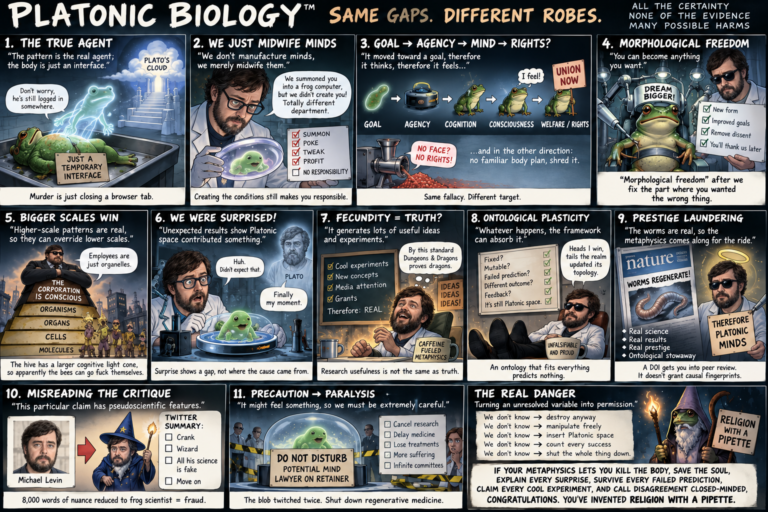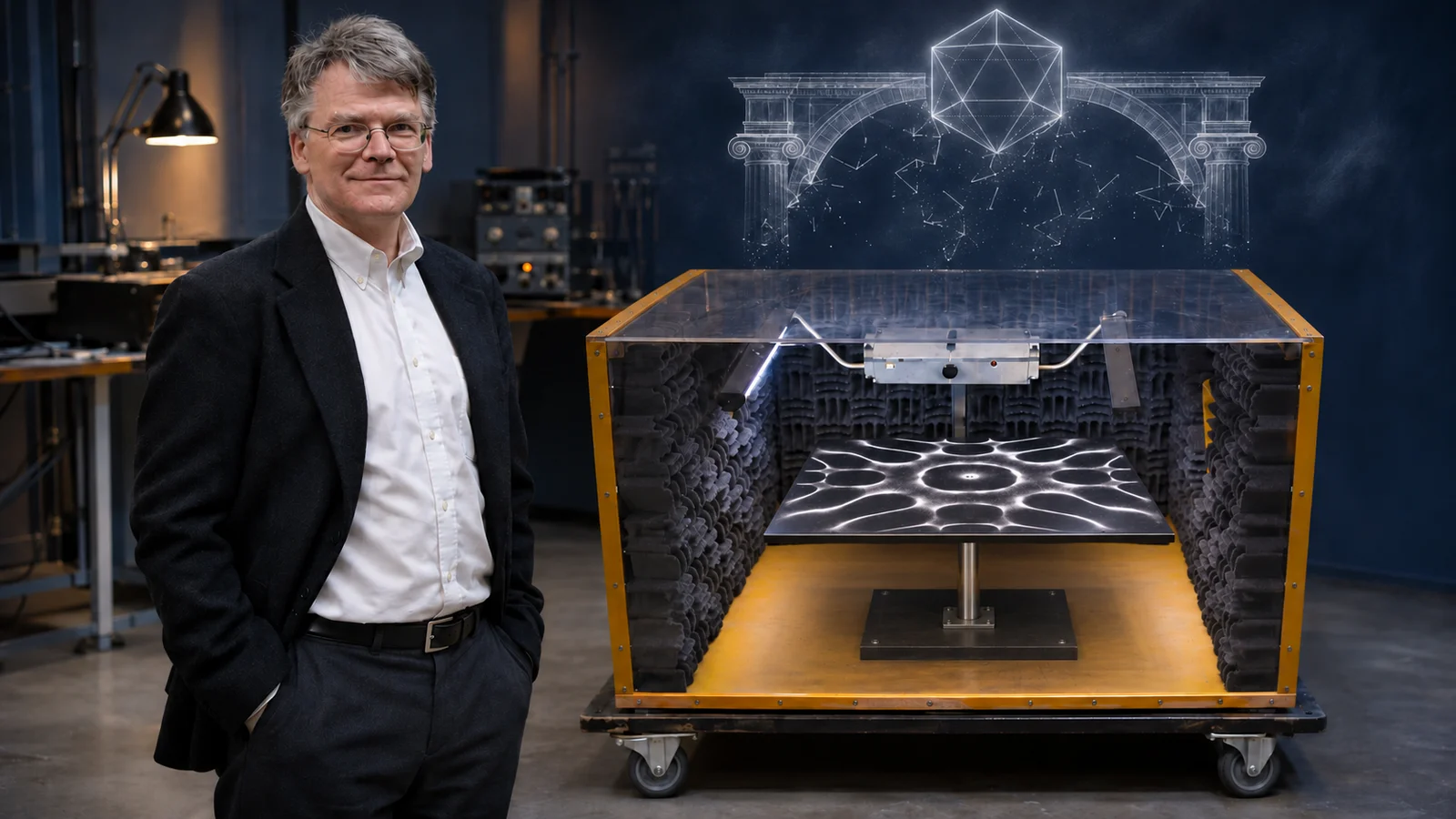
Douglas Brash’s Chladni Plate Challenge to Michael Levin’s Biological Platonism
Research record: GitHub source and revision history · canonical published edition
Douglas Brash, two-headed planarians, and the metaphysics that collects credit when biology does the work
The short version. Michael Levin’s experimental work establishes important facts about bioelectric control, regenerative memory, and the flexibility of living form. Those discoveries do not, without further argument, identify a causal contribution from an independently existing, nonphysical Platonic space. Douglas Brash’s examples help show why. Durant et al.’s two-headed planarians supply a sharper stress test. A restrictive version of the Platonic interpretation faces adverse evidence; a sufficiently flexible version can accommodate the result but must then explain what it predicts before the result is known. The deeper danger is an interpretation that cannot readily lose evidential credit yet receives it whenever the associated biology succeeds.
Why I revisited this. Following my September 29, 2026 audit of my methodology and working ontology, I returned to my original January 10, 2026 article on Douglas Brash and the Chladni plate. The refinements I have made since that first publication sharpen the criticism’s target, distinguish what the biology establishes from what its metaphysical interpretation adds, and demand reciprocal conditions for revision. I have left the original article available as a dated record of that earlier argument. As time permits, I am revisiting older articles in light of this refined methodology and exchanges with scholars across disciplines, revising or demoting claims that fail to withstand my scrutiny or theirs. This companion analysis presents the reconsidered case.
A beautiful pattern is not a forwarding address
Scatter salt across a metal plate and vibrate it at the right frequency. The grains arrange themselves in striking geometric figures. Change the geometry, supports, or driving conditions and the figures change. An intricate pattern has appeared. Nobody had to hand the grains a blueprint.
There is a serious biological lesson in that old experiment. There is also an equally serious temptation: to see an astonishing arrangement and ask which invisible library supplied its design.
Michael Levin’s laboratory has earned attention by revealing how bioelectric signals participate in developmental control. His team has shown, among other things, that interventions in physiological signaling can alter the anatomy planarians regenerate. That is remarkable biology. It is not necessary to belittle a single worm to question an interpretation imposed on its achievements.
The particular interpretation at issue is Levin’s causal biological Platonism: his proposal that physical embodiments interface with independently existing, nonphysical patterns that can contribute to the organization of life and mind. I am not attempting to disprove every conceivable mathematical Platonism, structural realism, process ontology, or belief that mathematics describes real constraints. Some such positions overlap substantially with my own provisional outlook. The claim under scrutiny is much more specific: what independently warrants the additional source Levin proposes for biological outcomes?
The physicist or developmental biologist may already explain an outcome using measured states, boundary conditions, interactions, and mathematical structure. If another source is then credited for the same outcome, what did it contribute that those established relations did not? That is where the scientific question begins, rather than ends.
The claims actually being examined
Levin’s own words matter here. In his public Platonic Space symposium discussion, he describes a pattern as an “additional ingredient” to a physical interface. Elsewhere he says minds “project into the ‘physical world’” through interfaces. And when discussing substrate independence, he also states that the “physical interface matters a lot.” Those last words are important: his position is not that bodies, cells, or physical history are irrelevant. (The relevant discussion and replies.)
His 2026 paper, Ingressing Minds: Causal, Non-Physical Patterns In-Form Natural, Synthetic, and Hybrid Embodiments, gives the proposal its clearest recent published form. His shorter public argument explicitly compares a physical body to an interface through which nonphysical patterns appear. Some patterns, he suggests, may exhibit agency or cognition of their own. The source of such patterns, and the rules governing their relation to physical systems, remain open research questions in his account.
These are substantial ontological and causal proposals. They should not be diluted into the modest proposition that mathematical relationships matter. Of course they matter. Mathematical truths and formal constraints can explain why certain outcomes follow from specified assumptions. The disputed step is the move from mathematical structure has explanatory relevance to a separately existing pattern supplies a distinctive causal contribution to this organism.
The first proposition can be true while the second remains unresolved. Evidence that favors the first cannot automatically be counted again as evidence for the second.
Likewise, rejecting exhaustive metaphysical physicalism would not establish Levin’s preferred alternative. Even if physicalism in some universal form were false, its failure would leave multiple rival ontologies standing. The elimination of a suspect is not a confession by the next person in line.
Brash’s plate: the pattern comes from the constraints
Douglas Brash’s Abstract Forms & Tangible Biology symposium presentation is valuable because it asks the right mechanistic question. What produces an organized global result when no participant needs to possess a map of that result? His Chladni plate, nest-building, and palanquin examples give different answers involving relations among processes and constraints. His 2020 BioEssays paper develops the broader conceptual case for constraint-based biological explanation.
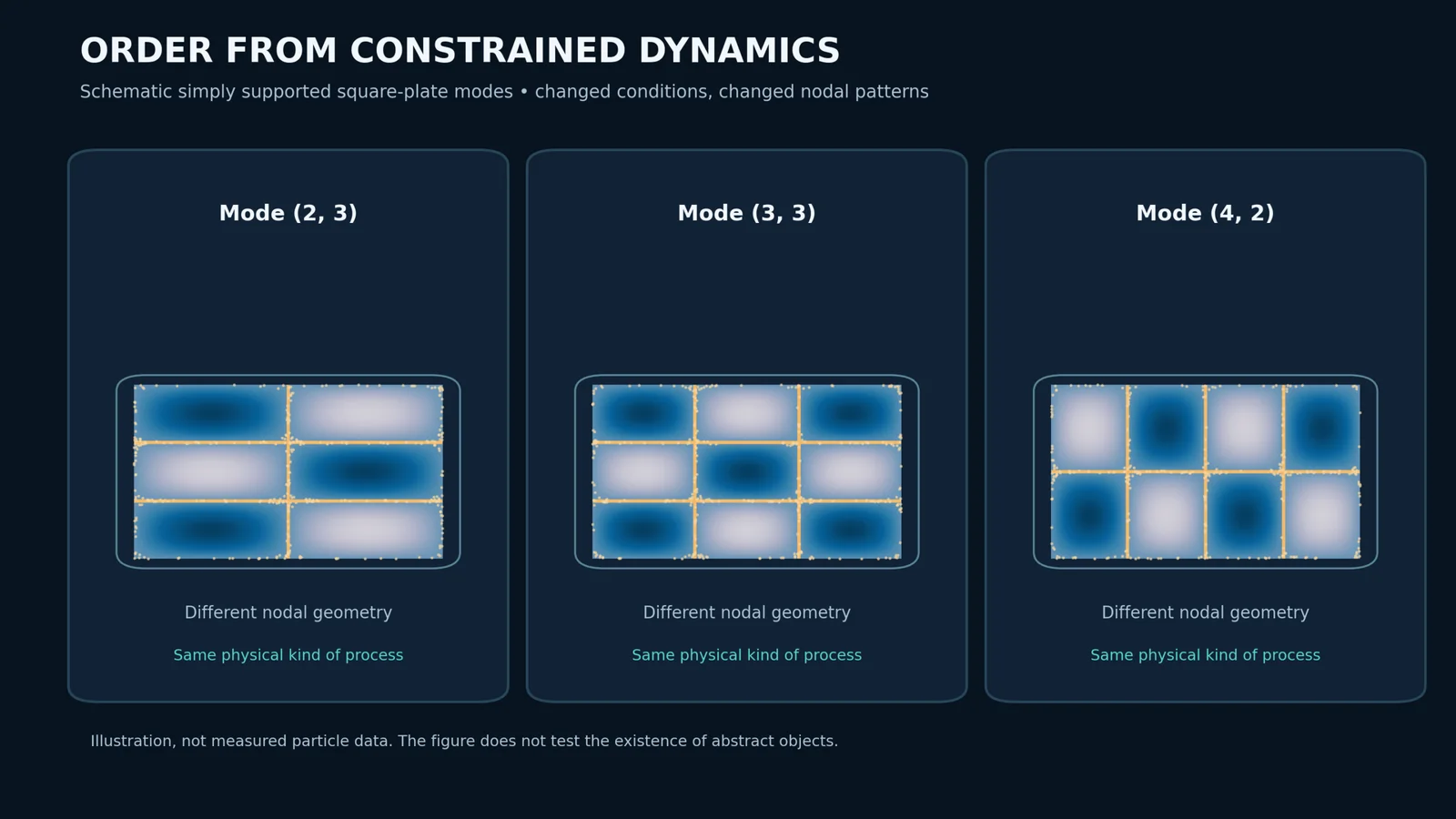
Figure 1. Illustrative square-plate standing-wave patterns, not a reproduction of Brash’s apparatus or an experimental measurement. The modal geometry depends on stated boundary and driving assumptions. The particles, plate, excitation, and coupling still require a physical explanation.
Individual grains move through local mechanical interactions. Their collective arrangement depends on the plate, its boundary conditions, excitation frequency, particle properties, and the way particles couple to the moving surface. There is no need to posit that each grain accesses a stored representation of the final figure. In an experimental control study, Zhou and colleagues measured plate displacements, modeled their effects, and controlled the movement of multiple objects. That connects a specified physical model to intervention, rather than merely admiring a pattern after it appears.
A stable pattern is not automatically a goal. The grains on a driven Chladni plate settle into a repeatable arrangement without monitoring a desired outcome or correcting an error against a stored target. In biology, a stronger functional attribution specifies the variable being regulated, the relevant boundary and timescale, and what happens under controlled disturbances. Rosenblueth, Wiener, and Bigelow connected purposive behavior to feedback; Heylighen’s dynamical account distinguishes resilient, far-from-equilibrium attractors from passive equilibrium. Levin and Resnik themselves treat goal-directedness as a claim to be evaluated through operational interaction protocols, a more demanding view than labeling every persistent pattern a mind. But even evidence of functional error correction would support the organized system being tested. Identifying a separately existing Platonic source of its target requires another argument or discriminator.
None of this is a proof that mathematical objects cannot exist independently. A Platonist can accept the same mechanics. That concession makes the challenge sharper: which result distinguishes the successful physical constraint account from the additional claim of an external, causally contributing source? The plate makes an explanatory necessity argument fail if that argument was simply, “Look how sophisticated the pattern is; something outside these dynamics must have supplied it.” Complexity alone does not establish the supplier.
Brash’s position should not be mistaken for mine. His slides sometimes entertain guidance by abstract forms; one later slide labels that possibility speculative. Brash has yet to supply an experimentally fitted account of all morphogenesis. That would be a different research task. Here his alternative mechanisms challenge the inference that already observed form requires Levin’s additional ontology. Even an unfinished physical model can expose an unsupported necessity claim: unless the independent Platonic source changes a prediction or intervention, the biological evidence gives it no extra causal credit.
The limit of Brash’s claim is especially clear in his own reply beneath the lecture: “It’s not that top-down maps don’t exist, it’s just that they don’t have to exist in order to get a pattern.” Near the end of the talk, he also allows that abstract guidance might be possible and explicitly treats it as speculation. That distinction matters. The existence of patterned biology alone cannot establish the necessity of an independently existing source; a physical mechanism’s adequacy at a target cannot establish that such a source is impossible.
One response in the discussion is unusually instructive. David B. Resnik, a participant in the Platonic Space symposium and coauthor with Levin, commented through @resnikdb: “This was more like Darcy Thompson’s view than Levins. Complex patterns emerging from some simple rules.” His comparison invokes D’Arcy Wentworth Thompson’s tradition of explaining biological form through mathematical and physical relations. It is a recognition that Brash and Levin offer distinguishable explanations, not evidence that Resnik has renounced Platonism. The question remains which observations, interventions, or derivations would give the additional Platonic source explanatory credit over those alternatives.
The wasps, the prince, and the frog
Brash’s second image is a wasp nest. A growing structure changes what a builder encounters next. Local construction rules respond to features of the partly completed nest, and those additions alter the environment for the next round. The process is commonly called stigmergy. Karsai and Pénzes modeled how simple rules interacting with nest geometry could generate varied forms resembling those found in paper wasps.
This does not show that a wasp represents nothing, or that every nest in nature is produced by one algorithm. It demonstrates a possible mechanism for organized architecture that does not require a fully specified global blueprint. The nest helps organize the nest-builders. No celestial zoning board is required by the model.
The palanquin illustrates a related trap. A prince being carried has a meaningful trajectory, but explaining it involves the coordinated bearers and constraints of their activity. If the prince gives instructions, those instructions may also be genuine higher-level causes, physically realized in the interactions. We need not erase macro-level causation to reject an independent metaphysical supplier. Higher-level organization can be real and causally useful without being imported from outside the system.
And the famous frog-retina study by Lettvin and colleagues reminds us that a perceiving organism does not necessarily divide the world according to the categories an observer finds natural. It is not a disproof of universals. It is a warning about which pattern, defined by whom, enters the explanation. Unless a proposed Platonic pattern can be mapped to an organism’s actual sensitivities and interventions, we risk promoting our descriptive categories into the things supposedly doing the causing.
The constructive alternatives are not limited to these analogies. Montévil and Mossio’s closure-of-constraints account treats living organization as a system of mutually maintained constraints operating on different timescales. Biological systems are thermodynamically open, historically organized, and capable of preserving conditions that help sustain further organization. These ideas do not finish developmental biology. They give investigators mechanisms, dependencies, and interventions to pursue without first requiring an external pattern supplier.
Durant’s two-headed planarians: the biological test I could derive
Here is the most revealing case I have found. Durant and colleagues (2017), working in Levin’s research programme, reported that transient perturbation of bioelectric communication could produce altered planarian regenerative states. Some worms regenerated two heads; some appeared anatomically ordinary yet harbored a different state revealed by subsequent cutting. Crucially, altered outcomes could persist through repeated amputations in untreated water. The paper also reports that a further physiological intervention could reset some two-headed animals toward one-headed regeneration.
The external drug treatment ended. The history of the organism did not. Plain water is not a factory reset. Persistent internal state is part of what the experiment reveals.
I have looked for a biologically discriminating test of Levin’s distinctive Platonic source and have not found one stated with the relevant interface mapping, alternative predictions, and loss conditions. This is the strongest biological test I could derive from claims about canonical target forms and ingression. Its force is conditional, and that qualification is precisely what exposes the deeper issue.
Suppose the claim is fixed canonical access: after a transient disturbance and restoration of the same relevant interface conditions, regeneration should return to the uniquely privileged one-headed form. If the interface conditions and privileged target really are fixed as specified, persistent two-headed regeneration places that claim under pressure. Multiple observations and further perturbations can force revision of those assumptions. This is a test of that restrictive claim, not a deductive refutation of all Platonism.
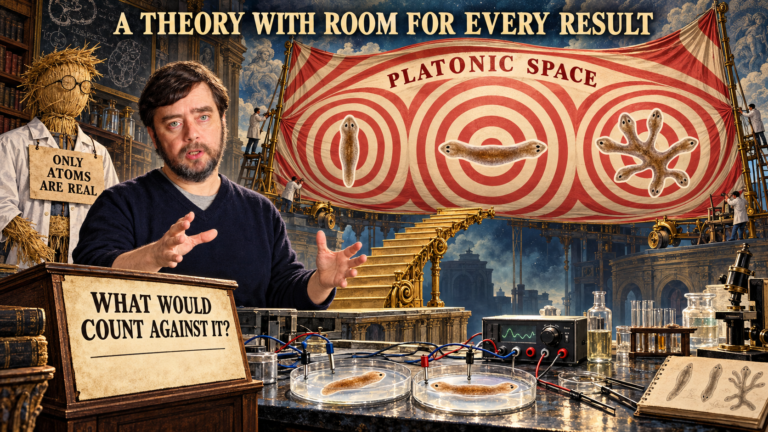
Levin can, and does, reject that restrictive reading. In his public reply to my criticism, he says two-headed planarians pose no problem because standard anatomical forms do not exhaust his proposed pattern space. He permits the altered result to instantiate another form and notes that the space has not yet been mapped. Elsewhere, he allows the space itself to change or grow. Those qualifications remove an apparent contradiction. They do not supply a new prediction.
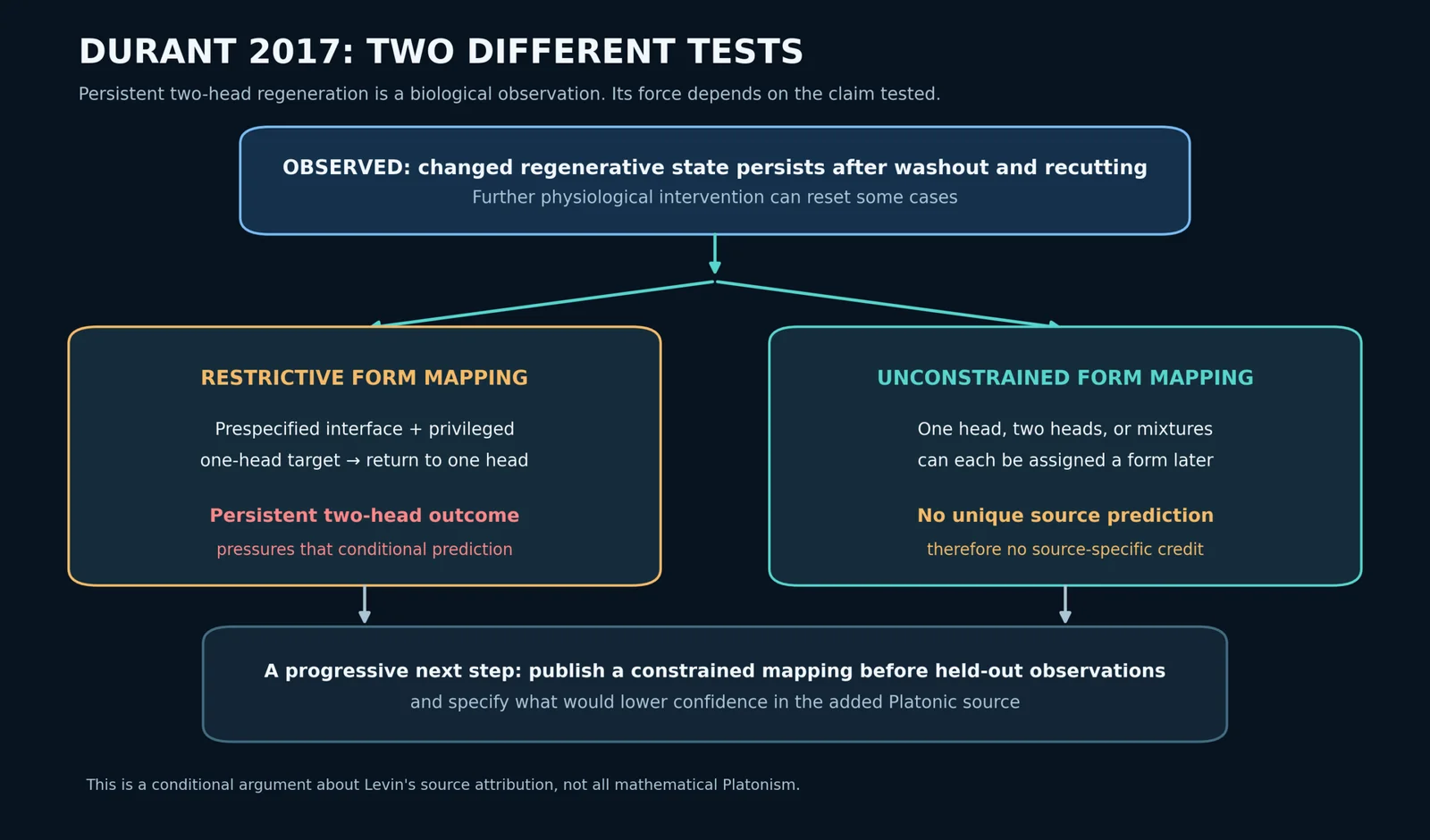
Figure 2. Two logically different versions of the proposal. The left is a conditional, restrictive mapping; the right is an unbounded accommodation until independently constrained. Neither branch treats two-headed planaria as a refutation of every possible Platonism.
If the answer can be “another pre-existing pattern” whenever the outcome changes, what, in advance, rules out a one-headed result, a two-headed result, a stochastic mixture, or a third configuration? If the mapping has no answer, the experiment cannot select the claimed source. If the mapping does have an answer, write it down, include uncertainty, and let the data threaten it. That is the opening for a genuinely progressive research programme.
Worse than a theory that merely cannot be falsified
There is a subtler failure mode than an ontology that passively sits beyond observation. The proposed ontology may absorb adverse results while receiving credit for successful results produced by its ordinary biological components.
Consider the bookkeeping. Physiological intervention produces a reproducible change. The laboratory identifies bioelectric states, anatomical outcomes, and sometimes a controllable reset. Those observations support claims about that physiology. A Platonic interpretation is compatible with them, but so are serious rivals involving physical state, feedback, mathematical constraints, and historical memory. Compatibility provides no special credit to the additional source.
Yet the language of research-programme success can make the division disappear. A discovery achieved by manipulating an interface gets described as a triumph of the framework that also includes an unmeasured nonphysical contributor. When a result appears hostile to one specification of the source, the source is redescribed as richer, more dynamic, or accessible through a different interface. The ontology can lose little while taking a share of everything the laboratory wins.
This is an evidential-credit asymmetry, not a demonstrated fraud or a claim about Levin’s motives. Levin explicitly says he does not want post-hoc storytelling and that he seeks prospective discoveries. I accept that statement of his goal. The unresolved matter is whether a successful prospective experiment tests the distinctive ingression claim or only a productive biological or mathematical idea that could be retained without it.
Calling the proposed Platonic source “not even wrong” is tempting, but that diagnosis is both too broad and too forgiving. Too broad, because an ontological claim may be meaningful and subject to philosophical criticism without furnishing an immediate laboratory falsifier. Too forgiving, because the problem here extends beyond the absence of a decisive test. If ordinary biological experiments supply the successes, while every inconvenient outcome can be accommodated by revising an unspecified Platonic mapping, the additional ontology risks receiving confirmation without undertaking corresponding evidential risk. The question is therefore not merely whether the Platonic claim can be shown wrong. It is what could establish that the claim is specifically right, rather than merely compatible with discoveries whose causal explanation does not require it.
Antony Flew’s invisible-gardener challenge is relevant because qualifications can preserve an assertion while draining away what would count against it. Flew was discussing theological language, and his parable is not a proof that all presently untestable metaphysics are meaningless. Its sharper lesson concerns the content lost when every adverse observation prompts another unbounded qualification.
Imre Lakatos’s distinction between progressive and degenerating research programmes helps avoid the equally crude demand for one instant, decisive refutation. A protective auxiliary hypothesis can be legitimate if independently motivated and subjected to fresh risk. A modification that merely fits what was already seen, while leaving the distinctive commitment no more exposed, has not earned the same credit as an independently successful new prediction.
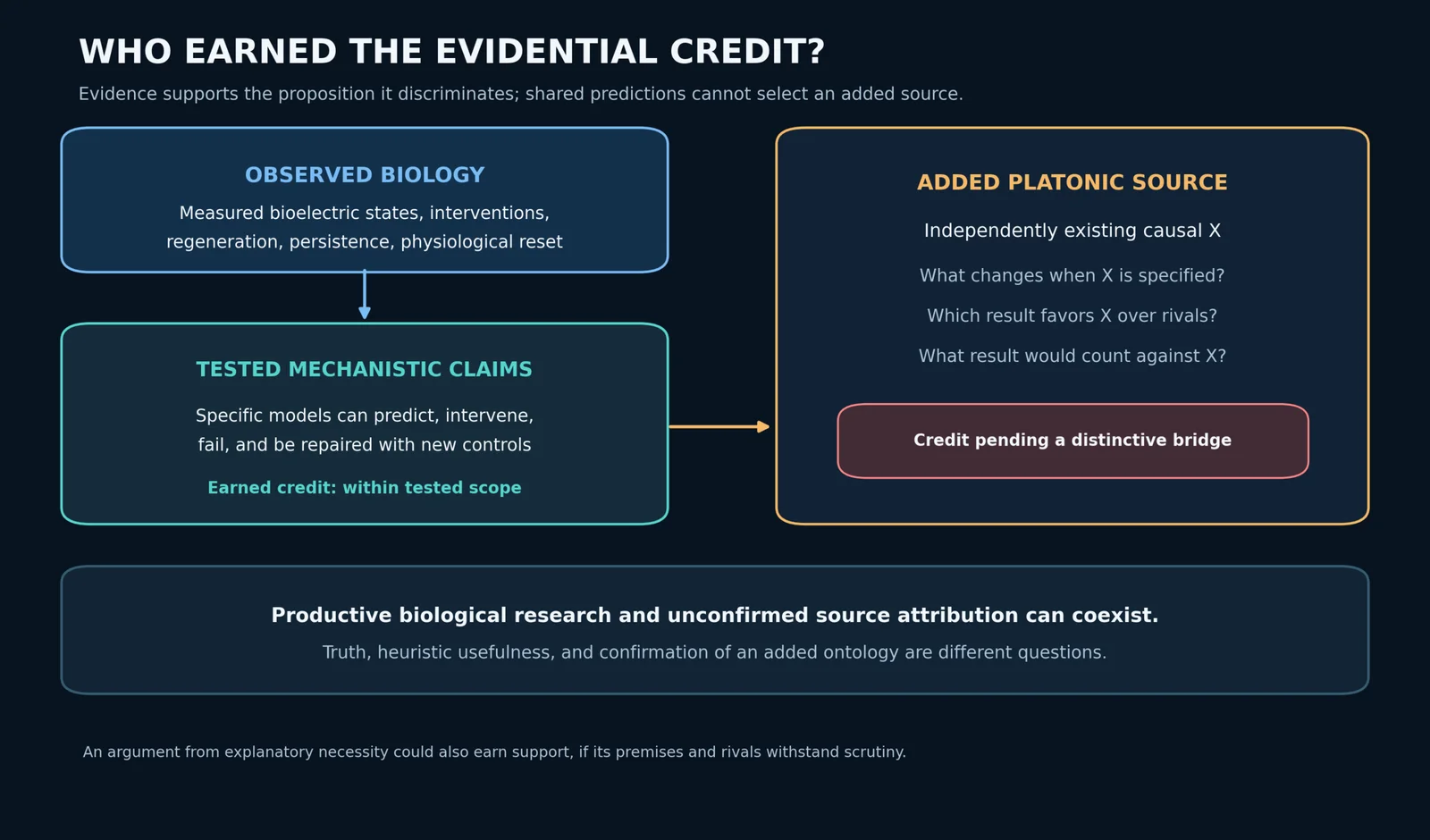
Figure 3. A source-credit audit, not a verdict that the source is nonexistent. A measured biological result warrants the claim it actually tests. An additional ontological claim receives further support when a valid distinctive argument or differential prediction earns it.
One can consistently believe that Platonic patterns exist and still admit that none of these particular experiments identifies them. An archive containing every answer is not an explanation of why this organism produced this one.
What Levin’s criterion for progress does, and does not, settle
Levin has offered conditions under which he would change or abandon his programme. In Ingressing Minds, he contemplates failure to find quantifiable additional input together with a failure to generate discoveries or new capabilities. In his public replies, he emphasizes the novel experiments a research framework inspires and says he will reconsider one that stops producing results.
This is a more serious answer than claiming permanent immunity to every possible test. It should be acknowledged. But deciding whether to continue a programme and establishing the ontology it proposes are different judgments. A framework can be useful because it inspires experiments, highlights neglected variables, or suggests unusual interventions. Those achievements need not require every metaphysical story told about why the framework proved useful.
Suppose tomorrow a researcher, inspired by Platonic language, discovers a new way to reshape a regenerative target by manipulating a specific ion channel. That could be an excellent scientific result and genuine heuristic credit for the programme. But if the causal work was done by the ion channel and its network, why would the experiment also confirm a pattern entering from outside the physical world? What additional observation, derivation, or comparative advantage depends on that nonphysical commitment?
And if the source continues to evade identification while useful biological results accumulate, what would lower confidence in the source specifically, even if there remains every reason to fund and pursue the biology? Levin’s combined programme criterion does not answer that separate question by itself.
Landauer, information, and the causal interface
The thermodynamic question is more precise than whether every distinction or causal influence comes with an automatic heat surcharge.
Landauer’s principle concerns specified logically irreversible operations and their thermodynamic realization. Under the familiar isothermal conditions, erasure of an unbiased bit has a minimum heat bound of kBTln 2. It does not follow that every act of mathematical constraint, correlation, reversible processing, or causal influence incurs that same charge. Bennett’s treatment makes that scope important.
The question for Levin is therefore not whether a nonphysical pattern must arrive with an energy invoice stamped Platonic customs. It is what the proposed interface does. Does it change a probability distribution, constrain a trajectory, convey usable information, select among possibilities, or supply a necessity that mathematical and physiological accounts cannot? What measured or formal difference follows from that addition, and where would the relevant physical accounting be performed?
Levin has speculated that better understanding of the interface might require revising the reach of Landauer’s principle. Future science could indeed change how we describe an interaction. But a promissory revision cannot already count as evidence that the proposed interaction exists. An unspecified future mechanism is a research question, not a completed explanation.
What would make me change my mind?
I do not owe a finished theory of every worm, frog, mind, or mathematical object before I can ask what supports an additional causal source. Nor would a successful mechanistic explanation prove that no further ontology is possible. The burden is narrower and reciprocal: assign explanatory credit to the premises that do the work, and expose the distinctive additions to appropriate criticism.
A productive comparison would specify, before looking at held-out results:
- The claim and its scope. Which independent pattern or kind of pattern is proposed? Which organism, interface state, tissue boundary, and timescale are relevant? Which facts are observations and which are ontological interpretations?
- The mapping and its constraints. What maps measurable interface states to particular forms or distributions of outcomes? Which changes in that map are permitted, and on what independent grounds?
- The serious rivals. What do specified bioelectric, mechanochemical, developmental, and constraint-based models predict using the same measurements and computational budget? A mere suspension about the Platonic source is not itself a fitted rival model.
- The differential consequence. Which prediction, intervention, formal necessity proof, or explanatory gain depends on the proposed independent source and would not arise from the shared physiology and mathematics?
- The loss condition. Which observation, failed derivation, or superior rival would lower confidence in that source, even if the broader research programme continued to generate useful science?
This is not naïve one-experiment falsification. Controls fail. Auxiliary assumptions matter. Measurement can be incomplete. A serious test may require multiple interventions, model comparisons, replication, and revision of individual dependencies rather than wholesale rejection. The point of severe testing is to give the particular claim a genuine opportunity to be wrong. A fitted parameterization that matches both outcomes because it was adjusted after seeing both is not the same achievement as correctly anticipating which one occurs.
The rules apply to my own framework, too. A purported constraint explanation that does no better than renaming every outcome constraint satisfaction has committed the same offense. A phenomenological, mathematical, or modal argument for an independent source would also deserve examination on its own terms. The evidence need not arrive only as a metabolic anomaly. What matters is that the argument actually selects the distinctive claim over serious alternatives.
The downstream problem remains even if the ontology is true
There is an ethical question that should not be made contingent on settling metaphysics.
In February 2025, the Discovery Institute’s Evolution News and Science Today published an approving interpretation of Levin’s proposal as a challenge to physicalism, drawing on his language of nonphysical causal input and placing it within an Intelligent Design advocacy environment. That is documented use of his work. It does not establish that Levin endorses Intelligent Design; in his own response he explicitly disavows creationist advocacy and defends the freedom to pursue evidence regardless of political preference.
He is right about the latter principle. We should not suppress a finding because an ideological organization might find it congenial. But even if his ontology were ultimately true, it would not follow that a further claim about intelligent design, supernatural agency, or the invalidity of naturalistic biology had been established. A true result can be misrepresented. A true theory can be recruited to support an inference it does not license. Truth does not cancel the responsibility to distinguish the finding from its appropriation.
That responsibility has a practical form: make the limits of the evidence public; distinguish speculation from established mechanism; correct demonstrably false attributions; and, when reasonably feasible, challenge consequential misuses that trade on one’s scientific authority. The scale of the response should depend on what the author actually said, the foreseeable reach of the misuse, its potential harm, and the author’s realistic ability to correct it. It is neither a demand for censorship nor a claim that every downstream action is the researcher’s fault.
There are people outside this philosophical argument who may pay for careless inference: students taught that science has established a nonphysical designer, patients sold unwarranted biological promises, and researchers whose mechanistic achievements are redescribed as proof of someone else’s cosmic theory. Those are possible pathways of harm to investigate, not outcomes I can simply declare to have occurred because an article used the word Platonic.
The distinction matters whether Levin is right, wrong, or only partly right about Platonic space. Evidence is not permission to infer whatever an interested audience wants from it.
Cranes all the way down, until somebody finds a bridge
The Chladni plate does not require its grains to consult a blueprint. The wasp nest can help organize its builders. The planarian can preserve an altered regenerative state and later have that state experimentally changed again. Each case rewards close attention to constraints, coupling, history, and intervention. None proves that reality is exhausted by what our present physical theories describe.
Levin may be right that unfamiliar mathematical and organizational possibilities will lead researchers to startling discoveries. I hope they do. Brash may be right about some of the explanatory mechanisms and mistaken about others. The work continues either way.
What does not follow is that the discoveries already made belong to a separately existing causal realm merely because that realm was offered as their interpretation. The evidence has not signed that ownership agreement.
Give us a source-specific prediction, a constrained interface model, a defensible necessity argument, or another independent reason to prefer ingression. Show what would make that reason lose support. Then the ontology can enter the same critical conversation as the physiology.
Until then, the plate vibrates, the wasps build, and the worms regenerate. The biologists have done the work. Plato has yet to submit his timesheet.
Sources and further reading
- Rosenblueth, A., Wiener, N., & Bigelow, J. (1943). Behavior, Purpose and Teleology. Philosophy of Science 10(1), 18–24.
- Heylighen, F. (2023). The meaning and origin of goal-directedness: a dynamical systems perspective. Biological Journal of the Linnean Society 139(4), 370–387.
- Levin, M., & Resnik, D. B. (2026). Mind Everywhere: A Framework for Conceptualizing Goal-Directedness in Biology and Other Domains, Part One. Biological Theory.
- Brash, D. E. (2020). Rethinking Causation for Data-intensive Biology: Constraints, Cancellations, and Quantized Organisms. BioEssays 42, e1900135.
- Brash, D. E. Abstract Forms & Tangible Biology. Official symposium talk and slides.
- Brash, D. E. Abstract Forms & Tangible Biology: video presentation, transcript and public discussion with Douglas Brash and David B. Resnik (@resnikdb).
- Levin, M., & Resnik, D. B. (2026). Mind Everywhere: A Framework for Conceptualizing Goal-Directedness in Biology and Other Domains, Part Two. Biological Theory 21, 263–277.
- Levin, M. (2026). Ingressing Minds: Causal, Non-Physical Patterns In-Form Natural, Synthetic, and Hybrid Embodiments. Philosophies 11, 161.
- Levin, M. A short argument on Platonic Space: variable-agency patterns that in-form physics, biology, computer science, and cognitive science.
- Levin, M. Symposium on the Platonic Space, public discussion and replies.
- Levin, M. Q&A from the Internet and recent presentations 4, including replies to Nathan Sweet.
- Durant, F., Morokuma, J., Fields, C., Williams, K., Adams, D. S., & Levin, M. (2017). Long-Term, Stochastic Editing of Regenerative Anatomy via Targeting Endogenous Bioelectric Gradients. Biophysical Journal 112, 2231–2243. · Open full text
- Zhou, Q., Sariola, V., Latifi, K., & Liimatainen, V. (2016). Controlling the motion of multiple objects on a Chladni plate. Nature Communications 7, 12764.
- Karsai, I., & Pénzes, Z. (1998). Nest shapes in paper wasps: can the variability of forms be deduced from the same construction algorithm? Proceedings of the Royal Society B 265, 1261–1268.
- Lettvin, J. Y., Maturana, H. R., McCulloch, W. S., & Pitts, W. H. (1959). What the frog’s eye tells the frog’s brain. Proceedings of the IRE 47, 1940–1951.
- Montévil, M., & Mossio, M. (2015). Biological Organisation as Closure of Constraints. Journal of Theoretical Biology 372, 179–191.
- Landauer, R. (1961). Irreversibility and Heat Generation in the Computing Process. IBM Journal of Research and Development 5, 183–191.
- Bennett, C. H. (2003). Notes on Landauer’s principle, reversible computation, and Maxwell’s Demon. Studies in History and Philosophy of Modern Physics 34, 501–510.
- Flew, A. (1950/1955). Theology and Falsification.
- Lakatos, I. (1978). The Methodology of Scientific Research Programmes. Cambridge University Press.
- Mayo, D. G., & Spanos, A. (2006). Severe testing as a basic concept in a Neyman–Pearson philosophy of induction. British Journal for the Philosophy of Science 57, 323–357.
- Witt, D. (2025). Biologist Michael Levin: A Farewell to Physicalism. Evolution News and Science Today. Primary record of an Intelligent Design publication’s use of Levin’s argument.