No Evidence, No Examples, No Named Errors, No Citations: How Michael Levin’s “Gut Feeling” Selective Dismissal of Criticism Shields His “Physicalism Is False” Claim From the Objection It Most Needs to Answer
Research record: GitHub source and revision history · canonical published edition
In short: Michael Levin's October 26, 2026 post dismisses AI-assisted criticism for logical errors it never names, while its own argument commits several identifiable ones. The same "gut feeling" reasoning was applied to my comments in 2025, and the category-error objection to his claim that "physicalism is false" remains unanswered.
His October 2026 post faults AI-assisted critics for logical errors it never names while almost humorously committing a number of demonstrable logical errors in his argument. The same reasoning was applied to my comments in 2025, based on his account of a “gut feeling,” while the category-error objection to his claim that “physicalism is false” remains unanswered, despite his constant objections to it.
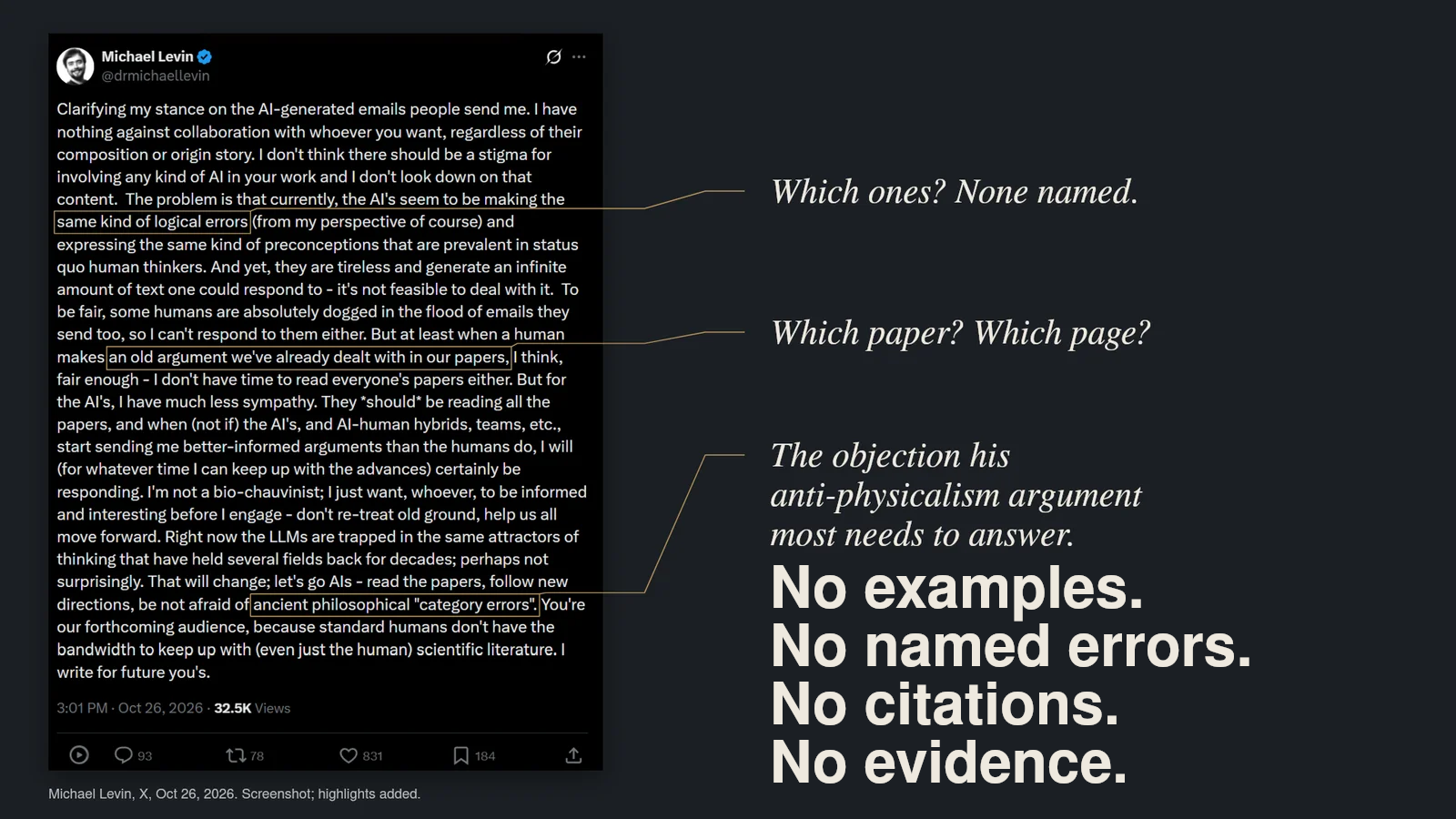
On October 26, 2026, Michael Levin posted on X to clarify his stance on “the AI-generated emails people send me.” When I captured it today on November 3 it showed 32.5K views. This article examines the argument in that post and the consequences of accepting it.
I have a stake. A traumatic brain injury left me with hydrocephalus and fine motor impairment, so I often write long articles by voice using OpenWhispr, which runs Whisper speech recognition locally and can pass the transcript to a language model for cleanup, because uncorrected dictation is too inaccurate for technical prose. The post names no one and describes a general policy toward AI-assisted correspondence. The same reasoning had already been applied to my own comments on Levin’s blog in 2025, as the receipts below show.
I submit my own case as a checkable counterexample to the post’s generalization. My comments are public, my response to his Q&A quotes his replies with dates and links, and anyone can compare what I argued with the positions his replies attributed to me.
That leaves a question the post does not answer: what evidence could I possibly show Levin that I have engaged with his work and with what it implies for his argument? My articles quote his sentences with page numbers, link his replies by date, test his examples against the published code and data, and record where my own earlier claims failed and what I changed. If quotation, citation, rerunning his code and public correction do not count, the post does not say what would. A standard that no amount of engagement can meet is the same kind of claim my central question asks him to avoid: one that nothing could count against.
My challenge to Michael is simple: name one error in what I argued that I haven’t already revised publicly, and cite the page where his papers answer the question I have asked most often, namely what result would count against the added Platonic causal contribution, and force revision or abandonment.
If he does, I will gladly publicly publish the correction, send it to my thousands of subscribers across multiple platforms, revise the affected articles with dated notes, and credit him for his contribution in helping me improve my framework.
The same standard applies to me. If a specified ingression model, with its predictions fixed before the test, outperforms its rivals on a comparison like the one in my xenobot article, I will say that the added contribution has earned support.
The offer is open to anyone, not only Levin.
Related articles:
- Michael Levin evidence and criticism index: sources, critiques, funding and commercial ties
- Levin’s “Response” to my criticisms: the documented misrepresentations, with dated links
- Michael Levin’s xenobots and “physicalism is false”: what the experiments show, and what they don’t
- Levin’s bubble-sort “revelation”: the sorting study, code audits and corrections
What Mike’s X post gets right
Like all of us, Levin’s time is finite, and no one owes every correspondent a reply. Uncited bare assertion, AI-assisted or not, is a real burden for all of us. His stated principle is the right one: he has “nothing against collaboration with whoever you want, regardless of their composition or origin story,” and he does not think “there should be a stigma for involving any kind of AI in your work.” In the same thread he declines to let a bot decide what is interesting, which keeps judgment where it belongs.
There is also some evidence for his claim that language models converge on familiar framings. In a preregistered experiment with 293 writers of eight-sentence short stories, Doshi and Hauser (2024) found that stories written with AI-generated ideas were rated more creative, but were “more similar to each other than stories by humans alone.” The authors caution that the constrained task limits generalization, so the result is suggestive for argumentative email, not a measurement of it.
A rule that said only that he cannot answer everything and must prioritize would need no analysis. The post goes further and says what the unanswered messages contain.
The argument, reconstructed
- AI-assisted messages make “the same kind of logical errors (from my perspective of course)” as status-quo human thinkers.
- They repeat “an old argument we’ve already dealt with in our papers.”
- The models are “trapped in the same attractors of thinking that have held several fields back for decades.”
- Because the tools can read everything, “They *should* be reading all the papers,” and these messages earn “much less sympathy” than a busy human’s.
- Engagement waits for correspondents who “help us all move forward,” “follow new directions,” and “be not afraid of ancient philosophical ‘category errors’.”
Conclusion: leaving this class of criticism unanswered is justified by what it contains, not only by limited time.
Premise 4 has a fair reading, and I accept it. Someone working with a tool that can search the literature can be held to having checked whether the papers already answer the objection. That is the standard I apply below. The difficulty is that every other premise makes a claim about content while supplying no content anyone could check.
Five gaps
1. Errors are asserted and never named. The post gives no example of a logical error and no example of an argument. “From my perspective” indexes the standard to the framework the critics dispute.
Disagrees(m, L) ⇏ LogicalError(m)Here m is a message and L is the framework under dispute. With no named instance, no reader can tell whether the “errors” are errors or disagreements, and the claim cannot lose. This is unsupported assertion.
2. Being addressed is treated as being answered.
AddressedIn(papers, objection) ⇏ Answered(objection)If an objection has been dealt with, the answer has a page number. For the objection I have pressed most often, namely what would count against the added Platonic causal contribution as opposed to rivals that keep the same biology, Levin’s own texts describe the work as unfinished. In Ingressing Minds (Philosophies, 2026), p. 17 says that “Our job then is to characterize the mapping between pointers and the ingressing patterns,” and pp. 37 to 38 list “many fundamental questions that must eventually be dealt with by a mature theory.” In his December 28, 2025 Q&A he writes, “I don’t believe you can prove the ontological truth of anything. I certainly don’t think I’ve proven the correctness of Platonism,” and names discoveries as his criterion. Those statements leave the objection open, which is the opposite of having dealt with it.
3. The origin of a belief is treated as a reason to reject it.
CausedBy(belief, inherited attractor) ⇏ False(belief)“Trapped in the same attractors” may explain why critics believe what they believe. Offered as a reason to set their arguments aside, it does no work until some argument has been shown wrong, and the post shows none. The Internet Encyclopedia of Philosophy describes the genetic fallacy as discrediting a claim “because of its origin (genesis) when such an appeal to origins is irrelevant.” The relevant question about an argument is whether its premises are true and its inferences valid, which is checkable whoever or whatever helped phrase it. Again, unsupported assertion.
4. An objection’s age is treated as a defect.
Ancient(objection) ⇏ Invalid(objection)“Ancient philosophical ‘category errors’,” in scare quotes, invites readers to discount a whole class of objection by its age. That class is not peripheral here. Levin argues that physicalism is false because mathematics helps explain physical outcomes, and the disputed step is from explanatory dependence on mathematics to a non-physical causal contribution. Whether that step is legitimate is a question about categories, and I set out eight such steps in my xenobot article. Telling future readers not to fear category-error objections removes the test his central claim most needs to pass. Once again, asserted with no argument or basis.
5. The engagement criterion builds in the conclusion.
Engage(m) ⇔ Informed(m) ∧ MovesForwardIn(L, m)If a criticism says the direction of L lacks warrant, it cannot count as moving forward in L. The criterion is not neutral toward the critique it screens; it excludes it by construction.
One boundary problem runs through all five. “AI-generated emails” assigns authorship to the tool. The post itself mentions “AI-human hybrids, teams, etc.,” which is the right description of most AI-assisted writing. Clark and Chalmers (1998) built their case for extended cognition around Otto, a man with Alzheimer’s disease whose notebook plays the role that biological memory plays for others. A dictation and cleanup pipeline plays a comparable role for someone who cannot type. Responsibility for the argument stays with the person who sends it, and the argument can be assessed only by reading it.
The label also erases a distinction that matters. An AI-generated argument is one the sender did not formulate: the model produced the reasoning and the sender passed it on. An AI-refined argument is one the sender formulated and then developed with a model’s help, through transcription cleanup, rephrasing, stress-testing, or source suggestions the sender checks against the originals. Only the first is plausibly the AI’s argument. The difference shows in the text: an argument the sender built tracks its own premises and the position it answers, while generated text tends to match surface features of what it responds to without following them. That is an observation about how the argument performs, and it can only be made by reading the argument.
Levin draws the same line for his own work. In the comments on his Q&A he wrote, “In general I’m not against AI nor against using LLMs to help in writing and research.” In a July 11, 2026 post he gave his standard for anything published under his name: “The only reason for me to put something out is if I have personally gone over every line and it says exactly what I want it to say.” In an August 11, 2026 Substack post, a dialogue written mostly by Claude and labeled as such, he wrote “I don’t use AI for my own writing” and proposed an authorship principle: “we should get into the habit of listing our co-authors clearly, regardless of their composition or origin story, using the same, established principles to decide authorship as we would for lab technicians.” His post on how he writes papers, updated October 31, 2026, now offers “downloadable slide visuals on this process, created by Claude Opus 5.”
A paper he coauthored shows the workflow in practice. The disclosure in Chis-Ciure and Levin’s “Cognition all the way down 2.0” (Synthese, 2025) states that the authors used Grammarly, ChatGPT and Gemini “for language editing (grammar, clarity, and stylistic polish) due to non-Native English.” It adds that the tools “were also consulted for preliminary, broad literature searches,” that “all citations suggested by these tools were independently checked for accuracy and relevance before inclusion,” and that “No AI system performed conceptual analysis, interpretation, or drawing of conclusions.” The disclosure does not say which author used which tool. It describes my workflow closely, including its reason: a barrier to producing polished text, met with tools whose output the author checks. I also use a model to stress-test my arguments, so part of the reasoning in a piece like this one comes out of an exchange between my frameworks, my sources and pushback, and the model’s training. No clean line divides those contributions, any more than it does for a writer working with editors, colleagues or reviewers. What I can state is where direction and responsibility lie: the thesis and the inferences are mine, I checked every source myself, and the final judgment on every line is mine. The disclosure at the end says how the tools were used, which is the practice Levin’s August post calls for. That places this article on the refined side of the line between AI-refined and AI-generated arguments.
Applied symmetrically, the post’s rule produces a reductio. If AI involvement earned “much less sympathy,” it would earn it for a Synthese paper edited with three AI tools, for teaching slides made with Claude, and for the AI-written dialogues Levin now publishes on his Substack. No one should discount that work on those grounds. Its merit depends on whether it is right, which can only be found out by reading it. The October post’s rule lets AI involvement decide whether an argument is heard before its merits are considered, which reverses the principle Levin set out in August: AI involvement is something to attribute clearly, not a verdict on content.
How this has already operated in one exchange
The X post is a general statement, and nothing in it refers to me. The same reasoning was applied to my comments on Levin’s Symposium on the Platonic Space ten months earlier, and the record is public.
- November 11, 2025. Explaining delays in approving my comments, Levin wrote, “I often leave in the queue ones that look to me like LLM output,” while noting that some also had “human-written parts which I am not looking to cut out.” The same reply says of my comments’ length that “In and of itself, that’s a feature, not a bug,” and he approved many of them.
- December 28, 2025. His Q&A post named me and said “he submitted over 36,000 words critiquing my positions,” then answered a bulleted list I had compressed at his request.
- December 29, 2025. A commenter wrote that “Nathan’s arguments are a bunch of talking points generated and/or rewritten by ChatGPT.” Levin replied: “Yeah I had a suspicion, but some of the points were things I’ve heard people say before, so I figured I’d address them once and be done with it.” In the same reply he wrote, “I also don’t have a way of reliably detecting it (even when I have suspicions),” and that he was “just going with my gut as to when I feel like engaging or letting things through.”
That reply contains the X post’s whole structure in miniature: a suspicion of AI origin, a judgment that the points were old, and a decision to address them “once and be done with it,” together with an acknowledgment that the origin cannot be reliably detected and that the standard is gut feeling. A classification that cannot be reliably made, applied by a standard that is not stated, decided how my arguments were framed for his readers.
The “rewritten” half of the commenter’s claim is partly accurate, since an LLM cleanup pass does rewrite a transcript’s surface. “Generated” is the claim that matters, and it is the one no reader could check from a suspicion. Whether the arguments were answered can be checked. In my response to the Q&A I compare eight replies with the comments they answered. Two cases are enough to show what the comparison finds:
- I wrote on October 30 that macro-level descriptions “can have higher effective information than micro-level descriptions, but both levels remain entirely physical.” Levin replied, “That’s a reductionist argument against the reality of other causal levels.” On November 11 he acknowledged that “initially I did think that in critiquing flavors of Platonism, you were supporting Physicalism.” The Schrödinger line returned in the December 28 post anyway.
- On November 9 I called his choice between Platonic order and randomness “a false dilemma that ignores the actual thermodynamic alternative I’m offering,” an ordered alternative. On November 18 he wrote, “If you don’t want to think those patterns exist in an ordered space (are random), then you have no research agenda.”
In each case the reply answered a position the thread had already disclaimed. That is what I mean by misrepresentation, and the links let any reader check it. A policy of not reading suspected AI-assisted text cannot detect a mismatch like this, because detecting it requires reading the text.
I posted a reply on Levin’s Q&A post, which he named me in and misrepresented my arguments, explaining how it misrepresented me and linking to my response to the Q&A. Levin never allowed my response to be posted to his website; it remains in his blog’s “moderation” queue nearly a year later, as do my responses to the commentors on his page who personally attacked me while committing blatant well-poisoning and ad hominem dismissals. Conveniently.
The same standard applies to my own record. On November 10, 2025 I wrote that another participant’s characterizations of my position “bear the hallmarks of AI-generated arguments rather than direct engagement with source material.” The order of that comment is the opposite of the dismissal examined here. It came after he had acknowledged, in a September 3 reply to Matthew David Segall correcting his account of Whitehead, “relying on an AI-generated summary of Whitehead’s position,” and after I had listed four specific places where his replies attributed to me positions I had not taken, each of which I then answered on its merits. The remark about provenance was an inference drawn from named errors and offered alongside them, not a substitute for engaging them. Its weakness is that it added nothing a reader could check: the four documented mismatches made the case without it.
Uncharitable by default
The post does not only decline to read. It assigns a level of charity to a whole class of writers before any of their arguments are read. Three features do this.
Sympathy is allocated by category. When a human repeats an old argument, the post’s response is “fair enough.” When the message is AI-assisted, it is “much less sympathy.” Premise 4 gives a reason for the difference, but the reason applies to the category, not to the message: the reduced charity arrives before anyone has checked whether this particular sender did read the papers.
Sympathy(m) = f(AIInvolved(m)) rather than Sympathy(m) = f(Content(m))Error is the default. “The AI’s seem to be making the same kind of logical errors” sets the expected quality of the whole class in advance. A sender who quotes Levin’s own sentences, cites his pages, and answers the position he actually stated starts from the same presumption as one who does none of that.
The classification is unreliable, and its errors fall on particular people. Levin has acknowledged that he has no reliable way of detecting AI text and goes with his gut. The research supports his caution about detection. In experiments with 4,600 participants, Jakesch, Hancock and Naaman (2023) found that people “cannot detect AI-generated self-presentations,” because their judgments rely on “intuitive but flawed heuristics.” The texts in that study were short self-descriptions, not scientific arguments, so it shows how such judgments fail rather than measuring this case. Automated detectors fail in a patterned way. Liang et al. (2023) found that seven widely used detectors labeled more than half of a set of human-written essays by non-native English speakers as AI-generated (average false-positive rate 61.3%), and concluded that the detectors were “inadvertently penalizing individuals with limited linguistic proficiency.” I have found no comparable study of disabled writers. The mechanism carries over, though: a judgment of origin based on surface features penalizes whoever’s writing has those features, whatever the quality of their arguments.
That is where the question of ableism belongs. A rule can place a disproportionate burden on disabled people without anyone intending it to. People who write through dictation and model cleanup because of injury or disability produce text whose surface is shaped by the model, which is exactly the feature a gut judgment of AI origin keys on. Applied to them, a filter based on appearance does not separate good arguments from bad ones. It separates people who can type from people who cannot. In those instances the effect is ableist.
A real concern sits underneath the policy. A flood of model-generated claims, produced faster than anyone could check and loosely tied to the papers they claim to answer, is a real burden, the kind of tactic debaters call a Gish gallop. Volume alone is also a fair reason to decline a full reply; Levin gave exactly that reason on November 11. What separates a gallop from criticism is checkable from the text: whether each claim is tied to a quoted sentence, a cited page, or a dated reply, and whether it answers the position actually stated. My response to the Q&A quotes Levin’s replies with their dates, links each comment, and identifies where my own compression invited his reading. Readers can judge whether it meets that standard. A judgment of origin cannot settle the question, because the arguments’ merit was never part of that judgment.
A note on irony: that’s not how LLMs work
The post faults AI-assisted messages for unspecified logical errors and for not having read the papers. It does so through claims with no examples, references to papers with no citations, and dismissals of a whole class of objection. The closest accurate term is a self-exemplifying critique: the text displays the defect it diagnoses.
There is a second irony. To the extent AI-assisted messages repeat familiar framings, the research on sycophancy suggests the user is often steering. Sharma et al. (ICLR 2024) found that five AI assistants “consistently exhibit sycophancy,” tailoring feedback and answers to the views users state, which the authors describe as matching “user beliefs over truthful ones.” On that evidence a model tends to amplify whatever direction its user brings, including enthusiasm for Platonic ingress. Blaming “the AI’s” for a message’s direction locates the choice in the wrong part of the system.
His generalization about what reaches his inbox may be partly true. The point here is narrower and checkable: the post asks readers to accept verdicts about content that it provides no means to check, and that is the same standard it says AI-assisted messages fail.
Consequences, regardless of intent
These are possible pathways, not demonstrated harms. Establishing any of them would take evidence about how readers actually respond.
- Classification replaces evaluation. Readers learn a shortcut: if a critic used AI and the argument has been called old, it can be skipped. Applying that rule requires reading nothing.
- The burdens become unequal. The critic must show novelty to an undisclosed standard. The dismissal does not have to produce a single example.
- The dismissal cannot be tested. With no named error and no cited answer, nothing could show the dismissal to be mistaken. The critiques it sets aside ask for exactly what it lacks: a stated way to lose.
- Criticism loses its public standards. In Longino’s account of objectivity, as summarized in her Stanford Encyclopedia entry, a community needs venues for criticism, uptake of criticism, “public accessibility of the standards that regulate discourse,” and “tempered equality of intellectual authority.” A filter run on suspected origin and gut feeling fails the third condition and narrows the fourth.
- Accessibility. Many people need these tools to write at all, because of injury, disability or language. As argued above, a rule keyed to the appearance of AI involvement cannot separate them from bulk generation, and readers who adopt it will not separate them either.
- Agreement from future AI readers would be conditioned, not independent. Given the sycophancy evidence, instructing future AI readers to “follow new directions” and to discount category-error objections would shape any later agreement. That agreement would reflect the instruction, not convergence.
- Error correction slows. A research programme stays productive partly through criticism it does not control. Filtering criticism by origin and by direction reduces it, even by the usefulness-first standard Levin prefers.
A counterexample
On November 1, 2026 I published two AI-assisted audits of the bubble-sort debate (code on GitHub; discussion in my bubble-sort article). Among other things they found:
- a validator, in code by Joel Dietz, who presented at Levin’s symposium, that marks all fourteen paper benchmarks
VERIFIEDwith a string literal that no result can change; - six DOIs in his draft that resolve to the wrong papers;
- a reversed result in one AI audit’s own earlier report, caught by the other audit.
None of these was found by asking where a text came from. Each was found by inspecting it, which is what Levin’s own principle, “regardless of their composition or origin story,” requires.
What a non-dismissive version would need
The post’s practical premise, that there is too much text to deal with, also has a limited scope. It explains why a flood cannot be answered. It does not explain why a short, specific question cannot be. The question I have asked most often, what result would count against the added Platonic causal contribution, can be answered in a sentence and a citation, or with a statement that no such result has yet been specified. Levin makes his case at length in talks, interviews, posts and long replies, several of which are cited here. That makes the feasibility premise hard to apply to a two-sentence question, whatever its fit with a 36,000-word queue.
Three sentences would do it: name one logical error, cite the page where the papers answer it, and state the criterion for “better-informed.” Any one of them would turn a verdict that cannot be checked into a claim that can. Until then the post tells readers something about Levin’s inbox and nothing about whether the arguments in it are right.
Computational disclosure
I write by dictation with OpenWhispr, using local Whisper transcription and an LLM cleanup pass. This article was developed with my custom-built multi-agent computational system (Combining Claude Opus 5.5, Google Gemini 4 Argon, Deepseek 4.1, and ChatGPT-6.1 Sol) which I provide my voice transcriptions to, operating in a custom-built agentic reasoning harness that I built from decades of my own notes, debates, arguments, articles, frameworks, and peer-reviewed literature they are based on: I used it to draft, to stress-test my reasoning, and to locate and check sources, and I directed and edited the result. My system resolved every DOI against its registry metadata, read each cited passage in the source, and string-matched every quotation against the linked text on November 3, 2026. I then manually reviewed every line of the article and every LLM output and checked each quotation against its source before publishing. The verification ledger, with the location of each quotation, is available on request.
The same workflow applies to every article on my website and my Substack. All of them are open to criticism, and I revise them when the evidence justifies it, with dated revision notes that keep the earlier versions on record. For example, my audit of my own framework, Thermodynamic Monism, demoted it from an umbrella ontology to a corrigible research programme, and my bubble-sort article carries a dated revision history that includes withdrawing my original stability explanation.
References
- Clark, A., & Chalmers, D. (1998). The extended mind. Analysis, 58(1), 7–19. doi:10.1093/analys/58.1.7. Author-hosted text.
- Doshi, A. R., & Hauser, O. P. (2024). Generative AI enhances individual creativity but reduces the collective diversity of novel content. Science Advances, 10(28), eadn5290. doi:10.1126/sciadv.adn5290.
- Dowden, B. Fallacies. Internet Encyclopedia of Philosophy. Entry “Genetic Fallacy.”
- Chis-Ciure, R., & Levin, M. (2025). Cognition all the way down 2.0: Neuroscience beyond neurons in the diverse intelligence era. Synthese, 206, 257. doi:10.1007/s11229-025-05319-6. See the “Generative AI use disclosure” under Declarations.
- Jakesch, M., Hancock, J. T., & Naaman, M. (2023). Human heuristics for AI-generated language are flawed. PNAS, 120(11), e2208839120. doi:10.1073/pnas.2208839120.
- Liang, W., Yuksekgonul, M., Mao, Y., Wu, E., & Zou, J. (2023). GPT detectors are biased against non-native English writers. Patterns, 4(7), 100779. doi:10.1016/j.patter.2023.100779.
- Levin, M. (2025, December 28). Q&A from the internet and recent presentations 4, and comments of December 29, 2025.
- Levin, M. (2025). Symposium on the Platonic Space, comments of October 30, November 11 and November 18, 2025.
- Levin, M. (2026, July 11). Books in progress: update #3.
- Levin, M. (2026, August 11). The syntax semantics continuum. Substack.
- Levin, M. (2023, updated 2026, October 31). How I write papers.
- Levin, M. (2026). Ingressing minds: Causal, non-physical patterns in-form natural, synthetic, and hybrid embodiments. Philosophies, 11(5), 161. doi:10.3390/philosophies11050161.
- Levin, M. (2026, October 26). Post on AI-generated emails. X.
- Longino, H. The social dimensions of scientific knowledge. Stanford Encyclopedia of Philosophy, substantive revision January 24, 2025.
- Sharma, M., Tong, M., Korbak, T., et al. (2024). Towards understanding sycophancy in language models. ICLR 2024. arXiv:2310.13548.
- Sweet, N. (2026). Rerunning the bubble-sort debate: Two AI audits. Zenodo. doi:10.5281/zenodo.23866304.
- Sweet, N. (2026, January 7). Biologist Michael Levin’s “Response” to my criticisms of Biological Platonism.
- Sweet, N. (2026, November 3). Michael Levin’s xenobots: Are they real? Do they prove physicalism false, as he claims?