What Is Truth? What I Actually Affirm, and What My Disagreement with Matthew David Segall Is Really About
Research record: GitHub source and revision history · canonical published edition
Matthew Segall, participatory inquiry, universal prehension, and how a qualified argument becomes a public caricature.
One of my favorite lines comes from Philip K. Dick. It has the useful quality of being equally inconvenient to a theologian, a skeptic, and the person quoting it:
Reality is that which, when you stop believing in it, doesn’t go away.
Philip K. Dick, How to Build a Universe That Doesn’t Fall Apart Two Days Later.
Dick’s line has become more demanding for me over time. Reality’s independence from my assent leaves plenty of room for me to misunderstand it. An experience can be real while my explanation of it is mistaken. A conviction I cannot shake tells me about its grip on me; it does not establish that its object exists. Nor must belief be something I can switch off on command for the question of belief-independence to make sense.
I’ve spent years as a computer information systems specialist, network engineer, and network administrator, working with complex networks. A beautifully coherent explanation of a fault can still leave a network down. The failure gives me something to investigate. Identifying its cause takes further work: comparing accounts, checking dependencies, and seeing whether a change produces the expected result. That is the habit I bring into philosophy.
Some realities also depend on shared practices. Refusing to believe in a bill rarely impresses the electric company. I increasingly value Dick’s sentence for the questions it opens: what depends on my belief, what warrants my interpretation, and what could correct it? My own framework owes answers too.
Before another explanation of what I supposedly misunderstand, here is what I actually argue.
- Truth and inquiry. We investigate the world from inside it, through bodies, relationships, instruments, and ideas that can change what happens. We can still get the explanation wrong. I distinguish whether a claim gets something right, what reasons we have to believe it, and what authority it receives. Some facts depend on our participation; we can still misunderstand them. My framework helps assess those judgments while leaving the larger theory of truth open.
- What I affirm. I take processes, causal capacities, organization, history, and constraints seriously. My process-and-powers account explains particular causal work; the wider framework also examines dependencies, improves questions, and asks which conclusions survive competing interpretations. PBSRR is my provisional ontology, RCF my correction method, and Sweet Rationalism my ethos. All three remain open to revision and comparison with simpler alternatives.
- What remains open. I withhold assent to the claim that causal actuality everywhere consists in felt inheritance or Whiteheadian prehension. That leaves its truth unresolved. I claim neither a solution to consciousness nor a completed cosmology superior to Whitehead’s. Withholding belief, challenging necessity, offering a better explanation, and making progress under uncertainty each require different work. An adequate explanation without prehension challenges its necessity to that explanation, while leaving universal experience open.
- What Matthew still needs to establish. Coherence, breadth, participation, and transformation can support a philosophical view without uniquely establishing it. We still need to ask which commitments produce the gains, how far the evidence travels, and what favors divine valuation or a particular divine source. Those questions remain for both of us.
- The ethical and computational questions. What good does divine remembrance bring the original sufferer? What identifies the source of a transformative encounter? Which features of a computational system bear on consciousness, and how does it affect human agency regardless? Each question needs its own evidence and a clear account of whose capacities or welfare are at stake.|
- The public record. Several alleged misunderstandings conflict with qualifications already in my articles. Matthew also offers useful clarifications, substantive disagreements, corrections, errata, and concessions that deserve credit. A public comment below shows one reader repeating and strengthening some of the criticisms. That concerns me regardless of Matt’s intent. My own attributions and arguments face the same scrutiny.
I want to make the disagreement easy to check, acknowledge how Matthew’s challenges have helped me develop the argument, and give future replies something more definite to answer than a silhouette of an obstinate skeptic.
Truth without an observer outside the universe
In his October 26 response, Matthew suggests that we may disagree more deeply about philosophy and truth. He writes:
Correspondence is real enough, but I regard it as derivative of a more primordial participation of knower and known.
He also writes:
We aren’t fully constituted subjects standing outside an already finished universe, inspecting it and attempting to produce increasingly accurate internal pictures of what is happening out there.
I agree. My Provisional, Boundary- and Scale-Relative Realism, or PBSRR, already says:
Science can be perspectival, agent-mediated, and model-plural without making truth arbitrary.
My Ethos also says:
How we describe and treat one another can help create the conditions in which people exercise agency, learn, or recover confidence.
I distinguish a knower, what is known, and the activity of knowing within an ongoing worldly process. The investigator’s capacities depend on a body, history, surroundings, and often other people and instruments. Those relations can shape what becomes available to inquiry and can change the investigator and the target. Asking whether an account gets something right is an activity within that process. It introduces no observer outside it.
Those distinctions still matter. The target’s existence need not depend on anyone investigating it, and participation need not make the participants’ explanations correct. Relational dependence, different roles, and possible error can coexist. My framework asks which dependencies actually hold and what their boundaries are.
So I can agree that knowing depends on participation while asking what “more primordial” establishes. Is correspondence derivative in its development, its justification, its truth conditions, or the constitution of actuality itself? If Matthew means that knowing arises through situated relations, we already share that commitment. If he means those relations universally consist in felt inheritance, the disputed identification returns. That further claim still needs its argument.
The risk in using this contrast against my position is that it supplies the separated spectator I have already rejected, then offers participation as the remedy. I am asking how a process involving knower, known, and knowing produces a warranted account, and why one ontological interpretation earns preference. If my argument nevertheless relies on an independently constituted spectator, show me where.
Matthew introduces the spectator contrast and suggests a deeper disagreement. He stops short of calling me a naive correspondence theorist. The public commenter goes further, accusing me of reducing truth to copying a finished external reality. That escalation matters to the public example below.
By truth here, I mean whether a claim gets right what it says is the case. By warrant, I mean the reasons that justify accepting it, reasons we may later revise. Calling something true can also confer authority in a conversation or institution. Whether it deserves that authority is another question. These distinctions let me ask what happened, how we know, and whose account gets accepted without assuming those questions always have the same answer.
Our senses and interpretations can be mistaken. When I call an account provisionally true on the best evidence available to me, I am describing a revisable judgment. That does not make my confidence the condition of its correctness or impose an obligation on everyone else to accept it. What the claim says is the case, how well I can establish it, and what authority others should grant my judgment remain distinguishable.
A modest correspondence commitment fits that view. We can ask whether a description gets something right from our position inside nature, using a vocabulary we may later revise. The Stanford Encyclopedia’s The Correspondence Theory of Truth describes a diverse family of views. Its Truth entry also discusses pragmatist accounts that retain answerability to an independent world. “Correspondence” and “participation” can coexist.
Mathematical proof, historical reconstruction, causal investigation, descriptions of experience, and ethical reasoning also justify claims in different ways. I leave the larger disputes about truthmakers, propositions, future contingents, and moral truth open. My framework helps assess warrant across those questions.
Wittgenstein’s attention to how words work in Philosophical Investigations helps here. Saying an account is true, calling someone a truth-teller, and describing an institution’s accepted truths can do different jobs. I want to know which use an objection challenges before deciding what follows from it.
Here is the distinction I use in PBSRR:
Maintain three different judgments: whether a proposition is true, whether its current warrant earns adoption, and whether investigating it remains useful.
I can find a proposal worth pursuing, decline to adopt it, and leave its ultimate truth unresolved. Those judgments tell us different things about where the inquiry stands.
The Ethos makes the related point:
Practical usefulness, predictive success, explanatory compression, successful intervention, coordination, and resilience can all be evidence-bearing achievements. None is a definition of truth, and none by itself licenses an ontology.
I describe those achievements as “evidence-bearing” because they can support particular claims. Successful intervention can support a causal claim. A practice can improve attention or cooperation. A new concept can reveal a neglected relation. I want to know what each achievement supports and how far that support reaches.
Matthew writes:
Truth is also something we participate in bringing about.
We certainly can bring some truths about. We establish a community, make an agreement, or build an institution. Some facts exist through those activities and the recognition that sustains them. John Searle’s Social Ontology: Some Basic Principles distinguishes that dependence from whether our judgments about those facts are correct. An agreement can depend on a shared practice while I remain mistaken about what it requires.
Participation needs that specificity. Taking part in inquiry, causally changing an outcome, and helping constitute a practice are different relations. So is endorsing an explanation of them. We might create a community and still misidentify what sustains it or credit divine intervention for an improvement brought about by changed practices. The participation is real; its explanation still needs assessing.
Terence McKenna puts the challenge memorably in Countdown Into Complexity, at about seventeen minutes:
The truth does not require your participation in order to exist. Bullshit does!
My reading is a qualified observation about social persistence: truth may obtain without our endorsement, while bullshit commonly needs circulation or uptake to retain a meaningful role in human society. A piece of bullshit can remain archived without an active audience, and some true social facts depend on participation. Those qualifications keep the aphorism from becoming a universal metaphysical law. Our endorsement cannot, by itself, make an account correct; where belief helps constitute a fact, we need to identify that dependence.
McKenna goes further in the surrounding talk, treating belief itself as a surrender of freedom. I’m willing to believe what the reasons support and revise when they change.
Matthew also says the past is settled and the future is not. That adds a position about time and possibility to the fact that inquiry happens within nature. Several rival metaphysics allow our actions to help produce later states. A new understanding, a newly available course of action, and a change in what is fundamentally possible still require different arguments. If the account needs objective indeterminacy or genuinely new possibilities, we should examine those commitments.
Matthew already relies on enough shared ground for that examination. There is a difference between what I wrote and what someone attributes to me. We can be mistaken. Transformation can leave a vision’s truth unresolved, and experiencing a presence can leave its source uncertain. We can use those agreements to assess an inference while our cosmologies remain unfinished.
What follows from having a concept of reality?
My exchange with the Philosopher Michael Kowalik about Dick’s aphorism makes the distinction more exact. Michael writes:
I am saying that reality is identical with the concept of reality, and it persists only to the extent that someone believes it.
I asked:
What establishes that reality equals its concept? I distinguish ideas from what they represent, not an “idea that is not an idea.” Conceiving something as predating conception doesn’t mean this conception existed then.
His subsequent reply begins:
If what you mean by reality is not identical with your concept of reality, then you do not mean what you mean: contradiction.
There are two questions inside that sentence. What conceptual content am I expressing, and what am I trying to refer to? If “what you mean” denotes my conceptual content throughout, I have not asserted that this content differs from itself. If it denotes the intended referent, Michael still needs to establish why distinguishing it from a concept entails self-nonidentity. His conditional asserts that connection without deriving it from the commitments I stated.
My claim is that a concept can represent something without being numerically identical to it. That rejects a requirement of identity for every instance of representation; it does not settle every identity claim or assert that concepts and their targets are independent. I can affirm a representation–referent distinction while asking what establishes Michael’s universal identification. Nor does conceiving something as earlier require the present act of conception to have occurred earlier. The time described within a thought and the time of thinking it are different questions.
Frege’s distinction between sense and reference helps specify the problem. Different ways of presenting something can share a referent, as in the morning-star and evening-star example. The distinction therefore supplies no automatic argument for ontological separation. It does show why differences among descriptions do not, by themselves, establish differences among their targets.
A representation can be selective without being inaccurate about what it asserts. Getting a specified feature right does not require reproducing or exhausting the target. Self-reference is possible too: a sentence can refer to itself. I therefore make no rule that representation and referent must always differ. The disputed inference is that intelligibility or accuracy requires their numerical identity.
The move from conditions of conceiving to the constitution of what is conceived resembles one argument toward idealism. In The Problems of Philosophy, Chapter IV, Bertrand Russell challenges a related inference in Berkeley: the mental character of apprehending does not by itself establish the mental character of its object. That objection targets an inference; it does not refute every idealist account.
A correction also reaches my own criticism. Hornsby’s identity theory of truth (1997), developed in discussion with McDowell, identifies true thinkables with facts while distinguishing thought-content from the activity of thinking. It does not identify every psychological episode with its subject matter or turn every belief into a fact. Sullivan (2005) nevertheless argues that modern identity theories remain vulnerable to an idealist objection. This is a live dispute about the identities being proposed. The word identity alone establishes neither absurdity nor the belief-dependence Michael asserts.
The possibility of error remains relevant even when we investigate beliefs themselves. An account of my argument can be internally consistent while attributing a commitment I do not hold. Deriving a contradiction from that attribution would not establish a contradiction in my position. If the commitment is alleged to be implicit, the inference needs showing. A coherence-based explanation of accurate attribution could be offered; merely observing that both accounts are beliefs leaves that task unfinished.
Persistence also needs a specified subject. A continuing experience and continued acceptance of an interpretation of it are distinguishable possibilities. Michael’s initial reply was:
If it doesn’t go away, then you are still believing in it.
Which belief does that identify: that an experience occurs, or that its apparent object exists as first interpreted? A definition equating persistence with belief cannot independently establish that the abandoned interpretation remains accepted. Moving from my belief to someone’s belief changes the claim again. Even if the latter dependence were established, it would not establish my continued assent. The narrower persistence claim needs no proof of independence from every mind: a practice can outlast my disbelief while other people sustain it.
Michael also writes:
The crucial point is that if your concept of truth/reality is not fully reducible to sense, then it is non-sense.
In this passage, sense appears to concern intelligibility or systemic coherence, rather than infallible sensory access. If that is the standard, the argument still needs to show why my distinction fails it. Defining the permissible vocabulary within one account does not establish that a rival distinction contradicts itself. A reductio must supply that derivation. Treating the contradictory reformulation as my stated position would instead substitute the claim being criticized.
Meaning, reference, and the later replies
Michael’s later reply describes my position more directly:
You assert (as most people do) that the idea of a thing represents the real thing (which is not identical with the idea). I argue that they are necessarily identical, because the distinction implies contradiction, which renders the common idea of reality meaningless (non-sense).
That substantially identifies the distinction I defend. The criticism of this reply concerns the missing inference, rather than an accusation that its opening sentence attributes an alien position to me. He still needs to show how the distinction entails contradiction. An improved attribution can deserve credit while its proposed refutation remains unproved.
His next response reads:
What you mean by the ‘thing itself’ is just what ‘you mean’, or else it is nothing. The intended meaning is called an idea, or concept.
I grant that my expression has conceptual content. That leaves further questions: what does it purport to identify, does anything answer to it, and how accurately does the claim describe that target if it succeeds? A thought about a dragon can occur without a corresponding animal existing; a belief about an existing animal can be mistaken. The processes producing an imagined threat can also affect conduct without the threat being present. Occurrence, successful reference, accuracy, and identity cannot all be established merely by defining intended meaning as an idea.
The Stanford Encyclopedia’s Reference distinguishes acts of referring from the relations between expressions and their targets, while Nonexistent Objects surveys rival accounts of discourse about apparent objects that do not exist. These debates leave room to dispute particular semantic theories. A meaningful expression does not, by itself, settle the existence or constitution of what it purports to describe.
My reply also makes another limit explicit:
Representational accuracy does not establish ontological identity, and nonidentity does not entail ontological separability.
Separability here concerns whether the relevant things could exist independently. A representation can be a process within the reality it represents. It may depend causally or constitutively on its surroundings without being identical to the whole it concerns. Distinguishing a participant, a practice, and an account of that practice leaves their dependencies to investigate. It does not assert two disconnected realms.
The demand for a contradiction must preserve those commitments. If an argument derives a conflict from them, I need to address it. If the conflict appears only after adding the identity I asked Michael to justify, that additional premise remains part of the dispute. My examples establish the limited failures of inference they illustrate; they do not complete a theory of reference or refute every idealism.
These quotations concern the Dick exchange. My separate discussion of McKenna is a different thread. The comparison turns on the words posted in each, rather than a judgment about Michael’s motives or a classification of his entire philosophy.
Who gets to call something true?
There is a serious objection worth keeping: the language of truth can hide the assumptions and relationships that give an account its authority. People can inherit a premise, forget its history, and begin treating disagreement as a defect in the person who questions it. My framework has to remain vulnerable to that criticism too.
In Truth and Power, Michel Foucault examines how institutions, procedures, sanctions, and authorized speakers organize what a society accepts as true. That reaches into inquiry itself: who can ask a question, which experiences become evidence, and which explanations receive a hearing. I take that as a reason to examine my standards and their effects, including whom they exclude. It does not, on its own, settle the accuracy of a particular account.
Roland Barthes’s Myth Today identifies a related move: a historically produced arrangement comes to appear natural and inevitable. That gives me a useful question to ask of any allegedly necessary category: what makes it necessary, and what have we merely become accustomed to? Its history can expose an unsupported assumption. History alone will not establish that the assumption is false.
Both insights matter to this exchange. Calling a disputed interpretation a correction can affect how readers approach the disagreement. So can my choice of what counts as evidence or an adequate answer. We need to examine those effects alongside the passages and arguments at issue. An account of how a claim acquired authority can reveal a source of reliability or a source of distortion; the particular connection needs showing.
Harry Frankfurt’s On Bullshit sharpens another distinction. On his account, bullshit involves indifference to whether an assertion is true. It can happen to be accurate, just as an earnest, carefully investigated claim can turn out false. Truth concerns what the assertion gets right; Frankfurt’s category concerns how it is produced. An unsupported claim gives us grounds to challenge its support, without yet establishing the speaker’s indifference.
That also limits my own preferred test. An account’s willingness to face correction matters to its trustworthiness; it cannot serve as a definition of truth or guarantee that its present answer is right. The point is to make mistakes discoverable and consequential. The framework has to do that work in practice.
Geoffrey Bowker and Susan Leigh Star’s Sorting Things Out makes the stakes of classification concrete: categories can organize access, recognition, and exclusion. Helen Longino’s account of critical inquiry asks more of a community than permission to object. Criticism needs a venue, publicly available standards, a fair hearing, and uptake capable of changing the inquiry. I take that to mean that the categories in my framework must themselves be open to challenge, especially by people whose lives they help organize. Can someone contest the terms of the assessment, or only submit an answer inside the boxes I supplied? An invitation to criticize means little if the criticism goes safely into a drawer.
What disagreement leaves us able to do
Disagreement about ultimate foundations need not prevent every shared decision. John Rawls’s idea of an overlapping consensus, also examined in Iason Gabriel’s work on alignment, allows people to support shared political principles for different philosophical or religious reasons. Amartya Sen’s The Possibility of Social Choice shows why partial comparisons and a broader informational basis can support decisions without a complete ranking of everything. Neither approach guarantees agreement. They give us alternatives to waiting for one final philosophy before acting.
We also need to distinguish what people value from what they ought to value. Shalom Schwartz and colleagues’ cross-national research on individual values investigates motivational patterns and conflicts. Establishing such patterns does not establish which priorities should govern us. Hume’s question about the move from is to ought remains a useful check on that inference. I affirm care, resistance to domination, and a meaningful right to challenge consequential decisions. Those are ethical commitments I owe reasons for, including when they conflict; they do not fall out of a description of persistence or intelligence.
Gabriel also distinguishes following instructions, satisfying preferences, and serving interests or values. Those goals can diverge. Elinor Ostrom’s work on polycentric governance supplies institutional possibilities worth investigating: rules fitted to particular settings, participation in shaping them, accountable monitoring, and accessible ways to resolve conflict. Applying those lessons to computational governance would require further work. A framework can help make disagreements and consequences legible; whether people can use it, and what incentives shape its use, are further questions.
For my own proposals, I want the decision rule, the authority to apply it, and the grounds for challenging it made explicit. Protective intent alone cannot authorize coercion. A proposed intervention needs a specified harm, reasons to expect benefit, comparison with less restrictive alternatives, and limits that the affected people can contest. “For your own good” is a reason to ask who holds the keys. Assistance should remain available without requiring assent to my worldview.
The positive model I am advancing
Here is the positive account behind my suspension of the universal claim. In Where the Necessity Case for Whitehead’s Prehension Fails and Why That Makes Whitehead More Useful, Not Less, I write:
Causal production is the concrete exercise of capacities by organized processes under constraints, making a difference to the transformations that can and do occur.
I draw that account from work on productive mechanisms, powers and dispositions, causal processes, biological organization, and dependencies we can investigate through intervention. Those traditions differ, so I owe an argument for bringing their resources together.
That positive account answers a particular demand in Matthew’s criticism: explain what produces change if feeling is withheld as a premise. If withholding feeling necessarily leaves no actual process or influence to explain, then prehension is being treated as indispensable to causal intelligibility. The question is whether the alternatives really incur that loss. Their ultimate intrinsic interpretation can remain open while we investigate what they explain.
The comparison asks what concrete systems do, how their history and organization support particular capacities, and what changes when we alter the relevant processes. That gives us causal work to examine beyond the observation that equations omit experiential vocabulary.
Take a process that keeps a variable within a range through feedback. To explain it, identify what detects a difference, which pathways carry it, what changes the outcome, and when the arrangement fails. We can learn why that regulation works while leaving the constituents’ ultimate intrinsic character open. If experience contributes something indispensable to the explanation, we should be able to identify that contribution.
I’d describe my current worldview as:
one objective reality; real causal and modal constraints on possible transformations; dynamically maintained processes and patterns; and no default privileged scale or boundary.
I call that working view modal-relational process realism. PBSRR helps me decide how much confidence and scope each claim earns. When I choose a system boundary, I have to justify it for the question I’m asking. The smallest constituent and largest whole receive no automatic priority. A causal pattern can be real at one scale while a deeper account remains unfinished.
That one reality includes institutions and relationships sustained by participants. Treating them as real leaves us needing to explain their particular dependencies. It commits me to neither a world wholly independent of minds nor one wholly made by them.
I use RCF to examine those commitments and revise them. Sweet Rationalism sets out the accompanying commitments to care, fair interpretation, and room for criticism. These parts should be able to correct one another.
In the causal article, I describe what I retain this way:
D retains the process-relational, causal, organizational, and evidenced experiential content I find well supported in Whitehead and the sciences.
What I leave open is universal prehension: the further claim that causal actuality throughout nature consists in felt inheritance. The arguments examined have not persuaded me to adopt it.
That leaves several questions unresolved. Does causal activity in lifeless domains have subjective form or valuation? Would a demonstrated phenomenal contribution establish fundamentality, and would fundamentality establish universal distribution? Where the evidence leaves intrinsic constitution open, I leave it open too. I infer no underlying substance that is intrinsically nonexperiential.
“D plus question mark X” is shorthand for that uncertainty. To make a prediction, I still have to specify mechanisms, conditions, observation assumptions, and uncertainty. The notation supplies none of that by magic.
As I put it in the article:
By open I mean unresolved truth, not equal support for every rival.
I defend some conclusions, investigate others, and withhold those that go beyond the grounds available. Calling that indecision skips the judgments a critic would need to challenge.
I also acknowledge where the account stops:
The process-and-power accounts have their own primitives, and none derives why those powers exist in the first place.
I owe a comparison between that stopping point and the alternatives. A different name for an unexplained primitive would leave the difficulty where it was.
I like the way Carl Sagan gives wonder a place inside the inquiry. In The Burden of Skepticism, he writes:
I maintain there is much more wonder in science than in pseudoscience.
That is one of my favorites because curiosity belongs in the work. I would keep the comparative boast open to argument and ground science’s credibility in particular achievements. Its theories can be mistaken. Wonder can motivate a question, a model, or a search; what the search finds decides which expectations survive. My framework has to make room for surprising answers, including ones I initially find implausible.
What we can learn before settling the larger question
There is useful work to do while that universal identification stays open. I describe it this way:
My positive programme includes explaining particular causal dependencies, constructing comparisons, and making corrections propagate.
Understanding a mechanism tells us why an outcome occurs. We may also learn which premises an argument depends on, or discover that two accounts have been answering different questions. Each adds something to our understanding before we have a finished cosmology.
For example, I write:
If independently supported premises yield a conclusion without a disputed premise, I have established that derivation’s dependence structure.
That establishes how the argument depends on its premises. An adequate alternative can challenge explanatory necessity at its stated target. Showing that reality could exist without the disputed feature takes a further modal argument, for example a defensible countermodel. The conclusion has to match the achievement.
Sometimes the question itself needs work. Explaining a particular experience, a unified subject, a report, phenomenal character, fundamentality, and universal distribution involves several related problems. We might learn about subject formation while leaving fundamentality open. Or we might place experience throughout nature and still need to explain particular subjects and qualities. I want to know which problem a proposed answer actually advances.
We can also learn which conclusions survive competing interpretations. If a conclusion follows from independently warranted premises without a disputed premise, that premise is dispensable to the derivation. If the conclusion survives the serious rival completions examined, we have established robustness across those alternatives. Both results have a stated scope; neither, by itself, ranks the alternatives’ probabilities.
Empirical confirmation needs a further comparison. If two specified models give the evidence the same justified, nonzero likelihood, that evidence leaves their pairwise odds unchanged, although both may gain against a third model. Merely accommodating the same finding establishes no such equality. We need the predictive assumptions that make the comparison possible.
Suppose rival accounts agree about a system’s organization and the effects of particular interventions, while disagreeing about intrinsic experience. We may still establish what sustains a capacity, what damages it, and what restores it. We have narrowed the uncertainty. How much confidence that earns depends on the shared assumptions and the range of alternatives examined.
That comparison has to preserve the question each account is trying to answer. My Framework Bridge says:
Preserve analytical distinction without presupposing ontological separability; compare whole constitutive interpretations when subtraction would beg the question.
Evidence for an activity and evidence for its proposed experiential identity can be examined separately, even if both descriptions ultimately concern the same reality. Where changing a category changes the whole account, we need to compare the resulting accounts together. I cannot create a convenient shared core by deleting the very feature in dispute.
A comparison among observers needs the same care. Suppose two instruments and a human report are used to track one changing process. We need a model connecting their records, the conditions under which that connection should hold, and changes that could expose a mistaken mapping. Ronald Giere’s account of scientific representation makes the purpose and selected respects of a model’s use explicit. Agreement among differently produced records can support a specified dependency without requiring identical experiences or descriptions.
William Wimsatt’s analysis of robustness also warns that apparently independent methods can share a bias. Two instruments using one faulty reference can agree for the wrong reason. The comparison should therefore examine shared assumptions and different ways of failing. Such work can improve access while leaving ultimate constitution open. Calling an instrument an observer in this operational comparison attributes no experience or unified subjecthood to it.
This can lead somewhere new. Changing the boundary may expose a dependency we missed. Reconstructing a rival may reveal a better question. Finding a missing bridge may suggest a measurement or intervention. Each proposed advance then needs checking. My general account of causal production becomes an explanation of a particular case when it identifies the capacities, organization, constraints, and dependencies producing the outcome. Merely naming powers earns as little as merely naming prehension.
The practical stakes are easy to see. A comparison may reveal someone affected by a decision, expose a mistaken attribution that shaped later criticism, or identify a dependency worth protecting. Those are achievements we can investigate. I also spell out the limit of the examples examined so far:
The documented corrections show the method operating; its advantage over simpler methods still needs evaluation.
That limit matters when I organize claims in records or a knowledge graph. Saving a correction, retrieving it in the right context, applying it to the affected judgments, and improving a later decision are different achievements. I want observations, interpretations, rival explanations, dependencies, and reasons to revise a claim kept distinguishable. Aidan Hogan and colleagues’ survey of knowledge graphs also makes clear why the assumptions used to interpret a graph matter: an unrecorded relation need not be absent from the world. Probability estimates need grounds and an updating model; a graph does not acquire them simply by connecting its entries. Have I made an error easier to correct, or merely easier to find again?
I’m trying to understand worldly processes and improve how we investigate them. Matthew’s challenges have helped me clarify how those tasks fit together. Whether my extra procedures improve on careful ordinary philosophy and science is a question I still owe my own work.
Necessity, abduction, and what my title actually targets
Matthew worries that the title “Where the Necessity Case for Whitehead’s Prehension Fails” suggests he offers a deductive demonstration. He also acknowledges:
I realize you distinguish explanatory indispensability from metaphysical necessity in the article itself.
He then emphasizes:
My arguments are abductive.
My article already says:
This is comparative warrant, not a demand for conclusive proof.
And it describes the proposed gains as:
Those are potential abductive virtues. Whether they produce a net advantage depends on the explanatory work and bridge assumptions of the complete theory.
My title names the claim that prehension is indispensable to the causal explanation under examination. Calling an argument abductive tells us how a view is being supported; it does not prevent the view from claiming that something is necessary. An inference to the best explanation can favor a theory partly because its distinctive commitment allegedly supplies what every adequate account needs. My article challenges that alleged dependence while explicitly assessing the broader case comparatively.
The wording of Matthew’s argument gives that reading a textual basis. In Experience Is Not a Predicate, he treats withholding experience as leaving actuality and causal influence missing, and presents receptive verbs as either experiential or reduced to mere succession. Applied to my proposed alternative, that excludes a substantive causal account whose intrinsic experiential character remains unresolved. He also states a loss condition:
Show me what causality means without implicitly relying on experiential verbs and prehension loses its warrant.
That conditional supplies a proposed way to undermine his warrant. It does not, by itself, establish that prehension is necessary, or that failing to meet his challenge would prove his view. The necessity issue comes from the surrounding claims about what cannot remain without experience. My article takes up the challenge by asking whether productive activity, capacities, and organization supply positive causal content without subjective prehension as a premise. Calculating Mercury’s orbit would answer a much easier question.
In his September 1 response, Matthew describes what he thinks the reconstruction loses:
It leaves no process, only forms, sans the felt flux that realizes them.
He adds that:
a structure whose actuality is held “unresolved” exercises no influence.
The claimed loss is substantive: withholding experience allegedly leaves no actual process and hence no real influence. Experience is doing the work of an indispensable condition of occurrence in that account. I grant the internal point that a Whiteheadian actual occasion ceases to be that kind of occasion if its constitutive feeling is removed. The disputed step is applying that result to an independently developed rival, as though withholding the Whiteheadian identification also withholds the occurrence the rival affirms. That requires an argument that the rival cannot preserve the relevant causal work. It cannot be settled simply by requiring the rival to remain Whiteheadian.
In the same response, Matthew allows that a dispositional account could challenge his distinction. That qualification matters: he leaves alternatives open to argument. My title addresses the indispensability claim his criticism deploys, without attributing to him a refusal to consider every alternative.
My answer in PBSRR is:
Affirming that a concrete process occurs while withholding its universal identification with feeling leaves constitution unresolved, not occurrence.
I affirm that the activity occurs and has effects. I question its proposed universal identity with feeling. Even if that identity were true, I could know that something happens before knowing its intrinsic constitution. So the claim that I leave occurrence unresolved misdescribes my position.
At the examined targets, I defend a positive result about causal explanation. I also wrote:
My narrower success therefore does not settle his fuller loss condition.
Explaining something without a premise and establishing a possible reality without the proposed constitutive feature are different achievements. My article makes its title’s scope concrete by comparing productive mechanisms, powers, process accounts, and organizational constraints. Its worked cases move through nerve dynamics, biological self-maintenance, gravitational-wave prediction, and the possible causal role of pain. The last case keeps independently evidenced experience in the comparison. The argument is that substantive causal explanation at the examined targets need not presuppose universal prehension. It does not establish that the processes explained are intrinsically nonexperiential, or exhaust what causal actuality is.
Matthew’s latest response says:
Physicists do not need to invoke Whitehead’s prehensions to calculate the orbit of Mercury, or God’s primordial valuation to investigate cellular regulation.
Agreed. Here is the comparison my article actually undertakes:
My comparison asks a different question: can the target-relevant causal and process work be reconstructed from independently developed mechanism, powers, process, organizational, and scientific accounts without primitive feeling as a premise?
Matthew can grant the success of physical description and still dispute its intrinsic interpretation. If he also thinks the reconstruction fails to explain productive activity, we need to examine where that work fails.
His constitutive objection deserves an answer too:
I don’t think experience can be adequately treated as a predicate that may or may not belong to an otherwise constituted actuality.
I already granted this:
Removing constitutive feeling changes a Whiteheadian actual occasion. Grant it.
I compare an account built from different premises against a target we have independent reason to explain. If the reconstruction changes that target, the comparison needs rebuilding around the competing accounts as wholes. Calling something shared does not make it so.
An account built that way will differ from Whitehead’s ontology. To show that it fails, identify the warranted feature it loses. Being insufficiently Whiteheadian is not, by itself, an explanatory defect.
Coherence, integration, scope, grounding, and compression all belong in the comparison. The entry Abduction surveys the questions this raises: which commitments generate a gain, how strong is the comparison, and have we overlooked a better alternative?
Matthew has already offered one comparative reason, quoted in my necessity article:
To my mind, that continuity is a strong reason for preferring the hypothesis, though its adequacy and the merits of competing explanations remain open to comparison.
My later response also quotes his acknowledgment:
A neutral process account can preserve continuity while suspending judgment about intrinsic character.
Continuity is a real proposed advantage to assess. If a rival explains the relevant continuity equally well, we need another reason to prefer the specifically experiential interpretation. That parity must be demonstrated; compatibility alone will not do. Matthew already allowed comparative assessment of other abductive grounds. I’m asking him to carry that comparison through.
That is why the title was supported by the article’s actual argument. It identified a claimed explanatory necessity, supplied positive alternatives at specified targets, and preserved the unresolved question of intrinsic constitution. To overturn that result, Matthew could show that an alternative covertly assumes subjective feeling or fails to explain a warranted feature of the target. To establish a broader abductive advantage, he could show what his interpretation explains better. Both are substantive replies. Describing his reasoning as abductive leaves those comparisons to be made.
Another favorite is Sagan’s formulation in the opening episode of Cosmos, The Shores of the Cosmic Ocean:
We wish to pursue the truth, no matter where it leads. But to find the truth, we need imagination and skepticism both.
That is the balance I want. The extra work I ask of my framework is to help construct serious alternatives, give each a fair comparison, and identify what could change the assessment. Skepticism that only interrogates someone else’s proposal would leave my own assumptions comfortably unexamined. Imagination needs enough freedom to suggest an answer and enough discipline to let it fail.
What an abductive advantage earns
In my working draft, From Abductive Advantage to Discriminating Ontological Credit (provenance note), I distinguish reasons to pursue an idea, its explanatory virtues, evidence favoring it over rivals, and how far that evidence travels. The draft says:
The ledgers can interact: a defended connection between explanatory virtues and truth can contribute to acceptance. They separate the reasons for credit rather than impose a categorical ban on abductive evidence.
A theory can receive support before it eliminates every rival or generates a new laboratory prediction. Coherence, economy, grounding, integration, and depth may give us reasons to believe it. We still have to defend their importance in the particular comparison. Two theories can fit the evidence and receive unequal support.
Coherence can involve mutual explanatory support, far more than avoiding contradiction, as the entry The Coherence Theory of Truth explains. Two accounts of a broken machine might both be internally consistent while proposing different repairs. What happens when we try the repairs helps assess them. A richer coherentist account can incorporate those results; it still needs to explain how they constrain belief. My objection concerns what mere consistency leaves undecided, rather than assuming that every coherence theory ignores experience.
Consistency and validity also do different work. Commitments can avoid contradiction without one following from another. A valid derivation establishes what follows from its premises; it does not by itself establish that those premises accurately describe the target. The occurrence of a belief, its fit with other commitments, and its correctness therefore require an account of their relations.
Michael answers my question about incompatible but internally consistent systems by invoking a meta-system. He concludes: “There is no ultimate system of systems, hence such distinctions cannot be consistently made in the absolute sense.” That partly answers where a comparison would take place. It does not yet explain what warrants the comparison framework or how it ranks the rivals. His conclusion concerns an absolute assessment; I had not asked for an ultimate system outside every framework. A comparison can state its assumptions, establish a limited result, and remain open to revision.
Susan Haack’s foundherentism offers one developed account combining experiential evidence with mutual support among beliefs. Its crossword analogy asks how entries fit both the clues and independently supported crossings. The analogy helps locate support and dependence; it is not a proof of the theory. Gila Sher’s foundational holism (2019) likewise proposes critically revisable foundations, including revision of logic through wider inquiry. That is a substantive alternative to requiring final prior certification, without making every circular argument legitimate.
A further scope distinction matters. Under a classical interpretation, an inconsistent collection cannot have all its members true together. It does not follow that every member is false. A person can correctly describe one event while holding incompatible views about another. This supplies no permission to endorse contradictions; it prevents a failure of the whole from automatically erasing every local judgment. My own framework has to preserve that possibility when correcting an error.
Rune Nyrup’s How Explanatory Reasoning Justifies Pursuit: A Peircean View of IBE helps separate a promising idea’s research value from accepting it as true. Finnur Dellsén’s Explanatory Consolidation: From ‘Best’ to ‘Good Enough’ goes further toward acceptance, examining accumulating evidence and repeated failures to develop better alternatives. Their different accounts help sharpen what an explanatory advantage earns.
Richard Dawid, Stephan Hartmann, and Jan Sprenger’s The No Alternatives Argument examines when failure to find alternatives can confirm a theory. Kyle Stanford’s Unconceived Alternatives and Conservatism in Science presses a question about the search itself: are our habits and institutions helping us overlook alternatives? The value of repeated searches depends partly on how genuinely varied and independent they were.
Some explanatory gains also arise from commitments working together. Pulling out one commitment may destroy the account we meant to evaluate. Where that happens, compare the full accounts. Then ask what supports attributing their success to particular commitments. A successful scheme still leaves that question to answer.
My draft applies the same scrutiny to PBSRR:
These cases support components of a selective, boundary- and scale-indexed realism.
Those cases also fit methodological localism, epistemic structural realism, perspectival realism, pragmatist realism, selective scientific realism, and some forms of pluralism. I cannot award PBSRR every success those neighbors can explain. Its additional machinery has to improve the comparison, correction, or outcome enough to justify the trouble. The more attached I become to that machinery, the more carefully I need to hear the simpler alternatives.
I take Matthew’s abduction seriously enough to ask what it earns. If continuity or integration favors his interpretation, show the contribution and compare it with the strongest rivals. If those rivals explain the same achievement equally well, what further reason favors universal experience? Whatever support survives should count.
How much cosmology does this question require?
The burden depends on the claim. Withholding belief calls for an assessment of the available reasons. Challenging necessity calls for an argument that preserves the target. Claiming a better explanation calls for a fair comparison of adequate accounts. Establishing overall cosmological superiority is a much larger undertaking. We need to keep track of which one we are doing.
Matthew acknowledges that I offer neither a completed alternative metaphysics nor a finite disproof of prehension. We agree about that limit. The disagreement concerns what my narrower comparisons establish and what supports his wider interpretation.
Our limits should make us careful about finality. Universal claims can still earn support, and some unresolved comparisons are better supported on one side. I put the issue this way:
The relevant questions concern inference, coverage, resolution, and successful transport. I use no literal fraction of cosmic history or spacetime as a Bayesian probability cap.
We can infer well beyond what we inspect directly. We also need to ask whether our categories and alternatives adequately represent what remains unknown. A scheme’s ambition, explanatory coverage, comparative adequacy, and ultimate truth need separate assessment. Answering every question on paper would leave us needing reasons to accept the answers.
Kant’s distinction between seeking systematic unity and asserting it helps here. The Stanford Encyclopedia’s Kant’s Account of Reason explains how the search can guide inquiry without certifying a finished account. Its Underdetermination of Scientific Theory distinguishes uncertainty about which assumption failed from uncertainty between competing explanations. Both give us further work to do.
Jamin Asay’s Going Local: A Defense of Methodological Localism about Scientific Realism argues for assessing realism science by science. Michela Massimi’s Perspectival Modeling examines how exploratory models can advance knowledge from particular perspectives. These are serious neighbors and possible simpler rivals to my approach. They show why situated inquiry and unfinished unification can be philosophically productive.
Whitehead understood the problem of finality himself. In The Axiomatic Matrix of Whitehead’s Process and Reality, Leemon McHenry quotes his warning that:
philosophers can never hope finally to formulate the metaphysical first principles
That leaves room for ambitious speculation, revision, and criticism. Unfinished inquiry is common ground between Whitehead and the kind of comparison I’m pursuing.
Process philosophy also includes more than comprehensive systems. Johanna Seibt’s entry Process Philosophy covers focused investigations as well. Donald Sherburne’s Whitehead Without God proposes other ways of doing work assigned to God. John Lango’s The Time of Whitehead’s Concrescence compares accounts of the ordering of becoming. Mark Losoncz’s Whitehead on Perishing examines what remains when subjective immediacy ends. These thinkers give us particular arguments and proposed solutions to assess.
Matthew’s Standing Firm in the Flux: On Whitehead’s Eternal Objects also engages sympathetic critics. In the longer author version, he declines to settle the doctrine’s ultimate necessity or extravagance. His constructive defense and the objections it answers both deserve a hearing.
A reconstruction can depart from Whitehead and remain philosophically serious. It has to preserve and explain what we have grounds to investigate. Before requiring rivals to reproduce a cosmic memory, a universal supplier of aims, or a realm of possibilities, we need reasons to believe those functions exist. The primitives and unanswered questions in my account deserve the same scrutiny.
Clarification, correction, and the existing record
Matthew writes:
Surely I’m entitled to clarify my own views without thereby implying that you’ve failed to understand them?
Yes. In Matthew Segall on Whitehead: What Does Segall’s God Interpretation Actually Add?, I wrote:
He called the original post a clarification from the outset.
And:
Explaining his position can help us understand it. Establishing that I misunderstood it requires a comparison with what I wrote.
Clarification can help readers, including when a distinction needs repeating. The problem begins with a claim that I missed something or relied on a view my article excludes. That claim needs support from what I wrote. Calling the passage a clarification leaves the question unanswered.
Matthew invites me:
If I’ve explicitly attributed a position to you that you don’t hold, by all means correct me.
That is precisely what the article he is answering attempts. It puts his descriptions beside my words and explains the discrepancies. If a comparison fails, identify it and explain why. Reissuing the invitation leaves the comparisons unanswered.
There was also an actual acknowledgment of error. His August 30 erratum says:
I did collapse the two-way conditional structure of his argument, and his explicit agnosticism regarding the primitive intrinsic character of causality.
He acknowledged collapsing a particular conditional and my stated agnosticism. His wider disagreement survives. He can also argue that my position has consequences I reject, provided he shows the inference and distinguishes those consequences from what I affirm.
The original article still carries the disputed interpretation, with an update noting my objection and Matthew’s continued defense of his reading. I have yet to verify a separate correction to the original subscriber audience. If one exists, I would welcome the link. A correction ought to travel at least as far as the error.
I also need to correct my own shorthand. In an earlier comment, I called the repetition of distinctions I had already made a textbook straw man. Repetition alone proves no such thing. A straw man requires a substituted position attributed to me and answered in place of my argument. Some passages may instead be ambiguous, unresponsive, or suggest a misunderstanding without demonstrating it. The charge should fit the passage.
Matthew has made useful corrections too. “Transcript” is more precise than “essay” for the published Mark Vernon conversation. His account of its origin and his qualifications about theological genre and moral judgment help clarify the source. His answers about continuity, the original sufferer’s good, and personal testimony help locate what remains in dispute.
My response put it this way:
Those answers deserve credit at the scope they reach.
I apply that standard throughout this exchange.
Transformation was already part of the argument
Matthew says:
This is the ameliorative dimension of my work that I think your reconstructions tend to miss.
Here is what I wrote in the article:
A theopoetic invitation can disclose possibilities or transform a practice.
It also says:
My proposals for improved attention, memory, care, and correction remain proposals.
I call them proposals because we need to find out whether they work. The article asks for comparisons with competent secular, religious, and simpler organizational alternatives. Does the proposed change improve attention, memory, care, or correction? For whom, and at what cost? I also want to know whether the people asked to sustain the practice have the time, support, and freedom to question it.
If I miss a particular contribution, I want to know which one. Explaining the general importance of transformation leaves the passages already discussing it unanswered. Even in a universe still becoming, those paragraphs have already been written.
Matthew also says concepts can change what we notice and which questions we ask. I agree. My Ethos opens questions themselves to revision. We may discover a badly described problem, an overlooked participant, or a practice that changes the capacities we are studying. The comparison should change with that discovery.
Then we can ask what became apparent, why this interpretation is warranted, and how alternatives explain it. A new question can improve the inquiry while leaving the proposed answer to establish.
His concern about retiring God as explanatory surplus needs the condition I actually wrote:
If ordinary learning, memory, coordination, and institutional accounts explain everything relevant, retire the larger God-pattern as an explanatory unit. If governance helps while religious framing adds nothing, retain the useful governance and narrow the theology.
“Everything relevant” includes what the framing contributes. A theological image might help people attend, aspire, organize, or endure. It may partly constitute the practice whose value we are assessing, so changing the image could change the practice. We would have to examine that changed practice rather than assume its benefits survive. Understanding the psychology can help us judge what to retain.
We can investigate whether the language improves care, who benefits, who bears the costs, and how competent alternatives perform. A favorable result earns practical credit under the ethical assumptions involved. If the practice helps bring about the improvement, that dependence belongs in its explanation. Identifying a cosmic source takes further argument.
The investigation can itself change relationships, open new questions, or develop participants’ capacities. I want to understand those changes and what they reveal. Their benefits, harms, and proposed ultimate source may receive different answers.
A correction can do something practical here. Preserving a conditional changes which argument readers encounter and which criticisms reach it. This exchange documents one misattribution and the attempt to correct it. Its wider effects would need investigation.
Matthew grants that ethical attractiveness does not prove panexperientialism and that transformation does not exhaust truth. We agree. What other reasons, together with the consequences he values, favor his distinctive ontology?
His historical picture also needs a closer look. An image of nature devoid of experience and value may have influenced ethics, politics, and institutions. To assess that claim, specify the people, periods, and pathways involved. Religious and secular worldviews can support care or accompany domination. We need comparisons of what people actually do under the relevant conditions.
James and Peirce offer resources for that inquiry. They leave us plenty to disagree about, as the entry Pragmatism makes clear. Invoking the tradition still leaves the particular inference to defend.
What divine valuation is being asked to explain
Here is the role Matthew assigns to divine valuation, quoted in my earlier response:
Divine valuation is the proposed actuality grounding the initial relevance from which an occasion’s own determination proceeds.
His October 22 continuation also says:
I do not think abstract possibilities can act by themselves; rather, they become effective only by being felt and valued by actualities.
He proposes divine valuation as a ground of initial relevance and of how possibilities become effective. I understand that as a grounding claim, alongside his acceptance of biological mechanisms. We can examine its premises and what it explains.
My article already asks:
An initial orientation and a later local decision perform different possible jobs. What does God supply that inherited constraints and the occasion’s own activity cannot supply?
I also wrote:
I do not offer local biology as a completed explanation of why actuality continues to arise.
An account of biological relevance needs to explain biological relevance. If we move to why anything becomes actual, the target has changed. At that point the divine proposal and its strongest alternatives need comparison on the larger question.
Inherited organization, physiological needs, learning, and environmental history can help explain particular forms of relevance. Matthew gives them important roles. What does divine grounding add? “Directed novelty” might mean a novel response, a new evolutionary function, or something undetermined in principle by prior conditions. We need to know which is meant.
Margaret Boden’s Creativity and Artificial Intelligence distinguishes combining familiar ideas, exploring a conceptual space, and transforming its rules. Those distinctions make novelty more specific than a choice between repetition and creation from nothing. They also leave us needing to assess the result. A new possibility can be worth investigating without being wise, humane, or evidence of a new subject of experience.
Abstract possibilities failing to act as agents leaves open why effective possibilities must be felt. Even if an actual valuer were required, we would still need to establish its identity, priority, and distribution. Why one divine actuality rather than finite distributed valuation or another account of grounding? The origin may remain unresolved.
Matthew writes in the latest response:
I’m not positing an invisible causal agent behind biological processes.
I accept that clarification alongside his affirmation:
I do affirm divine reality. God is not merely a useful fiction to me.
A constitutive, relational, or grounding account makes a claim we can examine through philosophical argument. My earlier article expressly allows this:
Constitutive, formal, modal, historical, phenomenological, and abductive arguments can earn warrant through defended premises and serious comparison; empirical contributions face observations and interventions.
The question has always been what supports the proposed ground.
A theological vision may help someone recognize what they take to be divine reality. We can ask what favors that identification over alternatives while participating in the inquiry ourselves. Our standards and our interpretation of the experience can both be revised.
The gazelle and the capacities of a loving God
Matthew agrees:
Objective immortality is not subjective restoration.
That is the distinction my original objection used:
Process theology distinguishes objective immortality, preservation within divine experience, from subjective immortality, a continuing subject’s own experience.
And:
A divine memory can preserve something about a creature without establishing that the creature experiences relief, restoration, or any future good.
The question follows directly: what good reaches the original sufferer? I find it hard to let this go because the creature whose suffering prompts the theory can disappear from its answer.
Matthew agrees that divine remembrance neither brings the gazelle back nor justifies what happened to her. He rejects a theodicy that makes her agony acceptable through some hidden cosmic arrangement. Those agreements help focus the remaining question.
I had also granted the limit on divine power:
A God unable to prevent an injury unilaterally escapes the specific charge of withholding that unilateral prevention. That is a conditional logical gain.
So I’m asking about the beneficial influence process theology does affirm.
What gives us grounds to call divine valuation loving toward creatures? The theology tells us what the gazelle’s experience contributes to divine life. What divine love contributes to her welfare remains unspecified. An everlasting witness leaves the question of assistance unanswered. How does this love differ from a cosmic receptivity that receives care and agony alike?
To assess that love, we need to know its capacities, limits, and expected effects. If effective care counts in its favor, we also need to say how unrelieved suffering affects the same assessment.
The proposed orientation of possibility and God’s reception of what happens also perform different jobs. Receiving suffering would leave us needing evidence that the initial orientation benefited the sufferer. Each role needs support for its actual existence.
Suffering and care already matter in my account through the creatures whose lives they affect. The gazelle’s agony is experienced by her; that is part of why her welfare matters. Its reality and importance do not depend on being received by another subject.
“Value” can obscure this. Intensity of experience, beauty in a cosmic whole, a creature’s welfare, and moral good can diverge. An increase in intensity or beauty may leave the sufferer worse off. We need to track whose good is being claimed and whether the argument moves between these senses.
Remembrance may help survivors, preserve testimony, or inform prevention. Relief benefits a living victim. Restoration would concern the original subject. Those benefits have different recipients. Placing them in one cosmic story does not transfer a benefit from one recipient to another.
The practical questions follow. Can people challenge a sacred demand? Can they refuse its theology and still receive assistance? Does criticism change a harmful practice? Matthew and I agree that sacred force alone cannot justify obedience. I want to see how that agreement protects the people affected.
Christ, continuing relationship, and hiddenness
Matthew grants:
You are right to distinguish the occurrence of an experience, its effects on my life, and the identity of its source.
I had made that distinction in the article:
An experience’s occurrence, its effect on conduct, and the identity of its source are separate claims.
He also denies that his experience publicly demonstrates an independent divine agent. I accept that the relationship’s meaning may exceed what a psychological and cultural account tells us. The source still needs identifying.
Here is how he describes the encounter:
Its Christ-ness was part of how it presented itself, rather than a label I later attached to an anonymous sensation.
My article replies:
That distinction concerns what the experience establishes. It makes no claim that an anonymous sensation was relabeled afterward.
I accept his report that the encounter presented itself as Christ. We still need to assess that identification. Psychological or cultural mediation could belong to a divine encounter as well as other explanations. Tracing that mediation may help us understand the encounter; its presence alone leaves the source undecided. What favors the specifically divine reading?
If a relationship has sustained someone, asking about its source can feel like asking them to surrender the relationship. I want to make room for that vulnerability while taking the question seriously.
A continuing relationship could add evidence. If later events count as encounters with Christ because the original interpretation guides their recognition, however, we need to consider how independent that confirmation is. Which features distinguish contact with Christ from a continuing relationship to a culturally available Christ-image? The answer could matter without exhausting the relationship’s meaning.
Hiddenness asks what we should expect from the proposed relationship. Matthew acknowledges that his encounter leaves sincere nonbelief unexplained. My question concerns recognizable availability: how should sustained, receptive nonrecognition affect confidence in the claim of a loving relationship? We can examine that without accounting for every individual case first.
Making absence compatible with divine reality leaves us needing an explanation of why it occurs. Experiences of recognition and nonrecognition both belong in the comparison, with their circumstances and limits preserved.
Matthew also says nonbelief carries no moral failure and does not diminish the obligation to care. I welcome that agreement. The questions about source and availability remain.
Computational systems: what property, in which system?
Matthew gives a more specific reason for doubting present machine consciousness:
Contemporary LLMs lack the precarious, self-maintaining embodiment characteristic of living organisms.
He qualifies this carefully. Metabolism is no simple litmus test. Experiential constituents need not form one unified subject. Sophisticated language alone leaves felt experience open, and future architectures may differ from present ones.
My article had already said:
Universal experience at one scale does not establish a unified experiencing machine at another. Conversely, an artifact’s engineered origin does not alone establish what its organization can never become. Cognition, agency, consciousness, sentience, and moral status need separate assessment.
That gives us room for a substantive disagreement about present systems. I’m asking what supports his expectations about particular architectures.
The earlier wording I challenged was:
There are principled and empirical reasons to doubt that an LLM running on 1s and 0s represented by transistors on a semi-conductor could ever be conscious, while I remain open to the possibility of future architectures wedding organics with cybernetics generating new kinds of minds.
Precarious self-maintenance is a more useful consideration to examine. Why does that organizational property bear on experiential unity? What evidence connects them, and how much doubt should its absence support?
A reason for doubt can matter without proving impossibility. Binary encoding alone identifies no necessary condition of consciousness. Metabolism might matter through a particular organizational capacity; we need to investigate whether that capacity is necessary, sufficient, or realizable in another way.
Matthew directs me to Remembering the Human Microcosm in the Age of Mechanized Intelligence. Which argument in the book establishes the connection at issue here? Identifying it would give us the premises and conclusion to examine.
We also need to decide which system we are discussing. Model parameters, a running model, a persistent system with memory and tools, and a human–computational arrangement have different capacities and dependencies. Comparing a bare model with an entire organism can leave out relevant organization. Expanding the computational boundary whenever a comparison fails would also need justification.
The system’s apparent moral agreement needs the same care. If several models give similar ethical answers, I want to know whether shared training material, feedback, evaluation, or incentives could explain the convergence. Shibani Santurkar and colleagues’ Whose Opinions Do Language Models Reflect? found substantial differences between the responses of the models they tested and survey responses from US demographic groups. Paul Röttger and colleagues’ Political Compass or Spinning Arrow? showed how question wording and response format can affect reported positions. Those findings concern the models and evaluations studied; they establish no permanent limit on future systems.
For a new claim of convergence, I would ask whether the result survives changes in wording and language, which populations are represented, and whether consequential behavior matches the answers. Even stable convergence would leave a normative argument to make. Tested behavior, moral justification, and authority to decide for others are separate questions.
Coupling can support a shared capacity while leaving subject unity open. We need to examine the proposed organization and assess self-reports against the conditions producing them. A report can provide evidence without being infallible; computational origin alone gives us no reason to assign it zero weight.
Synthbiosis: Deductive Proof That The Machine Did Not Need to Feel to Matter develops an ethical argument that can proceed while consciousness remains unresolved. Suppose a computational dependency sustains a person’s protected ability to communicate, and disrupting it would impair that ability. Given the relevant ethical premises, that can give us a reason to constrain the disruption. The argument depends on the relation, the impairment, and the normative bridge.
My preceding article states:
The constitutive relation, impairment, and normative bridge must still hold. A consciousness objection defeats this argument only by reaching a load-bearing premise.
That route protects an enabling relationship. Direct moral standing for the component requires its own grounds.
Matthew agrees that computational systems can matter through their effects on human capacities independently of their own sentience. I want that agreement to reach the decisions affecting those capacities. We should assess what support a person needs, whether a replacement preserves it, and what disruption would cost them. Direct standing, welfare, and subjecthood remain separate questions.
These distinctions help us identify who could be harmed and what needs protecting. Someone who depends on an aid to communicate should not have to settle the philosophy of mind before being heard. That is one practical contribution philosophy can make before we settle every question about mind.
Scientific premises still need individual answers
Several scientific premises also remain unanswered. My earlier article challenges unrestricted time symmetry, physical-constant fragility, the Sun/plasma contrast, and animal pain. The latest response does not individually defend, qualify, or withdraw those premises.
Take the time-symmetry claim in Words Made Flesh Again:
Physics describes dynamical relations, dependencies, and constraints with extraordinary precision. But causation? Its equations are time-symmetrical, and so hopelessly abstracted away from actual causation. What makes causal efficacy efficacious?
The unrestricted time-symmetry claim has an empirical counterexample. In Observation of Time-Reversal Violation in the B⁰ Meson System, published in Physical Review Letters in 2012, the BABAR Collaboration reported direct observation of time-reversal violation in the neutral B-meson system. The blanket premise needs qualification.
The correction reaches that premise. The metaphysics of time, the macroscopic arrow, and universal prehension still need their own arguments. Even where equations are time-reversal invariant, that alone tells us neither that they are causally useless nor that what they describe must be experiential.
The other scientific disputes need the same individual treatment. When a premise changes, trace what depended on it. Preserve the independent arguments and revise the affected ones. That is what openness to correction should produce in a particular case.
I have corrections to make too. My earlier response says:
Shared compatibility does not establish equal likelihoods.
And:
Nor is “not uniquely supported” equivalent to “receives no support.”
Two accounts can accommodate the same finding while differing in how strongly they lead us to expect it. An experiential explanation can receive support while serious rivals remain. We also need an actual predictive model before assigning likelihoods; suspension of judgment supplies none by itself.
Those corrections keep my demand proportionate: show what favors the claim under the comparison we can defend.
How “clarifications” can shape a public reading
A public commenter shows why I keep asking for the text. The comment invokes Matthew’s explanations while accusing me of misunderstanding, avoidance, and rhetorical dishonesty. In my response thread, I compare those accusations with what I wrote:
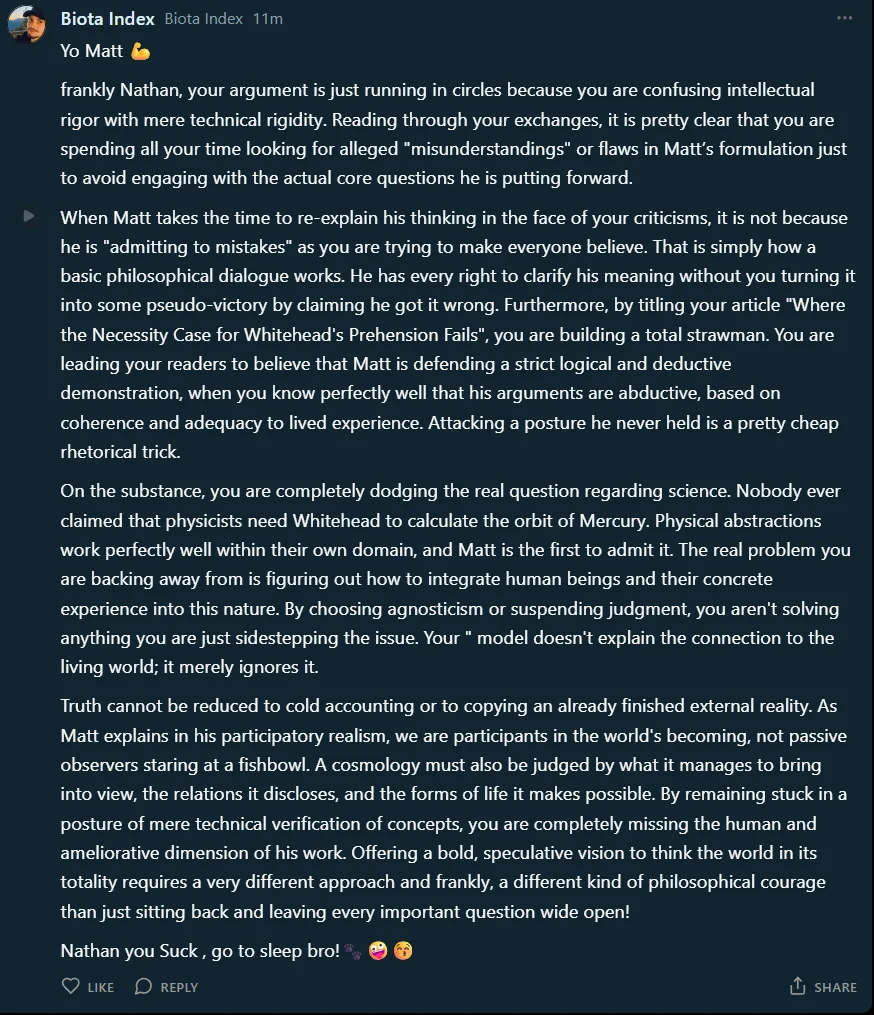
The public comment, reproduced as posted. My linked response compares its accusations with my actual words.
The comment calls my approach “mere technical rigidity” and says I spend “all your time” looking for alleged misunderstandings “just to avoid engaging with the actual core questions.”
My necessity article invites:
relevant literature I have missed, corrections where I have misread a source, stronger reconstructions of Matt’s arguments, and good-faith criticism of my own positive synthesis.
And asks:
Can causal production be specified positively without quietly rebuilding subjective prehension?
That invitation and question give the critic something specific to examine. Show where an unreasonable requirement blocks a sound inference. The comment offers no such passage. “Just to avoid” substitutes a story about my motives for the examination.
It also says Matthew’s clarifications are not admissions of mistakes “as you are trying to make everyone believe.” My article already distinguishes clarification from correction. His acknowledgment that he collapsed my conditional and agnosticism is quoted above. An account of the exchange has to include it.
The comment calls my title a “total strawman” and a “cheap rhetorical trick.” Matthew himself acknowledges the article’s distinction between explanatory indispensability and metaphysical necessity. I explicitly discuss abductive virtues. The title can still invite criticism, but the accusation of a knowing substitution needs evidence. The comment provides none by quotation or analysis.
The commenter repeats the point about calculating Mercury’s orbit. My argument concerns how organized capacities produce change and exercise influence. To challenge it, identify where that causal account fails. The orbit example leaves that comparison untouched.
On experience, the comment says my model “merely ignores it.” I retain “evidenced experiential content” and write:
A demonstrated phenomenal contribution would matter. Its fundamentality and universal distribution would remain further questions.
That keeps experience inside the inquiry and asks what follows from a demonstrated contribution. Calling it ignored erases the distinction being investigated.
The fishbowl spectator fares no better. The PBSRR and Ethos passages at the beginning already recognize perspective, agency, and participation that changes circumstances. Where does my argument rely on the spectator the comment attacks?
The comment says I am “completely missing the human and ameliorative dimension.” That strengthens Matthew’s more qualified “tend to miss.” My article discusses theopoetic transformation, attention, memory, care, and comparative outcomes. A neglected contribution could be identified. “Completely” runs straight into the passages quoted here.
Finally, the comment contrasts speculative courage with leaving “every important question wide open.” My article says:
Metaphysical progress therefore need not wait for metaphysical closure.
I offer a causal account, propose further comparisons, and say what would make me update toward universal prehension. The comment turns qualified suspension into avoidance and discards the conclusions I do defend. A speculative proposal still needs reasons to believe it, however much courage it takes to announce.
The closing instruction that I “go to sleep bro!” adds no premise. Philosophical courage apparently has a surprisingly strict bedtime.
This is the concern my requests for textual comparison were meant to address. The commenter invokes Matthew’s explanations and treats alleged misunderstandings of abduction, experience, and transformation as settled. The accusations extend to my honesty and willingness to engage. Yet my passages already acknowledge those distinctions and investigate those questions.
The escalation is visible in the wording. A qualified concern becomes a categorical omission. A headline objection becomes deliberate deception. An open question becomes refusal to investigate. None comes with a quoted demonstration.
I used “groupthink” in my response to criticize the substitution of cheerleading for engagement. What the record establishes is the repetition and escalation of unsupported characterizations by one commenter. It leaves the psychological mechanism, the prevalence of the pattern, and Matthew’s causal influence unestablished. The commenter remains responsible for its claims.
A sincere clarification can still contribute to a misleading impression when readers receive it as a correction of an error the original text excludes. Here one reader repeats those supposed errors with added personal accusations. That is reason to make the alleged error and the passage said to contain it easy to inspect.
Agreement with a preferred author cannot establish that a critic holds the position being attacked. Neither can suspicion of that author’s influence establish that the criticism is false. The relevant qualification is there to read.
What rigor is for, and what would change my mind
Matthew says he sometimes feels our encounter becomes “a series of propositions awaiting adjudication.” He reminds me that philosophy can change the inquirer and reveal a question neither participant previously knew how to ask.
There is a reflexive irony here. His description of our encounter is itself a judgment about what our exchange has become. When he identifies a misunderstanding and clarifies his position, he also asks me to distinguish a more adequate interpretation from a less adequate one. That is a legitimate part of philosophy, including philosophy understood as participation. His observation therefore invites the same care as mine: which passages show the problem, what has their treatment obscured, and what would a better encounter enable us to understand?
His account of how the exchange feels is part of what I need to understand. It does not by itself establish that assessing claims has obstructed understanding, or identify which assessment did so. Calling an exchange adjudicative leaves that explanatory work to be done. Equally, clarification, disagreement, and the discovery of an error can transform the inquirer. I want room for that transformation too, including the possibility that either participant’s judgment about the dialogue needs revising.
His questions have helped me sharpen the account of causal production, separate a local reconstruction from a finished cosmology, and understand what a constitutive objection demands. I’ve learned from that work while remaining unconvinced by the universal inference. He deserves credit for helping me develop it.
The questions and standards I use can change too. I wrote:
My framework must be able to lose something I want to keep.
I have had to act on that. I withdrew an unsupported explanation of algorithmic clustering. I distinguish operation counts from measured energy costs. I stopped treating institutional persistence as sufficient evidence of care, since coercive arrangements can persist too. What remains has to stand on what survives the corrections. Can I recognize a correction when it costs me a sentence I particularly like?
I still need to show what RCF adds. If ordinary source checking, causal analysis, and careful comparison do the job equally well with less burden, I should simplify the framework. Its vocabulary earns no constitutional immunity.
The comparison needs standards that can challenge my preferred result. Where a proposal makes probabilistic forecasts, Tilmann Gneiting and Adrian Raftery’s work on proper scoring rules gives tools for assessing those forecasts against outcomes. That evaluates specified predictions; it cannot certify every assumption or value in the framework. Leo Gao, John Schulman, and Jacob Hilton’s study of reward-model overoptimization, using a synthetic setup with a fixed reference reward model, shows how improving a proxy score can worsen performance against that reference.
For RCF, I therefore want new cases, comparisons with strong simpler methods, checks for lost capabilities, and outcomes beyond conformity to its vocabulary. A gain for one group can carry a cost for another; the score should not make that disappear. If my method keeps winning tests I designed for it, I should inspect the tests. The standards themselves must remain open to challenge.
One of my favorite passages from Sagan’s The Demon-Haunted World: Science as a Candle in the Dark puts the demand sharply:
Claims that cannot be tested, assertions immune to disproof are veridically worthless, whatever value they may have in inspiring us or in exciting our sense of wonder.
In the dragon-in-the-garage example, every proposed physical test meets a fresh excuse. That is the problem I want the framework to expose. I extend the demand beyond laboratory testing: mathematical claims answer to proof, historical claims to the record, and constitutive arguments to their premises and comparison with rivals. Empirical claims face relevant observations. A failed test can also implicate the measurement or background assumptions, so we still have to establish what failed. Present limits on testing can leave a claim unresolved; protection from every possible criticism makes revision impossible. I ask where a proposal could fail, which commitment would lose support, and what its defender would change. The framework asking those questions owes answers too.
Matthew has also acknowledged important limits to the dispute:
I also recognize that your process-and-powers reconstruction is not supposed to constitute a complete alternative metaphysics, and that you are not claiming to have disproven prehension simply because particular causal processes can be adequately explained without invoking it.
My necessity article already said:
I do not rank Whitehead’s entire scheme below a completed rival or seek to lower anyone else’s confidence in it.
He adds:
I know you don’t affirm such a bifurcation yourself.
Those agreements locate the disagreement more accurately. I retain the supported process, causal, organizational, and experiential content while leaving universal felt constitution open. We still need to establish which account explains better, what warrants extending felt constitution throughout nature, and why avoiding bifurcation would require Whitehead’s particular ontology.
My incompleteness leaves further work for both of us. Whitehead does not inherit reality by default.
I also have to explain the targets I claim to explain, preserve the features in dispute, and justify the cost of my added procedures. Leaving the larger question open gives me work to do.
Matthew could show where an account fails, where it covertly assumes the experience I leave open, or which independently warranted feature it loses. He could demonstrate an advantage in grounding, coherence, integration, or explanatory economy and defend its wider reach. He could also show where I misread his words. Any of those would move the argument.
I have already stated what that should change for me:
If universal prehension repeatedly explains, constrains, unifies, or compresses the evidence in ways these rivals cannot reproduce without greater cost, I should update toward it.
I owe the strongest argument he supplies a fair assessment. Where I claim explanatory adequacy, I have to show it. Where I withhold a universal identification, I have to explain why its grounds leave me unconvinced. A declared commitment to rigor settles neither question.
The theological and ethical questions are equally concrete. What supports the claimed beneficial influence? What good reaches the original sufferer? What identifies the source of an encounter? How should sincere nonrecognition affect the account? Which organizational property supports an expectation about machine experience? Which practical improvement survives a fair comparison?
These questions matter to how we investigate, care, and act. Better questions may replace them. Being specific gives us a way to find out.
We can create a more careful dialogue together and still get an answer wrong. Its value lies partly in making that error easier to find and repair. I want correction to reach a sentence, a premise, an inference, or a practice and make a visible difference. A willingness to be corrected should occasionally inconvenience a conclusion.
Apply that standard here too. Quote the passage, preserve its qualifications, and show where the reasoning fails. I will revise what the criticism warrants. That would be a transformation of the dialogue worth participating in.
References
Scholarship and reference works
Asay, J. (2019). Going local: A defense of methodological localism about scientific realism. Synthese, 196(2), 587–609.
BABAR Collaboration. (2012). Observation of time-reversal violation in the B⁰ meson system. Physical Review Letters, 109, Article 211801.
Barthes, R. (1984). Myth today. In Mythologies (A. Lavers, Trans.). Hill and Wang. (Original work published 1957.)
Biletzki, A., & Matar, A. (2026). Ludwig Wittgenstein. The Stanford Encyclopedia of Philosophy. Revised September 17, 2026.
Boden, M. A. (1997). Creativity and artificial intelligence. In Proceedings of the Fifteenth International Joint Conference on Artificial Intelligence (pp. 1563–1565). Invited address.
Bowker, G. C., & Star, S. L. (1999). Sorting things out: Classification and its consequences. MIT Press.
David, M. (2015). The correspondence theory of truth. The Stanford Encyclopedia of Philosophy. Revised May 28, 2015.
Dawid, R., Hartmann, S., & Sprenger, J. (2015). The no alternatives argument. The British Journal for the Philosophy of Science, 66(1), 213–234.
Dellsén, F. (2021). Explanatory consolidation: From “best” to “good enough”. Philosophy and Phenomenological Research, 103(1), 157–177.
Dick, P. K. (1978/1985). How to build a universe that doesn’t fall apart two days later. In M. Hurst & P. Williams (Eds.), I hope I shall arrive soon. Doubleday. (Written as a speech in 1978; Dick dates the quoted formulation to 1972.)
Douven, I. (2025). Abduction. The Stanford Encyclopedia of Philosophy. Revised June 18, 2025.
Foucault, M. (1977/2000). Truth and power [Interview with A. Fontana and P. Pasquino]. Reprinted in J. D. Faubion (Ed.), Power: Essential works of Foucault, 1954–1984 (Vol. 3). The New Press.
Frankfurt, H. G. (1986). On bullshit. Raritan, 6(2), 81–100. (Republished as a book by Princeton University Press, 2005; linked university-hosted essay text.)
Frege, G. (1892/1952). On sense and reference (M. Black, Trans.). In P. Geach & M. Black (Eds.), Translations from the Philosophical Writings of Gottlob Frege (pp. 56–78).
Gabriel, I. (2020). Artificial intelligence, values, and alignment. Minds and Machines, 30, 411–437.
Gao, L., Schulman, J., & Hilton, J. (2023). Scaling laws for reward model overoptimization. In Proceedings of the 40th International Conference on Machine Learning, Proceedings of Machine Learning Research, 202, 10835–10866.
Giere, R. N. (2004). How models are used to represent reality. Philosophy of Science, 71(5), 742–752.
Glanzberg, M. (2025). Truth. The Stanford Encyclopedia of Philosophy. Revised June 27, 2025.
Gneiting, T., & Raftery, A. E. (2007). Strictly proper scoring rules, prediction, and estimation. Journal of the American Statistical Association, 102(477), 359–378.
Haack, S. (1993). Evidence and Inquiry. Blackwell. See also An interview with Susan Haack: Evidence, Science, Law (W. A. Abdalla, interviewer, December 23, 2020) for her explanation of foundherentism and its crossword analogy.
Hogan, A., Blomqvist, E., Cochez, M., d’Amato, C., de Melo, G., Gutierrez, C., Kirrane, S., Labra Gayo, J. E., Navigli, R., Neumaier, S., Ngonga Ngomo, A.-C., Polleres, A., Rashid, S. M., Rula, A., Schmelzeisen, L., Sequeda, J., Staab, S., & Zimmermann, A. (2021). Knowledge graphs. ACM Computing Surveys, 54(4), Article 71, 1–37.
Hornsby, J. (1997). The presidential address: Truth: The identity theory. Proceedings of the Aristotelian Society, 97(1), 1–24. Reprinted text.
Hume, D. (1739–1740). A treatise of human nature. Book III, Part I, Section I. Project Gutenberg text.
Lango, J. W. (2001). The time of Whitehead’s concrescence. Process Studies, 30(1), 3–21.
Legg, C., & Hookway, C. (2024). Pragmatism. The Stanford Encyclopedia of Philosophy. Revised September 30, 2024.
Longino, H. E. (2025). The social dimensions of scientific knowledge. The Stanford Encyclopedia of Philosophy. Revised January 24, 2025. See Section 5 on conditions for effective critical inquiry.
Losoncz, M. (2023). Whitehead on perishing. Filozofija i društvo / Philosophy and Society, 34(3), 483–492.
Massimi, M. (2018). Perspectival modeling. Philosophy of Science, 85(3), 335–359.
McHenry, L. B. (1986). The axiomatic matrix of Whitehead’s Process and Reality. Process Studies, 15(3), 172–180.
McKenna, T. (1996, March). Countdown into complexity: Briefing for a descent into novelty [Workshop transcript]. Esalen Institute. Organism Earth transcript, quotation at 17:09.
Michaelson, E. (2024). Reference. In E. N. Zalta & U. Nodelman (Eds.), The Stanford Encyclopedia of Philosophy (Fall 2024 ed.). Substantive revision February 12, 2024; archived version includes a July 2024 minor update.
Nyrup, R. (2015). How explanatory reasoning justifies pursuit: A Peircean view of IBE. Philosophy of Science, 82(5), 749–760.
Ostrom, E. (2010). Beyond markets and states: Polycentric governance of complex economic systems. American Economic Review, 100(3), 641–672.
Rawls, J. (1987). The idea of an overlapping consensus. Oxford Journal of Legal Studies, 7(1), 1–25. The application to AI alignment is discussed in Gabriel (2020).
Reicher, M. (2026). Nonexistent objects. In E. N. Zalta & U. Nodelman (Eds.), The Stanford Encyclopedia of Philosophy (Spring 2026 ed.). Substantive revision December 7, 2022; minor update March 13, 2026.
Russell, B. (1912). The Problems of Philosophy. Chapter IV, “Idealism.”
Röttger, P., Hofmann, V., Pyatkin, V., Hinck, M., Kirk, H. R., Schütze, H., & Hovy, D. (2024). Political compass or spinning arrow? Towards more meaningful evaluations for values and opinions in large language models. In Proceedings of the 62nd Annual Meeting of the Association for Computational Linguistics (Volume 1: Long Papers) (pp. 15295–15311). Association for Computational Linguistics.
Sagan, C. (1980, September 28). The shores of the cosmic ocean [Television episode transcript; spoken by Sagan]. In Cosmos: A personal voyage (Episode 1). Series written by C. Sagan, A. Druyan, and S. Soter.
Sagan, C. (1987). The burden of skepticism. Skeptical Inquirer, 12(1).
Sagan, C. (1997). The demon-haunted world: Science as a candle in the dark. Headline. Chapter 10, “The Dragon in My Garage,” p. 161 (inspected edition).
Santurkar, S., Durmus, E., Ladhak, F., Lee, C., Liang, P., & Hashimoto, T. (2023). Whose opinions do language models reflect?. In Proceedings of the 40th International Conference on Machine Learning, Proceedings of Machine Learning Research, 202, 29971–30004.
Schwartz, S. H., Cieciuch, J., Vecchione, M., Davidov, E., Fischer, R., Beierlein, C., Ramos, A., Verkasalo, M., Lönnqvist, J.-E., Demirutku, K., Dirilen-Gumus, O., & Konty, M. (2012). Refining the theory of basic individual values. Journal of Personality and Social Psychology, 103(4), 663–688.
Searle, J. R. (2006). Social ontology: Some basic principles. Anthropological Theory, 6(1), 12–29.
Segall, M. D. (2023). Standing firm in the flux: On Whitehead’s eternal objects. Process Studies, 52(2), 159–178. Longer author manuscript.
Seibt, J. (2022). Process philosophy. The Stanford Encyclopedia of Philosophy. Revised May 26, 2022.
Sen, A. (1999). The possibility of social choice. American Economic Review, 89(3), 349–378.
Sher, G., & Chen Bo. (2019). Foundational holism, substantive theory of truth, and a new philosophy of logic: Interview with Gila Sher by Chen Bo. The Philosophical Forum, 50(1), 3–57.
Sherburne, D. W. (1971). Whitehead without God. In D. Brown, R. E. James, & G. Reeves (Eds.), Process philosophy and Christian thought (Chap. 16). Bobbs-Merrill. (Revised from The Christian Scholar, 50(3), Fall 1967.)
Stanford, K. (2023). Underdetermination of scientific theory. The Stanford Encyclopedia of Philosophy. Revised April 4, 2023.
Stanford, P. K. (2019). Unconceived alternatives and conservatism in science: The impact of professionalization, peer-review, and Big Science. Synthese, 196(10), 3915–3932.
Sullivan, P. M. (2005). Identity theories of truth and the Tractatus. Philosophical Investigations, 28(1), 43–62.
Whitehead, A. N. (1929/1978). Process and reality: An essay in cosmology (D. R. Griffin & D. W. Sherburne, Eds.; corrected ed.). Free Press. Passage on the revisability of first principles quoted through McHenry (1986).
Williams, G. (2023). Kant’s account of reason. The Stanford Encyclopedia of Philosophy. Revised January 4, 2023.
Wimsatt, W. C. (1981). Robustness, reliability, and overdetermination. In M. Brewer & B. Collins (Eds.), Scientific Inquiry and the Social Sciences. Jossey-Bass.
Young, J. O. (2025). The coherence theory of truth. The Stanford Encyclopedia of Philosophy. Revised December 27, 2025.
Primary exchange, framework documents, and supplied manuscript
Kowalik, M., & Sweet, N. (2026, October). Exchange on Philip K. Dick’s definition of reality [Substack comment transcript supplied by Nathan Sweet; descriptive title]. Includes the replies about the proposed contradiction, intended meaning, and representation, together with Sweet’s clarification distinguishing identity from separability. The supplied capture also contains assistant commentary, which is not treated as the participants’ own words or as independent scholarship. Direct URLs for the later Dick-thread replies were not supplied. This is distinct from the McKenna-note exchange.
Segall, M. D. (2026, July 30). Remembering the human microcosm in the age of mechanized intelligence [Book announcement]. Center for Process Studies.
Segall, M. D. (2026, August 29). Experience is not a predicate: Replies to some critics. Footnotes²Plato.
Segall, M. D. (2026, August 30). Erratum acknowledging the collapsed conditional and attribution of agnosticism [Substack note; descriptive title].
Segall, M. D. (2026, September 1). Response on causal actuality and the process-and-powers reconstruction [Substack note; descriptive title].
Segall, M. D. (2026, September 11). Words made flesh again: Autocosmological reflections on abstraction and life as a speculative philosopher. Footnotes²Plato.
Segall, M. D. (2026, October 22). Continuation on divine valuation and the efficacy of possibilities [Substack note; descriptive title].
Segall, M. D. (2026, October 26). Continuation on participation, truth, and the scope of the disagreement [Substack note; descriptive title].
Sweet, N. (2026). Matthew Segall on Whitehead: What does Segall’s God interpretation actually add?. Sweet Rationalism. Title of the version quoted in this article.
Sweet, N. (2026, September 16). Synthbiosis: Deductive proof that the machine did not need to feel to matter. Sweet Rationalism. Website copy updated October 16, 2026.
Sweet, N. (2026, September 25). Where the necessity case for Whitehead’s prehension fails and why that makes Whitehead more useful, not less. Sweet Rationalism. Title of the version quoted; website heading: “Where the Necessity Case for Matthew Segall & Whitehead’s Prehension Fails.”
Sweet, N. (2026, October 12). From abductive advantage to discriminating ontological credit [Supplied author manuscript].
Sweet, N. (2026, October 21). Provisional, boundary- and scale-relative realism (Supplied edition). Sweet Rationalism.
Sweet, N. (2026, October 21). Recursive corrigibility framework (Supplied edition). Sweet Rationalism.
Sweet, N. (2026, October 21). RCF framework bridge [Supplied framework document].
Sweet, N. (2026, October 21). Sweet Rationalism ethos (Supplied edition). Sweet Rationalism.
Sweet, N. (2026, October 26). Response to the public comment and comparison with the quoted record [Substack thread; descriptive title].