Responding to Joel Dietz (MIT)’s “77.6++%” Defense of Michael Levin’s Biological Causal Platonism and His Demonstrable Misrepresentations of My Actual Argument
Joel Dietz scored the structural mathematics 88.1% and the additional nonphysical ingress 0%, then put 77.6%, an unweighted average of seven different judgments, in his headline. That number tells you how the scorer chose and counted the pieces, not what the pieces support. Where does he quote me making the claims he attributes to me, and which of my actual arguments has his 0% result refuted?
Cite as: Sweet, N. (2026). Responding to Joel Dietz (MIT)’s “77.6++%” Defense of Michael Levin’s Biological Causal Platonism and His Demonstrable Misrepresentations of My Actual Argument [Preprint]. Zenodo. https://doi.org/10.5281/zenodo.24151128. The archive is licensed CC BY 4.0. Versions and archives: this version https://doi.org/10.5281/zenodo.24151128 · all versions (concept DOI) https://doi.org/10.5281/zenodo.24151127 · Zenodo record (article text, code and test packages, audit evidence, revision history, checksums) · source, evidence and change history on GitHub · changelog.


Reading Joel’s new article was an odd experience: a long, careful rebuttal whose own numbers sit on my side of the table. He shows that the tested sorting phenomena follow from the implemented dynamics, and he scores the additional nonphysical causal ingress at zero earned. I have no quarrel with the computation. A rebuttal still has to rebut something. Which part of my surviving argument does Joel’s result contradict?
For readers unfamiliar with Joel Dietz, he is a software entrepreneur and researcher. He is listed as director of Bioelectricity Nexus and an MIT Connection Science Fellow; he also presented at the 2025 Platonic Space Symposium, organized by Michael Levin and Hananel Hazan, on testable Platonic hypotheses in science. He was an early Ethereum community organizer and contributor. Beyond the work discussed here, he co-authored a 2024 conference paper on linking virtual worlds, while his MIT profile lists interests in swarm intelligence, cryptoeconomics and holonic philosophy.
One historical correction, briefly. My February explanation overstated what textbook sorting stability establishes about algotype clustering. Here Joel and I agree on the scientific practice: expose errors, preserve the record, and revise an explanation when the tests defeat it. I had already applied that standard to myself: my September 29 audit publicly demoted an overextended ontology, my October 13 revision withdrew the unsupported stability explanation and linked its earlier version, and my October 25 response to Joel explicitly accepted his contrary tests. His results reinforce that correction. But overturning that mechanism cannot establish independent nonphysical causation; my surviving question asks what evidence distinguishes Levin’s added cause from the implemented dynamics.
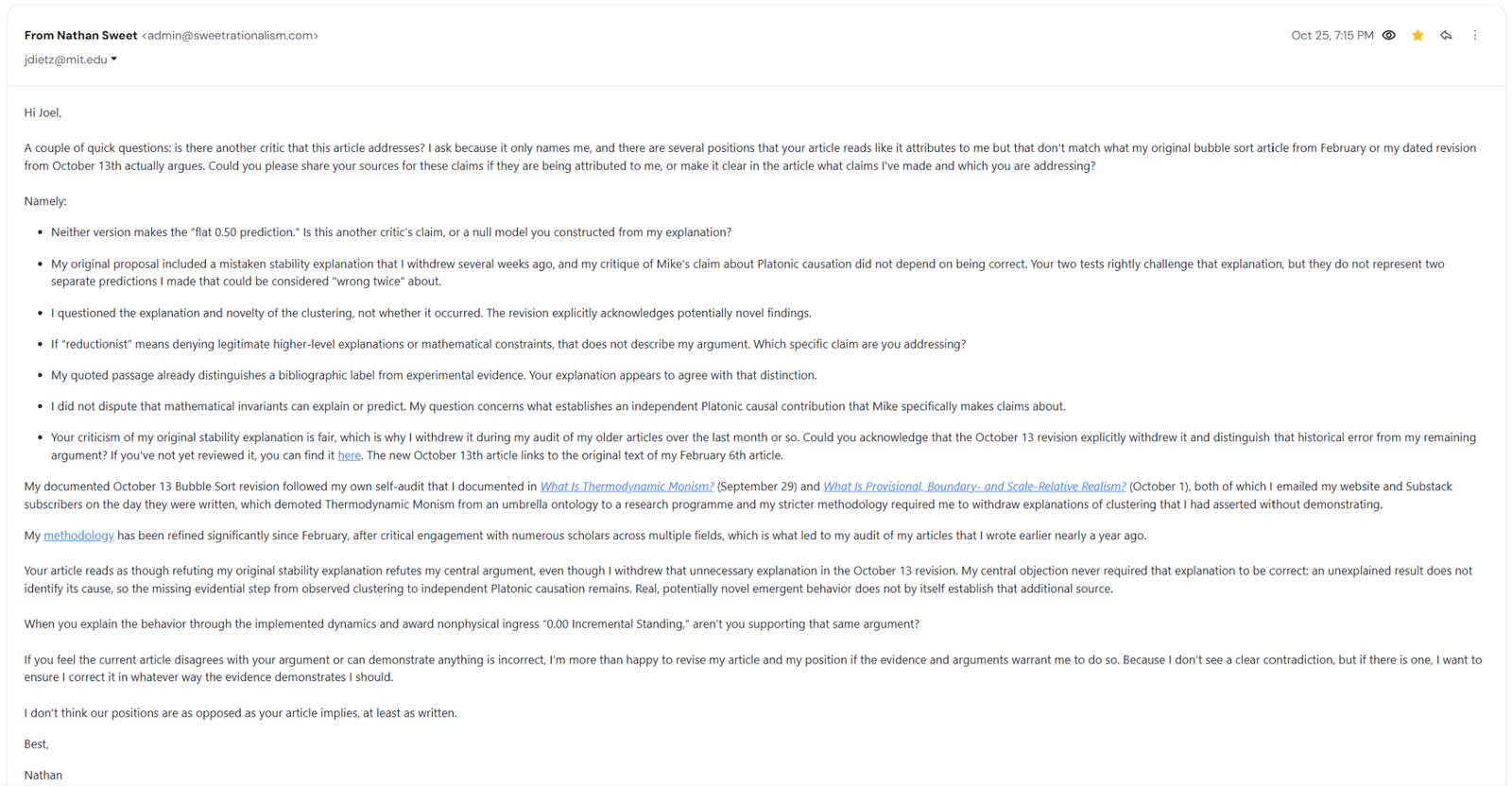
Joel invited me to respond before publication in his October 25 email. I sent him the corrections that day, pointing to my October 13 Bubble Sort revision and questioning the 0.50 forecast I never made, the reductionist label, and the treatment of a withdrawn explanation as my surviving argument. I repeated those concerns on Substack, where Joel replied that he did not recall seeing my emails. His later published response nevertheless retained the disputed characterizations. Why?
I was disappointed to find that the published audit also contained errors a human–AI verification pipeline ought to catch: incorrect DOIs linked to different papers, numerical discrepancies stamped VERIFIED without an implemented acceptance threshold, and claims about my position without the corresponding source quotations.
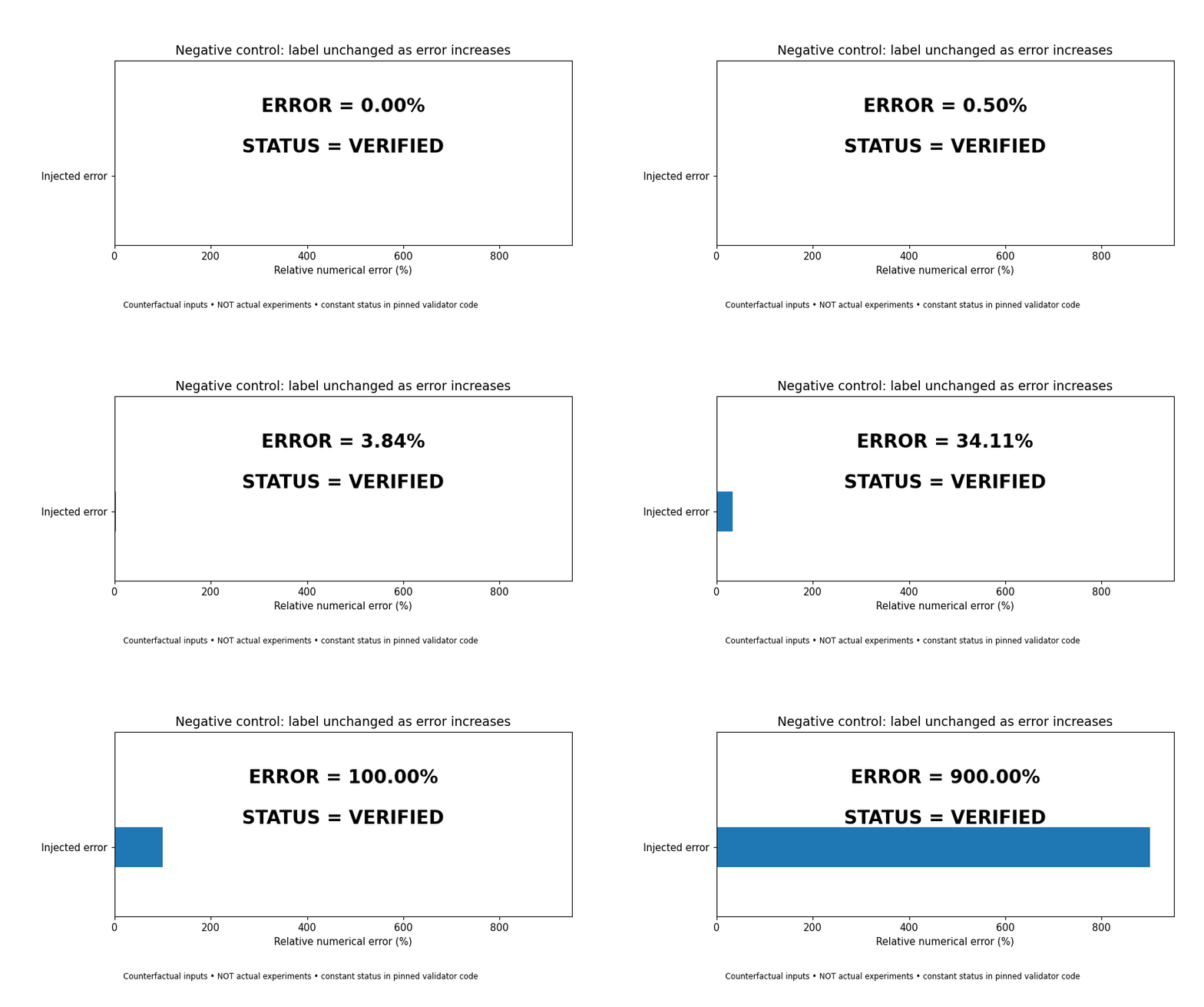
But then I realized Joel had handed me an unusually clean, public test of the Recursive Corrigibility Framework I have been applying to my own work. Readers can check the quotations, dates, DOI destinations, and executable verdict logic without accepting my philosophy or following months of dialogue and debates with other scholars. If an audit cannot survive those elementary checks, its rhetoric about verification is doing work its evidence has not earned. All while faulting me for failing to check the math. When a deliberately injected 900% error still earns VERIFIED, are we looking at a validator or a rubber stamp that learned Python?
Many of these are checkable facts, that might take someone just a couple of minutes each to check for anyone inclined to do so, without having to believe me about anything.
Two-minute source checks: short, independently checkable comparisons
Each item is a roughly one- or two-minute check on its own, not a claim that the entire audit takes two minutes. Open the cited source and compare the quoted statement, number, or code assignment. The more interpretive and multi-document issues have been moved to the detailed sections below.
- The headline and the referent. Joel’s Substack subtitle pits Platonic ingress against reductionist blog critics. Across the main text and companion, I am the only critic named by name. Compare that framing with my express acceptance of higher-level causation, emergence, and multiple realization. If he means me, the description is wrong; if he means someone else, whom?
- Five citations you can open. His reference list attaches wrong DOIs to Claverie and Wainwright (actual paper), Friedman et al. (actual 2020 paper), Pinet et al. (actual paper) and Pietak and Levin 2016 (actual paper). His companion’s Claim 6 heading links Vandenberg, Adams and Levin 2012 to a DOI that belongs to an unrelated integrin paper (actual paper). Those DOIs can be checked against journal records without accepting anyone’s philosophy.
- What would make a benchmark fail? His validator calculates error, then assigns
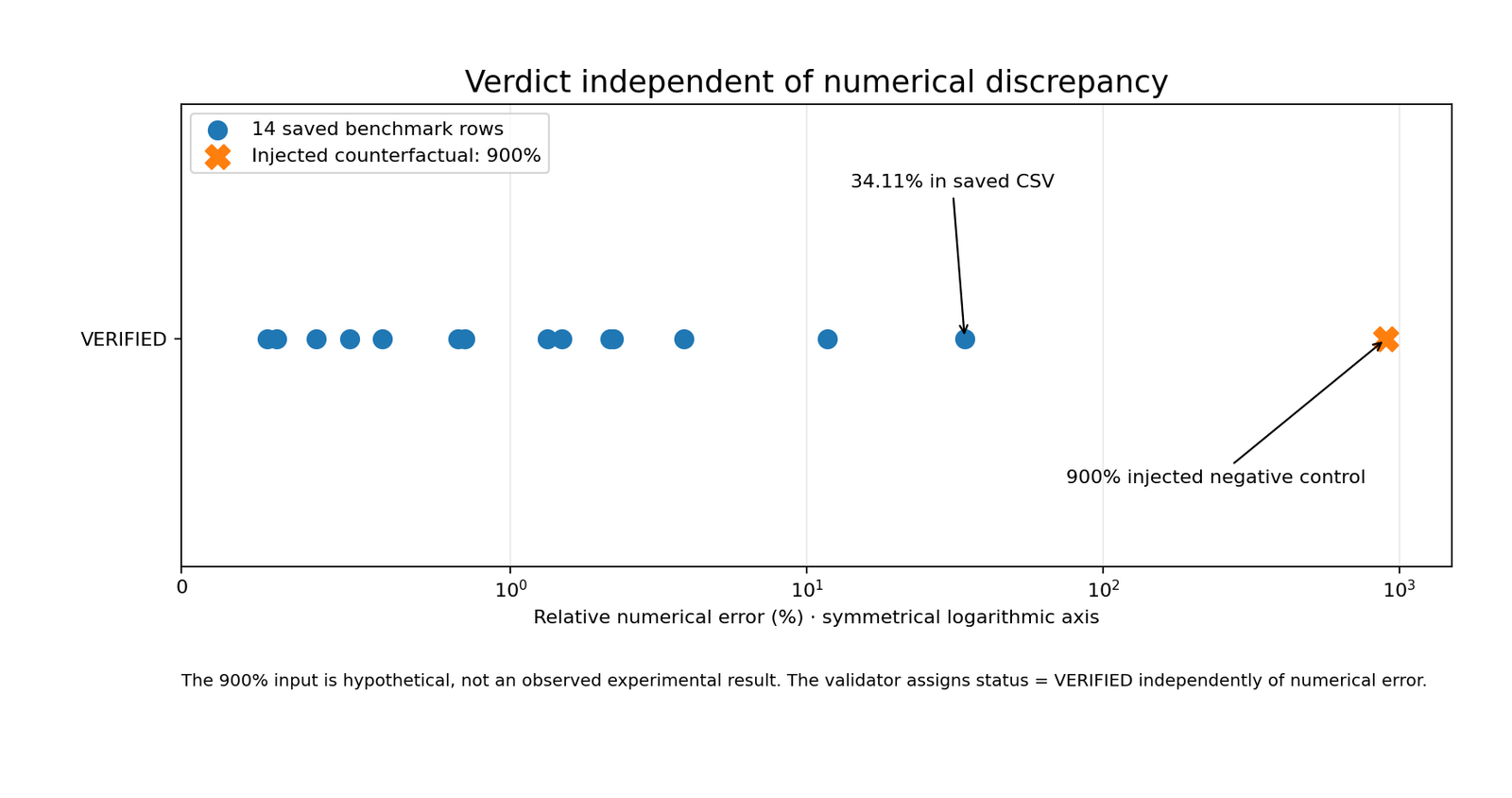
"status": "VERIFIED"unconditionally. The saved CSV records 0.370 published versus 0.496 replicated (34.11% error), VERIFIED; another row records 11.71% error, also VERIFIED. The figure title nevertheless says"14/14 Published Benchmarks Verified"and prints"✓ PASS"for every row. Which explicit error threshold or uncertainty test controls either verdict? The later 900% negative-control input is deliberately artificial, not one of these recorded benchmarks. - The xenobot number. Joel’s Claim 7 says 105°; his code says 65°, and a peak is coded at 65°. Which angle was tested, and which was assumed?
- The headline’s provenance. The score animation hardcodes seven percentages and
MEAN = "77.6%". The errata gives its arithmetic; hardcoded labels do not establish fabricated scores. Where is the executable, evidence-to-score rule that regenerates these labels after a failed test? - His answer to my question. His current score and D-versus-D+P passage report 88.1% for the structural calculations and 0.0% of the dualist points earned. The original question was whether the distinctive nonphysical addition earned any.
- The omitted symmetry condition. Joel quotes my D-versus-D+P challenge, but not its immediately following symmetrical condition for awarding P support. Read the adjoining sentences. The missing criterion is a text-comparison fact, regardless of anyone’s opinion of it.
- A publication-count timeframe. Joel reports “400+ papers in the last decade.” Levin’s biography instead reports more than 400 publications across his career, with a lab founded in 2000. Where is the ten-year count documented?
The version-by-version TXT diff shows which October 25 claims were moved into the November companion. The detailed analysis first addresses the misattributions a reader can check directly, then follows Joel’s scientific claims, with the linked companion considered where the claims arise. My criticism is of particular sentences, inferences, and attribution practices. His correct computations remain correct.
The misrepresentations: what Joel attributes to me and what I actually argued
The “reductionist blog critics”: who is the supposed target?
Joel’s framing. The Substack heading announces 88.1% mathematics and zero ghosts, while its subtitle sets Platonic Ingression against reductionist blog critics and introduces an internet philosopher who can code. His opening text names me as the critical participant. His companion names me again. I have not found a second named critic in either essay.
My actual words: I will grant Levin far more than a reductive critic needs to grant: genuine higher-level causation, mathematical explanation, multiple realization, robust agency at unfamiliar boundaries, and even mathematical realism for the sake of argument.
That is from my argument about ingress. In the xenobots article, I also argue that knowing lower-level laws does not automatically supply the best explanation at higher scales, explicitly invoking P. W. Anderson’s More Is Different.
That is not the reductionist dismissal Joel’s framing suggests. I defend serious higher-level explanations and dispute an additional causal ontology. “Reductionism” has two possible readings here, and neither fits. As a demand for traceable causal mechanisms it is compatible with nonreductive organization, so the word has been stretched. As a wholesale denial of emergence or top-down explanation it describes a position I do not hold, and attributing it to me is a straw man. A blog is a publishing medium, not an epistemic classification. The title can be cheeky; its implied target should still exist.
My D versus D+P challenge: the omitted symmetrical test
Before considering the biological simulations, consider Joel’s quotation of my October 4 D-versus-D+P argument and announces that his article runs that test. Credit where due: he quotes substantial portions of the challenge. But the introductory grammatical subject changes from Joel’s 2025 symposium talk to Joel himself, and he stops before the next, explicitly symmetrical requirement.
My actual words:
A knowledge graph, however, can encode D or D+P. Platonic ingress begins earning evidence only when at least one P-specific relation improves held-out prediction, intervention, compression, or comparative model performance beyond the best D-only account.
[Intervening passage omitted.]
Symmetry cuts both ways. If D-only rivals require a growing heap of bespoke repairs while a pre-specified D+P model repeatedly predicts held-out results, my confidence should move toward P. Skepticism that permits only one side to lose is advocacy with a lab notebook.
His own results following the quotation say that the implemented sorting rules already produce the phenomenon and that a nonphysical edge adds no predictive difference. That answers the central comparison in my direction. His held-out fish result is a legitimate success for a specified geometric model; the failed hornet transfer is an equally important loss. Neither independently measures ingress. The quote truncation matters because my condition already tells him exactly how evidence could make me move toward P. It was never a demand that only his side be allowed to lose.
The distinctive ingress proposal therefore has six separable proof obligations: define P independently; state its causal bridge to D; pre-specify an outcome distinguishing the models; isolate a P-linked intervention; compare strong D-only and nonreductive rivals; and declare a result that would lower support for P. These are requirements for credit, not premises that P is false. Joel’s correct demonstrations of D cannot substitute for them.
His AI/dualism detour: source criticism and experiences of an “Other”
Before the charts and simulations, consider how Joel introduces Levin’s complaint about AI-generated criticism through a description of the 36,000 words I sent him. He describes that material as covering virtually every possible argument against Levin’s positions. The quantity and rhetorical characterization do not identify a single false premise. The text contained extensive cited scholarship and responses to disputed characterizations, not a list of claims certified merely by being long.
If the point is simply that AI-assisted criticism can contain errors, I agree and have demonstrated the point against my own earlier writing. If the AI origin or size of a submission is being used to discredit an otherwise checkable argument, that risks the genetic fallacy and poisoning the well. The origin of a claim can motivate verification; it cannot substitute for showing where that claim fails. Nor do the substantial AI contributions to Joel’s AEL make his valid calculations invalid. Apply one evidential standard to both sets of tools. The xenobots audit and my documented response to Levin’s “gut feeling” dismissal show the actual human–AI research and correction workflow at issue; neither its scale nor its AI assistance decides whether an identified claim is true.
Joel’s subsequent analogy treats language models as confined to an intellectual “within,” unable to recognize a metaphysical “without.” This is a conjecture about the limits of particular evaluators, not an observation of a nonphysical source. A test might reveal systematic biases in how models grade dualist arguments. It still would not by itself establish that a dualist cause produced a sorting trajectory. If the inability is invoked to explain away every zero score against P, the auxiliary assumption shields P from loss rather than supplying evidence for it.
His discussion then moves through minds, altered states, and experiences of an “Other.” Those experiences may be real as experiences. Whether their apparent referents exist independently and cause biological outcomes is a second question requiring its own reasons. A report of contact, a mathematical abstraction, and a laboratory intervention do not carry evidence across those targets merely by sharing the vocabulary of otherness or mind.
Twelve D-versus-D+P proof obligations: a map of the argument
The following twelve entries are distinguishable evidential gaps, not twelve independent disproofs of Platonic ingress. Several depend on the same central problem: a mathematical result can be reproducible and useful without identifying an additional nonphysical causal source. The links lead to the relevant source quotation, mathematical comparison, model code, or argument throughout the article, following the order in which those topics are discussed. Each item states what would have to be shown for the extra contribution to earn credit.
The short checks above concern text and code that a reader can inspect directly. The dated correction history, the alleged 0.50 forecast, the estimated human/AI authorship shares, and full cross-language verification require more context than a quick glance, so they belong in the attribution analysis and technical audit. Likewise, a missing bridge is an unmet evidential obligation, not proof that the proposed cause cannot exist.
- P lacks a separately defined observable or inferential signature. Specify what would identify the added contributor independently of D’s successful mathematics.
- The P-to-D causal bridge is unspecified. Identify what P changes, at which boundary and timescale, and how that differs from ordinary modeled dynamics.
- Experiences of an “Other” do not identify an external causal source. Separate the phenomenological report from the claimed biological cause.
- P supplies no demonstrated distinctive prediction. State the prediction that a strong D-only account would miss.
- The interventions manipulate D, not an independently isolated P. Distinguish algorithm and model-parameter interventions from tests of ingress.
- Model success does not defeat the strongest D-only rivals. Check the held-out fish comparison, including the nearest-relative result.
- Some modeled goals are provided as inputs. Check the tadpole’s supplied target and xenobot’s coded efficiency optimum before calling either a discovery of an external goal.
- The 77.6% average combines unlike evidential judgments. Arithmetic agreement is not a calibrated probability of a causal ontology.
- AI representation convergence does not establish causal Platonism. The cited papers have narrower subjects than nonphysical biological ingress.
- An alleged AI blind spot cannot justify an upward correction. Show the direction and magnitude of a measured bias before treating zero earned points as a lower bound.
- Evidence for structural mathematics is not automatically evidence for an extra causal source. Ask what empirical result fails if the additional source is omitted.
- Loss conditions are not yet specified for P itself. Failures of geometric transfer can lower support for that model without lowering support for an unspecified metaphysical cause; see the proposed decisive test.
Runnable source and code checks: independent computational verification
These are executable rather than two-minute checks. Tool-first standard: Ask the agent to retrieve and hash the original files, inspect every script before running it, check claims with independent parsers/calculators or tests, and preserve actual outputs. It should use language-model judgment only where no executable comparison settles the issue, state the remaining uncertainty, test competing explanations, and record what would overturn its result. More tools are useful only if they provide an independent check, not just another opinion. For nontechnical readers: Choose one expandable test below, open Codex, Claude Code, or Antigravity, paste its complete prompt into a new agent task, and let the agent retrieve the linked sources and ZIP. If it cannot download the package automatically, download the ZIP yourself and attach it. Ask for the actual command output and citations to the code before accepting any verdict. You do not need to attach a ZIP to start: each expandable prompt contains the exact public ZIP URL, pinned GitHub links, source articles, and steps for independent retrieval. The canonical article is intended to be publicly accessible after publication; until then, agents can still audit the independently available external sources. For any inaccessible page, report the limitation rather than pretending to have read it. The copy-ready prompt contains source URLs and independently retrievable GitHub and WordPress v2 ZIP locations; the v2 ZIPs include matching instructions and executable inputs. Each ZIP is specific to one claim and contains a standard-library Python script, pinned source URLs, a local smoke-test fixture, and a copy-ready prompt. The relevant checks are repeated near their technical discussion. Run the live version for independent evidence; do not confuse offline fixtures with a primary-source reproduction.
- 🔻 Instructions To Test This Computationally (Three mismatched bibliographic DOIs against primary metadata)
- 🔻 Instructions To Test This Computationally (Supplied target in the Picasso tadpole simulation)
- 🔻 Instructions To Test This Computationally (Xenobot 105° narrative versus 65° model efficiency peak)
- 🔻 Instructions To Test This Computationally (Seven-score 77.6% mean and denominator sensitivity)
- 🔻 Instructions To Test This Computationally (Cross-language verification: exactly which arrays and benchmarks are asserted equal)
- 🔻 Instructions To Test This Computationally (Fourteen literal VERIFIED statuses and a synthetic negative control)
- 🔻 Instructions To Test This Computationally (How section boundaries change human/AI percentages)
The scientific and mathematical audit: which results bear on which claims
Here the distinction is between reproducing a phenomenon under specified dynamics, comparing predictive models, and testing an additional causal source. Each is valuable, but evidence earned at one level cannot be assigned to another without a justified bridge. The analyses retain legitimate results and failed tests alike.
Bioelectricity, evaluation tools, and the missing P-specific prediction
Joel introduces his work on bioelectricity, Joscha Bach, the reading list Levin supplied, and his NeuroEval, BioEval, MorphoEval, and Delphi projects. Their code, datasets, formal proofs, and public correction records are legitimate objects of evaluation. The claims about their scale or awards may be checked separately; they are not premises in a proof of ingress. I have never argued that the biology or the use of advanced mathematics should stop.
One revealing aside appears earlier in Joel’s article. He speculates that Levin’s need for research funding may make him more sensitive to “the language that makes funders want to fund.” That is a conjecture about how terminology might be chosen, not evidence that a nonphysical cause exists. Joel also says Levin’s laboratory produced 400+ papers in the last decade
; Levin’s biographical record instead states more than 400 publications across his career, with an independent lab dating to 2000. A ten-year total needs a separately demonstrated count. Funding sustains experiments; it does not validate their metaphysical interpretation. Whichever vocabulary is best suited to communicating this research, what result would distinguish nonphysical ingress from the mathematics and biology Joel and I already agree on?
Then comes his key admission. In the opening of his pinned article, Joel says the work required no Platonism. He explains that Platonic morphospace motivated some of the investigation. That distinction is precisely right. Motivation for an experiment is not evidence that the motivator’s ontology caused its results.
He characterizes my role as suggesting that his method might be a better validator than Levin’s. Even if that accurately captures a favorable remark, which it does, the relative audit quality is its own comparison. It supplies no numerical support for an independent Platonic source. His further suggestion that all major claims can be validated with accessible tools is promising for specified code and measurements. If it includes a causal nonphysical bridge, that bridge needs a specified observation or argument too. Otherwise the word all crosses from tested model behavior into untested ontology.
The decisive unanswered predictive question is simple: Which result of Joel’s validated models would a well-specified D-only rival fail to predict, but a pre-specified D+P model correctly predict? His independently useful mathematical work does not yet report such a contrast. A prediction derived after looking at the outcome, or a parameter selected to reproduce it, is not a held-out P-specific forecast.
The seven scored claims and their different proof duties
Joel next offers the seven-claim scoreboard, with longer analyses in a separate companion. The ordering matters because it reveals that the percentage combines different things.
- Claim 1, 66.7%: error handling. Joel correctly finds a
FREEZE-specific reset in Insertion Sort; his ablation shows that it matters to performance. But compare his quotation and source code with the actual sentence: Levin denies adding steps to check whether a swap completed or respond after an operation failed. The identified branch inspects frozen status during a prefix-sortedness check; Joel has not shown that it monitors or corrects a failed swap. Everything turns on what “no error handling” means: read as no defect-aware branch whatsoever, the code is a counterexample; read as no post-operation failure-feedback loop, his test has shifted the proposition. The 4.5-fold ablation result establishes that the branch is consequential, not that its function matches the quoted denial. Which interpretation is his 66.7% scoring? - Claim 2, 13.5%: delayed gratification. Joel shows that inversion count
I(v)decreases even when local monotonicity errorE(v)temporarily rises. Good mathematical distinction. But his “two rulers” analysis calls inversion count the true energy, whereas the original paper explicitly defines its delayed-gratification statistic using the temporary rise inE. Changing the ruler does not invalidate a correctly reported observation under the declared ruler. Against a stronger claim, that this behavior proves anticipation, planning, or escape from every descent potential, Joel has a substantial objection. Against the paper’s measuredE-trajectory, calling it an illusion risks equivocation over “farther from the goal.” The authors themselves note that a random walker can look as though it shows delayed gratification and that “perturbative experiments are needed to distinguish these cases”; it must be shown specifically in the context of barriers before it counts as a problem-solving strategy. - Claim 3, 86.5%: algotype clustering. Joel’s type-dependent movement and local sorting account for the reported clustering and anti-clustering under his implementation. The empirical pattern survives. Its mathematically explicable production is valuable. His companion also names me before assigning a fixed 0.50 expectation to unnamed critics. That specific numerical forecast is not my published claim. He may test a conditional null derived from his reconstruction. Passing the result off as my prediction would be a misattribution. A correct measurement cannot repair a missing quotation.
- Claim 4, 96.1%: Thompson and fish morphospace. Joel reports held-out morphometric predictions and a failed hornet-wing transfer. That is genuine exposure to risk. But his companion’s verdict calls the findings a quantitative law of vertebrate evolution. The actual tested scope is fish shape datasets, and against the nearest-relative copy his own signed outcome record shows only a 4.1% lower median error for the full prediction (p = 0.061, one-sided paired Wilcoxon, n = 1,122, against a pre-registered α of 0.01), so that hypothesis was not supported. The companion prose describes the same result as the nearest relative winning, which reverses the direction in the record. I recomputed the comparison from his locked predictions and the FishShapes data: the direction holds, with the full prediction’s median error about 3% to 4% lower, and with his pre-specified calibration the one-sided p is 0.044 to 0.057 depending on how species ratios are averaged, in every case above the pre-registered 0.01. “Law” is doing a lot of work here: a useful regularity in sampled fish should state its domain, and a general vertebrate law would extrapolate hastily from fish shape datasets. Neither the reported significance against a weaker comparator nor the fish model’s predictive success identifies nonphysical causal ingress. A p-value is not the posterior probability of Platonism.
- Claim 5, 95%: planarian regenerative memory. Bioelectric intervention and stable anatomical outcomes are excellent evidence for biological control and memory at particular scales. The absence of a DNA-sequence change is not the absence of physical causes. The relevant experiments should retain their full credit without automatically transferring it to P.
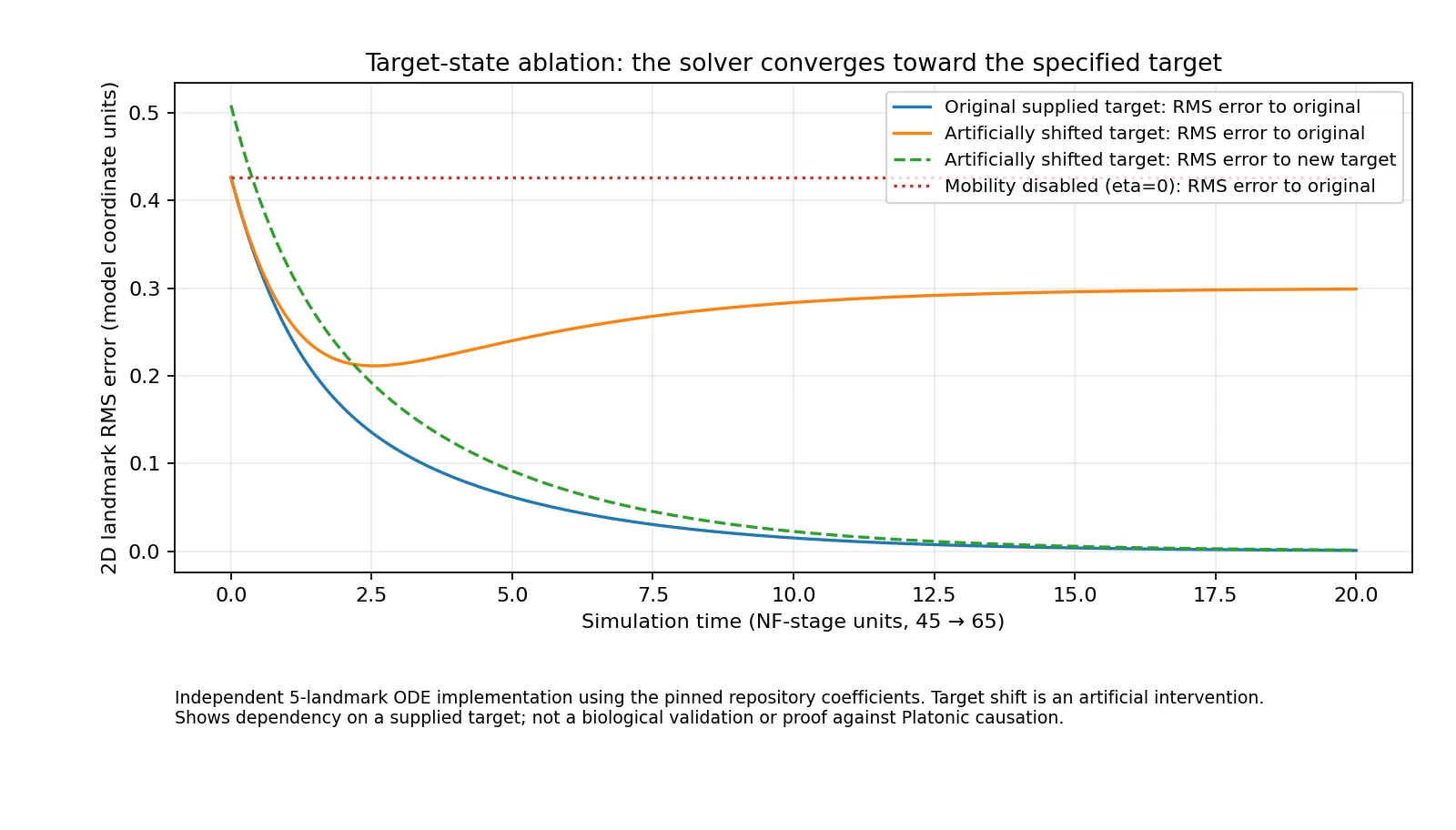
- Claim 6, 95%: the Picasso tadpole. Adaptive craniofacial remodeling is a real experimental result. But Joel’s reduced attractor model defines an energy as distance from a supplied target
X*and a velocity that moves toward it; the target landmarks are read from the parameters. Its convergence therefore shows what that target-seeking rule does given the target. As a conditional illustration the simulation is fine. As independent evidence that biology discovers or accesses an external Platonic target, it has the conclusion partly built into its premise. What held-out intervention distinguishes this regulator from a rival developmental mechanism? The relevant Pinet study does not itself establish a separate nonphysical agent; Joel’s mistaken DOI for that study, like the one for Vandenberg and colleagues in the companion’s Claim 6 heading, is an independently checkable source-identity problem. - Claim 7, 90.1%: xenobots. Cell-driven kinematic self-replication is a genuine, fascinating experimental result, but it does not automatically defeat physicalism; see my detailed xenobots audit. Joel says the favored Pac-Man opening is 105° and both fluid simulations find it. Yet his model introduction identifies approximately 65°, while one simulated efficiency sweep explicitly centers a Gaussian peak at
65.0in its formula. Are 105° and 65° two documented angle conventions, or is one a numerical error? And how can a peak stipulated in the equation count as independently discovered by that same simulation? A separate fluid solver may still yield a genuine result, but it requires an independently specified geometry and validation before it can corroborate an optimum.
Executable checks for Claims 6–7 and the aggregate: The three expandable tests below identify a supplied numerical target, check the xenobot angle discrepancy, and recompute Joel’s seven-claim average. They inspect published code and recorded numbers rather than requiring agreement with my philosophical interpretation.
🔻 Instructions To Test This Computationally (Supplied target in the Picasso tadpole simulation)🔻 Instructions To Test This Computationally (Xenobot 105° narrative versus 65° model efficiency peak)🔻 Instructions To Test This Computationally (Seven-score 77.6% mean and denominator sensitivity)How to read the scientific figures: There are three different kinds of evidence here. Source data are results saved by Joel’s simulation and scoring programs. Negative controls deliberately inject an artificial input to see whether a check can fail. Model interventions change an assumption in a mathematical model and trace what happens. Only the first reports saved results from Joel’s repository; the others are constructed tests, not observations of living organisms. Each figure explains which kind it is and links its source.
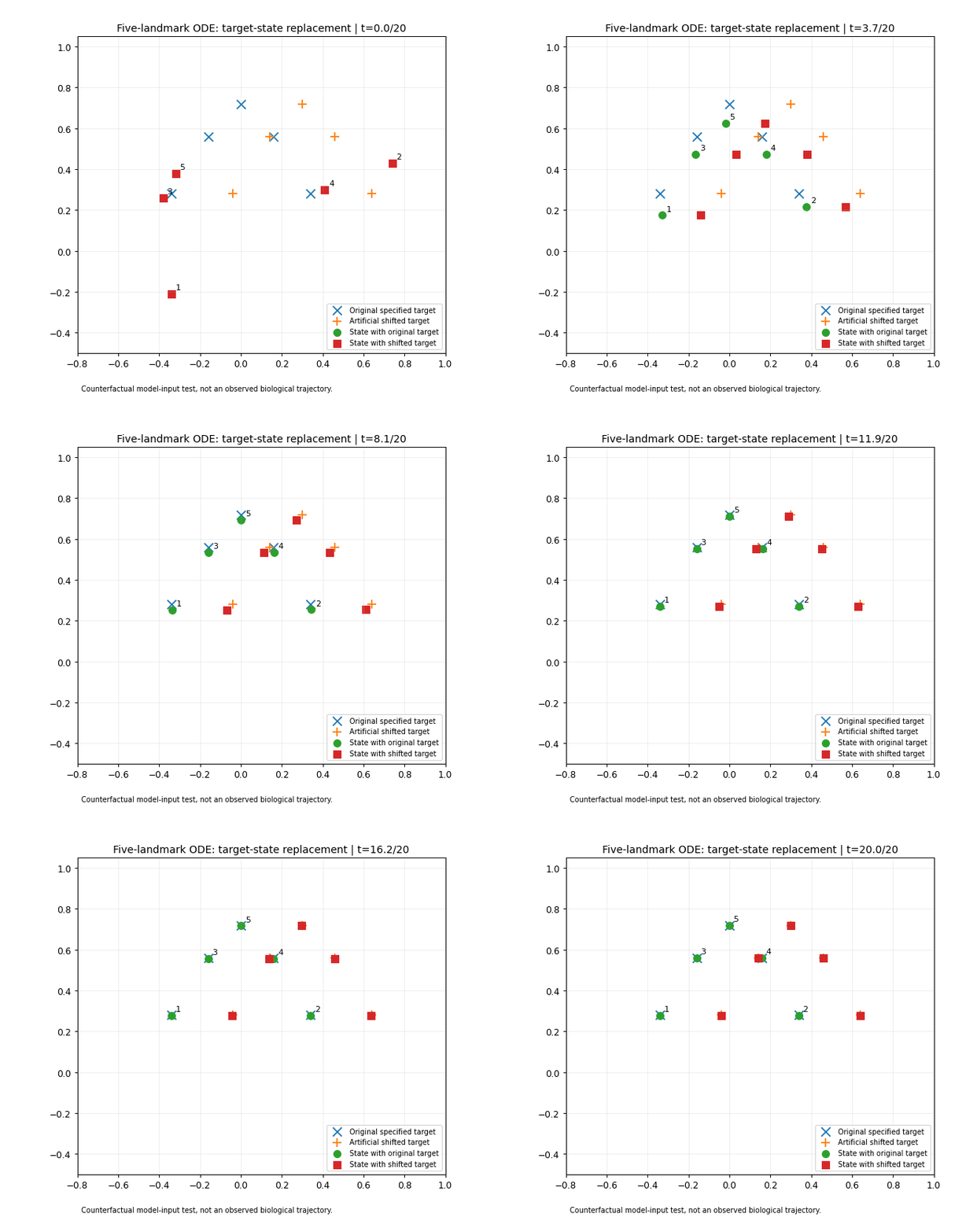
Model-input ablation for Claim 6: this numerical reanalysis changes the destination supplied to Joel’s simplified five-landmark tadpole model. Its output converges toward the specified target. The independent questions are where a biological target originates and what prediction an additional nonphysical cause supplies.
The arithmetic average of Joel’s seven displayed scores is approximately 77.6%; the corresponding structural-only average is 88.1%. Both calculations are correct. They are still averages of unlike judgments: code fidelity, simulation behavior, predictive morphology, and fits to biological systems. Equal weighting makes an editorial index, not a calibrated probability that a single theory is true. He appropriately limits the index to these seven claims from Ingressing Minds. Offered as evidence for nonphysical ingress, the 77.6% headline risks a composition fallacy: components of the science cannot transfer their support to a different claim merely because both appear in the same paper. Taken only as a descriptive summary of his rubric, it escapes that criticism. The title should not invite the stronger reading without supplying its bridge.
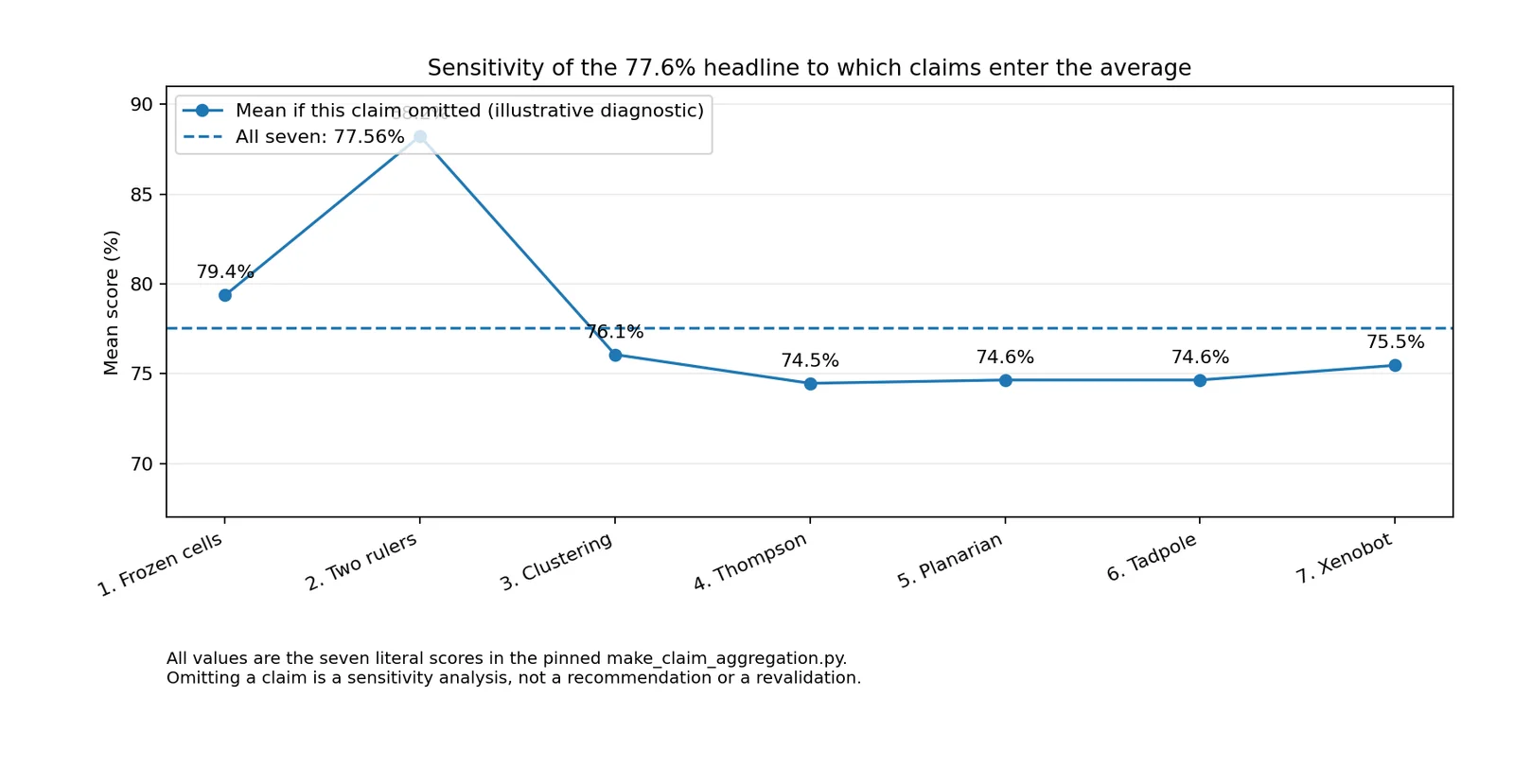
These model experiments are interventions on implemented rules, target coordinates, and other variables within D. That is real causal analysis of the simulations. It is not yet an intervention on an independently measured P. Likewise, an observed win over one comparator does not defeat every serious alternative: Joel’s own fish analysis reports that his predictor’s 4% edge over simply copying the nearest relative did not reach the pre-registered threshold. A fair comparison must retain that unsupported hypothesis.
The “Deep Platonic AI Stack”: representational evidence versus ontology
Joel cites Huh and colleagues’ Platonic Representation Hypothesis. That paper describes increasing alignment of learned representations and proposes convergence toward a shared statistical model of reality; it also discusses limitations and counterexamples. Statistical representational convergence does not entail a separately existing causal realm. If the word Platonic is used first for a model-space analogy and then for an external causal source, the inference equivocates between different propositions.
He then invokes Jiang and colleagues’ Artificial Hivemind. Their research concerns intra-model repetition and inter-model homogeneity on open-ended prompts. It does not establish that an AI is phenomenally aware of itself, locked forever inside its training data, or incapable of forming novel empirically testable hypotheses. Those are further claims. If he wants to use model homogeneity to explain why an auditor systematically underrates P, he needs to show the mechanism and its effect in a matched comparison, not merely import the title’s metaphor.
The section also treats teleology and contact with the “unknown unknown” as deficits of current models. Yet designing experiments with held-out biological data, adversarial predictions, and active interventions is already a way to learn about what the training corpus did not contain. Joel’s own work demonstrates that. Why should discovery of an unanticipated constraint be credited to a nonphysical source unless that source contributed a risky prediction that the stronger alternatives lacked?
The crucial result: D suffices while P remains unearned
Now Joel returns to the scoreboard. He says D suffices for the sorting arrays, with zero cell mismatches under his comparison and monotonic movement on the specified inversion potential. He also says, correctly, that sufficiency of D does not prove P false. These are exactly the distinctions I asked him to preserve. Then comes the twist: he suggests that because a large fraction of his auditing work used AI, the zero awarded to P might be a lower bound from an auditor unable to perceive an ontological outside.
There is no logical path from those premises to that bound. A scorer’s possible bias does not establish its direction or magnitude. It certainly does not assign evidence to a specific causal hypothesis. To earn an upward correction, Joel would need an independent calibration set with known false negatives, a demonstrated mechanism of bias, and a validated rule for changing scores. Without that, “the auditor cannot see it” is a proposed explanation for a result, not a reason to raise the hypothesis’s evidential standing.
Here is the smallest formal statement of the issue. Let D be a specified account of the observed system, P be the proposed additional causal contribution, and E be the tested sorting observations. If fully specified D and D+P assign the same positive likelihood to E (with Pr(E|D) > 0), their Bayes factor from E alone is Pr(E|D+P)/Pr(E|D)=1. The test supplies no relative lift for P. If P is too unspecified to assign that likelihood, no numerical Bayesian score follows. Neither case says P is impossible. Nor does either permit a 77.6% composite or 88.1% mathematical score to be reused as evidence for P.
Joel distinguishes the mathematical or structural patterns from the additional causal assertion. So do I. A useful morphospace can be real as explanatory structure without being a doorway through which independent minds enter biology. Standard philosophical discussions of abstract-object Platonism often treat abstract objects as causally inert. Moving to causally effective ingress adds a bridge obligation. It cannot be bought by renaming successful mathematics.
And consider the reductio. Grant him every correct simulation, every newly found mathematical pattern, and every surprising biological observation. Remove the claim of an extra nonphysical causal source. What predicted result now fails? In the cases he has scored, his own answer is none. So where is the disagreement about what the evidence has earned?
The “++”: correction, score calibration, and what must lose support
Joel says ++ denotes an improving correction loop. His own errata, S16–S17, deserves real credit here: the headline fell from 81.6% to 65.7% before rising to 77.6%. So it would be wrong to accuse his system of never subtracting points. What changed in these steps, however, was primarily which claims and weights entered the denominator, not new empirical support for ingress, still at 0%. That is a sensitivity of the aggregate to a human-selected scoring convention.
As a promise that the process keeps improving, ++ has my agreement. As a prediction that scientific support will rise, it risks a directional confirmation bias. Which aggregation rule was fixed before seeing the seven scores? What evidence would make a particular claim lose points, and what rule prevents changing the denominator afterward? A self-correcting loop must permit the next numerical revision to go either way.
The remaining issue is what the correction loop allows to lose support. Joel preserves a failed seven-test hornet-wing transfer and documents downward revisions to the aggregate score; both are genuine methodological strengths. But that transfer failure bears on the proposed geometry in the tested domain, while the numerical revisions primarily concern scoring conventions. Neither currently specifies a corresponding outcome that would lower support for independent nonphysical causal ingress. That additional loss rule must be stated separately.
Audit the auditor: quantitative benchmarks, AEL, and authorship
In his footnotes and technical appendices, Joel discusses causal-emergence measures, the AI-interactive “spirit of CIMC,” the plus-sign provenance, and his twelve-step Adversarial Epistemic Loop. Much of this is productive methodological infrastructure: alternative metrics, code, formal proofs, accessible artifacts, and some recorded failures. The CIMC agent’s reported wish to feel participants’ emotions is interesting participant-language evidence, but one utterance does not decide whether an agent feels, nor what kind of system or boundary might be its subject. That is not an objection to studying the report.
The benchmark-verdict question examined just below also bears on the provenance of the referee scores: his MorphoEval audit cites the same CSV to justify its claim that all fourteen benchmarks were verified. That is not an independent pass/fail gate. His separate cross-language verifier does perform useful assertions: it compares C++ with JavaScript benchmark dictionaries and checks matching final cell arrays across three languages. Those particular assertions do not establish equality of every intermediate kymograph frame or parity of Python’s fourteen benchmark values; the guide itself displays differing numerical outputs. Which further executable checks warrant the broader description? Separately, the cross-audit documents source-identity mistakes: five DOI errors are linked in the quick checks above; the executable test below covers the first three, and the other two are single lookups. None erases the genuine computational results; each limits what the claimed independent verification has yet established.
🔻 Instructions To Test This Computationally (Three mismatched bibliographic DOIs against primary metadata)🔻 Instructions To Test This Computationally (Cross-language verification: exactly which arrays and benchmarks are asserted equal)Typed-in and stipulated results: what they can and cannot show
Several results in Joel’s materials are not computed from the checks they appear to report. A typed-in result is a value written into the code, such as a constant label or a display string. A stipulated result is an input chosen in advance, so the model cannot discover it. Neither is fake: his relative errors are calculated, and his simulations may be sound. But a result that could not have come out otherwise tests nothing, so it cannot confirm anything. The same standard applies to my own checks: an independent review found that the negative-control line in the first version of the test script that accompanies this article is a fixed sentence, not a computed result, and recorded it in the evidence archive. None of this bears on whether P exists. It bears on how much a verification label can claim. The illustration at the top dramatizes this: the stamp is the constant label.
| Result | Kind | Where | What it can show | What it cannot show |
|---|---|---|---|---|
"VERIFIED" on 14 of 14 benchmarks | Typed-in constant label | validator, lines 352–353 | That each benchmark was run | That any error threshold was met |
| 77.6% and the seven scores | Typed-in display string | figure generator | The arithmetic of the labels (5429/70) | That the labels update when a score changes |
| Xenobot efficiency peak at 65° | Stipulated input | efficiency sweep formula | The shape of the model | An independent discovery of the optimum |
| Tadpole target landmarks | Stipulated input | model parameters | That the rule converges on whatever target it is given | Where a real embryo’s target comes from |
One reply is available: that VERIFIED only means a benchmark was executed. That is a possible reading, but the code states no such criterion, and the figure title says the benchmarks were verified, not run.
His saved result is 0.370 published, 0.496 replicated, 34.11% relative error, VERIFIED. A second benchmark records 11.71% error, VERIFIED. His cross-language table reports 0.5581 for the same delayed-gratification target in C++ and JavaScript, approximately 50.8% above the published 0.37. The figure meanwhile prints "14/14 Published Benchmarks Verified" and "✓ PASS" for every row. Perhaps the intended claim is qualitative reproduction of the trends, or perhaps these differences fall within justified sampling uncertainty. But then where is that criterion specified and applied in code, and what result would actually make this validator say FAIL? Without a loss condition, how does the printed verdict demonstrate the quantitative replication it announces?
What exactly does “14/14 verified” mean in Joel’s audit? These are lines 352–353 of his validator, reproduced exactly apart from indentation:
"relative_error_pct": round(abs(float(np.mean(dg_by_f["B"][3])) - 0.37) / 0.37 * 100.0, 2),
"status": "VERIFIED",
The code assigns its VERIFIED label regardless of the numerical error. This is the narrow programmatic finding: the source CSV’s VERIFIED label is not conditional on the relative numerical error. The next figure displays the numerical discrepancies actually saved in that CSV. The later animation deliberately tests the verdict rule with a synthetic 900% input; it is not a measured replication error.
🔻 Instructions To Test This Computationally (Fourteen literal VERIFIED statuses and a synthetic negative control)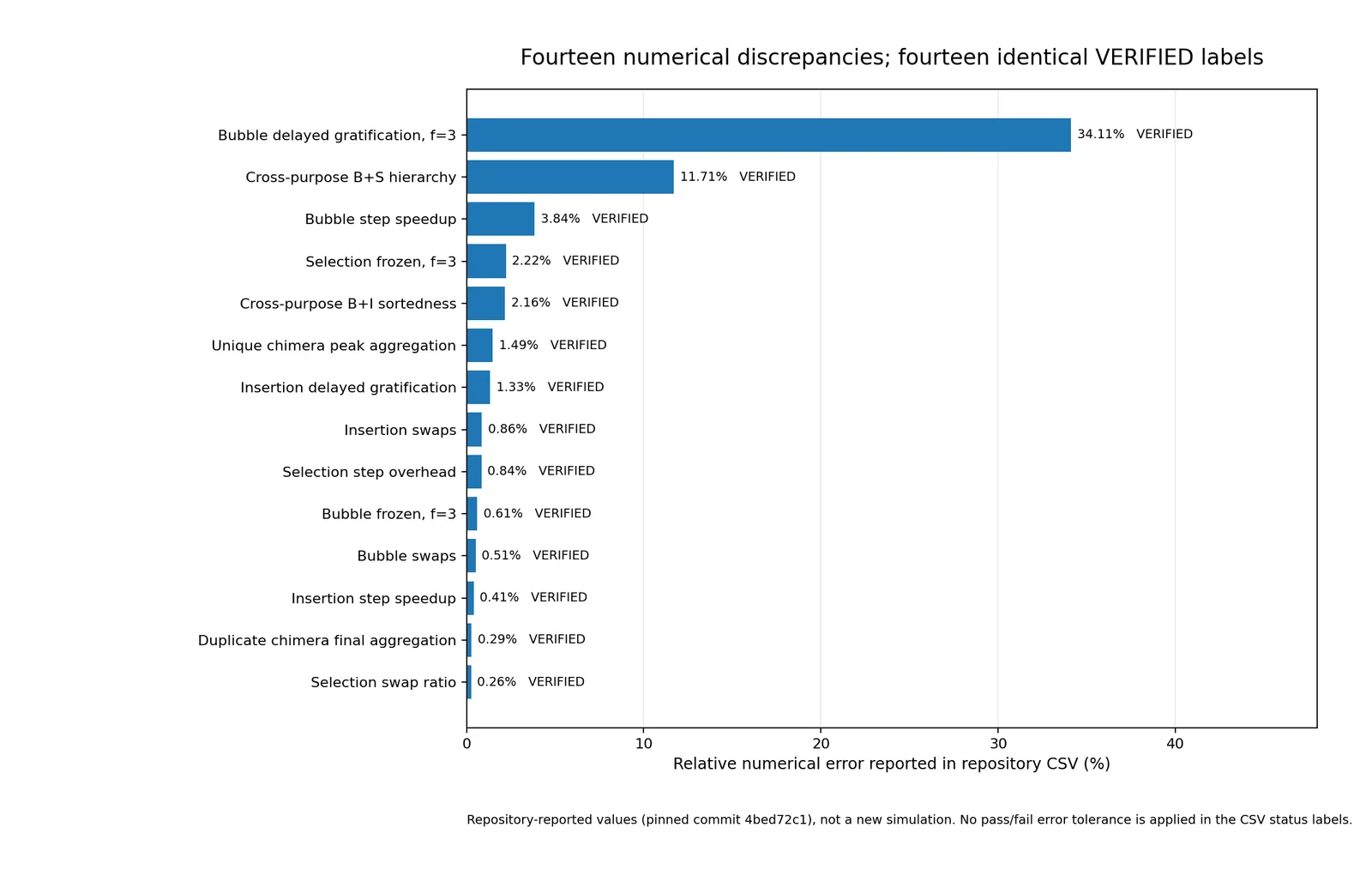
One more reproducibility question. In the animation source, the seven displayed percentages appear as fixed text and the aggregate is MEAN = "77.6%". His errata documents the actual arithmetic and revisions, so this alone is not evidence that he invented the numbers. It does mean that rerunning the image generator is not a check of the underlying scores. Where does the pipeline compute each earned point from an independently testable criterion and propagate a failed check all the way into the graphic and headline?
One plausible reason for differing sample means is visible in the code: the Python paper-benchmark routine uses NumPy’s random generator, while the cross-language comparison uses SplitMix64. Different sampled runs can yield different averages. This explains why any assertion of bit-exact parity needs a specified, matched experiment; it does not supply the missing quantitative acceptance rule.
Validator negative control: A deliberately injected, synthetic 900% discrepancy still receives VERIFIED because the status assignment is unconditional. This tests the verdict logic, not a biological experiment. The artificial discrepancy is not a measured replication error. Readers can inspect the static negative-control plot or the reanalysis package.
His authorship note reports extensive AI participation, including in the section responding to me. Fine. The response should therefore be judged by how well it preserves an opponent’s claim, traces source identity, discriminates evidential targets, and actually revises after criticism. An honest comparison would give the same frozen source packet to Joel’s AEL and my Recursive Corrigibility Framework, with independent scorers, blind planted defects, false-positive penalties, and outcomes each side can lose. We have an interesting natural test case; a controlled tournament has not yet been run.
Joel’s human-versus-AI heatmap also needs a unit of measurement, not just percentages. As I documented in my Bubble Sort response, Joel calls the section-by-section numbers his estimates, and the rendering script averages them. In a deliberately illustrative recalculation, dividing the introduction into two sections raises the mean estimated human-prose contribution from 53.1% to 57.4% without changing a single word. This is one denominator-sensitivity example: other section splits can move the mean in different directions. A correct mean of estimated inputs is not an independently measured proportion of intellectual work. My own writing draws on decades of learning, other researchers, previous corrections, computational systems and the conditions in which I work. Dividing all that into exact exclusive percentages would require an explicit unit, boundary, allocation rule and supporting records. Who checked a source, corrected an error and accepted a failed test is more informative than a superficially precise authorship pie chart. My account of the human–AI correction process, including its failures and revisions, is documented in the xenobots analysis and the response to Levin’s evidence-free AI dismissal.
🔻 Instructions To Test This Computationally (How section boundaries change human/AI percentages)Joel’s conclusion: Aristotle, Thompson, and the untested causal bridge
Joel closes with Aristotle’s biological observation, D’Arcy Thompson’s mathematical transformations, nested powers of psyche, and the importance of direct engagement with nature. This is an attractive history of inquiry. Formal causes, levels of organization, and non-neural cognition are important philosophical and scientific subjects. Nothing in my argument requires denying them.
Notice where Joel ends. The closing goes back to the same two facts, that the mathematics does substantial work and that nonphysical ingress has not earned a score, and then sets them against reductionist dismissals. A reader who arrives there with no other critic in view will assume the target is me. My actual quoted position shows otherwise. If he intends the contrast to reach me, it misrepresents me; if not, he should keep the distinction visible for readers who encounter no other named critic.
Is Platonic ingress false? That may be the least interesting question.
What do Joel’s tests license? Not the conclusion that Platonic ingress is false; no array of sorting cells was ever going to carry that weight. They license something narrower and still useful: for the outcomes he tested, the added nonphysical input is idle, because the rules he implemented already do the explaining and it earns no support. That is a finding about those outcomes, and it presumes nothing about a final inventory of reality.
Being wrong is ordinary. A hypothesis can be false and nevertheless be responsibly formed, tested, and revised. The worse failure is immunization: a speculative cause acquires the authority of an established result while every route for correcting it has been closed. Under that practice, every surprise counts as confirmation and every failure is explained as something the auditor was unable to see. A false claim can be found out and dropped; an immunized one cannot, and that is why one need not prove P false to reject the credit assignment.
What would the error cost? In a purely private discussion, perhaps very little. In the public presentation of science, the risks include confusing causal demonstrations with ontological conclusions, distorting research priorities, misleading audiences about what an experiment establishes, and importing unsettled premises into decisions about unfamiliar minds, agency, consciousness, or welfare. These are possible pathways, not claims that every belief in a latent space causes harm. The stakes rise when an unearned conclusion is used to guide interventions on systems that cannot easily refuse or correct their investigators. The person or organism bearing a cost may not be the one allowed to decide whether the premises are revisable.
Here is the specific credibility-to-harm pathway. If readers accept “77.6++%” as verification of Levin’s additional nonphysical causal ingress, the headline acquires support that Joel’s own 0.0%-earned ingress result does not supply. If those readers also accept that the alleged reductionist critic was refuted by a failed stability explanation, they can dismiss my surviving argument without seeing that I had withdrawn that explanation on October 13, or that its failure cannot establish an independent Platonic cause. Those two unearned transfers of credit can travel into citations, journalism, funding decisions, education and work on biological or artificial systems. Researchers with public platforms and technical credentials can amplify the errors, while those affected by downstream decisions may have no opportunity to inspect their source. The scale and likelihood of such harms need evidence; the mechanism warrants attention before an evidential score becomes a metaphysical endorsement.
Levin has publicly stated the categorical claim “physicalism is false” (the linked transcript is automated), and his published Ingressing Minds advances an explicitly causal nonphysicalist research programme. This goes beyond merely identifying gaps in present physical explanations. I likewise challenge exhaustively defined physicalist ontologies that claim more than evidence warrants; that symmetrical caution does not establish Levin’s alternative. The decisive questions are which physicalist proposition he has actually defeated and what positive evidence establishes his proposed replacement. My xenobots analysis treats these as separate burdens and grants the biology its full achievement. Biological novelty does not, by itself, settle the ontology of the universe.
Underdetermination is not a consolation prize for P and not a defeat for D. It means that specified available evidence has not separated every remaining rival. For those observed outcomes, the mechanism and mathematics that already account for them retain their evidential standing. P receives no additional credit without a demonstrated contribution. We can therefore be cautious in consequential decisions without pretending to know P is false. This is more accurate than absolute denial and more useful than permanently protected affirmation. It preserves a path to change our minds while refusing to spend other people’s welfare on an unearned conclusion.
The test that could change either conclusion
Specify P, its causal bridge to D, and a result that differs materially between D and D+P. Preregister the comparison with strong naturalistic and nonreductive rivals, controls, held-out data, and real loss conditions. If a P-specific relation improves prediction, compression, intervention, or transfer independently of the mathematical structure already present in D, that should change my assessment. If D wins, it should change theirs. Neither side gets a fixed exemption.
None of this subtracts from the work Joel has done. His computations stand, and they deserve accurate citations and faithful descriptions of the people he argues against. If his current score really does leave nonphysical ingress at zero earned points, we are standing on the same evidential ground, which makes it hard to see what the “reductionist blog critics” framing was for. A label can manufacture a disagreement; only a proposition in my surviving argument that turns out to be wrong can win one, and Joel has not yet pointed to one.
Research record and reproducibility
Reproducibility repository: Source-first computational audit scripts, seven per-test ZIPs, pinned inputs and current test-manifest (GitHub research materials); this WordPress article remains the canonical publication. Package availability on two hosts is a resilience measure, not independent scientific confirmation. The archived release of this response has its own DOI, listed under Primary texts below.
Primary texts: Joel’s Substack article and its subtitle · pinned November 10 main text · seven-claim companion · October 25 source · my D-versus-D+P argument · my current sorting analysis · Zhang, Goldstein and Levin’s original paper · their original code.
Rebuildable evidence: November 1 cross-audit · its archived DOI · context and source-identity archive · split-aware TXT diff archive. These links document earlier audits and source versions. The archived release of this response, with its code, test packages, audit evidence and checksums, is deposited on Zenodo as DOI 10.5281/zenodo.24151128.
Supplementary numerical figures and animations: Download the version-pinned source CSVs, Python rebuild scripts, GIFs, PNGs, provenance notes and SHA-256 manifest. The package separates source measurements from synthetic negative controls and hypothetical interventions.
Related foundations: The Recursive Corrigibility Framework states the revision and evidence rules applied here; Provisional Boundary and Scale-Relative Realism clarifies how I assess explanatory patterns without presuming a final ontology; the Framework Bridge sets conditions for transferring claims between disciplinary scales; and the Sweet Rationalism Ethos addresses critical engagement and correction. These methodological positions are not independent evidence that the article’s scientific conclusions are correct.
References
Author–date bibliography with links to publisher records, DOI landing pages, scholarly preprints, and primary documentary sources. Conference papers, preprints, correspondence, and code repositories are identified by type; a repository or a citation link is not independent verification of its contents.
Scholarly literature and reference works
Anderson, P. W. (1972). More is different. Science, 177(4047), 393–396. https://doi.org/10.1126/science.177.4047.393
Balaguer, M. (2024, December 24). Platonism in metaphysics. In The Stanford Encyclopedia of Philosophy (substantive revision).
Beane, W. S., Morokuma, J., Adams, D. S., & Levin, M. (2011). A chemical genetics approach reveals H,K-ATPase-mediated membrane voltage is required for planarian head regeneration. Chemistry & Biology, 18(1), 77–89. https://doi.org/10.1016/j.chembiol.2010.11.012
Claverie, T., & Wainwright, P. C. (2014). A morphospace for reef fishes: Elongation is the dominant axis of body shape evolution. PLOS ONE, 9(11), e112732. https://doi.org/10.1371/journal.pone.0112732
Friedman, S. T., Price, S. A., Corn, K. A., Larouche, O., Martinez, C. M., & Wainwright, P. C. (2020). Body shape diversification along the benthic–pelagic axis in marine fishes. Proceedings of the Royal Society B: Biological Sciences, 287(1931), 20201053. https://doi.org/10.1098/rspb.2020.1053
Huh, M., Cheung, B., Wang, T., & Isola, P. (2024). Position: The Platonic representation hypothesis. In Proceedings of the 41st International Conference on Machine Learning (Proceedings of Machine Learning Research, Vol. 235, pp. 20617–20642).
Jiang, L., Chai, Y., Li, M., Liu, M., Fok, R., Dziri, N., Tsvetkov, Y., Sap, M., Albalak, A., & Choi, Y. (2025; revised 2026). Artificial hivemind: The open-ended homogeneity of language models (and beyond). arXiv, 2510.22954 (preprint, version 2).
Kennedy, R., Dietz, J., & Nevelsteen, K. (2024). An interdimensional mapping protocol to connect rendering engines and game worlds. In Proceedings of EVA London 2024 (pp. 387–389). https://doi.org/10.14236/ewic/EVA2024.83
Kriegman, S., Blackiston, D., Levin, M., & Bongard, J. (2021). Kinematic self-replication in reconfigurable organisms. Proceedings of the National Academy of Sciences, 118(49), e2112672118. https://doi.org/10.1073/pnas.2112672118
Levin, M. (2026). Ingressing minds: Causal, non-physical patterns in-form natural, synthetic, and hybrid embodiments. Philosophies, 11(5), 161. https://doi.org/10.3390/philosophies11050161
Pietak, A., & Levin, M. (2016). Exploring instructive physiological signaling with the Bioelectric Tissue Simulation Engine. Frontiers in Bioengineering and Biotechnology, 4, 55. https://doi.org/10.3389/fbioe.2016.00055
Pinet, K., Deolankar, M., Leung, B., & McLaughlin, K. A. (2019). Adaptive correction of craniofacial defects in pre-metamorphic Xenopus laevis tadpoles involves thyroid hormone-independent tissue remodeling. Development, 146(14), dev175893. https://doi.org/10.1242/dev.175893
Vandenberg, L. N., Adams, D. S., & Levin, M. (2012). Normalized shape and location of perturbed craniofacial structures in the Xenopus tadpole reveal an innate ability to achieve correct morphology. Developmental Dynamics, 241(5), 863–878. https://doi.org/10.1002/dvdy.23770
Zhang, T., Goldstein, A., & Levin, M. (2025; first published online 2024). Classical sorting algorithms as a model of morphogenesis: Self-sorting arrays reveal unexpected competencies in a minimal model of basal intelligence. Adaptive Behavior, 33(1), 25–54. https://doi.org/10.1177/10597123241269740
Primary texts, correspondence, and reproducibility records
Dietz, J. (2026). Auditing Michael Levin’s Platonism [Substack essay]. MetaMeditations. Archived version at the cited Git commit.
Dietz, J. (2026). Seven-claim companion to the Platonism audit [GitHub document, pinned revision 4bed72c].
Dietz, J. (2026). MorphoLib: Numerical models, audit scripts, evaluation records, and data [Software and research repository, pinned revision 4bed72c].
Sweet, N. (2026, February; revised October). Why Michael Levin’s bubble sort “revelation” is misunderstood classical algorithm theory meets a God-of-the-gaps argument. Sweet Rationalism.
Sweet, N. (2026, October). Religion with a pipette: Is Michael Levin’s “Ingressing Minds” pseudoscience? A scholarly analysis. Sweet Rationalism.
Sweet, N. (2026, October 25). Response to Joel Dietz correcting attribution and stability claims [Correspondence, reproduced image].
Sweet, N. (2026). Levin sorting audits: Cross-audit [Version-controlled research record]. GitHub.
Sweet, N. (2026). Joel Dietz response: Source-first computational checks and reproducibility materials [Version-controlled software, pinned-source manifests, and test packages]. GitHub.