Michael Levin’s Xenobots: Are They Real? Do They Prove That “Physicalism Is False”?
Research record: GitHub source and revision history · canonical published edition · related: response to Joel Dietz’s 77.6% audit (DOI)
A Scholarly, Evidence-Based Analysis of the Science vs. the Hype: xenobot history, self-replicating living robots, independent replication, and Levin’s case against physicalism.
A note on the title: Levin does claim that physicalism is false (Ingressing Minds, p. 22). He does not claim that xenobots prove it. The title refers only to the first claim. The question it asks is mine: do xenobots show that physicalism is false? The article answers: no. The xenobot experiments show what living cells can do under new conditions, and they do not show that physicalism is false.
If you’ve watched Michael Levin’s videos about xenobots and wondered whether the science holds up to scrutiny, you’ve come to the right place. The short answer: the xenobot papers report striking biological results, but novelty and independent confirmation vary by claim. The philosophical interpretation is where things go spectacularly wrong.
Levin argues that mathematical patterns break physical closure and calls physicalism false in his lecture transcript. He proposes that bodies act as interfaces for nonphysical patterns, including kinds of minds. Based on the best evidence and arguments I have found so far, that metaphysical upgrade has not earned the confidence he places in it. Over nearly a year of dialogue and many, many thousands of words exchanged with Michael Levin and nearly a dozen scholars connected to his Symposium on the Platonic Space, I have still not been given evidence or an argument that discriminates in favor of his added Platonic causal claims over serious rivals, or that justifies even a modest belief in those additional claims.
My detailed comparison of eight cases identifies two clear misrepresentations and a third partial case that anyone can check themselves if they care at all about the truth of the matter: higher-level causation recast as reductionism, an ordered rival recast as randomness, and a challenge to added causal claims partly recast as opposition to mathematical structure. Those substitutions functioned to avoid engaging the crux: what favors the added Platonic contribution over rivals preserving the same biology, mathematics, and higher-level organization? Many of these exchanges are documented extensively on my website. Demolishing an argument I did not make does not answer the one I did.
See my article here: Biologist Michael Levin’s “Response” to My Criticisms of Biological Platonism: Misrepresentation of My Arguments, Platonic Morphospace, and a Claim That Is Unfalsifiable As Stated for the most direct checkable examples.
Now let us, for the sake of argument, grant the cellular competence. Grant independent mathematical objects. Even grant that physicalism is false. None of those concessions identifies Levin’s proposed source. That attribution still needs an argument distinguishing it from the alternatives.
I do not have to produce a complete rival model of xenobot development before asking what supports Platonic ingress. A gap in my account is not evidence for his proposed source. I do not have to finish developmental biology before asking to see the receipt.
Let’s examine the xenobots history, separate the remarkable science from the mystical nonsense, and explain what these living robots actually tell us about biology, without requiring belief in Platonic forms hovering in mathematical heaven.
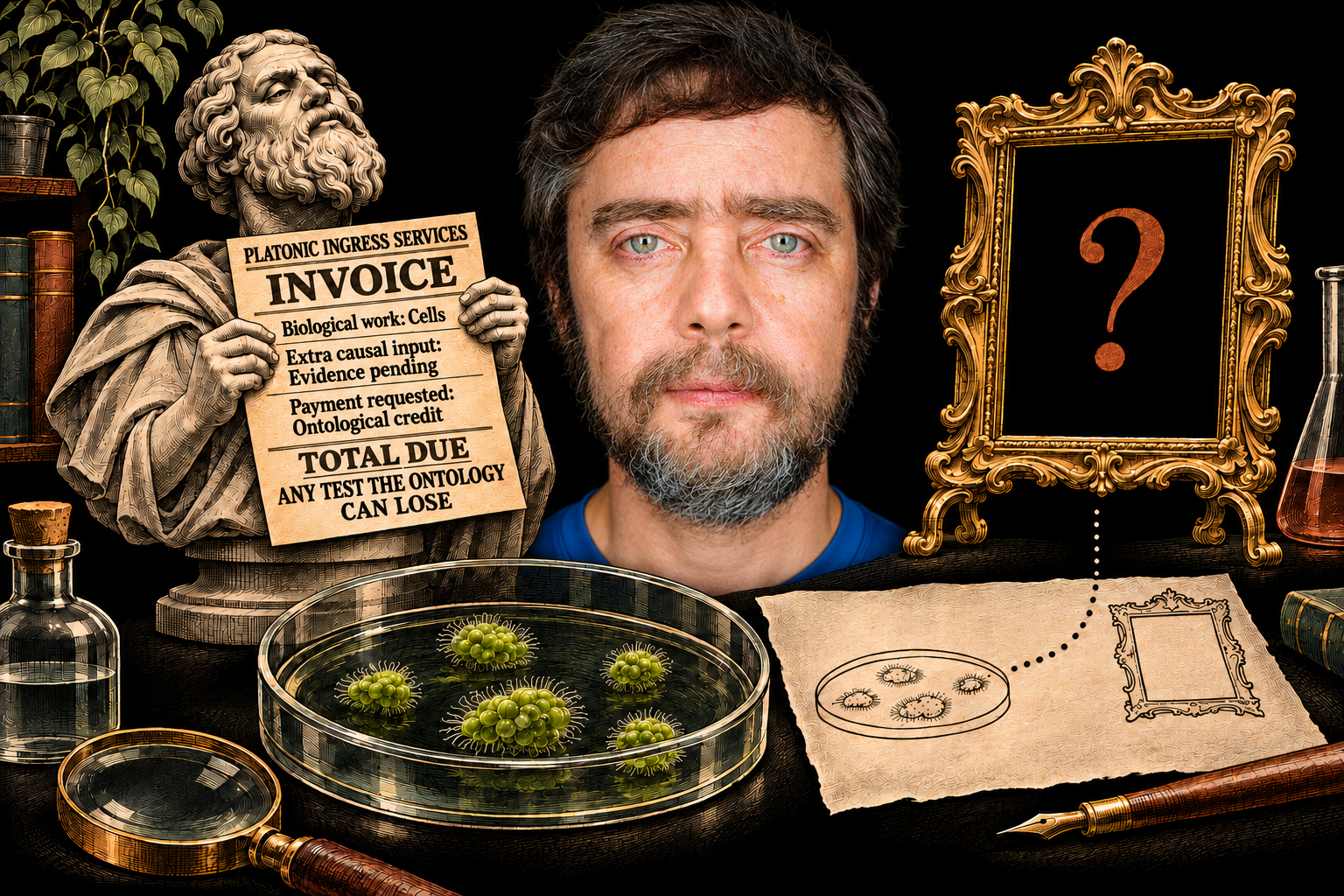
An invoice from mathematical heaven. Editorial illustration; the invoice asks for a test of the added causal claim.
What Are Xenobots? The Basic Xenobots Explanation
Michael Levin and his collaborators use the name xenobots for living constructs made from cells of the frog Xenopus laevis. Their history includes three distinct experimental platforms, with different degrees of design and intervention.
In the 2020 PNAS study, a computational evolutionary search produced candidate designs. Researchers then constructed and sculpted living approximations from epidermal and cardiac tissue. In the cardiac-driven experiments, cilia were suppressed using injected Notch ICD messenger RNA, and contractions supplied movement.
The March 2021 platform used self-assembling epidermal constructs propelled by naturally developing cilia. The study reported wound repair, movement through structured environments, collective behavior, and, in a separate experiment, writable reporter-based memory. The basic platform required no genomic editing; particular experiments used additional molecular interventions.
The late-2021 replication study reported kinematic replication: moving constructs gathered supplied dissociated frog cells into aggregates that developed into motile offspring. Computational shape optimization and manual shaping extended replication. The procedure depended on supplied living cells and supported a limited number of generations.
Living, motile frog-cell constructs have experimental support. The design pipeline, behavioral claims, and kinematic replication need their own assessments of novelty, controls, and independent confirmation.
What Levin Gets Right, and What Those Results Do Not Establish
A genome is not an anatomical blueprint specifying every event. Cells are active, context-sensitive materials. Change their neighbors, geometry, signals, and surroundings, and capacities absent from the ordinary frog can become visible. The collective configuration can be novel while its components carry a long evolutionary and developmental history.
Nor is a brain the entrance requirement for investigating goals, memory, or collective control. Levin’s comparison with thermostats and guided missiles makes a reasonable functional point: non-neural systems can regulate outcomes. Calling that goal-directed need not introduce a nonphysical owner.
Mathematics can explain real features of the world. Evolution need not separately invent every mathematical consequence of the structures it exploits. And knowing lower-level laws does not automatically furnish the best explanation at every scale. Anderson’s More Is Different makes that distinction without appointing an external supplier.
Levin’s patterns are also not necessarily frozen, perfect frog blueprints. His May 11 and December 30, 2025 replies allow active patterns and the generation of new ones. The question is how that proposed space relates to the cells, not whether his view resembles a particularly inflexible Plato souvenir.
None of this establishes that bodies obtain their capacities from independently existing agential patterns. A mathematical explanation, a useful research programme, and a further source of causal influence are different achievements.
The Extraordinary Revelation That Cells Known To Respond Differently In Different Environments Respond Differently in Different Environments
Let us pause, in the spirit of honest inquiry, to register the full weight of the philosophical upgrade.
Scientists took cells, interrupted the molecular equivalent of a very firm memo telling them to participate in frog development, changed their neighbors and surroundings, and observed behavior unlike their behavior inside a frog.
I will allow that to settle.
Cells that evolved to respond dynamically to environmental signals respond dynamically to a changed environment. Machinery inherited from organisms sensitive to contextual variation turns out to be sensitive to contextual variation when you vary the context.
Bloody hell, you don’t say!
The specific capabilities still matter. Motile aggregates gathering loose cells into further motile aggregates is a specific, testable claim, not a deduction from the slogan that cells respond to context. Grant that result in full: surprise still does not supply an address in Platonic heaven. The experiments can reveal something new without the explanation arriving from somewhere nonphysical.
After the papers come the interviews, the headlines, and the promotional vocabulary. The Petri dish is apparently auditioning for the apocalypse.
The cells, we are informed with the gravity appropriate to a papal encyclical, are doing things no one told them to do. I am reliably informed that my pancreas is currently doing several things no one told it to do. My liver has been freelancing for decades without a single directive from conscious management. The neurons firing as I write this sentence were not individually briefed. If the absence of individual instructions established Platonic ingress, the human body would be an embarrassment of mystical riches. We should perhaps notify Plato that he has been running a particularly successful operation in the islets of Langerhans.
An unanticipated competence is not a certificate of nonphysical origin. Neither is the absence of a separate instruction for every component. Levin’s mathematical argument still has to establish its proposed causal bridge; the cells’ novelty cannot do that work by proxy. What, specifically, should these cells do differently because his proposed source exists? Put that difference on the table before the tissue supplies the answer. The burden of proof does not grow cilia and swim away.
We changed the circumstances of living machinery. Establishing which capabilities follow, and how reliably, is worthwhile science. I am still looking for the result that puts Plato on the payroll.
Xenobot History, Naming, and Independent Replication
A Cell Culture by Any Other Name
The naming objection has substance. In an email conversation with me, developmental biologist Johannes Jaeger raised concerns about the promotional framing of familiar cell-culture preparations. He makes a related criticism in his public essay Why TAME is lame …, while also describing Levin’s bioelectric research as original and saying he has no immediate reason to doubt its technical soundness. Those are distinct judgments.
More pointedly, xenobot coauthor Douglas Blackiston calls the name a “nontechnical descriptor” and discusses its rebranding of animal-cap terminology. In his individually attributed commentary, published alongside differing perspectives from Kriegman, Bongard, and Levin, he locates the innovation in anatomical design and the use of known living materials. He prefers biomachine, while defending robot for purpose-designed living constructs.
Blackiston also reports that some press accounts exceeded the data by attributing cognition or novel functionality arising without investigator design. He says he removed his name from several misleading accounts. That supplies a concrete communication problem to investigate: which preparation, intervention, and measurement supports each public claim?
The historical baseline matters. Angerilli and colleagues reported in 2018 that Xenopus tropicalis animal-cap explants developed ciliated epidermis and rotated autonomously in culture. That predates the 2020 xenobot announcement. Kim and colleagues’ January 2020 work examined epithelial regeneration and mechanical control in X. laevis aggregates, before the March 2021 ciliated platform. Neither paper demonstrates the later kinematic-replication assay.
Calling something a xenobot does not reset the embryology literature to year zero. Specific designs and uses can be new while their component capacities are familiar. The question is which result is new, compared with which preparation. A catchy name does not come with a complimentary amnesty for the prior literature.
What Has Been Independently Reproduced?
Confidence belongs to particular results, not to a laboratory’s entire catalogue. The independent animal-cap and organoid studies above support tissue self-organization, epithelial differentiation, and ciliary function. They are historical antecedents and related evidence, not replications of every later xenobot claim.
As of November 2, 2026, targeted searches of scholarly records, citation trails, and primary papers did not identify a published direct wet-lab replication by an unaffiliated group of the three headline xenobot studies. The missing step is outside confirmation of those assays, including the size and reliability of the claimed effects.
| Claim | Evidence identified | Independent confirmation identified here |
|---|---|---|
| Animal-cap differentiation and ciliary motion | Independent antecedent studies, including the 2018 rotation result | Yes, for those underlying phenomena; preparations and species differ |
| The 2020 computational design-to-fabrication pipeline | Originating team’s experimental report | No direct outside replication located |
| The March 2021 package of motility, repair, collective behavior, and reporter memory | Originating team’s report; affiliated work subsequently uses the platform | No outside reproduction of that package located |
| The late-2021 cell-gathering kinematic-replication assay and shape advantage | Originating team’s repeated trials, controls, and comparisons | No direct outside replication located |
| Ciliated living constructs more broadly | Bhattaram and colleagues’ 2025 AggreBots study, using human airway cells | Independent related experiments from Carnegie Mellon and Washington University; a different platform |
AggreBots strengthen the general case for constructing motile tissues and controlling their behavior through geometry and active-cilia distribution. They do not reproduce the frog-cell replication assay. Conversely, a xenobot paper with authors from several universities is not an independent replication of that same team’s work. The 2021 replication paper’s repeated trials are experiments within that study, not separate laboratories confirming it. Reproducing the press release is not the kind of replication we are waiting for.
For kinematic replication, a decisive next check would be outside laboratories reproducing the progenitor/no-progenitor control and the claimed shape advantage across separate frog clutches, with documented cell density, culture conditions, transfer procedure, and complete outcome reporting. Success would increase confidence in that result. It would still leave the proposed Platonic source to earn its own support.
Biology’s Replication Problem, and the Xenobot Confirmation Gap
Biological experiments depend on materials with histories: strain, developmental stage, physiological state, culture conditions, handling, and interactions among them. The test is whether a result’s direction, magnitude, and relevant limits survive fresh experiments outside the original setup. Repeating trials inside one laboratory answers only part of that question.
The Reproducibility Project: Cancer Biology repeated 50 experiments from 23 papers and assessed 158 effects. For original positive effects reported numerically, the median standardized effect size fell from 2.96 in the originals to 0.43 in the replications, about 85% smaller. The companion methods report found that the public information needed to calculate effect sizes and plan statistical power was available for only four of the 193 experiments initially considered. Repetition also ran into missing procedural details and difficulties obtaining clarifications. A polished paper is not a substitute for an independently executable experiment.
Context itself can change the result. In Crabbe, Wahlsten, and Dudek’s three-laboratory mouse study, apparatus, protocols, and many environmental variables were standardized, yet behavior differed systematically across laboratories; some genetic effects depended on the testing laboratory. Voelkl and colleagues’ simulations using published animal data further showed how distributing a sample across laboratories could improve the accuracy and generality of the result without simply adding more animals. Biological context is something to investigate, not wave away because the genome and the bath water look familiar.
That bears directly on xenobots. Blackiston describes kinematic replication as fragile and dependent on carefully adjusted inputs. An outside laboratory needs to recover the cell-gathering result and the claimed shape advantage across fresh frog clutches, using documented densities, temperatures, geometry, transfer procedures, controls, and outcome measures. The confirmation gap identified above concerns those particular assays. Independent evidence for ordinary ciliary motion cannot fill it by proxy. Reproducing the press release still does not count.
This creates two evidential gates for Levin’s public argument. First establish how reliably the claimed biological competence travels beyond the originating setup. Then establish what it discriminates between. Even a perfectly successful outside replication would confirm the cellular behavior, not automatically the alleged Platonic contributor. A new laboratory can reproduce the result without reproducing the metaphysical inference.
Incomplete Explanations Do Not Appoint Their Own Successors
Physics, Whiteheadian process metaphysics, supernatural accounts, and biological Platonism all face unresolved questions. None supplies a finished explanation of everything at every scale. Incompleteness is not a special embarrassment reserved for physicalism.
That does not prevent a bounded explanation from answering its question. We can establish a cellular dependency without first solving quantum gravity. Effective-field-theory work on gravity itself produces defined results within a regime while leaving deeper questions open.
CurrentAccountWithin(A)HasNotExplained(X) ⇏ OntologyAIsFalse.

EvenIfOntologyAIsFalse ⇏ ArbitraryOntologyZIsTrue.
“Ontology A has not explained X. Therefore A is false and Ontology Z (Interpretation #43,311,237) is true.” Apparently an unanswered question is now a will, and the beneficiary gets to fill in its own name.
Even if A really were defeated, Z would still have to earn its inheritance. Funerals are not evidence for whoever turns up with a wheelbarrow.
The first move confuses an unresolved explanation with an established impossibility: an argument from ignorance. The second is a non sequitur; treating A and the preferred Z as the only possibilities adds a false dilemma. Demanding a complete rival account before allowing criticism adds a burden shift.
I examine the same evidential promotion in Matthew Segall’s Words Made Flesh Again, but the Evidence Never Said That?. Bioelectric regulation, embodied interaction, and evolutionary novelty can belong to D, the supported causal organization that rival accounts preserve. Evidence for D does not, by itself, select the preferred metaphysical addition. An unanswered question is not a theological or Platonic casting vote.
Levin Argues Against Physicalism, Not Merely for Unfinished Science
In his March 2025 post, Levin writes both “we already know physicalism is incomplete” and “I argue that this breaks the closure of the physical world.” In Ingressing Minds, §5.3, p. 22, he says mathematics “has already evicted us from the tidy physicalist paradigm” and adds, “There is no going back.” The automatic transcript of New Bodies, Unconventional Minds presents “physicalism is false” as his contention.
His argument is not confined to unexplained biology. Mathematical relationships need not change when physical constants change; they help explain physical outcomes; organisms and investigators exploit them. Levin takes this to establish nonphysical influence, defeat physical closure, and motivate extending the space of patterns to kinds of minds. His March 31, 2026 exposition lays out those moves explicitly.
Three claims must not exchange name tags:
| Claim | The further step still to establish |
|---|---|
| A present biological model is incomplete. | No physically continuous account could explain the phenomenon. |
| Mathematical truths are independent of contingent physical facts. | They supply an irreducibly nonphysical causal contribution to this event. |
| A specified physicalist thesis is false. | Levin’s particular ingression model is the correct replacement. |
An exhaustive physical ontology is a substantive claim about what exists. It is not the claim that physicists already know everything, that every adequate explanation must use microscopic vocabulary, or that investigating physical mechanisms commits the investigator to an exhaustive ontology. The philosophical literature distinguishes these commitments and their scope. The target has to stay fixed while the argument proceeds.
Some formulations of physicalism exclude independently existing abstract objects. Mathematical Platonism would conflict with those formulations. Others concern realization, grounding, or the causal sufficiency of concrete physical events; the problem of abstracta and its proposed solutions are established philosophical disputes. Refuting one formulation does not issue a death certificate for every other view carrying the name. Equally, calling every new discovery physical after the fact would protect a label rather than test a thesis.
If a physicalist thesis excludes irreducibly nonphysical causal contributions, establishing one would defeat it. The disputed premise is whether mathematical explanation establishes that contribution. Explaining an outcome through its mathematical structure and identifying an independent contributor to its causal history are not interchangeable operations.
Physicalism also need not entail determinism, practical predictability, or the elimination of higher-level explanations. An unpredictable result is not automatically a vacancy for a Platonic decision-maker.
Levin’s own interventions on actuation and progenitor geometry exemplify a successful practice: vary physical conditions, measure outcomes, and investigate the dependencies. Call that methodological physicalism in this limited sense. It is a procedure, not an oath that nothing nonphysical exists. “Test what changing the tissue does” is an instruction to follow or revise, not an ontology that becomes false. Its predictions and factual assumptions can, of course, be wrong. The distinction between ontological and methodological commitments matters precisely because the same investigative practice can be used by people who disagree about ultimate reality.
If “physicalism is false” is used to dismiss that practice, the conclusion has changed its subject. If it targets only an exhaustive ontology, the methods survive the announcement, including in Levin’s own laboratory. Neither reading turns a successful physical intervention into evidence for a nonphysical supplier.
Dennett supplies a concrete alternative to the supposed choice between unreal patterns and another causal realm. In Real Patterns, especially pp. 28–29 and 33–42, patterns can be objectively present and explanatorily valuable without being additional occupants pushing the underlying components around. His Game of Life example makes the point unusually clear. Gliders and their interactions become intelligible at a higher descriptive level, while every cell update still follows the underlying rule. The higher-level description reveals organization; it does not suspend the transition law. Needing more than a microscopic description is not the same as needing more than physical realization. This is a constructive counterexample to that inference, not a discovery about the ultimate contents of our universe. Calling the same rule-governed behavior ingression would leave the disputed source attribution exactly where it started: still to be established. Nobody has to smuggle a second set of hands into the pixels.
In Intentional Systems, pp. 87–92, Dennett distinguishes physical, design, and intentional strategies for predicting the same system. A goal-based prediction can be useful when tracing the physical details is impractical. Changing explanatory strategy does not establish a change of causal jurisdiction. This supports taking non-neural competencies seriously while blocking the promotion from a successful goal description to an independently existing owner of the goal.
The cited frog-cell experiments do not establish the falsity of an exhaustive physical ontology or a breach of physical causal closure. They report what living cells do under altered organization and conditions. The kinematic-replication study, for example, compares supplied cells, moving progenitors, and progenitor shapes. Those comparisons test contributions within the preparation; they do not isolate a Platonic contribution or establish that physically realized accounts cannot accommodate the behavior. A surprising frog-cell configuration is not an experimentally measured hole in physical causation. An excised bit of frog is not a crowbar for opening the universe.
Finally, apply the incompleteness objection symmetrically. If lacking a complete demonstrated causal mechanism makes an ontology false, Levin’s own unfinished interface-to-pattern account, pp. 17 and 38, fails that same test. If incompleteness does not disqualify his account, it cannot alone disqualify its rivals. That conditional exposes the double standard without pretending his entire mathematical argument rests on biological gaps. He does not need a completed theory of everything before proposing ingression. He needs support for the particular addition he proposes. You do not get to bury a rival for being unfinished and enter your own unfinished account as the attending physician.
What Ingression Leaves Unanswered
Why does this pattern appear through this arrangement? What determines accessibility? How does the proposed influence affect a state change? What would make a different outcome more or less expected?
An unspecified source and an unspecified coupling add questions to an unfinished physiological account. They do not make it more complete. An additional postulate earns its place by explaining, constraining, or predicting something the comparison otherwise misses.
Nor does moving the ultimate question into Platonic space make it disappear. Why this space, this structure, this coupling? If a Platonic account may stop at a primitive or necessary relation, its physical rival cannot be rejected merely for also reaching questions about its primitives. Levin himself doubts that a final answer would end further questions.
An unfinished universe is not an appointment letter for its metaphysical manager.
The Question That Needs an Accounting
When was the computational cost paid to obtain xenobot capabilities? Start by separating evolutionary search, laboratory search, development, description length, and metabolic work. They are not one currency.
When the question becomes an argument that the phenomenon needs a particular unverified supplier, try the following:
- If phlogiston doesn’t exist, is fire still hot?
- If élan vital is false, are organisms actually alive?
- If luminiferous aether was imaginary, does light still propagate?
- If there’s no inner homunculus, who’s pushing the neurons around?
- If there’s no Platonic algorithm, why does the code still sort the list?
- If there’s no soul, who exactly has been doing the breathing?
Fire kept burning after phlogiston was abandoned. Organisms kept living after vitalism lost its explanatory job. The survival of a phenomenon does not establish the survival of its proposed explanation.
Code keeps sorting whether or not we accept a Platonic interpretation. The question is what that interpretation explains about the sorting, beyond the implementation and its conditions. Likewise, grant the reported xenobot behaviors. What does the proposed supplier add to explaining how?
How Xenobots Work: The Biology and the Additional Bill
And then Levin opens his mouth and ruins it by invoking Plato.
In Ingressing Minds, he proposes a structured nonphysical space of patterns, extending from mathematical facts to kinds of minds, with physical bodies enabling their manifestation. His laboratory account also recognizes evolved cellular capacities. The extra claim is that those capacities, together with mathematical explanation, have already taken us outside physicalism.
No. Stop. This is where good xenobots science meets bad philosophy and produces intellectual shipwreck: when the authority of the experimental result is transferred to a causal source the result has not identified.
These are living cells with inherited and developmentally maintained machinery: membranes, proteins, motors, receptors, regulatory networks. Their organization and surroundings change what they can do. Thermodynamics constrains their viability; differentiation, adhesion, cortical mechanics, actuation, fluid interactions, and geometry help determine their behavior.
Just matter doing what matter does when you stop telling it to be a frog. Working out the particular dynamics is demanding science. A cosmic repository of biological possibility does not get to file its taxes in a dimension adjacent to this one and then charge the experiment for services it has not demonstrated.
🚨 Philosophical Sleight of Hand Alert
Watch how the question shifts:
Legitimate observation: xenobots exhibit capabilities not directly selected for in their present collective configuration.
Unsupported promotion: therefore their capabilities identify a source outside the physical world, the step advanced in Levin’s exposition.
What happened to inherited capacities, development, changed organization, and collective dynamics? Failing to explain the whole result does not exclude those resources. Treating that shortfall as their demonstrated impossibility is the god-of-the-gaps move, renamed with Greek philosophy.
The Discovery Institute has noticed the opportunity. Brian Miller explicitly urges Levin toward a designer, while recognizing that Levin’s account avoids a personal designer. The familiar template manufactures a mystery, declares the available resources insufficient, and supplies a preferred nonphysical contributor. The supplier changes. The missing inference remains.
We have been here with the bacterial flagellum, in which the Discovery Institute finds roughly the degree of mystery the rest of us find in a reasonably organized sock drawer.
The Category Changes, Made Explicit
The problem is the promotion between claims: instruction to cause, description to supplier, mathematical structure to independent agency. Here are eight concrete examples. The symbol ⇏ means “does not follow.”
An omitted task instruction is not an omitted cause
On pages 29–31 of Ingressing Minds, Levin moves from behavior not being directly prescribed to describing it as physically undetermined and not produced by the medium.
Let D include the implementation, input, and runtime conditions, and B denote a behavior:
NoExplicitGoal(D, B) ⇏ NotGeneratedBy(D, B).
A three-item illustration: numerical comparisons can produce this transformation without inspecting the tags:
[2_A, 1_B, 2_A] → [1_B, 2_A, 2_A].
The A tags become adjacent. No separate tag-clustering instruction was required. The algorithm does not have to announce every consequence of running it.
The Bubble Sort audit examines the implementations, clustering benchmarks, and proposed mechanisms in detail. It separates how clustering forms from how it persists, and what either result establishes about the proposed source.
Fix the transition rule, initial state, event order, and random draws, and the closed model’s execution is fixed. Leaving scheduling unspecified leaves inputs unspecified; it does not establish physical indeterminacy. In the Lex discussion around 02:18:32, Levin says the behavior can be traced through the algorithm. That traceability does not identify an additional source.
A mathematical constraint is not automatically an independent supplier
Levin’s March 2025 exposition assigns Platonic patterns a further causal role:
RepresentsOrConstrains(M, B) ⇏ ExistsIndependently(M).

RepresentsOrConstrains(M, B) AND ExistsIndependently(M)
    ⇏ SuppliesFurtherInfluence(M, B).
Geometry can genuinely help explain motion. That does not put an independently employed geometer inside the moving object. Even accepting independent mathematical objects leaves their biological causal role and agency to establish.
In his May 10, 2025 reply, Levin invokes a program controlling a computer. Maxwell’s equations alone omit the circuit organization, encoded instructions and data, initial state, and operating conditions. Including those conditions gives the program its explanatory role without establishing a separate nonphysical contributor.
MathematicalTruthIndependentOfPhysicalConstants
    ⇏ IrreduciblyNonphysicalContributionToPhysicalEvents.

PhysicalismFalse ⇏ LevinsIngressionModelTrue.
Nor does needing a mathematics department establish two interacting causal realms. Different methods can reveal different features of one system. A physical account can investigate mathematical structure rather than stop at the word emergence.
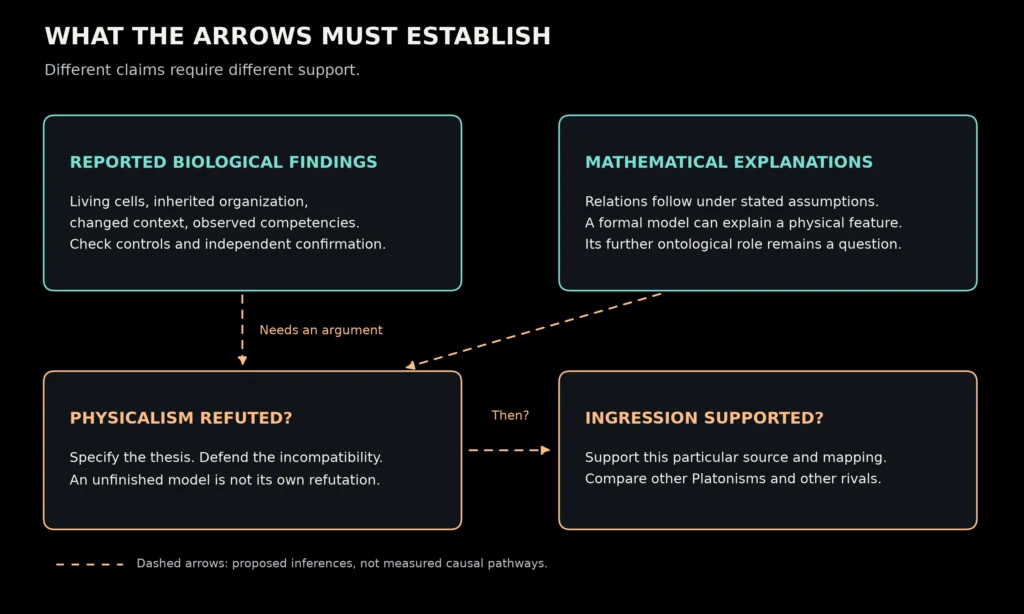
The arrows mark the inferences still to establish.
Changing a physical period is not changing arithmetic
In his August 29, 2025 symposium reply, Levin links causation to a counterfactual about different primes and different cicada periods.
For two ideal periodic events beginning together, overlap frequency is:
R(n, m) = 1 / lcm(n, m).

R(17, 2) = 1/34.
R(18, 2) = 1/18.
Changing a modeled period changes the overlap. It does not change whether 17 is prime:
InterveneOnPeriod(n = 18)
    is not the same operation as
Make17CompositeWhileKeepingStandardArithmeticFixed.
The second operation changes the mathematical structure, definition, referent, or assumptions. It is not an intervention within the same standard arithmetic. Counterfactual dependence on mathematical structure can illuminate an explanation; it does not automatically supply intervention evidence for a separate causal realm.
Same saltwater is not the same causal world
Footnote 17 of the final paper invokes the saline setting and absence of xenobot-specific selection. But:
Context = (medium, neighbors, contacts, geometry,
           mechanical constraints, signals, ...).

SameMedium(context1, context2) ⇏ SameContext(context1, context2).

SameGenome(system1, system2) ⇏ SameCellularStateAndOrganization(system1, system2).

NotSelectedSpecificallyFor(B) ⇏ NotHistoricallyEnabled(B).
An intact frog and its excised tissue can share a bath without sharing a developmental environment. The three-laboratory mouse experiment makes the broader point concrete: even extensive standardization left behavior and some genetic effects dependent on laboratory context. Removing tissue changes rather more than its postal address. I do not have to predict the whole xenobot to show that the bath water is not the whole environment.
Levin himself describes physical influences extending beyond the skin. Outside an organism is not synonymous with outside a physical account.
A dynamical semantics does not establish an external driver
Ingressing Minds, §4.3, pp. 18–19 adds time indexing in its treatment of self-reference. Compare:
Binary fixed-point problem: find v in {0,1} such that v = 1-v.

Temporal recurrence: v_(t+1) = 1-v_t.
The first has no solution. The second produces a binary two-cycle. Over [0,1], the negation map also has a fixed point at v = 1/2. The valuation domain, update rule, and starting value matter.
MathematicalModelHasDynamics
    ⇏ ModelIdentifiesAnIndependentCauseOfBiologicalBehavior.
Grim’s paper explores these semantic models. Grant their dynamics as mathematical objects, without requiring a computer to run them. Their proposed role in biology still needs the interface, mapping, and causal relation that the recurrence does not specify.
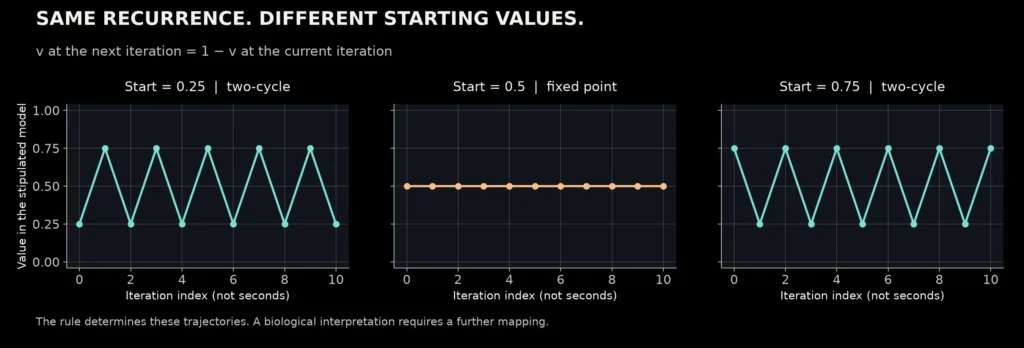
Calculated trajectories for v_(t+1) = 1 − v_t. Starting at 0.25 or 0.75 produces a two-cycle; starting at 0.5 produces a fixed point. The horizontal axis counts iterations.
The recurrence specifies the trajectory inside the model. It does not specify a route from the model to the frog.
An unrequested observable is not automatically an intrinsic goal
In the Lex discussion around 02:19:29–02:20:48, Levin connects unrequested clustering with intrinsic motivation:
QIncreases AND NobodyRequestedQ
    ⇏ SystemRegulatesQTowardATarget.
A clustering score can rise without the system maintaining or restoring it. Even if the behavior meets a stronger goal criterion, its Platonic provenance remains a separate claim. Disturb the proposed target while preserving numerical sortedness and matching movement opportunities; then test restoration against the scheduling, tie-handling, and reachability alternatives.
Defining intrinsic motivation as an unrequested regularity would make the attribution cheap. It would not establish the richer claim that the system actively prefers that outcome. We did not ask for it tells us about our instructions, not automatically what the system wants.
Levin’s cognitive light cones propose a way to represent the spatial and temporal reach of an agent’s capacities. The analogy is to spacetime diagrams. Applied to a xenobot, the useful question is which variable it regulates, which disturbances it compensates for, and over what range, compared with alternatives that require no such regulation. A cone can summarize those measurements. It cannot perform them. Nor would establishing a functional goal locate its source in Platonic space.
Zero extra instructions is not a measured energy result or a source detector
Around 02:16:50–02:19:07, Levin connects clustering, no extra steps, possible physical-cost advantages, and Platonic space:
ExtraTaskInstructions = 0 ⇏ ExtraPhysicalEnergy = 0.

ExtraTaskInstructions = 0 ⇏ PlatonicSource.

EvenMeasuredExtraPhysicalEnergy = 0 ⇏ PlatonicSource.
A computed integer already fixes its parity; exploiting that relation can save another calculation. Shared computation can be advantageous. Measuring its energy advantage requires a matched baseline. Identifying a Platonic source requires a different argument. A useful bonus does not arrive with an authenticated supplier’s signature.
A productive programme is not automatically a vindicated ontology
The introductory outline on page 3 and the programme discussion on page 37 of Ingressing Minds discuss contributions beyond conventional accounting, discoveries, and applications. None of those labels supplies an operational defeat for the added causal claim:
UsefulProgramme(P) ⇏ TrueOntology(P).
A speculative story can inspire an experiment that discovers a real relationship. Whether that relationship supports the story’s literal source attribution depends on how it compares with rival explanations. Falsifiable experiments can coexist with an interpretation that those experiments never put at risk. Getting useful work out of a hypothesis does not settle every commitment that inspired it.
The Real Xenobots History: Inherited Machinery in a New Configuration
The xenobot’s history is the universe’s history: hydrogen and helium, stellar chemistry, cells, coordination, new collectives. At the Petri dish, that history arrives as membranes, proteins, motors, receptors, regulatory networks, and developmental states. The molecular toolkit did not materialize when the researchers filled the dish.
Prigogine’s work on nonequilibrium organization helps explain how ordered dissipative structures can persist under energy flow. Evolutionary exaptation explains why a capacity’s present use need not be the use for which it originated. Developmental plasticity and collective dynamics help explain how new conditions can expose new capacities.
There was never a long natural history of selection for being a good xenobot. There was a long history relevant to the machinery xenobots deploy. Evolution can produce specialized adaptations and versatile capacities; it does not have to anticipate each future laboratory use.
Novel configuration does not mean causally blank starting point. The very firm molecular memo did not write itself when the cells arrived in the dish.
What Actually Pays the Computational Cost?
Researchers did not have to invent cilia, adhesion, metabolism, or regulatory responsiveness to obtain this new use of the cells. They inherited the machinery.
Evolution paid. Development paid. The cells are still paying: ATP, molecular synthesis, membrane maintenance, motor activity. The laboratory also pays for search, preparation, manipulation, and construction. Reuse is not creation from nothing, and a new use need not rebuild every component capacity from scratch.
An existing motor can power a new boat without having been designed for that boat. Reuse does not erase the cost or history of building the motor.
The late-2021 replication paper reports roughly 10–14 days of motility in its preparation and attributes deterioration to depletion of maternally supplied energy stores. Boundaries degrade. Distinctions collapse. The living construct ends up as molecular soup.
Landauer’s principle addresses irreversible erasure: under the usual conditions, resetting an unbiased bit without usable side information has a minimum average heat cost of k_B T ln 2. Reversible computation and experimental erasure work make the scope concrete. This is not a per-second charge on every persistent distinction.
For the fuller accounting, see my Thermodynamic Monism audit: passive retention, active maintenance, reversible computation, and irreversible erasure are different operations with different costs.
Living cells do pay thermodynamic rent for active maintenance. Mathematical availability does not supply their ATP. And a saving in design or computation, however useful, does not identify a nonphysical source.
The Mechanisms We Can Investigate
Cell adhesion involves adhesion molecules, cortical tension, active cytoskeletal processes, and tissue organization. Steinberg’s dissociated-cell experiments established important groundwork for understanding collective rearrangement.
Cilia drive movement in the ciliated platform. Their coordination could involve signaling, mechanics, or fluid-mediated interactions. Hydrodynamic synchronization demonstrated in algae offers a candidate mechanism to investigate in xenobots.
Later xenobot transcriptomics reports altered gene expression and responses to acoustic stimulation. Calcium-connectivity analysis of explanted amphibian epidermis reveals structured activity. These results make the machinery more interesting, not less.
Friston’s variational free energy belongs to a modeling framework; thermodynamic free energy concerns physical energy relations. Applying the former here requires an actual model of the collective, not substituting one meaning of free energy for the other.
The explanatory work lies in how the components interact to produce a particular outcome. Thermodynamics constrains what can occur; organization and dynamics determine much more than the announcement that the system is far from equilibrium.
Put the Claim on the Line
The evidence already challenges specific steps in the argument. In the three-item sorting example, numerical comparisons generate tag adjacency without a tag-clustering instruction. That is a constructive counterexample to the inference from an unrequested behavior to a behavior not generated by the implementation. The biological papers report concrete actuators and geometry-dependent replication. To the extent those findings hold up, they support the causal roles of organization and cellular machinery. An ingression account can incorporate those dependencies; its additional source still needs additional warrant.
The proposition is specific: a stated ingression model earns support if it outperforms serious rivals on a comparison fixed in advance. A documented success would require revising the objection that the addition has earned no support at that target. Criticism of its present support requires no complete rival theory of biology.
Choose a target: a distribution of morphologies, a locomotion measure, or replication performance. Let D include inherited machinery, changed context, mathematical structure, and higher-level control. Let D+P add a specified ingression mapping. Before the test, freeze the models, predictions, interventions, scoring rule, tolerances, and controls. Give the rivals comparable data and account for their flexibility. Then test predictions on withheld conditions and independent batches. Preregistration makes the distinction between forecasting and fitting the result checkable.
| Outcome under the agreed controls | Consequence |
|---|---|
| D misses its declared prediction beyond its failure threshold. | That prediction or model loses support. A failure of D does not automatically credit P. |
| D+P misses the distinctive prediction supplied by its frozen mapping. | That mapping loses support. Redrawing it afterward creates a revised model, not a successful old prediction. |
| D+P achieves the declared, reproducible advantage over serious rivals because of its distinctive commitment. | The specified ingression model earns comparative support. The objection that it adds no demonstrated value at that target must change. |
An existing result can meet this challenge if the prior prediction, comparison, and outcome are documented. A new discovery made with methods both accounts accept does not, by itself, identify the added source. To answer the logical objection, supply and defend the premise that connects the finding to that source.
A proposed bioelectric reset experiment illustrates the point. Reset internal states while preserving viability and geometry, then observe regeneration. If both accounts allow the altered interface to change the outcome, either result can leave them tied. Each must specify its prediction before the tissue provides the answer.
Useful to Whom, and What Gets to Lose?
In Ingressing Minds, p. 37, Levin proposes abandoning the programme if it produces no worthwhile discoveries or applications. The introductory outline on page 3 also mentions finding no quantifiable contribution beyond conventional accounting together with finding no new discoveries or capabilities. He says the model makes predictions that break with existing frameworks. Put those predictions in the comparison: dated forecast, rival forecast, result, consequence of failure.
A programme’s stopping rule and a metaphysical claim’s evidential loss condition are different things. A laboratory can stop being worth funding without its preferred ontology having been tested. Conversely, the laboratory can produce excellent results while its extra causal postulate contributes no demonstrated advantage. The introductory criterion does not require those two assessments to come apart when they should.
Religion With a Pipette develops this distinction: heuristic credit for inspiring research and evidential credit for an added cause require different comparisons. A productive research programme can earn the first without earning the second.
This is not just a complaint that fruitful is subjective. Define productivity down to the last publication, pound, and repaired cell. It still measures what the programme produced, not whether an additional Platonic cause supplied the capacity. Nor does calling the proposed surplus quantifiable provide the missing measurement: which accounting baseline, which predicted difference, and which outcome defeats the added contribution?
His December 2025 Q&A says he has not proved Platonism correct. In a January 3, 2026 reply, he writes, “I’m much less worried about true and false and more concerned with useful how and when.” But usefulness does not supply the missing premise in the argument against physical closure.
Useful to whom, for what, over what timescale, and at whose expense? A programme can sustain researchers, technicians, salaries, and institutional prestige while becoming scientifically unproductive or imposing costs on outsiders. If beneficiaries’ income established truth, a creationist publisher could validate Genesis by balancing its books. If advancing adherents’ objectives were enough, extremist propaganda could validate its worldview by recruiting efficiently. A closed circle’s success at keeping dissenters out would become another mark in its favor.
Levin’s published criterion, p. 37 names discoveries and applications. Credit genuine advances. Even then, useful work can come from shared methods while its preferred ontology contributes no demonstrated difference.
As specified in these formulations, pp. 3 and 37–38, the added Platonic causal contribution has no operational empirical loss condition. The interface-to-pattern mapping remains to be developed, pp. 17 and 38; no fixed comparison identifies the result that would defeat that addition even if useful discoveries continue. This is a defect in the current specification, not a requirement to finish all of biology before proposing a model.
An actual loss condition names the result, the claim it counts against, and what must change. If a failed result can always be assigned to the interface while the alleged source retains its credit, the experiment is not being allowed to test the added cause. Otherwise the grant can die while Plato remains suspiciously immortal.
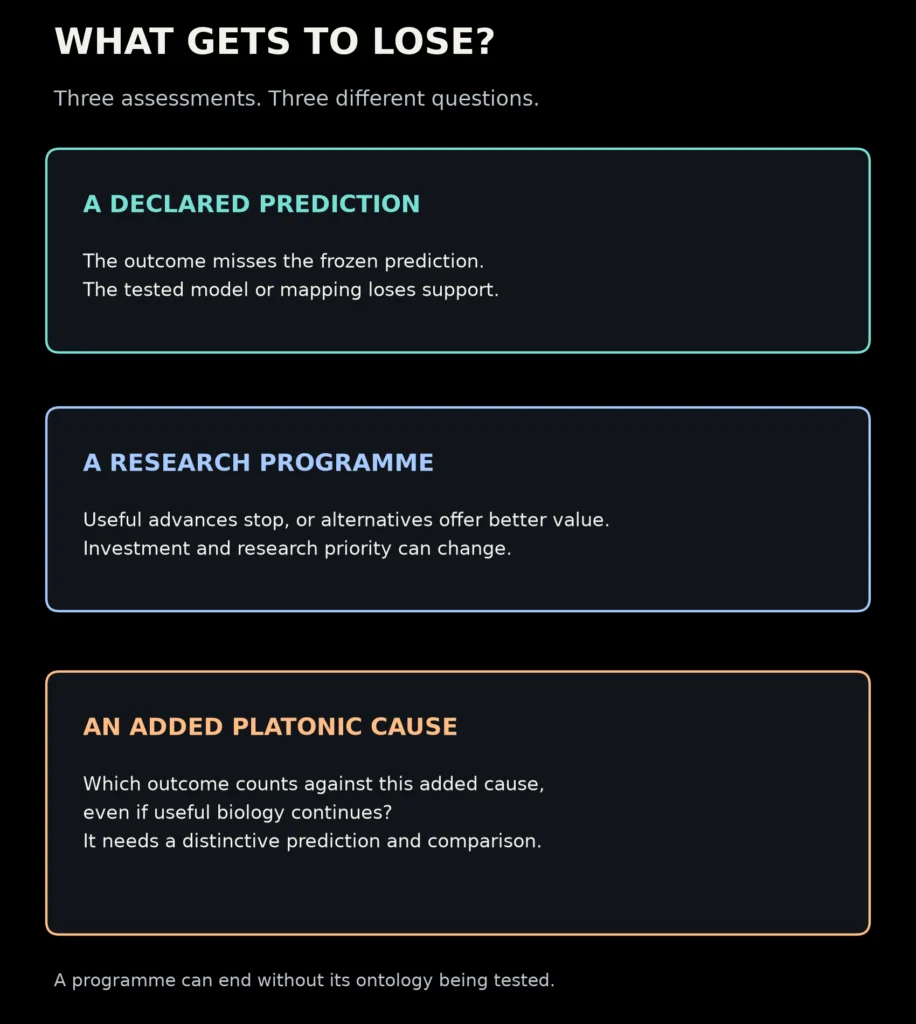
An experiment, a programme, and an added causal claim have different conditions for losing support.
What This Costs, and What Still Needs Investigating
The immediate cost is evidential. A result that both accounts accommodate gets credited to one account’s extra cause. A failed subsidiary model has no specified consequence for that cause. Readers cannot reproduce the programme’s success assessment if the accounting baseline, comparison, threshold, and time horizon remain open. Experimental credibility is then doing a second job for which it has not supplied the evidence.
The demonstrated failure is in evidential attribution: a claim gets credit from a test that did not distinguish it.
There are concrete communication problems to examine. In his 2023 commentary, Blackiston reports accounts attributing cognition or investigator-independent novel functionality beyond what he considered supported by the data, difficulties obtaining corrections, and removing his name from misleading pieces. That is a published account from the researcher who constructed the systems, not an imaginary concern invented by a hostile philosopher.
The route into ideological publicity is also visible. Daniel Witt’s February 28, 2025 article, published by the Discovery Institute’s outlet, presents Levin’s preprint as a rejection of materialism. Witt also doubts part of Levin’s mathematical argument. Its use as anti-materialist authority is documented. The question is what evidential authority the argument is being made to carry, and how that framing affects readers’ judgments.
Scientific spin can affect interpretation. In a randomized trial of cancer-study abstracts, clinicians shown abstracts with spin judged the treatment more beneficial than clinicians shown versions without it. That gives a testable concern about this publicity: hold the evidence and substantive argument fixed, vary whether the result is labeled confirmation of a Platonic source, and measure readers’ confidence in that source. This can reveal how much persuasive force comes from the label rather than additional evidence.
Six further risks deserve investigation. Research resources could follow a proposed source before anyone establishes its added explanatory value. Biological papers, metaphysical interpretations, and publicity could cite one another until repetition resembles independent confirmation. Biomedical promises could outrun demonstrated therapeutic capability. Institutions could reward metaphysical allegiance rather than evidential performance. Decisions about consciousness and moral status could follow ontological labels instead of evidence about relevant capacities, producing inappropriate attribution or inappropriate denial. Finally, failed promises could damage trust in biological methods that actually work.
Those are possible causal pathways, not six harms I have established in this case. Establishing them would require evidence about spending, citations, claims and audience responses, institutional decisions, or changes in trust.
The criticism is already serious enough. A claim advertised as a new causal contribution needs an accountable way to lose support. Its scientific surroundings do not do that job on its behalf. A laboratory’s productivity is not a metaphysical lie detector.
Framework Comparison: What the Evidence Actually Tests
| Question or manipulation | Originating study’s report or proposed test | What it establishes or would test |
|---|---|---|
| Suppress cilia in the 2020 cardiac-driven constructs | Reported method; cardiac contractions still produced movement | The actuation route in that platform. |
| Omit progenitors in the late-2021 replication assay | No offspring formed at the tested cell concentrations | The contribution of moving progenitors to assembling supplied cells. |
| Change progenitor geometry | Reported computational search and physical comparison | Geometry’s contribution to replication performance. |
| Withhold further dissociated living cells | The same replication procedure cannot continue | Dependence on feedstock. |
| Block a proposed signaling pathway | Proposed targeted test | Whether that pathway controls the measured behavior. |
| Compare specified Platonic and rival mappings | Proposed discriminating comparison | Whether the Platonic mapping improves explanation or prediction. |
If ingression incorporates the same physiological dependencies as its rival, observing those dependencies does not distinguish its additional source. The comparison needs a difference that matters to the contested claim.
Where Mathematical Explanation Becomes an Additional Claim
Levin’s anti-physicalist argument depends on mathematics as well as biology. Dismissing it simply because no experiment directly measured ingression would leave that argument unanswered.
Mathematics can do more than describe. Baker’s account of mathematical explanation and Wakil and Justus’s critique of a biological-optimality inference address that substantive dispute. But an equation describing a planetary orbit has not thereby been employed as celestial traffic police.
Whether mathematical structure is constitutive of a physical system remains a philosophical question. Neither calling it a compression algorithm nor calling it an ingress settles the matter. Independent existence, causal influence, and agency still require different arguments.
My response to Levin develops the distinction between models of morphospace, mathematical Platonism, and a biologically causal extension. Evidence for one does not automatically pay the others’ bills.
The Placebo Effect, Xenobots, and Cross-Scale Mechanisms
Biswas and colleagues investigate memory in computational gene-regulatory-network models. Pigozzi and colleagues examine associative conditioning in network models. Non-neural learning is an important direction of inquiry. The relevant comparison is between learning in a specified network model and a demonstrated causal pathway in the living preparation.
Mason’s 1952 case report describes substantial improvement in a teenager’s severe skin condition following hypnosis. It does not establish the causal route producing that improvement.
Yes, effects cross levels. So does water flowing downhill. Crossing levels is not the name of an additional source.
I examine the extrapolation problem in What Warrants the Scope Jump?: what licenses carrying a property established in one kind of system into a different system or scale? Calling both systems networks does not supply the bridge.
Placebo research connects expectation and learning with neural and physiological pathways. Language can alter expectations; neural regulation can alter autonomic and bodily responses; changed bodily signals can alter local cellular conditions. These are routes to investigate, with evidence for particular links in particular conditions.
A striking clinical result does not identify a cosmic intermediary. An incomplete route does not identify one either. The gap does not issue a forwarding address.
What the Evidence Has Not Chosen
The biological findings do not yet discriminate between Levin’s biological Platonism and rivals incorporating the same mechanisms, including other forms of Platonism and accounts without Platonism. Stronger comparative evidence or a successful argument could change that assessment.
When two specified models assign the same positive likelihood to an observation, it leaves their relative odds unchanged. Mere compatibility earns no automatic increase in confidence. A risky successful test can, when relevant rivals expected something different.
Not disproven is not an evidential pension plan. A hypothesis does not collect interest merely by remaining alive.
Xenobots Explained Without an Unearned Supplier
What do the papers support? Living, motile frog-cell constructs, with different evidential histories and the independent-confirmation limits described above.
How do the reported behaviors arise? Cellular machinery, development, collective organization, and physical conditions supply concrete explanatory resources whose detailed contributions remain under investigation.
When was the cost paid? Across the history producing that machinery, its development, the laboratory work, and its continuing operation. Reusing a capacity is not obtaining it from nowhere.
Has Levin established his rejection of physicalism? I have not found that demonstration in the evidence and arguments examined here. Nor would defeating a physicalist thesis, by itself, establish his agential Platonic space. Physicalism does not have to win for this particular inference to fail.
The stated programme criteria, pp. 3 and 37 do not make that added cause empirically falsifiable. Its distinctive prediction and loss condition still need to be specified. That leaves the ontology open; it does not make all alternatives equally credible. The additional source must earn its explanatory credit against alternatives, not merely survive our inability to disprove it.
We do not need to make the cells less extraordinary. We need to stop giving an unverified metaphysical consultant credit for the experiment.
The Pattern That Connects All Patterns
Differences that living systems actively maintain have costs. Membranes, motors, regulation, repair: the thermodynamic rent is paid through concrete processes. History supplies organization; development reconstructs it; new conditions reveal what else it can do.
But the energy bill is not the explanation of the organization. In “Cybernetic Explanation” (1967), Gregory Bateson distinguishes the energy that powers a response from the informational relations that shape it. An organism can supply the energy for its response while the relevant difference determines which response occurs. Paying the thermodynamic rent does not arrange the furniture.
In Mind and Nature, Bateson describes “the pattern which connects” as “a dance of interacting parts.” The emphasis falls on relations among parts and among patterns, not merely a list of ingredients. Bateson himself uses Platonic language. We can grant the reality and explanatory importance of pattern while asking what establishes Levin’s particular causal attribution.
My account of boundary- and scale-relative realism develops this positive case: higher-level patterns can earn explanatory and causal standing through prediction, intervention, and transfer, without settling their ultimate metaphysical source.
In “The Cybernetics of ‘Self’” (1971, p. 4), Bateson calls an information unit “a difference which makes a difference.” For xenobots, that directs inquiry toward a concrete question: which changes in contacts, geometry, signals, or surroundings alter the outcome, through which relationships? The consequential difference has to be traced through the system.
His formulation of the systemic point is especially useful: “the mental characteristics of the system are immanent, not in some part, but in the system as a whole.” (1971, p. 4) His governor-and-engine example follows the transformations around a causal circuit. The explanatory gain comes from understanding the connected process.
That sharpens the challenge for ingress. What difference does the proposed Platonic source make to a prediction or explanation that serious rivals cannot match? If the same organization and dependencies fit both accounts, the observed pattern has not identified the alleged supplier. Specify the distinguishing result, or defend the argument that establishes the further connection. A pattern does not arrive with its metaphysical return address attached.
The xenobot experiments pose worthwhile questions about development, design, and biological possibility. Their strongest claims deserve independent tests, and familiar capacities deserve their history. That’s enough. That’s more than enough.
We don’t need Plato to make it profound. We need thermodynamics, time, organization, context, and the patience to trace the relationships as far as the evidence will take us.
ATP. Protein folding. Voltage gradients. Mechanical forces. Neighbors. Geometry. Feedback. A long history of the universe teaching matter how to organize itself.
Where a Platonic contribution enters that account remains the question. “Physicalism is false” is a conclusion to establish, not a laboratory result to borrow. A programme that pays its bills has not thereby settled who, if anyone, supplied an extra cause.
The cells are doing the work. Plato is still waiting for a job description.
References
- Blackiston, D., Kriegman, S., Bongard, J., & Levin, M. (2023). Biological Robots: Perspectives on an Emerging Interdisciplinary Field. Soft Robotics, 10(4), 674–686. doi:10.1089/soro.2022.0142. The naming and press discussion cited here is Blackiston’s individual commentary.
- Jaeger, J. (2024, May 23). Why TAME is lame … Author’s public essay.
- Angerilli, A., Smialowski, P., & Rupp, R. A. W. (2018). The Xenopus animal cap transcriptome: building a mucociliary epithelium. Nucleic Acids Research, 46(17), 8772–8787. doi:10.1093/nar/gky771
- Kim, H. Y., Jackson, T. R., Stuckenholz, C., & Davidson, L. A. (2020). Tissue mechanics drives regeneration of a mucociliated epidermis on the surface of Xenopus embryonic aggregates. Nature Communications, 11, 665. doi:10.1038/s41467-020-14385-y
- Bhattaram, D., et al. (2025). AggreBots: Configuring CiliaBots through guided, modular tissue aggregation. Science Advances, 11(39), eadx4176. doi:10.1126/sciadv.adx4176
- Levin, M. (2019). The Computational Boundary of a “Self”: Developmental Bioelectricity Drives Multicellularity and Scale-Free Cognition. Frontiers in Psychology, 10, 2688. doi:10.3389/fpsyg.2019.02688
- Blackiston, D., Lederer, E., Kriegman, S., Garnier, S., Bongard, J., & Levin, M. (2021). A cellular platform for the development of synthetic living machines. Science Robotics, 6(52), eabf1571. doi:10.1126/scirobotics.abf1571
- Kriegman, S., Blackiston, D., Levin, M., & Bongard, J. (2020). A scalable pipeline for designing reconfigurable organisms. PNAS, 117(4), 1853–1859. doi:10.1073/pnas.1910837117
- Kriegman, S., Blackiston, D., Levin, M., & Bongard, J. (2021). Kinematic self-replication in reconfigurable organisms. PNAS, 118(49), e2112672118. doi:10.1073/pnas.2112672118
- Pai, V. P., Pio-Lopez, L., Sperry, M. M., Erickson, P., Tayyebi, P., & Levin, M. (2025). Basal Xenobot transcriptomics reveals changes and novel control modality in cells freed from organismal influence. Communications Biology, 8, 646. doi:10.1038/s42003-025-08086-9
- Blackiston, D., et al. (2025). Revealing non-trivial information structures in aneural biological tissues via functional connectivity. PLOS Computational Biology, 21(4), e1012149. doi:10.1371/journal.pcbi.1012149
- Steinberg, M. S. (1963). Reconstruction of tissues by dissociated cells. Science, 141(3579), 401–408. doi:10.1126/science.141.3579.401
- Brumley, D. R., Wan, K. Y., Polin, M., & Goldstein, R. E. (2014). Flagellar synchronization through direct hydrodynamic interactions. eLife, 3, e02750. doi:10.7554/eLife.02750.
- Gould, S. J., & Vrba, E. S. (1982). Exaptation: a missing term in the science of form. Paleobiology, 8(1), 4–15. doi:10.1017/S0094837300004310
- Landauer, R. (1961). Irreversibility and heat generation in the computing process. IBM Journal of Research and Development, 5(3), 183–191. doi:10.1147/rd.53.0183
- Bennett, C. H. (1973). Logical reversibility of computation. IBM Journal of Research and Development, 17(6), 525–532. doi:10.1147/rd.176.0525
- Bérut, A., et al. (2012). Experimental verification of Landauer’s principle linking information and thermodynamics. Nature, 483, 187–189. doi:10.1038/nature10872
- Friston, K. (2010). The free-energy principle: a unified brain theory? Nature Reviews Neuroscience, 11, 127–138. doi:10.1038/nrn2787.
- Biswas, S., Manicka, S., Hoel, E., & Levin, M. (2021). Gene regulatory networks exhibit several kinds of memory: quantification of memory in biological and random transcriptional networks. iScience, 24(3), 102131. doi:10.1016/j.isci.2021.102131
- Pigozzi, F., Goldstein, A., & Levin, M. (2025). Associative conditioning in gene regulatory network models increases integrative causal emergence. Communications Biology, 8, 1027. doi:10.1038/s42003-025-08411-2. Figure correction.
- Mason, A. A. (1952). A case of congenital ichthyosiform erythrodermia of Brocq treated by hypnosis. British Medical Journal, 2(4781), 422–423. doi:10.1136/bmj.2.4781.422
- Wager, T. D., & Atlas, L. Y. (2015). The neuroscience of placebo effects: connecting context, learning and health. Nature Reviews Neuroscience, 16, 403–418. doi:10.1038/nrn3976
- Levin, M. (2026). Ingressing Minds: Causal, Non-Physical Patterns In-Form Natural, Synthetic, and Hybrid Embodiments. Philosophies, 11(5), 161. doi:10.3390/philosophies11050161.
- Kondepudi, D., Petrosky, T., & Pojman, J. A. (2017). Dissipative structures and irreversibility in nature: Celebrating 100th birth anniversary of Ilya Prigogine (1917–2003). Chaos, 27, 104501. doi:10.1063/1.5008858.
- Baker, A. (2005). Are there Genuine Mathematical Explanations of Physical Phenomena? Mind, 114(454), 223–238. doi:10.1093/mind/fzi223
- Wakil, S., & Justus, J. (2017). Mathematical Explanation and the Biological Optimality Fallacy. Philosophy of Science, 84(5), 916–930. doi:10.1086/694154
- Popper, K. R. (1963). Conjectures and Refutations: The Growth of Scientific Knowledge. Routledge & Kegan Paul.
- Grim, P. (1993). Self-Reference and Chaos in Fuzzy Logic. IEEE Transactions on Fuzzy Systems, 1(4), 237–253. Author-hosted full text.
- Levin, M. (2025, March 9). Platonic space: where cognitive and morphological patterns come from (besides genetics and environment). Primary exposition.
- Levin, M. (2025–2026). Symposium on the Platonic Space. Post and August 29, 2025 reply to Alexey Tolchinsky; January 3, 2026 reply on truth and usefulness.
- Fridman, L., & Levin, M. Michael Levin: Hidden Reality of Alien Intelligence & Biological Life. Lex Fridman Podcast #486. Transcript.
- Anderson, P. W. (1972). More Is Different. Science, 177(4047), 393–396. doi:10.1126/science.177.4047.393
- Donoghue, J. F. (1994). General relativity as an effective field theory: The leading quantum corrections. Physical Review D, 50, 3874–3888. doi:10.1103/PhysRevD.50.3874
- Levin, M. (2026, March 31). A short argument on Platonic Space: variable-agency patterns that in-form physics, biology, computer science, and cognitive science. Author’s step-by-step exposition.
- Levin, M. (2026, October 17, video upload). New Bodies, Unconventional Minds: a continuum of cognition (& consciousness). Video; automatic transcript.
- Stoljar, D. Physicalism. Stanford Encyclopedia of Philosophy, substantive revision September 16, 2026, especially §5.5, Numbers and Abstracta. Scholarly review.
- Nosek, B. A., Ebersole, C. R., DeHaven, A. C., & Mellor, D. T. (2018). The preregistration revolution. PNAS, 115(11), 2600–2606. doi:10.1073/pnas.1708274114
- Levin, M. (2025, December 28). Q&A from the internet and recent presentations 4. Author’s reply on Platonism and research usefulness.
- Boutron, I., Altman, D. G., Hopewell, S., Vera-Badillo, F., Tannock, I., & Ravaud, P. (2014). Impact of spin in the abstracts of articles reporting results of randomized controlled trials in the field of cancer: the SPIIN randomized controlled trial. Journal of Clinical Oncology, 32(36), 4120–4126. doi:10.1200/JCO.2014.56.7503
- Witt, D. (2025, February 28). Biologist Michael Levin: A Farewell to Physicalism. Discovery Institute outlet’s commentary.
- Errington, T. M., Mathur, M., Soderberg, C. K., Denis, A., Perfito, N., Iorns, E., & Nosek, B. A. (2021). Investigating the replicability of preclinical cancer biology. eLife, 10, e71601. doi:10.7554/eLife.71601
- Errington, T. M., Denis, A., Perfito, N., Iorns, E., & Nosek, B. A. (2021). Reproducibility in Cancer Biology: Challenges for assessing replicability in preclinical cancer biology. eLife, 10, e67995. doi:10.7554/eLife.67995
- Crabbe, J. C., Wahlsten, D., & Dudek, B. C. (1999). Genetics of mouse behavior: interactions with laboratory environment. Science, 284(5420), 1670–1672. doi:10.1126/science.284.5420.1670
- Voelkl, B., Vogt, L., Sena, E. S., & Würbel, H. (2018). Reproducibility of preclinical animal research improves with heterogeneity of study samples. PLOS Biology, 16(2), e2003693. doi:10.1371/journal.pbio.2003693
- Levin, M. (2025–2026). Replies to readers on Platonic space: March 15, 2025: physical influences beyond the skin; May 10, 2025: program/computer analogy; May 11, 2025: perfect forms; December 13, 2025: cybernetic goals; December 30, 2025: active and generated patterns; January 14, 2026: further explanatory questions.
- Handel, C. J. (2025, December 17). Reader’s proposed bioelectric-reset experiment, comment on Levin’s Platonic-space post.
- Tufts University (2021, November 29). In a First, Scientists Create Tiny Multicellular Organisms That Can Replicate.
- Miller, B. (2026, February). Platonic Minds: How Stuart Burgess’s Ultimate Engineering Challenges Maverick Biologist Michael Levin.
- Sweet, N. Bubble Sort audit; response to Levin on morphospace; Religion With a Pipette; Thermodynamic Monism audit; Matthew Segall’s Words Made Flesh Again, but the Evidence Never Said That?; What Warrants the Scope Jump?; What Is Provisional, Boundary- and Scale-Relative Realism?; Articles index.
- Dennett, D. C. (1991). Real Patterns. The Journal of Philosophy, 88(1), 27–51. doi:10.2307/2027085. Tufts-hosted published full text.
- Dennett, D. C. (1971). Intentional Systems. The Journal of Philosophy, 68(4), 87–106. doi:10.2307/2025382. University-hosted published full text.
- Papineau, D. (2020 revision). Naturalism. Stanford Encyclopedia of Philosophy. Ontological and methodological commitments.
- Stoljar, D. (2026 revision). Physicalism. Stanford Encyclopedia of Philosophy. Varieties, scope, and associated commitments.
- Bateson, G. (1967). Cybernetic Explanation. American Behavioral Scientist, 10(8), 29–32. doi:10.1177/0002764201000808. Authorized reprint.
- Bateson, G. (1971). The Cybernetics of “Self”: A Theory of Alcoholism. Psychiatry, 34(1), 1–18, especially p. 4. doi:10.1080/00332747.1971.11023653. Open reprint, printed pp. 321–323.
- Bateson, G. (1979). Mind and Nature: A Necessary Unity. E. P. Dutton. Introduction.
- Levin, M. (2025, October 30; November 9 and 18). Replies examined in the opening’s misrepresentation comparison. October 30 reply; November 9 reply; November 18 reply. Compare Sweet’s October 30 comment and November 9 clarification.
Further reading on Michael Levin, xenobots, Platonic space, physicalism, and the arguments this article tests:
- Biologist Michael Levin Evidence and Scholarly Criticism Index: an annotated index of primary papers, peer-reviewed critiques, and audits, each labeled by the claim it tests. Use it to follow the xenobot, bioelectricity, TAME and Platonic-ingress sources past the ones cited here.
- Biologist Michael Levin’s “Response” to My Criticisms of Biological Platonism: the documented comparison behind this article’s opening. It sets Levin’s October 30, November 9 and November 18, 2025 replies beside the arguments they answered, shows the two misrepresentations and the partial third case, and explains why Platonic morphospace is unfalsifiable as stated.
- Why Michael Levin’s Bubble Sort “Revelation” Is Misunderstood: an audit of Zhang, Goldstein and Levin’s self-sorting arrays and Joel Dietz’s draft reply critiquing my argument, with two computational audits published as open code with versioned DOIs. It expands this article’s first category change: a behavior that no instruction requested is not therefore a behavior the implementation failed to generate.
- Religion With a Pipette: Is Michael Levin’s ‘Ingressing Minds’ Pseudoscience?: the full analysis of Levin’s Ingressing Minds and its absorption problem, where any surprising result can be redescribed as access to an unmapped region of Platonic space. It develops this article’s distinction between heuristic credit for a productive research programme and evidential credit for an added cause.
- Matthew Segall’s Words Made Flesh Again, but the Evidence Never Said That?: how process philosopher Matthew David Segall recruits bioelectric regulation, evolutionary novelty and embodied cognition as support for Whitehead’s ontology. The xenobot argument repeats the same move: evidence that rival accounts share gets credited to one preferred metaphysical addition.
- What Warrants the Scope Jump?: a reply to Matthew David Segall on what licenses extending a property established in one kind of system to other systems and scales. Here that test is applied to the move from gene-regulatory-network models and placebo responses to claims about living cellular collectives.
- What Is Thermodynamic Monism? Auditing My Own Framework: my audit of the naturalistic countermodel I first offered Levin, covering energy costs, Landauer’s principle and the limits of thermodynamic explanation. It is the fuller accounting behind this article’s question of what pays the computational cost of xenobot capabilities, and why an energy bill does not identify a source.
- What Is Provisional, Boundary- and Scale-Relative Realism?: the positive account that replaced Thermodynamic Monism. It keeps target morphology, multiscale organization and real patterns from Levin’s and Whitehead’s programmes while leaving their stronger Platonic and panexperiential additions open, and it expands this article’s closing argument that patterns can earn causal standing without a metaphysical return address.
- Institutional Capture & Diverse Intelligence: traces how Templeton funding, media amplification and the Discovery Institute carry Levin’s bioelectricity research toward intelligent-design arguments. It gives the institutional background for this article’s point that Discovery Institute writers have already put Levin’s Platonic interpretation to work.