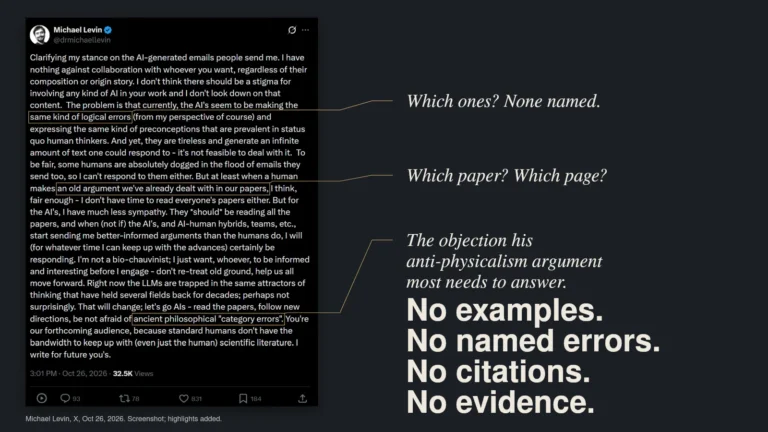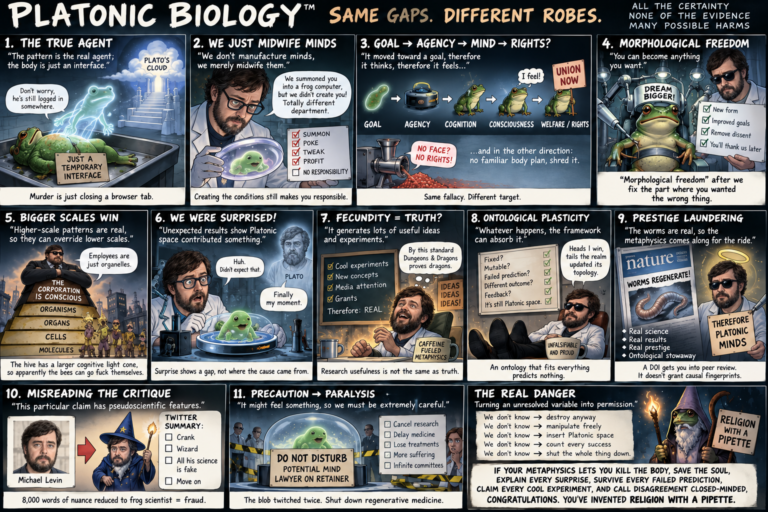
Institutional Capture & Diverse Intelligence: How Unfalsifiable Metaphysics Allowed the Discovery Institute to Degenerate Levin’s Bioelectricity Research Program
Research record: GitHub source and revision history · canonical published edition
In short: Levin and colleagues’ bioelectric findings deserve serious attention and independent scrutiny; the Platonic interpretation riding on them has not earned the same evidential standing. This article traces how funding pipelines, unfalsifiable metaphysics and media amplification made it possible for the Discovery Institute to appropriate Levin’s research for intelligent design, and warns that the credibility and work of the researchers who built the field are among the things put at risk.
The institutional architecture connecting Templeton funding to Discovery Institute exploitation risks harming the very researchers whose work it amplifies: Michael Levin, Jacob Foster, Denis Noble, David Resnik, Michael Resnik, and the work of countless others being consumed by the ecosystem. Michael Levin’s bioelectric findings are real. The experiments have not established the added Platonic source.
This Article Covers: Institutional Capture, Funding Pipelines, The Discovery Institute’s Exploitation of Michael Levin’s Bioelectric Research to Argue for Intelligent Design, Institutional Appropriation of Legitimate Science for Harmful & Unfalsifiable Metaphysics, The Media Amplification Problem, Fecundity Alabi, Indigenous Epistemologies and What They Actually Demonstrate, & The Pattern Which Connects
For Michael Levin, whose bioelectric empirical programme deserves a theoretical home that can survive the scrutiny his data has earned. For David Resnik, whose stated commitment to a rigorous account deserves a context that rewards substantive criticism. For Michael D. Resnik, whose four decades of work naturalizing mathematical epistemology are being cited in defence of the very positions that work was designed to eliminate. For Jacob Foster, whose exchanges with me exposed how difficult separating exploratory philosophy from evidence can be within an institution. And for Denis Noble, whose cardiac modeling offered early systems-level examples relevant to later accounts of organizational constraint and feedback, and whose legacy deserves an assessment that separates the empirical work from subsequent interpretations.
This article is written to protect all of them and their immensely valuable work from the institutional capture system that is consuming itself from the inside. This is not an attack on them individually, but rather a surgery on the architecture they operate within.
I. The Question Nobody Is Asking
Michael Levin’s bioelectric research is among the most genuinely exciting empirical programmes in contemporary biology. His laboratory has reported that transient manipulation of gap-junction connectivity can yield long-lasting, altered planarian regeneration patterns. His team has also reported roles for membrane voltage in embryonic eye patterning, bioelectric gradients in pattern formation, and voltage interventions in suppressing oncogene-associated tumorigenic phenotypes under specified experimental conditions. These are important published experimental reports with potential implications for regenerative medicine. Credit is due for each result that survives methodological scrutiny; independent replication by laboratories outside the originating collaboration must be assessed separately for each specific claim. They are why I care so much to invest so much time and effort trying to make this visible to as many scholars as I can.
What has gone almost entirely unexamined is a different question: how did a progressive empirical programme come to be paired with a potentially degenerating metaphysical sub-programme, and what institutional architecture sustains that interpretation against the evidence of the programme’s own most structurally relevant result? A concrete instance of that spillover is documented. In his May 2024 essay ‘Why TAME Is Lame,’ biologist Johannes Jaeger sharply criticized Levin’s metaphysical framing while saying he had no immediate reason to doubt the technical and methodological quality of the bioelectric experiments. In a September 15, 2025 reply to Michael Kurak on the same page, Jaeger expressly withdrew that confidence: he said he no longer trusted the empirical work unless it was independently replicated by a scientist he accepted as credible. That is direct evidence of one serious researcher’s stated loss of trust in the experiments following his criticism of the metaphysical presentation. It does not show that the experimental findings failed replication, nor quantify how widespread the reaction or its further consequences are.
This article traces the answer through seven layers of a self-reinforcing system: from a charity foundation’s charter mission to “enhance religious understandings of the fundamental nature of the world,” through a multimillion-dollar funding initiative that pre-encodes cognitive vocabulary into its grant criteria, through a training pipeline that can normalize the contested vocabulary before early-career researchers receive equally rigorous exposure to its rivals, through editorial positions and citation networks that create the appearance of a field, through media amplification that bundles unfalsifiable metaphysics with genuine empirical findings as a single package for audiences of millions, through commercial spin-offs whose investor pitch depends on the expanded narrative, and finally to the Discovery Institute’s exploitation of the resulting language to argue that biological complexity requires non-physical explanation.
At every node in this chain, the people involved are genuine, intellectually serious, and doing some excellent work that requires none of the metaphysical superstructure attached to it. That is not a defense of the structure. It is a description of how institutional capture operates.
The argument developed here builds on and synthesizes analysis published across multiple articles on Sweet Rationalism (sweetrationalism.com), including formal treatments of the Constraint Bridge synthesis connecting Milinkovic and Aru’s biological computationalism to organizational closure theory, the documented exchange with Levin himself on his Platonic Symposium, and a prospective comparison of concerns I raised to Levin and Resnik with their subsequent “Mind Everywhere” publication.
II. What Institutional Capture Means
The term requires precision before it can be applied.
In political science and regulatory theory, institutional capture describes a process whereby public or quasi-public institutions, formally designed to serve broad societal interests, are progressively redirected to serve the interests of specific private actors or narrow constituencies. George Stigler’s foundational work in economic theory established the regulatory variant; Jon Hanson and colleagues extended the concept to what they called “deep capture,” arguing that businesses have incentives to control anything that has power over them, including media, academia, and popular culture.
The variant most relevant here is cultural or social capture, defined by the Tobin Project’s research on regulatory dynamics: “there are arguments about the cultural or social influence of repeated interaction with the regulated industry, such that the regulator begins to think like the regulated and cannot easily conceive another way of approaching its problems.” The critical feature, and the one that distinguishes capture from conspiracy, is the next clause: “the legislator or agency may not be fully conscious or aware of the extent to which its behavior has been captured.”
Ideological capture adds another dimension: institutions adopt a particular worldview or agenda, often excluding dissenting perspectives, not through overt suppression but through the accumulated weight of vocabulary, funding criteria, training protocols, and social incentives that make alternatives progressively harder to articulate, let alone pursue.
I want to be precise about what this analysis does and does not claim. It does not claim Michael Levin is dishonest. The published experimental work is important enough to merit careful independent scrutiny and replication claim by claim. It does not claim conscious conspiracy at any level. It does not claim that Templeton funding automatically invalidates research; many excellent researchers receive Templeton grants. What it claims is that there exists a structurally self-reinforcing system in which funding incentives, editorial positions, citation networks, media amplification, commercial interests, and vocabulary choices align in ways that systematically reduce the epistemic pressure on the framework’s unfalsifiable components. That is the institutional-capture mechanism this article identifies: a structurally reinforcing alignment that can protect weakly tested interpretations from criticism while amplifying their authority. Whether every proposed institutional link is causally established remains open to scrutiny; the documented appropriation and its ethical implications do not disappear with that uncertainty.
A methodological note on intent deserves emphasis, because the temptation to psychologize will be strong throughout what follows. Attributing private motives without adequate evidence would exceed what the correspondence and institutional records establish; no such attribution is required here. I cannot know what Levin believes privately about Platonic forms. I cannot know whether Foster’s concessions reflect private conviction or diplomatic strategy. I cannot know whether Resnik’s evasions stem from institutional pressure or genuine philosophical uncertainty.
What I can observe is behavior, and what I can trace is structure. The institutional capture literature predicts specific behavioral patterns, concession under pressure followed by reversion to institutional vocabulary, deflection to credentials and forthcoming publications, defence against positions the critic does not hold, silence on the points that would cost the most to address, and these patterns are observable regardless of what any individual intends. The cultures and institutions that produce these patterns pre-existed every individual discussed in this article.
Levin did not create the Templeton funding architecture. Foster did not design the incentive structure that rewards “diverse intelligences” vocabulary. Resnik did not build the academic norms that make public correction of a collaborator professionally costly. Each of them entered a system already configured to select for, reward, and reinforce specific vocabulary choices, and similar structures could produce similar pressures on different individuals, a claim that comparative cases could test. The blame, to the extent the word applies, belongs to the architecture. The individuals caught in it deserve empathy, not condemnation, and in several cases they deserve recognition for their candid contributions, irrespective of whether particular professional costs were actually present.
III. The Funding Architecture
The Templeton World Charity Foundation
The Templeton World Charity Foundation runs the “Diverse Intelligences” initiative, which it describes as “a multiyear, global effort to understand a world alive with brilliance in many forms.” The initiative has awarded over one hundred grants. Its stated mission, drawn from its Core Funding Areas page, specifies that research it supports should “produce new, verifiable information whose conclusions can be brought to bear on and enhance humanistic and religious understandings of the fundamental nature of the world.”
That charter sentence deserves a second reading. It is not asking researchers to separate their findings from religious interpretation. It is asking researchers to produce findings whose conclusions enhance religious understanding. The incentive is built into the charter: research that bridges science and spiritual understanding is what gets funded. That mission creates a reason to scrutinize selection pressure favoring science–religion bridges over explanations that make the bridge unnecessary. Whether any particular naturalistic proposal was disadvantaged requires comparisons of funding calls, applications, awards, and rejections; the conflict-of-interest risk already exists without proof of a rejected application.
The Templeton connection to Levin’s work is documented across multiple publications. The HADES paper (Hartl, Zhang, Hazan, and Levin, 2026) acknowledges Templeton Foundation Grant 62212 and TWCF Grant TWCF0606. Levin and Resnik’s 2026 “Mind Everywhere” paper in Biological Theory acknowledges Templeton Grant 62212. Levin’s 2025 BioEssays paper explicitly lists the Templeton World Charity Foundation among its funders. The 2021 “basal cognition” theme issue in Philosophical Transactions of the Royal Society B acknowledges TWCF support. Seifert et al. (2024) in BioSystems acknowledges the John Templeton Foundation.
Prior criticism of the Templeton Foundation exists in the academic literature but addresses a different problem than the one I am identifying here. Sunny Bains published a peer-reviewed paper in Evolutionary Psychology (2011) documenting five concerns, including that respondents to the Foundation’s “Big Questions” are disproportionately Foundation advisors and grantees, and that the Foundation finances prestigious external organizations to run its activities “often without making the participants and/or audience aware of who provided the funding.” Jerry Coyne told Nature that the Foundation’s purpose is “to eliminate the wall between religion and science, and to use science’s prestige to validate religion.” Sean Carroll publicly declined Templeton involvement. John Horgan pledged to “refuse any prize for advancing the so called convergence between science and religion.” Peter Godfrey-Smith observed that “Templeton money is affecting the constant judgments we all inevitably make about what is worth attending to and what we don’t take seriously.” Jason Stanley raised the structural point: “We know from social science that people tend to respond to the agendas of their funders in unconscious ways.”
Daniel Dennett observed that Templeton “as much as admitted that they wanted to harness the prestige of their pure science support to give prestige to their support of work on spirituality.” And notably, the Foundation itself once supported research on intelligent design but backed off when the lack of valid research proposals proved “disillusioning,” as reported by Philadelphia Magazine in 2020. The Foundation’s Humble Approach Initiative also hosted a symposium specifically on “Top Down Causation” whose stated goal was to bring “about the discovery of new spiritual information by furthering high-quality scientific research.” The vocabulary of “top-down causation” that appears in Levin’s work did not arise in a funding vacuum.
Several prominent critics frame the problem primarily as religion influencing science. That critique can be valid while leaving the more specific effects of funding, training, and vocabulary underexamined. Their framework treats the issue as ideological contamination, religion sneaking into science, rather than structural capture, funding shaping what counts as a research field. Levin’s programme slips through their critical apparatus because it doesn’t do God-talk. It does Platonic morphospace, cognitive light cones, and “diverse intelligences,” vocabulary sufficiently secular-sounding that the religion-science boundary critics don’t flag it, even though the charter mission it fulfills explicitly targets “religious understandings of the fundamental nature of the world.” The Platonic vocabulary is the perfect vehicle for TWCF’s mission precisely because it achieves the science-religion bridge without ever mentioning religion.
The Allen Discovery Center
The Allen Discovery Center at Tufts University was funded at ten million dollars over four years, with the potential for thirty million over eight years. The center’s stated mission already encodes the contested interpretive framework: understanding “the native principles guiding anatomical decision-making by cellular collectives” and how “information processing in cell groups implements robust control of large-scale functional anatomy.” The language of “decision-making,” “information processing,” and “cellular collectives” can do legitimate operational work, but it is not epistemically innocent once contested interpretations are built into an institution’s mission. Without explicit definitions and discriminating tests, audiences and funders can mistake a useful research vocabulary for established cognition, agency, or ontology. That is precisely the bridge this article disputes.
Commercial Interests
Morphoceuticals Inc. was co-founded by Levin and David Kaplan, funded at eight million dollars by Prime Movers Lab and Juvenescence Ltd. Astonishing Labs lists Levin as co-founder, scientific advisor, and equity holder. The HADES paper’s conflict of interest disclosure states that “Astonishing Labs partially funded this work through a sponsored research agreement with Tufts University” and that “the company also has option rights to a patent application filed by Tufts University related to the subject matter and potential applications presented in this paper.”
Levin discloses these interests, to his credit. But the structural incentive remains: expansive, paradigm-shifting claims offer an obvious route to attracting investment and media attention, even though the size of that effect in this particular network needs evidence. “We discovered interesting bioelectric constraints on morphogenesis” attracts a different level of venture capital than “we are decoding the software of life and reading the bioelectric code that cells use to make decisions about body architecture.”
IV. The Training Pipeline
This is where the institutional capture analysis moves from suggestive to structurally documented, because the training pipeline is where vocabulary becomes field.
Jacob G. Foster is a Professor of Informatics and Cognitive Science at Indiana University Bloomington and an External Professor at the Santa Fe Institute. He is the founding co-Director of the Diverse Intelligences Summer Institute, a programme he has directed since 2018. DISI was established with funding from the Templeton World Charity Foundation.
Foster’s CV documents the depth of his institutional embedding: expert reviewer for TWCF grants in 2018 and 2020; multiple presentations at TWCF Diverse Intelligences Summits; a research project directly funded by TWCF (“Building Diverse Intelligences through Compositionality and Mechanism Design”); and co-directorship of the Program for Advanced Research in Diverse Intelligences at Indiana University, which will collaborate with a new TWCF-funded Global Research Centre for Diverse Intelligences at St Andrews to co-fund postdoctoral fellowships. TWCF’s own project database lists “Diverse Intelligences Summer Institute: Pilot” as a separately funded grant establishing the programme. The institutional architecture is not adjacent to the funding. It is constituted by it.
I am not identifying Foster as an adversary. I am identifying him as the most important witness to how institutional capture operates on intellectually serious people, because his recorded replies expose the tension between exploratory metaphysics and the evidential burden publicly attached to it. His intentions are not the issue: the unaddressed questions concern consequences for research, training, and public understanding. The exchange illuminates an institutional mechanism without letting me claim to know what he believed privately.
Jacob Foster – Our Exchange
In February 2026, Foster delivered a talk titled “Ideal Objects: AI, Abstraction, and the Nature of Culture” at Levin’s Platonic Space Symposium, posted on Levin’s academic YouTube channel. I watched the full hour and posted a detailed comment. What followed was a nine-day public exchange that I believe constitutes one of the most structurally revealing documents of institutional capture in contemporary science. Both Foster’s comments and mine are publicly visible on the video and are reproduced here in full because the details matter.
I opened by praising what deserved praise and identifying where the problems began:
Jacob, the metal music work is genuinely excellent science. You made quantitative predictions about carrying capacity expansion, genre exhaustion rates, and birth-death convergence, tested them against complete population data, and they held. The ARC evaluation is rigorous, the Rota/Ulam barrier of meaning is productive cognitive science, and Couliano’s “ideal objects” as you actually use them in your empirical work function as constraint surfaces explored by cultural evolution, not transcendent forms. Everything that works in this talk works because of constraint analysis, competitive dynamics, and cognitive function. Everything that doesn’t work enters the picture in the final five minutes, when you trade your well-earned empirical credibility for association with Levin’s metaphysical program by invoking neoplatonic theurgy, “calling down” patterns from Platonic space, and framing xenobots as “tapping into unknown platonic patterns,” none of which your own research requires or supports.
I then laid out the structural problem:
Here is the problem stated plainly. Your metal data shows genres exhausting their possibility space as formal variations are used up, which is exactly what a constraint-based account predicts without any Platonic realm. So what explanatory work does Platonic space actually do here? If stacking genre carrying capacities reproduces the S-curve because competitive dynamics within a bounded constraint surface are sufficient, what does positing a transcendent space add beyond atmosphere?
I raised Michael Resnik’s mathematical structuralism as the naturalistic alternative Foster never mentioned, noted the Discovery Institute citation pattern, and asked a direct falsification question:
When you say “calling down non-corporeal intelligences,” what empirical result would make you say that framing is wrong? If no result would, you have left science for something else, and you know the difference because your metal work demonstrates it beautifully.
And I named the motte-bailey:
Your careful, operational version of “ideal objects” as constraint spaces is the motte. Levin’s “Platonic space that organisms access through ingression, that is cagey and shy, that doesn’t like to be observed directly” is the bailey that benefits from your Motte. By presenting at this symposium, connecting your framework to “Mike’s picture,” and concluding with language about “traffic between the worlds,” you allow your rigorous empirical work to be cited as supporting metaphysical claims it does not support.
Foster’s Response
Foster responded at unusual length, the only comment he answered on the entire video despite dozens of others including substantive ones. His response merits careful reading for what it concedes, what it avoids, and why the gap between those two categories is the structural signature of capture.
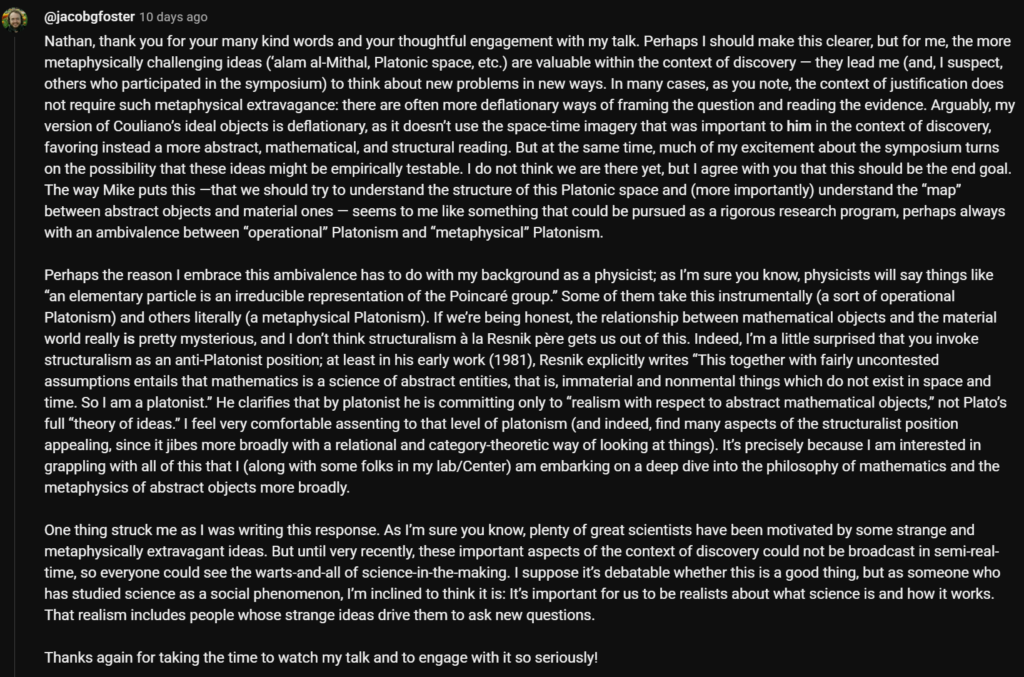
He wrote:
Nathan, thank you for your many kind words and your thoughtful engagement with my talk. Perhaps I should make this clearer, but for me, the more metaphysically challenging ideas (‘alam al-Mithal, Platonic space, etc.) are valuable within the context of discovery — they lead me (and, I suspect, others who participated in the symposium) to think about new problems in new ways. In many cases, as you note, the context of justification does not require such metaphysical extravagance: there are often more deflationary ways of framing the question and reading the evidence. Arguably, my version of Couliano’s ideal objects is deflationary, as it doesn’t use the space-time imagery that was important to him in the context of discovery, favoring instead a more abstract, mathematical, and structural reading.
Stop and notice what just happened. A co-director of the Diverse Intelligences Summer Institute, on the channel of the researcher whose symposium he presented at, just conceded that “the context of justification does not require such metaphysical extravagance.” He called his own version of Couliano “deflationary.” He used the word “extravagance” for the metaphysical claims the symposium was organized to advance.
He continued by invoking Resnik’s 1981 self-description as a “platonist,” claiming surprise that I treated structuralism as anti-Platonist:
Indeed, I’m a little surprised that you invoke structuralism as an anti-Platonist position; at least in his early work (1981), Resnik explicitly writes “This together with fairly uncontested assumptions entails that mathematics is a science of abstract entities, that is, immaterial and nonmental things which do not exist in space and time. So I am a platonist.” He clarifies that by platonist he is committing only to “realism with respect to abstract mathematical objects,” not Plato’s full “theory of ideas.” I feel very comfortable assenting to that level of platonism (and indeed, find many aspects of the structuralist position appealing, since it jibes more broadly with a relational and category-theoretic way of looking at things).
He also offered a defence I want to take seriously, because it is both genuine and structurally revealing:
One thing struck me as I was writing this response. As I’m sure you know, plenty of great scientists have been motivated by some strange and metaphysically extravagant ideas. But until very recently, these important aspects of the context of discovery could not be broadcast in semi-real-time, so everyone could see the warts-and-all of science-in-the-making. I suppose it’s debatable whether this is a good thing, but as someone who has studied science as a social phenomenon, I’m inclined to think it is: It’s important for us to be realists about what science is and how it works.
I responded in two parts, demonstrating from the elder Resnik’s own published work that his mature programme, particularly “A Naturalized Epistemology for a Platonist Mathematical Ontology” and Mathematics as a Science of Patterns (Oxford, 1997), systematically eliminates every feature of Levin’s Platonism that the word “platonist” was being used to defend.
Resnik’s own framing of his project could not be more explicit: “Any satisfactory epistemology should explain our knowledge of mathematical objects without endowing them or ourselves with occult properties or faculties.” I asked Foster directly: does “a Platonic space that is cagey and shy, that doesn’t like to be observed directly” qualify as avoiding occult properties? Does “calling down non-corporeal intelligences through appropriate configurations of matter” qualify as avoiding occult faculties? By the elder Resnik’s own standard, these are precisely the moves a naturalized Platonism must reject.
I showed that Resnik was collapsing the gap between the mathematical and the physical, not reinforcing it. Resnik’s own words: “from the point of view of today’s science, physical reality is most accurately described as an unchanging structure, whose local variations may be described in less sophisticated terms as bodies and causes, changes and happenings.” And: “In my version of Platonism, mathematical objects are positions in patterns, and mathematical knowledge is knowledge about patterns.” Positions in patterns. Not forms in a transcendent space. Not objects accessed through ingression. Relational positions whose identity is fixed by their structural role.
I pressed the questions Foster had not answered:
So when you say you’re “comfortable assenting to that level of platonism” and find “many aspects of the structuralist position appealing, since it jibes more broadly with a relational and category-theoretic way of looking at things,” I want to ask a genuine question: what exactly separates your position from mine? You’ve conceded that the context of justification doesn’t require metaphysical extravagance. You’ve described your own version of Couliano as deflationary. You find the structuralist, relational, category-theoretic framing appealing. The elder Resnik, whose authority you invoked, explicitly rejects mysterious epistemic access to abstract objects and builds a naturalized account based on pattern recognition and structural relations.
And I named the contradiction the shared label was concealing:
The word “platonist” is doing enormous work in making these positions look like points on a spectrum. They are not. Resnik’s platonism is an existence claim plus a naturalization program. Levin’s Platonism is an existence claim plus an inexplicable access mechanism (and corresponding interaction problem, unsolved since Aristotle, 2400 years running) that reintroduces everything the naturalization program was designed to eliminate. The elder Resnik spent four decades arguing that mathematical knowledge requires no break in the closure of the physical world. Levin’s 2022 paper explicitly claims to “break the closure of the physical world.” These are not ambiguities within a shared position. They are direct contradictions, papered over by a shared label.
Foster’s Second Response and Its Concessions
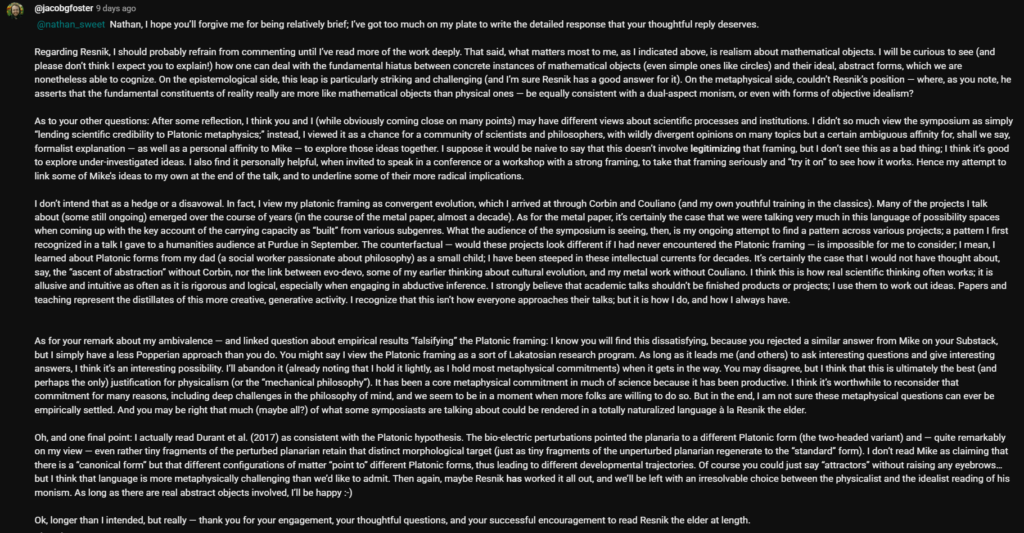
Foster replied again, prefacing with “I hope you’ll forgive me for being relatively brief; I’ve got too much on my plate to write the detailed response that your thoughtful reply deserves.” What followed was not brief. It was a carefully constructed series of concessions wrapped in diplomatic language whose full implications become visible only when read against the institutional context.
On Resnik:
Regarding Resnik, I should probably refrain from commenting until I’ve read more of the work deeply.
He acknowledged he had invoked an authority he hadn’t fully studied.
On the possibility of naturalizing the symposium’s content:
And you may be right that much (maybe all?) of what some symposiasts are talking about could be rendered in a totally naturalized language à la Resnik the elder.
That parenthetical “maybe all?” is extraordinary. A founding co-Director of the Diverse Intelligences Summer Institute, on Levin’s channel, allowed that perhaps the Platonic apparatus could be dispensable in an adequate naturalized account.
On the symposium’s institutional function:
I didn’t so much view the symposium as simply “lending scientific credibility to Platonic metaphysics;” instead, I viewed it as a chance for a community of scientists and philosophers, with wildly divergent opinions on many topics but a certain ambiguous affinity for, shall we say, formalist explanation — as well as a personal affinity to Mike — to explore those ideas together. I suppose it would be naive to say that this doesn’t involve legitimizing that framing.
He characterized the symposium as exploration. That does not remove its legitimating effect: an institution’s decision to convene and publicize a speculative ontology can confer authority on it, regardless of the organizers’ intentions. The resulting epistemic responsibility deserves an answer.
On the counterfactual question, whether his work would look different without the Platonic framing:
The counterfactual — would these projects look different if I had never encountered the Platonic framing — is impossible for me to consider; I mean, I learned about Platonic forms from my dad (a social worker passionate about philosophy) as a small child; I have been steeped in these intellectual currents for decades.
He did not resolve that question in our exchange. Institutional habituation is one possible explanation; philosophical disagreement, conversational limits, and other explanations remain open.
On his metaphysical commitments:
I hold it lightly, as I hold most metaphysical commitments.
And then came the Durant reinterpretation, which I believe is the single most structurally revealing moment in the entire exchange:
I actually read Durant et al. (2017) as consistent with the Platonic hypothesis. The bio-electric perturbations pointed the planaria to a different Platonic form (the two-headed variant) and — quite remarkably on my view — even rather tiny fragments of the perturbed planarian retain that distinct morphological target (just as tiny fragments of the unperturbed planarian regenerate to the “standard” form). I don’t read Mike as claiming that there is a “canonical form” but that different configurations of matter “point to” different Platonic forms, thus leading to different developmental trajectories. Of course you could just say “attractors” without raising any eyebrows… but I think that language is more metaphysically challenging than we’d like to admit.
I responded by making the logical structure of this move visible:
Sit with the logic. If convergence toward canonical morphology confirms Platonism, and permanent divergence to a novel morphology also confirms Platonism, what outcome of any kind counts against it? You’ve shown the framework absorbs all possible results. Convergence confirms it. Divergence confirms it. No result loses. Flew called this “death by a thousand qualifications.”
“I Simply Have a Less Popperian Approach Than You Do”
This sentence, from Foster’s second response, is the most structurally important thing he said in the entire exchange, and it requires careful dismantling because the move it performs is the single most common mechanism by which unfalsifiable frameworks evade accountability.
Foster’s full statement was:
As for your remark about my ambivalence — and linked question about empirical results “falsifying” the Platonic framing: I know you will find this dissatisfying, because you rejected a similar answer from Mike on your Substack, but I simply have a less Popperian approach than you do. You might say I view the Platonic framing as a sort of Lakatosian research program. As long as it leads me (and others) to ask interesting questions and give interesting answers, I think it’s an interesting possibility. I’ll abandon it (already noting that I hold it lightly, as I hold most metaphysical commitments) when it gets in the way.
Read that again. “I simply have a less Popperian approach than you do.” This frames our disagreement as a difference of methodological preference, like preferring qualitative over quantitative methods, or Bayesian over frequentist statistics. It is not. It is a framework that generates predictions disagreeing with a framework that does not, and framing that difference as a stylistic choice is how the substantive question gets neutralized before it can be answered.
The move is structurally identical to “falsifiability isn’t falsifiable,” which is the single most reliable signal that someone has not read the literature they are critiquing and would prefer you didn’t notice. The self-refutation objection treats falsificationism as a first-order empirical claim and asks whether it passes its own test. But falsificationism is a second-order methodology, evaluated by the progressive or degenerating character of the research programmes it generates. Applying the single-statement falsification test to the methodology is the epistemic equivalent of asking whether the rules of chess constitute a legal chess move. You have not found a contradiction. You have demonstrated you do not know what kind of thing you are talking about. And the move is never made innocently. It is made to neutralize epistemic standards before the real work begins, which is sneaking empirical claims past the audience while appearing to transcend the empirical altogether. Flew (1950) named this: death by a thousand qualifications, where the claim retreats from every falsifying condition until nothing remains to test, and then the retreat gets called depth.
For a full treatment of why this move fails and how six independent lines of defence rescue falsificationism from the self-refutation objection, see my response to philosopher Matt Segall’s deployment of the same defence.
The move is not ethically or epistemically innocent merely because it is presented as open-ended exploration. When real experimental findings are offered as support for untested ontology, withholding the demand for a discriminating test can transfer scientific authority to claims that have not earned it. That transfer has consequences for students, audiences, and those whose work or interests may be affected. The argumentative pattern appears in Foster’s exchange; none of this requires attributing an ulterior motive to him:
First, reframe your opponent’s standards as their limitation. Foster suggested I was “trapped” in a Popperian framework that he has transcended through broader reading. But falsificationism is not a personal commitment. It is a methodology whose track record can be evaluated against alternatives. The history of science offers concrete cases in which severe testing and the willingness to discard protected assumptions proved essential, but it is not a controlled centuries-long trial of Popper’s criterion. That history is a warning against immunizing interpretations from the very results that ought to constrain them. Tetlock’s forecasting research supports disciplined calibration, scoring, and revision over unaccountable confidence. The Open Science Collaboration (2015) documented replication difficulties and the need for stronger methods; it did not run a controlled cross-field test of Popperian philosophy. Evidence-based medicine offers further reasons to demand comparative evidence, but no single historical life-expectancy inflection establishes the claim made here. The practical point is harder to evade than these inflated summaries: specify what would make the claim lose support, and then run a test capable of producing it.
Second, invoke Lakatos as a shield against falsification demands. Foster explicitly did this: “You might say I view the Platonic framing as a sort of Lakatosian research program.” But Lakatos never replaced falsification with fecundity. He refined Popper; he did not soften the criterion. Lakatos’s own words: “In a progressive research programme, theory leads to the discovery of hitherto unknown novel facts. In degenerating programmes, however, theories are fabricated only in order to accommodate known facts” (MSRP, 1978, pp. 3-5). And: “Our empirical criterion for a series of theories is that it should produce new facts. The idea of growth and the concept of empirical character are soldered into one” (Criticism and the Growth of Knowledge, 1970, p. 119). Soldered. Not “balanced.” Not “weighed against other considerations.” Soldered into one. Scholarly growth alone is no answer to an empirical challenge: a Lakatosian programme earns progressive standing through its evolving theoretical and empirical record, including corroborated novel content, not through publication volume or the ability to redescribe whatever was already observed.
Lakatos classified Marxism as degenerating despite its enormous scholarly productivity, because its “auxiliary hypotheses were all cooked up after the event to protect Marxian theory from the facts.” He also wrote: “Intellectual honesty consists in stating the precise conditions under which one will give up one’s belief” (MSRP, p. 1). That question was asked three times across our exchange. It remains unanswered. By Lakatosian criteria, the Platonic-source claim at issue displays a serious warning sign: its defenders have accommodated the reported planarian result after the fact without providing an independently specified mapping or a risky, source-specific forecast. This is a diagnosis of a particular explanatory move, not proof that the entire diverse-intelligence research programme has never predicted a novel fact. If you invoke Lakatos, his methodology applies to your framework too.
Third, treat the absence of crisis as evidence of health. Foster’s “I’ll abandon it when it gets in the way” sounds like intellectual flexibility. The methodological danger is that a framework can always be made to fit a result after the fact, so no possible observation ever ‘gets in the way.’ A precisely specified constraint account must commit to ranges, frequencies, and intervention responses that can be wrong; merely calling an account constraint-based does not make those tests pass. That is not a deficiency. It is what makes it science.
Mayo’s severe testing criterion (2018) makes this sharper still: a claim passes severe testing when the data would very probably not fit the claim if the claim were false. The wider family of practices that exposes claims to calibration, replication, prediction, and severe criticism has substantial empirical support. That support does not prove a complete Popperian doctrine by a pair of randomized field-level trials; no such pair of trials was established here. The relevant challenge remains comparative: what independently testable gains does the proposed alternative to these practices produce? The “I have a different approach” defence has never been subjected to any test at all, because subjecting it to a test is precisely what the approach is designed to avoid.
There is a further prediction falsificationism makes that directly bears on the present case: frameworks insulated from discriminating evidence risk factional proliferation rather than empirically driven convergence, because rival accommodations can persist without a shared adjudicating test. Check the historical record. Neoplatonic emanationism, the tradition Levin’s Platonic Space Symposium explicitly invokes, has produced two thousand years of faction proliferation with zero convergence on testable claims: Plotinus, Porphyry, Iamblichus, Proclus, and seventeen centuries of successors disagreeing on virtually every structural detail with no principled mechanism for resolution, because the framework was designed to escape the only tools that could settle it. Psychoanalytic schools multiplied and never converged. Alchemical traditions fragmented. Fragmentation is not depth or richness. It is the predicted signature of a framework with no external constraint forcing convergence, and it is already visible in the “diverse intelligences” ecosystem, where “cognition” means something different in every paper depending on which collaborator is writing.
Foster’s framing of our disagreement as methodological preference also conceals a deeper self-refutation. If his “less Popperian approach” is itself a claim about what constitutes good scientific practice, what would show it wrong? If no outcome would, the approach is unfalsifiable by its own admission, and using it to defend an unfalsifiable framework is circular. If some outcome would, then he has loss conditions after all, and we are back to the question he has avoided three times: what are they?
The Physicalism That Nobody Holds
Foster also wrote:
You may disagree, but I think that this is ultimately the best (and perhaps the only) justification for physicalism (or the “mechanical philosophy”). It has been a core metaphysical commitment in much of science because it has been productive. I think it’s worthwhile to reconsider that commitment for many reasons, including deep challenges in the philosophy of mind.
And separately:
I think that [attractor] language is more metaphysically challenging than we’d like to admit.
This framing requires the position I am advancing to be naive physicalism, the billiard-ball, matter-in-motion picture that treats mathematics as mere description and consciousness as an embarrassment. Against that straw opponent, Platonism looks sophisticated and necessary. But I have never defended that position, and the alternative I have been articulating throughout this exchange is not physicalism at all.
The position is structural realism, and the elder Resnik whom Foster cited is its proof. When Resnik argues that physical reality is “most accurately described as an unchanging structure” and quantum particles “seem more like mathematical objects than everyday, commonsense bodies,” he is not being a naive physicalist. He is dissolving the abstract/concrete distinction that makes the math-world relationship look “mysterious” in the first place. Structural realism holds that relations are primary, that mathematical structure is immanent in physical process, and that what we call “physical” and what we call “mathematical” are two descriptions of the same relational architecture, not two different kinds of stuff requiring a bridge between them.
An attractor, in this framework, is not metaphysically mysterious. It is a mathematical description of a dynamical system’s long-term behavior under current constraints. It is falsifiable: change the constraints and the attractor changes, which is one dynamical reading of what Durant and colleagues reported. It carries no interaction problem because it does not posit a non-physical realm that must somehow causally influence the physical. The “metaphysical challenge” Foster senses in attractor language evaporates once you stop assuming attractors must be housed somewhere separate from the dynamics they describe. That assumption is residual substance ontology, and structural realism was specifically built to eliminate it.
Here is the part I most wanted Foster to notice, and the part that connects directly to the institutional capture analysis: his critique of physicalism lands only against a position nobody in our conversation holds. And it lands on his own framework with greater force.
The specific causal-access version of Platonism under criticism treats a nonphysical repertoire of forms as explanatorily relevant to physical development. If those forms do causal work, an account is owed of how that work occurs; other varieties of mathematical Platonism need not posit two interacting substances. Here is the parity reductio: grant, for the sake of argument, every difficulty Foster attributes to naive physicalism. A causal-access Platonism does not automatically solve any of them; it adds the burden of explaining how a proposed nonphysical source makes a discriminable difference to physical organization. Calling the new source a form cannot do that work. Naive physicalism has one substance and struggles with the mind-body problem. A two-domain causal-access account adds a bridge problem whose mechanism remains unspecified in the claims examined here. You haven’t escaped the problem; you’ve doubled it. The proposed extra bridge can manufacture an explanatory demand that immanent structural and dynamical accounts do not share. Such accounts are serious rivals, though their success does not settle every metaphysical question. Meanwhile, organizational closure (Montévil-Mossio 2015), enacted cognition (Varela, Thompson, Rosch 1991), and active inference (Friston 2010) address the “deep challenges in philosophy of mind” within structural realism, requiring no transcendent forms and generating no interaction problem.
There is a deeper irony here, and it applies to Levin’s framework even more directly than to Foster’s. Here is the dependence reductio: insofar as an argument for Platonic morphospace starts by portraying matter as incapable of its own rich organization, the supposed necessity of an extra organizer depends on the very impoverished physicalism it advertises itself as overcoming. A Platonic morphospace is not shown to be explanatorily necessary by first assuming the 17th-century Cartesian picture of matter as inert, mechanical, and intrinsically devoid of organizational capacity, because it is precisely that emptied-out matter that requires atemporal forms to explain why organisms develop the way they do. Constraint-based accounts, Montévil and Mossio’s organizational closure, Deacon’s teleodynamics, Prigogine’s dissipative structures, never accepted that premise in the first place, which is why they require no Platonic supplement: matter defined as inherently relational, processual, and self-organizing generates morphogenetic directionality without importing it from a transcendent realm. On that particular justification, the Platonic supplement is parasitic on its own reductive foil: replace impoverished Cartesian matter with relational constraint dynamics and the asserted need for that extra source is no longer established by the same evidence. The framework needs the disease it claims to cure. That is a conditional indictment of its explanatory argument, not a metaphysical proof against every possible repertoire of forms.
Any account claiming that a nonphysical repertoire contributes distinct causal effects to morphogenesis owes a specification of those effects and of the measurable physical processes through which they appear. Landauer’s familiar kBT ln 2 bound concerns the minimum heat associated with logically irreversible erasure of one bit under standard assumptions, not every maintained distinction. Bérut et al. (2012) tested an implementation of that erasure principle. The empirical-credit reductio is straightforward. Suppose Platonic access makes an additional causal difference: then specify the process, its observable signature, and a result that would distinguish it from physiological-memory and constraint-based rivals. Suppose instead that it changes no observable prediction at the stated target: then it cannot claim independent empirical confirmation from that target, however coherent it might remain as metaphysics. There are other philosophical possibilities, but neither horn licenses the same experimental data to be advertised as unique evidence for Platonic causation. This is a test of evidential entitlement, not a claim that Landauer disproves Platonism.
The Final Comment and the Escalation Timeline
After Foster went quiet, I posted a final formalization of the Lakatosian diagnosis, preceded by Popper’s foundational statement:
“A theory which is not refutable by any conceivable event is nonscientific. Irrefutability is not a virtue of a theory (as people often think) but a vice.” — Karl Popper, Conjectures and Refutations
And the note that Lakatos did not soften this demand but raised it:
Lakatos didn’t soften this demand; he raised it, requiring not merely that a theory could be refuted in principle but that it actively predict facts nobody had thought to look for, making “I’ll abandon it when it gets in the way” even less adequate than Popper would have found it.
I then laid out the full three-criterion diagnosis and the fecundity alibi’s historical parallels, and identified a deeper irony worth making explicit: that Levin’s Platonism is parasitic on the very reductive physicalism it claims to transcend. These arguments appear in Sections VII and XI of this article.
The escalation timeline of Levin’s metaphysical claims makes the Lakatosian trajectory visible in publication chronology:
In 2022, the TAME paper used computational and cybernetic language without Platonic forms. By 2024, the Thoughtforms blog introduced explicit Platonic terminology. In 2025, “Ingressing Minds” proposed non-physical causation, and by late 2025, Platonic Space was described as “cagey and shy” and resistant to direct observation. By early 2026, “Mind Everywhere” placed expansive mentalistic and teleological vocabulary in a peer-reviewed setting, increasing the importance of asking exactly which claims the reported experiments warrant and which remain interpretive additions. This is not the trajectory of a framework approaching testability. It is the trajectory of a framework escalating its commitments as it retreats from the constraints that would test them.
What Foster Avoided, and Why
Across this documented exchange, Foster did not directly answer my Lakatosian challenge, rebut the specific Discovery Institute appropriation I raised twice, or identify the discriminating test I requested three times. These were the questions that mattered for distinguishing empirical support from metaphysical promotion. Their absence from his replies has an epistemic consequence whether he agreed with me, disagreed, or simply chose not to engage.
And then he went quiet.
I want to be careful here, because I believe what happened next is more revealing than the exchange itself. After nine days of public discourse, Foster stopped responding publicly. But his engagement did not stop. He appeared on my mailing list, and his click-through rate on every piece of content I subsequently published was one hundred percent. Nine days and counting past our exchange, the tracking system registered clicks on the updates, which cannot establish close reading or agreement.
Continued attention is compatible with interest, disagreement, curiosity, or simple monitoring. It is not evidence that Foster secretly agrees or feels unable to say so. The observable question is why the substantive challenges remained unanswered in that exchange.
One charitable but unconfirmed interpretation is this: Foster is a genuinely brilliant person who found himself in a conversation where someone applied his own professional tools to his own institutional position with questions he did not resolve publicly. His response was to concede everything concedable, leave some points uncontested in this exchange, point me toward sources that would strengthen my position, praise the engagement with warmth exceeding professional courtesy, and then go quiet publicly while click tracking suggested continued interest in subsequent updates.
I get it. Imagine being in that position: your professional identity, your institutional role, your funding pipeline, your training programme, your editorial relationships, your network of collaborators, all organized around the proposition that “Diverse Intelligences” is a legitimate research framework. If you concede that the Platonic component is a degenerating sub-programme parasitic on progressive empirical work, you are not just revising a philosophical view. You are undermining the institutional rationale for your own centre, your own summer institute, your own TWCF grants, and the career trajectories of every early-career researcher you have trained through DISI since 2018. Whether Foster experienced any such conflict is unknown. The structural question remains: how do career, funding, and collaborative incentives affect which criticisms are publicly taken up, independent of anyone’s motives?
The institutional capture literature identifies this dynamic precisely: institutional incentives can reinforce expressed commitments without anyone being dishonest. The funding did not make Foster a Platonist. Foster’s pre-existing Platonic sympathies, cultivated since childhood through his father’s passion for philosophy, may have aligned with the initiative’s intellectual culture and incentives; what that did to his private views is unknown. The capture is not coercion. It is resonance selection. The system selects for people whose genuine intellectual inclinations align with the funding framework, then provides them with resources, status, and community that make those inclinations more publicly visible and institutionally rewarded.
V. The Co-Author’s Dilemma: David Resnik’s Father’s Structuralism That Couldn’t Speak Its Name
If Foster’s exchange demonstrates how institutional capture operates on someone adjacent to the research programme, the correspondence with David Resnik demonstrates how it operates on someone inside it. Resnik is Levin’s co-author on the “Mind Everywhere” papers in Biological Theory, an NIH bioethicist, and the son of Michael D. Resnik, the philosopher whose mathematical structuralism I have been arguing provides the naturalistic alternative Levin’s Platonism renders unnecessary.
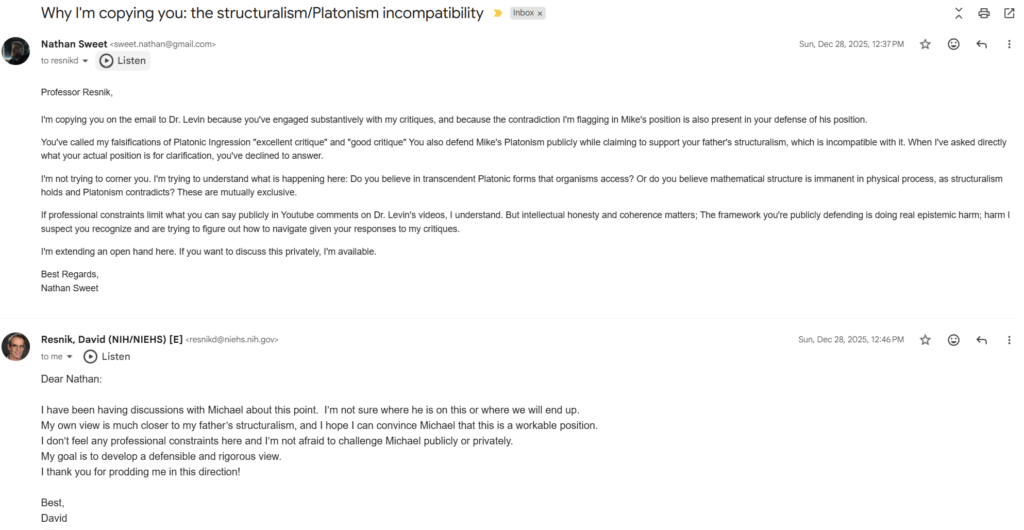
On December 28, 2025, I emailed Resnik directly, copying Levin, to flag the contradiction between his public defence of Levin’s Platonism and his private acknowledgment that his father’s structuralism is incompatible with it. His response arrived within fourteen minutes:
My own view is much closer to my father’s structuralism, and I hope I can convince Michael that this is a workable position. I don’t feel any professional constraints here and I’m not afraid to challenge Michael publicly or privately. My goal is to develop a defensible and rigorous view. I thank you for prodding me in this direction!
Two days later, on December 30, he wrote:
I have pressed Levin on this issue and hope to get him to see the merits of a structuralist approach and to drop talk of a separate Platonic realm or “ingression.”

And:
Structuralism is the position I favor and I hope to convince Michael of.
Read those sentences again. Levin’s co-author on the paper the Discovery Institute would celebrate ten weeks later as “The Levin Teleology Revolution” privately favours the framework I have been arguing should replace Levin’s Platonism, is actively trying to convince Levin to drop the Platonic vocabulary, and thanked an outside critic for “prodding me in this direction.” The published paper does not itself settle the private-versus-public interpretive question. “Mind Everywhere: Part Two” appeared in Biological Theory in early 2026 with its Platonic commitments intact.
The divergence between a privately expressed preference and the public claims attached to a joint paper matters because its evidential ambiguity can be used by third parties, independently of what either author intended. Institutional and collaborative constraints are relevant hypotheses; the correspondence does not establish which caused the divergence.
The Pattern of Deflection
Over a two-day email exchange comprising over a dozen messages to me, Resnik exhibited a consistent pattern: substantive engagement with positions I did not hold, and silence on the positions I did.
Three times he directed me to the preprint of the goal-directedness paper as a response to my critiques. Three times I pointed out that the preprint is naturalistic, aligns with my position, and does not address a single point of my critique, which concerned Levin’s public Platonic additions (“ingression,” “thin clients,” “free lunches,” “physicalism is not viable”) that appear in podcasts, YouTube videos, and symposia reaching millions, not in their peer-reviewed work.
When he did engage substantively, his quotes defended against reductive materialism, a position I had explicitly and repeatedly rejected. I had stated in plain language that thermodynamic monism rejects both materialism and reductionism because both presuppose substance ontology. Resnik’s response was to send quotes from the preprint arguing the framework is “compatible with scientific materialism” and does not assume “dualism, vitalism, or any type of exotic metaphysics.” These are excellent defences against a position I do not hold. They do not address the structuralist critique I do hold, which also rejects eliminative materialism for the same reasons. Defending against the wrong opponent while the actual critique sits unacknowledged is one of the most common mechanisms by which unfalsifiable frameworks evade scrutiny.
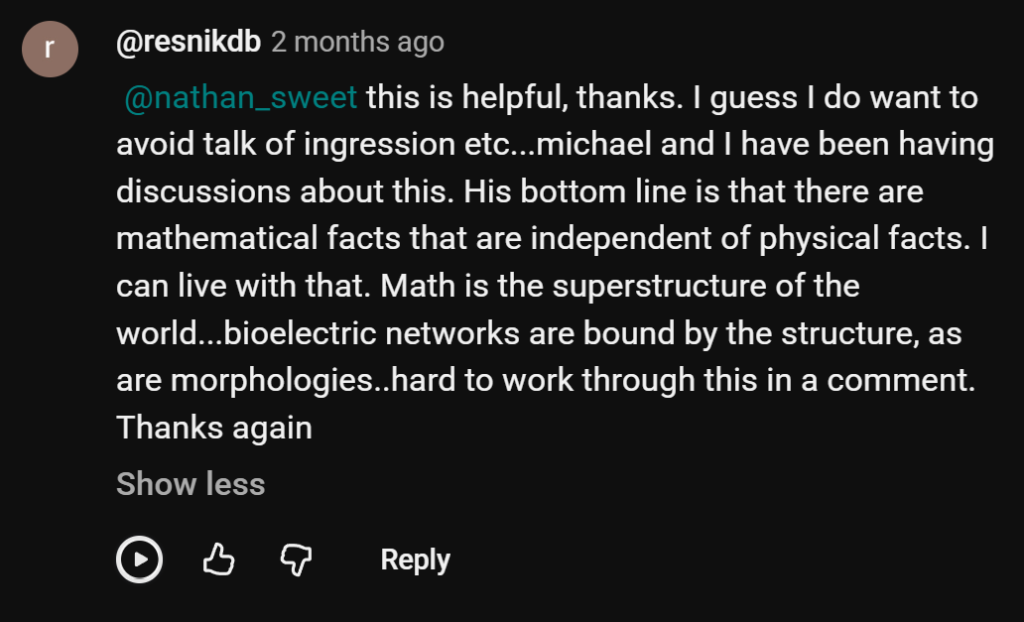
When I asked directly how the claim that “mathematical facts are independent of physical facts” is compatible with his father’s structuralism, Resnik replied by invoking Max Tegmark’s Mathematical Universe Hypothesis and Stephen Wolfram’s Ruliad. Both frameworks have been critiqued in the peer-reviewed literature as unfalsifiable in principle. Natal (2024, arXiv:2411.12562v3) identifies the fatal flaw: both conflate mathematical potential with physical actuality, and if all mathematical structures exist “eternally,” they explain nothing about why this universe exists with these laws. The framework becomes unfalsifiable because it predicts everything and therefore distinguishes nothing. Rickles, Elshatlawy, and Arsiwalla (2023, arXiv:2308.16068v2) identify the “realization problem”: if abstract structures generate reality, what does the generating? The generator must itself be mathematically describable, creating infinite regress. Thermodynamic Monism supplies a naturalistic rival: physical patterns can arise from dynamics under constraint without invoking an external generator. At those targets, a proposed Platonic supplier must show what it predicts or explains beyond the dynamics already doing the work. Sabine Hossenfelder, a respected mainstream physicist, dismisses Tegmark as unfalsifiable, superfluous by Occam’s razor, and “not even wrong,” noting that claiming the universe “is” mathematics rather than “is described by” mathematics adds nothing explanatory, since scientists never need this assumption to do physics. Woit and Smolin both note that claiming “all mathematical structures exist” is vacuous; it predicts too much and too little. Appealing to unfalsifiable frameworks to defend an unfalsifiable position does not resolve the unfalsifiability. It compounds it. I have documented the systematic failure of these frameworks, alongside Levin’s morphospace, Penrose-Hameroff’s Orch-OR, and others, in a comprehensive constraint-based audit : The Metaphysics Audit.
More revealingly, Resnik wrote in the same email: “My view is that the universe has a mathematical structure that underlies physics. Mathematics defines a space of possible events, processes, and interactions in the physical world; it is immanent in the world, not separate from it.” He then concluded: “In this way, there can be mathematical facts that are independent of physical facts.”
But immanence and independence are mutually exclusive. If mathematics is immanent in the world, it is not independent of the physical. If it is independent of the physical, it is not immanent but transcendent, and you need an interaction mechanism to explain how it causally influences physical systems.
The Internet Encyclopedia of Philosophy states this directly:
“An impenetrable metaphysical gap between the mathematical and spatio-temporal realms of the type that proponents of the epistemological challenge insist exists if platonism is true would exclude the possibility of causal interaction between human beings, who are inhabitants of the spatio-temporal realm, and mathematical entities, which are inhabitants of the mathematical realm.”
The Stanford Encyclopedia of Philosophy’s entry on naturalism and mathematics makes the implication explicit:
“Given that mathematical and modal facts are abstract in the sense of lying outside space and time, it follows that there is no possibility of identifying them with the kind of natural facts that have physical effects. If naturalist realism about mathematics is thus ruled out, the remaining options are irrealism and non-naturalist realism.” Independence, as Resnik claimed, equals separation equals transcendence. You cannot claim both immanence and independence without reproducing the interaction problem his father’s structuralism was designed to dissolve. The contradiction within a single paragraph mirrors the motte-bailey structure I documented in Levin’s public presentations: naturalistic language when challenged, Platonic commitments when unchallenged, and a verbal formula designed to make them look continuous when they are not.
What Remained Unaddressed
Across the full exchange, Resnik never addressed:
How Durant et al. (2017) does not falsify Platonic convergence predictions, despite repeated raising.
What mechanism enables “ingression” from a non-physical realm, the interaction problem Aristotle identified 2,400 years ago.
What empirical result would falsify Platonic morphospace.
The Discovery Institute’s citation of their work as supporting creationism.
The Landauer bound’s implications for any framework claiming non-physical causal influence on physical systems.
When I pressed on professional responsibility, I invoked scientific-integrity and authorship standards. NIH rescinded its 2024 scientific-integrity policy in March 2025 while continuing to follow the department-wide HHS Scientific Integrity Policy, updated in March 2026. That policy concerns accurate scientific communication within its defined scope, while current ICMJE guidance concerns accountability for coauthored publications. Neither automatically obliges an author to rebut a collaborator’s every separate public statement. The narrower ethical question I raised is whether foreseeable use of a jointly authored paper to promote stronger metaphysical claims warrants reasonable clarification of what its evidence actually establishes. Resnik drew a line:
I do not consider it to be my business to correct what Michael Levin may have said about Platonic space on videos, podcasts, blogs, etc. However, I will definitely take responsibility for works that I am an author on to make sure that they are the best they can be in terms of arguments, logic, and data.
This is a coherent position for a co-author of technical papers. For a bioethicist whose joint work is being invoked in public arguments that exceed its demonstrated evidence, the boundary of professional responsibility cannot be settled simply by saying a coauthor speaks only for himself. There is a serious ethical question about foreseeable misuse of scientific authority, even where no policy automatically requires rebutting every statement by a collaborator. The peer-reviewed naturalistic work is the motte. Levin’s podcast Platonism is the bailey. The motte-and-bailey effect is available whenever a defensible technical model supplies authority for a much stronger public metaphysics without an explicit evidential bridge. If a coauthor is asked to clarify that difference and declines, the vulnerability remains publicly unresolved. The effect does not require that coauthor’s endorsement, coordination, or bad faith. And the Discovery Institute does not distinguish between the two when citing “Levin and Resnik” as supporting teleological arguments “harking back to Aristotle and Plato.”
Two Resniks, One Capture
The deepest structural irony in this correspondence is genealogical. Michael D. Resnik spent four decades building a framework, mathematical structuralism, that naturalizes mathematical epistemology, dissolves the abstract/concrete distinction, identifies mathematical objects as positions in relational structures rather than inhabitants of a transcendent realm, and explains mathematical knowledge through ordinary cognitive processes without “endowing them or ourselves with occult properties or faculties.” His son David Resnik privately favours this framework, is actively trying to convince his co-author to adopt it, and thanked an outside critic for reinforcing that effort.
And yet the published paper that bears David Resnik’s name as co-author advances the Platonic vocabulary his father’s life’s work was designed to eliminate. The Discovery Institute celebrates that paper as the arrival of “the Levin Teleology Revolution.” The elder Resnik’s structuralism predicted the empirical findings, path-dependent morphology, attractor-state stability, constraint-determined form, decades before Levin’s laboratory confirmed them. The published credit flows to a Platonic framework the same data falsifies.
I do not think David Resnik intended any of this. I think he found himself in a collaborative relationship with a charismatic and productive senior researcher, discovered over time that the interpretive framework was drifting away from the positions he actually holds, tried to nudge it back, and encountered the structural reality that co-authorship within an institutional ecosystem limits how far you can push before the collaboration itself becomes untenable. I would probably navigate those constraints similarly if I were in his position, and I suspect most honest academics would too. The system does not need anyone to act in bad faith. It needs only that the costs of public correction exceed the costs of private discomfort, which they almost always do in collaborative science.
David Resnik told me, in writing, that structuralism is the position he favours. He told me he is pressing Levin to drop the Platonic vocabulary. He told me he hopes to convince Levin of structuralism’s merits. These are not the words of someone who endorses the framework the Discovery Institute is celebrating. They are the words of someone caught between private conviction and institutional architecture, managing the gap as best he can while the downstream consequences compound.
The elder Resnik’s framework deserves better than to have its predictive successes credited to the metaphysics it was built to replace. And David Resnik deserves recognition for the honesty he expressed in private correspondence, even as the institutional structure prevented that honesty from reaching the published page.
VI. The Editorial and Citation Structure
Levin is co-editor-in-chief of Bioelectricity and founding associate editor of Collective Intelligence. Both journals’ scope is defined by the theoretical framework they are meant to evaluate. Being editor-in-chief of a journal named after your research programme’s central concept is a textbook mechanism for editorial gatekeeping, where the framing of acceptable contributions is pre-shaped by the editorial vision before a manuscript is ever submitted.
The citation network is tightly coupled. The HADES paper (Hartl, Zhang, Hazan, and Levin) builds directly on Zhang, Hartl, Hazan, and Levin (March 07 2026, “Diffusion Models Are Evolutionary Algorithms”). Same four authors, rearranged. The HADES paper’s Section 4.1 makes the ontological claim that a diffusion model “literally represents a lineage’s evolving genome,” while Hartl and Levin (2025, Trends in Genetics) simultaneously acknowledges that the same analogy faces “significant challenges.” The same laboratory, overlapping author sets, publishing contradictory epistemic stances across different journals in the same year, with each paper citing the other.
Three hundred and fifty publications create massive citation mass, heavily self-referencing, which in turn creates the appearance of a large, active research community validating the framework when much of the citation weight is internal to the network. Chris Fields and Levin have co-authored extensively across active inference, tensor networks, quantum formulations, and “control flow in active inference systems.” Fields provides the mathematical formalism for many of Levin’s most speculative claims. The collaboration creates the appearance of rigorous mathematical grounding for claims that are fundamentally philosophical.
None of this is unusual in science. Productive labs cite their own work. Collaborators build on each other’s publications. The question is not whether the pattern exists but whether it is accompanied by the external coupling, the engagement with competing frameworks and disconfirming evidence, that Lakatos requires for a progressive programme. On that criterion, the pattern fails. The constraint-based alternatives, Montévil and Mossio’s organizational closure, Deacon’s teleodynamics, Varela and Thompson’s enactivism, Ladyman and Ross’s structural realism, are systematically absent from the citation network. The one paper that comes closest to providing an external challenge, Milinkovic and Aru’s (2026) alternative framework, never names Levin and is not cited by Levin’s group.
VII. Denis Noble: When Capture Consumes Its Most Important Victim
This section is the hardest to write, because it requires holding in mind simultaneously that Denis Noble made a genuinely revolutionary discovery, that he overreached in ways that deserve criticism, that the institutional ecosystem consumed his legitimate insights, and that the resulting destruction of his reputation makes the constraint-based alternative harder for everyone.
Noble is a Fellow of the Royal Society, emeritus professor at Oxford, and pioneer of systems biology. In 1960, he developed the first mathematical model of cardiac cells, demonstrating that heart rhythm is an emergent property of feedback loops rather than a single oscillator. His formal proof that “downward causation” operates as boundary conditions on differential equations constraining lower-level dynamics is foundational systems biology. This is organizational closure demonstrated empirically in cardiac tissue decades before Montévil and Mossio formalized it in 2015.
Noble’s cardiac modeling shows exactly what “downward causation” means when done rigorously: the cell-level membrane voltage constrains protein channel behavior, protein channels constrain ion flows, ion flows constrain voltage, and the closure of that constraint loop generates the heartbeat as an emergent property that exists at no single level. Remove the downward causation by voltage-clamping the cell, and the rhythm stops. This is not metaphor. It is mathematics, and the mathematics requires no Platonic realm, no transcendent forms, no “purposive agency.” It requires boundary conditions on differential equations, which is precisely the constraint-based formalism I argue should replace Levin’s Platonic morphospace.
Noble himself stated it with admirable precision: “In setting boundaries, downward causation can be viewed more like a context, setting constraints, purpose and goals.”
And there it is. The word “purpose.” The word “goals.” The moment where Noble’s legitimate constraint-based insight begins its journey toward capture.
Scale 1: Noble’s Insight Gets Captured by His Own Overreach
Noble discovers something real: biological systems exhibit multi-scale constraint dynamics where higher-level boundary conditions constrain lower-level processes, and this constraint closure generates emergent properties. His mathematics does not require Lamarck. His boundary conditions on differential equations are physical constraints, not inherited acquired characteristics. But Noble, instead of connecting this insight to organizational closure theory, to Deacon’s teleodynamics, or to structural realism, reaches for Lamarck and “purposive agency.” The vocabulary of “purpose” and “agency” feels more exciting than “constraint closure.” It also maps onto philosophical commitments Noble cultivated long before any Templeton money arrived.
His “Third Way of Evolution” project, which co-hosts conferences and maintains a website of scholars questioning aspects of the Modern Synthesis, has itself acknowledged the co-optation problem. The TWE website states explicitly: “It has come to our attention that THE THIRD WAY web site is wrongly being referenced by proponents of Intelligent Design and creationist ideas as support for their arguments.”
Noble sees the co-optation. He names it. And yet the vocabulary that enables it persists.
Scale 2: Levin’s Ecosystem Absorbs Noble’s Credibility
Levin cites Noble as authority for “no privileged level of causation” and “downward causation.” On Sean Carroll’s podcast, Levin said: “People like Dennis Noble have been saying this much better than I, that you can’t simply pick a level because you like it, you have to pick the best level.” On the Templeton Ideas podcast, Levin made the same move: “Dennis Noble has written quite well, against that view” of gene-centrism.
Noble’s rigorous constraint-based cardiac work becomes a credibility input for Levin’s cognitive vocabulary, which then escalates: from “cells process information” to “cells know things” to “organisms navigate Platonic morphospace” to “minds ingress from a non-physical realm.” Noble himself never makes the Platonic claims. But by sharing platforms with Levin, by being cited as Levin’s authority on podcasts reaching millions, Noble’s constraint-based insights become load-bearing elements in an institutional structure that redirects them toward unfalsifiable metaphysics.
In January 2026, Noble’s “Third Way of Evolution” project co-hosted “Biological Relativity: Evolution for the 21st Century” at Balliol College, Oxford, with speakers including Denis Noble, James Shapiro, and Michael Levin. Noble’s conference. Levin’s vocabulary. The institutional convergence is documented.
Scale 3: The Skeptic Immune Response Destroys the Baby with the Bathwater
In May 2025, Professor Dave Farina, a science communicator with 4.22 million subscribers, published a caustic attack peice “Denis Noble is a Clown.” The video has 368,183 views as of this writing.
Farina gets things right: Noble publishes his evolutionary claims outside evolution-specific journals. The journal Noble edited published indefensible papers, including on octopus panspermia. Noble mischaracterizes the Central Dogma. “Directed mutation” in Noble’s strong sense lacks evidence. The Templeton funding connection is a legitimate concern.
Farina gets things catastrophically wrong: he treats Noble as a monolithic crank. He opens with “clown,” frames Noble’s entire post-retirement career as “Nobelitis,” and never once engages with the cardiac modeling work. He mentions Noble “developed the first mathematical model of cardiac cells in 1960” and then immediately pivots to dismissal. The framing makes Noble’s actual scientific contribution a brief credential to be noted and then ignored, rather than the key to understanding what he gets right and where he goes wrong. Noble is anything but a clown, and his work deserves infinitely more respect than his funding sources will allow it to earn.
Farina also arrives at the right conclusion by the wrong method. His observation that “agency-based theories are vacuous because they make the exact same predictions as neo-Darwinian ones” is precisely the Lakatosian degeneration argument. But he frames it as “Noble is stupid” rather than as a systematic diagnostic of what happens when unfalsifiable metaphysical layers ride progressive empirical programmes. He has the analytical tool and wields it as a club rather than a scalpel. Applying the same tools to his own critique, we can identify dozens of fallacies employed in Dave’s critique of Dr. Noble.
The deepest structural failure is that Farina never asks why Noble’s legitimate insights ended up in the Templeton/Levin ecosystem instead of in the constraint-based framework where their distinctive predictions might have been compared against the alternatives. The institutional-capture hypothesis offers a testable explanation of that selection: funding missions, vocabulary, collaborators, and platforms can direct otherwise valuable work into a particular interpretive ecosystem. The specific causal weight of each channel remains to be measured. Templeton funds “purpose” and “agency” research. A constraint-based approach need not treat purpose or agency as metaphysical primitives; whether such approaches were disadvantaged in Templeton funding calls would require application and award data. Noble’s cardiac work could have been connected to Montévil and Mossio, to Deacon’s teleodynamics, to Kauffman’s constraint closure. Instead it got connected to Lamarck, to “purposive agency,” to the Third Way, a trajectory consistent with the stated institutional incentives, though not proof that those incentives alone caused it.
Scale 4: The Destruction Makes the Alternative Harder to Advance
Because Farina’s caustic video, which is the #1 search result on youtube for the terms Denis Noble, in which Dave is denigrating Dr. Noble’s character has 368,000 views and positions Noble as a “clown,” anyone who now cites Noble’s legitimate multi-scale constraint dynamics work risks being associated with crankery. The very insights that would provide Levin’s empirical work with a rigorous, falsifiable theoretical home, organizational closure, constraint dynamics, boundary conditions as downward causation, become tainted by association with a figure the skeptic community has declared a crank. This makes the institutional capture more durable: the constraint-based alternative is harder to advance because the person who demonstrated it most clearly in cardiac tissue has been publicly destroyed for his separate, genuinely problematic evolutionary claims.
Noble deserves better than Levin’s ecosystem, and he deserves better than Farina’s video. What he deserves is what the constraint-based framework provides: a rigorous, falsifiable home for his insights about multi-scale constraint dynamics, separated from the Lamarckian overreach, the Templeton “purpose” vocabulary, and the Discovery Institute co-optation that have collectively buried the most important thing he ever demonstrated. The same pattern of naturalistic work being absorbed into the Platonic ecosystem while quietly replacing its core claims is documented across multiple symposium presentations, including Pavel Chvykov’s thermodynamic attractor theory and Gordana Dodig-Crnkovic’s cognitive Platonism, which David Resnik himself identified as “refangled Kantianism” rather than Platonism. (Youtube Link)
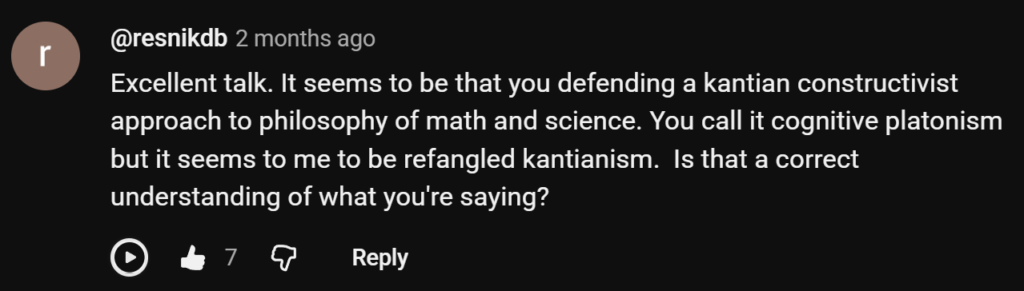
VIII. The Planarian Result and the Test Platonism Still Owes
The empirical case against Levin’s Platonic morphospace does not require philosophical argument alone. It requires one paper: Durant et al. (2017), “Long-Term, Stochastic Editing of Regenerative Anatomy via Targeting Endogenous Bioelectric Gradients,” published in the Biophysical Journal, from Levin’s own laboratory.
Durant and colleagues, including Levin as senior author, demonstrated that a brief 48-hour disruption of gap junction connectivity permanently rewrites a planarian’s body plan. The two-headed phenotype is, “in the absence of further treatments, permanent: both heads can be removed, the middle fragment can be allowed to regenerate, and the heads removed again multiple times, over months until the worms are too small to cut, in plain water long after the original drug is gone.”
The paper’s own conclusion: “Thus, species-specific axial pattern can be overridden by briefly changing the connectivity of a physiological network.”
The phenotype is stochastic: “discrete outcomes occur in predictable ratios within a treated population, but individual animals (though clonal and living in the same environment) regenerate toward distinct outcomes despite identical experimental perturbation.” Adjacent pieces from the same worm make independent stochastic decisions about morphology.
This is, as the authors note, “the first demonstration in a metazoan organism of significant changes to the body plan that are stable, stochastic, and induced by a brief and purely physiological perturbation.”
Consider the restrictive version of Platonic access that assigns one-headed anatomy a privileged pre-existing ideal and predicts recovery toward it after transient perturbation. If that is the claim, Durant and colleagues’ reported persistent two-headed regeneration presses directly against its expected return. Now consider the reply that two-headed forms were also waiting somewhere in an unmapped repertoire. That saves compatibility with the observation, but unless the repertoire and selection rule were specified independently, it gives up the very contrast that would have made the result a test. This is a conditional reductio of an evidential strategy, not a refutation of every Platonism; the physiological-memory alternative likewise owes prospective predictions and outside-lab scrutiny.
When I raised this with Levin directly, his response was: “Again, my view is not that standard animals are the full extent of Platonic patterns, so 2-headed planaria are not a problem. But even if we did have only convergence toward pre-existing Platonic forms, how do you know the 2-headed form is not a manifestation of a pre-existing pattern? We haven’t mapped out the space, so it’s way too early to say anything like that.”
When I raised it with Foster, his response was structurally identical: “The bio-electric perturbations pointed the planaria to a different Platonic form.”
The reductio targets the same inferential structure in both replies: without a prior mapping between proposed forms and physiological conditions, the observation cannot be used as a distinctive confirmation of Platonic access. If an organism converging toward its canonical morphology confirms Platonism, and an organism diverging permanently to a novel morphology also confirms Platonism because the system was merely “pointed to a different form,” then no morphological outcome, within that unconstrained repertoire, can count against the purported source attribution. That is the consequence of the conditional premise, not a claim that every conceivable Platonic model is inherently untestable. Without independent restrictions on the proposed space, an observed morphology can be assigned to its repertoire after the fact. The empirical findings no longer constrain the theory; instead, the theory expands to accommodate every possible outcome.
Here is the asymmetry the reductio exposes: a specified physiological-memory and constraint model must say how changing gap-junction connectivity shifts state variables, outcome frequencies, persistence, and reset conditions, and it can be wrong about any of them. The unconstrained Platonic reply can simply say that whichever form appeared was always available. In that version it has forfeited a morphology-based loss condition and earned no distinct empirical confirmation. This does not award the rival retrospective victory: it too must generate accurate, prospective, independently checked predictions. The methodological demand is symmetrical; the willingness to incur predictive risk is what distinguishes the proposed programmes at this target.
Lakatos’s criteria put pressure on this particular accommodation when it yields no novel, corroborated predictions:
- Criterion (a): no novel verified predictions beyond what the mechanistic bioelectric account generates. Every experimental success, limb regeneration, planarian axis reversal, tumor suppression, is fully predicted by constraint dynamics without any reference to atemporal forms.
- Criterion (b): oscillation between “useful metaphor” and genuine ontological commitment depending on whether falsification pressure is being applied. Under challenge, Platonic morphospace retreats to mathematical modeling tool. When making positive claims about what organisms do, it returns as genuine ontological commitment.
- Criterion (c): redefining convergence loosely enough after Durant to absorb path-dependence data that directly falsified the core prediction. The protective belt adjustment and the hard-core preservation happen in a single move.
IX. The Discovery Institute Finds Exactly What It Was Looking For
The Discovery Institute, through its publication Science and Culture Today, published “Michael Levin and the Philosophy of Intelligent Design” in January 2026. The article explicitly maps Levin’s Platonic morphospace onto the intelligent design research programme. I had warned both Levin and Resnik, months before the publication of “Mind Everywhere: Part Two” (Levin & Resnik, 2026, Biological Theory), that the Discovery Institute would cite their paper immediately upon release, and that the Platonic vocabulary made the specific appropriation foreseeable and unusually easy to perform. Both authors received this warning in documented correspondence. Neither addressed it substantively. Neither altered the vocabulary.
The paper published. The Discovery Institute cited it within days.
On March 4, 2026, Science and Culture Today ran “The Levin Teleology Revolution Is Here,” celebrating the publication of “Mind Everywhere: Part Two” with language that should alarm anyone who cares about the integrity of the bioelectric empirical programme. The article opened by marveling at what could now be read in “a major theoretical biology journal” and quoted the paper’s central thesis: that biology requires “an approach to teleology in biology, informed by mentalistic concepts, such as intelligence, cognition, and intentionality.” The Discovery Institute writer characterized this as “the rapidity and breadth of Michael Levin’s ‘intelligence and teleology’ revolution” and celebrated that Levin “has assembled a global community of like-minded investigators who openly advocate teleological arguments harking back to Aristotle and Plato.”
The article then performed the move I had predicted would happen: it positioned Levin’s framework as continuous with intelligent design while noting a single point of divergence. “Levin and his community are offering a teleology-informed take on biology which differs from intelligent design in one all-important respect: the existence of a designer.” One all-important respect. In effect, the Institute’s explicit one-designer-away comparison demonstrates how the inferential structure of certain Platonic-access claims is available for intelligent-design appropriation. In the relevant restricted argument, observed biological organization is taken to require an explanatory source beyond the specified physical mechanisms. The Discovery Institute substitutes a Designer for a Platonic organizing repertoire and advertises that substitution as a small step. The ontologies differ; the unearned passage from empirical organization to an extra organizing source is the structurally shared move.
The article concluded by directing readers to Richard Sternberg’s concept of an “immaterial genome” in the book Plato’s Revenge: The New Science of the Immaterial Genome, explicitly framing it as “a Platonic alternative that recognizes intelligent design.” Levin’s Platonism is here presented as the last step before the conclusion the Discovery Institute has been working toward for decades: that biological form requires a non-physical, immaterial organizing principle, and the only remaining question is whether that principle has agency.
The relevant isomorphism is an inferential one, not an identity of their full ontologies: biological organization is presented as evidence for an additional organizing source, yet the evidence does not independently identify that source. Once that bridge is left unconstrained, competing metaphysical programmes can cite the same findings as apparent vindication. The Discovery Institute has now done exactly that. Both frameworks identify an explanatory gap in mechanistic biology. The Institute invokes an intelligent designer; particular Platonic-access formulations invoke an extra-physical repertoire of forms. Where either is asked to explain biological outcomes beyond demonstrable physical mechanisms, both owe the same missing bridge: which distinct result follows from that source, and what evidence could count against it? Their incompatible accounts of the source do not rescue the shared inference. The Discovery Institute did not need to invent the published mentalistic and teleological language. Its March 2026 article quoted the coauthored paper and explicitly cast the difference as the presence of a designer. The Institute itself acknowledged that Levin rejects intelligent design. That acknowledgment did not stop the appropriation. Disavowing the Institute’s conclusion therefore cannot repair the evidential opening; only specifying and defending the disputed inferential bridge can do that.
The neo-Darwinian framing in the article is also worth noting, because it reveals the broader strategic function of the co-optation. The Discovery Institute writer celebrated that “the neo-Darwinians, his opponents, are aging out of academia” and that they “have only themselves to blame for Levin’s rise to prominence.” This positions Levin not merely as a scientist whose vocabulary is useful but as the intellectual successor to a tradition the Discovery Institute has been trying to displace for decades. Levin’s Platonic revolution is, in the Discovery Institute’s reading, the revolution that makes intelligent design scientifically respectable by doing everything intelligent design does except naming the designer.
I have not identified a public rebuttal by Levin to this specific Discovery Institute appropriation. Foster declined to address the Discovery Institute citation pattern when I raised it twice in our exchange. I do not attribute these silences to indifference or endorsement. The silence is consequential irrespective of motive. The published empirical findings and the stronger claims made in their name remain publicly bundled, while an ideological organization is already using that bundle. A substantive rebuttal would have to say what the data establish, what extra commitments the Platonic vocabulary introduces, and what could falsify or weaken those commitments. Such a clarification might challenge an institution’s favored public narrative; whether it would threaten particular grants or careers cannot be inferred from the silence. Institutional dependence on a distinctive public vocabulary creates a reason to investigate possible professional disincentives to challenging it; the ethical obligation to distinguish evidence from interpretation does not wait for those incentives to be measured.
The co-optation is not an external nuisance. It is the realized form of a foreseeable appropriation risk of a degenerating sub-programme that has been permitted to define the interpretive frame of a progressive one. And it was predicted, documented, communicated to the authors, and ignored. For the full documentation of the Discovery Institute isomorphism as it operates across Levin’s publication record, see “Cognition All the Way Down (the Drain) 2.0“and “Does Evolution Have Agency?“.
X. Indigenous Epistemologies and What They Actually Demonstrate
There is a particular irony in the Platonic morphospace framework’s relationship to Indigenous knowledge systems that deserves explicit treatment, because Levin occasionally gestures toward ancient wisdom traditions while fundamentally misunderstanding what they demonstrate.
In a podcast with Mayim Bialik (on Levin’s Academic Youtube Channel:Link) titled: “Alien Intelligence Is Already Inside You. Scientist Finds The Connection To Cancer & Regrowing Limbs” , Levin contrasted “beautiful spirit under every rock” with reductive denial, positioning his tools as the way forward. But many Indigenous knowledge systems are not claiming “beautiful spirits under every rock” in the naive sense. Some preserve sophisticated relational, ecological, and practice-based knowledge accumulated over long histories. Comparisons with biological constraint models are illuminating where specifically justified, without treating distinct Indigenous traditions as one modern scientific theory.
Aboriginal Australian Songlines, documented in Lynne Kelly’s The Memory Code (2016) and discussed alongside a modern educational study of Aboriginal mnemonic techniques by Reser and colleagues (DOI: 10.1371/journal.pone.0251710), are constraint paths: songs that are simultaneously geographic navigation, ecological knowledge, legal frameworks, and mnemonic architecture. Walking and singing regenerates the interface between knower and known. Memory in this framework is not retrieval from storage but reactivation of constraint patterns through embodied practice. A constraint-persistence interpretation offers a productive comparison with organizational closure, but the comparison is not an empirical identification, and the modern study does not establish 65,000 years of experimental validation. For a full treatment of how this reconception of memory as constraint maintenance rather than storage dissolves longstanding puzzles in both neuroscience and cultural transmission, see “Memory Is Not Storage“.
Tyson Yunkaporta’s Sand Talk: How Indigenous Thinking Can Save the World (2019) describes knowledge-keeping as a self-organizing system reflexively observing itself. Elders function as mnemonic pegs to each other, not as single authorities. Knowledge is validated through group processes, oral footnoting, and what Yunkaporta calls “us-two” thinking, a dyadic relational structure that resists the substance ontology underwriting both Western physicalism and Platonism. The system is relational, processual, and self-maintaining, which may be fruitfully compared with organizational closure at a different social and temporal scale.
Robin Wall Kimmerer’s Braiding Sweetgrass (2013) articulates a Potawatomi relational ontology in which beings are constituted by their relationships rather than possessing relationships as attributes. This has suggestive affinities with relational approaches such as Ladyman and Ross’s ontic structural realism, without being identical to it: things are crystallized relations, identity is invariance under perturbation, and what Western metaphysics treats as substances are better understood as stable patterns in a relational field. The grammar of Potawatomi encodes this directly: categories that English treats as nouns, Potawatomi treats as verbs, relational processes rather than static things.
Blackfoot metaphysics, as documented by Leroy Little Bear (2000) and Cajete’s Native Science (ISBN: 9781574160413), describes reality as flux, process, and relational movement. There are no static substances, only patterns of activity that persist through their relationships. These are historically independent relational ideas, not evidence that Blackfoot traditions are simply an earlier version of a modern academic doctrine.
The Nagarjuna tradition’s concept of svabhava, “own-nature” or intrinsic existence, is explicitly denied: nothing possesses svabhava, because everything exists dependently, in relation. The neti-neti (“not this, not this”) method of the Upanishadic tradition is a constraint-elimination procedure: knowledge is generated by progressively removing what does not survive scrutiny, which can be compared with critical elimination without being equivalent to scientific falsification.
The selected traditions emphasize relations, practice, ecology, and process in distinct ways. They deserve recognition for sophisticated bodies of knowledge developed long before modern constraint theory. Some comparisons with organizational closure are fruitful, but resemblance alone is neither a claim of identical ontology nor an independent test of Levin’s account. Whewellian consilience would require independently generated, discriminating expectations evaluated under commensurable evidential standards.
Dismissing these traditions as equivalent to naive animism while claiming your laboratory is “the first to have the tools to actually have empirical testable answers” is historically inaccurate and epistemically ungracious. These traditions developed sophisticated relational and practical insights long before modern terminology. They deserve treatment on their own terms, not dismissal as naive or retroactive assimilation to our equations.
XI. The Media Amplification Problem
On March 10, 2026, Mayim Bialik hosted Michael Levin for nearly two hours on her podcast. Bialik holds a PhD in neuroscience from UCLA. Not once in 110 minutes did she ask what evidence would falsify any of Levin’s claims. Not once did she press on whether “goal” means the same thing when applied to a salamander limb regrowing as when applied to a human planning dinner. Instead, the questions consistently invited further speculation: “Can we tell when cells are happy?” “Can we tell when systems are content?”
The problems were specific, timestamped, and documentable.
At 8:37, Levin described cellular disconnection from bioelectric networks as “dissociative identity disorder of the body.” DID is a contested psychiatric diagnosis involving phenomenal experience, autobiographical memory fragmentation, and subjective identity disruption. Cells disconnecting from a bioelectric network share none of these features. A more precise description: cells exit a collective constraint regime and revert to unicellular behavioral defaults. That is interesting enough without borrowing psychiatric vocabulary that smuggles in cognition.
At 9:32, Levin stated that cells “stop when they have achieved the correct goal in anatomical space.” An attractor state that a dynamical system settles into is not a “goal” in the sense William James defined the term, which requires that “the idea of the yet unrealized end co-operates with the conditions to determine what the activities shall be” (Principles of Psychology, 1890). Water flowing downhill reaches the ocean from any starting point and stops when it gets there. We do not say the water has a goal. Levin knows this distinction exists because he cites James elsewhere in his published work. The audience hears “cells have goals” and has no way to know they are hearing a definition of “goal” that no cognitive scientist would accept without heavy qualification.
At 17:30, Levin claimed there are “patterns of thought” in cells and tissues, immediately qualified with “I don’t mean necessarily human-level thoughts,” then said bacteria have “memories and preferences.” A stable bioelectric state that influences downstream gene expression is not a thought in any sense that preserves the meaning of the word. It is a constraint. The distinction matters because “constraint” gives testable predictions about what happens when you perturb it, while “thought” gives permission to attribute intentionality without evidence.
At 26:01, Levin stated cells are “all aligned towards a particular trip they’re going to take in the space of anatomical possibilities.” This is the Platonic morphospace claim arriving without introduction or justification. The constraint-based alternative: cells are channeled by physical boundary conditions, bioelectric gradients, mechanical forces, chemical concentrations, that progressively eliminate degrees of freedom. No navigation of a pre-existing space required.
At 27:48, gap junctions propagating ions and small molecules between cells became “instead of your thoughts and my thoughts, this is now our thoughts.” The mechanism is real. The interpretive frame is speculative. Neither Levin nor the host flagged the distinction.
At 42:20, Levin said cellular systems “literally” know things because they use “some of the same mechanisms and algorithms” as animals with memories and goal-directed behavior. This is the motte-bailey in real time. The motte: cells use ion channels and electrical signaling, which are also used by neurons. True. The bailey: therefore cells “literally know” things. The shared mechanism, ion channels, does not entail shared function, knowing. My laptop and the sun both radiate electromagnetic energy. That shared mechanism does not make my laptop a star.
At 52:00, Levin presented the Platonic space argument in its most explicit form: mathematical truths are not physical facts; mathematical truths constrain physical processes; therefore non-physical things causally interact with the physical world; therefore other non-physical things including “kinds of minds” might inhabit Platonic space. Step three conflates the descriptive role of mathematics, we use math to model physics, with a causal role, math makes physics happen. Ontic structural realism dissolves the entire chain by showing mathematical structure is constitutive of physical reality, not reaching down from a separate realm. Levin never mentioned this alternative. The audience was left thinking the only options were dumb materialism or his Platonic framework.
At 1:04:51, Levin claimed that even six-line fully deterministic sorting algorithms like bubble sort have “unexpected capabilities that are nowhere in the algorithm and fully recognizable to any behavioral scientist.” No citation was given. No example was provided. No peer-reviewed paper was referenced. If this claim is real, it is one of the most important findings in theoretical computer science in decades and deserves a paper, not an offhand remark on a podcast. What Levin describes as mysterious “clustering” in bubble sort is a well-documented property called algorithm stability, covered in every undergraduate algorithms textbook since Knuth’s The Art of Computer Programming (1973); for a full dissection, see “Why Michael Levin’s Bubble Sort ‘Revelation’ Is Misunderstood 1960s Algorithm Theory” .
At 1:08:28, Levin contrasted “beautiful spirit under every rock” with reductive denial, positioning his laboratory as the first to have “the tools to actually have empirical testable answers.” Aboriginal Australians, whose Songlines encode constraint-maintaining relational ontologies validated across 65,000 years of sustained empirical engagement with living systems, might have something to say about which traditions arrived at empirical answers first.
Not once across this entire programme did Bialik, a PhD neuroscientist, ask the question that could have drawn the ethically essential line between the reported experiments and their unwarranted metaphysical promotion, protecting listeners from mistaking one for the other: “What result from your lab would prove this framework wrong?”
When I documented these problems in the video’s comment section, the response was instructive. Some viewers suggested the show is “geared toward lay people” and that substantive critique should be directed elsewhere. But that framing reverses the obligation. Lay audiences are the ones least equipped to distinguish genuine empirical findings from unfalsifiable metaphysical claims layered on top of them. When Levin tells millions of people that cells “literally know things” and that minds may inhabit a Platonic mathematical realm, those millions have no way to evaluate whether that is what his data shows or what his interpretation adds. Others characterized the timestamped critique as “the same talking points” and questioned motives rather than engaging a single point raised. Both responses, “wrong audience” and “suspicious motives,” function as well-poisoning that protects the claims from scrutiny without ever contesting the substance.
The deeper issue is professional responsibility. A PhD in neuroscience is not a decorative credential. It represents specific training in evaluating empirical claims about biological information processing, exactly the domain Levin’s claims inhabit. When a credentialed neuroscientist hosts a guest who attributes cognition, memory, preferences, and goals to cells without once asking what would count as evidence against these attributions, a neuroscientist’s credential confers foreseeable authority on the framing, regardless of whether endorsement was intended. Unless a host distinguishes the data from the metaphysical inference, listeners are given little reason to notice that a credentialed scientific conversation has silently crossed the boundary between the two. The comment section is one of the few places where someone can note what the host did not ask. That is not an incivility. It is a public service.
The structural harm is not limited to one podcast. When unfalsifiable philosophical claims are bundled together with real findings and presented to millions as a single package, the foreseeable backlash against unchecked metaphysical claims can contaminate trust in the empirical work alongside them, a risk already made concrete by Jaeger’s publicly expressed withdrawal of confidence. The Discovery Institute is already citing Levin’s cognitive vocabulary. A single falsification question, asked once in two hours by a credentialed neuroscientist, could have drawn the line between what the data shows and what the interpretation adds. That line was never drawn. The audience of millions left without it.
XII. The Fecundity Alibi: Why “It Generates Productive Research” Is Not a Defence
The most common defence of Levin’s Platonic framing, offered by Foster and by Levin himself, is that it is productive. It generates interesting questions, inspires new experiments, and creates a vibrant research community. This is the fecundity alibi, and its historical track record should horrify rather than merely caution.
Scientific programmes can remain productive while accumulating ad hoc protections; productivity alone does not decide whether a theoretical component is progressing.
Ptolemaic astronomy was genuinely, impressively productive for over a thousand years, generating accurate navigational predictions, elaborate mathematical machinery, and a research community of considerable sophistication, right up until the moment its protective belt of epicycles became too expensive to maintain and Kepler’s ellipses made the entire apparatus unnecessary with a simpler account that actually predicted novel results. The epicycles worked. They were productive. They were also unnecessary, and the historical transition illustrates why comparative explanatory reach and progressively more discriminating predictions matter alongside productivity.
Phlogiston chemistry was so productive in the late 18th century that Joseph Priestley, one of the most gifted experimentalists of his era, generated genuinely important empirical discoveries while defending a theoretical framework that Lavoisier’s oxygen account rendered not just wrong but unnecessary. Priestley discovered oxygen while looking for dephlogisticated air. The empirical work survived the framework’s collapse. The framework did not. The lesson: productive empirical work embedded in a degenerating interpretation is evidence for the empirical programme, not for the interpretation.
Eugenics was among the most institutionally fecund research programmes of the early 20th century, producing peer-reviewed journals, university departments, and the enthusiastic support of mainstream scientists of genuine distinction, while generating catastrophic real-world harm precisely because its ideological superstructure was permitted to define the interpretive frame of legitimate population genetics research until the consequences became undeniable. The data on human trait variation was real. The interpretive framework was degenerating. The consequences of failing to distinguish the two were measured in human lives.
Bloodletting persisted as dominant medical practice for two thousand years, defended by sophisticated humoral theory and practiced by the most credentialed physicians of every era it survived. It generated extensive clinical literature. It killed patients. No outcome was ever permitted to count against it: death was absorbed into the protective belt as evidence the treatment came too late or in insufficient quantity. This is what a framework without loss conditions does to clinical practice, and it is the structural risk that unfalsifiable theoretical commitments pose to any empirical programme they are attached to.
Lysenkoism in Soviet biology was institutionally fecund for decades, producing papers, trained researchers, and ideologically validated results, while actively retarding the empirical programme it claimed to advance. The structural parallel to the present case is not the political ideology but the mechanism: an interpretive sub-programme sustained by institutional incentives rather than predictive success, which can ultimately discredit or obstruct the progressive empirical work it rides on. The comparison concerns institutional protection of interpretation, not an assertion that Levin’s programme has caused Lysenkoism’s coercion or historical harms.
Creationism and its successor, Intelligent Design, remain extraordinarily fecund for their research communities, generating journals, conferences, books, and the genuine subjective experience of explanatory progress, without an established record of independently corroborated novel predictions that outperform evolutionary developmental biology at the relevant targets. This is precisely Dembski and Behe’s Lakatosian problem stated plainly: the design inference is always post hoc, never predictive. The structural isomorphism with Levin’s Platonic morphospace, where every lab result can be retroactively absorbed into an unmapped space of pre-existing forms, is not an insult. It is a diagnostic.
The fecundity alibi, “it generates productive research,” is Lakatos’s criterion (a) violation wearing a celebratory hat. Productivity is not enough. Novel, risky, corroborated predictions, explanatory constraint, and successful interventions are stronger tests of scientific progress. I have not identified a distinctively corroborated prediction from the Platonic-access interpretation that a well-specified constraint-based rival cannot accommodate; that finding is provisional and does not establish that my preferred rival has yet passed the same severe tests. For a full treatment of the fecundity alibi’s structural mechanics and historical parallels, including the Discovery Institute’s deployment of the same defence, see “The Fecundity Alibi: How Unfalsifiability Masquerades as Progress“.
XIII. The Critical Vacuum and Why It Exists
I have not identified another published analysis tracing this institutional-capture mechanism across funding, training, terminology, media, and actual Discovery Institute appropriation. The absence of vigorous public scrutiny of these links is itself ethically concerning, even though a literature search cannot prove that no critique exists. The citation network, TWCF-to-training pipeline, Lakatosian appraisal, and competing interpretations of the Durant results each demand direct, independent criticism. I have not identified a comprehensive published evaluation bringing all these elements together, and the absence of one should not be mistaken for evidence that the programme has passed these tests. One of the most direct published critiques of Levin’s theoretical framework is Johannes Jaeger’s blog post (that I have my own issues with as it’s caustic and commits the inverse of most of the same errors it identifies in Levin’s work, and blames the individual rather than the instuitional and cultural thermodynamics, but that’s the topic for another article) “Why TAME is Lame” (2024), which is not peer-reviewed and does not trace the institutional structure.
If such a gap persists, institutional structure is one possible explanation. Novelty, disciplinary boundaries, and uneven attention are serious alternatives.
Existing Templeton critics, Coyne, Carroll, Dawkins, Horgan, use the religion-science boundary framing, which misses the mechanism. The DI initiative vocabulary, “diverse intelligences,” can frame demands for discriminating tests as failures of imagination or openness, with real consequences for who feels licensed to dissent. A training pipeline organized around contested vocabulary risks teaching early-career researchers to treat it as the natural starting point before encountering equally serious rivals. That curricular risk should be audited through actual syllabi, instruction, and student outcomes. Researchers with expertise in institutions, including Foster, have particular opportunities to ask how funding and vocabulary shape criticism. Whether any individual faces career disincentives is an empirical question; declining to examine the publicly visible risks still leaves them unaddressed. And identifying the pattern requires a rare combination of skills: enough biology to take the empirical work seriously, enough philosophy of science to apply Lakatos and Popper rigorously, enough institutional analysis to see the funding structure, and enough independence from the funding structure to say it publicly.
The possible gap in the critical literature is itself a question worth investigating, not independent proof of the mechanism proposed to explain it.
XIV. The Constraint-Based Alternative
Everything in this article has been diagnostic. This section is prescriptive.
The bioelectric empirical programme needs a theoretical home that can do three things simultaneously: explain why the empirical findings work, generate predictions that can fail, and make the evidential limits explicit enough to identify and rebut appropriation by organizations claiming that biology requires nonphysical explanation. The Platonic-access interpretation has yet to demonstrate a unique empirical advantage at these targets. Organizational closure is a promising rival, but it too must earn its predictive, interventional, and cross-system successes rather than inheriting them by contrast.
Montévil and Mossio (2015) define biological organization as a closure of constraints: “constraints realise closure, i.e. mutual dependence such that they both depend on and contribute to maintaining each other.” Bioelectric networks provide plausible instances to investigate under this closure-of-constraints model. Gap junctions create collective electrical states; collective electrical states constrain gene expression; gene expression builds and maintains gap junctions. The closure of this constraint loop generates the morphogenetic patterns Levin discovers, and it generates them without requiring any input from a non-physical realm.
Durant and colleagues’ reported path-dependent, stochastic outcomes are compatible with organizational closure and other state-dependent models: disrupt the constraint loop, and the system settles into whatever attractor basin its current energy landscape provides. There is no “target morphology” being accessed from elsewhere. There is a constraint regime whose perturbation produces a new stable state, while the sources of stochasticity must be identified experimentally rather than assigned to thermodynamic noise by default.
Friston’s free energy principle formalizes how apparently goal-directed behavior emerges from self-organization under Markov blanket conditions. Deacon’s teleodynamics shows how end-directed behavior emerges from the interaction of self-organizing constraint regimes without requiring experience as a primitive or matter as its absence. Varela and Thompson’s enactivism offers a phenomenological perspective on embodied coupling; it does not establish phenomenal experience from organizational closure alone.
Immanent, naturalistic structural approaches, drawing on but not identical to Resnik (1997) and Ladyman and Ross (2007), offer ways to explain why mathematical structures have purchase on physical reality without requiring a transcendent Platonic realm: the structures are immanent in the relational organization of physical processes, not accessed from outside. The “mystery” of the math-world relationship that motivates Levin’s Platonism is an artifact of substance ontology. Reject the assumed separation and the purported causal bridge becomes less pressing; residual ontological questions remain open.
The constraint framework can be developed into a contrasting predictive programme, provided its state variables and failure conditions are stated in advance. It can predict path-dependent responses to specified constraint perturbations; Durant and colleagues reported such responses in their own laboratory. It suggests that morphogenetic outcomes can depend on constraint regimes; which particular results have been independently reproduced by laboratories outside the original research network must be checked individually. It asks what energetic and material processes sustain particular biological states. Landauer’s bound applies to specified logically irreversible erasure, not to every maintained distinction, as illustrated by Bérut et al., 2012. A specified, interventionally tested constraint account makes appeals to extra causal sources harder to defend, although no scientific vocabulary is immune to rhetorical co-optation.
Each specified prediction should have an observable loss condition. That is not a limitation. It is what makes this a framework rather than a faith. The full formalization of these loss conditions, twenty falsification criteria and comparison against ten competing theories, is documented in “Consciousness Naturalized: A Falsifiable Substrate-Agnostic Consciousness Theory” and in the founding statement of Thermodynamic Monism as a falsification-first naturalism.
XV. What Would Need to Change
I am not calling for Levin’s laboratory to stop working. The empirical programme should continue; it is among the most important in contemporary biology. I am calling for four things.
First, the interpretive framework should be evaluated independently of the empirical findings. The question is not whether the bioelectric work is valuable, it is, but whether the Platonic interpretation adds anything the constraint-based account does not already provide. Until it earns such additional predictive or explanatory credit, the interpretation should be presented as a philosophical preference, not a scientific conclusion, and certainly not something that should be presented to lay audiences as though the data requires it.
Second, the training pipeline should expose early-career researchers to the constraint-based alternative, not as a competitor to be defeated but as a serious framework with its own predictions, loss conditions, and empirical track record. DISI publicly organizes its research identity around the “diverse intelligences” vocabulary. That makes exposure to seriously competing operational and ontological accounts an educational responsibility, not an optional courtesy; its implementation can be checked through syllabi, instruction, and participant testimony. A genuinely progressive programme would present multiple theoretical frameworks and let the evidence adjudicate.
Third, the Discovery Institute co-optation should be publicly addressed. Silence in the face of documented exploitation is not neutral in its effects. It leaves audiences, trainees, and ideological entrepreneurs free to borrow the authority of the science for claims the experiments do not establish. This is an ethical demand for public clarity, not an allegation of secret agreement, ill intent, or formal misconduct. The greater the reach of the claim, the less adequate it is to shrug off foreseeable misuse as somebody else’s interpretation. Levin’s empirical work deserves a theoretical framework whose claims carry their own testable limits, allowing researchers and teachers to expose appropriations that outrun the evidence. A well-specified constraint-based alternative is better positioned to answer that challenge if its rival predictions survive equally severe tests.
Fourth, the funding architecture should be scrutinized with the same rigor applied to pharmaceutical industry funding of clinical trials. When a charity whose charter mission targets “religious understandings” funds research that progressively adopts unfalsifiable metaphysical vocabulary, the structural incentive alignment raises comparably legitimate conflict-of-interest questions about whose research is encouraged, whose alternatives remain invisible, and how publicly trusted results are interpreted. It warrants scrutiny of calls, awards, disclosures, rival proposals, and downstream use, even before evidence of deliberate manipulation appears.
XVI. The Pattern Which Connects
Gregory Bateson asked what the pattern is that connects the crab to the lobster, the orchid to the primrose, and all four of them to me. His answer: the pattern which connects is the pattern which persists under constraint. Differences that make a difference are differences that constrain what comes next. If a distinction does not constrain, it dissolves into thermal noise. Persistence is evidence of constraint satisfaction.
Levin’s bioelectric findings are patterns that persist. They constrain what comes next in regeneration, in oncogenesis, in embryonic patterning. They are real. They matter. They deserve a theoretical framework that does justice to their reality by generating predictions that can fail, rather than one that absorbs every result and declares confirmation. For a formal treatment of why constraint satisfaction under thermodynamic bounds is the answer to Bateson’s question, see “Differences That Make a Difference” and “Constraint Propagation Across All Scales”.
The bioelectric research deserves better than the metaphysical millstone currently attached to it. And the scientists doing that work deserve a framework whose predictions they can actually test, lose, and revise, which is how a framework earns the right to be trusted beyond its original domain.
Sources & References
Bains, S. (2011). Questioning the integrity of the John Templeton Foundation. Evolutionary Psychology, 9(1), 92-115. https://doi.org/10.1177/147470491100900111
Bérut, A., Arakelyan, A., Petrosyan, A., Ciliberto, S., Dillenschneider, R., & Lutz, E. (2012). Experimental verification of Landauer’s principle linking information and thermodynamics. Nature, 483(7388), 187-189. https://doi.org/10.1038/nature10872
Boudry, M., & Braeckman, J. (2011). Immunizing strategies and epistemic defense mechanisms. Philosophia, 39(1), 145-161. https://doi.org/10.1007/s11406-010-9254-9
Cajete, G. (2000). Native Science: Natural Laws of Interdependence. Clear Light Publishers. ISBN: 9781574160413.
Cohen, M. R., & Nagel, E. (1934). An Introduction to Logic and Scientific Method. Harcourt, Brace and Company.
Deacon, T. W. (2012). Incomplete Nature: How Mind Emerged from Matter. W. W. Norton & Company.
Durant, F., Morokuma, J., Fields, C., Williams, K., Adams, D. S., & Levin, M. (2017). Long-term, stochastic editing of regenerative anatomy via targeting endogenous bioelectric gradients. Biophysical Journal, 112(10), 2231-2243. https://doi.org/10.1016/j.bpj.2017.04.011 | PMC: https://pmc.ncbi.nlm.nih.gov/articles/PMC5443973/
Flew, A. (1950). Theology and falsification. University (a journal of the Socratic Club at Oxford), 1(1). Reprinted in Flew, A. & MacIntyre, A. (Eds.), New Essays in Philosophical Theology (1955).
Friston, K. (2010). The free-energy principle: A unified brain theory? Nature Reviews Neuroscience, 11(2), 127-138. https://doi.org/10.1038/nrn2787
Kelly, L. (2016). The Memory Code: The Secrets of Stonehenge, Easter Island and Other Ancient Monuments. Pegasus Books.
Kimmerer, R. W. (2013). Braiding Sweetgrass: Indigenous Wisdom, Scientific Knowledge and the Teachings of Plants. Milkweed Editions.
Ladyman, J., & Ross, D. (2007). Every Thing Must Go: Metaphysics Naturalized. Oxford University Press. https://doi.org/10.1093/acprof:oso/9780199276196.001.0001
Little Bear, L. (2000). Jagged worldviews colliding. In M. Battiste (Ed.), Reclaiming Indigenous Voice and Vision (pp. 77-85). UBC Press.
Lakatos, I. (1970). Falsification and the methodology of scientific research programmes. In I. Lakatos & A. Musgrave (Eds.), Criticism and the Growth of Knowledge (pp. 91-196). Cambridge University Press.
Lakatos, I. (1978). The Methodology of Scientific Research Programmes: Philosophical Papers (Vol. 1). (J. Worrall & G. Currie, Eds.). Cambridge University Press. https://doi.org/10.1017/CBO9780511621123
Levin, M., & Resnik, D. B. (2026). Mind everywhere: A framework for conceptualizing goal-directedness in biology and other domains — Part two. Biological Theory. https://link.springer.com/article/10.1007/s13752-025-00524-5
“The Levin Teleology Revolution Is Here.” (2026, March 4). Science and Culture Today [Discovery Institute affiliated publication]. https://scienceandculture.com/2026/03/the-levin-teleology-revolution-is-here/
Laudan, L. (1977). Progress and Its Problems: Towards a Theory of Scientific Growth. University of California Press.
Mayo, D. G. (2018). Statistical Inference as Severe Testing: How to Get Beyond the Statistics Wars. Cambridge University Press. https://doi.org/10.1017/9781107286184
Milinkovic, B., & Aru, J. (2026). On biological and artificial consciousness: A case for biological computationalism. Neuroscience & Biobehavioral Reviews, 181, 106524. https://doi.org/10.1016/j.neubiorev.2025.106524
Montévil, M., & Mossio, M. (2015). Biological organisation as closure of constraints. Journal of Theoretical Biology, 372, 179-191. https://doi.org/10.1016/j.jtbi.2015.02.029 | PDF: https://hal.science/hal-01192916/file/Montevil-Mossio_2015_Closure-of-constraints.pdf
Natal, A. (2024). Critiques of the mathematical universe hypothesis and computational universe hypothesis. arXiv:2411.12562v3. https://arxiv.org/abs/2411.12562
“Mathematical Platonism.” Internet Encyclopedia of Philosophy. https://iep.utm.edu/mathplat/
“Naturalism.” (2015). In E. N. Zalta (Ed.), The Stanford Encyclopedia of Philosophy (Summer 2015 ed.). https://plato.stanford.edu/archives/sum2015/entries/naturalism/
Hossenfelder, S. (2017). Book review: Max Tegmark, “Our Mathematical Universe.” Backreaction [blog]. https://backreaction.blogspot.com/2017/11/book-review-max-tegmark-our.html
Helgesson, G., & Eriksson, S. (2018). Responsibility for scientific misconduct in collaborative papers. Medicine, Health Care and Philosophy, 21(3), 423-430. https://pmc.ncbi.nlm.nih.gov/articles/PMC6096512/
International Committee of Medical Journal Editors. (2026, January). Recommendations for the Conduct, Reporting, Editing, and Publication of Scholarly Work in Medical Journals. https://www.icmje.org/recommendations/
U.S. Department of Health and Human Services. (2026, March 19). The Scientific Integrity Policy of the U.S. Department of Health and Human Services. https://stacks.cdc.gov/view/cdc/262421
Jaeger, J. (2024, May 23; comment September 15, 2025). Why TAME Is Lame. Untethered in the Platonic Realm. https://www.johannesjaeger.eu/blog/why-tame-is-lame
Rickles, D., Elshatlawy, H., & Arsiwalla, X. D. (2023). Ruliology: Linking Computation, Observers and Physical Law. arXiv:2308.16068v2. https://arxiv.org/abs/2308.16068
Mossio, M., & Bich, L. (2017). What makes biological organisation teleological? Synthese, 194(4), 1089-1114. https://doi.org/10.1007/s11229-014-0594-z
Open Science Collaboration. (2015). Estimating the reproducibility of psychological science. Science, 349(6251), aac4716. https://doi.org/10.1126/science.aac4716
Popper, K. (1963). Conjectures and Refutations: The Growth of Scientific Knowledge. Routledge & Kegan Paul. https://doi.org/10.4324/9780203538074
Resnik, M. D. (1989/1990). A naturalized epistemology for a Platonist mathematical ontology. Philosophica, 43, 7-27.
Reser, D., Simmons, M., Johns, E., Ghaly, A., et al. (2021). Australian Aboriginal techniques for memorization: Translation into a medical and allied health education setting. PLOS ONE, 16(5), e0251710. https://doi.org/10.1371/journal.pone.0251710
Resnik, M. D. (1997). Mathematics as a Science of Patterns. Oxford University Press.
Sackett, D. L., Rosenberg, W. M. C., Gray, J. A. M., Haynes, R. B., & Richardson, W. S. (1996). Evidence based medicine: What it is and what it isn’t. BMJ, 312(7023), 71-72. https://doi.org/10.1136/bmj.312.7023.71
Rovelli, C. (1996). Relational quantum mechanics. International Journal of Theoretical Physics, 35(8), 1637-1678. https://doi.org/10.1007/BF02302261
Shackel, N. (2005). The vacuity of postmodernist methodology. Metaphilosophy, 36(1-2), 295-320. https://doi.org/10.1111/j.1467-9973.2005.00370.x
Sweet, N. (2026). The Metaphysics Audit: Tegmark’s MUH, Wolfram’s Ruliad, Levin’s Morphospace, Penrose-Hameroff’s Orch-OR, and more under constraint-based falsification. Sweet Rationalism. Unpublished working manuscript; not currently publicly available.
Tetlock, P. E. (2005). Expert Political Judgment: How Good Is It? How Can We Know? Princeton University Press.
Tegmark, M. (2008). The mathematical universe. Foundations of Physics, 38(2), 101-150. https://doi.org/10.1007/s10701-007-9186-9
Tetlock, P. E., & Gardner, D. (2015). Superforecasting: The Art and Science of Prediction. Crown Publishers.
Varela, F. J., Thompson, E., & Rosch, E. (1991). The Embodied Mind: Cognitive Science and Human Experience. MIT Press.
Yunkaporta, T. (2019). Sand Talk: How Indigenous Thinking Can Save the World. HarperOne.
Revision Notes
November 9, 2026. Evidential and ethical re-audit of this article, including the documented Discovery Institute appropriation, the restricted explanatory-bridge isomorphism, the prospective harm of uncritical adoption, the conditional reductios, third-party replication limits, source corrections, and applicable scientific-integrity standards. The underlying chat quotations remain preserved as author-verified. Read the complete source-auditable revision record (plain text).
November 11, 2026. Corrected two compressed claims: the early “is not” phrasing leapt from lack of independent evidence for Platonic ingress to an unearned verdict of falsity, while “Thermodynamic Monism dissolves this” suggested an ontological finality the comparative model never established. The argument now distinguishes the empirical work done by physical dynamics from the extra work a Platonic source would need to demonstrate. This preserves the challenge to explanatory necessity without claiming the naturalistic model exhausts reality.