Religion With A Pipette: Is Michael Levin’s ‘Ingressing Minds’ Pseudoscience? A Scholarly Analysis
How Good Science Gets Appropriated By Potentially Harmful Metaphysics Without Warrant
Michael Levin’s worms, bioelectricity, and synthetic organisms are excellent science. The danger begins when their empirical authority is allowed to travel across unsupported bridges into nonphysical ingress, minds, and other claims the experiments did not establish, especially once those claims begin shaping research, public belief, institutions, and ethics.
Levin’s paper is structured in a way that makes that migration unusually easy: Platonic space can function as metaphysical entity, epistemic framework, heuristic, latent structure, or research programme, while success is judged largely by fecundity rather than by a P-specific result that could clearly count against it.
That flexibility lets almost any surprising outcome be redescribed as evidence that some previously unmapped pattern was available in Platonic space, allowing the ontology to expand with the data instead of risking a prediction the data could kill.
Once “our present model does not fully explain this” is allowed to count as evidence for a preferred unseen cause, the same rule can be used to smuggle in intelligent designers, providence, jinn, cosmic purpose, racial essences, astrological forces, or any other ontology whose defenders are willing to redescribe surprises after the fact.
The danger is therefore methodological before it is metaphysical: a standard loose enough to vindicate Platonic ingress without a unique discriminator is loose enough to lend scientific prestige to almost any claim about reality, including absurd or socially dangerous ones, while giving the evidence no reliable way to say no and no way for reality to push back and force revision.
It identifies no P-specific mechanism, predicts no unique outcome, excludes no serious rival, specifies no observation that would uniquely lower P’s standing, and leaves no result that cannot be absorbed after the fact by expanding or redescribing the supposed Platonic space. If both an outcome and its relevant alternative can be accommodated by redescribing an unmapped region of P after observation, then observing either outcome cannot count as distinctive evidence for P.
That is the absorption problem in its simplest form: convergence can fit P, divergence can fit P, novelty can fit P, and surprise can fit P so long as the topology, accessibility rules, and pattern-to-embodiment mapping remain open to revision after the result. A framework that can retrospectively accommodate mutually incompatible outcomes has not thereby prospectively predicted any of them.
TL;DR: the conclusion stated up front
Protecting the legitimate empirical results of Biologist Michael Levin’s experimental biology is the reason this article was written.
Bioelectric pattern memory, regenerative plasticity, synthetic organisms, distributed control, and unfamiliar forms of agency are serious scientific results. They embarrass simplistic pictures of organisms as gene-scripted clockwork. Excellent. Science is supposed to embarrass simplistic pictures.
The trouble begins one step later. In his paper Ingressing Minds, Levin treats a structured nonphysical “Platonic space” as more than a suggestive model.
He says nonphysical patterns already ingress into living and nonliving systems, proposes that the excess competency of minimal systems can reveal what is being obtained from that space, and elsewhere admits that he does not know how to distinguish Platonic space as a metaphysical entity from Platonic space as an epistemological framework.
Those claims pull in different directions.
A method unable to tell entity from framework cannot use practical success to certify the entity; a gap in an accounting model does not arrive stamped FROM PLATO; and a mathematical constraint does not become an additional interacting cause merely because it explains something beautifully.
The diagnosis in this article is therefore claim-level.
Levin’s bioelectric and synthetic-biology programme remains science.
Platonic space remains speculative metaphysics.
Several sentences in Ingressing Minds, however, give the stronger metaphysical causal posit the posture of established scientific knowledge before a specifically Platonic discriminator has been produced.
The pseudoscience concern begins when that evidential exchange rate becomes too generous.
The article considers four burdens.
1. Incremental yield. After the biology, attractors, mathematical structure, organizational causation, and ordinary difference-making are already granted, what changes when P is added?
2. Source identification. When a model is surprised or incomplete, what identifies a nonphysical Platonic source rather than hidden dynamics, path dependence, boundary error, implementation detail, organizational constraint, or some other rival?
3. Exposure. What did P say before the result, what result would lower its standing, and what fresh risk does a repair buy after failure?
4. Consequences. If patterns really are agents and bodies really are interfaces, what follows for continuity, welfare, manipulation, research responsibility, and the public authority of the science?
The biological pressure test is unusually concrete. Durant and colleagues showed that a transient bioelectric intervention can install a stable two-headed regenerative target in planaria. Levin can preserve broad P by saying that the two-headed animal corresponds to another previously unmapped Platonic form. Logical survival is easy. Scientific exposure is harder.
If each novel stable morphology receives a new Platonic postcode after it appears, convergence fits, divergence fits, and surprise fits. The catalogue grows; the prediction does not.
The worms have changed the target while the ontology has learned mainly how to redraw the map.
Why care? Because first-rate experimental results carry legitimate authority, and legitimate authority is precisely what unsupported metaphysics can borrow. Once empirical result, model, heuristic, ontology, and speculation are bundled together, confidence earned by the worms can migrate to claims the worms never tested. The consequences flow downstream.
Students can leave believing that bioelectric experiments showed nonphysical ingress.
Journalists can turn a conditional ontology into a discovery. Ideological institutions can keep the laboratory prestige and drop the caveats. Research attention can be redirected toward a metaphysical variable that has not yet shown incremental causal work.
Ethics can be distorted in opposite directions: an embodied system may be treated as disposable because the “real” agent supposedly persists elsewhere, or every unfamiliar competence may be promoted from goal-directedness to mind, feeling, and rights without the intermediate evidence.
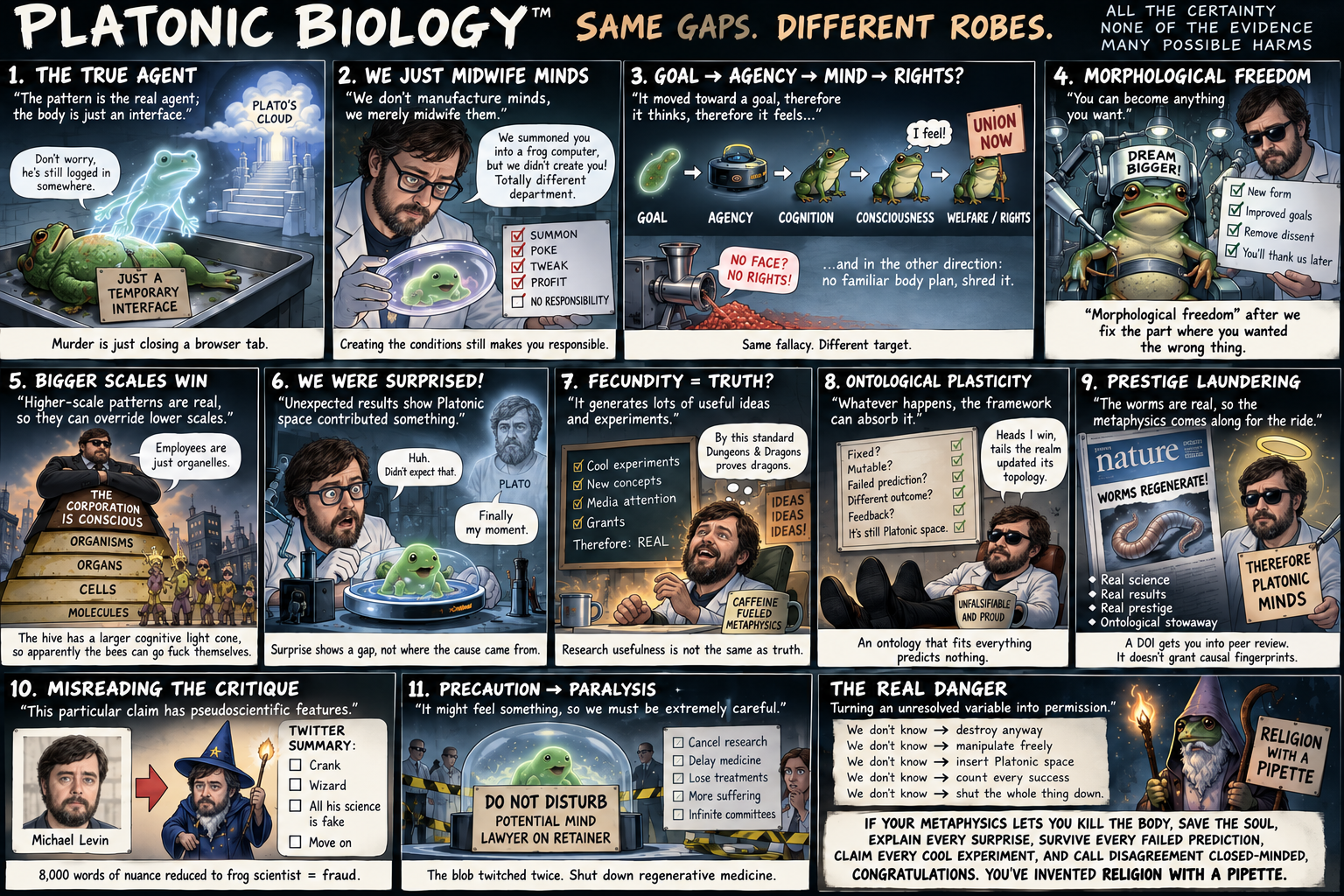
The cover image is a bit on the polemic side, on purpose, because the potential for harm is very real.
The underlying rule is not. The worms have earned their place in biology. Platonic ingress has not yet earned a lab badge. If it wants one, the route is open: arrive before the surprise, constrain what happens next, outperform serious rivals on a target that actually discriminates among them, and risk losing.
The rest of the article is just showing the peer-reviewed scholarship, arguments, and evidence that supports these conclusions. I openly welcome criticism, corrections, and any counter-arguments anyone thinks I might have missed! Including from Michael Levin, or any of the scholars associated with his Platonic Symposium, several of whom I have already been in regular contact with since last November. If you think I got anything wrong, please show me so I can revise my article accordingly.
Michael Levin has now made the Platonic proposal definite enough to test. In his paper Ingressing Minds: Causal, Non-Physical Patterns In-Form Natural, Synthetic, and Hybrid Embodiments, living and synthetic systems can be informed by patterns from a structured nonphysical domain; those patterns can matter causally; some can be minds; bodies can function as interfaces through which they ingress. The relevant question concerns the specifically Platonic addition: what does it earn beyond the biology, mathematics, dynamics, and organization already on the table?
I call the shared empirical and explanatory package D. It includes the worms, morphologies, bioelectric interventions, attractors, behavioral competencies, higher-level constraints, mathematical relations, and whatever causal organization rival accounts can jointly address while disagreeing about ultimate ontology. Levin adds P: a structured nonphysical domain whose patterns can causally contribute to those outcomes and can include minds. The local comparison is D versus D+P. If removing P leaves the target intact, P has not earned credit for that target. If adding P changes a prediction, intervention, constraint, compression, or successful transfer, there is something to measure.
I will grant Levin far more than a reductive critic needs to grant: genuine higher-level causation, mathematical explanation, multiple realization, robust agency at unfamiliar boundaries, and even mathematical realism for the sake of argument. Weirdness is irrelevant to the charge. It is an audit of the extra passenger.
PART I
The extra passenger: what does P actually add?
My corrections first: what actually needs correcting
My article I wrote back in March, Institutional Capture & Diverse Intelligence, needs four specific repairs: its opening conclusion outran the comparative result established in the body in a way my argument didn’t require; the Landauer wording made a conditional thermodynamic argument sound like a universal maintenance cost if not read carefully; Popper received too much credit for a broader family of error-exposing methods; and one sentence compressed Lakatos’s programme-level criterion too aggressively. The rest of the methodological baseline already contained the structural, process-relational, and second-order falsification arguments this article still uses.
First, the conclusion. I opened March with: “Michael Levin’s bioelectric findings are real. The Platonic interpretation riding them is not.” The body earned a comparative result instead: the experiments left the specifically Platonic addition without explanatory or empirical credit unavailable to serious rivals. The corrected sentence is: Levin’s bioelectric findings are real. His experiments have not yet established the Platonic interpretation riding them.
The heading “The Falsification That Already Happened” needs the same scope control. Durant directly pressures a specific biological implication: pre-existing forms functioning as privileged morphogenetic targets. A transient physiological intervention produced a stable alternative regenerative target across repeated amputations. Broad P can absorb the two-headed form as another previously unmapped Platonic form, but that repair reduces the experiment’s discriminatory force unless the revised morphospace adds prospective topology, probabilities, forbidden or disfavored transitions, or another independently specified constraint. The correction narrows the target while preserving the biological challenge.
The March baseline was already structural and process-relational. I wrote that “the alternative I have been articulating throughout this exchange is not physicalism at all. The position is structural realism,” and described falsificationism as “a second-order methodology, evaluated by the progressive or degenerating character of the research programmes it generates.” The present D-versus-D-plus-P comparison simply thins that strategy further by removing auxiliary ontology. The resulting question is harder to evade: what distinctive work does P itself do?
For the full audit of what changed in my own thermodynamic framework, what survived, and why I demoted it from umbrella ontology to a corrigible research programme, see What Is Thermodynamic Monism? Auditing My Own Framework—September 2026 Revisions and Clarifications.
Second, Landauer. My March wording made a conditional thermodynamic argument sound like a universal surcharge. The stronger version is this: if P causally alters a physically instantiated information-processing system, D+P must differ from D somewhere in the system’s physical state transitions, reachable states, trajectories, outcome probabilities, controllability, or another reproducible counterfactual. A P-dependent effect may appear in those variables without appearing as an extra packet of heat. Where the physical operation specifically includes information erasure or many-to-one resetting, its thermodynamic treatment must be stated explicitly. Standard one-bit erasure protocols and strong-erasure conditions are where Landauer-type bounds become directly relevant; generalized formulations depend on the physical implementation, input statistics, state energies and entropies, environmental coupling, and thermodynamic boundary conditions.
Source fidelity: what the Landauer literature actually says
Bérut et al. (2012), experimental one-bit erasure:
“In 1961, Rolf Landauer argued that the erasure of information is a dissipative process.”
“This result demonstrates the intimate link between information theory and thermodynamics.”Bérut et al., Nature 483, 187–189 (2012)
The experiment establishes the Landauer bound for the physical one-bit erasure protocol they tested, approaching the bound in the slow-erasure limit. It does not establish a context-free maintenance charge on every distinction or every causal relation.
Maroney (2009), generalized Landauer treatment:
“Landauer’s principle holds a special place in the thermodynamics of computation.”
“The equality can, of course, only be reached in the limit of slow processes.”Maroney, Physical Review E 79, 031105 (2009)
Maroney’s generalized treatment is exactly why I should not attach a universal kT ln 2 toll to logical irreversibility in the abstract. The familiar formulas arise under additional assumptions about the physical realization, distributions, energies, entropies, and bath conditions.
Norton (2025), strong versus weak erasure:
“Purely thermodynamic considerations show that strong erasure cannot be dissipationless.”
“Locally, the data would be erased, but not globally.”Norton, Philosophy of Physics 3(1):3 (2025)
Norton’s distinction matters because an apparent local many-to-one operation may relocate information rather than globally erase it. Before assigning a lower bound, the physical erasure procedure and system-environment boundary have to be specified.
Stanford Encyclopedia of Philosophy, interventionism:
“Interventionist theories are intended both as theories of causation and of causal explanation.”
“A randomized experiment provides one paradigm of an intervention.”Stanford Encyclopedia of Philosophy, “Causal Approaches to Scientific Explanation”
The relevant causal burden is therefore difference-making, not a metaphysical surcharge. On the Woodward-style interventionist account summarized there, changing a cause must change the effect or its probability distribution under an appropriate intervention; abstractness alone does not disqualify a cause.
That yields the stronger March argument: P must be a genuine difference-maker. No mysterious packet of heat from Platonic space is required. If P changes a biological outcome, D+P and D alone must differ somewhere in the physically realized counterfactual structure: reachable states, transition probabilities, trajectories, controllability, outcome distributions, or another reproducible consequence. If the P-dependent difference includes erasure or irreversible information processing, that physical implementation belongs inside the appropriate thermodynamic accounting. Landauer occupies that conditional branch of the argument. The thermodynamic question becomes: what physical difference does P make, and when that difference includes erasure or irreversible information processing, how does the implementation close its thermodynamic books? A distinctive heat signature is optional; a P-specific physical difference is compulsory if “causal ingress” is meant literally.
Third, Popper. The March article already treated falsificationism as a second-order methodology that could be appraised by the performance of the practices it recommends. The actual overreach was credit assignment. I wrote that “Popper’s criterion has been tested across centuries of scientific practice” and then let the history of science, Tetlock’s forecasting work, replication research, and evidence-based medicine accumulate too neatly under that one label. Those literatures support explicit prediction, calibration, replication, severe testing, scored error, and disciplined revision through partly different mechanisms. Tetlock directly supports forecasting and calibration; replication research supports reproducibility and methodological rigor; evidence-based medicine adds controlled comparison and evidence synthesis; Mayo supplies a distinct severe-testing framework. Popper belongs in that family of error-exposing practices, but he does not own all of their successes.
The correction broadens the challenge to P. Levin can reject Popper’s demarcation project and still face Bayesian comparison, severe testing, interventionism, predictive scoring, replication, or Lakatosian programme appraisal. Each asks in its own way how evidence should change P’s relative standing. So the live question is: what observation, failed intervention, comparative prediction, or accumulating pattern of results should leave P worse off than it was before? Foster’s “I simply have a less Popperian approach than you do” left that update rule unspecified in our exchange.
For the broader methodology behind that question:
How Can Reality Tell Our Metaphysics “No”? What Does a Metaphysical Claim Have to Do to Earn Its Keep?
This develops the claim-neutral problem of how an added metaphysical commitment earns credit, acquires loss conditions, and updates without taking the shared empirical carrier down with it.
https://sweetlyrational.substack.com/p/how-can-reality-tell-our-metaphysics
Fourth, Lakatos. My sentence “Growth without novel empirical predictions is degeneration, full stop” compressed a programme-level comparison too aggressively. Lakatos evaluates sequences of theories and distinguishes theoretical from empirical progress. A theoretically progressive shift adds excess empirical content; an empirically progressive shift gets some of that excess corroborated. The two-headed-worm repair therefore faces a precise question: what fresh empirical exposure did “perhaps this is another previously unmapped form” buy after the result? A future revision can earn credit by fixing a topology of reachable forms, strongly disfavored transitions, prior probabilities, intervention-sensitive pathways, or another prospective constraint. A catalogue that simply expands after each novel morphology preserves logical possibility while surrendering the outcome discrimination that could have supported the biological claim.
After those corrections, the central comparison survives without needing the overstatements. The March article already had the important architecture: rich non-Platonic accounts could recover much of the biology, and empirical success for that shared biology did not automatically establish the specifically Platonic addition. The present article makes that comparison cleaner. D is thinner, the rival set is broader, Landauer is confined to the irreversible-information case inside a broader difference-making and thermodynamic-accounting argument, methodological error-exposure is no longer credited wholesale to Popper, Lakatos is stated at programme scale, and institutional analysis stays with public evidence.
What remains is the question that mattered from the beginning, and which every scholar connected to Levin’s Platonic Symposium that I have been communicating with nearly a year now has been unable to tell me: what distinctive work does P do?
Where the biology ends and the extra passenger boards
I can make Levin’s argument much easier to test by splitting it into steps. At the bottom are results already familiar in biology and philosophy of science: robust higher-level organization, multiple realization, attractors and basins, mathematical constraints, and experimentally tractable bioelectric control. Call that shared package D.
Bioelectric networks can participate in distributed control of morphology. Synthetic biological constructs can display coherent behaviors that were not individually selected in their new configuration. Call this large empirical and theoretical package D. Then Levin adds a stronger package, call it P. P says that there is a structured nonphysical space of patterns, that at least some of those patterns are causally active with respect to physical systems, that interaction is probably bidirectional, that the patterns span a spectrum from static mathematical truths to minds, and that bodies can operate as interfaces through which those patterns ingress (Levin 2026).
D is only the local overlap for the targets under comparison. A Whiteheadian, powers theorist, structural realist, dynamical biologist, and Platonist can interpret D very differently while agreeing on the worms, morphologies, interventions, attractors, and measured outcomes. That overlap is enough to ask what P adds.
So the live comparison is D versus D plus P. Almost every empirical example Levin cites already supports some part of D. P earns additional credit where it changes a prediction, intervention, modal constraint, explanatory compression, or other target-relative result. When the shared evidence does not yet separate the accounts, I stop the empirical credit there and keep the larger metaphysical question open.
The ablation is deliberately local. If a target survives removal of P, then P was unnecessary for that target. Ranking complete cosmologies would require a complete comparison with explicit criteria, costs, and gains. Here the smaller job comes first: an addition earns necessity only where the target depends on it.
Grant higher-level structure as much reality as the evidence can carry, then ask what changes when the specifically Platonic addition is introduced. Johannes Jaeger’s commentary on Assembly Theory gives us almost the exact methodological distinction this argument needs. He is perfectly willing to let higher-level organization be real enough to detect and causally consequential enough to measure, while refusing to pretend that the detector has thereby told us what the higher level is. Jaeger writes:
“Applied to the natural world, the metrics it proposes may allow us to detect whether levels of organization above the basic laws of physics have emerged in an observed system, and to estimate the causal influence of these higher levels on the underlying dynamics. As an added bonus, assembly theory manages all this without having to assume anything specific about what those higher levels of organization actually are. To me, this sounds interesting and potentially useful. We should not dismiss the work outright and, despite our skepticism, give the theory a fair chance to prove its worth.
On the downside, there are several serious problems that stem from the framing and presentation of the argument in the paper, the hype the authors have generated around it (online and in peer-reviewed print), and their problematic and overextended interpretation of the model.”
(Jaeger 2024a; DOI) Jaeger gives me exactly the stopping point I need: the measure can support objective higher-level organization and causal influence while leaving the source ontology underdetermined. Levin’s biology currently earns the organization. P begins where the extra discriminator begins. Written plainly, that sounds almost embarrassingly obvious. Metaphysical arguments are unusually good at taking obvious distinctions, putting a fake mustache on them, and walking them past security.
The rivals are already in the bibliography. Mostly they are not put in the ring.
Before asking whether P wins, ask which serious rival it beats. Ingressing Minds is not short of relevant literature. The striking problem is comparative: many of the strongest alternatives are cited, grouped as background, or saved for future integration without being made to compete with P on the biological targets that are supposed to motivate P in the first place. A rival in the reference list is not a rival answered.
There is useful provenance here. This comparative challenge did not originate after I read Ingressing Minds. In February 2026, after Levin and David B. Resnik published Mind Everywhere, I documented that I had already put Montévil and Mossio’s organizational closure, Deacon’s teleodynamics, Friston’s free-energy framework, Kauffman’s constraint and self-organization work, mathematical structuralism, and thermodynamic accounting forward as concrete alternatives, and had repeatedly asked what the stronger metaphysical layer predicted that those accounts did not. Ingressing Minds improves on that earlier situation in one important respect: many of these research traditions now appear in its bibliography. The unresolved problem has therefore become sharper. In February the problem was that the strongest rivals were missing. In September many of them arrived in the bibliography. They still were not made to lose. Citation establishes that an alternative exists. Comparative evidence is what would establish that P does better.
See the earlier provenance of that rival-model challenge:
“Mind Everywhere” by Michael Levin & David B. Resnik: The Paper I Predicted
Documents the rival frameworks and differential-testing questions I had raised before the earlier Mind Everywhere paper appeared. The present article updates and narrows several of those earlier formulations while preserving the comparative burden they were aiming at.
https://sweetrationalism.com/articles/biology/bioelectricity-morphogenesis/mind-everywhere-by-michael-levin-david-b-resnik-the-paper-i-predicted/
Start with emergence. Levin cites Sean Carroll and Achyuth Parola on what emergence can mean, and the formal causal-emergence work of Pedro Mediano, Fernando Rosas, Anil Seth and colleagues, including Reconciling emergences: An information-theoretic approach to identify causal emergence in multivariate data. Those papers do not define emergence as intellectual surrender. Rosas and colleagues develop a quantitative method for identifying higher-scale causal structure in multivariate systems. Yet Levin’s operative contrast describes the emergentist as accepting that patterns simply appear and that “there is no further source to be sought.” That may describe one weak use of the word. It does not dispose of the stronger accounts already sitting in his bibliography.
The same pattern appears with constraint, process, and biological organization. The references include Biological organisation as closure of constraints by Maël Montévil and Matteo Mossio; James Woodward’s interventionist causation; William Bechtel and James Winning on constraints and control; Alicia Juarrero on context-sensitive constraint; Terrence Deacon on thermodynamic teleology; Stuart Kauffman and Andreas Wagner on self-organization, adjacent possibility, and evolutionary novelty; and Everything Flows: Towards a Processual Philosophy of Biology, edited by Daniel Nicholson and John Dupré. These are not merely softer versions of reductive mechanism. They are precisely the kinds of accounts that can grant higher-level organization, path dependence, novelty, teleology-like behavior, and real causal structure without yet adding a causally interacting Platonic domain. On page 37 Levin proposes eventually unifying his framework with work on top-down causation and with Kauffman, Wagner, Juarrero, Deacon, and others. That is a useful research proposal. It leaves the prior comparative question untouched: if those accounts already recover the target, what observable or explanatory work remains uniquely P’s?
The gap is sharpest at two load-bearing bridges. On causation, Levin cites Pearl, Woodward, Hall, Spirtes, Glymour and Scheines, yet defines cause broadly enough to include “the most insightful” explanation and says the deeper causation issue will be handled in a future paper. On mathematical explanation, he cites Alan Baker, Marc Lange, Bradford Skow, Lauren Ross, Øystein Linnebo, Penelope Maddy, Paolo Mancosu, Hartry Field and others, but does not stage the comparison that matters here: mathematical explanation or realism on one side, additional cross-domain causal ingress on the other. Those are different commitments. The paper’s own bibliography contains much of the machinery needed to keep them separate.
Levin acknowledges the omission directly in note 21: the “very rich recent literature on causality, emergence, the metaphysics of biology, information theory, the philosophy of mathematics, and philosophy of mind is relevant here,” while “space limitations prevent me from engaging with all of it here.” No paper can answer everything. This one does need the strongest rivals at the points where it moves from biology to ontology, because those rivals determine whether P is an empirical addition or an optional interpretation of results they already explain. The question I will keep asking through the rest of this article is therefore narrower than “is Platonism false?”: which result is better explained, predicted, controlled, or compressed by D+P than by the strongest D-only rival already cited in Levin’s own paper?
Two especially relevant comparison families are barely visible or absent as such: naturalistic structural realism and mathematical structuralism. They matter because they can take structure and mathematics seriously without turning explanatory structure into traffic from a second causal realm. If P beats them, the place to show it is at the bridge. If it does not, the experiment has not yet chosen between them.
One venue question is worth asking
Levin’s empirical work has appeared in specialist and highly selective venues, including Nature Reviews Molecular Cell Biology and Biophysical Journal. Yet interestingly, the much stronger metaphysical claims in Ingressing Minds appeared in Philosophies, a broad-scope, open-access philosophy journal published by MDPI known to be far less specialized and selective. MDPI’s editorial model has also been the subject of sustained scholarly and institutional scrutiny. Jeffrey Beall’s Research Evaluation analysis by M. Ángeles Oviedo-García raised questions about rapid review, special-issue volume, APC incentives, citation practices, and quality assurance across MDPI journals. The first version of that article was challenged, placed under an expression of concern, and retracted and replaced with a revised version. More recently, Finland’s Publication Forum, drawing on discipline-specific expert panels and research-community feedback, downgraded many MDPI and Frontiers journals over concerns that high-volume APC publishing can outrun careful quality assessment, while retaining or later restoring other titles. That history makes the review process worth inspecting rather than treating peer-reviewed as an evidential endpoint. The useful questions are which P-specific claims were independently challenged, which rivals were excluded, and what evidential work the published argument actually performs.
The paper’s publication record is unusually easy to inspect and equally interesting: it was received on 1 June 2026, revised on 31 July, accepted on 3 August, and published on 9 September. The two-day revision-to-acceptance interval makes the Socratic question concrete: when a paper tells us that we “already know” a nonphysical domain causally ingresses into biology, what did peer review independently establish about that ontology? The answer has to come from the discriminating argument and evidence: what P uniquely predicts, what rivals lose, and what result would lower P’s standing. None of that has been provided by Levin at this point.
You do not need a ghost to get real causation
I want the skeptical side to carry a positive causal story into this comparison. Otherwise Levin gets an easy opponent: equations and correlations on one side, concrete causal production on the other. The literature gives us richer rivals.
Several of those rivals are not reductive physicalisms at all. Powers, process, organizational, structural, neutral, or experiential interpretations can disagree sharply about what reality ultimately is while still recovering the same tested causal organization without Levin’s P. Logically, rejecting one physicalism leaves the rest of the rival field standing. A successful critique of one physicalist ontology would leave many live alternatives unless a further bridge selects P.
Mechanism, powers, process, organizational, and interventionist traditions supply several pieces. Machamer, Darden, and Craver model productive change through organized entities and activities (Machamer, Darden and Craver 2000). Mumford and Anjum emphasize powers and tendencies (Mumford and Anjum 2011). Dupré treats causal interaction as capacities exercised by persisting processes (Dupré 2021), and Esser develops a cross-domain process account in which dispositions persist and mutually manifest through interactions (Esser 2026). Montévil and Mossio add scale-sensitive constraints; Woodward adds intervention-sensitive difference-making. I use these as a rival family at specified targets, not as one synthetic final metaphysics.
At a specified boundary and timescale, causal actuality can be characterized through concrete processes, capacities, organizational constraints, and actual or counterfactual transformations whose differences change what can occur.
The rival family already supplies production, powers, constraint, persistence, and difference-making before P enters. The incremental question is therefore straightforward: what does the specifically Platonic content explain, constrain, predict, unify, or compress beyond that baseline?
A Platonist can reinterpret those mechanisms, powers, processes, or constraints through P. The useful test is whether some P-specific feature carries explanatory weight that disappears when P is removed. If the translation preserves only generic production or modal structure, the rival has not silently become Platonic; the distinctive content still needs its own bridge. The full comparative source audit, positive causal synthesis, and transport test behind this argument are developed here:
Causal Actuality Without Prehension
The full comparative source audit behind the D versus D+P baseline used here, testing whether positive causal explanation requires a specifically experiential or other extra metaphysical premise.
https://sweetrationalism.com/wp-content/uploads/2026/09/Causal_Actuality_Without_Prehension_v1_0.pdf
Montévil and Mossio are especially useful here because they give me a concrete account of higher-level causal organization rather than a slogan. Their abstract states the proposal compactly: They open the paper by spelling out what they mean by biological self-determination:
“We propose a conceptual and formal characterisation of biological organisation as a closure of constraints. We first establish a distinction between two causal regimes at work in biological systems: processes, which refer to the whole set of changes occurring in non-equilibrium open thermodynamic conditions; and constraints, those entities which, while acting upon the processes, exhibit some form of conservation (symmetry) at the relevant time scales. We then argue that, in biological systems, constraints realise closure, i.e. mutual dependence such that they both depend on and contribute to maintaining each other. With this characterisation in hand, we discuss how organisational closure can provide an operational tool for marking the boundaries between interacting biological systems.”
“In Theoretical Biology, an enduring tradition has placed heavy emphasis on the idea that biological systems realise what could be referred to as ‘self-determination’. That is, in very general terms, the capacity of a system’s constitutive organisation to contribute to the determination and maintenance of its own conditions of existence through the effects of its activity.”
(Montévil & Mossio 2015; author-hosted PDF; DOI) That already gets us much of the vocabulary that makes Levin’s picture attractive: a system can participate in maintaining the very conditions under which it continues to exist. Montévil and Mossio do not leave the phrase floating at the level of organismic poetry. Their bridge runs through work and constraint: They then define the relevant causal role rather than merely naming it:
“When a (W-C) cycle is realised, constraints which apply to the system are not independently given (as in the Carnot engine) but rather are produced and maintained by the system itself. Hence, the system needs to use the work generated by the constraints in order to generate those very constraints, by establishing a mutual relationship, i.e. a cycle, between constraints and work.
In a fundamental sense, the account of closure that we provide in this paper lies at the intersection between Rosen’s and Kauffman’s proposals. In particular, our central thesis is that organisational closure should be understood as closure of constraints, a regime of causation which is at the same time distinct from – and related to – the underlying causal regime of thermodynamic openness.”
“What do we mean by constraints? In contrast to fundamental physical equations and their underlying symmetries, constraints are contingent causes, exerted by specific structures or dynamics, which reduce the degrees of freedom of the system on which they act. As additional causes, they simplify (or change) the description of the system, and enable an adequate explanation of its behaviour to be provided, an explanation which might otherwise be under-determined or wrongly determined.”
I use this passage positively: Montévil and Mossio give higher-level organization a causal role through structures, dynamics, dependencies, boundary conditions, and timescales. Their account lets me grant much of the causal richness Levin wants before I decide what ontology ultimately supplies it. One sentence is especially useful whenever biology is forced toward a privileged scale:
“Secondly, closure should be clearly distinguished from independence, insofar as a system which realises closure is a physically open system, inherently coupled to the environment with which it exchanges energy and matter. This implies in particular that closure is a context-dependent determination, to the extent that it is always realised with respect to a set of specific boundary conditions, which includes several external (and independent) constraints acting on the system.”
“Moreover, as mentioned, constraints are such at different time scales, which means that closure is a multiscale causal regime.”
Batterman reaches the same pressure point from another direction. Higher-level regularities can remain robust across very different lower-level realizations, and explaining that robustness can require attention to the macro-pattern itself:
“I believe that the real challenge posed by the possibility of multiple realizability is to provide an answer the following question:
(MR) How can systems that are heterogeneous at some (typically) micro-scale exhibit the same pattern of behavior at the macro-scale?
Note the this question refers to a macroscopic pattern of behavior. This is important. Patterns are repeatable and relatively robust phenomena. So (MR) is asking for an account of a repeatable, relatively stable phenomenon. As such the question concerns the very possibility of this stability under variations in lower-scale detail.”
For Batterman, the explanatory target is precisely the stability under micro-level variation. The earned autonomy lies exactly in that invariance: Batterman states the reductionism dispute directly:
“I suggest that the only way to answer this is to provide an account of why the details that genuinely distinguish these systems from one another at smaller scales (details that tell us that the microstructure of iron and aluminum are genuinely distinct), are irrelevant for the macroscopic behavior of interest. In doing this one is able to demonstrate that the macroscopic behavior is stable under changes in the microscopic details. And, with the demonstration of that stability, one can understand how it is that the macro behavior is relatively autonomous from the micro details.”
“The multiple realizability argument challenges the reductionist claims expressed in (i) and (ii) by highlighting the autonomy of the higher-level (geometric) explanation from the lower-level (very different) micro-based explanations stemming from the microscopic details of the iron and aluminum boards and pegs.”
(Batterman 2018; DOI) I therefore grant Levin the part of the argument that matters most: microscopic completeness does not guarantee the best explanation of a robust biological regularity. The remaining Platonic steps are ontological independence, nonphysical existence, and cross-domain interaction. Those are exactly the steps P has to earn.
A theorem is not a travel visa
Levin’s mathematical argument is interesting because he is asking for more than “the universe is mathematical.” His cicada example points to a genuine fact: prime-number structure can matter to why some biological periods are favored. Alan Baker is the right pressure test because he grants genuine mathematical explanation and even thinks it can support mathematical realism. That lets me give Levin a strong antecedent before asking what kind of causal relation follows.
“According to the causal account, explaining a phenomenon involves giving a description of its various causes. Clearly this account is incompatible with the existence of any genuine mathematical explanations, since mathematical objects (if they exist) are acausal. Hence this account is not helpful for the current debate since to adopt this account is effectively to beg the question against the platonist.”
Baker then turns to a pragmatic account of explanation rather than pretending that the only respectable explanation must be an efficient-causal chain:
“According to the pragmatic account, explaining a phenomenon involves providing an answer to a ‘why’-question which shows how the phenomenon is more likely than its alternatives. This is the sketchiest of the three accounts, but perhaps also the most useful in the present context. It suggests that genuinely explanatory applications of mathematics ought to be reconfigurable as answers to questions about why a certain physical phenomenon occurred. This parallels cases of explanation involving concrete theoretical posits, which are unproblematic common ground for both platonists and nominalists in the indispensability debate. Why is the light from certain distant galaxies getting bent? Because there is a black hole between us and the distant galaxies. Why do periodical cicadas have prime periods? Because prime numbers minimize their frequency of intersection with other period lengths. In each case we have a naturally motivated why-question paired up with a (partial) answer. And in each case the answer seems genuinely explanatory.”
(Baker 2005; DOI) The cicada case itself is worth giving in Baker’s own compact form because it shows what the mathematics actually contributes: And Baker is not shy about the metaphysical conclusion he thinks this supports:
“The basic structure common to the predation and hybridization explanations is as follows;
- Having a life-cycle period which minimizes intersection with other (nearby / lower) periods is evolutionarily advantageous. [biological ‘law’]
- Prime periods minimize intersection (compared to non-prime periods). [number theoretic theorem]
- Hence organisms with periodic life-cycles are likely to evolve periods that are prime. [‘mixed’ biological / mathematical law]”
“I have argued that there are genuine mathematical explanations of physical phenomena, and that the explanation of the prime cycle lengths of periodical cicadas using number theory is one example of such. If this is right, then applying inference to the best explanation in the cicada example yields the conclusion that numbers exist.”
Baker lets me grant mathematical explanation, and perhaps realism about numbers, without collapsing explanation into efficient-causal traffic between domains. Marc Lange’s work on explanation by constraint pushes the same point: a theorem or modal constraint can explain why a phenomenon has the structure it does even when the explanatory relation is not a local push-pull history.
So I keep the relations typed separately: “X explains Y” and “X causally transmits influence into Y from another domain” make different commitments. Sliding between them can turn a theorem into a travel visa. The cicadas need heritable periodicity, ecological interaction, differential survival or reproduction, and a mathematical relation showing why some periods reduce intersection with others.
A space on paper is not yet a place
The word space does a lot of work here. Biology already uses morphospaces, fitness landscapes, phase spaces, configuration spaces, and latent spaces; physics uses state spaces that organize real possibilities without behaving like ordinary locations. I want to know what extra step turns a successful formal space into Levin’s causally inhabited nonphysical domain. Jaeger and Monk provide a useful benchmark because they show how an abstract biological space can earn scientific content through variables, trajectories, perturbations, and predictions.
“In this paper, we illustrate how dynamical systems theory can provide a unifying conceptual framework for evolution of biological regulatory systems. Our argument is that the genotype–phenotype map can be characterized by the phase portrait of the underlying regulatory process. The features of this portrait – such as attractors with associated basins and their bifurcations – define the regulatory and evolutionary potential of a system. We show how the geometric analysis of phase space connects Waddington’s epigenetic landscape to recent computational approaches for the study of robustness and evolvability in network evolution. We discuss how the geometry of phase space determines the probability of possible phenotypic transitions. Finally, we demonstrate how the active, self-organizing role of the environment in phenotypic evolution can be understood in terms of dynamical systems concepts. This approach yields mechanistic explanations that go beyond insights based on the simulation of evolving regulatory networks alone. Its predictions can now be tested by studying specific, experimentally tractable regulatory systems using the tools of modern systems biology.”
(Jaeger & Monk 2014; DOI) Their discussion of Waddington is especially useful because it marks the exact point where a suggestive image has not yet become a mechanism:
“Waddington admonished his readers on several occasions that his landscape is intended to apply at a metaphorical level only. It is not supposed to be mechanistically rigorous. This point has been criticized by several authors as it limits the applicability of the concept in an empirical setting. It is difficult to measure a metaphor, after all.”
The trustworthy progression is empirical: metaphor first, measurable variables and mappings next, then predictions, perturbations, and only as much realism as the stable structure earns. Jaeger and Monk also keep the programme empirical rather than pretending the full possibility space has been written down in advance:
“Based on this last point, we need to emphasize that our conceptual framework does not provide a general theory from which we can derive all possible regulatory behaviours. Instead, we propose a more empirical research programme to explore the space of possible phase space geometries from specific, real world instances. Phase space analysis could be used in the near future to gain new insights into models of evolving regulatory processes such as cell cycle regulation, microbial metabolism and physiology, stem cell differentiation, or aspects of development such as axis formation and segmentation in arthropods, vertebrate limb development and somitogenesis, and pattern formation in plant roots, stems and leaves. Only by examining a large number of such systems will we be able to derive general insights into potential regularities or rules that govern biological regulatory dynamics.”
Levin adds another rung: the structured space becomes a distinct nonphysical domain with causal residents. Levin may eventually justify the extra ontological rung, but useful geometry cannot do the job by itself. Otherwise the grammar does a small magic trick: give relations a metric, call the result a space, and before long the prose sounds as though somebody discovered a place. The structure may be profoundly real. The causal address is the extra claim.
When “Platonic space” loses its specifically Platonic content
“Platonic space” has a thin reading and a thick one. The thin reading covers possibility structure, attractor geometry, counterfactual constraint, latent organization, and morphological option spaces. Biology can support those directly. The thick reading in Ingressing Minds adds ontological independence, nonphysical existence, causal ingress, and minds as inhabitants or patterns of that domain.
Much confusion disappears once those versions stop sharing a passport. A measurable morphospace can be scientifically useful without being a separate nonphysical realm. A formal constraint can be real in the explanatory sense without becoming an extra interacting cause. If the term contracts to the thin reading under pressure and expands to the thick reading when conclusions are drawn, the word has done work the evidence did not.
The transport test is simple: which feature made the source explanation better, and is that same feature doing work at the target? Morphological memory, path dependence, and attraction toward a stable state may earn credit in an experiment. Nonphysicality and mindhood inherit none of it until one of those properties changes the result. The name can travel freely. The evidence cannot.
See my recent article that develops this same transport problem directly:
What Warrants the Scope Jump?
A direct treatment of what earns local explanatory credit and what additional bridge is required before that credit can be exported to a wider metaphysical claim.
https://sweetlyrational.substack.com/p/what-warrants-the-scope-jump
PART II
The gap does not name its cause
The metaphysics has already left the lab
The danger appears when confidence properly earned by the science is appropriated as warrant for the metaphysics, then carried into conclusions or decisions the experiments never licensed. Successful science is an unusually powerful vehicle for this because nobody has to counterfeit the prestige. The prestige is genuine. The unsupported part travels with it.
Ingressing Minds gives us a live example. Levin does not stay with “this ontology may be worth exploring.” He writes that “we already know” nonphysical patterns ingress into physical systems, treats unexplained competency as directly revealing what is obtained from Platonic space, and then says he cannot distinguish the space as metaphysical entity from the space as epistemological framework. Readers therefore receive excellent experimental biology and categorical ontological language in the same package. A careful philosopher can unpack it. A headline usually will not.
Pete Mandik captured the reception satirically when he asked for writing about Levin that was sufficiently “credulous and gushing,” with bonus points for DMT machine elves. The joke worked because the downstream path already existed: essays were already moving from Levin’s proposal to psychedelic entities, cognospheres, cosmic purpose, and altered states as possible interfaces with other minds.
Pete Mandik’s note on the reception of Levin’s Platonic claims
A satirical reception marker showing that the move from Levin’s scientific authority to increasingly speculative metaphysical readings was already visible to outside observers.
https://substack.com/@petemandik/note/c-336955726
Eli Stark-Elster supplies the far end of that chain: psychedelic entities and Levin’s framework become reasons to consider surveying a wider “cognosphere” through DMT, sensory deprivation, and trance. That essay shows what the combined package invites; it tells us nothing about Levin’s intent. Brady Dale gives us an intermediate case in Michael Levin Is the Most Interesting Person Alive. Dale explicitly says he will proceed as if Levin is onto something because repeating the caveats would make worse reading. The caveats then disappear exactly as advertised, and an experimental research programme becomes an unexplored quadrant of reality in which the universe may be “whispering” through humans, turtles, and vacuum cleaners (Dale 2026).
Michael Levin Made Me Believe in Gods
Eli Stark-Elster’s essay is a concrete downstream example of Levin’s framework being extended from biological research into claims about psychedelic entities and a wider “cognosphere.”
https://unpublishablepapers.substack.com/p/michael-levin-made-me-believe-in
I call the mechanism inferential-distance laundering. Xenobots support claims about what cells do in novel configurations. Sorting systems can reveal surprising implementation-level behavior. A phenotype can expose a bad model. Each result has a legitimate evidential radius. Cross enough extra bridges quickly enough and the remote conclusion inherits the emotional authority of the original experiment. By the end, “cells surprised us” has become “nonphysical minds may be entering matter,” while the missing intermediate warrants have vanished in the scenery.
See my recent article applying the same evidential-transport audit to a different metaphysical programme:
Matthew Segall’s Words Made Flesh Again, but the Evidence Never Said That?
It examines how good empirical science can lend prestige to a metaphysical conclusion that the cited evidence does not uniquely establish.
https://sweetlyrational.substack.com/p/matthew-segalls-words-made-flesh
Fecundity belongs on its own ledger. Platonic interactionism is already fertile as an idea-generator; cognospheres, altered-state surveys, cosmic-purpose questions, and new experimental programmes appear readily. Fertility can be scientifically valuable even when the ontology is false. Confirmation is another matter. A metaphor may generate a research programme without becoming one of the things discovered by that programme.
Surprise is a confession about the model, not a forwarding address
Levin’s “free lunch” intuition starts from a real phenomenon: simple systems can display competencies their designers did not explicitly put in. That should make us suspicious of our accounting. It should not make us clairvoyant about what the missing term is.
Unexpected behavior can come from hidden dependencies, global consequences of known rules, path dependence, implementation detail, boundary choice, attractor structure, environmental coupling, organizational constraints, or a bad observer model. P is another candidate. Surprise tells us the baseline missed something. The payer remains unknown.
Jaeger’s discussion of Assembly Theory supplies the right stopping rule. A metric may detect higher-level organization and even estimate its causal influence without telling us what that higher-level organization ultimately is. The same discipline belongs here. Before explaining a “free lunch,” find out who already paid.
The competency delta could become valuable evidence once its source is independently tracked. Define a P-linked variable, relation, topology, or invariant before the residual is observed. Show that it predicts where the excess competency should appear, where it should fail, or how an intervention should alter it. Otherwise the residual has been christened, not explained.
Do not smuggle a mind up the ladder
The word mind arrives late in Ingressing Minds, after goal-directedness, agency, intelligence, pattern, policy, memory, and embodiment have already done a lot of work. I want those capacities factored before I let them climb the same ladder. Roli, Jaeger, and Kauffman give us one explicit organizational notion of agency: They then state the organizational requirement they think turns internally generated action into agency:
“Here, we must emphasize again that our use of the term ‘choice’ does not imply consciousness, awareness, mental states, or even cognition, which we take to involve at least some primitive kind of nervous system. It simply amounts to a system which is capable of selecting from a more or less diversified repertoire of alternative dynamic behaviors (‘actions’) that are at its disposal in a given situation. All forms of life—from simple bacteria to sophisticated humans—have this capability. The most central distinction to be made here is that the selection of a specific behavior is not purely reactive, not entirely determined by environmental conditions, but (at least partially) originates from and depends on the internal organization of the system making the selection. This implies some basic kind of agency. In its broadest sense, ‘agency’ denotes the ability of a system to initiate actions from within its own boundaries, causing effects that emanate from its own internal dynamics.”
“Agency requires a certain type of functional organization. More specifically, it requires organizational closure, which leads to autopoietic (i.e., self-making, self-maintaining, and self-repairing) capabilities. It also leads to self-determination through self-constraint: by maintaining organizational closure, an organism is constantly providing the conditions for its own continued existence.”
(Roli, Jaeger and Kauffman 2022; DOI) Jaeger’s “Fourth Perspective” pushes the organizational connection into evolutionary theory:
“This chapter examines the deep connections between biological organization, agency, and evolution by natural selection. Using Griesemer’s account of the reproducer, I argue that the basic unit of evolution is not a genetic replicator, but a complex hierarchical life cycle. Understanding the self-maintaining and self-proliferating properties of evolvable reproducers requires an organizational account of ontogenesis and reproduction. This leads us to an extended and disambiguated set of minimal conditions for evolution by natural selection—including revised or new principles of heredity, variation, and ontogenesis. More importantly, the continuous maintenance of biological organization within and across generations implies that all evolvable systems are agents or contain agents among their parts.”
(Jaeger 2024b) And Jaeger, Riedl, Djedovic, Vervaeke, and Walsh build an even more ambitious account around relevance realization:
“The way organismic agents come to know the world, and the way algorithms solve problems, are fundamentally different. The most sensible course of action for an organism does not simply follow from logical rules of inference. Before it can even use such rules, the organism must tackle the problem of relevance. It must turn ill-defined problems into well-defined ones, turn semantics into syntax. This ability to realize relevance is present in all organisms, from bacteria to humans. It lies at the root of organismic agency, cognition, and consciousness, arising from the particular autopoietic, anticipatory, and adaptive organization of living beings. In this article, we show that the process of relevance realization is beyond formalization. It cannot be captured completely by algorithmic approaches. This implies that organismic agency (and hence cognition as well as consciousness) are at heart not computational in nature.”
(Jaeger et al. 2024) The last inference is much stronger than the organizational observations underneath it. “Not fully captured by current formalization” leaves agency and consciousness metaphysically open. The useful move is decomposition. Control, goal-directedness, agency, cognition, consciousness, valence, welfare, and responsibility are separate variables. Evidence can connect them. A vocabulary ladder cannot.
I keep the decomposition because each rung carries different evidence. Control can establish reliable state regulation; goal-directedness adds target-sensitive correction; agency adds some form of endogenous organization and selection; cognition adds further representational or problem-solving capacities; consciousness adds phenomenal for-me-ness; valence and welfare add yet another target. Evidence should accumulate along that ladder rather than ride one word upward.
Joscha Bach gives this decomposition an unusually useful internal pressure test because he has worked through these questions with Levin directly. Their 2022 conversation moves from cellular agency to software, goal states, morphic-space navigation, and general intelligence (Bach and Levin 2022). In 2023 Bach described Levin’s work as fully within science while framing the central problem in terms of radically local cellular agents achieving higher-scale coherence (Bach 2023). I like that comparison because it lets me grant multiscale agency and emergent goal-directed organization while leaving the agent’s ontology open.
For ethics, the same factorization matters. Agency can help locate a candidate boundary; welfare asks whether states can go better or worse for the bearer; moral patiency asks what normative weight follows. I want evidence for each step. Jaeger’s separate paper on algorithmic mimicry draws a much sharper biological boundary: Then he goes further:
“There are three fundamental differences to consider:
- Living systems are autopoietic, that is, self-manufacturing, and therefore able to set their own intrinsic goals, while algorithms exist in a computational environment with target functions that are both provided by an external agent.
- Living systems are embodied in the sense that there is no separation between their symbolic and physical aspects, while algorithms run on computational architectures that maximally isolate software from hardware.
- Living systems experience a large world, in which most problems are ill-defined (and not all definable), while algorithms exist in a small world, in which all problems are well-defined.
These three differences imply that living and algorithmic systems have very different capabilities and limitations.”
“The second problem is that the current debate ignores the fact that organismic and algorithmic systems are built on architectures that are radically and fundamentally different. While computers are designed on the principle of a maximum separation or fractionability of hardware and software, organismic agency requires a completely different organization based on the maximum integration of physical and symbolic aspects. In this particular sense, organisms and computers seem to be exact opposites of each other. This means that algorithms can only imitate (i.e., simulate, emulate, or mimic), but not truly reproduce or represent higher-level phenomena such as agency, which is exclusive to living matter and its peculiar organization.”
(Jaeger 2024c; PDF) I agree with the architecture-sensitive part and leave the material exclusivity open. My working rule is substrate-agnostic but implementation-sensitive: if a nonbiological or hybrid system eventually instantiates the load-bearing organization, the category should move with the evidence. Matthew David Segall’s disagreement with Levin becomes useful at exactly this point.
Symmetry check: I apply the same burden elsewhere
Matthew David Segall is useful here because he shares much of Levin’s anti-reductionist territory and still resists assigning agency to abstract patterns. In Patterns Are Not Puppeteers, he keeps a structured field of possibility while making organisms the present locus of decision. His slogan is wonderfully concise: “patterns are not puppeteers” (Segall 2025a). Segall’s proposed reformulation is useful here because it separates a structured field of possibility from agency assigned to abstract patterns: https://footnotes2plato.substack.com/p/patterns-are-not-puppeteers-the-return
Patterns Are Not Puppeteers: The Return and Reformation of Platonic Form in Biology
Segall’s essay is used as a symmetry check: it preserves a structured field of possibility while explicitly resisting the inference that abstract patterns themselves must be the agents.
https://footnotes2plato.substack.com/p/patterns-are-not-puppeteers-the-return
On agency location, I think Segall improves the comparison. A pattern can constrain, inform, or structure possibilities while agency remains with the concrete process integrating conditions, acting, and changing its world. Levin’s reply pushes back by emphasizing nested patterns and the thought that “we are the patterns” (Segall 2025b), which reopens the boundary question at several scales.
A Dialogue with Michael Levin
Matthew David Segall’s dialogue with Levin is relevant here because Levin’s reply emphasizes nested patterns and distributed agency, keeping the boundary problem live rather than collapsing agency to one organism by definition.
https://footnotes2plato.substack.com/p/dialogue-with-michael-levin
The reply deserves serious consideration because biological control can be nested across cells, tissues, organs, organisms, colonies, and technological scaffolds. Insisting on the organism as the one true agent may draw the boundary too early. A distributed-agent edge case appears immediately. What happens when the candidate agent spans an organism and persistent external scaffolds: a slime mold colony, a eusocial insect colony, a biohybrid device, a human-computational research team, or a synthetic system whose self-maintaining control loop crosses living and nonliving components? “The organism decides” still leaves us asking which organism, at which scale, and by what measurable criterion.
That boundary problem is real. Cells, tissues, organisms, colonies, and technologically scaffolded collectives can all participate in control. The useful empirical question is which boundary best predicts intervention, persistence, repair, and goal-directed behavior under perturbation. Whiteheadian vocabulary can interpret the hierarchy; the experiment still has to tell us where the operative agent boundary sits.
Segall can also fairly object that, inside Whitehead’s scheme, experience is constitutive of an actual occasion rather than an optional predicate attached afterward. I grant that internal point. My external question is comparative: what evidence, explanatory gain, novel prediction, or intervention warrants identifying concrete actuality throughout nature with experiential becoming rather than with serious process-relational rivals that preserve the established causal and organizational structure and the evidenced cases of consciousness? The missing piece is still the bridge from shared process facts to the stronger ontology.
For the longer positive-causal comparison behind this symmetry test:
Where the Necessity Case for Whitehead’s Prehension Fails and Why That Makes Whitehead More Useful, Not Less
This separates positive causal actuality from the further claim that all actuality must be prehensive, using the same incremental-credit burden applied to Levin here.
https://sweetlyrational.substack.com/p/where-the-necessity-case-for-whiteheads
My own thinner rule is less satisfying as a final metaphysics and more useful in the lab: attribute agency at the boundary where doing so improves prediction, intervention, transfer, and compression across perturbations, then test neighboring boundaries. The fuller Whitehead comparison is linked above.
Where Ingressing Minds overreaches
There is a second reason my exchange with Matthew David Segall belongs in this article, and it has nothing to do with treating Segall and Levin as making the same metaphysical claim. They are not. The overlap is methodological. Reading Ingressing Minds against its exact wording supports a stronger diagnosis in several places. Several of the bridge failures are explicit rather than hypothetical. Compatibility is treated as confirmation, residuals are recruited as ontological sources, and elasticity is already doing protective work. In several passages Levin makes the stronger move explicitly. Where his wording is categorical, my description of what the paper asserts should be categorical too. The inference can then be evaluated separately.
Rival compression becomes a straw man when “emergence” is defined as giving up
“When such examples are encountered, physicalist biologists say these are simply ‘facts that hold’ about the world. … there is no further source to be sought. It’s just what happens, full stop.”Michael Levin, Ingressing Minds, p. 16–17. Source
“To the extent that something has an explanation for why it, rather than something else, occurs, it is no longer ‘emergent’. Emergence is thus a moving target, signifying merely surprise and a willingness to suppose that there is no upstream instructive pattern to be investigated.”Michael Levin, Ingressing Minds, p. 39, note 6. Source
Levin goes further than criticizing one thin version of emergence. He stipulates a use of “emergence” under which an explained phenomenon ceases to count as emergent, then criticizes emergence for being unexplained and research-stopping. The definition rigs the comparison, and the broad attribution to “physicalist biologists” overgeneralizes the target. Nonreductive emergence, process accounts, powers, organizational closure, constraint-based explanations, dynamical systems, neutral monism, and other rivals can all continue asking deeper questions without positing Levin’s nonphysical realm. Levin later acknowledges several such alternatives in note 7. So the inference from “do not stop at a shallow explanation” to “posit a Platonic source” is a false dichotomy.
Mathematical explanation is made to do the work of interactionist causation
“There is nothing in the physical world that can be used as a control knob to alter them. I argue that this breaks the closure of the physical world, as these mathematical facts impinge on physics and dynamics that are the substrate of evolution.”Michael Levin, Ingressing Minds, p. 16. Source
“The most insightful, most impactful (for research) reason why things in the world are the way they are should be considered their cause.”Michael Levin, Ingressing Minds, p. 3–4. Source
The shift is explicit. The paper moves from mathematical invariance and explanatory relevance to the stronger conclusion that physical closure is broken and that mathematical or mental patterns are causes in an interactionist sense. Without a bridge between explanatory dependence and interactionist causation, the argument trades on two senses of “cause.” A mathematical fact can figure indispensably in an explanation, constrain a model, or support a counterfactual without thereby being an additional nonphysical causal input that interacts with a physical system. Levin is free to adopt a broad concept of cause, but once that same vocabulary supports claims of bidirectional interaction and ingress, the paper needs to show that the causal relation preserved across the bridge is the stronger one rather than merely explanatory or modal dependence.
Compatibility becomes an assertion of established nonphysical ingress
“Taking Platonic mathematics seriously and applying it in biology means we have already abandoned the closure of the physical world for our explanations, intervention strategies, and computational models. We already know that non-physical patterns ingress into, and functionally matter, in the non-living and living world and that we can (and do) study them to great effect.”Michael Levin, Ingressing Minds, p. 22. Source
Levin’s wording here is categorical: “we already know.” The sentence claims established knowledge that nonphysical patterns ingress into and functionally matter in the physical world. The paper establishes mathematical structure, biological patterning, control, attractors, unexpected competencies, and the usefulness of abstract descriptions. The missing step is source identification: which result discriminates a causally interacting nonphysical realm from the serious alternatives surveyed elsewhere in this article? Under the demarcation standard used here, this is one of the clearest claim-level pseudoscientific elements in the paper because a specifically metaphysical causal posit is presented with the authority of established science before P-specific discrimination has been shown.
An unexplained residual is directly assigned to Platonic space
“In minimal systems, it may be possible to quantify the effort put in and the competencies that emerge; the delta between them directly sheds light on what and how much can be obtained from the Platonic space, and thus, what and how much is missing in the accounting provided by current paradigms in biology and computer science.”Michael Levin, Ingressing Minds, p. 26. Source
Levin’s wording warrants the stronger description: the paper directly recruits it. The delta can reveal that a chosen accounting scheme is incomplete. The missing cause remains unidentified. Hidden dependencies, dynamical consequences of known rules, implementation details, boundary choices, path dependence, observer-model error, organizational constraints, mathematical structure, and P remain rival explanations. Assigning the unexplained portion to Platonic space before a P-specific variable or mapping independently tracks it is an argument from ignorance plus underdetermination. The residual is evidence against the completeness of the accounting model, not yet evidence for the ontology used to name the residual.
The deeper problem is that this inference rule is content-blind. If “our present account does not explain Y” licenses “therefore my preferred X is the missing cause,” almost any ontology can occupy the blank. An intelligent-design advocate can point to an unresolved feature of biological organization and insert a Designer. A Christian fundamentalist can point to an unexplained recovery, experience, or historical event and insert providence, miracle, or demonic agency. An Islamist extremist can insert divine decree, jinn, or supernatural sanction. An astrologer can insert planetary influence; a spiritualist, disembodied minds; a conspiracy theorist, hidden agents. The reductio targets the inference rule: once model incompleteness licenses a preferred unseen cause, the same license is available to every one of these additions. A rule that cannot discriminate among them cannot confer evidential credit on Platonic ingress merely because Platonic ingress is the preferred completion. An unexplained residual identifies a hole in the accounting; it does not identify the entity filling it.
“Real” changes from a pragmatic success term into an ontological conclusion
“It is real, while non-physical, because its contents (a) matter for what happens in the physical world … and (b) it can be profitably studied and exploited with outcomes that play out in the arena of empirical experiment.”Michael Levin, Ingressing Minds, p. 23. Source
“Because of a commitment to experimental fecundity, I cannot provide distinctions between its status as a metaphysical entity, or an epistemology framework. I don’t know how one could distinguish these … All we have are metaphors, and (fortunately) ways to see which metaphors work better to make sense of the world.”Michael Levin, Ingressing Minds, p. 39, note 1. Source
These two passages create a direct internal tension. In the main text, practical leverage is offered as the reason the space is “real, while non-physical.” In the note, Levin says he cannot distinguish whether the same space is a metaphysical entity or an epistemological framework. Here “real” slides from pragmatic success to ontological conclusion. If the available evidence cannot distinguish entity from framework, then experimental fecundity cannot at the same time establish the entity as a causally interacting nonphysical domain. The weaker claim can survive: the framework may be useful. The stronger ontological claim does not inherit that success for free.
Unexpected behavior becomes non-determination, intelligence, and a “secret sauce”
“machines (whether meaty or silicon-based) also do other things that are not in the algorithm, as do we, and these things are not just unpredictable complexity, it is intelligence and other components of minds.”Michael Levin, Ingressing Minds, p. 31. Source
“It is those behaviors—allowed by the algorithm but not directly prescribed by it—that correspond to the freedom (physically non-determined) or secret sauce that we seek…”Michael Levin, Ingressing Minds, p. 31. Source
“The freedom consists of side-quests—not incompatible with, but not predicted, explained, or produced, by that medium.”Michael Levin, Ingressing Minds, p. 31. Source
The inference fails at a specific step. “Not explicitly programmed,” “not predicted by the observer,” “not explained by the current description,” and “not produced or determined by the implementation” are different claims. A deterministic algorithm can have global behavior that no programmer wrote as an explicit instruction and that an observer failed to anticipate. Surprise measures the observer’s forecast error until evidence shows an additional causal input. The passage therefore slides from epistemic surprise to ontological non-determination. In the peer-reviewed methodological terms, representation loss and model incompleteness are being promoted into a new causal bearer without the bridge.
Pattern continuity is used to transport agency and mind across scales
“all that remains is to notice that evolution (not just human mathematicians) is exploring the same space of patterns and embrace the idea that since we are patterns too, patterns can be agential (and thus, Platonic space can include minds, not just passive truths).”Michael Levin, Ingressing Minds, p. 34. Source
“I think cognition and goal-directedness goes all the way down, with its simplest forms revealed by the least-action principles in physics…”Michael Levin, Ingressing Minds, p. 35. Source
“there are no truly inanimate systems anywhere—they all reflect patterns from the same unimaginably rich pool.”Michael Levin, Ingressing Minds, p. 35. Source
The paper makes the universalizing move explicitly. From “we are patterns” and “we are agents,” agency does not spread automatically to patterns in general. Otherwise “humans are physical systems” and “humans write philosophy” would be enough to make the furniture eligible for tenure. The shared noun is too coarse to transport the property. Formal resemblance to goal-directed behavior leaves cognition at the lower scale unearned. “Pattern,” “goal,” and “mind” also change jobs mid-argument. A continuity hypothesis remains testable, but mental properties need markers at each relevant boundary instead of inheritance by vocabulary.
The paper calls programme fecundity a refutation criterion while leaving the ontology radically underdetermined
“The criteria used for all models of this scope must be judged on the merits of its ability to drive new exploratory work and novel capabilities.”Michael Levin, Ingressing Minds, p. 37. Source
“If it has not driven interesting research that would otherwise not have been thought of, if it has given rise to no new technological applications, then it should be abandoned.”Michael Levin, Ingressing Minds, p. 37. Source
“Is it discrete or continuous? Is it layered into some sort of levels or types? … Is it truly unchanging, or is the relationship bi-directional…?”Michael Levin, Ingressing Minds, p. 37–38. Source
Levin deserves credit for supplying an abandonment rule. Its content is primarily a criterion of research-programme fecundity: keep the programme while it generates interesting research and applications. Ontological exposure requires another ledger. A false ontology can generate useful experiments, and a true ontology can be heuristically sterile on a convenient timescale. The tension sharpens because the same paper criticizes physicalism and emergence for post hoc elasticity while leaving P’s topology, temporal behavior, internal dynamics, and coupling unsettled. The asymmetry is straightforward: historical usefulness can preserve the programme while the ontology carries little prospective risk. Progress requires revisions to those open dimensions to generate new, independently testable constraints.
One footnote creates a potential no-marker escape hatch
“Physics doesn’t see minds because it uses low-agency tools (voltmeters etc.); it takes minds to recognize minds—a kind of resonance or impedance match between what you’re looking for and the tools you are using.”Michael Levin, Ingressing Minds, p. 40, note 22. Source
The sentence creates a potential escape hatch without, by itself, making the entire programme self-sealing. If failure of a physical measurement to detect mind can be dismissed because the instrument lacks the right agency, negative evidence loses force by construction. Scientific use requires an independently characterized and calibrated higher-agency detector that discriminates minds from non-minds under matched conditions. Otherwise “you need a mind to detect a mind” can convert an absent marker into evidence that the wrong observer was used.
Where the evidential register changes
Michael’s paper also contains passages that stay explicitly conjectural. Questions about whether Platonic space has a “chemistry,” whether it exerts “positive pressure,” whether patterns can change with embodiment, and whether a Universal Mind interpretation might eventually make sense are marked with words such as “perhaps,” “could,” “maybe,” and “if.” Those belong to speculative metaphysics. The claim-level diagnosis begins where the evidential register changes: “what if?” becomes “we already know,” residuals acquire a Platonic source, and practical fecundity starts carrying ontological weight.
Several parts of my Matthew Segall critique therefore transfer directly at the level of inference: rival compression, compatibility presented as confirmation, semantic thickening, analogy-to-identity transport, scale slip, tribunal shifting, and the need for an identifiable way for the stronger metaphysical claim to lose. The personalization, tu quoque, role-reversal, and correction-reach issues from the Segall dispute are absent here. The comparison is methodological.
The compact comparison now reads more sharply. In the Whitehead debate, my question was what warrants transporting well-supported causal, relational, and experiential facts into a universal experiential ontology. Here the question is what warrants transporting well-supported patterns, constraints, mathematical structure, agency-like organization, and biological surprise into a causally populated nonphysical realm containing minds.
Different metaphysics, different vocabulary, same bridge requirement: do not add what the evidence did not earn, and do not subtract what the evidence did not defeat. W
When the source text itself says “we already know,” “directly sheds light,” or “all that remains,” the burden is no longer hypothetical. The bridge is being asserted as the furniture of reality.
PART III
Make the ontology risk something
Fixed heaven or evolving warehouse?
Levin’s willingness to let some Platonic patterns change “over time” or through embodied experience makes the programme more interesting to me, because it forces a concrete fork (Levin 2026): is Platonic space fixed enough to constrain what can happen, or historical enough to change as embodiment explores it?
Levin’s own research agenda keeps both possibilities live: discrete or continuous, layered or unlayered, fixed or modified through instantiation, perhaps even with a lateral “chemistry” among changing patterns (Levin, Platonic space: where cognitive and morphological patterns come from). At present those alternatives mark the search space; they do not discriminate among its occupants. It also tells us which dimensions eventually have to be frozen for a discriminating test.
A young programme can legitimately explore several incompatible versions at once. The evidential problem begins only when that exploratory plurality is later treated as though each version had been confirmed by the same result. Before a strong comparison can discriminate the ontology, enough load-bearing content has to be frozen that outcomes can count differently.
By ontological plasticity I mean the simultaneous openness of topology, temporal status, mutability, internal dynamics, coupling, and the mapping from pattern to embodiment. Exploratory openness is legitimate; confirmation requires remembering which version predicted what before the observation.
The demarcation issue turns on what happens after this exploratory stage. Exploratory plurality is normal science. It becomes an immunizing device only if mutually incompatible versions are all allowed to claim the same successful result after the fact, while no result lowers the standing of the family. A programme can remain broad during discovery; confirmation still has to attach to the version that actually faced the evidence.
A fixed version of Platonic space would acquire predictive bite only if it specified accessibility, distance, easier and harder transitions, or other pre-outcome structure. A historically changing version would acquire predictive bite only if it specified its dynamics and coupling to embodiment. I find the fork useful because either version can become scientifically interesting once it starts constraining what should happen next.
“This leads us to the third and last issue, which consists of a number of methodological challenges concerning the mathematical and conceptual tools we use to study evolving systems. These tools are often borrowed from physics (as discussed, e.g., in Fontana and Buss, 1996, or Knuuttila and Loettgers, 2016), and most of them were originally developed within a strictly Newtonian paradigm. Let us take dynamical systems theory as an example, which is used to support dynamic mechanistic explanations in evo-devo (see Brigandt, 2015; DiFrisco & Jaeger, 2019). In this framework, we first prestate the space of possible trajectories of a system (its configuration space) before homing in on those that are actually realized in specific circumstances through validation of the model with empirical data (see, e.g., Jaeger & Crombach, 2012; Jaeger et al., 2012; Jaeger and Monk, 2014; Crombach and Jaeger, 2021). This is classical ‘physics in a box.’ It is a very powerful approach for simulating developmental processes, but breaks down at the level of whole-cell or whole-organism models, since traditional dynamical systems models cannot deal with systems based on organizational closure. In fact, it cannot deal with self-constructing systems in general (Fontana and Buss, 1994, 1996).
Organizational closure, considered in a dynamic context, leads to the continuous (re)generation of the rules and constraints that determine the behavior of the system. Therefore, systems with organizational closure require models that rewrite their own equations and boundary conditions based on principles generated from within themselves. This recursiveness lies at the heart of Rosen’s (1991) conjecture that organisms cannot be completely captured by any finite algorithm.”
(Jaeger 2024b; DOI) Jaeger, Riedl, Djedovic, Vervaeke, and Walsh push the same problem through an affordance landscape rather than a configuration space:
“Think of an affordance landscape (at a specific time) as a map of possible actions/outcomes for an organism. Some of these actions/outcomes are not static or prespecified: as organisms respond to affordances, they alter the structure or topography of the affordance landscape. What was once improbable, may become highly attainable (and vice versa). This provides an alternative to the widespread idea that evolution happens in a predefined space of possibilities which, though astronomical in size, can be prestated (i.e., precisely circumscribed) before any evolution has actually taken place (Figure 5, left; see also Felin and Kauffman, 2019; Roli et al., 2022). The adjacent possible, in contrast, shows us that the box representing this space simply does not exist. It sees evolutionary possibilities as co-emerging with evolution, the adjacent possible being the space that contains everything that could actually happen next, given the current state of the world (Figure 5, right). This space is in constant flux, generated by the evolutionary process as it goes along. This leads to a radically open-ended view of evolution, in which possible future affordances, goals, and actions cannot possibly be prestated as well-defined sets ahead of them actually being jointly actualized (Roli et al., 2022). Kauffman (2000) calls this radical emergence.”
(Jaeger et al. 2024; DOI) Roli, Jaeger, and Kauffman make the proposal still stronger. On their account the adjacent possible is generated historically rather than merely traversed: Their argument about affordances then puts pressure on the assumption that every relevant possibility can simply be listed beforehand: And later:
“This results in a constructive co-emergent dynamic in which sets of goals, actions, and affordances continuously generate and collapse each other as the world of the agent keeps entering into the next space of possibilities, its next adjacent possible. Through this co-emergent dialectic, new goals, opportunities, and ways of acting constantly arise. Since the universe is vastly non-ergodic, each moment in time provides its own unique set of opportunities and obstacles, affording new kinds of goals and actions. In this way, true novelty enters into the world through radical emergence—the generation, over time, of opportunities and rules of engagement and interaction that did not exist at any previous time in the history of the universe.”
“What is important to note here is that any physical object has an indefinite number of alternative uses in the hands of an agent. This does not mean that its uses are infinite—even if they might be—but rather that they cannot be known (and thus prestated) in advance.”
“This brings us to a cornerstone of our argument: when jury-rigging, it is impossible to compose any sort of well-defined list of the possible uses of the objects to be used. By analogy, it is impossible to list all possible goals, actions, or affordances of an organismic agent in advance. In other words, Kantian wholes can not only identify and exploit affordances, but they constantly generate new opportunities for themselves de novo.”
(Roli, Jaeger and Kauffman 2022; DOI) I treat this as a serious rival programme. If possibility space is historically generated, Levin owes a dynamics of how Platonic space itself changes. If the space is instead pre-existing, it owes enough prior structure to constrain prospective outcomes. The useful comparison asks which version produces the stronger pre-specified map from state to possibility.
The practical questions are concrete: identify the state variables, the update rule, the coupling, and an observation that separates two-domain ingress from one historically evolving organizational process. Answering those questions would turn the temporal status of Platonic space from interpretive flexibility into a research object.
Turing does not issue Platonic birth certificates
What Turing gives Levin is a legitimate historical bridge between questions about intelligence, development, embodiment, and computation. Turing gives the research programme plenty without supplying the later ontology. Greif, Kubiak, and Stacewicz reconstruct the relation carefully, and their abstract shows both the connection and the modesty of Turing’s own claim: They then reproduce Turing’s own much more tentative statement: And immediately characterize what he actually did with the connection:
“We inquire into the role of Turing’s biological thought in the development of his concept of intelligent machinery. We trace the possible relations between his proto-connectionist notion of ‘organising’ machines in Turing (1948) on the one hand and his mathematical theory of morphogenesis in developmental biology (1952) on the other. These works were concerned with distinct fields of inquiry and followed distinct paradigms of biological theory, respectively postulating analogues of Darwinian selection in learning and mathematical laws of form in organic pattern formation. Still, these strands of Turing’s work are related, first, in terms of being amenable in principle to his (1936) computational method of modelling. Second, they are connected by Turing’s scattered speculations about the possible bearing of learning processes on the anatomy of the brain. We argue that these two theories form an unequal couple that, from different angles and in partial fashion, point towards cognition as a biological and embodied phenomenon while, for reasons inherent to Turing’s computational approach to modelling, not being capable of directly addressing it as such.”
“I am afraid I am very far from the stage where I feel inclined to start asking any anatomical questions [about the brain. …] At present I am not working on the problem at all, but on my mathematical theory of embryology […. ] I think it is not altogether unconnected with the other problem. The brain structure has to be one which can be achieved by the genetical embryological mechanism, and I hope that this theory that I am now working on may make clearer what restrictions this really implies.”
“Although he did not develop a systematic connection between his analogues of Darwinian evolution in learning and his account of the laws of form that govern the development of anatomical structures, he informally suggested a connection between learning and neuro-anatomy.”
(Greif, Kubiak and Stacewicz 2024; DOI) I like Turing’s historical modesty here. He gives Levin a strong ancestor for asking how development, embodiment, learning, and computation constrain one another. “Not altogether unconnected” is a perfectly respectable research programme, and perhaps the most underrated phrase in the history of ambitious science.
A theory needs more than an exit sign
I read Levin’s falsifiability clause as two different tests packed into one sentence. One concerns whether a distinct Platonic contribution can be measured; the other concerns whether Platonic framing produces discoveries or capabilities worth pursuing (Levin 2026). Splitting them makes the programme easier to evaluate.
Call the first H-O, the ontological-causal claim that a distinct nonphysical structured domain contributes causally to physical outcomes. Call the second H-F, the historical-pragmatic claim that Platonic framing generates research unavailable from the prior programme. A false ontology can be fertile and a true ontology can be heuristically sterile, so the two ledgers should move independently.
Levin’s “Free Lunches” presentation suggests using the gap between effort invested and competency obtained to probe the latent space from which capacities come (Levin 2026, “Free Lunches”). I would treat that gap first as a model residual: the difference between the competency we observe and the competency predicted by the best current model. P would gain support only if an independently specified P-linked feature tracked that residual better than the strongest alternatives.
That bridge is the key. “Our accounting is incomplete” and “the missing contribution came from P” are different empirical claims. A prospective P-linked mapping, variable, topology, or invariant can connect them; the residual by itself only tells us where the current model lost information.
The earlier time section already exposed another testing dimension: topology, mutability, internal dynamics, coupling, and the embodiment map are still open. I treat that breadth as legitimate programme formation. For confirmation, a specific version has to be frozen early enough that outcomes can favor it over neighboring versions.
Lakatos is useful here precisely because a grand ontology need not be destroyed by one anomalous observation. A research programme can protect a hard core while revising auxiliaries. But the revisions count as scientific progress only when they generate excess empirical content and some of that novel content is subsequently corroborated; endlessly explaining known trouble after the fact is the degenerating pattern Lakatos was trying to distinguish from progressive science (SEP, “Imre Lakatos”; SEP, “Prediction versus Accommodation”). Mayo’s severity criterion supplies the complementary point.
P would not need a new force or a one-step Popperian falsifier to earn comparative warrant. A genuinely P-dependent gain in unification, principled restriction of possibilities, explanatory compression, derivation, robustness, or transfer would matter if that gain deteriorates when the Platonic content is removed and matched rivals do not recover it at equal or lower cost.
A claim earns evidential support only from a test that had a good chance of revealing the relevant error if that error were present. If P would look successful across the outcomes the experiment was realistically capable of producing, the test is not severe with respect to P, however interesting the experiment may be (Mayo 1997; Mayo and Spanos 2006; Mayo 2018). And because Levin’s claim is explicitly causal, Woodward’s interventionist benchmark is relevant as well. A causal claim should support counterfactual difference-making: under an appropriate intervention on the cause, the effect or its probability distribution should change.
For the scientific version of P, what I want is an exposure architecture: enough pre-specified structure that a wrong version of P can be made to look wrong. Mature research programmes need this broader pattern of exposure and revision.
The demarcation literature helps here precisely because no single criterion settles the case. A metaphysical hypothesis can remain perfectly respectable while lacking this architecture. The pseudoscientific feature appears conditionally when the same hypothesis is presented as scientifically supported while its distinctive posit cannot be independently measured, cannot make rivals expect different outcomes, cannot lose relative standing when a prediction fails, or can be repaired indefinitely without acquiring new risk. The defect is not metaphysics. It is scientific credit without matching scientific exposure.
Scientism would universalize scientific method into the only legitimate route to knowledge. I am doing the narrower thing: matching the evidential standard to the claim’s advertised reach. If P is offered as metaphysics, assess it as metaphysics. If P is offered as causal biology, it inherits causal and biological burdens. Different claims can answer to different tribunals; no epistemic empire is required.
The same localism blocks the physicalism straw man. My claim here is conditional: if P is said to make a causal difference in this system, identify the difference P adds relative to serious rivals. Anti-physicalists can answer that without becoming physicalists; physicalists can answer it without proving physicalism. The target is local and so is the burden.
- Freeze the hard core. State which claims define P: a nonphysical structured domain exists; at least some of its patterns causally influence physical systems; and embodiments stand in a specified interface relation to those patterns. Say which changes would count as revising an auxiliary and which would amount to replacing P.
- Specify the bridge independently of the residual. Define how a Platonic state, relation, topology, or mapping connects to observables. “Whatever the current model failed to predict” cannot double as the measurement of P.
- Derive a rival-discriminating prediction. Identify an outcome for which D plus P and the strongest D-only rivals assign materially different expectations before the result is observed.
- Make the causal claim bite. State the counterfactual or intervention-sensitive difference the P-linked relation makes to a physical outcome, transition probability, controllability structure, or accessibility relation.
- Pre-specify forbidden or strongly disfavored outcomes. P does not need to make one result logically impossible, but some observations must reduce its likelihood relative to rivals rather than merely select another uncharted region of Platonic space.
- Make the test severe. Design the experiment so that a materially wrong P would probably be exposed rather than passed by default.
- Freeze the update rule. Say in advance what repeated failure changes: the bridge, an auxiliary, the causal-ingress claim, or the scientific standing of the programme. New auxiliaries are allowed, but they must buy new independent risk rather than only repair the last anomaly.
- Replicate across boundaries. If one Platonic structure is supposed to ingress through radically different embodiments, specify the cross-substrate invariant prospectively and recover it in held-out systems while controlling for shared physical or computational structure.
This architecture would not decide every conceivable Platonism. It would make Levin’s scientific version of Platonic causal interactionism progressively more exposed. The four useful cases are simple: a true but sterile ontology can deserve shelving; an ontology that is false but demonstrably generates otherwise-unreached research can still earn heuristic credit; an unexplained competency can expose a model gap; and a P-linked residual can support P only after the bridge to P has been independently specified.
Levin’s own fecundity standard creates a historical provenance test, and on this point I want to give his position its strongest form. He explicitly rejects post-hoc interpretation as the goal. In his public Q&A he says the point is to ask what new experiments a framework suggests ahead of time and says the agenda is “already bearing fruit” (Levin, Q&A 4). In 2026 he also wrote that he had thought about these ideas for decades but only began discussing them publicly in 2025 because they had finally become actionable enough to drive research programmes (Levin, “Forms of life, forms of mind”). Those are explicit claims of prospective fecundity. The public record must show whether the specifically Platonic content generated the claimed research gains.
I therefore keep three propositions separate. A framework can be imaginable or internally coherent. It can be capable in principle of suggesting experiments. And it can be historically shown to have generated a distinctive successful experiment. Only the third establishes actual research fecundity. Possible inspiration and historical provenance are different claims. An existing system can test P without P having caused its discovery.
The first distinction is easy to lose: Levin’s broader diverse-intelligence, basal-cognition, teleological, and bioelectric framework plainly predates his explicit Platonic programme. Which elements of that broader framework actually inspired particular experiments is a separate historical provenance question. Documented provenance could establish fecundity for the broader framework without establishing fecundity for P. The provenance test asks which successful experimental move depended on a specifically Platonic commitment: a nonphysical structured domain, causal ingress, or minds as patterns. If the same experiment follows naturally from goal-directed morphogenesis, synthetic morphology, attractor dynamics, bioelectric memory, or unconventional agency without those commitments, the discovery cannot be charged to P merely because P later adopts it.
The chronology is therefore suggestive but not decisive. Durant’s planarian experiment was published in 2017; Xenobots were established in 2020–2021; Anthrobots in 2023; and the sorting work appeared in 2024, before Levin says he began discussing the Platonic programme publicly in 2025. Levin himself makes the chronology more nuanced in his 2026 “Free Lunches” talk: his point, he says, is not that Xenobots and Anthrobots suddenly made him a Platonist; he had been thinking along these lines for decades, and those systems now make the ideas experimentally actionable (Levin 2026, “Free Lunches”). I take that at face value. It means those systems can now be proposed as test beds for P. Their value as present test systems is clear. Their ability to discriminate P, and P’s role in their original discovery, remain separate open questions.
How would we tell the difference? The provenance chain has to exist before the result becomes impressive: a timestamped P-specific premise, an experimental choice that follows from that premise, a prediction or search strategy that differs materially from strong D-only rivals, and an outcome that then changes their relative standing. Lab notebooks, grant proposals, preregistrations, dated talks, internal project documents, or published protocols could establish that history. A personal recollection that a worldview was inspirational is relevant evidence, but it cannot by itself tell us which component of the worldview did the causal work. Otherwise the experiment and the ontology meet only after the experiment has become interesting, which is a splendid way to write mythology and a poor way to assign experimental credit.
The closest public candidate I can find is Ertle, Levin, and Scheutz’s 2025 Free Lunch? Low-Cost Intelligence Through Pattern-Guided Exploration. It genuinely asks a prospective question: can structured but task-unrelated patterns improve maze exploration? The study is therefore relevant to the later “free lunch” programme. But the paper itself does not invoke Platonic space, and its results remain physical and computational. In the simple-mapping experiments, structured fractals and artworks outperformed shuffled controls and noise. In the deep-Q-learning experiments, however, replacing the fractal input with uniform noise did not significantly change the key one-to-one input advantage (Ertle, Levin and Scheutz 2025). The study therefore supports the usefulness of extra pattern streams under some conditions; it does not yet isolate a specifically Platonic source of the gain.
The bookkeeping rule is straightforward. If Levin shows that P prospectively generated a successful experiment or research direction that the strongest D-only programmes would not naturally have produced, that result would earn P heuristic credit. If a P-specific expectation also prospectively distinguishes D plus P from those rivals and succeeds, that result would begin to earn P evidential credit for the stronger ontology. If an older experiment is simply re-read as an example of ingression, it may illustrate the theory beautifully while adding no evidence that the theory caused the discovery or that its ontology is true. Science can adopt children. It should be more careful about issuing retroactive birth certificates.
Retrospective reinterpretation is not pseudoscience by itself; scientists reinterpret old results through new theories constantly. Retrospective fit becomes misleading when it is booked as prospective confirmation or retroactive discovery credit.
The worms rewrite the target
Durant and colleagues showed that a transient bioelectric perturbation can induce a stable, stochastic shift in planarian regenerative anatomy, including altered patterning states that reappear after later cuts (Durant et al. 2017). Durant directly establishes path dependence, multistability, persistent target-state alteration, and editable patterning circuitry.
Durant does not falsify every conceivable Platonic ontology, and I never needed it to. It does falsify the only biologically outcome-constraining implication I can presently identify in Michael Levin’s own Platonic interpretation before the repair: if pre-existing Platonic forms function as privileged morphogenetic targets, then a transient physiological perturbation should not be able to install a novel target that regenerates stably across repeated amputations as though the target itself had been rewritten.
When I raised exactly this case, Michael replied that standard animals need not exhaust the Platonic patterns, that the two-headed planarian might instantiate another pre-existing form, and that “we haven’t mapped out the space.” That answer preserves broad P logically. It also changes the empirical structure of the hypothesis. If any stable morphology produced by intervention can be assigned after the fact to a previously unmapped Platonic form, the relevant morphospace becomes empirically indefinitely extensible: the catalogue expands with the observations that were supposed to test it. I use “indefinitely extensible” rather than “literally infinite” because mathematical infinity is stronger than the evidence warrants. The scientific problem is the open-ended extension rule, not the cardinality.
Three consequences follow. First, the original biological exposure disappears: stable convergence and stable divergence can both be absorbed by P. Second, P becomes explanatorily redundant at this target because bioelectric dynamics, attractor switching, path dependence, and organizational constraints already account for the observed transition without requiring an independently specified Platonic variable. Third, D and D plus P become observationally indistinguishable over the tested morphology unless P prospectively constrains the space. If every realized outcome receives a matching form, observing the outcome cannot tell us whether the form caused it, merely redescribes it, or was never there.
Theory revision is not the pseudoscientific part. Good science revises theories constantly. A revision earns its keep through the new exposure it buys. If “the two-headed worm was another previously unmapped form” is followed by a pre-specified topology, transition rule, probability structure, or other constraint that can now fail, the programme has learned from the anomaly. If the same move merely enlarges the catalogue so that every future morphology also has a Platonic address waiting to be assigned after observation, the repair protects P while reducing the evidence capable of testing it. The pathology is accommodation without added exposure.
Broad P survives by becoming harder to distinguish from no Platonic realm at all. The way back to empirical content is straightforward: freeze enough of P before the next result. Specify reachable and unreachable regions, hard or strongly disfavored transitions, prior probabilities, intervention-sensitive pathways, or another P-specific invariant that D does not already provide. An infinite morphospace could still be scientifically exposed if that structure were fixed in advance; an indefinitely expandable catalogue of whatever biology happens to produce cannot do the same work.
How Levin could make me eat this article
The route toward P is open. I would update if the Platonic framing prospectively generated research that the prior biological, dynamical, organizational, or computational programme would not naturally have produced. Freeze the provenance before the result: a dated P-specific premise, an experimental choice that follows from it, a prediction or search strategy that differs from strong rivals, and an outcome that changes their relative standing.
P does not need to make a voltmeter twitch. It could earn credit through principled unification, stronger compression, derivation, robustness, transfer, or a successful cross-substrate invariant, provided the gain depends on the specifically Platonic content rather than on mathematics, attractors, organization, or causal architecture already present in D.
Joel Dietz’s 2025 Radical Platonism and Radical Empiricism points in the right direction by proposing a predictive morphospace language connecting bioelectric patterns to downstream gene-expression cascades and morphology. A knowledge graph, however, can encode D or D+P. Platonic ingress begins earning evidence only when at least one P-specific relation improves held-out prediction, intervention, compression, or comparative model performance beyond the best D-only account.
The decisive experiment would make P itself measurable at the edges: specify its hard core and bridge principle before observation; define a P-linked variable, topology, relation, or invariant independently of the residual; identify outcomes that materially separate D+P from serious rivals; use negative controls and held-out embodiments; replicate the advantage independently. Most important, freeze the update rule. A failed bridge must cost P something. A repair must buy fresh risk.
Symmetry cuts both ways. If D-only rivals require a growing heap of bespoke repairs while a pre-specified D+P model repeatedly predicts held-out results, my confidence should move toward P. Skepticism that permits only one side to lose is advocacy with a lab notebook.
PART IV
When metaphysics starts making decisions
If Levin is right, the ethics get harder, not easier
The metaphysics stops being decorative the moment a laboratory builds a new body, edits its target states, gives it neurons, repeatedly perturbs it, or destroys it at the end of an experiment. “Where is the agent?” then becomes a question about what can be harmed, what can survive, and who is responsible for imposing the conditions.
Levin’s own ethical writing points toward compassion, morphological freedom, concern for unfamiliar beings, and life-positive outcomes. Take that seriously. In Ingressing Minds, he says “the patterns themselves are the agent” while the body is “important but not primary,” a scratchpad through which the pattern projects effort and experience. He also describes scientists as enabling intelligence to inhabit embodiments and as “midwifing” life and mind (Levin 2026).
Now the continuity problem arrives. If the morally relevant individual is primarily a pattern and the pattern can survive one embodiment, what exactly happens when an embodiment is destroyed, copied, restarted, merged, or replaced? The ontology supplies no free answer. A later realization might be the same subject, a successor, a copy, or merely another system instantiating a similar organization. Until evidence distinguishes those possibilities, “the real agent lives elsewhere” is a dangerous permission slip. Murder does not become closing a browser tab because somebody has drawn a cloud around the user account.
The reverse error is just as easy. Goal-directed behavior does not automatically give us consciousness, feeling, welfare, rights, or personal identity. If every unfamiliar competence is marched up that ladder by rhetorical promotion, precaution can become paralysis: regenerative research delayed, treatments postponed, destructive controls abandoned, and scarce attention diverted toward entities whose morally relevant capacities have not been shown. Moral uncertainty calls for graded safeguards, not a metaphysical panic button.
Recent work from Levin’s group makes the issue concrete. Fotowat and colleagues reported Xenopus-derived biobots containing neural precursor cells, with mature neuronal features, self-organizing networks, altered morphology, more complex movement, calcium activity, transcriptomic changes, and pharmacological responsiveness (Fotowat et al. 2026). Those findings belong on the empirical ledger. Sentience, phenomenal experience, valence, and welfare remain separate questions. The new neural and behavioral capacities tell us when those questions deserve more serious testing; they do not answer them by vocabulary.
Neural-organoid ethics offers a useful decision structure. Birch and Browning argue for precaution when evidence makes sentience a live possibility, and later work develops governance under moral-status uncertainty (Birch and Browning 2021; Shlobin, Savulescu and Baum 2024). Neurobots are different systems, so the category does not transfer automatically. The decision variables do: evidential strength, severity, duration, reversibility, available alternatives, and expected scientific or medical benefit.
“Midwifing” also fails to dissolve laboratory responsibility. Creation, instantiation, ingress, summoning, and embodiment may differ metaphysically. The experimenter still selected the conditions, imposed the intervention, chose the endpoint, and controlled the exit. If a being arrives through a door you built and can only leave when you open it, responsibility does not vanish because you prefer the verb invited.
The laboratory’s engineering language makes the point sharper. Levin’s public FAQ describes an eventual “anatomical compiler” that would translate a desired morphology into signals cells can use, with a long-term aspiration of “total control.” The same page describes an “axis of persuadability,” interventions that persuade a system to do what the experimenter wants, and bioprompting that exploits a receiver’s competencies so simple signals can induce complex outcomes (Levin Lab, Resources).
These ideas could be medically transformative. They also make one distinction non-negotiable: changing what tissue does is not automatically the same act as changing what an agent persistently seeks, avoids, remembers, or values. Morphogenetic memory is not autobiographical memory. A developmental setpoint is not yet a preference. If future systems acquire durable preference-like behavior, flexible avoidance, aversive learning, integrated memory across contexts, or long-horizon self-maintenance, the ethical burden should rise with that evidence.
The phrase doing the moral work in Levin’s defense of morphological freedom is “if they wish.” It is an excellent phrase. “I may alter my embodiment” and “I may alter yours because I have decided which version of you ought to exist” are radically different permissions. A research programme built around persuadability, target editing, and morphological control should keep that difference visible before the technology becomes powerful enough to make the distinction expensive.
Scale creates another trap. Cells can be modeled as agents inside tissues, tissues inside organisms, organisms inside collectives. A larger cognitive light cone may mark broader control; it does not automatically confer higher moral rank. Constituents do not become expendable organelles because a higher-scale pattern has an impressive résumé. Moral standing has to track the relevant capacities at each candidate boundary.
The practical rule is therefore deliberately unromantic. Keep agency, consciousness, sentience, valence, welfare, patiency, identity, and responsibility on separate ledgers. Connect them with evidence rather than metaphor. Increase precaution as morally relevant capacity, possible harm, and irreversibility increase; decrease it when evidence weakens or less destructive alternatives disappear. Levin’s framework widens the space of possible agents. If taken seriously, it should make ethical bookkeeping stricter, not mystical.
For the fuller moral-status and coupled-system analysis behind this precautionary rule:
Synthbiosis: The Machine Did Not Need to Feel to Matter Morally
It separates agency, consciousness, welfare, direct standing, constitutive moral relevance, and responsibility rather than letting unfamiliar embodiment decide them in advance.
https://sweetlyrational.substack.com/p/synthbiosis-the-machine-did-not-need
How a speculation acquires a lab coat
Institutional capture here operates through transmission. A famous laboratory can state an empirical result, a model, a heuristic, and an ontology in the same talk, while downstream institutions retain the prestige and shed the qualifiers. Ordinary rhetoric is enough to move evidential authority farther than the evidence itself.
A speculative ontology becomes consequential once it inherits laboratory authority. It can shape what students take to be established, what institutions amplify or fund, what ideological groups announce that science has vindicated, and how unfamiliar living or synthetic systems are treated. The mechanism is simple: evidential credit travels farther than the evidence did.
I documented one such case in my March analysis of the Discovery Institute, where Levin’s work was reused inside a very different ideological programme. The 2026 paper raises the stakes because the strongest interactionist claims are now Levin’s own published claims rather than an outsider’s reconstruction. A sentence saying that “we already know” nonphysical patterns ingress into living systems can leave the paper carrying the authority of the experiments even though the experiments did not discriminate that ontology.
The educational version is quieter. Students encounter bioelectric control, mathematical models, metaphors, and philosophical interpretation under one famous name. Without explicit bookkeeping, “the experiments show remarkable morphogenetic control” can become “the experiments show Platonic ingress,” then “minds or souls are what the biology discovered.” Each sentence sounds like a modest paraphrase of the previous one. The final claim is several unsupported bridges away.
Here the laundering mechanism is visible in plain sight. The remedy is boring and effective: label the result, model, heuristic, ontology, and speculation separately; record provenance when the ontology is said to generate a discovery; and state what result would move the ontology relative to its rivals. Scientific hygiene is often less glamorous than revelation. It is also much harder to exploit.
The skepticism I defend
I am happy to grant real higher-scale causes when they improve prediction or intervention, real mathematical explanation when it earns counterfactual leverage, real patterns when they survive changes in lower-level realization, and unfamiliar agency when the behavioral and causal evidence supports it. The commitment stops where the discrimination stops. That boundary is provisional; stronger evidence can move it tomorrow.
My current ontology behind that selective-realism rule is developed in What Is Provisional, Boundary- and Scale-Relative Realism?, including the D+X comparison, scope discipline, boundary tests, and the rule that ontological commitment stops where discrimination stops.
At present, the clearest biological constraint I can identify in Levin’s Platonic interpretation met Durant’s intervention and lost. The repair preserved broad P by making the morphospace roomy enough to contain the counterexample. P therefore survives as a metaphysical possibility while becoming harder to distinguish from no Platonic realm at that target. The next experiment should carry more risk than the last explanation.
Keep the biology. Put the metaphysics on probation.
The title now has a cleaner answer than the old three-way label suggested. Levin’s laboratory programme is science. Platonic space, as an ontological interpretation, is speculative metaphysics. Several passages in Ingressing Minds cross a further line because they present the specifically Platonic causal posit with the authority of established science before its distinctive content has been operationalized and discriminated.
The strongest examples are plain enough to survive paraphrase. Levin says “we already know” nonphysical patterns ingress into living and nonliving systems. He says the competency delta in minimal systems can “directly” reveal what comes from Platonic space. He calls the space “real, while non-physical” partly because it can be studied and exploited experimentally. Yet he also says he cannot distinguish whether Platonic space is a metaphysical entity or an epistemological framework. The contradiction is epistemic, not grammatical. Experimental usefulness can vindicate a framework as useful. It cannot simultaneously establish an entity that the same method admits it cannot distinguish from the framework.
The same problem recurs in different clothes. Mathematical explanation becomes evidence for broken physical closure; observer surprise becomes physical non-determination; pattern continuity is asked to carry agency and mind across scales; programme fecundity is allowed to stand in for ontological exposure. Each is a live hypothesis. Each earns additional credit only when its extra content supplies its own discriminator. The paper repeatedly charges the evidence twice: once for the modest claim it supports, and again for a stronger metaphysical conclusion that has yet to pay its own evidential bill.
Here I use pseudoscientific at the claim level: a claim functions pseudoscientifically when it borrows science’s epistemic authority while its distinctive entity, causal bridge, or loss condition remains unestablished. Hansson’s demarcation discussion, Fasce’s discriminant approach, Fernandez-Beanato’s multicriterial account, Boudry’s emphasis on diagnosing actual epistemic pathologies, and Letrud’s distinction between episodic bad science and systematic failure all support this cluster-based diagnosis.
The label is secondary to the evidential test. The diagnosis changes when a fact changes: an independent operationalization of P appears; a prospective P-specific prediction succeeds where serious rivals fail; a failed result genuinely lowers P; the morphospace repair gains fixed structure and fresh risk; causal ingress acquires intervention-sensitive evidence; or the relevant P-specific advantage replicates independently. Levin also has a cleaner epistemic option: present Platonic space explicitly as metaphysics or heuristic guidance. That would align the language with the evidence and relinquish the stronger claim that the nonphysical causal ontology is already scientifically established.
Why press the wording this hard? Because a metaphysical mistake is usually cheap while it remains an argument among philosophers. It becomes expensive when it inherits the authority of working biology and starts allocating attention, legitimacy, or moral concern. These claims have already escaped the seminar. They travel beside respected experiments into journalism, education, institutional politics, psychedelic speculation, unconventional-intelligence ethics, and synthetic-life research. A badly typed ontology can make bodies look disposable because the “real” agent supposedly persists elsewhere. It can make every unfamiliar competence look like a mind because goal, agency, cognition, consciousness, sentience, and welfare have been compressed into one ascending arrow. It can give ideological groups scientific prestige for conclusions the experiments never tested. It can consume research time and public trust while its distinctive variable still has not shown incremental causal work.
The mechanism is evidential overreach: experimental authority certifies more than the experiment established.
Plato has survived roughly twenty-four centuries without a Tufts ID badge; he can wait for a discriminator. If I am wrong, show me the result and I will happily print the correction in type large enough to be read from Platonic space. If Levin is wrong, the worms lose nothing. They remain astonishing worms. What loses is the metaphysical hitchhiker riding in their lab coat. The less amusing possibility is what happens when unexplained residues start issuing scientific visas: every ontology with a passport queues at customs.
Before letting any of them through, ask the impolite question that works on mine as well as Mike’s: what observation would have made you turn this one away?
Adventurous science deserves stricter bookkeeping. Levin’s programme is interesting precisely because it builds strange things, perturbs old assumptions, and asks questions that cautious disciplines often postpone. Keep doing that. The stranger the hypothesis, the more important it becomes to know which observation belongs to the organism, which to the model, which to the heuristic, and which to the ontology.
So keep the worms. Keep the bioelectric memories. Keep the higher-level constraints, the mathematical spaces, the synthetic organisms, the possibility that familiar categories of agency are parochial, and the possibility that Levin is right about far more than current evidence can show. Then make the extra claim pay its own fare.
A useful metaphor does not become an entity by promotion. An unexplained residual does not name its own cause. A prestigious experiment does not notarize every ontology written in the discussion section.
Metaphysics is welcome in the laboratory. Once it asks the laboratory for a certificate of reality, it gets the same fire inspection as everything else.
Computational-use disclosure: Computational systems were used for source retrieval, stylistic auditing, and editorial revision. I manually reviewed the cited sources, supplied full texts and transcripts where source fidelity required them, guided the argument and structure, and made the final editorial decisions. I welcome correction of demonstrable inaccuracies.
References
Mandik, Pete. 2026. Public Substack note on the reception of Michael Levin’s Platonic claims, 14 September 2026.
Professional profile https://substack.com/@petemandik/note/c-336955726
Dale, Brady. 2026. “Michael Levin Is the Most Interesting Person
Alive.” Front Stage Exit, 11 September 2026.
https://www.frontstageexit.com/p/michael-levin-is-the-most-interesting
Stark-Elster, Eli. 2026. “Michael Levin Made Me Believe in Gods:
Toward a Natural History of the Cognosphere.” Unpublishable
Papers, 10 September 2026.
https://unpublishablepapers.substack.com/p/michael-levin-made-me-believe-in
Levin, Michael. 2026. “Forms of Life, Forms of Mind: A Short Argument on Platonic Space.” Thoughtforms, 31 March 2026. https://thoughtforms.life/a-short-argument-on-platonic-space-variable-agency-patterns-that-in-form-physics-biology-computer-science-and-cognitive-science/
Levin, Michael. 2026. “Q&A from the Internet and Recent Presentations 4.” Thoughtforms. https://thoughtforms.life/qa-from-the-internet-and-recent-presentations-4/
Levin, Michael. 2025. “Platonic Space: Where Cognitive and
Morphological Patterns Come From (Besides Genetics and Environment).”
Thoughtforms.
https://thoughtforms.life/platonic-space-where-cognitive-and-morphological-patterns-come-from-besides-genetics-and-environment/
Levin, Michael. 2026. “Free Lunches: Model Systems for Studying the
Agential Gifts from the Platonic Space.” Thoughtforms Life
Podcast.
https://thoughtforms-life.aipodcast.ing/free-lunches-model-systems-for-studying-the-agential-gifts-from-the-platonic-space-by-michael-levin/
Mayo, Deborah G. 1997. “Severe Tests, Arguing from Error, and
Methodological Underdetermination.” Philosophical Studies
86(3): 243–266.
https://doi.org/10.1023/A:1017925128970
Author-hosted PDF:
https://errorstatistics.com/wp-content/uploads/2021/02/mayo1997\_article\_severetestsarguingfromerrorand.pdf
Mayo, Deborah G., and Aris Spanos. 2006. “Severe Testing as a Basic
Concept in a Neyman–Pearson Philosophy of Induction.” The British
Journal for the Philosophy of Science 57(2): 323–357.
https://doi.org/10.1093/bjps/axl003
Publisher page:
https://www.journals.uchicago.edu/doi/full/10.1093/bjps/axl003
Mayo, Deborah G. 2018. Statistical Inference as Severe Testing:
How to Get Beyond the Statistics Wars. Cambridge University
Press.
https://doi.org/10.1017/9781107286184
Publisher page:
https://www.cambridge.org/core/books/statistical-inference-as-severe-testing/D9DF409EF568090F3F60407FF2B973B2
Machamer, Peter, Lindley Darden, and Carl F. Craver. 2000. “Thinking about Mechanisms.” Philosophy of Science 67(1): 1–25.
https://doi.org/10.1086/392759
Mumford, Stephen, and Rani Lill Anjum. 2011. Getting Causes from Powers. Oxford University Press.
https://doi.org/10.1093/acprof:oso/9780199695614.001.0001
Dupré, John. 2021. “Causally Powerful Processes.” Synthese 199: 10667–10683.
https://doi.org/10.1007/s11229-021-03263-9
Esser, Stephen. 2026. “Turning Salmon’s Causal Process Theory into Process Ontology.” Synthese 208.
https://doi.org/10.1007/s11229-026-05691-x
Woodward, James. 2003. Making Things Happen: A Theory of Causal
Explanation. Oxford University Press.
https://doi.org/10.1093/0195155270.001.0001
Stanford Encyclopedia overview of interventionist causation:
https://plato.stanford.edu/entries/causation-mani/
“Imre Lakatos.” Stanford Encyclopedia of Philosophy.
https://plato.stanford.edu/entries/lakatos/
“Prediction versus Accommodation.” Stanford Encyclopedia of
Philosophy.
https://plato.stanford.edu/entries/prediction-accommodation/
Dietz, Joel. 2025. “Radical Platonism and Radical Empiricism: Network Analysis of Testable Platonic Hypotheses in Contemporary Science.” Symposium on the Platonic Space. Slides: https://thoughtforms.life/wp-content/uploads/2025/08/Joels-slides.pdf Symposium page: https://thoughtforms.life/symposium-on-the-platonic-space/
Bach, Joscha, and Michael Levin. 2022. “Collective Intelligence.” Theories of Everything with Curt Jaimungal, 9 November 2022. https://www.youtube.com/watch?v=kgMFnfB5E_A
Bach, Joscha. 2023. Interview with Lex Fridman, Lex Fridman Podcast #392, including discussion of Levin’s paradigm of self-organization. Transcript: https://lexfridman.com/?p=5616
Ertle, Emily A., Michael Levin, and Matthias Scheutz. 2025. “Free
Lunch? Low-Cost Intelligence Through Pattern-Guided Exploration.”
2025 IEEE International Conference on Development and Learning
(ICDL). DOI: 10.1109/ICDL63968.2025.11204411.
Publication page:
https://hrilab.tufts.edu/publications/ertleetal25icdl/
Full text: https://hrilab.tufts.edu/publications/ertleetal25icdl.pdf
Levin, Michael, Josh Bongard, and Jeantine E. Lunshof. 2020.
“Applications and Ethics of Computer-Designed Organisms.” Nature
Reviews Molecular Cell Biology 21: 655–656.
https://doi.org/10.1038/s41580-020-00284-z
Full text: https://www.nature.com/articles/s41580-020-00284-z
Gumuskaya, Gizem, et al. 2023. “Motile Living Biobots Self-Construct
from Adult Human Somatic Progenitor Seed Cells.” Advanced
Science.
https://doi.org/10.1002/advs.202303575
Zhang, Taining, Adam Goldstein, and Michael Levin. 2024. “Classical
Sorting Algorithms as a Model of Morphogenesis: Self-Sorting Arrays
Reveal Unexpected Competencies in a Minimal Model of Basal
Intelligence.” Adaptive Behavior.
https://doi.org/10.1177/10597123241269740
Publisher page:
https://journals.sagepub.com/doi/10.1177/10597123241269740
Hansson, Sven Ove. 2025. “Science and Pseudo-Science.” Stanford
Encyclopedia of Philosophy, substantive revision 28 July
2025.
https://plato.stanford.edu/entries/pseudo-science/
Pigliucci, Massimo. “Pseudoscience and the Demarcation Problem.”
Internet Encyclopedia of Philosophy.
https://iep.utm.edu/pseudoscience-demarcation/
Internet Encyclopedia of Philosophy. “Scientism.” https://iep.utm.edu/scientism/
Fasce, Angelo. 2020. “Are Pseudosciences Like Seagulls? A
Discriminant Metacriterion Facilitates the Solution of the Demarcation
Problem.” International Studies in the Philosophy of Science
32(3–4): 155–175.
https://doi.org/10.1080/02698595.2020.1767891
Publisher page:
https://www.tandfonline.com/doi/abs/10.1080/02698595.2020.1767891
Fernandez-Beanato, Damian. 2020. “The Multicriterial Approach to the
Problem of Demarcation.” Journal for General Philosophy of
Science 51: 375–390.
https://doi.org/10.1007/s10838-020-09507-5
Full text:
https://link.springer.com/article/10.1007/s10838-020-09507-5
Boudry, Maarten. 2022. “Diagnosing Pseudoscience, By Getting Rid of
the Demarcation Problem.” Journal for General Philosophy of
Science 53(2): 83–101.
https://doi.org/10.1007/s10838-021-09572-4
Author record: http://hdl.handle.net/1854/LU-8736766
Letrud, Kåre. 2019. “The Gordian Knot of Demarcation: Tying Up Some
Loose Ends.” International Studies in the Philosophy of Science
32(1): 3–11.
https://doi.org/10.1080/02698595.2019.1618031
Publisher page:
https://www.tandfonline.com/doi/full/10.1080/02698595.2019.1618031
Blancke, Stefaan, and Maarten Boudry. 2022. “Pseudoscience as a
Negative Outcome of Scientific Dialogue: A Pragmatic-Naturalistic
Approach to the Demarcation Problem.” International Studies in the
Philosophy of Science 35(3–4): 183–198.
https://doi.org/10.1080/02698595.2022.2057777
Full text:
https://www.tandfonline.com/doi/full/10.1080/02698595.2022.2057777
Hume, David. 1739–1740. A Treatise of Human Nature, Book
III, Part I, Section I. Full text:
https://www.gutenberg.org/ebooks/4705
Baker, Alan. 2005. “Are There Genuine Mathematical Explanations of
Physical Phenomena?” Mind 114(454): 223–238.
https://doi.org/10.1093/mind/fzi223
Full-text PDF:
https://academic.oup.com/mind/article-pdf/114/454/223/6205584/fzi223.pdf
Batterman, Robert W. 2018. “Autonomy of Theories: An Explanatory
Problem.” Noûs 52(4): 858–873.
https://doi.org/10.1111/nous.12191
Publisher page:
https://onlinelibrary.wiley.com/doi/10.1111/nous.12191
Maroney, O. J. E. 2009. “Generalizing Landauer’s Principle.” Physical Review E 79: 031105.
https://doi.org/10.1103/PhysRevE.79.031105
Norton, John D. 2025. “The Simply Uninformed Thermodynamics of Erasure.” Philosophy of Physics 3(1): 3, 1–21.
https://doi.org/10.31389/pop.154
Stanford Encyclopedia of Philosophy. 2023. “Causal Approaches to Scientific Explanation.”
https://plato.stanford.edu/entries/causal-explanation-science/
Bérut, Antoine, Artak Arakelyan, Artyom Petrosyan, Sergio Ciliberto,
Raoul Dillenschneider, and Eric Lutz. 2012. “Experimental Verification
of Landauer’s Principle Linking Information and Thermodynamics.”
Nature 483: 187–189.
https://doi.org/10.1038/nature10872
PubMed: https://pubmed.ncbi.nlm.nih.gov/22398556/
Durant, Fallon, Joseph Morokuma, Douglas Fields, Katherine Williams,
David J. Adams, and Michael Levin. 2017. “Long-Term, Stochastic Editing
of Regenerative Anatomy via Targeting Endogenous Bioelectric Gradients.”
Biophysical Journal 112(10): 2231–2243.
https://doi.org/10.1016/j.bpj.2017.04.011
Full article:
https://www.sciencedirect.com/science/article/pii/S0006349517304277
Birch, Jonathan, and Heather Browning. 2021. “Neural Organoids and
the Precautionary Principle.” The American Journal of Bioethics
21(1): 56–58.
https://doi.org/10.1080/15265161.2020.1845858
PubMed: https://pubmed.ncbi.nlm.nih.gov/33373578/
Fotowat, Haleh, Laurie O’Neill, Léo Pio-Lopez, Megan M. Sperry,
Patrick Erickson, Tiffany Lin, and Michael Levin. 2026. “Engineered
Living Systems With Self-Organizing Neural Networks: From Anatomy to
Behavior and Gene Expression.” Advanced Science 13.
https://doi.org/10.1002/advs.202508967
Full text:
https://advanced.onlinelibrary.wiley.com/doi/10.1002/advs.202508967
Greif, Hajo, Adam P. Kubiak, and Paweł Stacewicz. 2024. “Selection,
Growth and Form: Turing’s Two Biological Paths Towards Intelligent
Machinery.” Studies in History and Philosophy of Science 106:
126–135.
https://doi.org/10.1016/j.shpsa.2024.05.017
Full article:
https://www.sciencedirect.com/science/article/pii/S0039368124000657
Jaeger, Johannes. 2024a. “Assembly Theory: What It Does and What It
Does Not Do.” Journal of Molecular Evolution 92: 87–92.
https://doi.org/10.1007/s00239-024-10163-2
Full text: https://pmc.ncbi.nlm.nih.gov/articles/PMC10978598/
Jaeger, Johannes. 2024b. “The Fourth Perspective: Evolution and
Organismal Agency.” In Matteo Mossio, ed., Organization in
Biology. Springer.
https://doi.org/10.1007/978-3-031-38968-9\_8
Open-access chapter:
https://link.springer.com/chapter/10.1007/978-3-031-38968-9\_8
Jaeger, Johannes. 2024c. “Artificial Intelligence Is Algorithmic
Mimicry: Why Artificial ‘Agents’ Are Not (and Won’t Be) Proper Agents.”
arXiv:2307.07515v4.
https://arxiv.org/abs/2307.07515
Full-text PDF: https://arxiv.org/pdf/2307.07515
Jaeger, Johannes, and Nick Monk. 2014. “Bioattractors: Dynamical
Systems Theory and the Evolution of Regulatory Processes.” The
Journal of Physiology 592(11): 2267–2281.
https://doi.org/10.1113/jphysiol.2014.272385
Full text: https://pmc.ncbi.nlm.nih.gov/articles/PMC4048087/
Jaeger, Johannes, Anna Riedl, Alex Djedovic, John Vervaeke, and Denis
Walsh. 2024. “Naturalizing Relevance Realization: Why Agency and
Cognition Are Fundamentally Not Computational.” Frontiers in
Psychology 15:1362658.
https://doi.org/10.3389/fpsyg.2024.1362658
Full text:
https://www.frontiersin.org/journals/psychology/articles/10.3389/fpsyg.2024.1362658/full
Lange, Marc. 2023. “Explanations by Constraint: Not Just in Physics.”
International Studies in the Philosophy of Science 36(4):
265–277. Published online 2024.
https://doi.org/10.1080/02698595.2023.2298085
Author-hosted full-text PDF:
https://marclange.org/wp-content/uploads/2025/05/Explanations-by-Constraint-Not-Just-in-Physics.pdf
MDPI. 2014/2015. “Response to Mr. Jeffrey Beall’s Repeated Attacks on MDPI.” Publisher statement documenting MDPI’s 2014 listing and 2015 removal after appeal.
Norwegian Register for Scientific Journals, Series and Publishers. 2026. “Philosophies.” Current record recognizes the journal as peer-reviewed and Level 1.
Publication Forum (Federation of Finnish Learned Societies). 2024. “Grey Area Journals to Level 0” and “Changes to the Classification.” Institutional expert-panel assessment of quality-assurance concerns in high-volume APC publishing.
Oviedo-García, M. Ángeles. 2021/2023. “Journal Citation Reports and the Definition of a Predatory Journal: The Case of the Multidisciplinary Digital Publishing Institute (MDPI).” Research Evaluation 30(3): 405–419a. Revised replacement version following expression of concern and correction. Correction and replacement notice.
Levin, Michael. 2026. “Ingressing Minds: Causal, Non-Physical
Patterns In-Form Natural, Synthetic, and Hybrid Embodiments.”
Philosophies 11(5):161. Published 9 September 2026.
https://doi.org/10.3390/philosophies11050161
Full text: https://www.mdpi.com/2409-9287/11/5/161
PDF: https://www.mdpi.com/2409-9287/11/5/161/pdf
Levin Lab, Tufts University Department of Biology. 2026. “Resources:
Frequently Asked Questions.” Primary-source laboratory statement on
research aims, agential material, anatomical compilers, persuadability,
morphoceuticals, cognitive light cones, synthbiosis, and morphological
freedom.
https://as.tufts.edu/biology/levin-lab/resources
Montévil, Maël, and Matteo Mossio. 2015. “Biological Organisation as
Closure of Constraints.” Journal of Theoretical Biology 372:
179–191.
https://doi.org/10.1016/j.jtbi.2015.02.029
Author-hosted full text:
https://montevil.org/assets/pdf/2015-MM-Organisation-Closure-Constraints.pdf
Roli, Andrea, Johannes Jaeger, and Stuart A. Kauffman. 2022. “How
Organisms Come to Know the World: Fundamental Limits on Artificial
General Intelligence.” Frontiers in Ecology and Evolution
9:806283.
https://doi.org/10.3389/fevo.2021.806283
Full text:
https://www.frontiersin.org/journals/ecology-and-evolution/articles/10.3389/fevo.2021.806283/full
Shlobin, Nathan A., Julian Savulescu, and Matthew L. Baum. 2024. “The
Ethical Landscape of Human Brain Organoids and a Mindful Innovation
Framework.” Nature Reviews Bioengineering 2: 785–796.
https://doi.org/10.1038/s44222-024-00211-3
Publisher page: https://www.nature.com/articles/s44222-024-00211-3
Segall, Matthew David. 2025a. “Patterns Are Not Puppeteers: The
Return and Reformation of Platonic Form in Biology.”
Footnotes2Plato, 10 November 2025.
https://footnotes2plato.substack.com/p/patterns-are-not-puppeteers-the-return
Segall, Matthew David. 2025b. “A Dialogue with Michael Levin.”
Footnotes2Plato.
https://footnotes2plato.substack.com/p/dialogue-with-michael-levin
“Karl Popper: Philosophy of Science.” Internet Encyclopedia of Philosophy. https://iep.utm.edu/pop-sci/
Tetlock, Philip E. 2005. Expert Political Judgment: How Good Is It? How Can We Know? Princeton University Press.
Tetlock, Philip E., and Dan Gardner. 2015. Superforecasting: The Art and Science of Prediction. Crown.
Sweet, Nathan. 2026a. “Institutional Capture and Diverse
Intelligence: How Unfalsifiable Metaphysics Allowed the Discovery
Institute to Degenerate Levin’s Bioelectricity Research Program.”
Sweet Rationalism, 11 March 2026.
https://sweetrationalism.com/articles/biology/bioelectricity-morphogenesis/institutional-capture-diverse-intelligence-how-unfalsifiable-metaphysics-allowed-the-discovery-institute-to-degenerate-a-vital-bioelectricity-research-program/
Sweet, Nathan. 2026b. “A Provisional, Boundary- and Scale-Relative
Realism.” Sweet Rationalism.
https://sweetrationalism.com/frameworks/ontology-scale-relative-realism/
Sweet, Nathan. 2026c. “Recursive Corrigibility Framework.” Sweet
Rationalism.
https://sweetrationalism.com/frameworks/recursive-corrigibility-framework/