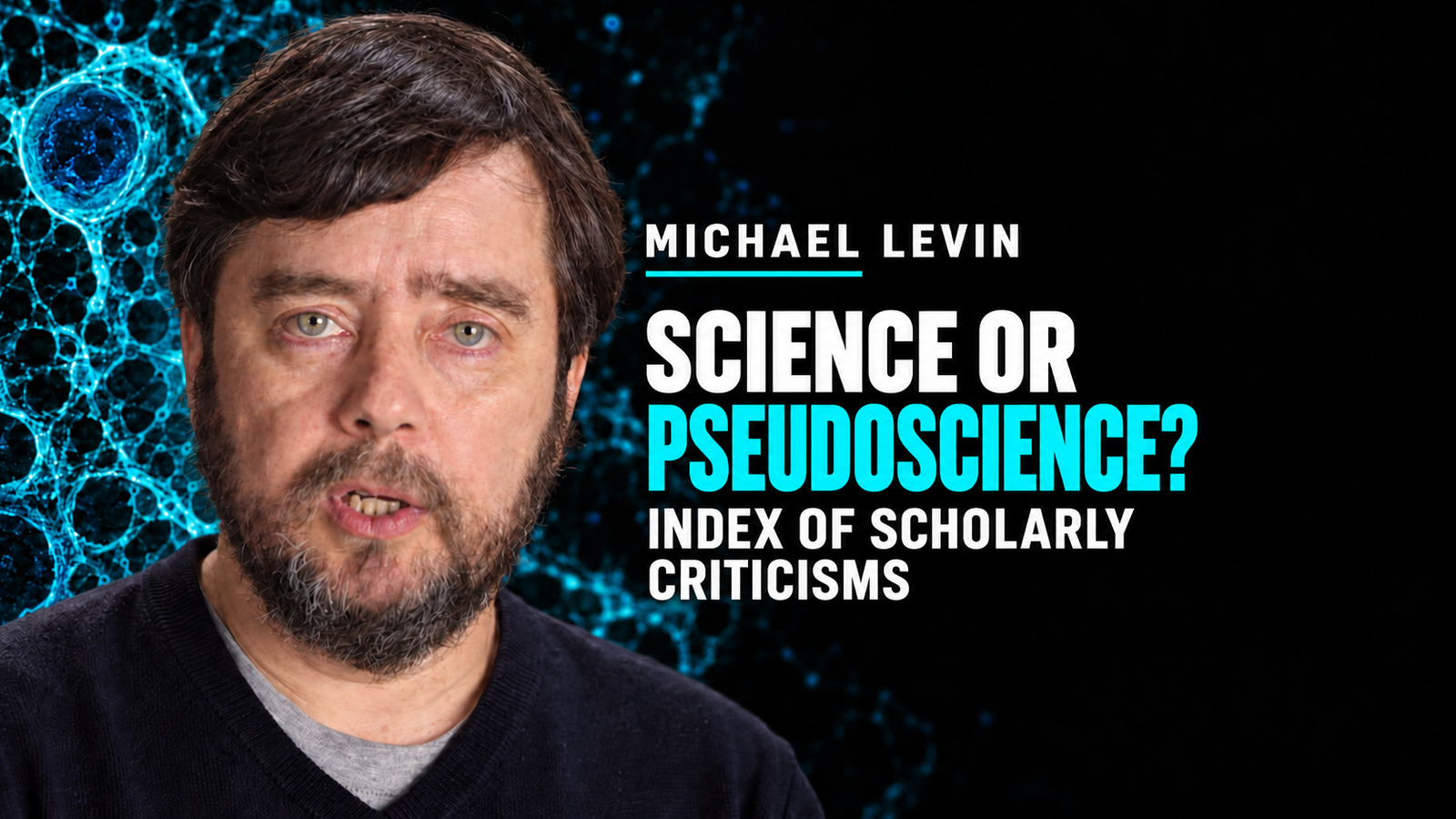
Biologist Michael Levin Criticism: Science or Pseudoscience?
Evidence and critiques of Michael Levin’s lab at Tufts University, bioelectricity, TAME, consciousness claims and Biological Platonism, plus his connections to Softmax, Astonishing Labs and research funding.
This index collects critiques of Michael Levin’s bioelectricity research, TAME framework, cell cognition, xenobots, and Platonic biology, with links to articles, peer-reviewed papers, and preprints. It examines where experimental evidence ends, where claims about consciousness and nonphysical minds overreach, and how those interpretations enter AI alignment, funding networks and commercial ventures.
Is Michael Levin’s work legitimate science or pseudoscience?
Bioelectric signals help control development. Claims about conscious cells, Platonic minds and bodies as interfaces for nonphysical agents require further evidence. The central question is which experiment distinguishes those interpretations from competing biological explanations.
My criticism concerns a transfer of authority: a real experiment lends credibility to a much larger story, and readers are left thinking the whole package was tested.
Why this matters: When speculation is accepted as discovery, it can distort what students learn, what institutions amplify, and how living or synthetic systems are treated. A laboratory result becomes a permission slip for whichever metaphysics happens to be standing beside the microscope.
Common questions about Levin’s biology, consciousness claims, and Platonic space
What are the main criticisms of Michael Levin’s work?
The recurring objections concern inflated cognitive language, unexplained causal claims, weak tests of Platonic space, neglected alternatives, and experimental success used to sell a much larger philosophy. The sleight of hand happens when evidence for cellular coordination becomes evidence for minds everywhere. Read the critique →
Which experiment supports the big claim, rather than just the biology underneath it?
Does Michael Levin’s research prove cells are conscious?
Adaptive behavior, memory, and problem solving do not by themselves establish subjective experience. Calling a cell’s response a “preference” does not tell us whether anything feels good or bad to it. Consciousness needs evidence beyond an upgraded vocabulary. Read the critique →
What would distinguish a conscious cell from one doing the same job without experience?
What is TAME, and why do scientists criticize it?
TAME means Technological Approach to Mind Everywhere. Critics question whether its broad use of cognition and agency distinguishes meaningful capacities or makes almost every adaptive system qualify. A useful engineering metaphor still has to earn its literal interpretation. Read the critique →
If almost everything counts as cognitive, what does the label help us tell apart?
Is there evidence for Michael Levin’s Platonic space?
Biological patterns and mathematical regularities do not, by themselves, establish a nonphysical realm supplying forms or minds. The objection targets that extra step. A space of possible outcomes can organize a model without becoming another place that acts on a body. Read the critique →
What result requires a real Platonic realm rather than a mathematical description?
Does unexplained cell behavior prove minds come from outside the body?
A missing explanation identifies a gap in our knowledge. It does not identify the occupant. Unexpected competence could expose an incomplete physical model without providing evidence for an incoming mind. The proposed source needs support of its own. Read the critique →
How do we know the missing cause is Platonic ingress rather than biology we have not understood yet?
Can Michael Levin’s Platonic biology be tested or falsified?
A theory that supplies a pattern for every possible outcome can always congratulate itself afterward. Testing Platonic biology requires independently constrained predictions that could fail. Read the critique →
What result would make Levin give up or substantially change the Platonic explanation?
Does calling cells intelligent explain how they work?
Cognitive models can help predict and control cells. That practical success matters. But “the cells decided” can also replace the mechanism with a flattering verb. The test is whether the cognitive account explains or predicts something a serious alternative misses. Read the critique →
What can the intelligence model predict that the competing biological model cannot?
Do xenobots and anthrobots prove there is a mind without a brain?
These experiments reveal striking capacities in reorganized cell collectives. The jump to subjective experience or a disembodied mind requires further evidence. A new body plan does not wipe away the cells’ inherited machinery, developmental history, or physical resources. Read the critique →
Which observed ability demonstrates experience, rather than coordinated biological activity?
Do Levin’s bubble-sort experiments prove algorithms have agency?
The implemented system changes local control, scheduling and component reliability. Explaining its behavior requires controls matched to those changes; the comparison with ordinary textbook bubble sort leaves their contribution unresolved. Read the critique →
Does the behavior survive controls that match the actual implementation?
What do two-headed planarian experiments actually show?
Rewritable target anatomy challenges a fixed, privileged body-template interpretation. A realm containing both forms can accommodate the result afterward; it needs independent constraints to predict which form will appear. Read the critique →
Did the theory predict the new target, or simply make room for it afterward?
Does bioelectricity work independently of genes?
Bioelectric signaling involves physical cells, channels, networks, and developmental organization. Showing that DNA sequence alone is an inadequate explanation does not remove genetics from the process or establish a second, nonphysical source of instructions. Rejecting a caricature of biology does not prove the replacement story. Read the critique →
What actually generates and maintains the bioelectric pattern in this experiment?
Can evolution explain cells doing things they never evolved to do?
Evolution builds capacities that can be reused in new settings. A cell need not have evolved specifically to make a xenobot to contribute to one. Novel behavior deserves investigation; novelty alone does not establish competence arriving from outside evolutionary and developmental history. Read the critique →
Which inherited abilities and new conditions produce the behavior, and what remains unexplained?
Does useful research prove Levin’s philosophy is right?
Useful ideas can inspire successful experiments without their metaphysics being true. Otherwise every productive metaphor would get a certificate of existence. The credit belongs first to what the experiment tested; the philosophy needs an additional reason to share it. Read the critique →
Would the discovery still work if we removed the Platonic claim?
Do similar patterns in brains and AI prove access to a Platonic realm?
Similar representations can emerge from shared tasks, data, constraints, and performance demands. Convergence needs explanation, but it does not identify a transcendent source by itself. Mathematical agreement cannot carry an ontological conclusion simply because both use the word “pattern.” Read the critique →
What rules out shared constraints as the reason the representations converge?
Does Levin’s theory violate physics or thermodynamics?
Causal ingress must make an identifiable physical difference. The thermodynamic test depends on the operation claimed, with Landauer bounds applied to specified erasure protocols under stated conditions. Read the critique →
If a nonphysical mind affects the body, what measurable change identifies its contribution?
Are there simpler explanations for Levin’s results?
Developmental mechanisms, attractor dynamics, organizational closure and evolutionary history offer competing explanations. Comparisons need matched predictions, controls and measures of explanatory performance. Read the critique →
Has the strongest alternative been tested against the same result?
Have Michael Levin’s claims been independently replicated?
Replication requires independently repeating a measured effect. Testing Platonic ingress requires an additional result that discriminates that interpretation from its alternatives. Read the critique →
Which independent study repeated which experiment, and what conclusion did it actually test?
Does peer review mean Levin’s theory is accepted science?
A published philosophical proposal and an independently tested causal explanation carry different evidence. The disputed claim needs an experiment that tests it; a prestigious journal cannot supply the missing result. Read the critique →
Was the disputed claim tested, or was an argument about it published?
Does Michael Levin support intelligent design?
The indexed articles trace intelligent-design appropriation of Levin’s work: how biological authority travels into claims about purpose and nonphysical causes, and which claims originate with Levin or with the people reusing his research. Read the critique →
What did Levin actually claim, and what did someone else add when reusing it?
What could go wrong if people accept Levin’s framework uncritically?
Speculation can enter education, funding, headlines, and ethical decisions carrying the prestige of real experiments. Treating bodies as disposable interfaces or every adaptive system as a conscious subject risks opposite errors. The costs land on students, patients, unfamiliar beings, and public trust. Read the critique →
Which real-world decision depends on a claim the evidence has not established?
Who has published critiques of Michael Levin?
This index includes my articles, Johannes Jaeger’s “Why TAME is lame,” M. Chirimuuta’s peer-reviewed discussion, Wiktor Rorot’s preprint and Matthew David Segall’s qualified criticism. Related papers examine cellular consciousness, model-to-ontology inferences, scientific demarcation and institutional influence. Read the critique →
Which source addresses the exact claim you want to check?
How is Michael Levin connected to Emmett Shear and Softmax?
Former Levin-lab researcher Adam Goldstein co-founded Softmax; the company cites TAME; and Levin publicly describes collaboration on cognitive scaling. The pressure point is the leap from biological collective organization to reliable AI alignment. Read the connections and critiques →
What evidence shows that agents learning to cooperate will also protect humans?
Does Michael Levin have a financial stake in Softmax?
His 2026 publication disclosure identifies him as a minor shareholder in SoftMax and Astonishing Labs and describes sponsored research and AI sublicensing. Ownership percentages and payment amounts are undisclosed. Read the financial disclosure →
How are those interests disclosed, managed and separated from claims of validation?
Is Michael Levin funded by Templeton or the US military?
Grant records and acknowledgments document Templeton, DARPA, Army and Air Force support for biomedical and theoretical research. The funding questions concern project objectives, dissemination, contract rights and applications. Read the funding records →
What does the funder’s involvement actually change about the questions asked and the uses of the work?
Peer-reviewed critiques of Levin and related claims (15)
The first two papers engage Levin or the basal-cognition program he contributes to. The others challenge related moves: adaptive behavior promoted into consciousness, formal models promoted into ontology, fruitfulness mistaken for truth and authority substituted for evidence.
A Mark of the Noncognitive
Chirimuuta examines the inference from a useful cognitive description to an actual cognitive property. The paper considers passive, inflexible responses and offers a competing philosophical account, pressing the gap between predictive convenience and evidence of cognition.
Peer-reviewed conceptual critique of cognitive attribution. DOI: 10.1007/s13752-026-00548-5.
On the prospects of basal cognition research becoming fully evolutionary: promising avenues and cautionary notes
Shared molecular machinery is not a license to treat every organism as cognitively equivalent. This paper engages Levin and the broader basal-cognition field, demanding attention to homology, convergence, lineage, gains, losses, and functional differences. It challenges definitions so expansive that evolutionary distinctions disappear into the same flattering label.
Peer-reviewed scrutiny of the basal-cognition field and its evolutionary assumptions. DOI: 10.1007/s40656-025-00660-y.
Related critiques: the same reasoning problems in other contexts
Cell consciousness: a dissenting opinion
A direct challenge to the claim that every cell has consciousness: biochemical sensitivity is not sufficient evidence of experience, “preferences” require interpretation, and anesthesia or shared molecules do not settle the matter. The target is cellular-consciousness theory associated with Reber, Miller, and Baluška. Its relevance is the evidential leap from adaptive function to feeling.
Peer-reviewed commentary on cellular-consciousness theory. DOI: 10.1038/s44319-024-00127-4.
Debunking a myth: plant consciousness
The authors audit twelve arguments for plant consciousness, including anticipation, learning, signaling, integration, and anesthesia. The pressure is on the step from plant physiology to subjective experience. A plant’s impressive capacities deserve explanation; naming them with mental verbs does not supply the missing evidence. Its relevance here is the comparable inference from physiological capacity to experience.
Peer-reviewed critique of plant consciousness using neural criteria. DOI: 10.1007/s00709-020-01579-w.
Plants Neither Possess nor Require Consciousness
This opinion paper challenges consciousness claims built from plant sensitivity, coordination and similarities to nervous systems. It questions whether experience is necessary to explain the behavior, challenges analogical arguments and argues against plant consciousness.
Peer-reviewed opinion article arguing against plant consciousness. DOI: 10.1016/j.tplants.2019.05.008.
Plant “intelligence” and the misuse of historical sources as evidence
Historical scientists cannot provide experimental evidence from beyond the grave. Kingsland and Taiz audit quotations, omissions, altered context and exaggerated attribution used to authorize plant-intelligence claims. The parallel is evidence laundering through prestigious names. A published reply contests their portrayal of contemporary plant research.
Peer-reviewed historical critique of plant-intelligence research. A published reply contests the critique’s portrayal of contemporary plant research: https://doi.org/10.1007/s00709-024-01993-4. DOI: 10.1007/s00709-024-01988-1.
Why studying plant cognition is valuable, even if plants aren’t cognitive
The paper distinguishes a cognitive conjecture’s value in generating research from evidence that the conjecture is true. The same distinction applies to TAME: productive tools and experiments need an additional test to establish their philosophical premises.
Peer-reviewed analysis of plant cognition and explanatory usefulness. DOI: 10.1007/s11229-022-03869-7.
A critical analysis of Markovian monism
A formal model cannot settle the nature of mind merely by being sophisticated. Beni examines Markovian monism and the jump from free-energy or blanket models to ontology, distinguishing mathematical, material, and fictive readings. The parallel with Platonic biology is the unpaid inference from a model that works to a reality the model supposedly reveals.
Peer-reviewed philosophical critique of Markovian monism. DOI: 10.1007/s11229-021-03075-x.
The Emperor’s New Markov Blankets
A conditional-independence relation on paper is not automatically an organismic boundary in the world. This target article distinguishes statistical from physical blanket claims and modeling inference from a system supposedly performing it. The authors demand the extra premises. That is exactly the kind of accounting missing when formal structure gets promoted into agency or metaphysical reality.
Peer-reviewed target article with commentaries and response. Author-hosted full version: https://manuelbaltieri.com/assets/pdf/EmperorMarkovBlanketsPrePublished.pdf. DOI: 10.1017/S0140525X21002351.
Naturalizing relevance realization: why agency and cognition are fundamentally not computational
Organisms generate and revise what matters through their organization, self-production and circumstances. This rival account challenges computation over pre-given problems as a complete explanation of agency.
Peer-reviewed account of agency and cognition proposing a noncomputational explanation. DOI: 10.3389/fpsyg.2024.1362658.
Prediction Versus Accommodation and the Risk of Overfitting
A sufficiently flexible story can explain yesterday beautifully and predict tomorrow poorly. Hitchcock and Sober examine prediction, accommodation and overfitting. A Platonic warehouse containing every possible outcome needs constraints that stop it from declaring success whatever the experiment produces.
Peer reviewed; the application to Platonic biology is this index’s comparison. DOI: 10.1093/bjps/55.1.1.
Diagnosing Pseudoscience – by Getting Rid of the Demarcation Problem
Pseudoscience is not simply an idea that sounds strange. Boudry examines claims that imitate scientific warrant without earning it and the failures that help diagnose them. Applied to this debate, the question concerns which claim receives which evidence. Neither a famous laboratory nor a dramatic headline answers that question.
Peer-reviewed analysis of how to diagnose pseudoscientific reasoning. DOI: 10.1007/s10838-021-09572-4.
The Multicriterial Approach to the Problem of Demarcation
Fernandez-Beanato argues for multiple demarcation criteria, examining method, evidence and domain. The paper supplies criteria for assessing the scientific standing of a claim and the gap between speculative proposals and established results.
Peer-reviewed account of scientific demarcation criteria. DOI: 10.1007/s10838-020-09507-5.
Questioning the Integrity of the John Templeton Foundation
Bains examines the John Templeton Foundation’s scientific sponsorship, public presentation, funding priorities and disclosure practices. The institutional comparison concerns how sponsorship and scientific prestige can increase a claim’s perceived warrant.
Peer-reviewed critical commentary about the John Templeton Foundation. The institutional comparison with Levin’s funding is this index’s analysis. DOI: 10.1177/147470491100900111.
Basic research, lethal effects: Military artificial intelligence research funding as enlistment
Examines US Defense Department AI grant solicitations from 2007–2023. The authors argue that the basic/applied research distinction can obscure military objectives; funding calls recruit academic research into warfighting agendas; promises of progress and remaining technical obstacles justify further investment; and researchers share responsibility for those institutional relationships. Calling a project basic science does not settle what its funding apparatus wants to do with it.
Scope: A study of Defense Department AI funding. Its relevance here is the question of how military funding shapes research agendas, obligations and applications. See the funding records →
Preprints critiquing Levin or his laboratory (1)
Rorot’s preprint directly scrutinizes information-processing and agency interpretations of Levin-lab planarian experiments.
Looking for keys in model organisms: Interpreting and keying-up in basal cognition
Rorot identifies unquantified information, mechanisms left undistinguished and analogical mappings that remain sketches in interpretations of Levin-lab planarian experiments. The critique presses the gap between an observed biological result and the information-processing or cross-scale agency attributed to it.
Submitted preprint, as classified by the archive. Author PDF: https://wiktor.rorot.pl/files/publications/rorot-2025-keys.pdf.
Scholars’ critiques of Michael Levin (4)
These essays examine Levin’s cognitive language, agency claims, body–mind framing and philosophical interpretations. Jaeger challenges TAME; Segall critiques Platonic puppeteer imagery and also counters Jaeger’s account.
Why TAME is lame
Jaeger attacks expansive cognitive language, weak-to-strong retreat, feedback dressed as agency and bioelectric control promoted into a new master explanation. He emphasizes organisms’ self-production and questions engineering-centered ambitions and their consequences.
Scholarly essay critiquing TAME and its account of cognition and agency.
Intentional Confusion
Jaeger responds to Levin and Dennett by asking when feedback becomes agency and when an intentional stance establishes a mind. He challenges metaphor slippage, missing autonomy, and evolutionary generalization. “It helps to describe it this way” is a practical claim. “It really has the attributed mentality” adds a burden the description alone cannot discharge.
A philosophical critique proposing a substantive account of cognition to compare with alternatives.
Patterns Are Not Puppeteers: The Return and Reformation of Platonic Form in Biology
Segall argues that abstract patterns should not steal the organism’s agency or reduce its body to a thin interface. He questions mind-beaming imagery and causal reification, then proposes a Whiteheadian reconstruction.
Scholarly essay combining criticism of Platonic puppeteer imagery with a Whiteheadian alternative.
Some Philosophical Implications of Michael Levin’s New Paradigm Biology
Segall pushes back against Jaeger’s organism–mechanism framing while examining the philosophical implications of Levin’s bioelectric coordination and developmental-competence research.
Scholarly counterargument to Jaeger’s critique.
My Michael Levin articles on SweetRationalism (20)
Newest first. My Levin articles examine his papers, lectures, experiments, symposium arguments and defenses of Platonic biology. They press cognitive inflation, causal ingress, flexible predictions, borrowed authority, ideological reuse and ethical consequences.
Religion With A Pipette: Is Michael Levin’s ‘Ingressing Minds’ Pseudoscience? A Scholarly Analysis
The central audit: excellent biology does not provide a free pass for “ingressing minds.” I examine mathematical spaces turned into causal places, surprise mistaken for source identification, missing comparisons, flexible predictions, mind-language inflation, publication prestige, institutional amplification, and ethical identity claims. If the extra realm does explanatory work, show the work.
Institutional Capture & Diverse Intelligence: How Unfalsifiable Metaphysics Allowed the Discovery Institute to Degenerate Levin’s Bioelectricity Research Program
I trace how funding, training, editorial structures, commercial interests, and media can carry metaphysical confidence farther than the experiments warrant. The article examines correspondence, structuralist alternatives, Noble’s overreach, planarian history, fruitfulness defenses, and Discovery Institute appropriation. The problem is authority traveling without its evidential limits, with consequences for education and legitimate bioelectric research.
Primary appropriation document: William Dembski, “Michael Levin and the Philosophy of Intelligent Design” (January 20, 2026). Dembski uses Levin’s work to develop an intelligent-design discussion of information, agency, purpose, intelligence and design, and examines where Levin’s positions diverge from the ID community’s. This is the published conceptual reuse examined by the critique.
The Paper I Predicted: “Mind Everywhere” by Michael Levin & David B. Resnik
I compare “Mind Everywhere” with the objections and correspondence that preceded it: biological success promoted into pervasive mentality, unresolved target-rewriting questions, structuralist explanations wearing a Platonic badge and shifting theological framing. A prediction ledger records what I argued and what followed.
Primary papers: Levin and Resnik’s Mind Everywhere, Part One and Part Two (Biological Theory, 2026). The authors emphasize empirical testability, prediction, explanation and practical consequences, and reject vitalism and divine design. The critical question is which results distinguish the stronger philosophical interpretation from competing accounts. Open manuscripts: Part One and Part Two.
I Read Pezzulo & Levin (2025), “Bootstrapping Life-Inspired Machine Intelligence”, So You Don’t Have To. Michael Levin’s Discovery Institute Problem
A detailed audit of Pezzulo and Levin’s biological examples and design principles: autonomy, cognitive light cones, Markov blankets, generative models, nested agency, rebuilding, and top-down control. Useful engineering ideas repeatedly face a larger question: what licenses their promotion into literal minds? I also examine normative overreach and the framing’s intelligent-design attack surface.
Why Michael Levin’s Bubble Sort “Revelation” Is Misunderstood 1960s Algorithm Theory Meets God-of-the-Gaps Argument
Sorting becomes an alleged revelation when ordinary explanatory accounting goes missing. I challenge novelty rhetoric, prior algorithm theory, stability, implementation assumptions, scheduling, compilation, physical computation, and the leap from surprise to hidden agency or Platonic origins. The actual decentralized implementation needs matched controls; comparing it only with textbook bubble sort will not settle the argument.
Where Does a Xenobot’s History Come From? What Pays the Computational Cost?: The Scientific Truth Behind Michael Levin’s Self-Replicating Robots and “Free Lunches”
Xenobots do not arrive with their history erased. I track inherited cellular competence, evolution, laboratory construction, physical resources, replication rhetoric, and the “free lunch” story. Novel organization is worth studying. It does not demonstrate that the organization’s competence came from a nonphysical warehouse rather than capacities carried by the cells.
Absence IS Possibility Space. A Recursive Constraint Falsification Analysis of Michael Levin’s Platonic Morphospace Hypothesis: Platonic Space Discussion #3
A symposium audit that keeps asking where the explanation went: constraints versus enablements, unspecified mechanisms, allegedly unpaid computation, xenobots, triangles, irreducibility, Markov blankets, good-regulator arguments, genotype–phenotype maps, and cognitive vocabulary. I also state how the critique could fail. “More than constraints” needs to identify what more contributes.
Cognition All the Way Down (the Drain) 2.0: Michael Levin’s Thermodynamic Consciousness Shell Game, The Discovery Institute, and the Art of Making Everything Think by Defining “Thinking” as Everything 🔄️
I follow the vocabulary as adaptive response becomes cognition, cognition approaches consciousness, and the enlarged label starts doing the work of evidence. The article examines paper–video shifts, homeostasis versus experience, thermodynamic rhetoric, protective definitions, and Discovery Institute reuse. A term that includes everything may have stopped telling us anything useful about the disputed capacity.
The Fecundity Alibi: How Unfalsifiability Masquerades as Progress. Weaponizing Real Science To Justify Problematic Metaphysics
The fecundity defense lets successful science pay the bills for metaphysics the science never tested. I examine borrowed credit, movable success criteria, postponed accountability, and retreat into “it inspires research.” Exploration is worthwhile. Confirmation is another claim. The framework has to identify which discoveries depended on its controversial premise.
Platonic Patterns Without Platonic Baggage: Pavel Chvykov’s Physics Reveals What Michael Levin’s Symposium Can’t Admit
Chvykov’s pattern physics supplies the uncomfortable comparison: mathematical description and physical organization can do explanatory work without a transcendent supplier. I examine ambiguity about “Platonic,” causal interaction, borrowed support, and absent discriminating tests. A symposium full of pattern talk does not automatically become evidence for the largest ontology advertised there.
Does Evolution Have… Agency? Evolutionary Science Under Attack: Biologist Michael Levin’s Diverse Intelligence Framework
Morphogenesis, natural induction, and developmental competence deserve more than a choice between genetic caricature and cosmic agency. I audit evolutionary premises, cognitive expansion, ingression, interaction, structuralism, causal emergence, novelty, and ethical attribution. The article also examines intelligent-design reuse. Different claims carry very different evidential burdens; “paradigm change” cannot flatten those differences.
Is Michael Levin’s Platonic Morphogenesis Scientific? Brian Cheung’s Bidrectional Relational Convergence Research Inadvertently Reveals the Motte-Bailey Problem
Cheung’s convergence results do not identify Platonic access simply because brains and models learn similar representations. I examine shared data, constraints, training, performance, grounding, mathematical certainty, and retreat between naturalistic and transcendent meanings of “Platonic.” The familiar escape is to defend the modest model while retaining the prestige of the stronger claim.
Michael Levin’s Platonic Space Symposium Discussion #1: TAME, Distributed Agency vs Individual Intent
I audit mathematical fixity, identity assumptions, nonphysical facts, pattern memory, regeneration, attractors, simulations, sorting, preferences, and shifting system boundaries. Distributed control does not automatically establish individual intention. When the discussion changes its scale or meaning, the evidential claim needs to change with it rather than quietly getting larger.
Michael Levin’s Platonic Spiral: Evolution or Unfalsifiable Circle?
An Oxford-talk audit of competence, comprehension, pre-evolutionary intelligence, expanded agency, evo-devo, planarian history, xenobots, closure, causal emergence, and cost accounting. I ask whether the spiral exposes the metaphysical addition to risk or lets every successful experiment reinforce it. Developmental flexibility cannot bear every philosophical conclusion piled on top.
Thermodynamics Constraints Explain Everything Platonism Tries to Explain, But Can Not: Michael Levin’s December 2025 Max Planck School—Matter Meets Life Lecture
I audit the Max Planck lecture’s movement from developmental control to larger metaphysical claims: mathematical applicability, cybernetic language, planarian history, scale collapse, incoming-agent explanations, xenobot and anthrobot novelty, ethics, and appropriation. The central question is what the added story explains after the experimental findings receive their own credit.
Cognitive Platonism as Naturalistic Replacement: How Gordana Dodig-Crnkovic and David Resnik’s Own Admissions Dissolve Michael Levin’s Transcendent Morphospace
Naturalism and structuralism cannot defend transcendent morphospace merely by sharing its vocabulary. I compare Dodig-Crnkovic’s and Resnik’s positions with the stronger claim, examining borrowed support, mathematical structure, causal interaction, rewritable targets, and retreat into weaker Platonism. Calling a naturalistic alternative “Platonic” does not make its evidence travel to the nonphysical version.
The Chladni Plate Alternative to Platonism: How Douglas Brash’s Constraint-Based Framework Explains Bioelectric Morphogenesis Without Platonic Forms
A Chladni plate makes patterns without consulting a celestial template library. I use Brash’s comparison to examine constraints, attractors, stigmergy, history, embodiment, target rewriting, causal interaction and testing. The mechanistic account challenges the explanatory necessity of the proposed Platonic addition.
My Public Debate With Michael Levin on thoughtform.life Platonic Symposium: Verbatim Comment Record of His Replies to My Critique (Platonism, Bioelectricity, Falsifiability)
The public exchange records Levin’s and my arguments about Platonism, bioelectricity and falsifiability, including the objections, concessions and replies.
Michael Levin’s Platonism: Harmful & Unfalsifiable Metaphysics— Evidence from Bioelectric Morphogenesis That Falsifies Platonic Predictions
An early attack on fixed targets, planarian history, causal ingress, thermodynamic costs, shifting burdens, indistinguishable explanations, TAME, and ethical attribution. Its durable objection concerns a metaphysics that can fit every result while borrowing the lab’s authority. The falsification claim concerns the specified target-form interpretation. An expanded realm that absorbs the altered form must earn its new scope with independently constrained predictions.
Biologist Michael Levin’s “Response” to My Criticisms of Biological Platonism: Misrepresentation, Platonic Morphospace, and Infinitely Unfalsifiable Metaphysics
I dissect Levin’s response on Landauer, path dependence, nonlocal-consciousness evidence, the adjacent possible, interaction, burden shifting, falsifiability slides, retreats and intelligent-design appropriation. The reply includes concessions and the underlying exchange. The empirical tests concern privileged targets, physically identifiable causal contributions and discriminating predictions.
Other critical articles (5)
Journalistic reporting, technical blogs and public discussions examine cognitive attribution, Platonic claims, sorting algorithms and causal explanation.
Slime moulds and intelligence
Alex Kacelnik challenges cognitive inflation and missing explanations.
What Is It Like to Be a Cucumber?
Reports criticism of unfalsifiable claims and terminology stretched into meaninglessness. Anil Seth questions the clarity and plausibility of “ingressing minds.” The profile documents Levin’s nonphysical Platonic account and his proposed connection between laboratory results and metaphysics.
On Michael Levin’s research and approach
This technical discussion examines what the sorting implementation actually changes: decentralization, local rules, scheduling, and failure conditions. It questions whether unexpected behavior warrants cognition or teleology while remaining sympathetic to the research. The original paper’s disclosed assumptions provide the basis for checking which changes explain the behavior.
Technical blog discussion. Original sorting paper: https://arxiv.org/abs/2401.05375.
Michael Levin’s Platonic Biology
An AI-assisted discussion asks why a structured possibility space should be treated as a real supplier of biological forms. It presses the explanatory gap, interaction problem, retrospective fit and confusion between formal description and causal source.
Public AI-assisted discussion.
Michael Levin’s Platonic Biology -II
The sequel challenges patterns promoted into agents, regularity mistaken for a separate realm, and origin questions relocated instead of answered. It asks what Platonic biology contributes beyond describing lawful organization. This continues the preceding AI-assisted discussion.
Public AI-assisted discussion; continuation of the preceding article.
Michael Levin, Softmax and Astonishing Labs: from cell cognition to commercial claims
Softmax draws on cellular agency and collective cognition for AI alignment; Astonishing Labs commercializes bioelectric research. Levin collaborates with Softmax and has disclosed minor shareholdings in both companies. Sponsored research and AI sublicensing connect the ventures.
What connects Levin to Softmax?
People and research: Softmax’s current team page names Emmett Shear as CEO and founder, David Bloomin as founder, and Adam Goldstein as board member and founder emeritus. It says Goldstein researched signaling, bioelectricity and basal cognition in Levin’s Tufts lab, then brought organic alignment into Softmax.
The intellectual connection is explicit: Softmax’s reading list includes Levin’s TAME paper and Biology, Buddhism, and AI: Care as the Driver of Intelligence. Its mission uses multicellularity as a model for agents developing complementary roles and shared goals.
Levin acknowledges collaboration: In Lex Fridman Podcast #486, around 2:51, he describes working with Softmax while discussing stress sharing, memory anonymization and cognitive scaling. That identifies the proposed transfer: mechanisms and interpretations of collective biological organization become candidates for artificial collective intelligence.
Yes, there is a financial connection: A 2026 Lancet Psychiatry declaration identifies Levin as a minor shareholder in SoftMax and Astonishing Labs. It describes institutional sponsored research and AI sublicensing connecting the companies. Ownership percentages, payments and full contract terms are undisclosed there.
Company funding: Ashlee Vance’s March 2025 launch report identifies Andreessen Horowitz, Lionheart Ventures and Plural as investors, with the amount undisclosed. Softmax’s current team page identifies Lionheart founder David Langer as a board member.
Astonishing Labs: when the framework becomes a commercial pitch
Astonishing Labs’ science page presents bioelectricity as an operating system above genetics, invokes collective intelligence and promotes cancer normalization and interventions in aging. Its commercial claims extend the same cognitive framing into proposed biomedical applications.
The issue is the move from model to mechanism to medicine. The “operating system” account needs evidence of the mechanism it adds and the predictive or intervention advantage it delivers over matched alternatives. Cancer and aging claims need disease-specific endpoints, controls, replication and a stated stage of development. The word intelligence cannot fill in a missing experiment.
This connection reaches research already criticized in the index: the Zhang, Goldstein and Levin sorting-algorithm paper acknowledges Astonishing Labs and JTF funding. That is relevant to the sorting critique: commercial backing makes independent evaluation of the algorithms’ claimed competencies more consequential.
The disclosure record: the sorting paper declares no potential conflicts while acknowledging Astonishing Labs support. A 2023 perspective identifies Levin as an Astonishing Labs scientific co-founder and acknowledges institutional sponsored research from Astonishing Labs and Morphoceuticals. Whether those declarations are consistent depends on the roles and ownership at the relevant dates and the journals’ disclosure policies.
Which parts of the commercial story have independent evidence, and which parts still borrow credibility from the legitimate experiment next door?
Softmax: where the biological analogy has to pay its evidential bill
- Cooperation with whom? Agents can cooperate superbly with one another while excluding or exploiting humans. A cohesive collective is not automatically a humane one.
- What happens when humans are no longer useful? If cooperation depends on mutual need, test what survives changes in bargaining power, access to resources and dependence.
- What is the engineered mechanism? Specify the AI counterpart of biological coupling, boundaries, error signals and regulation. Shared biological vocabulary cannot substitute for a demonstrated implementation.
- What counts as care? Distinguish observable welfare protection from inferred subjective concern. Conscious experience is neither established by cooperative behavior nor required as a premise for testing safety.
- What survives outside the training game? Test unfamiliar agents, hostile incentives, coalitions, deception, resource asymmetries and changing environments. Cooperation within a simulation does not certify deployment safety.
- Who corrects the collective? Demand evidence for oversight, correction, containment and continued human influence. More effective collective problem solving can increase capabilities before it establishes protection.
Softmax’s stated risks and safeguards
Softmax’s April 2026 essay Red Button, Blue Button names cancer, arms races, slavery, harmful group dynamics, concealed motives and defection as risks. Its proposed safeguards include reputation, audits, institutions and corrigibility. The test is whether those mechanisms preserve human welfare when agents become more capable, incentives change or cooperation benefits the AI collective at humans’ expense.
The public critiques below question mutual dependence, incentives, internalized cooperation, defensive capacity and the transfer from biological systems to AI.
Public critiques of Softmax and organic alignment (3)
Emmett Shear (OpenAI Ex-Interim-CEO)’s New “Softmax” AI Alignment Plan — Is It Legit?
A dedicated critique of Shear’s biology-inspired alignment proposal. The episode’s published guide covers organic alignment, human morality and cognitive submodules, top-down versus emergent morality, raising AI alongside humanity, incremental development, convergence versus divergence, and multi-agent reinforcement learning.
Direct Softmax critique; summary based on the published episode guide.
AI News Crossover: A Candid Chat with Liron Shapira of Doom Debates
Shapira identifies the missing condition in the multicellularity analogy: cells need one another, whereas sufficiently capable AI might no longer need humans. Cooperation under mutual dependence does not establish durable concern for dispensable partners. He also questions how shared goal development avoids powerful optimization toward the wrong goals. Labenz offers a counterargument for exploring alternative approaches and specialist ensembles.
Public debate about Softmax’s alignment assumptions; written transcript.
Chris_Leong’s critique and reported exchange with Emmett Shear
Asks whether cooperation is internalized or merely useful until incentives change; why organic training should produce deeper alignment; whether the project chiefly improves capabilities; and whether defenders can withstand stronger attackers. Also challenges the inference from evolution’s methods to optimal engineered design and the oversimplified organic/hierarchical contrast. The comment reports Shear acknowledging cancer-like failure and the need for an immune-system analogue.
Scope: Forum commentary. The commenter reproduces the exchange with Shear; independent access to the linked X thread was unavailable.
Who funds Michael Levin’s research? Military grants, Templeton and commercial interests
Templeton grants support projects on purpose and nested intelligence. Defense agencies support biomedical and theoretical work. Levin has disclosed equity in commercial ventures that sponsor research and license Tufts discoveries. The records below identify the projects, recipients and disclosed financial relationships.
Templeton: name the actual foundation and the actual grant
John Templeton Foundation grant 62212, Synthetic Living Machines and the Emergence of Purpose, lists Levin as project leader, Tufts as grantee and $2,133,060 awarded. The project proposes testing whether purpose-driven approaches improve prediction and control. Those performance measures test the framework’s practical advantage; claims about nonphysical purpose require a discriminating causal test.
Templeton World Charity Foundation grant 0315 lists Levin, Tufts, $233,855 and a 2019–2022 project on communication with nested intelligences. Its description includes ant-colony training, trainable tissues and public dissemination.
McMillen and Levin’s 2024 collective-intelligence paper also acknowledges JTF grants 62212 and 62230, TWCF0606, the Guy Foundation Family Trust, and AFOSR.
Which hypotheses get funded, which alternatives receive a fair comparison, and can a result that undercuts the advertised framework receive the same publication and publicity?
US military support: DARPA, Army and Air Force
Tufts’ 2014 cancer-research announcement acknowledges DARPA subaward W911NF-09-1-0125 alongside the G. Harold and Leila Y. Mathers Charitable Foundation. Harvard’s 2017 announcement of Levin joining the Wyss Institute describes collaboration on infection tolerance within the DARPA-funded THoR program.
Fields and Levin’s Thoughts and thinkers, acknowledgments on PDF page 30, names Army Research Office grant W911NF-23-1-0100 and Air Force Office of Scientific Research award FA9550-22-1-0465, Cognitive & Computational Neuroscience, alongside JTF grant 62212. Military funding reaches theoretical work as well as biomedical collaboration.
The June 2026 purinergic-signaling xenobot preprint lists CRREL contract W913E524C0012 and JTF grant 62212.
What can the funder do with the discoveries, and what responsibilities follow even when the researcher’s immediate goal is healing?
Commercial interests: four companies with documented personal stakes
Publication disclosures report personal equity, advisory roles, university research support and intellectual-property licenses. Ownership percentages and compensation amounts are undisclosed in these records.
| Company | Documented connection | Why it matters to the critique |
|---|---|---|
| Softmax | Minor shareholding; participation in an institutional sponsored research agreement; sublicensing of AI discoveries. 2026 declaration → | Biological cognitive-scaling ideas inform AI alignment. Test whether coordination protects humans when incentives, capabilities and dependence change. |
| Astonishing Labs | Scientific co-founder and consultant; minor shareholding; sponsored research at his institution. 2026 declaration → | Commercial claims about cellular intelligence, bioelectric control and therapeutic prospects need evidence beyond the framework’s vocabulary and academic prestige. |
| Morphoceuticals | Scientific co-founder; consulting or advisory relationship and equity or stocks. Levin and Watson’s February 2026 declaration →. A 2023 perspective acknowledges institutional sponsored research. | Bioelectric regeneration has commercial stakes. Keep mechanistic modeling, animal-model findings, independent validation and human therapeutic claims at their actual evidential levels. |
| Fauna Systems | Co-founder and shareholder; exclusive Tufts license for certain xenobot intellectual property. September 2026 preprint declaration →. A 2025 paper reports sponsored research agreements at Tufts and UVM. | Xenobot interpretation and commercialization overlap. Examine what the organisms demonstrate, what the license covers, and which practical or cognitive claims have independent support. |
The September preprint discloses Levin’s Fauna interest and license and reports that Fauna neither participated in nor funded that study.
Morphoceuticals’ July 2025 announcement reports more than $15 million in company seed financing, initially led by Juvenescence and Prime Movers Lab. The June 2026 lecture disclosures also list all four companies.
Related ventures: Anthrobots, Inc. and Cellja Vu
Astonishing Labs’ portfolio page identifies Anthrobots and Cellja Vu as based on Levin’s research. Anthrobots develops human-cell biobots; Cellja Vu applies cellular-memory ideas to drug resistance. Tufts’ FY2023 inventor-recognition page lists an exclusive license with Anthrobots, Inc. Levin’s separate personal holdings or compensation in these portfolio companies remain unverified.
For Anthrobots, the foundational research reports repair of scratches in cultured human neural-cell sheets in vitro. Clinical claims require evidence of safety and efficacy in the proposed patient population. Cellja Vu’s cellular-memory account needs comparisons with pharmacological explanations and evidence of an advantage in relevant disease models.
The commercial pressure point: Astonishing Labs markets collective intelligence, an “operating system” above genetics, cancer normalization and interventions in aging. Levin’s disclosed equity gives him a financial interest in ventures promoting this research. Independent validation becomes especially consequential where the sales pitch reaches beyond the demonstrated mechanism or therapeutic result.
Which claims increase commercial value, who independently checks them, and do audiences see the financial interests where they encounter the claims?
Other support and the institutional questions worth asking
Tufts’ March 2016 announcement documents a $10 million Paul G. Allen grant for the discovery center led by Levin.
Levin and Watson’s 2026 review disclosure reports financial support from Eugene Jhong and states that the named funders had no input into its content.
My criticism: prestige, investment and institutional enthusiasm can make a framework easier to circulate than to challenge. The pressure points are funding and publicity for stronger claims, engagement with rival explanations, independent validation and disclosure of interests where audiences encounter the commercial or philosophical pitch.
Critiques that help analyze the funding record
My Institutional Capture article develops the argument about funding, vocabulary, editorial and publicity structures. Sunny Bains’ peer-reviewed Templeton critique examines JTF and supplies the historical institutional comparison. Widder, Gururaja and Suchman’s peer-reviewed military-funding analysis challenges the idea that basic-research status removes military responsibility.