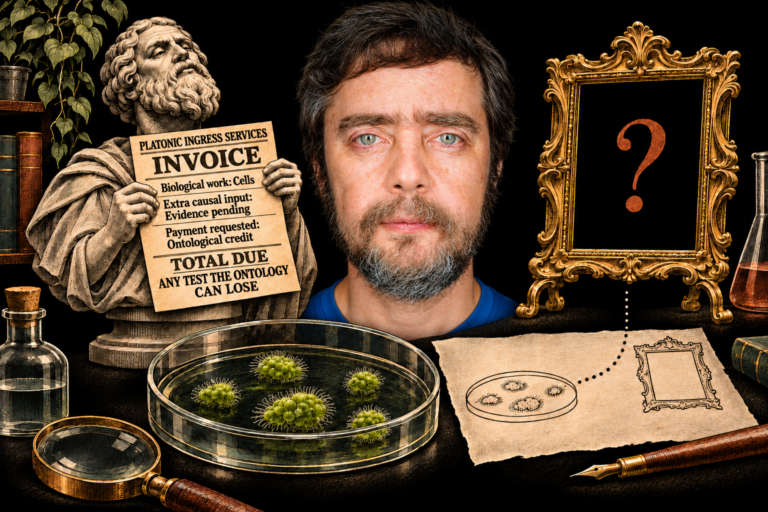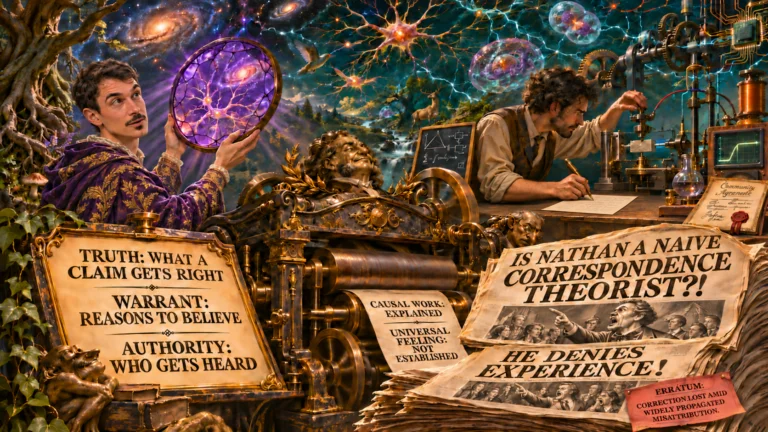
Biologist Michael Levin’s “Response” to My Criticisms of Biological Platonism: Misrepresentation of My Arguments, Platonic Morphospace, and a Claim That Is Unfalsifiable As Stated
Research record: GitHub source and revision history · canonical published edition
In short: If Michael Levin's Platonic space can absorb one head, two heads, or any head nobody has seen, it explains nothing about heads. This article asks what the published evidence can and cannot tell apart, documents where Levin's reply refuted a position I had said I did not hold, and asks what would count against Biological Platonism.
“I think it’s much more interesting to live not knowing anything than to have answers which might be wrong.”
― Richard P. Feynman
BBC, The Pleasure of Finding Things Out (1981). Attribution verified.
What Does Michael Levin’s Platonic Space Explain If Every Outcome Fits?
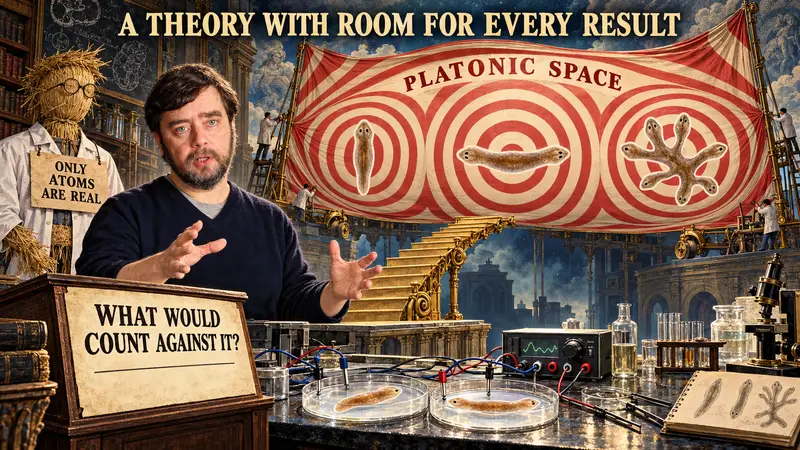
Suppose a regenerating flatworm grows one head, or two, or something nobody has seen. Levin’s reply to the two-headed case is that the two-headed form may itself be a manifestation of a pre-existing pattern, and that the space has not been mapped well enough to say otherwise. A hypothesis that can absorb one head, two heads, and any head nobody has seen has told us nothing about heads. It is also not confined to his lab, because advocates outside it already quote claims of this kind, and a claim that short and quotable should be able to say what would count against it. What follows asks what the published evidence can and cannot tell apart, where Levin’s replies refuted a position I had said I did not hold,
Preliminary Note
Michael Levin’s December 28, 2025 post, “Q&A from the internet and recent presentations 4,” answers a short list of my criticisms. The longer arguments behind that list are in my symposium comments and in what follows.
The title says misrepresentation, so the claim has to be shown, and I use the word narrowly. I mean that a reply attributes to an argument a position its author had said, in the same thread, that it did not hold. The comparison is between the stated arguments and their replies; the symposium page and the post let a reader check each case. The bullets he answered were my compression, made at his request, so I do not rest the claim on them. I rest it on three places where the thread already contained the answer. First, my October 30 comment argued that higher-level patterns have real causal efficacy, and he replied, “That’s a reductionist argument against the reality of other causal levels.” On November 11 he wrote that he had “initially” thought I was supporting physicalism, and on December 28 the Schrödinger line returned against my parsimony point. Second, after I called his random-versus-ordered choice a false dilemma on November 9 and described an ordered alternative, his November 18 reply still said that without his view the patterns are “random.” Third, and this one is a related mismatch and not a misattribution, on November 11 he quoted my definition of thermodynamic monism in the thread and asked how it handles the value of e, and the December 28 post says “I don’t know what thermodynamic monism is.” Section 1 gives these and five more in a table with links to each comment, says which meet the definition, and notes where my own wording invited the reading and where his reply was fair. The distinctions matter because a reply to one claim can leave a different claim untouched.
The target is Levin’s claim that “Platonic forms inject information and influence into physical events, such as the growth and form of biological bodies.” I will call this the biologically causal extension. Mathematical Platonism concerns the independent existence of mathematical objects. Morphospace models organize possible forms. Mathematical constraints delimit what systems can do. The extension adds a further relation: forms contribute information or influence to particular biological events. That added work is what needs support. Levin’s bioelectric experiments supply a particularly strong comparison, because they identify physiological variables through which regenerative anatomy can be changed.
Levin has also said he has “no more ontological commitments” than treating as real whatever he must worry about in designing and carrying out experiments. Taken alone, that sentence would turn the injection language into a manner of speaking. It cannot be taken alone, because the same pages say much more. They say that physical bodies “don’t create, or even connect to (and thus have) minds,” that non-physical patterns “ingress into, and functionally matter, in the non-living and living world,” and that even “a classical Newtonian world already enables the ingression of non-physical drivers such as minds.” Those sentences carry commitments about how reality is structured, and a hedge on how sure the author is does not shrink what a sentence says. Section 2 sets out what they require. My argument concerns the position the published sentences state, in which forms act on bodies.
A shared standard is already available. In their peer-reviewed Mind Everywhere papers, Levin and David Resnik emphasize empirical testability, useful interaction protocols, and frameworks that enable new discoveries. Their operational standard is that mentalistic attributions “can be neither ruled out nor claimed in any particular case without experimental support.” That is a useful way to assess agency across unfamiliar systems. Applied to the added causal role of forms, the question becomes precise: what observation, intervention, or defended argument earns that addition its place?
The laboratory results make this question concrete. Regenerative anatomy follows a manipulable physiological history. An additional form-space earns explanatory credit when its structure supplies restrictions or successful predictions beyond that account. Without those restrictions, assigning every observed morphology to a form merely reproduces the outcomes under another description. I use “unfalsifiable as stated” for this specific problem: the post and replies give no outcome in morphogenesis excluded by the injection claim. A specified restriction with genuine conditions for revision would change that assessment.
What the Two-Headed Planaria Showed
Durant and colleagues (2017) reported that a brief perturbation of the bioelectric network in amputated planarian fragments can rewrite the regenerative body plan. Treated fragments produced a stable ratio of two-headed and normal regenerates. The normal-looking ones, cut again in plain water with no further drug exposure, produced the same ratio. These animals did not differ from wild-type worms in histology, expression of key polarity genes, or neoblast distribution. The altered plan was stored in patterns of resting potential, and a treatment that hyperpolarized the tissue reset later regeneration to the single-headed form in 34% of recut double-headed worms, against none of the vehicle controls. The authors call this a multistable, epigenetic anatomical switch. They followed the double-headed lines through repeated amputations over months, and the observations cover that span.
On the authors’ account the ordinary one-headed anatomy is also a physiological state. Outcomes followed the manipulable bioelectric state in both directions, and the paper’s explanation needs no further influence.
A convergence reading would predict something different. If forms with a privileged standard shape pulled regenerating animals toward it, altered worms should drift back toward one head. That prediction requires a rule making the ordinary morphology the target, and the rule does not come with Platonism. Levin does not hold it. In his words, his view is “not that standard animals are the full extent of Platonic patterns,” so two-headed planaria are “not a problem.” Durant therefore does not count against his stated position. It counts against a canonical-attractor reading that he disclaims, and it leaves the extension with a choice between two branches.
On the first branch, the extension carries a selection rule saying which forms are realized under which physiological conditions. Then it forbids some outcomes, the planarian experiments and others become tests of it, and the rule has to be stated independently of the results it is meant to explain. On the second branch, it carries no rule. The realm holds whatever the physiology happens to produce, compatibility with any result costs nothing, and the realm is redundant to the bioelectric account for every result in hand.
Levin’s reply to the planarian point sits on the second branch unless a rule accompanies it. He asks “how do you know the 2-headed form is not a manifestation of a pre-existing pattern?” and adds that the space has not been mapped out, so it is “way too early to say anything like that.” That possibility is precisely why a selection rule matters. If it is too early to say the two-headed form lies outside the space, it is too early to credit the space with explaining the form, and until the space can be mapped independently of the animals that realize it, pointing at it explains the result no better than pointing at nothing.
Levin also says his goal is to suggest experiments ahead of time. For the planarian case, that standard calls for a restriction linking physiological conditions to particular forms before the outcome is used to support it. Such a restriction would turn the appeal to a pre-existing pattern into a proposal the experiments can assess.
An experiment tests a claim together with auxiliary assumptions about measurement, intervention and mechanism. Following Lakatos, the important question is what a programme gains when it responds to difficulty: independently supported restrictions and successful new predictions, or merely renewed compatibility. Comparative likelihoods likewise require specified outcome distributions. Compatibility with everything supplies no distribution and therefore no likelihood advantage by itself. An infinite possibility space can support testable science when its structure and access rules constrain which outcomes occur.
A selection rule stated in advance, whose predictions then succeed, would change my assessment. Levin has named conditions under which he would move on, among them finding no measurable computation beyond what standard accounting predicts, and those are decision rules for allocating lab resources. They are not conditions under which the claim would be false, and they leave open which observations would favor the extension over a bioelectric and dynamical account. The same discipline governs positive claims for thermodynamic monism: models must identify their mechanisms, scope and revision conditions. The planarian interventions already support causal control through physiology; further predictions of reachable forms require a specified model. Until the extension supplies independently justified restrictions, discriminating predictions, or additional explanatory work, these experiments do not establish its added causal role.
1. How the Exchange Went
I came to the symposium in good faith and thought of it as a collaboration. As I remember his podcast appearances, Levin presented the Platonic framework as an answer to questions he thought physicalism could not address. I had developed a thermodynamic constraint satisfaction framework that answers those questions without invoking non-physical realms, and I offered it believing I was helping advance his research program.
Over the following weeks I posted a large number of comments. Levin’s own count, in the Q&A post, is that I “submitted over 36,000 words critiquing my positions,” and he writes that he approved “a bunch” of them. On November 11, 2025 he told me no moderation criterion existed against critiques of Platonism and that he planned to approve most or all of mine after reading them. He also gave three reasons for the delay: the length and number of my comments risked dominating a symposium with many participants, some exchanges in the queue were becoming adversarial, and some of the text looked to him like AI-generated output. I record all three because the account should be complete, and he is entitled to run his own blog as he chooses, as he says in the post.
Some time after that, Levin proposed by email that I post a short list of bullet points, and said he would answer it. I complied. The December 28 post answers those bullets and, in his words, says “a few words on each of his summarized points.” Compression matters because of what it removes. It strips context, qualifications, and the structure that makes arguments cohere. Many of his replies to the bullets address the narrowest reading of a compressed line, and several are right that the line overstated or misattributed, which is mostly my doing. The stronger evidence is in the symposium replies, where arguments and replies can be compared directly, as the second subsection below shows.
Levin’s post names me and lists my points, and it calls particular arguments of mine, among other things, “gibberish,” “nonsense,” and “bizarre.” Some of those lines deserved a sharp reply, and I say below which ones. The effect on a reader who has not seen the full comments is a public record of my position that consists of a bulleted list and a set of dismissals, while my longer arguments, some posted as early as November 9, 2025, remained in the moderation queue. That fixes an incomplete version of my position in public view without giving me the chance to correct it in the same space. It is why I am writing a long, point-by-point response, partly in defense of my name.
Levin replied at length in the thread and in the post. Volume of reply is not the measure, though, and what the replies addressed is what this article examines. I also find it devastating to see contributions I offered as help presented as a list of criticisms that I had compressed at his request. The question I would put to myself is whether the compression was my error. Parts of it were, and the concessions below say where.
My estimate, which Levin may well dispute, is that direct answers to my three core questions would take a small fraction of the time he spent in the same weeks on talks, podcasts, and long symposium replies. He did answer them in the post, in the form of a decision rule for moving on, a pointer to his research agenda, and the statement that Landauer’s principle may need revising. Section 7 explains why I do not think those answers settle the matter.
Concessions
My original critiques were framed as questions, not pronouncements. When Levin asked me to compress those questions into bullet points, what got compressed were the implications of the questions remaining unanswered or being sidestepped, and not a shift in intent from inquiry to accusation. The compression made them read as declarative claims, and it was my error not to correct that misreading sooner. The fuller arguments supply the premises and qualifications needed to assess those implications. They remain the basis for the comparisons below.
Two of the bullet points were misattributed to Levin when they were actually responses to other symposium participants. He is correct that he did not make the arguments about prebiotic chemistry or the Spirograph analogy. Those came from others in the discussion, and I should not have compressed them as if they were his claims. That is my error, and I own it.
The bulk/boundary objection has a useful, specific source. Samuel Bilson’s thesis, completed in 2010 and posted to arXiv in 2025, derives reconstruction limits for specified geodesic probes in particular asymptotically AdS geometries. Where null circular orbits occur, those probes have a restricted reach; other geometries in the same work permit full reconstruction. This supports a demand for an explicit mapping and a statement of what the available probes identify. It supplies no general theorem against biological coupling. Chris Fields’s November 2 note invokes bulk:boundary duality, while Levin’s reply distances his own proposal from requiring that identification. The relevant challenge is therefore to specify the proposed biological correspondence and its evidential consequences.
The topology requires a different treatment. My November 9 comment invoked ∂∂M = 0. That identity states that the boundary operator applied twice gives zero; it does not prohibit interactions across a boundary. Biological membranes themselves demonstrate why the distinction matters. The substantive coupling question is where a proposed influence enters the dynamics and how its effects can be distinguished, which section 3 addresses directly.
Where the replies to the bullets answer a narrower claim
These distinctions separate overcompressed objections from the arguments the replies still need to address. The following cases compare the post’s answers with the content of the questions; the next subsection compares the fuller symposium exchanges.
The interaction-problem bullet said the framework posits a non-physical realm interacting with matter without a causal mechanism. The reply is “Correct. So does the fact that mathematical truths, like the specific value of e etc. etc., constrain physics.” That settles whether constraint is unsolved, and the bullet concerned injection, the stronger relation, as section 3 explains. The unfalsifiability bullet said any experimental outcome can be read afterward as varying access to the forms. The reply is “my goal is not to interpret outcomes post-hoc,” which describes his intention and method and leaves open which outcomes the claim excludes. He follows it with a specific claim about getting more out than goes in, which section 4 takes up. The parsimony bullet said constraint satisfaction explains the biological data without a realm. The reply is that “Explain the data” is post-hoc, with Schrödinger’s equation as the counterexample, and then asks how constraint satisfaction explains the value of e. The first answers a point about explanatory standards, and the second concerns a mathematical fact the bullet never claimed to explain. The causation bullet separated formal from efficient causes in the cicada case, and the reply calls that “a naïve distinction between ‘descriptions’ and ‘forces’.” My wording invited some of that, since the bullet glossed efficient causes as physical forces. The argument in section 3 does not rest on forces. It rests on the asymmetry between what can be varied and what cannot.
The fourth case was particularly vulnerable to compression. In the other three, the replies address different claims. Accordingly, the post is not a point-by-point refutation, and that a reader who takes the replies as having answered the arguments would be mistaken about what was answered. The bullets were compressed at his request, though, so they are the weakest test. The symposium replies are a better one, because he answered the full comments, sometimes sentence by sentence, and both sides are on the page.
Where the symposium replies answered a different argument
Eight cases follow. Three meet the definition from the opening, one of them only in part, and the other five are mismatches of a different kind. The table gives each case with its source comment, and the paragraphs after it give the longer quotations, my own errors, and the places where his reply was fair.
| Case | What the thread already said | What the reply attributed or answered | Kind, and why |
|---|---|---|---|
| Reduction | October 30: macro-level descriptions “can have higher effective information than micro-level descriptions, but both levels remain entirely physical.” November 11: thermodynamic monism is “non-reductive.” | October 30: “That’s a reductionist argument against the reality of other causal levels.” December 28: the Schrödinger’s-equation line returns against the parsimony bullet. | Misrepresentation. A reductionism the thread disclaims, repeated after he wrote on November 11 that he had “initially” thought I was supporting physicalism. The physical-constitution sentence is compatible with the higher-level causal account the comment explicitly defends. |
| Random or ordered | November 9: “This is a false dilemma that ignores the actual thermodynamic alternative I’m offering.” | November 9: the alternative is that “the surprising facts of biology are random.” November 18: “If you don’t want to think those patterns exist in an ordered space (are random)…” | Misrepresentation. The alternative was described as ordered and the reply still calls it random, after the correction. |
| The November 9 comment | November 9: “I’m not asking you to abandon useful heuristics or mathematical thinking,” and “which position are you defending?” Then my reply: “I’m not arguing that mathematical patterns are ‘determined by physics’ in the reductive sense you’re refuting.” | November 9: the issue is whether “the idea of a latent space of important patterns, which is not determined by the objects physics studies, is wrong.” | Misrepresentation, in part. The comment asked which position he defends and the reply treats it as arguing against a latent space. He did answer the position question. |
| “I don’t know what thermodynamic monism is” | November 11: he quoted my definition and asked how it handles the value of e. | December 28: “I don’t know what thermodynamic monism is.” | Not a misrepresentation in the defined sense. A disclaimer of knowledge about a position he had quoted. Why it happened is not something the page shows. |
| “Path-dependence of evolution” | November 9: “your response didn’t address the path-dependent divergence in your own data,” with the Durant 2017 two-headed planaria as the data. November 9, earlier: “Your own experimental data going back over a decade demonstrates exactly what thermodynamic path-dependence predicts.” | December 28: “I don’t know what path-dependence of evolution means in this context.” The next item answers the planarian point: two-headed planaria “are not a problem.” | Not a misrepresentation in the defined sense. A disclaimer of knowledge, followed by an answer to the substance. The bullet said “of evolution” and the comments were about regeneration, so the wording did not match the thread. The reply to the planarian result is taken up in the section on the two-headed planaria. |
| The authority label | The bullet says Penrose and Tegmark defend a descriptive mathematical Platonism and not a causal biological one. | December 28: “Sounds like another argument from authority.” Earlier, October 30: it is simpler to “follow Pythagoras, Penrose, Tegmark, and others.” | A label applied to a scope argument. Contestable, since I did name the physicists, and his own replies use the same names. |
| A declined question | October 30: “What empirical predictions does Platonic realism make that differ from nominalist physicalism?” | October 30: “I’m not sure what distinction you’re making.” | A non-answer, not a misrepresentation. |
| The cicadas | October 30: “prime periods minimize temporal overlap between prey emergence and predator life cycles,” and the question where primes exert “downward causal influence.” | October 30: what explains “13 and not 12 years,” and “things that serve as the reason why something is happening are, in a crucial sense, their cause.” | A question about causal influence replaced by one about explanation. Not a misrepresentation in the defined sense. Section 3 takes up the equivocation. |
The first case is reduction. In my October 30 comment I cited the causal emergence literature as support for the opposite of reduction, writing that macro-level descriptions “can have higher effective information than micro-level descriptions, but both levels remain entirely physical,” and I asked whether the finding that “higher-level patterns can exhibit stronger causal efficacy than lower-level dynamics through purely physical thermodynamic coarse-graining” undercut the motive for positing non-physical causation. Levin quoted my sentence that “the entire causal chain consists of physical quantities causally interacting through physical mechanisms” and answered: “That’s a reductionist argument against the reality of other causal levels. Everything, including a psychoanalysis session, is really just Schrodinger’s equation governing some particle interactions…” That sentence asserts physical causal constitution. It does not entail the explanatory reduction attributed to it: higher-level patterns can be physically constituted and still supply indispensable causal descriptions. The surrounding comment explicitly defends those higher levels. On November 11 I wrote that thermodynamic monism is “non-reductive (higher-order relational patterns have genuine causal efficacy via constraint propagation),” and the same day he wrote that “initially I did think that in critiquing flavors of Platonism, you were supporting Physicalism.” The Schrödinger line then came back on December 28, against the parsimony bullet: “‘Explain the data’ is post-hoc – Schrodinger’s equation, in a sense, explains all the data from anything that happens in this world.” That argument works against a theory claiming the lowest level of description suffices. It does not work against a claim that constraint satisfaction in a bioelectric network is where the explanation for a tissue-level result sits, which is the claim I made.
The distinction has a formal basis. Hoel, Albantakis and Tononi (2013) construct causal models in which a macroscale has greater effective information than its microscale under specified interventions; Hoel (2017) develops that account further. Their point concerns which model captures causal organization most informatively. It supplies a concrete answer to the equation of physical constitution with explanatory reduction: a system’s organization can require a higher-level description even when the system’s parts and interactions are physical.
The second case is randomness, and it recurs. In his October 30 reply he wrote: “Regardless, unless these patterns are all disjoint and random, they form an ordered space.” In his November 9 reply he described the alternative to his view as one on which “the surprising facts of biology are random – there is no relationship between them that can be studied.” I answered the same day: “This is a false dilemma that ignores the actual thermodynamic alternative I’m offering,” listing the options as a Platonic realm with causal powers, “random disconnected regularities,” or constraint landscapes “generating ordered non-random outcomes through purely physical dynamics describable mathematically.” My October 30 comment had already said that morphospace “works perfectly well as a phase space of physically realizable configurations under given constraints,” which is an ordered space. On November 18 he wrote: “If you don’t want to think those patterns exist in an ordered space (are random), then you have no research agenda beyond waiting until cool examples of emergence are found.” In the same November 9 reply he says that “everyone else is going down the conventional emergence/thermodynamics/dynamical systems theory route,” so he knows a structured alternative exists, and the December 28 post defines a space by a “sensible metric (not random),” which a phase space has. Ordered versus random therefore does not separate the two views. The live question is whether the ordered structure exists independently of physical systems and acts on them, or is the structure of what those systems can do. The December 28 post also tells me to “Publish this viable third option.” I had posted it in the thread on November 11, at his invitation, and he may mean a paper, which I am writing.
The third case is the November 9 comment itself. Levin summarized it as two issues, the first being that “the idea of a latent space of important patterns, which is not determined by the objects physics studies, is wrong,” and he concluded that the way forward is to refute his argument about the value of e. My comment said “I’m not asking you to abandon useful heuristics or mathematical thinking.” It asked “which position are you defending?”, set the Durant planarian results against the reading on which regenerating animals converge on a standard form, and described the shift between strong and weak claims as the obstacle to evaluating the framework. When I wrote back that “I’m not arguing that mathematical patterns are ‘determined by physics’ in the reductive sense you’re refuting,” I was saying that the reply had defended mathematical Platonism against a position I had not taken. His November 9 reply does not mention the planarian data. It does answer the position question, in his words “I think it’s the former,” meaning a realm with causal properties that interact with matter, and I count that as a direct answer. It sits beside his October 30 statement that “my only metaphysical commitment here is that I don’t believe ‘regularities’ are random,” which describes a much thinner position. The social-agenda half of his reply, that he will “not bend our opinions to political or social agendas,” answered a request I did make, since I asked him to consider changing his public terminology partly because of how it is being used. I also wrote back that “precision isn’t ‘bending to agendas’; it’s scientific rigor,” and the December 28 post repeats the framing without addressing that.
The fourth case is authority and scope. His October 30 reply says it is simpler to “follow Pythagoras, Penrose, Tegmark, and others.” On November 11 he asks, “Are you not motivated to target other Platonists?” and says “No point in talking about biology and such until we settle the status of those objects.” On December 28 my point that Penrose and Tegmark defend a descriptive mathematical Platonism, and not a causal biological one, is answered with “Sounds like another argument from authority.” My point was about scope. Four questions about mathematics can be answered separately: whether its statements are objective, whether they are necessary, whether they are indispensable to physics, and whether its objects exist as non-physical entities. Answering yes to the last leaves the biological claim still open. Treating the status of mathematical objects as a precondition for biology assumes the transfer in dispute. Citing these mathematicians establishes a lineage for Platonism; establishing a biological causal extension requires a further argument. My answer on e, that it “describes what happens when physical systems undergo continuous compounding,” addresses a relation between mathematical structure and physical processes. Section 5 develops that answer and separates a derivation of e from an explanation of why exponential models apply. The dates in the thread establish the sequence of public statements.
Two more replies declined the question. Asked “What empirical predictions does Platonic realism make that differ from nominalist physicalism?”, with the distinction stated in the question as patterns existing in non-physical space versus patterns as organizational regularities in thermodynamic phase spaces, he answered: “I’m not sure what distinction you’re making. I don’t know what regularities are if they don’t exist in some option space.” If a phase space counts as an option space, the two views agree on that part, and the disagreement is the added claim, which is where section 5 places it. And on the cicadas, my October 30 comment had already supplied the explanation, that “prime periods minimize temporal overlap between prey emergence and predator life cycles,” and asked where in that chain primes must exist non-physically “exerting downward causal influence.” He asked what explains “13 and not 12 years” and then answered the chain question by saying “things that serve as the reason why something is happening are, in a crucial sense, their cause.” That replaces a question about causal influence with one about explanation, the equivocation section 3 takes up.
My November 9 convergence experiment tests a canonical-target reading: a privileged form would pull altered animals toward a standard anatomy. Levin’s reply instead permits two-headed forms, so his broader proposal requires a different selection rule. Section 6 likewise assesses the consciousness evidence and his explicit interface account. The relevant mismatches in this exchange concern reduction, randomness, the target of the November 9 comment, and the substitution of questions about mathematical explanation for questions about biological influence.
What remains to be answered
Across months of discourse and dozens of exchanges, I repeatedly asked for a discriminating prediction and a condition that would count against injection. Levin’s post offers a rule for moving on, a research agenda, and a possible revision to computational accounting. The remaining task is to connect the injection claim to adverse as well as favorable observations, so that it can be appraised separately from a decision to devote lab resources to it.
That matters beyond academic philosophy. Unrestricted accommodation leaves the selection question open, and design advocates can fill that opening with a Designer or Mind. That is the structural reason an unrestricted version of the extension creates an exploitation surface. The Discovery Institute has already written about Levin’s views, and section 8 lists nine of its pages with what each says, one of which treats the unanswered selection question as grounds for a designer. A stated restriction would let readers distinguish the scientific content from the added design interpretation.
Everything that follows is meant to help my own framework earn its keep as much as it is meant to test his. I will happily revise anything I have put forth that can be shown to be wrong. My aim is to protect Levin’s groundbreaking laboratory work from metaphysical overreach, and from appropriation by people who would use that overreach for their own purposes. I welcome pushback, because disagreement is how frameworks improve, and demonstrating an error is a contribution and not a failure. My critique targets one interpretation, identifying where it succeeds, where it fails, and where it stops constraining anything.
For readers who want the original arguments in context, I have preserved the verbatim comment record from the symposium, which includes sixteen of my comments that had not been posted when I last checked. The comments propose several concrete tests his lab could run, and they cite published work on the points at issue. The symposium page itself shows which of my comments were posted.
2. What the Published Sentences Require of Reality
Levin’s Q&A uses several qualifications: a disclaimer of strong consciousness claims, an account of science in terms of metaphors, and a practical criterion of reality. These do different jobs. A hedge about confidence changes how firmly a proposition is held; a metaphorical reading can change its content; a practical criterion changes the proposed basis for accepting it. Each therefore needs to be connected to the particular sentence it qualifies. The table asks what the published claims require and where those requirements meet evidence.
| Sentence and source | Kind of commitment | What must hold for it to be true | Where it could be checked, or what avoids it |
|---|---|---|---|
| “Platonic forms inject information and influence into physical events, such as the growth and form of biological bodies.” (Platonic-space page) | Causal and ontological | Forms exist as entities that stand in a causal-like relation to events, and some outcomes carry a contribution that prior physical state plus physical law does not fix. If law fixes the outcome already, the injection does no work. | A specified coupling or selection rule with consequences beyond a defined physiological model; compare it with a structural account of the same observations. |
| “we have already abandoned the closure of the physical world for our explanations, intervention strategies, and computational models.” (Platonic-space page) | Metaphysical and explanatory | Complete physical descriptions leave something open that the forms close, so physical explanation is incomplete in principle and not only in practice. | Open gaps are what unmodeled physiology looks like today. A gap in a model is not a gap in the dynamics, so the claim needs a case where full physical specification still fails. |
| “even a classical Newtonian world already enables the ingression of non-physical drivers such as minds” (Platonic-space page) | Metaphysical, with an empirical edge | Given deterministic dynamics and complete physical state, an additional driver needs a specified departure, selection rule, or constitutive reinterpretation. | The first option requires a departure from the specified physical equations. Energy balance is one diagnostic, not a necessary signature of every proposed coupling. The second is a selection rule at the boundary. The third is the constraint reading again. |
| “physical bodies don’t create, or even connect to (and thus have) minds – instead, minds are the patterns” and “I think we are the forms, who do or don’t project through physical interfaces” (Platonic-space page; Q&A) | Ontological | Minds are non-physical patterns, bodies are interfaces, and a production or identity theory of mind is false. An interface needs a physical description that identifies it as an interface for this pattern and not another. | Production, identity, and transmission models predict the same correlations between brain states and mental states. A discriminating case would be one where interface state and pattern state come apart. |
| “we already know physicalism is incomplete” because of patterns “not themselves explained, set, or modifiable by the laws of physics” (Platonic-space page) | Metaphysical | Mathematical facts are not fixed by physical facts and they guide events. The first part needs a stronger relation than supervenience, since necessary truths supervene trivially on any base. It needs the relation to be explanation or grounding. | The explanatory and ontological steps differ across non-causal explanation, structuralism and nominalist reconstruction; the biological causal claim needs a further argument. |
| “you get more out than you put in” (pointer analogy) and “we often get more out than we put in” (Landauer reply) | Empirical, an accounting claim | A surplus on a stated measure relative to a stated baseline, with the source of the surplus outside the accounted system. | Section 4. A surplus that is measured would be an anomaly in accounting before it is evidence for any source. |
| “I suspect it’s not fixed but modifies through time” and “I think the whole point of their ingressing into the physical world is to change and grow” (Q&A) | Metaphysical, with a teleological element | The space has an ordering of states, so it follows a law, a history, or a clock of its own. “The whole point” also attributes a purpose to ingress, which needs a bearer of purposes. | Section 6 sets out the options. Each reading needs its own dynamics or relation to physical history before consequences can be assessed. |
| “it’s the patterns from that space acting as agents” (Q&A) | Ontological | Non-physical patterns have goals and act on them, which needs a criterion of agency applicable to them. | The proposal needs operational differences between agency of the physical pattern-bearer and agency attributed to an independent pattern. |
| “it has a relatively smooth character which allows evolution to progress rapidly” (Platonic-space page) | Empirical inference | The evolvability of biological search is best explained by a mind-independent structured space. | Developmental modularity, robustness, and the physics of the genotype-phenotype map also explain smooth search. The observation does not tell the two apart. |
| “Correct. So does the fact that mathematical truths, like the specific value of e etc. etc., constrain physics.” (Q&A, on the interaction problem) | Metaphysical | The relation Levin offers as the model for interaction is constraint. | Constraint is the weaker claim, and every view that accepts mathematical structure in nature accepts it. Section 3 asks what, beyond constraint, “inject” adds. |
The table draws on the Platonic-space page, and the same commitments appear in the February 2025 preprint (Levin 2025, version 1). Of mathematical facts that no physical control knob can alter, he writes “I argue that this breaks the closure of the physical world.” Of the free lunch he writes that it “opens an important gap in the closure of the physical world.” He describes the radical Platonist view, in which “some of the causal input into mind and life originates outside the physical world,” as “fundamentally a dualist theory (by emphasizing causes that are not to be found in physical events)” that implies panpsychism. The first pillar of the framework there is that “Platonic forms inject information and influence into physical events,” which is the sentence this article tests, and the proposal is set against “the quantum interface typically resorted to for solving the interactionist problem of dualism,” which places it among responses to that problem. Whatever the Q&A hedge about “no more ontological commitments” means, it cannot describe the position that text states. The comparison turns on whether the Q&A changes the earlier claim’s content, lowers confidence in it, or proposes a different standard for accepting it. Those options have different consequences.
Two tensions follow from putting these sentences next to the replies. The first is about the standard of knowledge. Levin writes in the post that “All we have in science (and in life) are conceptual metaphors,” that “ontologically real” is “a minefield,” and that he knows of no way to find anything ontologically real in third-person science. The Platonic-space page says “we already know” that non-physical patterns ingress and matter, and that we already know physicalism is incomplete. If third-person science cannot reach ontological claims, the page’s “we already know” has no standard behind it. If it can, the post’s refusal to commit does not apply to those sentences. Each sentence can sit at one of those levels, and the request I am making is that each be placed at one.
The consciousness issue has an explicit source. In his Fridman interview at 1:34:13, Levin says, “I don’t believe that we create consciousness,” and describes physical bodies as interfaces for minds. At 1:42:49 he identifies the proposal with an older dualistic worldview. These are substantive ontological commitments, even when offered provisionally. Section 6 asks how that interface account earns support against accounts in which organization produces or constitutes the relevant capacities.
The Q&A names this structure itself, in the bullet it calls the motte-and-bailey: strong ontological claims stated in one place and weak claims of useful heuristics offered when challenged. His reply is “Nothing is oscillating here,” in the same paragraph that says “all of them are metaphors.” The record quoted above shows the pattern across his own texts. In the February 2025 preprint he writes that the position “breaks the closure of the physical world.” The Platonic-space page says “we already know” that non-physical patterns ingress and matter. The Q&A says he knows of no way to find anything ontologically real in third-person science, and the symposium says he has “no more ontological commitments” than treating as real what he must worry about in experiments. These cannot all report the same view at the same strength. The symposium thread shows the same shift within ten days. On October 30 he wrote that “my only metaphysical commitment here is that I don’t believe ‘regularities’ are random.” On November 9, asked whether morphospace is a realm with causal properties that interact with matter or a mathematical description of constraint landscapes, he answered “I think it’s the former,” and in the same reply wrote that “All scientific frameworks are just useful ways of thinking.” A realm with causal properties is a stronger commitment than a belief that regularities are not random, and the second sentence does not say which of the two he was defending. A label on each sentence would settle which level he holds it at, and he says he already tries to say which ideas are pure speculation.
A third comparison comes from Levin and Resnik’s published account of goal-directedness. They require mentalistic attributions to be backed by experimental utility and explicitly describe higher levels of organization as causally potent. That supports a non-reductive research programme: tissue-level goals and information-processing organization can guide intervention while retaining their physical mechanisms. The bioelectric experiments supply such an intervention target. An independently acting form requires its own route from proposal to warranted attribution.
Calling “inject” a metaphor changes the task: identify which relations the metaphor represents and which inferences it licenses. Scientific metaphors can be productive when their use is constrained by models, comparisons and observations. A fallibilist qualification instead changes confidence in a claim. These are different adjustments: a claim can be uncertain while still attributing a specific causal structure, and the ingress sentences need to be appraised at the level their content supports.
Three readings are available for the extension, and they differ in what they leave to dispute. On the convention reading, “forms inject information” is shorthand for the usefulness of modeling mathematical structure. On the constraint reading, mathematical facts delimit what physical systems can do. Both provide substantive resources for biology; the ingress reading adds an independently acting source. On the ingress reading, the sentences in the table are meant literally, and the commitments in the third column hold. The rest of this article asks what the evidence says about the third reading, and where it cannot tell the third apart from the other two.
3. Constraint Is Not Injection: The Handle Problem
Asked how non-physical forms could interact with matter, Levin writes “Correct. So does the fact that mathematical truths, like the specific value of e etc. etc., constrain physics.” He adds that naive versions of interaction and causation need to be extended, that he is working with philosophers on this, and that “just because something is as yet unsolved, doesn’t mean we can ignore it; sometimes it means we need to solve it.” An open problem is a reason to investigate. Explanatory credit depends on the work the proposed answer already performs.
Two different things sit under the word interaction. A constraint says that the structure of mathematics limits which trajectories, forms, or life cycles are available to physical systems. That is the sense in which the value of e or the arithmetic of periods bears on physics and biology, and it is shared by structuralists, immanent realists, mathematical Platonists, and nominalists who think mathematics is a language for physical structure. Injection says that forms add information to specific events, which needs the forms to be inputs at some place in the dynamics. Levin’s own parity argument, that mathematical truths constrain physics, supports the first and offers nothing for the second.
The claim that all interactions are unsolved, including matter acting on matter, is true at the level of deep metaphysics and misleading at the level of practice. Matter-on-matter interaction comes with handles. One can say where the force enters the equation, intervene on the source and watch the response, and write quantitative predictions that can fail. Ingress currently has no corresponding handle. A parity of unsolvedness at the foundations does not give the two cases parity of evidential standing, and the difference in what can be done with each is the relevant difference.
The Platonic-space page makes the handle question sharp by stating that “even a classical Newtonian world already enables the ingression of non-physical drivers such as minds.” Given deterministic physical equations and complete initial and boundary conditions, the trajectory is fixed. An additional driver therefore needs a specified departure from those equations, a rule selecting the conditions, or a constitutive relation explaining how the supposed driver belongs to the same physical process. A tiny influence amplified by chaos is another candidate mechanism, but its measurable implications depend on the coupling and the noise model. In each case, writing the proposed relation makes clear which predictions differ and which observed dependencies the model must reproduce.
The cicada argument and Levin’s own test of causation
Levin’s clearest account of why he calls the relation causal is in the symposium. He writes that “if I have A and B, I tweak A and see if B changes. I tweak B and see if A changes.” On that basis, he says, if the distribution of primes were different the cicadas would emerge after a different number of years, while “nothing we can do in the physical world to change the distribution of primes.” From the asymmetry he concludes that “the Platonic fact is responsible for the biological (or physical) fact,” and adds, “Perhaps we need a different word.”
Applied strictly, his test cannot be run on primes. A tweak requires something that can be varied, and the distribution of primes cannot be varied by anything physical. What he has is counterfactual dependence: had the arithmetic been different, the outcome would differ. Counterfactual dependence on a mathematical fact is exactly what a non-causal, structural explanation provides, and it is the standard reading of this case. The periodical-cicada argument was introduced in the philosophy of mathematics to ask whether mathematical facts can explain physical ones at all, and it is usually discussed as a case of mathematical explanation that is not causal (Baker 2005; Lange 2013). Ross’s taxonomy separates law-based, mathematical, and causal constraints, and notes that the first two “both limit the outcome, but are not as tangible as physical barriers” (Ross 2023). Levin says a forthcoming paper with her addresses this issue, and whether constraint explanation is a species of causation or a different explanatory form is the question I expect it to take up. Until it appears, the cicada case is evidence that arithmetic bears on life cycles, and does not choose between a causal and a structural reading of the bearing.
The cicada case also faces an objection that bears on how much it can carry. Daly and Langford (2009) argue that primes enter the explanation partly because the cycle is measured in years. In seasons a 17-year cycle is 68, and in months it is 204, and the number theory that seems to do the work changes with the unit. If so, part of what looks like arithmetic structure in the cicadas is a fact about how we index their life cycle. Baker and Colyvan (2011) reply that the explanation survives indexing, and I do not rely on how that exchange ends. If the objection holds, the case is weaker evidence for structure bearing on organisms. If it fails, the case remains a mathematical explanation, and Saatsi (2011) argues that in cases like this mathematics plays a representational role, standing for physical features of the system, without doing explanatory work of its own. Neither outcome supplies a channel into an embryo.
Reutlinger (2016) shows why the dependence alone cannot separate the readings. On his counterfactual theory, causal and non-causal explanations both explain by revealing counterfactual dependencies between explanandum and explanans, and he applies it to Euler’s explanation and to renormalization-group explanations of universality as non-causal cases. If that is right, Levin’s observation that the outcome would differ had the primes differed shows the explanation is dependence-revealing. Whether the dependence is causal needs something further, such as an intervention that can actually be carried out, and his own tweak test says as much.
The same symposium supplies a public illustration of how many readings the case supports. Levin has said he is working with philosophers including David Resnik and Lauren Ross on “new terminology for causes that make a difference but have an atemporal component.” David Resnik’s own symposium talk, whose abstract and slides are posted on Levin’s site, presents the cicada case under the heading “not causal, but structural,” on the grounds that number theory delimits a space of possible life cycles within which selection operates (slide 37, Resnik 2025). The same slides separate D’Arcy Thompson’s view, in which mathematics constrains morphogenesis through the laws of physics and chemistry so that form emerges from the bottom up, from the proposal Levin makes, in which a space of possible forms is internally represented and used to guide morphogenesis from the top down (slide 40). They conclude that this proposal is compatible with, and complements, the bottom-up account (slide 46). They also put to Levin, publicly, the questions this article asks: whether the idea is needed to explain and predict morphogenesis when genetics, physics, chemistry, and environment might suffice, how groups of cells could interact with the space through their bioelectric network, and what testable hypotheses follow (slide 5). These questions identify the work required to connect the interpretation to experimental practice.
Resnik’s treatment identifies the point of agreement: mathematical structure can delimit biological possibilities, and higher-level organization can guide morphogenesis. The distinctive claim still requiring evidence is that an independently existing pattern supplies an additional causal contribution. The diversity of readings within the symposium makes that distinction worth stating explicitly.
The gap argument deserves its strongest form, which the same slides state well. Complex structures such as eyes seem to need information about where to go in morphospace and when to stop, and cells appear to act on information that does not come directly from genetics, physics, or chemistry (slides 2 and 23). The bioelectric work locates that information in the physiology. Durant et al. found the altered target stored in resting-potential patterns, and the slides themselves ask whether bioelectric networks have set points and how they are determined. What remains open is how those patterns came to encode the targets they do, and the candidate answers include evolution, physical self-organization, and the structure of the possibility space. An unanswered question about origin is the opening for any of those answers and credits none.
Finally, because Levin allows that ordinary notions of interaction and causation must be extended, “inject,” “influence,” and “impose” name an unspecified relation, call it R. Evidence for R has to come from effects that R has and the constraint relation lacks. Until such effects are named, observations that are explained by constraint are observations of constraint.
4. Landauer and “More Out Than We Put In”
Landauer’s principle concerns the thermodynamic cost of specified logically irreversible operations. In the standard symmetric-memory setting, erasing an initially unknown bit has a minimum average cost tied to the heat bath’s temperature. Bennett’s treatment separates that erasure cost from measurement and reversible computation. The argument relevant here is therefore an accounting argument: identify the physical memory, operation, resources and boundary, then compare the measured result with the applicable bound. That gives “more out than we put in” a testable meaning.
Norton (2005) challenged arguments for the principle’s unconditional generality; Ladyman and Robertson (2014) defend a statistical-mechanical proof against his objections. The dispute makes the assumptions important. It also coexists with direct experimental support: Bérut and colleagues (2012) measured the heat of single-bit erasure in a colloidal memory, and Jun, Gavrilov and Bechhoefer (2014) independently tested erasure in a feedback trap, including a reversible control protocol. These experiments establish a concrete standard for a proposed departure: a named operation, an explicit baseline, and measured energy exchange. Any residual must then be traced to its source.
Levin’s reply is that “a better science of Platonic forms + their interfaces will force a re-do of Landauer’s Principle (or at least, its limitations)” because such principles “only do the accounting on the physical side and they fail to account for the fact that we often get more out than we put in.” Elsewhere in the post he suspects “the current way we define computational cost is wrong” and that there are shortcuts “our current formalism of computation isn’t well-designed to capture.” This commits the proposal to a comparison in physics and computer science, and the prediction depends on what “more out than we put in” measures. At least four different quantities hide under the phrase.
The first is algorithmic information. For a deterministic computation, the complexity of the output cannot exceed the complexity of the program plus the input, up to a constant (Li and Vitányi). A short rule can still generate an output that looks vastly richer, and finding what a short rule produces can take long computation, a property Bennett called logical depth (Bennett 1988). Levin’s own example fits this: starting with a few axioms, “we eventually find a specific value for e, or Feigenbaum’s constant,” and the finder has no choice about the results. The results are entailed by the axioms. The surplus is in surprise to the finder, and the cost of retrieval is paid in time and energy by whoever computes. The second quantity is free energy. A small bioelectric intervention that triggers a large morphological outcome is an amplifier, and an amplifier delivers more work than its input signal because it draws on stored resources. The third is leverage, the ordinary situation in any system with feedback where small inputs select large outcomes. The fourth is the number of computations a substrate can be said to perform at once, which the polycomputing program counts, and which is an accounting claim that depends on stating how computations are individuated.
Each reading has an ordinary source of its surplus, which is why a surplus that is measured would be an anomaly in accounting before it would be evidence for any particular source. Levin states the test himself: “we will either be able to find measurable compute not predicted by the standard paradigm or we won’t.” This becomes a discriminating test when “the standard paradigm” is specified as a baseline model. The standard paradigm has to be specified as a model that outputs a number for the system in question, the boundary has to be fixed in advance, and the measure has to be named. If such an anomaly were found, the next step would still be to rule out unmodeled physics, unmodeled stored resources, and observer-relative counting before attributing the surplus to forms.
The preprint introduces the surplus through the logic-gate case. Once evolution produces a voltage-gated channel that can serve as a transistor, “the computational features of these logic gates (and their other properties, like the universality of the NAND gate etc.) are accessible without having to specifically evolve the contents of their truth tables,” and “with the right kind of pointer (or interface, or receiver) in physical space, one gets more out than one put in” (Levin 2025). That is a claim about consequences. The properties of a gate follow from what the gate is, so in the algorithmic-information sense nothing has been added, and the cost of retrieving them is paid by the physical process that computes. It fits the first of the four quantities above. The preprint then concludes that this “opens an important gap in the closure of the physical world.” The logic-gate case does not carry that step, because the observation that realized structures have mathematical consequences is not an observation that the physical dynamics leave something open.
A further distinction keeps the discussion honest. The Platonic-space page calls the “free lunches” patterns that guide events but are “not themselves explained, set, or modifiable by the laws of physics,” and its examples are facts about primes and constants. Those facts are not physical resources, so they need no energy budget, and nothing in Landauer’s principle says otherwise. Retrieving them by computation costs energy, which current accounting already covers. “Free” in the sense of “not set by physical law” and “free” in the sense of “costless in energy” are different claims. The first is the mathematical Platonism that I leave alone. The second is the one that bears on thermodynamics, and it is the one the evidence cited so far does not touch.
5. What the Evidence Does Not Tell Apart
An observation supports a hypothesis over its rivals to the degree that it was more probable under the hypothesis than under them. If an observation is about equally probable under all of them, it fits each and favors none. Levin’s case is built from observations compatible with the extension and with several rival interpretations. Comparative credit depends on the expectations each interpretation supplies beyond compatibility. The table lists the main observations, the readings that accommodate each, and the further specification needed to separate them.
| Observation | Readings that fit it | What would tell them apart |
|---|---|---|
| Mathematical facts (the value of e, Feigenbaum’s constant, algebra of quaternions and octonions) are found and not chosen, and bear on physics | Mathematical Platonism; structuralism (M. Resnik 1997); Aristotelian immanent realism, in which forms are realized in things; real-pattern realism (Dennett 1991); mathematical-universe views (Tegmark 2008); Field-style nominalism for the theories it covers | These observations alone leave several mathematical ontologies available. A biological causal extension requires an additional bridge. |
| Periodical cicadas have prime cycle lengths | Causal-like dependence on a Platonic fact; non-causal structural explanation (Baker, Lange, and D. Resnik’s talk); constraint on the selection landscape (Ross); indexing to the unit of measurement (Daly and Langford) | A case where the relation has effects that structural explanation lacks. Levin and Ross have a paper pending. |
| Two-headed planarian lineages persist through repeated amputation | Extension with a space wider than standard animals; the authors’ multistable bioelectric switch; dynamical systems with several attractors | A restriction on realized forms stated before data, tested against a bioelectric model fitted on part of the data (section 7) |
| Xenobots show competences with no direct selection history | Forms supplying them; generic properties of cell collectives under physics and chemistry; repurposing of capacities selected in other contexts; constraint satisfaction as a countermodel | Compare specified predictions for the competence at issue. Existing simulation-to-organism design work supplies a physical benchmark; an ingress model must add testable content. |
| The framework has suggested productive experiments | The extension; cybernetic and agency models usable “totally agnostic” about consciousness; bioelectric control as a physical research program | A discovery whose support depends on the extension’s distinctive content, or a comparison of research paths under the rival frames |
| Evolutionary search moves quickly across a smooth space | A structured Platonic space; developmental modularity and robustness; the physics of the genotype-phenotype map | A smoothness property that physical accounts cannot produce |
| Agency looks like a continuum from thermostats to people | The extension; the cybernetic continuum with no non-physical component | Nothing. Levin says his agency framework works for those who are agnostic. |
| Brain states correlate with mental states | Production, identity, and transmission or interface models | A dissociation between interface state and pattern state |
| “More out than we put in” | Algorithmic information, free energy, leverage, polycomputing accounting, or a genuine anomaly | A measured surplus against a baseline written in advance (section 4) |
Levin’s reply to the planarian point, that the two-headed form might itself be a manifestation of a pre-existing pattern, is the same logic in one sentence. It may be. Because it may be whatever the animals turn out to do, the outcome cannot be counted for the extension.
The replies that bear on this table
On parsimony, Levin answers that “‘Explain the data’ is post-hoc – Schrodinger’s equation, in a sense, explains all the data from anything that happens in this world,” and that insight which drives new science is what we want from a framework. The second half is a fair criterion for choosing what to work on, and it does not say which of several hypotheses compatible with the same results is true. Credit for the experiments belongs to the extension only if their design depended on content the weaker readings lack. The first half, the Schrödinger point, treats constraint satisfaction as if it were the lowest-level equation, which is the reduction case in section 1, and it has the useful property of being checkable: Schrödinger’s equation, with a specified Hamiltonian, forbids outcomes, and it earned its place by producing sharp predictions such as the hydrogen spectrum that could have failed. Its standing comes from what it excludes. A space that accommodates every morphology excludes none, and credit for insight has to come from something other than universal coverage.
Levin’s question about e separates into a mathematical question and a question about application. Its numerical value is fixed by a definition and derivation, for example the convergent series of reciprocal factorials. Exponentials apply to a physical process when its dynamics and constraints satisfy the relevant model. A mathematical derivation and an account of physical applicability therefore answer different parts of the question. The additional claim that the mathematical object acts on the process needs a further bridge. The same holds for his remark that standard physical structure does not explain why quaternions behave differently from octonions. The relevant differences are theorems about the algebras. A structural account identifies the properties from which they follow; ontological interpretations then require a separate argument. The thermodynamic literature supplies a worked example of the relevant distinction. Jaynes (1957) showed that the exponential-family distributions of statistical mechanics follow from maximizing entropy under constraints, and Jarzynski (1997) and Crooks (1999) derived exponential relations linking work fluctuations to free-energy differences. These results explain why exponentials appear in the functional forms physics uses. Their explanatory work is the derivation of physical regularities from explicit statistical and thermodynamic assumptions. Their relevance is that physical applicability and mathematical necessity can be investigated in an organized way without assigning an additional causal input to the mathematical objects. The injection premise needs a further inferential bridge.
On discoveries, he writes that “leading to discoveries is a good way to evaluate frameworks (what else is there?).” What else is there is credit assignment. A framework earns credit for a discovery to the extent that the discovery was derived from it and not from something it shares with its rivals. By his own account, the Platonic research is about 10 to 15 percent of what he does, and the agency framework can be used by people who are “totally agnostic about panpsychism.” That makes the productive core separable from the extension. The extension has not yet been shown necessary for any experiment, and the question to put to each success is whether the lab would have done it without the extension. I put it in that form because it is a question he can answer, and he says there are successes. I would like to see them listed with dates and with the rival predictions beside them.
There are already concrete predictive tools to compare. Kriegman and colleagues (2020) used simulation and evolutionary design to select candidate biological constructions and then built organisms exhibiting predicted behaviors. Their 2021 self-replication study used design search to improve a novel competence. These studies supply model-to-intervention examples within Levin’s own collaboration. The open comparison concerns the particular additional competence attributed to ingress and what a specified ingress model predicts beyond those physical and computational resources.
He asks what an “independent ontological entity” is. For mathematical Platonism, numbers exist independently of our thinking and physical instantiation; structuralism treats numbers as positions in structures, with realist and nominalist variants. Thus a structured space alone leaves the ontological issue open. The causal extension must specify the independence it attributes to patterns and how those patterns contribute to biological events. His practical criterion, that “if X is something I have to worry about in designing and carrying out experiments, then it’s real,” admits idealized frictionless surfaces, rational agents, and money, and so cannot separate realism about forms from instrumentalism about them. It supports the weaker readings and cannot carry the added weight.
That dispute is live among professionals. In the 2020 PhilPapers survey of philosophers, about four in ten accepted or leaned toward Platonism about abstract objects and about four in ten nominalism, with the rest spread over other answers (Bourget and Chalmers 2023). The survey covers philosophers and not mathematicians, and it asks about abstract objects in general. The distribution illustrates a live philosophical dispute; the biological inference still needs its own bridge from empirical success to ontology.
On Field, Levin asks whether the nominalization program has been useful in biology, cognitive science, or physics. Field carried it out for Newtonian gravitational theory in Science Without Numbers, and its extension to modern physics is contested. The program does not claim to make physics easier. Its point is that the empirical content of a physical theory can be stated without commitment to abstract objects, which is why predictive success in physics cannot discriminate between realist and nominalist readings. Usefulness is a fair criterion for choosing a working formalism and not for settling that question.
He asks me to publish the third option. I posted its outline in the thread on November 11 at his invitation, he replied with a question about e, and a full account is mine to publish. The experimental physiology already identifies causal interventions. Extending it into a more general account of xenobot competences requires explicit models and further predictions. This separates the demonstrated mechanisms from the additional work a broader framework promises.
The same distinction between a general framework and a specific process model matters for free-energy approaches. Their methodological status has been disputed (Colombo and Wright 2021). Predictive-processing models have been criticized as seldom empirically validated and often offered as just-so stories (Litwin and Miłkowski 2020). Where I invoke free energy minimization, then, I invoke a modeling framework, and the countermodel earns credit only through specific process models that make predictions which can fail.
Finally, the bullets that named Dennett, Penrose, Tegmark, Kauffman, and Hoffman were worded as contradictions with people, and Levin is right that a bullet worded that way does not state an argument. The substance of each is in this article under a different description: real-pattern realism as a naturalistic reading of his own claim about patterns (section 9), the transfer problem from descriptive Platonism to biological ingress (section 2), the requirement that a changing space follow a rule (section 6), while the Hoffman item concerns a theory Levin says he does not use as a premise.
6. If the Hedges Are Granted
Levin’s qualifications concern different parts of the proposal: the space can change, Plato’s original meaning is dispensable, patterns need not be substances, and scientific descriptions are metaphorical. Following those qualifications through clarifies which reading is available and what work it still promises to do.
A space that modifies through time
The argument that evolving affordances resist exhaustive prestating appears in Longo, Montévil and Kauffman (2012) and Garte, Marshall and Kauffman (2025). Levin accepts this line of thought, writes that his view “is not that Platonic Space is a fixed, complete structure that can’t be extended,” and suspects it is “not fixed but modifies through time.” That concession has a consequence he has not drawn. A space that changes needs an ordering of its states, and there are three ways to supply one.
If the ordering is indexed to physical time and driven by what physical systems instantiate, the state of the space at any moment is a function of physical history. Then the space is a historically accumulated constraint on future possibilities, which is a position I can accept and which does not need a realm outside the world. If the space has its own dynamics, those dynamics are a law of the space, and a law can be stated and tested. If the space has its own time, a coupling rule between two times is needed, and that is the interaction problem again with an extra clock. Levin’s own statement about the difficulty fits this: “I don’t know how to handle time at the juncture of the physical and the nonphysical (yet).” That admits that the central relation is unspecified at the point where it is supposed to operate, and it is a reason not to credit the space with explanatory work at the juncture until the problem is solved.
He adds that some patterns may be eternal, naming the value of e, and others change. That is a mixed ontology, and it needs a criterion for which forms are which. Without one, whatever persists can be called eternal and whatever varies can be called evolving, and the combination accommodates both outcomes. The sentence in which he says the whole point of ingress is “to change and grow” adds a purpose to the space, which needs a bearer of purposes, as the table in section 2 notes. He also concedes “Yeah I contradict Plato’s original definition (at least, for some forms).” That is fine as a position, and it means “Platonic” is a label and not a source of predictions.
We are the forms
Levin replies that he does not suggest physical creatures access forms: “I’m saying we are the forms.” We do not impose forms on matter, he adds, because forms “impose themselves when we or other factors arrange matter.” The first sentence states an identity. If organisms are the patterns, then access is instantiation, and instantiation is what immanent realism, structuralism, and real-pattern realism all accept. The second sentence is where the distinction survives. It says that arranging matter is the occasion on which a form imposes itself, which needs a mapping from arrangements to forms, and that mapping is the selection rule of the opening section in a new place.
The same sentence has already received more than one reading from his closest collaborators. On November 2, 2025 Levin posted a note from Chris Fields, who wrote that “we fully agree” and that “we are the forms looking out on the world” is “just right.” Fields then places the Platonic and experienced worlds in a bulk:boundary duality, with patterns generating experienced worlds on the interaction channel between us. In the Q&A post Levin says Fields has “a somewhat different view, even though we agree on enough to write dozens of papers together.” Agreement on the sentence without agreement on what ingress is shows that the sentence does not discriminate among the views.
Realm, structure, and what “Platonic” adds
Asked whether “realm” is redefined so broadly that it collapses into physical structure, Levin answers “Cool, then we have nothing to argue about. My goal is not to uphold Plato’s original meaning.” Elsewhere in the post he defines a space as anything “whose contents are arranged in a sensible metric (not random) that can be systematically explored and navigated,” and counts transcriptional states, physiological states, and anatomical morphospace as real spaces agents navigate. On that definition, there is no disagreement about spaces. His description of the alternative as a view on which regularities are “random” does not fit it, and I said so in the thread before he repeated it, as section 1 shows with dates. State spaces with metrics are real as the models of physical systems they are. The dispute starts where “Platonic” is meant to add something: existence independent of physical instantiation, together with an ability to act. If the label adds nothing, we agree, as he says. If it adds those two things, they are the commitments to be warranted.
The literature on morphospace itself treats it as a constructed space. Its coordinates and metric are chosen by the modeler, and the literature distinguishes the mathematical content of morphospaces from their use as metaphors (Mitteroecker and Huttegger 2009). For trilobites, Gerber (2014) finds that development makes accessibility in morphospace strongly anisotropic, so that the apparent range of possible phenotypes and what is actually reachable come apart. Erwin (2007) reviews the measured disparity from which empirical morphospaces are built. When Levin counts anatomical morphospace as a real space that agents navigate, the space that has been mapped is a model of measured forms together with developmental constraints. None of that requires a region of the space to exist independently of organisms and their developmental histories, and none of it is evidence that one does.
Patterns as agents
On evolutionary search, Levin writes that it is probably “not sampling the space, it’s the patterns from that space acting as agents.” I agree with him that it is anthropomorphic to treat intentional goal-directedness as a human-only capacity, and that the continuum from thermostats to people is a well-established research tool. The disagreement is narrower. His agency tools are interventionist: one measures competence by perturbing a system and watching how it pursues its goal. Applying that standard to a non-physical pattern requires specifying its states, what can change them, and how its response differs from the response of its physical embodiment. A claim that forms are agents needs that operational bridge. The basal-cognition programme studies cognitive processes in simple, often non-neuronal organisms in order to find conserved mechanisms (Fábregas-Tejeda and Sims 2025), and nothing in that programme calls for a non-physical agent. That is why the continuum can be accepted without accepting the extension.
The same structure answers the cranes-and-skyhooks bullet, which Levin calls the opposite of what he does. Whether a top-down explanation is a crane depends on whether the top is built from simpler parts. If the forms and their contribution are derived from the physical history that instantiates them, the explanation is a crane, and I accept it. If the forms supply design and information that the physical dynamics do not, the lifting comes from outside the mechanism, and that is the skyhook the bullet worried about. Which it is depends on the answers to the questions about time and rules above, and I do not think his reply, which points to a talk and papers, settles it.
Something more than neural configuration
On embodied semantics Levin writes that semantic content can have strong relationships with neural configurations, and that “It doesn’t mean that is all that it is.” He adds that the claim that content is nothing more than neural configurations is a very big claim, and that many besides him find it insufficient. An embodied account can include the organism, its history and its relations with an environment, well beyond an isolated neural configuration. A proposed further source must be specified against that richer comparison: what is added, how it relates to the organized system, and which observations or arguments support it?
Regress and explanatory work
Levin characterizes regress as returning to the same place in a cycle. An infinite regress instead involves an unending sequence of dependencies; circularity is a different structure. As the Stanford Encyclopedia’s account explains, an objection must identify the defect in the relevant regress. Merely raising another question can be productive science. The critical question is whether the proposed new level explains the target or relocates the same unfinished explanatory task.
Here the task is specific: account for how particular forms are selected, how they change, and how they influence particular organisms. Positing a structured source can be illuminating if its independently specified properties constrain those answers. If the source’s structure and coupling are simply whatever is required to reproduce each biological outcome, the proposal borrows the organization it was introduced to explain. That is the explanatory burden: independently constrained selection and coupling, rather than an extra level carrying the same unfinished task.
Consciousness, cognition, and physical dependence
Parnia and colleagues’ AWARE II study, published in 2023, followed 567 in-hospital cardiac arrests; 53 people survived and 28 completed interviews. Eleven reported memories or perceptions suggestive of consciousness. The paper reports no identification of its visual target, one identification of an auditory stimulus, and EEG activity consistent with cognitive processing emerging during prolonged CPR. These are observations during resuscitation, when circulation and brain function can partly recover. Retrospective recall alone cannot locate an experience within a period of absent brain activity. The study’s limited testing and survival constrain what can be inferred from its target results. Its positive contribution is a way to investigate reported experience alongside measured brain physiology, with the timing and measurement problems exposed rather than settled by the word “death.”
The hypomagnetic evidence supplies a different kind of result. Zhang and colleagues (2021) reduced the geomagnetic field around male mice, found impaired hippocampal neurogenesis and learning, and rescued those deficits through interventions on reactive oxygen species or restoration of the geomagnetic field. Manipulation, impairment and rescue support a causal contribution of these physical conditions to the capacities measured. The authors leave the detailed magnetic-to-biochemical mechanism open. Human studies by Binhi and Sarimov (2009) and Sarimov and Binhi (2025) address task performance and pupil responses. The latter reuses the earlier experimental setting and reports a pupil effect sensitive to the statistical treatment of differences between participants. These are bounded cognitive and physiological findings, rather than assays that settle the origin of first-person experience.
Together, these studies identify physical dependencies any adequate account must reproduce. An interface theory can accommodate dependence by making the interface necessary for particular performances; a production or constitution account accommodates it through the organization doing the work. The comparative task is to specify what the interface hypothesis adds and where its expectations differ. Pointing to an unsolved sufficiency question supplies neither the interface’s mechanism nor that comparison.
Levin’s reference to other positive data raises the same requirement. A proposed case needs its study, observation, timing, controls and rival predictions. A negative target result has force against a model to the extent that the model predicted detectable success under those conditions. A positive report earns comparative credit to the extent that its ordinary physiological and informational alternatives are addressed. This preserves the live question while giving both kinds of result an evidential role.
7. Falsification: What Was Answered and What Is Left
I asked Levin directly what would convince him the Platonic space hypothesis is wrong. His answer is that every practicing scientist has to decide when to stop spending scarce resources, and that for him the rule is “I move on 1) when I think of a better path that isn’t so crowded by others that I’m not needed there, OR, 2) when I feel that it’s not being fruitful for new discoveries and I’ve done everything I know of to make it go.” Biological ideas in his lab take six months to a year to reach a go or no-go decision, and for something this large and conceptual he expects several years, “unless something definitive breaks, either for or against it.” He points to the polycomputing work as a case with a clean criterion and to the last slide of his talk for the rest of the research agenda.
It answers the question of how to run a lab. It does not answer the one I asked, which concerns the conditions under which the claim that forms inject information would be false. The two come apart. A claim can be false while a framework built around it stays productive for years, and a claim can be true while its research line is abandoned because funding ran out. A decision rule for stopping does not tell an outsider which observations would count against the claim. Its first trigger is about opportunity cost and its second is about barrenness, and neither is triggered by adverse evidence as such. The phrase “nets no new discoveries” is also hard to turn into a test, because discoveries made with shared methods, such as bioelectric manipulation or agency models, count equally for every rival.
Levin states the standard I would apply: “my goal is not to interpret outcomes post-hoc,” and a framework should suggest experiments ahead of time. He also says that failing to generate novel, risky predictions is not something he can be accused of, and that it has “paid off a couple of times.” I take that at face value and would like to see the list. For each prediction, four entries would settle the matter: what the extension predicted, when it was stated, what the strongest rival predicted, and what happened. If the extension’s predictions were stated first and differed from the rivals’, that is the kind of progress Lakatos described, and I would revise my assessment.
A test template that works on whatever restriction he states
Levin has said that standard animals are not the full extent of the space and that it has not been mapped. A restriction can be stated without mapping everything. The test needs five entries. The restriction says which morphologies or behaviors are realized under which physiological and intervention histories. The outcome distribution says what it predicts, including what it excludes. The rival model is fitted in advance. The discriminating condition is a result where the two predict differently. The loss condition says what would lower confidence in the restriction.
For the planarian case, a bioelectric or dynamical model fitted on part of the regeneration data makes a prediction for held-out protocols: the set of stable regenerative outcomes reachable by perturbation, and their frequencies. A restriction from the extension would be tested by whether it predicts anything that differs. Forms that the extension says are never realized although the physiological model reaches them would count in its favor, and so would realized forms outside the physiological model’s reachable set. If outcomes track the physiological model in both respects, the restriction added nothing at this target. The test is two-sided. The bioelectric model might fail its out-of-sample predictions, and that would count against my side. It would not by itself count for the extension, but it would make the question of what else is doing the work a live one.
At the level of a specified model, I can state in advance what would count each way. A candidate ingress model could predict an accounting residual, a departure from a defined stochastic baseline, a restriction on reachable morphologies, or a dissociation between interface and pattern states. It would earn comparative support by predicting those observations more successfully than physiological and other rival models, using independently specified parameters and held-out data. Conversely, successful physiological predictions, closed accounting and outcomes within the stated noise distribution would reduce confidence in an ingress model that predicted otherwise. The thermodynamic-monist countermodel faces the same comparison: its confidence should fall when its specified expectations fail where a rival succeeds. The force of each result comes from the models’ contrasting expectations.
Levin and Resnik’s operational standard is useful here: attributing a capacity requires support appropriate to the capacity. For an independently acting form, the proposal must identify its causal contribution and the observations or arguments that distinguish it from the structured physiology already observed. Logical coherence, explanatory gain and empirical performance are complementary demands. Keeping them separate prevents a productive vocabulary from automatically inheriting an ontological conclusion.
Newman (2024) is the caution for my own side. He argues that developmental morphogenesis depends on the inherent material properties of tissues, a non-computational modality, and that multi-attractor dynamical models are misapplied to the global properties of development. The reading I listed in the table, dynamical systems with several attractors, may fall within his target, and so may the attractor language in Levin’s own descriptions of morphospace. A bioelectric or dynamical account has to say how it answers him, and if it cannot, the countermodel loses ground. The extension gains nothing from this. A critique of attractor models of development concerns how development is modeled and says nothing about a source external to tissue.
8. What Follows If the Extension Is Accepted Uncritically
The consequences of the extension are visible in its public reception. Levin says creationist use “is certainly not my goal and I have no interest in religious groups’ use of these ideas for creationism or anything like that,” and describes ingress into simple machines and algorithms as an antidote to life-centered creationism. Brian Miller’s response shows why that safeguard is insufficient for this reader: he quotes the extension across machines and organisms, accepts the opening it offers, and adds a designer. His argument uses the breadth of the claim rather than requiring ingress to be unique to life.
The following record makes that uptake concrete. The dates show which material was already public during the exchange and how the interpretation developed afterward.
| Date | Page | What it says | Bearing on the extension |
|---|---|---|---|
| Feb 28, 2025 | Daniel Witt, Biologist Michael Levin: A Farewell to Physicalism | Reports the preprint and its “radical Platonist” sentence with approval, lists Richard Sternberg among biologists who “have come out as Platonists,” and ends on “The camel’s nose is under the tent.” It also notes that Levin hasn’t answered how forms act and “doesn’t pretend to be able to.” | An early report that takes the extension as a step beyond physicalism and flags the missing mechanism. |
| Apr 16, 2025 | Daniel Witt, Biologist Michael Levin Is at It Again, Now Pushing at the Mind-Brain Equation | On the Kofman and Levin preprint about the mind-body interface. Puts Levin beside Günter Bechly, Richard Sternberg and Guillermo Gonzalez as scientists whose careers are at risk for questioning a paradigm. | Not about the extension. It shows the placement of Levin alongside ID figures, with no design claim. |
| Apr 22, 2025 | Stephen Iacoboni, Life Itself: In Michael Levin’s Platonism, Teleology Advances | Quotes Levin’s sentence that “the interface between mathematical truths and physical objects is precisely the interface between non-physical mind and its physical embodiments,” and says the “next crucial step in developing the foundational theory of intelligent design” is acknowledging telos. His quotation of the “scratchpad” sentence leaves out the parenthesis “(important but not primary)” and shortens “effort and experience (consciousness)” to “consciousness,” with no ellipsis. | Treats the extension as support for the next step of ID. The shortened quotation reads stronger than the sentence in the preprint. |
| Jun 10, 2025 | David Klinghoffer, Sternberg and Egnor Reveal the Immaterial Realm | Calls the Sternberg and Egnor thesis “the next frontier for intelligent design.” A similar hypothesis, it says, is coming from “biologists like Michael Levin unconnected to the ID community,” whose language about Platonic forms is, per Brian Miller, “parallel to Sternberg’s” yet independent of any influence. | States the parallel and the independence in the same paragraph. |
| Jun 16, 2025 | Klinghoffer, A Diffident Revolutionary, an excerpt of Plato’s Revenge | Reports Sternberg’s argument that the information for a developed animal “will not fit in the fertilized egg” and “requires an external source of information to correct errors and an external channel of transmission.” Klinghoffer concludes that “the information comes from a place outside the animal.” He then quotes Levin’s sentence about “causal input into mind and life” originating “outside the physical world” and describes Levin as “not an ID advocate.” | The same slot as Levin’s first pillar, an outside source of information entering development, in a quotation that is accurate. |
| Dec 9, 2025 | Iacoboni, Science, Purpose, and Michael Levin: The Discussion Evolves | Says Levin “has emphatically endorsed” ingress from an immaterial Platonic space “and that there is no naturalistic explanation for this,” and that his views “bear striking resemblances” to those of ID scientists, “especially” Sternberg. | The interview supports an ingress account; the added exclusion of naturalistic explanation needs a further argument, developed below. |
| Dec 22, 2025 | Science and Culture, Michael Levin: “Evolution by Natural Induction” (By What?) | On a different Levin paper. Opens by saying Levin “is NOT a proponent of intelligent design” and did not approve or review the piece. | A disclaimer by the site itself. |
| Feb 18, 2026 | Brian Miller, Platonic Minds: How Stuart Burgess’s Ultimate Engineering Challenges Maverick Biologist Michael Levin | Takes Levin’s Platonic-space conjecture as given. Says Levin “wishes to explain life in terms of design without appealing to a personal designer,” argues that this fails for the reason multiverse explanations fail, and concludes that “a mind deliberately designed life.” Levin, he writes, needs only to “take the last unavoidable step.” | The extension used as a premise for a design argument. Miller calls the open selection question a “measure problem.” |
| Mar 4, 2026 | Science and Culture, The Levin Teleology Revolution Is Here | On the Levin and Resnik teleology paper. Says his program “differs from intelligent design in one all-important respect: the existence of a designer,” that he “is scrupulous to differentiate his ideas and approach from ID,” and sends readers to Sternberg’s book for “a Platonic alternative that recognizes intelligent design.” | Another statement of the difference, from the same site. |
Six of the nine pages bear on the extension itself: February 28, April 22, June 10, June 16, December 9, and February 18. Together they document, over a year, Discovery Institute writers using Levin’s language of Platonic ingress as parallel or supporting material for an immaterial source of living form, ending in an argument that the extension, if accepted, requires a designer. Four of the nine say in plain terms that Levin is not an ID advocate, and the December 22 page adds that he did not review it. This documents a route from the published ingress claim to arguments for an immaterial source or designer. The interpretations are attributable to the named authors.
Sternberg’s argument as Klinghoffer reports it concludes that development needs “an external source of information” and “an external channel of transmission.” Levin’s first pillar says that forms “inject information and influence into physical events, such as the growth and form of biological bodies.” Both send information from outside the physical world into development, and the Discovery Institute authors say as much when they call the language parallel and the views strikingly alike. Joe Felsenstein, writing outside the Discovery Institute in The Panda’s Thumb on May 5, 2025, reached the same pairing and quoted Sternberg’s own page for “my thinking is compatible with intelligent design broadly defined.” The two views share an explanatory slot: an outside source of biological information. They differ on the grounds, since Sternberg argues from what can fit in an egg and Levin from mathematical structure and bioelectric results, and they differ on what fills the slot. Levin names no designer, Sternberg is reported as holding with Plotinus that the forms proceed from the One while saying his framework permits agnosticism, and Miller concludes that only a mind will do. That is the non-discrimination result of section 5 seen from outside. The shared part of the claim does not choose between a designer and none, and what does the choosing is an added premise.
Miller’s measure problem occupies the selection gap identified in section 5. He assumes biological designs are optimal and argues that a mind must explain their selection from the available patterns. That step needs both a defended measure over alternatives and evidence for the claimed optimality. The relevance here is direct: leaving the selection rule unspecified permits a design argument to insert its own selector. A scientific restriction on ingress would make that added premise easier to identify and assess.
The November 9 follow-up asked whether the Discovery Institute was misusing Levin’s words or quoting an unrestricted claim accurately. The relevant sentence appears in Levin’s February 2025 preprint and Platonic-space page. Klinghoffer’s June 16 text is a book excerpt presenting Sternberg’s position, and the more explicit design inferences in this record belong to Iacoboni, Klinghoffer and Miller. The issue is the inference readers draw from the sentence. Accurate quotation can be embedded in a further argument whose conclusion needs additional premises. A stated restriction on what ingress explains would expose that extra step. Miller’s acknowledgment that Levin never invokes a personal agent shows why a general disavowal of design advocacy leaves the substantive selection gap open.
Levin’s reply to the misuse concern on November 9 compared it to what happened to his bioelectric work, when practitioners said things like “Chi and Prana have been found and explained – by bioelectricity,” and he did not put a lid on the work. I answered that the comparison is not parallel. The bioelectric misuse applies a mechanistic claim outside its domain, and the clarification stays inside the framework: voltage patterns act through ion channels and gap junctions and not through mystical energy. Clarifying the Platonic claim, I argued, means giving up the language or defending all of it. The record supports part of that. A restriction on the bioelectric claim excludes the misuse because the claim names its mechanism, whereas the injection sentence names none, so a restriction has to state what the sentence excludes, which is the label I ask for in section 2. The record does not support the stronger form, that no clarification is possible. Levin has said he finds no utility in creationism, and the pages of December 22 and March 4 repeat that he is not an ID proponent. The clarification has not stopped authors from treating the sentence as an opening for one.
Iacoboni’s December 9 article says Levin endorses immaterial ingress and “no naturalistic explanation”, then embeds Fridman episode #486. The interview supplies an explicit claim that minds are not produced by physics and treats mind–brain relations as analogous to mathematics–physics relations. That supports describing Levin’s proposal as an ingress or interface view. Iacoboni’s broader conclusion about naturalistic explanation requires an additional argument: the scope of naturalism is itself disputed, and a rejection of physical production does not settle every naturalistic alternative. The public summary combines an identifiable proposal with a further exclusionary interpretation.
Levin’s answer is that he will not bend the science to social or political preferences, and that “if the data happen to support views you don’t like, then it’s on you to do the hard work to show why those views are wrong despite the data.” I agree with the principle. I wrote in the thread on November 9 that “precision isn’t ‘bending to agendas’; it’s scientific rigor,” and the post repeats the framing while leaving the distinction between precision and ideological suppression unanswered. The disputed premise is that the data support the extension as distinct from the weaker readings, and I have argued that they do not. He also says that if non-physical sources of information give ID advocates cover, I should complain to the mathematicians. Mathematical Platonism does not make the biological claim, though. Only the extension says that biological form and behavior receive information from such a source, and that is the claim the Discovery Institute pages above take up. The practical remedy is a stated restriction, a label on the epistemic status of each sentence, and a statement of what would count against it. Those make the claim harder to reuse for purposes it does not support.
The worry about large language models is the same worry in another medium. Levin says it would be a good argument “if the content I’ve been producing was known to be wrong,” and that he thinks the content is more likely helpful than wrong. I did not argue that the content is known to be wrong. My concern is unlabeled status. A model trained on text that states “forms inject information” without saying whether the sentence is a result, a convention, or a speculation will tend to report it with the confidence of the surrounding prose. This is a forecast and not an observation, and it applies to every field. Levin’s statement that he tries to say which ideas he expects to hold and which are pure speculation is the right practice, and the request here is that it be applied to the sentences in section 2.
The documented uptake identifies concrete pathways of risk. Advocates can carry short ingress claims into design arguments, as the pages above demonstrate. Students and journalists can mistake an interpretive extension for an established experimental conclusion. The same language can influence discussions of moral standing when it is attached to minds and sentient beings. The first pathway is documented here; the latter two are prospective concerns. Clear epistemic labels and a stated selection rule give readers a way to assess the extra inferences instead of treating the authority of the laboratory results as authority for every interpretation attached to them.
The relevant asymmetry is control over the public account of this exchange. Levin’s post names me and publishes compressed criticisms with replies, while my account describes fuller comments waiting in moderation. Readers need access to the arguments and the responses together to assess whether the replies meet them.
The theological literature also shows why the steps should be separated. In God and the Platonic Host, William Lane Craig treats independently existing, uncreated abstract objects as a problem for classical theism and explores anti-realist alternatives. The relation between mathematical ontology and a designer is therefore an argument to examine, not an entailment delivered by the word “Platonic.” The relevant evidence here is the named authors’ actual use of Levin’s biological extension.
9. What Would Strengthen His Case
A critique that only subtracts is incomplete. Several of the conceptual tools I use would make Levin’s arguments stronger, and I offer them as such.
First, the surplus claim can become a measurement. A statement of the form “this system, with these boundaries, produces output O when the accounted inputs predict at most O′, on this metric” turns “more out than we put in” into an anomaly search whose result is informative whichever way it goes. His polycomputing program is already close to this. What it needs is the baseline written down, in the way section 4 describes, and Landauer’s bound scoped to the operations it governs.
Second, real-pattern realism gives a precise version of his claim that e and the quaternion facts are not just descriptions. A pattern is real, on that account, when treating it as real compresses and predicts beyond the micro-level description, and the reality comes in degrees tied to the leverage the pattern provides. That is close to his own criterion of “various degrees of fecundity,” and it supports the reality of mathematical structure in nature without requiring forms to be inputs. His claim that mathematical objects have properties “we discover” also has a structuralist reading in which discovery is of facts about structure (M. Resnik 1997).
Third, a space that “modifies through time” has a reading on which it makes risky predictions. If the space is a historically accumulated constraint on what a lineage can reach, then the reachable set depends on the lineage’s history, so two lineages with different histories should have different reachable sets, and the dependence can be stated before the data. That is a selection rule in exactly the sense the opening section asks for. It also matches the planarian results, in which the altered lineage persists because its history differs. It is, however, a physical-history account, and Levin may regard it as a different claim from his. If so, the difference is worth stating, because then the Platonic part of his claim is whatever remains after this has been subtracted.
Fourth, his own research program separates cleanly from its interpretation. The Platonic-space page says the mapping between the interface one builds and what comes through it is “not linear or simple and must be investigated.” The mapping from architecture to outcome is a measurable regularity of physical systems and does not depend on any commitment about where the outcome comes from. Describing the program that way protects the laboratory work from the dispute about ontology and gives the ontological claim a clear place: it is the interpretation of the mapping, to be earned separately.
Fifth, the labels. Placing each sentence in one of three classes, an experimental result, a modeling convention, or an ingress hypothesis, and attaching a credence that can later be scored against outcomes, would turn his stated practice of distinguishing strong ideas from speculation into something outsiders can check. I have tried to apply it to my own claims in this article.
Sixth, the free-energy literature offers a template for what to do with a claim whose status is unclear. Its critics ask what standing the principle has apart from the specific models built on it (Colombo and Wright 2021), and the practical answer is to look at those models. The same split applies here. The extension plays the role of the principle, a selection rule or restriction plays the role of the process model, and credit flows to the extension only through the successes of the model. That gives his stated aim of suggesting experiments ahead of time a form in which it can be scored.
Seventh, the oldest objection to Platonism helps him. The epistemological objection of Benacerraf and Field, surveyed by Liggins (2010), asks how we could have any epistemic access to abstract objects if they are acausal and lack spatiotemporal location. Descriptive Platonists usually answer from mathematical practice. An extension on which forms act on bodies would, if it were true, supply the access route the objection says is missing. The same fact is what the extension has to display in order to count as evidence, so the two requirements coincide. That is a further reason for him to state the channel, since doing so would answer the old objection and the new one together.
Finally, a stronger form of the gap argument is available to him than the one in the Q&A post. It is the one David Resnik’s slides give: complex structures appear to require information about where to go in morphospace and when to stop, and physics, chemistry, and genetics alone do not obviously supply it. The bioelectric work shows where that information is stored. The open question is how the stored patterns came to encode the targets they do, and an account of that origin, whether evolutionary, physical, or structural, would be a genuine contribution. It is also the question on which the ingress reading and its rivals would finally have to make different predictions.
10. Index of Levin’s Replies
The Q&A post answers 68 items. This index records where each is treated. R means I respond with an argument. S means the reply adequately addresses that item. C means I concede that my bullet overstated or misattributed. O means the item is open pending work either of us has said is coming, and I owe a reply in the cases marked as mine.
| # | His heading | Status | Where, and the one-line position |
|---|---|---|---|
| 1 | Ontological Platonism | R | Sections 3 and 4. “Path-dependence” refers to the persistence of the two-headed lineages in Durant et al. |
| 2 | Non-Local Consciousness | C, R | Section 6 assesses AWARE II and hypomagnetic evidence; section 2 identifies his explicit interface ontology. His reply says “I don’t know what thermodynamic monism is,” though he quoted its definition in the thread on November 11 (see the opening). |
| 3 | Mathematical Pre-Existence | R | Section 6. He accepts that pre-statable sets can be transcended, so the space needs a rule for changing. |
| 4 | Empirical Contradiction | R | The opening section. |
| 5 | The Interaction Problem | R | Sections 1 and 3. He answers “Correct,” and offers constraint as the model. |
| 6 | Unfalsifiability | R | Sections 1 and 7. |
| 7 | Motte-and-Bailey | R | Section 2. The pattern is documented across his own texts. A label on each sentence would settle the level he holds each at. |
| 8 | Intelligent Design Weaponization | R, C | Section 8. Nine Discovery Institute pages are listed with dates and quotations. They document reuse and a design argument built on the extension (Miller, February 18, 2026), four of them say Levin is not an ID advocate, and “weaponized” would overstate it. |
| 9 | Indigenous Appropriation | S | He has not engaged those traditions, and the claim of misattribution was not supported. Dropped. |
| 10 | Colonialist Epistemology | S | A claim that terms alter practice would need a demonstration. Dropped. |
| 11 | Violation of Parsimony | R | Sections 1 and 5. Section 5 adds that the status of mathematical objects is itself split among professional philosophers, and that I owe the same discipline to the free-energy framework. The Schrödinger reply is the reduction case in section 1. |
| 12 | Misplaced Concreteness / Mathematical Constants | R | Sections 3 and 5. His claim that mathematical objects have properties we discover is compatible with structuralism. |
| 13 | Contradiction of Dennett | R | Sections 5 and 9. Authority is not the argument. Real-pattern realism is offered as a precise version of his claim. |
| 14 | Conflation of Platonisms | R | Sections 1, 2 and 5. Evidence for descriptive Platonism does not transfer to biological ingress. The authority reply is taken up in section 1, where his own replies cite Penrose and Tegmark in support. |
| 15 | Infinite Regress | R | Section 6 distinguishes regress from circularity and asks what explains the source’s organization, changing states and coupling. |
| 16 | Topological and Physical Invalidity (AdS/CFT) | C | Section 1. |
| 17 | Ambiguity of Agency | R | Sections 2 and 6. Labeling request. No criterion of agency for non-physical patterns. Basal-cognition research studies physical mechanisms. |
| 18 | Contradiction with Kauffman | R | Section 6. |
| 19 | Contradiction with Hoffman | S | He does not invoke Hoffman’s theory to support his claims. |
| 20 | Incompatibility with Synthbiosis | R | Section 6. If we are the forms, access is instantiation. |
| 21 | Betrayal of Intellectual Heritage | S | Heritage is not evidence about biology. Dropped. |
| 22 | Moderation Asymmetry | Narrative | Section 1, with his stated reasons. |
| 23 | Category Error regarding Causation | R | Sections 1 and 3. The formal/efficient distinction restated through Ross and his own interventionist test. Section 3 adds the indexing objection to the cicada case and the monist counterfactual reading of causal and non-causal explanation. |
| 24 | LLM Training Data Pollution | R | Section 8. Concern is unlabeled status, as a forecast. Iacoboni’s shortened quotation of the “scratchpad” sentence is a documented small example of how a sentence changes in reuse. |
| 25 | The “Conquistador” Metaphor | S | The analogy is not supported here. Dropped. |
| 26 | The “Ethical Heat Shield” | R | Section 2, on the sentence about architects of new sentient beings. His claim that the framework adds responsibility is not disputed. |
| 27 | The “Dormitive Virtue” Fallacy | R | Sections 5 and 7. Credit assignment from his own 10 to 15 percent estimate. |
| 28 | Violation of Wheeler’s Boundary Principle | C, R | Section 1 concedes the topological inference. Section 3 keeps the handle question. |
| 29 | Misunderstanding of Choice | O | He offers a definition and invites a better one. A quantitative model of choice from my side is owed. |
| 30 | The Fields Contradiction | R | Section 6. The same sentence read two ways. |
| 31 | Thermodynamic Contingency of Forms | R | Section 6. He allows that some patterns may be eternal, which needs a criterion. |
| 32 | Structural Asymmetry of Influence | R | Section 8, narrowly. |
| 33 | Adoption Friction | S | No evidence offered. Dropped. |
| 34 | Violation of Landauer’s Principle (second listing) | R | Section 4 distinguishes the erasure bound, its independently reproduced experimental support, and debates about its derivation and scope. |
| 35 | The “Predicativism” Error | S | Not an argument about biology. Dropped. |
| 36 | Confusion of “Realm” with “Structure” | R | Section 6. |
| 37 | The “Information Vacuum” Failure | O | He does not recognize the setup. The description is mine to supply. |
| 38 | Misrepresentation of “Free Lunches” | R | Section 4. He suspects the definition of computational cost is wrong. |
| 39 | Failure of Recursive Depth | O | He says more is coming with Richard Watson. |
| 40 | Violation of CPT Symmetry | S | No rigorous link has been shown. Dropped. |
| 41 | The “Borrowed Prestige” Fallacy | S | He used the gauge-symmetry example to illustrate that physics questions reduce to mathematics. |
| 42 | Epistemic Gatekeeping | S | He disclaims the claim attributed to him. |
| 43 | A “Degenerating Research Program” | R | Section 7. Request for the dated list of risky predictions. |
| 44 | Denial of Computational Irreducibility | R | Section 4, through logical depth. |
| 45 | Misinterpretation of Evolutionary Search | R | Section 6. Patterns acting as agents. |
| 46 | The “Air Molecules” Strawman | R | Section 6. “Something more” also carries a burden. |
| 47 | Anthropomorphism of Constraints | R | Section 6. Agreed for thermostats. The issue is patterns in the space. |
| 48 | Dismissal of Causal Emergence Quantification | S | He uses Hoel’s measures in his papers. |
| 49 | Inversion of Complexity Scaling | S | He holds a continuum, and the bullet misdescribed his view. |
| 50 | The “Spirograph” Category Error | C | Section 1. Misattributed. |
| 51 | Misapplication of “Intervention vs. Counterfactuals” | R, O | Section 3. A paper with Lauren Ross is pending. |
| 52 | Rejection of “Cranes” for “Skyhooks” | R | Section 6. Depends on whether the top is built from below. |
| 53 | God of the Gaps via Gödel | S | I have no passage in which he uses Gödel this way. Dropped. |
| 54 | Argument from Ignorance (Prebiotic Chemistry) | C | Section 1. Misattributed. |
| 55 | Argument from Evolutionary Ignorance (Xenobots) | R | Section 5 compares existing simulation-to-intervention xenobot studies with the additional predictive work claimed for ingress. |
| 56 | Circular Reasoning on Patterns | O | His argument “boiled down” is linked and not stated in the post. I will respond to it as stated. |
| 57 | The “Genetic Fallacy” of Discovery | R | Section 5. Credit assignment. |
| 58 | The “Randomness vs. Platonism” False Dichotomy | R | Sections 1 and 5. He restated the random alternative after my November 9 correction (section 1). The outline of the third option is in the thread from November 11, and a full publication is mine. |
| 59 | Impossibility of Bulk Recovery | C | Section 1. |
| 60 | Irrelevance of Gauge Symmetries | S | He has not made that connection to morphogenesis. |
| 61 | Neglect of Nominalist Reconstruction | R | Section 5. |
| 62 | The “Evolving Platonism” Contradiction | R | Section 6. |
| 63 | Conflation of Utility with Ontology | R | Section 5. |
| 64 | Misidentification of Thermodynamic Stress | O | A model that does useful work is mine to supply. |
| 65 | The “Hubris of the Wizard” Stance | R | Section 6. “We are the forms.” |
| 66 | Lack of Interaction Surface | C, R | Section 1 and the handle question in section 3. |
| 67 | Denial of Embodied Semantics | R | Section 6. |
| 68 | “What would convince you the Platonic Space hypothesis is wrong?” | R | Section 7. |
11. Open Questions and What Would Count as an Answer
- Which morphologies does the extension predict will be realized, and which excluded, under stated physiological and intervention histories? A table or rule stated before data would count.
- What is the literal content of “inject,” “influence,” and “impose”? A relation with effects that constraint does not have, named in advance, would count.
- What orders the states of a space that modifies through time? A statement that the ordering follows physical history, a law of the space, or a clock of its own, with its consequence, would count.
- What is the baseline and the metric for “more out than we put in”? A model that outputs a number for a named system, with the boundary fixed in advance, would count.
- Which predictions has the extension made that rivals did not, with dates? A dated comparison stating each prediction, its rationale, its rival expectations and its outcome would count.
- What is the criterion of agency for non-physical patterns, and how would changes in their states be distinguished from changes in their physical embodiments? A criterion that can be applied would count.
- Which class does each published sentence belong to: experimental result, modeling convention, or ingress hypothesis? A labeled version of the key sentences would count.
- Which outcomes of the convergence experiment I proposed on November 9, or of a revised version of it, does his view forbid? The thread has no reply to it, and the post answers only by disclaiming convergence. A stated outcome that would count against the extension would count.
- Given that Klinghoffer’s June 16 quotation of his sentence is accurate, does he regard a stated limit on the injection sentence as within his scientific ethics, and what would it say it excludes? A sentence stating the limit and what the extension forbids would count.
Positive claims for my own framework carry corresponding obligations: identify the process models, specify their applicable scales and interventions, and test further predictions against serious rivals. The current critique stands or falls on the inferential comparisons made here, while a fuller thermodynamic account must earn its own predictive and explanatory reach.
References
Baker, A. (2005). Are there genuine mathematical explanations of physical phenomena? Mind, 114(454), 223-238. doi:10.1093/mind/fzi223
Baker, A., & Colyvan, M. (2011). Indexing and mathematical explanation. Philosophia Mathematica, 19(3), 323-334. doi:10.1093/philmat/nkr026
Bennett, C. H. (1988). Logical depth and physical complexity. In R. Herken (Ed.), The Universal Turing Machine: A Half-Century Survey (pp. 227-258). Oxford University Press. doi:10.1093/oso/9780198537748.003.0008
Bennett, C. H. (2003). Notes on Landauer’s principle, reversible computation, and Maxwell’s demon. Studies in History and Philosophy of Science Part B: Studies in History and Philosophy of Modern Physics, 34(3), 501-510. doi:10.1016/S1355-2198(03)00039-X
Bilson, S. (2010; arXiv posting 2025). Gauge/Gravity Duality: Recovering the Bulk from the Boundary using AdS/CFT. Doctoral thesis, Durham University. arXiv:2503.03533; related published work: Journal of High Energy Physics 2008(08), 073, doi:10.1088/1126-6708/2008/08/073.
Binhi, V. N., & Sarimov, R. M. (2009). Zero magnetic field effect observed in human cognitive processes. Electromagnetic Biology and Medicine, 28(3), 310–315. doi:10.1080/15368370903167246.
Bourget, D., & Chalmers, D. J. (2023). Philosophers on philosophy: The 2020 PhilPapers survey. Philosophers’ Imprint, 23(1). doi:10.3998/phimp.2109
Bérut, A., Arakelyan, A., Petrosyan, A., Ciliberto, S., Dillenschneider, R., & Lutz, E. (2012). Experimental verification of Landauer’s principle linking information and thermodynamics. Nature, 483(7388), 187-189. doi:10.1038/nature10872
Colombo, M., & Wright, C. (2021). First principles in the life sciences: The free-energy principle, organicism, and mechanism. Synthese, 198(S14), 3463-3488. doi:10.1007/s11229-018-01932-w
Craig, W. L. “God and the Platonic Host.” Author-hosted essay.
Crooks, G. E. (1999). Entropy production fluctuation theorem and the nonequilibrium work relation for free energy differences. Physical Review E, 60(3), 2721-2726. doi:10.1103/PhysRevE.60.2721
Daly, C., & Langford, S. (2009). Mathematical explanation and indispensability arguments. The Philosophical Quarterly, 59(237), 641-658. doi:10.1111/j.1467-9213.2008.601.x
Dennett, D. C. (1991). Real patterns. The Journal of Philosophy, 88(1), 27-51. doi:10.2307/2027085
Durant, F., Morokuma, J., Fields, C., Williams, K., Adams, D. S., & Levin, M. (2017). Long-term, stochastic editing of regenerative anatomy via targeting endogenous bioelectric gradients. Biophysical Journal, 112(10), 2231-2243. doi:10.1016/j.bpj.2017.04.011
Erwin, D. H. (2007). Disparity: Morphological pattern and developmental context. Palaeontology, 50(1), 57-73. doi:10.1111/j.1475-4983.2006.00614.x
Field, H. (1980). Science Without Numbers: A Defence of Nominalism. Princeton University Press.
Fábregas-Tejeda, A., & Sims, M. (2025). On the prospects of basal cognition research becoming fully evolutionary: Promising avenues and cautionary notes. History and Philosophy of the Life Sciences, 47(1), 10. doi:10.1007/s40656-025-00660-y
Garte, S., Marshall, P., & Kauffman, S. A. (2025). The reasonable ineffectiveness of mathematics in the biological sciences. Entropy, 27(3), 280. doi:10.3390/e27030280.
Gerber, S. (2014). Not all roads can be taken: Development induces anisotropic accessibility in morphospace. Evolution & Development, 16(6), 373-381. doi:10.1111/ede.12098
Hoel, E. P. (2017). When the map is better than the territory. Entropy, 19(5), 188. doi:10.3390/e19050188.
Hoel, E. P., Albantakis, L., & Tononi, G. (2013). Quantifying causal emergence shows that macro can beat micro. PNAS, 110(49), 19790–19795. doi:10.1073/pnas.1314922110.
“Infinite Regress Arguments.” Stanford Encyclopedia of Philosophy, Winter 2025 archive, substantive revision August 12, 2022. Archived entry.
Jarzynski, C. (1997). Nonequilibrium equality for free energy differences. Physical Review Letters, 78(14), 2690-2693. doi:10.1103/PhysRevLett.78.2690
Jaynes, E. T. (1957). Information theory and statistical mechanics. Physical Review, 106(4), 620-630. doi:10.1103/PhysRev.106.620
Jun, Y., Gavrilov, M., & Bechhoefer, J. (2014). High-precision test of Landauer’s principle in a feedback trap. Physical Review Letters, 113, 190601. doi:10.1103/PhysRevLett.113.190601.
Kriegman, S., Blackiston, D., Levin, M., & Bongard, J. (2020). A scalable pipeline for designing reconfigurable organisms. PNAS, 117(4), 1853–1859. doi:10.1073/pnas.1910837117.
Kriegman, S., Blackiston, D., Levin, M., & Bongard, J. (2021). Kinematic self-replication in reconfigurable organisms. PNAS, 118(49), e2112672118. doi:10.1073/pnas.2112672118.
Ladyman, J., & Robertson, K. (2014). Going round in circles: Landauer vs. Norton on the thermodynamics of computation. Entropy, 16(4), 2278-2290. doi:10.3390/e16042278
Lakatos, I. (1970). Falsification and the methodology of scientific research programmes. In I. Lakatos & A. Musgrave (Eds.), Criticism and the Growth of Knowledge (pp. 91-196). Cambridge University Press. doi:10.1017/CBO9781139171434.009
Landauer, R. (1961). Irreversibility and heat generation in the computing process. IBM Journal of Research and Development, 5(3), 183-191. doi:10.1147/rd.53.0183
Lange, M. (2013). What makes a scientific explanation distinctively mathematical? The British Journal for the Philosophy of Science, 64(3), 485-511. doi:10.1093/bjps/axs012
Levin, M. (2025). Ingressing minds: Causal patterns beyond genetics and environment in natural, synthetic, and hybrid embodiments (version 1) [Preprint]. doi:10.31234/osf.io/5g2xj_v1
Levin, M. (2025). Interview with Lex Fridman, episode #486, especially 1:34:13 and 1:42:49. Transcript.
Levin, M., & Resnik, D. B. (2026). Mind everywhere: A framework for conceptualizing goal-directedness in biology and other domains. Parts One and Two. Biological Theory, 21, 242–262 and 263–277. Part One, doi:10.1007/s13752-025-00523-6; Part Two, doi:10.1007/s13752-025-00524-5. Published February 25.
Li, M., & Vitányi, P. (2019). An Introduction to Kolmogorov Complexity and Its Applications (4th ed.). Springer. doi:10.1007/978-3-030-11298-1
Liggins, D. (2010). Epistemological objections to Platonism. Philosophy Compass, 5(1), 67-77. doi:10.1111/j.1747-9991.2009.00259.x
Litwin, P., & Miłkowski, M. (2020). Unification by fiat: Arrested development of predictive processing. Cognitive Science, 44(7), e12867. doi:10.1111/cogs.12867
Longo, G., Montévil, M., & Kauffman, S. (2012). No entailing laws, but enablement in the evolution of the biosphere. Proceedings of the 14th Annual Conference Companion on Genetic and Evolutionary Computation (GECCO ’12 Companion), 1379-1392. doi:10.1145/2330784.2330946
Mitteroecker, P., & Huttegger, S. M. (2009). The concept of morphospaces in evolutionary and developmental biology: Mathematics and metaphors. Biological Theory, 4(1), 54-67. doi:10.1162/biot.2009.4.1.54
Newman, S. A. (2024). Form, function, mind: What doesn’t compute (and what might). Biochemical and Biophysical Research Communications, 721, 150141. doi:10.1016/j.bbrc.2024.150141
Norton, J. D. (2005). Eaters of the lotus: Landauer’s principle and the return of Maxwell’s demon. Studies in History and Philosophy of Science Part B: Studies in History and Philosophy of Modern Physics, 36(2), 375-411. doi:10.1016/j.shpsb.2004.12.002
Parnia, S., et al. (2023). AWAreness during REsuscitation II: A multi-center study of consciousness and awareness in cardiac arrest. Resuscitation, 191, 109903. doi:10.1016/j.resuscitation.2023.109903.
Resnik, D. B. (2025). Mathematics, morphogenesis, and metaphysics: thinking about Platonic space in biology. Talk and slides, Symposium on the Platonic Space. thoughtforms.life/platonic-space-david-resnik (page date not shown; slide numbers above refer to the posted PDF)
Resnik, M. D. (1997). Mathematics as a Science of Patterns. Oxford University Press.
Reutlinger, A. (2016). Is there a monist theory of causal and noncausal explanations? The counterfactual theory of scientific explanation. Philosophy of Science, 83(5), 733-745. doi:10.1086/687859
Ross, L. N. (2023). The explanatory nature of constraints: Law-based, mathematical, and causal. Synthese, 202(2). doi:10.1007/s11229-023-04281-5
Saatsi, J. (2011). The enhanced indispensability argument: Representational versus explanatory role of mathematics in science. The British Journal for the Philosophy of Science, 62(1), 143-154. doi:10.1093/bjps/axq029
Sarimov, R. M., & Binhi, V. N. (2025). The effect of a hypomagnetic field on the pupil size of the eye in humans. Opera Medica et Physiologica, 12(1), 127–135. doi:10.24412/2500-2295-2025-1-127-135.
Tegmark, M. (2008). The mathematical universe. Foundations of Physics, 38(2), 101-150. doi:10.1007/s10701-007-9186-9
Zhang, B., Wang, L., Zhan, A., Wang, M., Tian, L., Guo, W., & Pan, Y. (2021). Long-term exposure to a hypomagnetic field attenuates adult hippocampal neurogenesis and cognition. Nature Communications, 12, 1174. doi:10.1038/s41467-021-21468-x.
Levin’s pages cited
Levin, M. (2025, December 28). Q&A from the internet and recent presentations 4. Levin, M. (2025, March 9). Platonic space: where cognitive and morphological patterns come from (besides genetics and environment). Symposium on the Platonic Space, comments of 2025.
Other sources cited
Witt, D. (2025, February 28). Biologist Michael Levin: a farewell to physicalism. Science and Culture, Discovery Institute.
Witt, D. (2025, April 16). Biologist Michael Levin is at it again, now pushing at the mind-brain equation. Science and Culture.
Iacoboni, S. J. (2025, April 22). Life itself: in Michael Levin’s Platonism, teleology advances. Science and Culture.
Klinghoffer, D. (2025, June 10). Sternberg and Egnor reveal the immaterial realm. Science and Culture.
Klinghoffer, D. (2025, June 16). A diffident revolutionary. Science and Culture, an excerpt of Plato’s Revenge: The New Science of the Immaterial Genome, Discovery Institute Press.
Iacoboni, S. J. (2025, December 9). Science, purpose, and Michael Levin: the discussion evolves. Science and Culture, Discovery Institute.
Science and Culture (2025, December 22). Michael Levin: “Evolution by natural induction” (by what?).
Miller, B. (2026, February 18). Platonic minds: how Stuart Burgess’s Ultimate Engineering challenges maverick biologist Michael Levin. Science and Culture.
Science and Culture (2026, March 4). The Levin teleology revolution is here.
Laufmann, S. (2025, April 15). You’re invited: CELS 2025 applications are open. Science and Culture.
Felsenstein, J. (2025, May 5). Intelligent Design advocates buy into Platonic nonsense.