Michael Levin’s Platonic Morphospace: The Ingression Challenge and Its Evidence
Michael Levin’s Platonic Morphospace: The Ingression Challenge and Its Evidence
Research record: GitHub source and revision history · canonical published edition
Versions and archives: this version (v2; 29-revision archive) https://doi.org/10.5281/zenodo.24097599 · archived initial version (v1) https://doi.org/10.5281/zenodo.24095566
 · all versions (concept DOI) https://doi.org/10.5281/zenodo.24095565
 · revision audit (Markdown text) · complete revision archive (ZIP)
Bottom line. The biological experiments are real; their claimed necessity for a nonphysical source of forms is not established by them. Douglas Brash’s challenge in this recorded discussion remains decisive for the present explanatory proposal: what specifically changes when an organism is said to access Platonic space, and which observation would distinguish that account from an adequate physical, developmental, or organizational rival? A productive metaphor is not thereby a causal mechanism. Equally, failure to demonstrate ingression does not disprove mathematical Platonism, every version of process ontology, or the possibility of future nonphysical theories.
This is an evidential and methodological critique of a particular strong interactionist interpretation. It preserves the chronological public argument with its original attributed quotations. Those quotations are part of the attested debate record; the scientific citations and the inferences drawn from them are separately evaluated.
Primary discussion: Michael Levin, Platonic Space Discussion #3 (February 5, 2026). Program context: Platonic Space symposium.
The competing claims and conditions for revision
Empirical target: physical structures allegedly act as interfaces to a distinct realm that supplies competencies or patterns not adequately explained by their physical organization and histories. Stronger philosophical target: those patterns exist independently of physical systems. The first may be experimentally modeled; the second is not automatically decided by the first.
- For ingression to gain support: specify the interface variables, the incoming resource or constraint, predicted outcomes in advance, and an experiment in which a Platonic model wins against a matched mechanistic or organizational alternative.
- For the present critique to lose support: show such independent and replicated differential predictions, or show that its allegedly sufficient rivals fail under comparable tests while ingression succeeds. A novel anomaly alone is insufficient.
- For a physical rival to lose support: demonstrate a well-controlled observation outside its stated boundary, including negative controls and tests for unmeasured developmental, bioelectric, and environmental variables.
- For the author’s own constraint-based proposal to lose support: show that its operational variables cannot be specified, that its novel predictions fail, or that it adds no reliable explanatory or interventional gain over a simpler dynamical baseline. Then demote or abandon that proposal without treating its failure as evidence for ingression.
- For the historical factual criticisms to lose support: provide the complete cited methods, conditions, and outcomes supporting the disputed quantitative or universal assertions.
No single experiment proves or disproves a universal ontology. Scientific falsification here means severe, revisable testing of typed hypotheses with clear loss conditions, not the naive requirement that one counterexample deductively refute every metaphysical formulation.
Antony Flew’s useful question is what a putative factual assertion excludes, and what could lead its proponent to withdraw or narrow it. His warning about a hypothesis suffering “the death by a thousand qualifications” targets endless protective reinterpretation, not legitimate scientific refinement. Popper himself permitted auxiliary changes that made a theory more testable. A research programme should expose its revisions to fresh risk, preserve its failed predictions, and identify which observations or arguments would lower support. These rules apply to this critique as readily as to Levin’s proposal. Flew, Theology and Falsification.
The same evidential tribunal applies to my own affirmative claims. Whenever one of my earlier criticisms overreaches, the fairer Socratic question is: What rules out this physical, developmental, organizational, or as-yet-unknown explanation consistent with the evidence? That question must remain open; neither an unnamed rival nor my favored constraint-based account wins merely by being conceivable. If I ask whether absence can be modeled as a structured possibility space, that is a research question, not evidence that “absence” is an entity. If I propose constraint-based dynamics, I must show predictive or interventional gain over a simpler model. A rhetorical question cannot secretly assume its answer. Where a stronger, well-supported criticism exists, such as the missing differential evidence for a claimed additional physical cause, I state it directly and specify what would reverse it.
Chronological evidence and public discussion
Speaker statements below are reproduced from the documented discussion without substantive rewording. The assessments distinguish what the remarks establish from the further interpretive claims that remain unsupported.
Opening Challenge (0:20-2:04): Douglas Brash Identifies the Core Problem
BRASH: “Unless there’s a proposal for where these forms are stored and what the mechanisms are for pointing and ingressing, you know, how you consult these forms, then the whole project is kind of indistinguishable from well, mathematics, physics and biology all have patterns and rules and why there are any rules and how they get consulted we don’t know.”
BRASH (continued): “My impression is that at least a number of the talks, certainly mine and Cordanas, are that well okay you don’t really need to have forms outside somewhere that are being consulted. You can have them just as rules and constraints within say the biological organism itself.”
Assessment. Brash states the central discriminating question. If an organism’s behavior is predicted from its physical organization, does the additional hypothesis of nonphysical ingression change any prediction? In this discussion no operational interface law, independent ingressing variable, or differential test is supplied. This is a serious explanatory deficit, not a proof that no such mechanism could ever be formulated. Brash also proposes an alternative in which internal and environmental constraints jointly structure biological possibilities. Whether that alternative succeeds must be determined case by case.
Levin's Response (2:04-4:54): The "Free Lunches" Claim and Category Errors
LEVIN: “I’m arguing for a strong interactionist model and before you can worry about the interaction you have to think that there is interaction, right?”
LEVIN: “Lots of people say well it’s not just constraints it’s also enablements but I think enablements are actually, you can take them much more seriously, that is not just that by closing off some stuff over here I sort of forced you into this other set of things that you’re going to do but in the sense of free lunches, meaning that or heavily discounted lunches, in that you get more than you put in.”
LEVIN: “By putting in some amount of effort to make some kind of interface, what you actually get through it is in some way, in some quantifiable way, more than you put in. In other words, what you get are not simply constraints on things that you can’t do nor being sort of shuttled into other modes but actually you get policies, maybe information, so static patterns, policies, maybe actual compute, you know, in the form of virtual machines.”
LEVIN: “I think the things we call biology tend to be systems that exploit the hell out of that. That basically they are very good at exploiting these things, saving effort, the things that they did not need to evolve or find or search for or anything like that.”
Assessment. Levin explicitly calls his view a strong interactionist model. That framing inherits an interaction and causal-exclusion burden if the alleged source is both nonphysical and an additional cause of physical outcomes. Kim’s exclusion problem applies conditionally on particular closure and sufficiency assumptions; those philosophical premises are debated and cannot simply be declared established by conservation laws. The key empirical demand remains: describe what the proposed interface changes, and how to distinguish that change from ordinary physical and higher-level causal organization. Levin’s language of enablements may describe real structural opportunities without requiring any separate source that transmits information into matter. See the Stanford Encyclopedia of Philosophy’s discussion of mental causation.
Brash’s Richard Levins Response (5:00-6:50): Offering Mechanistic Alternative
BRASH: “Richard Levins’ idea… the way you get some structure is by crystallizing out of an amorphous mass. In other words, what happens is biology starts off, it’s not that you build new things, it’s just that you start off doing many many things badly and by adding constraints now you exclude many of those things and now the remaining ones are done well.”
BRASH: “So what you’ve done then is essentially increase the signal to noise ratio of stuff you already had.”
Assessment. Richard Levins’ constraint-selection analogy is a serious rival to the claim that novel competence needs a newly introduced ontological resource. Restricting a set of trajectories can improve reliability without supplying a new blueprint. It remains an explanatory sketch until variables, dynamics, and interventions are specified for a given organism. A constraint can enable relative to a task while still being physically implemented. There is no categorical opposition between constraint and enablement. A separate Chladni-plate comparison of material constraint and form develops this rival analogy and its limits.
Levin on Xenobots (7:08-9:09): The "Unpaid Computational Cost" Claim
LEVIN: “With xenobots, anthropots, this kind of thing, there’s an opportunity and a challenge now for biologists to be able to say when was the computational cost paid to design these things. In other words, we know when the frog and the human design was paid for, it was in the millions of years of selection for specific features. But when you create something that’s never been here before and it has certain competencies, you want to know where did those come from and when did we pay for them.”
LEVIN: “When I ask people this question, they generally say, well, it has an evolutionary history. It just sort of learned to do that when it was being selected for other stuff. And that’s okay except A, it provides zero explanatory value.”
LEVIN: “It rips up a large part of what I thought evolutionary theory was supposed to do, which is provide a tight specificity between a history of environments and the properties that you got out the other end.”
Assessment. The demand for an account of xenobot competence is legitimate. But ‘not selected for this exact configuration’ does not imply ‘not explicable from evolved and engineered components.’ Exaptation, multiscale interaction, cell motility, adhesion, and the construction procedure offer competing causal accounts. Calling evolutionary history ‘zero explanatory value’ is too strong: a complete account would identify which inherited capacities are transferred, which interactions generate new system-level behavior, and which manipulations disable it. Levin’s challenge can improve biology without licensing the inference to Platonic ingression. See the original xenobot design study and our focused analysis of the inference from xenobot competence to claims about physicalism.
Computational Irreducibility and the Adjacent Possible: Kauffman vs. Levin
Related scholarship. Ragnar van der Merwe’s peer-reviewed critique concerns Stuart Kauffman’s Theory of the Adjacent Possible, not Levin directly. It identifies metaphysical commitments and bridge problems in that theory. Similar questions can be posed to Levin, but the argument must be reconstructed for his own claims; another thinker’s unresolved commitments do not refute Levin by association. The relevant issue is whether the specified state-space model predicts accessible transitions beyond a physical rival. See van der Merwe (2023).
Levin on "More Than Constraints" (9:35-11:19)
LEVIN: “I think this is more than constraints… maybe you’re actually by building certain interfaces you’re tapping into something that provides a bigger return on investment.”
LEVIN: “If you don’t have a long history of selection for it and you don’t have direct engineering or design for it, we’re looking at something additional to that.”
Assessment. ‘Tapping into something’ and ‘return on investment’ can be productive heuristics. To become evidence for a new causal domain they require a model that predicts interface-dependent changes that well-specified alternatives do not. The open question is not whether novelty occurs; it plainly does. It is why this novelty would favor ingression over recombination, exaptation, learning, self-organization, and interaction effects.
Markov Blankets and Good Regulator Theorem (14:30-15:16)
BRASH: “The Markov blanket theorem, which sounds like it goes back to Ross Ashby’s thing about if you’re going to have a regulator, it has to have a model of what’s being regulated. And I looked into the literature. So I was familiar with Ashby but I looked into the literature and I see that there’s debates about whether he ever actually proved that.”
Assessment. The Conant–Ashby good-regulator result has stated mathematical assumptions; its use as a claim about richly representational inner models requires a separate bridge. Bruineberg, Dołęga, Dewhurst, and Baltieri challenge the transfer between formal Markov blankets and organismic boundaries. That critique is peer-reviewed, but it is not a wholesale refutation of every active-inference model. This article’s former attribution to Daniel Williams’s Predictive Processing and the Representation Wars was inaccurate: that paper addresses representational interpretation, not a general proof of FEP unfalsifiability. See Bruineberg et al. (2022) and Williams.
Levin's Triangle Example (20:36-21:45): The "Free Lunch" Paradigm Case
LEVIN: “Let’s say that in some universe there’s the highest fitness belongs to a particular shape triangle, right? And so you crank a bunch of generations and you find the first angle and you crank a bunch more generations you find the second angle, well now the third one you don’t have to look for, you know exactly what it is because you get this amazing free gift that once you know two angles you know the third. So in some sense evolution just saved a third of its time, right?”
LEVIN: “These properties you don’t have to go look for them, they’re handed to you.”
Assessment. In Euclidean geometry the third angle follows from the first two and the angle-sum constraint. That mathematical relationship can save search effort when the search procedure exploits it. This supports the importance of structured possibility spaces, but does not identify a source of extra physical computation. ‘Free gift’ is an intelligible metaphor; treating it as demonstrated nonphysical input requires the missing interface model. It also matters whether the optimization process can actually represent and exploit the relation. Logical entailment alone need not confer algorithmic access.
Brian Cheung on AI Models (21:51-22:45)
CHEUNG: “Algorithms that don’t normally work are actually working a lot better now as a model gets to a certain level of competency. So like things like evolutionary search, reinforcement learning, these things if you tried to train a model from scratch it’d be hopeless… but if you do it on a model that’s like already pre-trained it works remarkably well.”
Assessment. Pretraining can make later search and reinforcement learning more effective because the model already carries learned structure in its parameters and activations. That transfer is an empirical phenomenon worth studying. It is not differential evidence for nonphysical access unless an intervention demonstrates residual performance no ordinary learned-representation account predicts.
Levin on "Competent Substrate" (22:51-23:39)
LEVIN: “Evolution, I think, works quite differently on a competent substrate. So, right, when you have cells that can actually solve problems on their own, it’s a completely different story because the mapping between a genotype and phenotype is not hardwired, right? If it’s actually an interpretation, an intelligent interpretation process, then some very interesting things happen to evolutionary search.”
Assessment. The genotype-to-phenotype relationship is not a rigid lookup table. Levin is right to insist that development has context-sensitive, error-correcting capabilities. Whether these merit ‘intelligence’ is partly a construct question and partly testable: specify goals, feedback, adaptation across novel tasks, and counterfactual responses. Literal functional intelligence need not entail human cognition or phenomenal experience. None of those achievements alone establishes access to Platonic entities.
Picasso Tadpoles (24:14-24:36): Key Empirical Claim Verified and Contextualized
LEVIN: “If you make a tadpole where the mouth is like on the back of the head, eventually that mouth will come around to where it needs to be and you got yourself a normal frog. Oh, it’s crazy. You can scramble. But we made these things called Picasso tadpoles where we scramble the cranium facial, like the mouth is out here, the eyes back here. Like they still make normal frogs because all this stuff moves around until you get a nice frog face.”
Evidence check. Vandenberg, Adams, and Levin’s 2012 experiment shows remarkable correction in perturbed tadpole craniofacial structures. It also reports limits: eyes alter in shape without fully normalizing; some other defects persist. ‘They still make normal frogs’ therefore overgeneralizes a partial and tissue-specific finding. Pinet and colleagues’ later study identifies cartilage remodeling and candidate endocrine and metalloproteinase pathways in pre-metamorphic tadpoles; it is a valuable mechanistic advance, not a full explanation of the distinct 2012 developmental course. The positive research accomplishment survives. The leap to nonphysical guidance does not follow. Vandenberg et al. (2012); Pinet et al. (2019).
Further controlled comparison. Jones, Fonticella, and McLaughlin (2025) contrasted two pharmacologically induced craniofacial defect conditions in Xenopus laevis. Thioridazine-treated tadpoles showed substantial pre-metamorphic remodeling, while ivermectin-treated defects persisted or worsened through the measured stage 49. Corrective capacity therefore depends on the intervention, tissue, and developmental interval; it is not an unrestricted guarantee that every scrambled face becomes normal. Because the treatments differ pharmacologically, the comparison does not isolate a single corrective mechanism or decide a separate claim about Platonic ingression. See Jones, Fonticella, and McLaughlin (2025).
Levin on Evolution and Phenotypic Correction (24:42-27:06)
LEVIN: “Imagine you have your tadpole, you make a mutation. The mutation does two things: it moves the mouth off to the side, but it also has some other beneficial effect somewhere else. Well, if the material was a direct mapping from genotype to phenotype, you would never see the consequences of this other mutation because the mouth was off to the side. The thing would starve and that’s the end of that.”
LEVIN: “What happens is it turns a lot of deleterious mutations into neutral ones… it becomes very hard for selection to actually see the genome because if you have a beautiful looking tadpole, you don’t know if the genome was amazing or if actually the structural genome wasn’t so good, but it fixed everything along the way.”
Assessment. Phenotypic accommodation can buffer mutations and change which variants selection exposes. That is a meaningful insight about evolvability. Developmental systems theory, facilitated variation, and cryptic variation offer rival explanations that can be tested by perturbing regulatory circuits and quantifying rescue. Neither a simple one-gene/one-trait caricature nor a fully finished mechanistic explanation is warranted.
Planarian Mixoploidy Claim (26:47-27:28): Empirical Verification
LEVIN: “In planaria, the material is incredibly junky because, for reasons we could describe, the genome, like all the cells have different numbers of chromosomes. They’re mixoploid. I mean, it’s just incredible. But they’re the ones that have the most regenerative capacity, cancer suppression, immortality, right? They don’t age. And it’s not because they have a beautiful genome. It’s the exact opposite.”
Evidence check. The claim that ‘all the cells have different numbers of chromosomes’ is much broader than the cited evidence. Kobayashi and colleagues studied diploid/triploid offspring in a particular Dugesia ryukyuensis lineage, not a universal census of every planarian cell. Grohme and colleagues found unusual spindle-checkpoint gene loss in Schmidtea mediterranea while documenting retained checkpoint function, a striking instance of mechanistic reorganization, not proof of chromosomal chaos in each cell. Wnt and bioelectric interventions provide important local causal leverage over regeneration; neither alone is a complete model of morphogenesis. Kobayashi et al. (2009); Grohme et al. (2018); Durant et al. (2017).
Jacob Foster on Genotype-Phenotype Maps (28:05-30:25)
FOSTER: “Some of you may know this old paper by Stadler, Stadler, Wagner and Fontana called ‘The Topology of the Possible’ which is about the genotype phenotype map.”
FOSTER: “What we have to understand if we want to, say, engineer in ultimately in competency space which is sort of what matters, you know, we really need to understand the sort of topology of that mapping.”
Assessment. Stadler, Stadler, Wagner, and Fontana formalize accessibility relations in genotype–phenotype maps using pre-topology. Their work shows why the organization of a search space matters and why simplistic smooth fitness landscapes are inadequate. It provides a constructive rival research route to a nonphysical-interface claim, but does not itself decide metaphysical Platonism. The original paper is The Topology of the Possible (2001).
Levin on "Intelligence Literally" (30:32-31:42)
LEVIN: “I have a more radical view which is I think it’s more than that. I think it’s intelligence, literally, I think it’s problem solving competencies, not, you know, most of those descriptions are still at kind of a lower, you know, kind of a dynamical systems level but I actually think a lot of what’s going on is basically isomorphic with paradigms from behavioral science where this is like, this is classic, you know, anticipation, habituation, Pavlovian conditioning.”
Assessment. ‘Literally intelligent’ should be made operational rather than dismissed by definition. At a specified biological boundary and timescale, test goal-directed error correction, learning, transfer, flexible means–ends selection, and matched inert controls. A behavioral-science vocabulary can illuminate biological organization and support interventions. It does not, without an additional bridge, establish consciousness, personhood, or a Platonic source.
Observer Theory Discussion (33:02-36:58)
PARTICIPANT: “When you look at some of the work that’s been done on both evolutionary algorithms with sort of one-dimensional Turing machines and also bulk orchestration when they take properties from the whole and not the part, it seems like there is a dynamic where you get these step-ups in the very basic forms of those computational systems where new things don’t go in the linear fashion.”
PARTICIPANT: “They find some novel rule that was already there that they could already select from and that just gives you the free lunches straight away.”
Assessment. New computational capacities can appear under coupling and coarse-graining. To establish a new causal competence, test whether the coarse-grained variables improve prediction and intervention across contexts, beyond a redescription of the same data. ‘The rule was already there’ can refer to mathematical affordance or latent physical organization; neither reading alone demonstrates ingression.
Functional Information Discussion (36:58-39:46)
CHEUNG: “This notion of like functional information which I’ve just started reading about, which is apparently this idea of reposing the notion of information or complexity as this idea that once things become composable the amount of combinations that can possibly exist explodes.”
LEVIN: “I think of life as an engine for turning, you know, random encounters into algorithmic information that gets baked in to, you know, how to make stuff, you know, how to do stuff in the future.”
Assessment. The number of possible combinations can increase dramatically as components become composable. That combinatorics is not identical to the measure of functional information in any one system. Levin’s account of preserving useful regularities through learning and evolution is plausible in broad outline; it should be evaluated with explicit information measures and causal manipulations. An untrained speaker mentioning an unfamiliar concept is not evidence that the concept is invalid.
Play Discussion (39:53-41:13)
LEVIN: “I think part of cognition is non-goal directed, just sort of messing around to see what happens. Right, so play. And we know what creative play looks like in mammals and birds. I think we’re terrible at detecting it in other, like in unconventional embodiment.”
Assessment. Levin’s invitation to investigate exploratory behavior in unfamiliar biological substrates is productive. ‘Play’ requires a construct definition matched to the target: variation, exploration, reward sensitivity, social engagement, or affective play may dissociate. Functional exploration can exist without evidence of subjective play. A cell’s surprising behavior neither proves nor disproves phenomenal experience.
Leo on Affordances (41:13-45:55)
LEO: “I was thinking affordances, you know, the sort of Gibsonian possibilities for action… that therefore puts your attention very much on the relational properties.”
LEO: “When you’re talking about interface, interfaces on the one hand sounds very relational to me and competency starts to be more agent-based, right?”
Assessment. Gibsonian affordances emphasize agent–environment relations and action possibilities. That is a useful constraint on the meanings of ‘interface’ and ‘competence.’ An organism’s relational affordance is not automatically an interface to a distinct nonphysical domain. The latter claim needs its own bridge and discriminating prediction.
Karl Friston on Epistemic Affordance (48:04-51:09)
FRISTON: “You can derive the most likely path into the future that looks like, you know, this is how this system chooses to behave, and interestingly one of the imperatives for the most likely paths do have this sort of epistemic playful aspect and a sort of instrumental aspect. So in my world that’s called epistemic affordance.”
FRISTON: “This can only happen when you’ve got this deep sparse structure. You got sort of nested Markov blankets.”
Assessment. Friston’s claims about epistemic behavior and nested Markov blankets can be tested only after defining the boundary, the factorization of states, and what would count as the relevant behavior in a matched system lacking that structure. Statistical conditional independence does not on its own identify a physical organismic boundary. The direct research target is this proposed dependence, not a blanket declaration that all free-energy models are unfalsifiable.
Levin and Friston on Evolution (51:15-52:12)
LEVIN: “Does that mean then that we could take what you just said and apply it on an evolutionary scale and say that the many sort of, I guess you could call them Markov blankets between the genotype and the phenotype, mean that overall the whole process might not be, it might exhibit competencies that aren’t as blind and dumb as it’s supposed to be.”
FRISTON: “Yeah. I mean that also occurred to me because you got again the separation of scales.”
Assessment. Extending a model from individual regulation to evolution changes the system boundary and timescale. The transfer requires explicit mappings: which entities vary, which information is preserved, what counts as a preference, and which alternatives predict different evolutionary trajectories. Without those bridges, the proposal remains suggestive rather than established.
Levin on Pre-Replication Dynamics (56:05-57:51)
LEVIN: “I personally am very suspicious of the idea that survival and replication is the main driver. Um, I mean I know that’s how it’s supposed to be. I’m not, I don’t know. I’m not sure that’s true at all.”
LEVIN: “There are some very interesting dynamics which we’ll preprint in about a week of what happens before you get replicators… there’s some underlying dynamic which for us seems to be a positive feedback loop between learning and causal emergence.”
Assessment. Dynamics before replication and feedback between learning-like adaptation and causal emergence are legitimate research targets. As stated in the discussion, these were anticipations of work, not presented experiments. No inference about the subsequent state of publication is made here. The prospective test is to define ‘learning’ and ‘causal emergence,’ build a non-learning control, and measure what each model predicts across replicates.
Blaze on Coarse-Graining (58:03-1:00:57)
BLAZE: “A coarse-graining is just a model… there’s nothing that says one coarse-graining is correct and another is not… for organisms with complex life cycles, the question of like, well, is this next stage the same species or is it actually one species giving rise to another, like these questions come up all the time.”
BLAZE: “For me, autopoiesis is something that we recognize when we assert that the thing that is doing the autopoiesis actually has a self model.”
Assessment. Coarse-graining depends on modeling choices, yet it is too strong to say all biological boundaries are arbitrary. Some boundaries are more predictive, interventionally stable, and explanatory than others. Autopoiesis and self-modeling are distinct constructs: a biochemical system may reproduce organizational constraints without representing itself as an agent. That difference must be experimentally examined, not settled by terminology.
Levin on Polycomputing (1:01:04-1:02:28)
LEVIN: “Josh Bongard and I have been playing with this in terms of polycomputing and this notion of different observers who see the same physical events as different computations… if evolution has a choice between scaling up the competencies of the material versus leaving the material in place and instead working on adding different observers who see the exact same thing going on but are able to map a different coarse-graining and a different set of interpretations on it, the answer is evolution prefers to be able to do both. But if it has to choose one, it’ll scale the observers rather than mess with the material.”
Assessment. Levin makes a testable comparative claim about whether evolution favors scaling observers over changing material in a specified environment. It requires definitions, measured fitness functions, matched interventions, and replication. The reported research was described as not yet public at the time of the conversation. This record makes no later-publication claim. ‘Evolution prefers’ is acceptable shorthand only if the selection process is explicitly identified.
Katrina on Play and Panksepp (1:04:08-1:05:29)
KATRINA: “Jaak Panksepp the neuroscientist has this kind of widely shared model of play which is more that it’s a relational activity between organisms, so something like learning to cook actually isn’t play under some definitions. Play is this emotion regulation, social engagement that we do in order to create alignment between us and other agents.”
KATRINA: “Our free lunches are via human communication.”
Assessment. Panksepp’s mammalian PLAY circuitry is evidence about a particular affective and social system; it should not be silently exported to cells, algorithms, or other scales. Social learning and communication can transfer competencies between people without proving a nonphysical transfer medium. The question of subjective states in unfamiliar systems remains open to targeted evidence.
Jacob Foster on Domestication and Song (1:26:42-1:28:31)
FOSTER: “There’s a beautiful example with the domestication of these birds, the white-rumped munia, where like their wild type song is like very very characteristic but under domestication as a sort of epiphenomenon of the reduced selection pressure they started to develop like much much more variable song behavior.”
Assessment. Domesticated Bengalese finches show altered and often more variable song patterns compared with wild white-rumped munia; the broader causal explanation involves domestication and altered constraints on learning and selection. This is a useful case of how a changed developmental/evolutionary landscape can expand phenotypic outcomes without positing a separate source of forms. It does not by itself rule out metaphysical Platonism.
The Rat Drowning Experiment (1:34:47-1:36:28): Major Empirical Distortion
LEVIN: “This guy did these experiments where he would take a rat and throw it in a bucket of water and the rat can tread water for a couple of minutes and then it drowns, right? And that’s what happens. So then what he would do is he would throw the rat in, wait a minute, 45 seconds, take the rat out, dry him off, put him back in the thing. You do that a couple times and basically the rat learns that he’s going to be rescued and then you find out that a rat can actually tread water for about an hour.”
LEVIN: “You wouldn’t predict it from standard Darwinian principles. I don’t think you’d predict this.”
Evidence check: Richter (1957). This popular retelling leaves out crucial experimental conditions. Richter’s domesticated controls at 95°F usually swam 60–80 hours; at 63–73°F the mean was only 10–15 minutes, and individual outcomes varied enormously. Among whisker-clipped wild rats, 34 of 34 died within 1–15 minutes in the reported condition. Richter described several plausible stress and vascular factors and proposed a vagal pathway; he did not isolate ‘hope’ as a single experimentally measured cause. The comparison of ‘a rat’ drowning in minutes with ‘a rat’ swimming an hour collapses temperature, domestication, handling, sensory manipulation, and individual differences. The earlier critique’s claim of a universal 60–80-hour baseline was itself too broad; the accurate finding is condition-dependent. Later work criticized untestable psychological attribution and examined cardiac mechanisms. None of this establishes Platonic access, and the full physiological mechanism is not thereby settled. Richter (1957); Hughes and Preskorn (1981); Binik et al. (1979).
Participant on Ingression (1:38:31-1:39:03)
PARTICIPANT: “That sort of dynamic of reinforcement and coupling from different observers where you accept and reject propositions that change the morphism is accessible, the choices accessible between states in your external model seems to… and that can apply not just in that example. That sort of dynamic can apply at all scales is an interesting way of investigating that difference, is how to leave the backs of an idea of Platonic space. When we do new things or we introduce a new element to something else that doesn’t have that element, we are ingressing in Platonic space.”
Assessment. The participant’s analogy may describe expanding the set of accessible model states. It does not specify a causal bridge to a Platonic domain. If ‘ingressing’ means ordinary recombination or model revision, the metaphysical conclusion is unearned; if it means a distinct causal operation, the observable signature and independent controls remain to be supplied.
David on Ant Colonies (1:39:18-1:40:02)
DAVID: “When I had kept ant colonies and the queen would die, if the queen died… basically the colony just fell apart even though they continued living, they weren’t foraging and eventually they would just die out. It seemed to me looking at it that they lost the will to live once the queen was dead.”
Assessment. The ant-colony observation is valuable first-person testimony about a colony’s decline after queen loss. The proposed loss of a ‘will to live’ is an interpretation. Changes in reproductive regulation, chemical signaling, social structure, or worker age profiles are plausible rivals, but no cause can be assigned without observations or interventions in the particular colony. The absence of a full molecular account is not positive evidence for Platonic dynamics.
David on "Why Is There Something Rather Than Nothing" (1:40:36-1:41:15)
DAVID: “Maybe that’s what existence is actually like, why is there something rather than nothing, right? Have you ever thought about that question?… Maybe there’s something rather than nothing because the universe wants to do stuff, so to speak.”
Assessment. ‘The universe wants to do stuff’ is an imaginative metaphysical conjecture or metaphor. It cannot serve as a positive explanatory answer unless ‘wanting’ is defined and the proposal discriminates possible worlds. This does not mean questions of cosmic existence or agency are forbidden; it means an asserted cause must do more than re-label the explanandum.
Levin's Response to Biochemical Explanation (1:41:15-1:42:07)
LEVIN: “I think there’s always a biochemical story to be told of anything… but to me it’s almost like, it’s like the neural correlates of consciousness, you know, like yeah you could tell that story and the question is, it’s not false exactly because it does accompany and it does sort of implement the thing you’re talking about, but in most interesting cases that low-level story is not the most insightful story.”
LEVIN: “If you watch two brilliant mathematicians discuss some proof and you come away saying, ‘Look, here there was a bunch of air molecules and they moved like this and then like that,’ like you’re not wrong exactly, but you’ve missed the whole point.”
Assessment. Levin’s point about explanatory levels is substantially right. Molecular details can be causally important while an organizational, intentional, or mathematical description answers a different question better. That point supports pluralism, not automatically a second ontological realm. A high-level model earns explanatory credit through prediction, intervention, compression, and transfer. An additional nonphysical cause remains an additional hypothesis.
The rival account: constraint, organization, and possibility
The earlier formulation, “absence IS possibility space,” is worth keeping as a speculative research intuition, with its scope made precise. For a given system, boundary, time interval, and dynamics, constraints delimit accessible states. Removing one trajectory can redirect a process toward another, and an organized network may maintain the constraints that sustain it. Yet logical possibility, dynamical reachability, biological viability, and thermodynamic availability are different sets. Absence itself is not a newly discovered physical substance or a demonstrated causal agent.
Terrence Deacon’s Incomplete Nature presents an absential and teleodynamic account of end-directed processes. Montévil and Mossio independently provide a conceptual and formal characterization of biological organization as mutual dependence among constraints at specified timescales. They are relevant alternatives, not a completed universal derivation of embryogenesis and not interchangeable theorems. The work to do is concrete: map regulatory dependencies, perturb them, and compare quantitative predictions. Montévil and Mossio (2015).
Kauffman’s adjacent possible directs attention to transitions reachable from a current organization. As a heuristic, it can inform models of novelty. Ragnar van der Merwe has shown that some of Kauffman’s stronger metaphysical formulations face unresolved commitments; this is a caution for any framework, including one I favor, that slides from mathematical accessibility to a final account of what exists. Van der Merwe (2023).
What the mathematics and thermodynamics do, and do not, establish
The Wolpert–Macready No Free Lunch theorems compare algorithms averaged over specified classes of optimization problems. They explain why structure and inductive bias matter; they are not a general theorem forbidding surprising biological competence or a proof against nonphysical ontology. Wolpert and Macready (1997).
Landauer’s principle addresses a minimum dissipative cost associated with logically irreversible information erasure under stated physical conditions. It does not assign kT ln 2 to every biological distinction, constraint, observation, or act of computation. Evolutionary history, metabolic work, material organization, and engineered assembly have real costs, but identifying a particular competence’s ‘bill’ requires a specified model and measurements. It is an error to assert that every apparent free lunch has already been thermodynamically paid for in a known, quantifiable way. Landauer (1961).
Bennett sharpens the argument. Reversible computation can preserve the information needed to retrace a computation and avoid the erasure cost at every step; physical computation still requires an actual substrate, dynamics, boundary conditions, and a coupling to observable outcomes. For Levin’s proposed physical ingressions, the demand is therefore neither “show that each bit cost kT ln 2” nor “violate energy conservation.” It is: specify the interface, the physical variables it changes, the associated resources and entropy flows where relevant, and a measurable prediction beyond physically implemented information processing. If no such difference follows, the Platonic language has not earned the role of an additional physical cause. None of this proves an exhaustive ontology of physicalism. Bennett (1973); Bennett (1982); Landauer (1991).
Competing predictions rather than competing metaphors
- Constraint-based models: specified perturbations of signaling, cell junctions, geometry, and mechanical forces should shift reachable morphologies in predicted directions. Models lose support when those dependencies and outcome distributions fail on independent tests.
- Organizational closure models: the persistence of a capacity should depend on measured cycles of mutual maintenance at defined boundaries and timescales. Closure is not assumed whenever a system self-repairs.
- Platonic ingression models: interfaces must generate a predictive signature not absorbed by fitted physical or organizational models, ideally with blinded perturbations of an independently specified mapping.
A failed constraint model does not by itself confirm ingression, just as missing evidence for ingression does not entail that the physical alternatives are complete. The study that discriminates those rivals would be the contribution worth celebrating.
Scholarly challenges and relevant primary research
- Direct named criticism, public scholarly essay: Johannes Jaeger, “Why TAME is lame” (2024). Critiques reductionist and control-oriented aspects of Levin’s Technology Approach to Mind Everywhere; it is a scholar’s blog essay, not a peer-reviewed paper and does not directly refute the separate morphospace-interface thesis.
- Direct public commentary with AI-generated passages: Anatol Wegner, “Michael Levin’s Platonic Biology” (2025). An explicitly Gemini-assisted critique/review of Levin’s preprint. AI-generated evaluations require independent checking; they are not themselves peer-reviewed source evidence.
- Peer-reviewed, related metaphysical criticism: Ragnar van der Merwe (2023) targets Kauffman’s adjacent possible and poses transferable questions, not a direct rebuttal of Levin.
- Peer-reviewed methodological criticism: Bruineberg et al. (2022) challenges uses of formal Markov blankets; its application to claims in this conversation needs a separate argument.
- Empirical sources and rivals: Vandenberg et al. (2012); Pinet et al. (2019); Grohme et al. (2018); Durant et al. (2017); Stadler et al. (2001).
Conclusion: the experiment is not the ontology
The strongest critique is also the simplest. Levin’s laboratory results demonstrate important biological capacities and the need for better theories of development, morphogenesis, and multiscale competence. They do not, without a discriminating bridge, establish that an organism consults a nonphysical library of forms. The symposium repeatedly returns to interfaces, constraints, and impressive examples. It does not supply the differential test Brash requested.
A speculative Platonic proposal may still be worth exploring. What it has not earned is the right to collect explanatory credit each time biology does something surprising. Calling the surprise an “ingression” before specifying the interface is not an explanation; it is the outstanding research question with a more spectacular name. If a future test distinguishes ingression from its strongest rivals, this assessment must change. Until then, the biology stands, the ontology remains provisional, and the burden of proof remains exactly where Brash put it.
For further primary sources and critiques of other distinct claims, see the Michael Levin evidence and scholarly criticism index.
Verified sources and further reading
- Bennett, C. H. (1973). Logical Reversibility of Computation. IBM Journal of Research and Development 17(6), 525–532.
- Bennett, C. H. (1982). The thermodynamics of computation: a review. International Journal of Theoretical Physics 21, 905–940.
- Bennett, C. H. (2003). Notes on Landauer’s principle, reversible computation, and Maxwell’s Demon. Studies in History and Philosophy of Modern Physics 34(3), 501–510.
- Bruineberg, J., Dołęga, K., Dewhurst, J., and Baltieri, M. (2022). The Emperor’s New Markov Blankets. Behavioral and Brain Sciences 45, e183.
- Conant, R. C., and Ashby, W. R. (1970). Every good regulator of a system must be a model of that system. International Journal of Systems Science 1(2), 89–97.
- Deacon, T. W. (2012). Incomplete Nature: How Mind Emerged from Matter. W. W. Norton.
- Durant, F., et al. (2017). Long-Term, Stochastic Editing of Regenerative Anatomy via Targeting Endogenous Bioelectric Gradients. Biophysical Journal 112(10), 2231–2243.
- Flew, A. (1950). Theology and Falsification. University; reprinted with author’s introduction in Philosophy Now (2000).
- Gould, S. J., and Vrba, E. S. (1982). Exaptation: A Missing Term in the Science of Form. Paleobiology 8(1), 4–15.
- Grohme, M. A., et al. (2018). The genome of Schmidtea mediterranea and the evolution of core cellular mechanisms. Nature 554, 56–61.
- Hughes, C. W., and Preskorn, S. H. (1981). Consideration of Physiologic Mechanisms in Animal Models of “Sudden Death”. OMEGA: Journal of Death and Dying 11(2), 113–118.
- Jaeger, J. (2024). Why TAME is lame. Independent scholarly commentary, not peer-reviewed.
- Kobayashi, K., Arioka, S., Hoshi, M., and Matsumoto, M. (2009). Production of asexual and sexual offspring in the triploid sexual planarian Dugesia ryukyuensis.
- Landauer, R. (1961). Irreversibility and Heat Generation in the Computing Process. IBM Journal of Research and Development 5(3), 183–191.
- Landauer, R. (1991). Information is physical. Physics Today 44(5).
- Montévil, M., and Mossio, M. (2015). Biological organisation as closure of constraints. Journal of Theoretical Biology 372, 179–191.
- Jones, E., Fonticella, J. M., and McLaughlin, K. A. (2025). Identification and Characterization of Static Craniofacial Defects in Pre-Metamorphic Xenopus laevis Tadpoles. Journal of Developmental Biology 13(3), 26.
- Pinet, K., Deolankar, M., Leung, B., and McLaughlin, K. A. (2019). Adaptive correction of craniofacial defects in pre-metamorphic Xenopus laevis tadpoles involves thyroid hormone-independent tissue remodeling. Development 146(14), dev175893.
- Richter, C. P. (1957). On the Phenomenon of Sudden Death in Animals and Man. Psychosomatic Medicine 19(3), 191–198.
- Stadler, B. M. R., Stadler, P. F., Wagner, G. P., and Fontana, W. (2001). The topology of the possible: Formal spaces underlying patterns of evolutionary change. Journal of Theoretical Biology 213(2), 241–274.
- Van der Merwe, R. (2023). Stuart Kauffman’s metaphysics of the adjacent possible: a critique. Interdisciplinary Science Reviews 48(1).
- Vandenberg, L. N., Adams, D. S., and Levin, M. (2012). Normalized shape and location of perturbed craniofacial structures in the Xenopus tadpole reveal an innate ability to achieve correct morphology. Developmental Dynamics 241(5), 863–878.
- Wegner, A. (2025). Michael Levin’s Platonic Biology. Public, Gemini-assisted commentary, not peer-reviewed.
- Williams, D. (2018; online 2017). Predictive Processing and the Representation Wars. Minds and Machines 28, 141–172. Included for context on representations, not as a critique proving FEP unfalsifiability.
- Wolpert, D. H., and Macready, W. G. (1997). No Free Lunch Theorems for Optimization. IEEE Transactions on Evolutionary Computation 1(1), 67–82.
Additional philosophical background: Stanford Encyclopedia of Philosophy: Mental Causation; Emergent Properties.
Relevant research code: The Levin Lab’s official software catalogue identifies BETSE, a bioelectric tissue simulation engine: see the maintained GitHub codebase (BSD-2-Clause) and its archived GitLab predecessor. The lab also lists Santosh Manicka’s BioElectricNetwork models (GPL-3.0; associated with Manicka and Levin’s 2019 somatic-computation paper) and the 2025 ElectricMorphogenesis research code associated with field-mediated bioelectric prepatterning. The latter repository’s README and LICENSE file give conflicting license descriptions, so its terms should be checked before code reuse. These projects support inspection and testing of specific physical and computational models. They do not, by themselves, settle Platonic ingression.
Revision Notes
November 9–10, 2026.
- Scope (clarified November 11): Made the original target explicit: the alleged independent causal role of physically effective Platonic ingression. The earlier article already named this proposition; its experimental examples did not amount to a critique of the entire bioelectric research programme.
- Thermodynamics (clarified November 11): Corrected literal wording that carried Landauer’s erasure bound over to every distinction or constraint. The intended interaction objection concerned physical accounting and discriminating effects wherever nonphysical ingression is alleged to change a realized process. Bennett’s reversible-computation analysis shows why there is no universal per-distinction heat charge.
- Ingression (clarified November 11): Removed language implying that an unmodeled ingress necessarily violates conservation laws. The actual challenge is the interaction problem: identify the proposed interface, its physical and informational accounting as appropriate, and the change it predicts beyond the same biological dynamics without the proposed Platonic source.
- Method: Clarified mature, programme-level falsification and Flew’s demand for factual discrimination. Added symmetrical loss conditions for the article’s own speculative alternatives.
- Possibility space: Recast the former “Absence IS Possibility Space” formulation as a conditional state-space proposal, contingent on independently useful modeling and tests.
- Richter: Corrected the rat-swimming comparison for water temperature, animal condition and variable endurance, without substituting a second universal baseline for Levin’s simplified retelling.
- Sources: Corrected the Hughes–Preskorn and Pinet references, narrowed claims about craniofacial remodeling and planarian ploidy, and distinguished direct experimental papers from related scholarship and public commentary. Added the 2025 controlled comparison of remodeling and non-remodeling tadpole defects with its causal and developmental limits.
- Debate record: Preserved the attributed public exchanges and their chronological sequence while removing repetitive verdicts and improving the distinction between observation, inference and ontology.
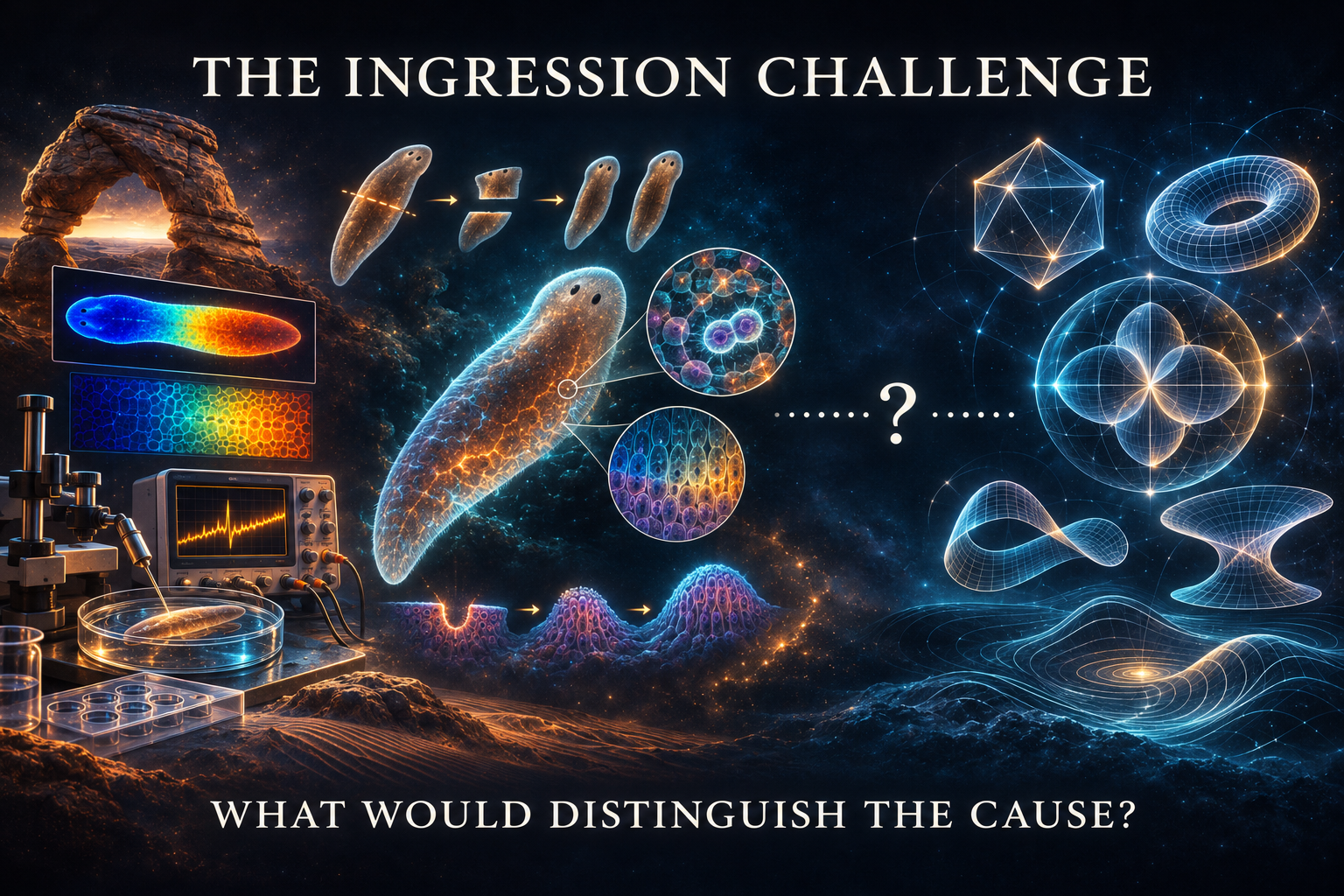
- Illustration: Replaced a visual assertion of identity with a question about what would discriminate physical mechanisms from the proposed external source.
- Computational provenance: Linked the Levin Lab’s official software directory and two relevant codebases, with no implication that the code endorses or refutes the additional Platonic ontology.
November 10, 2026, archival completion. Added article-specific version and concept DOIs, refreshed the reconstructable text record, and incorporated the two intervening editorial revisions and the archived release text into the historical ZIP. The original exchanges remain separately preserved.
Reproducibility record: Read the Markdown revision audit (plain text) or download the complete revision archive (ZIP, including full historical snapshots and exact diffs). The deposited version DOI preserves the initial archival edition and its original support files.