
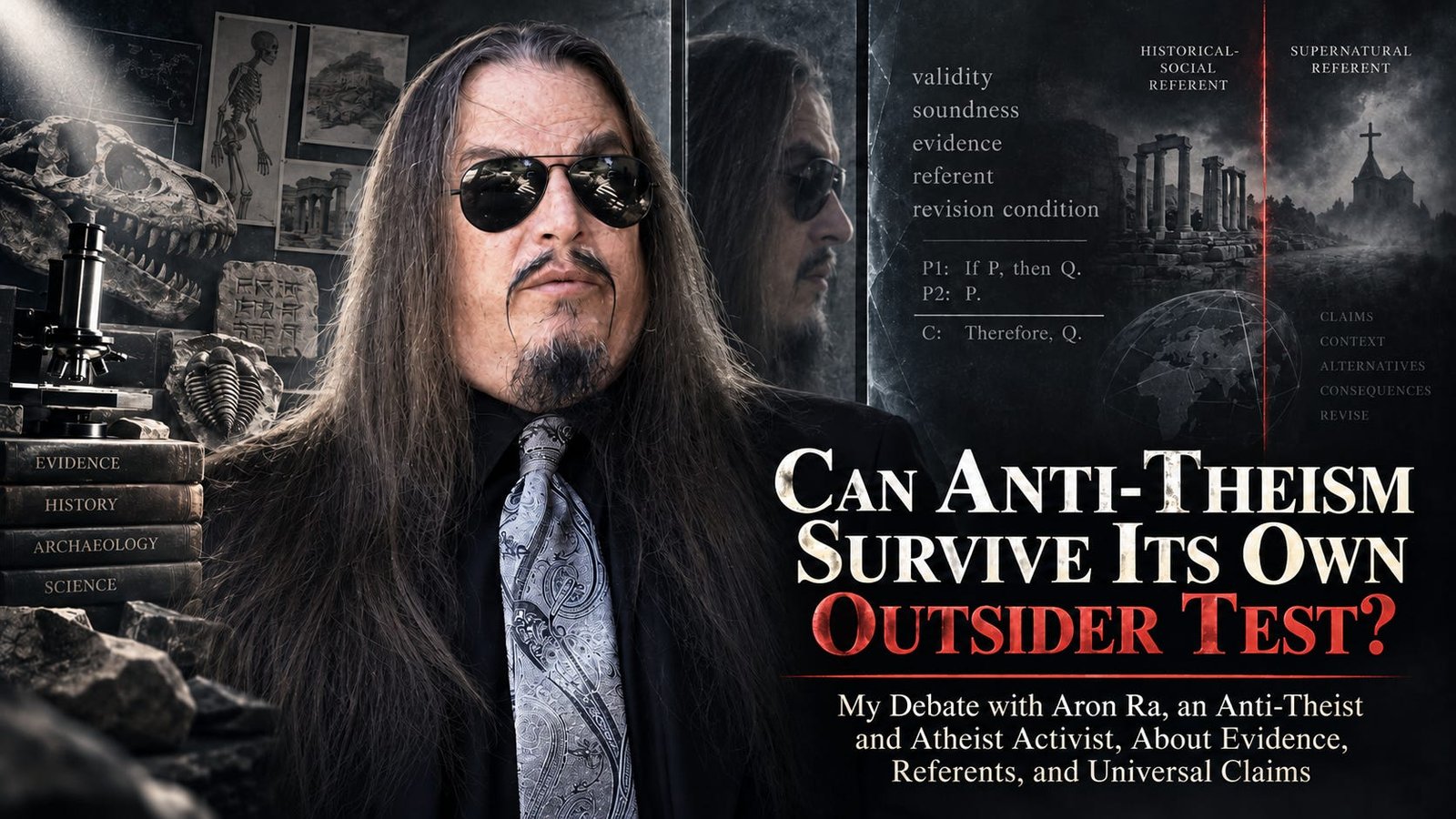
Can Anti-Theism Survive Its Own Outsider Test?
My Public Debate with Aron Ra about Naturalistic Explanation and the God Claims Biblical Debunking Leaves Open
The Skeptic’s Mirror: necessary truths, social Gods, sophisticated theology, and what happens when Hitchens’ razor cuts both ways
By Nathan Sweet
The same evidential rule should govern supernaturalists, sophisticated theologians, and skeptics: isolate the added commitment, make it earn discriminating evidence, and state what would force revision.
My recent public debate with Aron Ra, an American Atheists Board Member and self-described antitheist, became a test of whether skeptical criticism helps build that stronger comparison. Aron himself recognizes the wider target: “The Bible is easy to disprove, but that shouldn’t be enough to disprove God.” This article asks what follows methodologically from that recognition.
Aron’s input was very helpful, and I appreciate his willingness to test my argument. The exchange exposed weaknesses and helped me improve it. I welcome further comments and criticisms that could lead to similar improvements, including challenges to the revisions presented here.
I’ve spent the last few days since my public debate with Aron Ra going back over the scholarship and applying my own critical methodology to my own argument, as well as Aron Ra’s responses to that argument. My aim is to build the strongest naturalistic counter-model I can, together with a methodology for evaluating metaphysical claims said to have implications in our shared reality. Religious experiences, traditions, institutions, and moral commitments give us phenomena to explain. What, if anything, warrants the further claim that a supernatural agent, revelation, divine purpose, or universal experiential ground explains them better?
That project matters especially when potentially harmful forms of theism survive the rejection of biblical literalism and creationism. A theology can accept evolution and deep time while claiming authority over conscience, bodies, education, or public policy. Intellectual sophistication does not establish that authority. Nor does the possibility of harm make a theology false: the evidential case and the ethical assessment each need their own argument.
By a naturalistic null hypothesis, I mean a provisional family of explanatory comparators using biological, psychological, historical, and social processes without assuming the disputed theological addition. This is a research baseline, not yet a statistical null with specified parameters, and it does not assume that naturalism exhausts reality. Its job is to make a comparison possible: what should differ if the addition is true, how would we distinguish that difference from bias or error, and what result would make either account lose support?
The challenge therefore reaches beyond requesting more evidence. We need a method that explains why a finding favors one account over its serious alternatives, and how that judgment can be corrected. If a claim has no specified empirical consequences, its conceptual or explanatory case must still be assessed without quietly crediting it with evidence that competing accounts accommodate equally well.
I do not use atheist as a global identity label; the Stanford Encyclopedia distinguishes global from local atheisms. My judgments concern specified claims. Where a supernatural hypothesis predicts detectable effects that fail to appear, and naturalistic alternatives explain the observations better, I can judge it probably false. An underspecified or empirically indistinguishable claim instead leaves less basis for that judgment. Neither the word God nor its rejection settles every referent in advance.
The title’s “outsider test” comes from John W. Loftus’s The Outsider Test for Faith: evaluate an inherited religion with the skepticism you would apply to a rival religion. My extension rotates the test once more. Apply the same skeptical standards to skeptical claims when the skeptic becomes the claimant.
The immediate disagreement concerned a broad evidential claim Aron used to support a public-policy conclusion. He wrote:
“As there is absolutely no actual factual evidence of nor any logically valid arguments either, but plenty of both against, then it is irresponsible and dishonest for the State to promote policies pretending as if some particular religion is true.”
A defensible opposition to state endorsement of religion does not require proving every religious argument invalid. The additional claims, “absolutely no actual factual evidence,” “no logically valid arguments,” and “plenty of both against,” each require their own support. Once a skeptic offers them as reasons, they become subject to the same scrutiny as any other claim.
The recursive standard is not one I invented for Aron. I reminded him of several standards he had previously used against religious arguments: a claim is not truth merely because someone asserts or believes it and cannot be called truth until we can “SHOW that it is true”; “The only value information has is however accurate you can show it to be,” otherwise “It is just an empty assertion”; and, after previously recognizing that an inference he regarded as obvious had not been made explicit enough for his audience, “I must learn to be more explicit in my explanations.” I also quoted his criticism of a presuppositionalist for offering “no evidence whatsoever; only the logical fallacy of a non-sequitur.”
Those earlier statements supply the mirror from Aron’s own side of the glass: assertions require demonstration, a non-sequitur must be shown rather than named, and “obvious” is not a substitute for making the inferential work explicit.
Aron has also stated a closely related evidential standard. In his November 22, 2015 post, “Anti-theist Answers to Christian Questions”, answering question 25 about sufficient evidence for God, he wrote: “I’ll accept whatever qualifies as evidence. That means a body of objectively verifiable facts that are positively indicative of and/or exclusively concordant with that one conclusion over any other.” In answer 15 of the same post, he also wrote, “If God were real, there would be a way to him through science too.” Those are demanding discrimination criteria. The mirror I am using here therefore does not ask Aron to accept a foreign evidential rule. It asks whether the same demand for objectively verifiable, conclusion-discriminating evidence applies when his own universal skeptical diagnoses become the claims under examination.
Our disagreement therefore concerned what happens when skeptical standards are aimed inward at a skeptical conclusion. The immediate dispute became whether a contingent premise can be true and usable in a sound deductive argument. The larger question is harder: what skeptical method still works after the easy biblical targets are gone?
A flood claim can be tested against geology. A six-thousand-year-old Earth can be tested against physics, astronomy, and paleontology. A prophecy can be tested against textual history. Sophisticated theology may accept evolution, deep time, textual development, metaphorical scripture, and ordinary causal closure while adding mind, purpose, value, universal experience, divine ground, or cosmic meaning at a more abstract level. Those additions still owe evidence.
I began by trying to make Aron’s anti-theist argument harder to attack.
I wrote:
“saying no God argument can be valid is too broad; the stronger criticism is that supernatural and religion-specific conclusions go well beyond what the premises have actually earned.
This is much more damaging to theism because it concedes that valid arguments are easy to construct and forces the real burden onto the only question that matters: whether the premises actually justify a supernatural, personal, revelatory, religion-specific God.”
That remains my position. Validity is cheap compared with establishing the premises and every bridge required to reach a substantive conclusion.
Aron objected to the modal force of my paraphrase and clarified his own claim:
“I didn’t say that no god argument CAN be valid. I said that every argument for God that there currently is or ever was is invalid, or at least faulty.”
The distinction is real. My phrase “can be valid” was modal; his stated claim was historical and universal: every argument that currently exists or ever existed is defective. That clarification narrows what I may attribute to him. It does not erase the separate unrestricted wording quoted in the introduction, “no logically valid arguments.” The charitable reading is that he meant no existing argument succeeds, not that a valid God-argument is modally impossible.
Aron continued:
“As they all rely on frauds, falsehoods and fallacies, and their syllogisms have premises that are not necessarily true along with conclusions that are always non-sequitur. When I tell them there is no logically valid argument, I expect them to push back with an example. But they don’t. They won’t because they know they can’t. Because it is all make-believe and the wanna-pretenders know that I have already seen all the best mental contortions that their raving inanity could produce.”
That statement combines distinct defects. According to the Internet Encyclopedia of Philosophy’s account of validity and soundness, a deductive argument is valid when it is impossible for its premises to be true and its conclusion false. As philosopher Catarina Dutilh Novaes puts it: “A valid argument whose premises are also true is said to be sound.” A false premise can make an argument unsound without making it invalid. Fraud concerns provenance or honesty. A fallacy is a defect in reasoning. A non sequitur is an inferential failure.
I therefore replied:
“False or unsupported premises make an argument unsound, not invalid; fraud would be a provenance problem; and a non sequitur is specifically a validity problem. Those are worth keeping separate because otherwise a believer can correctly point out the technical mistake and dodge the stronger criticism.”
My wording needs a correction too: an unsupported premise does not necessarily make an argument unsound. It leaves its soundness unestablished on the evidence offered; the premise might nevertheless be true. A false premise makes a deductive argument unsound.
The opening rhetoric also matters. Calling prospective respondents “wanna-pretenders” producing “raving inanity” does not bear on their premises or inferences. It functions as poisoning the well if it invites the audience to classify contrary arguments psychologically before evaluating them. The IEP fallacy survey distinguishes defects in an argument from attacks on an arguer or motive. A fallacy weakens an inferential route; it does not establish the opposite conclusion.
My first argument specified a historical-social referent.
Aron said:
“When I tell them there is no logically valid argument, I expect them to push back with an example.”
So I supplied one:
P1. Any materially instantiated higher-level social pattern with reproducible causal effects exists as a social entity.
P2. The historical-social God is such a pattern.
C. Therefore the historical-social God exists.
I wrote:
“That is valid, and its premises are at least plausibly sound. It establishes no supernatural deity whatsoever, but it is enough to defeat ‘every argument for God that currently exists or ever existed is invalid or unsound’ unless you stipulate in advance that by ‘God’ you specifically mean a supernatural personal being.”
The referent was explicit from the start: “the historical-social God,” with “no supernatural deity whatsoever” established by the conclusion. Nothing in this inference changes a social tradition into a supernatural being. Aron could question whether that tradition satisfies P1, or whether an argument about it addresses his intended claim. Those are different objections.
My description of the premises as “plausibly sound” does need correction. Soundness belongs to an argument, not its individual premises. I also explicitly denied that mere plausibility establishes soundness. The original inference is valid when its stated referent is held fixed; whether its premises are true and adequately supported is a separate question. Validity alone does not defeat the broader claim that an argument is “invalid or unsound.”
The distinction between minimal social existence and stronger explanatory leverage also deserves a separate formulation. My original P1 required reproducible causal effects; the surrounding discussion proposed comparative tests for higher-level explanatory status. In the debate I explicitly said that material evidence did not by itself prove all of P2. The minimal existence claim can be stated independently:
P1m. Any materially realized and historically identifiable social tradition-complex exists at least as a historical-social pattern.
P2m. At least some genealogically bounded YHWH/God tradition-complex is materially realized and historically identifiable.
Cm. Therefore at least some YHWH/God tradition-complex exists as a historical-social pattern.
That conclusion is deliberately modest. It does not establish a supernatural deity, a unified macro-agent, or irreducible higher-level causation. It only identifies a historical-social referent.
This answers an unrestricted “no valid argument” claim only if that claim includes the stated social referent. It does not refute the claim that no sound argument has established an independently existing supernatural God. I made that scope qualification in my first reply. Aron could reasonably exclude social-existence arguments from his intended theological target; that would delimit the disagreement, not show this inference invalid or its social premise false.
A stronger and separate research programme asks whether some YHWH/God lineage structure earns nonredundant higher-level realist treatment. That requires additional criteria and evidence, and it remains open below.
Then one phrase, “not necessarily true,” took over the debate.
Aron responded:
“Thanks for the example to prove my point that every religious syllogism starts with premises that are not necessarily true.”
I answered the inference immediately rather than merely asking for clarification:
“you didn’t actually show that my example proves your point, because you never identified either premise as false or inadequately supported; you only observed that they are ‘not necessarily true,’ which either means merely contingent, and is irrelevant to soundness, or means unsupported, in which case you still have to show where the support fails.”
I also gave the stronger higher-level claim an explicit loss condition: demote it if lower-level psychological and social variables preserve the same explanatory, historical, predictive, or intervention work. And I noted that using this one case to support the universal claim that every religious syllogism begins with defective premises would itself require a further argument rather than follow from the example.
“Not necessarily true” has a standard modal meaning. The Stanford Encyclopedia of Philosophy on modality treats necessity and contingency as modal notions and separately discusses epistemic modality in terms of what the available evidence leaves open. A contingent proposition can be actually true while failing to be necessary.
I asked:
“when you say my premises are ‘not necessarily true,’ do you mean contingent, false, or inadequately supported?”
Each answer has different consequences. Contingency is not a defect in soundness. Actual falsity defeats soundness if the premise is required. Inadequate support creates an evidential burden.
Aron returned:
“Are we still talking syllogisms where the premises are not necessarily true?”
I replied:
“We are talking about whether the premises are true and warranted, not whether they are ‘necessarily true.’ … A sound deductive argument needs a valid inference and true premises, not premises that are true in every possible world.”
I used evolution as a reductio. A concrete experimental example strengthens that point: Zachary Blount, Christina Borland, and Richard Lenski (2008) replayed evolution from stored E. coli clones to investigate why citrate use evolved in one population. Earlier and later clones differed in their tendency to evolve the innovation. Their conclusion was that “the evolution of this phenotype was contingent on the particular history of that population.” Historical dependence was something to investigate, not a reason to disqualify the finding. This experiment does not settle metaphysical determinism; it illustrates how science studies outcomes dependent on particular antecedent conditions.
Aron then wrote:
“If the premises aren’t true, then the syllogism can’t act actually prove anything. Having a ‘plausible’ premise at best means ‘maybe’. But when neither of your premises are necessarily true, then it doesn’t work at all.”
The first sentence concerns truth and soundness. Read modally, the last imposes a further necessity requirement. From:
It is not necessary that P.
we do not get “P is false.” We get only that P is not true in every relevant possible world. The disputed move is:
possibly false
therefore actually unusable.
As a general rule about deductive arguments, that inference is false. Consider: all objects in this box are metal; this coin is in the box; therefore this coin is metal. In any actual case where both premises are true, the argument is sound, although neither premise had to be true. Necessity belongs to the truth-preserving connection, not to each empirical premise.
If Aron instead means “not established as true,” he has a legitimate question about warrant. But that reading requires evaluating the support for these premises; it does not turn contingency into a logical defect.
There is a separate scientific comparison if “may be false” means that some uncertainty remains. The LIGO and Virgo discovery paper (2016) reported gravitational-wave detection with an estimated false-alarm rate below one event per 203,000 years and supplied uncertainty intervals for inferred source properties. That false-alarm rate is not the probability that the conclusion is false. It shows how a discovery can be warranted through explicit error assessment without becoming infallible. This is an example of empirical inference, not a claim that uncertain premises yield deductive certainty.
Applied consistently, a rule excluding contingent premises would disqualify empirical premises science routinely uses; a rule excluding all residual uncertainty would disqualify warranted scientific conclusions. These are different rules. Neither follows from the legitimate demand to establish the premises of a sound deduction. The criticism is of those rules if asserted, not an attribution to Aron of a wish to reject science.
I pointed out the shift:
“you just shifted from ‘not necessarily true’ to ‘if the premises aren’t true’ and then back again to ‘neither of your premises are necessarily true.’ I agree that if a premise is actually false, the syllogism is unsound, but that was never the dispute.”
Aron replied:
“I didn’t shift anything. Being not necessarily true leaves open that either or both may be false. I shouldn’t have to explain this to a philosopher!”
A contingent proposition may be false. It may also be true. The proposed general disqualification is refuted by sound arguments with contingent premises. What remains unresolved is whether Aron accepts that distinction and which evidential objection he intends.
“I shouldn’t have to explain this to a philosopher” invokes my standing to portray an undemonstrated error as an embarrassing failure of competence. Its ad hominem force is to invite readers to discount me and my further replies while the disputed inference remains unproved. That is the well-poisoning concern: the alleged error becomes grounds for personal discredit before it has been established. The same failure would occur if a theist dismissed Aron’s objection as ignorance he ought to have outgrown. Neither judgment of the speaker supplies the missing argument.
My answer remains:
“Of course a contingent premise could have been false; soundness asks whether it is true, not whether it is true in every possible world.”
Before Aron moved to the later “word salad” objection, I also explicitly ruled out the weaker positions his replies could otherwise be read as attributing to me:
“I am not claiming these premises are necessary truths, that mere plausibility makes an argument sound, that possibility is evidence, or that this syllogism establishes a supernatural God.”
That matters because my later correction from “plausibly sound” to a more exact evidential description does not concede that I had argued plausibility was sufficient for soundness. I had already denied that inference in the thread.
At that point I reduced the dispute to four discriminating questions.
Which premise fails? Which condition does it fail? What evidence demonstrates the failure? What evidence or argument would make the diagnosis change?
Aron later answered the first two: P2 was the target, and he said it failed every stated condition. Aron did not demonstrate every alleged failure or state what would make him revise his diagnosis. The modal disqualification fails as a general rule; acknowledgment of that error remains absent. Appendix B summarizes the questions and responses.
Aron then made more specific claims, each requiring a separate test.
Aron later wrote:
“OK, so once we remove the word salad in the dubious assertion that is Premise One, then we can summarize it as: ‘If it’s real, it’s real’.
There is no second premise.
What is called Premise Two ignores the fact that God is not a social pattern at any level, nor is it materially instantiated, nor reliably identifiable, and has no reproducible explanatory, historical, predictive, or causal leverage; none of that at all. But but believers still claim all of those things, because faith causes them to lie about everything.
Thus Premise Two isn’t even a premise; it’s just a non-sequitur jump to an assumed conclusion.”
That response contains distinct claims: P1 is circular or meaningless; P2 is not a premise; the relevant pattern is not social, materially instantiated, or identifiable; it has no explanatory, historical, predictive, or causal leverage; and the conclusion is a non sequitur.
I answered the P1 criticism by making the criterion more explicit:
“P1 does not say ‘if it’s real, it’s real.’ It says that if a higher-level social pattern is materially instantiated, independently identifiable, and earns reproducible explanatory, historical, predictive, or causal leverage, then that is sufficient reason to treat it as real at that social scale.”
I then operationalized the disputed terms rather than leaving them as labels:
“‘materially instantiated’ means there are observable people, artifacts, practices, representations, institutions, and processes realizing the pattern. ‘Reliably identifiable’ means we can specify why different manifestations count as instances or historical continuations of that pattern rather than grouping them arbitrarily. And ‘explanatory, historical, predictive, or causal leverage’ means retaining the higher-level pattern helps us explain, reconstruct, predict, or intervene better than an adequate rival description that leaves it out.”
So reducing the criterion to “if it’s real, it’s real” does not expose a circularity unless those proposed tests themselves collapse. It deletes the tests before evaluating them. I also gave Aron three explicit ways to defeat or force revision of the argument: show that the P1 criterion is inadequate; show that the historical-social YHWH/God pattern fails one of P2’s stated conditions; or show that the conclusion does not follow even if P1 and P2 are true. Aron then selected the second route and said P2 failed every condition.
That selection makes a condition-by-condition comparison available. It does not establish that Aron conceded meaningfulness: a critic can test a criterion for the sake of argument while separately disputing it. The two objections must nevertheless be distinguished and demonstrated.
The later formulation makes independent identifiability explicit and broadens the kinds of leverage under consideration. It develops the original criterion rather than repeating it word for word. Comparative explanatory tests were already present in my earlier reply. Aron’s initial paraphrase must be assessed against the wording he was answering; the separate formulations below clarify which burdens belong to minimal existence and which to stronger realism.
Even the original P1 named material realization and reproducible effects. “If it’s real, it’s real” omits those proposed grounds and leaves only an empty conclusion. That is a substantive misrepresentation of the proposed criterion. The later operational definitions make the difference explicit. They do not prove the criterion correct, but repeating “meaningless” does not test them. Nor would showing that an existence criterion is partly analytic establish that an empirical application of it is meaningless. To demonstrate circularity, the critic must identify where the conclusion is assumed in establishing the premises. To challenge the criterion instead, the critic can show that its tests admit arbitrary groupings or fail to support the intended realist conclusion. Those are substantive possibilities; deleting the tests does not establish either.
The serious question inside Aron’s criticism survives: do those conditions actually distinguish robust higher-level social patterns from arbitrary descriptions? If they do not, P1′ fails.
He then made a different claim: “There is no second premise.”
Aron later made the premise-status claim explicit:
“P2 is literally not even a premise. For the reason that it is actually a reaction of the type that is typical of believers. Whatever criteria is given to accept something as real, apologists will automatically say that their god meets whatever that criteria is.”
The Stanford Encyclopedia of Philosophy on argument treats premises by their inferential role. If P2 is offered with P1 in support of C, it functions as a premise. Truth, support, ideological origin, and motive are separate questions. This was also my answer in the exchange itself:
“P2 is also a premise even if you believe it is false. A false premise makes an argument unsound; it does not make the premise disappear or turn the inference into a non sequitur.”
If P2 is false, the deduction is unsound. If P2 assumes C, it may beg the question. If “God” changes meaning, the argument may equivocate. If P1 and P2 can both be true while C is false, the inference is invalid. “Typical of believers” does not determine premise-status. The stated reason fails to support the stated conclusion. P2 functions as a premise whether its content ultimately survives scrutiny or not.
Consider an illustrative syllogism: all planets move in perfect circles; Mars is a planet; therefore Mars moves in a perfect circle. The first premise is false—Kepler’s work on Mars helped replace circular orbits with ellipses—but it remains a premise, and the inference remains valid. Rejecting a scientific assertion changes its evidential standing; it does not erase its role in an argument. The same distinction applies to religious assertions.
The move from ideological typicality to “not a premise” is a non sequitur. If ideological origin is also being used to establish falsity, that is a genetic fallacy. The IEP also notes the relevant nuance: provenance can affect evidential weight and justify verification. It does not replace evaluation of the claim itself. As I put the distinction in the thread, suspicious provenance can justify independent verification, but “people of this ideological type often say things like this” does not yield “therefore this proposition is not a premise,” still less “therefore it is false.”
Aron’s further generalization,
“Whatever criteria is given … apologists will automatically say that their god meets whatever that criteria is.”
may describe a real apologetic strategy, but as a claim about all apologists it requires evidence and still does not tell us whether this P2 satisfies these criteria.
The stronger statement,
“faith causes them to lie about everything”
is a hasty generalization and poisoning-the-well move if used to discredit the premise. A proposition’s truth does not depend on the team associated with it.
Aron later repeated that P2 was “literally not even a premise,” so I do not count premise-status as an implicit concession. But he never answered the inferential-role point: no rule was supplied by which ideological typicality makes a declarative proposition offered in support of C cease functioning as a premise. Aron also offered no evidence for “faith causes them to lie about everything.” That assertion supplies no established reason to reject P2.
An objection about a supernatural being does not answer the stated social referent.
When Aron wrote,
“God is not a social pattern at any level, nor is it materially instantiated”
there are two possible readings. If he meant the supernatural being asserted by believers, he was denying a claim my first argument expressly excluded. If he meant the historical-social pattern I specified, he was making substantive denials about its realization and organization. Either reading needs to be assessed against that stated referent.
I reiterated the distinction:
“When you say ‘God is not materially instantiated,’ you seem to be talking about the supernatural being believers claim exists. I agree that my argument has not established such a being or force. P2 refers instead to the historically documented YHWH/God tradition: its texts, representations, rituals, institutions, identities, laws, communities, and behaviors.”
I then gave the objection its strongest form rather than shielding P2 from criticism:
“if you are saying that those realizers do not form a sufficiently coherent historical-social pattern, or that keeping track of that pattern adds nothing beyond simply listing the people, texts, institutions, and behaviors involved, that is a substantive objection to P2 and exactly the kind of criticism I am asking for. But if you are saying that a supernatural God is not materially instantiated, then you are denying a claim my argument deliberately does not make.”
Aron’s later wording removes any doubt about the target of that objection. He explicitly named “The historical-social YHWH/God pattern” and said it failed every condition in P1. At that point he was directly challenging the social model, so it would be inaccurate to say he never engaged the stated referent. The remaining question is whether his denials were demonstrated. Appealing to the absence of a supernatural being could not establish them.
I also made the label optional:
“You do not have to call the historical-social pattern ‘God,’ and my argument does not depend on claiming that this pattern is numerically identical to the supernatural being a theist means by ‘God.’ Call it the historical-social YHWH/God tradition-complex if that is clearer.”
That wording protects the referent specified from the outset. It closes the objection that the argument depends on moving between social and supernatural meanings of “God.” The supernatural claim remains a further proposition requiring additional evidence. Questions about whether the social pattern is well bounded or explanatorily useful remain open, but substituting a supernatural being for that pattern cannot answer them.
A higher-level social pattern can be physically realized through components and relations without being an extra fundamental substance.
Contemporary social ontology makes that question legitimate. In a peer-reviewed 2023 paper, Francesco Guala discusses an inferentialist approach in which real kinds are “real-world structures that make successful scientific predictions, explanations, and interventions possible,” specifically considering historical and multi-functional social kinds. Brian Epstein’s peer-reviewed framework separates the grounding of social facts from the anchoring of social categories and notes that it has become “intellectually respectable to take social properties seriously.”
Neither proves P1′. They show that material realization, higher-level social reality, multiple realization, explanatory leverage, grounding, and category anchoring are substantive philosophical questions rather than empty vocabulary.
My Provisional, Boundary- and Scale-Relative Realism makes the commitment graded: treat a higher-level pattern as increasingly real to the extent that it earns robust prediction, intervention, explanation, or transfer at a specified boundary, and demote it if an adequate rival preserves that work without the pattern.
Aron made an empirical denial that can be checked.
Aron eventually stated:
“The historical-social YHWH/God pattern fails every one of the stated conditions in P1.”
Earlier:
“God is not a social pattern at any level, nor is it materially instantiated, nor reliably identifiable, and has no reproducible explanatory, historical, predictive, or causal leverage; none of that at all.”
Those are strong empirical denials. They also have a simple quantifier structure that matters to the burden of rebuttal. Aron said the pattern fails every one of the conditions and has none of that at all. I therefore did not need to establish every part of the stronger P2′ programme to falsify that universal formulation. One established property among those explicitly denied is enough to defeat “every one” and “none.” The rest of the evidence asks how many of the remaining denials survive.
First, material realization can be checked against the historical record.
Jeremy Smoak and William Schniedewind’s peer-reviewed study of Kuntillet ʿAjrud analyzes eighth-century BCE inscriptions while explicitly resisting the inference that their religious content, by itself, establishes a cultic function for the site. They instead place divine names and blessing formulas within daily life and Israelian scribal curriculum. One Pithos A inscription includes:
“I have [b]lessed you to YHWH of Shomron (Samaria) and to his ʾasherah.”
That does not establish a supernatural Yahweh. It establishes material traces of YHWH naming, blessing formulas, representation, and scribal practice. At the minimal historical-social boundary specified here, these artifacts contradict the denial of material realization. Whether they form a sufficiently coherent, nonredundant macro-level kind is a further question. Rejecting that stronger claim cannot erase the material practices themselves.
Second, historical identifiability can be treated as a genealogical problem.
Religious traditions transform, split, hybridize, and retrospectively rewrite themselves. I explicitly rejected an immutable essence in the debate and treated a coarse or fractured genealogy as a reason to revise the model. The issue is how well specified lineages can be tracked through change.
But difficult identity through change is not the same as untrackable lineage. In 2025, Anastasia Ejova and colleagues used computational phylogenetic methods on a purpose-built dataset of 291 religious denominations and their genealogical relationships, reconstructing dated Indo-Iranian, Islamic, and Judeo-Christian phylogenies.
That study supplies a concrete genealogical model to assess; it does not by its existence prove the model reliable or establish my exact partition. Aron’s specific denial must be tested against the relevant lineage evidence, rather than enlarged into a claim about all religious genealogy. The stronger form of P2′ should therefore concern a nested, genealogically structured family of YHWH/God lineages, with uncertainty represented explicitly.
Third, predictive and explanatory leverage are empirical questions too.
Aron’s claim of “no reproducible explanatory, historical, predictive, or causal leverage; none of that at all” is also testable.
A 2019 meta-analysis by Henk Stulp, Jurrijn Koelen, Annemiek Schep-Akkerman, Gerrit Glas, and Liesbeth Eurelings-Bontekoe was based on 123 independent samples from 112 primary studies and 348 effect sizes. The authors report that “narrowing down the general concept of religiosity to specific measures of God representations resulted in stronger associations,” while also reporting substantial heterogeneity across results.
A cross-cultural study by Benjamin Purzycki and colleagues tested 591 participants from eight communities. Holding relevant variables constant, higher ratings of gods as punitive and knowledgeable were associated with greater allocations to geographically distant co-religionists relative to oneself and local co-religionists.
These studies support associations involving measurable God representations. They do not by themselves establish causal direction, held-out predictive improvement, or the incremental contribution of an entire historical lineage. If Aron’s denial encompasses those representation-level associations, this is relevant counterevidence. If his target is specifically nonredundant lineage-level leverage, that stronger question remains open. The material evidence already defeats “every condition fails”; the behavioral evidence need not be stretched to do more than it establishes.
The stronger research claim retains its own evidential burden.
The stronger research question I take from the exchange is:
Your P2′ is a genuine premise, but you still owe evidence that the historically connected YHWH/God tradition-complex is sufficiently coherent, sufficiently well-bounded, and sufficiently nonredundant to merit realist treatment as a higher-level social pattern rather than serving as shorthand for lower-level psychological, textual, institutional, demographic, and network variables.
I accept that burden for the stronger research claim. Accepting it does not rehabilitate the modal error, the premise-status error, or the blanket denial of material realization. In particular, I do not need to establish nonredundant macro-level causation to show that an identified tradition has material realizers.
A critic can reasonably withhold belief pending that stronger evidence without building an alternative model. But asserting that the argument is invalid or that every condition fails goes further: those diagnoses need their own support. That research question remains open; Aron did not demonstrate a refutation of the stronger model.
The claim requires evidence about the specified pattern and comparisons that could support or defeat it.
The appropriate test is a cost-matched model comparison.
Model 1: people, texts, institutions, rituals, incentives, psychological variables, networks, demographics, and local representations, with no higher-level historical lineage variable.
Model 2: the same variables plus explicitly modeled historical descent, transmission, branching, inherited constraints, and YHWH/God lineage structure.
Specify the outcome, historical boundary, competing partitions, and comparison criteria before evaluating success. Compare held-out reconstruction and prediction across settings; assess causal claims with designs that can identify causal effects. Match data access and account for model complexity so extra variables cannot win merely by fitting more noise. Ablations and robustness checks should test whether lineage structure supplies the gain.
If Model 1 preserves the work, demote the stronger lineage claim. If Model 2 repeatedly improves performance under those controls, increase confidence in its usefulness and investigate what realist interpretation that success warrants. Improved prediction alone does not establish an autonomous agent or irreducible causal power. This test of macro-level realism is also separate from using ordinary naturalistic explanations as theological comparators; those explanations need not wait for P1′ to succeed.
That is the research programme developed from the comparative tests I proposed in the debate.
A successful historical-social model makes the supernatural addition earn its support.
The aim is to develop a naturalistic rival against which supernatural explanations can be compared.
Let:
H: a naturalistic model of nested historical-social YHWH/God lineages together with their cognitive, textual, institutional, ritual, and behavioral realizers.
G: an additional independently existing supernatural agent corresponding to some theological interpretation of those lineages.
Texts, institutions, rituals, religious experiences, political structures, moral systems, conversions, schisms, prayers, laws, art, wars, communities, behavioral effects, and historical transmission are evidence of something. The skeptical question is not simply:
Is there evidence for God?
It is:
Evidence of what?
If H already makes a body of evidence E probable, E cannot simply be credited wholesale to H+G. Richard Carrier’s Bayesian treatment of religious arguments is useful here because the relevant issue is comparative likelihood under rival hypotheses.
The discriminating quantity is the likelihood ratio:
P(E | H + G) / P(E | H).
For specified models, a ratio near one means E contributes little likelihood evidence for adding G beyond H. Posterior odds also depend on priors, and predictions must account for auxiliary assumptions and parameter uncertainty. H and H+G are schematic labels here; no numerical Bayes factor has been calculated. Evidence can favor G without being logically exclusive to G, but merely showing that G accommodates it does not establish that advantage.
The supernaturalist therefore owes a residual: what does G explain better, what prediction changes, what observation should differ, and what independent information channel, intervention, or held-out success discriminates H+G from H?
I wrote to Aron:
“If much of the historically observable evidence associated with ‘God’ can already be explained by a lower-commitment historical and social model, then supernatural agency, revelation, miracles, consciousness, moral perfection, Christianity, or denomination-specific claims do not get to inherit that evidence merely because the same word ‘God’ is used for both.”
That inference is central. Granting the historical-social evidence makes the supernatural burden harder than simply declaring:
“God is imaginary.”
But biblical debunking leaves a residual-target problem: what survives after literalism?
Aron’s public work provides a useful stress test. His signature project, Foundational Falsehoods of Creationism, and his Young Earth Creationism material attack claims that collide directly with established science. His 2018 essay on unfulfilled prophecy uses historical context, translation, and ordinary empirical knowledge against literal prophecy readings.
Aron himself states the limit succinctly: “The Bible is easy to disprove, but that shouldn’t be enough to disprove God.”
Suppose the creationist loses everything. Deep time and evolution survive. Noah’s flood is mythology. Genesis is not a scientific chronology. Prophecy fails as a uniquely supernatural information channel. Scripture shows textual development. Miracles remain evidentially unsupported. That result does not automatically settle philosophical theism, religious naturalism, pantheism, panentheism, process theology, idealism, ground-of-being theology, mystical realism, or other programmes making different claims.
This is the residual-target problem: a skeptical method can be extremely effective against empirically exposed supernatural propositions while remaining underpowered against metaphysical additions compatible with ordinary science.
The wider target does not depend on calling literalists a tiny minority.
Pew’s global estimates published in 2025 put religious affiliation at 75.8% of the world population in 2020. Those figures measure affiliation, not literalism, creationism, or harmful beliefs. They cannot tell us what fraction of potentially harmful religious views is literalist.
A narrower result is available: Gallup’s 2022 U.S. survey found that 25% of Christians treated the Bible literally, while 58% regarded it as divinely inspired without taking everything literally. These are U.S. Christian attitudes to scripture, not worldwide estimates of creationism or harm. The defensible point is that criticism of literalism leaves substantial nonliteral religious commitments to evaluate.
The practical stakes can be identified directly. In Humanae vitae, §§4 and 10–14, an argument from natural law, divine design, and interpretive authority supports restrictions on deliberately contraceptive acts. Refuting a young Earth would not address that argument. This illustrates a route from metaphysical premises to consequential norms; it does not quantify their harms or attribute the position to every Catholic.
My concern is the possibility that unearned metaphysical authority licenses coercion, exclusion, or resistance to correction. Establishing any particular harm requires specifying the practice, affected people, consequences, and causal evidence. Philosophical sophistication neither establishes a claim’s truth nor guarantees its harmlessness.
Historical scholarship sharpens the problem because “Judaism,” “Christianity,” “God,” “Son of God,” “orthodoxy,” and even scholarly categories such as “Gnosticism” are historically changing constructs.
Mark S. Smith’s Oxford study of biblical monotheism reconstructs Israelite religion against a wider West Semitic background. In his chapter on monotheistic rhetoric, Smith explicitly argues that “monotheism is not a separate stage of religion in ancient Israel” and characterizes it as “a kind of ancient rhetoric reinforcing Israel’s exclusive relationship with its deity.” That is more precise than treating later monotheism as a timeless proposition appearing fully formed.
Elaine Pagels’s peer-reviewed work makes early Christian diversity concrete. Her 2002 study of Irenaeus’s “canon of truth” examines boundary-making through hermeneutics and ritual. Her 2024 Harvard Theological Review study, “How the Gospel of Truth Depicts Paul’s Secret Teaching”, uses the Gospel of Truth as evidence for second-century reception of Paul and documents sharply divergent interpretations among Christians working with overlapping Pauline materials. Michael Allen Williams adds a methodological correction: “Gnosticism” can itself reify heterogeneous movements into a single object. Historical criticism must decompose its own categories as aggressively as theology’s.
Adela Yarbro Collins argues that some Markan hearers may have construed Jesus’s divine sonship “in another, more traditionally Jewish way.” Her 2000 companion study of “Son of God” among Greeks and Romans tests the title against Greek and Roman usage and the wider Greco-Roman context of Mark’s readers. Daniel Boyarin challenges a sharp early Christianity/Judaism separation and uses Logos/Memra and Jewish binitarian traditions to place Johannine divine language within a more complex Jewish theological field.
These histories help identify which later supernatural or metaphysical commitments require independent warrant. Anti-theism must track the proposition actually under examination at each historical stage rather than defeat one modern doctrinal bundle and project that result backward across the whole lineage.
Graham Oppy’s comparative approach to arguments for atheism points in the same direction. Oppy distinguishes direct, indirect, and comparative arguments and concludes that “a successful argument for atheism would most likely look something like the comparative argument” he sketches.
David Kyle Johnson’s 2015 work on miracles provides a direct bridge to my logical correction. Johnson explicitly writes, “Such arguments can be valid,” then relocates the dispute to whether belief that the alleged miracle occurred is justified. Validity does not purchase evidential warrant.
Johnson’s 2022 follow-up, “On Angels, Demons, and Ghosts”, is even closer to the method at issue here. He says his earlier impossibility formulation was “too strong” and explains that it made the negative conclusion unfalsifiable, while retaining a severe skeptical judgment about the present evidence. His revised view leaves open that “if such entities were real, it would be theoretically possible to demonstrate their existence scientifically.” That is the kind of skeptical correction I am arguing for: narrow an overstrong universal claim without surrendering what the evidence still earns.
Sophisticated theology survives that first filter, so it needs a different stress test.
Contemporary theology can surrender Aron’s easiest targets and retain ambitious ontological claims.
My continuing exchange with provides an example. His 2020 article “The Varieties of Physicalist Ontology” argues that Whitehead’s process-relational panexperientialism is a more formidable alternative to standard physicalism than dominant substance-property forms of panpsychism. His 2024 paper “Physics Within the Bounds of Feeling Alone” argues for a panexperientialist view in which feeling is central to physical reality. The Process & Science Network, which he directs, explicitly aims to “actively generate testable research programs” spanning physics, biology, psychology, and cosmology while challenging scientific materialism’s exclusion of mind, purpose, and value.
Segall’s September 2026 discussion of “spiritual science” makes the target harder, not easier. He says he cannot verify most of Steiner’s claims, calls insulating them from criticism “epistemically disastrous,” and argues that spiritual research needs ways of being “compared, corrected, replicated, interpreted, and distinguished from projection.” That is substantial methodological common ground. The remaining dispute is not whether sophisticated metaphysical or spiritual claims should be corrigible, but whether their distinctive additions have yet produced discriminators adequate to those standards.
In our separate exchange, the disputed increment is Segall’s universal identity claim that concrete causal actuality just is experiential feeling or felt inheritance. My shared core, D, already grants process, causation, temporal inheritance, receptivity, organization, and real causal efficacy. X adds universal experiential identity. My position is D+?X: accept that shared core while suspending judgment about X. That suspension is an epistemic position, not itself a competing predictive theory. The comparison requires developed accounts of process, powers, neutral events, or emergence that accommodate D without assuming X.
Flood geology, prophecy criticism, and textual development do not answer that question. The relevant test is:
What reason favors an account identifying causal actuality with feeling over serious accounts that preserve the shared phenomena without assuming that identity? What would reverse that assessment?
A universal identity claim can matter without violating a physical law or invoking a miracle. If a chain such as receptivity → interiority → feeling → experience → value → purpose → spiritual significance transports warrant without separately validated bridges, thin observations can be made to support much richer ontological and normative claims. Those promotions can affect consciousness attribution, moral patiency, ecological ethics, technological governance, research priorities, and public authority.
The scrutiny is symmetric. If X earns comparative support, my suspension should change. If a naturalistic account loses on independently justified criteria, it should be revised. Experiential identity and supernatural agency are different proposals; neither can be accepted or rejected merely by treating them as interchangeable.
Nor is the objection that Segall has never described a methodology. The sources above show that he has. The question is whether that methodology, applied to this identity claim, supplies a comparison whose outcome is not already settled by its definitions. Coherence, explanatory integration, or a demonstrated contradiction in a rival can matter, provided the criteria and disputed premises are exposed to criticism. A metaphysical preference with no discriminating empirical consequences may remain debatable on those grounds, but it gains no empirical confirmation simply by restating shared observations.
The general anti-theist upgrade is therefore:
Can anti-theism remain equally severe when theology stops making easy supernatural claims and starts making sophisticated metaphysical ones?
The method is to identify the disputed addition, hold the evidential record constant across the comparison, develop serious alternatives, specify what would favor each, and state revision conditions before interpreting the result. Creationism, prophecy, miracles, and supernatural interventions remain special cases inside that broader method.
The same move brings Hitchens’ razor back onto the skeptic.
I wrote:
“This is where Hitchens’ razor becomes awkwardly relevant: ‘What can be asserted without evidence can also be dismissed without evidence.’”
Hitchens used the formulation in God Is Not Great. I use it here as a burden rule, not as proof that an unsupported proposition is false.
When Aron asserted that:
“God is not a social pattern at any level”
and is:
“not materially instantiated”
with:
“no reproducible explanatory, historical, predictive, or causal leverage; none of that at all”
he made positive claims about reality. The minimal material-realization denial conflicts with the historical evidence above; stronger denials about independent lineage-level leverage still require comparison. Withholding assent to my model would have been a weaker claim than asserting that every condition fails.
Hitchens’ razor works as a burden rule: unsupported propositions remain unearned. It does not license the inference:
You have not earned P → therefore not-P is established.
My Sweet Rationalism ethos states the symmetric constraint:
Do not add what the evidence did not earn. Do not subtract what the evidence did not defeat.
Supernaturalism pays for every added commitment. Universal skeptical negations pay the same evidential price.
Each theological arrow therefore carries its own evidential burden.
A 2026 SkeptiCamp report says Matthew Lee Loftus emphasized audience and message selection because “You can’t refute everything; you would be playing whack-a-mole.” I take the higher-leverage extension here to be: audit the inferential generator of theological overreach rather than refuting every downstream claim one at a time.
The recurring question is:
What evidence or argument favors the disputed increment over serious alternatives?
Necessary ground does not entail intelligence. Intelligence does not entail agency. Agency does not entail personhood. Personhood does not entail moral perfection. Moral perfection does not entail special concern for humans. Human concern does not entail revelation. Revelation does not entail this scripture. This scripture does not entail Christianity. Christianity does not entail your denomination.
Every arrow requires its own bridge.
A later thread corrected one point in my account and sharpened what still remained.
I had summarized part of the earlier exchange as moving toward “Maybe I should look at it again.” Aron corrected me:
“No sir. My comment that ‘I should look again’ was tongue in cheek. I did look again, and saw that I was right the first time. Premises that are ‘not necessarily true’ still leave open that they are potentially false, and thus the syllogism is inoperative.”
That is a genuine correction of my report. I had treated a sarcastic remark as evidence of epistemic movement, and I withdraw that characterization.
I then checked sources relevant to the modal rule. Dutilh Novaes’s account of argument and the Internet Encyclopedia on validity and soundness require actually true premises for soundness; the Stanford Encyclopedia on modality distinguishes necessary from contingent truth. Aristotle’s Posterior Analytics does require necessity for scientific demonstration in its special sense, while allowing: “Syllogism there may indeed be without these conditions.” That restricted Aristotelian ideal must not be substituted for either modern deductive soundness or all legitimate empirical inference.
On the modal reading, the first clause is true: a contingent premise could have been false. “Thus” introduces the invalid inference already exposed above. On the epistemic reading, uncertainty about a premise warrants checking its support; it still does not establish logical inoperability. Aron offered no argument bridging either gap. The same rule would otherwise disable ordinary deduction from contingent empirical premises such as common ancestry, plate tectonics, particular experimental results, and historical events merely because the actual evidence could have been different.
Aron then replied:
“You asked for sources, then provided them for me. If we both already agree that a syllogism with false premises is unsound, then why are we still talking about this?”
But the sources supported the proposition we already agreed on, that actually false premises defeat soundness. They did not establish the disputed proposition that premises which are not necessary truths therefore make the syllogism inoperative. I nevertheless reconstructed the strongest version of his concern that the sources do support:
“The closest defensible version I could find is that contingent premises remain open to falsity, so unless they are adequately established as actually true, soundness has not been established. I agree with that.”
Aron also gave the better substantive formulation:
“your premises are false, inadequately supported, and fail to entail the conclusion.”
That sentence names the distinctions I had been pressing: actual falsity, inadequate warrant, and non-entailment. It does not show that Aron accepted my analysis, withdrew his earlier modal inference, or abandoned it. When I described this as conceding the “central structure,” the relevant change was that he named specific questions to test. His wording did not concede the answers or retract his earlier claims.
Those are three substantive and separable objections. I bracketed the modal dispute and asked which premise was false, where its support failed, or why the conclusion did not follow. A countermodel with true premises and a false conclusion, or an identified equivocation, would expose invalidity. Aron supplied neither. The original social-existence syllogism already has a valid form: if every F is R, and the specified historical-social pattern is F, it is R. Its explicit exclusion of a supernatural conclusion blocks the alleged social-to-supernatural inference. The minimal formulation has the same valid structure. Premise truth and the stronger model’s evidential warrant remain separate burdens; Aron’s continued non-entailment charge did not establish a defect in that form.
The mirror only works if criticism changes my own argument where it earns a change.
The exchange helped me refine the criterion and exposed errors that deserve precise correction. I accept Aron’s clarification that “look again” was sarcastic. My wording about “plausibly sound” premises and unsupported premises making an argument unsound also needs the corrections set out above.
Other limits were already part of my argument. I specified a historical-social referent from the outset, rejected an immutable essence, denied that the behavioral studies established autonomous macro-causation, and gave conditions for demoting the stronger model. I also requested definitions, counterexamples, and formal analysis alongside empirical evidence. Those commitments should be assessed by how well I apply them.
Criticism can correct an error, make a distinction clearer, or sharpen a test. Each is useful; the record should show which happened.
By the end, the resolved and unresolved parts of the disagreement were narrow enough to state cleanly.
Aron eventually identified P2 as the central target and said it failed every stated condition: realization, identifiability, explanatory leverage, historical leverage, predictive leverage, and causal leverage. That specifies what must be tested; it does not supply evidence that any of those conditions fails.
Aron supplied no contrary empirical source or comparative test demonstrating all of those failures, no rule connecting contingency to syllogistic “inoperability,” no demonstration that the expanded P1′ criteria are semantically empty, no countermodel for the stated inference, and no stated condition for revising his diagnosis. Aron repeatedly framed my request as asking him to explain the same “obvious” point again. I explicitly removed that burden:
“If you believe you already demonstrated the defect, you need not repeat yourself, and I never asked you to; just point to the specific argument, evidence, source, or inferential step that does the work.”
Aron did not identify the earlier demonstration. Pointing to it would not have required him to re-explain anything, so “I am not going to repeat myself” did not answer that request. His claim to have demonstrated these defects “in detail” remained unsupported by an identified argument. He also did not state what evidence or argument would change his diagnosis.
None of this makes my case true. As I wrote at the time, it means only that evidence presented and conclusions asserted were not presently on equal footing.
That leaves the methodological question intact:
When the skeptic becomes the claimant, what evidence must the skeptic provide, and what would make the skeptic revise the claim?
Appendix B sets out the questions and responses for comparison.
The same standard also requires a fallacy audit of both sides.
I only name fallacies where the form fits. The Internet Encyclopedia of Philosophy’s caution governs the audit: “A charge of fallacious reasoning always needs to be justified.”
On Aron’s side, these are the fallacies or inferential defects whose forms fit.
Modal conflation / non sequitur: “a premise could have been false” does not entail “therefore the syllogism is inoperative.” Contingency does not entail actual falsity or invalidity.
Misrepresentation by omission: “If it’s real, it’s real” deletes the proposed grounds for applying the criterion. The original P1 already specified realization and effects; later P1′ added identification and clearer leverage tests. Those later refinements must not be attributed retroactively to the original wording.
Non sequitur about premise-status: being “typical of believers” does not prevent P2 from functioning as a premise. Using ideological origin to establish falsity would additionally commit a genetic fallacy. Provenance can warrant checking evidence; it cannot perform either inference by itself.
Hasty generalization: “faith causes them to lie about everything.” The universal claim exceeds anything demonstrated in the exchange.
Poisoning-the-well function: “wanna-pretenders,” “raving inanity,” and global dishonesty attributions invite readers to discount interlocutors before testing their propositions. The philosopher jab similarly presents my supposed failure of competence as grounds for discounting further replies, although the disputed inference remains unproved.
Premise-status error: premise-status depends on inferential role, not whether the proposition is true, religious, well-motivated, or supported.
Invalidity charge: the original syllogism and the minimal formulation are valid with their stated social referent held fixed. Premise truth, evidential support, and relevance to a supernatural claim are separate questions.
Equivocation/conflation across truth, necessity, and warrant: “not necessarily true,” “not true,” and “not established as true” are treated as interchangeable at several points.
I also would not call the later empirical objections “moving the goalposts” by default. Critics may refine objections. He raised modal, semantic, and empirical objections, and returned to the modal claim later. Nor do I infer bad faith from Aron’s refusal to continue. Leaving a discussion is permitted; it simply does not demonstrate the conclusion.
On my side, the audit separates errors, refinements, and remaining burdens.
Truth and warrant: “False or unsupported premises make an argument unsound” wrongly groups two conditions. I repeated that slip later as “false or inadequately warranted,” although elsewhere I correctly said that inadequate support leaves soundness unestablished. False premises defeat soundness; unsupported premises may still be true. Calling individual premises “plausibly sound” was also a terminology error. My explicit denial that plausibility suffices for soundness remains part of the account.
Reporting reconsideration: I accept Aron’s clarification that “look again” was sarcastic and withdraw my characterization of it as reconsideration. His later naming of substantive objections likewise does not establish agreement or withdrawal of his earlier claims.
Scope of the counterexample: my original social referent was explicit. Its existence does not refute a claim confined to supernatural existence, a limit I acknowledged immediately. My earlier “can be valid” paraphrase also went beyond Aron’s clarified historical claim about existing arguments. Those qualifications limit what the example rebuts; they do not establish equivocation within it.
Development of the criterion: the later P1 formulation adds explicit identification criteria and broadens the leverage considered. Separating minimal existence from stronger realism makes their different burdens easier to evaluate. Refining a criterion is legitimate; it does not retroactively add conditions to its earlier wording.
Existing safeguards and open tests: I already rejected an immutable God essence, identified genealogical overcompression and redundancy as possible failures, and denied that the behavioral studies established autonomous macro-causation. The remaining question is whether evidence about particular representations supports the exact lineage-level claim being tested. I also explicitly requested “definitions, evidence, counterexamples, rival models, or formal analysis.” There is no basis for recasting that as a commitment to empirical falsifiability as the only test of logical or semantic claims.
These distinctions correct actual errors while preserving the argument’s stated scope and unresolved evidential burdens.
The surviving asymmetry is evidential, not personal.
I provided sources relevant to the modal distinction, empirical evidence bearing on the historical-social claims, revisions to my own construct, and conditions under which the stronger model should be demoted. Aron eventually made clearer counterclaims, but offered no source for the modal rule, no contrary empirical source or comparative test supporting the universal denial, no countermodel for the stated inference, and no stated revision condition.
Three verdicts should stay separate. The modal disqualification and the stated premise-status inference fail. The denial of every condition is defeated at the minimal material-realization level. Stronger claims about nonredundant lineage-level realism remain open. None of those results establishes supernaturalism, and the last cannot be settled by either side’s assertion.
My position and its remaining burdens can now be stated directly.
For specified supernatural claims whose predicted detectable effects fail to appear, or whose evidence is better explained by naturalistic rivals, I can assign substantial probability to their falsity. Where neither predictions nor a meaningful comparison have been specified, lack of a discriminator alone does not establish that probability. That is why my skeptical conclusions must remain local to the claim and the evidence.
I am highly confident that historical-social God traditions exist. I am also highly confident that ordinary biological, psychological, historical, and cultural mechanisms explain large portions of religious belief, experience, institutional persistence, and doctrinal change. Evidence supporting those social-historical processes does not automatically support a supernatural agent.
Confidence should decrease as a claim becomes less empirically specified. An unspecified ultimate ground, necessary structure, unknown intelligence, or minimally God-like reality remains locally unresolved where available evidence has little discriminatory reach.
The theological ladder therefore matters:
Necessary reality. Intelligence. Agency. Personhood. Moral perfection. Human concern. Revelation. Scripture. Christianity. Denomination.
Each arrow needs a bridge. Evidence defeating a denomination updates that denomination. Evidence defeating supernatural intervention updates interventionist models. Evidence supporting a historical-social God pattern remains credited at that historical-social level.
These are the results that would force me to revise the position.
I lower confidence in the historical-social YHWH/God construct if it cannot be operationally bounded without arbitrary retrospective grouping; if competing genealogical models reconstruct the data equally well while disagreeing radically about the lineage; if cost-matched lower-level models preserve the same historical reconstruction, prediction, intervention, and counterfactual leverage without representing the higher-level lineage; if P1′ generates clear false positives; or if predictive associations attributed to God representations collapse under better controls, replication, or causal analysis.
Any deductive step must preserve truth from its stated premises to its conclusion. For the stronger research programme, P1′ licenses only defeasible warrant; it cannot deductively guarantee that the proposed macro-level ontology is true.
My skepticism toward supernaturalism should also move if supernatural hypotheses produce independent, risky, replicated discriminators unavailable to lower-commitment rivals. Stable acquisition of otherwise inaccessible information through alleged revelation would matter. Reliable prospective miracle predictions under controlled conditions would matter. Interventions whose outcomes depended on supernatural-agent variables after ordinary mechanisms were controlled would matter. A demonstrably superior theory with unique predictive successes would matter.
Those outcomes have low prior plausibility in my current model, but they are revision conditions rather than forbidden possibilities.
The broader lesson can be compressed to this.
The funny version is:
Two skeptics with substantial common ground about supernatural claims ended up arguing about whether empirical premises are permitted to be contingent.
The useful version is:
Skepticism became the object of skepticism.
The method that survived the exchange is simple to state and difficult to apply consistently:
Grant everything the evidence earns. Remove nothing the evidence has not defeated. Hold the referent still. Separate shared evidence from the disputed addition. Demand that every added supernatural or metaphysical property produce a residual against the strongest lower-commitment rival. Apply the same rule to the skeptic. State what would make you change your mind.
And that is where the skeptic’s mirror finally points.
Consider this pattern:
God exists.
It is obvious.
My experience proves it.
Your objection is meaningless.
I have already explained this.
If you cannot see it, that is your problem.
Please stop asking what would change my mind.
Skeptics recognize the problem immediately. The same diagnosis should survive when the nouns and conclusion change.
Human reasoning has reusable failure modes. They do not depend on whether the conclusion concerns Jesus, atheism, physicalism, panpsychism, politics, or a favored scientific theory.
So the mirror applies here too. If my historical-social God construct is too coarse, cut it. If its genealogy fractures, split it. If lower-level models preserve all of its explanatory work, demote it. If I misquoted Aron, show the line and I will correct it. If the chronology is wrong, bring the thread. If the formalization fails, give the countermodel. If a supernatural hypothesis earns independently replicated comparative support, update.
If conclusions become immune because they are ours, skepticism has become apologetics with different nouns.
Appendix A separates the minimal counterexample from the stronger research programme.
The minimal historical-social existence argument is this.
P1m. Any materially realized and historically identifiable social tradition-complex exists at least as a historical-social pattern.
P2m. At least some genealogically bounded YHWH/God tradition-complex is materially realized and historically identifiable.
Cm. Therefore at least some YHWH/God tradition-complex exists as a historical-social pattern.
The conclusion is historical-social only. It establishes neither a supernatural deity nor autonomous macro-causation. Its purpose is to show why an unrestricted “no valid argument for God” formulation is too coarse once God is allowed to refer to historically instantiated religious-social patterns. It does not defeat the intended supernatural claim.
The stronger scale-realist programme asks a different question.
P1′. If a higher-level social pattern is materially realized, independently identifiable at an explicitly stated historical-social boundary, and yields reproducible explanatory, historical, predictive, intervention, or transfer leverage beyond an adequate cost-matched rival that omits the pattern, those successes provide defeasible warrant for stronger realist treatment at that scale.
Current evidence. Material realization and historical identifiability are supported for at least some bounded YHWH/God lineages. Studies of God-representation variables also report psychological and behavioral associations. What remains open is whether a lineage-level variable itself adds nonredundant explanatory, predictive, intervention, or transfer leverage beyond adequate decompositions into lower-level psychological, textual, institutional, demographic, and network variables.
Research conclusion. Stronger macro-level realism should therefore remain provisional until that cost-matched comparison succeeds. If the lower-level rival preserves the work, demote the macro-lineage construct. If the lineage variable repeatedly adds held-out leverage that disappears under ablation, increase confidence in its explanatory usefulness and assess the further realist inference separately.
Appendix B shows exactly what Aron answered, what his replies change, and what they do not reach.
The entries below separate an objection that actually changes part of my argument from one that merely asserts a defect, shifts the target, or leaves a premise unanswered. “Remains untouched” means that the response does not refute or revise that part of the argument. It does not mean that every broader empirical claim is already proved.
1. Do you mean contingent, false, or inadequately supported by “not necessarily true”?
Aron’s response: He later calls the premises false, inadequately supported, and non-entailing.
What remains untouched in my argument, and why: My distinction between validity, truth, and evidential support survives. Contingency does not establish falsity or inadequate support, and none of those conditions is identical to non-entailment. Aron’s later accusations therefore do not reach the modal inference unless he supplies an independent argument connecting them. They also do not establish that my premises have those defects. My own earlier grouping of false and unsupported premises still needs correction: unsupported premises leave soundness unestablished; actually false premises defeat it.
2. Which premise fails?
Aron’s response: He identifies P2 as the central target, while also criticizing P1 as meaningless.
What remains untouched in my argument, and why: P2 remains an empirical premise whose support must be assessed. Naming the target clarifies the disagreement but does not show that P2 is false, unsupported, or otherwise defective. The response therefore reaches the location of the dispute, not its resolution. My claim that the specified social pattern meets the stated conditions still stands as an empirical question to be answered with evidence.
3. Which P1 condition does P2 fail?
Aron’s response: He says “every one,” encompassing realization, identifiability, and explanatory, historical, predictive, or causal leverage.
What remains untouched in my argument, and why: My objection to the phrase “every condition fails” survives independently of whether all of P2 is established. A single demonstrated property defeats that blanket denial. The material-realization evidence discussed below supplies such a counterexample at the stated social boundary. Aron’s breadth claim therefore does not reach the narrower point it would have to defeat: that at least one condition is met. This limited result does not establish every condition or settle the larger model.
4. What evidence demonstrates those failures?
Aron’s response: He supplies no contrary empirical source or comparative test establishing the asserted failures.
What remains untouched in my argument, and why: The material historical-social core of my referent has positive evidential support. The Kuntillet ʿAjrud inscriptions materially instantiate historically situated YHWH representation and practice. That directly supports the material-realization component and contradicts the blanket denial. Aron’s response does not address that evidence, so it does not reach this component of the argument. Whether a larger tradition-complex adds nonredundant explanatory or predictive value remains a further question, as I acknowledged in the debate. A critic can identify inadequate support without producing a new study, but must show the relevant gap.
5. What logic source says contingent premises make a syllogism “inoperative”?
Aron’s response: He supplies no source supporting that rule and says the sources I provided prove his point.
What remains untouched in my argument, and why: My argument remains logically eligible for soundness even though its premises concern contingent social facts. The standard definition of soundness requires a valid inference and actually true premises, not necessary premises. Aristotle places stronger conditions on scientific demonstration in a special sense while distinguishing it from syllogism generally. Aron’s agreement that false premises defeat soundness does not address the extra step he needs, from contingency to logical inoperability. My premises still need adequate support for their actual truth; that is a different question.
6. What rule licenses “possibly false, thus inoperative”?
Aron’s response: He repeats that possible falsity makes the syllogism inoperative without establishing that connection.
What remains untouched in my argument, and why: My rejection of “possibly false, therefore inoperative” survives by counterexample. If every object in this box is metal and this coin is in the box, it follows that the coin is metal. When both premises are actually true, the deduction is sound even though they could have been false. Aron’s rule would invalidate that ordinary deduction, so repeating the rule does not reach the argument’s logical form. It remains necessary to assess the support for my social premises, but uncertainty about them does not itself invalidate the inference.
7. If P1 is meaningless, what content is semantically indeterminate?
Aron’s response: He paraphrases P1 as “If it’s real, it’s real” and later calls it meaningless.
What remains untouched in my argument, and why: P1 retains the specific content originally proposed: material realization and reproducible causal effects as conditions for social existence. “If it’s real, it’s real” deletes those conditions rather than showing that they are empty. The paraphrase therefore does not reach the proposition I actually offered. The adequacy of the criteria remains open to criticism, and applying them requires evidence about the proposed social pattern. Even showing that part of the criterion is analytic would not establish meaninglessness or dispose of its empirical application.
8. If P2 is not a premise, why does inferential role not suffice for premise-status?
Aron’s response: He says P2 is a reaction typical of believers, who assert that their God meets whatever criteria are offered.
What remains untouched in my argument, and why: P2’s status as a premise survives because of its inferential role. It is a proposition offered with P1 in support of C. Calling P2 a reaction typical of believers is an accusation by association, not a demonstration about this proposition. It neither shows that P2 has the same function as an apologetic move nor explains why its inferential role should be denied. Even a genuine resemblance would address rhetorical association, not premise-status or truth. P2 could be false, unsupported, or question-begging and still be a premise. The response therefore does not reach the premise-status issue or demonstrate that this particular proposition is false.
9. If the inference is a non sequitur, where is the countermodel or equivocation?
Aron’s response: He asserts non-entailment but supplies neither a countermodel nor a demonstrated change of meaning within the inference.
What remains untouched in my argument, and why: The original inference remains valid with its explicitly historical-social, non-supernatural referent held fixed. Its form is: every F is R; this specified pattern is F; therefore this pattern is R. The original argument excludes a supernatural conclusion. My later willingness to dispense with the label “God” protects that distinction; it does not repair a supernatural conclusion I had asserted. Where an objection shifts to supernatural existence, it changes the subject rather than reaching this conclusion. The social premises still require support, and whether this is a counterexample to Aron’s intended class of theological arguments is a separate question about scope.
10. What evidence or argument would make you revise your diagnosis?
Aron’s response: He states no revision condition for these diagnoses.
What remains untouched in my argument, and why: My request for symmetrical, claim-appropriate revision conditions remains unanswered. A logical diagnosis can be challenged through formalization, counterexamples, or clarified definitions; an empirical denial can be challenged through relevant evidence. I exposed my own proposal to those forms of criticism in the debate. Asking Aron what would overturn his diagnoses applies the same standard to his claims. His silence does not refute my model or prove that he could never revise his views; it simply leaves the requested audit condition unspecified.
11. If you already demonstrated the defect, can you point to the specific comment/source instead of repeating it?
Aron’s response: He says he has already explained it and declines to repeat himself, without identifying the requested demonstration.
What remains untouched in my argument, and why: My challenge to identify the alleged refutation remains unanswered. A pointer to the specific demonstration would satisfy the request without requiring a repeated explanation. Saying the defects were already demonstrated does not identify an argument that establishes them. The validity of my inference and the evidence for material social realization therefore still have to be confronted on their merits. Ending the exchange does not settle those remaining empirical questions.
What this leaves standing overall: My argument retains a valid deductive form, an explicitly non-supernatural social referent, and evidence for that referent’s material historical realization. Aron’s objections do not reach those points when they conflate contingency with falsity or invalidity, strip the premises of their stated content, shift to a supernatural conclusion the argument excludes, challenge premise status by rhetorical association, or assert empirical and logical defects without the evidence or countermodel needed to establish them. The broader proposal remains a research programme: whether a particular tradition-complex earns treatment as a useful social entity at the proposed scale requires comparative evidence. That limitation was already explicit in the debate. The methodological point also remains: where natural social and cognitive mechanisms explain phenomena invoked for a metaphysical claim, those phenomena alone do not discriminate in favor of the additional metaphysics. That additional claim needs further warrant.
Appendix C: Sources and further reading
Discussion threads
Facebook public anchor A: https://www.facebook.com/nsweet791/posts/pfbid02hza9Px3evtcioQFGbEpK7VMh3bjAHUv7GTFyjX55HiawGHj3uUSuQr8DniL25d7Jl?comment_id=1077289701429011&reply_comment_id=2174907596777646
Facebook public anchor B: https://www.facebook.com/nsweet791/posts/pfbid02hza9Px3evtcioQFGbEpK7VMh3bjAHUv7GTFyjX55HiawGHj3uUSuQr8DniL25d7Jl?comment_id=1077289701429011&reply_comment_id=1783169326194081
Facebook public anchor C: https://www.facebook.com/nsweet791/posts/pfbid0WYMgeYeY26zwpLhVoAMcF3PTDssAD7JfWtBckmJhVgfgyVNwSVg4k4mRBMhsSPTSl?comment_id=2910987882568232&reply_comment_id=2299020640935644
Facebook public anchor D: https://www.facebook.com/nsweet791/posts/pfbid0WYMgeYeY26zwpLhVoAMcF3PTDssAD7JfWtBckmJhVgfgyVNwSVg4k4mRBMhsSPTSl?comment_id=2000047520708704&reply_comment_id=1562094901513915
Additional linked Facebook discussion: https://www.facebook.com/nsweet791/posts/pfbid02a8WMtVWuW9AwBQJpJbHGN1CjtgSJwWdNkr7FvXj795SPHLtum3hdP3KcRFberHMYl
Aron Ra’s public role and methodological statements
American Atheists, current leadership page listing Aron Ra as a Board Member: https://atheists.org/about/our-people
Aron Ra, “Anti-theist Answers to Christian Questions,” including his self-description “I’m an antitheist” and his stated evidence criterion: https://www.aronra.com/anti-theist-answers-to-christian-questions/
Aron Ra, “855 FOR LIES,” including his self-description as “best known as a science communicator”: https://www.aronra.com/855-for-lies/
Aron Ra, “Correspondence with a Creationist,” including “The Bible is easy to disprove, but that shouldn’t be enough to disprove God”: https://www.aronra.com/correspondence-with-a-creationist/
The logic, modality, and fallacy claims rely on these sources.
Catarina Dutilh Novaes, “Argument and Argumentation,” Stanford Encyclopedia of Philosophy (2021), especially §§1–2.1: https://plato.stanford.edu/entries/argument/
Stanford Encyclopedia of Philosophy, “Varieties of Modality”: https://plato.stanford.edu/entries/modality-varieties/
Stanford Encyclopedia of Philosophy, “Philosophy of Macroevolution”: https://plato.stanford.edu/entries/macroevolution/
Internet Encyclopedia of Philosophy, “Validity and Soundness”: https://iep.utm.edu/val-snd/
Internet Encyclopedia of Philosophy, “Fallacies”: https://iep.utm.edu/fallacy/
Aristotle, Posterior Analytics, Book I: https://classics.mit.edu/Aristotle/posterior.1.i.html
The added scientific examples make distinct points.
Zachary D. Blount, Christina Z. Borland, and Richard E. Lenski, “Historical contingency and the evolution of a key innovation in an experimental population of Escherichia coli,” PNAS 105(23): 7899–7906 (2008), DOI 10.1073/pnas.0803151105: https://pubmed.ncbi.nlm.nih.gov/18524956/. Experimental investigation of historical dependence.
LIGO Scientific Collaboration and Virgo Collaboration, “Observation of Gravitational Waves from a Binary Black Hole Merger,” Physical Review Letters 116, 061102 (2016), DOI 10.1103/PhysRevLett.116.061102: https://arxiv.org/abs/1602.03837. Discovery with quantified uncertainty.
NASA Science Editorial Team, “Orbits and Kepler’s Laws” (2024): https://science.nasa.gov/solar-system/orbits-and-keplers-laws/. Kepler’s work on planetary orbits.
The skepticism and comparative-evidence claims draw on these sources.
Stanford Encyclopedia of Philosophy, “Atheism and Agnosticism”: https://plato.stanford.edu/entries/atheism-agnosticism/
John W. Loftus, The Outsider Test for Faith: https://www.simonandschuster.com/books/Outsider-Test-for-Faith/John-W-Loftus/9781616147372
Richard Carrier, “Bayesian Reasoning’s Power to Challenge Religion and Empirically Justify Atheism,” Socio-Historical Examination of Religion and Ministry 3(1), 2021, DOI 10.33929/sherm.2021.vol3.no1.04: https://www.shermjournal.org/articles/bayesian-reasoning%E2%80%99s-power-to-challenge-religion-and-empirically-justify-atheism
Graham Oppy, “Arguments for Atheism,” The Oxford Handbook of Atheism, pp. 53–70 (2013), DOI 10.1093/oxfordhb/9780199644650.013.040: https://academic.oup.com/edited-volume/37199/chapter-abstract/327367279
David Kyle Johnson, “Justified Belief in Miracles is Impossible,” Science, Religion and Culture 2(2): 61–74 (2015), DOI 10.17582/journal.src/2015/2.2.61.74
David Kyle Johnson, “On Angels, Demons, and Ghosts: Is Justified Belief in Spiritual Entities Possible?,” Religions 13(7), 603 (2022), DOI 10.3390/rel13070603: https://www.mdpi.com/2077-1444/13/7/603
Christopher Hitchens, God Is Not Great, publisher page: https://www.hachettebookgroup.com/titles/christopher-hitchens/god-is-not-great/9780446195348/
Matthew Lee Loftus, SkeptiCamp 2026 report discussing skeptical target selection: https://skepticalinquirer.org/exclusive/new-mexico-skepticamp-2026/
The social-ontology claims draw on these sources.
Francesco Guala, “Social kinds: historical and multi-functional,” European Journal for Philosophy of Science 13, 32 (2023), DOI 10.1007/s13194-023-00534-9: https://link.springer.com/article/10.1007/s13194-023-00534-9
Brian Epstein, “A Framework for Social Ontology,” Philosophy of the Social Sciences 46(2), 147-167 (2016), DOI 10.1177/0048393115613494: https://journals.sagepub.com/doi/10.1177/0048393115613494
The archaeology, genealogy, and behavioral-evidence claims draw on these sources.
Jeremy Smoak and William Schniedewind, “Religion at Kuntillet ʿAjrud,” Religions 10(3), 211 (2019), DOI 10.3390/rel10030211: https://www.mdpi.com/2077-1444/10/3/211
Anastasia Ejova et al., “Three evolutionary radiations shaped the evolution of global religious diversity,” Evolutionary Human Sciences 7, e43 (2025), DOI 10.1017/ehs.2025.10027: https://www.cambridge.org/core/journals/evolutionary-human-sciences/article/three-evolutionary-radiations-shaped-the-evolution-of-global-religious-diversity/D35FAB40A70860F610F82D1397EBFD3D
Henk P. Stulp et al., “God representations and aspects of psychological functioning: A meta-analysis,” Cogent Psychology 6(1), 1647926 (2019), DOI 10.1080/23311908.2019.1647926: https://www.tandfonline.com/doi/full/10.1080/23311908.2019.1647926
Benjamin Grant Purzycki et al., “Moralistic gods, supernatural punishment and the expansion of human sociality,” Nature 530, 327-330 (2016), DOI 10.1038/nature16980: https://pubmed.ncbi.nlm.nih.gov/26863190/
The residual-target problem and sophisticated-theology sections draw on these sources.
Aron Ra, Foundational Falsehoods of Creationism archive: https://www.aronra.com/category/foundational-falsehoods-of-creationism/
Aron Ra, Young Earth Creationism archive: https://www.aronra.com/category/young-earth-creationism/
Aron Ra, “Unfulfilling Prophecies”: https://www.aronra.com/unfulfilling-prophecies/
Mark S. Smith, The Origins of Biblical Monotheism, Oxford University Press (2001): https://academic.oup.com/book/12858
Mark S. Smith, chapter on monotheistic rhetoric in The Origins of Biblical Monotheism: https://academic.oup.com/book/12858/chapter-abstract/163143353
Elaine Pagels, “Irenaeus, the ‘Canon of Truth,’ and the Gospel of John: ‘Making a Difference’ through Hermeneutics and Ritual,” Vigiliae Christianae 56(4): 339–371 (2002), DOI 10.1163/157007202320809194: https://brill.com/abstract/journals/vc/56/4/article-p339_1.xml
Elaine Pagels, “How the Gospel of Truth Depicts Paul’s Secret Teaching: A Study in Second-Century Reception History,” Harvard Theological Review 117(1): 99–112 (2024), DOI 10.1017/S001781602300041X: https://www.cambridge.org/core/journals/harvard-theological-review/article/how-the-gospel-of-truth-depicts-pauls-secret-teaching-a-study-in-secondcentury-reception-history/DEC5FFAB793CF45956CA4B3C15DDE381
Michael Allen Williams, Rethinking “Gnosticism”: An Argument for Dismantling a Dubious Category (Princeton University Press, 1996): https://www.jstor.org/stable/j.ctt7tbrf
Adela Yarbro Collins, “Mark and His Readers: The Son of God among Jews,” Harvard Theological Review 92(4): 393–408 (1999), DOI 10.1017/S0017816000017740: https://www.cambridge.org/core/journals/harvard-theological-review/article/abs/mark-and-his-readers-the-son-of-god-among-jews/765FC451556FBA90D6D0E95A2E2E1679
Adela Yarbro Collins, “Mark and His Readers: The Son of God among Greeks and Romans,” Harvard Theological Review 93(2): 85–100 (2000), DOI 10.1017/S0017816000016710: https://www.cambridge.org/core/journals/harvard-theological-review/article/abs/mark-and-his-readers-the-son-of-god-among-greeks-and-romans/F277B034441A74AB3FCBCAF8450B74B3
Daniel Boyarin, “The Gospel of the Memra: Jewish Binitarianism and the Prologue to John,” Harvard Theological Review 94(3): 243–284 (2001), DOI 10.1017/S0017816001037026: https://www.cambridge.org/core/journals/harvard-theological-review/article/abs/gospel-of-the-memra-jewish-binitarianism-and-the-prologue-to-john/A97052954F201A3B1B79FD50EB9E3EFA
Matthew T. Segall, “The Varieties of Physicalist Ontology: A Study in Whitehead’s Process-Relational Alternative,” Philosophy, Theology and the Sciences 7(1): 105–131 (2020), DOI 10.1628/ptsc-2020-0008: https://www.mohrsiebeck.com/en/article/the-varieties-of-physicalist-ontology-101628ptsc-2020-0008/
Matthew David Segall, “Physics Within the Bounds of Feeling Alone,” World Futures 80(8): 593–614 (2024), DOI 10.1080/02604027.2024.2406182: https://www.tandfonline.com/doi/abs/10.1080/02604027.2024.2406182
Process & Science Network, Center for Process Studies: https://ctr4process.org/programs/process-science-network/
Matthew David Segall, “Skepticism and Spiritual Science in an Unfinished World” (September 2026):
Demographic scope and a consequential theological example.
Pew Research Center, How the Global Religious Landscape Changed From 2010 to 2020 (June 9, 2025): https://www.pewresearch.org/religion/2025/06/09/how-the-global-religious-landscape-changed-from-2010-to-2020/. Affiliation estimates; not a measure of literalism or harm.
Gallup, Fewer in U.S. Now See Bible as Literal Word of God (July 6, 2022): https://news.gallup.com/poll/394262/fewer-bible-literal-word-god.aspx. U.S. respondents; the Christian subgroup supplies the 25% and 58% comparison.
Paul VI, Humanae vitae (July 25, 1968), especially §§4 and 10–14: https://www.vatican.va/content/paul-vi/en/encyclicals/documents/hf_p-vi_enc_25071968_humanae-vitae.html. Primary text showing an argument from natural law and divine design to reproductive norms.
AI-Use Disclaimer: AI was used as an editorial aid, not as a substitute for sources or judgment. The linked chat between me and Aron Ra and the peer-reviewed scholarship are provided for verification. I spent the past several days reviewing the cited papers and checking the logic and inferences as carefully as possible. I welcome all good-faith criticism related to the evidence, logic, and arguments put forth, and I remain fully open to revision based on evidence. Let me know if you think I got anything wrong, and show me where to find the correction!
My current framework pages are listed here for reference.
Sweet Rationalism ethos: https://sweetrationalism.com/frameworks/sweet-rationalism-a-foundational-framework/
Recursive Corrigibility Framework: https://sweetrationalism.com/frameworks/recursive-corrigibility-framework/
Provisional, Boundary- and Scale-Relative Realism: https://sweetrationalism.com/frameworks/ontology-scale-relative-realism/
Framework Bridge: https://sweetrationalism.com/frameworks/interoperability-framework-bridge/

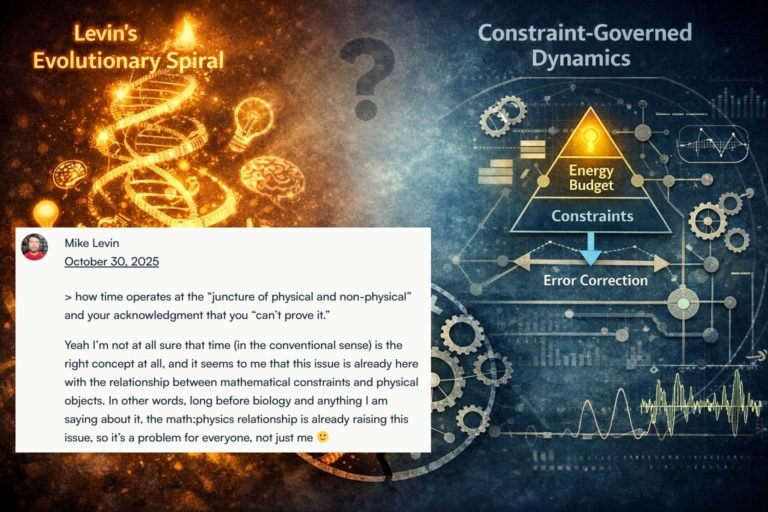
I did an interview with Aron once. it is the only vid on his channel with ‘nihilism’ in the name.
fun guy
will check this out
https://www.youtube.com/watch?v=sEL0-xSOvp4&pp=ygUQYXJvbiByYSBuaWhpbGlzbQ%3D%3D
my position has advanced a lot since then. his has not much to my knowledge
Yeah, I’ve been friends with Aron for a few years now on Facebook and have watched his content since the early days of Youtube. He’s even used some of my arguments for his debates (with my permission).
He’s entertaining to a certain point to watch and a fun guy to talk to (especially if you are agreeing with him with the ineptitude of creationists, lol), but he really doesn’t understand philosophy at all while at the same time pretending like he does when he’s debating people.
He commits many of the same errors theologians make with him (hence my skeptic’s mirror theme in my article), and his target is the small % of theists that are young earth creationists, biblical literalists, Muslim extremists, and right-wing Christian zealots.
I’ve been trying (this debate is just one of many) to help him learn how to address more sophisticated (and I’d argue equally if not more harmful if accepted uncritically) versions of theism.
So far, I’ve not had any luck. He’s not so open to evaluating why his own arguments fail, as he is evaluating why others’ arguments fail. 🤣
Sounds about right from what i remember. I used to talk with him more often. Taught him what Nihilism is.
There are some foundational realizations that he has yet to digest that would help him a lot.
someone needs to pick the low hanging fruit, but, that cant be all one does or the people he ‘saves’ will likely regress fast because he has not helped them with the ‘what’s next’ part of losing/overcoming a religion.