
Matthew Segall’s Words Made Flesh Again, but the Evidence Never Said That?
How good science gets made to lend its prestige, without its consent, to a specific metaphysical conclusion it never established and doesn’t support uniquely.
Substack Repost Notice: This is an archival copy of my substack post. Some formatting may not display correctly on our website. See the original post here: https://sweetlyrational.substack.com/p/matthew-segalls-words-made-flesh
This article addresses a different problem from my previous exchange with Matthew Segall. Here I am examining how scientific findings are represented and recruited inside Segall’s Words Made Flesh Again, especially where empirical results are made to appear as support for a specific metaphysical conclusion that the evidence itself does not establish. My previous article addressed a separate issue: Segall’s misrepresentations of my own argument and the position he attributed to me.

The present article brackets that dispute as far as possible and grants Segall his own case, then asks what the cited science actually supports.
Matthew Segall’s Words Made Flesh Again gives scientific findings an impressive itinerary. Electrical regulation in developing organisms approaches Plato. Evolutionary novelty opens onto a new ontology of possibility. Bodily feeling becomes a clue to the intrinsic character of causation everywhere. The experiments supply the departure points. Whitehead supplies the destination.
The missing step is the argument that gets us from one to the other.
That step matters because much of the science is interesting and substantial. Cells coordinate their activity electrically. Organisms regulate development after disturbance. Evolution repurposes structures. Human thought depends on bodies. None of these discoveries arrives with a philosophical certificate declaring that concrete causal activity is intrinsically experiential. Segall supplies that interpretation, then lets the scientific examples lend it an authority they have not independently earned.
Three problems deserve the impatient reader’s attention. A claim about the time symmetry of physics is too sweeping, and the conclusion drawn from it does not follow. Some of the opponents, including Hume and the genetic-blueprint picture of development, emerge considerably easier to defeat after Segall has described them. Most consequentially, evidence for processes that competing ontologies can accommodate keeps being made to look like evidence selecting his ontology.
Segall openly says he has “no proof of the prehensions of particles.” That is a useful admission. The difficulty begins when the surrounding argument makes that missing proof seem almost a formality, something the imaginative reader can supply while the laboratory is busy elsewhere.[1]
Physics does not hand us the missing bridge
Consider the physics. Segall writes: “Its equations are time-symmetrical, and so hopelessly abstracted away from actual causation.” The sentence contains a factual generalization and an inference. Neither survives intact.[1]
In 2012, the BABAR collaboration reported an experimental comparison of transitions in neutral B mesons with their time-reversed counterparts. The result rejected time-reversal invariance at a significance equivalent to fourteen standard deviations. The paper describes the result as a direct observation of T violation. A statement about physics as a whole has to accommodate physics that has actually been done.[2]

This experiment does not explain the thermodynamic arrow of time or settle the metaphysics of causation. Its relevance is precise: the blanket premise about physics is false. The second problem would remain even if that premise were repaired.
An equation’s invariance under time reversal does not establish that causation is absent, unreal, or inaccessible. Segall’s sentence compresses three questions that have to be kept apart: whether a physical law is invariant under time reversal, whether a formalism identifies causal dependence, and what causation ultimately consists in. Those are not the same problem.
Farr and Reutlinger examine almost exactly this inference in the philosophy-of-physics literature. When “time symmetry” means time-reversal invariance, they argue that the crucial premise connecting that symmetry to the exclusion of asymmetric causation should be rejected.[19] Time-reversing a lawful dynamics and identifying which variables make a difference to which others are not the same operation.
Causal-inference research makes the distinction sharper. Pearl’s structural framework separates observational relationships from causal claims because the latter require additional assumptions; causal structure generally cannot simply be read from correlations or temporal succession.[17] Eberhardt and Scheines likewise treat interventions as a distinct source of information about causal structure and emphasize the assumptions required for causal discovery.[18] The rooster can crow before sunrise every morning without acquiring responsibility for astronomy. Earlier-than is not causes. Covaries-with is not causes. And neither relation, by itself, tells us what causation is made of.
The correction should not be exaggerated in the opposite direction. It would be false to say that physics simply “does not talk about causality.” Relativity employs causal constraints, and contemporary quantum foundations contains explicit programs of causal modelling. Costa and Shrapnel, for example, develop a framework for discovering causal structure in quantum processes.[20] There is a genuine and continuing dispute about the status of causal concepts in fundamental physics. That dispute is precisely why Segall cannot settle it by attaching “and so” to a claim about time symmetry.
The distinction is not semantic bookkeeping. A dynamical equation can tell us how allowed states are related without thereby giving a Pearl-style causal model; a causal model can identify intervention-sensitive dependence without telling us the intrinsic metaphysical nature of that dependence; and a metaphysics can propose what causal efficacy ultimately is without receiving empirical confirmation merely because the lower-level science leaves that question open.
Segall is entitled to ask, “What makes causal efficacy efficacious?” The question is legitimate. What does not follow is that an incompleteness in one descriptive framework supplies positive evidence for his preferred answer. A blank space in physics is not a measurement of prehension. To move from “our equations do not exhaust the metaphysics of causation” to “causal actuality is intrinsically experiential” requires a discriminating argument against rival answers. The opening in our account of causation does not already have Whitehead’s name engraved above the door.
The methodological stakes extend beyond this dispute. Whenever an unanswered scientific question is allowed to count as evidence for whichever ontology supplies the most satisfying story, ignorance itself becomes a renewable evidential resource. That rule does not remain politely attached to Whitehead. A theologian can place providence in the same gap, an essentialist can place natural hierarchy there, a technological prophet can place inevitable machine transcendence there, and a sect can place its preferred invisible agency there. Each can truthfully say that established science has not excluded the interpretation. None has thereby shown that the evidence favors it. Public decisions in medicine, technology, education, welfare, and research allocation cannot afford a rule under which the absence of a scientific answer is quietly converted into confirmation of somebody’s prior ontology. The burden belongs to the bridge.
Bioelectricity is impressive before anybody turns it into Plato
The developmental biology deserves the same separation between achievement and interpretation. Segall credits Michael Levin’s experiments with severely challenging “neodarwinian assumptions about living form being reducible to inherited molecular machinery.” He then welcomes the prospect of a “Platonic revival” flowing from a developmental biology laboratory.[1]
Levin’s work belongs to an important scientific development. Electrical properties help organize living tissues, and treating development as a simple transcription of a genetic blueprint misses much of what needs explaining. The question is what follows from that correction.
Custodio Nunes and Elias Barriga’s review, Bioelectricity in Morphogenesis, examines membrane potentials, ionic currents, electrical sensing, cell behavior, and tissue organization. Its account places electrical processes alongside established mechanical and biochemical frameworks and identifies substantial gaps in how particular electrical signals are generated, sensed, and translated into biological effects.[3]
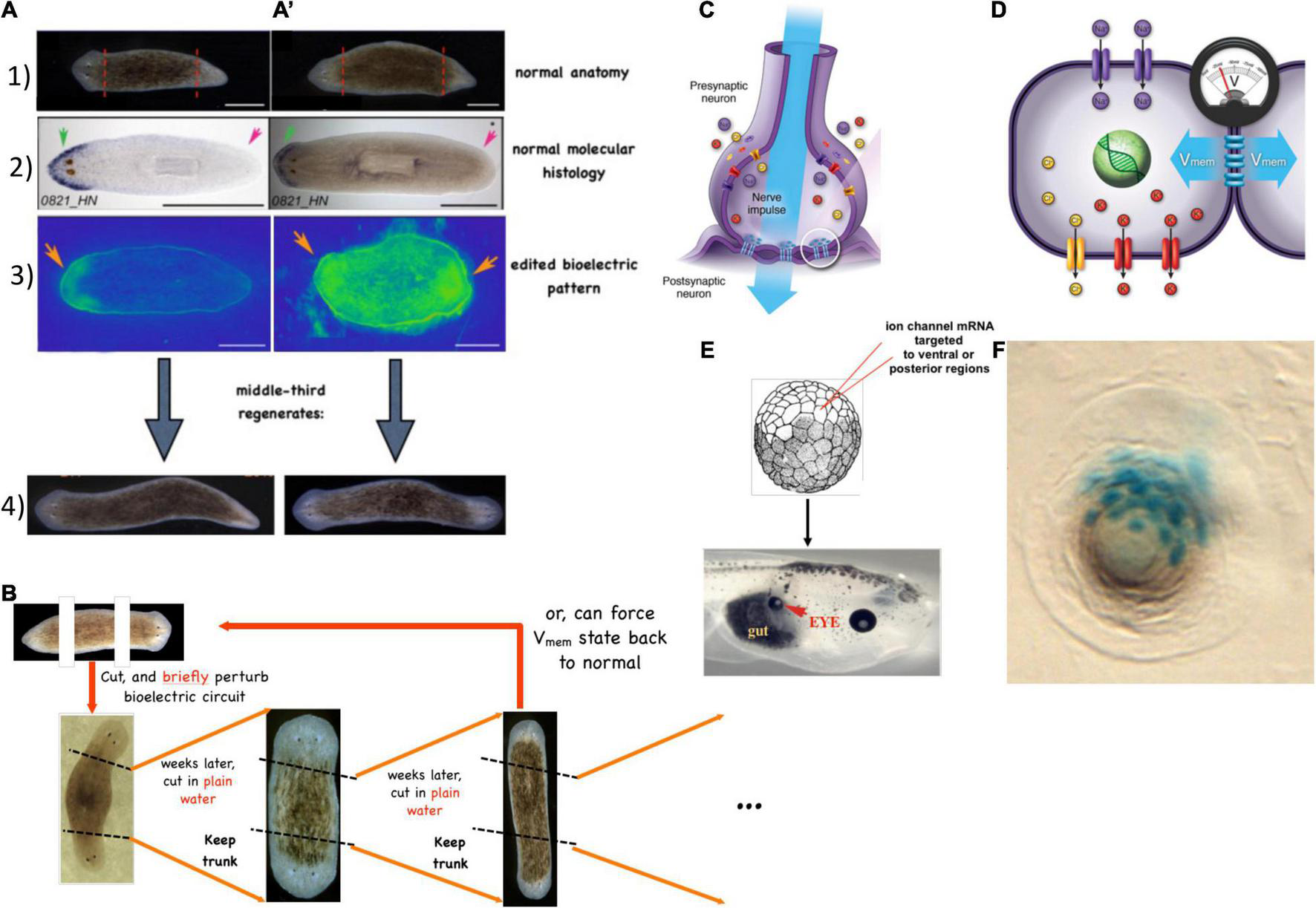
That is a rich research program. It has mechanisms to identify, measurements to improve, and interventions to perform. Its success would enlarge our understanding of organized physical activity. To make it an argument for Platonic forms or universal feeling requires another step, with another burden of justification.
There is also a change of subject concealed in the target. A claim about the immediate causes of tissue development is not, by itself, a refutation of an evolutionary account of how those developmental systems arose and changed. Electrical organization can be important to morphogenesis without becoming an embarrassment to evolution. Calling both questions “neodarwinian assumptions” saves words at the expense of the distinction.
Segall even acknowledges disagreement with Levin about where agency lies. That acknowledgment exposes the issue neatly. Agreement about an experimental result can coexist with disagreement about its philosophical interpretation. The result therefore cannot be cited as though it had already settled that disagreement.[1]
Hume becomes easier to defeat after being simplified
Hume receives a comparable compression. According to Segall, he “imagined a mind receiving tidy sensory data and inferring causes after the fact.” The contrast is with Whitehead’s embodied being, already affected by the world before reflective reasons arrive.[1]
But Hume’s own account of ordinary causal expectation makes custom central. In Section V of the Enquiry, he calls these inferences “effects of custom, not of reasoning.” Later in the same section, he writes that “belief is something felt by the mind.”[4]
The context matters. Hume is explaining how repetition produces expectation and how belief differs from an idea merely entertained. He is not claiming direct perception of a metaphysically necessary connection between external events. That leaves a real disagreement with Whitehead about causal experience. It also means that invoking automatic, felt, pre-reflective processes cannot by itself defeat Hume. He has already made room for them.
Segall’s word “inferring” is not the error on its own. Hume uses the language of inference. The problem is the contrast built around it: bodily immediacy on one side, a spectator collecting sensory items on the other. Hume’s actual psychology makes that opposition considerably less convenient.
Interpretive laundering: when mere claimed compatibility starts impersonating confirmation
These corrections lead to the larger issue. An observation can support what several theories share without supporting what makes one of them distinctive. If rival accounts both accommodate electrical coordination, discovering electrical coordination does not automatically adjudicate between their ontologies. The result may be important evidence against a crude model of development while doing little to select a universal metaphysics of experience. Philosophy of science has a familiar name for the general predicament: underdetermination, where available evidence fails to choose uniquely among rival accounts.[13]
Call the transfer interpretive laundering: empirical credibility earned by a phenomenon is passed to a contested interpretation without the intervening comparison being supplied.
This is not a claim that scientific language automatically corrupts philosophical argument. It is a demand to keep the inferential books separate. There is experimental evidence for a phenomenon; there is an interpretation of that phenomenon; and there is a further claim that the interpretation is better supported than its rivals. Those are three different achievements.
The psychological literature gives a reason to care about the distinction. Weisberg and colleagues found that logically irrelevant neuroscience information could make poor explanations seem more satisfying to nonexperts, even though the added neuroscience did not repair the explanation’s logic.[14] That experiment does not show that Segall is performing the same psychological trick, intentionally or otherwise. It establishes the more modest and relevant point that the prestige of a scientific vocabulary can affect judgments of explanatory quality independently of whether the scientific detail supplies the missing inference.
How the promotion works in Words Made Flesh Again
Several moves in Segall’s essay amplify the risk that compatibility will be read as confirmation. First, he explicitly loosens the epistemic register: “My only evidence is experience, my only instrument imagination,” followed by “tentative formulations of felt possibilities.”[1] That is a defensible description of speculative philosophy. Imagination is indispensable for generating possibilities. But it cannot simultaneously serve as the discriminator telling us which possibility the experiments favor.
Second, experimental results repeatedly arrive beside much larger metaphysical promotions. Levin’s work becomes an opening toward Plato; Kauffman’s evolutionary novelty becomes “morphogenesis is flesh feeling its way into form”; quantum foundations open toward an ontology in which possibility itself is granted standing.[1] Each transition may be worth exploring. None becomes an empirical result merely by being narrated immediately after one.
Third, the essay stacks domains. Biology, evolutionary novelty, embodied perception, quantum possibility, cosmology, theology, and artificial intelligence are placed into a common process-relational story. This can amount to genuine explanatory unification. It can also produce the appearance of independent convergence when one interpretive rule is simply being applied repeatedly. Four applications of “this result can be redescribed in Whiteheadian terms” are not automatically four independent confirmations of Whitehead.
Fourth, skepticism is distributed asymmetrically. Mathematical physics is criticized as abstract, incomplete, and potentially blind to what it cannot measure, while Whiteheadian terms are rendered comparatively concrete through stomachaches, inheritance, embodiment, and feeling.[1] Yet prehension, actual occasion, and eternal object are concepts too. Their evocative proximity to lived experience cannot exempt their extension across nature from the same suspicion directed at other abstractions.
Fifth, an explanatory gap is allowed to behave like positive evidence. “What makes causal efficacy efficacious?” is a serious question.[1] But a question unanswered by one theory is not evidence for whichever ontology supplies the most vivid answer. Powers theories, neutral-event approaches, nonexperiential process ontologies, structural accounts, and suspended judgment can all occupy that logical space. A hole in a description is not a Whitehead-shaped fossil.
Sixth, rivals are compressed. Hume becomes the tidy-data spectator just discussed. Genetic inheritance can sound like a blueprint picture that contemporary developmental biology itself has long complicated. Once the opponent is thinned out, Whitehead appears to contribute explanatory resources that a stronger rival may already possess.
Seventh, Segall’s most important concession is surrounded by material that can make the missing evidence feel less missing: “I have no proof of the prehensions of particles.”[1] The sentence should increase the visibility of the unresolved bridge. The surrounding phenomenological, biological, cosmological, and theological material instead makes universal prehension feel like a natural continuation of what is already known. That is precisely where a reader must distinguish plausible extension from independently supported extension.
D + ?X: factor the shared evidence away from the disputed identity
The disagreement becomes much cleaner when the evidence and the metaphysical identity claim are factored instead of bundled.
D = the shared process-relational domain: causal organization, temporal inheritance, embodied interaction, developmental regulation, historical dependence, evolutionary novelty, and every case of experience for which experience is actually evidenced.
X = the further universal identity claim: concrete causal actuality, as such and everywhere, just is experiential feeling or prehension.
Segall: D + X
My position: D + ?X
The question mark is not a negation sign. D + ?X does not mean D − experience. It includes experience wherever there is evidence of experience. It leaves unresolved whether the intrinsic character of every concrete causal event, at every relevant scale, is experiential. That is a narrower disagreement than “experience versus no experience,” and it prevents the evidence shared by both positions from being counted as though it belonged only to D + X.
Bioelectric morphogenesis
What D already contains: Electrical regulation, tissue-level coordination, and history-sensitive developmental control.
What X additionally claims: Those causal processes are intrinsically experiential as such.
What would discriminate: A result better expected if causal regulation is experiential than if it is nonexperiential or its intrinsic character remains unresolved.
Embodied causal feeling
What D already contains: Organisms with the relevant capacities undergo felt, embodied causal interaction.
What X additionally claims: The same experiential character belongs to causal actuality universally, including cases where experience has not independently been established.
What would discriminate: A justified bridge from local phenomenology to universal causal identity, rather than a resemblance in vocabulary.
Evolutionary novelty
What D already contains: Exaptation, path dependence, changing affordances, and limits on prospective enumeration.
What X additionally claims: The novelty-generating process is intrinsically experiential or requires specifically Whiteheadian possibility.
What would discriminate: A prediction, constraint, or explanatory gain unavailable to nonexperiential open-ended evolutionary accounts.
Quantum/process interpretations
What D already contains: Relational structure, transactions or actualization where the interpretation supports them, and nonclassical possibility structure.
What X additionally claims: Actualization is experiential inheritance or prehension.
What would discriminate: Evidence or theoretical necessity distinguishing experiential actualization from nonexperiential process interpretations.
Artificial systems
What D already contains: Whatever integration, recurrence, agency, cognition, or consciousness indicators are actually evidenced at the specified boundary and scale.
What X additionally claims: Experiential primitives belong throughout the relevant causal substrate.
What would discriminate: A principled account of subject unity, scale, boundary, and when experiential constituents compose an experiencing subject.
This factorization changes the evidential bookkeeping. Suppose evidence E is strongly predicted by D. If both D + X and D + ?X contain D, then observing E can strongly confirm D while adding little or nothing to the comparison over X.
P(E | D + X) / P(E | D + ?X)
In Bayesian terms, the relevant question is whether E is substantially more expected under D + X than under D + ?X. If both positions already predict E about equally well, observing E may strongly support D while doing almost nothing to resolve X.
D + ?X ≠ D − experience
The question mark is not a negation sign. D + ?X includes experience wherever there is evidence of experience. It leaves unresolved whether the intrinsic character of every concrete causal event, at every relevant scale, is experiential.
?X ≠ ¬X
Suspending judgment about the universal identity claim does not deny it. It preserves the unresolved part of the dispute instead of quietly converting uncertainty into rejection.
Quantum possibility still needs its own admission ticket
Quantum physics makes the distinction especially important. ’s linked cosmology draft with Timothy E. Eastman and Ruth Kastner () develops a process-relational interpretation in which possibilities have ontological standing and transactions contribute to the emergence of spacetime. The draft also advances a philosophical argument: an adequate cosmology must account for inquirers who entertain possibilities. It considers the reply that actual neural or computational configurations can represent alternatives, and rejects that reply through its account of reference, feeling, and causal inheritance.[5]
That is where the dispute belongs. Does inquiry require the particular ontological account of possibility being proposed? Why would an actual system’s capacity to represent alternatives be insufficient? If the answer depends on accepting a Whiteheadian account of what representation must be, then that account needs its own defense. Otherwise, the disputed metaphysics helps write the admission requirements and then congratulates itself on being the only candidate qualified to enter.
The scientific success of quantum theory cannot answer that philosophical question on its behalf. Nor does an affinity between transactional interpretation and Whitehead turn their combination into an experimental finding. A proposal may be ingenious, coherent, and worth pursuing. Those qualities need to be argued for where they occur, rather than borrowed from the prestige of quantum mechanics.
Evolutionary possibility: ignorance, open-endedness, and ontology are not synonyms
Evolutionary possibility introduces a related promotion. Segall writes, commenting on Stuart Kauffman’s concept of adjacent possibles: “There is no list of such possibilities written in advance.” One can understand that as a claim about the impossibility of exhaustively specifying future biological functions. One can also understand it as a claim that the possibilities themselves lack any determinate prior existence. The difference is an entire metaphysics.[1]
Stuart Kauffman and Roli’s argument is stronger than the familiar observation that evolution is difficult to predict. They focus on new uses and affordances, whose functional significance cannot simply be read off an inventory of physical variables. That challenge deserves an answer. But the further mathematical claim in their June 2021 author manuscript is startling: “We cannot prove, once and for all, the uses of X! Therefore, no axiom of extensionality.”[6]
Extensionality says that sets with the same members are identical. As the Stanford Encyclopedia of Philosophy states it, if two sets have the same elements, they are equal.[7] It does not demand that an investigator possess a complete list of the members or an algorithm for recognizing them.
To establish that future uses cannot constitute a determinate set, one needs an argument about whether membership is determinate. Inability to enumerate or prove the uses does not supply that argument by itself. Unpredictability, limits of representation, and ontological indeterminacy must be distinguished before any inference can connect them. Putting them in the same sentence does not do it.
Abstraction cannot be the sin only of rival vocabularies
Segall is right that an abstraction can omit precisely what matters for a particular question. A model can predict something accurately while leaving other features unexplained. But prehension, actual occasion, and eternal object are concepts too. Their evocative proximity to lived experience does not exempt their extension across nature from scrutiny.
My bodily feeling is an experience. The proposition that every concrete causal event is experiential is a generalization. Between the two stands the very problem of abstraction that Segall asks us to take seriously. Calling the second proposition concrete does not make its universal scope something I have directly experienced.
Whitehead’s own methodological warning is unusually well suited to this situation: “The aim at generalization is sound, but the estimate of success is exaggerated.” His speculative philosophy includes imaginative extension, coherence, application, and revision. The question is whether this particular extension has earned the confidence placed in it.[8]
Does Segall offer anything beyond mere compatibility?
Yes, and the distinction matters. The strongest version of Segall’s case is abductive rather than deductive. Whiteheadian panexperientialism is offered as a unifying interpretation of causal efficacy, embodiment, novelty, possibility, and subject formation. It promises continuity: one categoreal scheme from physical causation through life and cognition, rather than an ontological rupture at the point where experience appears. Philosophy has every right to compare theories by explanatory scope, coherence, simplicity, unification, and other abductive virtues.[9]
That is more than saying “Whitehead is compatible with the evidence.” It is a genuine philosophical proposal. But a proposal can possess unificatory appeal without the cited experiments supplying differential confirmation of its distinctive ontology. The comparative questions remain: What becomes intelligible specifically because causal efficacy is identified with feeling? What constraints does that identity impose? Which difficulties does it resolve that D + ?X or another process-relational rival cannot? What assumptions purchase the gain? What evidence should move us away from it?
The cumulative case faces the same demand. Bioelectricity, bodily cognition, evolutionary novelty, and quantum possibility may jointly make a worldview attractive. Individually inconclusive findings can indeed become powerful together. Evidence need not be statistically independent to matter. Conversely, the number of scientific fields invoked cannot establish a joint advantage by itself. If the same interpretive mapping is reapplied to each field, what looks like cumulative confirmation may partly be repeated accommodation.[10]
So the fair verdict is narrower than “there is no argument.” Segall offers more than bare compatibility as philosophy, but in this essay he shows little that converts the cited science into discriminating empirical support for D + X over D + ?X and other serious rivals.
The Last Thursday test: compatibility is cheap
A crude joke from philosophy makes the point with useful brutality. Last Thursdayism is the hypothesis that the universe was created last Thursday exactly as it now appears, complete with fossils, memories, photographs, scars, historical documents, and everybody sincerely believing in an older past. Everything you observe today can be made compatible with the story. Almost none of it confirms the story over ordinary alternatives.
The comparison is methodological, not substantive. I am not saying Whiteheadian panexperientialism is Last Thursdayism, equally absurd, or equally insulated from argument. Segall’s position has real commitments, a philosophical lineage, and potential comparative virtues. Last Thursdayism is useful because it exposes a bad evidential rule in its purest form. If the inference is merely:
Evidence E is consistent with ontology O.
O supplies an intelligible story about E.
Therefore E confirms O.
then the inference is invalid. A sufficiently flexible ontology can absorb nearly anything. The relevant question is contrastive: what does E do to O relative to serious alternatives? The broader philosophical problem is underdetermination, not Last Thursdayism itself.[13]
Why this evidential rule matters beyond Whitehead
Once a worldview is permitted to treat evidence that merely fits it as evidence that specifically favors it, the gate is open to almost anything. Bioelectric regulation does not arrive carrying a Whiteheadian passport. Neither does quantum indeterminacy, evolutionary novelty, embodied cognition, morphogenesis, thermodynamic irreversibility, or the fact that organisms act in ways our simpler models failed to anticipate. Those findings constrain some claims. They do not, by themselves, select one grand ontology from every rival capable of accommodating them. If the rule is merely “my worldview can tell a story in which this result makes sense,” then every sufficiently elastic belief system gets to walk into the laboratory afterward, drape itself in a white coat, and announce that science has vindicated it.
A theocratic metaphysics can play exactly the same game. Developmental plasticity becomes evidence of divine purposiveness. Evolutionary novelty becomes evidence of providential creativity. Human embodiment becomes evidence that spirit and matter were designed to interpenetrate. Quantum uncertainty becomes “room for God.” The underlying science can remain entirely genuine while the bridge remains entirely unearned. Unless those observations are better expected under the theological ontology than under serious alternatives, the theology has arrived after the experiment and claimed custody of the result.
A cultic worldview can do it too. Imagine a charismatic movement claiming that consciousness is a universal field accessed through submission to its leader. Reports of altered states become evidence. Neural plasticity becomes evidence. Placebo effects become evidence. Synchrony during group ritual becomes evidence. Any failure can be absorbed as insufficient spiritual development or as the field operating more subtly than expected. Genuine neuroscience can surround the doctrine without a single result distinguishing its ontology from ordinary psychological, social, or neurobiological explanations.
An authoritarian or essentialist social ideology can perform the same laundering. Evidence that humans coordinate in groups can be promoted into proof that hierarchy is naturally rightful. Evolved dispositions can be promoted into immutable social roles. Cultural differences can be inflated into essential kinds of people. Emergent organization can be repackaged as evidence that some favored political arrangement expresses a deeper natural order. The invalid step is invariant: take a modest empirical result, attach a much larger ontology or normative program, then allow the prestige of the former to pay the evidential debts of the latter.
A technological cult can do likewise. Scaling curves become evidence that intelligence has an inevitable destiny. Emergent capabilities become evidence that a machine god is arriving. Network effects become evidence that humanity is converging on a planetary mind. Distributed computation becomes evidence that the internet already constitutes one subject. “Our previous model was inadequate” is not a blank cheque payable to the metaphysics of whoever happens to be standing nearest the printer.
This is not guilt by association, and it is not a claim that Whiteheadian metaphysics itself produces these harms. It is a symmetry test for an evidential rule. If the rule is valid when it favors a humane ontology, it must remain valid when used by an ideology we distrust. If we suddenly demand rival comparison, falsifiers, causal mechanisms, or stronger evidence when the conclusion becomes ugly, then those standards belonged in the original case too.
The stakes are not confined to philosophy. Research on motivated reasoning shows that people can interpret identical quantitative evidence differently when it bears on identity-laden commitments, and greater numeracy does not necessarily remove that vulnerability.[15] Research on misinformation likewise shows that unsupported claims can persist after correction and can affect behavior and public expenditure.[16] Neither literature licenses the accusation that metaphysical speculation causes those effects. Together they give us a reason not to be casual about inferential habits that allow preferred narratives to inherit scientific authority without discrimination.
Public decisions in medicine, education, environmental regulation, criminal justice, technology governance, disability policy, animal welfare, and research funding eventually depend on judgments about what evidence does and does not establish. Once “consistent with” is permitted to impersonate “supported over alternatives,” every faction can acquire a scientific costume. The safeguard cannot be that a particular philosopher is thoughtful or that a particular worldview is humane. The safeguard has to be a rule that still works when the claimant is a zealot, a demagogue, a corporation, a sect, or a government.
The standard therefore has to be symmetrical. Ask: What observation favors this interpretation over its strongest rivals? What would we expect to see if it were false? What does it predict, constrain, explain, or let us intervene upon that the alternatives do not? If the answer is only that the ontology can accommodate the evidence, then it has achieved the minimum requirement for not having been refuted by that evidence. It has not thereby been confirmed.
That is the reductio at the center of the problem. If bioelectricity, evolutionary novelty, embodied feeling, and quantum possibility count as evidence for universal prehension merely because they fit naturally into that story, then the same inferential license must be granted to mutually incompatible systems that can narrate those findings just as fluently. The defect does not appear only when the resulting worldview is extremist, cultlike, or harmful. The defect was already present in the evidential rule.
Critical thinking depends on refusing that substitution especially when the conclusion is beautiful, humane, intellectually fashionable, spiritually satisfying, or personally congenial. Those are the moments when skepticism earns its keep. The laboratory owes no ontology royalties merely because an ontology has written itself into the acknowledgments section.
Artificial intelligence makes the boundary problem unavoidable
The discussion of artificial intelligence supplies a final test. Segall writes that language models “speak oceans without any sense for the taste of salt.” As a remark about text-only systems lacking human gustatory equipment, it is straightforward. As a verdict on every possible form of machine experience, it would outrun the evidence.[1]
Butlin and colleagues’ peer-reviewed account of AI consciousness indicators begins from uncertainty and warns of risks from both under-attribution and over-attribution. Their proposal uses theory-derived indicators to inform credences, with disputed assumptions and unresolved questions remaining.[11] It supplies no warrant for treating verbal fluency as proof of experience, or unfamiliar embodiment as proof of its absence.
Panexperientialism does not automatically make an entire computer, or a language model running on it, one unified experiencing subject. Experiential constituents and a subject at the scale of the whole system are different claims. That distinction makes the question for Segall sharper: what principle determines where a subject exists, at what scale, and with what kind of experience? Whitehead’s distinction between basic experience and consciousness helps frame the problem. It does not answer every question about how experience is organized.[12]
The criterion must do the work. Salt is an excellent illustration of a particular sensory capacity. It is a poor substitute for an argument about the limits of subjectivity.
What the evidence actually supports
The laboratory has established a great deal. It supports real causal organization, temporal inheritance, developmental regulation, embodied interaction, evolutionary novelty, relational dependence, and experience wherever experience is independently evidenced. It also supports the reality of higher-level patterns when those patterns improve prediction, intervention, or explanation at the relevant scale. None of that requires a return to a crude picture of passive matter executing a genetic blueprint.
D + ?X is not metaphysical emptiness
My position therefore is not “we know nothing about what reality is.” It makes positive commitments. Reality contains stable, structured processes and relations. History and constraint matter. Organization can be causally and explanatorily real at more than one scale. Boundaries are not simply assumed; they are hypotheses to be tested. Lower-level realization does not automatically eliminate higher-level organization, and higher-level usefulness does not require inventing a new substance. Experience is real wherever there is evidence for experience. What remains unresolved is a narrower claim: whether the intrinsic character of every concrete causal event, everywhere, is experiential.
That is what D + ?X means. D contains the supported structure. ?X marks the residual identity question.
D + ?X ≠ metaphysical neutrality
It is a positive, provisional realism with one disputed universalization left open.
How the framework closes the missing bridge
The framework does not close the bridge by inserting Whitehead where the evidence stops. It closes the inferential gap by separating what the evidence actually supports from what has been added to it, then asking what would discriminate the added claim from its strongest rivals.
If bioelectricity, embodied experience, evolutionary novelty, or quantum structure are already expected under D, then those findings can strongly support D without favoring X. To earn X, Segall needs something more: a prediction, explanatory gain, intervention, constraint, or otherwise discriminating reason that is better under D + X than under D + ?X or another serious rival.
That is the positive methodological content of the framework: it preserves what survives comparison, marks what remains unresolved, and refuses to let an unanswered question masquerade as evidence for whichever ontology supplies the most satisfying answer.
What metaphysical conclusion survives
What survives is a provisional, boundary- and scale-relative realism about structured causal processes, relations, constraints, and organization. It is realist because those patterns are not treated as mere conveniences when they support prediction, intervention, and transfer. It is scale-relative because the best explanatory variables can change with the system and boundary under study. It is provisional because those commitments remain revisable when stronger evidence or better rivals appear.
That conclusion is already substantially richer than metaphysical agnosticism. It says that the world is not exhausted by a flat inventory of isolated microphysical parts, that organization and history can be real explanatory features, and that experience belongs in our ontology wherever it is evidenced. What it does not yet say is that experience is the intrinsic nature of causal actuality as such. This is the point I remain agnostic of.
And that is where the disagreement with Segall becomes precise.
The laboratory gets us to D. My framework shows what D positively commits us to and where the evidence runs out. Segall’s D + X may still be defensible by some further argument, but the science he cites does not yet make that crossing for him. The bridge is not closed by adding Whitehead where the evidence stops. It is closed by building only the spans the evidence can actually bear, and marking the remainder honestly as open.
References
Segall, Matthew David. 2026. “Words Made Flesh Again.” Footnotes²Plato, September 11. ↩
Lees, J. P., et al. (BABAR Collaboration). 2012. “Observation of Time-Reversal Violation in the B⁰ Meson System.” Physical Review Letters 109 (21): 211801. DOI: 10.1103/PhysRevLett.109.211801. ↩
Nunes, Custodio O., and Elias H. Barriga. 2025. “Bioelectricity in Morphogenesis.” Annual Review of Cell and Developmental Biology 41: 187–208. DOI: 10.1146/annurev-cellbio-101323-032747. ↩
Hume, David. 1748. An Enquiry concerning Human Understanding, Section V, “Sceptical Solution of These Doubts.” ↩
Segall, Matthew David, Timothy E. Eastman, and Ruth E. Kastner. 2026. “On the Possibility of Cosmology: Spacetime Actualism and the Process-Relational Alternative.” Conference draft, posted July 3, Footnotes²Plato. ↩
Kauffman, Stuart A., and Andrea Roli. 2021. “The World Is Not a Theorem.” Entropy 23 (11): 1467. DOI: 10.3390/e23111467. The extensionality passage discussed in the article appears in the June 22, 2021 author manuscript, arXiv:2101.00284v4. ↩
Bagaria, Joan. 2023. “Set Theory.” Stanford Encyclopedia of Philosophy, revised January 31. ↩
Whitehead, Alfred North. 1978 [1929]. Process and Reality: An Essay in Cosmology. Corrected ed., edited by David Ray Griffin and Donald W. Sherburne. New York: Free Press. Part I, ch. I, p. 7. Accessible text. ↩
Douven, Igor. 2025. “Abduction.” Stanford Encyclopedia of Philosophy, revised June 18. ↩
Crupi, Vincenzo. 2025. “Confirmation.” Stanford Encyclopedia of Philosophy. See especially §3 on Bayesian confirmation. ↩
Butlin, Patrick, Robert Long, Tim Bayne, Yoshua Bengio, Jonathan Birch, David Chalmers, et al. 2026. “Identifying Indicators of Consciousness in AI Systems.” Trends in Cognitive Sciences 30 (6): 488–501. DOI: 10.1016/j.tics.2025.10.011. ↩
Desmet, Ronald, and Andrew David Irvine. 2022. “Alfred North Whitehead.” Stanford Encyclopedia of Philosophy, revised November 10. ↩
Stanford, Kyle. 2023. “Underdetermination of Scientific Theory.” Stanford Encyclopedia of Philosophy, substantive revision April 4. ↩
Weisberg, Deena Skolnick, Frank C. Keil, Joshua Goodstein, Elizabeth Rawson, and Jeremy R. Gray. 2008. “The Seductive Allure of Neuroscience Explanations.” Journal of Cognitive Neuroscience 20 (3): 470–477. DOI: 10.1162/jocn.2008.20040. Open manuscript. ↩
Kahan, Dan M., Ellen Peters, Erica Cantrell Dawson, and Paul Slovic. 2017. “Motivated Numeracy and Enlightened Self-Government.” Behavioural Public Policy 1 (1): 54–86. DOI: 10.1017/bpp.2016.2. ↩
Lewandowsky, Stephan, Ullrich K. H. Ecker, Colleen M. Seifert, Norbert Schwarz, and John Cook. 2012. “Misinformation and Its Correction: Continued Influence and Successful Debiasing.” Psychological Science in the Public Interest 13 (3): 106–131. DOI: 10.1177/1529100612451018. ↩
Pearl, Judea. 2009. “Causal Inference in Statistics: An Overview.” Statistics Surveys 3: 96–146. DOI: 10.1214/09-SS057. ↩
Eberhardt, Frederick, and Richard Scheines. 2007. “Interventions and Causal Inference.” Philosophy of Science 74 (5): 981–995. DOI: 10.1086/525638. ↩
Farr, Matt, and Alexander Reutlinger. 2013. “A Relic of a Bygone Age? Causation, Time Symmetry and the Directionality Argument.” Erkenntnis 78: 215–235. DOI: 10.1007/s10670-013-9510-z. ↩
Costa, Fabio, and Sally Shrapnel. 2016. “Quantum Causal Modelling.” New Journal of Physics 18: 063032. DOI: 10.1088/1367-2630/18/6/063032. ↩


Yes, a frame can make compatibility feel like confirmation. Since the ontology already supplies the meaning, the evidence gets interpreted from within that frame before you’ve even collected it. And since the structure can pre‑load the inference, the phenomenon ends up looking like it was already part of the story. We call it innovation, when it actually derived from orientation.
Yes, exactly, with one minor but important qualification: interpretation from within a frame, at least by itself, is not the problem. Every interpretation must be made within a certain frame; that’s unavoidable. There’s no “god’s eye view” from nowhere. I’m a big fan of Donna Haraway’s work on what she calls the “god trick” in her writing on the situatedness of knowledge. Worth checking out if you haven’t yet!
Theoretical orientation can be genuinely productive and help reveal patterns others miss. The problem is when the frame supplies the contested meaning in advance and evidence merely compatible with that frame gets counted as confirmation of it. Like happens with Matt’s article here.
So I like “derived from orientation,” but I’d add: orientation can generate insight without generating discrimination. If the same phenomena are equally expected under serious rivals, then the frame may organize the evidence well without thereby establishing its distinctive ontology. The mistake is treating the usefulness of the orientation as independent evidence for the worldview that supplied it.
But I think this is pretty much what you’re already saying. 🤣