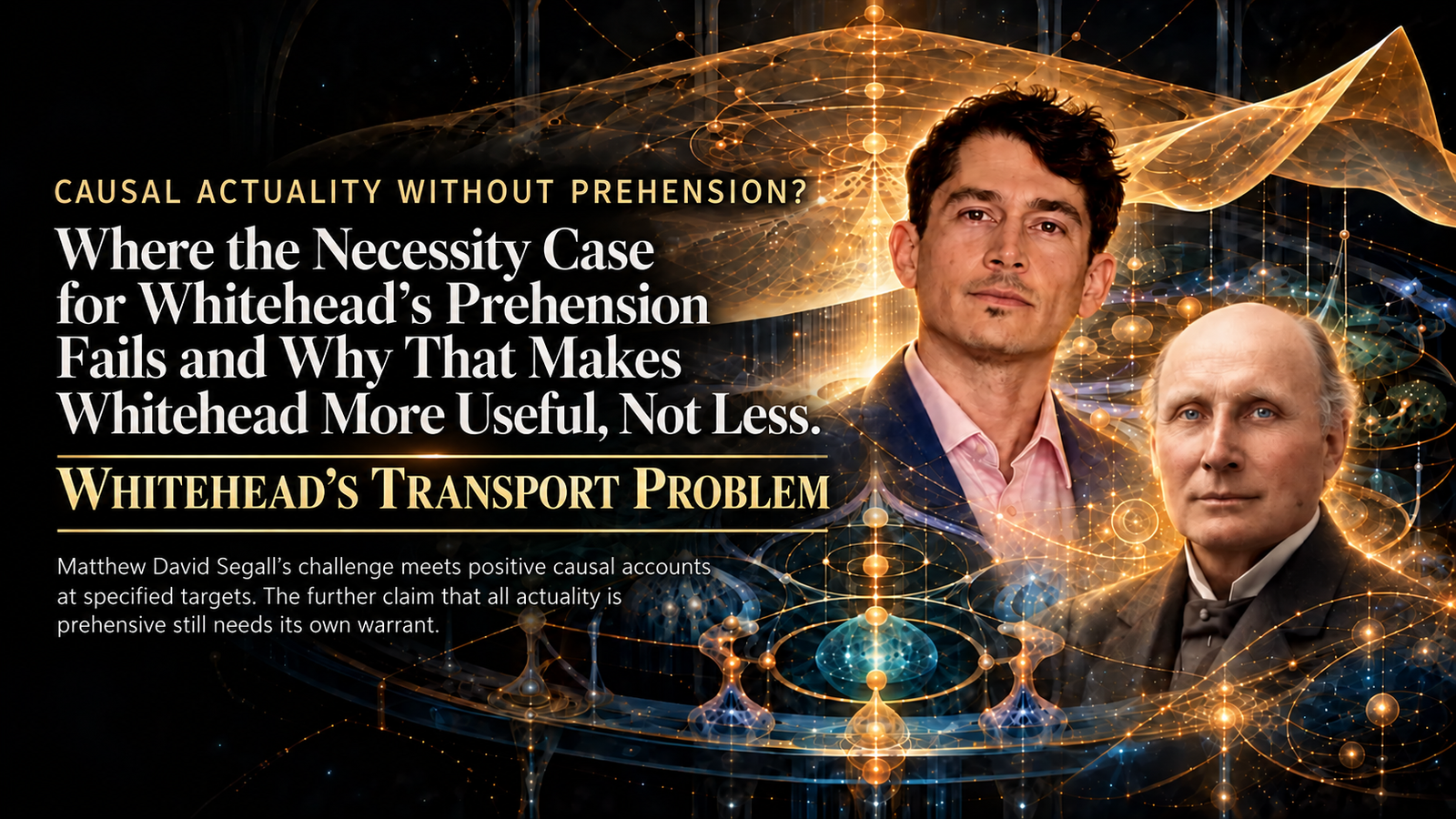
Where the Necessity Case for Mathew Segall & Whitehead’s Prehension Fails
Matthew David Segall’s challenge meets positive causal accounts at specified targets. The further claim that all actuality is prehensive still needs its own warrant.
Substack Repost Notice: This is an archival copy of my substack post. Some formatting may not display correctly on our website. See the original post here: https://sweetlyrational.substack.com/p/where-the-necessity-case-for-whiteheads
TTS accessibility version: symbolic notation is rendered in spoken words. For example ?X will appear in the text as “question-mark ?X”, if you are reading this article rather than listening to the Substack text-to-speech version, just read this as “?X”.
This post accompanies the comparative white paper, From Bodily Causal Feeling to Whitehead’s Universal Prehension: Testing the Scope Inference (Positive causal explanation without prehension as a premise, phenomenal powers, and a transport test for Matthew David Segall’s universal scope claim). It compares published alternatives at specified causal and experiential targets and develops the transport test used below.
This is also a work in progress. I am actively inviting relevant literature I have missed, corrections where I have misread a source, stronger reconstructions of Matt’s arguments, and good-faith criticism of my own positive synthesis. My aim is to build the most defensible corrigible comparison I can, not to make the present wording or D plus question-mark ?X immune to revision. Where criticism lands, I want the smallest warranted change, a record of what changed and why, and preservation of whatever survived the criticism.
My previous article, Logic Does Not Choose Relevance. Does Feeling? Not Alone. left one question deliberately open: if I decline to adopt universal prehension, can I give a positive account of causal actuality that does more than redescribe regularities, equations, or functional roles without quietly rebuilding subjective prehension under another name? Matt’s strongest challenge made that the right next question.
I have been working through a more focused exploration of relevant literature on these subject over the last year and through this specific disagreement with for the last few months.
After pushing the question through mechanism accounts, causal powers, direct process ontologies, organizational constraints, intervention-sensitive causation, and the strongest local phenomenal-powers case considered here, I no longer think maybe is an intellectually honest answer to the specified causal question.
Answer: The evidence and arguments available warrant yes: positive causal accounts exist at the tested targets without subjective prehension as an explanatory premise.
I state the result before the argument so the reader can judge whether everything that follows actually earns it. Published mechanism, powers, process, and organizational accounts give positive explanations for the substantial, specified causal targets examined here without subjective prehension as an explanatory premise.
Thus, the evidence does not establish that concrete actuality throughout nature is constituted by Whiteheadian prehensive occasions, that all causal efficacy is felt inheritance, or that lifeless causal domains instantiate subjective form and valuation.
I provisionally decline to adopt that further universal claim; its truth remains unresolved.
My position starts with a positive commitment. D retains the process-relational, causal, organizational, and evidenced experiential content I find well supported in Whitehead and the sciences. D is a reconstructed comparative overlap, not Whitehead’s actual occasion with its constitutive feeling surgically removed, and it is not claimed to be a metaphysically neutral final ontology. It is neutral only with respect to the disputed addition X at the targets being compared. X is the further claim that concrete causal actuality throughout nature is constituted by Whiteheadian prehensive occasions, so that causal efficacy everywhere is felt inheritance.
Question-mark ?X is not a third ontology. It separates two questions: the truth of X remains unresolved, while adoption of X is provisionally withheld because the universal scope has not earned my assent on the arguments examined here. The same distinction applies in the other direction: an exhaustive not X ontology would owe its own universal-scope warrant. By open I mean unresolved truth, not equal support for every rival. I do not rank Whitehead’s entire scheme below a completed rival or seek to lower anyone else’s confidence in it.
One burden distinction matters more than others from the outset since it often conveniently goes unnoticed in these debates. Whitehead offers a remarkably comprehensive metaphysical scheme, but the claimed explanatory completeness or superiority of that scheme is not a datum that rivals must first overcome. It is itself one of the claims under comparison.
Having an internally connected account of causation, experience, value, possibility, and nature gives Whitehead a serious candidate for whole-scheme comparison; it does not by itself establish that those phenomena have been adequately explained, that the specifically experiential commitment earned the explanatory gains, or that a rival must reproduce the entire technical or terminological architecture before questioning universal prehension. Comprehensiveness is a theoretical virtue to be assessed along with warrant, not discriminatory evidence for the truth of the scheme that possesses it.
Those advancing X owe a case for its universal scope; assessing that case does not first require me to establish not X.
This is the same standard that both Matthew David Segall and I apply to exhaustive physicalism, applied semetrically.
See my article below.
D plus question-mark ?X is not what I get by abandoning Whiteheadian inquiry. It is what I get when I refuse to exempt the universal Whiteheadian extension from the standards used to assess everything else. Whitehead’s criteria and Matt’s own loss condition both invite the same test: what explanatory work disappears when X is withheld as a premise? At the specified targets, productive change, capacities, historical dependence, organization, constraint, self-maintenance, intervention-sensitive difference-making, nerve excitation, and the physical dynamics examined below retain positive explanations without universal felt inheritance. That defeats necessity at those targets without establishing not X. Questions about intrinsic actuality, phenomenal unity, valuation, subject formation, and a complete metaphysics remain live residuals.
Two questions therefore organize the comparison. Can causal production be specified positively without quietly rebuilding subjective prehension? And when experience is independently part of the target, does a distinctively experiential feature earn comparative credit that survives the move from local phenomenality to fundamental and lifeless domains?
The scope claim and the further comparisons
Two comments in the exchange clarify the relevant comparative tasks.
poses a methodological whole-rival challenge:
“So, by your own method, if that happens we must shift to abductive comparison of whole rival schemes.”
Jason says Matt’s article is meant to explain why “the straightforward ablation fails”: removing experience or feeling “fundamentally changes [the] process-relational core of the scheme.” That identifies a real theory-internal fact about Whitehead, but it is not, and has never been, my proposed decomposition. I have never argued that Whitehead minus X equals D. I’ve always maintained D is not the residue left after surgically deleting feeling from a Whiteheadian actual occasion. In Whitehead’s scheme feeling is constitutive; remove it and the result is no longer Whitehead’s actual occasion.
There is a further asymmetry hidden in Jason’s premise to avoid here. Whitehead’s scheme is comprehensive in scope, but its explanatory completeness is not an established obstacle that a rival must clear before X can be questioned. That completeness is part of the comparative hypothesis. A scheme does not acquire evidential credit merely because it contains a category for every target under discussion. Whole-scheme abduction must still ask whether those categories actually explain the targets, which commitments produce the gain, and whether the gain survives comparison with alternatives.
My comparison asks a different question: can the target-relevant causal and process work be reconstructed from independently developed mechanism, powers, process, organizational, and scientific accounts without primitive feeling as a premise? That is why D is a reconstructed comparative overlap rather than an amputated Whiteheadian ontology. The antecedent needed for Jason’s methodological conclusion is therefore stronger than “Whitehead changes if feeling is removed.” It would have to be shown that the relevant explanatory target cannot be preserved in an adequate rival reconstruction without primitive feeling. Jason’s comment points to Matt’s article as the reason for thinking straightforward ablation fails, but it does not demonstrate that stronger comparative claim. The worked cases below are designed to test exactly that.
This is not a post hoc retreat from an earlier subtraction claim either. In my response to Jason I explicitly said that the nonexperiential-emergence fork was not my position and that forcing me to promote one open alternative into a counter-ontology would recreate the same universalization error I was criticizing.
He makes the target explicit: “explanatory adequacy for experience.” He asks for a rival process-relational account without primitive feeling if my aim is to diminish confidence in Whitehead’s comprehensive scheme. That conditional does not describe my claim about the scope of X.
Jason Hoskins, September 20, 2026:
And my responses:
Jason explicitly allows agnosticism and says a nonexperiential emergence theory is not my position. His challenge has force against an overall ranking of Whitehead’s account of experience; I make no such ranking.
Even if I grant that stronger antecedent for the sake of argument and move to whole-scheme comparison, three questions still remain:
Burden: If agnosticism about universal prehension is epistemically reasonable, why must the agnostic construct a complete rival metaphysics before continuing to ask what warrants X?
Credit assignment: If explanatory adequacy must be assessed at the level of whole schemes, what identifies universal primitive feeling, rather than some other feature of the Whiteheadian package, as the source of any comparative advantage?
Transport: Even if primitive feeling contributes distinctively to explaining human experience, what warrants transporting that explanatory credit into causal domains where experience is not independently established?
These are distinct problems: burden, credit assignment, and transport. Whole-scheme comparison may tell us which package performs better at a target. It does not automatically tell us who must construct the rival, which component earned the gain, or how far that gain travels.
For the comparative history behind why I now state D + ?X and its burden structure so explicitly:
This is why the issue is not whether Whitehead minus feeling remains Whitehead. Of course it does not. The issue is whether the explanatory target can be reconstructed without primitive feeling and, if it can, what incremental credit X earns beyond that reconstruction. question-mark ?X remains an epistemic position, not a complete rival; the paper therefore compares published alternatives at selected targets without pretending they jointly form a finished cosmology.
Matt offers a direct test in Experience Is Not a Predicate:
“My loss condition?: Show me what causality means without implicitly relying on experiential verbs and prehension loses its warrant.”

And in his September 19 response he made the comparative structure clearer:
“Shared operational successes cannot automatically be credited to my proposal. My positive case concerns whether prehension offers a more adequate and coherent interpretation of concrete causal inheritance.”
He concluded:
“To my mind, that continuity is a strong reason for preferring the hypothesis, though its adequacy and the merits of competing explanations remain open to comparison.”
Matthew David Segall, September 19, 2026:
Matt’s loss condition is useful, and Jason’s whole-scheme condition is useful when a whole-scheme ranking is actually claimed. Neither makes a finished cosmology a prerequisite for withholding X. My positive necessity challenge accepts its own burden: at a specified causal target, I owe a positive target-matched account.
Matt can grant those accounts while maintaining that they leave causation’s intrinsic nature unresolved. If he instead excludes them because powers, sensitivity, or inheritance are already implicitly experiential, the inference causal actuality implies subjective or prehensive character needs independent support stated in vocabulary both sides can assess. My narrower success therefore does not settle his fuller loss condition.
This is comparative warrant, not a demand for conclusive proof. Davey, Woodward, and Stanford give different reasons to resist treating the current best explanation as an automatic winner. X need not have a simple observational falsifier to remain assessable: coherence, explanatory cost, stronger rivals, testable consequences of sharper formulations, and whether its distinctively experiential feature survives transport can all change its abductive standing.
The further comparison asks:
Does universal prehension produce a comparative gain over developed positive rivals once both human experience and causal production are kept in view?
The paper begins that test at several specified targets. It does not claim to rank fully worked-out rival cosmologies.
And the test is reciprocal. If universal prehension repeatedly explains, constrains, unifies, or compresses the evidence in ways these rivals cannot reproduce without greater cost, I should update toward it. If increasingly developed rivals recover the causal and experiential work while the specifically experiential feature repeatedly disappears during transport to lifeless or fundamental domains, my confidence in the universal extension should decrease.
The comparison asks what each position actually earns rather than resting on an unanswered question in the other.
What, exactly, is the universal claim under test?
Before evaluating the result more deeply, the target has to stay fixed. In Whitehead’s scheme an actual occasion is already a prehensive, experiential unit. Saying that such an occasion feels states a connection within the scheme. The claim about nature is that concrete actuality throughout the universe is constituted by such occasions and that causal inheritance is prehensive. An enduring object can be a society of occasions without being one unified subject.
Whitehead states the universality directly in Process and Reality:
“Every reality is there for feeling: it promotes feeling; and it is felt.”
Alfred North Whitehead, Process and Reality, corrected edition, p. 310 (the original-edition page number 472 also appears in brackets in this scan). At p. 18 he calls actual entities “drops of experience”; at pp. 34–35 he distinguishes enduring societies from their constituent occasions. His sentence about every reality being available for feeling should not be read as the separate claim that every composite object is itself one feeling subject.
Matt makes the causal identity equally explicit in his peer-reviewed 2019 Process Studies article:
“All causal efficacy in nature is the transmission of intensities of feeling from the settled past into the cresting wave of the present.”
Matthew T. Segall, “Whitehead and Media Ecology: Toward a Communicative Cosmos,” Process Studies 48(2), 2019. article. In his 2020 peer-reviewed article, The Varieties of Physicalist Ontology, he presents Whitehead’s wager as treating feeling or prehension as intrinsic to natural processes as causality itself. He argues for continuity across microscopic and macroscopic processes while distinguishing processual occasions from a simple aggregation of micro-subjects.
His 2026 formulation is even more compact:
“To be actual is to feel and be felt.”
And the thicker ethical-ontological implication is explicit too:
“The ethical and ecological stakes of acknowledging nature is pervaded by experients, by valuers, are enormous.”
Matthew David Segall, Experience Is Not a Predicate, August 29, 2026. “Valuation” here is technical Whiteheadian terminology; it does not by itself establish that each composite object is a subject with humanlike interests or moral standing.
In his September 19 response to me, Matt states the scope move in one sentence:
“Prehension generalizes that relation throughout nature.”
Matthew David Segall, September 19, 2026:
What I call the semantic checkpoint is equally important. Feeling in the claim under test means positive prehension under a subjective form, not human pain and not merely responding to a cause. Whitehead’s own categoreal scheme fixes the minimum technical content: a prehension has a subject, datum, and subjective form, and a positive prehension is a feeling. His later analysis calls a simple physical feeling an act of causation. The subject here is not a Cartesian ego that exists before the process; Whitehead says that for the philosophy of organism the subject emerges from the world and treats subject as shorthand for the subject-superject of the concrescence. Consciousness is a further, non-universal feature of some experience, not what I mean by the disputed subjective element. Process and Reality, Categories of Explanation (xi), Part II ch. IX, and Part III ch. II.
This gives the equivalence test an independent anchor. I am not defining prehension narrowly so that rivals automatically escape it. I am preserving the feature that distinguishes Whiteheadian prehension from generic causal sensitivity. When I use the neutral shorthand causal inheritance, I intentionally leave open whether the relation is prehensive. When I use felt inheritance, I mean the stronger Whiteheadian claim that causal efficacy is constituted through positive prehension under subjective form. If a technical correction replaces my shorthand with positive prehension, simple physical feeling, subjective form, concrescence, causal efficacy, or subject-superject while leaving the referent and inference unchanged, that is a terminological correction, not an answer to the scope question. A substantive reply has to show either that I have changed the Whiteheadian referent or that the exact Whiteheadian feature is warranted in the target domain.
If feeling becomes only causal responsiveness in a lifeless domain, the distinctive experiential X has disappeared. If a genuinely subjective invariant is preserved, the cross-domain claim remains meaningful but needs target warrant. A clear definition within a metaphysical scheme is not itself evidence that everything in nature instantiates that scheme.
Taken together, these formulations commit the Whiteheadian proposal to several linked universal claims. Actuality claim: concrete actuality is constituted by experiential occasions rather than merely compatible with experience. Causal-identity claim: causal efficacy itself is prehensive or felt inheritance, rather than prehension being one optional interpretation of an independently intelligible causal relation. Subjective/valuative extension: the occasions posited throughout nature, including lifeless domains, have subjective form and valuation in Whitehead’s technical sense; this does not mean that every enduring object is one unified subject. Continuity claim: physical, biological, and conscious becoming instantiate one generic prehensive architecture, with ordinary consciousness representing a highly organized development rather than the first appearance of experience.
The evidence can bear differently on each claim. Positive causal production, process, constraint, inheritance, and modal difference can be characterized without subjective prehension as an explanatory premise for substantial specified targets. That challenges the inference from causal intelligibility to the necessity of prehension for those targets. Whether nature’s causal processes are ultimately constituted by Whiteheadian occasions remains a separate question about universal ontology.
For the immediately prior response on relevance, feeling, and the transport test that this paper develops more fully:
Where the universalization has to earn its warrant
Whitehead’s own method makes this burden sharper rather than weaker. In Process and Reality, pp. 3–8, he defines speculative philosophy as aiming at a “coherent, logical, necessary system of general ideas” that is also applicable and adequate to experience. His famous aeroplane metaphor begins from particular observation, rises into imaginative generalization, and returns to renewed observation; he also says the success of a generalization is tested by whether it illuminates domains beyond the restricted source from which it began. I therefore have no objection to the speculative flight. The question is which features survive the landing with their universal warrant intact.
I am not treating the following transitions as invalid by definition. I am treating them as bridge commitments whose warrant cannot simply be inherited from the claim immediately before them:
Causal inheritance implies felt inheritance. A process being causally received, inherited, transmitted, integrated, or made effective does not yet establish reception under subjective form.
Selective relevance implies subjective valuation. Selection, weighting, suppression, prioritization, context sensitivity, or differential response can be real without thereby being phenomenal or valuative in Whitehead’s technical sense.
Structural non-exhaustion implies experiential intrinsic nature. Showing that formal, mechanistic, powers, or relational descriptions leave intrinsic character unresolved identifies a residual; it does not identify that residual as feeling.
Local phenomenal efficacy implies fundamental phenomenality. Even if the way pain, pleasure, or another conscious state feels contributes causally at a local target, that does not by itself establish phenomenality as fundamental or present in domains where experience is not independently established.
Continuity or anti-bifurcation implies universal panexperiential continuity. Avoiding a sharp mind–nature bifurcation is a genuine theoretical virtue, but continuity can also be proposed in terms of process, powers, organization, neutral properties, or other common structure. Continuity alone does not discriminate subjective form.
Interpretability implies instantiation. A scheme can coherently interpret physical, biological, and conscious processes in prehensive terms without that interpretive success itself establishing that those targets literally instantiate the scheme’s distinctively experiential primitives.
Unification implies X-specific explanatory credit. Compressing causation, experience, relevance, valuation, and becoming into one architecture is potentially a major virtue. But the gain has to be traced to X rather than automatically credited from the process-relational structure already shared in D. Shared successes cannot be spent twice.
None of those bridges is thereby false. Each may ultimately be defensible. The point is that each adds content not contained in the premise before it. The question is therefore not merely whether Whitehead can interpret the target prehensively. He can. The sharper question is: which part of the Whiteheadian package is doing the explanatory work, and what changes when that part is removed?
Nor am I requiring Matt or Whitehead to produce a single observation in which a universal metaphysical principle visibly fails. Whitehead explicitly argues that first principles of that scope cannot be isolated by ordinary difference-testing. My test is comparative instead: keep the meaning of the proposed subjective feature stable across domains; identify the target and boundary; state what explanatory loss follows if X is withheld; compare serious alternatives at that residual; and ask whether prehension explains, predicts, constrains, grounds, unifies, or compresses something those alternatives cannot recover without greater cost. This is not experimentalism. A genuinely X-dependent unification, principled grounding relation, reduction in independent assumptions, or explanatory compression can count as a real metaphysical gain even without a novel laboratory prediction. The requirement is differential credit, not a new force or a new instrument reading. If X provides that gain, X gains warrant. If the positive work survives while the distinctively subjective component disappears, the universal extension has not yet earned that credit.
Seen this way, D plus question-mark ?X is not a rejection of Whitehead’s speculative method but an application of its corrigible logic to Whitehead’s own universals. Preserve what survives renewed observation and comparative explanation. Separate what remains conjectural. Do not fill an unresolved residual merely because one scheme supplies an elegant occupant for it. And allow any demoted commitment to return if removing it later produces a distinctive explanatory loss.
For the immediately preceding exchange on continuity, comparative warrant, and what would actually justify the scope jump:
When bridge debt compounds
The reason I keep those transitions separate is that bridge debt compounds. A sequence can become increasingly coherent while becoming increasingly underdetermined. Experience can be generalized into feeling, feeling into prehension, prehension identified with causal efficacy, causal efficacy connected to relevance, relevance to valuation, valuation to continuity, and continuity to universal actuality. If each transition is then allowed to lend its apparent warrant to the next, an elegant system can begin to look cumulatively confirmed even when several of its crucial bridges remain independently unsettled. The danger is not speculative imagination. It is letting the beauty of the completed architecture substitute for the missing warrant at one or more of its joints.
Matt’s own theological development of Whitehead makes the risk concrete. In Whitehead’s Evolutionary Theology, Segall interprets Whitehead’s primordial nature of God as ordering relevant possibilities, links that function to contemporary fine-tuning questions, maps Creativity, primordial nature, and consequent nature onto Father, Logos/Son, and Spirit, and describes the universe as divinely lured toward beauty, even as a kind of “school for love.” In the same essay, he says that if there is a “second coming,” it would be realized through human spiritual community.
In How might Whitehead describe Jesus?, he presents Jesus as the first organism on Earth to awaken fully to the divine longing at the heart of cosmogenesis and treats resurrection as expressing a metaphysical truth about tragedy being transfigured into a higher harmony.
Those are not consequences established merely by the causal argument examined here, and it would be unfair to pretend Matt always presents them as ordinary empirical deductions. In Seeking the Harmony of Harmonies, he explicitly offers his Whiteheadian theology as a proposal to be entertained and describes his Christian commitment as “transformational, not informational,” rather than as a set of propositions he must defend in the same manner as a scientific hypothesis. I take that distinction seriously.
The methodological point is narrower: later theological claims do not inherit evidential warrant merely because they form a beautiful continuation of earlier metaphysical ones.
Once the theological extensions enter, the bridge sequence can continue: universal prehension implies divine ordering of possibility implies cosmic valuation and teleology implies Trinitarian interpretation implies Christological interpretation implies resurrection or second-coming claims implies normative authority implies obligation implies policy. Every arrow is a separate transport problem. None of those transitions is ruled out by definition. But each adds content. Universal prehension does not by itself establish a divine source of relevant possibility; divine ordering does not by itself establish that the cosmos is objectively aimed toward beauty or love; cosmic teleology does not by itself identify a Trinitarian structure; a Trinitarian mapping does not identify Jesus as a privileged evolutionary breakthrough; and Whiteheadian objective immortality does not by itself establish resurrection as a metaphysical truth. Nor does any of that, by itself, establish what other people ought to be required or forbidden to do. Each step needs its own bridge, its own alternatives, and its own account of what explanatory or normative work the added commitment performs.
I am not attributing any particular public-policy program to Matt here. The point is structural. Once a worldview moves from claims about what exists to claims about what ought to be protected, required, prohibited, or imposed, a new normative bridge has entered. That bridge cannot borrow its authority merely from the metaphysics upstream.
The stakes rise as a speculative chain becomes more action-guiding, less reversible, and more consequential for people who did not choose its premises. Even if universal prehension, divine valuation, cosmic purpose, or a Christological interpretation were granted as serious metaphysical possibilities, none by itself entails a public duty, a coercive norm, or a policy intervention. A further case is required: what value or interest is being protected, why it generates an obligation, who has legitimate authority to act, what evidence supports the intervention, what harms and alternatives are expected, how reversible the action is, and how the interests and dissent of those affected are represented. A worldview may orient a life without thereby earning jurisdiction over other lives.
This is not a special burden imposed on religion. A physical account of brains does not by itself determine criminal responsibility. An evolutionary explanation does not generate a social norm. A model that predicts behavior does not thereby define human welfare. An optimization objective does not establish what ought to be optimized. The same separation matters as computational and robotic systems increasingly mediate decisions affecting humans and other biological and non-biological systems. Whether or not a particular computational system has welfare, agency, or subjecthood, its outputs can still carry assumptions into institutions at enormous scale. Designers, deployers, and institutions therefore need to keep descriptive models, status claims, value claims, authority, and action distinct, preserve meaningful contestability and revision, and demand more warrant as consequences become more coercive, irreversible, or widely distributed. The aim is not one metaphysics that every person or system must inhabit. It is a shared world in which diverse people and systems can coexist without an unearned ontology silently becoming compulsory.
This is where imaginative generalization risks becoming an unwarranted leap of faith: not when it goes beyond current observation, but when the conclusion contains more ontological, theological, or normative information than the bridge from the available evidence can support, and the coherence of the completed picture is then allowed to flow backward as evidence for its earlier commitments. I will call that evidential backflow. Dependent commitments can mutually illuminate one another without becoming independent evidence for one another.
The methodological lesson is therefore not “never speculate.” Whitehead would rightly reject that. A beautiful metaphysical synthesis can tell us which questions fit together without yet telling us that all of its answers are true together. Constraining the bridges makes Whitehead more useful, not less: we can preserve questions about relevance, value, purposiveness, suffering, divine possibility, and incarnation as serious philosophical research targets without requiring any one speculative answer to certify the next. Do not let warrant flow farther than the bridge that earned it. Coherence can justify continued inquiry; it does not by itself justify jurisdiction.
That is why the rest of this article proceeds residual by residual rather than asking the reader to accept or reject the whole Whiteheadian cosmos at once.
For a worked example of the same evidential-credit problem when biological and scientific results are transported into stronger metaphysical conclusions:
Yes, causal actuality can be characterized positively without prehension
The first result is stronger than “we can describe causal regularities without talking about experience.”
That would not be enough.
Whitehead’s challenge is precisely that abstract descriptions can leave concrete actuality untouched. A sequence such as A causes B, or an equation relating one variable to another, might tell us how events are patterned without telling us what causal production consists in.
So I looked for accounts that specify production, capacities, and organization. This tests whether alternatives to prehension have positive content. Humean and contingent-law accounts also remain relevant competitors to the assumption that causal roles belong to intrinsic essences.
There are several.
The paper assembles four bodies of work. No single author endorses the assembly exactly as written. More significantly, two published process accounts offer direct comparators of their own.
The first is the literature on mechanisms. Machamer, Darden, and Craver characterize mechanisms in terms of organized entities and activities that are productive of change. Causal explanation here does not stop at correlation. It identifies the concrete organization through which a process produces an outcome.
The second is the literature on causal powers and dispositions. On these views, actual things or processes possess capacities whose manifestations depend on their circumstances and interaction partners. A power need not be reduced to the regularity we observe after it manifests. It is part of what the system can actually do.
The third is work on causal constraints and biological organization, especially Montévil and Mossio. Relatively stable structures constrain changing processes, and organized systems can contain networks of constraints that mutually maintain one another. This gives causal content to maintained organization at a specified scale and timescale.
The fourth is intervention-sensitive and counterfactual causation. This does not provide a creation story for causality, but it provides a disciplined way of distinguishing causal dependencies: change this factor under the relevant conditions and determine what else changes.
John Dupré treats causal interaction as the exercise of capacities in persisting processes and cautions against taking machine-like mechanisms as a general metaphysics of living things. Stephen Esser develops a process ontology in which a causal process “propagates a bundle of dispositions between interactions.” Those are much closer rivals to Whitehead’s account of becoming than a nerve equation alone. Dupré’s detailed defense is centered on biology; Esser’s proposal does not settle intrinsic character.
For the targets examined, the synthesized positive account is this:
Causal production is the concrete exercise of capacities by organized processes under constraints, making a difference to the transformations that can and do occur.
These resources give causal actuality positive content in terms of production, capacity, manifestation, organization, constraint, and modal difference without requiring a prehending subject, a subjective form, or feeling as explanatory premises. Their common success is local to the targets they explain. It does not turn the distinct frameworks into one final account of intrinsic nature.
For those targets, these accounts defeat the necessity claim that without prehension positive causal explanation is an empty blank. They leave Whitehead’s question about the full intrinsic nature of causation unresolved.
The choice is not:
prehension or an empty causal blank.
There are substantive causal alternatives that do not presuppose experience. The ontological question about their bearers remains unresolved.
That is a premise-dependence result, not a negative ontology. X is unnecessary to those derivations, while the intrinsic character of their bearers remains unresolved. Whitehead can still interpret successful causal models as abstractions from prehensive becoming, but the models’ success directly supports the shared causal structure. The further prehensive interpretation earns additional credit only if it explains, constrains, or unifies something beyond that shared result.
The paper’s worked cases are deliberately chosen as a matched evidential ladder, not as a miscellany of scientific successes. Hodgkin-Huxley tests richly structured causal dynamics in a system closely associated with experience; organizational closure moves to living self-maintenance and boundary formation; gravitational-wave prediction moves into a remote lifeless domain where causal structure has strong predictive support; and the pain literature returns to a domain where phenomenality itself is independently evidenced. Together they vary proximity to known experiencers, degree of organization, direct evidence of phenomenality, and predictive causal success. The question is not which case disproves panexperientialism, but where the specifically subjective feature begins to make a discriminating explanatory difference.
Segall’s exchange with helps further clarify this issue.
A formal calculus can preserve relations while leaving unexplained how its symbols pick out particular things and why a proposition becomes relevant in a concrete case. The mechanism, powers, process, and organizational accounts discussed here have a different explanatory job: they identify productive activities, capacities that manifest under particular conditions, organizational constraints, and the differences these make to possible and actual transformations. They give causal production positive content at the tested targets; the intrinsic nature of their bearers remains unresolved. Segall interprets indication and relevance through Whiteheadian feeling. Non-exhaustion is not positive identification: the limits of formal logic do not establish feeling as the explanation of reference and relevance, much less subjective form throughout domains where experience is not independently established. To warrant X, that subjective feature needs a defensible cross-domain meaning and a distinct comparative explanatory contribution where it is posited.
Ben Snyder’s subsequent reply actually sharpens the distinction. He argues that Whitehead’s logical constructions can trace abstract concepts back toward objects given in experience while describing the further move from acquaintance-based meaning to panexperiential ontology as something that “can lead into” that ontology rather than as a logical entailment. That is precisely the bridge at issue here: grounding reference in experience does not by itself establish that everything referred to is experiential.

My article related to this same subject:

What remains unresolved: intrinsic actuality and the universal identity
The strongest Whiteheadian reply is not that mechanisms secretly use the word information, or that scientists occasionally describe systems as receiving, responding, selecting, or integrating.
Those vocabulary arguments are useful warnings against conceptual smuggling, but they cannot settle the ontology.
The harder objection is this:
A powers-and-process account may specify causal roles, manifestations, structures, and modal relations while still leaving unresolved what those causal powers are concretely or intrinsically.
That objection survives my paper. The process-and-power accounts have their own primitives, and none derives why those powers exist in the first place.
If that residual were enough to discount those accounts as genuinely explanatory, the same standard would have to be applied symmetrically to Whitehead’s universal proposal: specifying causal actuality in prehensive terms within the scheme does not by itself establish that subjective form is instantiated in causal domains where experience is not independently established.
In fact, I think it should survive.
There is a real difference between knowing what a causal system does, what differences its organization makes, what transformations it permits, and knowing whether there is anything further to say about the intrinsic character of what possesses those capacities.
Three questions must be distinguished.
Can causal production be positively specified?
Yes.
Can it be specified without subjective prehension?
Yes.
Does that specification exhaust what causal actuality is intrinsically?
I do not know.
Candidates for that third question include Whiteheadian prehension, Russellian monism, panprotopsychism, powerful-quality theories, neutral approaches, stronger dispositionalisms, and other possibilities.
The identity of causality and felt inheritance therefore remains a further claim requiring its own warrant.
Experience supplies a serious local explanatory candidate
A second result concerns the possible explanatory work of phenomenal character.
Mørch’s phenomenal-powers argument identifies a case where phenomenality itself may matter explanatorily.
Pain is not merely a state that happens to precede avoidance. Its unpleasantness appears intimately connected to why a subject wants it to stop. Pleasure has a corresponding relation to attraction and pursuit.
If all of the causal work were performed by an independently complete physical mechanism and phenomenal valence merely rode alongside it, we would still need to explain why aversive phenomenal character systematically aligns with avoidance and attractive phenomenal character with pursuit.
The phenomenal-powers proposal tries to make the connection less brute: the experience contributes to its causal tendency in virtue of how it feels.
That is a genuine explanatory proposal.
The local phenomenal-power claim is a serious proposal, but the evidence does not yet establish a residual attributable specifically to phenomenality rather than to the strongest rival explanations.
Philip Goff directly challenges Mørch’s proposed introspective access to a necessary causal link between pain, considered in isolation, and avoidance. He suggests that avoidance may be rationally appropriate without such a link. Goff also explicitly allows that phenomenal feeling may contribute causally as part of a richer “pain-plus” property. His argument is directed especially at a theorist committed both to a powers ontology and to strong introspective revelation. Failure to introspect a causal necessity is not proof that feeling has no causal role.
A stronger comparative challenge comes from Simone Gozzano, who defends pain as “a non-fundamental yet causally efficacious dispositional property.” This grants possible phenomenal causal relevance while grounding pain in physical organization. It is an argued proposal with live individuation and realization problems, but it makes the key point: local phenomenal efficacy does not by itself favor fundamental or universal phenomenal powers over realized phenomenal dispositions.
Brendan Zietsch offers a more direct challenge to Mørch’s evolutionary argument. His peer reviewed paper proposes that developmental associative learning helps explain why familiar sensations seem aligned with fitness threats and rewards. He argues that an imagined first pain accompanied by injury cannot isolate how the sensation alone would motivate. That is a serious rival hypothesis, not a demonstrated developmental mechanism. Nor does sought sensory pain refute an account restricted to aversive unpleasantness. The promising test is to distinguish first exposure, learned revaluation, affective valence, and avoidance while specifying exactly which state each theory calls pain.
So the stronger result is:
phenomenal affect remains a serious local candidate. The unresolved issue is which account explains its causal role: Mørch’s intrinsic phenomenal powers, Goff’s joint pain-plus property, Gozzano’s realized phenomenal disposition, Zietsch’s associative-learning proposal, or another rival. None of these local options alone licenses universal prehension.
The evidence audit makes that distinction concrete. Supported: experimental manipulation and learning can alter pain reports or avoidance. Challenged: treating sensory intensity, unpleasantness, trying, and successful avoidance as interchangeable. Untested: the claim that these results identify a fundamental phenomenal power. Presently underdetermined: which complete account best explains the local phenomenal role.
For example, Flury and colleagues found changes in reinforced avoidance without detected generalisation to their pain ratings, but their design could not separate intrinsic pain-avoidance motivation from task compliance. Woo and colleagues identified distinct contributions to pain regulation, while explicitly noting that they did not separately measure intensity and unpleasantness. These studies help specify the problem. They do not furnish a decisive metaphysical experiment.
Mørch’s argument concerns trying to avoid unpleasantness, not the claim that aversion always wins or that avoidance always succeeds. A rival must therefore explain the motivation, not merely measure a button press. A phenomenal-powers account must specify its qualifications independently, rather than classify every contrary result as masking after the fact.
The test also has to allow phenomenal character to be physically realized. Requiring feeling to vary while its complete, identical physical realizer stays fixed would prejudge the comparison. The useful question is which account explains the evidenced experience and its role better. If fully specified models predict the same observations under the proposed interventions, those observations cannot discriminate them by likelihood.
Roelofs defends a qualified Revelation thesis against an objection to constitutive panpsychism; his paper does not supply a general refutation of Goff. The narrower question for this argument is what, if anything, bridges phenomenal acquaintance to knowledge of causal essence and distinguishes that route from serious rivals.
Three bridges for a phenomenal-powers route
A phenomenal-powers route to universal prehension has three separate bridges:
local phenomenal explanatory credit implies fundamental phenomenal power implies universal prehensive actuality.
The first asks whether phenomenal character explains an independently evidenced experiential target better than realized-role, joint-property, learning, or organizational rivals. The second asks why any such local gain favors fundamental rather than realized phenomenality. The third asks why a fundamental phenomenal feature should be attributed to causal actuality generally. The comparison leaves the first contested, the second underdetermined, and the third unestablished. A direct global Whiteheadian argument can bypass this route only by earning its own comparative advantage.
And this is where the transport problem becomes decisive
The governing constraint is:
The ontology should travel only as far as the credit-bearing warrant does.
The paper makes that principle precise.
Suppose phenomenal unpleasantness really does explain avoidance better than the strongest non-experiential rival. What earned the advantage: phenomenal character, aversiveness, motivational directedness, a disposition toward an outcome, or the organization relating them? Those features do not survive generalization in the same way.
Imagine moving from painful motivation in a human being to a bacterium moving away from a toxin.
Painful sensory intensity, unpleasantness, and an organism’s avoidance behavior can dissociate; neither an asymbolia case nor an avoidance reflex, by itself, decides the metaphysics of aversive feeling. Mørch restricts her 2020 usage of “pain” to phenomenologically normal pain, excluding the asymbolic case, in note 19.
The bacterium has directed behavior.
It has sensitivity to environmental conditions.
Its current state depends on past conditions.
Its internal organization changes how external perturbations alter its trajectory.
But none of those features, by themselves, preserve the thing that supposedly made the pain explanation better: painfulness.
Whitehead does not need to claim that bacterial or fundamental feeling is human pain. He does need to say which distinctively subjective feature survives the change of scale and how we can warrant that feature there.
A Whiteheadian can formulate that invariant as a determinable rather than a human determinate: perhaps what is preserved is the thin structure of positive prehension under some subjective form, while pain, color, reflective awareness, and other familiar qualities are later determinates. That is a legitimate clarification, but it does not create a third epistemic escape from the transport test. If the proposed invariant remains genuinely subjective, it belongs on the preservation side and needs target-domain warrant plus a reason it improves the comparison. If it is thinned until only directedness, sensitivity, integration, inheritance, or differential response remains, it belongs on the abstraction side and the distinctively experiential content has disappeared. The test is therefore about preservation of the credit-bearing feature, not preservation of human-like phenomenology.
If an argument begins with:
pain explains avoidance partly because of how pain feels
and arrives at:
a bacterium also has a state directed toward avoidance,
then the specifically phenomenal feature has disappeared during transport.
The vocabulary travelled.
The explanatory advantage did not.
The same problem becomes still sharper when the destination is fundamental physics.
An electron can have dispositions.
An interaction can depend on prior conditions.
A field can constrain possible trajectories.
A physical process can exhibit directional, modal, relational, and historically conditioned structure.
None of that is yet the same thing as independently establishing felt reception, phenomenal character, or subjective form.
This produces the central test of the paper:
Which feature makes the source explanation better, and what warrants claiming that the same feature explains the target?
If the feature disappears during abstraction, the original advantage cannot simply accompany the generalized vocabulary.
If the feature survives, the next task is to give target-domain warrant and a comparative reason it explains the target. That reason can be abductive, such as a principled unification or a reduction in independent assumptions; demanding direct first-person evidence in every domain would set an impossible standard for competing metaphysics too.
That is the transport problem.
The cases therefore create an evidential gradient. Where phenomenality is independently evidenced, as in pain, its local causal interpretation remains contested among fundamental-power, realized-role, joint-property, learning, and organizational accounts. Moving outward to living organization and then lifeless physical domains, causal structure remains evidenced while direct evidence for the specifically experiential feature recedes. The universal inference therefore becomes harder, not easier: the bridge must do more epistemic work as target evidence for the transported feature does less.
That does not turn absence of evidence into evidence of absence. It limits transported credit. If universal prehension has not yet won a clean X-specific advantage where phenomenality is independently evidenced, extending X into domains where phenomenality is not independently evidenced cannot inherit that missing advantage merely by expanding the scope of the hypothesis. Easy transport by thinning feeling into generic sensitivity, directedness, integration, or inheritance loses X-specific content; content-preserving transport retains the subjectivity and therefore retains the warrant burden.
Whitehead’s genuine abductive case and its scope
He has a serious unification argument.
Known experience and its possible causal role do not have to appear as a metaphysically isolated anomaly in a universe otherwise composed of an utterly different kind of causal actuality. Prehension gives Whitehead one general form of becoming through which ordinary causal interaction and the forms of experience familiar to us can belong to the same ontological family.
Those are potential abductive virtues. Whether they produce a net advantage depends on the explanatory work and bridge assumptions of the complete theory.
Whitehead’s direct route deserves to be stated in its strongest form before criticizing its scope. His claim is not merely that repeated visual sequences make us infer causation. In perception in the mode of causal efficacy, bodily inheritance and compulsion are themselves part of experience: his flash-and-blink example is meant to show that the causal relation is felt even though it is not presented as a clear sensory object in presentational immediacy. That is a substantive critique of a narrowly sensationalist picture of experience, and I grant the local point rather than redescribing it as mere correlation.
Segall’s 2019 peer-reviewed treatment makes the next move unusually explicit. He describes human causal efficacy as a specific example close enough to let us grasp a proposed generic nonhuman relation, then says that example is “imaginatively extended so as to characterize the becoming of actual occasions at every spatiotemporal scale.” “Whitehead and Media Ecology,” Process Studies 48(2), 2019. That is precisely the scope bridge under examination. The dispute is not whether Whitehead can describe directly felt causal efficacy in human experience; it is what licenses the imaginative extension from that local mode of experience to the intrinsic constitution of causal actuality generally.
Segall’s published 2020 version of the direct case uses the experienced weight of a stone in the hand as a clue to nature beyond our bodies (pp. 123–126). I grant the local experience during that interaction. What needs a bridge is the step from a concrescing subject feeling bodily causal reception to every causal process, including those outside living bodies, being constituted by positive prehension under subjective form. An experienced effect of a stone on a body does not alone show that each causal contributor prehends; neither does it show that none does.
There is also a stronger epistemic case than a bare gap argument. Felt causal reception is at least one candidate intrinsic character with which we have direct acquaintance, whereas physical theory often gives us relational, structural, and dynamical description. That can make an experiential completion less arbitrary than an invented unknown quiddity and therefore a serious abductive candidate. But known candidate does not mean uniquely admissible completion, and acquaintance with one intrinsic mode does not establish universal instantiation. To move from epistemic access to X still requires either a reason that the experiential candidate is uniquely privileged or a comparative gain that serious alternatives cannot match.
Matt also forecasts that future indicators of experience will resist a non-arbitrary phylogenetic switch-on point and that gradualist accounts will prove fruitful. That is a research expectation worth specifying in advance. The absence of a sharp biological threshold favors universal X only if target-matched rivals predict a sharp threshold or otherwise fit the pattern less well. A gradual emergence or realization account may also predict graded indicators without attributing feeling to all causal actuality.
The proposed gains are avoiding an unexplained bifurcation, giving causal efficacy an intrinsic interpretation, and placing experience within one account of nature. Their net value depends on whether this account closes more explanatory bridges than it opens and whether X, rather than shared process structure, does the work.
In fact, Segall’s 2020 peer-reviewed paper already presents an unusually direct version of this dispute. He discusses Terrence Deacon’s Incomplete Nature: if the special organization of societies explains why brains differ from rivers, what further explanatory work does universal micro-level intentionality do? Deacon grants that organization itself still has to explain the distinctive features of mind. Segall replies that an explanatory gap remains and that Whiteheadian prehension is an interpretation of causal relation as such.
Explaining why conscious systems differ from other systems, why experience occurs at all, and what causal actuality ultimately is are different tasks; success at one is not victory at all three.
An unresolved account of experience marks a gap for the account that has it. If the gap alone is treated as positive evidence that all causal actuality feels, the reasoning becomes an “experience of the gaps” inference: the missing explanation has been filled with X without a warrant for its universal scope. A proper comparative answer instead asks where each account gains, where it relocates the work, and what specifically supports X.
Those virtues cannot be credited to X simply by saying that alternatives leave an unintelligible blank.
A powers/process/constraint account gives causal actuality positive content without subjective prehension.
The proposed universal extension has to earn a net comparative gain over the strongest relevant rivals for the targets used to justify it.
And once the competition is formulated that way, the universal scope claim becomes the expensive part.
The real comparison is total bridge burden, not who has a gap
A rival that asserts wholly nonexperiential fundamentals owes an account of how organized systems come to instantiate phenomenal unity, valence, and subjectivity. Withholding judgment about intrinsic nature does not itself assert that emergence story, though a full abductive comparison must examine the substantive ontologies still in contention.
But moving experience into the primitives does not automatically pay every explanatory debt. Universal prehension still has to account for why bounded macro-subjects arise, why particular phenomenal qualities and grains occur, why consciousness depends so systematically on some organizations rather than others, and how low-grade or primitive experientiality relates to the structured forms of experience familiar to us. Whiteheadian dominant-occasion strategies can address some of this, and Segall’s 2020 paper expressly reframes the standard combination problem. Their comparative adequacy still has to be shown rather than credited merely because experience appears at both ends of the ontology.
So the relevant comparison is not:
Which side has an explanatory gap?
Both may. The sharper question is:
Which account handles the relevant bridges with the strongest target-specific support, the fewest unsupported assumptions, and the lowest explanatory cost?
Comparative preference should track how well each account closes the relevant bridges, the assumptions and costs it incurs, and the importance of the targets on which those differences occur. There is no simple bridge-count scoreboard: one severe explanatory failure can matter more than several small conveniences.
The comparison needs several serious rivals
If I were to claim that one complete account explains experience better overall, a whole-rival comparison would apply.
I don’t claim that.
But rather than stopping at the weaker burden my actual position requires, I will grant the stronger challenge for the sake of comparison and ask how Whitehead’s specifically experiential commitment fares against serious positive alternatives anyway. This is additional work, not a prerequisite for ?X.
The absence of a finished rival cosmology cannot function simultaneously as evidence for X and as a gatekeeping condition on whether X may be critically assessed. And if the stronger comparison still fails to isolate a distinctive explanatory gain for universal prehension, then appealing to the mere incompleteness of rivals does not supply the missing warrant.
Here I identify promising rival components and test bounded claims. Their bearing on X concerns necessity and the credit for universal scope, not a verdict that Whitehead’s entire scheme ranks last or first.
The interesting comparison is not:
Whitehead versus dead matter.
It is not:
Whitehead versus Humean regularity.
And it is certainly not:
experience versus equations.
The serious competitors include Dupré’s and Esser’s process-and-power accounts, dispositional essentialism, powerful qualities, modal structuralism, Russellian panpsychism, neutral or panprotopsychist Russellian views, Gozzano’s realized phenomenal dispositions, emergentist accounts, and combinations of these. Cosmopsychism is another experiential competitor: it exchanges the micro-subject combination problem for a problem of how individual subjects derive from a cosmic one, as Miller explains. These alternatives rank highly for different targets; they cannot all be collapsed into a single package.
Some can preserve phenomenal efficacy without making all causal actuality experiential.
Some can give causal production positive metaphysical status without phenomenality.
Some agree with Whitehead that structure alone leaves something unresolved while disagreeing about what fills that residual.
That makes the comparison substantially harder for everyone.
It also makes it worth doing.
Physical success has earned its own abductive weight
Physical explanations have succeeded in prediction and intervention in domains studied here, including nerve conduction and experimentally manipulated pain and neural activity. Their reach is not confined to familiar experience on Earth: the observed gravitational-wave signal from a distant black-hole merger matched a waveform predicted by general relativity. These are substantial empirical and pragmatic achievements. They give strong credit to physical causal structure, including where we have no independent access to experience.
That record is also abductive evidence for physicalist approaches within the scope in which they explain and predict. It does not by itself decide that intrinsic nature everywhere is exhaustively nonexperiential. Whitehead may interpret the same successful descriptions as abstractions from felt becoming, but fitting an existing result is weaker evidence for X than generating a distinctive constraint or explanation from X. Neither side gets to claim the shared successes exclusively.
The evidential ledger is therefore uneven: physical dependence and organized neural contributions have extensive direct support; phenomenal causal power has a serious but contested local case; and universal prehension has a proposed continuity advantage whose incremental explanatory payoff remains to be established. The metaphysical physicalist claim of exhaustive nonexperience would also require its own additional warrant. Comparing these different kinds and scopes of support is more informative than invoking “abduction” without saying which commitment earned the result.
What survives the comparison, and what the decomposition makes possible
The comparison changes the shape of the dispute more than it settles final metaphysics. At the specified targets, published alternatives describe production, persistence, powers, constraint, organization, and modal difference without subjective prehension as a premise. That is a genuine counterexample to necessity at those targets. What survives for Whitehead remains substantial: intrinsic causal actuality is unresolved, phenomenal character remains a serious local candidate where experience is independently present, and continuity and unification remain live abductive virtues.
Matt’s universalization also does real conceptual work at the level of the whole scheme: causation, experience, valuation, becoming, and theology can be read as one continuous architecture. That integration may offer genuine compression and coherence. The comparison asks which of those gains depends specifically on X rather than on process-relational structure the rivals can share.
My move is therefore to factor the package, not subtract Whitehead until only conventional science remains. Preserve the problems and independently warranted commitments; treat disputed universal extensions as hypotheses; suspend one commitment at a time; identify the explanatory loss, if any; and compare that residual against serious rivals. A Whiteheadian commitment that uniquely repairs the loss returns with stronger warrant because we can finally say what work it performs.
That turns Whitehead from a package deal into a decomposable research programme. We can ask what bears causal inheritance, what sustains organization, when integration becomes subjecthood, whether phenomenal character makes a causal difference, and what survives transport across boundaries and scales without requiring metaphysical closure first. Whitehead remains useful because these are good problems even when his universal answers are held open.
Metaphysical progress therefore need not wait for metaphysical closure. Local causal, biological, and experiential questions can be answered, narrowed, or left unresolved without forcing every neighboring question to the same status.
For the phenomenal-powers route, the bridges are: local phenomenal credit implies fundamentality implies universal prehensive actuality. The first remains contested, the second underdetermined, and the third unestablished by the arguments examined here. A direct global Whiteheadian route can bypass the first two only by supplying its own comparative reason why subjective prehension is a better interpretation of causal actuality than the process, powers, modal, organizational, and neutral alternatives already on the table.
Explanatory credit cannot be spent twice. A local success for phenomenality cannot automatically pay for fundamentality, and fundamentality cannot automatically pay for universal distribution. Likewise, the success of physical causal descriptions does not establish exhaustive nonexperience. Each added commitment has to earn the scope at which it is asserted.
There is a broader epistemic asymmetry here. Strong evidence can justify very high confidence in a local causal claim without licensing comparable confidence in a claim about the intrinsic, necessary, universal, or exhaustive character of reality. We are bounded observers working from a tiny spatial, temporal, perceptual, and computational sample of what exists. That fact is not a numerical Bayesian probability cap, and it does not make local knowledge weak. It is a standing reason to demand increasingly strong bridges as a claim expands toward final ontology.
So the present ledger is asymmetric rather than neutral. The positive causal result is strong at the targets actually examined. The local phenomenal case is serious but unresolved. The universal Whiteheadian extension remains a live metaphysical possibility whose specifically experiential contribution has not yet earned enough comparative warrant for me to adopt it. That is why question-mark ?X is not an empty suspension: it retains the process-relational and evidenced experiential content in D while declining the additional universal identity until it does more explanatory work than its rivals.
This also explains why the conclusion is not not X. The positive accounts show that X is not required for those explanations; they do not show that their bearers lack experiential intrinsic character. If a future Whiteheadian argument identifies an X-specific constraint, compression, unification, or bridge that serious rivals cannot match without greater cost, the rational response is to update toward it.
Why this extends beyond Whitehead
For philosophers, the decomposition separates conceptual unification from evidential credit. A metaphysical system can remain fertile even when one of its universal claims is demoted: the live work becomes identifying the residual that actually requires the stronger commitment rather than asking whether the whole worldview wins at once.
For biologists and complex-systems researchers, this permits process, historical dependence, constraint, boundary formation, self-maintenance, and multiscale organization to be studied without first deciding universal phenomenality. If experience or valuation later proves necessary for a particular biological target, that becomes a specific comparative claim rather than a background requirement.
For consciousness researchers, it encourages the separation of integration, agency, self-maintenance, valuation, phenomenal character, subject unity, and causal efficacy. These properties may interact without being identical. The useful tests are therefore dissociations, perturbations, boundary manipulations, matched-performance comparisons, and explicit bridges between levels, not a definition that makes one disputed property travel automatically with another.
The same discipline is useful for developers of computational and robotic systems that increasingly operate in open environments and participate in human decision processes. A result established for a benchmark, model component, simulation, prompt, or laboratory task should not automatically be transported to a deployed system, an embodied robot, a human-computational team, or a different timescale. Claims about capability, agency, subjecthood, phenomenality, and responsibility should remain separate unless an explicit bridge is supplied. When a deployment result fails, revisions should propagate through actual dependencies rather than forcing either wholesale rejection or automatic defense of the system.
What would change the assessment?
The remaining tests are now specific. For an argument beginning with aversive feeling: which account best explains its causal role, what favors fundamental over realized phenomenality, and what carries a distinctively experiential feature into domains where experience is not independently established? For a direct Whiteheadian argument: what makes prehensive inheritance a better overall interpretation of causation and experience than the strongest reconstructed rivals?
If a Whiteheadian bridge yields distinctive gains over the direct process rivals, local phenomenal alternatives, and neutral intrinsic completions while reducing the total bridge burden, I should increase my confidence in its universal scope. If developed rivals recover the causal and experiential work while that specifically experiential feature loses its explanatory role under transport, my confidence should decrease.
Bottom Line
The specified causal question is provisionally answered YES across the empirically constrained cases examined here.
Positive causal accounts exist at the tested targets without Whiteheadian subjective prehension as an explanatory premise. That result already goes beyond what was required to defend ?X. I did not need to construct a complete nonexperiential cosmology, solve the emergence of consciousness, defeat Whitehead’s entire scheme, or eliminate every possible remaining metaphysical question before declining to adopt universal felt inheritance.
Nevertheless, I tested the stronger challenges anyway: Matt’s necessity/loss-condition challenge, Jason’s demand for abductive comparison, the strongest local phenomenal-powers case examined here, and the transport of any resulting experiential advantage across biological and lifeless domains.
Those stronger tests were never tests of ¬X. They test whether the arguments offered for X actually earn the explanatory credit and universal scope being claimed for them.
The positive causal work Matt challenged can be recovered without primitive subjective feeling as a premise at the specified targets. Where phenomenality is independently evidenced at the target, the case that its specifically experiential character supplies a fundamental causal advantage remains contested.
Even if Whitehead’s comprehensive scheme proves explanatorily attractive overall, that does not by itself show that its specifically experiential commitment is what earned the relevant gain, nor does success in explaining evidenced experiential cases automatically warrant transporting that commitment into domains where phenomenality is not independently established.
Terminological corrections matter when they change the claim, the target, or the inferential burden. They do not answer the argument merely by redescribing the target in the vocabulary of the framework under examination.
Calling causal inheritance prehension, treating selective integration or relevance as sufficient for subjective form, or classifying a process as an actual occasion does not by itself establish the disputed experiential content. The substantive question remains unless the Whiteheadian characterization adds independently warranted content that changes the comparison.
A framework cannot establish its disputed universal commitment by defining admissible rivals in terms that already presuppose that commitment. The issue here is not whether Whiteheadian terminology is internally coherent, but whether its specifically experiential content earns differential explanatory credit and whether that credit survives transport beyond the domains in which phenomenality is independently evidenced.
Nor can Whitehead’s comprehensiveness itself settle the comparison. A metaphysical scheme may be architecturally broad enough to place causation, experience, value, and nature within one conceptual system while the adequacy of those identifications remains precisely what is under examination.
The claim that universal prehension contributes to a more adequate or complete explanation is therefore a candidate abductive advantage requiring further comparative warrant to establish, not a demonstrated starting condition that requires every interlocutor to construct an equally comprehensive rival before evaluating X.
Systematic comprehensiveness is not yet demonstrated explanatory completeness. Nor does explanatory success attributed to the whole automatically identify its specifically experiential commitment as the source of that success.
Thus, universal felt inheritance remains unadopted, with its truth unresolved, while substantial positive alternatives exist for the explanatory targets used to motivate it. The next rational update should turn on whether its distinctively experiential contribution survives matched comparison, credit assignment, and transport, not on whether a rival can eliminate every remaining metaphysical question before X itself has earned universal scope.