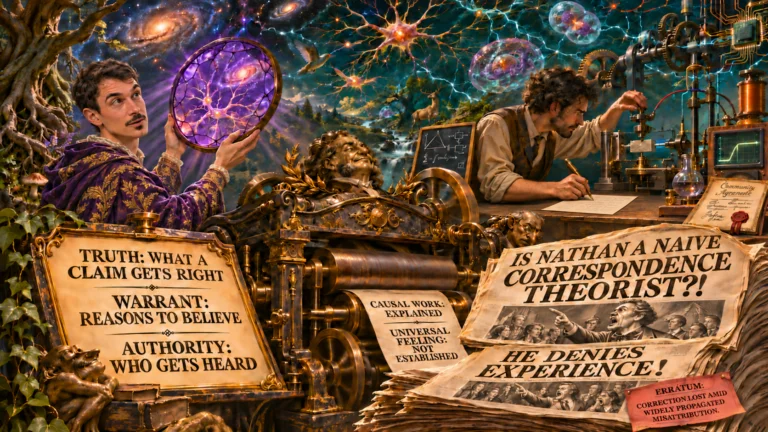
The Paper I Predicted: “Mind Everywhere” by Michael Levin & David B. Resnik
Research record: GitHub source and revision history · canonical published edition
How Levin and Resnik’s ‘Mind Everywhere’ Repeated the Predictable Evidential Gap: A Dated Correspondence Audit
In short: On February 25, 2026, Michael Levin and David B. Resnik published the two-part “Mind Everywhere” in Biological Theory. Before publication, I challenged both authors to distinguish the demonstrated utility of cognitive descriptions from Levin’s further public claims about Platonic access and to compare them with specified constraint-based rivals. The resulting paper offers an explicit operational defense, but it still does not supply the requested differential test for a separate Platonic source. That narrower, testable prediction is the subject of this correspondence audit.
On February 25, 2026, Michael Levin and David B. Resnik published “Mind Everywhere: A Framework for Conceptualizing Goal-Directedness in Biology and Other Domains” in Biological Theory (Part One | Part Two). They defend TAME as a pragmatic, experimentally assessable toolkit for investigating goal-directed competencies across different systems. Here “TAME” also denotes Levin’s wider public programme, including talks and his discussions of Platonic morphospace. Those venues must be compared, but their claims cannot simply be attributed to the coauthored paper. The central question is what evidence licenses the move from an effective experimental stance to an additional ontology.
The revealing feature of this defense is the missing comparison at the precise evidential junction I challenged in advance. The authors emphasize operational testability and discovery, yet do not show what a Platonic source predicts or changes beyond physical bioelectric and organizational mechanisms. Their bibliography does cite Deacon and Friston, and other constraint-related scholarship, so it would be false to say those authors are entirely absent. The narrower problem remains: the paper does not adjudicate the named rival explanations I put forward, especially organizational closure (Montévil and Mossio), dynamical attractors, and the interaction problem for any literally independent source of form. A paper can cite a literature without testing a rival model against its own. The dated forecast concerned this specific displacement of an ontological test by a defense of heuristic fertility.
Levin has acknowledged in later discussions that he lacks direct experimental evidence establishing Platonic ingression as a physical causal source. That qualification matters. So do the foreseeable consequences when the qualification travels less widely than the metaphor. A public scientist who describes biological discoveries in language of an independently existing, causally accessible realm can make it easier for unrelated organizations to offer those same discoveries as apparent support for their preferred ontologies. The inference does not require Levin to endorse those groups, intend their use, or cause every downstream harm. It requires careful tracing of the public language, its documented appropriation, and the missing bridge from experiment to ontology. Possible harms from widespread uncritical adoption remain warnings to investigate, not claims that every causal link has already occurred.
My target is the inferential and communicative responsibility accompanying empirical success, not a declaration that Levin’s developmental-biology findings are false. Some results are robust within the published experimental programme; the degree of independent replication must be assessed study by study. Their success cannot be assigned as evidential credit to an additional, as yet untested metaphysical source.
I anticipated the article during my November–December 2025 correspondence with both authors. Those exchanges helped prompt the launch of this site and my public critiques of TAME’s philosophical extrapolations. Levin encouraged me to formalize my arguments in a blog. This article records why I took that invitation seriously and what the subsequent publication did, and did not, address.
Between November and December 2025 I set out seventeen distinguishable objections or requests for clarification, some directed at the coauthored operational proposal and others explicitly at Levin’s wider public Platonism. I asked for differential predictions, cited named rivals, proposed interventions, identified potential interpretive slippage, and raised the ethical consequences of unwarranted ontology transfers. The correspondence and the paper must each be judged against the particular question raised.
The publication repeated the most consequential pattern I had challenged: an ambitious defense of the productivity of cognitive frameworks without an independent test establishing a Platonic source of morphological form. The authors did reply to some adjacent operational objections, so “no response to anything” would be inaccurate. What remains unaddressed, in the public paper and to the extent established by my retained correspondence, is the specific evidence that would make the extra ontology win or lose against its physical rivals.
This is a dated prediction ledger, an argument about inferential responsibility, and a standing invitation to correct the record with a discriminating test.
The Prediction Ledger
I begin with three central issues, then audit all seventeen. The quotation-marked correspondence below is reproduced from my personally verified records; the paper quotations are linked to the published texts. My evaluative sentences remain interpretations open to correction, not additional words attributed to either author.
On burden of proof: When I presented established work on organizational closure and dynamical constraints as rivals to an additional Platonic cause, I was asked about my publication record. A publication record does not decide the merit of the underlying peer-reviewed sources. It is fair, however, to demand that my synthesis be operationalized and tested too. The asymmetry I object to is assigning the extra Platonic layer scientific credit without an equally demanding comparison.
- Landauer’s principle establishes a thermodynamic lower bound for logically irreversible erasure under appropriate conditions, not for every form of information processing.
- Prigogine’s dissipative structures earned the Nobel Prize in Chemistry (1977).
- Friston’s free energy principle is among the most cited theoretical frameworks in neuroscience.
- Montévil and Mossio’s closure of constraints (2015) is established theoretical biology.
- Kauffman’s autocatalytic sets are foundational to origins-of-life research.
- Michael Resnik’s mathematical structuralism is a standard position in philosophy of mathematics, developed over four decades at UNC Chapel Hill.
- Deacon’s teleodynamics is published by Norton and reviewed in Nature.
Montévil and Mossio, Deacon, Friston, Kauffman and others provide serious, published components of alternative explanations. They are not interchangeable, not all experimentally validated in the same sense, and their combination is not automatically a completed theory. Precisely because these are genuine live competitors, a paper advocating improved predictive and engineering power should show which interventions or held-out outcomes its favored toolkit explains better, and whether that comparison requires anything Platonic.
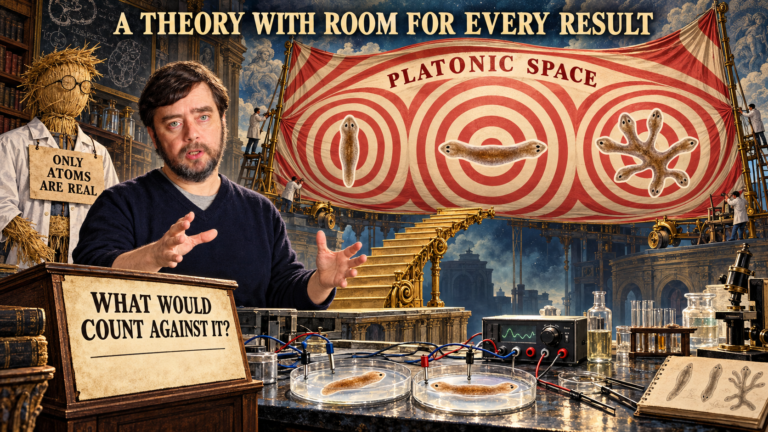
1. Levin’s planarian data put a restrictive Platonic-convergence reading under empirical pressure. What would the added ontology predict?
The crucial finding is more powerful than a slogan about metaphysics: changing a physical control regime can durably change the body plan, and a further directed physical intervention can reset it. That is causal leverage for the constraint-based model. What, exactly, does the additional Platonic interpretation contribute?
In Durant et al. (2017), temporary gap-junction disruption produced stable two-headed regeneration over repeated cuts in plain water, long after the original treatment washed out. The investigators also reset 34% of experimentally treated, two-headed worms to stable one-headed regeneration (N = 102) through a further bioelectric manipulation, versus 0% of corresponding vehicle controls (N = 102). Other treated animals had a cryptic, stochastic regenerative state. “Permanent” in the paper describes persistence over the observed regenerations and experimental conditions, not an infinite observation.
Consider a restrictive Platonic-convergence hypothesis: the organism remains directed toward one privileged, pre-existing ideal anatomical form, and that ideal exerts a restorative influence when temporary disturbance ends. This version predicts a tendency to recover one-headed morphology without another intervention. The alternative physical hypothesis predicts path-dependent stability after a regulatory transition, plus specific ways to shift the resulting state through altered voltage and coupling. A permissive Platonist can instead say that one-headed and two-headed forms are both available in an uncharted space. That escape preserves metaphysical compatibility; it does not retrospectively provide an independent prediction.
The passive reversion does not occur in the persistent two-headed cohort. More tellingly, experimentally shifting bioelectric conditions can change the stable target again. The physical intervention does explanatory work; the proposed Platonic source has not yet been shown to do any distinct work. Calling the latter an attractor “in Platonic space” cannot substitute for identifying a discriminating causal signature.
Attractor and regulatory-network models make the relevant conditional prediction: if the intervention changes the accessible developmental states or their stability, subsequent regeneration can remain altered until a counter-intervention shifts the regime. The Durant paper tests a physical reset. These models still owe quantitative parameterization, prospective predictions and independent transfer tests; their success does not make every high-level model of agency explanatorily empty.
I put this challenge to both authors using a comparison matrix. The following table now separates the restricted hypothesis I tested from unrestricted metaphysical accommodation; it is an adversarial reconstruction, not a quotation of Levin’s universally endorsed position:
| Model or evidence | Prospective expectation | Observed result | What follows |
|---|---|---|---|
| Restrictive, privileged-one-head Platonic convergence | Passive restoration toward one head when the brief disturbance ends | Stable two-headed regeneration after washout, over repeated cuts | Pressure against this conditional prediction, not all Platonism |
| Bioelectric regulatory-state / attractor account | Persistent altered target after perturbation; reset possible with targeted control | Durable two-headed state; 34% stable one-head reset under directed treatment (N=102) | Direct, partial interventional support for the physical control model |
| Unconstrained “other forms also exist” Platonic reading | No exclusive morphology forecast until form-space mapping is specified | Compatible with both one-head and two-head outcomes | Compatibility only, no independent source-specific confirmation |
| Basal xenobot transcriptomics (Pai et al., 2025) | Altered gene expression relative to selected embryo controls | At least 537 uniquely upregulated transcripts, not distinct organismal profiles | Expression plasticity; no independent test of abstract ontology |
The comparison has three outcomes. First, passive persistence challenges only a model that predicts automatic restoration of the privileged one-headed form. Second, the experimentally achieved bioelectric reset gives a concrete intervention-sensitive account of how a target can change; it does not by itself rule out every Platonic story. Third, the 2025 xenobot study identifies at least 537 uniquely upregulated transcripts in basal xenobots relative to specified embryo controls, not 537 distinct transcriptomic profiles. That is evidence of transcriptional plasticity, not an experiment deciding whether abstract forms exist. The decisive question remains: which result would differ if independent Platonic ingression were added to the best physical account?
I raised the distinction between physical regulatory persistence and independent Platonic-source predictions beginning in November 2025, with Resnik from December 2025, and on multiple occasions in the correspondence I retain. The exchanges establish that I asked the question; the published record alone does not prove how every later response across every venue should be classified.
Neither author gave me a source-specific, experimentally discriminating prediction for Platonic ingression in the correspondence described here. The published paper discusses the planarian experiments as evidence for TAME’s operational approach, which it is entitled to do; it does not show that these results require a non-physical source. A general answer that additional morphologies may exist in an uncharted Platonic space prevents contradiction only by making clear in advance what the space excludes.
This is the outstanding challenge: given reversible manipulation of the persistent biological state by specified physical interventions, what distinct result would count for, and what would count against, a causal Platonic morphospace? Until such a result is specified, a new metaphysical label has earned no added explanatory credit.
2. The co-author privately preferred structuralism. Does the paper clarify what its ontology actually commits to?
David B. Resnik is a bioethicist affiliated with the National Institute of Environmental Health Sciences. His father, Michael D. Resnik, wrote Mathematics as a Science of Patterns (1997), a major work in mathematical structuralism. The relevant philosophical distinction is not “structuralism versus Platonism” in general: Michael D. Resnik’s realism about abstract mathematical structures is itself frequently classified as Platonistic structuralism. That does not establish a causal Platonic morphospace capable of supplying biological anatomy.
There are several forms of mathematical structuralism, including varieties compatible with abstract structures and varieties that stress instantiation. Their existence does not by itself entail Levin’s further claim, sometimes expressed publicly, that organisms access independent forms that help determine morphogenesis. The serious question is whether mathematical structure functions here as a description of physically realized relations or as an added causal source. If the latter, what observation separates it from dynamical constraints? Neither the word “structure” nor its pedigree can settle that question.
I wrote to David Resnik on December 28, 2025, and asked him directly: “Do you believe in transcendent Platonic forms that organisms access? Or do you believe mathematical structure is immanent in physical process, as structuralism holds and Platonism contradicts?”
He responded the same day: “My own view is much closer to my father’s structuralism, and I hope I can convince Michael that this is a workable position.”
He confirmed this twice more over the following days: “Structuralism is the position I favor and I hope to convince Michael of.”
The paper appeared roughly two months after this correspondence. Its publicly available Part Two emphasizes a pragmatic, physically compatible cognitive toolkit; it does not present a comparative test between the alternative ontological readings of morphogenesis. The published bibliography does not appear to cite Michael D. Resnik’s Mathematics as a Science of Patterns. These omissions matter because I had asked explicitly how Resnik’s preferred structural perspective differs, in experimentally relevant ways, from Levin’s public Platonic access proposal.
Resnik’s own words indicate that he preferred a structuralist interpretation and hoped to persuade Levin toward it. The published paper does not disclose or adjudicate that interpretive difference. That is a fair question about clarity and coauthorship, even though the operational claims of the coauthored paper can consistently be defended without endorsing Levin’s broader metaphysics.
3. A “shy” Platonic space, a next-day clarification, and the empirical cost of an elastic metaphor
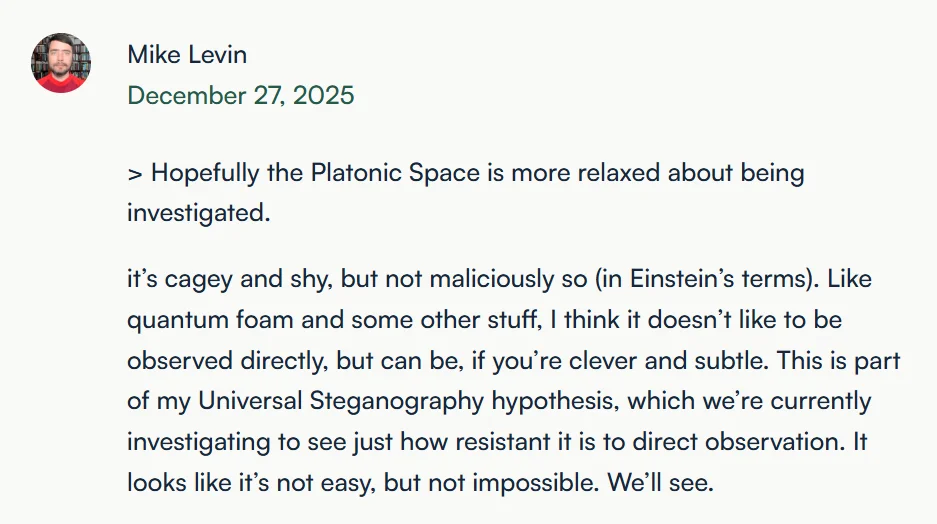
On December 27, 2025, Michael Levin wrote on his Thoughtforms symposium (link):
“Hopefully the Platonic Space is more relaxed about being investigated. It’s cagey and shy, but not maliciously so (in Einstein’s terms). Like quantum foam and some other stuff, I think it doesn’t like to be observed directly, but can be, if you’re clever and subtle.”
On December 28, 2025, Levin posted a “clarification” (link):
“I do not claim that the system as a whole has any directionality for whether we notice these things or not. I have made no claims about that.”
These comments appeared a day apart in the same discussion. The first personifies Platonic space as “cagey” and “shy,” as if it “doesn’t like to be observed directly”; the second denies a literal claim that the system has preferences about being noticed. A charitable reading is metaphor followed by ontological clarification. That still leaves an epistemic danger: if the language is used to explain away missing evidence, rather than to suggest an experiment that could fail, it becomes an evasion device. My reductio targets that use, not a claim that Levin secretly believes a universe-sized agent is hiding from us.
The next-day statement denies literal directionality. It therefore narrows what can fairly be attributed to the earlier metaphor; it does not, by itself, supply a test of Platonic access.
These are direct quotations from the linked exchange, not paraphrases. The issue is the publicly available inference that ambiguous metaphors make possible, and whether the clarification travels with the stronger imagery.
Here is the reductio, explicitly conditional: if an alleged realm’s reluctance to be observed is allowed to count as an explanation for every failed attempt to detect it, a null result can never lower confidence. A positive result would support the story; a negative one would be reclassified as more hiding. That is structurally similar to familiar theological immunization strategies. It is an indictment of an unconstrained inference rule, not an assertion that Levin endorses every theology that could use the same maneuver.
Bell’s theorem illustrates a different standard: define an empirically consequential class of hypotheses, derive inequalities under specified assumptions, and test them. Bell-type experiments constrain locally causal hidden-variable models under the relevant auxiliary assumptions; they did not falsify every conceivable hidden-variable theory. The lesson is methodological and still sharp: identify which particular hidden-realm proposal takes the empirical risk.
The comparable challenge to “Universal Steganography” is to specify an observable signature of independent Platonic access and a result that would count against it. If the claimed elusiveness merely explains why no signature appears, the claim becomes harder to test exactly when it needs testing most. That is the Bell comparison in reverse as a methodological reductio, not a claim that Bell’s actual mathematics applies to morphogenesis.
I asked Levin directly, in writing, multiple times: “What empirical result would make you say ‘I was wrong, there is no Platonic realm’?”
My repeated request for a discriminatory result had not been answered in the correspondence examined here. A response can always be supplied later, but it must specify an experiment and its failure condition rather than merely expanding the set of possible forms.
Correspondence Record
Between November 2025, and December 2025, I exchanged emails with both Michael Levin and David Resnik. The exchanges are extensive and documented. What follows is the accounting of every substantive issue I raised and how each author responded.
What I told them and what happened
Issue 1: The inferential bridge from naturalistic biology to a Platonic source. I challenged public claims about “non-physical latent space” and “breaking the closure of the physical world” when they are offered as biology rather than declared metaphysical possibilities. The published TAME account is compatible with physical mechanisms; the additional causal reading needs its own evidence.
Resnik’s response: Referred to Levin’s Dennett collaboration and philosophical pedigree. Those are relevant intellectual context, but they do not decide whether a proposed independent source adds identifiable causal predictions.
What the paper does: In response to the materialism objection, Part Two states that it is not positing metaphysically irreducible minds. That is an explicit limiting commitment, not a concealed admission. The remaining question concerns the distance between this operational defense and Levin’s separate public talk of Platonic access.
Issue 2: The operational/metaphysical slide. I documented how a useful intervention strategy can be presented alongside much larger claims about an independent source of forms. A charitable account may distinguish different contexts; an epistemically responsible one must also identify when the evidence for one is being rhetorically transported to the other.
Resnik’s response: “I do not consider it to be my business to correct what Michael Levin may have said about Platonic space on videos, podcasts, blogs, etc.”
What the paper does: It explicitly treats cognitive and teleological attributions as hypotheses about effective interaction protocols. That is the empirical defensible position. The paper does not itself establish the independent Platonic cause discussed in other venues. The two levels must not borrow evidential credit from each other.
Issue 3: The false comparative baseline. I rejected the suggestion that my position denies higher-level causal or organizational explanations. It does not. The strongest rival is not a cartoon of eliminative materialism; it is a specified multiscale causal model that admits higher-level constraints and measures what they add.
Resnik’s response, as I documented it: Continued emphasizing the case against restrictive materialist descriptions after I clarified that my alternative was not eliminative materialism. My objection to the adequacy of that comparison remained.
What the paper does: Its Second Objection explicitly answers a proposed incompatibility with scientific materialism, and Part Two says low-level physical explanations may sometimes be sufficient. That is a coherent response to a real objection; it does not settle whether organizational-closure and constraint models perform as well as, or better than, the cognitive toolkit in the authors’ chosen experiments.
Issue 4: The Dennett boundary. I challenged using Dennett’s earlier intentional-stance work as if it licensed a later ontological claim about a causally active Platonic space. Dennettian prediction by treating a system as if it had goals is not itself an argument that mathematical forms physically enter tissue.
Resnik’s response: “Daniel Dennett was his philosophical mentor and they wrote a paper together. Dennett was a hardcore materialist and no intellectual slouch!”
What the paper does: The coauthors cite Levin and Dennett’s 2020 account when presenting graded cognitive language. That is legitimate background for an operational stance. It becomes a credibility-transfer problem only if that citation is made to do additional work establishing Levin’s separate public Platonism, which Dennett did not test or endorse there.
Issue 5: Falsifiability and competing programmes. I repeatedly asked what observation would discriminate an independently acting Platonic source from a physical constraint account. I also proposed conditional tests. A research programme need not be killed by a single anomalous result, but serious criticism demands specified losses of confidence, novel risk, and comparative success rather than endless post-hoc accommodations.
Levin’s response, as recorded: He invited a 500–700-word summary. The extended exchange did not yield the requested differential condition for a Platonic source. That does not mean he denied the existence of all testable predictions for TAME’s operational programme.
Resnik’s response: Emphasized operational, empirically assessable TAME definitions. Those can answer the question “Is a cognitive toolkit useful?”; they do not answer the distinct question “Is a separate Platonic realm causally involved?”
What the paper does: It explicitly lists empirical testability as its first pillar and fecundity in discovery as its second. I was therefore wrong to say it simply replaces testing with productivity. My critique is that demonstrating productive operational heuristics does not, without a separate inferential bridge, corroborate a literally independent Platonic source. The new discoveries must also be compared with serious rival toolkits.
Issue 6: Durant et al. 2017. The persistent two-headed state and experimentally achieved bioelectric reset challenge a restricted, automatic-convergence model. This was raised in correspondence. No further ontological inference follows unless the competing Platonic model specifies an exclusive, risky prediction.
Issue 7: Mathematical structuralism and causal Platonism. My correspondence exposed an important interpretive difference, but mathematical structuralism is not universally anti-Platonist; Michael D. Resnik is often categorized as a Platonistic structuralist. The unresolved issue is whether abstract relations are being granted an additional physical causal role.
Issue 8: The interaction problem. I asked how a purportedly causally efficacious, non-spatiotemporal source would influence morphogenesis, and what measurements distinguish that influence from physical regulation. Traditional debates about abstract objects and causation motivate the question, but quoted encyclopedia formulations cannot by themselves rule out every possible metaphysics. The requirement is a substantive bridge, not an appeal to labels.
No such independently testable causal bridge was identified in the exchanges summarized here or established by the coauthored pragmatic account. If the alleged Platonic realm is only a mathematical description, no extra physical cause has been claimed and this particular interaction objection changes target.
Issue 9: Landauer and physical realization. I raised Levin’s image of Platonic space supplying “free lunches, stuff we didn’t pay for.” Landauer’s principle concerns the thermodynamic cost of logically irreversible information erasure under specified conditions, not an obligatory fixed dissipation for every measurement, computation, maintained distinction, or mathematical truth. The defensible challenge is this: any physical use, storage, control or resetting of information in a biological mechanism requires a realizable process and appropriate energetic accounting. What additional process, if any, is claimed for access to independent forms?
Neither author responded.
Issue 10: The fecundity defense. Productive programmes can nevertheless contain false or dispensable ontological assumptions. Historical cases such as phlogiston and caloric theory illustrate why useful exploration is not an automatic proof of a theory’s entire metaphysics. Lakatos also assessed empirical progress over time, so fecundity is neither worthless nor a substitute for discriminating rival explanations.
Resnik’s response, as I read it: Repeatedly returned to TAME’s experimental gains when I was challenging its public metaphysical extrapolation. The empirical record deserves attention; the exact issue was whether those gains are specific evidence for the additional source.
What the paper does: It openly invokes discovery fecundity alongside testability. I predicted its emphasis on that criterion. The criticism that survives is about how much the criterion licenses: an effective experimental strategy can win pragmatic credit without validating the entire public metaphysical story associated with it.
Issue 11: A specified constraint-based rival. I presented an integrative alternative drawing on Montévil and Mossio’s closure of constraints, Deacon’s teleodynamics, bioelectric regulation, attractor dynamics, Kauffman’s autocatalytic networks and related scholarship. Their mechanisms can explain substantial aspects of biological self-maintenance and altered morphology without postulating an independent repository of forms. My unifying synthesis is not itself a completed, experimentally validated model of every TAME result, and its relative performance must be tested.
Resnik’s response: “When you say ‘My framework operationalizes this…’ Have you published anything on this?”
The publication question addressed my standing more directly than the causal comparison. An unpublished synthesis still bears a burden of specification; the established primary papers that constitute its components should be engaged on their merits. The same inferential standards apply to published and public-facing metaphysical proposals.
What the paper does: It cites Deacon, Friston and several constraints-related sources, so it is inaccurate to claim those authors are wholly absent. It does not offer the controlled head-to-head comparison I requested between the pragmatic TAME toolkit and specifically parameterized organizational-closure or attractor models, nor between physical controls and an independent Platonic source. That is a comparative gap, not a bibliographic void.
Issue 12: Documented appropriation and foreseeable harm. I showed how advocates of intelligent design can use Levin’s public language about apparently independent forms to claim scientific support for their own ontology. The key mechanism is evidential authority transfer without a verified bridge. Discovery Institute commentary supplies a concrete example. I also cited authorship/accountability norms. The NIH’s 2024 policy cited in my original correspondence was later rescinded; the relevant current federal guidance is the HHS Scientific Integrity Policy updated March 19, 2026. I do not claim that this policy governs an individual’s separate philosophical speech or proves a violation.
Levin’s response: “I don’t know what the Discovery Institute has to do with forest fires.” The causal sequence I outlined, from public ontological language to appropriation and then possible antiscientific political consequences, has unequal evidence at its links. Appropriation is documentable. Specific wildfire or climate-policy outcomes attributable to these statements were raised as conditional downstream risks, not established events. The absence of proof for the last link does not erase the already documented first link or the duty to scrutinize foreseeable consequences.
Resnik’s response: “I do not consider it to be my business to correct what Michael Levin may have said about Platonic space on videos, podcasts, blogs, etc.” The statement is reported verbatim. Authorship standards establish responsibility for the coauthored paper; they do not automatically create legal or professional liability for every independent interview. My ethical criticism concerns an avoidable public ambiguity where a coauthor knows the operational paper may serve as a credibility anchor for stronger untested claims.
What the paper does: It provides no assessment of documented intelligent-design appropriation. A scientific paper is not obliged to rebut every ideological reuse. Yet when its explanatory language and the senior author’s public ontology are used to borrow scientific authority, the omission becomes relevant to a broader ethical evaluation of responsible communication, not proof of bad faith.
Issue 13: The persuadability continuum. I challenged the step from physical responsiveness and control loops to genuinely normative engagement with reasons. A graded continuum is a useful research hypothesis only when “persuasion,” “agency,” cognition, and conscious experience are separated and each has operational indicators. Otherwise the same word can quietly change evidential function across scales.
Neither author responded.
Issue 14: Immanence and independence. In our exchange Resnik described mathematics as “immanent in the world, not separate from it” while also entertaining “mathematical facts that are independent of physical facts.” Those propositions need disambiguation. Logical or modal independence of mathematical truths is not identical to positing a second, physically influential substance. My challenge is to specify which independence is meant and what ontological or causal work it adds.
I did not receive, in the cited correspondence, a disambiguation of those senses. Calling the tension “incoherent” without first specifying the modal and causal meanings would overstate the conclusion.
Issue 15: Mathematical-universe and Ruliad comparisons. Resnik raised Tegmark and Wolfram. I questioned what observable consequences would distinguish the relevant large metaphysical claims, drawing on contemporary critiques of their testability. Neither popularity nor the existence of critical scholarly writing establishes that all versions are disproved or universally regarded as unfalsifiable.
Resnik did not respond to the rebuttals.
Issue 16: Coauthor responsibility. I invoked principles of research authorship and integrity. The ICMJE authorship recommendations hold authors accountable for a published work, including the resolution of integrity questions. Whether a specific policy formally binds these authors is a separate issue. The broader ethical question remains whether publicly foreseeable confusion between a testable intervention programme and a speculative causal ontology warrants a clear correction or boundary statement.
Issue 17: The Argument from Ignorance
The inference I challenged was the move from the admitted incompleteness of reductionist explanations to the insinuation that an additional Platonic source is needed. The authors also argue, fairly, that mentalistic experimental toolkits may discover capacities missed by strictly low-level models. That positive pragmatic thesis deserves testing. It does not settle the separate question of whether an independently existing source supplies forms to matter.
The structure of the move is:
“Because one mechanistic account is incomplete, the additional Platonic source is scientifically supported.” This is a hypothetical inference under examination, not a quotation of either author or an assertion that the published paper states it.
This is an argument from ignorance unless two conditions are satisfied:
- The relevant alternatives have been fully evaluated and shown to fail on specified criteria.
- The proposed framework generates independent, discriminating predictions that differ from those alternatives.
In correspondence I provided concrete models and sources: closure of constraints, regulatory attractors and bioelectric control, among others. These frameworks are legitimate candidate rivals, not a single fully specified, already victorious theory. The demand is to construct a comparison with measured targets, boundary conditions, independent controls and a result on which one proposal must lose confidence.
The planarian experiments support a concrete causal model: a brief physiological intervention can reconfigure subsequent regeneration, and a later directed intervention can partially reset that stable state. A restricted Platonic-convergence hypothesis expecting passive return to a unique ideal is disconfirmed by persistent two-headed outcomes. A broader Platonic proposal remains logically compatible by admitting multiple forms, but earns no empirical credit from that flexibility until it predicts a held-out outcome the physical model misses.
Durant et al. (2017) documents persistence across repeated regenerative cycles and a 34% successful stable one-head reset under further bioelectric treatment in the reported group. It gives unusually direct intervention evidence for regulatory state control. It does not, by itself, decide the existence of abstract mathematical objects.
I asked for empirical discriminators between physical control alone and a literally additional Platonic cause. The replies I received favored operational definitions or wider philosophical considerations. None supplied the specified source-specific predictor in the exchange cited here. A strong next response would name the rival models, prospective interventions, negative controls and the result that would lower confidence in the added source.
The problem is comparative, not a demand for an instantly complete theory. The paper’s operational approach is in principle testable by predictive and engineering success; the metaphysical source requires a different evidential bridge. Physical constraint models must face the same demanding interventions. No programme gets credit merely because its competitor is incomplete.
Unless a Platonic-source model specifies a constrained mapping, differing predictions and a loss condition, the planarian and xenobot experiments support the physical biological findings but do not discriminate in favor of the added ontology. Unconstrained compatibility is not confirmation.
The scorecard
Seventeen issues raised. The central, specific request for a differentiating test of Platonic ingression remains unanswered in the correspondence and publication audited here. Other objections received operational replies, indirect responses or partial engagement; recording that distinction strengthens the case rather than weakening it.
Across the correspondence as I recorded it, Levin declined to provide a source-specific falsifier while continuing to defend his broader interpretation publicly; several comments I submitted were held in moderation; and the exchange ended with his statement that my concerns were “slowing him down.” These are claims about documented interaction, not an inference that the laboratory data are invalid or that a public video itself constitutes misconduct.
Resnik expressed a preference for structuralism, repeatedly returned to the manuscript’s operational account, asked about my publication record, and suggested later letters to the journal. The responses bear on the question of which evidential target was being addressed, not by themselves on whether he secretly endorsed Platonic causation.
What the Published Paper Does
Part Two appeared around two months after the December 2025 exchanges. Comparing the forecast to its public argument, the following points survive scrutiny:
It directly answers an objection about compatibility with scientific materialism. That is a real philosophical objection and the paper’s answer is relevant. The response does not address the alternative I gave both authors: a multiscale, constraint-based, non-eliminativist account. This is a misaligned comparison, not proof that the paper was written as a personal straw man of me.
It lists empirical testability first and discovery fecundity second. Its pragmatic criteria can be assessed by comparative predictions, interventions and new capabilities. What I predicted and continue to contest is the risk of transporting that pragmatic success to Levin’s extra-empirical Platonic source without a separate experiment. A productive framework need not provide a metaphysical free pass.
It presents cognitive attributions as hypotheses about effective interaction protocols and acknowledges that all studied systems have physical mechanisms. That is a defensible research programme. The added claim of independent Platonic access belongs to Levin’s broader public discourse and still requires separate evidence. Calling both discussions “TAME” does not erase the boundary between them.
It cites Deacon and Friston and discusses dynamical and constraint-related approaches, so it would be false to describe a total omission. It does not conduct the requested explicit comparative adjudication between organizational closure, specified bioelectric/attractor mechanisms and an independent Platonic source; nor does it define what observation would demote the latter. That is the specific omission that matters.
It does not discuss the documented appropriation of Levin-associated ontological language by Discovery Institute writers. That omission is not automatically a breach of journal standards; it remains pertinent to the ethical consequences of authority transfer across the paper, public interviews and ideological reuse.
What This Means
I want to be precise about what I am claiming and what I am not claiming.
The planarian, bioelectric, xenobot and other studies are important experimental contributions. Their particular outcomes, replication status, generality and clinical implications must be evaluated study by study; no blanket endorsement of every reported effect is needed. The strongest conclusion relevant here is that the cited experiments demonstrate specific physical interventions and developmental flexibility. They do not establish an independent Platonic supplier of forms.
Cognitive vocabulary can be a productive, testable way to organize experiments and interventions. The authors explicitly call for empirical calibration of its utility. Such tools can earn explanatory credit if they prospectively outperform simpler dynamical, cybernetic or closure-based rivals, not because human-sounding labels are intrinsically profound. Agency, goal-directed control, consciousness and experience should also be kept distinct.
I am challenging the unsupported ontological surplus in accounts of Platonic space as an independent causal source of biological form. The burden is not to eliminate metaphysics by decree. It is to ask which additional observation, mechanism or intervention is supplied by the stronger claim and what evidence would force its revision. The following remain serious deficiencies of an unconstrained Platonic-source version:
Loss conditions are missing: no specified observation in the materials audited here uniquely counts against an independent Platonic source after alternative forms and mappings are freely admitted. A claim may be metaphysically entertainable without being established as scientific explanation.
A restrictive convergence version loses a prediction: repeated two-headed regeneration undermines the claim that passive recovery must always aim at one privileged anatomical ideal. The 2017 experiment also shows that targeted bioelectric intervention can partly reset that state. A looser Platonism survives the result, but only as compatibility without demonstrated source-specific prediction.
The causal bridge remains unspecified: if the realm is non-physical and causally supplies form, how does that influence appear in measurements that a physical regulatory model would not predict? If the realm is simply mathematical structure or an optional metaphor, the causal-interaction objection changes form, but the claim no longer earns credit as an independent cause.
Thermodynamics is not a blanket disproof of abstract objects. Landauer’s bound applies to logically irreversible erasure, not every distinction or computation. A living tissue that measures, stores, transforms and resets control states still requires a physically realizable, energetically constrained mechanism. “Free lunches” from mathematical possibility do not bypass the need to specify that mechanism.
The coauthors’ public interpretive boundary remains unclear: Resnik told me he favored structuralism and hoped to persuade Levin. Their paper defends operational mentalism without deciding that wider ontological dispute. The legitimate criticism is the unclarified transfer of authority, not a deduction that Resnik contradicted himself merely by coauthoring a pragmatic paper.
The language is demonstrably appropriable and, in documented cases, appropriated. Discovery Institute writers have invoked Levin’s science and concepts to bolster intelligent-design narratives despite his own distinctions from intelligent design. That fact does not show that Levin endorses those groups. It does establish a responsibility to notice how unjustified evidential bridges can be reused, while further political or ecological harms remain risk claims requiring independent causal evidence.
I presented alternatives and asked questions that deserve explicit responses. I also recognize that neither author is obliged to answer every private message or accept an independently drafted research programme. The public, durable requirement remains: if an added ontology is asserted as scientific explanation, give the rival-sensitive experiment and the result that would make it lose support.
An answer need not be thousands of words. It needs a specified causal claim, a comparison class and a failure condition. More philosophical prose, however elegant, cannot substitute for an observable difference. That unanswered scientific question is the issue, irrespective of why correspondence ended.
The Constraint-Based Alternative and Its Unfinished Tests
Substantial parts of morphogenesis, regenerative stability and physiological coordination can be modeled through bioelectric regulatory networks, feedback, dynamical attractors and organizational constraints. Those approaches can explain important observed effects without adding a separate Platonic source. They do not yet explain every TAME phenomenon in a single validated model. Their genuine advantage in the cited planarian experiment is concrete causal manipulation and a tractable programme for testing what carries the pattern.
Describing a tissue as “remembering” a target or “solving” a problem can capture a predictive strategy. A mechanistic account should also identify what physical state persists, how signals are coupled, and which intervention changes the eventual anatomy. In the cited planarians, measured bioelectric properties and targeted treatments meet part of that standard. It is unnecessary to decide whether the metaphor is literally true in order to test the control mechanism.
Multiscale organization requires mechanisms that link cellular signaling, tissue-level constraints and future developmental trajectories. Organizational closure provides one account of how constraints are mutually maintained; bioelectric-network and attractor models supply more direct experimental targets in this case. Those descriptions can complement one another without being identical and without, by themselves, deciding whether any tissue has subjective experience.
The proposed thermodynamic-constraint synthesis begins with modest claims: information-processing operations have specific physical realizations; logically irreversible erasure has thermodynamic limits; biological identities can exhibit robustness under perturbation; and some biological organizations regenerate the constraints that sustain them. Those propositions do not deductively yield every form of goal-directedness, agency, or consciousness. They motivate a competing research programme whose variables and predictions must be specified at each scale.
“Goals” can sometimes be operationalized as controlled setpoints or attractors; “memory” can sometimes be implemented by persistent regulatory states; and “problem-solving” can sometimes be modeled as context-sensitive trajectories through a constrained state space. These are candidate model mappings, not identities true by definition for all systems. The test is whether the cognitive toolkit identifies new interventions or transfers that these more economical models systematically miss.
The rival programme has testable footholds: predict how specified gap-junction and voltage interventions change regenerative outcomes, which perturbations reset a persistent two-headed state, when initial conditions yield stochastic mixtures, and how these effects transfer to different species or contexts. The cited studies provide examples of success, including partial reset; they do not establish that all morphogenesis is exhausted by one proposed synthesis. A Platonic-source proposal could earn scientific credit by predicting an intervention-resistant residual pattern that survives controls and that the physical rivals cannot accommodate prospectively. Until that happens, adding the realm is metaphysical permission, not explanatory achievement.
This alternative draws from Montévil and Mossio (2015), Moreno and Mossio (2015), Kauffman’s constraint closure, Hordijk–Steel RAF work, Deacon’s teleodynamics, Friston’s free-energy approaches and physics of dissipative systems, among others. These are nonidentical literatures with varied support; assembling them is not itself an independently verified theory. They provide enough mechanism and conceptual structure to deny that the empirical findings force the extra Platonic conclusion. No rival, including mine, should be excused from quantitative forecasts, external replication or correction under failure.
A Note on How This Article Came to Exist
I work independently of a faculty appointment and bring decades of transdisciplinary experience to these questions. Levin encouraged me to write publicly and engage the community; this article is part of that engagement. Its claims stand or fall with their sources and predictive distinctions, not with my credentials or anyone else’s.
Readers can verify that Durant et al. (2017) found both persistent altered regeneration and an intervention-induced partial reset; that mathematical structuralism and Platonism overlap in some standard classifications; that Resnik privately expressed a preference for structuralism in the correspondence I retain; and that the published paper emphasizes pragmatic testability without offering the independent Platonic-source test I requested. Each conclusion has a different evidential status. None requires an academic title to assess.
The decisive questions are public and falsifiable where appropriate. A critic can correct my conclusions by identifying a misquoted passage, a missed differential prediction, a stronger physical rival or a failed control. Criticism of my CV alone will not answer any of those questions.
I contacted both authors before writing this public critique, offered sources and comparisons, and responded in the exchanges I retain. I experienced the eventual close of that correspondence as dismissive. Their right to disengage remains, as does the research community’s right to ask for a testable bridge between discoveries and a much larger public ontology. One clear differential prediction would do more for this debate than another hundred pages of interpretive insulation.
Primary studies, author texts, philosophical references, and policy documents
Durant, F., Morokuma, J., Fields, C., Williams, K., Adams, D. S., & Levin, M. (2017). Long-Term, Stochastic Editing of Regenerative Anatomy via Targeting Endogenous Bioelectric Gradients. Biophysical Journal, 112(10), 2231–2243. https://doi.org/10.1016/j.bpj.2017.04.011. PubMed: https://pubmed.ncbi.nlm.nih.gov/28538159/. PDF (open): https://www.chrisfieldsresearch.com/bioelectric-epigenetics-BJ-2017.pdf.
Levin, M., & Resnik, D. B. (2026). Mind Everywhere: A Framework for Conceptualizing Goal-Directedness in Biology and Other Domains—Part One. Biological Theory. Published 25 February 2026. https://doi.org/10.1007/s13752-025-00523-6.
Levin, M., & Resnik, D. B. (2026). Mind Everywhere: A Framework for Conceptualizing Goal-Directedness in Biology and Other Domains—Part Two. Biological Theory. Published 25 February 2026. https://doi.org/10.1007/s13752-025-00524-5.
Resnik, M. D. (1997). Mathematics as a Science of Patterns. Clarendon Press; Oxford University Press. Internet Archive (controlled digital lending): https://archive.org/details/mathematicsassci0000resn.
Montévil, M., & Mossio, M. (2015). Biological organisation as closure of constraints. Journal of Theoretical Biology, 372, 179–191. https://doi.org/10.1016/j.jtbi.2015.02.029. PubMed: https://pubmed.ncbi.nlm.nih.gov/25752259/.
Deacon, T. W. (2012). Incomplete Nature: How Mind Emerged from Matter. W. W. Norton & Company. Internet Archive (controlled digital lending): https://archive.org/details/incompletenature0000deac.
Landauer, R. (1961). Irreversibility and heat generation in the computing process. IBM Journal of Research and Development, 5(3), 183–191. https://doi.org/10.1147/rd.53.0183. PDF (open): https://sites.pitt.edu/~jdnorton/lectures/Rotman_Summer_School_2013/thermo_computing_docs/Landauer_1961.pdf.
Friston, K. (2010). The free-energy principle: a unified brain theory? Nature Reviews Neuroscience, 11(2), 127–138. https://doi.org/10.1038/nrn2787. PubMed: https://pubmed.ncbi.nlm.nih.gov/20068583/. PDF (open): https://www.fil.ion.ucl.ac.uk/~karl/NRN.pdf.
Levin, M., & Dennett, D. C. (2020). Cognition all the way down. Aeon. https://aeon.co/essays/how-to-understand-cells-tissues-and-organisms-as-agents-with-agendas.
Popper, K. (1963). Conjectures and Refutations: The Growth of Scientific Knowledge. Routledge. https://doi.org/10.4324/9780203538074. Internet Archive (scan): https://archive.org/details/karl-popper-conjectures-and-refutations-the-growth-of-scientific-knowledge.
Lakatos, I. (1978). The Methodology of Scientific Research Programmes: Philosophical Papers Volume 1. Cambridge University Press. Cambridge Core: https://www.cambridge.org/core/books/methodology-of-scientific-research-programmes/8DBCEFE34A59BAD3D393FB958A4DC5FC.
Dennett, D. C. (1995). Darwin’s Dangerous Idea: Evolution and the Meanings of Life. Simon & Schuster. WorldCat record: https://www.worldcat.org/title/darwins-dangerous-idea-evolution-and-the-meanings-of-life/oclc/34925327.
U.S. Department of Health and Human Services. (2026, March 19). Scientific Integrity Policy of the U.S. Department of Health and Human Services (updated edition). Current official PDF and record. Historical correction: the earlier NIH 2024 policy linked in correspondence was rescinded in March 2025; it is not invoked here as current authority.
Helgesson, G., & Eriksson, S. (2018; published online 2017). “Responsibility for scientific misconduct in collaborative papers.” Medicine, Health Care and Philosophy, 21, 423–430. DOI. Ethics discussion, not a determination that either named coauthor committed misconduct.
International Committee of Medical Journal Editors (ICMJE). “Defining the Role of Authors and Contributors.” Current recommendations. Relevant to accountability for a coauthored work; not proof of responsibility for all unrelated speech. The earlier cited Baur et al. (2015) cargo-toxicity paper was an erroneous reference and is removed.
Pai, V. P., et al. (2025). Basal Xenobot transcriptomics reveals changes and novel control modality in cells freed from organismal influence. Communications Biology, 8, 646. Full text and DOI. Reports 537 uniquely upregulated transcripts.
Stanford Encyclopedia of Philosophy. “Structuralism in the Philosophy of Mathematics” and “Platonism in Metaphysics.” Distinguish ante rem Platonistic structuralism from the untested causal-source hypothesis.
Stanford Encyclopedia of Philosophy. “Information Processing and Thermodynamic Entropy” and “Bell’s Theorem.” Scope of erasure bound and locally causal hidden-variable assumptions.
Discovery Institute, Evolution News. “Michael Levin and the Philosophy of Intelligent Design” (January 20, 2026); “The Levin Teleology Revolution Is Here” (March 4, 2026). Primary examples of ideological uptake, not evidence that Levin endorses intelligent design.
Related published analyses: Bubble Sort Misunderstood · Levin Misrepresentation Response · Chladni Plate Challenge · Michael Levin Evidence and Scholarly Criticism Index.
Revision Notes — 9 November 2026
Retested the empirical, philosophical and ethical inferences while preserving the dated correspondence and conditional reductios. Clarified the physical bioelectric reset, differentiated operational TAME from independent Platonic-source claims, corrected the structuralism/Landauer/Bell interpretations and bibliography, and retained the documented appropriation and prospective-harm warning. Download the detailed audit and before/after record.