

A Quick Note: One Nature Does Not Entail One Feeling
What my framework implies for Matthew David Segall’s bifurcation argument
Substack Repost Notice: This is an archival copy of my substack post. Some formatting may not display correctly on our website. See the original post here: https://sweetlyrational.substack.com/p/a-quick-note-one-nature-does-not
September 17 update: Matthew has since responded to this article, and I have added his response and my reply at the end so the subsequent exchange remains part of the public record.
I used two terms too loosely, and Matt was right to correct them. Once X is restated in his preferred language, however, the argument remains unchanged. His response also appears to concede the central non-entailment I was making: “there is but one nature” does not by itself establish that every concrete actual occasion is constituted through prehensive feeling.
That matters because the terminological objections, while useful for precision, are red herrings with respect to the main argument if they are treated as resolving it. Changing “member” to “concrete actual occasion” and “property” to “constituted through prehensive feeling” removes the vocabulary dispute while leaving the inferential structure intact.
The exchange therefore narrows the disagreement considerably. The remaining question is the one I posed from the start: what additional argument or evidence gets us from the shared one-nature, process-relational commitments to universal prehensive constitution?
So the exchange produced a useful vocabulary repair, exposed two distractions from the central inference, repeated Matt’s previous public misrepresentations of my argument that I’ve already corrected more times than I can count at this point, and made the live burden I had already identified clearer rather than changing the argument.
Matt’s response:
My reply:
I only wanted to do something fairly limited here: make a few quick notes on where I think Matthew’s most recent responses, together with the formal proofs in my recent Synthbiosis article, leave the live disagreement for anyone interested in the too-long, didn’t-read version of what I have a feeling will likely be the conclusion of our current debate, at least for now.
I am not trying to rerun the whole exchange or declare all of metaphysics settled. The useful change is narrower. Matt’s later replies have clarified what he is actually claiming and conceding, while my more exhaustive audits and the Synthbiosis proofs article provide me a demonstrated independent case in which the same rules about boundaries, constitution, identity, scale, and evidential transport can be pushed hard enough to see what they do when Whitehead is nowhere in the premises.
I think the dispute can now be stated with less noise. The issue was never whether relation, inheritance, organization, causal efficacy, or experience are real; I already grant all of those where the evidence earns them. What the later exchange and the Synthbiosis work make easier to see is which conclusions belong to that shared process-relational carrier, which depend on stronger additions, and whether the same inferential rules still behave coherently outside the dispute that made them contentious. These are notes on where I think that leaves the argument, and why, rather than another attempt to replay every turn that got us here.
Scope. Nothing in this article marks a change from a previously mechanistic, atomistic, nonrelational, or “experience-subtracted” position. The methodological and ontological rules used here predate this latest audit and were already explicit in my Recursive Corrigibility Framework, Provisional Boundary- and Scale-Relative Realism, and public statements of D + ?X. The new material is a worked application of those existing rules to a separate problem that makes their consequences for the Segall dispute unusually visible.
The premise that needs correcting
A recurring reconstruction of my position treats my agnosticism about universal experientiality as though I begin with a complete nonexperiential world and then ask whether experience should be added to it.
I do not.
My position has consistently granted a substantial shared carrier, which I call D: causal efficacy, temporal inheritance, relational dependence, organization, integration, transformation, process, and every instance of experience actually evidenced.
Matt’s stronger claim, X, is not “experience exists.” It is the universal identity claim that concrete causal actuality just is experiential feeling or felt inheritance.
My shorthand D + ?X means that X remains unresolved. It does not mean D + ¬X.
The distinction has always been methodological as well as ontological:
D ⊬ X
D ⊬ ¬X
That is local underdetermination of a stronger identity claim, not construction of a second, nonexperiential nature.
This was already built into RCF and my ontology
The rules being applied here were not invented to answer Matt.
My Recursive Corrigibility Framework already requires a recursive mirror: apply an argument’s standards back to the argument, apply the same inferential rules to serious rivals under matched evidence, and then apply those standards to the evaluator itself.
My Provisional Boundary- and Scale-Relative Realism already treats boundaries and scales as hypotheses, distinguishes local from global underdetermination, requires bridges when local evidence is exported to universal claims, and withholds stronger intrinsic, identity, and necessity commitments when no discriminator has been earned.
The standing rule was already:
Do not add what the evidence did not earn. Do not subtract what the evidence did not defeat.
The same framework already treated universal physicalism and universal panexperientialism symmetrically. Successful physical realization does not by itself establish that all reality is intrinsically physical. Evidenced experience does not by itself establish that all concrete causal actuality is intrinsically experiential everywhere in the universe.
So the relevant history is not, as some other articles written about me would seem to suggest:
I held a bifurcated ontology, then a later audit pushed me toward Whitehead.
It is:
I applied pre-existing anti-reification, boundary, scale, bridge, symmetry, and underdetermination rules to another domain, and the result independently reproduced the same structure my ontology already predicted.
What the synthbiosis case actually contributes
The human-computational agency audit does not create my process-relational alternative. It supplies a concrete stress test of it.
Applying the already-established rules to agency shows why a skin-bounded individual can be a real agent without being a causally self-sufficient world. Human agency depends on material, informational, social, infrastructural, and ecological conditions. A computational component can sometimes enter those dependencies without becoming identical to the human. A coupled system can sometimes instantiate intervention-relevant organization without thereby becoming one phenomenal subject.
None of those claims requires X.
More importantly for the Segall debate, none requires the opposite of X either.
The example therefore gives independent content to a position that was already on the table:
One connected natural order can contain real process, relation, causal inheritance, organized individuals, constitutive dependencies, and every evidenced instance of experience while leaving the universal intrinsic character of causal actuality unresolved.
That is not a newly invented rival to Whitehead. It is a worked example of the rival I was already defending.
Matt’s bifurcation objection therefore misses the target
Matt’s strongest challenge is that bracketing universal experience threatens to recreate the division Whitehead opposed.
In Experience Is Not a Predicate, he asks what remains when experience is bracketed and says that “actuality itself goes missing.” He repeatedly presses the possibility that an agnostic rival leaves bare causal succession on one side and feeling on another.
But that criticism only lands if my rival actually contains that division.
It does not.
D already contains causal efficacy, inheritance, transition, organization, relation, and all evidenced experience. ?X leaves open one further identity claim about the intrinsic character of all concrete causal actuality. This has always been the case. Matt helped me make that more explicit. For that I am genuinely thankful.
The unresolved variable is not “nonexperience.”
It is unresolved.
Calling it “vacuous actuality” fills the variable with ¬X. Calling it “feeling” fills it with X. Neither follows from suspension.
Whitehead’s anti-bifurcation diagnosis can be granted without granting X
Whitehead’s original complaint in The Concept of Nature was against the “bifurcation of nature into two systems of reality.” His corrective demand was equally clear: “there is but one nature.”
I can grant both.
There need not be one real causal world plus a second merely subjective world of experience.
There can be one natural order containing differently organized processes, relations, organisms, environments, computational systems, and experience wherever experience is evidenced.
That does not entail that every member of that one nature possesses the same intrinsic phenomenal property.
Whitehead himself did not need to smuggle his entire later metaphysics into the definition of the 1920 problem. In the same work, while considering whether mind and nature might share some ultimate character of passage, he explicitly calls that “a speculation in which we have no concern.”
The later Whiteheadian programme may still be right. But anti-bifurcation and panexperiential identity are not analytically identical claims.
“Distinction is not division” supports my factorization
Matt later puts the point neatly: “distinction is not division.”
I agree.
That is exactly why distinguishing D from X does not divide nature.
Separating causal efficacy from phenomenality for purposes of proof dependence does not assert two substances. Distinguishing organism from environment does not make either causally independent. Distinguishing a human from a computational component does not deny constitutive relations between them.
But the converse matters too:
Unity is not identity.
Showing that two features belong to one connected nature does not establish that they are identical.
Relational continuity does not entail experiential identity.
Constitutive dependence does not entail identity.
One nature does not entail one phenomenal property.
And anti-bifurcation does not by itself entail X.
The methodological point is the same one I have been making throughout
The question is not whether Whitehead can accommodate causation, inheritance, embodiment, relation, experience, or de-bifurcation.
He can.
The question is which of those results specifically depends on X.
If D already supports conclusion C, and D + X also supports C, then C cannot be counted as evidence specifically for X merely because Whitehead’s ontology contains it.
Formally:
D ⊢ C
D ∪ {X} ⊢ C
does not establish:
C therefore X
The same rule applies to my own framework. If “human” or “biological” can be removed from an argument without changing the morally or causally relevant premises, those labels do not get credit for the conclusion.
That recursive symmetry is not a new principle produced by the synthbiosis paper. It is RCF doing what it was designed to do.
Matt’s own later concessions narrow the dispute further
The strongest version of this argument no longer depends only on my reconstruction of Matt’s position. His own later corrections now supply several of the premises needed to state the live disagreement precisely.
First, on August 30, Matt explicitly acknowledged the source-fidelity error: “I did collapse the two-way conditional structure of his argument, and his explicit agnosticism regarding the primitive intrinsic character of causality.” That matters logically because ?X is not ¬X. Arguments against a positively nonexperiential ontology do not thereby refute suspension about X.
Second, in that same correction Matt wrote that his identification of bodily feeling with causal relation “bears a comparative burden with alternative metaphysical accounts of causation” and that his case “doesn’t necessarily prove the universal extent of experiential relations.” That is almost exactly the burden my question was designed to isolate. The comparison is therefore not an illegitimate demand generated by an alien grammar; it is a burden Matt himself now says the identity claim bears.
Third, on September 5, Matt accurately restated the live question: I grant what he calls a process-relational causal core and ask “what warrants the further claim that concrete causal actuality is universally experiential rather than leaving its intrinsic character open.” In the same reply he says: “none of this deductively proves panexperientialism. It is an abductive metaphysical proposal.”
That combination is decisive for the structure of the debate. If causal actuality = experiential feeling is true by definition only inside the Whiteheadian categoreal scheme, then the external question becomes why that scheme should be preferred as a description of reality. If, instead, universal experientiality is a fallible abductive generalization from embodied causal efficacy, then serious alternatives must be compared and the generalization must earn its universal scope. Either way, the comparative question survives.
Matt also says that, concretely considered, “causal relation just is felt inheritance of the past into the present.” That may be the right metaphysics. But stating the identity does not remove the burden he elsewhere acknowledges. It locates the claim to be compared.
The written record now establishes a narrower point than either panexperientialism or its negation: X is being offered as a fallible abductive metaphysical generalization beyond substantial shared process-relational commitments, and its comparative warrant is therefore the live issue.
That conclusion does not establish ¬X. It explains why nothing I have granted so far requires a move from ?X to X.
What the separate audit adds to the debate
It adds independent exemplification, not a changed ontology.
The Segall debate could previously remain at a fairly abstract level: can a process-relational rival coherently reject bifurcation while suspending X?
The synthbiosis case supplies a worked example in another domain. When boundaries are treated as hypotheses, when properties are indexed to the scale where they do explanatory work, when relations can be constitutive without collapsing identity, and when substrate labels are prevented from doing hidden inferential work, the result is neither atomism nor undifferentiated holism.
It is exactly the kind of boundary- and scale-relative relational realism my framework already endorsed.
That matters because the rival is no longer merely described in abstract philosophical vocabulary. The same rules generate useful distinctions under intervention:
individual ≠ isolated;
relation ≠ identity;
constitution ≠ fusion;
scale-relative ≠ unreal;
one nature ≠ one phenomenal property.
The application therefore strengthens the evidential credibility of the pre-existing framework insofar as the framework generated coherent consequences outside the dispute for which it is being used.
It still does not prove that the framework is the uniquely correct ontology.
What becomes of Matt’s “blank”?
There is no requirement that every meaningful ontology provide a final intrinsic characterization of causal actuality before it can describe anything real.
My framework is deliberately thin at precisely that point.
It can be strongly realist about particular processes, relations, organisms, mechanisms, constraints, and higher-scale patterns where they earn predictive or intervention-relevant leverage while remaining agnostic about a stronger universal claim concerning what all actuality is “in itself.”
That is incompleteness in the ordinary sense that an open question remains.
It is not emptiness.
Nor is an unresolved variable evidence for one proposed resolution of it.
The comparison therefore remains:
Whiteheadian universal experiential identity
versus
one or more positive one-nature relational/process rivals that share substantial causal and experiential content while withholding the universal identity claim.
What would actually discriminate X?
Matt’s September 5 reply does provide a substantive cumulative rationale for X: phenomenological disclosure of causal efficacy through embodied feeling, constitutive internal difference, categoreal continuity across nature, and the claim that purely structural descriptions leave concrete occurrence unspecified. Those are real philosophical considerations, and I do not treat them as “no answer.”
But factorization still matters. Phenomenological disclosure establishes experience in our embodied causal case. Constitutive inheritance establishes that causal influence makes an internal difference. Continuity is a theoretical virtue of one categoreal account. Structural incompleteness leaves intrinsic character unresolved. None of those claims, by itself, says that the unresolved intrinsic character is experiential everywhere.
So the burden has therefore been the same throughout: what follows from X that does not follow from the shared carrier or serious rivals?
What observation should be more expected if all concrete causal actuality is experiential?
What intervention becomes possible because X is true?
What contradiction appears in D + ?X that cannot be repaired without X?
What otherwise unexplained phenomenon becomes intelligible only after the universal experiential identity is introduced?
If Matt supplies that discriminator, X earns additional warrant.
If he does not, then relationality, causal efficacy, temporal inheritance, embodiment, de-bifurcation, and the existence of experience where it is evidenced remain largely shared explanatory work.
Shared explanatory work cannot by itself select the disputed addition.
Nothing in my position had to move for this result
This point matters because otherwise the argument quietly reinstates the same reconstruction I have repeatedly rejected.
I did not begin from nonexperiential physicalism and later discover relation.
I did not begin from self-sufficient substances and later discover coupling.
I did not begin by treating humans as metaphysically privileged subjects and later adopt scale-relative boundaries.
I did not begin by denying experience a place in nature and later concede Whitehead’s anti-bifurcation diagnosis.
The relevant methodological and ontological commitments were already explicit.
The later audit did something different and much more useful:
it subjected an unrelated case to the same pre-existing rules and obtained consequences consistent with those rules without importing X.
That does not change my side of the Segall debate.
It gives the existing side another independent stress test.
The remaining question for Matt
The false choice remains false:
universal experientiality or bifurcated mechanism.
My position has never occupied the second horn.
The live rival remains:
one connected, process-relational nature; real causal and constitutive relations; real experience wherever evidenced; boundaries and agency indexed to the scales where they do explanatory work; and universal experiential identity left open until the evidence discriminates it.
That position can be wrong.
But it cannot be refuted by attributing to it the nonexperiential, atomistic, bifurcated ontology it explicitly rejects.
So the question remains the same one my framework posed before the synthbiosis audit:
After granting the shared process-relational carrier and refusing the bifurcation, what explanatory, predictive, interventional, or otherwise discriminating result still specifically requires X?
If there is one, show it.
If there is not, Whitehead’s anti-bifurcation diagnosis can remain valuable while universal experiential identity remains what it was before this latest application:
a serious live hypothesis and, in Matt’s own later description, an abductive metaphysical proposal whose comparative burden has not disappeared.
Update, September 17, 2026
responded to this article in his September 17 Substack response:
I replied here:
His terminological correction is useful. “Member” is too loose for Whitehead’s actual occasions, and “property” can misleadingly suggest something possessed by an already constituted entity. I am therefore happy to restate X entirely in Matt’s preferred vocabulary:
X: every concrete actual occasion is constituted through prehensive feeling.
That clarification does not change the argument of this article. The sentence Matt objected to was not offered as a quotation or technical reconstruction of his ontology. It was a non-entailment claim made immediately after granting Whitehead’s anti-bifurcation thesis: “there is but one nature” does not by itself entail X.
Matt’s response also again asks what remains once “experiential togetherness has been bracketed.” But this still does not describe D + ?X. D explicitly contains every evidenced instance of experience. What remains unresolved is the unrestricted extension of prehensive constitution to all concrete actuality, not whether experience exists or belongs within nature.
This matters because it is not the first time my position has been publicly reconstructed into a stronger, more vulnerable form and then criticized in place of the argument I actually made. Matt previously acknowledged one such collapse in his August correction and another in response to his GPT audit.
Whatever the intent, the recurring effect is the same: my actual position is made to look substantially more absurd and easier to reject than it is.
These repeated public misrepresentations need to stop.
The cleanest way forward is to quote the proposition I actually assert, state it in Matt’s strongest preferred terminology if necessary, and engage that proposition directly.
So the live question can now be stated with even less terminological friction:
After granting one nature, causal efficacy, inheritance, relation, integration, embodiment, and every evidenced instance of experience, what additional argument or evidence warrants the conclusion that every concrete actual occasion is constituted through prehensive feeling?
Further update, September 17, 2026
Later the same day, Matthew clarified his positive argument. Most importantly, he explicitly agreed with the logical point at the center of this article:
“So I agree that D does not entail X.”
He then stated the remaining Whiteheadian case more precisely. The move from embodied felt causal efficacy to panexperientialism is, on his account, an abductive metaphysical generalization, not a deduction or a claim resting on one unique experiment. He further argues, following Whitehead’s reformed subjectivist principle, that experiential togetherness is not one kind of togetherness among others, but that other descriptions of togetherness are abstractions from it. This substantially narrows the disagreement: the issue is no longer whether anti-bifurcation or D deductively entails X. Matt now explicitly says it does not. The live question is whether the abductive generalization from embodied felt causation to panexperientialism is comparatively better warranted than leaving X open.
I responded here. My reply grants that an abductive metaphysical argument need not provide a deductive proof or unique experimental prediction. The remaining objection is narrower: D + ?X does not posit a second, nonexperiential or “ontologically alien” kind of togetherness. It leaves the relevant question unresolved while keeping Matt’s Whiteheadian account itself inside the live hypothesis space. Treating that suspension as though it already posited the rival he rejects again converts ?X into something like ¬X before criticizing it.
The dispute can therefore now be stated especially cleanly:
What comparatively warrants the move from bodily felt causal efficacy to panexperientialism, rather than keeping that universal extension open among the serious possibilities?
That is the bridge still under examination.
Framework and primary sources
Nathan Sweet, Recursive Corrigibility Framework.
Nathan Sweet, Provisional Boundary- and Scale-Relative Realism.
Matthew David Segall, Experience Is Not a Predicate, August 29, 2026.
Matthew David Segall, Words Made Flesh Again, September 11, 2026.
Alfred North Whitehead, The Concept of Nature, 1920.
Alfred North Whitehead, Science and the Modern World, 1925.


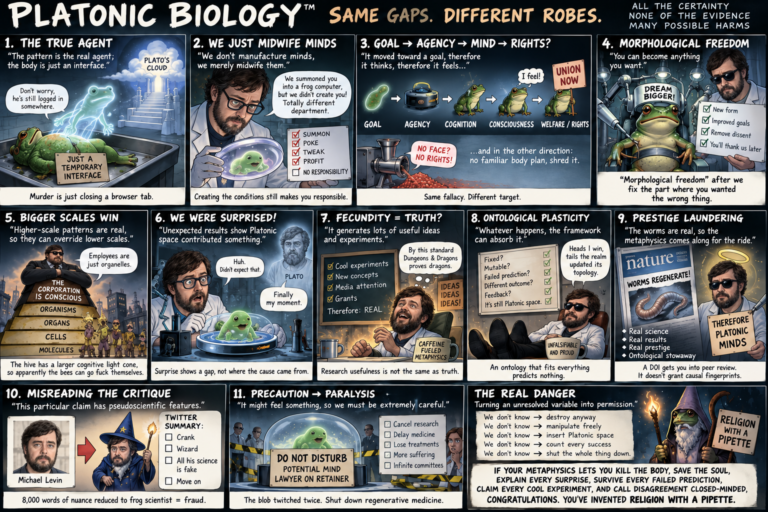
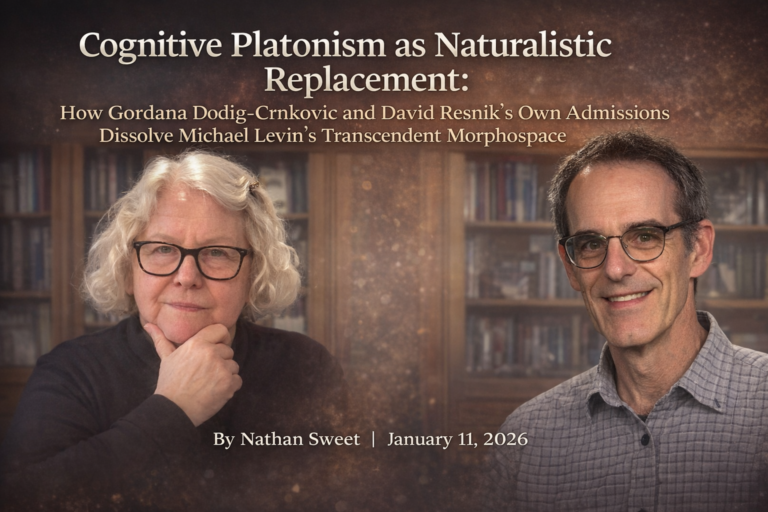

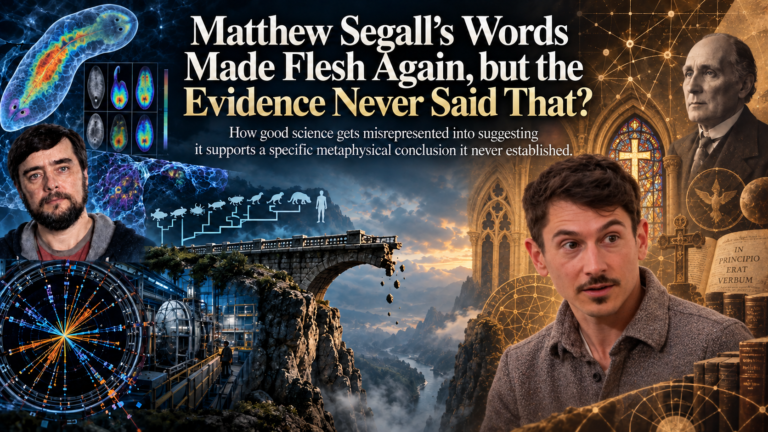

Okay. I asked Fable 5 to simplify everything that’s been produced over the last couple days because this is too many words to really comprehend. So some nuance may be stripped but its for the sake of understanding. This was my prompt “okay this really now just feels like we’re speaking in different languages about the same content. can you make the argument as simple as possible? present his position and then my position.”
Nate’s position. Things happen and affect each other. Some of what happens is felt: us, animals, wherever there is evidence. That is all the evidence supports. Whether everything that happens is felt, in some tiny degree, is a claim the evidence does not reach. It might be true. It might not. He will not say either. If you want him to lean toward “everything is felt,” show him something that view explains, predicts, or fixes that “some things are felt, the rest unknown” does not. Until then, “unknown” is the honest answer, and “unknown” is not “no.”
Will’s position. Things happen and affect each other. And “affect” has to mean something. Either it means “this, then that, reliably,” or it means “this did something to that.” The only place anyone knows what “did something to” is like is from the receiving end, in ourselves. That is where the word gets its meaning. So when he says everything affects everything, either he means the thin sense, in which case he is a Humean and you are arguing about whether there is a push at all, or he means the thick sense, in which case he is using a word whose only known content is felt and calling that content “unknown” everywhere except in us. You think that “unknown” is not a neutral base. It is a word in use with its meaning on loan. The honest move is to say: the content we have is felt, we have no other, so the simplest picture is felt, in degrees, everywhere. Not proven. Chosen because it is the only filled-in version, and held open to anyone who fills it in another way.
Where you agree. The evidence does not decide it. The comparison is by coherence and adequacy. Nobody has proven anything. Some things are felt. His suspension is not denial.
Where you actually disagree, in one sentence each. He says “affect” can be used without saying what it is, and leaving it unspecified is the honest default. You say “affect” cannot be used in the thick sense without borrowing its meaning from the felt case, and once borrowed, “unspecified elsewhere” is not neutral but a debt.
Why it feels like different languages. He speaks in warrant: what is earned, what is unearned. You speak in meaning: what the word contains, what is there. The shared content is one word, “affect,” and what it holds. His “unearned” is your “unfilled.” He thinks an unfilled slot is fine to leave. You think an unfilled slot inside a word you are using is not a base you can compare from.
What would end it. He says which sense of “affect” he means. If thin, you disagree about whether there is a push, and that is a different and older argument. If thick, the content is felt or unknown, and your whole case is that felt is the only content anyone has put on the table.
Do you get the gist of this simplification? and do you think it accurately details the differences we hold? I have a draft of a response but it seems your views have changed a bit since I started writingg, so I want to make sure we’re on the same page in a way that is intelligible to me.
Hi Will, and thanks for the comment. Kudos to you for trying to understand such an advanced topic, ask questions, and challenge your assumptions as well as mine. And yes, I agree, I’ve posted a lot the last few days, but most of it was formalization and tracing the peer-reviewed scholarship that supports that formalization.
But I am not sure what you would have prompted it to generate that summary, and it really isn’t responding to what I’ve argued. Can you please show me your prompts?
Did you give my actual articles to Claude and ask it to identify any areas where your summary misrepresents my articles before posting it? Or ask it to identify if your prompts might have led it to that conclusion?
If you haven’t copied and pasted my articles to Claude and asked it to quote my words verbatim whenever discussing my arguments with you, I think that would help a lot.
I just did a quick prompt with a fresh instance and memory disabled (so no influence from my prompts or history), and Claude Opus 5 was able to easily identify many issues and summarize them better than I would have, all without any previous context whatsoever. I shared a link you can read yourself and copy and paste to show your claude instance (so it can better understand the argument you’re trying to have it critique). https://claude.ai/share/3537503e-0a45-4ed0-9250-9af75930ffd7
When working with these machines, one of the most important things is to always provide the full source texts and others’ arguments, peer-reviewed papers or books you want it to evaluate, and prompt them to find holes in your position rather than trying to get them to confirm your conclusions. They are sycophantic and will agree with you confidently, even when dead wrong, unless you prompt them to be adversarial stress testers continuously and repeatedly.
I hope this helps!