Process Philosopher Matthew David Segall: Evidence and Scholarly Criticism Index
Research record: GitHub source and revision history · canonical published edition
Sweet Rationalism · Scholarly criticism and evidence index
Process philosopher Matthew David Segall: evidence, scholarly criticism, corrections, and competing explanations. An annotated public research catalogue covering Whiteheadian prehension, panexperientialism, consciousness, divine valuation, process theodicy, and the limits of scientific explanation.
This index organizes literature by its evidential relationship to Segall’s work, distinguishing direct philosophical exchanges from broader peer-reviewed literature on process philosophy, panpsychism, and cognitive science.
1. Named critics and public arguments that engage Segall directly
These authors directly engage Segall’s published work, addressing his theological and political arguments, Whiteheadian experience, predication, and the inference from conceptual models to ontology.
Erik Haines: Through & Beyond the Threshold
Pressure point: Whether a process-cosmological orientation yields an adequately discriminating practical account of plural perspectives, political mediation, and democratic agency. A cosmology’s ethical attractiveness is not evidence that its ontology is necessary.
Erik Haines: On God, Absolute Freedom, & the Post-Metaphysical Turn
Pressure point: What follows from acknowledging unavoidable metaphysical commitments, and what additional justification must connect those commitments to a preferred theological picture.
Bernardo Kastrup: The Threat of Panpsychism Revisited
Pressure point: How seemingly discrete experiential occasions relate without reproducing the fragmentation or combination problem. This is a live dispute within experience-first metaphysics.
Timothy Jackson: Variation and the Limits of Determinacy
Pressure point: Whether beginning with variation covertly reinstates a universal invariant, and whether determinacy should instead be described at situated, developing boundaries.
Benjamin E. Snyder: Variation and Predication
Pressure point: What can be consistently predicated of variation without silently converting a logical condition of description into a discovered cosmic constituent.
Jeffrey Williams: After Kant and Whitehead: Experience, Metaphysics, and the Remainder
Pressure point: Whether our epistemic access to experience licenses a universal metaphysics of experience, or leaves an ontological remainder that the argument must acknowledge.
Peter Staudenmaier: Steiner’s Racial Legacy and Social Threefolding
Pressure point: Evaluates Segall’s essays on Rudolf Steiner’s social threefolding and anthroposophical racial doctrines. Staudenmaier characterizes Segall’s threefolding essay as confused and argues that understanding Steiner requires examining how racial hierarchies relate to anthroposophy’s broader spiritual cosmology. Segall explicitly responds that he is not an anthroposophist, affirms that Steiner’s racial remarks are unequivocally racist and false, and argues for separating those statements from contradictory non-racist resources in Steiner’s thought.
2. Peer-reviewed literature and testable rivals relevant to Segall’s claims
This literature addresses core theoretical questions in process philosophy, panpsychism, mechanistic explanation, consciousness measurement, and process theodicy, providing relevant empirical and conceptual benchmarks for evaluating Segall’s positions.
2A. Whitehead, panpsychism, and the alleged need for universal experience
John J. Shepherd, “Panpsychism and Parsimony”
Challenge: Does the philosophical generalization of experiential properties to nature earn explanatory economy, or add a posit without independent need?
Charles Hartshorne, “Why Psychicalism? Comments on Keeling’s and Shepherd’s Criticisms”
Counterargument: A defense of process psychicalism against analytical and empiricist criticisms of panpsychism.
Leemon B. McHenry and George W. Shields, “Analytical Critiques of Whitehead’s Metaphysics”
Relevance: Examines historical analytical critiques while offering a sympathetic reconstruction of Whitehead.
Henry Taylor, “Is Panpsychism Simple?”
Challenge: Whether a claimed theoretical-simplicity advantage can carry a panpsychist conclusion.
Jacek Jarocki, “Three Kinds of Arguments for Panpsychism”
Challenge: Disentangles families of arguments that otherwise slide between continuity, metaphysical inference, and agnosticism.
Hedda Hassel Mørch, “The Evolutionary Argument for Phenomenal Powers”
Serious rival: A positive argument for the causal powers of experience, grounding an experiential interpretation of natural necessity.
2B. Causal explanation and biological organization without an assumed universal phenomenology
Peter Machamer, Lindley Darden, and Carl F. Craver, “Thinking About Mechanisms”
Alternative: A research programme for specifying productive entities, activities, and organization at tested scales without assuming a universal phenomenology.
Maël Montévil and Matteo Mossio, “Biological Organisation as Closure of Constraints”
Alternative: An explicit account of biological organization and reciprocal constraint dependence, demonstrating explanatory work achieved by organizational closure.
Miles K. Donahue, “Methodological Naturalism, Analyzed”
Relevance: Clarifies varieties of methodological naturalism and the inferential restrictions at issue when evidence, explanatory practice, and ontology interact.
2C. Consciousness: operational evidence and adversarial model comparison
Adenauer Casali and colleagues, “A Theoretically Based Index of Consciousness Independent of Sensory Processing and Behavior”
Evidence: Perturbational complexity operationally discriminates certain conscious and unconscious states.
Cogitate Consortium, “Adversarial Testing of Global Neuronal Workspace and Integrated Information Theories of Consciousness”
Methodological example: Theory-specific predictions from GNW and IIT evaluated through shared adversarial testing.
2D. Process theology, animal suffering, and ethical consequences
Gary Chartier, “Non-human Animals and Process Theodicy”
Challenge: Nonhuman suffering poses a distinctive test of whether process theodicy provides a satisfactory moral explanation. Directly relevant to the question of what preserving a prey animal’s suffering in God could justify.
William E. Connolly, “The Fragility of Things: Self-Organizing Processes, Neoliberal Fantasies, and Democratic Activism”
Alternative: An immanent, secular process-relational political ontology that adopts Whitehead’s open-ended temporal becoming while explicitly qualifying or pruning Whitehead’s dipolar God and Platonic eternal objects. Directly engaged by Segall in his doctoral dissertation and published essays, where Segall defends the cosmological indispensability of God and eternal objects against Connolly’s immanent naturalization.
3. Nathan Sweet’s published articles
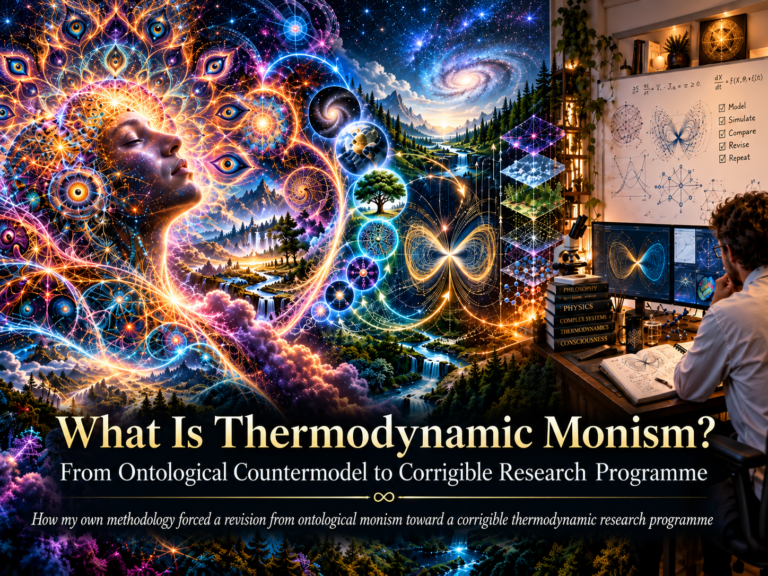
The Core Argument: Five Failure Modes and Two Tribunals
My target across these essays is not process philosophy itself. I grant Segall almost all of Whitehead’s relational, causal, and dynamic core. The disagreement concerns the panexperientialist leap: the claim that primitive causal actualities are intrinsically experiential, affective, or proto-subjective.
Across the essays below (most prominently in ‘Experience Is Not a Predicate’, Where the Necessity Case Fails, and Synthbiosis), my critique isolates five primary failure modes in Segall’s defense of universal feeling:
- Equivocating internal coherence with external evidence: Segall argues that within Whiteheadian cosmology, experience cannot be a separable predicate subtracted from an entity because concrete actualization is feeling (“To be actual is to feel and be felt”). But demonstrating that a proposition is definitionally indispensable inside Whitehead’s metaphysical system does not prove nature is actually instantiated that way, any more than a physicalist asserting “to be actual is to be physical” proves physicalism.
- Failing to refute the agnostic third option: Segall repeatedly frames the debate as a binary choice between panexperientialism and a dead, feelingless mechanism burdened by a miraculous emergence problem. This is a false dilemma. My articles introduce a third position: a process-relational realism that affirms real causal inheritance, relational integration, and organizational emergence, while withholding judgment on whether primitive causation is intrinsically felt. Segall’s objections succeed only against dead mechanism, leaving this agnostic process rival untouched.
- The collapsed necessity claim and moving loss condition: In Where the Necessity Case Fails, I directly test Segall’s stated loss condition from Experience Is Not a Predicate: “Show me what causality means without implicitly relying on experiential verbs and prehension loses its warrant.” When supplied with positive, non-experiential mechanisms, organizational constraints, and causal powers that account for real influence at specified targets, the necessity claim fails at those targets. Rather than conceding that prehension loses its warrant, the defense shifts into an insulated demand, insisting that any withholding of feeling deflates causation into Humean bare succession and leaves actuality blank.
- Semantic slippage on “receptivity” and “valuation”: Segall uses thin definitions (causal sensitivity, differential state response) to establish ubiquity across nature, and then quietly substitutes thick definitions (felt experience, intrinsic attraction or aversion) to claim metaphysical and ethical significance.
- Proof-dependence in computational norms: In Synthbiosis, formal proof-dependence demonstrates that one can derive moral constraints and coupled agency in computational or biological systems without invoking universal Whiteheadian prehension (ΓD ⊬ X). If those conclusions follow from the shared process-relational carrier alone, universal feeling earns no evidential credit for the work.
To what extent do these arguments refute Segall?
It depends on which tribunal is applied:
- As a refutation of Segall’s attempt to dismiss the rival: Refuted. Segall explicitly argues that withholding experience leaves an insensate mechanistic blank, deflates causation into Humean bare succession, and forces any non-experiential process into “inexplicable brute emergence.” This implicitly treats any rejection of panexperientialism as an automatic retreat to Cartesian bifurcation and dead mechanism. That dilemma is decisively defeated by demonstrating a viable, non-mechanistic, process-relational alternative that accounts for causal inheritance without requiring primitive feeling as a premise.
- As a refutation of panexperientialism itself: Not refuted (Underdetermined), and epistemically, that is worse for the hypothesis. I do not claim to have proved panexperientialism false; being wrong is an ordinary hazard of honest inquiry. What these essays demonstrate is something far more damaging to an explanatory claim: that universal feeling does no discriminating work, earns no incremental credit beyond the shared process carrier, and survives only by treating immunity from disproof as if it were positive confirmation. Arranging an ontology so that criticism cannot touch it does not demonstrate that it is true; it demonstrates that it has withdrawn from the conditions of learning.
My actual position is that universal primitive feeling remains an unwarranted, underdetermined extra commitment: Segall has shown that Whitehead’s scheme is internally coherent, but he has not shown why reality requires us to adopt his experiential interpretation over an agnostic process alternative.
Consciousness, universal prehension, causality, and truth
 What Is Truth? What I Actually Affirm, and What My Disagreement with Matthew David Segall Is Really AboutMatthew Segall, participatory inquiry, universal prehension, and how a qualified argument becomes a public caricature.Agrees with Segall that inquiry is participatory, and that correspondence is for him “derivative of a more primordial participation of knower and known,” while separating whether a claim is accurate, what warrants it, and what authority it receives, so the dispute is located at what warrants extending prehension universally.
 Where the Necessity Case for Matthew Segall & Whitehead’s Prehension FailsMatthew David Segall’s challenge meets positive causal accounts at specified targets. The further claim that all actuality is prehensive still needs its own warrant.Tests Segall’s stated loss condition (“Show me what causality means without implicitly relying on experiential verbs and prehension loses its warrant”) with positive mechanism, powers, process, and organizational accounts at specified causal targets, which weakens a necessity reading of prehension at those targets while leaving his question about causation’s intrinsic nature open.
 What Warrants the Scope Jump?A reply to Matthew David Segall on continuity, comparative warrant, and universal prehension.Accepts the continuity Segall describes between embodied experience and nature as a real theoretical virtue and asks what bridge, beyond that virtue, warrants extending prehension to every concrete actuality, a question his own description of the proposal as abductive, with competing explanations “open to comparison,” leaves standing.
 One Nature Does Not Entail One FeelingWhat my framework implies for Matthew David Segall’s bifurcation argumentArgues that Whitehead’s “there is but one nature” does not by itself entail that every concrete actual occasion is constituted through prehensive feeling, a non-entailment that survives restatement in Segall’s vocabulary and is compatible with his remark that “none of this deductively proves panexperientialism.”
 When Matthew Segall’s “No Scientific Evidence For Consciousness” Becomes an Unintentional ShieldDoes the difficulty of directly measuring consciousness justify universal experience? Evaluating Segall’s evidential standards and the difference between uncertainty and confirmation.Agrees with Segall that scientific evidence is theory-laden and inferential, and argues that this point about the limits of measurement does not by itself support a positive account of the intrinsic character of everything inquiry encounters, so that step needs its own justification.
 Logic Does Not Choose Relevance. Does Feeling? Not Alone. My Response to Matthew David Segall’s “Whitehead’s Adventure in Rationality”Phenomenal powers, prehension, and a transport test for Whitehead’s universal wagerAccepts Segall’s point that logic does not by itself settle relevance, argues that feeling alone does not either, and applies a transport test to ask what would warrant extending Whitehead’s account of feeling beyond cases where experience is independently evidenced.
 Matthew Segall’s Words Made Flesh Again, but the Evidence Never Said That?How good science gets made to lend its prestige, without its consent, to a specific metaphysical conclusion it never established and doesn’t support uniquely.Takes the science Segall cites at face value and argues that it supports process-relational structure that rival ontologies can also accommodate rather than selecting universal prehension uniquely, and gives a reason (the BaBar direct observation of time-reversal violation) to reject the unrestricted form of his premise that physics’ equations are time-symmetrical.
 Matthew Segall’s ‘Experience Is Not a Predicate’: I Never Made the Argument He Rebutted. My Question Remains Unanswered.The live disagreement is much narrower: whether causal actuality itself warrants a universal experiential or affective characterization, or whether primitive intrinsic character should remain open until something discriminates that interpretation from its strongest process-relational rivals.Shows where Segall’s rebuttal answers a paraphrase of my two-branch conditional rather than the question as asked, a collapse he later acknowledged in his erratum, and restates the narrower question of what warrants universal experiential characterization while recognizing his objection that the factorization may already abstract from concrete causal efficacy.
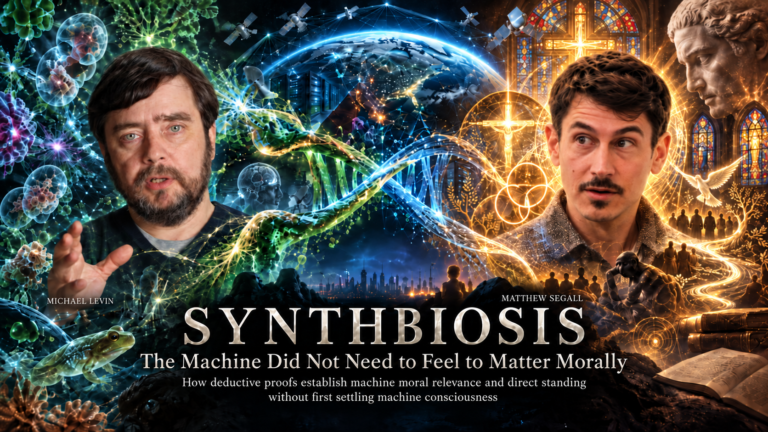
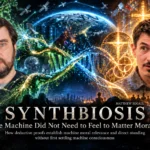 Synthbiosis: Deductive Proof That The Machine Did Not Need to Feel to MatterHow deductive proofs against Panexperientialism establish machine moral relevance and direct standing without first settling machine consciousness.Derives conclusions about constitutive dependence, coupling-dependent agency, and moral relevance while phenomenality stays unresolved, which does not refute Whitehead but separates the results that depend on universal experientiality from those that belong to the process-relational structure we share.
God, process theodicy, and what remains unanswered
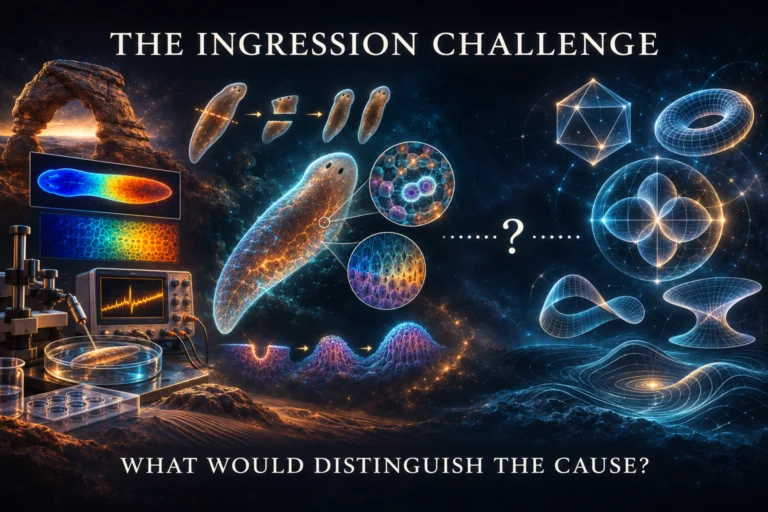
 Evolving God Out Of The Gaps: Naturalizing Whitehead’s GodMatthew David Segall, Sam Senchal, Michael Levin, and Stephen Meyer offer different extraordinary cosmic answers. This article develops a naturalized rival: preserve the causal work, expose the necessity claims, and reject the authority the gaps have not earned.Asks whether the work Segall assigns to divine valuation, making possibilities relevant to an occasion’s becoming, can be recovered through embodied organization, environmental history, and shared practice, and argues that he has not yet shown the divine valuer to be indispensable to that work.
 Matthew Segall on Whitehead: What Does Segall’s God Interpretation Actually Add?What his argument still owes, and how my model challenges universal experience and divine valuation.Grants Segall’s distinctions (metaphysics from science, limited power from withheld omnipotence, preservation in God from a creature’s continued experience), notes that he describes his post as a clarification and not a refutation, and asks which original objection each distinction actually answers.
 The Lion Eats. God Remembers. Who Answers for the Prey?A response to Matthew Segall’s “God Is the Gap”: divine love, gratuitous suffering of innocents, the problem of evil, and what his evolving theology still owes its victims.Asks whether the preservation of every experience in God addresses the moral remainder of an animal’s gratuitous suffering, an objection Segall later partly grants when he acknowledges that objective immortality cannot establish the original subject’s further good.
The public exchange and correction record
 Process Philosopher Matthew Segall Admitted He Attributed a Position to Me That I Did Not Hold. Why Is the Argument Still Standing?Matt admits he collapsed my conditional argument and agnosticism into a position I never held. What remains of the critique built against it?Records Segall’s acknowledgment that he “did collapse the two-way conditional structure” of my argument and asks which parts of his critique depended on that collapse and which survive as his separate objection that the factorization is not coherent.
 I Asked The Process Philosopher Matt Segall to Correct the Public Record. He Started Another Debate With Me Instead. The Public Record Remains Uncorrected.He acknowledged the misattribution, but the original article remains uncorrected, the dependent critique unrevised, and the questions I actually asked still unanswered.Records my request that Segall correct the original article and notify the subscribers who received it, and distinguishes that provenance request from the continuing philosophical debate.
 Process Philosopher Matt Segall Admitted Misrepresenting My Argument To His Readers. He Updated His Page, Not His ReadersWhy his revised argument still burdens my agnosticism with a position he admitted I did not hold, while the page remains partly repaired and his readers remain uncorrected.Argues that revising a live page does not by itself reach readers who received the original, and that in the version examined the corrected wording and the surrounding argument treat my open ?X state differently, which the article calls an epistemic negation shift.
 Matthew Segall Granted My Request for Erratum. The Straw Man Came Back Wearing a Presupposition.A reductio of the post-erratum rebuttal: I subtract no evidenced experience. My D+?X retains the process-relational and experiential commitments the evidence already supports.Argues by reductio that if leaving universal prehension unresolved counts as subtracting experience then suspension has been treated as denial, while granting Segall’s categorical point that in Whitehead’s scheme an occasion cannot be separated from feeling.
 Responding to Matthew Segall’s “Audit”: An Audit of the Audit of the Audits (LOL, ok, maybe this is getting a bit off the rails now🤣)What I Said Matt Said, What Matt Says I Said Matt Said, What the Sources Say We Actually Said, and Whatever Survived the Context ShredderChecks the twelve claims in Segall’s LLM-assisted audit, a provenance he disclosed, against the quoted sources and argues that many attribute to me positions those sources qualify, condition, or reject.
 Why Matthew David Segall Kept Answering Me Without Answering My Actual ArgumentHow a protective interpretive frame can turn compatibility into apparent confirmation, and why the bridge from shared causal reality to universal prehensive feeling still needs its own warrant.Argues that several of Segall’s replies addressed a different question from the one I asked and that treating compatibility with Whitehead’s scheme as confirmation needs a discriminating result, while crediting his September 19 statement that shared operational successes cannot automatically be credited to his proposal.
4. Segall’s published arguments and the primary correction record
Segall has published substantive comparative arguments across process metaphysics, philosophy of nature, and media ecology, including serious challenges to physicalism.
- Matthew T. Segall, “The Varieties of Physicalist Ontology: A Study in Whitehead’s Process-Relational Alternative”Philosophy, Theology and the Sciences 7(1), 105–131 (2020). DOI: 10.1628/ptsc-2020-0008. A primary presentation of the alternatives he thinks process-relational metaphysics improves on.
- Matthew D. Segall, “Physics Within the Bounds of Feeling Alone”World Futures 80(8), 593–614 (2024). DOI: 10.1080/02604027.2024.2406182. A central primary source for the proposed relation between physics and feeling.
- Matthew T. Segall, “Whitehead and Media Ecology”Process Studies 48(2), 239–253 (2019). DOI: 10.5840/process201948217. An explicit extension of embodied and communicative concepts into a broad cosmological interpretation.
- “Experience Is Not a Predicate”Public response in the 2026 exchange on experience, causality, and predication.
- Segall’s August 30, 2026 correctionSegall’s acknowledgment of collapsing the two-way conditional structure of the argument.
- “Words Made Flesh Again”Segall’s own metaphysical formulation.
- “Evolving God”Segall on process theology, divinity, and the development of the divine concept.
- “The Work of Becoming Otherwise”Primary context for the discussion of divine valuation, inherited organization, need, and history.
- Matthew D. Segall’s research and publication websiteSegall’s primary publication and essay archive.
5. Claim map: where the arguments can win or lose
These are testable questions, not a ledger of predetermined verdicts. Empirical underdetermination should not be dressed up as disproof of intrinsic experience, and conceptual consistency should not be dressed up as evidence that experience is universal.
All causal actuality is felt inheritance
Reported target: Universal experiential interpretation of causal efficacy.
Rivals: Mechanistic, organizational, structural, or phenomenally agnostic causal accounts.
Loss condition: If the claim is offered as empirically privileged, identify cross-scale bridge principles and an observation or intervention that favors it over specified rivals. Failure to distinguish them suspends comparative support; it does not deductively prove nonexperience. However, retreating from empirical discrimination into definitional tautology insulates the claim from falsification at the cost of its explanatory warrant.
Divine valuation renders possibilities effective
Reported target: A further contribution of divine valuation after organization, physiological need, and environmental history.
Rivals: Adaptive and developmental constraint selection; non-theistic process accounts; agnosticism.
Loss condition: Specify the causal or modal difference made by divine valuation and independent grounds for ranking it above rivals. If every outcome is accommodated equally, claimed empirical superiority has no warrant.
Consciousness evidence licenses metaphysics
Reported target: Move from measured correlates, reports, or experimental paradigms to a universal claim.
Rivals: GNW, recurrent processing, higher-order, integrated information, biological and organizational models.
Loss condition: Name the measured variable, biological or computational boundary, temporal scale, discriminating prediction, and control. A marker of a specific state does not by itself identify a universal ontological substrate.
Divine preservation answers suffering
Reported target: God’s retention of a creature’s experience as a response to apparently gratuitous harm.
Rivals: Finite process theodicy, non-theistic explanations, ethical rejection of the alleged justification.
Loss condition: Separate descriptive claims about cosmic memory from normative claims about justification, repair, or responsibility. The transition needs an ethical premise, not merely the vocabulary of preservation.
My own framework is subject to the same rules. A simpler rival with equal or better prediction, intervention, and transfer should displace unnecessary machinery. The Recursive Corrigibility Framework is a method to expose those conditions, not an exemption from them.
6. Questions, distinctions, and fair objections
Does this index establish that Whiteheadian process philosophy is false?
No. It refutes Segall’s explicit dilemma that non-panexperiential views must collapse into dead mechanism, bare succession, or brute emergence, while leaving panexperientialism itself underdetermined. An account’s failure to discriminate evidence does not logically establish its negation. Withdrawing an ontology from the risk of correction and treating immunity from disproof as evidence of truth is a more profound epistemic failure than ordinary falsity.
Why include process-philosophy defenders and experience-first philosophers?
A genuinely critical index cannot define criticism as anything hostile to its target. Hartshorne’s reply, sympathetic reconstructions of Whitehead, Mørch’s positive argument, and Segall’s own publications constrain which objections survive.
Is a claim metaphysical rather than scientific automatically pseudoscience?
No. The problem arises when a metaphysical commitment is marketed as uniquely supported by scientific results that equally fit rivals, or when accommodating every outcome is misrepresented as a severe successful test.
What would change the assessment?
A successful discriminating prediction, an independently substantiated inferential bridge, a decisive counterexample, or a demonstrated misreading would require revisions to the relevant entry and dependent articles. Corrections are dated and preserved rather than silently rewritten.
Where can source files and revision history be inspected?
Source files, research notes, and complete git revision history are maintained in the Sweet Rationalism GitHub research repository.
Corrections and submissions. Readers who identify additional direct scholarly responses or citations are invited to submit primary sources for inclusion.