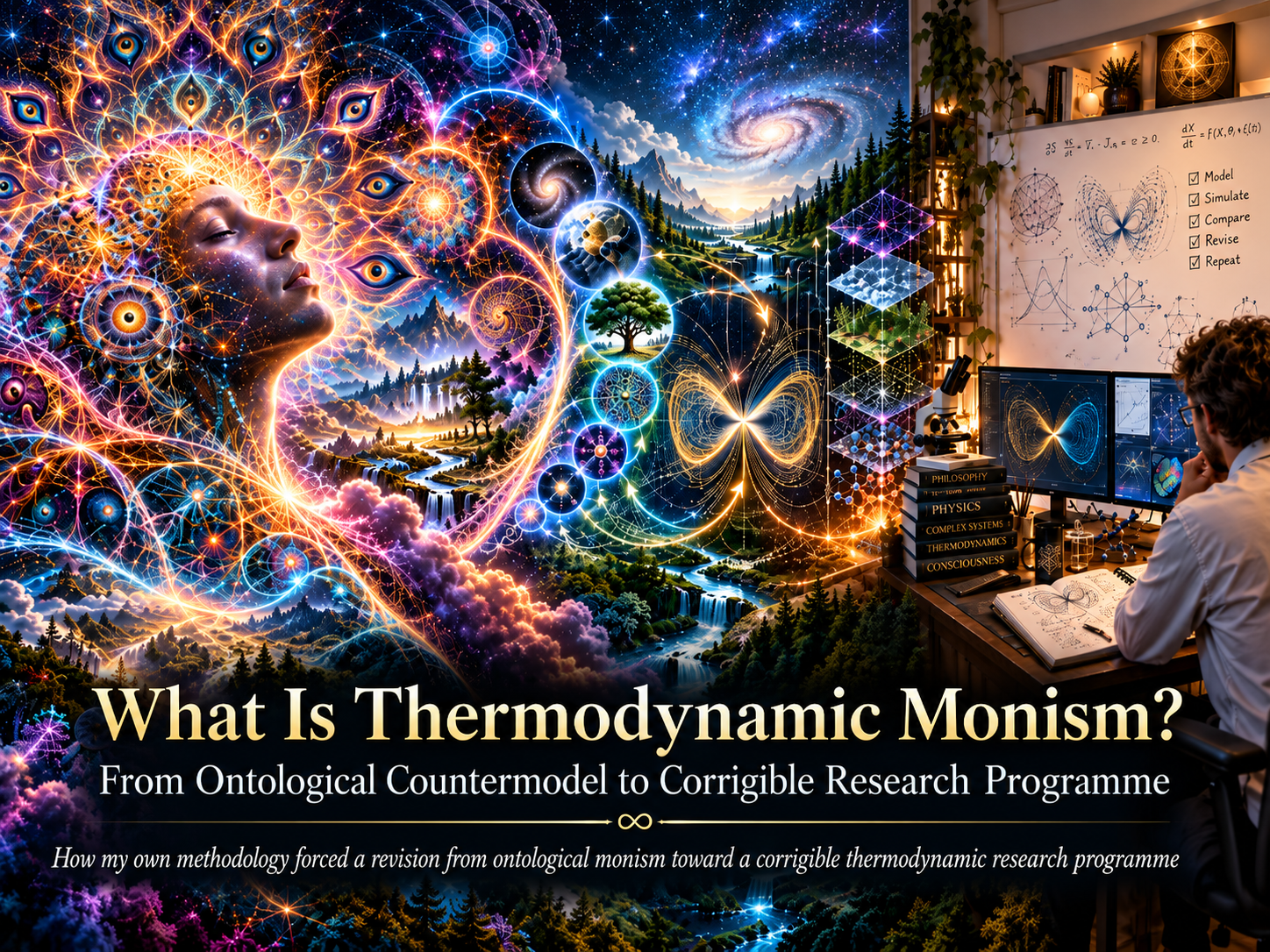
What Is Thermodynamic Monism? Auditing My Own Framework—September 2026 Revisions and Clarifications
From Ontological Countermodel to Corrigible Research Programme
How my own methodology demoted Thermodynamic Monism from an umbrella ontology to a corrigible research programme without abandoning its one-process, non-dualist core.
Thermodynamic Monism, plainly: Thermodynamic Monism is a process-relational research programme built around one ontological wager and one physical discipline: reality is treated as one causally continuous process order rather than as separately existing causal substances or realms, and physically realized organization must be implemented through dynamics that respect thermodynamic constraints. Higher-level patterns can be real and causally explanatory at the boundaries and scales where they make a difference, while thermodynamic variables earn explanatory credit only where they add target-specific constraint, prediction, intervention, inference, compression, or transfer. One process does not mean one explanation.
The phrase “one fundamental ontology: thermodynamic relational dynamics” referred to one causal/process order. Explanatory authority remained target-specific: thermodynamics constrained physical realization without automatically settling agency, meaning, consciousness, identity, value, or the intrinsic nature of reality.
Why I am writing this now
My original aim in bringing Thermodynamic Monism into dialogue with Michael Levin was not to defeat his anti-physicalist biological Platonism. I thought I was helping. I approached him offering collaboration to help provide solutions to problems I thought he had. Levin had repeatedly framed a longstanding problem in interviews and talks: how embodied minds, morphogenetic goals, and striking biological competencies arise when he regarded standard physicalist and emergence-based accounts as insufficient. I initially took his turn toward Platonic space as a reluctant response to that explanatory gap, so I offered a radically naturalistic process-relational countermodel meant to show that the phenomena he thought naturalism could not accommodate could in fact be recovered without a second causal realm. Only later did I understand that Levin was defending the Platonic hypothesis itself as a positive causal ontology, not merely using it provisionally because naturalistic explanations had run out. At that point, what I had intended as a constructive solution became a genuine metaphysical disagreement that spanned several months of dialogue.
By May 2026, I had stopped writing about Thermodynamic Monism. That was deliberate and grew out of internal audits I had been performing while working through several other scholars’ frameworks. Thermodynamic realization, energetic cost, dissipation, irreversibility, nonequilibrium organization, physical implementation, resource constraints, and the one-process commitment had survived nearly every serious challenge I had thrown at them; what no longer fit was using Thermodynamic Monism as the umbrella name for a framework that had become increasingly boundary-, scale-, and target-specific. When I updated the website that May, I also renamed the epistemic methodology I had been calling Recursive Constraint Falsification as the Recursive Corrigibility Framework (RCF) and replaced Thermodynamic Monism as my umbrella ontology with Provisional, Boundary- and Scale-Relative Realism (PBSRR).

See my new article here: What Is Provisional, Boundary- and Scale-Relative Realism? A Naturalized Realism of Form and Process
No single debate caused the change. It accumulated over several years of engagement with dozens of scholars across philosophy of science, physics, theoretical biology, neuroscience, consciousness research, complex systems, information theory, mathematics, causal inference, process philosophy, and adjacent fields, alongside an immense amount of time spent reconstructing arguments from peer-reviewed literature and primary sources. Some exchanges exposed weaknesses in other positions; the useful ones exposed weaknesses in mine as well. That pressure improved both the method and my ability to state its commitments precisely.
The website update made the structural change visible: Thermodynamic Monism became a research programme, constraint framework, and comparative countermodel, while Provisional, Boundary- and Scale-Relative Realism (PBSRR) became my working ontology. The missing piece was a reader-facing account of how that transition affected the older articles on Thermodynamic Monism, falsification-first methodology, and organizational theories of consciousness.
The older articles remain part of the record because they document a real developmental path: stronger claims were proposed, exposed to criticism and literature, decomposed, retained where they survived, and demoted where the evidence stopped carrying them. This article makes that path explicit and subjects my own framework to the same scrutiny I apply to everyone else’s.
Matthew Segall’s panexperientialism provides a useful symmetry test. I keep it live as a research programme while declining, on the evidence currently available to me, to adopt the universal experiential claim. The unresolved issue is what experience everywhere contributes beyond process, relation, causal inheritance, organization, continuity, and other structures shared with serious rivals. Thermodynamic Monism faced a different problem. Its one-process ontological commitment was soundly separable from the much narrower question of where thermodynamic variables actually earn explanatory credit, but my wording did not always keep those jurisdictions apart.
The evidential burdens differ. Thermodynamic constraints are independently established within their proper domains; universal prehension and a causally ingressing nonphysical Platonic realm add further commitments that require their own support. The common rule is scope discipline: no claim gets to carry more evidential authority across targets, scales, or ontological levels than its bridge can support.
That is the reason for returning to Thermodynamic Monism now. Quite a lot survived. Some claims became stronger after unnecessary commitments were removed. Some became research hypotheses rather than conclusions. Some should simply be withdrawn because I had asked them to do more work than the evidence earned. The rest of this article separates those cases.
What Thermodynamic Monism required, and what it did not
The plain definition above decomposes into three commitments and one methodological role. TM-0 is thermodynamic admissibility: where thermodynamic quantities are well-defined at the relevant boundary and scale, physically implemented processes must remain thermodynamically consistent. TM-1 is a thermodynamic explanatory programme: thermodynamic variables deserve explanatory credit where they add quantitative bounds, prediction, intervention, inference, compression, or transfer at a target. Merely noting that a target has a physical implementation earns no explanatory bonus. TM-2 is process-relational monism: reality is treated as one causally continuous process order containing real higher-level organization and multiple useful explanatory vocabularies across scales.
TM-C is the comparative role: use that one-process account as a countermodel when a richer ontology is claimed to be necessary, then ask what changes when the additional ontology is removed. I retain TM-0 strongly, TM-1 target by target, TM-C as a comparative strategy, and substantial weight on the one-process family expressed by TM-2. PBSRR now carries that last commitment as a revisable ontological hypothesis. Thermodynamic constraint no longer receives automatic promotion into explanatory privilege, and TM leaves intrinsic reality open wherever the evidence does not discriminate it.
That constraint-versus-metaphysics distinction was already explicit in my January article, Thermodynamic Monism Is Not Materialism, Physicalism, or Reductionism. Later work made the division sharper by separating thermodynamic admissibility, target-specific explanation, and the one-process ontological hypothesis.
Historically, the label names the one-process research programme and countermodel I was developing. Its present form keeps monism separate from the explanatory jurisdictions of thermodynamics, organization, causation, semantics, phenomenology, and other scale-dependent variables.
The strongest positive case Thermodynamic Monism can make
The audit leaves a substantive positive core:
Thermodynamic Monism proposes that the reality encountered in successful causal inquiry belongs to one causally continuous process order. Within that order, physically realized systems are thermodynamically constrained; persistent entities can often be understood as dynamically maintained organizations; and higher-level constraints and variables can be objectively explanatory at the boundaries and scales where prediction or intervention depends on them. Thermodynamic explanation remains local to the targets where thermodynamic variables actually do work, while consciousness, value, semantics, and intrinsic ontology retain their own evidential burdens.
The clauses carry different evidential weights. The thermodynamic constraint claim is the strongest. Modern thermodynamics of information and stochastic thermodynamics place quantitative restrictions on physically implemented measurement, feedback, dissipation, error correction, molecular machines, sensing, and other biological functions. Parrondo, Horowitz, and Sagawa review the thermodynamic accounting of information-processing operations; Cao and Liang survey quantitative applications to biological functions; and England derives a lower bound on heat production for self-replication under specified assumptions. In these cases thermodynamic variables genuinely reduce the attainable possibility space. See Parrondo, Horowitz, and Sagawa 2015, Cao and Liang 2024, and England 2013.
The process and organization claims also have substantial support, although the metaphysical inference is weaker. Montévil and Mossio characterize biological organization through mutually dependent constraints operating in open nonequilibrium conditions and explicitly index those constraints to relevant timescales. Marc Lange and Lauren Ross show how constraints can carry genuine explanatory roles without functioning as additional forces. Paul Needham has argued that thermodynamics itself supplies reasons to take macroscopic processes seriously in metaphysics. Together these literatures support a world in which persistence, organization, and explanation fit naturally into a process-relational picture. Sophisticated substance ontologies can accommodate much of the same evidence, so the science gives process metaphysics comparative motivation rather than deductive proof. See Montévil and Mossio 2015, Lange 2023, Ross 2023, and Needham 2013.
Higher-level explanation requires the same discipline. Hoel, Albantakis, and Tononi showed that, under their effective-information measure, a coarse-grained macro description can outperform the corresponding micro description in causal informativeness even when the macro dynamics are completely realized by the micro dynamics. Dewhurst argues that this is better read as a result about causal explanation than a discovery of new causal powers, while Franklin-Hall presses a variable-selection problem for interventionist accounts of high-level explanation. The strongest conclusion available to TM is scale-relative causal-explanatory reality: some higher-level variables earn objective standing because they improve prediction, intervention, compression, or control at the boundary where the target exists. See Hoel, Albantakis, and Tononi 2013, Dewhurst 2021, and Franklin-Hall 2016.
The one-process claim is the genuinely metaphysical part. Thermodynamics does not deductively establish monism. The case is abductive: physically continuous accounts repeatedly recover the observed causal work in domains where causal structure can be measured and manipulated, and the same process-relational architecture turns out to organize problems of persistence, higher-level causation, biological form, agency, and identity without adding a new ontological primitive for each target. That combination of causal continuity, bridge economy, and cross-domain explanatory compression earns comparative weight. It does not settle final ontology, and the compression counts only where the underlying machinery is independently supported rather than repeated under new vocabulary.
Pressure-testing the positive core
Thermodynamics may turn out not to be fundamental. TM can absorb that possibility because thermodynamic quantities can constrain realizations without being the microscopic furniture of reality. The harder question is then why the metaphysics should retain the word Thermodynamic. The answer is jurisdictional: thermodynamics supplies the programme’s realization and possibility-space discipline, while monism supplies the one-process ontology. Where thermodynamic variables add no target-specific leverage, the label has no explanatory work to claim.
Process ontology remains contestable. Christopher Austin and William Morgan show that sophisticated substance ontologies can accommodate turnover, dependence, vague boundaries, and dynamism. Their objection defeats any easy inference from biological change to compulsory process metaphysics. Process descriptions still track the persistence conditions, turnover, and organization of many living and open systems with unusual directness, which gives them comparative explanatory appeal. Explanatory appeal alone leaves ontological priority underdetermined. TM therefore carries process-relational monism as a motivated metaphysical hypothesis rather than a theorem extracted from metabolism. See Austin 2020 and Morgan 2021.
Higher-level causation can collapse into coarse-grained microphysics if the variable choice is doing all the work. Macro variables sometimes improve causal informativeness and intervention, but those results depend on the coarse-graining, intervention distribution, and metric. TM survives on the narrower claim that higher-level organization can carry stable causal-explanatory structure at its own boundary and timescale. If matched lower-level models recover the same leverage at equal or lower cost, the macro-level causal claim loses standing.
Thermodynamic admissibility by itself is nearly trivial. TM becomes scientifically substantive at TM-1, where a thermodynamic variable changes a quantitative bound, prediction, intervention, inference, engineering decision, or excluded outcome. England’s replication bound and stochastic-thermodynamic tradeoffs in sensing and molecular machinery are examples of the right form. Adding the word entropy to a description earns nothing.
Shared empirical structure underdetermines metaphysical completion. Physicalism, idealism, Russellian monism, panpsychism, neutral monism, and other views can accept much of the same public structure. TM’s abductive case therefore cannot rest on compatibility or parsimony alone. Its stronger advantage appears when one independently supported process-relational architecture preserves the target across domains, compresses several otherwise separate problems, and avoids bridges that a richer causal ontology must add. That advantage disappears if the apparent compression is only verbal, if different domains require unrelated mechanisms hidden under the same terminology, or if a richer rival earns differential predictive or interventionist success.
Consciousness, semantics, value, and welfare remain separate targets. Thermodynamics constrains the physical realization of systems that remember, regulate, communicate, evaluate, and perhaps experience. The constitutive bridges to phenomenality, semantic content, welfare, and moral standing require additional evidence.
After that pressure test, the positive residue is substantial but bounded: one provisional causal/process order; thermodynamic constraint on physical realization; dynamically maintained and historically dependent organization; real scale-relative explanatory variables where intervention and prediction warrant them; and open questions wherever those commitments do not discriminate consciousness, value, or intrinsic ontology.
That is enough to make Thermodynamic Monism a defensible naturalized metaphysical research programme. Its scientific components can earn very high confidence locally; its one-process metaphysics remains abductive and revisable. Keeping those evidential statuses separate is part of the programme rather than an embarrassment.
What Thermodynamic Monism does to old metaphysical problems
A metaphysics earns more than aesthetic points when the same commitments keep surviving contact with problems that were not invented to flatter it. That is where Thermodynamic Monism is more interesting than I had been giving it credit for. Its recurring move is simple enough to state in one sentence: treat apparently stable things as organized processes with histories, ask which distinctions and boundaries are actually maintained, allow higher-level organization to be causally real without turning it into a second substance, and make any additional causal ontology say what changes because it is there.
That does not turn the history of philosophy into a thermodynamics homework problem. Some old puzzles become substantially less mysterious. Others are translated into empirical questions. A few are merely constrained. Several remain almost untouched. Keeping those outcomes separate matters, because a framework that “solves” every paradox by redescribing it in its own vocabulary has probably learned how to colonize questions rather than answer them.
Identity when the parts keep changing
The oldest pressure point is the tension between being and becoming. Parmenides makes change look metaphysically suspicious; Heraclitus makes persistence look suspicious. A process ontology does not have to choose between them so sharply. A river can remain the river while its water changes because what persists is an organized historical process, not a frozen inventory of material. The same move scales to organisms, storms, institutions, memories, and many artifacts. Stability becomes something a changing process can achieve.
That is why the Ship of Theseus looks different under TM. Replacing one plank does not force us to search for a hidden substance that stayed numerically identical underneath the repairs. We can instead ask which continuities matter: causal history, organization, function, material lineage, ownership, memory, or some combination of them. Duplication cases still hurt. If the original timbers are rebuilt into a second ship, different continuity relations point in different directions, and TM does not manufacture a single metaphysical fact where the criteria themselves have come apart. What it does offer is a reason to stop assuming that material sameness must be the master criterion.
The statue and the lump of clay belongs to the same family. Two descriptions can track the same local matter while supporting different counterfactuals, histories, interventions, and persistence conditions. Melt the statue and the lump survives in one sense while the statue does not. If higher-level organization earns realist standing through those differences, constitution need not be a choice between “two objects occupying one place” and “only the matter is really real.” There can be one physically continuous realization carrying more than one legitimate pattern description at different explanatory targets.
Sorites cases and vague boundaries become less threatening for similar reasons. A boundary can be real enough to regulate exchange, sustain control, or support intervention without being infinitely sharp. Cell membranes are not metaphysical razor blades. Species boundaries, ecosystem boundaries, cognitive boundaries, and even the edges of a hurricane can be robust at one scale and fuzzy at another. TM therefore makes room for graded or scale-indexed individuation without equating vagueness with unreality. The metaphysical question becomes partly operational: what difference does treating this boundary as real make at this timescale?
This also softens the traditional problem of the One and the Many. One causally continuous order can contain many relatively autonomous organizations. The parts need not be unreal because the whole matters, and the whole need not be a second substance because its parts realize it. That is the deepest reason for the slogan one process does not mean one explanation.
Classical substance-versus-process disputes sit underneath all of these examples. TM shifts the default question from “what is the permanent thing beneath the changes?” toward “what organization persists through the changes, through what history, and under what maintenance conditions?” That shift is especially natural in biology, where organisms continually exchange matter with their surroundings while preserving developmental and regulatory organization. It is less decisive for objects whose identity really is well captured by material composition, and sophisticated substance metaphysics can accommodate change. So the abductive gain here is fit and compression, not a proof that substance ontology is impossible.
The same caution applies to essentialism and natural kinds. TM gives us a way to understand some kinds as historically stabilized dynamical regimes rather than bundles held together by an eternal intrinsic essence. Species, organisms, ecological niches, cognitive capacities, and diseases often look more intelligible when history and organization enter the identity conditions. Gold is a different case. Its atomic structure provides exactly the sort of relatively sharp microphysical criterion that a process-friendly metaphysics should happily preserve. TM gains nothing by forcing every kind into the same mold.
Causation once levels are allowed to be real
The reductionism-versus-holism fight is one of the places where TM has its strongest leverage. Physical realization does not tell us in advance which variables will best explain the target. Temperature is realized by molecular motion, yet thermodynamic variables can be the right variables for predicting and controlling a gas. A tissue voltage is realized through channels, ions, membranes, and cellular organization, yet the tissue-level variable may expose an intervention that a list of molecular states obscures. The important test is whether the higher-level variable carries stable counterfactual, predictive, or interventionist structure.
That makes emergence less mystical. Saying that a capacity “emerges” earns almost nothing until we can say what new organization appears, what variables become useful, which lower-level possibilities are constrained, and what changes under intervention. Some emergence will turn out to be merely descriptive coarse-graining. Some will support robust higher-level laws or control variables. TM does not need a special metaphysical fluid called Emergence. It needs a demonstrable change in explanatory organization.
Much of the dispute over downward causation can be translated the same way. A whole does not need to fire an extra force downward at its parts. Organization at one scale can alter the accessible states, boundary conditions, transition probabilities, and effective constraints of processes at another scale. A piston constrains gas molecules without becoming a new fundamental interaction. A tissue-level bioelectric state can alter what individual cells do through perfectly ordinary physical channels while the tissue-level description remains the most informative way to specify the intervention. The phrase downward causation is useful only if it points us toward that structure rather than away from it.
The causal exclusion problem then loses some of its theatrical force. If “the belief caused the action” and “the neural process caused the action” refer to nested descriptions of one organized causal history, we do not automatically have two independent causes competing for one causal slot. The hard question is whether the mental-level variable is causally relevant qua that variable. Does changing the belief, under an intervention that preserves the comparison well enough, change behavior in a stable and generalizable way? If yes, explanatory reality at the higher level need not violate causal continuity below.
Constraint explanation matters here because a constraint is not automatically another efficient cause. Conservation laws, boundary conditions, geometric restrictions, organizational dependencies, and mathematical constraints can explain by limiting what trajectories are available. Marc Lange’s work is useful precisely because it separates that modal role from an additional event entering the causal history. This distinction is one of the places where my earlier argument against causal Platonism was already stronger than a simple “show me the energy bill” challenge. A mathematical structure can characterize or constrain a possibility space without becoming a nonphysical agent pushing matter around.
The old question of whether laws of nature govern or merely describe also becomes less binary. TM has no need to picture laws as cosmic police issuing commands to particles. Regularities, symmetries, conservation relations, and higher-order constraints can be genuinely informative about what can happen without becoming separate causal substances. That still leaves live metaphysical questions about necessity, modality, and why these laws obtain. TM changes the grammar of the question more than it answers the final modal one.
Life does not need an exemption from physics
Biology is where the process picture stops feeling like a philosophical preference and starts paying empirical rent. Living systems persist by exchanging matter and energy, repairing themselves, regulating internal variables, maintaining boundaries, and repeatedly steering away from states incompatible with continued organization. None of that requires a vital substance. It requires a very unusual organization of ordinary causal processes.
That changes the old life-versus-nonlife debate. TM does not expect a single metaphysical ingredient to appear at the exact moment matter becomes alive. The transition can instead be studied through graded increases in autocatalysis, compartmentalization, constraint closure, heredity, regulation, error correction, and control over exchanges with the environment. The origin of life remains difficult, but the difficulty moves into chemistry, organization, history, and the emergence of self-maintaining constraints. The concept of a vital force loses explanatory work as those mechanisms become available.
The same framework naturalizes a large portion of teleology. Organisms really do behave in ways for which goals, setpoints, error signals, attractors, and viability conditions can be scientifically useful. That does not require the future to reach backward and cause the present. A control system can be organized so that deviations from a target state recruit processes that tend to restore or replace that state. Biological function and local purpose can therefore be real features of organization without implying a cosmic purpose behind the universe as a whole. Contemporary philosophy of biology already contains several naturalistic ways of handling teleological language; TM’s contribution is to connect goal-directed organization tightly to physical realization, history, and constraints rather than treating teleology as an ontological exemption.
This is especially important for morphogenesis. “Where does the form come from?” can be decomposed into developmental state spaces, bioelectric and biochemical control, mechanical constraints, gene-regulatory dynamics, prior history, multistability, attractors, and perturbation responses. The existence of a morphospace or attractor landscape in the model does not tell us what the state space is made of metaphysically. Durable alternative regenerative outcomes are therefore interesting because they show that biological systems can carry editable target states and path-dependent memories in their physical organization. They do not, by themselves, choose between every metaphysical interpretation of those facts.
The organism as an individual becomes an empirical problem too. Multicellular organisms, colonial organisms, holobionts, slime molds, symbioses, and human-tool systems all make it dangerous to assume one privileged boundary in advance. We can ask where regulatory closure occurs, which components are mutually dependent, what perturbations the larger unit compensates for, which histories reproduce the organization, and over what timescale the candidate individual persists. Some systems will have nested individuality rather than one final answer.
There is also a useful way to look at the apparent chicken-and-egg circularity of self-organization. In an organized system, components can help maintain the constraints that in turn make those components possible. Autocatalytic and constraint-closure accounts make this kind of circular dependence scientifically tractable. The explanation is historical and networked rather than logically vicious: no premise is proving itself merely because later organization recursively supports the conditions of its continuation.
Information, irreversibility, and the arrow of time
Maxwell’s Demon remains one of the cleanest demonstrations of why system boundaries matter. The demon appears to beat the Second Law only while the information-processing machinery doing the sorting is treated as though it lives outside the accounting. Once memory, resetting, measurement, and the full physical cycle are brought back into view, the alleged free lunch becomes a bookkeeping problem rather than a supernatural exception.
Landauer belongs here, but carefully. Landauer’s principle is not a tax on every distinction simply for existing. The famous lower bound concerns logically irreversible information processing under specified physical conditions. Passive storage, reversible transformation, measurement, copying, error correction, and erasure have different thermodynamic profiles. TM’s broader point survives the correction: causally operative information in finite physical systems is implemented through physical states and operations, and those operations inherit resource constraints. The specific bill depends on what the system is actually doing.
That helps with the supposed conflict between life and the Second Law. Organisms produce and maintain local order because they are open systems exploiting gradients and exporting entropy. The interesting question was never whether life violates thermodynamics. It is how matter organized far from equilibrium comes to maintain boundaries, repair damage, remember, reproduce, and gain increasing control over its own accessible state space. Prigogine-style dissipative organization gives part of that story; biology supplies much of the rest.
Order from disorder therefore needs no miracle, but it also should not be reduced to the slogan “entropy makes complexity.” Nonequilibrium driving can create ordered regimes, and selection can stabilize some of them, while many driven systems remain boring. The causal route from energy flow to a bacterium, a nervous system, or a technological civilization contains enormous additional structure. Thermodynamics constrains that route and sometimes explains parts of it. It does not author every intermediate chapter.
The arrow of time is a place where TM has real contact and a real limit. Irreversibility matters to records, memory, aging, learning, development, and every process whose later states contain traces of earlier ones. Statistical mechanics can explain a great deal about macroscopic temporal asymmetry given suitable boundary conditions. It does not, merely by invoking entropy, explain the low-entropy past or settle whether temporal asymmetry is ultimately fundamental. Loschmidt’s reversibility objection and recurrence problems survive as foundational questions about how time-symmetric microscopic dynamics relate to irreversible macroscopic behavior. A thermodynamic metaphysics should display those residuals rather than hide them.
The relation between information and matter becomes correspondingly cleaner. Information need not be a new substance. It can describe relational differences that are multiply realizable across physical media, while any actual use of those differences for memory, communication, computation, or control occurs through an implementation. This gives TM a natural home for multiple realizability: a higher-level organization may be instantiated by different materials, yet every actual realization has its own dynamics, failure modes, and energetic costs. Substrate independence means independence from one particular material implementation, not independence from implementation altogether.
Mind without a second causal universe
The traditional mind-body interaction problem becomes much smaller if cognition belongs to the same causal process order as the body from the outset. There is no additional interaction surface to explain between two substances. Neural, bodily, environmental, and social processes can jointly realize cognition while psychological variables remain useful at their own scale. That does not prove exhaustive physicalism, because causal continuity and intrinsic ontology are different claims. It does remove one reason for positing a second causal realm.
Mental causation is the harder descendant of the old interaction problem. Beliefs, expectations, intentions, fears, and reasons appear in successful explanations of behavior. TM can take that seriously without giving them a second force law. If manipulating an organism’s represented expectation changes behavior in a stable way, the mental-level variable may be causally explanatory even though the intervention is realized through neural and bodily changes. What matters is whether the higher-level description tracks the difference-making structure rather than merely redescribing an outcome after the fact.
Consciousness is where the programme must become more modest. The Hard Problem does not disappear because a system has a thermodynamic boundary or because information integration costs energy. TM can decompose several neighboring problems: how a bounded perspective is physically maintained, how information becomes globally available, how self/world distinctions persist, how reports and memories are generated, and how a system integrates information through time. Those are substantial achievements if the models succeed. The remaining question of why or whether such organization is identical with phenomenal for-me-ness still requires a bridge. My present position leaves that bridge open.
That restraint propagates to philosophical zombies, Mary, and inverted qualia. If phenomenality is eventually shown to be constitutively identical with some organization, then a perfect organizational duplicate lacking experience may turn out to be incoherent. But the identity cannot be established by assuming the zombie is impossible. Mary’s room and inverted-qualia arguments likewise ask whether complete structural or functional information exhausts phenomenal character. TM can say much about realization and organization while leaving the intrinsic phenomenal residual unresolved.
The unity of consciousness is more tractable. Instead of assuming a metaphysically simple subject, we can ask what actually binds information, valuation, memory, and control into a common perspective over time. Split-brain cases, dissociation, anesthesia, seizures, recurrent processing, global availability, and radically different computational or biological architectures become ways of testing candidate boundaries. Unity may be graded, nested, intermittent, or multiply realized. None of those possibilities requires that a subject be an indivisible substance.
The self then looks less like a pearl hidden behind experience and more like a maintained organization across bodily regulation, memory, prediction, social relation, narrative, and control. This does not make selves fictional. A process can be real because it persists, predicts, controls, and matters to what happens next. It also explains why selves change without making personal continuity meaningless.
Personal identity and teleportation puzzles expose the price of asking for one binary answer after several continuity relations have been pulled apart. Biological continuity, causal history, memory, psychological organization, embodiment, legal responsibility, and social recognition can normally travel together. Teleporters and perfect duplication thought experiments force them apart. TM suggests that the resulting indeterminacy may belong to our concept rather than to a missing metaphysical barcode. We can still decide which continuity matters for survival, responsibility, or welfare, but those are target-specific questions.
The free-will debate changes in a similar way. Causal sovereignty is an impossibly strong standard for agency if it means being the uncaused origin of oneself. Real systems can nevertheless model alternatives, learn, inhibit impulses, represent reasons, anticipate consequences, and recruit constraints to alter future trajectories. That is genuine control. Whether the underlying physics is deterministic, stochastic, or something more complicated is a separate issue. Randomness does not create authorship, and deterministic realization does not by itself erase organized control.
For the same reason, fatalism does not follow from constraint. Constraints often create the stable possibility space in which agency can exist. Chess is playable because not every move is legal. Biological agents gain freedom in a practically important sense by acquiring more ways to sense, model, remember, coordinate, and intervene within the constraints they cannot abolish.
Epiphenomenalism remains harder. TM can make the physical machinery underlying reports, attention, memory, and discrimination causally tractable, but an epiphenomenalist can still say that phenomenal experience accompanies all of that without affecting it. Thermodynamics alone does not refute the position. The pressure comes from elsewhere: if experience is completely causally isolated, why should judgments and reports about experience systematically track it? That is an epistemic and causal problem, not a free Landauer theorem.
Mathematics can describe the maze without becoming another room
TM’s cleanest dispute with Platonism concerns causal ingress, not the bare existence of abstract objects. Standard mathematical Platonism can say that numbers or sets exist timelessly and causally inertly. Thermodynamics has little to say about that claim because there is no physical interaction to account for. The burden changes when a nonphysical pattern is said to guide morphogenesis, alter a trajectory, supply information to a mind, or otherwise make a difference to physical events. At that point the proposal has become a causal hypothesis and needs a discriminator.
The problem of universals can be approached without immediately choosing between a transcendent realm of Forms and pure nominalism. Recurring relational structures can be objectively instantiated across many systems. The same mathematical relation, symmetry, or organization can therefore be real as a pattern that multiple physical systems instantiate. Whether an additional independently existing universal is needed remains a separate question. TM gets the repeated structure without automatically purchasing the extra ontology.
This also reframes the mystery of why mathematics works so well. Mathematics is exceptionally good at representing invariant relations, symmetries, transformations, constraints, and possibility spaces. A world with repeatable structure is exactly the sort of world for which such tools should become powerful. That observation does not prove nominalism, structuralism, or Platonism. It simply blocks the inference from “mathematics describes physical structure with astonishing precision” to “mathematical objects therefore causally generate the physical world.”
The same distinction protects against confusing map and territory. A state space, attractor landscape, morphospace, Hilbert space, or computational graph can capture genuine structure while remaining a representation. Sometimes the mathematical object is indispensable to the best explanation. Indispensability still does not, by itself, tell us whether the represented structure exists independently as another causal domain. TM keeps asking what is being represented, how the mapping is established, and what intervention would distinguish the stronger ontological claim.
My earlier attempt to use thermodynamic constraint to dissolve Hempel’s dilemma went too far. The operational criterion remains useful: a causally active physical process should participate in conservation, intervention, measurement, implementation, and thermodynamic accounting at the relevant boundary. That helps us recognize physical realization even as theories change. It does not furnish a timeless metaphysical definition of physical. The success of the operational criterion therefore supports causal continuity more strongly than exhaustive physicalism.
That is why the usual physicalism-versus-anti-physicalism binary is too coarse for TM. A physicalist, idealist, neutral monist, Russellian monist, panpsychist, or theist could accept much of the same public thermodynamic and organizational structure. Those positions disagree about what ultimately realizes the structure. Shared empirical success should therefore be credited first to the shared structure. The incompatible metaphysical completions still need their own reasons.
A similar warning applies to computational and informational ontologies. Computation and information are enormously useful abstractions, and some systems are best understood in those terms. Actual computation still occurs through some realized transition structure. Causally operative information still has to be stored, transmitted, transformed, or used by something. TM therefore resists turning information into a frictionless substance while leaving open the metaphysics of abstract information itself.
Meaning, value, and systems larger than a skull
The symbol-grounding problem cannot be solved by attaching joules to syntax. What thermodynamic realization does supply is the embodied machinery through which representations can become connected to sensing, action, memory, error, reward, and consequences. Meaning can then depend on more than one relation: causal covariation, historical function, use, interpretation, social practice, and a system’s own goals or needs. TM constrains the implementation without pretending that energy expenditure is semantics.
That matters for the Chinese Room. Searle’s thought experiment invites us to inspect one rule-following component and ask where understanding resides. A process-relational view immediately asks whether the chosen boundary is the right one. Semantic competence might be realized across the whole organized system, including memory, perception, action, training history, tools, and environment. That possibility weakens arguments that infer the absence of understanding from the internal experience of one subcomponent. It still does not prove that the larger system has phenomenal understanding.
The same boundary discipline is useful in the extended-mind debate. A notebook, phone, language community, search engine, or computational model can become part of a cognitive process if perturbing or removing it predictably impairs the target capacity and restoring it restores the capacity. That is an empirical constitution question, not a license to call every useful object part of the mind. Coupling strength, reliability, accessibility, replacement, path dependence, and timescale all matter.
For machine intelligence and machine consciousness, this separation is essential. Substrate flexibility makes cognition and agency plausible across very different realizations when the relevant organization is preserved. Phenomenality does not follow automatically. A system can model itself, plan, use tools, remember, revise policies, and participate in distributed agency while the phenomenal question remains open. TM therefore resists both biological chauvinism and the opposite shortcut of equating sophisticated computation with experience.
The older TM account of meaning and nihilism was directionally useful but too narrow when it equated meaning with prediction-error reduction. Goal-directed systems really can have objective differences between information that matters and information that does not relative to their organization. A glucose gradient means something very different to a bacterium capable of exploiting it than an arbitrary molecular fluctuation does. Human semantic life, however, also depends on history, convention, representation, social coordination, and interpretation. Functional significance can be naturalized without pretending it exhausts semantics.
The same distinction sharpens value. There are real facts about what is good or bad for an organized system in the thin sense of supporting or impairing its viability, goals, integrity, or capacities. Food and poison are not interchangeable from the organism’s perspective. That gives a naturalistic foothold for system-relative value. Phenomenal valence, welfare, moral standing, and obligation require more. TM does not erase Hume’s is-ought gap by discovering that organisms have needs. Normative conclusions still require a bridge connecting empirical facts to reasons or duties.
Moral responsibility can nevertheless become more realistic once it is separated from metaphysical self-creation. Responsibility under causal determination can vary with control, understanding, foreseeability, reasons-responsiveness, authority, and ability to prevent or repair harm. Those are features of organized agents and social systems that can be investigated. Ultimate causa-sui freedom is not required for every meaningful distinction between accident, coercion, negligence, and deliberate action.
TM also gives a straightforward account of much of social ontology. Money, laws, corporations, scientific communities, governments, languages, and institutions are physically realized through people, records, artifacts, communication networks, norms, and repeated practices. Their dependence on those realizers does not make them imaginary. Change the institutional organization and behavior changes. Remove the records or enforcement structure and some social facts disappear. Higher-level social patterns can therefore be causally real while remaining entirely dependent on distributed implementation.
That opens the door to collective agency without automatically creating collective consciousness. A team, company, institution, or human-computational network may coordinate information and action in ways no member can realize alone. The relevant question is what control exists at the larger boundary. Whether that organization also constitutes one phenomenal subject is a completely separate bridge.
It also dissolves a stale opposition between social construction and realism. A thing can be historically constructed and still constrain us objectively. Money is constructed; insolvency can ruin a company. Laws are constructed; they alter incentives and available actions. The causal reality of a pattern does not depend on its having existed before the systems that created and maintain it.
Finally, putting observers inside the causal order changes the old observer-versus-observed picture. Observation involves interaction, discrimination, memory, updating, and some realized channel through which one system becomes correlated with another. That helps naturalize perspective without concluding that reality is merely whatever appears from one perspective. Observers are part of the world they model, and their boundaries and limitations become part of the epistemic story.
The places where TM should keep its hands off
Some famous problems are only lightly touched by this framework. Quantum measurement is one. Every actual detector, record, laboratory, and observer is physically realized and thermodynamically constrained, but that fact does not choose among Everettian, Bohmian, relational, collapse, Copenhagen-style, or other interpretations of quantum theory. TM can constrain the measurement apparatus without pretending to have solved the measurement problem.
It is equally neutral between fundamental determinism and indeterminism. A one-process ontology can contain deterministic, stochastic, or effectively probabilistic dynamics. Randomness does not create agency, and determinism does not destroy organized control. Those debates have to be settled on their own physics and metaphysics.
Simulation arguments lose one rhetorical shortcut because a causally effective simulation still requires an implementation somewhere. “It is all information” does not make computation free or substrate-less. TM does not tell us whether our world is simulated. A sufficiently good simulation hypothesis simply relocates the implementing process.
Radical skepticism fares similarly. A brain in a vat would still require an enormous causal apparatus capable of producing and stabilizing the relevant sensory stream, but that requirement does not logically show that we are not in one. Boltzmann brains likewise become highly structured physical fluctuation hypotheses rather than bare labels, yet TM supplies no solution to the cosmological measure problem that makes them troublesome.
Fine-tuning can sometimes be decomposed into selection effects, stability conditions, dynamical attractors, and observer-conditioning before a designer is introduced. That is useful cleanup. TM still does not explain why the fundamental laws, constants, or initial conditions have the values they do. The same restraint applies to causal theology. A deity proposed as a world-facing cause owes a difference-making bridge like any other causal addition; a causally inert deity becomes a different sort of metaphysical or existential claim. Thermodynamics alone cannot settle that claim.
Arguments for a disembodied soul or survival after death inherit a similar burden. Everything we can currently manipulate about ordinary personal continuity depends heavily on maintained organization, so a causally active survivor would need evidence showing how the relevant continuity is preserved outside that organization. A causally inert soul cannot be ruled out by calorimetry. Miracles, if they are claimed to alter physical events, likewise become questions about boundary specification, unusual lawful processes, measurement error, or reproducible departures from established constraints rather than a label that ends the inquiry.
TM is compatible with panpsychism and panexperientialism at the level of much shared causal structure, but compatibility is cheap. Universal experientiality adds a further claim. It earns comparative support only if it explains or predicts something beyond the process-relational organization both views already accept. TM avoids the panpsychist combination problem insofar as it does not begin with microexperience that must somehow compose into macroexperience. It also gives up panpsychism’s proposed answer to how consciousness belongs in fundamental reality. The residual remains open rather than being solved by subtraction.
Idealism, neutral monism, and Russellian monism remain serious for the same reason. Idealism can accept much of the observable causal structure while interpreting its basis as mental. Neutral monism and Russellian monism can accept the structural description while proposing a different account of intrinsic nature. TM’s comparative advantage lies in operational contact, causal continuity, and lower commitment at the tested targets. If one of those richer completions begins generating differential explanatory leverage, the balance should change.
The framework has even less to contribute to some other classics. The problem of induction is fundamentally epistemological; RCF has more to say about severe testing, calibration, intervention, and transfer than TM does. The demarcation problem cannot be solved by requiring every science to produce a thermodynamic prediction. Historical science, taxonomy, mathematics, exploratory research, and many legitimate explanatory practices answer to different standards while remaining corrigible.
Nor does monism end infinite explanatory regress in the deepest sense. It can remove a regress created by adding a second realm, then a mapping between realms, then an explanation of that mapping. It cannot tell us why the one process exists at all. Why is there something rather than nothing? remains outside thermodynamics because thermodynamics already presupposes actuality, states, relations, and constraints. Why these laws rather than others? is also largely open. TM characterizes consequences of constraints that obtain; it does not derive the entire modal architecture of reality from nothing.
The largest residual may be intrinsic nature itself. The public structure can be relational, dynamical, thermodynamic, and organizational while the question “what is it intrinsically?” remains underdetermined. Physicalism, idealism, Russellian monism, neutral monism, panpsychism, and currently unconceived alternatives can disagree there while sharing much of the measured structure. TM’s one-process wager reduces the number of causal realms; it does not license an inventory of reality’s final intrinsic furniture.
And a few famous paradoxes mostly belong elsewhere. Zeno’s paradoxes are handled by mathematics and theories of motion far more directly than by thermodynamics. The liar paradox, Russell’s paradox, and Gödelian incompleteness concern semantics, set theory, proof, and formal systems. Their physical implementations have resource costs, but their formal validity conditions do not become thermodynamic facts because a mathematician needs a warm brain or a computer to study them. A framework earns trust partly by knowing which questions are not its questions.
What that breadth is worth abductively
The breadth matters, but not as a head count. Seventy old puzzles reframed by the same assumptions do not become seventy independent confirmations of those assumptions. At most they show explanatory integration. The stronger evidence still comes from the places where the underlying machinery is independently supported and exposed to intervention, measurement, or successful transfer.
That qualification actually sharpens TM’s abductive case. Ontological economy is only the beginning. A small package of commitments, one causal process order, thermodynamic realization, historically maintained organization, path dependence, and scale-relative causal constraint, repeatedly reorganizes problems that otherwise appear to require separate metaphysical machinery. Identity through material turnover, emergence, mental causation, biological teleology, morphogenesis, social reality, and distributed agency all become questions about persistence and difference-making across boundaries and timescales. When the same architecture handles those targets without a new primitive for each one, that is cross-domain explanatory compression.
There is also a bridge economy. TM still owes bridges across scales. A tissue-level variable cannot inherit authority from a molecular result merely because both are physical. What it often avoids is a second kind of bridge between causally distinct ontological domains. Physical matter does not have to receive instructions from an abstract realm; neural activity does not have to make contact with an immaterial substance; higher-level organization does not have to become a second force in order to matter. Every richer ontology is free to earn those additions. Until it does, the account that preserves the phenomenon while crossing fewer unsupported ontological boundaries has an abductive advantage.
The same architecture also buys naturalization without eliminativism. Selves, reasons, goals, organisms, institutions, meanings, and higher-level causes need not be fundamental substances in order to be real. They can earn reality through stable causal and counterfactual organization. This lets TM keep causal continuity without making the smallest available scale the only scale that matters. It also permits explanatory pluralism without turning every useful vocabulary into a different kind of fundamental stuff.
History contributes another advantage that simple parsimony misses. Irreversibility, path dependence, development, learning, memory, and evolution are native to the picture. A present organization is partly what it is because of the trajectory by which it became reachable. That makes TM unusually comfortable with systems for which history changes the future possibility space. Static metaphysics can represent such histories, of course, but TM does not have to bolt temporality on after the ontology has been built.
There is a final virtue that can easily be mistaken for weakness: the framework can remain incomplete without filling every residual with a universal predicate. It can say that thermodynamics strongly constrains realization, that process-relational organization explains persistence well, and that higher-level variables can be causally real, while leaving phenomenal intrinsic character, the ultimate basis of laws, and the existence of actuality unresolved. Ignorance is not evidence for TM. The abductive advantage is simply that an unsupported answer does not become preferable merely because it closes a blank space on the diagram.
This changes the comparison with the main rival families. Interactionist Platonism carries additional mapping and causal-ingress burdens at biological targets. Substance dualism carries the interaction problem. Reductive physicalism risks losing explanatory structure when the useful variables live at higher scales, while sophisticated nonreductive physicalism may overlap with TM so strongly that the disagreement becomes largely one of metaphysical framing. Whiteheadian panexperientialism preserves much of the same process and causal inheritance while adding universal experiential constitution. Panpsychism adds fundamental phenomenal properties and inherits some version of the combination problem. Russellian and neutral monisms offer candidate accounts of the intrinsic residual that TM leaves open. Idealism makes mentality basic while still owing an account of the strikingly stable public dynamical structure. Ontic structural realism may sit close to TM near fundamental physics, with TM placing more emphasis on temporality, thermodynamic realization, and historically maintained organization. Computational or informational ontologies gain enormous descriptive power but still need an account of implementation when information is supposed to do causal work.
None of those comparisons can be settled by counting primitives. The working criterion is harder: how much independently supported structure does the programme preserve; how many apparently separate problems does that structure genuinely compress; how many new bridges are required; how well does the account survive prediction, intervention, and transfer; and how much unresolved residue is being left open rather than defined away? TM receives comparative credit where it preserves the phenomenon, reduces the number of independent mysteries, and introduces fewer unsupported bridges. A rival should take that credit back whenever its additional commitments generate prediction, intervention, compression, or explanation that TM cannot recover without ad hoc repair.
That gives the one-process hypothesis a more substantial abductive case than simplicity alone. It is still a case, not a coronation. Cross-domain compression earns ontological weight only when the compression survives discriminating contact with the world.
Why the Levin-era version became a stronger countermodel
The Levin comparison required a rival with enough structure that naturalism could make positive claims of its own. Levin’s Platonic proposal went beyond the ordinary use of mathematics, abstract state spaces, or dynamical models. The stronger proposal added a structured nonphysical space of patterns, a relation between those patterns and physical embodiments, causal significance for at least some of those patterns, and in some formulations minds among the patterns themselves.
That package contains several commitments beyond the biology: the empirical bioelectric phenomena; an abstract mathematical or state-space representation; ontological independence of the represented pattern space; a bridge between that space and physical embodiment; causal efficacy or ingress; and a mapping problem concerning why one pattern rather than another appears in a given system. Adding minds brings further questions about agency, identity, and consciousness. Thermodynamic Monism tested how much of the target could be recovered once those additions were removed. A bare skeptical refusal would have made the comparison too easy to dismiss, so I granted the naturalistic rival substantial structure.
I granted real higher-level causal organization, attractors, multiscale control, path dependence, distributed regulation, information processing, goal-directed behavior, substrate-flexible organization, process, relation, dynamical stability, and biological novelty. I also granted that microscopic descriptions can discard the variables that matter most for prediction and intervention. The comparison then asked what explanatory work remained uniquely attributable to the nonphysical Platonic realm.
This made the naturalistic rival strong enough to face the biological target while carrying fewer ontological commitments. If the specifically Platonic component could be removed and the explanatory work survived, the evidence belonged first to the shared biological and causal structure. My more recent comparisons make the test harsher by widening the rival set. Levin’s Platonic addition can now be compared against mechanisms, powers, direct process accounts, organizational constraints, interventionist causation, dynamical systems, and other independently motivated frameworks that disagree among themselves about final ontology while recovering overlapping targets.
The strategy is the same, but it now carries fewer assumptions. The earlier countermodel asked whether a relatively thick naturalistic process ontology could recover the target without Platonic ingress. The broader comparison asks whether the Platonic addition outperforms any serious thinner rival that already recovers the shared evidence. That raises the evidential burden on the distinctive metaphysical addition.
Constraint, causal ingress, and the bridge problem
The distinction between constraint and causal ingress was already explicit in my original exchange with Levin. When he described mathematical entities as causally potent because they provide the “why” of physical events, I answered:
“Your claim that mathematical entities are ‘causally potent’ because they provide the ‘why’ of physical events is precisely what constraint-based explanation describes, but you’re attributing ontological status to what are actually atemporal physical constraints.”
I then appealed to Marc Lange’s distinction between ordinary causal-history explanation and explanation by constraint. A constraint can delimit the framework within which possible causal processes occur without entering the causal history as another efficient cause. Energy conservation constrains possible forces without behaving like an extra force. Mathematical structure can characterize a possibility space without thereby becoming a nonphysical agent that injects information into matter. See Marc Lange, “Explanations by Constraint: Not Just in Physics”.
The same exchange already asked for a differential loss condition. I put the question to Levin this way:
“If xenobots exhibited path-dependent divergence … rather than convergence toward optimal forms, would this count as evidence against Platonic causation, or would any outcome be consistent with ‘accessing forms’?”
The bridge problem was therefore present from the beginning. What has become more precise is the bookkeeping. Levin’s current FAQ describes Platonic space as a nonphysical latent space of patterns that is not fixed by evolutionary history or by the properties of the physical world, yet affects physical events and can be accessed through physical embodiments. That goes beyond the ordinary claim that mathematical structures are real, objective, or useful. Standard contemporary mathematical Platonism usually treats abstract mathematical objects as nonspatiotemporal and causally inefficacious, although broader platonist views need not. Levin’s proposal adds an interactionist commitment: nonphysical patterns are supposed to make a difference to physical trajectories. See the Levin Lab FAQ and the Stanford Encyclopedia of Philosophy on mathematical Platonism.
The biology can then be separated from that additional commitment. Levin and colleagues have strong evidence that bioelectric patterns regulate morphogenesis, that target morphology can function as a control-relevant state, and that transient interventions can produce durable changes in regenerative outcomes. Durant and colleagues showed that a brief perturbation of endogenous bioelectric networks can stably rewrite planarian regenerative anatomy, including altered patterning that reappears after later amputations. More recent work from Levin’s group has used neural cellular automata, evolutionary optimization, and in-vivo validation to study how bioelectric patterns support robust target morphologies. Those results support multistability, path dependence, distributed control, and physically editable anatomical setpoints. Their metaphysical source remains underdetermined by those results alone. See Durant et al. 2017 and Hansali et al. 2025.
Let B be the empirically grounded bioelectric, dynamical, and control-theoretic account, and let H_P be the added hypothesis of Platonic ingression. The relevant comparison is what H_P generates beyond B: a new observation, an excluded outcome, an intervention, a causal discrimination, better compression, or transfer to a case B fails on. In the shorthand I now use, compatibility is free; production is expensive. Evidence already generated by B cannot be counted again as independent confirmation of H_P.
A constrained Platonic hypothesis that predicts privileged convergence toward particular pre-existing forms risks loss when transient physiological interventions durably rewrite the regenerative target and stable alternative attractors persist. A version of Platonic space broad enough to contain every stable morphology, every alternative attractor, and every trajectory biology might realize can remain logically possible, but scientific credit then depends on a prior mapping, probability distribution, or intervention that tells us which pattern should appear where. The old question survives intact: what result would be more expected if Platonic ingression is real than if embodied bioelectric and dynamical constraints are sufficient?
Thermodynamic Monism served as a countermodel in this argument. It did not need to establish itself as the final ontology of reality. It needed to recover the relevant biological targets without Platonic ingress strongly enough to show that the richer ontology had not yet been shown necessary. PBSRR now generalizes the same comparison across multiple serious rivals rather than making any one countermodel carry the whole burden.
What is physicalism?
Physicalism deserves separate treatment because the word covers several different commitments. In contemporary philosophy, the slogan definition is familiar: physicalism is the metaphysical thesis that everything is physical, or that everything appropriately supervenes on the physical. The Stanford Encyclopedia of Philosophy entry on physicalism develops the problem immediately raised by that slogan: what does physical mean?
My January article The Empty Set Cannot Kill Physicalism took a strong position on Hempel’s dilemma. I wrote:
“Physical means: subject to thermodynamic constraints, obeying conservation laws, requiring energy for information processing, participating in the closed causal network that shows up in measurement, intervention, and energy accounting.”
and then:
“Under this definition, Hempel’s dilemma never arises.”
That second claim carried more than the operational criterion could establish. Thermodynamic constraint, conservation, implementation, measurement, intervention, and energy accounting give a strong test for physically realized causal processes. They do not by themselves provide a complete metaphysical definition of physical, settle every version of Hempel’s dilemma, or guarantee that present thermodynamic vocabulary occupies a privileged level in a completed science. I retain the constraint test while demoting the claim that it dissolves Hempel’s dilemma altogether.
The same article already placed a strong limit on what successful physics could establish metaphysically:
“Physicalism is a metaphysical position, not a finding of physics. You cannot derive ‘everything is physical’ from any set of physical measurements. The claim outruns the evidence.”
That distinction remains central. Physical realization is strongly supported wherever cognition, memory, learning, and conscious-state changes can be studied interventionally: these capacities depend on physical organization, and interventions on that organization alter them. Physical causal continuity at tested targets is also strongly supported by successful mechanistic and interventionist accounts that recover outcomes without an additional nonphysical intervention. Neither result by itself determines the intrinsic nature of whatever realizes those processes.
Higher-level patterns can remain genuinely real and explanatorily indispensable while being physically realized. Organisms, intentions, institutions, and other macroscopic structures earn that status when higher-level variables support stable prediction, intervention, counterfactual dependence, compression, or control at the scale where the target exists. This is compatible with many forms of nonreductive physicalism, but the evidential commitment is to the realized causal structure, not automatically to an exhaustive metaphysical completion.
Exhaustive physicalism adds the further claim that reality is intrinsically, universally, and finally physical. The success of physically continuous explanation gives that family substantial evidence to work with, but does not by itself settle the intrinsic character of reality. Failure to establish exhaustive physicalism gives no automatic evidential windfall to idealism, panpsychism, Platonism, theology, or any other completion.
The failure of one final ontology is not a raffle ticket for the next booth.
Metaphysical portability was already part of Thermodynamic Monism
The portability of Thermodynamic Monism across metaphysical interpretations was explicit in the original programme. In the January article I wrote:
“Thermodynamic monism makes no claims about the fundamental nature of reality (what exists). It makes claims about how organized systems behave regardless of what they are made of.”
I then made the intended portability concrete:
“You can be an idealist and accept thermodynamic monism … You can be a panpsychist and accept thermodynamic monism … You can be a theist and accept thermodynamic monism.”
That was not a later retreat from physicalism. It was built into the programme. The Levin-era countermodel also used a deliberately physically continuous one-world causal picture, and I sometimes described thermodynamic relational dynamics as fundamental. Read together, those passages are best understood as a distinction between causal/process monism and substance physicalism: one causally continuous process order, with thermodynamic constraints on physical realization, without a claim that our present category physical exhausts reality’s intrinsic nature.
The empirical core is therefore metaphysically portable wherever rival completions reproduce the same public structure. A physicalist can interpret the measured dynamics as exhaustively physical; an idealist can accept the same thermodynamic regularities within a mind-first ontology; a Russellian monist can accept the structural and dynamical description while leaving intrinsic nature open; a panpsychist can add fundamental phenomenal properties; and a neutral monist can derive both mental and physical descriptions from something more basic. These positions differ profoundly and need not receive equal prior weight. Shared evidence supports their common empirical structure before it supports the incompatible additions. See the SEP entries on idealism, Russellian monism, panpsychism, and neutral monism.
I now formalize that old intuition as a metaphysical-completion invariance test: when evidence E is reproduced by rival completions C1 through Cn, E earns credit for their shared empirical structure and each extra ontology must earn its own discriminator. Empirical success alone does not settle exhaustive physicalism; first-person immediacy alone does not settle idealism; structural incompleteness alone does not settle Russellian quiddities; biological novelty alone does not settle Platonic ingress.
Landauer and “thermodynamic rent”: attach the cost to the operation
Several early passages have to be read together. In Consciousness Naturalized I wrote “Maintaining any distinction costs energy” and used the shorthand “ΔS ≥ k ln 2 per bit distinction maintained.” In What Thermodynamic Monism Adds to Sagan’s Dragon I wrote:
“This is where thermodynamic monism enters, not as a metaphysical stance, but as a constraint reminder.”
“In the actual universe, persistence is never free. Anything that continues to exist as a structured pattern must dissipate energy, export entropy, and resist noise.”
“If it persists, it pays. If it pays nothing, it persists nowhere.”
The target was a physically instantiated or causally efficacious posit that supposedly persists, processes information, or changes physical outcomes while escaping physical accounting. One sentence nevertheless outran that target: “anything that continues to exist as a structured pattern must dissipate energy” is too broad when read literally. Stable and metastable physical distinctions can persist passively for long intervals with negligible ongoing dissipation.
The operation carrying the cost matters. Active biological or computational maintenance can require continuous free-energy throughput because noise, leakage, turnover, damage, and reuse have to be countered. Passive retention can instead rely on energy barriers, structure, isolation, redundancy, or other forms of metastability. Reversible transformation, copying, measurement, error correction, and irreversible erasure each have different thermodynamic profiles. Landauer’s specific lower bound attaches to logically irreversible information disposal under specified conditions, not to the mere existence of a distinction or to every operation performed on it. Bennett’s reversible-computation work makes this separation essential. John Norton’s distinction between strong and weak erasure sharpens the bookkeeping question further: has information been globally discarded, or has its trace simply moved elsewhere? See John D. Norton, “The Simply Uninformed Thermodynamics of Erasure”.
By July, my later consciousness work stated the distinction explicitly: “Landauer’s principle does not say that every distinction continuously consumes kBT ln 2 merely by existing. A physical distinction can persist passively in stable or metastable structure.” The broader thermodynamic claim survives in this form: every physically realized distinction that does causal or informational work must be instantiated in a physical process, while its thermodynamic profile depends on the operation being performed. Nonequilibrium thermodynamics supplies the realization context; Landauer supplies a specific bound within it.
The January “thermodynamic rent” argument also included an explicit failure condition. I wrote that the critique would fail if a rival repeatedly generated “novel, risky, quantitative predictions that outperform constraint-accounted models while remaining genuinely insulated from energy and control accounting” and those predictions replicated. I closed by asking frameworks to specify “what would falsify it, how it pays thermodynamic rent, and where its information is processed.” The useful principle here is broader than a heat bill: a world-facing causal claim owes some discriminating consequence. Depending on the claim, that consequence may be energetic or material implementation, a changed transition probability, a restricted state space, a novel intervention, improved prediction, an excluded outcome, or successful transfer to a new case.
A separate overreach appeared in Palanquins & Princes. I wrote “Concepts cannot exist apart from substrate-specific implementations,” that a Platonic realm of concepts would be forbidden by “Landauer’s principle,” and that “Process ontology is not philosophically preferred. It is physically forced.” I later wrote, “Landauer did not merely suggest process ontology. He proved that information cannot exist without physical instantiation.” Those claims extend Landauer from physically implemented information processing into the bare ontology of abstracta. The erasure result cannot decide whether causally inert mathematical objects exist.
The distinction is clean. Mathematical reasoning, representation, communication, memory, and computation are implemented processes when they occur in physical systems, and those processes inherit physical constraints. The additional metaphysical existence of causally inert abstract objects is a different question. A claim of causal Platonic ingress creates a third question because the proposed abstract pattern is now supposed to change a realized trajectory. That claim earns empirical standing by identifying the difference it makes: which transition changes, which state becomes accessible or inaccessible, which probability shifts, which intervention behaves differently, or which reproducible residual appears when the proposed contribution is omitted? A cause that changes the realized course of events has to make a discriminating difference somewhere in an adequately specified comparison.
The Free Energy Principle: where the bridge was too quick
The original Thermodynamic Monism article set an explicit scope limit at the outset:
“Thermodynamic Monism makes no claim to explain everything.”
“The goal is not to ‘explain everything with thermodynamics’ as a slogan, but to use thermodynamics as the universal falsification pressure that prevents skyhooks, non-operational essences, and cost-free abstractions from steering reasoning.”
Later passages about Friston went further:
“The free energy principle is the unified principle driving cognition and behavior.”
“The free energy principle is not just an elegant framework. It is grounded in thermodynamic necessity. Organisms minimize free energy because energy is costly. Prediction error is metabolically expensive.”
“Active inference provides the mechanism; thermodynamic grounding explains why that mechanism exists.”
I also wrote that “all biological phenomena minimize free energy under constraints.” The tension lies in the bridge among variational free energy, prediction error, metabolic cost, thermodynamic free energy, and evolutionary selection. Those quantities and explanations can be related in specified models, but a shared phrase such as free energy does not establish the relation by itself.
The defensible formulation is narrower and more useful: FEP and active inference provide powerful formal and model-based tools for studying some forms of self-organization, perception, action, learning, and control. Thermodynamic and metabolic constraints independently bound their physical implementation. Stronger claims about causal mechanism or thermodynamic necessity require an explicit mathematical and empirical bridge and should be compared against serious alternatives at the target.
That preserves the original article’s rejection of “thermodynamics explains everything” while narrowing the places where I had let several distinct free-energy concepts do more inferential work than their bridge warranted.
Cross-scale causation: causal relevance without extra forces
In my November 2025 exchange with Michael Levin I described Thermodynamic Monism as nonreductive because “higher-order relational patterns have genuine causal efficacy via constraint propagation.” I then wrote that Levin’s bioelectric work supplied a mechanism through which “nested Markov blankets minimizing free energy create measurable downward causation from tissue-level fields to cellular behavior.” Elsewhere in the same exchange I said higher-level patterns had “irreducible causal power” while remaining entirely physical through thermodynamic constraint propagation.
Those were already positive, mechanistic claims. The remaining question concerns the strength of genuine, downward, and irreducible. Physical realization leaves room for higher-level variables to track stable counterfactual structure and to support prediction or intervention at their own boundary and timescale. A tissue-level voltage pattern, organism-level control variable, or other macrodescription can therefore be causally explanatory without introducing another force into the microphysics.
The strongest defensible reading of my earlier claim is intervention-sensitive and scale-relative: higher-level causal relevance is earned when organization, constraint, or a macrovariable contributes stable predictive, counterfactual, interventionist, compression, or control leverage at the target while the bridge to its realizing dynamics remains explicit. If an equally tractable lower-level account recovers the same leverage at equal or lower cost, the claim of distinctive macro-level causal importance weakens.
This preserves the anti-reductionist core of the original argument while dropping any implication that “irreducible causal power” requires an autonomous metaphysical force.
Consciousness: from a constitutive identity to an open discriminator
Consciousness Naturalized proposed a specific constitutive identity:
“Core Formulation: Consciousness is identical to organizational closure from the coupling position of a self-maintaining system.”
“This is not a causal claim (‘closure produces consciousness’) but a constitutive identification.”
The paper also stated its method explicitly:
“Method: Abductive identification via Inference to Best Explanation (IBE), constrained by falsifiability requirements. The framework does not deduce phenomenology from physics.”
It supplied operational definitions, predictions, and loss conditions. The February position was therefore a developed, abductive identity theory rather than an inference from thermodynamic cost alone.
By July, the hypothesis had narrowed. I wrote that “Organizational closure alone is not proposed as sufficient for consciousness” and that “The remaining identity claim is the scientific wager.” The candidate became the richer conjunction C = O ∧ P ∧ R ∧ T ∧ A, combining endogenous organizational closure, system-relative self/world/viability distinctions, recursive availability, temporal integration, and flexible counterfactual control.
My current position keeps perspectival organizational closure as a serious identity hypothesis while treating phenomenal for-me-ness as a distinct explanatory target. Thermodynamic, neural, computational, organizational, recurrent, affective, field-level, and presently unknown variables remain candidate difference-makers. Their standing should be decided through dissociation, perturbation, matched-performance comparison, cross-substrate testing, calibrated participant evidence, and rival-specific loss conditions.
The lineage is therefore straightforward: the earlier identity proposal was substantive and falsifiable; later work lowered confidence in its constitutive conclusion while preserving much of its organizational and empirical scaffolding.
Agency, meaning, and value: where the original distinctions survive
The original Thermodynamic Monism article already treated agency, meaning, and value as higher-level properties rather than thermodynamic quantities in disguise. I wrote:
“Meaning is real not because it is physical, but because it is functionally defined: meaning is whatever reduces prediction error for goal-directed agents.”
“Values are real not because they are physical, but because they are structurally defined: values are whatever satisfies goals under constraints.”
“Agency is real not because it is physical, but because it is dynamically defined: agency is what happens when systems model future states and act to satisfy those models.”
“These properties are not physical properties. They are structural, functional, and dynamical properties that apply to organized systems at any scale.”
Those passages already locate the explanatory work at the level of organization, function, and dynamics. A few lines later I made the stronger claim that “thermodynamic monism grounds meaning and value objectively in thermodynamic facts,” with representations gaining meaning by reducing prediction error about goal-relevant states and values arising from objective facts about what reduces or increases an organism’s constraints. That stronger grounding claim is where the scope needs tightening.
For agency, much of the original structure survives. Modeling possible states, acting under constraints, feedback, and real causal efficacy remain central. My current account factorizes agency more carefully across control, counterfactual responsiveness, learning, reasons-responsiveness, self-modification, scaffolding, boundary, and timescale. No single optimization formalism receives constitutive privilege in advance.
For meaning, prediction-error reduction can contribute to functional significance for an agent, but semantics can also depend on historical function, representation, use, social practice, interpretation, and system-relative goals. The original definition captured one important route to significance and treated it too narrowly as the general case.
For value, there are objective facts about viability, damage, affordances, goal satisfaction, and what helps or impairs a particular organized system. I still regard these as genuine organism- or system-relative values in an important functional sense. Phenomenal valence, welfare, moral standing, and normative obligation add further questions with their own empirical and normative bridges. Functional bad-for/good-for relations should therefore be preserved without silently turning them into a complete theory of welfare or ethics.
Why a thinner ontology makes the comparison harder
Narrowing Thermodynamic Monism removes escape routes from the comparison. Shared successes cannot be spent twice: Levin can dispute my use of Landauer, Friston, consciousness, semantics, or monism, but those disputes still leave the central Platonic burden untouched. What does the specifically Platonic addition predict, exclude, explain, or enable that serious thinner rivals do not?
The same logic applies to universal prehension. My recent Causal Actuality Without Prehension asks whether substantive causal actuality can be characterized without subjective prehension as an explanatory premise. Mechanisms, powers, biological constraints, process accounts, and intervention-sensitive causation provide positive causal content at the tested targets while leaving intrinsic nature open. A failed necessity argument therefore leaves the disputed ontology unresolved rather than establishing its negation.
Universal prehension, causally active Platonic ingress, and exhaustive physicalism each carry their own positive burdens. Claiming that a rival explains the target better creates comparative burdens on my side as well, which is why I built countermodels. Withholding assent from an underdetermined universal claim, however, does not require solving every remaining metaphysical problem first.
The strategy now travels more easily across disputes: identify the thinnest serious shared carrier, isolate the distinctive addition, and ask what changes when that addition is removed. The ontology shrank; the discrimination improved.
From falsification-first to corrigibility-first
I used to call my method falsification-first. The name was narrower than the method I was already using. Early Recursive Constraint Falsification treated claims as packages of target propositions, auxiliaries, measurements, definitions, and background assumptions; used Duhem-Quine and Lakatos to localize failure; moved from correlation toward intervention; and treated calibration and comparative performance as tests of the method itself. By May, the differential loss-condition test sharpened the target further: what result would lower this added commitment rather than merely a broad superclass shared with its rivals?
The intellectual genealogy is correspondingly plural: Popper for risky exposure to error; Duhem and Quine for the localization problem; Lakatos for progressive versus degenerating programmes; Mayo for severity; Tetlock and colleagues for scored probabilistic calibration where forecasts can resolve; Longino for socially distributed criticism; Pearl and interventionism for causal claims; and methodological pluralism for the recognition that no single tribunal governs every kind of question. See the IEP entry on Popper, the SEP entry on Lakatos, Mayo and Spanos on severe testing, Mellers, Tetlock and colleagues on probabilistic forecasting, and the SEP entries on scientific method, scientific pluralism, and the social dimensions of scientific knowledge.
Across those versions, the invariant was build claims so error can become informative, diagnostic, and corrigible. For contingent empirical claims, I still want to know what could lower their standing before I am impressed by the number of observations they can accommodate. Other claim types answer to different tribunals: mathematics to proof, phenomenology partly to calibrated participant evidence, metaphysics to comparative explanatory and modal argument as well as empirical contact where it makes world-facing claims, and normativity to explicit normative bridges.
The broader name is corrigibility-first fallibilism: expose, diagnose, discriminate, update. Falsification remains one operator inside that sequence alongside severe testing, Bayesian or likelihood comparison, intervention, replication, calibration, proof, source criticism, participant evidence, semantic analysis, and normative argument. Scientific methods receive extraordinary authority where they reliably constrain the target; that authority remains indexed to the questions they can actually adjudicate.
The current ontology: less furniture, worse name
My current working ontology is Provisional, Boundary- and Scale-Relative Realism, or PBSRR. Its awkward name reflects an awkward commitment: I do not pretend to possess a final ontology. PBSRR begins with a thin realist residual. Inquiry repeatedly encounters constraints that are not freely chosen by our descriptions. Predictions fail. Interventions work. Some patterns survive changes in observer, instrument, model, and context. Some explanations transfer, while others collapse when conditions change. I treat that resistance and invariance as evidence that inquiry answers to something not exhausted by its present representations.
Beyond that residual, commitment is selective. Entities, relations, mechanisms, processes, constraints, and higher-level patterns receive stronger realist treatment when they produce robust predictive, counterfactual, explanatory, or interventionist leverage across serious alternatives. Boundaries and scales are hypotheses to be tested. Identity can be real while indexed to the timescale and organization that makes a pattern persist. Lower-level realization leaves open which scale provides the most useful explanatory variables. The resulting ontology is deliberately thinner than physicalism, idealism, panpsychism, panexperientialism, Platonism, computationalism, or any completed process metaphysics, without pretending those alternatives deserve equal confidence.
If forced to place a comparative bet today, I put more weight on a modal-relational process family involving one constrained reality, dynamic organization, real relational dependence, scale-relative individuation, and an intrinsic character that remains open where the evidence does not discriminate it. Part of that weighting is abductive. The same small set of commitments handles identity through change, multiscale causation, biological organization, implemented information, and several forms of agency with relatively little extra ontological machinery. That is a best current bet, not a coronation. We are recently evolved primates on one wet rock, sampling a microscopic fraction of spacetime through biological sensors, finite instruments, and concepts assembled during an absurdly short interval of cosmic history. Perhaps we should hesitate before engraving Final Ontology, Definitely This Time on the moon.
Where Thermodynamic Monism now belongs
Thermodynamic Monism now has four continuing jobs. Its scientific programme asks when thermodynamic variables add genuine target-specific leverage beyond the baseline fact of physical implementation. Its methodological role supplies a one-process countermodel against claims that an additional causal ontology is necessary. Its metaphysical role remains a defeasible hypothesis about causal architecture: one causally continuous order containing real, scale-relative organizations. And it has a problem-structuring role: many questions about identity, emergence, teleology, information, mind, and social organization can be recast as questions about persistence, boundaries, history, constraint, and difference-making before richer metaphysical machinery is introduced.
These roles have separate proof duties. Thermodynamic bounds bear on admissibility and local explanation; monism bears on causal architecture; process-relational metaphysics bears on ontology; cross-domain compression bears on abductive comparison. Strength earned in one layer cannot simply be transferred to the others, and one recurring idea applied to ten puzzles is not ten independent replications. Consciousness, meaning, value, and welfare keep their own evidential burdens.
Thermodynamics itself remains open to foundational analysis. The relation between thermodynamics and statistical mechanics, the interpretation of entropy, irreversibility, coarse-graining, and the arrow of time are all live questions. TM therefore treats successful thermodynamic accounting as strong local evidence while keeping the one-process metaphysics open to comparative revision.
What would make me revise again?
The programme has claim-specific loss conditions. TM-0 would face a genuine crisis if reproducible physically implemented processes violated thermodynamic consistency after boundary conditions, measurement, system definition, and the relevant thermodynamic regime had been specified well enough to make the apparent violation meaningful. More commonly, a TM-0 claim should be narrowed when the thermodynamic quantities invoked are poorly defined at the proposed boundary or scale.
TM-1 should lose explanatory standing at a target when thermodynamic variables fail to add prediction, intervention, quantitative constraint, compression, hidden-state inference, or transfer beyond serious alternatives. A supposed thermodynamic bridge should be rejected when two quantities merely share vocabulary while lacking a specified mathematical, causal, or empirical relation.
TM-C fails at a target when the one-process countermodel cannot recover the phenomenon it was built to recover and a richer rival prospectively predicts the missing structure under severe comparison. TM-2 should lose standing when a dualist or pluralist rival repeatedly earns reproducible predictive or interventionist leverage that one-process accounts cannot recover without ad hoc repair. Its claimed cross-domain compression should also be demoted if the apparent unity depends on equivocation, if different targets require unrelated mechanisms hidden beneath the same words, or if the framework accumulates bespoke auxiliaries faster than it eliminates independent mysteries. Organizational explanations should likewise weaken when organizational variables add no held-out leverage beyond simpler lower-level descriptions. Claims about physical causal continuity should be revised if robust evidence appears for causal phenomena that physically continuous models cannot recover after serious alternatives, measurement defects, boundary errors, and hidden variables have been examined.
Richer metaphysics should gain standing when their distinctive additions repeatedly do work that thinner rivals cannot recover without greater cost. Platonism can gain warrant. Panexperientialism can gain warrant. Idealism can gain warrant. A stronger physicalism can gain warrant. An ontology none of us has yet conceived can gain warrant. The same comparison rule applies in every direction: identify the feature doing the work, show what changes when it is removed, specify the boundary and target, compare serious alternatives, and make room for failure. I ask nothing of Levin, Segall, physicalists, idealists, theists, or anyone else that I am unwilling to ask of my own framework.
Thermodynamic Monism has already changed under that pressure. Some commitments survived with high confidence, some narrowed, and some moved from conclusion to research hypothesis. Several arguments became stronger once they stopped depending on the whole package.
Where the programme stands now
The central lesson is local explanatory success needs an additional bridge before it can support a wider metaphysical scope. Physics does not become exhaustive physicalism merely by succeeding as physics. Bioelectric regulation does not become causal Platonic ingress merely by exhibiting striking multiscale control. Process and causal inheritance do not become universal prehension merely because they also appear in experience.
Thermodynamic Monism requires a more specific diagnosis because its published formulation already rejected the slogan that thermodynamics explains everything. Its vulnerable points were narrower: some passages blurred thermodynamic realization with explanatory privilege, treated several free-energy quantities as more tightly linked than the bridge warranted, overstated Landauer’s metaphysical reach, and sometimes gave higher-level causal and constitutive claims more confidence than the evidence had earned.
What survives is stronger than a historical countermodel. Thermodynamic Monism remains a defensible naturalized metaphysical research programme whose positive core is one process order + thermodynamic realization constraints + dynamically maintained multiscale organization + explanatory pluralism. Its strongest abductive virtue is the amount of philosophical work that core can do without multiplying causal realms: questions about identity through change, emergence, teleology, implemented information, mental causation, biological form, and distributed organization repeatedly reduce to tractable questions about persistence, history, boundaries, constraints, and intervention. That integration is evidence only to the extent that the shared machinery is independently supported; it is not confirmation by head count. TM’s scientific components can be tested locally, and its metaphysical monism should fall in standing if a pluralist or dualist rival earns reproducible differential leverage that one-process accounts cannot recover without ad hoc repair. PBSRR now carries that core with a thinner confidence architecture and clearer boundaries of jurisdiction. Reality remains under no obligation to fit inside the name I once gave it.
Related reading
My most direct recent statement of the causal comparison is Where the Necessity Case for Whitehead’s Prehension Fails and Why That Makes Whitehead More Useful, Not Less. It develops the positive causal comparison and explains why defeating explanatory necessity does not establish a negative intrinsic ontology.
What Warrants the Scope Jump? develops the bridge problem directly: which feature earns local explanatory credit, what survives transport, and what additional warrant is required before that feature is universalized.
Matthew Segall’s Words Made Flesh Again, but the Evidence Never Said That? applies the same discipline to the transport of scientific findings into stronger metaphysical conclusions.
For the technical comparison, see Causal Actuality Without Prehension v1.0. For the current working ontology, see Provisional, Boundary- and Scale-Relative Realism.
For intellectual provenance, the earlier Thermodynamic Monism argument remains available in Thermodynamic Monism Is Not Materialism, Physicalism, or Reductionism, and the stronger comparative use against biological Platonism can be seen in Thermodynamics Constraints Explain Everything Platonism Tries to Explain, But Can Not.
The consciousness lineage is documented in Consciousness Naturalized: A Falsifiable Substrate-Agnostic Consciousness Theory, which contains the stronger February identity proposal and its explicit loss conditions, and in the July version of David Chalmers’ Own Later Work Reframes the Hard Problem of Consciousness He Named, which separates organizational closure from the fuller O ∧ P ∧ R ∧ T ∧ A hypothesis and leaves phenomenal identity as the remaining scientific wager. When “No Scientific Evidence” Becomes an Unintentional Shield likewise shows that Recursive Constraint Falsification already contained theory-ladenness, auxiliary-hypothesis localization, counterfactual intervention, Lakatosian programme appraisal, and calibration before I stopped calling the overall method falsification-first.
Scholarly anchors
The discussion of Levin’s Platonic Space uses his current Levin Lab FAQ, which explicitly describes Platonic space as nonphysical and as affecting physical events. For the contrast with standard mathematical Platonism, see the Stanford Encyclopedia of Philosophy, “Platonism in the Philosophy of Mathematics”, which treats mathematical objects as abstract and ordinarily causally inefficacious.
For the distinction between modal or explanatory constraint and causal history, see Marc Lange, “Explanations by Constraint: Not Just in Physics”.
For the bioelectric target-morphology evidence used in the comparison, see Fallon Durant et al., “Long-Term, Stochastic Editing of Regenerative Anatomy via Targeting Endogenous Bioelectric Gradients”, and Sammy Hansali et al., “The Role of Bioelectrical Patterns in Regulative Morphogenesis: An Evolutionary Simulation and Validation in Planarian Regeneration”.
The discussion of physicalism follows the contemporary debate summarized in the Stanford Encyclopedia of Philosophy, “Physicalism” and Daniel Stoljar’s Physicalism, including the continuing problem of defining “physical” without trivializing or prematurely closing the ontology.
For thermodynamic information processing, see Rolf Landauer, “Irreversibility and Heat Generation in the Computing Process”, Charles Bennett, “The Thermodynamics of Computation”, and John D. Norton, “The Simply Uninformed Thermodynamics of Erasure”, which sharply distinguishes strong and weak erasure. Landauer’s broader 1996 essay “The Physical Nature of Information” should be distinguished from the erasure result itself: Landauer explicitly argued there that information is tied to physical representation and even pressed that view against Platonist intuitions, but the broader metaphysical conclusion does not follow from the erasure bound alone.
For active inference and free-energy formulations, see Karl Friston, “The Free-Energy Principle: A Unified Brain Theory?”.
For constraint-based biological organization, see Maël Montévil and Matteo Mossio, “Biological Organisation as Closure of Constraints”.
For mechanistic explanation, see Peter Machamer, Lindley Darden, and Carl Craver, “Thinking About Mechanisms”.
For severe testing as an epistemic discipline, see Deborah Mayo and Aris Spanos, “Severe Testing as a Basic Concept in a Neyman-Pearson Philosophy of Induction”.
For the broader methodological revision from falsification-first to corrigibility-first, see the SEP entry on scientific method for the contemporary methodological-pluralist landscape; the IEP entry on Popper for falsification, auxiliaries, and Popper’s rejection of verificationism as a criterion of meaning; the SEP entry on Lakatos for progressive and degenerating research programmes; Barbara Mellers, Philip Tetlock and colleagues, “Identifying and Cultivating Superforecasters as a Method of Improving Probabilistic Predictions”, for scored probabilistic forecasting and calibration; and the SEP entry on the social dimensions of scientific knowledge for Longino’s account of public critical interaction. The SEP entry on scientific pluralism provides the wider reason not to turn any one of these into a universal algorithm of inquiry.
For the positive thermodynamic programme, see Yuansheng Cao and Shiling Liang, “Stochastic thermodynamics for biological functions”, and Jeremy L. England, “Statistical physics of self-replication”. For the reminder that the foundations and temporal asymmetry of thermodynamics remain active research questions rather than a finished route to final ontology, see the 2026-revised SEP entry on thermodynamic asymmetry in time.
For the strengthened positive metaphysical case, see Juan M. R. Parrondo, Jordan M. Horowitz, and Takahiro Sagawa, “Thermodynamics of information”; Paul Needham, “Process and Change: From a Thermodynamic Perspective”; Lauren N. Ross, “The explanatory nature of constraints: Law-based, mathematical, and causal”; and Erik Hoel, Larissa Albantakis, and Giulio Tononi, “Quantifying causal emergence shows that macro can beat micro”. The counterpressure is equally important: Joe Dewhurst, “Causal emergence from effective information: Neither causal nor emergent?”, and L. R. Franklin-Hall, “High-Level Explanation and the Interventionist’s ‘Variables Problem’”, caution against promoting macro-level explanatory success into novel metaphysical causal powers. Christopher J. Austin, “Organisms, activity, and being: on the substance of process ontology”, and William Morgan, “Are Organisms Substances or Processes?”, provide direct counterarguments to treating process ontology as forced by biological dynamism.
For the classical-problem applications, useful orientation points include the SEP entries on personal identity, vagueness, mental causation, free will, teleological notions in biology, multiple realizability, and social ontology. These literatures are not evidence for TM merely because TM can be applied to their puzzles; they provide the rival analyses against which any claimed compression has to be judged.
For the metaphysical-completion comparison, see the SEP entries on idealism, Russellian monism, panpsychism, and neutral monism. These positions disagree profoundly about intrinsic ontology while remaining capable, in different ways, of accepting much of the same empirical structure.