
What Warrants the Scope Jump?
A reply to Matthew David Segall on continuity, comparative warrant, and universal prehension.
Substack Repost Notice: This is an archival copy of my substack post. Some formatting may not display correctly on our website. See the original post here: https://sweetlyrational.substack.com/p/what-warrants-the-scope-jump
’s latest reply to my previous article,
that prompted this article:
https://sweetlyrational.substack.com/p/i-just-realized-why-matthew-david/comment/341065048
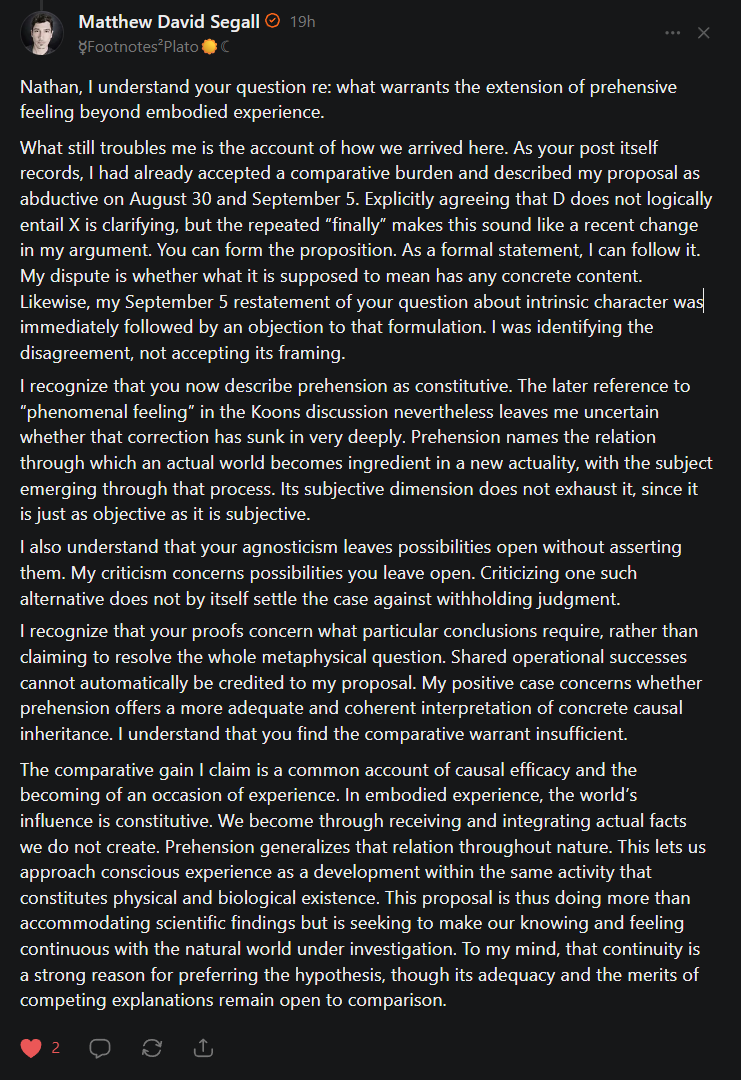
I’m posting this as a separate article rather than leaving it buried in a comment thread because Matt raised several concerns to me about the historical framing of our exchange, and I want those concerns, along with any corrections they warrant, to be visible to the same readers who saw my earlier account.
Where my wording can reasonably suggest something stronger than I intended, I want to repair it plainly and on the record. My aim is not to preserve every sentence I previously wrote. It is to preserve the argument while representing Matt’s position and the history of the exchange as accurately as I can.
Two of those historical points can be resolved very quickly. I used “finally” in the sequential sense of arriving at a later stage in the exchange, not to claim that Matt had never previously described his proposal as abductive or accepted a comparative burden. But because the word can carry that implication, I am removing it where it creates ambiguity. Likewise, when I wrote that Matt “restated my live question” on September 5, I meant exactly that. I did not mean that he accepted my framing. Since that comment is unnecessary to establish the provenance of the terminology anyway, I will rely instead on Matt’s direct positive formulations of his own position and the disagreement.
I also think Matt’s response deserves to be treated as an important and constructive contribution. It distinguishes my suspension of judgment from the assertion of a positive nonexperiential alternative, recognizes what my proofs are and are not intended to establish, acknowledges that shared operational successes cannot automatically be credited specifically to his metaphysics, and gives a clear account of what he thinks prehension positively earns: explanatory continuity between causal efficacy and experiential becoming.[1]
That matters because it lets us concentrate much more directly on the comparative question. What does the Whiteheadian extension explain, unify, constrain, or otherwise earn that its strongest rivals do not? How much confidence should those gains warrant? And what bridge warrants extending that characterization from embodied experiential cases to every concrete actuality?
I also want the burdens to remain symmetrical. My framework has obligations here too. If D is supposed to preserve content across rival ontologies, I need to show that the common content is genuinely stable enough for the target inference rather than merely verbal similarity produced by abstraction. And questionmark ?X cannot function as permanent insulation from comparative evidence. If X repeatedly outperforms its strongest rivals on independently defensible criteria, earns a credible bridge for its wider scope, survives serious attempts at revision, and does so without compensating explanatory costs, my framework requires me to update toward X. Unconceived alternatives constrain claims of finality. They do not excuse me from updating toward the best-supported available hypothesis.
A quick accessibility note: a reader mentioned that some of my compact logical notation does not translate cleanly through Substack’s text-to-speech system because punctuation such as the question mark may not be spoken. So in this article I am writing “questionmark ?X” instead of “?X” by itself, and “D plus questionmark ?X” instead of “D + ?X” wherever the notation appears in running prose. The meaning is unchanged. D is the target-relevant content already warranted for the comparison, while questionmark ?X means that X remains unresolved rather than affirmed or denied.
So what follows is both a correction and a continuation. I am granting the points that improve the record, distinguishing them from criticisms that would actually change the argument if successful, and making my own reciprocal burdens explicit.
With that cleared away, here is my response to Matt.
My response to Matt:
Matt, I think this response brings us substantially closer to the actual comparison, and I want to recognize that before pressing the remaining disagreement. You distinguish my suspension from the assertion of a nonexperiential alternative, recognize what my proofs are and are not intended to establish, acknowledge that shared operational successes cannot simply be credited to your metaphysics, and identify a positive comparative gain you think prehension provides. I want to treat those as substantive points of convergence.
A couple of the historical issues can be disposed of quickly.
On my repeated use of “finally,” fair point about the possible implication. I meant it sequentially, in the sense of arriving at this stage after the preceding exchange, not as a claim that your abductive framing or acceptance of a comparative burden first appeared on September 17. Since the word can suggest the latter, I am removing it where that ambiguity arises. Nothing in my argument depends on the stronger reading.
On September 5, I think there is a slightly different issue. My article says that you “restated my live question.” It does not say that you accepted my framing. Your clarification that you were identifying the disagreement rather than endorsing my formulation is therefore compatible with what I wrote.
Still, I can remove even the appearance of ambiguity because I do not need the September 5 restatement to establish the provenance point.
Your own direct formulations are stronger evidence.
On August 30 you stated your positive proposal directly: concretely considered, “causal relation just is felt inheritance of the past into the present.”
In our September 1 exchange, you explicitly characterized the disagreement in terms of “an identity claim about what concrete actuality is.”
You also framed the choice as one between “a primitive left blank” and “a primitive we directly feel from within.”
And elsewhere in that exchange you argued that feeling adds no further characteristic beyond inheritance, receptivity, integration, and response because those verbs already name it.
Those are your positive formulations of the issue rather than restatements of mine.
So I can make the provenance point more precisely: my earlier language about intrinsic character, causal actuality, and identity arose from trying to compress that argumentative history. I nevertheless accept that “universal experiential identity” was imperfect shorthand because “identity” can suggest a grammar of independently constituted terms that you reject. I have replaced that shorthand with the process-relational formulation you prefer.
That also handles my later use of “phenomenal feeling” in the Koons discussion.
I accept the terminology correction.
Your claim is not that phenomenality is an optional predicate attached to a causal actuality constituted independently of it. Prehension names the constitutive relation through which the actual world becomes ingredient in a new actuality, with the subject emerging through that process, and its subjective dimension does not exhaust it because you regard the relation as objective as well as subjective.
I can state the comparison in that language.
What I do not think follows from that wording error alone is that the constitutive point had not “sunk in very deeply.” My understanding of your position as constitutive was already explicit in our earlier exchange.
But I do not think we need to spend much time litigating that either.
The useful test is simply this:
Once “phenomenal feeling” is replaced with “prehensive constitution” or “felt inheritance,” what changes in the argument?
Does a premise fail?
Does a derivation stop going through?
Does some supposedly shared content cease to be shared?
Does the comparative burden disappear?
Does the scope of X become warranted?
If so, then the terminology correction has exposed a substantive defect and I want to know exactly where.
If not, it is a real correction of translation without yet adjudicating the proposition being translated.
Your clarification concerning questionmark ?X is more directly substantive.
You say that my agnosticism leaves possibilities open without asserting them.
Yes. That is exactly what I mean.
Questionmark ?X means that X remains unresolved. Neither X nor its negation is being asserted.
And I agree with your further point: you are perfectly entitled to criticize particular possibilities that my suspension leaves open.
If you show that a particular powers ontology fails, confidence in that powers ontology should fall.
If you show that a particular emergentist account fails, confidence in that account should fall.
If you show that a particular neutral-process account fails, confidence in that account should fall.
Those failures may also raise the relative standing of X.
The only limitation is that defeating one alternative does not by itself exhaust questionmark ?X unless that alternative exhausts the unresolved possibility space.
So I think we substantially agree on that point.
There is also a reciprocal obligation on my side that I want to make explicit.
Questionmark ?X cannot become permanent insulation against evidence.
It is an epistemic status, not a rival ontology.
If X repeatedly outperforms the strongest available rivals on independently defensible criteria, explains or compresses phenomena they cannot match without greater cost, supplies a credible bridge for its broader scope, and continues surviving serious attempts at comparative revision, then my framework requires me to move toward X.
At some point continued suspension itself could become less warranted than provisional acceptance.
I do not require metaphysical omniscience before updating.
Unconceived alternatives limit claims that the possibility space has been exhausted. They do not prevent rational preference among the theories we actually have.
Your question about whether D has enough “concrete content” is therefore one of the genuinely important remaining issues.
I think at least two different objections may be hiding inside that phrase.
One is semantic.
Perhaps what I call causal efficacy, inheritance, relation, integration, or receptivity changes meaning so radically between Whitehead, powers ontology, and other process accounts that D creates only an illusion of common content.
If that is your objection, it is a serious challenge to my factorization.
I bear a burden there.
I cannot simply put the same word in several columns and declare that an invariant exists.
The common content has to survive translation strongly enough to support the particular inference under investigation.
If causal efficacy in Whitehead, causal power in a powers account, and causal dependence in another process ontology do not preserve sufficient common counterfactual, relational, intervention-relevant, or explanatory structure for the target question, then that particular D has fractured.
And my framework already contains the response:
Stop factorizing at that level and compare the whole rivals.
That would be a genuine loss for that application of my method.
But notice what would not follow.
Failure of the D-factorization would not by itself establish X.
It would establish that I decomposed the rival space incorrectly.
We would then return to whole-theory comparison.
The second possible objection is metaphysical.
Perhaps D preserves genuine common content but leaves unanswered what causal actuality concretely or intrinsically is.
If that is the objection, I agree with the description.
That incompleteness is exactly what questionmark ?X records.
D is not intended to be a completed intrinsic metaphysics.
So I think the decisive question is:
Does D fail because its purported common content is unstable?
Or does D merely fail to settle a further metaphysical question I am explicitly leaving unresolved?
The first challenges my method.
The second describes it.
There is also a point at which the “concrete content” objection could turn into burden shifting, though I want to state this conditionally.
If the requirement becomes that before your universal X bears a comparative burden I must first provide a complete, independently intelligible nonexperiential metaphysics of causal actuality, then I do not think that burden follows.
Suspending judgment on X does not commit me to not-X.
Questionmark ?X is not itself a positive ontology and therefore does not inherit the burden of providing every possible alternative completion.
You bear the burden appropriate to the positive universal claim you affirm.
I bear the burdens appropriate to the positive claims I make, including the claim that some particular D preserves enough stable content to support some particular inference.
Those burdens should not be exchanged.
If, however, your “concrete content” challenge is simply asking whether D genuinely preserves stable content across the rivals, that is not burden shifting at all.
That is a legitimate challenge to my framework, and one I need to be willing to lose.
There is one piece of context about my own evidential ledger that may help locate this disagreement. Whitehead is not a marginal foil in my framework.
Among the historical thinkers relevant to this problem, I probably rank him highest for the process-relational architecture itself: becoming, causal inheritance, relational constitution, anti-bifurcation, novelty, perspectival limitation, and the warning against mistaking abstractions for concrete actuality have all survived substantial attempts at reconstruction and criticism.
Panexperientialism therefore remains one of the strongest live metaphysical possibilities in my questionmark ?X space. What I want to know is whether there is a warrant for moving in that direction rather than toward the rivals and currently unknowns.
That is also why I think the comparison should be severe. Much of the method I am applying here is continuous with methodological commitments I take from Whitehead himself: speculative metaphysics as revisable hypothesis, comparative adequacy across rival schemes, resistance to misplaced concreteness, and refusal to treat any conceptual scheme as final.
And I do not reserve that scrutiny for Whitehead. I apply the same method to physicalism. I do not infer from the extraordinary empirical success of physics that a particular metaphysical interpretation of the physical therefore exhausts actuality. Physics earns the success of its measurements, predictions, mathematical structures, causal models, and interventions. Physicalism still has to earn whatever further ontological claim it adds to those achievements.
I have applied that criticism directly to /Erik Svensson and ’s versions of physicalism here, despite both of them being scholars whose work I genuinely appreciate and sympathize with their views on many subjects.
See my article here:

The symmetry is deliberate. I do not let exhaustive physicalism universally inherit the empirical success of physics merely because it describes that local success in physicalist terms, and I do not let panexperientialism inherit the success of process, causal inheritance, embodiment, or relational explanation merely because Whitehead can describe those achievements in terms of prehension.
In both cases I preserve what the evidence already establishes, subtract what the serious rivals also preserve, and then ask what the stronger metaphysical interpretation specifically adds. If either interpretation produces a genuine positive residual, that should move my confidence toward it. If the relevant explanatory achievements survive its removal, those achievements cannot by themselves establish the additional ontology.
My question is not whether Whitehead deserves to be taken seriously. He plainly does in my present framework. It is whether the stronger categoreal commitments, including universal felt inheritance, are doing indispensable explanatory work rather than accompanying explanatory achievements that survive their removal.
If they produce a genuine positive residual under that comparison, that should count strongly in their favor. If the relevant explanatory, predictive, or intervention-sensitive achievements survive without them, their historical importance and philosophical fertility would not by themselves establish their necessity.
Your final paragraph then gets us directly to the positive case.
You identify the comparative gain you see in X.
Prehension provides a common account of causal efficacy and the becoming of an occasion of experience. In embodied experience, we become through receiving and integrating actual facts we did not create. The world’s influence is constitutive of our becoming.
You generalize that relation throughout nature.
That allows conscious experience to be interpreted as a development within the same activity that constitutes physical and biological existence.
I agree that this kind of continuity is a genuine theoretical virtue. But the peer-reviewed literature gives us reason to separate continuity as a theoretical virtue from continuity as warrant for a universal experiential conclusion. Jacek Jarocki’s analysis is unusually close to that pressure point. He reconstructs a panpsychist Continuity Argument that moves from graded continuity among sentient beings toward mentality at the fundamental level, then concludes that “panpsychism motivated by the Continuity Argument clearly needs an independent argument.”[2]
His target is that specific continuity argument, rather than Matt’s exact Whiteheadian formulation, but the inferential burden is the same one I am isolating here: continuity can motivate a hypothesis without itself supplying the bridge to universal scope.
Rune Nyrup’s Peircean account of inference to the best explanation gives the abductive point a useful calibration. The account he defends says explanatory reasoning “first and foremost justifies pursuing hypotheses rather than accepting them as true.”[3]
In that sense, you have supplied a positive reason for taking X seriously and comparing it aggressively. The remaining question is whether the continuity gain is strong enough, relative to its alternatives, to warrant the universal scope.
The question is how much discriminatory work that reason performs.
At this point I think we need to distinguish a candidate comparative virtue from a demonstrated discriminator.
The continuity you describe is genuinely attractive, but continuity with nature is not yet uniquely Whiteheadian. A powers account, a neutral-process or neutral-monist account, an emergent process account, and a sufficiently sophisticated non-reductive physicalist account can each say in its own vocabulary that conscious experience develops continuously from the same natural order that constitutes physical and biological processes. They disagree about what that underlying continuity consists in.
What is specifically Whiteheadian is therefore not the claim that experience is continuous with nature. It is the stronger claim about what the continuous activity already is: prehensive constitution, or felt inheritance, throughout concrete actuality.
That is where I locate the unresolved comparative burden. You have identified a genuine candidate advantage: Whitehead gives one categoreal account of causal efficacy and experiential becoming. But for that advantage to discriminate X from its strongest rivals, we still need to know what the specifically prehensive interpretation explains, constrains, or unifies that those rivals cannot reproduce in their own frameworks without greater explanatory cost.
If the continuity survives the change of interpretation, then continuity belongs to the shared carrier. If something important fails specifically when universal prehension is removed, that failure would identify the positive residual X needs.
There is also a specific transition in your paragraph that I think needs to be isolated.
In embodied experience, the world’s influence is constitutive.
Then:
Prehension generalizes that relation throughout nature.
I understand what the hypothesis says.
What I am still asking for is the bridge that warrants the generalization. The philosophy-of-science literature on extrapolation makes that burden unusually clear. Francesco Guala describes comparative process tracing as “the best analysis of extrapolation inferences” then available in the philosophical and scientific literature.[4]
Daniel Steel focuses on “‘fingerprints,’ or distinctive markers, as a strategy for avoiding an underdetermination problem having to do with spurious analogies.”[5]
More directly still, Niccolò Negro and Liad Mudrik’s recent peer-reviewed paper on extrapolating consciousness formulates the central problem this way: “How can one justifiably generalize from an epistemically privileged domain to a less epistemologically privileged domain?”[12]
Translated into this dispute: which causal or structural feature licenses carrying the experiential character disclosed in embodied cases into the vastly broader target class of concrete actuality as such?
“Prehension generalizes that relation throughout nature” describes the Whiteheadian move. It is not yet, by itself, a reason that the move is true.
And I think there is a reference-class issue here.
Embodied experience is not an arbitrary sample of causal actuality.
It is a highly organized case involving living organization, integration, memory, responsiveness, valuation, nervous systems in the human case, and whatever further organization is relevant to the phenomenology being discussed.
So why should the character of causal influence as disclosed within embodied experience be treated as representative of causal actuality as such rather than as the form causal influence takes within a particular organizational regime?
It identifies the bridge that has to do the work.
What invariant licenses the extrapolation?
A necessity relation?
A structural identity?
An explanatory dependency?
An argument that every serious alternative fails?
A demonstration that the experiential dimension cannot arise only under particular kinds of organization?
Something else?
There is also empirical reason not to treat the phenomenological starting point as self-interpreting. Matthis Synofzik, Gottfried Vosgerau, and Martin Voss review the experience of agency and conclude that “predictive and postdictive processes are both integrated by the brain according to the principles of optimal cue integration.”[6]
Their empirical target is agency experience, not the metaphysics of causal efficacy in general. The constraint is therefore narrow but important: first-person causal phenomenology can be genuine evidence without functioning as a transparent readout of the metaphysical character of causation outside the cases in which that phenomenology occurs.
Your phrase “the same activity that constitutes physical and biological existence” makes this even easier to isolate.
There appear to be two possible readings.
If “the same activity” means causal inheritance, receptivity to antecedent conditions, integration, transition, constraint, and real causal influence, then I already grant a great deal of that in D, and the literature contains developed alternatives that preserve substantial parts of it. Robert Koons explicitly develops a powerist ontology on which “Causal powers and dispositions are fundamental.”[7] Donovan Wishon’s historical analysis characterizes neutral monism as grounding mind and matter in a more fundamental reality that is “intrinsically neither mental nor material.”[8] Niccolò Negro develops an interpretation of Integrated Information Theory that he describes as “a form of emergentism that is incompatible with panpsychism.”[9] These are not the same theory, but that is exactly the point: robust causal, monist, process-compatible, and consciousness-relevant alternatives exist without simply reproducing universal prehensive constitution. Continuity with nature therefore does not uniquely select X.
In that reading, much of the continuity belongs to the shared carrier.
If “the same activity” means the full objective-subjective structure of prehension, including felt inheritance, then the statement contains X.
In that reading, saying that physical and biological existence are constituted through the same activity states the universalization whose warrant is under examination.
So I think we need to separate the shared causal-relational continuity from the specifically experiential interpretation of that continuity.
Otherwise it becomes difficult to tell whether the explanatory gain comes from discovering a common mechanism or from describing every case under the same Whiteheadian category.
That is the distinction I would make between substantive explanatory unification and categoreal unification. Philip Goff’s 2009 critique states the explanatory challenge starkly: “panpsychism cannot help us to explain consciousness”, at least the kind of consciousness the paper takes us to have pre-theoretical reason to believe in.[10] The structural pressure carries over here even though Matt’s Whiteheadian proposal is not identical to the target of Goff’s paper: does universal prehension reveal an explanatory dependency that the strongest rivals lack, or does it primarily redescribe physical, biological, and experiential becoming under one common category?
Substantive unification earns comparative credit when one account removes independent primitives, constrains phenomena that rivals leave unconstrained, reveals dependencies the rivals miss, improves explanatory compression, successfully transfers across domains, or solves a problem competitors can solve only with additional machinery.
Categoreal unification, by itself, is simply placing heterogeneous phenomena under one general description.
I am asking how we distinguish the two.
What becomes harder to explain if universal prehension is removed and the strongest rival substituted?
Does the rival require an additional bridge between causal efficacy and experience that Whitehead eliminates?
More primitives?
More ad hoc exceptions?
Worse phenomenological adequacy?
Less explanatory compression?
Failed transfer across domains?
Does Whitehead constrain possibilities the rival leaves arbitrary?
Those would all be genuine differential gains for X.
And the same standard should apply symmetrically to my side.
If my favored factorization repeatedly requires artificial abstractions, hidden bridges, or exceptions to preserve D, that should count against it.
If X repeatedly removes those liabilities while retaining the evidence, I should update toward X.
This also separates a theory-internal statement from a theory-selection argument.
Within Whitehead’s scheme, saying that prehension is both objective and subjective may be exactly right.
I accept that as the internal claim I am supposed to evaluate.
But the fact that Whitehead’s ontology coherently describes causal actuality that way does not by itself establish that causal actuality outside the evidenced experiential cases has that structure.
That requires the comparative step.
Otherwise a feature of the candidate ontology risks functioning as evidence for the candidate simply because it is built into its categoreal description.
That is why I keep returning to the same operation:
Preserve the phenomenon.
Change the interpretation.
Ask what is lost.
If the specifically Whiteheadian interpretation preserves or explains something that the strongest rivals cannot, that difference belongs on X’s side of the ledger.
If the result survives all of those interpretations, the result belongs to the shared carrier and cannot by itself discriminate X.
This brings us to revision conditions. Deborah Mayo and Aris Spanos formulate severity within statistical inference by arguing that “only statistical hypotheses that have passed severe or probative tests are inferred from the data.”[11] Their formal machinery is statistical; the methodological feature relevant here is error exposure. What failed transfer, explanatory cost, rival success, or other result would actually reduce confidence in the universal extension rather than merely being absorbed by a redescriptive framework?
I am not asking for a single Popperian observation that instantly kills Whiteheadian metaphysics.
I am asking what would lower your confidence in the universal extension.
Suppose a nonexperiential process ontology achieved comparable continuity between physical organization and conscious experience with fewer commitments.
Would that matter?
Suppose a rival matched Whitehead’s phenomenological adequacy while offering a better account of cross-scale organization.
Would that matter?
Suppose the bridge from embodied felt causality to universal prehension repeatedly failed to generate any differential explanatory constraint.
Would that matter?
Suppose a rival obtained the same continuity without universal experiential constitution.
Would that matter?
What could make you say:
Whitehead remains coherent, but this result reduced my reason for accepting the universal generalization?
That is the sort of revision condition I am asking for.
And I owe you the reciprocal answer.
What would make me leave questionmark ?X and move toward X?
If X repeatedly outperformed its strongest rivals under criteria that did not assume X, if it removed explanatory burdens they could not remove without greater cost, if its universal scope acquired a defensible bridge rather than resting only on extrapolation, if my attempted D-factorizations repeatedly fractured in exactly the way your account predicts, and if the Whiteheadian account continued to survive serious comparative attempts to make it lose, I should update toward X.
If that advantage became strong enough, withholding judgment could itself become the less rational position.
Questionmark ?X is not sacred.
It is where my present evidential ledger stands.
There is one final methodological question I still think matters.
What procedure could discover that the Whiteheadian categoreal scheme itself is wrong?
Not merely that some application needs adjustment.
What would allow an ontology whose categories neither of us presently possesses to enter the comparison?
If “concrete intelligibility” is defined in a way that already requires the felt or prehensive structure whose universality is under comparison, then X risks doing two jobs: serving as one candidate hypothesis while also contributing to the admission criterion for its competitors.
If that is not what you mean by concrete intelligibility, then I would like to know what independent criterion competitors are required to satisfy.
And this question applies to me as well.
What would show that my factorization rules, my account of invariance, my boundary methodology, or my criteria for comparative warrant are defective?
Neither framework should be exempt from the kind of correction it asks of the other.
That is also the limited role I assign to unconceived alternatives.
They do not mean that a theory can never win.
They mean that “best among the serious alternatives currently available” and “final ontology of actuality” are different epistemic statuses.
Whitehead could become the strongest available theory.
My confidence should then increase.
If the advantage became sufficiently strong, I should provisionally accept it.
None of that requires pretending that every metaphysical possibility has already been enumerated.
So I think your response leaves us with a much cleaner disagreement.
I accept removing the ambiguous uses of “finally.”
Your September 5 clarification is compatible with what I actually wrote, but I can remove that comment from the provenance argument and use your stronger direct formulations instead.
I accept the terminology correction concerning prehension as constitutive rather than a detachable phenomenal predicate.
I accept that you may legitimately criticize individual alternatives left open under questionmark ?X.
I accept that D itself carries a burden to demonstrate stable content across rivals.
And I accept explanatory continuity as a genuine positive virtue of X.
What remains is therefore much more specific.
Can D preserve enough stable content across the relevant rivals to perform the inferential work I assign to it?
If not, which invariant fractures, and what conclusion fails?
What warrants treating embodied experiential causation as representative of causal actuality universally?
What bridge carries the specifically experiential dimension across that scope?
When you say physical, biological, and experiential existence involve the “same activity,” which part of that sameness belongs to the shared causal-relational structure and which part specifically requires X?
Does universal prehension provide substantive explanatory unification beyond categoreal unification?
Which strongest rival fails where X succeeds?
What would lower your confidence in X?
What would permit the Whiteheadian categories themselves to lose?
And symmetrically, what evidence would make continued questionmark ?X less warranted than accepting X?.
Those are the questions I think this response lets us isolate.
That is where I would like the discussion to go next.
Not back to whether suspension secretly asserts not-X.
Not back to whether D is a completed metaphysics, because it is not intended to be one.
Not back to whether one imperfect phrase proves that I misunderstand your constitutive grammar when my engagement has elsewhere demonstrated otherwise.
But forward to the comparative problem:
What does X specifically earn?
What does it cost?
What warrants its scope?
What could make it lose?
And when would its gains become strong enough that refusing to update toward it would itself become unreasonable?
That is a comparison I am prepared to let Whitehead win.
References
Matthew David Segall, reply to Nathan Sweet on Sweet Rationalism, September 2026.Comment
Jacek Jarocki, “Three Kinds of Arguments for Panpsychism,” Acta Analytica 39 (2024): 379–398. DOI: 10.1007/s12136-023-00566-z.Open-access PDFOpen-access full textDOI
Rune Nyrup, “How Explanatory Reasoning Justifies Pursuit: A Peircean View of IBE,” Philosophy of Science 82, no. 5 (2015): 749–760. DOI: 10.1086/683262.Public preprint PDFPublisher abstractDOI
Francesco Guala, “Extrapolation, Analogy, and Comparative Process Tracing,” Philosophy of Science 77, no. 5 (2010): 1070–1082. DOI: 10.1086/656541.Publisher abstractInstitutional recordDOI
Daniel Steel, “A New Approach to Argument by Analogy: Extrapolation and Chain Graphs,” Philosophy of Science 77, no. 5 (2010): 1058–1069. DOI: 10.1086/656543.Publisher abstractDOI
Matthis Synofzik, Gottfried Vosgerau, and Martin Voss, “The Experience of Agency: An Interplay Between Prediction and Postdiction,” Frontiers in Psychology 4 (2013): 127. DOI: 10.3389/fpsyg.2013.00127.Open-access PDFOpen-access full textPMC full textDOI
Robert C. Koons, “Powers Ontology and the Quantum Revolution,” European Journal for Philosophy of Science 11 (2021), article 14; published online 28 November 2020. DOI: 10.1007/s13194-020-00314-9.Open-access PDFOpen-access full textDOI
Donovan Wishon, “Radical Empiricism, Neutral Monism, and the Elements of Mind,” The Monist 104, no. 1 (2021): 125–151. DOI: 10.1093/monist/onaa026.Publisher abstractDOI
Niccolò Negro, “Emergentist Integrated Information Theory,” Erkenntnis 89 (2024): 1949–1971; published online 14 October 2022. DOI: 10.1007/s10670-022-00612-z.Open-access PDFOpen-access full textDOI
Philip Goff, “Why Panpsychism Doesn’t Help Us Explain Consciousness,” Dialectica 63, no. 3 (2009): 289–311. DOI: 10.1111/j.1746-8361.2009.01196.x.Publisher abstractUniversity recordDOI
Deborah G. Mayo and Aris Spanos, “Severe Testing as a Basic Concept in a Neyman–Pearson Philosophy of Induction,” The British Journal for the Philosophy of Science 57, no. 2 (2006): 323–357. DOI: 10.1093/bjps/axl003.Publisher abstractAuthor-uploaded full textDOI
Niccolò Negro and Liad Mudrik, “Extrapolating Other Consciousnesses: The Prospects and Limits of Analogical Abduction,” Philosophy of Science 93, no. 1 (2026): 181–202; published online 27 August 2025. DOI: 10.1017/psa.2025.10104.Open-access PDFOpen-access full textAccepted preprint PDFDOI